
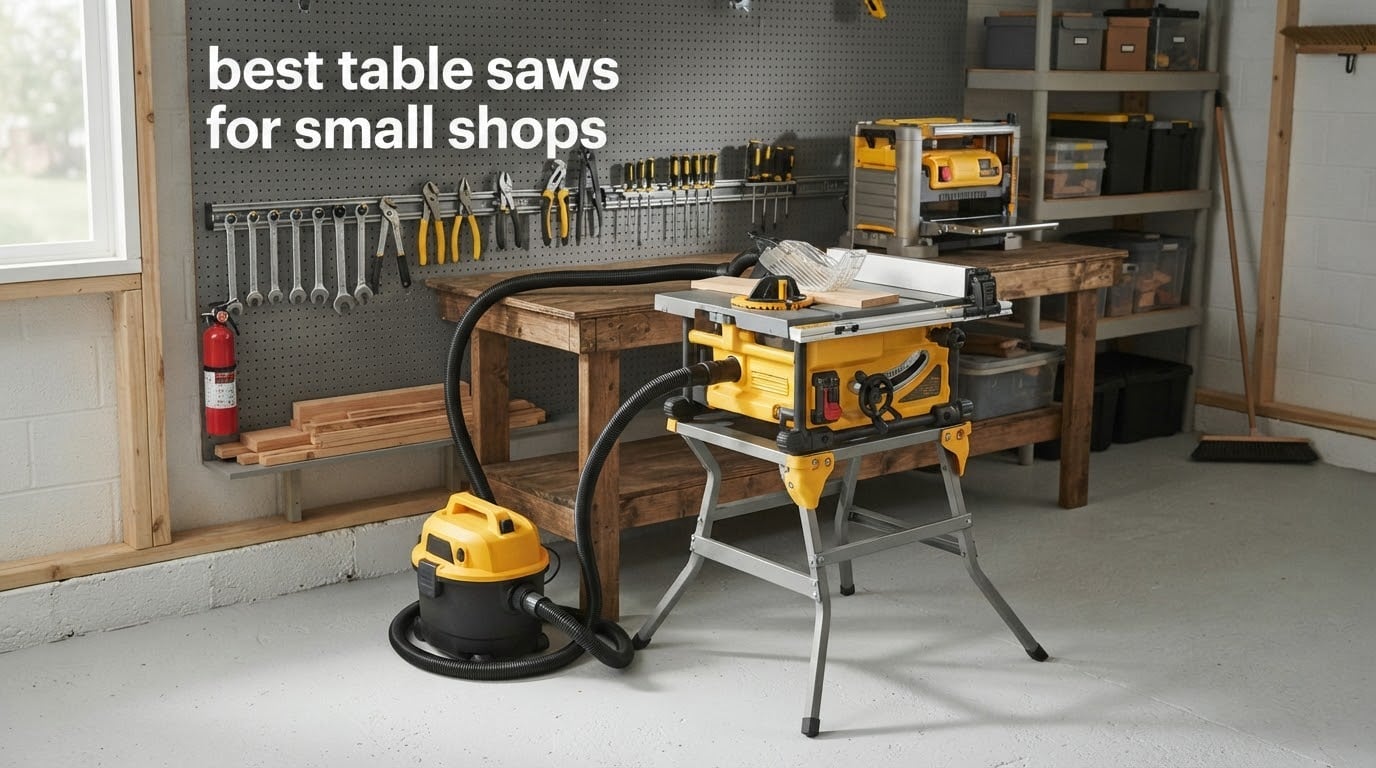
If your shop is a single-car garage, a basement corner or a bay in a shared building, the best table saws for small shops are not the biggest saws on the market. Our top pick is the DEWALT DWE7485, an 8-1/4 inch compact jobsite saw that weighs 54 pounds and occupies a footprint small enough to slide against a wall between projects. The best value pick is the SKIL TS6307-00, a 10 inch saw with an integrated folding stand that a single person can carry, set up and break down without a cart.
The thing buyers get wrong most often is treating small and cheap as the same category. A cramped shop does not mean you need a hobby saw, and it does not mean you need a 300 pound cabinet saw either. It means you need accurate fence travel, a rip capacity that matches the sheet goods you actually buy, and a stand you can move with one hand.
Our team pulled specifications, dimensions and owner feedback for 12 saws, then sorted them by the three things that decide a small-shop purchase: how much floor the saw takes, how accurate the fence stays over time, and how the saw handles dust. We also went into the owner review threads on r/Tools, r/woodworking and SawmillCreek, because that is where the real ownership reports live.
Before the long version, here is the short version in the format most people scan first:
Best overall for a small shop: DEWALT DWE7485, 8-1/4 inch blade, 24.5 inch rip capacity, 54 pounds, tool-free modular guarding and on-board storage.
Best value with full 10 inch capacity: SKIL TS6307-00, 10 inch blade, folding stand included, cuts a full 4×4 at 90 degrees, 51.2 pounds.
Best for sheet goods: DEWALT DWE7491RS, 32-1/2 inch rip capacity with a rolling stand and a 2-1/2 inch dust port.
Best for thick stock: SKILSAW SPT99-11, worm drive gearing, 3-5/8 inch depth of cut, 30-1/2 inch rip capacity.
Best for joinery and dados: EVOLUTION R10TS, zero-clearance throat plate and an included dado plate.
Best for dust control: DOVAMAN DTS02M, rear vacuum connector and a claimed 98 percent dust separation rate.
Best for genuinely tiny spaces: WORX BladeRunner WX572L, 14.7 pounds, stores in a closet between projects.
Readers who want the wider picture on home-shop machines can start with our 10 best table saws for home workshops before coming back to the size question, since a home workshop and a small shop are not the same room.
Table of Contents
Top 3 Table Saws For Small Shops (October 2026)

DEWALT DWE7485 Compact Jobsite Saw
- 24.5 in rip capacity
- Tool-free modular guarding
- 54 pounds
- On-board storage
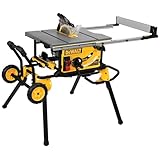
DEWALT DWE7491RS with Rolling Stand
- 32-1/2 in rip capacity
- Rolling stand included
- 2-1/2 in dust port
- 3 year warranty
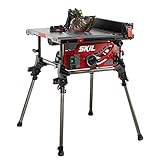
SKIL TS6307-00 Folding Stand Saw
- Integrated folding stand
- Cuts a full 4x4
- 2 to 47 degree bevel
- Dust port elbow
Those three cover most small shops. The DWE7485 wins on accuracy and portability, the DWE7491RS wins on raw rip capacity, and the SKIL wins when the saw has to collapse into a corner every night.
Table Saw Specs at a Glance in 2026
Here is the full field with the numbers that actually decide a small-shop purchase. Every saw below has at least one published owner review, and the weights and dimensions come from the manufacturer listings rather than from our estimates.
| Product | Specifications | Action |
|---|---|---|
| DEWALT DWE7485 8-1/4 in Compact Jobsite Saw |
|
Check Latest Price |
| DEWALT DWE7491RS 10 in Saw with Rolling Stand |
|
Check Latest Price |
| SKIL TS6307-00 10 in Folding Stand Saw |
|
Check Latest Price |
 WORX BladeRunner WX572L Tabletop Saw WORX BladeRunner WX572L Tabletop Saw |
|
Check Latest Price |
 SKILSAW SPT99-11 10 in Worm Drive Saw SKILSAW SPT99-11 10 in Worm Drive Saw |
|
Check Latest Price |
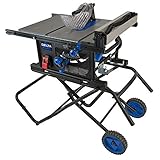 Delta 36-6023 10 in Table Saw Delta 36-6023 10 in Table Saw |
|
Check Latest Price |
 Bosch GTS15-10 10 in Jobsite Saw Bosch GTS15-10 10 in Jobsite Saw |
|
Check Latest Price |
 Prostormer 10 in Table Saw with Stand Prostormer 10 in Table Saw with Stand |
|
Check Latest Price |
 DOVAMAN DTS02M 8.5 in Dustless Saw DOVAMAN DTS02M 8.5 in Dustless Saw |
|
Check Latest Price |
 SKIL TS6308-00 8-1/4 in Compact Saw SKIL TS6308-00 8-1/4 in Compact Saw |
|
Check Latest Price |
 EVOLUTION R10TS 10 in Jobsite Saw EVOLUTION R10TS 10 in Jobsite Saw |
|
Check Latest Price |
 VEVOR 10 in Table Saw with Stand VEVOR 10 in Table Saw with Stand |
|
Check Latest Price |
Two entries deserve an immediate flag. The VEVOR listing gives a height of 41.3 inches, which matters if you are working under a low ceiling, and the Prostormor-class listings show a 240 volt figure that you should confirm with the seller before wiring anything in. We come back to both in the individual reviews.
1. DEWALT DWE7485 8-1/4 in Compact Jobsite Saw: The Pick for Most Small Shops
DEWALT 15 Amp 8-1/4 in. Compact Portable Jobsite Table Saw (DWE7485)
8-1/4 in blade, 24.5 in rip capacity, 54 pounds, 5800 rpm, 22.75 x 22.75 in
Pros
- Tool-free modular guarding system
- Rack and pinion telescoping fence rails
- On-board storage for every accessory
- Handles 4x8 sheet goods
- Packs into a small car easily
Cons
- 8-1/4 in blade caps capacity below full 10 in saws
- No stand included so it needs a bench or separate stand
This is the saw I keep coming back to for one-person shops, and it is the one that shows up most in owner threads. Multiple commenters on r/Tools and r/woodworking describe the DeWalt portable line as the gold standard for jobsite saws, and one beginner in r/BeginnerWoodWorking singled out this exact model as a solid bet that will last and is easy to transport. That matches how it behaves in a garage.
The square metal roll cage base is the part that surprises people. It is a jobsite-rated chassis, so moving the saw between the workshop and a friend’s driveway does not mean treating it like an appliance you might drop. At 54 pounds it is genuinely a one-person lift, and at 22.75 by 22.75 inches with a 13 inch height it tucks under a bench or into a corner without stealing the walking lane.
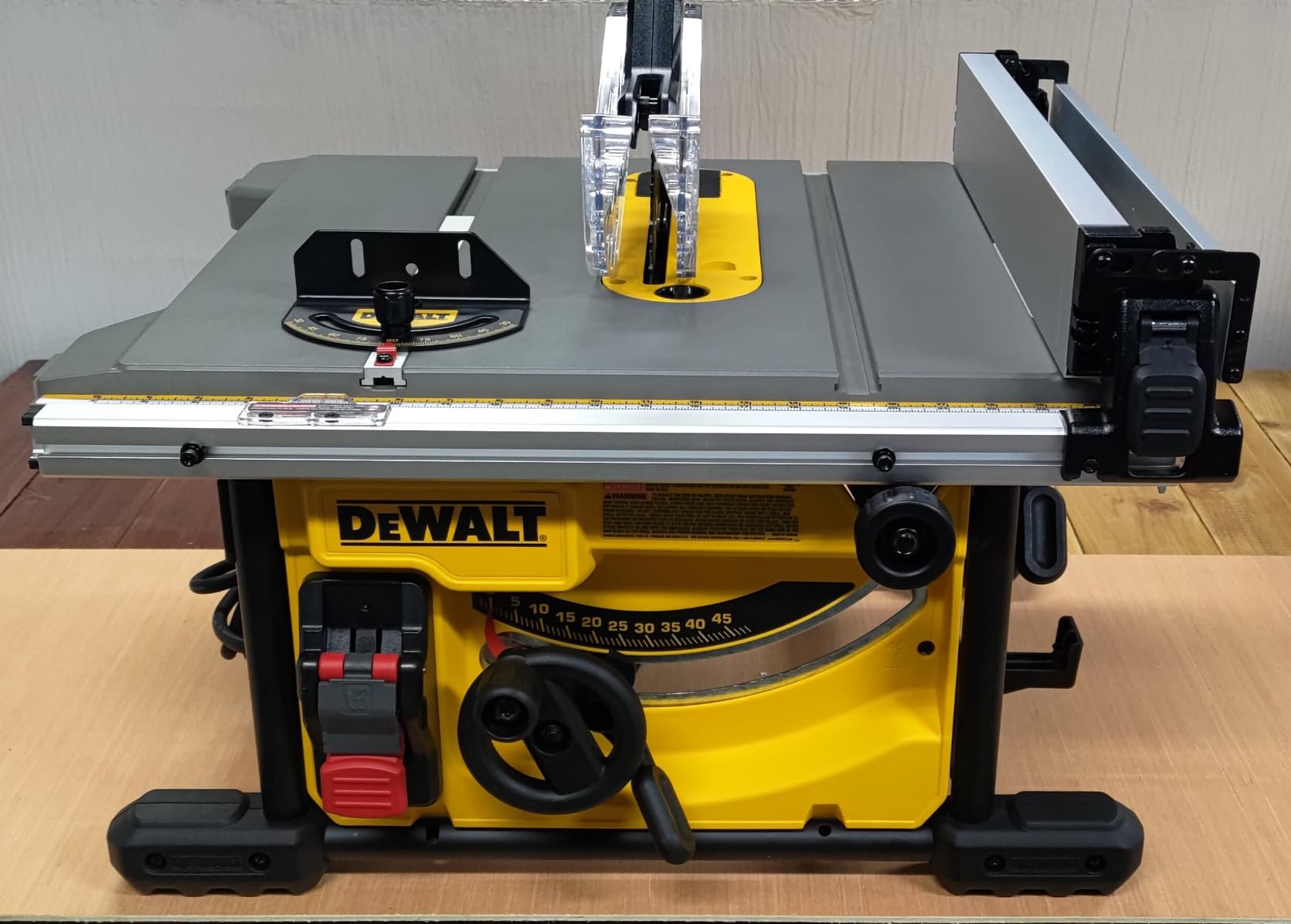
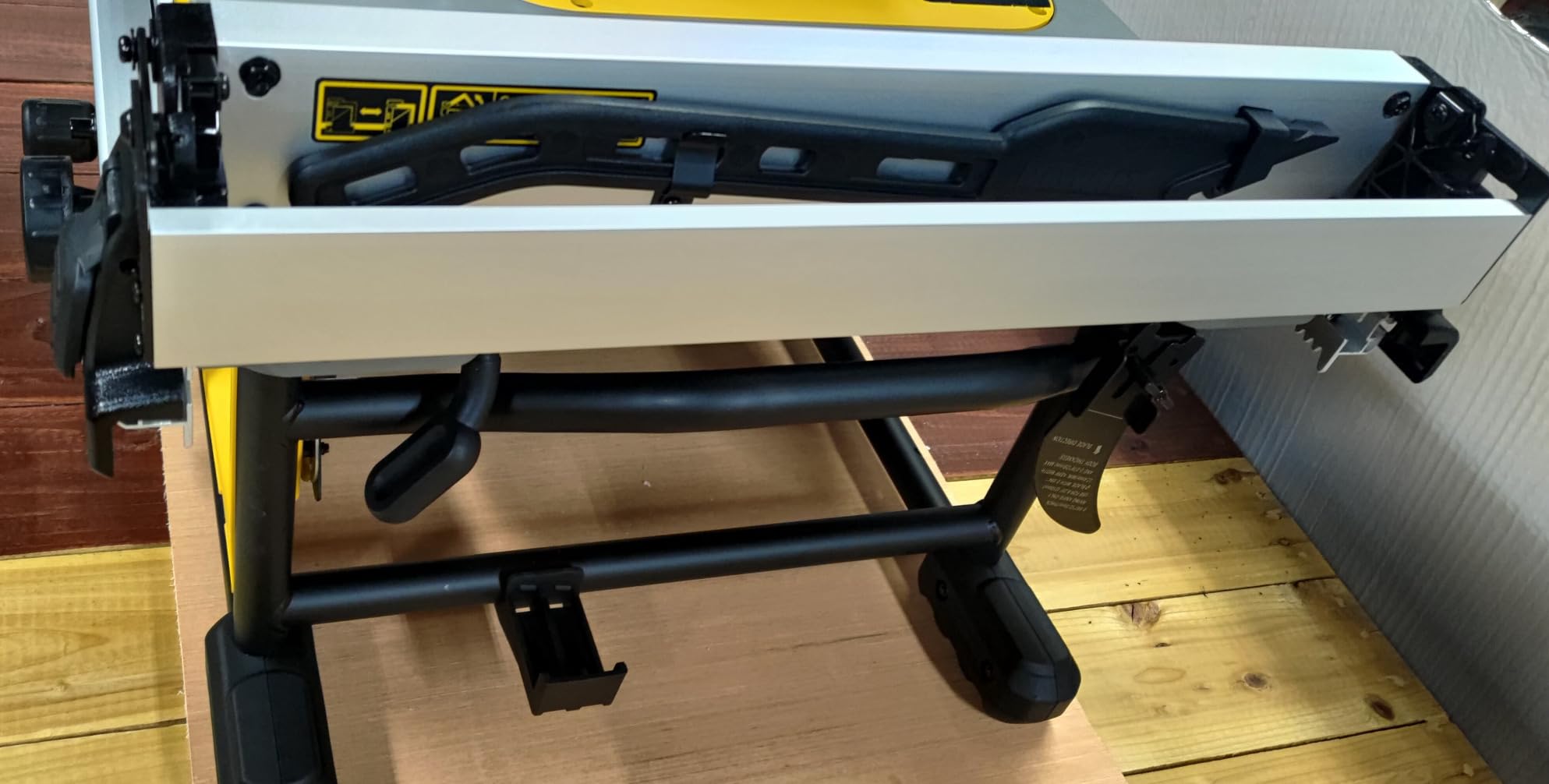
The Site-Pro modular guarding system adjusts without tools, which is not a marketing line, it is the difference between using the guard and removing it because it is in the way. The riving knife here is the non-through-cut type, so it suits solid wood stock without splitting sheet goods. Anti-kickback pawls, a push stick and a miter gauge all ride in the on-board storage, so nothing gets left in the truck.
Owner reviews concentrate on two things: the rack and pinion telescoping fence rails feel fast and stay put, and the 24.5 inches of rip capacity is genuinely useful. That figure is short of a full 4×8 sheet, but the specification sheet still lists it as capable of ripping 4×8 plywood or OSB, and in practice it covers the trimmed pieces most small shops break down first.
Where the DWE7485 earns its place in a small shop?
This saw wins when the shop is one room, the material is mostly dimensional lumber and sheet goods, and you need the machine to be a one-hand carry. The 5800 rpm blade speed and 1800 watt motor rip hardwood comfortably, and the power-loss reset stops the tool restarting itself after a supply interruption.
It also wins if you are splitting time between the shop and job sites, since everything stores on the saw. If your shop is a basement where noise matters, the blade guard system does more for dust control here than a bare riving knife does, which is one reason the Fine Woodworking forum crowd keeps pushing people toward guards rather than knives alone.
When to pass on the DWE7485?
Skip it if you cut dadoes regularly. An 8-1/4 inch saw generally will not take a full dado stack, and while the motor will handle a simple groove with a single blade, real joinery wants a different machine. The Delta 36-6023 in this list carries a documented 13/16 inch by 8 inch stacked dado capacity.
Also skip it if you want a stand in the box, because the DWE7485 is supplied as a bare saw. Owners almost universally add a folding stand or a purpose-built bench, and you should factor that into the floor plan rather than setting the saw on sawhorses and calling it a shop.
2. DEWALT DWE7491RS 10 in Saw with Rolling Stand: Best for Sheet Goods
DEWALT Table Saw 10 Inch with Foldable Rolling Table Saw Stand, 15 Amp, 4800 RPM, 32-1/2-Inch Rip Capacity (DWE7491RS)
10 in blade, 32-1/2 in rip capacity, 110 pounds, 2-1/2 in dust port, 3 year warranty
Pros
- 32-1/2 in rip capacity handles full sheets
- Rolling stand included so no cart is needed
- 2-1/2 in dust port accepts a standard hose
- Onboard storage keeps the guard and fence with the saw
Cons
- Heaviest saw here at 110 pounds
- 4800 rpm blade speed is slower than most 10 in rivals
If your small shop is really a small cabinet shop, this is the saw that stops you from working around a limitation. Thirty-two and a half inches of rip capacity means a full sheet of plywood sits flat on the table with the fence near the far edge, and the 3-1/8 inch depth of cut at 90 degrees means 4×4 posts break down in a single pass rather than two.
The included rolling stand is the real story for small rooms. A saw plus a separate cart takes up two footprints; this is one assembly you can roll to the wall when the door needs opening. The stand is designed for quick setup and breakdown, which is what makes the difference between a saw that lives in the shop and one that lives in the corner.
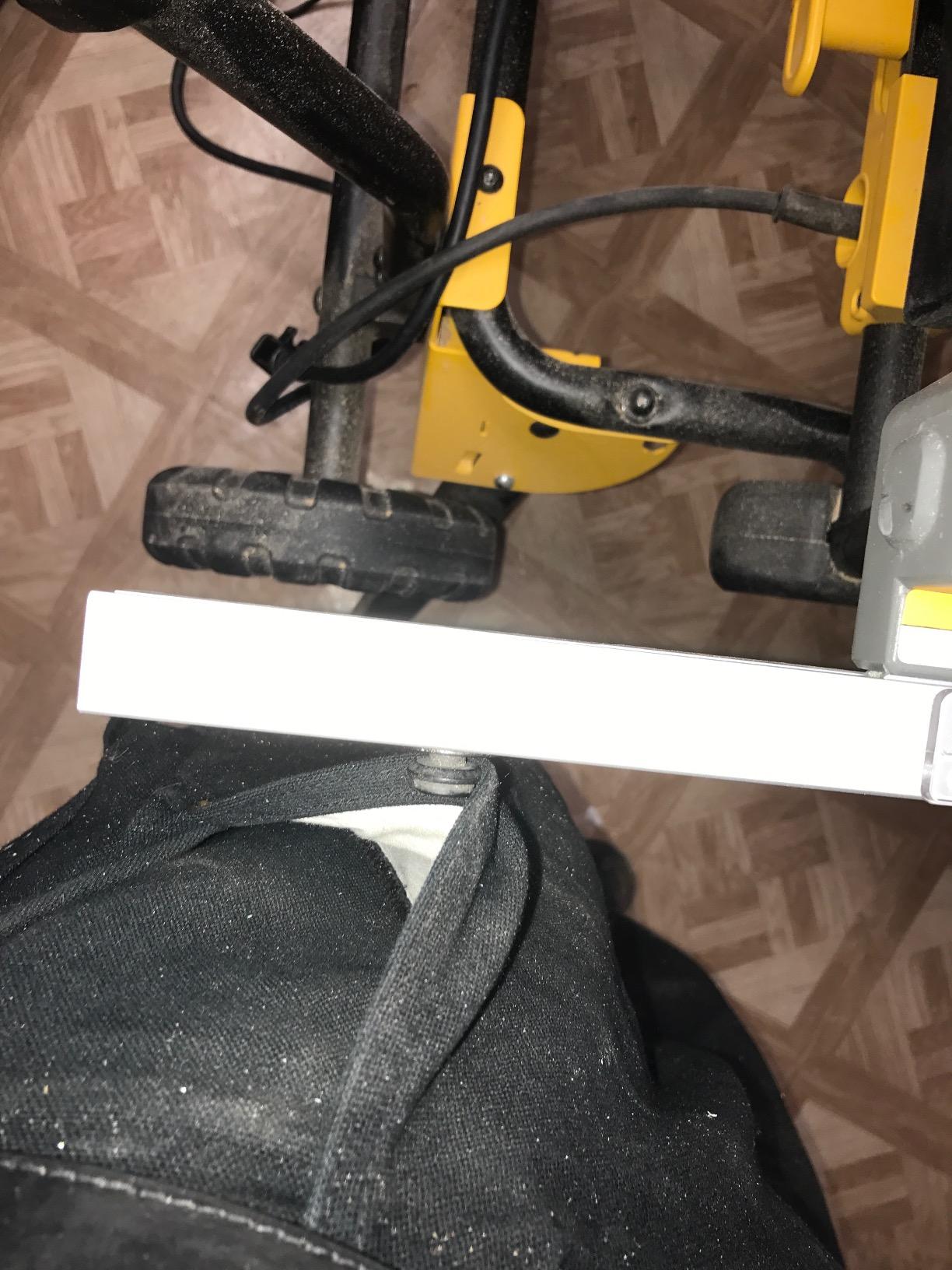
Owner reviews highlight the fence accuracy, the rip capacity and the convenience of the stand, and with 4,800 rpm this saw carries close to 5,800 published owner ratings. That volume matters for a first purchase, because the failure modes of popular saws are well documented by now. If something is going to bother you about this design, you can probably read about it first.
The 2-1/2 inch dust collection port is the biggest single practical advantage in a small shop, because that hose size is what most shop vacuums and some dust collectors actually accept. A narrower port means an adapter and a leaky seal, and a leaky seal means dust on the floor within a week.
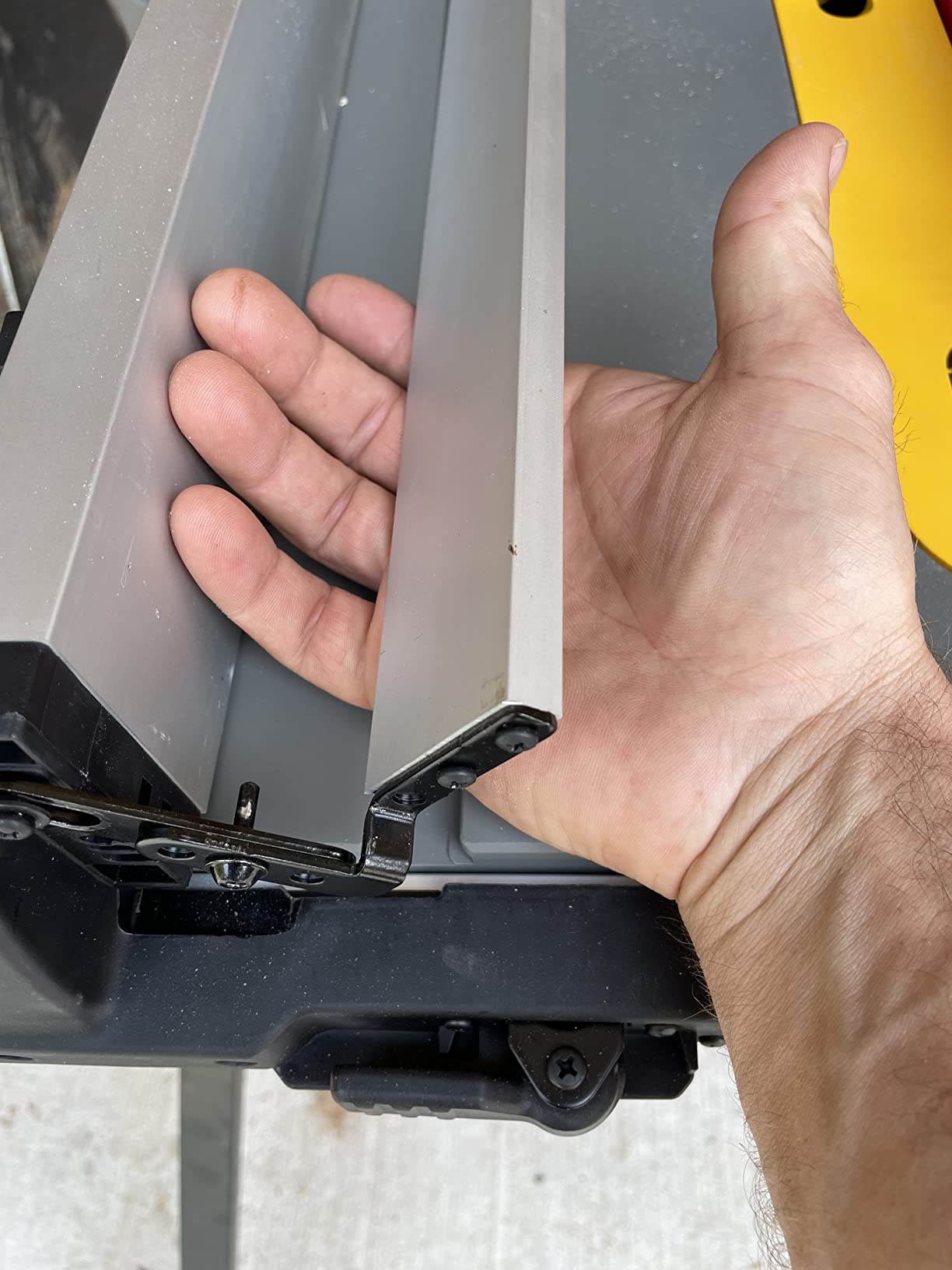
Who the DWE7491RS suits?
This suits anyone who breaks down full sheets regularly and has a clear 31 by 24 inch spot to put it. The table height of 28.52 inches sits at working height, so there is no need for a support table on the outfeed side, and the patented material support handles narrow rip cuts without the board tipping.
It also suits shops with a plan for dust, because the port is already the right diameter. If you are running a basement workshop attached to living space, that matters more than any feature on the spec sheet, and it is a step up from the narrow adapters that ship with compact saws.
When the DWE7491RS is too much?
It is too much for a single-car garage where the saw must be moved every time the car comes in. At 110 pounds without the stand, this is the heaviest saw in the roundup, and the wheels are on the stand rather than on the saw itself. If your floor space is genuinely tight, the lighter saws further down this list are a better fit.
The 4,800 rpm blade speed is also slower than the direct drive competition, which shows up as more heat on long rip cuts in hardwood. For most small shops that is a non-event. For someone running solid hardwood daily, the faster 5,000 rpm machines make more sense.
3. SKIL TS6307-00 10 in Folding Stand Saw: The Best Value Pick
SKIL 15 Amp 10-Inch Jobsite Table Saw with Folding Stand-TS6307-00
10 in blade, 51.2 pounds, integrated folding stand, 4x4 capacity, 2-47 degree bevel
Pros
- Folding stand stores flat against a wall
- Rack and pinion fence rails stay parallel
- Aluminum table is flat and square
- Plenty of power for 2x4 pine and hardwood
Cons
- Supplied miter gauge is weak
- Supplied 24 tooth blade tears out on crosscuts
- Heavier plastic use than metal rivals
This is the value pick in the truest sense, because it gives you a full 10 inch blade and a stand in one package for less than most 8-1/4 inch saws cost once you add their stand. It cuts material up to 4×4 at 90 degrees, bevels between 2 and 47 degrees on a quick release lever, and the whole assembly weighs 51.2 pounds.
The integrated stand is what makes it a small-shop saw rather than a jobsite accessory. When you are done, the legs fold and the saw leans against a wall at 28.74 by 27.17 inches, which is a footprint you can live with in a room that also holds a planer and a bench.
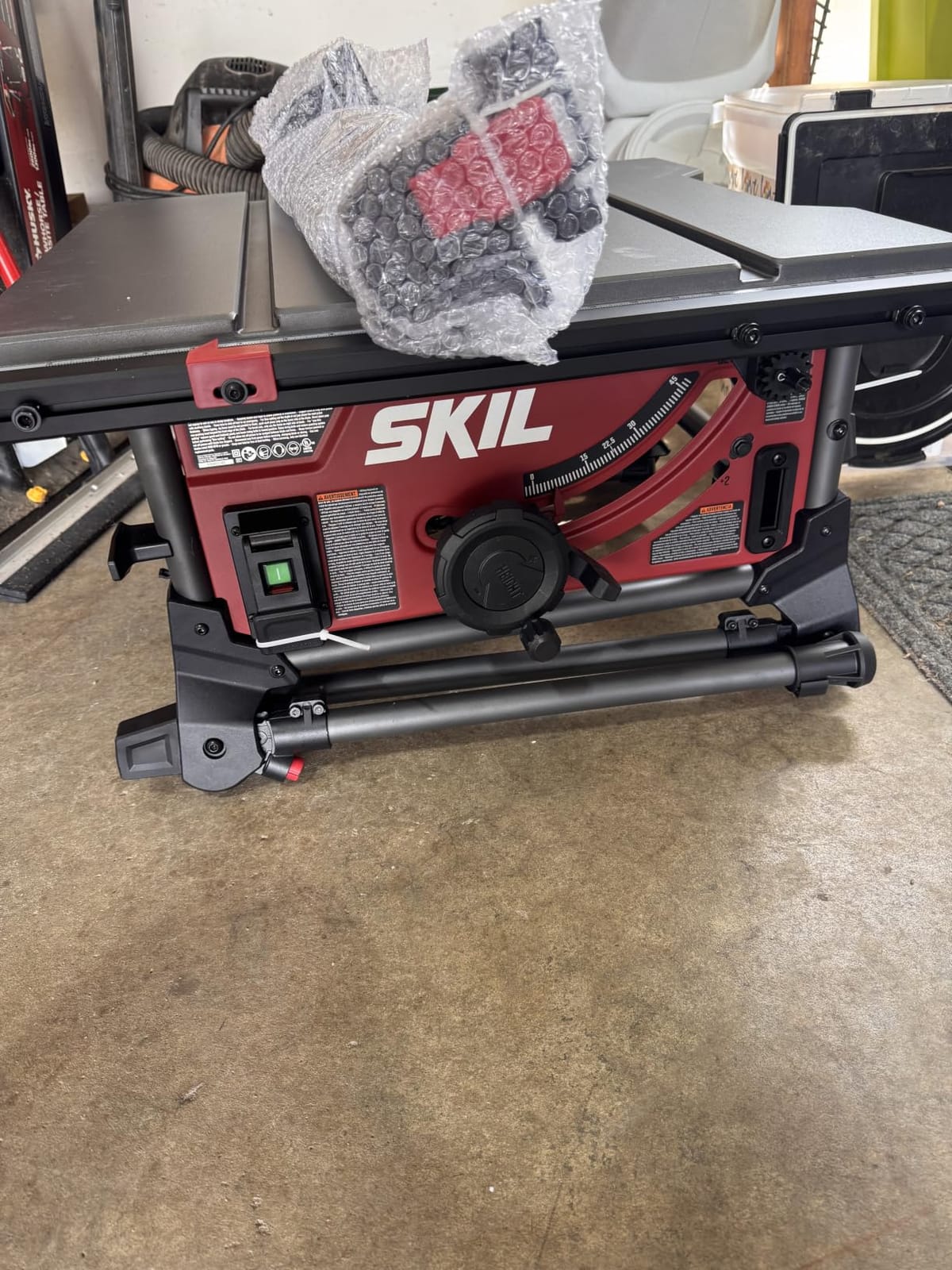
Owners consistently praise the rack and pinion fence rails for producing parallel, square cuts out of the box, and the micro-adjustment for blade alignment is a small detail that saves real frustration. The parallel blade alignment means you can square the saw with a screwdriver rather than a machinist square, which is a meaningful difference in a one-person shop.
The dust port elbow redirects debris to a container, which is a humble feature that matters more in a small room than a bigger port does. It is not sealed extraction, but it keeps the pile on one side of the table where a shop vacuum can reach it.
Why the TS6307-00 converts more beginners?
The first cut a new owner makes decides whether they keep working. This saw is square and stable enough that the first rip usually goes where the scale says it should, and the accessories store on the machine so the fence, miter gauge, push stick, guard, riving knife and dust elbow all travel together.
For projects involving dimensional lumber, trim and shelving, the 15 amp motor has plenty of headroom. When you move to furniture, the first change most owners make is a better blade, and the second is a better miter gauge.
When the TS6307-00 falls short?
The supplied miter gauge is the most common complaint in the reviews, and multiple owners replace it with an aftermarket sled. It is not a dealbreaker for ripping, but if you crosscut full sheets, budget for the replacement.
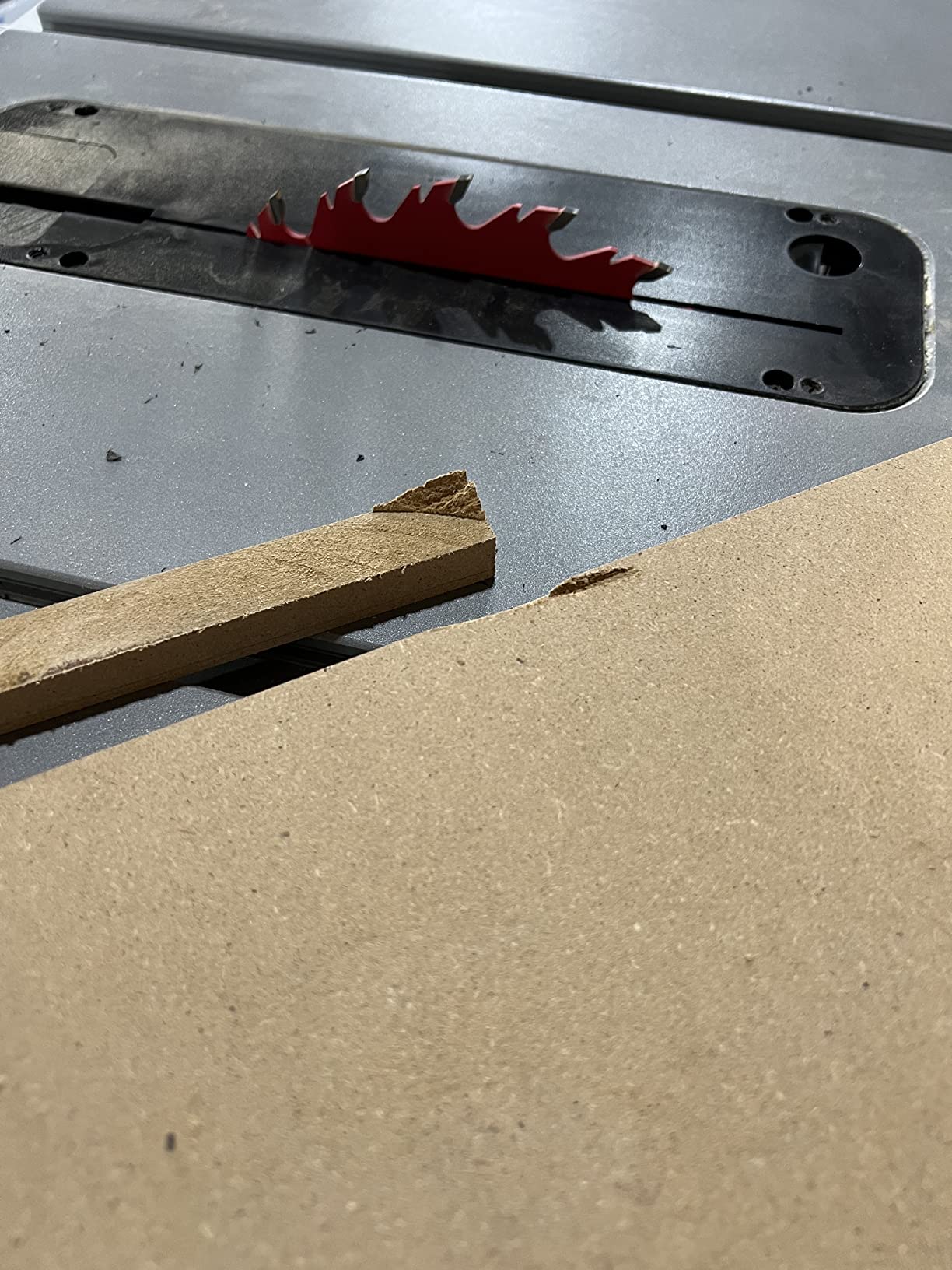
The supplied 24 tooth blade also causes tear-out on crosscuts, so a higher tooth count blade is the first upgrade worth making. Beyond that, the heavy use of plastic components means this is a saw for someone building furniture on weekends rather than someone cutting framing lumber every day for a living.
4. WORX BladeRunner WX572L Tabletop Saw: Best for Genuinely Tiny Spaces
WORX BladeRunner Portable Tabletop Saw, 5.5 Amp, WX572L
4 in T-shank blade, 14.7 pounds, 16.89 x 15.71 in, five blades, 0 to 60 degree miter
Pros
- Under 15 pounds so one hand carries it
- Tool-free blade changes with common T-shank blades
- Five blades cover wood metal tile and plastic
- On-board storage for the whole kit
Cons
- Thinnest cut depth here and not production capable
- Blade flexes if you push hard on hard stock
- Plastic miter gauge is wobbly
This is not a small table saw, it is a tabletop saw, and the distinction matters if your workspace is a rented room or a shared apartment corner. At 14.7 pounds and 16.89 by 15.71 inches, it goes in a closet between projects and comes out for picture frames, small boxes and craft work.
The vertical blade action is unusual and genuinely useful. Instead of pushing the workpiece across a table, the blade moves down through it, which limits binding, allows inside cuts and supports scrolling work. Tool-free changes using standard T-shank jigsaw blades up to 4 inches mean you are not hunting for a proprietary accessory when a blade dulls.
Five blades come in the box, covering wood, aluminum, steel, ceramic tile and scrolling, and the safety switch with safety key guards against accidental starts. The on-board storage for the miter gauge, rip fence and blades means the whole kit is one object rather than a drawer full of loose parts.
Owner reviews split cleanly, and that split is the whole story. People who use it for the work it is designed for love it. People who expected a table saw report blade flex, a wobbly miter gauge and a rip fence that has to be squared by hand.
Where the BladeRunner makes sense?
Apartment hobbyists, renters, model builders and anyone doing picture-frame or small-craft work will get more use from this than from any of the 10 inch saws here. Low vibration and a stable footprint on a flat surface make it pleasant for repetitive small cuts.
It also works as a second machine. A serious shop can keep a jobsite saw for sheet goods and put the BladeRunner on a bench for trim, dados on small stock and repetitive hobby work, where a 110 pound machine would be overkill.
When the BladeRunner stops making sense?
Stop when you need furniture-scale stock. The blade bends if you push too hard on thick or hard material, cuts have to be made slowly, and the thinnest cut depth in the group means thick hardwood is simply not in scope.
Skip it if squareness on crosscuts matters, because the plastic miter gauge is not reliable for repeat work and the etched measurement guides on the table are low contrast. The rip fence pivots at both thumb knobs, so it is not square until you set it by hand every time you reposition it.
5. SKILSAW SPT99-11 10 in Worm Drive Saw: Best for Thick Stock
SKIL 10 Inch Heavy Duty Worm Drive Table Saw with Stand – SPT99-11
10 in worm drive blade, 3-5/8 in depth of cut, 30-1/2 in rip capacity, 94.3 pounds
Pros
- Worm drive cuts 3-5/8 in through thick stock
- 30-1/2 in rip capacity handles full sheets
- Rugged stand with 16 in wheels
- Outfeed supports one-person large cuts
Cons
- Only a 1 year limited warranty
- Worm drive is slow for production work
- 94.3 pounds without the stand
If your material list includes 6×6 posts, laminated beams or thick hardwood slabs, this is the saw in the roundup built for it. Worm drive gearing reduces blade speed for torque, and the result is a 3-5/8 inch depth of cut and 30-1/2 inches of rip capacity without a struggle.
The rolling stand with 16 inch wheels and easy-load handles is what makes a 94.3 pound saw tolerable in a small room. The outfeed and side support let one person handle full sheet cuts, which is a genuine advantage when you are working alone rather than as a pair.
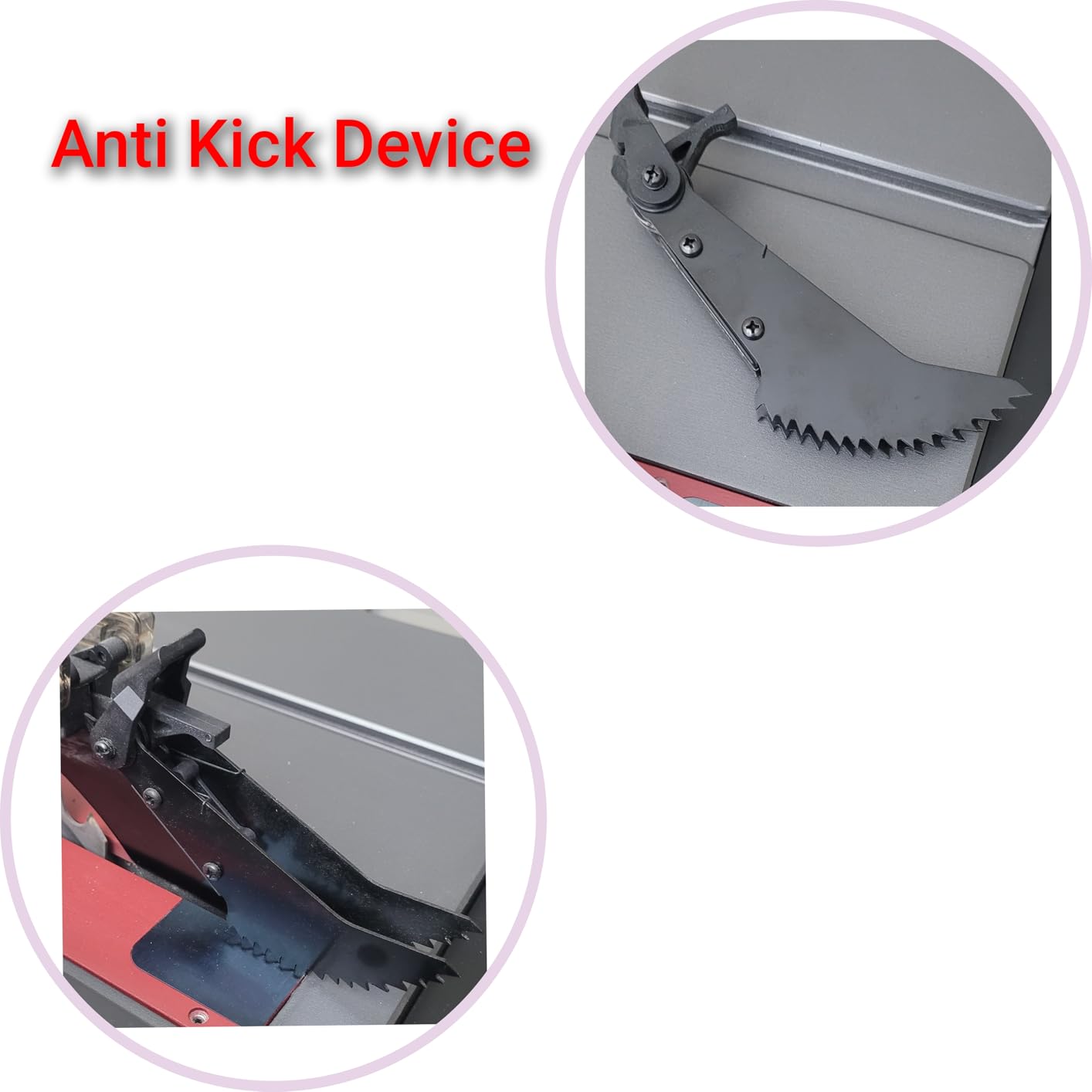
The precision rack and pinion fence system makes quick, smooth adjustments, and the dust port elbow contains debris to one area for clean-up. The Smart Guard System with its anti-kickback device is included, and the insert plate and push stick round out the safety package.
Owners consistently favor this saw for cut depth and thick stock capability, and the mobility of the wheeled stand gets mentioned just as often. The trade-off they accept in return is speed, because a worm drive saw trades blade speed for torque by design.
Who should buy the worm drive?
Buy it if you work with thick dimensional lumber, glulam, composite panels or heavy hardwood. A 3-1/8 inch depth of cut on a direct drive saw means two passes on a 2×8, and two passes on a heavy piece in a small shop means re-supporting the workpiece and re-establishing the cut.
It also suits people cutting a lot of sheet goods who want extra margin, since 30-1/2 inches of rip handles a full sheet. The stand is built for rough handling, which matters if the saw lives in a trailer or a shared shop.
Who should not buy the worm drive?
Do not buy it for production speed. Worm drive saws are inherently slower, and if you make dozens of cuts a day in dimensional lumber, the slower cycle time will cost you more than the deeper cut ever gives back.
Watch the warranty. A 1 year limited warranty is the shortest in this roundup, and for a long-term owner that is the number to weigh against the cut depth. The dimensions also run large at 39.76 by 30.2 inches, so measure the room before committing.
6. Delta 36-6023 10 in Table Saw: The Dado and Warranty Pick
Delta 36-6023 10 Inch Table Saw with 32.5 Inch Rip Capacity
10 in blade, 32.5 in rip capacity, 13/16 in stacked dado, 77 pounds, 5 year warranty
Pros
- Stacked dado capacity of 13/16 in by 8 in
- 5 year professional warranty
- 32.5 in rip capacity for full sheets
- Stand included in the box
Cons
- Thinnest review base among the 10 in saws
- Heavy at 77 pounds for a portable model
- Lowest rating among the 10 in saws here
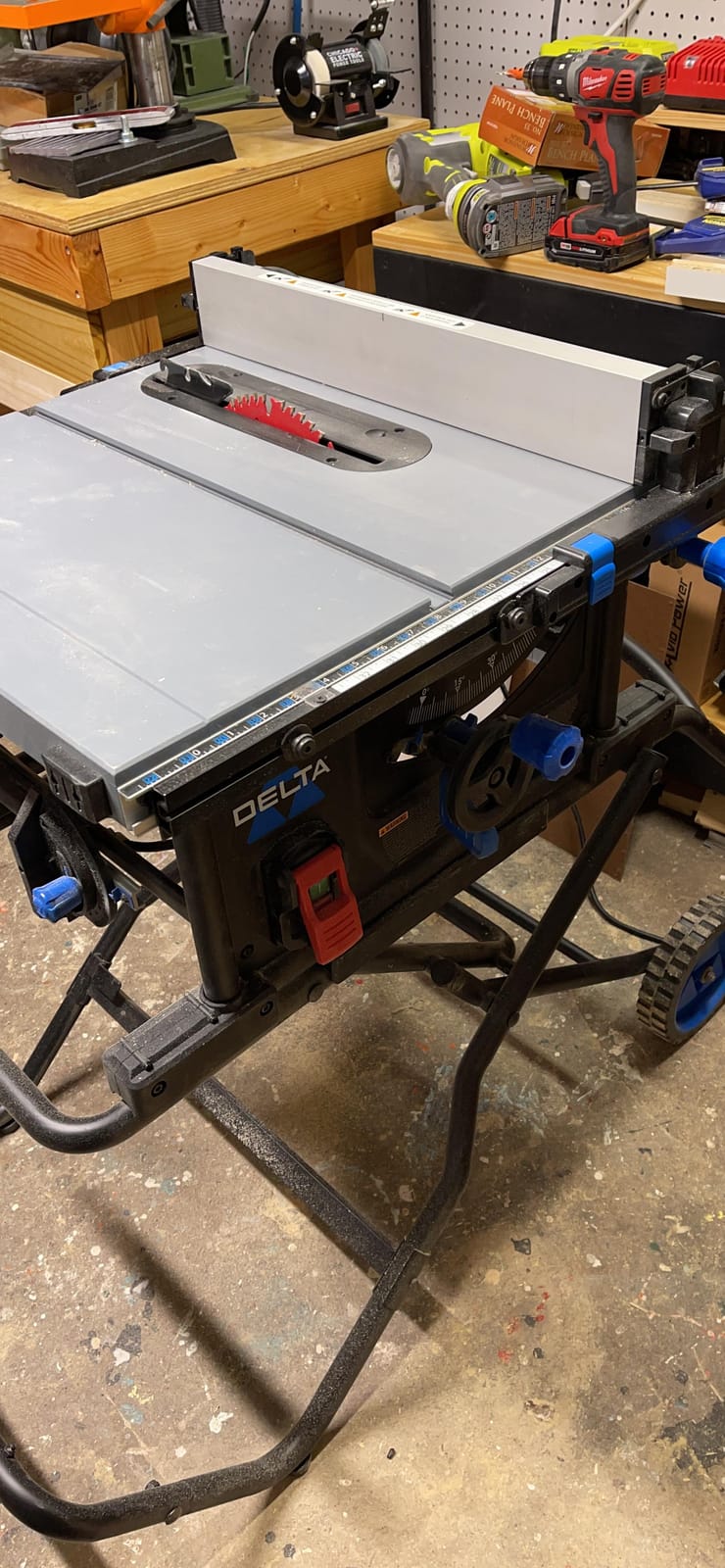
The Delta is the only saw in this roundup with a documented stacked dado capacity, at 13/16 inch by 8 inch, and that single specification puts it in a different category from every other 10 inch model here. If you build casework or boxes, a real dado capability changes what the saw can do for you.
The 15 amp contractor grade motor is specced for treated lumber and hardwoods, and 32.5 inches of rip capacity handles full sheet goods. The rack and pinion fence rails give fast, smooth fence adjustments, and a portable stand is included in the box.

What drew us to this saw is the warranty. Five years of professional coverage is the longest term in the roundup, and for a buyer who plans to own the same machine for a decade, warranty length is a more useful signal than a tenth of a star in the average rating.
Metal handle components and a 77 pound frame feel solid for the class, and the 27 by 19 inch table footprint is among the narrower ones here, though the 35 inch height is tall enough to matter under a low ceiling.
Where the Delta 36-6023 earns its spot?
Choose it if joinery is on the plan. Drawer boxes, sliding dovetails, dados for shelves and fluted panels are all out of reach on most portable saws, and this one is specced to do them with a stacked blade set.
It also makes sense as a second machine for someone who already has a compact saw for sheet goods. The Delta handles the joinery and heavy ripping while the smaller saw stays portable, and the stand lets you park the 77 pound body against a wall.
What to watch on the Delta 36-6023?
The rating is soft for this category, and with 200 reviews it has the thinnest owner history among the 10 inch saws here. Buyers consistently point to inconsistency relative to the heavily reviewed DeWalt and SKIL options, so go in expecting to check alignment and squareness on day one.
At 77 pounds it is not a one-hand carry, and the review count means you are buying on specifications rather than on accumulated field reports. If joinery is a someday project rather than a weekly one, the value here shrinks quickly.
7. Bosch GTS15-10 10 in Jobsite Saw: Best for Controlled Cuts
BOSCH GTS15-10 10 Inch Portable Jobsite Table Saw with Rise Wheeled Stand
10 in carbide blade, 3800 rpm, 103 pounds, gravity-rise stand, 32-1/8 in rip capacity
Pros
- Soft start and regulated speed reduce breaker trips
- Three second convenience brake between cuts
- ClampZone areas add a free work surface
- Color-coded fence index pins for quick setup
Cons
- Only a 1 year limited warranty
- Lowest blade speed in the group at 3800 rpm
- Smallest review base of the premium 10 in saws
The Bosch stands apart for what happens electrically during a cut. Soft-start circuitry reduces the chance of tripping a circuit breaker, which matters in a small shop where the saw often shares a circuit with a dust collector, and electronically regulated speed holds blade speed under load instead of bogging down.
The convenience brake stops the blade in approximately three seconds, and in a shop where you make many short cuts that difference is real productivity rather than a spec-sheet novelty. The ClampZone areas let the tabletop double as a light-duty secondary work surface, which in a cramped shop is surface area you did not have to buy.
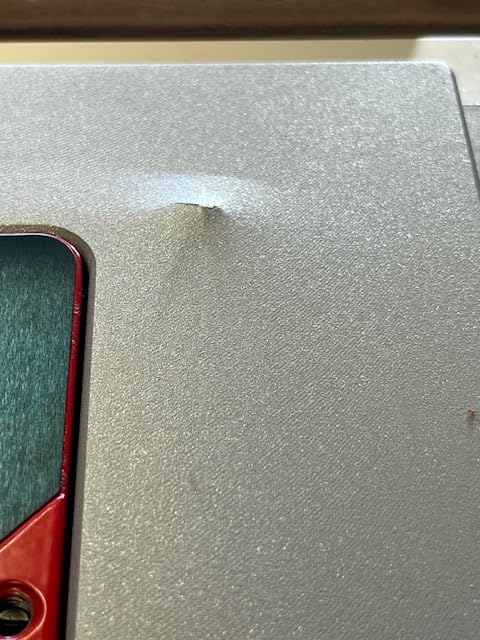
The 32-1/8 inch rip capacity and color-coded rack and pinion fence index pins mean setup after a move is fast, since the color coding tells you which pin belongs where. The Smart Guard System with riving knife, anti-kickback pawls and a full guard assembly covers the safety argument that a bare riving knife cannot.
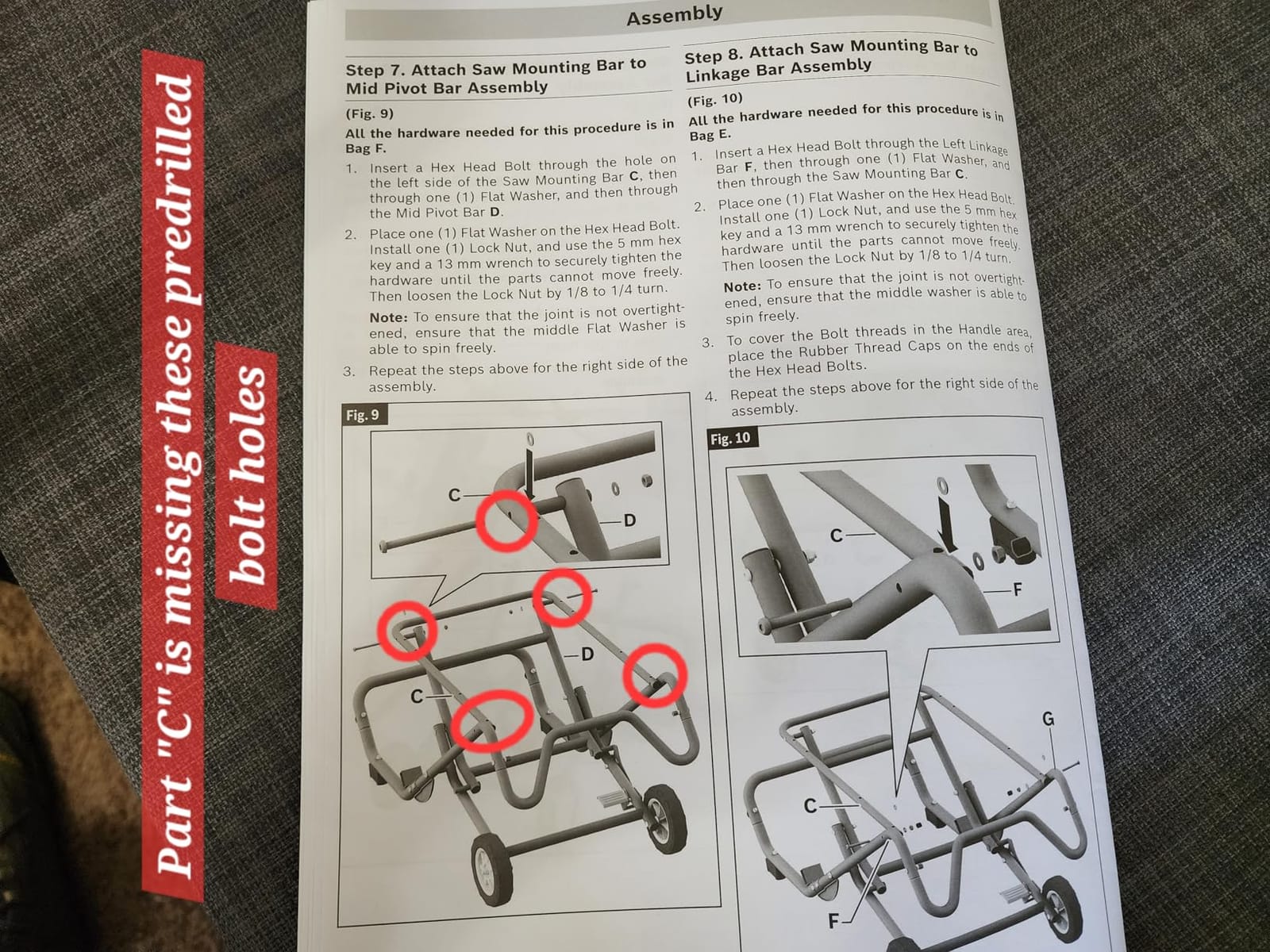
On-tool storage holds the fence, miter gauge, guard system, wrenches and push stick, and the open frame roll bar design with lightweight construction is easier to maneuver than the spec weight of 103 pounds suggests. The included GTA50W gravity-rise wheeled stand sets up with a single action.
Where the Bosch electronics help most?
In a basement or garage with marginal circuits, soft start and regulated speed are the features that decide whether the saw is usable. They are also the features most often ignored in roundups, which is why we call this the controlled-cut pick.
For repeat furniture work, the three second brake and the ClampZone work surface both cut time. The open frame also means you can see the cut from more angles, which is genuinely useful when squaring a panel.
Where the Bosch costs you?
The 1 year limited warranty is the shortest term on a premium saw in this list, and that is a real gap against the Delta and the SKIL, both of which carry longer coverage.
Blade speed is 3,800 rpm, the lowest in the roundup, which shows up as more heat and a slower cut in hardwood than the 5,000 rpm machines. The review base is also thin at 195, so you are trusting a design with less field history than the DEWALT and SKIL saws at the same class.
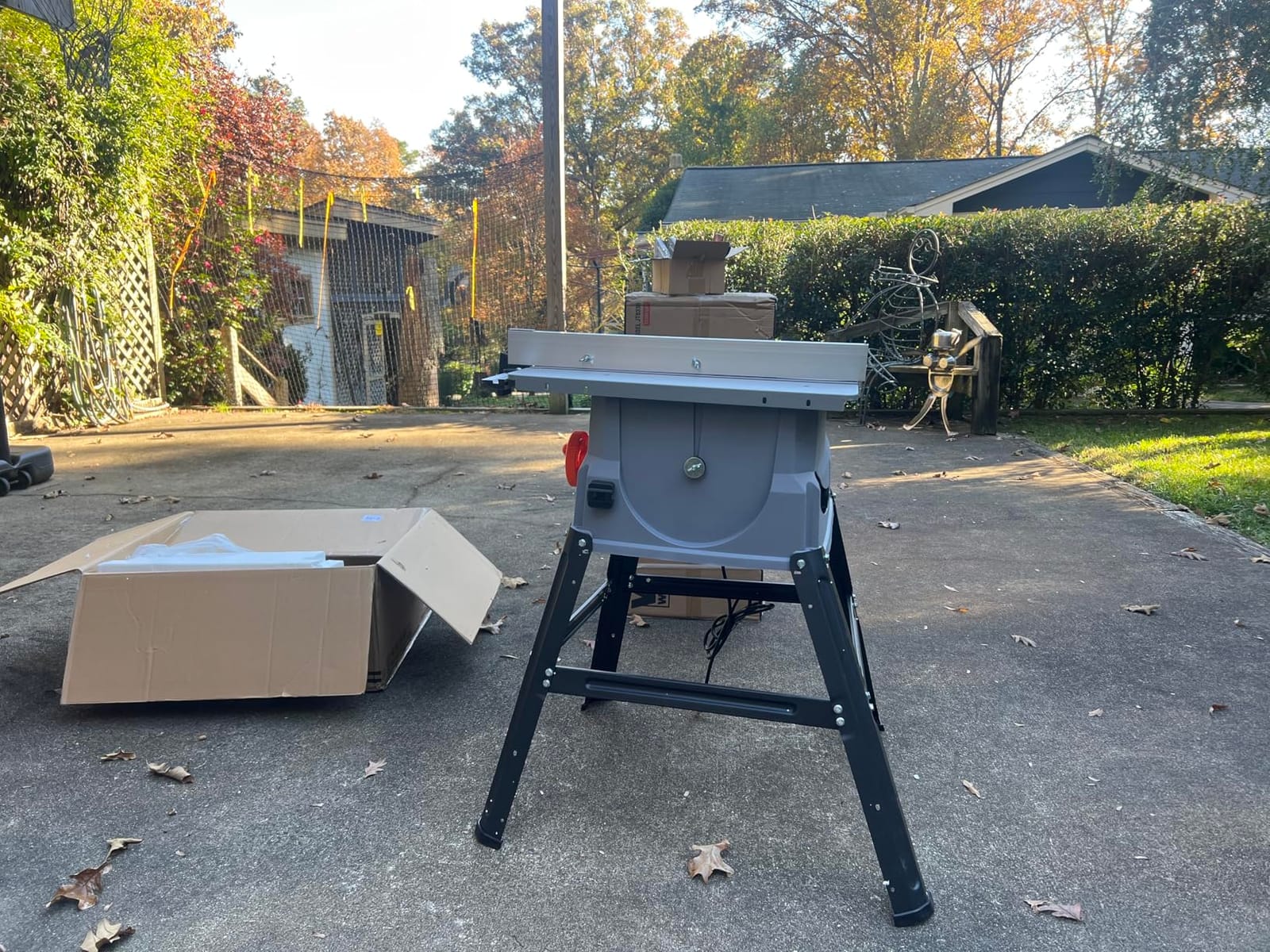
8. Prostormer 10 in Table Saw with Stand: Budget 10-Inch Pick
Prostormer 10 Inch Table Saw with Stand
10 in carbide blade, 5000 rpm, 22 x 23 in footprint, spindle lock, 0 to 45 degree bevel
Pros
- Low cost entry to a 10 in saw
- 5000 rpm no-load speed cuts typical wood well
- Clear blade guard gives a clean line of sight
- Spindle lock speeds up blade changes
Cons
- Dust collector port is supplied without a collector
- Included components are listed only as attachments
- Limited warranty and thin brand support
The case for this saw is arithmetic. A 10 inch blade, 5,000 rpm no-load speed and 15 amp motor at a fraction of what the premium models cost is a real proposition when the budget is the deciding factor, and the 22 by 23 inch footprint is genuinely compact once the stand is folded.
Four metal brackets at the base add rigidity at the bottom of the stand, which is where cheap saws usually flex, and the stable bottom support keeps the saw from walking while you push. The clear blade guard provides visibility and prevents accidental contact, which is better than no guard at all.
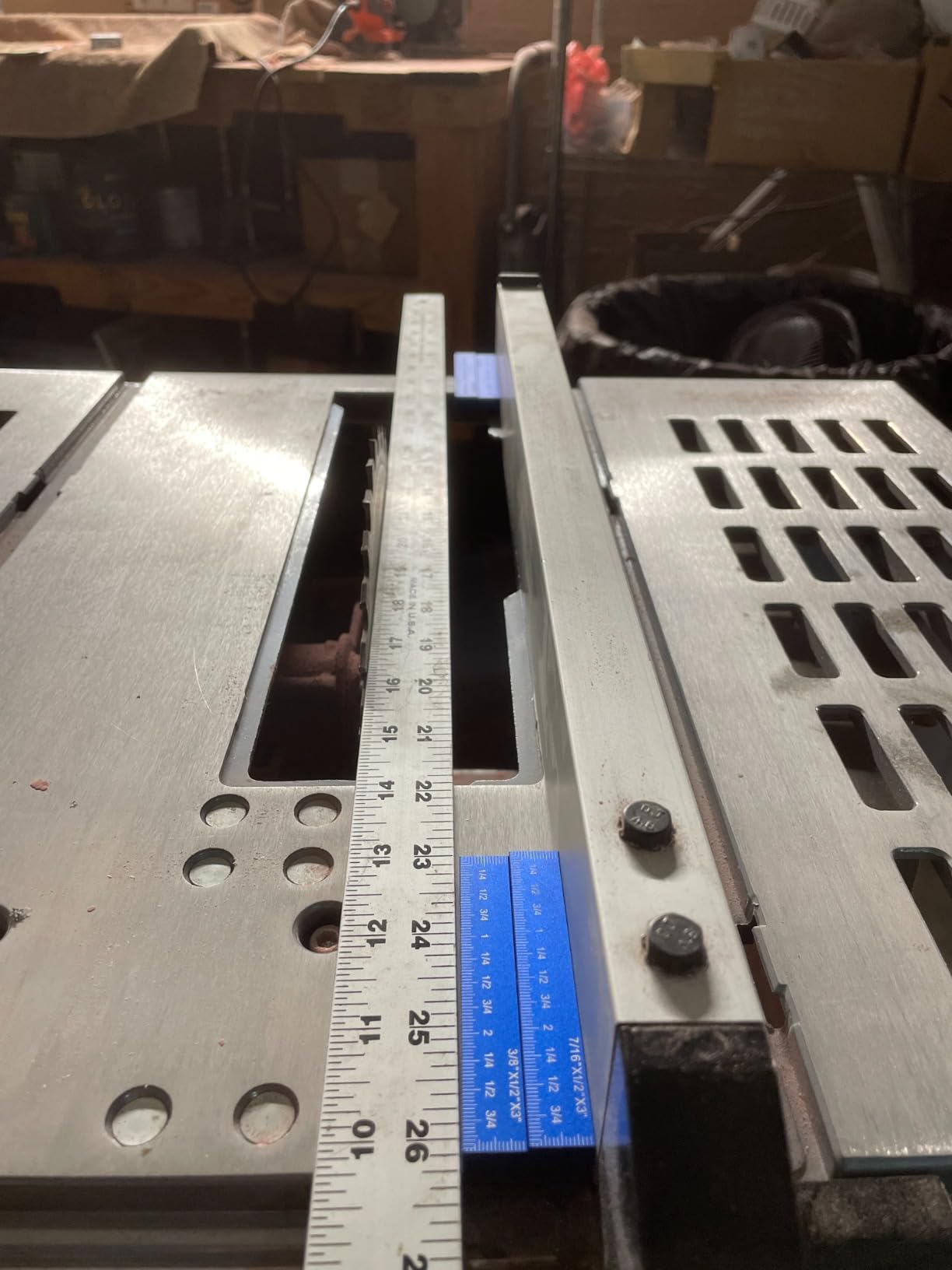
Storage compartments on both sides of the saw hold wrenches and the push stick, and the spindle lock makes blade changes quicker than a two-wrench routine. Adjustable blade angle and height give 90 degree crosscuts and 0 to 45 degree bevels with a stop.
Owners are drawn by the value and accept the compromises, the most common being dust. The rear dust collector port is a real opening in the design, but the collector itself is not part of the package, so a clean shop means a separate purchase and a seal you can build yourself.
Where the Prostormer makes sense?
It makes sense as a first table saw for someone who wants full 10 inch blade capacity and is willing to treat it as a learning tool. Check alignment, square the fence and calibrate the miter gauge in the first session, and the saw will serve ordinary project work.
The 5,000 rpm speed is competitive with the mid-range machines, and the clear guard is a genuine safety plus in a shop where a young apprentice or family member might wander over.
Where the Prostormer needs caution?
The included components are listed only as attachments, with no detailed accessory breakdown, so verify that the box actually contains a miter gauge, rip fence and push stick before you rely on the listing. Accessory support is thin, and the warranty is limited only.
One more check before you buy: the specification listing shows a 240 volt figure for a corded 120 volt class saw, which is inconsistent with the 15 amp, 1800 watt rating. Confirm the electrical spec with the seller before the machine arrives, because a 240 volt circuit is not something you improvise in a garage.
9. DOVAMAN DTS02M 8.5 in Saw: Best for Dust Control
DOVAMAN 15A Table Saw, 8.5″ Dustless Portable Table Saw
8.5 in carbide blade, 50 pounds, 5000 rpm, 60 mm depth, extendable side plate
Pros
- Claimed 98 percent dust separation with a rear connector
- Extendable side work plate expands the surface from 48 to 80 cm
- Soft start reduces vibration and breaker risk
- Cast aluminum top rather than sheet steel
Cons
- Rip fence drifts out of square on some examples
- Guard interferes with stock thicker than about 2 cm
- Uses 16 mm T-slots rather than the common 19 mm
Dust is the loudest complaint small-shop owners have about portable saws, and this is the one machine in the roundup designed around it. A 98 percent claimed dust separation rate through the rear vacuum connector, combined with a 60 tooth carbide blade, is a different proposition from a saw with a narrow elbow and an open underside.
The extendable side work plate is the sleeper feature. It expands the cutting surface from 48 cm to 80 cm, which in a one-person shop is the difference between a supported panel and a panel that sags off the outfeed side. Soft start technology also gives a low-vibration controlled startup that protects the material and lowers circuit breaker risk.
Other details worth knowing: cutting depth is 60 mm at 90 degrees and 40 mm at 45 degrees, the bevel stop adjusts from 0 to 45 degrees and locks in accurately, and the top is cast aluminum rather than stamped sheet. The saw weighs 50 pounds and measures 27 by 23 by 15 inches.
Owners call it a large upgrade in shop cleanliness, and they are right that a vacuum-connected saw changes the feeling of a small room. The recurring criticisms are mechanical rather than conceptual: rip fence alignment drifting over time, and a guard that gets in the way on stock thicker than roughly 2 cm.
Why the dust port changes the shop?
For a basement workshop or a garage attached to a house, dust control is not a nicety. Reviewers on Lumberjocks are blunt that a shop vacuum only captures table saw dust if the underside is close to airtight, and a saw designed with a proper rear connection and shroud gets you part of the way there before you build anything.
The side plate also reduces how often you need an outfeed table, which is a meaningful floor-space saving in a one-car shop. The soft start is a quiet bonus for shops that share a wall with living space.
Where the DOVAMAN falls short?
Watch the rip fence. Some owners report 2 to 3 mm of variation between the top and bottom of the fence over time, so check parallelism periodically rather than trusting the scale. That is the price of a budget machine and it is a manageable one if you know to look.
Non-standard 16 mm T-slots limit which premium guide and jig accessories will fit, and reviewers describe the saw as notably loud. If you work in a shared wall space, test it before you commit.
10. SKIL TS6308-00 8-1/4 in Compact Saw: Lightest Compact Option
SKIL 15 Amp 8-1/4-Inch Compact Portable Jobsite Table Saw (Stand SFS0001 Sold Separately)-TS6308-00
8-1/4 in blade, 40 pounds, 2-1/2 in depth of cut, 25.98 x 22.83 in, dust elbow
Pros
- Only 40 pounds and easy to move alone
- Rack and pinion fence has a built-in ruler
- 2-1/2 in depth of cut handles 3x stock in one pass
- Aluminum table and on-board accessory storage
Cons
- Much of the body is plastic and some aluminum
- Stand sold separately as model SFS0001
- No blade height scale so dado work needs a square
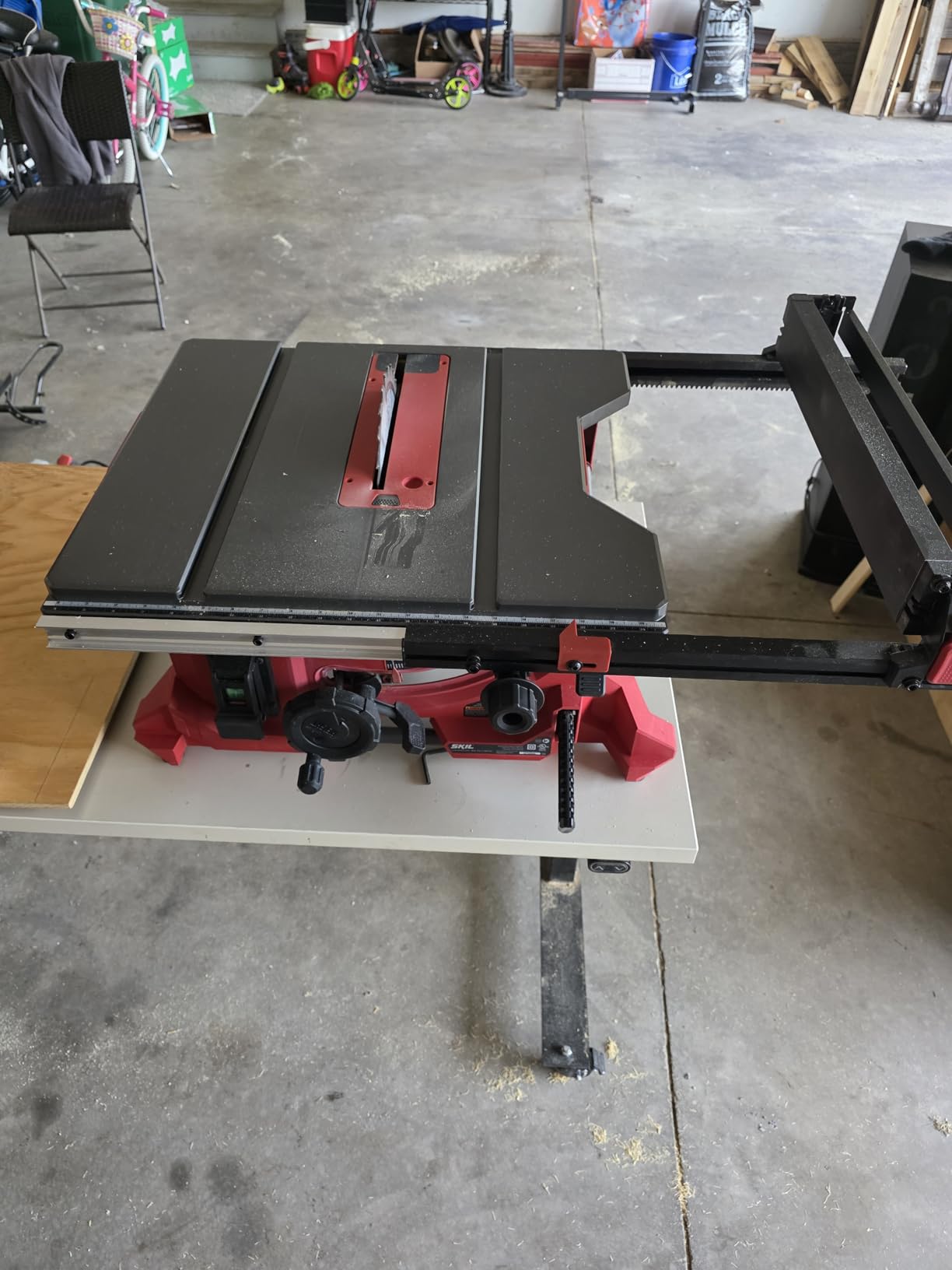
This is the compact saw for someone who physically cannot lift 54 pounds more than once. At 40 pounds and 25.98 by 22.83 by 12.99 inches, it is the smallest 8-1/4 inch machine in the roundup, and owners moving it between rooms notice the difference immediately.
The rack and pinion fence with a built-in ruler is the detail that makes it feel more expensive than it is, because you stop reaching for a tape measure on every rip. The 2-1/2 inch maximum depth of cut at 0 degrees handles 3x stock in a single pass, and the 15 amp motor covers plywood, 2×4 crosscuts and simple dado work.
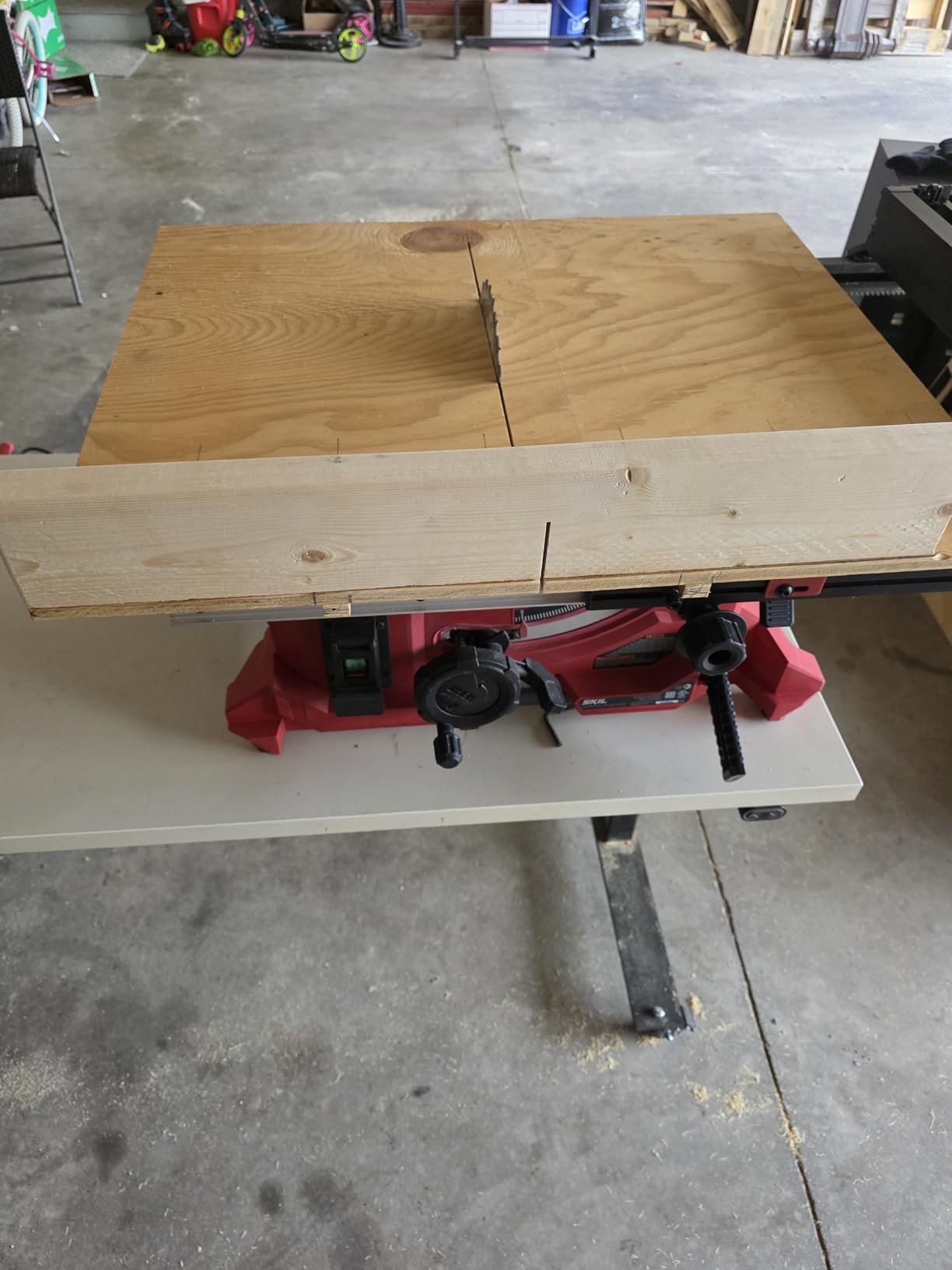
On-board storage keeps every accessory with the saw, the aluminum table stays flat for accurate cutting, and parallel blade alignment micro-adjustment lets you square the saw with hand tools. The dust port elbow is included and supports 2-1/2 inch hose connections, which is the right size for a standard vacuum.
First-time table saw owners report that the included fence ruler made projects noticeably easier, and it is widely regarded as a value alternative to a comparable DeWalt compact saw. That comparison is the honest headline here, because these two machines occupy the same shelf.
Where the TS6308-00 fits best?
It fits a one-person shop where the saw moves daily, an apartment workshop, and any setup where the machine lives under a bench during the week. The safety switch for immediate shutdown and the parallel alignment micro-adjustment are both genuinely helpful for a first-time owner.
It is also a good second saw alongside a larger 10 inch machine, handling trim and narrow stock while the bigger saw handles sheets. If you buy the folding SFS0001 stand, the whole assembly stays lighter than most 10 inch saws on wheels.
Where the TS6308-00 falls short?
The construction is not heavy duty. Much of the body is plastic with some aluminum, and a few owners report plastic parts cracking and blade wobble on certain production units. Buyers report it runs louder than a comparable DeWalt, which matters in a basement.
No stand is included, and there is no blade height adjustment scale, so dado work needs a square to set depth. If you cut a lot of sheet goods, remember the rip capacity is 24.5 inches on one side of the blade and considerably less on the other.
11. EVOLUTION R10TS 10 in Jobsite Saw: Best for Dado Work
Evolution R10TS 10″ Jobsite Table Saw | Zero-Clearance Throat Plate | Dado Plate Included | 15A Motor | 26” Rip | 3-3/8” Cut | 0-45° Bevel | Precision Fence | Heavy Duty Portable Woodworking Saw
10 in TCT 40 tooth blade, 26 in rip, 3-3/8 in depth, zero-clearance throat plate, dado plate
Pros
- Zero-clearance height-adjustable steel throat plate
- Dado plate included for grooves and joints
- Sliding cross-cut table for repeat crosscuts
- Electronic blade brake and 3 year warranty
Cons
- Supplied miter gauge for the sled is low quality
- Needs about an hour of setup to make the table true
- Instructions are small and vague
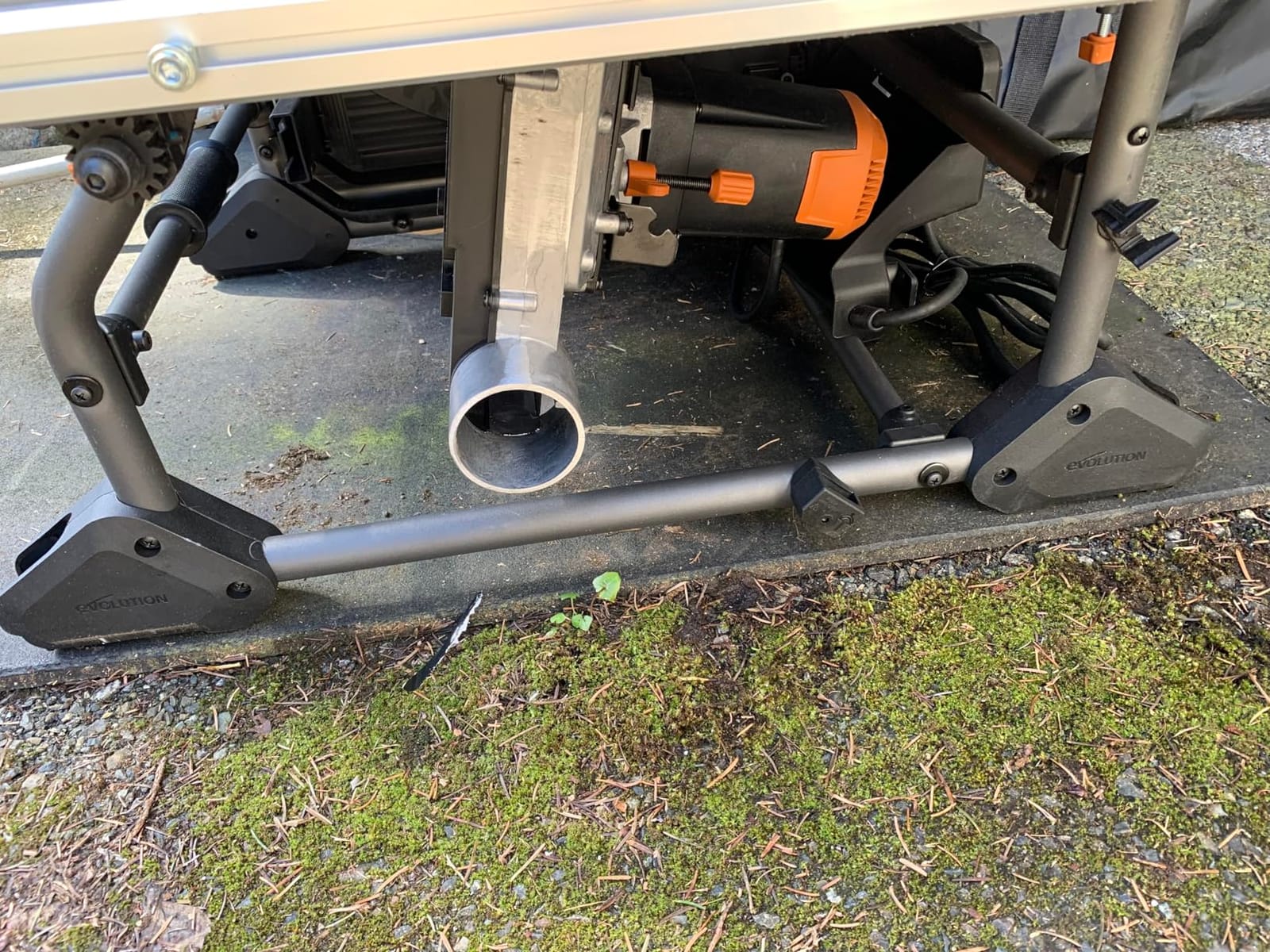
The Evolution solves two problems that normally send you back to the search engine. The zero-clearance height-adjustable steel throat plate lets you run a full kerf through hardwood without the insert splitting it out, and the included dado plate means you can cut grooves on site rather than skipping the joinery.
The sliding cross-cut table is a real differentiator for furniture work, because a sled with proper bearings holds a large panel square in a way a miter gauge never will. Rip capacity is 26 inches, depth of cut is 3-3/8 inches and the bevel runs 0 to 45 degrees on a geared adjustment that holds position.
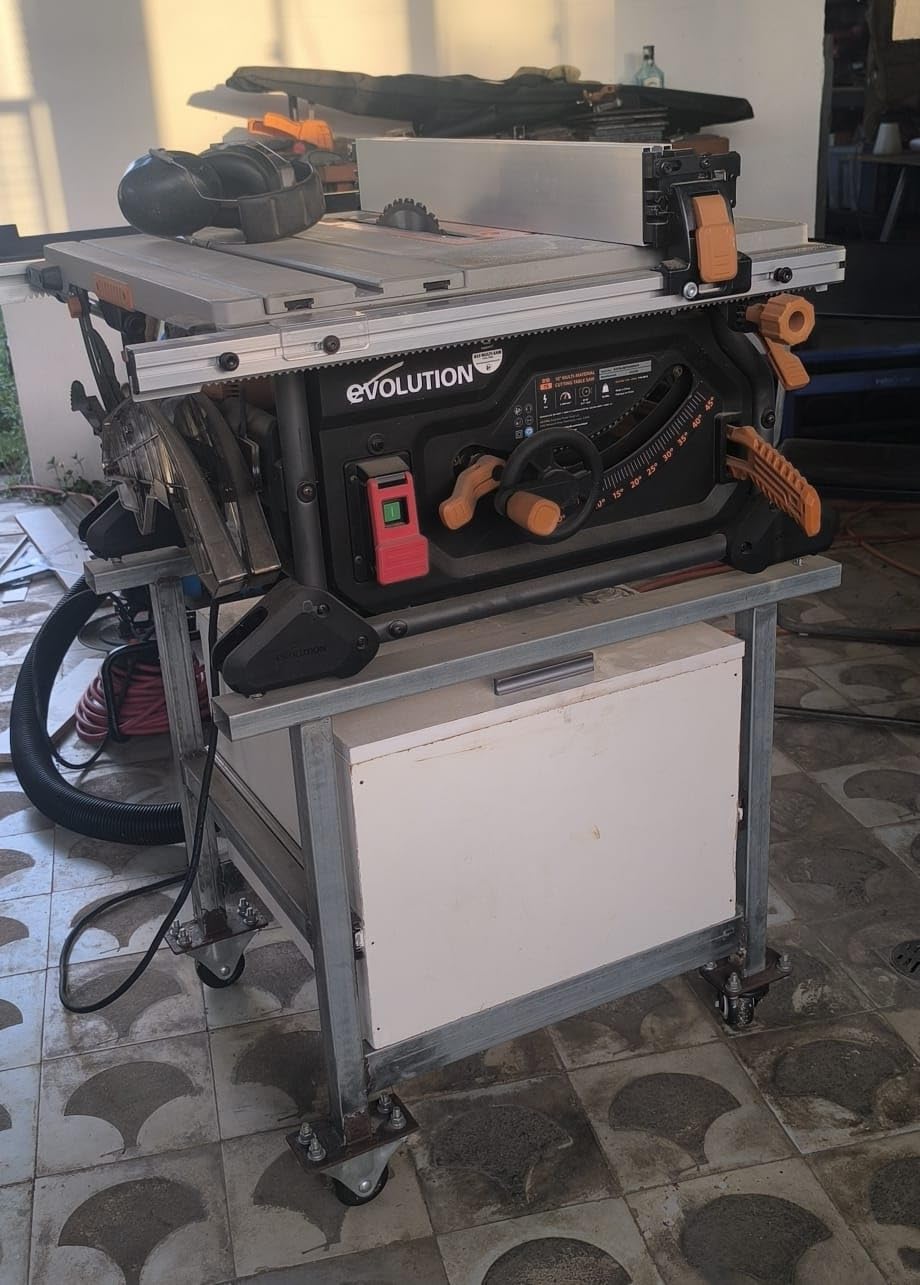
The blade is a 10 inch TCT tungsten carbide with 40 teeth, rated for wood, mild steel, aluminum and composites, and the 15 amp high-torque motor has soft start. The electronic blade brake, anti-kickback pawls and quick-release riving knife form a complete safety package.
Owners praise accuracy straight out of the box, the rack and pinion fence, and how light the saw is for one person to move around a shop. Many describe it as ideal for a small shop, which is exactly the use case this roundup covers.
Where the Evolution earns its place?
Buy it for furniture, cabinetry or anything where dados, grooves or square crosscuts on panels are routine. The zero-clearance throat plate is the single most valuable feature on this page for hardwood work, because the stock insert on cheaper saws tears out the moment you cut solid wood.
The outfeed support bar and onboard storage make it a self-contained station, and the 3 year warranty is a reasonable term for a saw specced this thoroughly.
Where the Evolution disappoints?
Budget an hour on day one. Owners report that it takes about an hour of setup to make the table true, and the instructions use small, vague diagrams, so budget your time as well as your money. Small parts also arrive loose in the box, which is worth sorting out immediately.
The supplied miter gauge for the sliding table is low quality, so plan an aftermarket replacement. One owner had a defective stock plastic throat plate, which the manufacturer replaced at no cost, and another had a bent rack and pinion slider fixed the same way, so service appears responsive if something arrives damaged.
12. VEVOR 10 in Table Saw with Stand: Best for Bevel Range
VEVOR Table Saw with Stand, 10-inch 15-Amp, 25-in Max Rip Capacity, Cutting Speed up to 5000RPM, 40T Blade
10 in 40 tooth blade, 5000 rpm, 25 in rip, minus 60 to 60 degree bevel, 59.4 pounds
Pros
- Bevel range of minus 60 to 60 degrees is the widest here
- Folding stand with wheels rolls with the saw
- Includes a vacuum hose
- 5000 rpm with a 40 tooth blade
Cons
- Rating spread includes a notable share of 1 star reviews
- No customer review images to confirm build quality
- Supplied miter gauge and shield are basic
The reason this saw is in the list is the bevel range. A minus 60 to 60 degree swing covers compound cuts that a 0 to 45 degree saw cannot make in one setup, and for certain trim and framing work that removes an entire step from the process.
The folding stand has wheels, so the saw moves as one unit, and the box includes a black vacuum hose, which is more than most machines in this price band supply. A full-length adjustable parallel fence with a measuring guide rail is a better fence than the short rails on budget saws, and at 59.4 pounds it is manageable in a small shop.
Cut speed is 5,000 rpm with a 40 tooth blade, and maximum rip capacity is 25 inches. The dust extraction port, blade guard and safety shield are all present, and copper wire overload protection covers the overheating scenario that cheap motors are prone to.
Buyers like the speed, portability and dust collection. The caution is the rating spread, where the manufacturer data shows a meaningful share of 1 star reviews, which tells you the average of 4.0 across 39 reviews hides a divided customer base.
Where the VEVOR holds up?
It holds up as a secondary or occasional saw, and for anyone doing compound bevel work where a 45 degree limit is the real constraint. The vacuum hose in the box means you can connect a shop vac on day one, which several budget saws do not let you do.
The measured dimensions are the catch. At 50.8 by 22.7 by 41.3 inches, this is the tallest saw in the roundup, and the listed height is above the stand rather than the table surface. Measure your ceiling clearance and your door openings before you order, because a saw that will not go through the garage door is a very expensive shelf.
Where the VEVOR worries me?
The rating distribution is the honest concern. Nearly a tenth of reviews in the manufacturer data are 1 star, which is not what you want in a machine with rotating components and a guard system. There are also no customer review images to help you judge real build quality, which removes a signal you get on every other saw in this roundup.
The supplied miter gauge and shield are basic, and the listing again shows 240 volts for a 15 amp, 1800 watt corded saw, so confirm the electrical specification before wiring it in. Buy this one for a specific bevel need, not as your only table saw.
How to Choose a Table Saw for a Small Shop?
Once you have narrowed the field, these are the decisions that actually matter in a room that measures in feet rather than yards. The order matters too, because the first two questions eliminate more saws than the rest combined.
Measure the footprint before you fall for the specs
Every review on this page lists dimensions, and those numbers matter more than any feature. The compact DEWALT DWE7485 measures 22.75 by 22.75 inches, the SKIL TS6308-00 measures 25.98 by 22.83 inches, and the SKIL TS6307-00 is 28.74 by 27.17 inches.
Compare those to the DEWALT DWE7491RS at 31 by 24 inches, the Bosch GTS15-10 at 28.1 by 27.8 inches, and the SKILSAW SPT99-11 at 39.76 by 30.2 inches. That last figure is the one that closes a small garage bay, and no amount of good rip capacity compensates for a saw you cannot walk around.
Add working clearance on the outfeed side for long stock, and check the height. A 35 inch listed height on the Delta and a 41.3 inch listed height on the VEVOR will not go through a low door, while the 12.99 inch height on the SKIL TS6308-00 goes under a bench. If you need more machine than a room allows, our guide to combination woodworking machines for small shops is worth reading, because some of those pack a saw and a jointer into one footprint.
10-Inch vs 8-1/4-Inch Blades for a Small Shop
Choose 10 inches if you break down full sheets, cut 4×4 posts, or plan to dado or groove. Choose 8-1/4 inches if floor space and weight matter more than capacity, and if your material is mostly dimensional lumber and trim.
The 10 inch saws here run 25 to 32-1/2 inches of rip capacity. The 8-1/4 inch machines run 24.5 inches, which is less than a full sheet, though the DEWALT DWE7485 specification still lists 4×8 plywood and OSB ripping within that figure. The 10 inch advantage is depth of cut as well, with 3-1/8 inches at 90 degrees on the DEWALT DWE7491RS and 3-5/8 inches on the worm drive SKILSAW.
The 8-1/4 inch camp wins decisively on weight, at 40 and 54 pounds against 77, 94.3, 103 and 110 pounds for the larger saws. For one person moving a machine daily, that difference decides the purchase more often than cut capacity does.
Stand type, rolling stands and uneven garage floors
Three stand approaches appear here. Integrated folding stands, like the SKIL TS6307-00, fold flat and lean against a wall. Included rolling stands, like the DEWALT DWE7491RS and the Bosch gravity-rise stand, move with the saw but add a second object to store. Benchtop mounting, like the DEWALT DWE7485 and SKIL TS6308-00, saves floor space entirely but requires a solid bench underneath.
On uneven garage floors, a saw on a folding stand can rock, and rocking shows up as an out-of-square crosscut. A mobile base with locking casters is the fix, and leveling feet matter more in a garage than in a dedicated shop. If your floor is poured recently, check it for slope before assuming the saw is at fault.
Dust collection is a build, not a purchase
Portable saws throw sawdust because there is no shroud under the table, and this is the top small-shop pain point in owner discussions. A narrow dust port makes it worse, because adapters leak. The DEWALT DWE7491RS with its 2-1/2 inch port and the DOVAMAN with its rear connector are the two machines here that make extraction straightforward.
The consensus among experienced builders is that you need a near-airtight shroud under the table before a shop vacuum captures table saw dust properly. Beyond that, the steps that matter: seal the throat plate gap, build or buy a blast gate, run 2-1/2 inch hose from the port to a remote canister, and keep the guard on rather than removing it. A blade guard does more for dust than a riving knife alone, and dust control also means your filter last longer and the room stays livable.
First upgrades worth making after you buy
Four upgrades cover almost every saw on this page, and they are the same four that come up in owner threads. A zero-clearance throat plate stops hardwood tear-out at the blade, and the EVOLUTION R10TS already ships with one. A better blade is next, since supplied 24 tooth blades on the SKIL machines tear out on crosscuts.
A push block, such as a MicroJig, matters more on narrow rip cuts where a sawblade needs a guide. An upgraded miter gauge or sled is the fourth, and it is the most common single purchase made by SKIL TS6307-00 owners. We have also seen owners swap the entire guard system for improved dust performance, so check the guard before you replace the fence.
Who should skip a compact table saw entirely?
If you are producing furniture daily, learning to cut dados and flush cutting rabbets in solid wood, a compact saw is a stepping stone rather than a destination. The fence drifts, the throat plate tears out and the miter gauge is plastic. In that case, read our guide to cabinet table saws for serious woodworkers first and budget the floor space accordingly.
The other case is noise. A saw in a basement attached to living space is a daily negotiation, and the SKIL machines and the DOVAMAN get described as loud in the reviews. If the room is your workshop and only your workshop, the decibel level is a footnote. If it is not, test before you commit. If instead your material list is dominated by curves and resaw work, our picks for woodworking bandsaws for small shops cover that half of the shop floor.
Frequently Asked Questions
What is the best table saw for a small shop?
The DEWALT DWE7485 is the best all-round choice for a small shop. It weighs 54 pounds, measures 22.75 by 22.75 inches, has a rack and pinion fence that stays parallel, and its tool-free modular guarding system actually gets used. If you break down full sheets regularly, the DEWALT DWE7491RS gives you 32-1/2 inches of rip capacity and a rolling stand in one package.
Should I get a 10 inch or 8 inch table saw?
Choose 10 inches if you rip full sheets, break down 4×4 posts or cut dados, since saws in that group run 25 to 32-1/2 inches of rip capacity and reach 3-1/8 inches of depth. Choose 8-1/4 inches if weight and floor space decide it, because the compact saws weigh 40 to 54 pounds while the 10 inch models run 77 to 110 pounds. The smaller blades are easier to move daily.
What is the best table saw for value for money?
The SKIL TS6307-00 offers the most capability per unit of outlay in this roundup. You get a 10 inch blade, an integrated folding stand, the ability to cut a full 4×4 at 90 degrees, a 2 to 47 degree bevel and a dust port elbow, at 51.2 pounds. The two things to plan for are a replacement miter gauge and a higher tooth count blade for clean crosscuts.
What is the best dust collection system for table saws?
For a small shop, a remote canister vacuum with a blast gate works better than a big central system. Connect a 2-1/2 inch hose to the saw port, run it to a filter that is not in the breathing zone, and seal the gap around the throat plate so the underside is close to airtight. Sawdust is fine and combustible, so never run a standard shop vac on a table saw without a sealed canister.
Why does my table saw throw so much dust?
Most portable saws have an open underside with no shroud, so sawdust escapes below and behind the table. A narrow dust port makes it worse because adapters leak. Four fixes help: use a machine with a full width port, seal the throat plate gap, fit a blast gate, and keep the blade guard on, which captures dust at the source instead of relying on air movement to find the port.
Is a riving knife necessary?
Yes, every table saw should have a correctly set riving knife or splitter, and anti-kickback pawls should sit in the cut. The riving knife finishes the kerf on the back of the workpiece, which reduces kickback. A riving knife does not stop dust from the cut itself, so pair it with anti-kickback pawls and keep the blade guard system in place whenever the material allows.
Conclusion
The best table saws for small shops are the ones you can move, keep clean and afford to service, and after a season of daily work, the difference between those criteria and a cheap saw becomes obvious. Our winner is the DEWALT DWE7485, at 54 pounds with a 24.5 inch rip capacity and a rack and pinion fence that stays put, and our value pick is the SKIL TS6307-00 if you want full 10 inch capacity with a folding stand.
Whatever you choose in 2026, measure the footprint, plan the dust path before the saw arrives, and add a throat plate, a better blade, a push block and an upgraded miter gauge in that order. Those four upgrades will improve any of the twelve saws above more than another hundred dollars of machine will.