
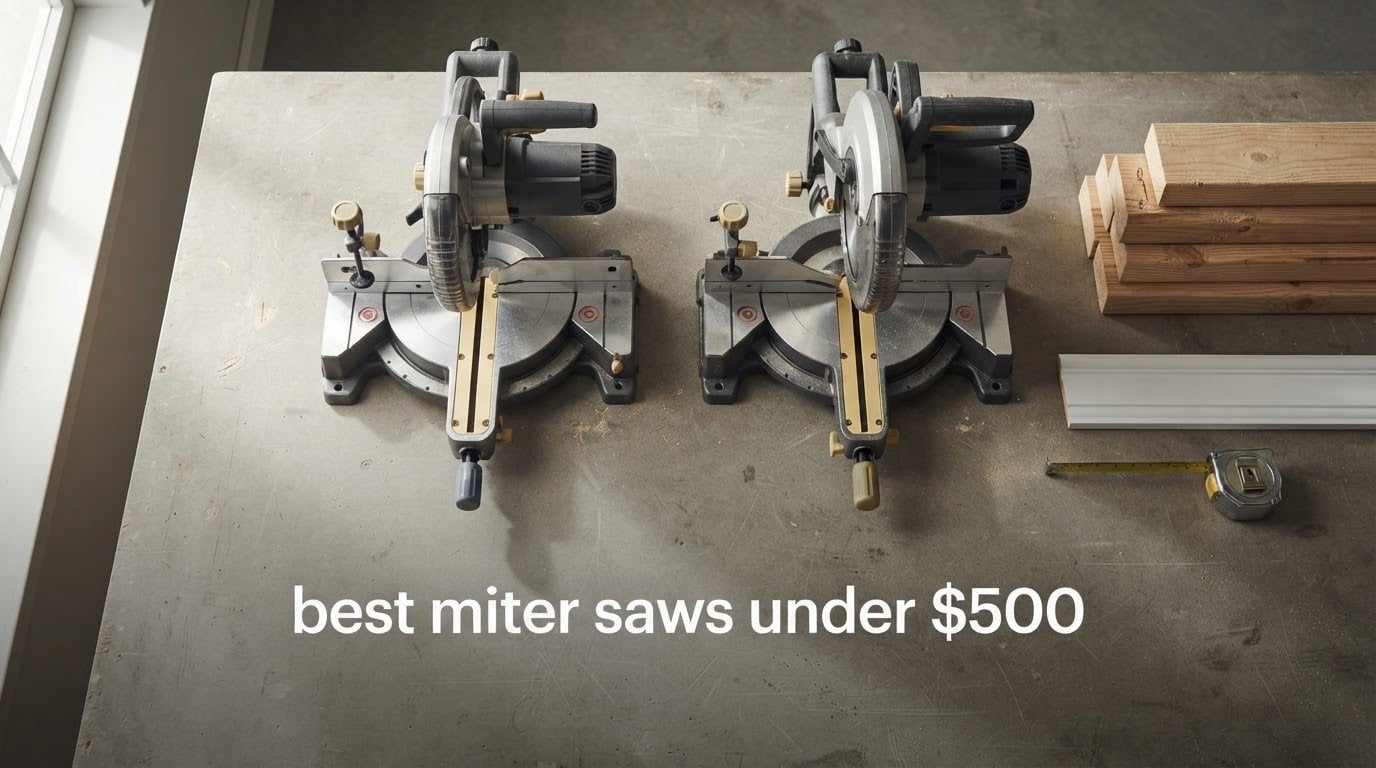
Most miter saw roundups quietly drift upward. One covers a 200-dollar starter, the next jumps to 800-dollar shop machines, and the reader is left doing the arithmetic. This one is different. Every saw below was checked against a hard ceiling of 500 dollars, so if you are planning a trim job, a deck frame, or a run of picture frames, you can pick from this list without wondering whether you overshot.
We spent several weeks comparing eight miter saws against each other and against owner feedback, focusing on the things that decide whether a saw is a pleasure or a headache: out-of-the-box squareness, how the miter detents actually hold an angle, whether the dust port works with a shop vac, and how much bench space the thing eats. Four of these eight are sliding models, and the space question comes up more than any other complaint we found.
Our methodology is spec plus verified owner reviews, not a lab bench. We cross-checked the manufacturer ratings and review counts and the recurring themes in owner feedback, and we flag the units where the out-of-box accuracy needed correcting. If you want the short answer first, jump to the quick answer section below. For a narrower look at trim-specific picks, our best miter saws for trim carpentry guide goes deeper on fence alignment and crown molding setups.
Table of Contents
Quick Answer: What Is the Best Miter Saw Under 500?
The best miter saw under 500 dollars right now is the DEWALT DWS779, a 12-inch dual-bevel sliding compound saw that crosscuts 2×14 lumber at 90 degrees and comes with a dust bag, blade wrench and material clamp. It is heavier than most of the list, but its dual-rail carriage and stainless detent plate hold repeat miters far better than cheaper sliders.
Here is how the eight picks divide up:
DEWALT DWS779 – best overall under 500
DEWALT DWS715 – best for trim and crown molding
SKIL MS6305-00 – best value sliding miter saw
DEWALT DWS713 – best miter saw for beginners
EVOLUTION R185SMS+ – best for cutting metal
DOVAMAN 10 in. Sliding Miter Saw – budget pick with dual-speed control
Makita LS1040 – best for small garage shops
Delta 10 in. Sliding Compound – best for 2x lumber crosscuts
Top 3 Best Miter Saws Under 500 (October 2026)


All 8 Miter Saws Under 500 Compared in 2026
The full lineup, with the spec that matters most for each one. Prices shift constantly, so use the buttons to confirm the current figure against the 500-dollar ceiling before you buy.
| Product | Specifications | Action |
|---|---|---|
| DEWALT DWS779 12 in. Sliding Dual Bevel |
|
Check Latest Price |
| DEWALT DWS715 12 in. Single Bevel |
|
Check Latest Price |
| SKIL MS6305-00 10 in. Dual Bevel Slider |
|
Check Latest Price |
 DEWALT DWS713 10 in. Single Bevel DEWALT DWS713 10 in. Single Bevel |
|
Check Latest Price |
 EVOLUTION R185SMS+ 7-1/4 in. Sliding EVOLUTION R185SMS+ 7-1/4 in. Sliding |
|
Check Latest Price |
 DOVAMAN 10 in. Sliding Miter Saw DOVAMAN 10 in. Sliding Miter Saw |
|
Check Latest Price |
 Makita LS1040 10 in. Compound Makita LS1040 10 in. Compound |
|
Check Latest Price |
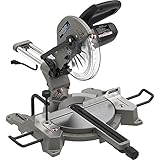 Delta 10 in. Sliding Compound Delta 10 in. Sliding Compound |
|
Check Latest Price |
1. DEWALT DWS779 – Best Overall Under 500
DEWALT Miter Saw, 12 Inch Double Bevel Sliding Compound Miter Saw, Includes Blade Wrench and Clamp, Increased Crosscut Capacity, Powerful 3800 RPM Motor 15 Amp (DWS779)
12-inch blade
15 Amp 3800 rpm
Dual bevel 49 degrees
2x14 at 90 degrees
67.7 lb
Pros
- Dual bevel on both sides so you never flip the workpiece
- 2x14 crosscut capacity at 90 degrees
- Ten positive stops on a stainless detent plate
- Tall sliding fence holds crown molding up to 7-1/2 in. nested
- Ball-bearing dual rails keep the head smooth
Cons
- Heaviest saw in the group at 67.7 lb
- Rails need periodic cleaning and lubrication
- Dust collection is efficient but not complete
This is the saw I keep coming back to. The DWS779 is a 12-inch dual-bevel slider with a 15 Amp, 3800 rpm belt-drive motor, and it is the only machine in this group that crosscuts 2×14 dimensional lumber at 90 degrees. That single spec is why it wins the overall award: it handles the widest range of material without a second saw.
Owner feedback on this model is remarkably consistent. People who have had one for years still describe the detents as repeatable and the tall sliding fence as the reason crown molding stays put instead of tipping out of the cut. With a 4.8 rating across more than 9000 reviews, it is the most proven machine here.
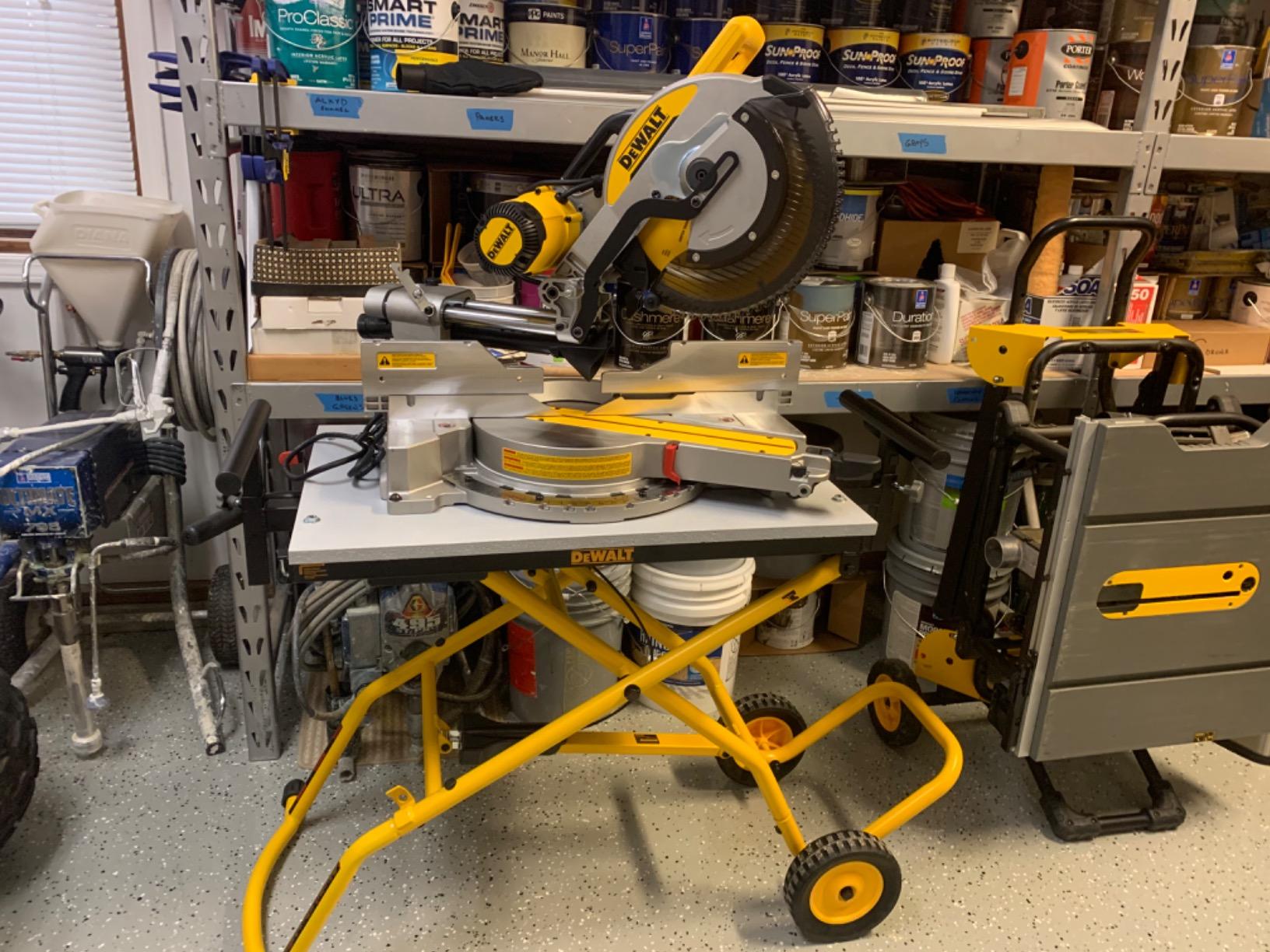
Compound cuts are where the dual bevel earns its keep. With a 49-degree bevel on both sides, a crown cove cut does not require turning the workpiece over and risking a mark on a finished face. The miter range runs 60 degrees one way and 50 the other, and the cam-lock miter handle with detent override lets you nudge past a stop for non-standard angles without losing your reference.
The included kit is unusually complete for a saw at this level: a carbide blade, blade wrench, vertical material clamp and a dust bag that captures the majority of what the cut produces. Buyers regularly hook the port to a shop vac anyway, which is the right call on any miter saw.
What you need to know before you commit?
Rear clearance is the first thing. A 12-inch dual-bevel slider needs roughly 40 inches of front-to-back room to run the head out at full extension. Measure your wall-to-wall space before the box arrives, because a slider that cannot extend is just a heavy non-slider.
The 67.7-pound weight is real. Moving this between rooms takes two hands, and lifting it onto a stand above chest height is awkward. If your shop is upstairs or your work happens in a carport, read pick number seven instead.
Who this saw is wrong for?
If you only cut baseboard, chair rail and picture frame stock, you are paying for capacity you will never touch, and you are carrying a machine most of the room. A 10-inch non-slider is lighter, cheaper and easier to store for trim-only work.
It is also the wrong pick for a small garage where the saw has to share a bench with other tools. The footprint of 32.5 by 23 inches is real estate a 10-inch box simply does not need. For heavy lumber work with room to swing, though, nothing else here matches it.
2. DEWALT DWS715 – Best for Trim and Crown Molding
DEWALT 12-Inch Miter Saw, 15-Amp, Single Bevel, Compound (DWS715)
12-inch 80T blade
15 Amp 4500 rpm
Single bevel 0-48 degrees
2x8 at 90 degrees
42.8 lb
Pros
- XPS shadow line is clear and needs no batteries
- 14 positive stops on a stainless detent plate
- Accurate out of the box after a square check
- Light for a 12-inch saw at 42.8 lb
- Compact footprint for a small shop
Cons
- Single bevel means flipping the workpiece for one side
- Supplied material clamp is weak and uncomfortable
- No slide-out material supports
- Stock power cord is short
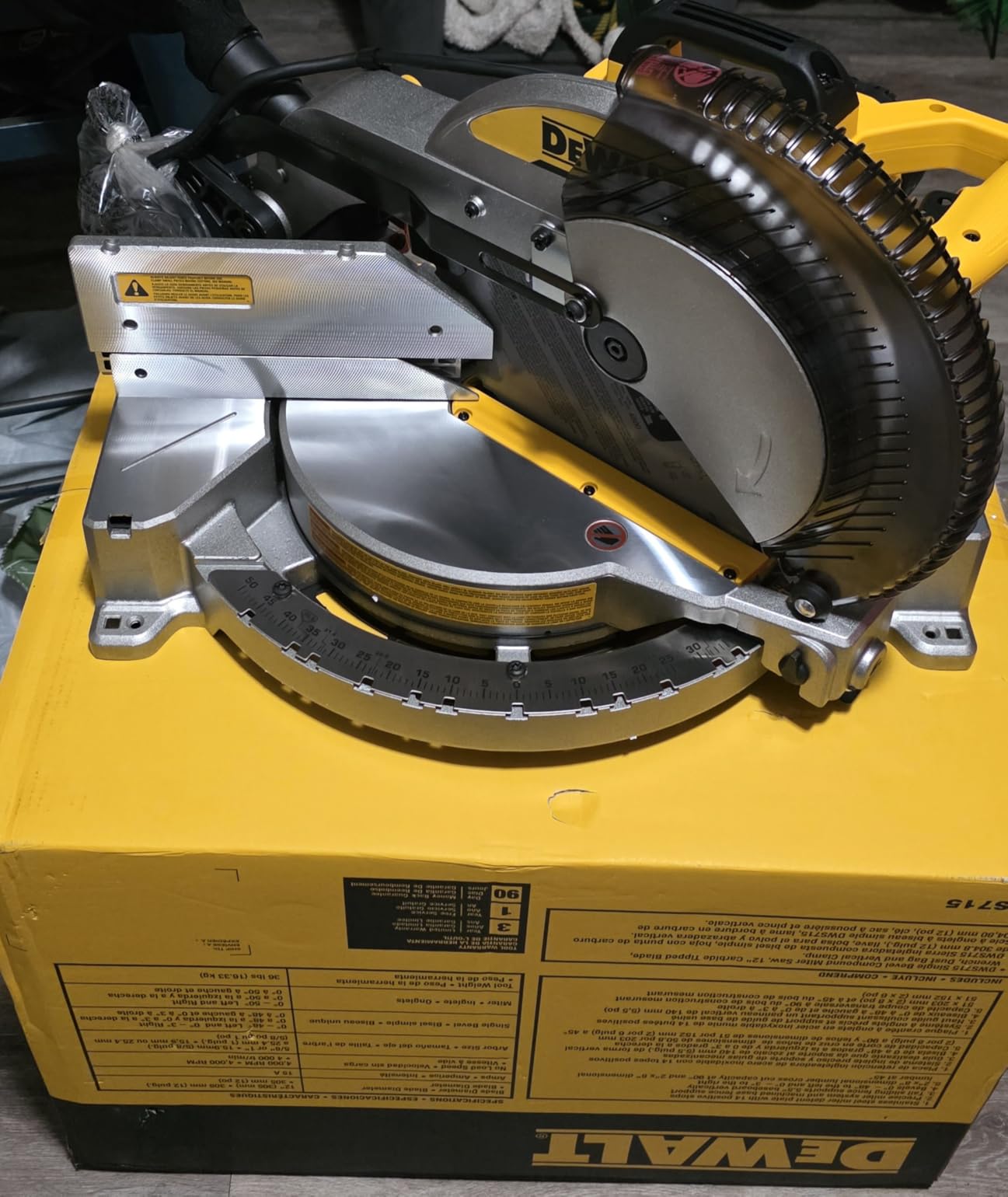
The DWS715 is the trim specialist of this list, and the reason is the XPS cut line. Instead of a laser that drifts with battery level and temperature, it casts a shadow line from the blade tooth directly onto the workpiece. There is nothing to calibrate and nothing to replace, and the line stays visible in a bright shop.
With a 12-inch 80-tooth blade, a 4500 rpm motor and 14 positive stops on a stainless detent plate, this is a genuinely capable crosscut saw for 2×8 lumber at 90 degrees and 2×6 at 45. Owner feedback repeatedly praises the factory accuracy, and most buyers report cutting square with nothing but a tape-measure check.
At 42.8 pounds it is roughly 25 pounds lighter than the DWS779, and the footprint is small enough to live on a bench in a one-car garage. If you cut a lot of baseboard and cove stock, a lighter saw that you will actually move is worth more than a heavier one that stays in the corner.
The electric brake in the transparent blade guard brings the blade to a stop quickly, which is a real safety and workflow gain when you are making repeated trim cuts. The tall fence also holds 5-1/2-inch base molding vertically, so wide trim does not rock out of position.
Why the single bevel is a non-issue for most trim work?
Bevel here runs 0 to 48 degrees on one side and 0 to 3 on the other. For interior baseboard, casing and face frames, that covers essentially everything. The limitation only bites on two-sided compound cuts, which are rare in residential trim and common in cabinet work.
Two smaller notes from owner feedback worth planning around. The included vertical clamp is the most commonly criticized part, so budget for an aftermarket hold-down. The cord is also short for a wall-to-wall baseboard run, and most owners add an extension.
Where it falls short?
There is no slide, so 2×10 and 2×12 will not crosscut at 90 degrees. If your project list includes dimensional framing rather than trim only, you are looking at the wrong machine or you need the DWS779.
It is also single-bevel, which matters if you plan built-ins and want to compound both sides of a leg without flipping the board. Trim carpenters tend to accept that trade without blinking. Our trim carpentry miter saw guide goes deeper on the fence and clamping setup that makes these cuts repeatable.
3. SKIL MS6305-00 – Best Value Sliding Miter Saw
SKIL 10″ Dual Bevel Sliding Compound Miter Saw-MS6305-00
10-inch blade
15 Amp 4800 rpm brushless
Dual bevel
2x12 at 90 degrees
39.4 lb
Pros
- Dual bevel on a 10-inch slider is rare at this level
- LED shadow line stays accurate without batteries
- Quick-acting hold-down clamp stores on the saw
- Reports square and true out of the box
- Light enough to move between jobs
Cons
- Some units arrived with an over-torqued arbor nut
- No blade brake so the blade spins down slowly
- Wide blade recess often requires kerf tape
Most dual-bevel sliders are 12-inch machines priced at the top of the band. The SKIL MS6305-00 breaks that pattern: a 10-inch dual-bevel slider with a brushless motor spinning to 4800 rpm, 11 positive stops and miter range to 50 degrees on both sides, all well inside the ceiling.
For a homeowner doing picture frames, molding and occasional 2×12 crosscuts, this is the most capable machine per dollar in the group. The 4.6 rating across more than 2200 reviews is not the highest here, but the complaints are narrow and mostly about assembly, not cut quality.
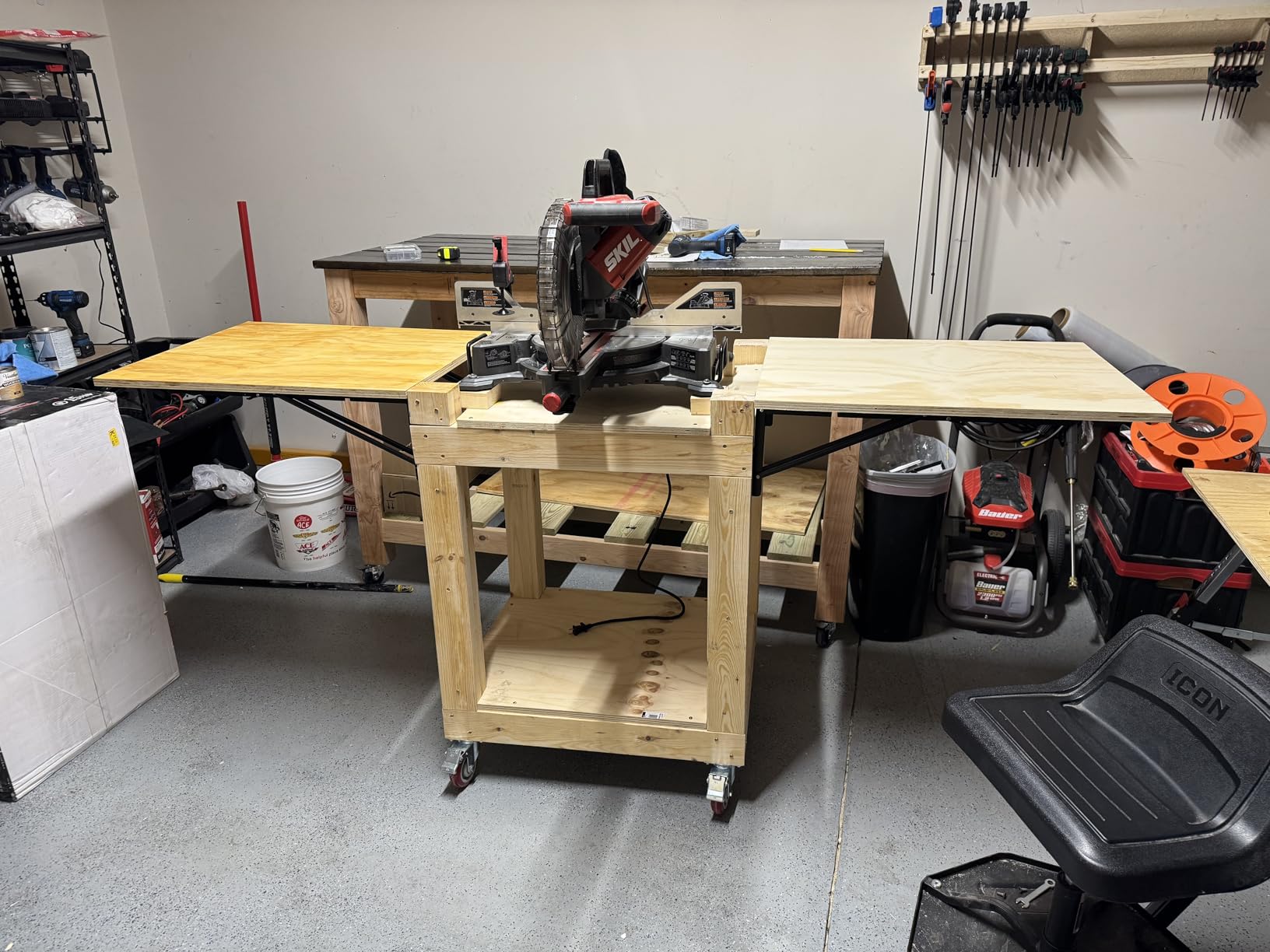
The LED shadow line is the feature owners single out most. It is cast by a dedicated lamp rather than the blade itself, so it stays crisp and visible regardless of speed, and it needs no battery to keep working. Several buyers describe it as easier to read than a laser line in a bright garage.
The included quick-acting clamp is genuinely unusual at this tier, and it stores in a slot on the saw instead of rattling loose in the box. It makes short trim cuts much less frustrating, because you can clamp, measure and cut without reaching for a separate hold-down.
Checking the two known quirks on day one
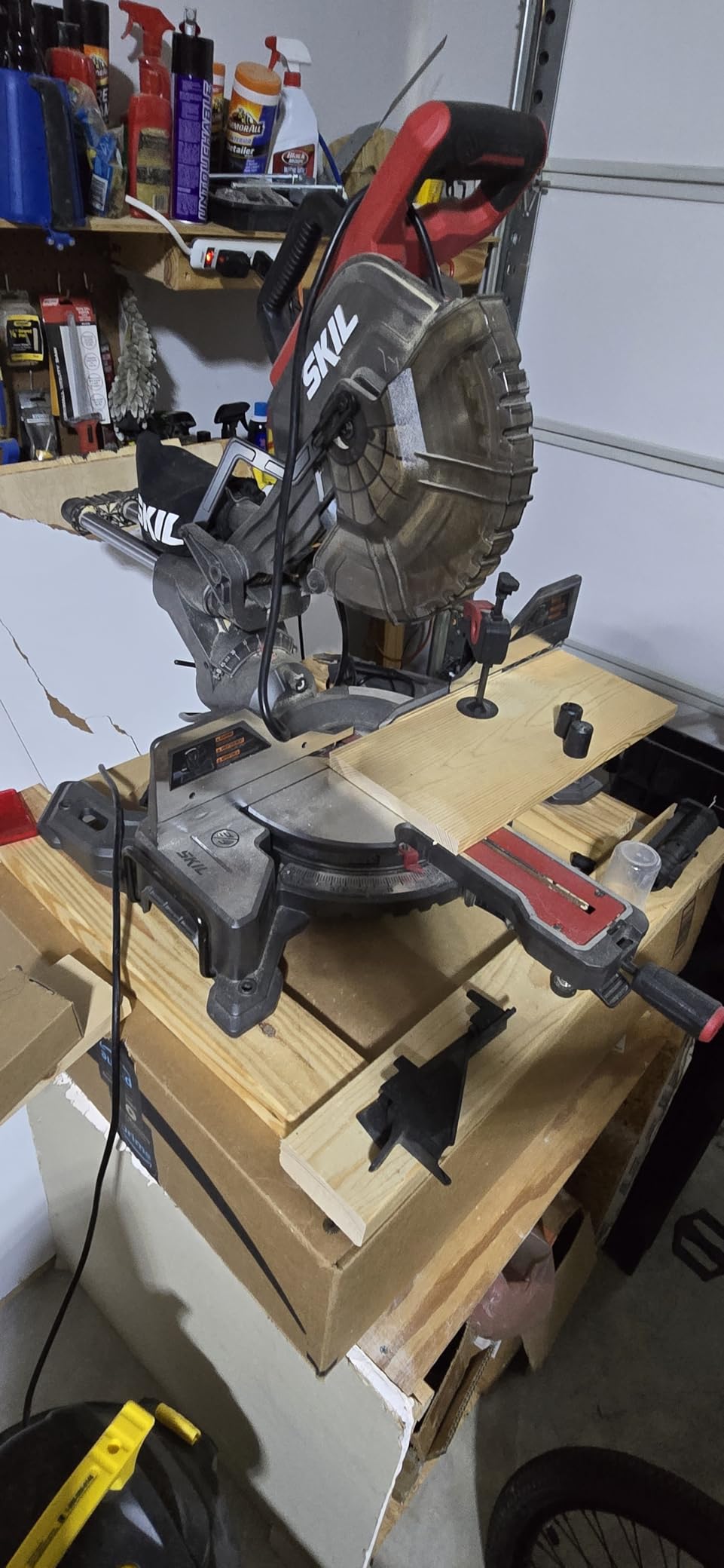
Two fit-and-finish items show up often in owner feedback. The blade arbor nut on a few examples arrives over-torqued, which can block a blade change until you work it loose, and the head lock pin can refuse to release if the saw is not bolted or clamped to a surface first. Budget ten minutes for both before your first cut.
Also note there is no blade brake. The blade spins down after each cut, so you wait a few extra seconds before the next one, and you keep your hands clear of the arbor area longer than you would on a braked saw.
How it compares to the value-tier alternatives?
Against the Harbor Freight and unbranded marketplace listings that dominate the shopping results for this query, the SKIL wins on documentation, warranty service and the availability of replacement parts. Those machines can be cheaper on a given day, but a saw you cannot get serviced is a poor value at any figure.
Where it loses to the DWS779 is capacity. Two by twelve at 90 degrees is useful, but a 12-inch blade still wins on tall trim, wide casing and dimensional lumber. If your material never exceeds 10 inches, the SKIL is the smarter buy.
4. DEWALT DWS713 – Best Miter Saw for Beginners
DEWALT Miter Saw, Single Bevel, Compound, 10-Inch, 15-Amp (DWS713)
10-inch 80T blade
15 Amp 5000 rpm
Single bevel 0-48 degrees
2x6 at 90 degrees
31 lb
Pros
- Only 31 pounds so one person can set it up
- Compact 24.8-inch footprint
- 14 positive stops dial in repeatably
- Comes with an 80-tooth finishing blade
- Reported as square out of the box
Cons
- Single bevel only
- Weak dust collection
- No laser or shadow cut line
Newcomers do not need the biggest saw, they need the simplest one. The DWS713 is a 10-inch single-bevel compound saw that weighs 31 pounds, has 14 positive stops and a detent plate you can read at a glance, and it fits on a folding stand in about a minute.
At 5000 rpm with a 15 Amp motor, it has plenty of speed for trim and 2x lumber, and the crosscut capacity of 2×6 at 90 degrees covers the framing most beginners actually cut. The 4.8 rating across nearly 1400 reviews reflects a design that has been in production long enough that parts and advice are easy to find.
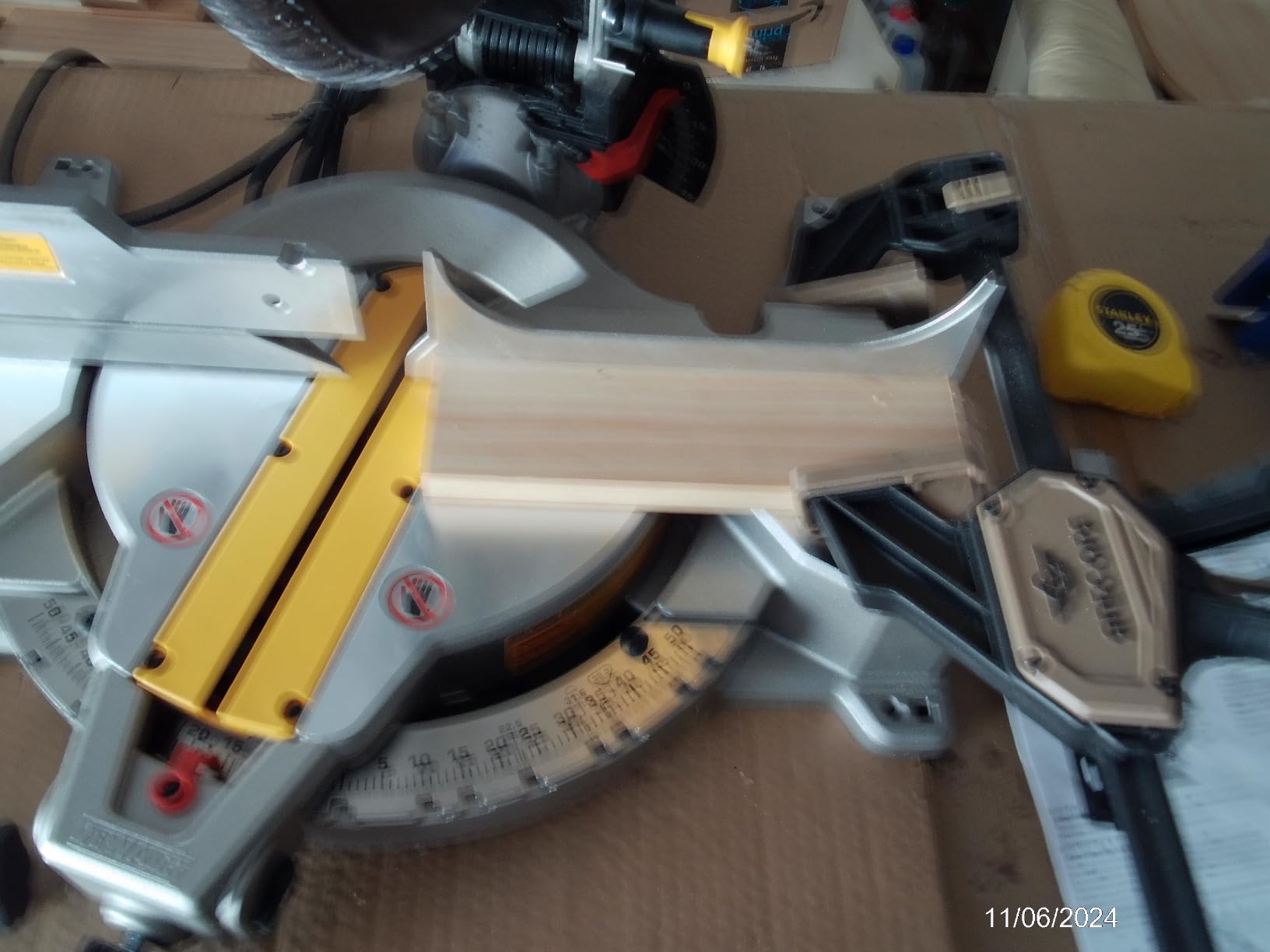
There is no cut line indicator on this model, and that is the honest trade. Accuracy comes from the machined base fence and the detents, which is a slower way to work but a very forgiving one for a first project. Measure, snap the detent, cut. The fence does not drift.
The included 80-tooth carbide blade is a finishing blade, which means your first cuts come out cleaner than most owners expect from a budget saw. If you later want a rip blade for rough lumber, that is a separate purchase worth making deliberately.
What makes this the easiest saw to learn on?
A non-sliding head cannot develop the side-to-side play that sliders pick up over time, so a miter angle set this morning behaves the same way next month. For someone building habits around square cuts, that predictability is worth more than capacity.
At 31 pounds it is also the saw you can carry to a job, set on a folding stand and pack away at the end of the day. The 24.8-inch length is short enough to leave room for a workbench on the same wall.
What you give up?
Crosscut capacity tops out at 2×6 at 90 degrees, so 2×8 and wider need a different tool. Dust collection is the weak point here, with most owners hooking the port to a shop vac. And the single bevel only tilts to one side, so a two-sided compound cut means flipping the workpiece.
None of that is a dealbreaker for trim and light framing, and it is the reason this saw sits at the approachable end of the lineup. Outgrow it in a few years and you will know exactly which feature you were missing.
5. EVOLUTION R185SMS+ – Best for Cutting Metal
Evolution Power Tools R185SMS+ Sliding Miter Saw with Multi-Material Cutting, 45 Degree Bevel, 50 Degree Miter, 210 mm Slide, Blade Included Cuts Wood Plastic Metal & More, 7-1/4″
7-1/4 inch TCT blade
10 Amp 3700 rpm
45 degree bevel
50 degree miter
210 mm slide
Pros
- Only saw here that cuts mild steel dry
- Minimal heat and sparks with no coolant
- Handles plate
- tube
- angle iron and roofing
- Cast base adds rigidity
- Useful for flooring and light steel trim
Cons
- Only a 7-1/4 inch blade
- 10 Amp draw is well below the rest of the group
- Metal capability limited to mild steel
- No laser or shadow line listed
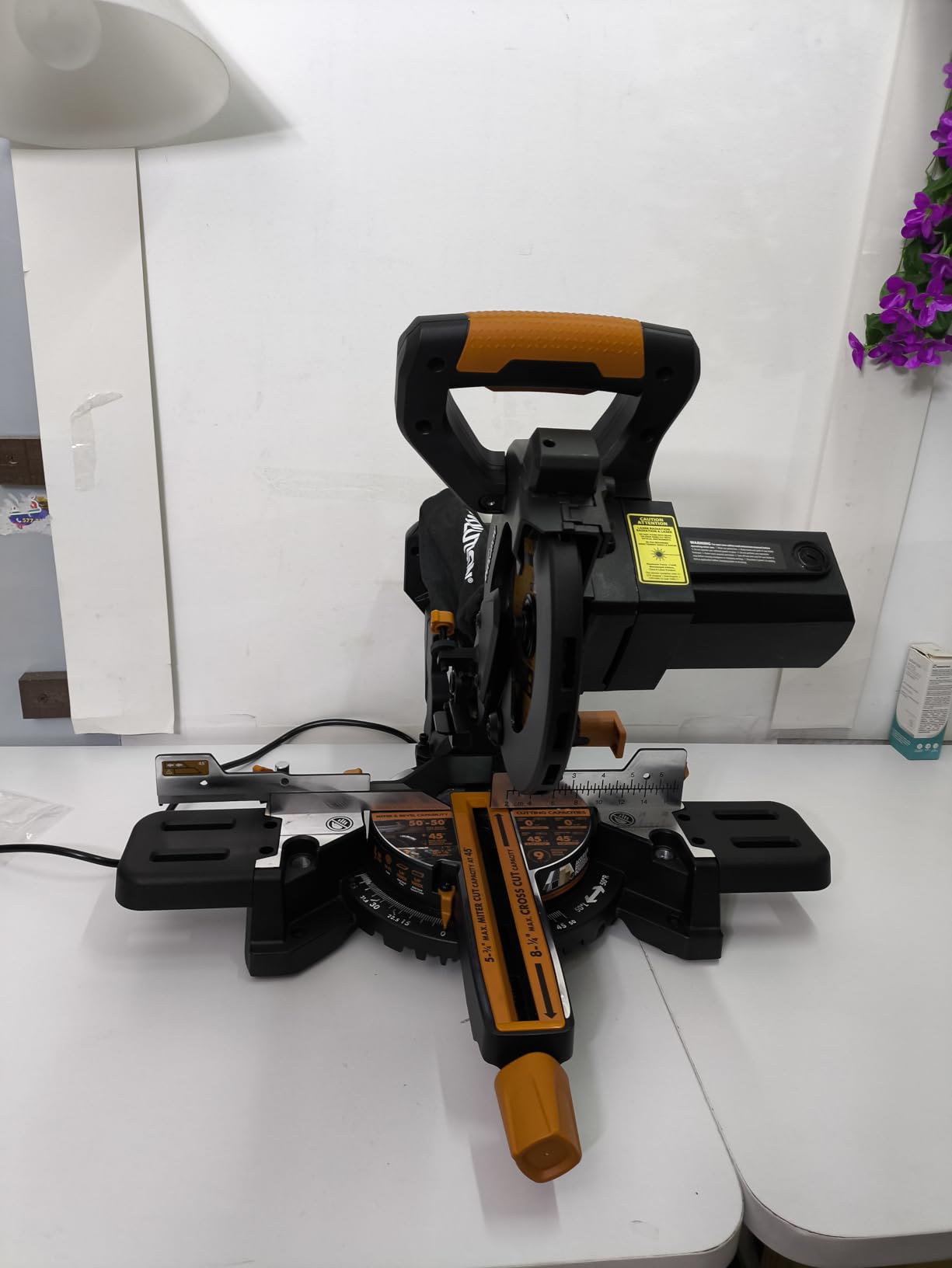
No other miter saw in this roundup cuts metal, so this pick exists for a specific reason. The EVOLUTION R185SMS+ uses a tungsten carbide tipped blade and a dry cutting process that shears through mild steel without coolant, sparks or heat. Reviewers who own it for flooring, trim and light steel work describe the edge quality on the cut as immediately workable.
It is also a legitimate woodworking saw. The 210 mm slide, 45-degree bevel and 50-degree miter give it usable capacity in a compact package, and the 3-year warranty covers a tool that will be used outside the shop as often as inside it.
Blade life is the headline number here. The tungsten carbide blade averages roughly 1000 cuts in 2 by 2-inch mild steel, which means the blade pays for itself long before it needs attention on wood. That is a different cost equation from a 60-tooth framing blade that you would never touch to metal.
The cast base and high-torque gearbox reduce motor load, which is why a 10 Amp saw can still work metal where a higher-amperage saw with a wood blade would stall. For steel plate, square tube, angle iron, pipe and metal roofing, it handles a genuinely different material set than the other seven picks.
When this saw is the right tool?
Choose it if your projects cross materials: metal roofing trim, aluminum or steel edging, flooring that needs a clean crosscut, or general shop work where a dedicated abrasive chop saw would otherwise be a second purchase. One saw covers the range, and the blade change is the only step between jobs.
It also suits a small shop, since 7-1/4-inch machines store more easily than 12-inch boxes and the vertical profile leaves more room on a bench for clamping and workholding.
When it is the wrong tool?
If your material list is dimensional lumber and trim, this is the wrong saw. A 7-1/4-inch blade cannot crosscut a 2×8, and the 10 Amp draw will feel slow in thick hardwood compared with the 15 Amp machines here.
It is also a wood-and-mild-steel tool, not a general metal shop machine. Stainless, hardened steel and heavy structural sections are outside its range. If metal is an occasional task rather than a regular one, a dedicated abrasive chop saw is a better division of tools.
6. DOVAMAN 10 in. Sliding Miter Saw – Budget Pick With Dual-Speed Control
DOVAMAN 10-Inch Sliding Miter Saw, Multi-Material, 2-Speed, 15A
10-inch blade
5000 and 3200 rpm
15 Amp 2000 watts
2-speed
3.5 by 13.4 in. capacity
Pros
- Lowest cost in the group
- Three TCT blades and spare carbon brushes included
- Dual speed handles wood
- PVC and soft metal
- 13-inch rail with extendable side tables
- Laser guide reported as accurate by buyers
Cons
- Needs out-of-box squareness correction on some units
- Printed manual is poor
- Plastic adjustment hardware
- Must be tied down to avoid tipping
The DOVAMAN 10-inch sliding miter saw is the least expensive saw here, and the inclusion list is the reason: three TCT blades, two spare carbon brushes, a support clamp and a dual-speed motor in a 10-inch sliding frame. Most of the other picks ship with one blade and no spares.
Two speeds is a genuinely useful idea. At 5000 rpm the saw cuts wood cleanly, and dropping to 3200 rpm for PVC and soft metals reduces binding and heat. That is a design choice you rarely see from name-brand machines in this price band, and owners who use it for more than lumber tend to notice the difference.
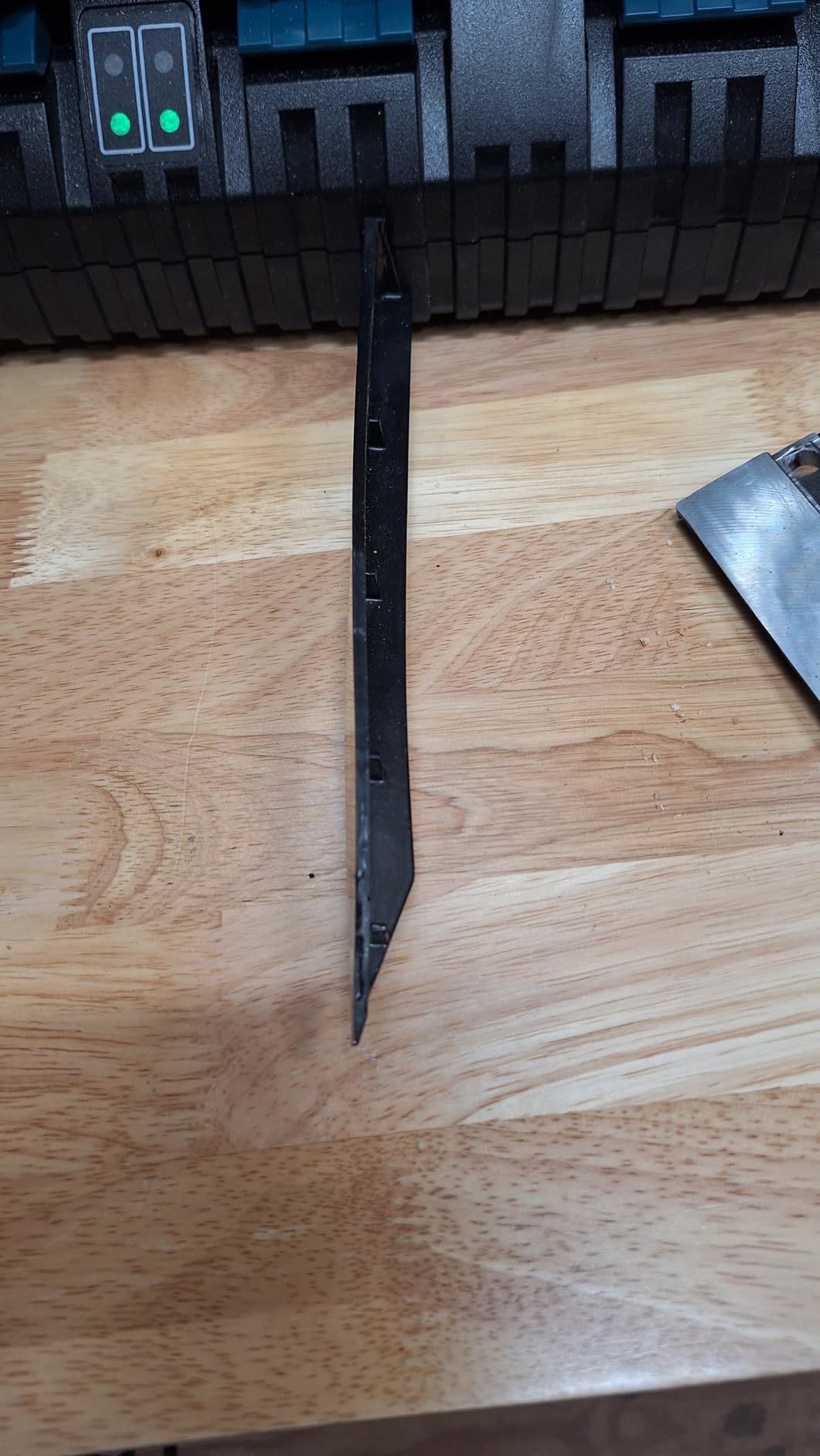
The 13-inch rail and extendable side tables give a listed maximum cutting capacity of 3.5 by 13.4 inches, which is more than a typical non-slider in this group can manage. The laser guide is reported as accurate and easy to see, and the ambidextrous start buttons are a small touch that matters if you are left-handed.
Service is worth noting. Multiple reviews single out fast, generous replacement support, which is often the deciding factor when a machine carries a lesser-known brand name. Reliable support can outweigh a slightly better spec sheet from a bigger name.
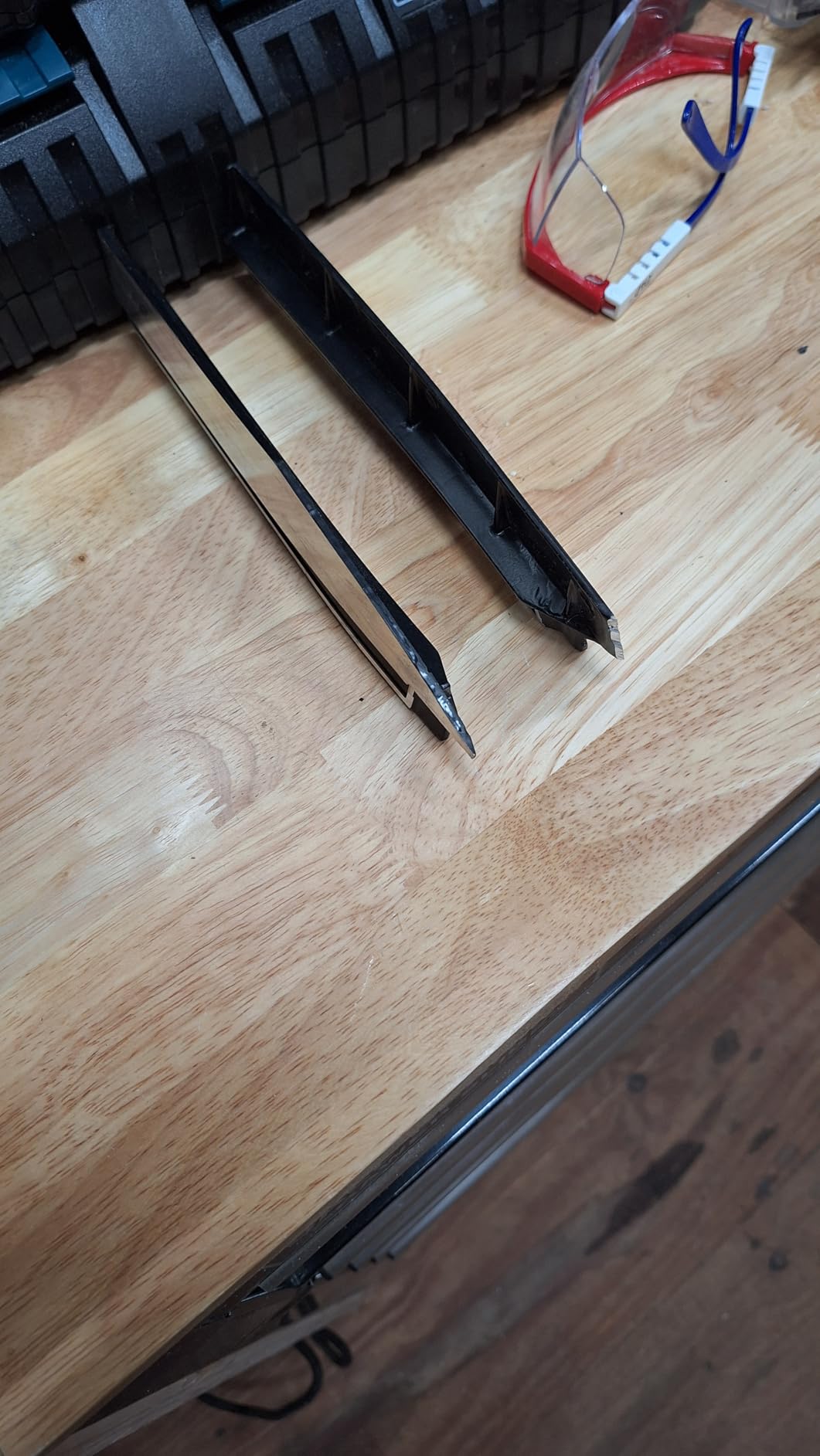
Check the square before your first cut
The 4.3 rating is the lowest in the group, and the reason is specific rather than general. Some owners found the saw cutting at 89 degrees on arrival, correctable through the back plate adjustment. That is a five-minute check with a speed square, and it should be the first thing you do after unpacking.
Other recurring notes: the printed manual is thin on useful detail, the plastic adjustment hardware including the clamp knobs feels light, and a few owners reported blade alignment drifting with carbide tooth chipping over time. Quality control is the weak link here, not the design.
How to spot a listing you should skip?
Shopping results for this query are full of unbranded marketplace listings with invented-sounding names, no manufacturer, no warranty terms and no service address. A red flag checklist: no stated warranty length, no manufacturer part number, a spec panel that contradicts itself, and a seller with no history.
Buying from a known retailer, with a stated return window and a brand that publishes part numbers, protects you far more than a lower number does. If a listing is priced far below the rest of the field, the reason is usually missing support rather than a better saw. For wet-room and tile-adjacent trim work, we keep a separate guide to tile saws for bathroom remodels since those cuts are better made wet.
7. Makita LS1040 – Best for Small Garage Shops
Makita LS1040 10″ Compound Miter Saw
10-inch 40T blade
15 Amp direct drive 4600 rpm
9 positive stops
5-1/8 in. max cut
27 lb
Pros
- Lightest and smallest saw in the roundup at 27 lb
- All-metal construction with a machined aluminum base
- Single-pivot head holds rock solid
- Direct drive with soft start
- Needs no adjustment out of the box
Cons
- Blade stops about 1/8 inch short of cutting a 1x6 fully
- Vertical vise is loose on 1x material
- Extension wings sold separately
- Blade retaining bolt is stubborn to remove
The LS1040 is the oldest design in this group and the one carpenters keep coming back to for trim. At 27 pounds with a 20-inch footprint, it is the smallest saw on the list by a wide margin, and the single-pivot head has none of the side-to-side play that a worn slider develops.
Carpenters favor it for a specific reason: a single-pivot arm cannot shift, so a miter angle that was true in the morning is true in the evening. With a 4.7 rating across more than 650 reviews, the consensus is that this design is simply difficult to knock out of alignment.
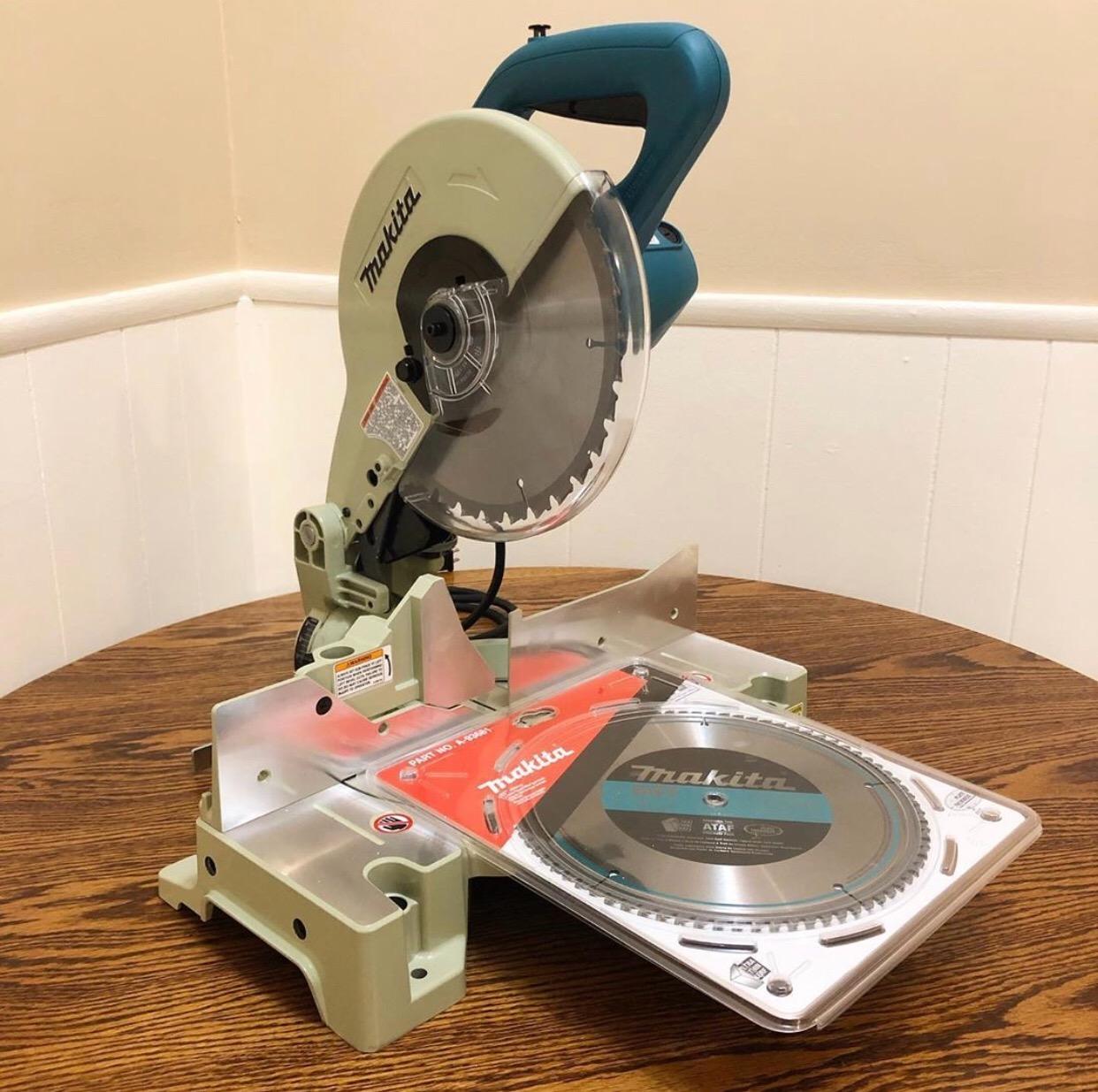
The 15 Amp direct-drive motor with soft start runs at 4600 rpm, and the miter range is 0 to 45 degrees on one side and 0 to 52 on the other, with nine positive stops including the common angles for trim and framing. The soft start matters more than it sounds: it reduces the startup bang that startles people into dropping workpieces.
It is also a one-person carry saw. You can set it on a workbench, move to a different project, and put it away without recruiting help, which is the difference between owning a tool and using one.
Two engineering details to plan around
First, the maximum cutting length is listed at 5-1/8 inches, and owners point out the blade stops about 1/8 inch short of cutting fully through a 1×6. A narrow rip or a piece of trim fitted in the corner of the base will hit that limit.
Second, the vertical vise does not clamp tightly on 1-inch material without adding a block behind it. A better hold-down is a small, cheap fix and the first upgrade most owners make.
Who should look elsewhere?
If you crosscut dimensional lumber regularly, the 5-1/8-inch limit is restrictive, and a 10-inch slider such as the SKIL or Delta will serve you better. The single bevel also stops at 45 degrees on one side, so heavy compound work is out of scope.
Extension wings are also sold separately here, which is a common surprise for first-time owners who expect a fully supported base out of the box. If your shop is tight on space and light on heavy lumber, this is the saw to buy. In a small garage, bench space is the scarce resource.
8. Delta 10 in. Sliding Compound – Best for 2x Lumber Crosscuts
Delta – 10 in. Compound Sliding Miter Saw
10-inch 60T blade
15 Amp 5500 rpm
2x12 at full bevel
Spindle lock
29.5 lb
Pros
- Deep throat gives real crosscut capacity for a 10-inch saw
- Solid metal build with no flexy plastic parts
- Cuts 2-inch thick pine with ease
- Accurate with factory settings
- Spindle lock simplifies blade changes
Cons
- Laser guide is weak and best used indoors
- Louder than most competing saws
- Dust bag is ineffective and can cover the slide bars
- Material support brace is not attached
- Short power cord
The Delta Shopmaster is the value pick for anyone who mainly wants to crosscut framing lumber. Its deep throat is what separates it from a conventional 10-inch non-slider, and it still manages a listed 2×12 capacity at full bevel. At 5500 rpm with 15 amps, owners report cutting 2-inch thick pine without effort.
Build quality gets consistent mention. Metal construction, no flexy plastic parts, and a spindle lock that holds the arbor while you loosen the blade nut. Several owners note that the cord exits the rear of the slide bar, which protects the rails from a sawdust-filled plug.
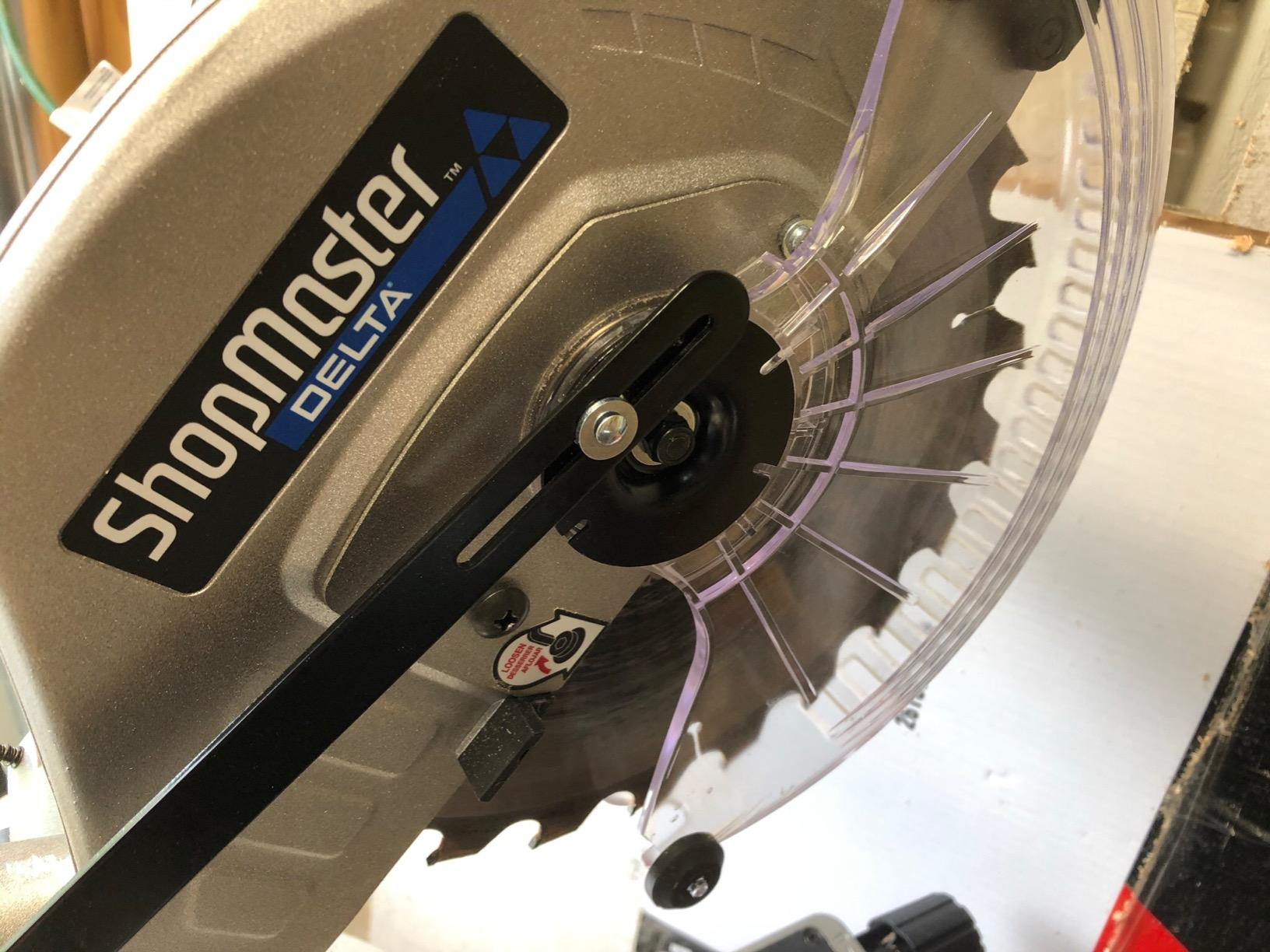
It weighs 29.5 pounds, so it moves like a non-slider despite having rails, and it carries a 3-year warranty. For a weekend project shop that wants sliding capacity without a 60-pound commitment, the geometry is unusually good.
One safety note that shows up repeatedly in reviews: several negative experiences trace back to starting the blade against the workpiece, which causes kickback. The manual warns against it. Let the blade reach full speed in free air first, then bring it down onto the material.
What to fix before the first session?
The dust bag is the weak point. It does not effectively capture anything, and it can sit over the slide bars, so the first job is a shop vac and, ideally, removing the bag entirely. The material support brace also arrives unattached, and it is easy to lose, so tape it down once installed.
The laser guide is another honest weakness. Multiple buyers report it arriving misaligned and recommend treating it as an indoor convenience rather than a precision reference. If accurate alignment matters, verify with a square instead of trusting the laser.
Where it sits against the other sliders?
Against the SKIL MS6305-00, the Delta wins on crosscut depth and speed but loses on the cut line system and dual bevel. Against the DEWALT DWS779, it wins on weight and loses on blade diameter, dust collection and fence height.
For a trim-focused buyer it is a compromise, but for someone framing a deck or a set of stairs, a saw that crosscuts 2×12 and weighs under 30 pounds is a genuinely useful tool. Just budget a shop vac and a better hold-down on the way to owning it.
What Owners Complain About Most?
Across thousands of owner reviews of saws in this class, four complaints come up repeatedly, and they matter more than any single spec number.
Dust collection is universally poor. Owners describe the bags as ineffective in plain language and hook nearly every saw to a shop vac instead. Bags clog, airflow drops further, and the mess lands on the slide rails. A dust hood or a vac is a real upgrade, not a luxury.
Detents and positive stops are sometimes described as loose. A stop that does not hold produces a miter that is off at 45 degrees, which is unusable for interior trim because the joint will not close. Check your saw with a speed square on arrival and calibrate before the first project.
Sliding saws demand rear clearance. Extending a 12-inch slider needs roughly 40 inches of front-to-back space, and this is the most common regret among owners. If you cannot swing the head out fully, choose a non-slider such as the Makita LS1040 or the DEWALT DWS713 instead.
Kerf marks show on finished faces. Crown molding and casing get torn on the exit side when the blade is dull or the wood is figured. A sharp 60-tooth or higher blade, clear tape over the blade recess, and supporting the workpiece on both sides fix most of it. A better blade upgrades a budget saw more than any other purchase.
Buying Guide: How to Spend a 500-Dollar Miter Saw Budget?
Sliding or non-sliding, and how much room you have
A non-sliding saw has a fixed head position and crosscuts roughly 6 inches of 2x lumber on a 10-inch model, or about 8 inches on a 12-inch model. A sliding saw roughly doubles that, which is the difference between a shop that frames decks and a shop that handles trim only.
Before choosing a slider, walk to the back wall and mark the space. A 10-inch slider needs around 30 inches of front-to-back room; a 12-inch dual-bevel slider needs closer to 40. Axial-glide designs exist precisely to solve this, but none sit in this price band. If your garage is tight, a non-slider is not a compromise; it is the right call.
10-inch or 12-inch blade
A 12-inch blade is worth it for tall trim, wide casing, baseboards and any dimensional lumber over 2×8. A 10-inch saw is lighter, cheaper and easier to move, and it handles the overwhelming majority of home trim work. If your longest piece is baseboard or chair rail, a 10-inch machine will not disappoint you.
Be aware of the height difference too. The 12-inch models here are noticeably heavier, and the DWS779 at 67.7 pounds is a two-person lift in some setups. The Makita at 27 pounds is the opposite end of the scale.
Single or dual bevel
A dual-bevel saw tilts both ways, so compound cuts on both sides of a workpiece happen without flipping the board. That saves time and protects finished faces. A single-bevel saw tilts fully to one side only, which is fine for one-sided trim and light framing.
If you plan built-ins, crown cove work or anything with two compound edges, dual bevel earns its cost. If you are hanging baseboard, it does not matter.
Laser guide or LED shadow line
A laser projects a thin line and drifts with battery level, temperature and vibration, and it can be knocked out of alignment by a knock to the saw. An LED shadow line is cast from a fixed lamp onto the workpiece and needs no calibration, which is why it wins on our list for accuracy-sensitive work.
Either way, verify alignment with a speed square on day one. A cut line indicator is a guide, not a guarantee.
Dust collection, and how to improve it
No miter saw in this price range collects dust properly, and the question of which has the best dust collection has a blunt answer. The DEWALT DWS779 is the strongest of the set on paper, with a bag that captures the majority of cut debris and a port that pairs well with a hose.
Five practical improvements apply to any saw here. First, run a shop vac instead of the cloth bag. Second, fit a dust hood or elbow so the port seals to a 4-inch hose. Third, keep a brush and a compressed-air blast available for the slide rails. Fourth, empty the bag before it packs down, since a full bag is the biggest cause of poor capture. Fifth, cut with the workpiece supported on both sides so the dust shoots into the hood instead of across the bench.
Amps, speed and blade choice
Fifteen amps is the standard for this class and the EVOLUTION at 10 amps is the exception, which is why it suits a different material set. Within the 15 Amp group, blade speed mostly affects finish quality: faster finishing blades such as the 5000 rpm models suit hardwood, and the slower high-torque arrangements favor thick material.
Do not overspend on the saw before the blade. Owners consistently report that a good blade improves a modest saw more noticeably than a modest blade improves a good saw. A sharp 60-tooth or finer blade for trim is the highest-leverage upgrade in the whole setup.
Stand, and splitting the budget
A miter saw is useless at floor level, so the stand is not optional. A height-adjustable rolling stand serves garage use, and a folding stand is cheaper and better for a job site. Within a fixed 500-dollar total, the split that works for most people is roughly two-thirds on the saw and one-third split between a stand and a spare blade, because the blade is where accuracy is won or lost.
If you already have a stand, spend the difference on the best saw that fits your clearance. If you do not, a mid-tier 10-inch non-slider plus a folding stand often beats a slider with nothing to put it on. If your work drifts into slabs or pavers rather than lumber, our concrete saw guide for slabs covers the wet-cutting side of the job.
A five-minute accuracy check when the saw arrives
Run this before your first real cut. First, set the miter to zero and check the blade against the fence with a speed square; adjust until it is dead true. Second, set the bevel to 45 degrees and confirm the angle with a square. Third, scribe a line on scrap, cut just outside it, then check the cut against a machinist square. Fourth, verify the laser or shadow line matches your scribe line and correct it if not. Fifth, run a test 45-degree miter on two scrap pieces and check that the parts fit together without a gap.
Ten minutes now saves you a bad trim run later. Cheap saws in particular benefit from this check, since out-of-box squareness varies more at the lower end of the price range.
Frequently Asked Questions
What is the best mitre saw under 500?
The DEWALT DWS779 is the best miter saw under 500 dollars. It is a 12-inch dual-bevel sliding compound saw with a 15 Amp 3800 rpm motor, 2×14 crosscut capacity at 90 degrees, a stainless detent plate with 10 positive stops, and an included dust bag, blade wrench and vertical clamp.
What is the best miter saw for value for money?
The SKIL MS6305-00 offers the most capability per dollar in this price range. It is a 10-inch dual-bevel sliding saw with an LED shadow line, 11 positive stops, 2×12 crosscut capacity at 90 degrees, a brushless motor at 4800 rpm, and a quick-acting hold-down clamp that stores on the saw.
Are Harbor Freight miter saws any good?
Harbor Freight miter saws, sold under the Hercules, Admiral, Bauer and Warrior names, are hit or miss. Some owners report accurate cuts and good value, while others describe detent slop and finish that needs correcting on arrival. The deciding factor is warranty service: if the listing is sold and serviced by Harbor Freight itself, a saw with a stated warranty and a real return policy is a reasonable gamble. An unbranded marketplace listing with no warranty is not.
Do I need a sliding miter saw?
Only if you crosscut dimensional lumber wider than 2×6 or need tall trim capacity. A non-sliding 10-inch saw crosscuts about 2×6 at 90 degrees, while a slider roughly doubles that to 2×12 or more. Before buying a slider, confirm you have the clearance to run the head out fully, which takes roughly 30 inches front to back for a 10-inch model and close to 40 inches for a 12-inch dual-bevel saw.
What size miter saw should a beginner buy?
Most beginners are best served by a 10-inch non-sliding compound saw such as the DEWALT DWS713, which weighs 31 pounds, has 14 positive stops and handles 2×6 at 90 degrees. You can move it alone, it stores in a small garage, and it has no moving carriage to develop play. Move to a 12-inch dual-bevel slider when you start crosscutting wider lumber regularly.
How do I improve miter saw dust collection?
Run a shop vacuum instead of the cloth bag, fit a dust hood or elbow so the port seals to a 4-inch hose, keep the slide rails clean so the carriage moves freely, empty the bag before it packs down, and support the workpiece on both sides so debris is thrown into the hood. Even with all of that, expect to sweep after cutting, because no miter saw at this price collects dust completely.
The Verdict: Which Miter Saw Under 500 Should You Buy?
The DEWALT DWS779 is our overall pick, and it wins on capacity: 2×14 at 90 degrees, dual bevel on both sides, ten positive stops and a dust bag in the box. If 67.7 pounds and a large footprint are a problem in your space, the DEWALT DWS715 gives you a 12-inch blade and a battery-free XPS shadow line at roughly 25 pounds less.
Best value goes to the SKIL MS6305-00, best for beginners to the DEWALT DWS713, and best for a small garage to the 27-pound Makita LS1040. The Delta 10-inch sliding compound saw wins on 2x crosscut capacity for a sliding saw, the DOVAMAN is the budget pick, and the EVOLUTION R185SMS+ is the only one here that cuts mild steel.
Pick the saw that matches your material list and your floor space, spend a little of what is left on a good blade and a shop vac, and run the five-minute square check before the first cut. That is the whole decision. Prices on these machines move often, so confirm the current figure is still inside the 500-dollar ceiling before you order, and check back as our picks are updated through 2026.