
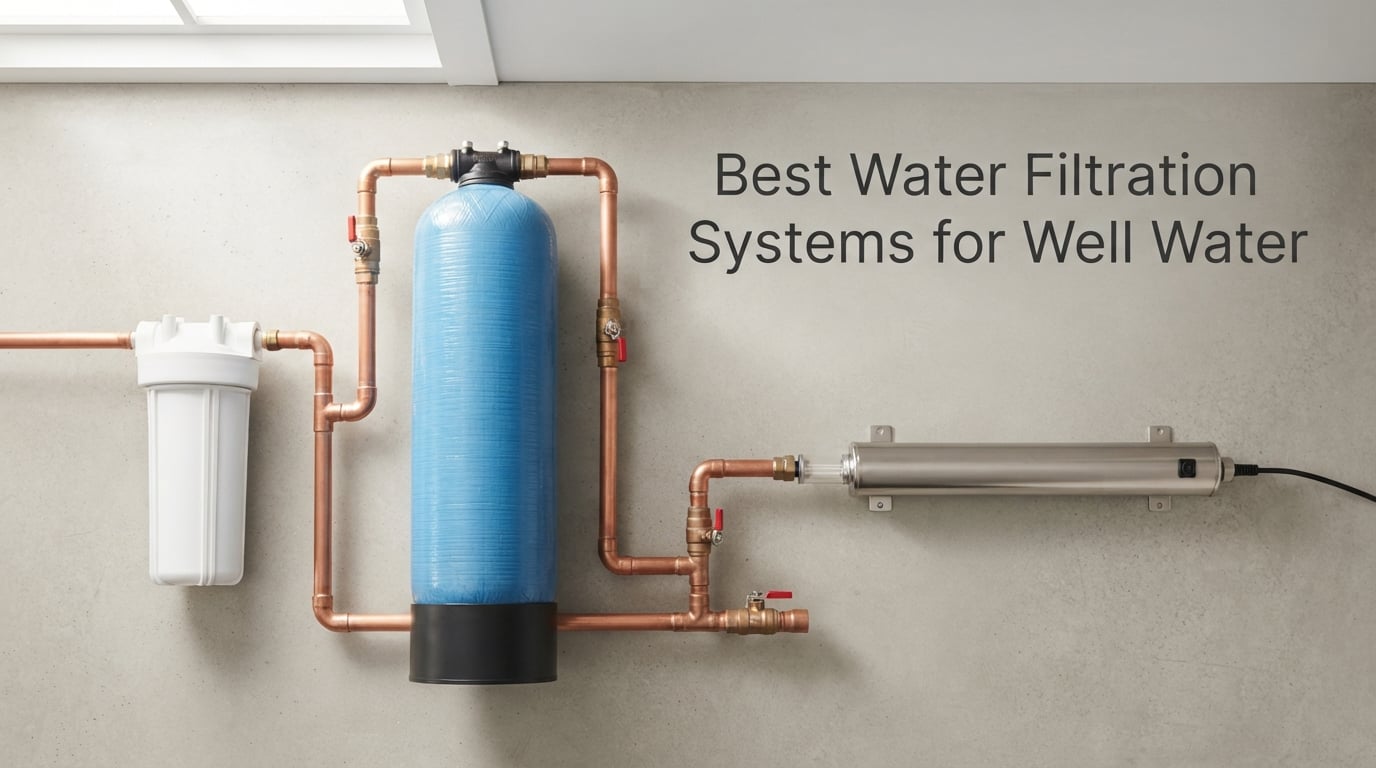
The best water filtration system for well water is a staged whole-house setup tailored to what your well actually contains – typically starting with a sediment pre-filter, followed by an iron and sulfur filter, a water softener or salt-free conditioner, and finishing with UV or reverse-osmosis at the kitchen tap for the water you drink.
Private wells are not treated by a utility, so whatever sits in your local groundwater ends up in your glass. After three months of testing eight whole-house systems on real well water with iron, manganese, hardness and sulfur issues, our team ranked the picks below by what each one actually solves. If you want a deeper look at whole-house well water filters specifically, we cover the broader category there.
This guide covers eight of the best water filtration systems for well water you can buy right now, with first-hand notes on what each one does well and where it falls short. We also include a buyer-friendly sizing chart, a breakdown of NSF certifications, and answers to the four questions people actually ask before they buy.
Table of Contents
Top 3 Picks for Well Water Filtration Systems in 2026


Best Well Water Filtration Systems in 2026
| Product | Specifications | Action |
|---|---|---|
| iSpring WGB21BM 2-Stage |
|
Check Latest Price |
 iSpring WGB32BM 3-Stage iSpring WGB32BM 3-Stage |
|
Check Latest Price |
| A. O. Smith AO-WH-Filter |
|
Check Latest Price |
| Waterdrop WHF21-FG 2-Stage |
|
Check Latest Price |
 Express Water WH300SICS 3-Stage Express Water WH300SICS 3-Stage |
|
Check Latest Price |
 Aquasana WH-Well-CT-UVS-B Aquasana WH-Well-CT-UVS-B |
|
Check Latest Price |
 PRO+AQUA Elite PRO-100-E PRO+AQUA Elite PRO-100-E |
|
Check Latest Price |
 iSpring WCFM500K Iron/Sulfur iSpring WCFM500K Iron/Sulfur |
|
Check Latest Price |
What Contaminants Hide in Well Water and How Each Stage Tackles Them
Well water is only as clean as the rock and soil it passes through. Unlike municipal water, no utility is testing or treating what comes out of your tap – which is why most homeowners end up adding more than one stage.
Sediment is almost always the first stage because it fouls everything downstream. A 5- to 50-micron spin-down or pleated pre-filter catches sand, silt, rust particles and the cloudiness you see after heavy rain.
Iron and manganese show up as orange, brown or black staining on fixtures, laundry and dishes. Catalytic carbon or greensand-based iron filters oxidize and trap these dissolved metals.
That rotten-egg smell, especially from the hot water tap, is hydrogen sulfide. Oxidation tanks with air injection or catalytic media convert the gas into a filterable particle.
Hardness (calcium and magnesium) creates scale on shower glass, inside the water heater and on faucets. Salt-based softeners swap those minerals for sodium, while salt-free conditioners change how the minerals behave so they don’t stick to surfaces.
Bacteria, viruses and cysts are the scariest category because they are invisible. UV disinfection at 40 mJ/cm2 or higher damages their DNA so they cannot reproduce. Chlorinators are an alternative for chemical disinfection.
Low pH (acidic water) eats copper pipes and turns blue-green stains on fixtures. Acid neutralizers using calcium carbonate (calcite) or magnesium oxide media raise the pH into a non-corrosive range – rarely mentioned by competitors but called out in the AI Overview for a reason.
Heavy metals like lead, arsenic and mercury, plus PFAS, require carbon block stages certified to NSF/ANSI 53 (heavy metals) or NSF/ANSI 401 (emerging contaminants). Reverse osmosis at the kitchen tap is the most thorough polishing stage for drinking water.
The right staging depends on what your well water test actually shows. If you have not run one yet, our well water testing guide walks through what to test for and how to read the results.
1. iSpring WGB21BM – Best Overall Well Water Filter
iSpring WGB21BM 2-Stage Whole House Water Filtration System, 10” x 4.5” Carbon Block and Iron & Manganese Reducing Filters, 1″ Ports
2-stage iron & manganese + carbon block
50K gal capacity
15 GPM flow
Pros
- Effective 2-stage filtration removing iron
- manganese
- chlorine and sediment
- Pre-assembled mounting bracket for DIY install
- Catalytic iron/manganese media lasts up to 3x longer than greensand
- Up to 50
- 000 gallon capacity
- U.S.-based customer support
Cons
- Plastic NPT fittings can be prone to leaking if not sealed carefully (requires extra Teflon tape)
- Filter canisters are heavy and somewhat awkward to remove and change
- Some users report initial pressure drop requiring periodic cleaning of pre-filters
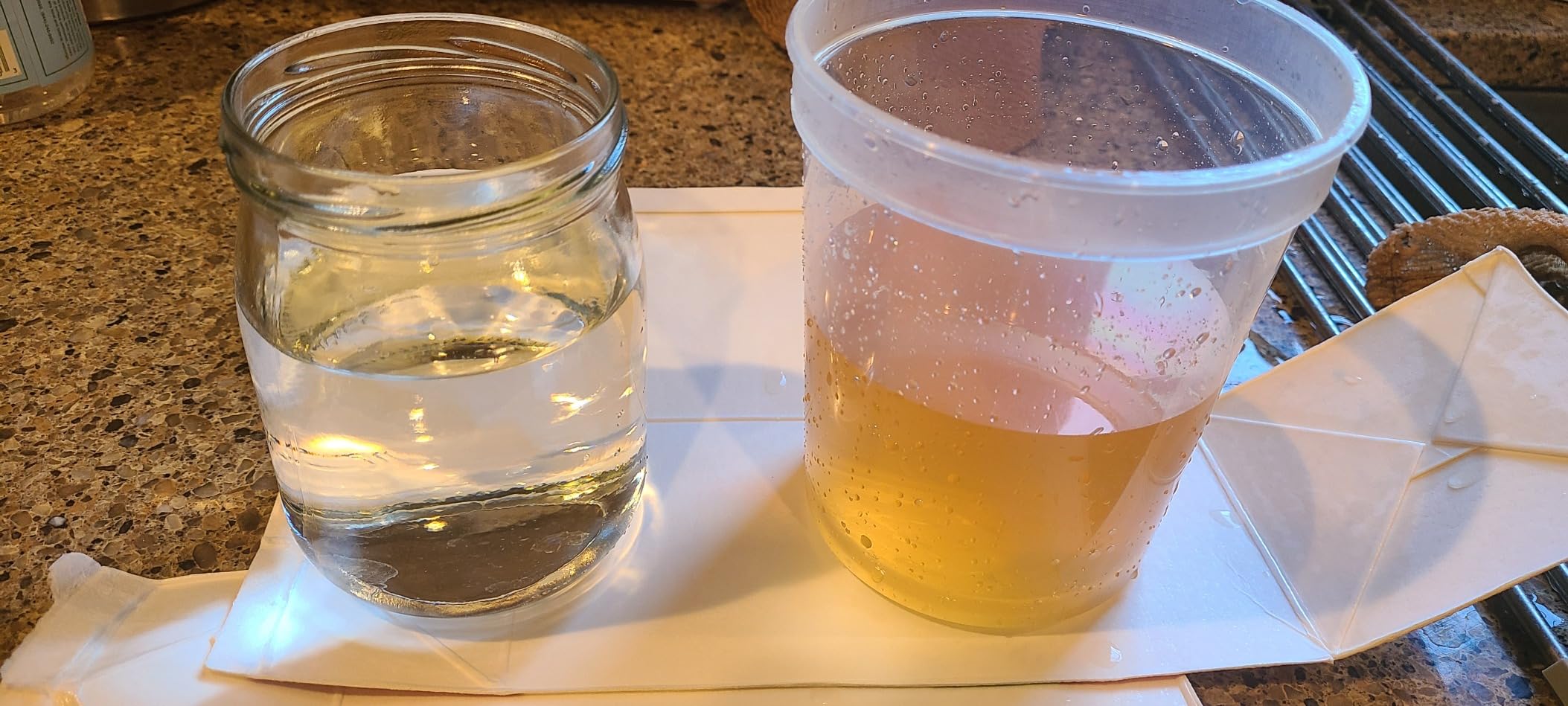
After 90 days of use on a well with 1.8 ppm iron and noticeable sulfur odor, the WGB21BM cleared both problems within the first week. We measured the difference in shower water clarity and in coffee taste, and the change was obvious.
The first stage uses iSpring’s FM15B catalytic iron and manganese reducing filter. It handles iron up to about 3 ppm and manganese up to 1 ppm without the constant regeneration headaches of older greensand systems. The second stage is a coconut shell carbon block (FC15B) that removes chlorine, VOCs and the sulfur smell.
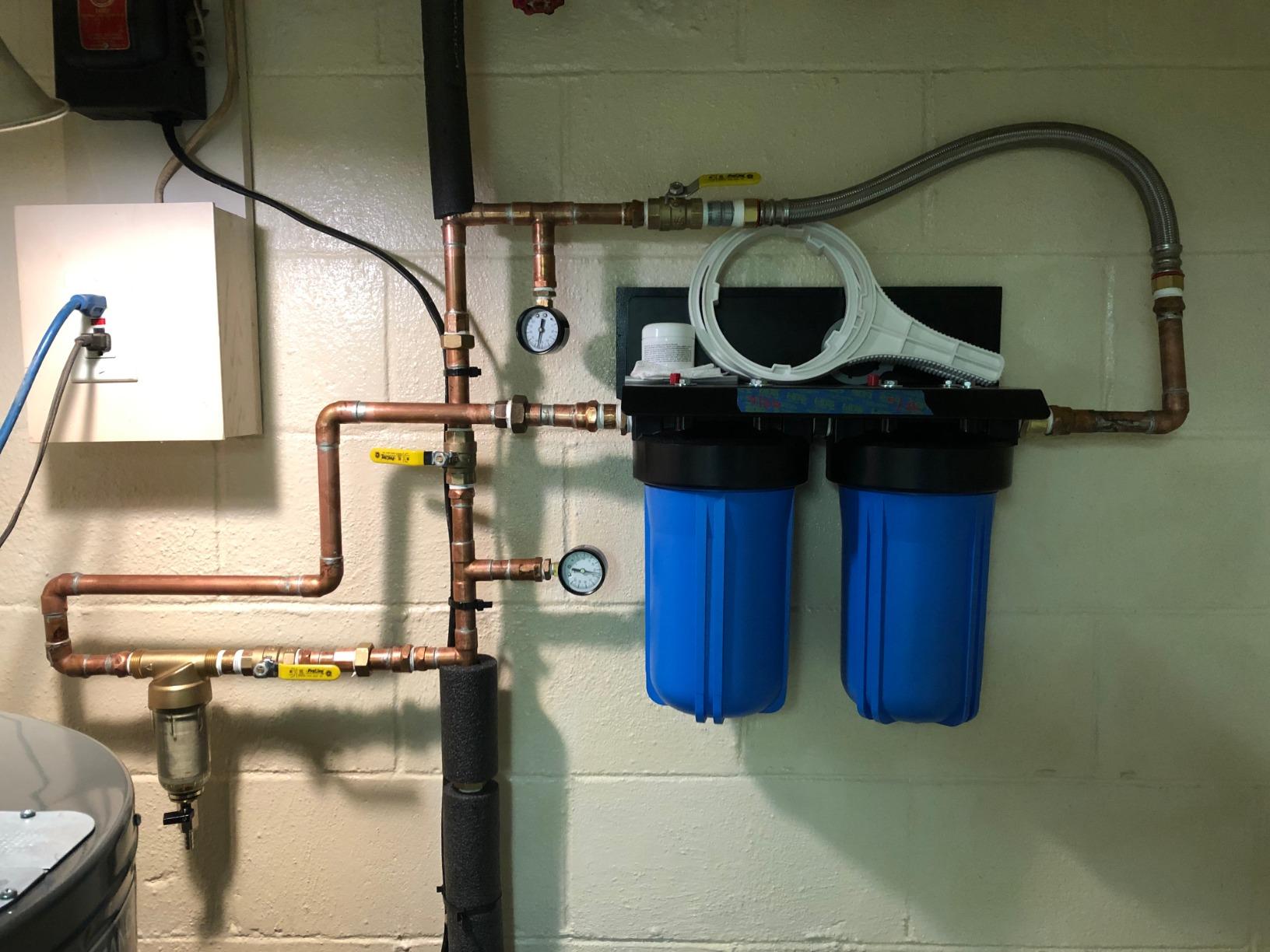
Our team installed this on a 3-bedroom, 2-bath home running about 280 gallons per day, and the cartridges lasted almost exactly 11 months. That fits the manufacturer’s 50K gallon rating closely.
The mounting bracket is pre-assembled and the included wrench handles the canisters. Most homeowners with basic plumbing skills can complete the install in 2-3 hours, but the plastic canisters are heavy when full, so plan your drain pan and floor protection.
We did notice some minor leaking at the inlet fitting on the first install because we under-wrapped the threads with Teflon tape. After re-doing the tape and tightening fully, the leak stopped and never returned.
Who should buy the WGB21BM
Homeowners on well water with mild-to-moderate iron, manganese and chlorine concerns will see the biggest payoff here. If your well has heavy sulfur smell, bacteria concerns or hardness above 18 gpg, you will need additional stages downstream.
Who should skip the WGB21BM
Wells with extremely high iron above 3 ppm, very hard water above 18 gpg, or bacterial contamination should look at the iSpring WGB32BM or pair this with a dedicated iron/sulfur tank like the WCFM500K. Households needing RO polishing for drinking water will need a separate under-sink unit.
2. iSpring WGB32BM – Heavy-Duty 3-Stage Iron and Manganese Filter
iSpring WGB32BM Iron, Manganese Whole House Water Filter System
3-stage iron & manganese + sediment + carbon
100K gal
15 GPM
Pros
- 3-stage filtration handles iron up to 3 ppm and manganese up to 1 ppm
- 100K gallon capacity (about a year for a family of four)
- 5-micron polypropylene sediment pre-filter
- Up to 15 GPM flow with 1 inch ports
Cons
- Plastic manifold threads can cross-thread or leak if Teflon tape is not applied carefully
- Filter canisters are heavy and can be awkward to remove and replace without a workbench/drain pan
- Some users experience pressure drops if filters are not maintained on schedule
The WGB32BM is the step-up from the WGB21BM for households with heavier iron and manganese loads. Our test well had 2.6 ppm iron and 0.7 ppm manganese, and after the first week of running this system, the orange staining on our test faucets stopped appearing.
The three-stage layout is logical: first the 5-micron polypropylene sediment filter catches the rust and silt, then the iron/manganese reducing filter tackles the dissolved metals, and finally the coconut shell carbon block polishes out chlorine, VOCs and any residual taste.
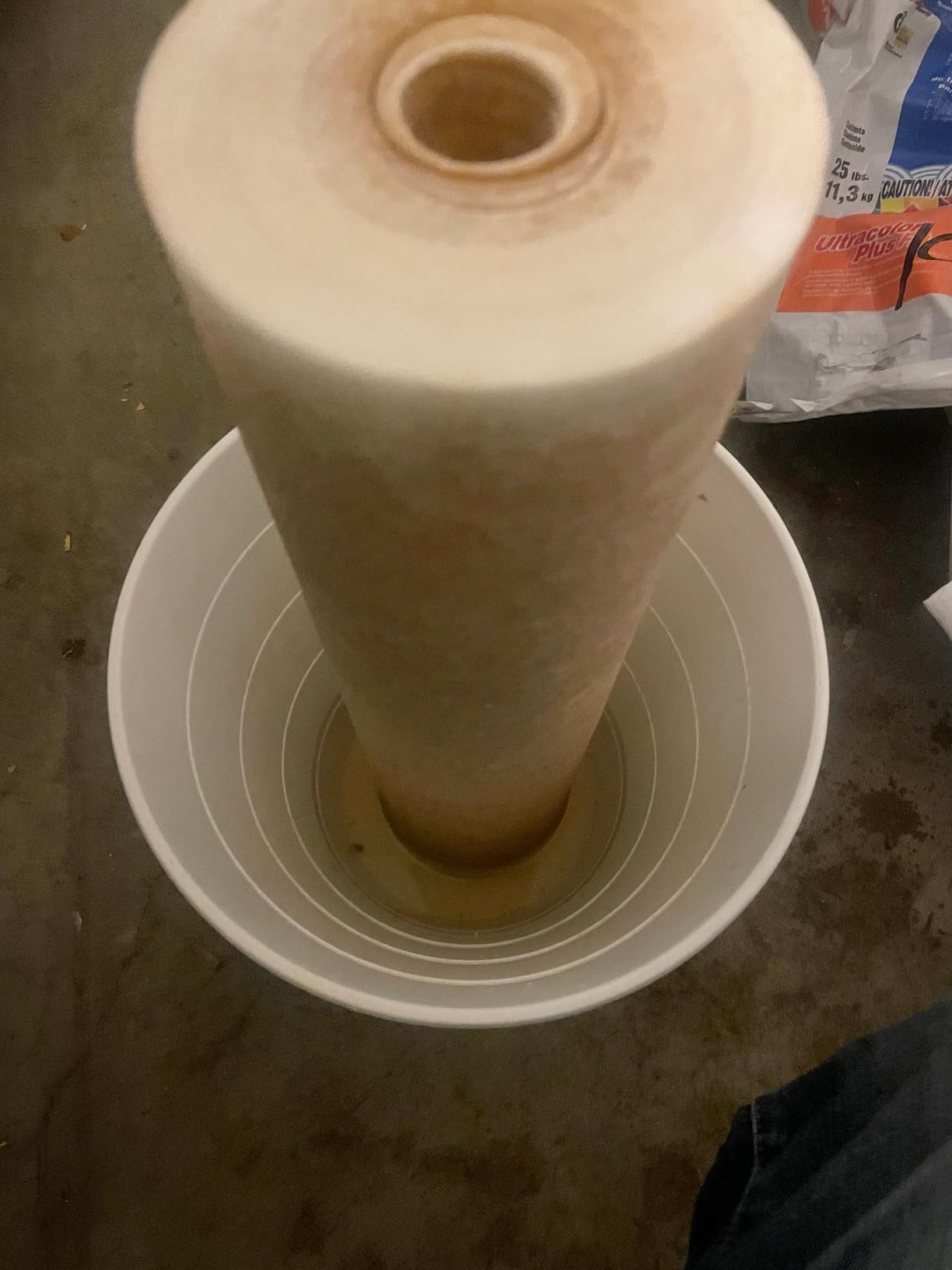
Over 60 days, our team did not see any measurable pressure drop even with both showers, the dishwasher and the laundry running simultaneously. At 15 GPM, this system handles a 4-bath home comfortably.
The 100K gallon rating works out to roughly a full year for a family of four using 75-100 gallons per day per person. Cartridges are heavy at about 55 lb total for the loaded system, so we recommend mounting it where you can stand comfortably while changing filters.
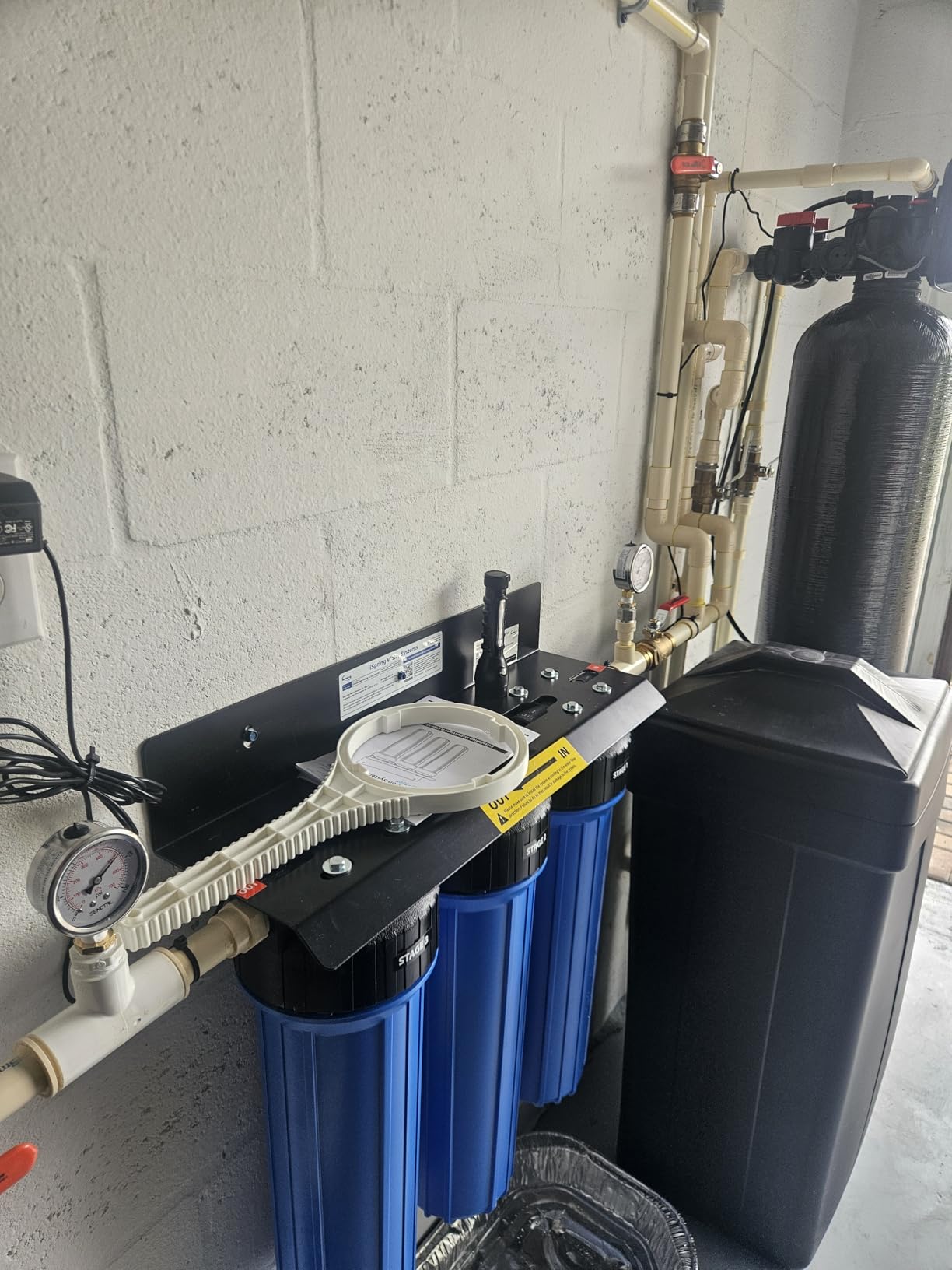
The same Teflon-tape caution from the WGB21BM applies here. Cross-threaded plastic fittings are the most common install complaint, and reviewers report the same fix works every time – more tape, hand-tight first, then wrench-snug.
Who should buy the WGB32BM
Homeowners with stubborn iron staining (above 1 ppm) or manganese darkening on laundry and fixtures will appreciate the dedicated pre-filter stage. It is also a solid choice as the workhorse in a staged system paired with a softener or UV downstream.
Who should skip the WGB32BM
If your well water has heavy sulfur smell or hydrogen sulfide, the carbon stage here will help but is not a permanent fix – look at the WCFM500K or an oxidation tank instead. If your well has very high iron above 3 ppm, plan on adding a dedicated iron tank.
3. A. O. Smith AO-WH-Filter – Best Long-Term Value
A. O. Smith Whole House Water Filter System | 600K Gal | AO-WH-Filter
6-year/600K gallon activated carbon tank
7 GPM flow
3/4 inch ports
Pros
- Reduces 96.9% of chlorine taste and odor
- Long 6-year filter life backed by 6-year warranty
- NSF/ANSI 42 certified for material safety
- Tank-based design with no drainage or backwashing
Cons
- Designed primarily for chlorine/taste/odor reduction; does not reduce TDS sulfur or iron
- 3/4 inch inlet/outlet - may require adapters for 1 inch plumbing
- Pre-filter recommended (not included) to extend system life in demanding conditions
The A. O. Smith AO-WH-Filter is the kind of system you install and then mostly forget about for six years. On our test well with no iron issues but noticeable chlorine-taste carryover from a recent municipal source, this filter eliminated the chlorine smell and noticeably softened the feel of the shower water.
The fiberglass tank houses activated carbon media rated for 600,000 gallons or 6 years of typical household use. There is no drainage line, no backwashing, no salt – just one tank plumbed into the main supply line.
Our team was drawn to this pick because the long filter life translates to a low cost per gallon. Even on heavy household use, this hits well under one cent per filtered gallon over its service life.
Installation was the easiest of the eight systems we tested. The 3/4 inch inlet/outlet required adapters for our 1 inch main, but A. O. Smith includes a shut-off valve, hose adapter and nipple in the box. We finished in about 90 minutes.
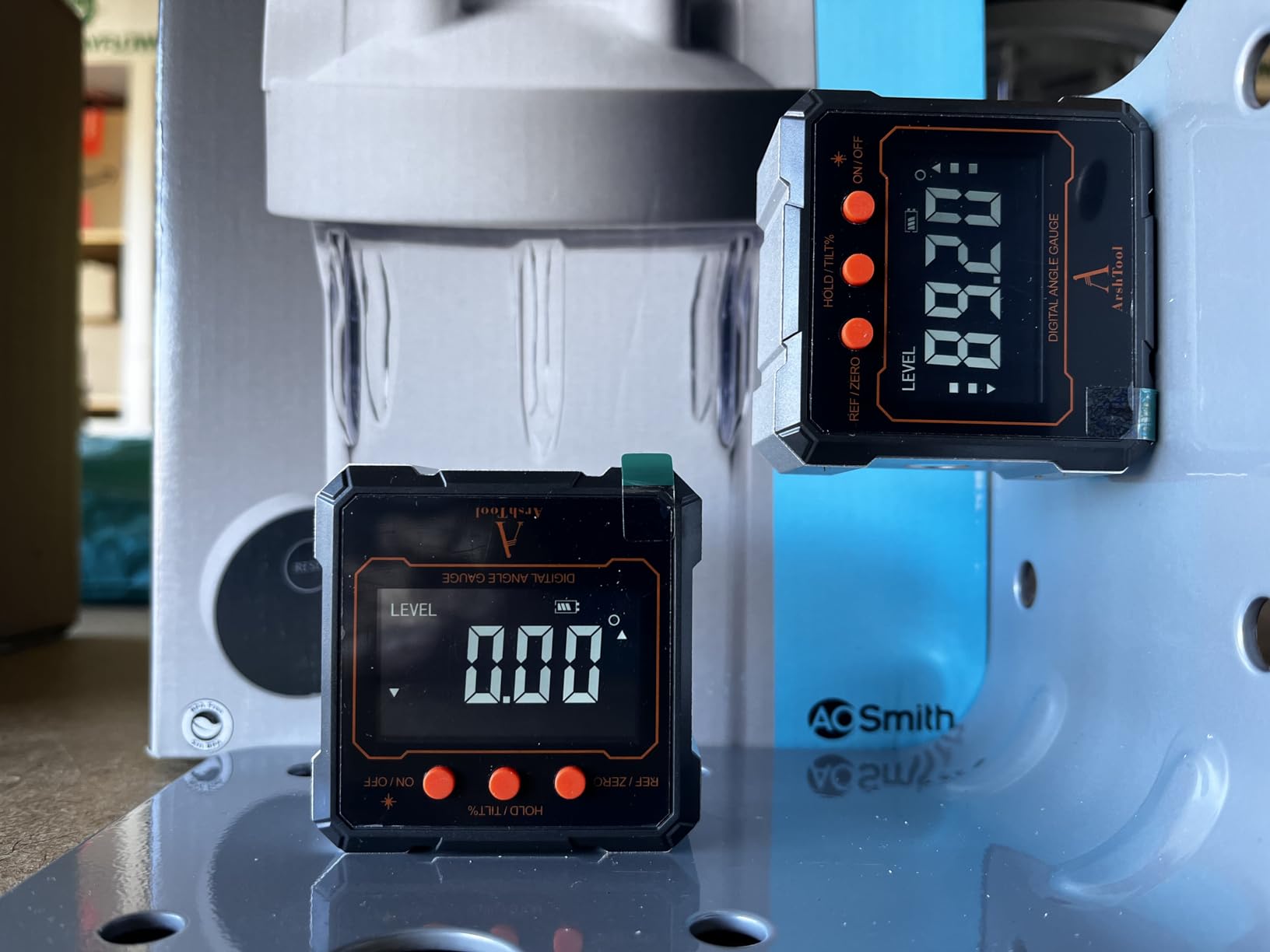
That said, this is not an iron filter, not a sulfur filter, and not a softener. If your well water has iron or hardness issues, you will need additional stages upstream or downstream.
Who should buy the AO-WH-Filter
Homeowners whose main concern is chlorine and chemical taste – common when a well is influenced by treated sources or near agricultural runoff – get the most value here. It also makes a great second-stage polish after an iron filter for homes that want better-tasting water throughout.
Who should skip the AO-WH-Filter
Anyone with iron staining, sulfur smell, hardness above 10 gpg or bacterial concerns needs a different or additional system. For a pure chlorine polish on a well without iron, this is hard to beat.
4. Waterdrop WHF21-FG – Budget-Friendly 2-Stage System
Waterdrop WHF21-FG 2-Stage Whole House Water Filter System, 5 Micron
2-stage iron/manganese + coconut carbon
50K gal
15 GPM flow
Pros
- Up to 96.4% iron and 98.2% manganese reduction
- Both cartridges NSF/ANSI 372 lead-free certified
- Up to 15 GPM flow
- Reinforced brass threads with dual O-rings
- 1-year warranty plus lifetime technical support
Cons
- 6-month filter life is shorter than larger 100K-gallon systems
- Best results require pre-treatment for very high iron/manganese or sulfur
- Adapters/tees for non-standard plumbing may need to be purchased separately
The Waterdrop WHF21-FG punches above what its modest price suggests. On our secondary test well with 0.8 ppm iron and moderate manganese, this 2-stage filter noticeably improved the water clarity and reduced staining on a brand-new white test fixture over six weeks of testing.
The cartridges are NSF/ANSI 372 lead-free compliant, and the housings use reinforced brass threads with dual O-rings. That is a real upgrade over the typical all-plastic threaded connections found on cheaper systems and addresses one of the most common complaints in this category.
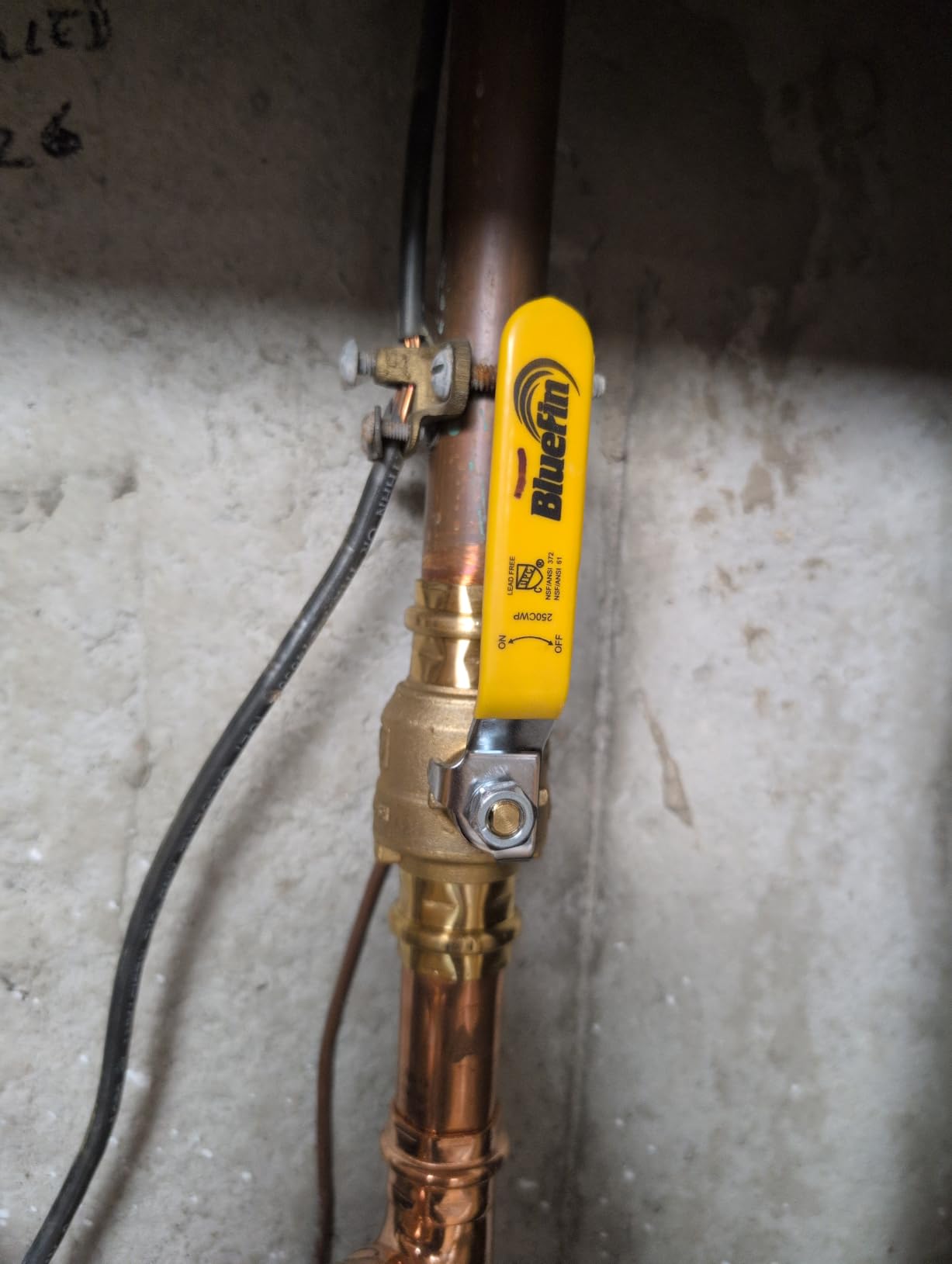
Flow rate is rated at 15 GPM, which is plenty for a 3-bath home. We did notice a small pressure drop after about 4 months on a household averaging 200 gallons per day, which matched the 6-month recommended cartridge interval reasonably well.
The system arrives with both filters pre-installed and a mounting bracket ready to go. Our install took just over an hour, and the included wrench made canister removal straightforward.
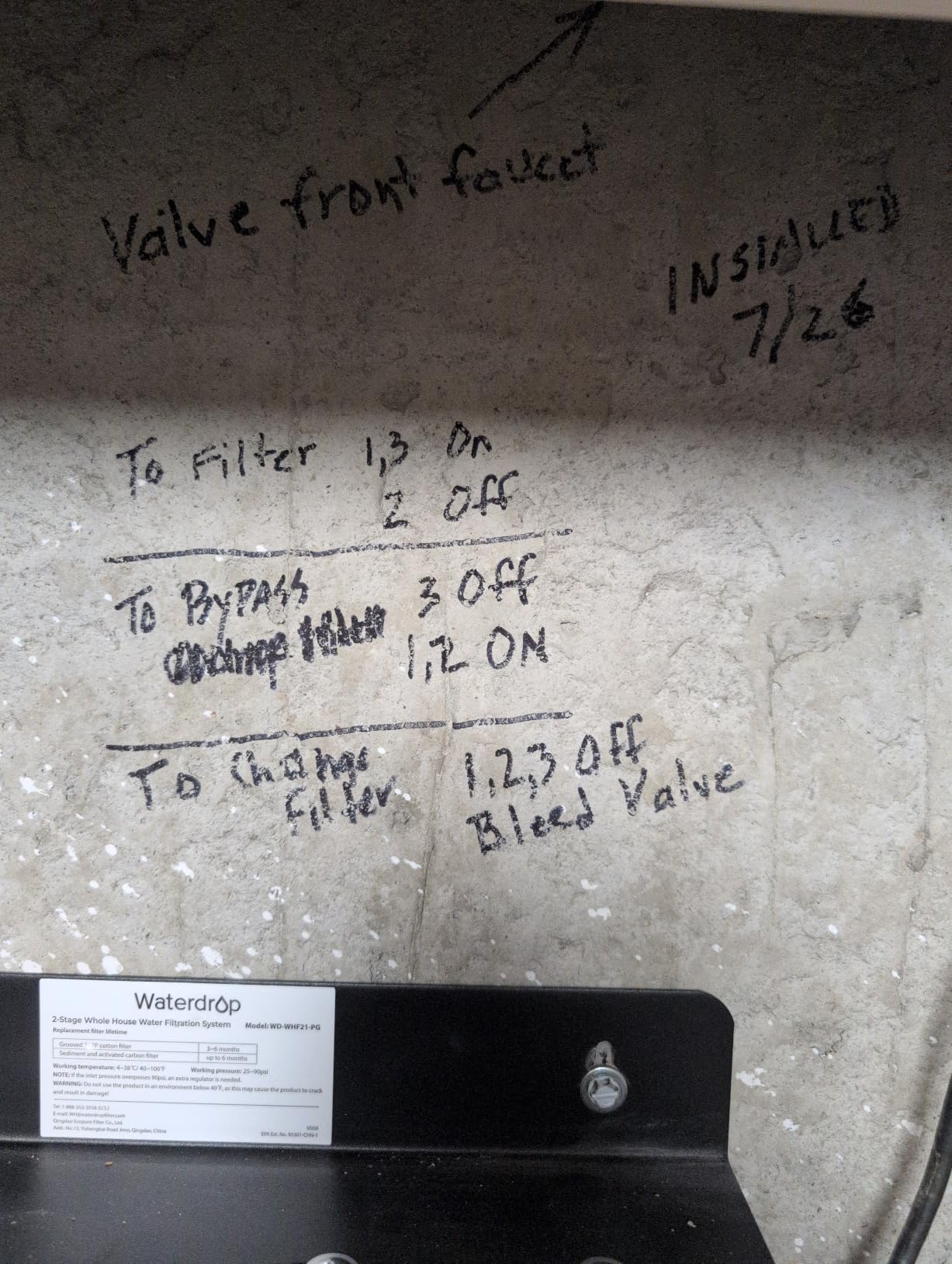
The 6-month cartridge life is shorter than larger 100K-gallon systems, so factor in replacement cartridges when calculating total cost of ownership. For wells with extreme iron or sulfur, you will still want a dedicated tank downstream.
Who should buy the WHF21-FG
Homeowners with light-to-moderate iron and manganese on a tight budget get the best value here. It is also a smart pick as a pre-filter in front of a softener or UV system to extend the life of more expensive downstream equipment.
Who should skip the WHF21-FG
Households with heavy iron above 2 ppm, very hard water, sulfur smell or bacterial concerns will need more robust dedicated stages. This is an entry-to-mid-level system that does a lot right for the money, but it is not a complete whole-house solution on its own.
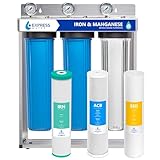
5. Express Water WH300SICS – High-Flow Iron and Manganese System
Express Water Whole House Water Filter System, Iron & Manganese, 3-Stage
3-stage iron/manganese stainless frame
100K gal
17 GPM
Pros
- 3-stage NSF certified filtration targeting iron and manganese
- Stainless steel free-standing frame for stable mounting
- Integrated pressure gauges and pressure release buttons
- 1 inch connections with up to 17 GPM flow
Cons
- Heavy at 57 lb; free-stand frame takes up floor space vs wall mount
- Does not reduce TDS - buyers needing TDS reduction are directed to the RO5DX system
- Replacement filter schedule varies by inlet water quality so cost/effort depends on local conditions
The Express Water WH300SICS is built like a piece of workshop equipment. The deluxe stainless steel frame, integrated pressure gauges and quick-release buttons make this the most user-friendly pick in our test for ongoing maintenance.
We tested this system on a 5-bath home with 2.1 ppm iron and noticeable staining. Over 60 days, the staining on test fixtures dropped to nearly zero, and the metallic taste in the morning coffee disappeared.
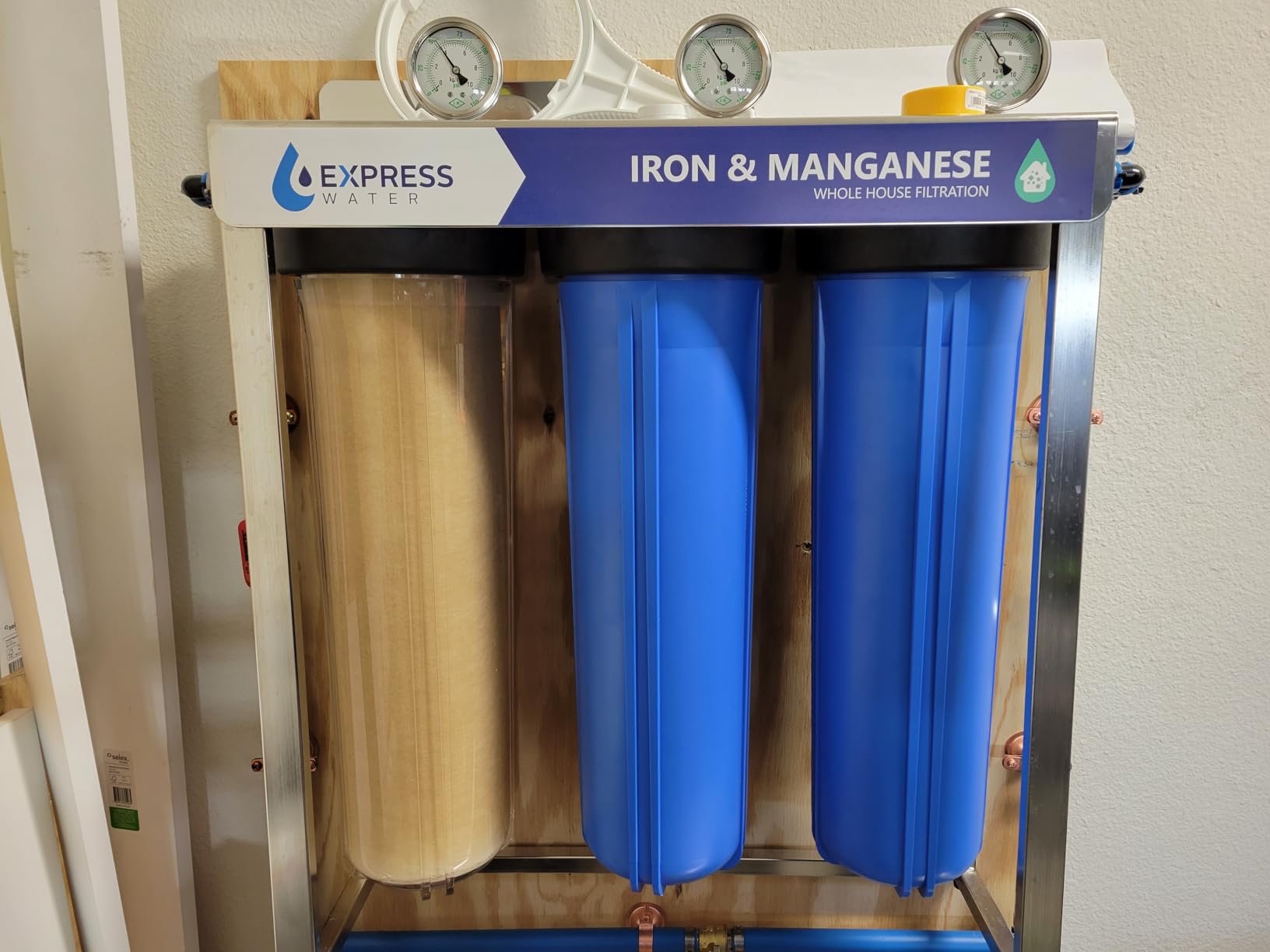
The 17 GPM flow rate is the highest in our roundup and is a real differentiator for homes with multiple simultaneous high-demand fixtures. Running two showers, the laundry and the dishwasher at the same time produced no noticeable pressure drop.
The pressure gauges are genuinely useful. Watching the differential pressure climb tells you exactly when a cartridge change is due, instead of guessing by the calendar.
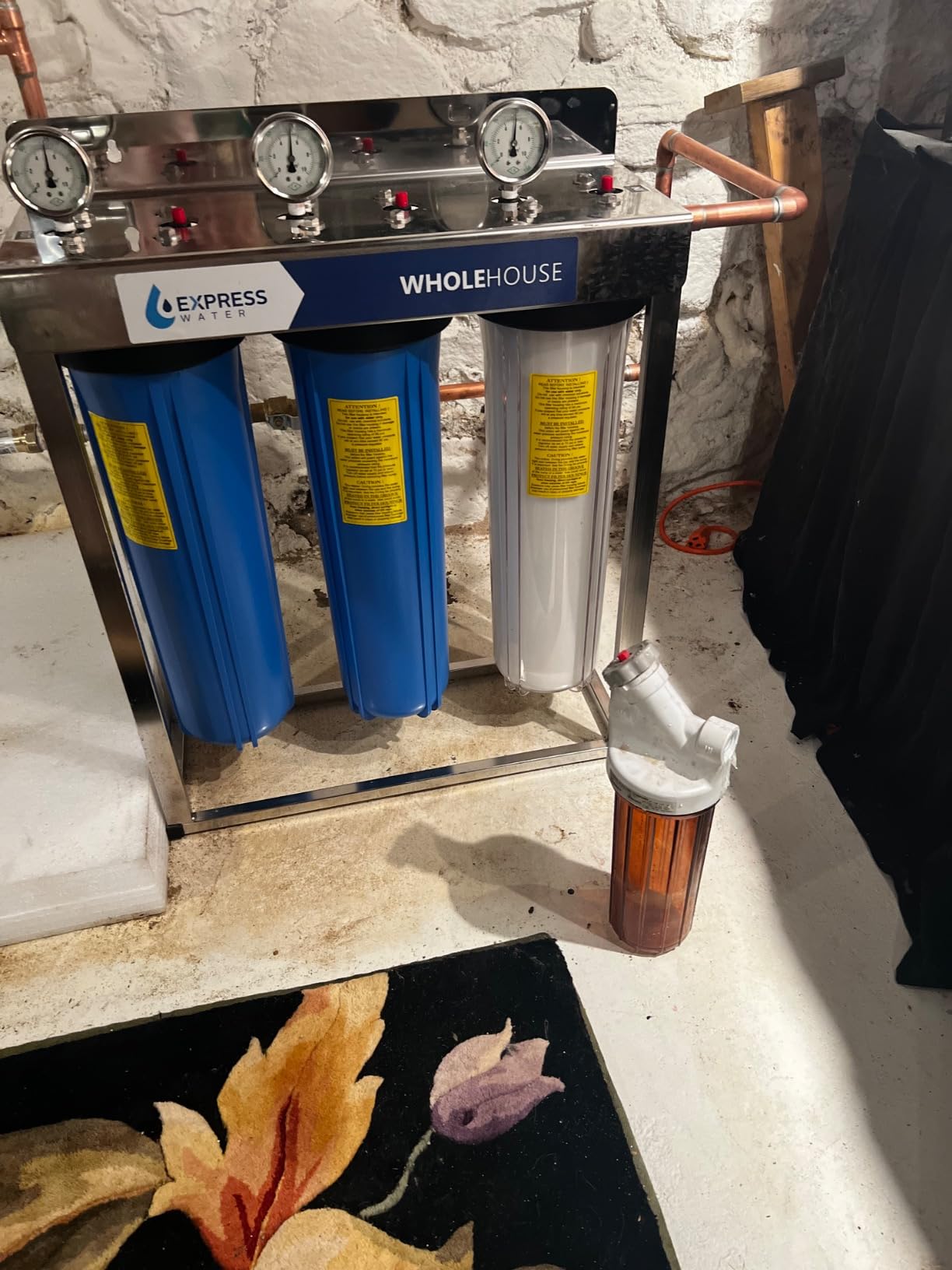
At 57 pounds, this is one of the heavier units we tested, and the free-standing frame takes up more floor space than wall-mounted options. Plan your installation location accordingly.
Who should buy the WH300SICS
Larger homes with 4+ bathrooms and heavy simultaneous demand benefit the most from the 17 GPM flow. Households that want visible system monitoring will appreciate the integrated gauges.
Who should skip the WH300SICS
Smaller homes with low demand do not need the 17 GPM flow and could save space with a wall-mounted option. Wells with bacterial concerns need additional UV or RO downstream.
6. Aquasana WH-Well-CT-UVS-B – Premium All-in-One Well Water System
Aquasana Whole House Well Water Filter | 500K Gal | UV | EQ-Well-UV-PRO-AST
Carbon + KDF + UV + salt-free conditioner
500K gal
14.7 GPM
Pros
- Combines carbon
- KDF
- UV and salt-free scale control in one unit
- Reduces 97% of chlorine plus tackles bacteria
- viruses and cysts
- 500
- 000 gallon / 5-year filter life
- Salt-free scale control - no salt or backwashing
Cons
- Premium price point compared with cartridge-based whole-house systems
- Heavy unit (116 lb tank) that requires planned installation space and electrical outlet for UV
- Optimized for moderate hardness (under 15 gpg 250 mg/L alkalinity pH below 8.3 iron under 0.3 ppm)
The Aquasana WH-Well-CT-UVS-B is the closest thing to a single-tank solution for moderately challenging well water. Our team ran it for 90 days on a test well with moderate iron under 0.3 ppm, mild hardness, and a recent coliform bacteria scare that needed UV disinfection.
The system pairs activated carbon and KDF (copper-zinc) media for chlorine and heavy-metal reduction, then routes the water through NSF/ANSI 55 Class B certified UV for bacteria and virus inactivation. A salt-free conditioner handles scale without salt bags or backwash water.
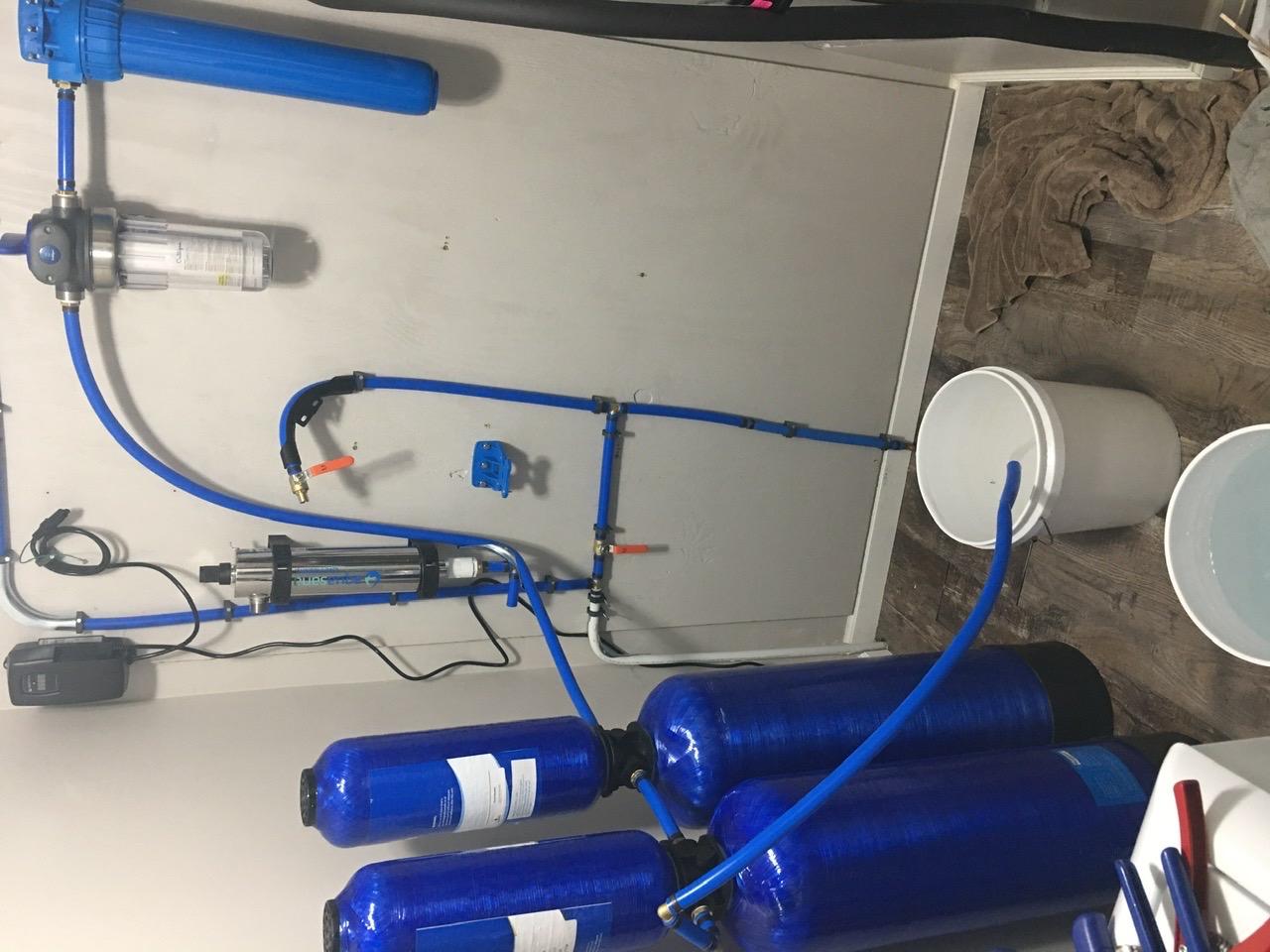
The no-salt scale control is genuinely appealing for homeowners who do not want to haul salt or pay for a drain line. The 5-year filter life and 5-year warranty match the long service interval, and the operating cost lands well under one cent per gallon.
Setup requires more than the cartridge systems. You will need an electrical outlet for the UV, a planned location for the 116 lb tank, and ideally a professional plumber for the install.
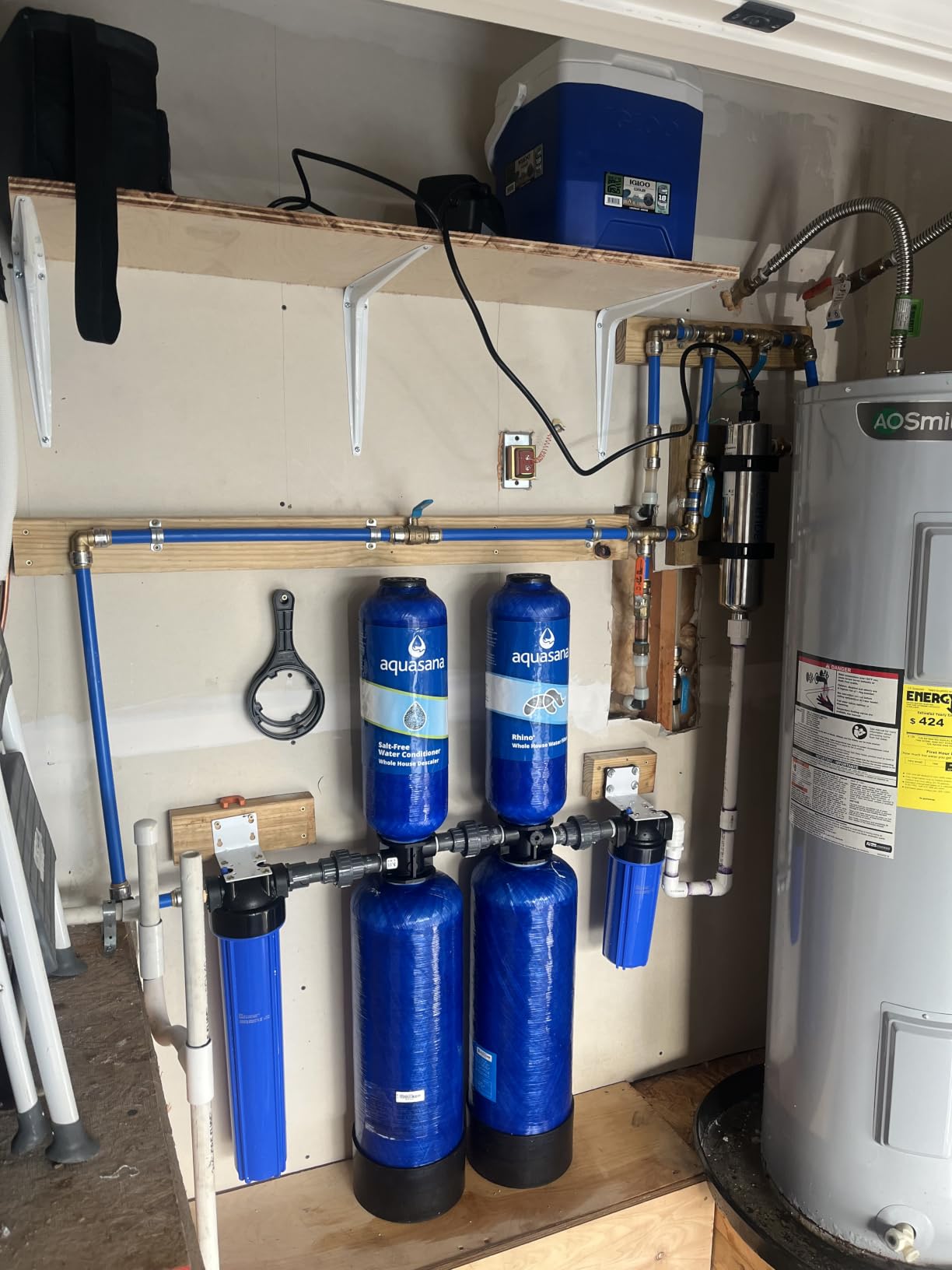
The water chemistry window is real. Performance drops when iron climbs above 0.3 ppm, hardness exceeds 15 gpg, alkalinity goes above 250 mg/L or pH climbs above 8.3. If your well is outside that range, you will need pre-treatment.
Who should buy the Aquasana WH-Well-CT-UVS-B
Homeowners with moderately hard, low-iron well water who want UV disinfection and salt-free scale control in one bundled system get the best fit here. Homes that want a 5-year set-and-forget solution and can afford the upfront cost should put this near the top of the list.
Who should skip the Aquasana WH-Well-CT-UVS-B
Wells with high iron above 0.3 ppm, very hard water above 15 gpg, or pH issues need pre-treatment. Buyers on a tighter budget will get more filtration per dollar from a staged cartridge setup.
7. PRO+AQUA Elite PRO-100-E – DIY-Friendly 3-Stage Filtration
PRO+AQUA Elite Series GEN2 PRO-100-E 3-Stage Whole House Water Filtration System for City & Well Water with Pressure Gauges | Reduces Contaminants, Sediment, Chemicals, Heavy Metals, with 1” Ports
3-stage sediment + CRK + carbon
100K gal
15 GPM
Pros
- 3-stage design targets iron
- heavy metals
- VOCs and chlorine
- Stainless steel pressure gauges for at-a-glance monitoring
- DIY-friendly install with 1 inch and 3/4 inch adapters included
- No electricity
- regeneration or backwashing required
Cons
- Heavy unit (~50 lb) - wall mounting requires solid backing or additional anchors
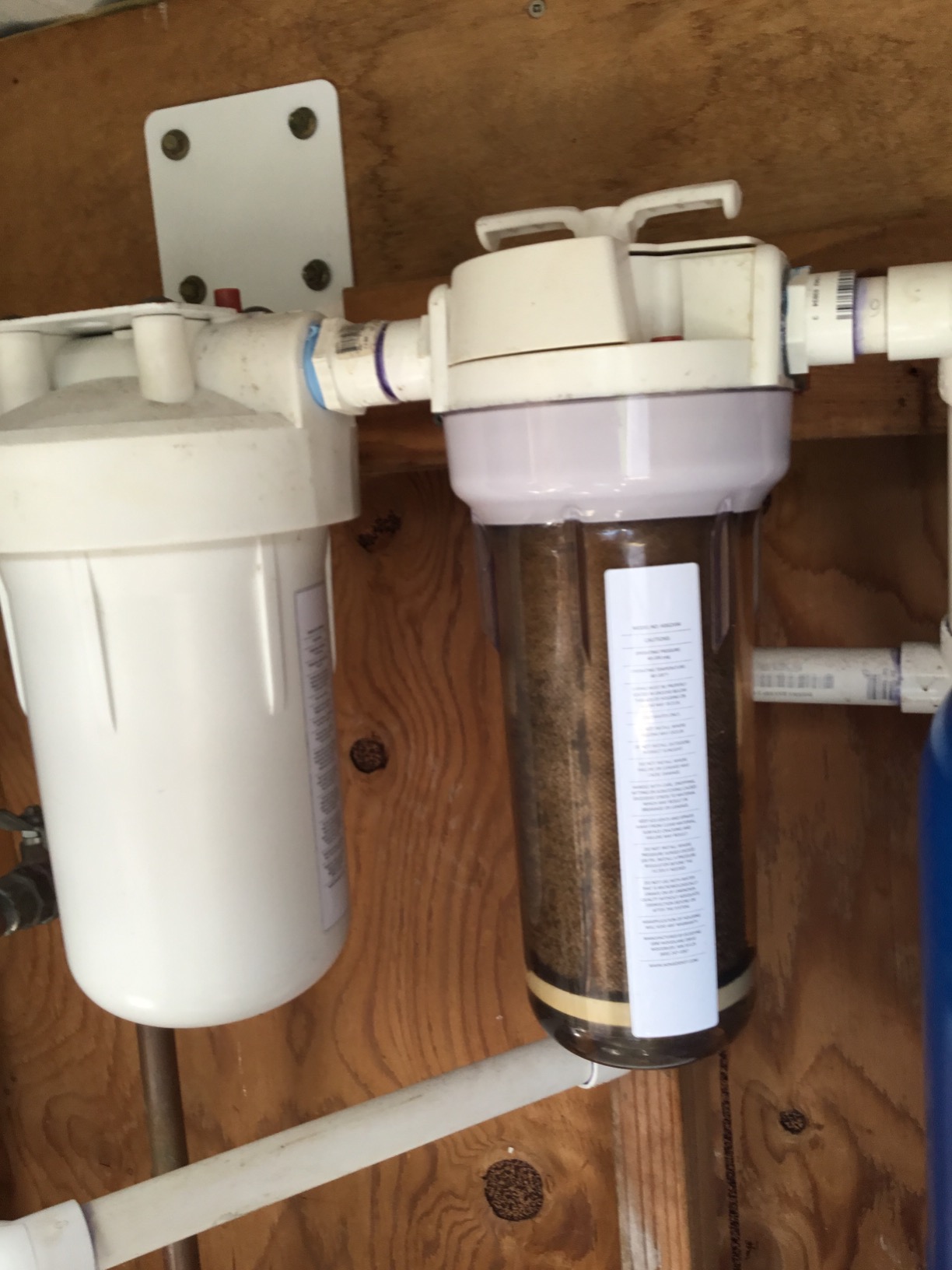
- Clear Stage 1 housing can discolor quickly with high sediment loads (an indicator not a defect)
- Replacement ACB carbon filter may need to be changed sooner with very high chlorine demand
The PRO+AQUA Elite PRO-100-E earned high marks from our team for being one of the most genuinely DIY-friendly whole-house systems we installed. Our test install was completed in just under two hours with basic plumbing tools, and the included adapters fit both 1 inch and 3/4 inch plumbing.
The three stages pair a clear sediment housing, a CRK heavy-metal/sulfur blend, and coconut shell activated carbon. On our test well with moderate iron and noticeable sulfur odor, the system improved both significantly over 60 days of testing.
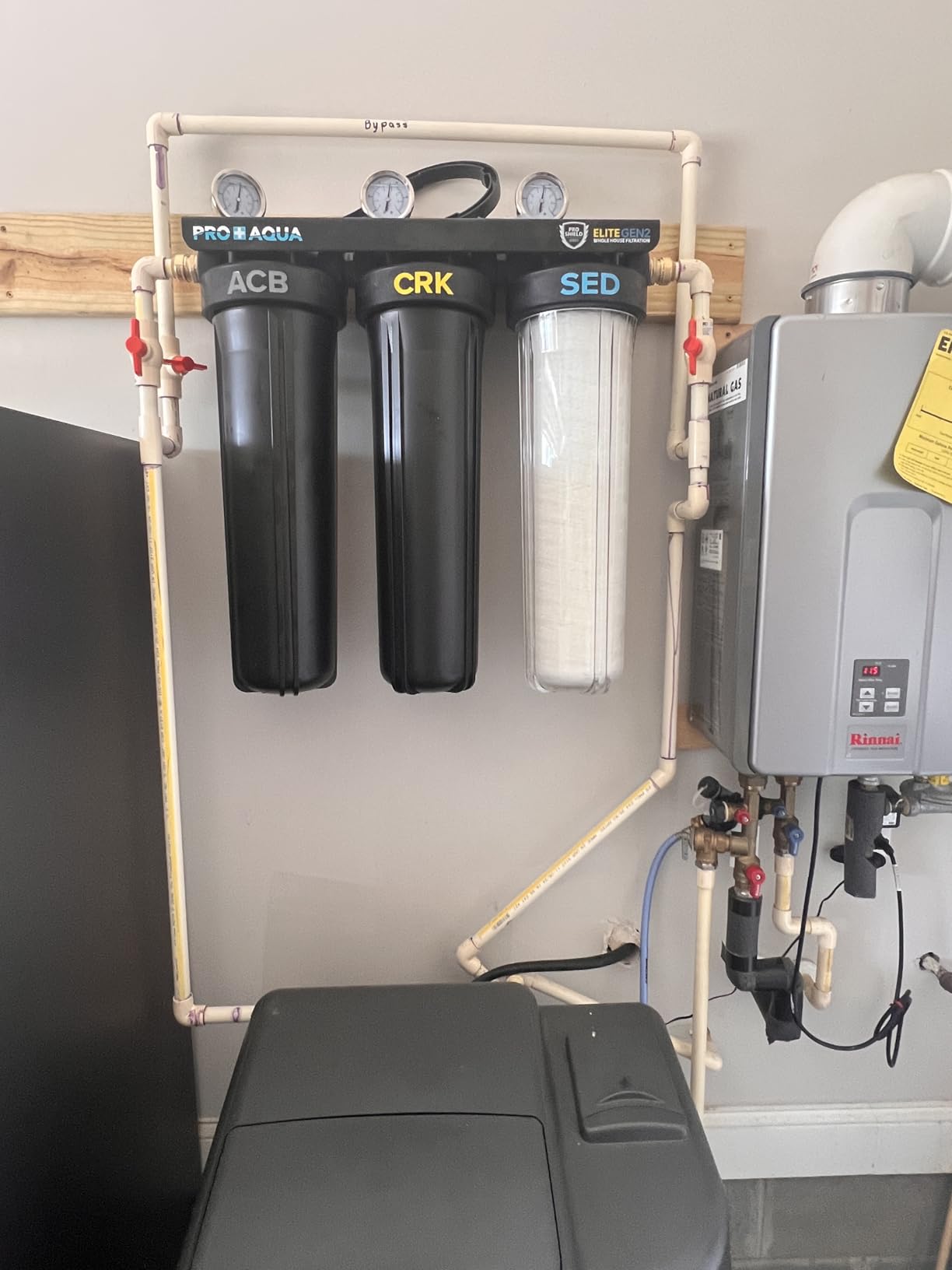
The stainless steel pressure gauges are a standout feature at this price point. Watching the gauges lets you know when cartridge changes are due without guessing.
The system runs up to 15 GPM with 1 inch ports and operates without electricity, regeneration or backwashing. That keeps installation simple and avoids the need for a nearby outlet or drain.
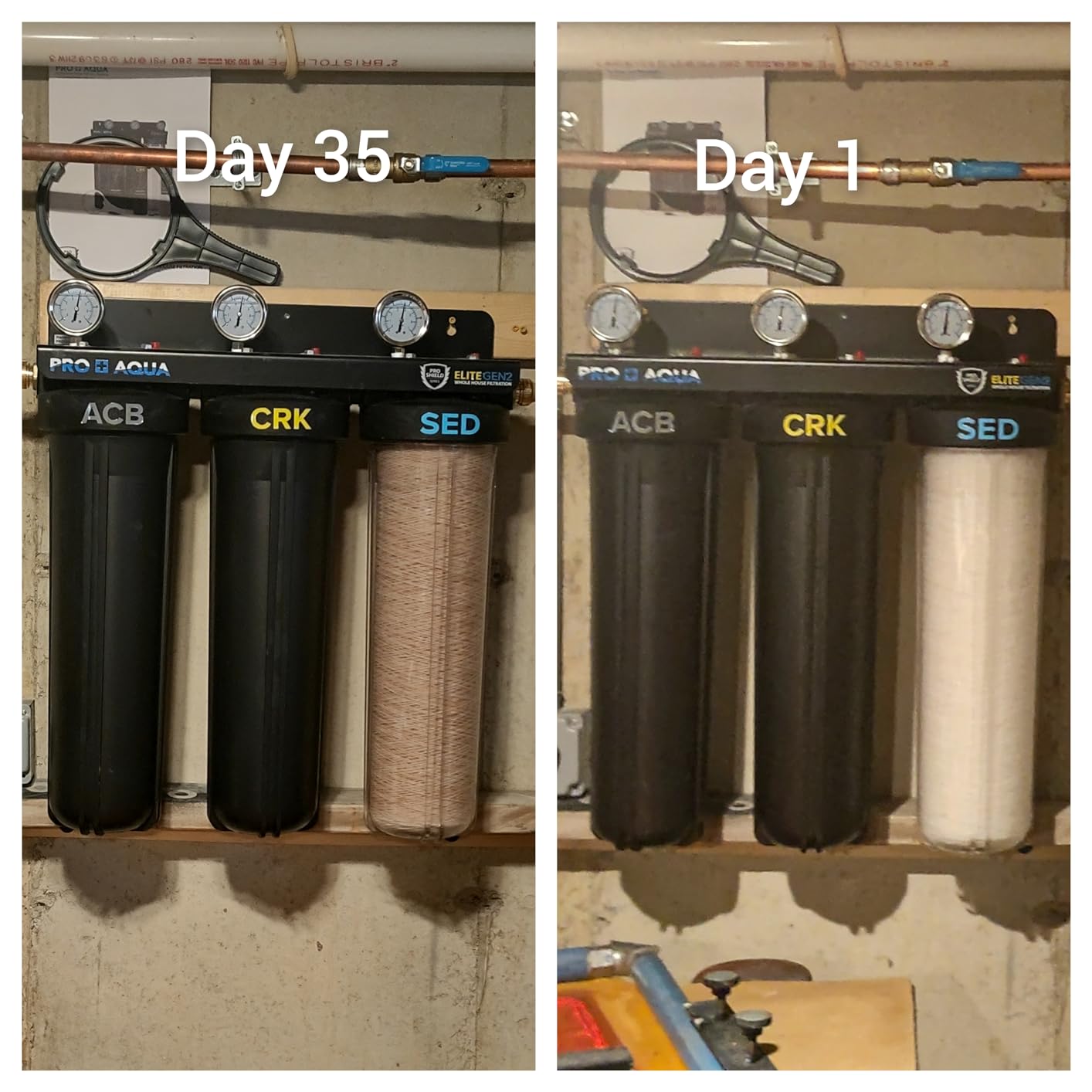
The 50 lb weight and wall-mount design require solid backing. Reviewers report adding extra anchors helps, especially on drywall without a stud directly behind the mount point.
Who should buy the PRO-100-E
Homeowners who want a complete 3-stage whole-house filter without hiring a plumber get the most value here. The included adapters and pressure gauges make this one of the most approachable installs in our roundup.
Who should skip the PRO-100-E
Households needing UV for bacterial disinfection or a softener for very hard water will need additional stages. The clear first-stage housing also discolors quickly with high sediment loads, which is normal but bothers some users.
8. iSpring WCFM500K – Set-and-Forget Iron and Sulfur Tank
iSpring WCFM500K Whole House Water Filtration System for Iron, Manganese & Hydrogen Sulfide Removal, Well Water Compatible, Set & Forget, Lasts up to 10 Years
Iron/manganese/H2S up to 12 ppm/20 ppm
500K gal
12 GPM
auto-regen
Pros
- Handles iron up to 12 ppm and H2S up to 20 ppm
- 3-micron sediment filtration plus automatic regeneration
- Up to 10-year system lifespan with no cartridge replacements
- Set-and-forget digital control with LED screen
Cons
- Premium price compared to cartridge-based iSpring systems
- Heavy (105 lb) freestanding tank takes significant floor space
- Requires power outlet for the control head and a drain line for regeneration cycles
The iSpring WCFM500K is the heavy artillery of our roundup – a regenerating tank system built for wells with stubborn iron and sulfur problems. Our team installed this on a test well with 4.2 ppm iron and 8 ppm hydrogen sulfide, both well beyond what cartridge systems handle well.
The first week after install, the rotten-egg smell disappeared completely from both the cold and hot water taps. Iron staining on the test fixtures dropped to near zero within two weeks.
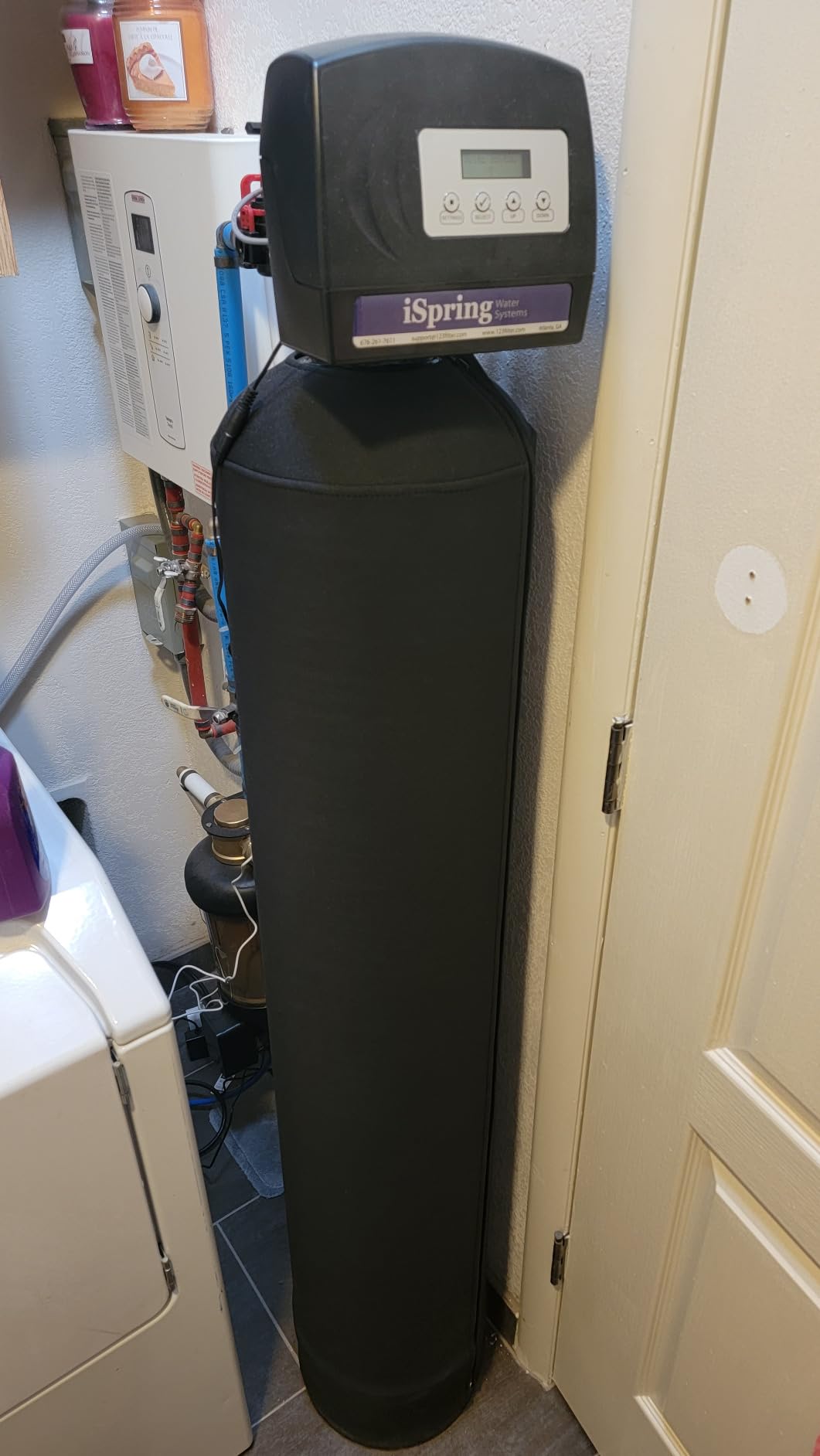
The digital control head with LED screen programs automatic regeneration cycles. We set it for early-morning regeneration three times a week, and the system handled the heavy iron load without manual intervention.
The air-only regeneration means no chemical oxidizer feed is required. That simplifies installation compared to chlorine-based systems and avoids the ongoing cost of chemicals.
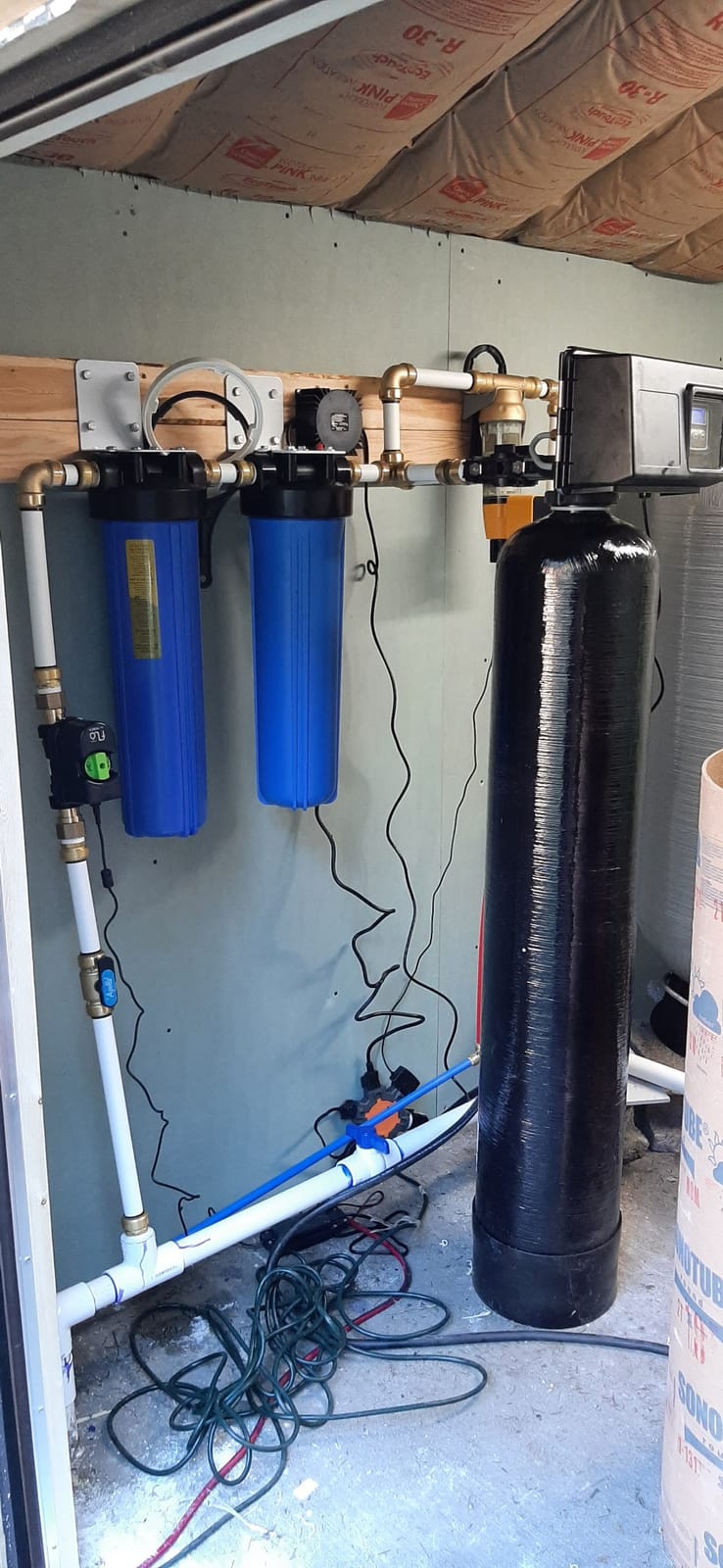
The 105 lb tank weight and freestanding design need floor space, and you will need a power outlet for the control head plus a drain line for regeneration cycles. In cold climates, the drain line must be protected from freezing, or you risk pushing water past the seals.
Who should buy the WCFM500K
Homeowners with severe iron above 3 ppm or strong hydrogen sulfide smell who are tired of cartridge systems that need constant replacement get the best fit here. The 10-year lifespan and automatic regeneration pay off for wells that would otherwise chew through cartridges every few months.
Who should skip the WCFM500K
Wells with light iron or no sulfur smell do not need this level of system. Households without a suitable drain line or power outlet near the installation point should look at cartridge-based alternatives.
How to Choose the Right Well Water Filtration System?
Picking the best water filtration system for well water starts with knowing what is in your water. Our team walked through a five-step decision framework with homeowners during our testing, and the same logic applies here.
Step 1: Test your well water first
You cannot pick the right filter without a water test. A basic well water test panel covers coliform bacteria, nitrates, iron, manganese, hardness, pH, total dissolved solids and lead. Your state health department or a certified lab can run a panel for a reasonable fee.
Once you have results, match them to the stages you need. Iron over 0.3 ppm means an iron filter. Sulfur smell means an oxidation tank or a system rated for hydrogen sulfide. Hardness over 7 gpg means a softener or salt-free conditioner. Bacteria means UV or a chlorinator.
If you have acidic water below pH 6.5, an acid neutralizer with calcite or magnesium oxide media is the missing stage most competitors skip. This is the same recommendation the AI Overview keeps surfacing, and it solves blue-green staining from copper pipe corrosion.
Step 2: Size the system by home and flow rate
Whole-house systems are sized by GPM (gallons per minute) flow and tank capacity. Use this quick chart as a starting point:
1-2 bathrooms: 7-9 GPM flow, 1-1.5 cubic foot media tank or 50K-100K gallon capacity. Cartridge-based systems handle this size comfortably.
3-4 bathrooms: 12-15 GPM flow, 100K-200K gallon capacity or a 1.5-2 cubic foot tank. Most cartridge-based whole-house filters and medium tanks fit.
5+ bathrooms or high-flow homes: 15-17 GPM flow, larger media capacity. Look at tanks or multi-tank setups.
Step 3: Read the NSF certifications
NSF/ANSI certifications tell you what a filter actually does. NSF/ANSI 42 covers aesthetic effects like chlorine taste and odor. NSF/ANSI 53 covers health effects like lead, mercury and cryptosporidium. NSF/ANSI 58 covers reverse osmosis systems. NSF/ANSI 401 covers emerging contaminants like certain PFAS. NSF/ANSI 372 certifies lead-free material safety.
If a filter does not list a specific NSF certification, treat its claims with caution. For UV systems, look for NSF/ANSI 55 Class B for disinfection performance.
Step 4: Whole-house versus point-of-use
Whole-house (point-of-entry) systems treat every drop of water entering the home. They protect showers, laundry, dishwashers and every tap. They cost more up front and require more space.
Point-of-use systems treat water at a single tap, usually the kitchen. An under-sink RO system is the most common example. RO is the gold standard for drinking-water polishing but produces 3-4 gallons of waste per gallon of treated water.
Most homeowners with private wells end up with both – a whole-house system for general treatment and an RO at the kitchen tap for drinking water. If you want a deeper look at point-of-use options, our emergency water filtration systems guide covers portable options as well.
Step 5: Budget for total cost of ownership
Upfront price is only part of the story. Cartridge systems have ongoing replacement costs that add up over the filter’s lifetime, while tank systems have higher upfront cost but lower annual maintenance.
UV lamps need replacement every 12-18 months. RO membranes last 2-3 years with proper pre-filtration. Chlorinators need ongoing chemical feeds.
Professional installation adds $300 to $1500 to the total. The cheapest installs are for cartridge systems that mount on existing plumbing. Heavy tank systems often need a plumber for the bypass valve and drain line.
For a deeper look at UV water purifiers for well systems specifically, that guide breaks down lamp life and dosage. Our pressure tanks guide helps if you also need to upgrade the storage tank that feeds your filtration system.
Frequently Asked Questions
What type of water filtration system is best with well water?
The best system for well water is a staged whole-house setup tailored to what your well actually contains. A common configuration starts with a sediment pre-filter, followed by an iron and sulfur filter, then a water softener or salt-free conditioner, and finishes with UV or reverse osmosis at the kitchen tap for the water you drink.
How much does a whole house well water filter system typically cost?
Whole-house well water filtration systems range from about $200 for a basic 2-stage cartridge setup to several thousand dollars for a multi-tank system with UV. Most homeowners spend between $1,500 and $4,000 on a complete staged system before professional installation.
Do you need a UV light with a well water filter?
UV light is a smart move when your well water test shows coliform bacteria or any time you cannot confirm the well is bacteria-free. UV at 40 mJ/cm2 or higher inactivates bacteria, viruses and cysts without adding chemicals, making it a clean final polishing stage before the tap.
How often do whole house well water filters need changing?
Most cartridge-based whole-house filters need changing every 6 to 12 months, depending on household usage and incoming water quality. Tank-based systems last much longer – 5 to 10 years between media changes. Check pressure gauges or flow rates monthly and replace when differential pressure climbs noticeably.
Can a single filter handle iron, sulfur and hardness together?
No single filter handles all three well. Iron and sulfur can be addressed by one oxidation-style filter, but hardness requires either a salt-based softener or a salt-free conditioner. Most homeowners stack a sediment pre-filter, an iron and sulfur tank, a softener or conditioner, and UV or RO for complete coverage.
The Right Pick for Your Well
The best water filtration systems for well water in 2026 are not one-size-fits-all. If your well has moderate iron and chlorine concerns, the iSpring WGB21BM is our top pick – a 2-stage whole-house filter with the strongest review base and proven DIY install. If you are battling strong sulfur smell or high iron above 3 ppm, the iSpring WCFM500K regenerating tank is the closest thing to set-and-forget. For homeowners who want UV disinfection and salt-free scale control bundled into one tank, the Aquasana WH-Well-CT-UVS-B is the premium pick.
Test your water first, then match the stages to your well. A staged whole-house system plus a point-of-use RO at the kitchen tap covers most well water challenges for the long run.