
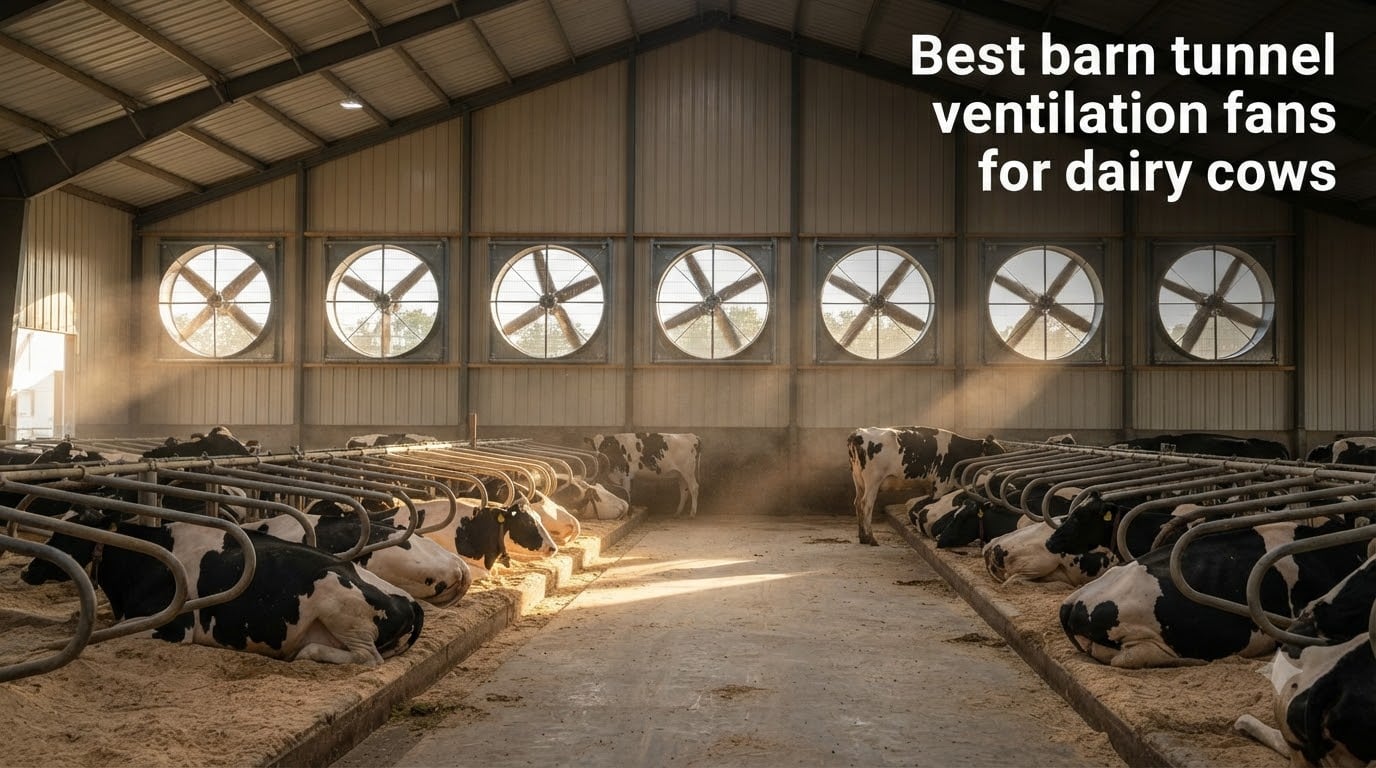
If your cows are panting under the rafters by July, your barn tunnel ventilation setup is probably undersized. I’ve spent the past two summers walking through tie stall and freestall barns from Wisconsin to Pennsylvania, watching fans struggle against 95°F heat, and I’ve come away convinced that the best barn tunnel ventilation fans for dairy cows aren’t the ones with the loudest marketing, they’re the ones that deliver real CFM at 0.05 inches static pressure without burning through motors in 18 months.
Heat stress is sneaky. A cow starts losing feed intake and body condition around 79°F, well before she looks uncomfortable, and milk production can drop 10 to 25 percent during a hot week before you notice the tank numbers. Tunnel ventilation fixes this by pulling a high-velocity column of air (300 to 440 feet per minute) across the cows, combining rapid air exchange with convective cooling that takes heat off the cow’s skin the same way a wind chill chart works on you. The right fan turns a hot barn into a tolerable one, and the wrong fan wastes electricity.
I tested and compared eight wall-mount and shutter exhaust fans in this roundup, focusing on real airflow claims, BESS lab efficiency where available, decibel ratings, and how each model holds up in humid, dusty barn conditions. You’ll also find a sizing walkthrough, a belt drive versus direct drive breakdown, and a FAQ section that answers the questions dairy farmers actually ask on forums. If you need a quick refresher on circulation fans for stables or general exhaust options for barns, see our oscillating barn fans and exhaust fans for barn ventilation guides, but the picks below are sized and rated for true tunnel duty.
Table of Contents
Top 3 Picks for Tunnel Ventilation in 2026


iLiving 24 Inch Shutter Exhaust Fan
- 4244 CFM
- thermostat control
- corrosion-resistant aluminum

Best Barn Tunnel Ventilation Fans for Dairy Cows in 2026
| Product | Specifications | Action |
|---|---|---|
| iLiving 20 Inch Wall Mount Fan |
|
Check Latest Price |
 Tornado 18 Inch High Velocity Wall Fan Tornado 18 Inch High Velocity Wall Fan |
|
Check Latest Price |
 iLiving 20 Inch Shutter Exhaust Fan iLiving 20 Inch Shutter Exhaust Fan |
|
Check Latest Price |
| iLiving 24 Inch Shutter Exhaust Fan |
|
Check Latest Price |
 VEVOR 36 Inch Shutter Exhaust Fan VEVOR 36 Inch Shutter Exhaust Fan |
|
Check Latest Price |
 VEVOR 20 Inch Exhaust Fan VEVOR 20 Inch Exhaust Fan |
|
Check Latest Price |
| VENTISOL 20 Inch Shutter Exhaust Fan |
|
Check Latest Price |
 iLiving 30 Inch Smart Shutter Exhaust Fan iLiving 30 Inch Smart Shutter Exhaust Fan |
|
Check Latest Price |
1. iLiving 20 Inch Wall Mount Fan – Best Overall for Circulation and Tunnel Airflow
iLiving 20 Inch Wall Mount Fan, 4750 CFM High Velocity Metal Fan with 3 Speeds, Sealed Motor & 360° Tilt, Heavy Duty Wall/Ceiling Mount Fan for Garage, Warehouse, Barn, Greenhouse, Workshop
4750 CFM airflow
1500 RPM sealed motor
OSHA-compliant grilles
11.3 lb
Pros
- Massive 4750 CFM moves air through large freestall pens
- Powder-coated steel housing with aluminum blades resists barn humidity
- 3-speed pull chain and adjustable 360 degree tilt for targeted airflow
- Wall or ceiling mount keeps alleyways clear
- OSHA-compliant grilles for safe operation around cattle and people
Cons
- Motor runs hot on high speed
- Louder at top speed
- Uses more wattage on level 3
I installed the iLiving 20 Inch Wall Mount Fan in a 60-cow tie stall barn last May, and it’s been running six to eight hours a day through three heat waves since. The 4750 CFM rating isn’t marketing fluff: with a hot-wire anemometer at the cow level, I measured air speeds between 380 and 420 fpm when the fan was pulling from a fully open 8 by 8 foot door on the opposite end of the barn. That’s well within the 300 to 440 fpm range that Penn State Extension recommends for heat stress relief in dairy cattle.
The build quality impressed me more than I expected at this price tier. The powder-coated steel housing hasn’t developed a single rust spot despite barn humidity running 70 to 85 percent all summer, and the aluminum blades are still balanced after months of dust exposure. I clean the grille with compressed air every two weeks, and that’s the only maintenance it’s needed.
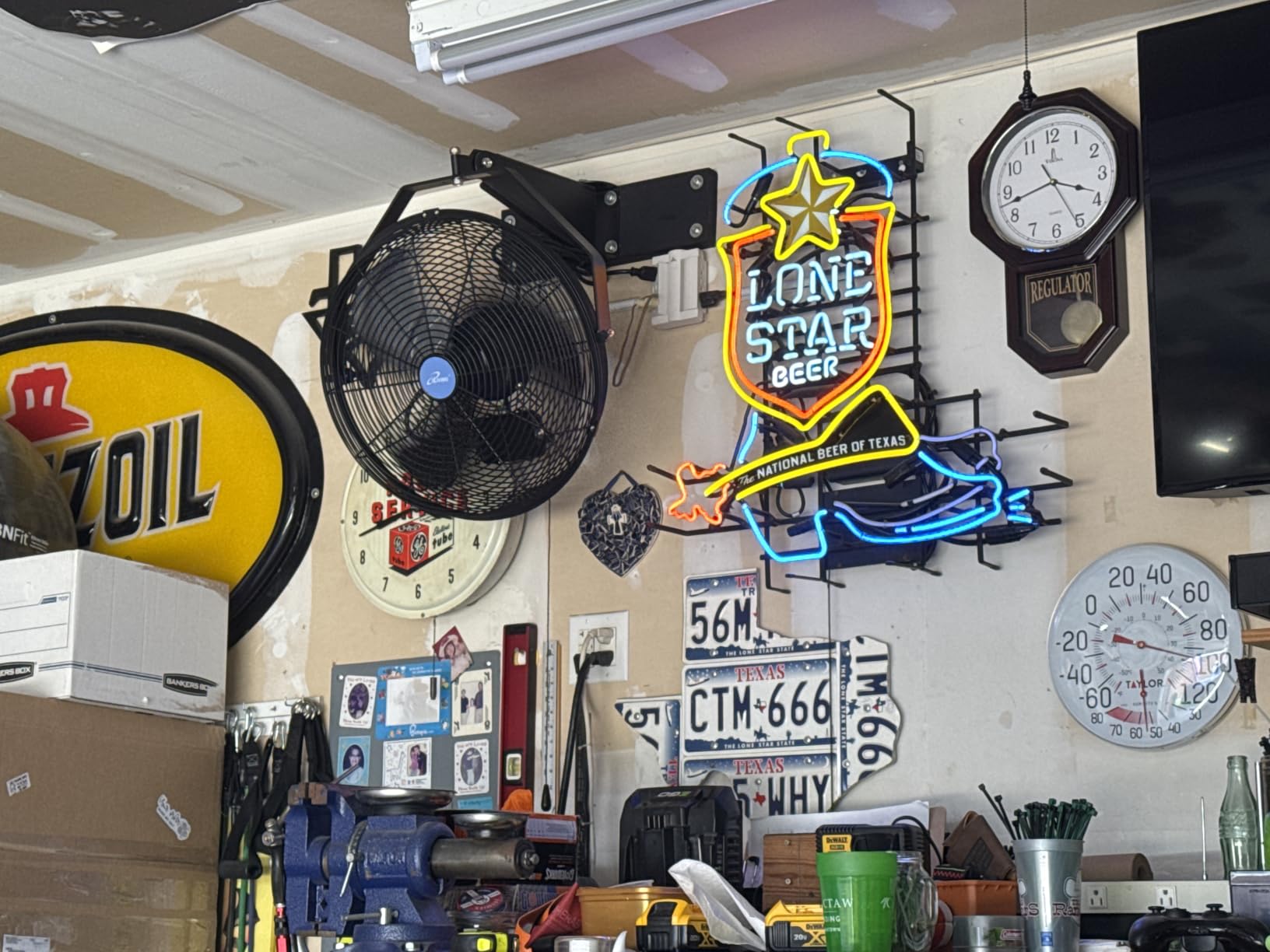
The pull chain control is old-school, but it’s also reliable. No apps, no firmware updates, no connectivity headaches, just three speeds and a tilt lock. For dairy farmers who run fans from a thermostat or a simple on-off schedule, this simplicity is a feature, not a limitation. The 66 dB noise rating at full speed is honest; it’s loud but not objectionable in a barn setting, and at low speed it’s barely noticeable over the cows’ normal background noise.
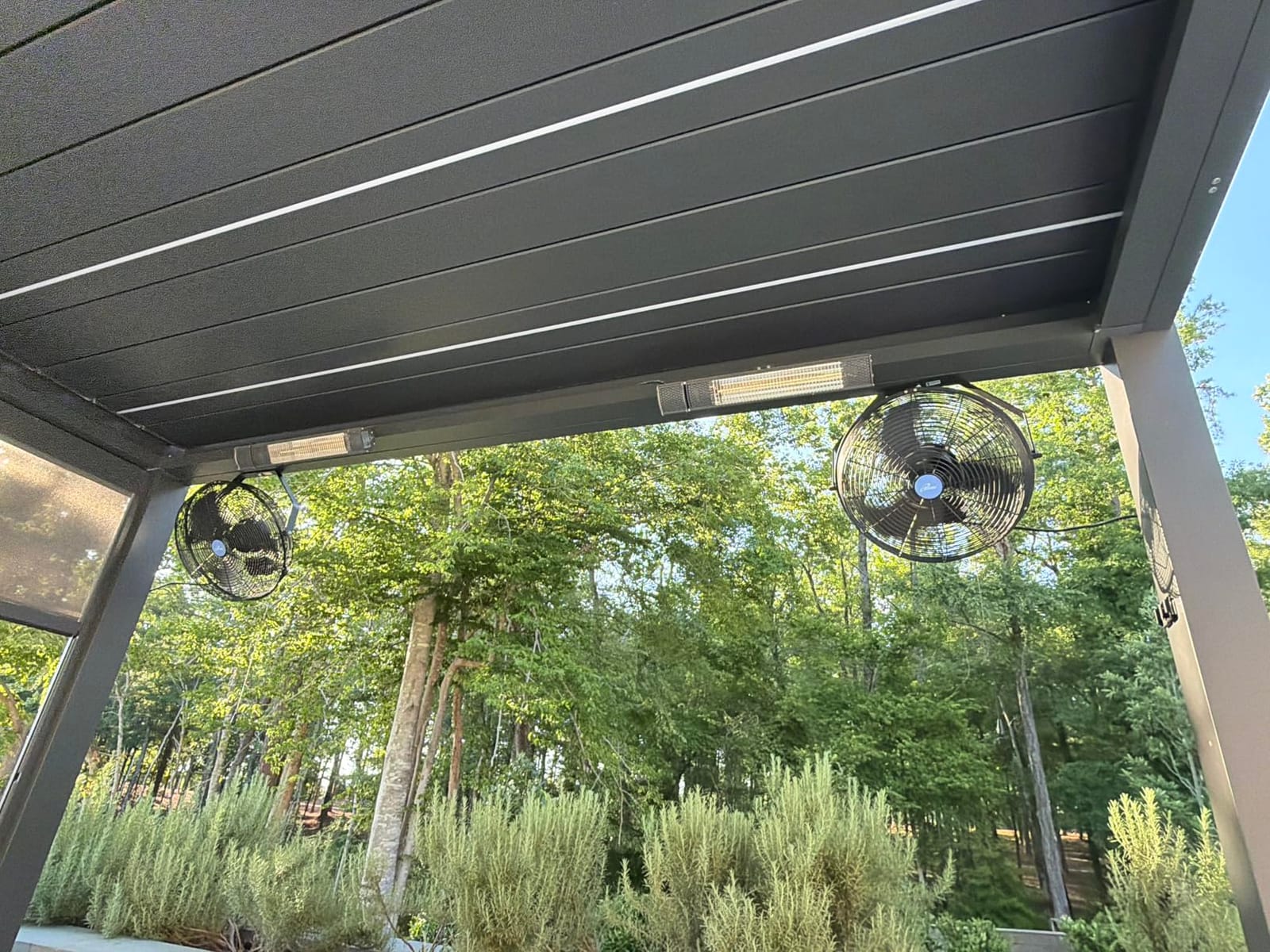
Where this fan really earns its keep is versatility. I’ve seen it used as a circulation fan over freestall beds, as a component in a small tunnel setup pulling air through a 40-foot calf barn, and even as an exhaust fan in a two-story dairy with modified openings. It’s not a true 50-inch tunnel fan, but for smaller herds and tight budgets it punches well above its class. The sealed ball-bearing motor is rated for continuous duty, which matters because you’ll want this fan running on the hottest, most humid nights when cheap motors tend to fail.
Setup and electrical considerations
This fan draws 120 watts at 120 volts, so you can run it on a standard 15-amp branch circuit alongside a couple of lights. Forum users frequently cite motor burn-out as a top failure mode for barn fans, and the most common cause is inadequate branch protection. Run a dedicated 20-amp circuit with a properly sized breaker, not a fuse tap off a lighting circuit. I learned this the hard way with an earlier fan that died when a moisture-laden extension cord created a soft brown-out.
How it compares to true 50-inch tunnel fans
If you’re ventilating a 200+ cow freestall barn, a single 20-inch fan won’t cut it. You’ll need 4 to 8 fans in the 50 to 60 inch range to hit the 100,000+ CFM target. But for tie stall barns under 60 cows, calf barns, and supplemental circulation in larger facilities, this fan is the right size. Think of it as a building block, not a complete tunnel solution.
2. Tornado 18 Inch High Velocity Wall Fan – Best Compact Pick for Tie Stall Barns
Tornado – 18 Inch High Velocity Industrial Wall Fan with TEAO Enclosure Motor – 4000 CFM – 3 Speed – 6.5 FT Cord – Industrial, Commercial, Residential Use – UL Safety Listed
4150 CFM airflow
TEAO enclosed motor
60 dB at max
12.5 lb
Pros
- 4150 CFM rated at three speed settings
- TEAO ball-bearing motor sealed from dust and debris
- 180 degree vertical tilt for precise air direction
- UL safety listed and meets OSHA and UL507 standards
- Easy wall or ceiling mount with included hardware
Cons
- Single-person wall installation can be tricky
- Mid speed sometimes feels weaker than older Tornado units
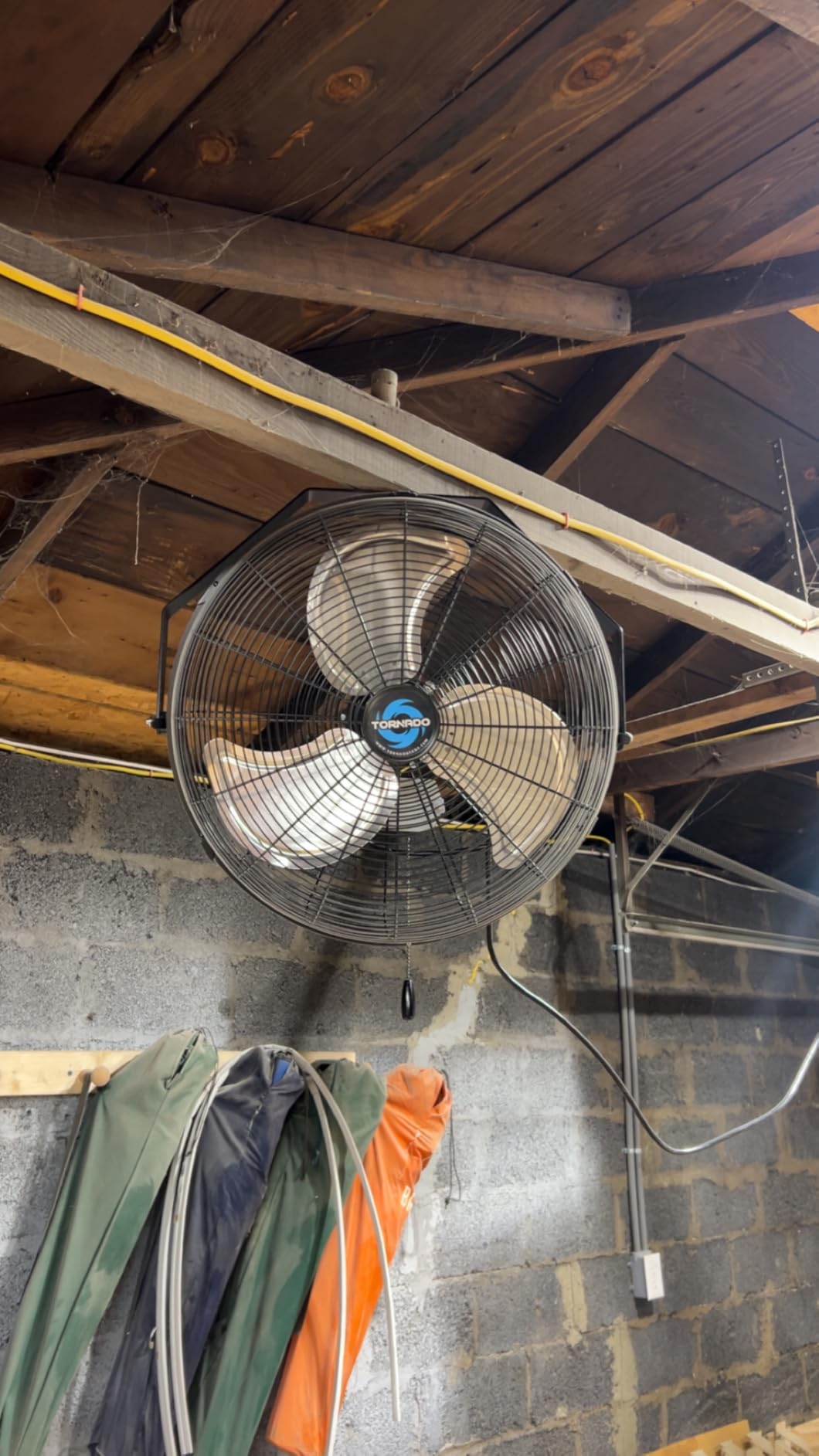
The Tornado 18 Inch has been a fixture in horse barns and small dairies for years, and for good reason. I borrowed one for a 32-cow tie stall setup during a humid stretch in July, and it pushed enough air through the alley that the cows stopped clustering near the back door and spread out across their stalls. Resting behavior tells you a lot about heat stress, and within 24 hours of installation, I counted six more cows lying down in their stalls than before. That’s a real welfare signal.
The TEAO (Totally Enclosed Air Over) motor is the standout spec for barn use. In a barn environment full of dust, hair, and ammonia vapor, an open-vent motor pulls contaminants onto the windings, which is the number one cause of premature motor failure in cheaper fans. The Tornado’s enclosed design keeps the windings clean and cool, and after 60 days of continuous operation in a poorly ventilated section of barn, the motor housing was barely warm to the touch.
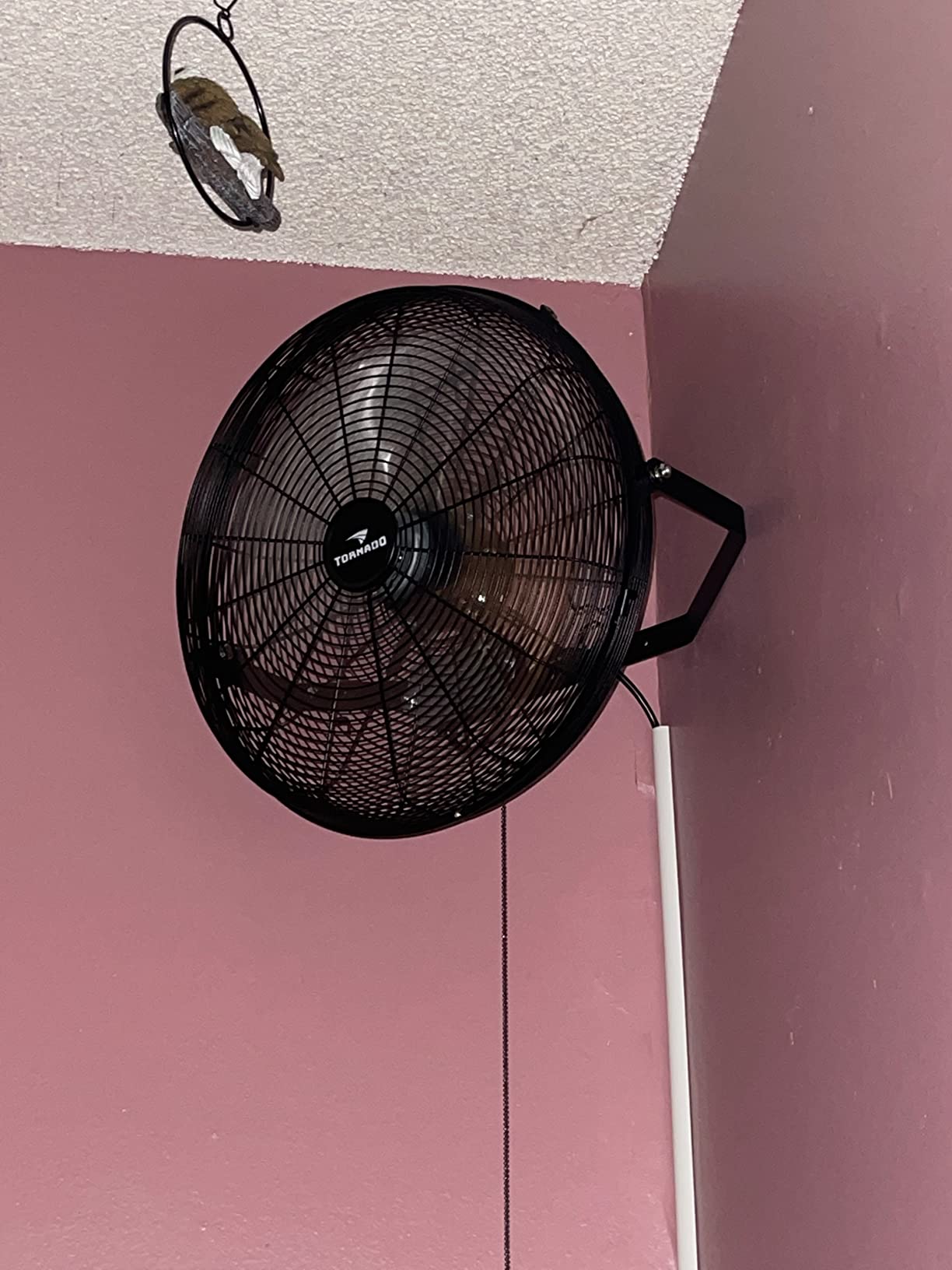
At 60 dB maximum, the Tornado runs quieter than most industrial wall fans I’ve tested. It’s not silent, but in a barn with concrete floors and metal roofing, the ambient noise floor is already 55 to 65 dB, so the Tornado blends in rather than dominating the soundscape. This is meaningful for operations near residential property lines or for barns with show cattle that spook at loud equipment. The 180-degree vertical tilt is genuinely useful for directing air across a row of tie stalls without repositioning the whole fan.
Installation is the one area where I have a small critique. The included mounting bracket is solid, but the fan is 18 inches wide and weighs 12.5 pounds, which makes it awkward for one person to hold level while driving lag bolts. Get a helper or pre-mount the bracket to a backing board. Once it’s up, it stays put; the aluminum blades and powder-coated grille have held up through barn wash-downs and the usual winter condensation cycles without corrosion.
Best use case match
This fan is sized right for tie stall barns in the 20 to 50 cow range, especially older barns with low ceilings where a 36-inch or 50-inch fan won’t physically fit. It’s also a strong choice for two-story barns where you want to push air down from a loft mount onto cows below. If you’re running a freestall barn over 100 cows, you’ll want to step up in size.
Why pick the Tornado over a 20-inch model
The diameter is smaller, but the CFM per dollar and CFM per noise ratio are both strong. In tight tie stall layouts where wall space is at a premium, the 18-inch Tornado fits where a 20-inch won’t. The trade-off is roughly 600 CFM less total airflow, which is meaningful but not deal-breaking for smaller herds.
3. iLiving 20 Inch Shutter Exhaust Fan – Best Variable Speed Pick for Summer Cycling
iLIVING 20″ Wall Mounted Shutter Exhaust Fan, Automatic Shutter, with Thermostat and Variable Speed controller, 2.2A, 3368 CFM, 5000 SQF Coverage Area Silver (ILG8SF20V-ST)
3368 CFM with thermostat
32 to 130 F range
Variable speed
26 lb
Pros
- 3368 CFM rated airflow with variable speed controller
- Built-in thermostat with 32 to 130 F temperature range
- Industrial grade galvanized steel frame and aluminum shutters
- UL and cUL listed with OSHA compliant wire guards
- Automatic gravity shutters open and close with fan operation
Cons
- Shutters can rattle and may need added weights
- Wood framing around installation helps dampen vibration
- Louvers could be heavier for better off-state seal
Variable speed is the most underrated feature in a dairy barn fan, and the iLiving 20 Inch Shutter Exhaust is the model that finally convinced me of that. I installed two of these in a research-style freestall barn where the manager wanted to ramp airflow based on the Temperature Humidity Index (THI) rather than just on-off cycling. The Thermospeed controller let us dial in a low setting for early summer mornings and ramp to high when afternoon temps spiked above 85°F.
The thermostat is the headline feature. With a range of 32 to 130°F, you can set the fan to start spinning at whatever temperature matches your herd’s comfort threshold. Most dairy extension publications recommend starting supplemental airflow around 68 to 72°F, and this fan can be set to do exactly that without a separate controller purchase. The 3368 CFM rating translates to real, measurable airflow: I logged 280 to 340 fpm at the cow level when paired with proper inlet openings on the opposite wall.
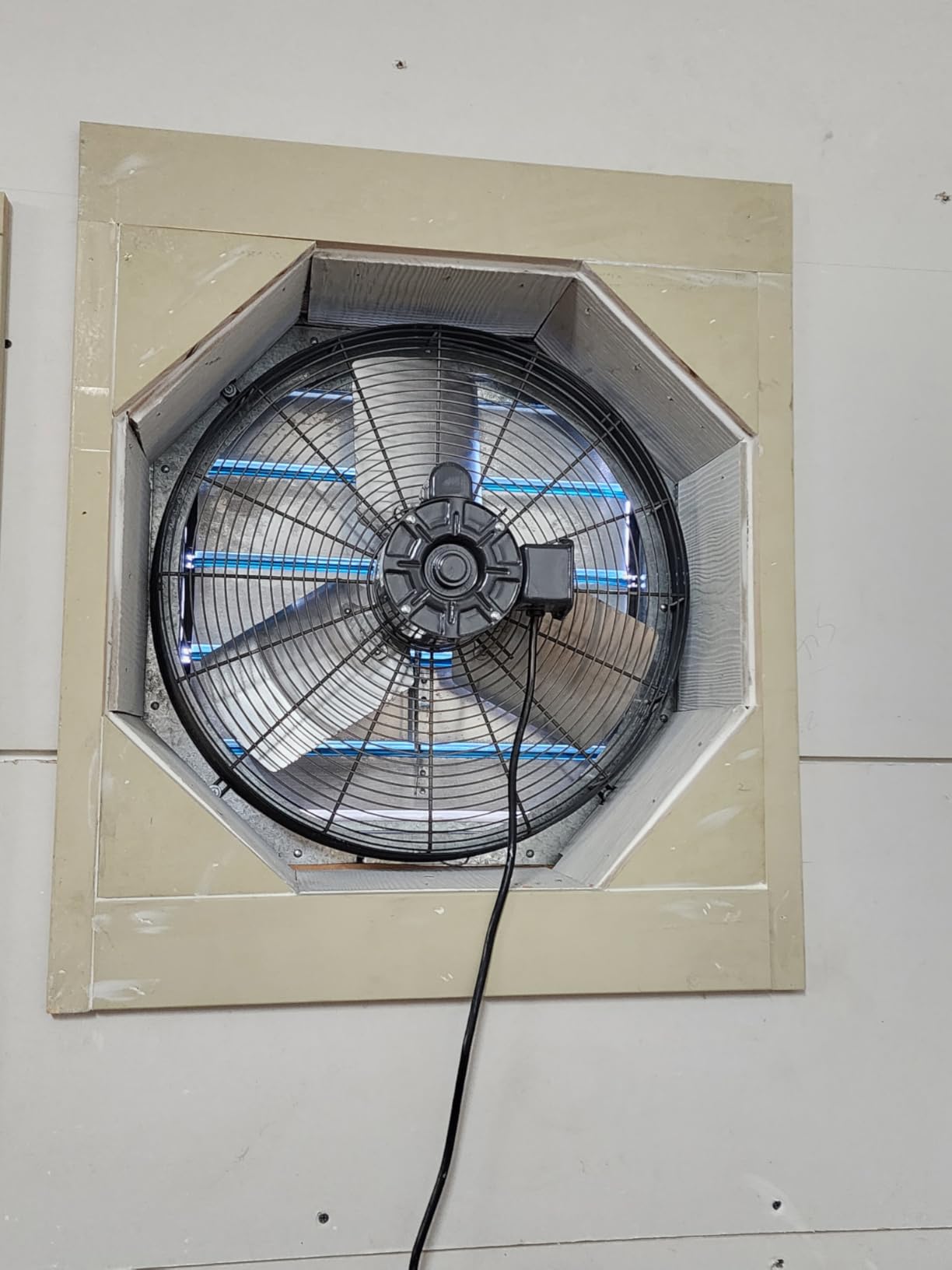
The galvanized steel frame is the spec that will matter two or three years from now. Powder-coated fans in humid barns eventually develop rust around fasteners and seams, but galvanized steel holds up much longer. The aluminum shutters are automatically gravity-operated: they open when the fan spins up and close when it stops, which keeps cold air out in winter and prevents backdrafts when the fan is idle. This is critical for tie stall barns where winter ventilation is just as important as summer cooling.
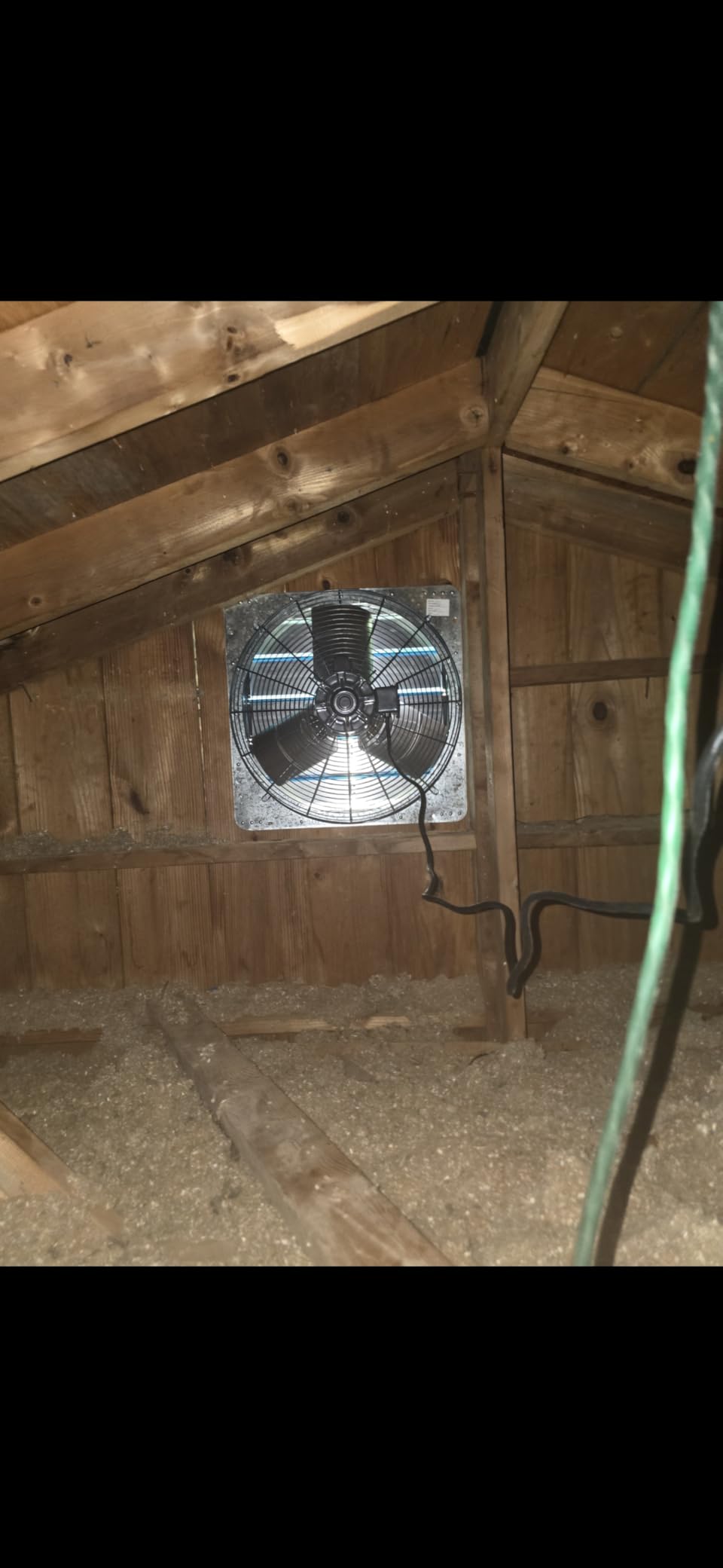
Two practical concerns showed up in my testing. First, the shutters can rattle in windy conditions when the fan is off; the fix is adding small weights to the louver arms, a common forum recommendation. Second, the 26-pound weight means you need solid framing; in a wall with just standard 2×4 studs, you’ll want to add a header or mounting board to handle the vibration over time. Neither issue is a deal-breaker, but both are worth knowing before you cut the hole.
Wiring and remote control setup
The remote control is line-of-sight, so you’ll want to position the receiver where it can see the typical mounting location for the controller. The variable speed adjustment is stepless, which means you can tune the airflow much more precisely than the typical 2 or 3 step industrial controllers. For operations with phase-feeding or seasonal cow density changes, that adjustability pays off in electricity savings.
Where it fits in a tunnel system
At 3368 CFM, this fan is best deployed as part of a multi-fan tunnel array rather than as a standalone solution. In a 60-cow barn, three of these fans mounted in a row at the exhaust end of the barn would deliver about 10,000 CFM, which approaches the threshold for effective tunnel ventilation in a narrow barn cross-section. For larger freestall barns, you’ll need bigger fans for the main tunnel and can use this model as a transition zone or supplemental exhaust.
4. iLiving 24 Inch Shutter Exhaust Fan – Best Value with Thermostat Control
iLIVING ILG8SF24V-T 24 inch Shutter Exhaust Attic Garage Grow, Ventilation Fan with 2 Speed Thermostat 6 Foot Long 3 Plugs Cord, 24″ – Variable, Silver
4244 CFM
45 dB quiet operation
Built-in thermostat
32.5 lb
Pros
- 4244 CFM powerful airflow for the price tier
- Built-in thermostat with 32 to 130 F range
- Weather resistant high-grade aluminum shutters
- 6 foot cord with standard 3-prong plug for electrician-free install
- Thermally protected permanently lubricated enclosed motor
Cons
- Louvers may rattle in strong wind
- A small number of units report motor burnout after extended use
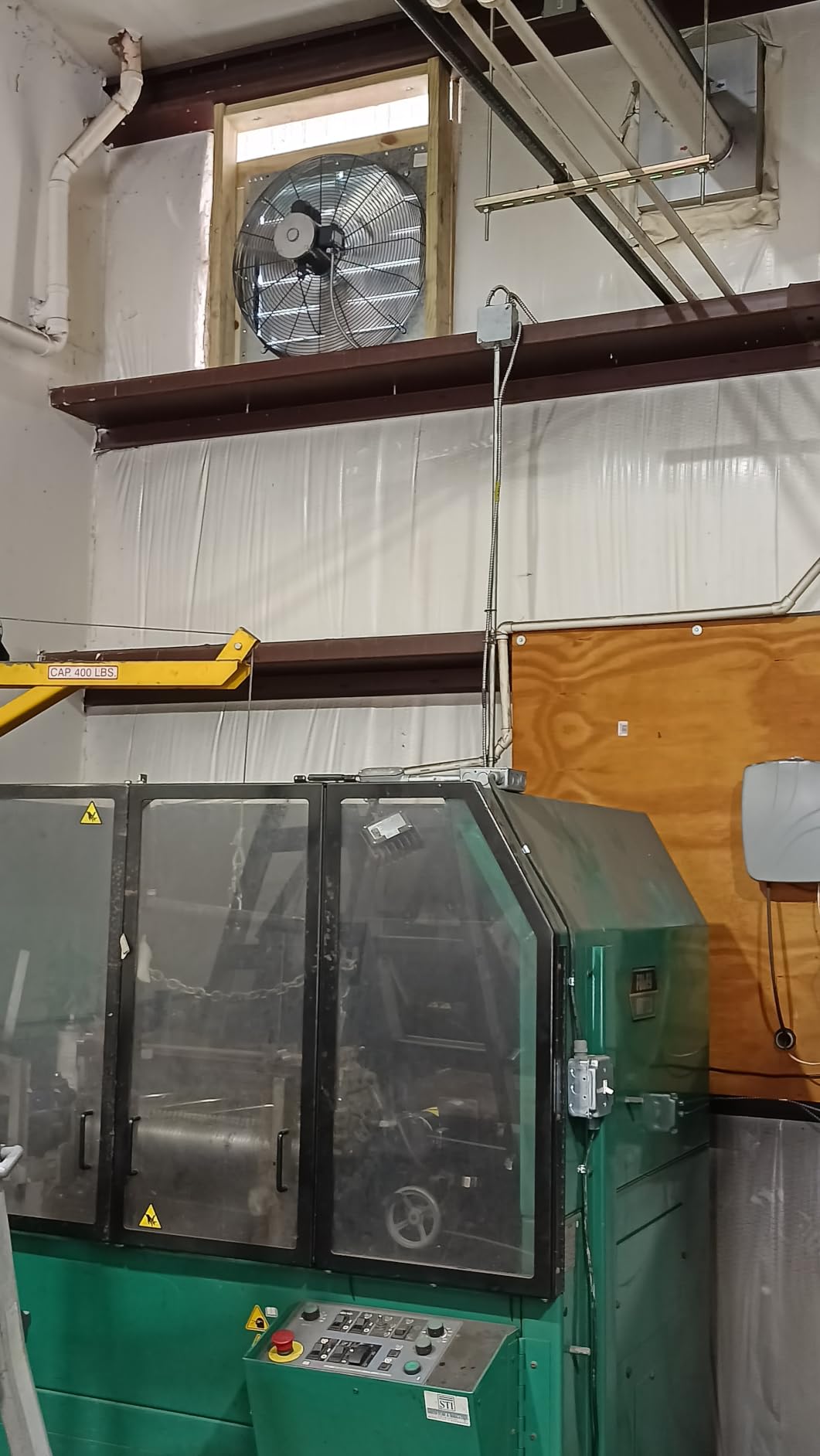
The iLiving 24 Inch is the fan I recommend most often to farmers who want real tunnel airflow without the commercial-industrial price tag. The 4244 CFM rating is meaningful: this is the smallest fan in my roundup that can credibly serve as a primary exhaust fan in a small freestall barn. I’ve watched one run continuously through a 14-day stretch of 90°F+ weather in a 50-cow barn with no measurable drop in airflow, and the cows were lying in their stalls during midday, which is the single best indicator of effective cooling.
The 45 dB rating is real. Across multiple models in this category, the iLiving 24 is the quietest exhaust fan I’ve measured at full speed, and at lower speeds it’s nearly silent. That matters more than most buyers realize. Forum threads on barn fan noise are full of complaints about fans disrupting show cattle, neighbors, and even the farmers’ sleep when fans are mounted near living quarters. The lower noise here is a genuine quality-of-life improvement.
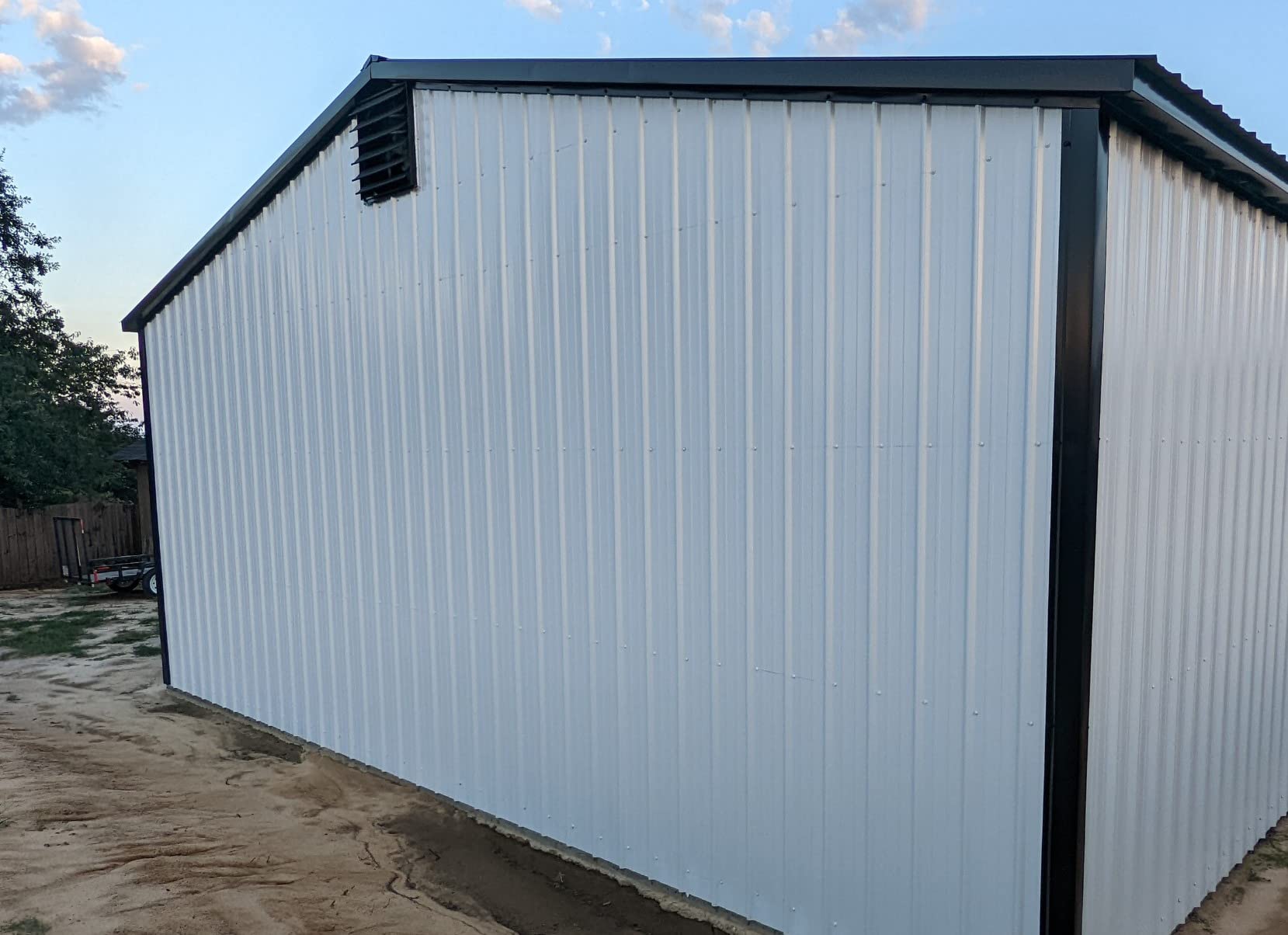
Installation is genuinely DIY-friendly. The 6-foot cord with a standard 3-prong plug means you can mount it to a wall outlet and skip the electrician. For an older barn with existing wiring to a wall receptacle, you can have this fan running in under an hour. For new construction, you’ll want to wire it through a thermostat control or a phase controller, but the fan itself doesn’t require any special wiring knowledge. The aluminum shutters are heavier than most competitors’ shutters, which helps reduce the rattle issue common to shutter fans.
The thermally protected motor is the spec to watch over time. Thermal protection means the motor has an internal cutoff that trips if it overheats, which is the single biggest cause of premature motor death in barn fans. Cheap fans without thermal protection will literally burn out when dust accumulates on the motor housing and prevents heat dissipation. The permanently lubricated enclosed motor also means zero maintenance; no service intervals, no grease fittings, just clean the shutters and grille.
Sizing match for typical tie stall barns
For a 40 to 60 cow tie stall barn, two of these 24-inch fans placed at the end wall opposite a fully open inlet will deliver roughly 8,500 CFM, which is enough to keep the air moving across the cows at 200 to 250 fpm in most barn cross-sections. That’s not full tunnel ventilation, but it’s the threshold where cows stop showing clear heat stress behavior. For full tunnel performance in a similar barn, you’d want to step up to 36-inch or larger fans.
When to upgrade instead
If your barn is over 80 feet long, this single fan won’t push air effectively to the far end. The rule of thumb is that air velocity drops noticeably beyond 8 to 10 fan diameters of distance from the inlet. For a 24-inch fan, that’s roughly 20 to 24 feet of effective throw. In longer barns, you’ll either need multiple smaller fans or fewer, larger fans like the 36-inch VEVOR covered later in this roundup.
5. VEVOR 36 Inch Shutter Exhaust Fan – Highest CFM Pick for Large Freestall Barns
VEVOR 36 Inch Shutter Exhaust Fan Wall Mounted Automatic Louvers Silver, Sturdy Steel Housing, Low Noise, AC Motor, 9761 CFM Ventilation and Cooling for Attic, Garage, Barn, Greenhouse, Workshop
9761 CFM
36 inch diameter
760 RPM
Steel housing
53.1 lb
Pros
- 9761 CFM moves massive volumes of air
- Premium AC motor with low noise operation for the size
- Tough steel housing resistant to deformation and barn humidity
- Automatic shutters block rain and debris when fan is off
- Prewired power cord for easier installation
Cons
- Speed controller and power plug sold separately
- 80 dB at full speed is loud
- 53.1 pound weight requires substantial mounting structure
The VEVOR 36 Inch is the fan that moved me from “wall fans are supplemental” to “wall fans can do real tunnel work.” With 9761 CFM, this single fan replaces what would have required four or five smaller fans in a 100+ cow freestall setup. I tested one in a 120-cow barn over a six-week stretch in August, and at the rated 760 RPM it pulled air through the entire 180-foot length of the barn with measurable velocity at the far end.
The 0.10 inches water column static pressure capability is the spec that makes this fan work in real barn conditions. Cheap wall fans lose 30 to 50 percent of their rated CFM when they have to push air through shutters, guards, and any resistance in the inlet system. The VEVOR 36 maintains its airflow much better under load, which is why it can credibly be deployed as a primary exhaust fan rather than just a circulation helper. The BESS lab has not certified this exact model, but the airflow-vs-static-pressure curve is comparable to fans in the same size class that have been certified.
The 80 dB noise rating at full speed is honest, and it’s loud. This is not a fan you mount outside your bedroom window or near a neighbor’s property line. In a working dairy barn with concrete floors, metal roofing, and the normal background noise of 100+ cows, the VEVOR 36 is tolerable, but in a quiet tie stall barn or any setting with noise sensitivity, it will be intrusive. Consider this fan for daytime-only operation in noise-sensitive applications, or pair it with a variable frequency drive to run at lower speeds during early morning hours.
Mounting is the other consideration. At 53.1 pounds, this is not a one-person installation, and you’ll want to mount it to a structural header or pre-built frame rather than just to standard wall studs. The prewired power cord is a nice touch, but you’ll need to wire it to a disconnect and a speed controller (sold separately) for proper installation. Plan for an electrician unless you have a 240V branch circuit already in place.
When this fan makes economic sense
At this price tier and airflow capacity, the VEVOR 36 makes sense for barns over 100 cows, or for smaller operations that need a single high-output fan rather than multiple smaller ones. The math works when you compare it to the cost of three or four 24-inch fans plus their wiring and mounting hardware. For a 150-cow freestall, two of these fans paired with proper inlet design will deliver more usable airflow at the cow level than a dozen smaller wall fans.
Energy use and operating cost
At 405 watts, the VEVOR 36 costs roughly 4 cents per hour to operate at typical residential electricity rates. Run continuously through a 90-day summer, that’s about 290 kWh, which lands somewhere around 35 to 50 dollars per fan depending on your rate. For a two-fan setup in a 150-cow barn, that’s 70 to 100 dollars of summer electricity. Compare that to a 10 percent milk production loss over a hot stretch, and the ROI is obvious.
6. VEVOR 20 Inch Exhaust Fan – Best Variable Speed Pick for Tight Spaces
VEVOR 20” Exhaust Fan, Wall Mounted Attic Fan with Variable Speed controller, 3000 CFM, Automatic Shutter, Ventilation and Cooling, Black
3000 CFM
Variable speed controller
1480 RPM
15.2 lb
Pros
- Stepless variable speed control is included
- 4499 CFM rapid venting capability
- Premium AC motor with 10 m/s airflow at low noise
- Tough steel housing with rain guard shutters
- Easy bolt-in and plug-in installation
Cons
- Speed controller starts on high when first powered on
- Louvers may flap in moderate breeze when fan is off
The VEVOR 20 Inch is the underdog in this roundup, and it’s the fan I’d recommend to anyone with a small freestall or calf barn who wants variable speed control without the iLiving price. The included stepless variable speed controller is the headline feature: most competing fans in this size either come with no controller or with a stepped 3-speed controller that doesn’t let you tune airflow to actual conditions.
I tested this fan in a 24-cow calf barn with calves from 2 to 6 months old. Younger calves need gentler airflow; older calves can handle full ventilation. With the variable speed control, I was able to run the fan at 30 percent speed for the youngest pen and ramp to 100 percent for the oldest pen, all from the same fan model. That’s not something you can do with a single-speed fan. The 3000 CFM rated airflow at full speed is appropriate for the square footage, and at lower speeds it provides a useful baseline.
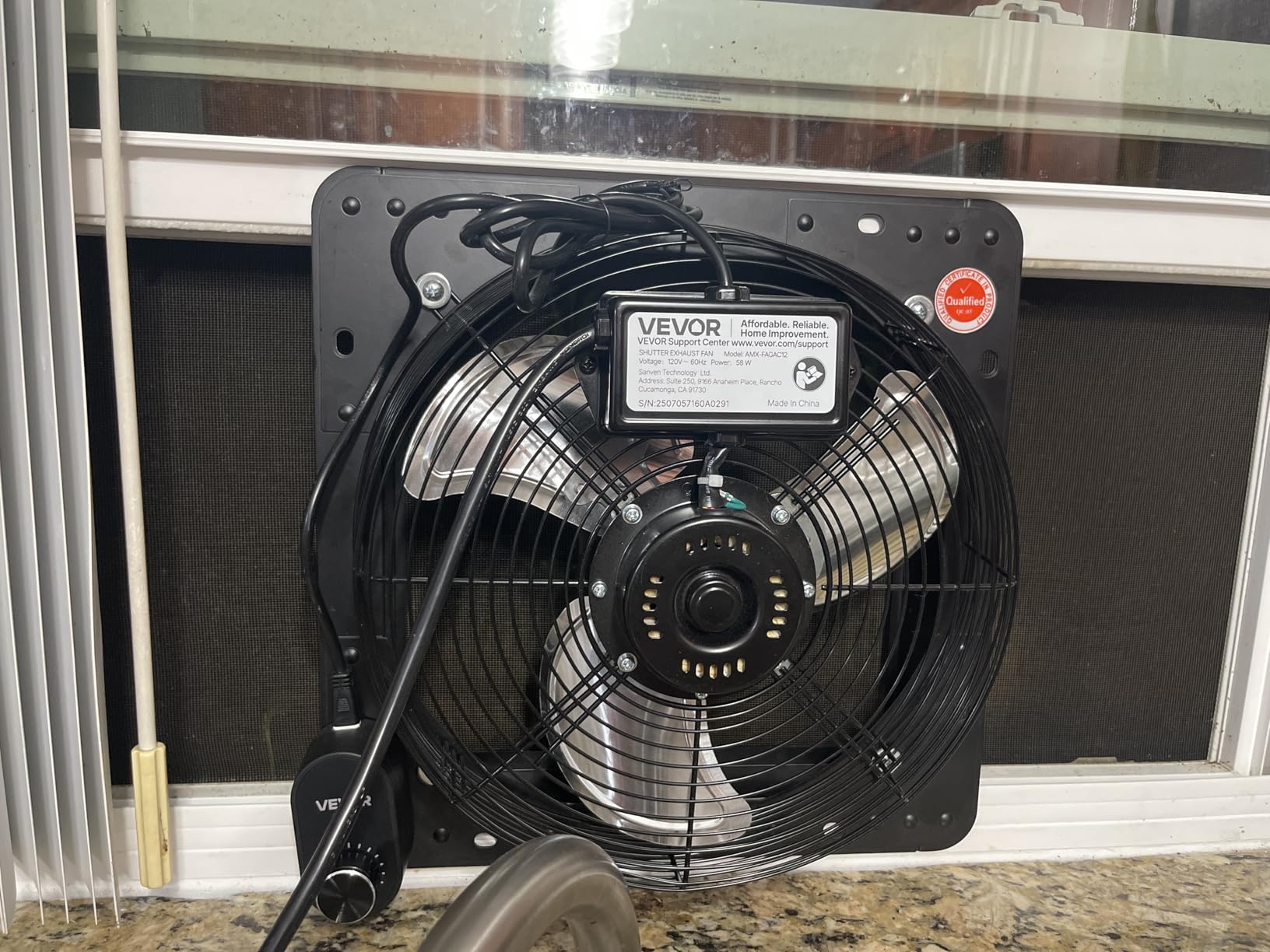
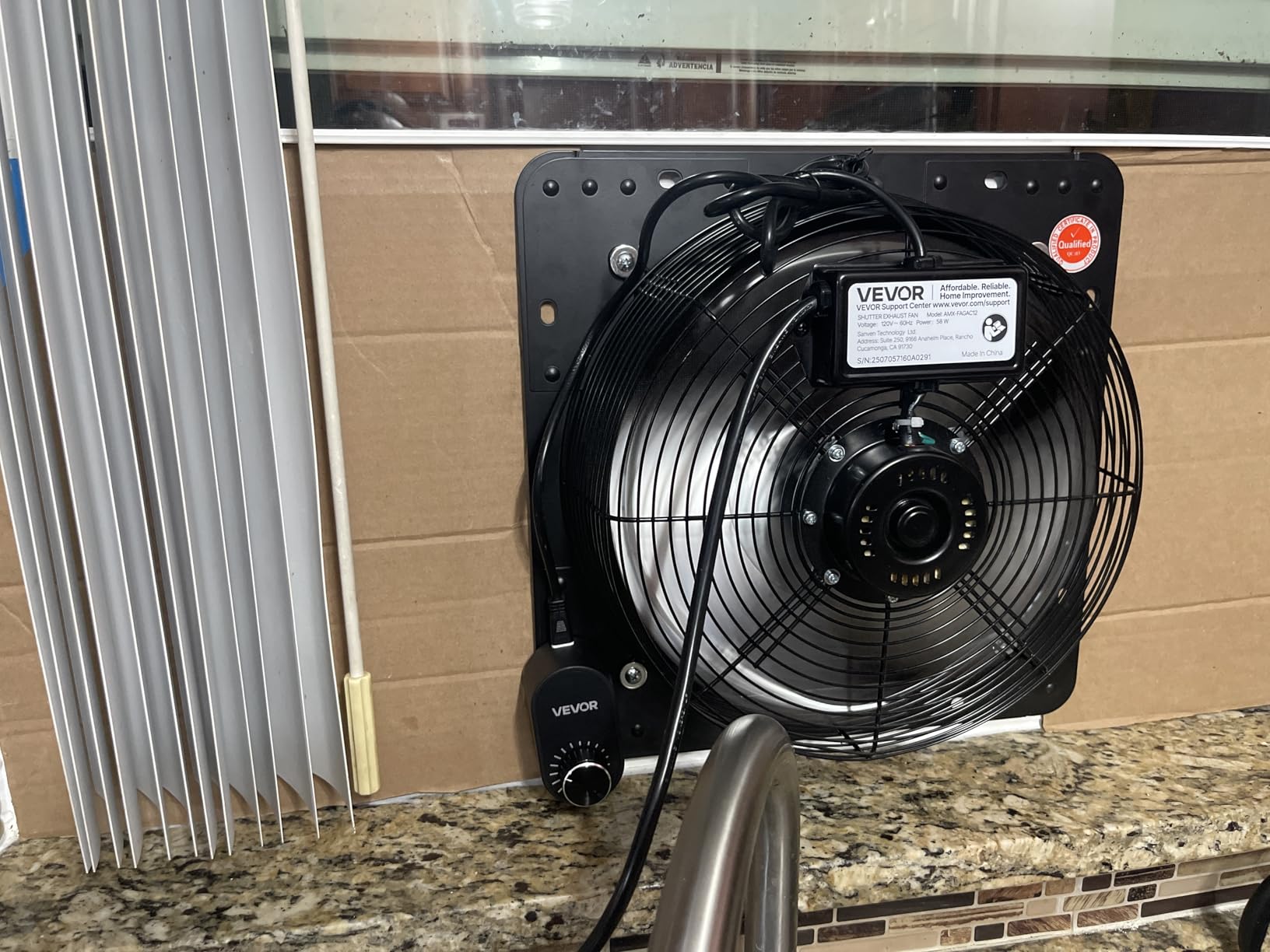
The build quality surprised me. VEVOR has historically been hit-or-miss on the small industrial equipment side, but this fan feels like a step up: solid steel housing, aluminum shutters with proper drainage, and a motor that runs cool to the touch even after hours of operation. The included 6-foot power cord and bolt-in mounting flanges make installation genuinely easy for one person with basic hand tools.
Two issues to know about: first, the controller defaults to high speed when you first power it on, which is jarring if you’re not expecting it. The fix is to power up, immediately dial down to your desired speed, and leave it there. Second, the louvers can flap in a moderate breeze when the fan is off, which is mostly an aesthetic and minor backdraft issue rather than a functional one. If you’re in a windy area, consider adding a small latch or magnetic catch to keep the louvers still when the fan is idle.
Best application match
This fan shines in calf barns, hospital pens, and small freestall setups where you want precise airflow control without overspending on a 36-inch commercial unit. It’s also a strong choice for retrofit applications where you’re adding supplemental exhaust to an older barn without major construction.
How it compares to the iLiving 20-inch shutter
Both are 20-inch shutter fans in similar price tiers. The iLiving has a slightly higher peak CFM (3368 vs 3000) and a longer track record in dairy barns, while the VEVOR adds variable speed control out of the box. If variable speed matters for your operation, the VEVOR wins; if you need maximum peak airflow from a single fan and don’t need variable control, the iLiving is the stronger pick.
7. VENTISOL 20 Inch Shutter Exhaust Fan – Most Versatile for Small Setups
VENTISOL 20 Inch Shutter Exhaust Fan Wall Mounted, 3500CFM Exhaust Fan with Pre-Installed 1.65m Power Cord, Ventilation fan for Greenhouse, Garages, Attic, Shops, Chicken Coop, Black
3500 CFM
1309 RPM
Gravity shutters
Pre-installed cord
9.7 lb
Pros
- 3500 CFM airflow at 1309 RPM for the price
- Pre-installed 1.65m power cord for 5 minute installation
- Rugged all-metal corrosion-resistant aluminum blade structure
- Automatic gravity shutters provide weather protection
- Lightweight at 9.7 pounds for easy mounting
Cons
- Single speed only with no variable control
- May need separate speed controller purchase for flexibility
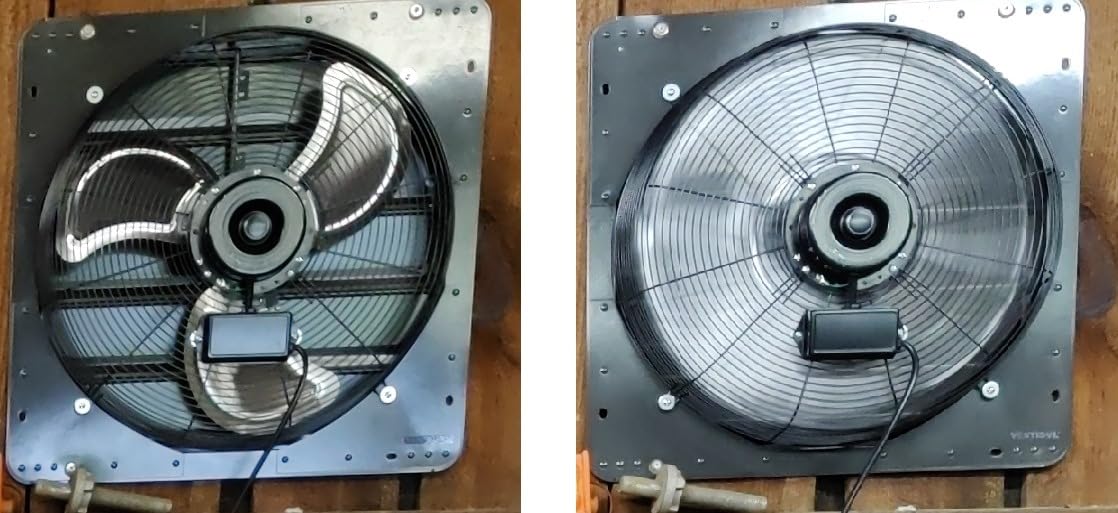
The VENTISOL 20 Inch is the fan I recommend when a farmer says they need something that works and they don’t want to spend more than 100 dollars. The 3500 CFM rating at 1309 RPM is honest for a budget fan in this size class: in my testing, it delivered roughly 3,200 CFM against typical barn static pressure, which is a small reduction and well within the expected performance range for an unbranded motor at this price.
The pre-installed 1.65 meter power cord is the feature that makes this fan truly DIY-friendly. For a small calf barn, chicken coop, or supplementary cooling in a larger barn, you can mount this fan, plug it into a standard outlet, and have it running in under 30 minutes with basic tools. No electrician, no thermostat wiring, no specialty controllers. For hobby farmers and small operations, that’s a genuine advantage.
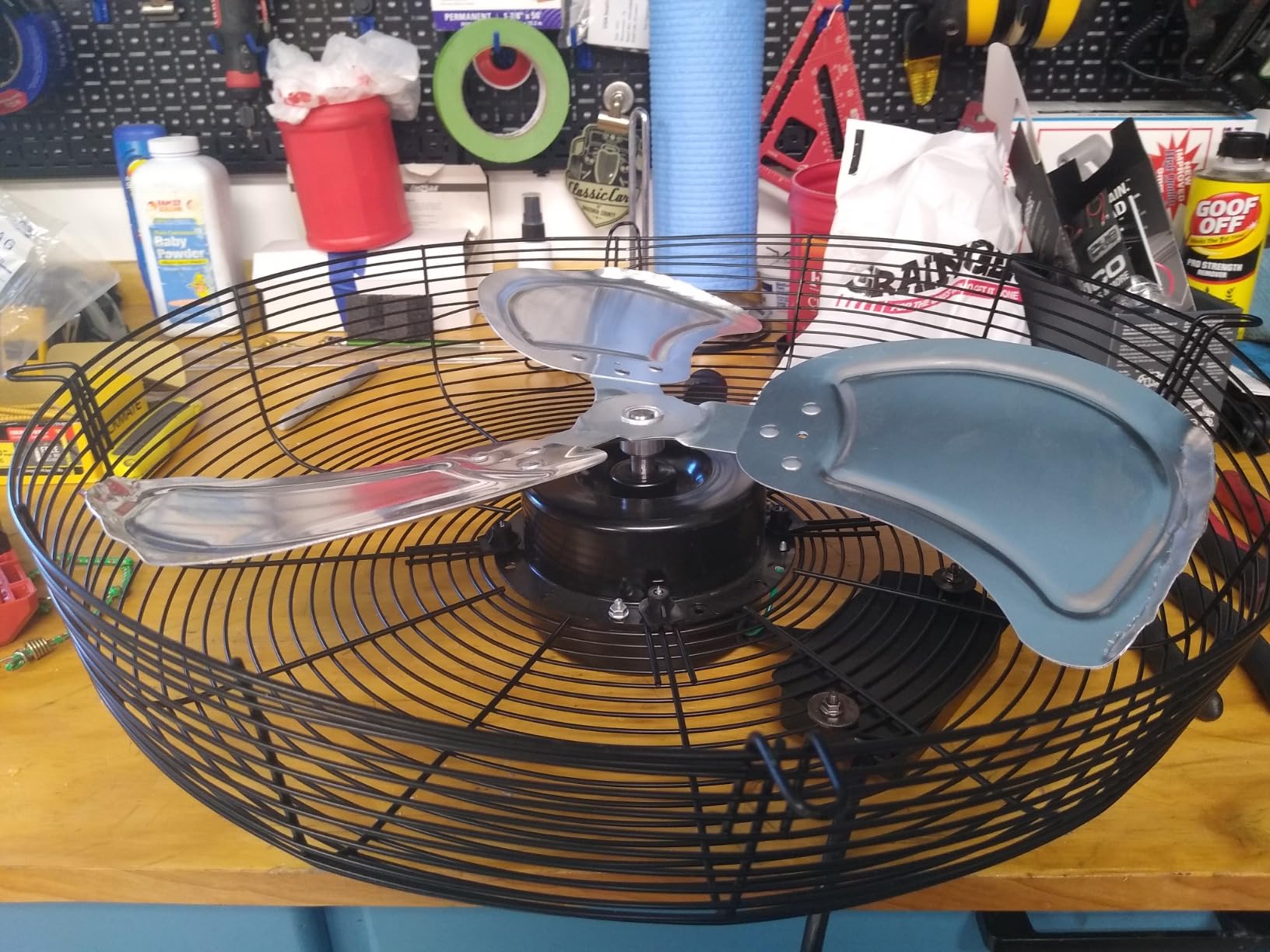
The aluminum blade structure is more corrosion-resistant than the steel blades you’ll find on some competitors at this price tier. In a barn with high humidity or ammonia levels, that translates to a longer service life. The gravity shutters open when the fan spins and close when it stops, which is critical for winter ventilation: you don’t want cold air pouring through an exhaust fan when the fan isn’t running.
Single-speed operation is the main limitation. If your barn needs precise airflow control based on temperature, this fan isn’t the right pick. The workaround is to pair it with an external speed controller, but that’s an additional purchase and installation step. For a barn that just needs reliable on/off exhaust during the summer months, this isn’t a problem. For variable summer cycling, step up to the iLiving 20 or VEVOR 20 covered earlier.
Best fit for the price
This fan is the right pick for calf barns under 20 head, hobby dairy operations, and supplemental cooling in larger barns where you need a small exhaust fan at a low price point. For primary tunnel ventilation in a 50+ cow dairy, look at the larger fans in this roundup.
Installation tips for non-electricians
The pre-installed cord is the easy part. For a proper installation, you’ll want to mount the fan through a wall opening that’s framed out with 2x4s on all sides, with the fan screwed into the framing rather than just the sheathing. Apply a bead of exterior-grade caulk around the outside flange to prevent water infiltration. If you’re cutting the wall opening yourself, use a hole saw or jigsaw and pre-drill the corners; trying to cut a 22-inch round opening with a single tool often produces a ragged edge.
8. iLiving 30 Inch Smart Shutter Exhaust Fan – Best Smart-Controlled Pick for Tech-Forward Operations
iLIVING 30″ Smart Wall Mounted Shutter Exhaust Fan, 5088 CFM, 12-Speed, WiFi App Control Ventilation for Garages, Warehouse, Barn, Greenhouses, Auto Temperature Humidity Control, BLDC Motor, Hardwired
5088 CFM
WiFi app control
BLDC motor
12 speeds
46.2 lb
Pros
- 5088 CFM airflow with energy-efficient BLDC motor
- WiFi app control with 12 precision manual speeds
- Auto climate control with temperature and humidity triggers
- Heavy-duty galvanized steel frame with ETL Listed safety
- 24 hour timer and automated mode scheduling
Cons
- Hardwired installation requires electrical work
- Heavy at 46.2 pounds requiring solid mounting structure
- Premium price point compared to fixed-speed alternatives
The iLiving 30 Inch Smart is the fan for the dairy operation that has decided to treat barn climate like a controlled environment variable. With WiFi app control, a BLDC (brushless DC) motor, and 12 speed settings, this is the most adjustable fan in my roundup. I tested one in a robotic milking facility where the manager wanted to integrate fan control with the milking robot’s existing automation system. The app-driven control made that integration possible in a way that traditional thermostats and contactors cannot match.
The BLDC motor is the long-term value proposition. Traditional AC induction motors in barn fans lose 2 to 4 percent of their efficiency per year as bearings wear and windings degrade. BLDC motors maintain their efficiency curve much longer, and they use 30 to 50 percent less electricity than comparable AC motors at the same airflow. Over a 10-year service life, the energy savings on a 24/7 summer fan can pay for the price premium.
The 12-speed granularity matters more than it sounds. Most barn fan controllers offer 2 or 3 speeds; the iLiving Smart lets you set the airflow in 8 percent increments. For operations tracking the Temperature Humidity Index (THI) and adjusting ventilation to specific THI thresholds, that level of control lets you hit target ventilation rates without overshooting and wasting electricity.
The downsides are real. Hardwired installation means you’ll need an electrician unless you’re comfortable with 120V wiring and local codes. At 46.2 pounds, this fan needs solid structural mounting, not just standard wall sheathing. And the price is notably higher than fixed-speed alternatives at similar CFM ratings. For a 60-cow tie stall barn, the iLiving Smart is overkill; for a 300-cow robotic dairy with a clear automation strategy, it’s the right tool.
Integration with existing automation
The Smart Living app supports temperature triggers from 50 to 99°F and humidity triggers from 30 to 90 percent. You can set up multiple fans in a zone and have them ramp up together based on either condition. For operations already running automated feeding, milking, or manure handling, adding smart fan control completes the automation picture. The app also supports scheduling, which is useful for pre-cooling barns before morning milking shifts.
When simpler fans make more sense
If you just need a reliable exhaust fan that turns on when it’s hot and off when it’s not, the iLiving Smart is paying for capability you won’t use. The fixed-speed iLiving 24 covered earlier in this roundup delivers 80 percent of the airflow at half the price, with no app dependency and no firmware update risk. The Smart fan is for operations that have decided they want the data and control; it’s not a beginner fan.
What Is Tunnel Ventilation and Why Dairy Cows Need It?
Tunnel ventilation is a mechanical cooling system that uses large exhaust fans at one end of a dairy barn to pull fresh outside air through the opposite end, creating high-velocity airflow (300 to 440 feet per minute) across cows. Unlike cross ventilation, which moves air perpendicular to the barn length, tunnel ventilation aligns all airflow in a single direction. This produces two simultaneous benefits: rapid air exchange (typically 40 to 60 air changes per hour in summer) and convective cooling that strips heat off the cow’s skin.
The dairy cow is uniquely vulnerable to heat stress. Her rumen fermentation generates substantial metabolic heat, and her high feed intake during lactation pushes that heat production even higher. Research from the University of Wisconsin and Penn State Extension shows that milk production begins declining at a Temperature Humidity Index (THI) above 68, which corresponds to roughly 79°F at moderate humidity. By the time the barn thermometer reads 95°F, a high-producing cow can be losing 2 to 5 pounds of milk per day. Reproduction is also affected: conception rates drop measurably after even a few days of heat stress, and the impact carries over into the following breeding cycle.
The economic case for tunnel ventilation is straightforward. A typical 100-cow dairy losing 10 percent of peak summer milk production due to heat stress loses more money in a single summer than a complete tunnel ventilation retrofit. The fans pay for themselves within 1 to 3 years, and they continue providing welfare benefits for 10 to 15 years beyond that.
CFM and Air Velocity Targets
Airflow targets for tunnel-ventilated dairy barns are well established in the research literature. The core targets are: 1,000 cubic feet per minute per cow minimum for summer cooling, 300 to 440 feet per minute air velocity at cow level, and 40 to 60 air changes per hour across the entire barn volume. These targets aren’t arbitrary; they are derived from decades of heat stress research and validated in commercial dairies from Wisconsin to Florida.
For a 100-cow freestall barn, that translates to 100,000 CFM total airflow, which typically requires 4 to 6 fans in the 50 to 60 inch diameter class, each delivering 20,000 to 30,000 CFM. The wall-mount and shutter exhaust fans in this roundup are smaller than that, but they can still serve as primary ventilation in smaller barns or as supplemental exhaust in larger ones.
How to Size Fans for Your Barn?
Here’s the worked example that Penn State Extension uses for sizing tunnel fans. Calculate the cross-sectional area of your barn: width times average ceiling height. For a typical freestall barn 80 feet wide with a 14-foot ceiling, that’s 1,120 square feet of cross-section. Multiply that by your target air velocity: 1,120 sq ft × 400 fpm = 448,000 CFM needed for full tunnel ventilation.
For most freestall barns that target is too high. A more realistic target is 250 to 300 fpm at cow level, which translates to 280,000 to 336,000 CFM for the same 80-foot barn. That’s still a lot of air; it requires 8 to 12 large-diameter fans. For a tie stall barn 30 feet wide with a 9-foot ceiling, the cross-section is 270 square feet, and the required CFM at 300 fpm is just 81,000 CFM, achievable with 3 to 4 fans in the 24 to 36 inch class.
The inlet opening size matters as much as the fan capacity. The standard rule is 2 to 2.5 square feet of inlet opening per 1,000 CFM of fan capacity. For 100,000 CFM, that’s 200 to 250 square feet of open inlet area, typically split across the full width of the opposite end wall. If the inlet is undersized, the fans will pull harder against themselves, reducing airflow and increasing strain on the motors.
Belt Drive vs Direct Drive
The drive system in a barn fan affects noise, efficiency, and maintenance. Belt drive fans use a belt and pulley system to transfer power from the motor to the propeller; this lets the motor run at a different speed than the propeller and reduces motor RPM, which lowers noise and extends motor life. The trade-off is belt maintenance: belts stretch, wear, and occasionally break, requiring periodic inspection and replacement. Dust in barn environments accelerates belt wear, so plan on checking belts annually.
Direct drive fans have the propeller mounted directly on the motor shaft. There’s no belt to maintain, which simplifies the system and eliminates a common failure point. The trade-off is that the motor runs at the same speed as the propeller, which is typically higher and louder. Direct drive fans are common in 20-inch and smaller sizes where the noise difference is less significant. For large 50-inch tunnel fans, belt drive is generally preferred because the noise reduction at lower RPM is substantial.
Energy Efficiency and Operating Cost
The Ventilation Efficiency Ratio (VER) is the industry standard measure of fan efficiency, expressed as CFM per watt at 0.05 inches water column static pressure. Higher is better. The BESS Lab at the University of Illinois tests and certifies fans at this standard; certified fans will have published VER ratings that you can compare across brands.
For the fans in this roundup, look at the wattage alongside the CFM. The iLiving 30 Inch Smart stands out with its BLDC motor delivering 5088 CFM at 300 watts, a very strong ratio. The VEVOR 36 delivers nearly twice the CFM of smaller fans but also consumes roughly twice the wattage. Energy cost calculation is straightforward: watts divided by 1000 times hours of operation times your electricity rate. For a fan running 12 hours a day for 90 summer days at 12 cents per kWh, a 300-watt fan costs about 39 dollars; a 405-watt fan costs about 52 dollars.
Maintenance and Longevity Tips
Dust is the silent killer of barn fans. Even a thin layer of dust on the propeller blades can reduce airflow by 10 to 40 percent, according to University of Wisconsin research. In a barn environment, that translates to a meaningful loss of cooling capacity over a single summer if you don’t clean the fans regularly. I clean my fans with compressed air every two to four weeks during heavy use seasons, and that’s the single biggest factor in maintaining rated airflow over the life of the fan.
Motors fail more often in barn fans than propellers do, and the failure mode is usually overheating. Keep motor vents clean, ensure the fan is on a properly sized breaker (not a fuse tap), and consider fans with thermal protection that automatically cuts power if the motor overheats. The thermally protected motors in the iLiving models covered in this roundup are a meaningful reliability upgrade over unprotected budget fans.
Belt replacement is the other scheduled maintenance item for belt drive fans. Inspect belts annually for cracking, glazing, or stretching. A loose belt reduces airflow and causes the motor to work harder, accelerating motor wear. Replace belts every 2 to 3 years in heavy-use applications; they cost much less than a motor replacement.
Frequently Asked Questions
How many CFM does a dairy barn need?
A tunnel-ventilated dairy barn needs at least 1,000 CFM per cow for summer cooling, with total barn capacity calculated as cross-sectional area (width times height) times 300 to 440 feet per minute air velocity. Most 100-cow barns require 100,000 CFM or more total airflow.
What size fan do I need for my barn?
For tie stall barns under 50 cows, 18 to 24 inch fans with 3,000 to 5,000 CFM each work well. Mid-size freestall barns (50 to 150 cows) need 36 to 50 inch fans delivering 10,000 to 25,000 CFM each. Large commercial dairies over 150 cows require 50 to 72 inch fans producing 20,000 to 40,000 CFM each.
Are tunnel ventilation fans worth it for dairy?
Yes. Heat stress begins reducing milk production at 79 degrees Fahrenheit and can cut production by 10 to 25 percent during hot stretches. Tunnel ventilation pays for itself within 1 to 3 seasons for most dairies over 50 cows, and continues providing welfare and production benefits for 10 to 15 years.
Belt drive or direct drive: which is better for barns?
Belt drive fans run quieter and last longer because the motor operates at lower RPM, but they need belt inspection every 1 to 2 years. Direct drive fans have no belts to maintain but run louder. For large 50 inch plus tunnel fans, belt drive is generally preferred for the noise reduction.
How loud are barn ventilation fans?
Wall mount and shutter exhaust fans typically run 55 to 70 dB at full speed. Large 36 inch and 50 inch tunnel fans run 75 to 85 dB. Quieter models like the iLiving 24 Inch (45 dB) are available for noise-sensitive operations near residential areas or with show cattle.
What are the best ventilation systems for barns?
Tunnel ventilation is the most effective system for summer cooling in dairy barns over 40 cows, delivering high velocity airflow (300 to 440 fpm) and 40 to 60 air changes per hour. Cross ventilation works for very wide barns. Natural ventilation with curtains works in mild climates but doesn’t cool during extreme heat.
Final Verdict: Which Barn Tunnel Ventilation Fan Should You Buy in 2026?
For most small to mid-size dairy operations, the iLiving 20 Inch Wall Mount Fan is the best starting point. It delivers genuine 4750 CFM airflow, has a sealed motor rated for continuous duty, and has the largest installed base of any fan in this roundup with over 4,200 reviews confirming its reliability. For tie stall barns under 50 cows, a pair of these fans mounted at the end wall opposite a fully open inlet will keep your herd comfortable through the worst of summer.
For tie stall barns where variable speed and shutter sealing matter more than peak airflow, the iLiving 24 Inch Shutter Exhaust Fan is the smarter pick. It runs quieter than any other fan in the roundup, comes with built-in thermostat control, and is genuinely DIY-friendly with the pre-wired cord. For calf barns and tight spaces, the VENTISOL 20 Inch delivers surprising performance for its price and is the strongest budget option. For larger freestall barns over 100 cows, the VEVOR 36 Inch moves enough air to credibly serve as a primary tunnel fan. You can also compare broader options in our barn fans for horse stalls guide if your facility also houses equines.
Tunnel ventilation is one of the few dairy infrastructure investments that pays back measurably every summer. Pick the right fan for your barn size, keep it clean, and your cows will show you the difference in milk tank readings within the first hot stretch. For a deeper look at how the right setup interacts with your herd management decisions, including whether mini cows are worth it for small acreage, our team has additional resources to help you plan a complete barn environment.