
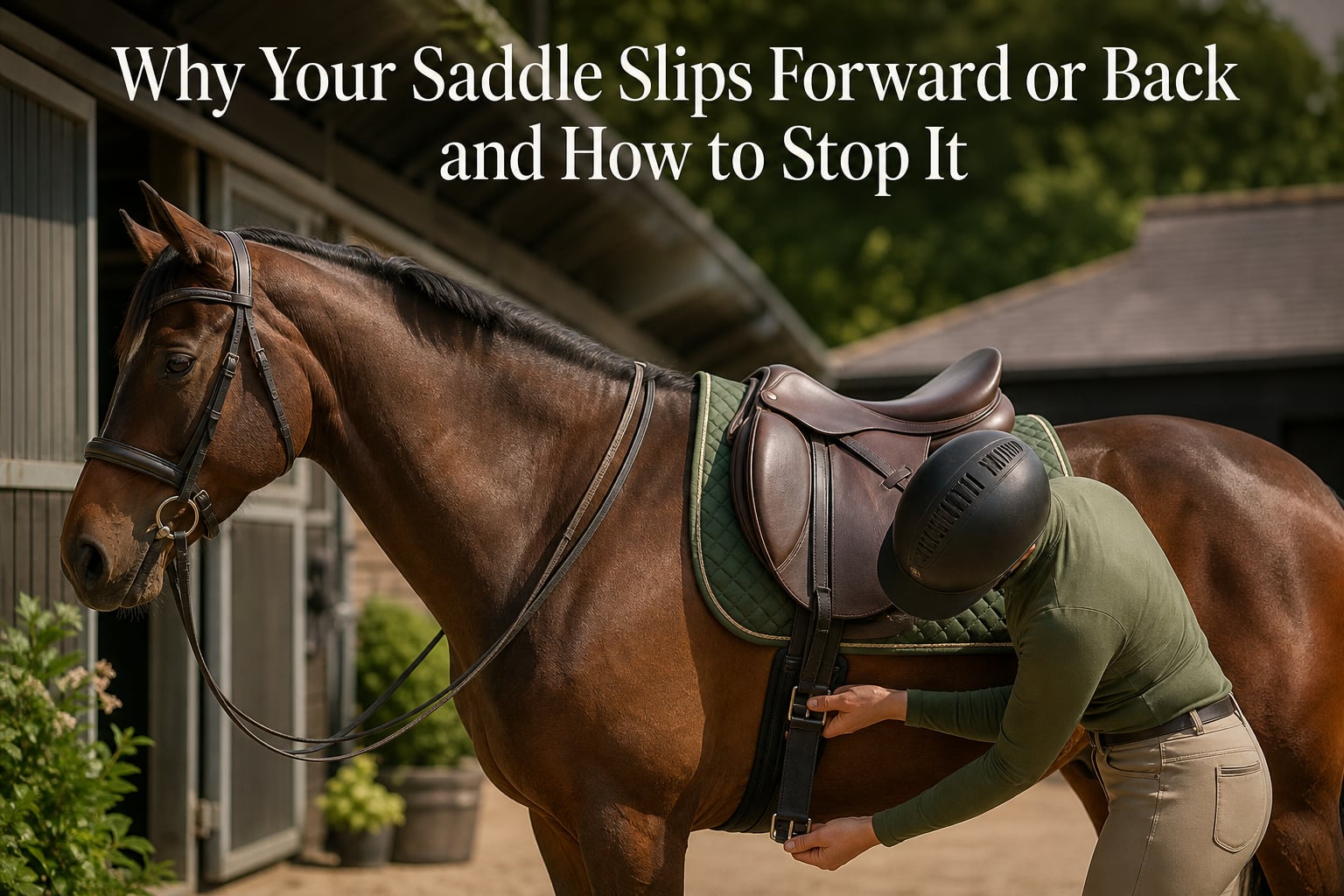
A saddle slips forward or back most often because the saddle fit, girth alignment, and the horse’s shape are working against each other. The safest way to stop saddle slipping is to identify the direction of travel and the reason for it before adding a pad, changing girths, or tightening anything.
That distinction matters. A saddle that lands on the shoulder can restrict movement, while one that drifts backward can leave the rider off balance and change where pressure sits on the back.
This guide is about horse saddles, not bike saddles. It explains what forward slip and backward slip can mean, how to check the issue in motion, and when a qualified saddle fitter or veterinarian should be part of the answer.
Table of Contents
Poor fit and conformation explain why a saddle slips forward or back
Saddle movement is not one problem with one cure. The direction offers a useful clue: forward slip usually points to the girth groove, shoulder area, tree width, or a low-withered shape, while backward slip can point to rear balance, changing topline, girth position, or movement that lifts the front of the saddle.
Before riding, place the saddle in its natural resting place behind the shoulder blade and girth it normally. Walk the horse forward a few steps, then look again; if the saddle has already moved significantly, the setup needs attention before you ride.
The girth groove is the horse’s natural place for the girth to settle
Some horses, especially round ponies and horses with a forward girth groove, have a girth groove well forward of where a rider wants the saddle to remain. The girth follows that groove as the horse moves and can pull the billets and saddle toward the shoulder.
Low withers, a broad or mutton-withered back, and a fairly round barrel give a saddle fewer natural landmarks to sit against. These conformations are not faults; they simply require a fit that distributes pressure and holds a stable position without forcing the horse into it.
A stable saddle stays centered and keeps its clearance as the horse moves
Check that the gullet channel remains clear of the spine and that the saddle stays centered rather than rolling to one side. One-sided saddle sliding can come from uneven muscling, a crooked rider, unequal stirrup loading, asymmetrical flocking, or a fit problem, so treat it as a separate clue rather than merely pulling the saddle straight.
Look for changes after a ride, not only while the horse is standing. A saddle can appear acceptable in the yard yet show front lift, rear lift, shifting panels, or a changed balance point once the back is working.
A saddle moves forward when the girth groove or fit pulls it toward the shoulder
Forward slip is common on wide-backed, low-withered, and round horses because the girth may settle forward and draw the saddle with it. A saddle that is too wide can also drop lower at the front and migrate onto the shoulder, while a saddle that is too long or positioned too far forward begins with too little room to stay clear of the scapula.
A forward girth groove can pull even a snug girth toward the shoulder
A girth can feel tight and still be positioned in the wrong place for the saddle. When the groove lies forward, the horse’s motion may keep inviting the girth forward; repeatedly tightening it can make the horse uncomfortable without stopping the pull.
Billet placement matters as well. If the billets create a line that pulls sharply forward to reach the girth groove, the saddle receives a forward force with every stride.
A front-heavy fit can make a saddle slide forward
Check whether the front of the saddle sits low, whether the tree width matches the horse’s back, and whether the panels contact evenly. A front that collapses down around the withers is more likely to travel forward than a saddle with balanced support along the bearing surface.
Do not judge tree width by wither clearance alone. A saddle can have visible clearance at rest yet be unstable, too narrow, or too wide through the panels once the horse moves and changes shape under a rider.
A rider who tips forward can add to forward slip
Rider balance is usually a contributing factor, not a reason to dismiss fit. A rider who braces in the stirrups, hangs on the reins, or consistently tips ahead of the motion can increase pressure at the front and make an already marginal setup travel sooner.
A saddle moves backward when rear balance or girth alignment lets it drift
Backward slip receives less attention, but it deserves the same careful check. A saddle can drift back when its front lifts or lacks stable contact, when the girth and billets do not hold it in a balanced position, or when the back’s shape and movement encourage it to travel toward the loins.
A lifted front can let the saddle travel backward
Watch for a gap beneath the front panels, a cantle that feels low relative to the pommel, or a saddle that rocks when gentle pressure is applied at alternate ends. Those observations do not diagnose the fit by themselves, but they are useful notes for a saddle fitter.
Topline changes can alter the picture. Conditioning, time out of work, weight change, age, or discomfort can change muscle behind the shoulder and along the back, so a saddle that previously stayed put may start slipping back without any change to the tack.
A rearward drift can reveal a problem in motion rather than at rest
Film a short, level-ground session from the side and behind if it is safe to do so. Check at walk, trot, transitions, and after dismounting, because downhill travel, transitions, and repeated rising can reveal movement that a static fitting check misses.
Marking the initial position with a small piece of tape on the saddle pad can make movement easier to see. Use this only as a reference, and remove it after the assessment; the goal is to document the direction of travel, not to force the saddle to stay in place.
A systematic check finds the cause before an accessory hides it
Use the same order each time you investigate saddle slipping. Change one factor at a time so you can tell whether the saddle, girth, pad, rider balance, or the horse’s condition is making a meaningful difference.
Step 1: Start with the horse’s back and the saddle’s resting position
Run clean hands over the back before tacking up and note heat, swelling, sensitivity, guarded behavior, or asymmetry. Set the saddle behind the shoulder blade, check that it is not bridging or rocking, and confirm that the gullet channel is clear.
Step 2: Check the girth line after the horse takes a few steps
Girth the horse gradually, walk forward, and reassess where the girth has settled. If it moves forward into a pronounced girth groove and pulls the saddle with it, record that rather than simply shortening the girth or tightening it more.
Step 3: Watch movement at several gaits and from both sides
Ask a knowledgeable helper to observe whether the saddle moves forward, backward, sideways, or all three. Notice whether the movement begins immediately, only in transitions, only on one rein, or after the horse warms up; each pattern is useful information.
Step 4: Compare the post-ride picture with the starting picture
After dismounting, check the saddle’s position, the pad’s symmetry, and the horse’s response as you untack. Uneven sweat, ruffled hair, localized dry spots, or rubs are not stand-alone proof of a fit issue, but they warrant discussion alongside the observed movement.
A fitted saddle, appropriate girth, and limited stabilization stop most slipping
The best fix depends on what the assessment shows. Accessories should support a saddle that fits; they should not be used to hold an unsuitable saddle against the horse.
Step 1: Ask a qualified saddle fitter to assess the tree, panels, and balance
Call a saddle fitter when the saddle consistently moves, the horse has changed shape, or you cannot determine whether the issue is too much or too little width. Ask them to assess the saddle on the moving horse, including the bearing surface, tree width, balance, billets, shoulder clearance, and gullet channel.
Step 2: Choose a girth that follows the horse’s shape without forcing the saddle
An anatomical girth or stabilizer girth may help some horses by accommodating a forward girth groove while keeping a more appropriate line from billets to girth. The best girth is not a universal style; it is one that sits comfortably in that horse’s groove and supports a correctly fitted saddle.
Be cautious with elastic components if they allow the girth to become inconsistent during work. Tighten gradually and recheck after a few minutes of walking, rather than relying on a single very tight adjustment at the mounting block.
Step 3: Use a non-slip pad only when it does not change the fit
A non-slip pad can add useful stability on an otherwise suitable setup, particularly for low-withered horses. It must not crowd the saddle, narrow the fit, create pressure at the withers, or substitute for a change the horse needs in tree width or panel support.
Half pads and memory foam pads can alter the saddle’s balance and available space. Recheck fit with the exact pad you intend to ride in, because adding thickness under a saddle changes the system rather than simply adding grip.
Step 4: Reserve a crupper for a persistent, correctly assessed need
A crupper can be an appropriate stabilizing aid for some horses and ponies with persistent forward slip, particularly where conformation gives the saddle little natural resistance. It should be fitted so it is not pulling continuously or rubbing, and it should follow a fit assessment rather than replace one.
If a crupper prevents the saddle from moving but the saddle still tries to climb onto the shoulder, stop and reassess the cause. Restraining the saddle does not automatically make its pressure pattern comfortable.
Step 5: Improve rider balance after the tack has been assessed
Once saddle fit is addressed, ask an experienced instructor to watch your position at transitions and over ground changes. Work toward an even seat, quiet leg, and independent upper body so you are not repeatedly loading one side or the front of the saddle.
Persistent slip, pain, or asymmetry needs professional assessment
A new slipping pattern can be a signal, not just an inconvenience. If the horse reacts to grooming or saddling, resists moving forward, changes behavior under saddle, has uneven muscling, or slips noticeably to one side, pause the riding plan and seek qualified advice.
Lameness, pain, uneven movement, and muscle loss can change how the horse carries both saddle and rider. A saddle fitter can assess the tack, but a veterinarian should assess possible pain or lameness; these are related questions that need the right professional roles.
The most common saddle-slip questions have practical answers
How do I stop my saddle from slipping forward?
Start by having saddle fit, tree width, panel contact, billet line, and the horse’s forward girth groove assessed. Then use a girth that suits the horse’s shape; add a non-slip pad or a correctly fitted crupper only if they do not hide a fit problem.
Why does my saddle keep slipping back?
Backward slip may occur when the front lifts, the saddle is poorly balanced, the girth line does not stabilize it, or the horse’s topline has changed. Watch the saddle in motion and ask a saddle fitter to assess it rather than assuming the girth merely needs tightening.
What is the best girth to stop a saddle slipping forward?
There is no one best girth for every horse. An anatomical or stabilizer girth can help when it accommodates a forward girth groove and maintains a good billet-to-girth line, but it must be chosen after the saddle fit and the horse’s shape are assessed.
Can a crupper stop a saddle from slipping?
A correctly fitted crupper can help some horses and round ponies with persistent forward slip. It should not pull constantly, rub, or be used to hold an unsuitable saddle in place; assess fit first.
Can a saddle pad cause saddle slipping?
Yes. A thick, worn, uneven, or poorly positioned pad can change balance, crowd the saddle, or make it less stable. Check saddle fit with the exact pad you ride in and keep the pad clear of the withers.
A direction-first check stops saddle slipping more safely than repeated tightening
When a saddle slips forward or back, first identify its direction, then assess saddle fit, the girth groove, and the horse’s movement before changing equipment. A well-chosen girth, non-slip pad, or crupper can support the right setup, but persistent movement, discomfort, or asymmetry calls for a saddle fitter and, when pain is possible, a veterinarian.
Take notes through one careful assessment, make one change at a time, and prioritize the horse’s comfort over a quick restraint. That approach gives you a clearer answer than simply pulling the saddle back into place after every ride.