
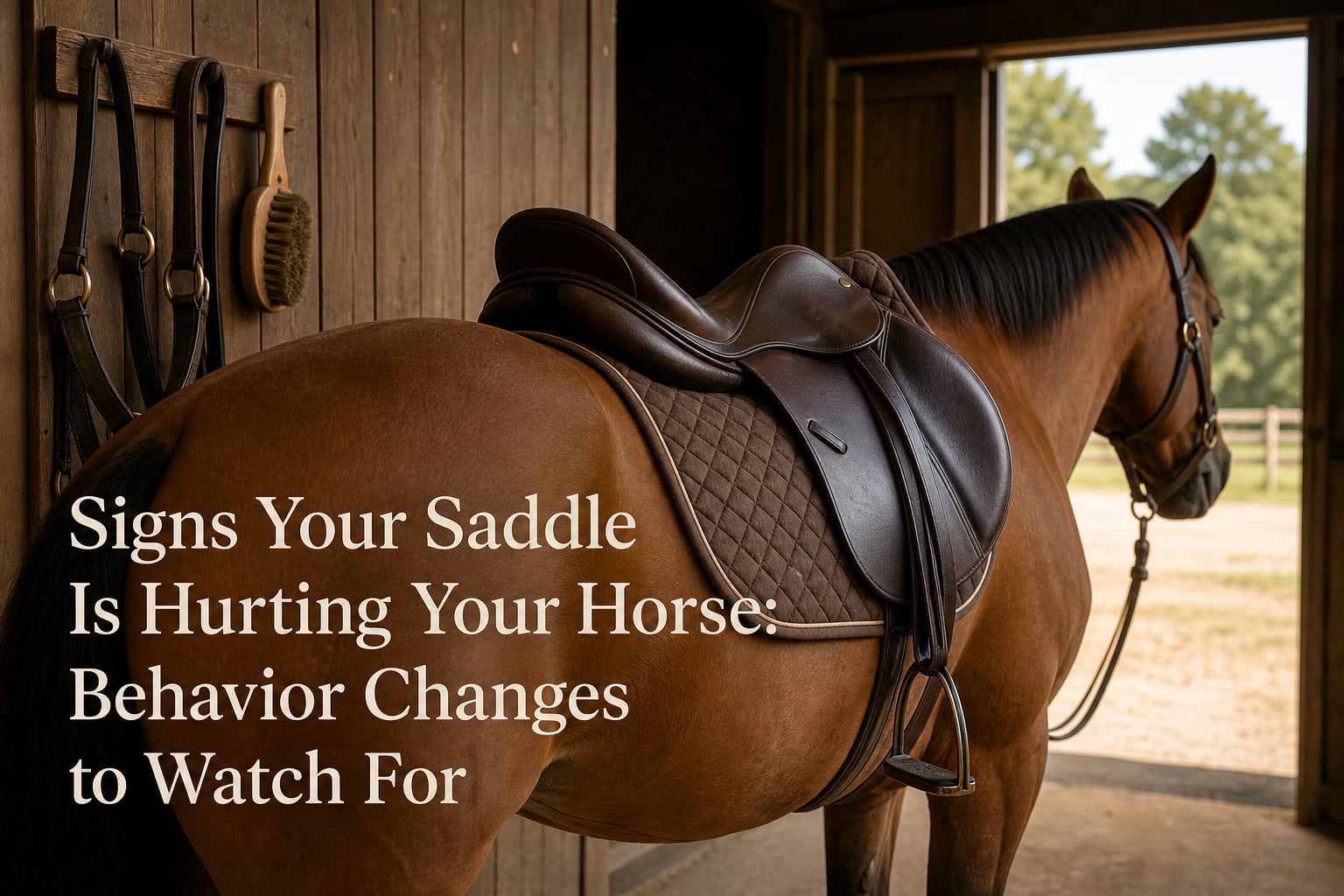
Your horse pins their ears every time you reach for the saddle. They swish their tail at the canter, refuse to stand still at the mounting block, and have started rushing through transitions. You wonder if this is a training problem, or something more.
Most of the time, it is something more. Research and decades of equine veterinary experience tell us that the majority of behavioral problems under saddle come from physical discomfort, not from a vindictive or stubborn horse. And one of the most common sources of that discomfort is a saddle that does not fit properly.
Recognizing the signs your saddle is hurting your horse can spare your horse months of unnecessary pain and prevent long-term damage to their back, muscles, and trust in you as a rider. In this guide, we walk through every behavioral and physical sign to watch for, how to check your horse’s back yourself, and exactly when to call a veterinarian versus a saddle fitter.
Table of Contents
Behavioral Signs During Tacking and Mounting
The earliest signs your saddle is hurting your horse usually show up before you even get on. Tacking up is the moment your horse anticipates what is coming. If they associate the saddle with pain, they tell you through their body language.
Watch for these behaviors as you approach with the saddle and during the girthing process:
Your horse moves away or turns their hindquarters toward you when you carry the saddle over
They pin their ears flat against their head as the saddle settles on their back
They try to bite, nip, or snap when you reach for the girth or cinch
They kick out, cow-kick, or threaten to kick when you tighten the girth
They swell their chest and hold their breath to avoid the girth tightening properly
They pace, paw, or fidget at the cross-ties instead of standing quietly
Girthiness and cinchy behavior deserve special attention. A horse that suddenly becomes girthy when they never were before is telling you something changed. This behavior is often dismissed as a bad habit, but in most cases it develops because the girth or saddle is creating pressure that causes real pain.
Mounting resistance is another red flag. If your horse walks off, swings away, or refuses to stand at the mounting block, they may be bracing against the discomfort they know is coming once your weight settles into the saddle.
One important point from equine behavior specialists: horses do not fake pain to avoid work. If your horse is reacting negatively to tacking up, treat it as a genuine signal until a professional can rule out a physical cause.
Behavioral Signs While Riding
Once you are in the saddle, the signs become more dynamic. Your horse is now carrying your weight plus the pressure of a saddle that may be creating sharp points of discomfort with every stride. The signs your saddle is hurting your horse while riding tend to fall into a few recognizable categories.
Tail Swishing and Head Tossing
Mild tail swishing is normal during fly season, but persistent, aggressive tail swishing, especially during transitions or at the canter, signals irritation. Head tossing and throwing often accompany tail swishing. Together, these behaviors tell you your horse is frustrated and uncomfortable.
Bucking, Rearing, and Bolting
These are the most dramatic signs, and unfortunately the ones most often punished as training issues. A horse that bucks after the canter transition or rears when asked to collect may be responding to a saddle that pinches when their back lifts and rounds. Bolting can be a flight response to sudden sharp pain.
Forum discussions from equestrian communities consistently highlight the same pattern: riders spend months trying to train out bucking or rearing, only to discover that a saddle refit eliminated the behavior entirely within days.
Refusing to Go Forward
A horse that used to move forward willingly but now feels sticky, lazy, or resistant may be protecting their back. This is sometimes called a “dead back” response. The horse has learned that pushing forward increases pressure on painful areas, so they shut down and stop trying.
Stumbling and Irregular Gaits
When a saddle restricts shoulder movement or creates pressure behind the withers, horses compensate by shortening their stride. This leads to stumbling, tripping, and irregular gaits that can look like lameness. If your horse trips frequently or feels uneven without a clear leg lameness, the saddle may be the hidden culprit.
Resistance to Collection and Lateral Work
Collection requires a horse to lift through their back and engage their core. If the saddle is bridging or creating pressure points, this movement causes pain. Your horse may resist bending, refuse to flex, hollow their back, or throw their head up every time you ask for collection or lateral movement.
Physical Signs on Your Horse’s Body
Behavioral signs are your horse’s voice, but physical signs are the evidence left behind. After you ride, your horse’s body tells the story of what happened under that saddle. Learning to read these signs is one of the most valuable skills any horse owner can develop.
Withers Swelling and Edema
Fluid swelling around the withers after riding is called edema, and it means the saddle is creating pressure that restricts normal lymphatic drainage. You might feel soft, puffy areas on either side of the withers when you run your hand over your horse’s back after untacking.
White Hairs and Pressure Marks
White hairs appearing in the saddle area are not just a cosmetic change. They indicate that sustained pressure damaged the hair follicles. These white patches often show exactly where the saddle tree or panels are creating concentrated pressure points. If you see symmetrical white patches forming, the saddle is not distributing weight evenly.
Muscle Atrophy and Asymmetry
Long-term poor saddle fit causes muscle wasting. You might notice hollows behind the shoulders, an uneven topline, or one side of the back appearing more developed than the other. Muscle atrophy means the horse has been changing their posture to avoid pain, which leads to underuse of certain muscle groups.
Sweat Mark Patterns
After a ride, the sweat pattern under your saddle reveals how weight was distributed. A well-fitting saddle leaves an even sweat mark matching the panels. Dry spots are actually the problem area: they indicate places where pressure was so intense that sweat glands could not function. Look for dry spots near the withers, behind the shoulder, or at the rear of the saddle panels.
Bumps, Hard Nodules, and Scarring
Feel along your horse’s back for small, firm lumps under the skin. These nodules can form from chronic pressure and inflammation. Over time, repeated tissue damage can lead to permanent scarring, which shows up as hard, fibrous areas that do not resolve even with rest.
Back Soreness and Sensitivity to Touch
Run your fingertips firmly along both sides of your horse’s spine, from the withers to the loin. A healthy back feels symmetrical and supple. If your horse flinches, dips their back away from your hand, twitches the skin, or steps away, they are telling you those muscles are sore.
How Saddle Pain Changes the Horse-Rider Relationship?
One topic that almost no competitor covers is the emotional and relational impact of saddle pain. Horses are deeply associative learners. When the saddle causes pain every time they are ridden, they begin to anticipate that pain before it even happens.
This anticipation changes everything about your relationship. Your horse may start avoiding you in the field, become difficult to catch, or lose their enthusiasm for work. What looks like attitude or stubbornness is actually a horse trying to protect themselves from a predictable source of suffering.
Over time, this erodes trust. A horse that used to greet you at the gate may turn and walk away. A willing partner may become reactive and defensive. The good news is that when the pain source is removed, many horses return to their original temperament quickly. But the longer the pain persists, the longer the trust rebuild takes.
Riders also carry emotional weight in this dynamic. Feeling like your horse hates being ridden, or worrying that you are causing pain without knowing it, creates anxiety and self-doubt. Identifying and fixing the root cause restores confidence for both horse and human.
When to Call a Veterinarian vs a Saddle Fitter
This is one of the most common questions in equestrian forums, and surprisingly, no major competitor provides a clear answer. The decision matters because calling the wrong professional first can waste time and money while your horse stays in pain.
Here is a practical framework our team recommends based on input from both equine veterinarians and certified saddle fitters.
Call Your Veterinarian First If
Your horse shows acute pain signs like severe back sensitivity, dramatic swelling, sudden lameness, or behavioral changes that appeared overnight with no saddle change. A veterinarian should also be your first call if your horse has a fever, weight loss, or any sign of systemic illness alongside back soreness.
The vet can rule out conditions that mimic saddle pain, including kissing spines, ulcers, arthritis, ligament injuries, and neurological issues like EPM. These conditions require veterinary treatment, and no saddle adjustment will fix them.
Call a Saddle Fitter First If
Your horse’s behavioral signs correlate with a recent saddle change, weight change, or fitness change. If you recently purchased a new saddle, your horse gained or lost significant weight, or they came back from time off and the saddle no longer fits, a saddle fitter is the right starting point.
A qualified saddle fitter can assess tree width, gullet clearance, panel contact, and saddle balance. They can shim, flock, or adjust the fit, or tell you honestly if the saddle is a lost cause for your horse’s current conformation.
The Best Approach: Work as a Team
In practice, the best outcomes happen when your veterinarian and saddle fitter communicate. Many horses need both: the vet treats underlying back pain or injury, and the saddle fitter ensures the corrected saddle will not recreate the same problem. If possible, schedule both assessments within the same window of time.
How to Check Your Horse’s Back for Saddle Pain?
You do not need to wait for a professional to start monitoring your horse. A simple back check takes about five minutes and should be part of your regular grooming routine. Here is how to do it.
Step 1: Stand your horse on level ground and look at their topline from the side. Note any dips, hollows, or asymmetries compared to what is normal for your horse.
Step 2: Using the flats of your fingers, press firmly along the longissimus dorsi muscle, which runs on either side of the spine from the withers to the loin. Apply even pressure and watch your horse’s reaction.
Step 3: Feel for heat, swelling, or hard spots. Compare left and right sides. Any significant difference between sides is worth noting.
Step 4: After your next ride, pull the saddle and pad off and immediately check the sweat pattern. Photograph it so you can compare over time. Dry spots, uneven patches, or sweat lines that cut off abruptly all indicate pressure distribution problems.
Step 5: Keep a simple log. Note the date, what you observed, and any behavioral changes. This record becomes invaluable when working with a vet or saddle fitter.
Action Steps: What to Do When You See These Signs
If you have identified behavioral or physical signs your saddle is hurting your horse, take action immediately. Do not wait to see if it resolves on its own.
Stop riding in that saddle. Every ride in a poorly fitting saddle compounds the damage. Give your horse time off or ride bareback (if safe) until you have a professional assessment.
Document everything. Take photos of white hairs, sweat marks, swelling, and muscle asymmetry. Record videos of behavioral signs during tacking and riding. This documentation helps your vet and saddle fitter diagnose the problem faster.
Schedule a professional assessment. Use the vet vs saddle fitter framework above to decide who to call first. Do not skip this step.
Avoid the pad trap. Thick pads, gel pads, and shims can mask mild issues temporarily, but they cannot fix a fundamentally poor fit. Relying on pads as a band-aid solution allows underlying damage to continue. Your saddle fitter may recommend specific pads as part of a broader solution, but pads alone are never the answer.
Quick Reference Saddle Pain Checklist
Use this checklist weekly to catch problems early. If you check three or more boxes, schedule a professional saddle fit assessment.
Horse moves away or resists when saddle approaches
Pinning ears, biting, or kicking during girthing
Girthy or cinchy behavior that is new or worsening
Refusing to stand still at the mounting block
Tail swishing during transitions or at the canter
Head tossing or throwing under saddle
Bucking, rearing, or bolting that is new or escalating
Reluctance to go forward or a feeling of a “dead back”
Frequent stumbling or irregular gaits without lameness
Resistance to bending, collection, or lateral work
Swelling or edema around the withers after riding
White hairs appearing in the saddle contact area
Muscle atrophy, hollows, or topline asymmetry
Dry spots in the sweat pattern after riding
Flinching or dipping away when you palpate the back
Frequently Asked Questions
How do I know if my saddle is hurting my horse?
Look for behavioral signs like pinning ears, biting, tail swishing, bucking, refusing to go forward, and girthiness during tacking or riding. Also check for physical signs such as withers swelling, white hairs, dry spots in sweat marks, muscle atrophy, and back sensitivity when you run your hands along the spine. If multiple signs appear together, your saddle likely does not fit properly.
Why is my horse suddenly aggressive when being saddled?
Sudden aggression during saddling, including biting, kicking, or pinning ears, is almost always a pain response rather than a behavioral problem. Your horse is telling you the saddle or girth is causing discomfort. Have a veterinarian rule out ulcers or back injury, then have a saddle fitter assess the fit.
Will a saddle sore go away on its own?
Minor swelling and sensitivity may resolve with rest, but saddle sores will return immediately if the underlying fit problem is not corrected. White hairs, muscle atrophy, and scar tissue are often permanent. The only lasting solution is to fix the saddle fit so the sore is not recreated with every ride.
Can a saddle pad fix a poorly fitting saddle?
No. Saddle pads can temporarily mask minor pressure issues, but they cannot change the tree width, gullet clearance, or fundamental balance of a saddle. Using thicker pads to compensate for poor fit often makes the problem worse by changing how the saddle sits. Always address the root cause with a professional saddle fitting.
How often should I have my saddle fit checked?
Most professionals recommend a saddle fit check every 6 to 12 months. You should also schedule a check any time your horse gains or loses significant weight, changes fitness level, returns from extended time off, or shows any new behavioral or physical signs of discomfort.
Conclusion
Your horse’s behavior is their primary way of communicating with you. When they pin their ears at the saddle, swish their tail under rider, or refuse to go forward, they are not being difficult. They are asking for help.
The signs your saddle is hurting your horse are consistent and recognizable once you know what to look for. By checking your horse’s back regularly, reading sweat patterns, and acting quickly when you spot trouble, you can prevent the chronic pain and trust erosion that come from long-term poor saddle fit. Partner with your veterinarian and saddle fitter, document what you see, and always believe your horse when they tell you something is wrong.