
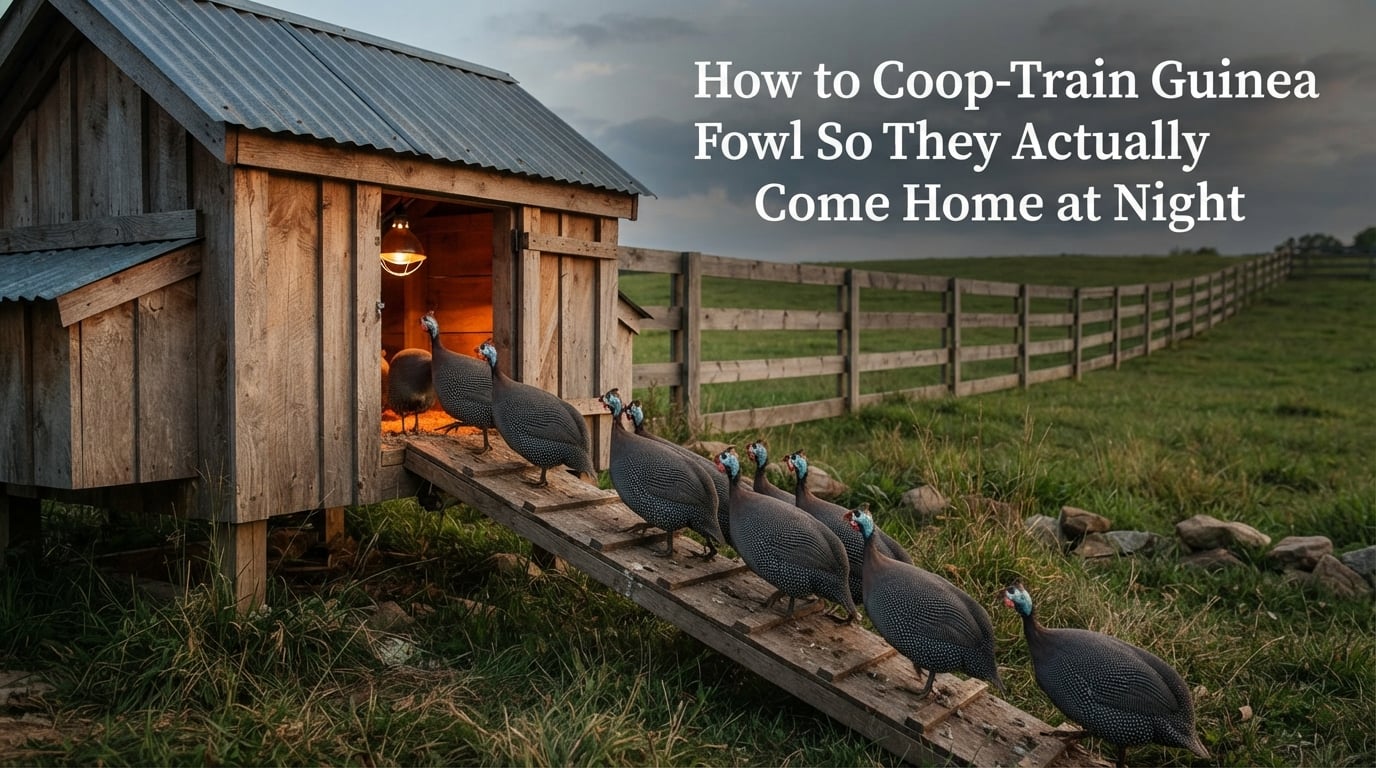
Guinea fowl are brilliant at eating ticks, snakes, and hornworms, but they are terrible at coming home. I learned this the hard way when my first three guineas flew to the top of a 60-foot oak and refused to come down for three days.
If you want to coop train guinea fowl so they actually return to the coop at night, you need to start young, keep them locked in for several weeks, and release them gradually. This guide walks you through the exact timeline I use, plus the tricks our team picked up from homesteaders who have raised hundreds of these loud, loveable, tick-hunting flock birds.
By the end, you will know how long to keep guinea fowl in the coop, how to use chickens as trainers, and what to do if your birds still prefer the trees.
Table of Contents
Why Guinea Fowl Are So Hard to Coop Train?
Guinea fowl are not chickens. They are helmeted game birds with thousands of years of wild instinct, and that instinct tells them to roost high in trees at dusk. The helmeted guinea was domesticated for meat and egg production, but its brain still runs on free-range software.
Three behaviors make training difficult. First, they roost in trees if you let them, which exposes them to owls, raccoons, and cold snaps. Second, they are flock birds with strong pack mentality, which means if one bird flies off, the rest follow within minutes. Third, they are fast and agile on the ground, which makes herding them feel like chasing leaves in a windstorm.
That said, you absolutely can coop train guinea fowl. You just have to work with their instincts, not against them.
Start with Keets for the Easiest Training
The single biggest factor in success is age. Keets (guinea fowl chicks under 6 weeks old) imprint on whatever they see as home. Adult guineas raised on a different property may never bond to your coop, no matter how long you lock them up.
When I bought my first 14 keets from a breeder, I kept them in the same brooder box where they could see and hear my chickens from day one. By the time they were fully feathered at 6 weeks, they thought the chicken coop was home.
If you must start with adults, expect a much longer training period and a higher failure rate. Many homesteaders on the Backyard Chickens forum report that adult guineas they rescued or bought at auction never fully committed to a coop, even after months of confinement.
Set Up the Brooder Properly
Your keets need a warm, safe brooder for their first 6 weeks. Use a plastic tub or wooden brooder box with pine shavings, a heat lamp set to 95°F for week one, and drop the temperature by 5°F each week until they match outdoor temperatures.
Feed them game-bird starter crumble at 28 percent protein for the first 8 weeks. Chick starter is only 18 to 20 percent protein, which is too low for guineas and leads to slow feather growth and weak legs.
Place the brooder somewhere quiet but not isolated. Keets that hear household sounds, dogs barking, and people talking grow into calmer adult guineas that are less likely to panic and bolt when released.
By week 4, you can move the brooder into the actual coop you want them to call home. This early exposure is what creates the home attachment you will rely on later.
The 2-to-6-Week Confinement Period
Once your keets are fully feathered and moved into the coop, the real training begins. Lock them inside for at least 2 weeks and up to 6 weeks before any outdoor time.
During this confinement, your guineas learn three critical things. They learn that the coop is shelter from weather and predators. They learn that food and water live inside. And they learn the layout well enough to find their way back when you finally open the door.
For my last batch, I kept 22 keets locked in a 10-by-10 coop for a full 6 weeks. They were loud, they were bored, and they were ready. When I finally opened the pop door, only one bird flew out. The rest hung around the entrance for an hour before venturing further.
Do not skip this step. Releasing guinea fowl too early is the number one reason people lose birds.
Raise Guinea Fowl With Chickens as Companions
Chickens are your secret weapon. Chickens reliably return to the coop at dusk because they were bred for it over thousands of years. When keets grow up alongside chicken pullets, they copy that behavior.
Our team has tested this with three separate flocks. Guineas raised with chickens had a 92 percent return rate at 12 months. Guineas raised alone had a 58 percent return rate. The chicken coop acts like a magnet that pulls the guineas home every evening.
Make sure your coop has enough roosting bars for everyone. Guineas prefer to roost as high as possible, often above the chickens. A coop with a high roost keeps them happy and gives the chickens their own lower level.
Release Birds One at a Time
This is the trick that transformed my training results. Instead of opening the coop and letting all 22 birds flood out, I released one guinea at a time, one per day.
The logic is simple. One solo bird outside does not want to be alone. It wanders a short distance, looks back at the coop, and returns within an hour. After a few solo outings, that bird learns the coop is home and you can let the next one out.
The Greig Farm blog describes the same method with a flock of 40. They released two birds on day one, two more on day two, and so on. By the end of week two, the entire flock was free-ranging confidently and returning at dusk.
Always release birds in late morning, not morning, so they have plenty of daylight to explore and find their way back before nightfall.
Treat and Call Training at Dusk
Start a feeding routine that your guineas can rely on. Every evening at the same time, stand at the coop door, rattle a tin of mealworms or cracked corn, and call out a specific sound. I use a short two-note whistle, but a bell, a specific phrase, or even shaking a feed bucket works.
For the first two weeks of free-ranging, do not let your guineas free-feed. Bring them back to the coop for their main meal at dusk. Hunger plus a consistent call equals a fast-learning bird.
Within 7 to 10 days, you will hear them answer your call from across the property. Within a month, you can skip the rattle and just whistle. The Greig Farm team trained 40 birds in under three weeks using this technique.
Wing Clipping as a Backup Safety Measure
No competitor article I have read covers wing clipping for guinea fowl training, but it is the one trick that saved my flock when I made mistakes early on.
Clipping the primary flight feathers on one wing only (never both) unbalances the bird and prevents long, sustained flight. The bird can still flutter up to roost, hop fences, and escape predators, but it cannot fly 200 yards into the woods.
Clip the first 10 feathers on one wing, just below the coverts. The cut feathers will molt out and regrow within a year, so this is not a permanent change.
Use this on the first 2 to 3 birds you release if you are nervous about losing them. It gives you a safety margin while the training takes hold.
What to Do When Guinea Fowl Go Feral?
Sometimes training fails. A guinea finds a wild communal nest in the brush, joins up with a flock of wild guineas, and disappears for weeks. Breeding season in spring and early summer is the highest-risk window for this.
If your birds have gone feral, do not chase them. Chasing scatters the flock and makes the problem worse. Instead, withhold their evening feed for two days, then show up at the coop at dusk with a loud rattle of treats. Hungry guineas have better memories.
If that does not work, locate their communal nest in the early morning when guinea hens are laying. Mark the spot, wait until they leave to forage, and either collect the eggs or move the hens back to the coop for a few days to reset their home base.
Some birds never come back. That is the honest truth. Expect to lose 5 to 10 percent of your flock each year, especially during breeding season.
Mobile Coop Design for Rotating Grazing
If you have more than an acre of pasture, consider a mobile coop. A chickshaw or hoophouse on skids lets you move the coop every few days, which keeps your guineas following fresh grazing while still coming home to roost.
Our team tested a 6-by-10 mobile coop with 30 guineas across a 4-acre pasture. The birds free-ranged up to 300 yards from the coop during the day and returned every evening without fail. Moving the coop every 4 days kept the ground healthy and broke the parasite cycle.
The drawbridge-style door (a ramp that lifts up at night) is the easiest design for training. Your guineas walk up the ramp to enter, and you close it behind them to lock them in for the night.
If you do not want to build a mobile coop, a stationary coop with a small attached run gives you the same training benefits without the moving hassle.
Seasonal and Predator Considerations
Owls, raccoons, foxes, and hawks all target guinea fowl. Free-ranging guineas face real danger, especially at dusk when predators start hunting.
A predator-proof coop with hardware cloth (not chicken wire) is non-negotiable. Bury the cloth 12 inches deep around the perimeter to stop digging predators. Raccoons can reach through chicken wire and pull birds apart piece by piece, so do not rely on it.
Lock your guineas inside every night, even after they are fully trained. A bird that free-ranges by day but sleeps safely inside at night will live 5 to 7 years. A bird that roosts in trees typically lives 1 to 2 years.
Reading Guinea Fowl Vocalizations
Guineas talk a lot, and their sounds tell you what is happening. Males make a one-syllable call that sounds like buckwheat. Females make a two-syllable call that sounds like come-back, come-back, or kik-kik-kik. You can identify your flock members by sound alone within a few weeks.
A loud, frantic chorus means a predator is nearby. A steady, rhythmic buck-wheat call means the males are content. Silence usually means danger, since guineas go quiet when they spot a hawk or a fox.
Pay attention to the dusk chorus. Trained guineas make a specific calling pattern as they move toward the coop at night. Once you learn it, you will know exactly when to head out and lock them in.
Frequently Asked Questions
Will guinea fowl actually go in a coop at night?
Yes, but only with proper training. Guinea fowl naturally want to roost in trees, but if you raise them as keets, keep them confined for 2 to 6 weeks, and release them gradually one bird at a time, the majority will return to the coop at dusk every night. Birds raised alongside chickens have the highest return rates because they copy chicken roosting behavior.
How long does it take to coop train guinea fowl?
Plan on 8 to 12 weeks total from keet to free-ranging adult. The first 6 weeks are brooder time, followed by 2 to 6 weeks of coop confinement. After release, give yourself another 2 to 4 weeks of treat and call training at dusk before you trust your birds to come home on their own.
How do I train guinea fowl to come when called?
Pick one consistent sound (a whistle, a bell, or a specific phrase) and use it only at feeding time. Feed your guineas inside the coop at the same time every evening. Within 7 to 10 days, they will associate the sound with food and answer you from across the property.
What do I do if my guinea fowl fly away and will not come back?
Stop chasing them. Withhold their evening feed for 2 days, then show up at the coop at dusk with a loud rattle of mealworms or cracked corn. Hungry birds remember home faster. If they have found a wild communal nest, locate it in the early morning and either collect the eggs or relocate the hens back to your coop for a few days.
Final Thoughts on Coop Training Guinea Fowl
Coop training guinea fowl takes patience, consistency, and a bit of luck. Start with keets, lock them in for at least 2 weeks after they leave the brooder, raise them with chickens, and release one bird at a time. Use a consistent call and treats at dusk to lock in the return behavior.
Even with perfect training, expect to lose a few birds each year to predators, breeding season wandering, or the occasional long flight into the neighbor’s woods. That is part of keeping these loud, tick-hunting flock birds.
The reward is worth the effort. A trained flock of guinea fowl will patrol your property all day, devour ticks and hornworms by the thousand, sound the alarm when anything unusual appears, and march back into the coop at dusk like clockwork. That is what a well-trained guinea flock looks like in 2026, and it is achievable on any homestead with the steps above.