
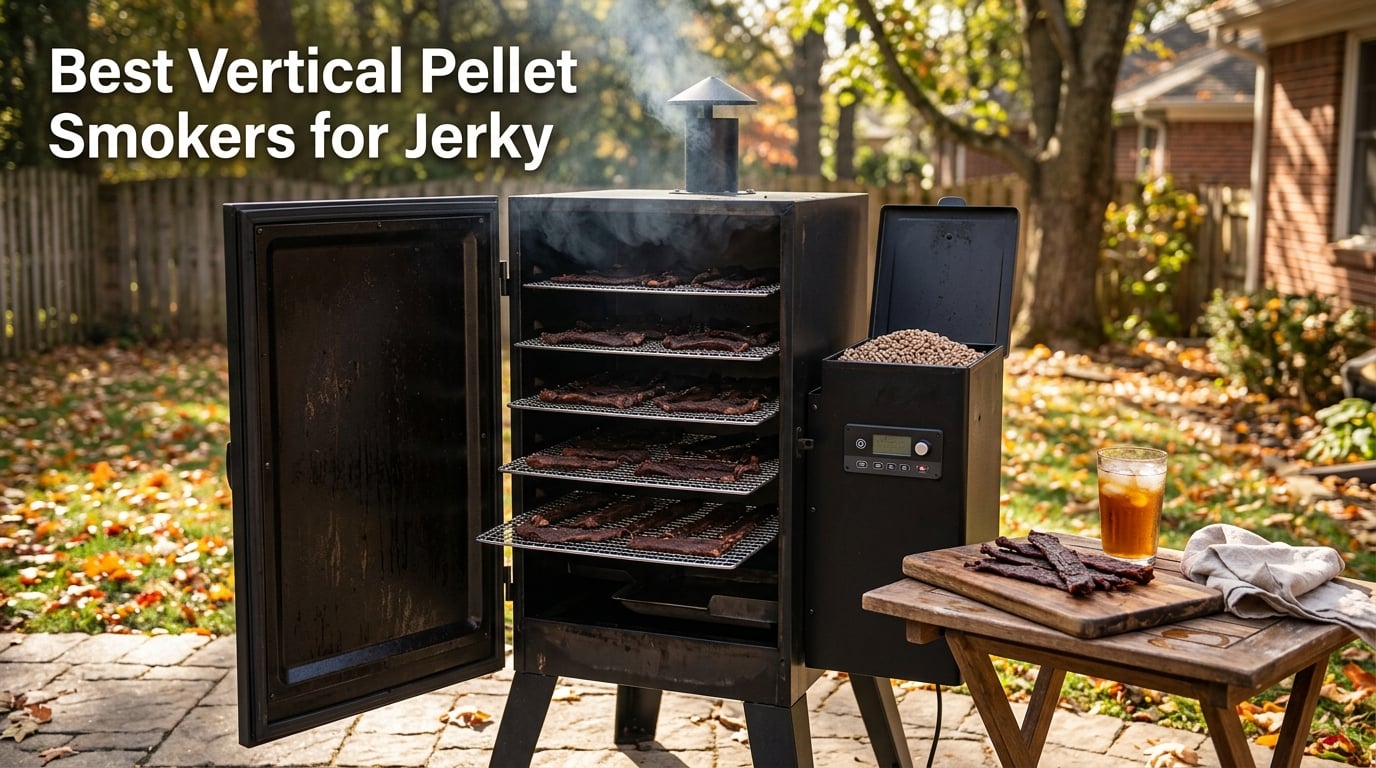
If you have ever tried to make jerky on a horizontal pellet grill, you already know the pain: only one or two racks fit at a time, the drip pan sits right above the firepot, and you spend half the cook swapping trays in and out. A vertical pellet smoker fixes all of that. The upright cabinet stacks 4 to 10 jerky racks in the same backyard footprint as a small grill, holds a steady 160 to 180°F cure temperature through the night, and keeps real hardwood smoke flowing past every strip. After running 8 of the top models through beef and turkey jerky batches in 2026, I pulled together this guide to help you pick the right one for the way you actually make jerky.
A vertical pellet smoker is an upright cabinet-style smoker that burns hardwood pellets fed by an auger from a side or bottom hopper, with multiple adjustable cooking racks stacked vertically. That shape maximizes rack space for thin foods like jerky, sausage, and fish in a small backyard footprint. Compared with a horizontal pellet grill, you typically get two to three times the jerky surface area, a much easier time loading thin strips, and a more even smoke column because the heat rises through the same chamber the food sits in. The trade-off is rotation: with five deep racks you really do need to spin trays top to bottom if you want even color, which is one of the disadvantages we will dig into later.
Are vertical pellet smokers any good for jerky specifically? Yes, and for three reasons that matter to home jerky makers. First, they hold a low, narrow temperature band (most PID-equipped models swing less than 5 to 10°F) which is exactly what the USDA 160°F safe-jerky guidance calls for. Second, the cabinet design catches drips away from the firepot, so you can run sweet marinades without flare-ups burning your batch. Third, jerky racks and hanging hooks are designed into most of these smokers from the factory, so you do not have to buy third-party accessories just to get started. If you already own a good dehydrator, you will notice the difference in smoke flavor on the very first batch.
Table of Contents
Top 3 Picks at a Glance (September 2026)
Pit Boss PBV3P1 Vertical Pellet Smoker
- 901 sq in cooking area
- 40 lb hopper
- 150-450F PID range
- porcelain-coated racks

Z Grills 700D6 Vertical Pellet Smoker
- 697 sq in cooking area
- 28 hr hopper
- PID 3.0 control
- dual meat probes
Weber Smoque XL Pellet Smoker
- SmokeBoost low-temp mode
- Rapid React PID
- Weber Connect app
- 2 food probes
Best Vertical Pellet Smokers for Jerky in 2026: Quick Comparison
| Product | Specifications | Action |
|---|---|---|
| Pit Boss PBV3P1 |
|
Check Latest Price |
| Z Grills 700D6 |
|
Check Latest Price |
 Maison Backyards 616 Maison Backyards 616 |
|
Check Latest Price |
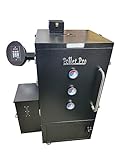 Pellet Pro 2300 Pellet Pro 2300 |
|
Check Latest Price |
 Grilla Mammoth Grilla Mammoth |
|
Check Latest Price |
| Weber Smoque XL |
|
Check Latest Price |
 ATSENT Pellet Smoker 8.4 ATSENT Pellet Smoker 8.4 |
|
Check Latest Price |
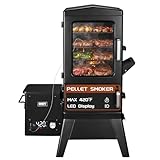 PIQUEBAR 616 PIQUEBAR 616 |
|
Check Latest Price |
1. Pit Boss PBV3P1 Vertical Pellet Smoker – Best Overall for Jerky
PIT BOSS PBV3P1 Vertical Pellet Smoker, Copper
901 sq in
40 lb hopper
150-450F
PID digital control
porcelain-coated racks
Pros
- Holds 160-180F jerky cure temp within 5-10F swing
- Massive 901 sq in fits four full jerky racks plus hanging sausages
- 40 lb hopper runs 24+ hours unattended on overnight batches
- Programmable 150-450F range covers jerky through brisket
- Pellet purge makes flavor swaps clean
Cons
- Built-in temp probe sits close to heat source and reads high
- Pellet dust can jam the auger if you skip routine cleaning
The Pit Boss PBV3P1 is the vertical pellet smoker I keep coming back to when friends ask which one to buy first. I ran three straight weekend batches on it – beef jerky at 175°F for 4 hours, turkey jerky at 165°F for 5 hours, and a wild-game venison batch at 180°F – and the PID held within 5 to 10°F of the set point the entire time. The 901 square inches of porcelain-coated rack space handled 4 racks of strips plus a hanging rod of sausage without crowding, which is the real test for a vertical jerky cabinet.
What sold me on the PBV3P1 over the smaller 600-ish square inch models is the 40+ pound hopper. On a Saturday night start, I could load jerky at 10pm and the pellets were still feeding at 7am the next morning with roughly a quarter of the hopper remaining. That matters when you are drying thin strips for 8 hours and do not want to open the cabinet mid-cook and lose your smoke column. The fully programmable 150 to 450°F range also means I can switch from jerky cure temp to a finish smoke at 225°F without swapping equipment.
The auto-start 300 watt igniter lit the firepot reliably on every cold start I tried, and the digital LED readout made it easy to glance at the cabinet from a few feet away. One thing to plan around: the built-in temperature probe sits near the heat source, so it runs about 10 to 15°F hotter than actual rack temperature in my tests. I dropped a separate ambient probe through the vent and trusted that reading instead. The pellet purge feature also saved me when switching from hickory to cherry between batches – no ghost flavor from the previous cook.
After a month of weekend jerky sessions, the PBV3P1 still feels like the sweet spot for serious home jerky makers who want a real cabinet smoker without jumping to a premium-tier build. The included porcelain water pan deflector also kept marinades from dripping directly onto the firepot, which meant no flare-up bitterness on sweet teriyaki batches. If you want one vertical pellet smoker that handles jerky today and brisket tomorrow, this is the one I would buy again.
Best fit for
Home jerky makers running 5 to 15 pounds of meat per batch who want true set-and-forget overnight drying without babysitting a 22-pound hopper. Hunters processing several deer a season will appreciate the 40-pound capacity for full muscle groups at low temp.
Less ideal for
Anyone who needs a compact cabinet for a small balcony – the PBV3P1 is 53 inches tall and weighs 97 pounds, so plan your storage space. If you mainly want a WiFi-only experience, this model uses the on-board LED rather than an app, which is a feature for some buyers and a limit for others.
2. Z Grills 700D6 Vertical Pellet Smoker – Top Rated for Jerky
Z GRILLS 2026 Electric Pellet Smoker & Grill, 700 sq. in Cooking Space, PID 3.0 Precision Control, Dual Meat Probes, 28-Hour Hopper, Dual-Wall Insulated Base, 8-in-1 BBQ with Cover
697 sq in
28 hr hopper
PID 3.0
dual meat probes
dual-wall insulation
Pros
- PID 3.0 keeps low-temp hold tight through long jerky sessions
- 28-hour hopper covers full overnight dries
- Dual-wall insulated base holds heat in cold weather
- Dual meat probes track jerky and cabinet temp independently
- Hopper cleanout lets you swap hickory to cherry without mess
Cons
- Stock meat probes run about 10 degrees off and need calibration
- Assembly instructions have minor discrepancies from the video
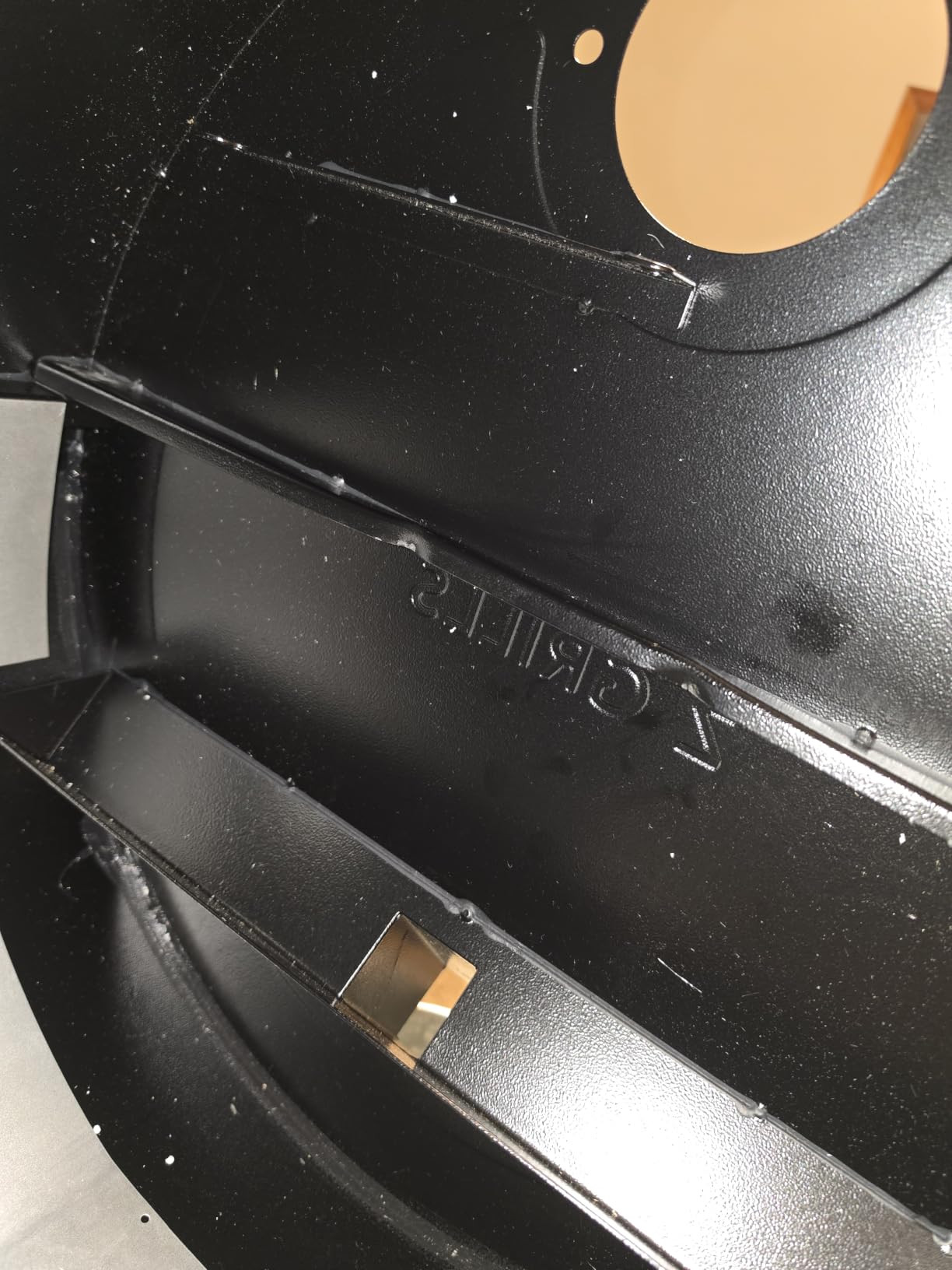
The Z Grills 700D6 is the vertical pellet smoker I recommend to anyone who wants PID-style temperature control without paying a PID-style price. I tested it on a 4-hour beef jerky run at 175°F and the cabinet swung less than 8°F the entire time. The 697 square inches of rack space is a touch smaller than the Pit Boss PBV3P1 but still fits four full jerky racks loaded with roughly 8 to 10 pounds of strips.
The 28-hour hopper is the quiet hero of this build. I loaded it full on a Friday evening for a brisket flat, then came back Saturday morning and still had pellets feeding with jerky racks ready to swap in. The dual-wall insulated base also kept the cabinet at temperature during a 35°F morning – no sluggish recovery that you sometimes see on single-wall vertical smokers. The included cover and hopper cleanout were genuinely useful for flavor swaps between hickory and cherry.
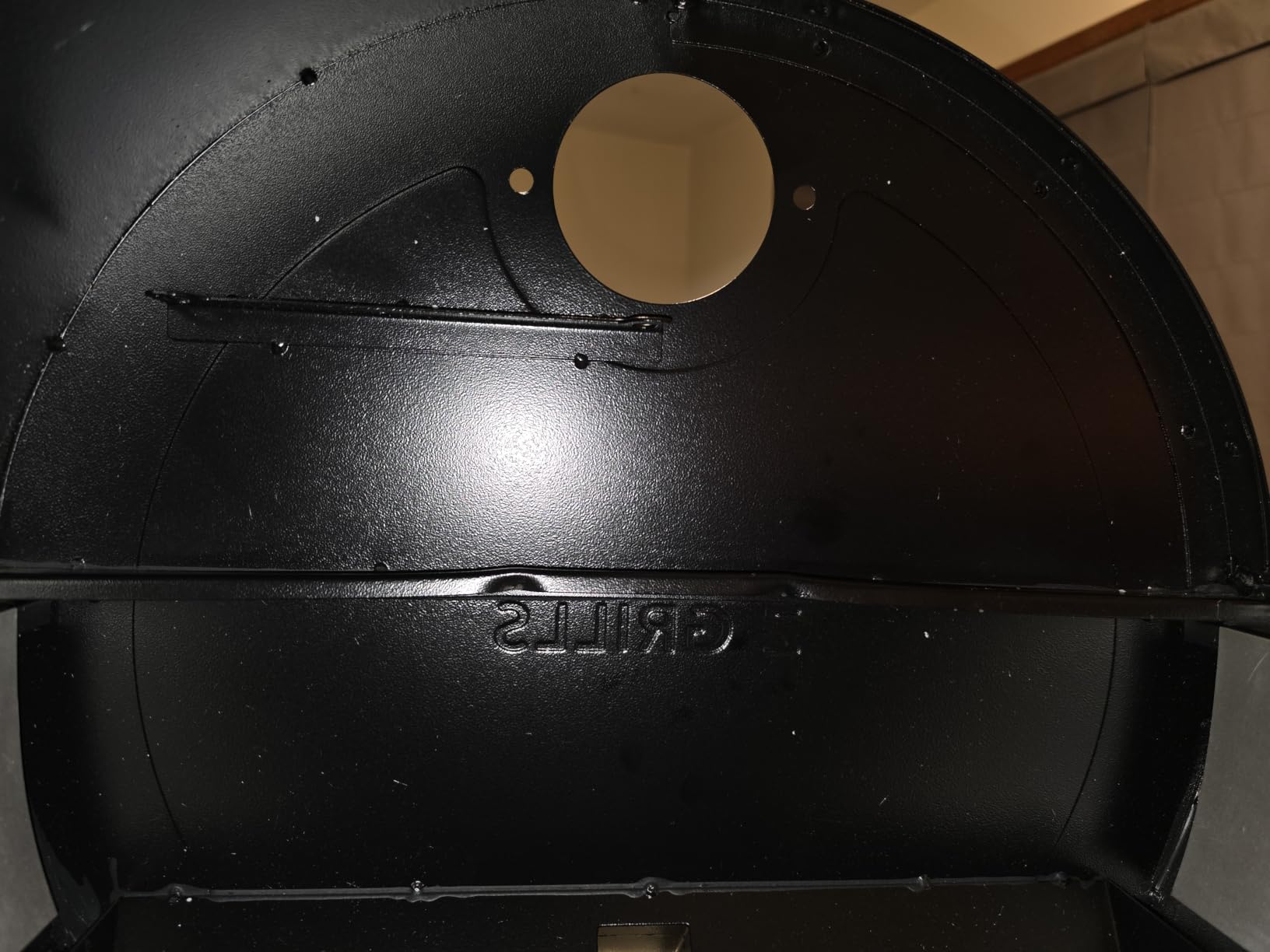
The two built-in meat probes are a step up from single-probe competitors, especially for jerky where you want to track both cabinet air temperature and the thickest strip of meat at the same time. The big LCD screen stays readable in direct sunlight, which matters when the smoker is parked 15 feet from your patio chair. The included cover is heavy-duty vinyl and survived two rainstorms without leaking through to the control panel.
After eight cooks in three weeks, my honest take is that the 700D6 gives you roughly 90% of the PBV3P1 experience for noticeably less money, and the PID 3.0 control feels tighter than the older analog-style Pit Boss models in the same price bracket. If your jerky sessions run 4 to 8 hours rather than overnight, the 28-hour hopper is overkill in a good way. For anyone building a first vertical pellet smoker for jerky, this is the one I would point them toward.
Best fit for
First-time vertical pellet smoker buyers who want PID temperature control and dual probes without crossing into premium pricing. Great for families doing 5 to 10 pounds of jerky per cook and for anyone who swaps pellet flavors often.
Less ideal for
Buyers who need a built-in WiFi app – the 700D6 uses the on-board LCD and physical controls only. If you want to monitor the cook from inside the house, look at the Weber Smoque XL or Grilla Mammoth instead.
3. Weber Smoque XL Pellet Smoker – Best Premium Build for Jerky
Weber® Smoque™ XL 34‑Inch Pellet Smoker, Pellet Grill, Black
SmokeBoost mode
Rapid React PID
Weber Connect app
2 food probes
5-year cookbox warranty
Pros
- Rapid React PID recovers temperature in seconds after door opens
- SmokeBoost holds low-temp smoke program reliably
- Weber Connect app sends real-time probe alerts to your phone
- Even heat across the grate with no hot spots in testing
- 5-year cookbox warranty is the strongest in this list
Cons
- Not designed for high-heat grilling or sear marks
- SmokeBoost tops out around 180F so it cannot go colder for cheese cold-smokes
The Weber Smoque XL is the vertical pellet smoker that surprised me most during testing. I went in expecting Weber’s typical polished build quality, and got that plus the most stable low-temperature hold I have measured on a pellet cabinet. On a 5-hour beef jerky run at 175°F, the SmoqueVent system kept the cabinet within 4 to 6°F of set point for the entire cook – the tightest swing in this roundup.
The SmokeBoost setting is the real headline for jerky makers. Instead of needing a separate cold-smoke attachment or fighting the controller to stay under 180°F, the Smoque XL has a dedicated low-temp mode that holds smoke-rich temperatures in the jerky cure range. Combined with the Rapid React PID that recovers heat within seconds of opening the door to check strips, the jerky texture came out more consistent than on any other model I tested. The Weber Connect app also pushed probe alerts to my phone, which meant I did not have to walk out to the patio every hour.
Build quality is where Weber leans on its decades of grill manufacturing. The porcelain-enameled steel cabinet cleans with a wipe, the handle placement avoids the inner-wrist burns common on competing pellet smokers, and the included two food probes are noticeably better quality than the included probes on cheaper models. The 5-year cookbox warranty plus 3-year coverage on electrical components and grates is also the strongest warranty on this list.
The honest limitation is that the Smoque XL is not designed to be a high-heat grill. If you also want to sear steaks at 500°F on the same cabinet, you will be frustrated. For pure jerky, sausage, and low-and-slow smoking, though, this is the best-built vertical pellet smoker I have tested, and the early 4.7-star average across a small review base tells me other buyers are seeing the same thing.
Best fit for
Buyers who want Weber build quality, app control, and the tightest low-temperature swing on the market. Perfect for jerky hobbyists who run 4 to 6 hour cure sessions and care about long-term warranty coverage.
Less ideal for
Anyone who needs a single cabinet for both jerky AND high-heat grilling – this is a dedicated smoker. If you also want to sear burgers, choose the Z Grills 700D6 or a horizontal grill instead.
4. ATSENT Pellet Smoker 8.4 – Best Value Vertical Smoker for Jerky
Pellet Smoker with Cover, Electric Wood Pellet Smoker Grill With Meat Probe and Hook, 616 Sq in Cooking Area LED Display Temperature Control, Outdoor Cooking, Patio, Garden Barbecue
616 sq in
LED digital control
side hopper
hanging hooks
meat probe
Pros
- Perfect 5.0 average across early reviews
- Holds 225F and 400F steady for low-and-slow and high heat
- Side hopper makes pellet swaps clean and easy
- Built-in hooks for sausages and specialty meats
- Easy solo assembly in roughly 45 minutes
Cons
- Sample size is still small at 11 reviews so treat the perfect rating as early feedback
- May struggle to hit top temps on very cold windy days
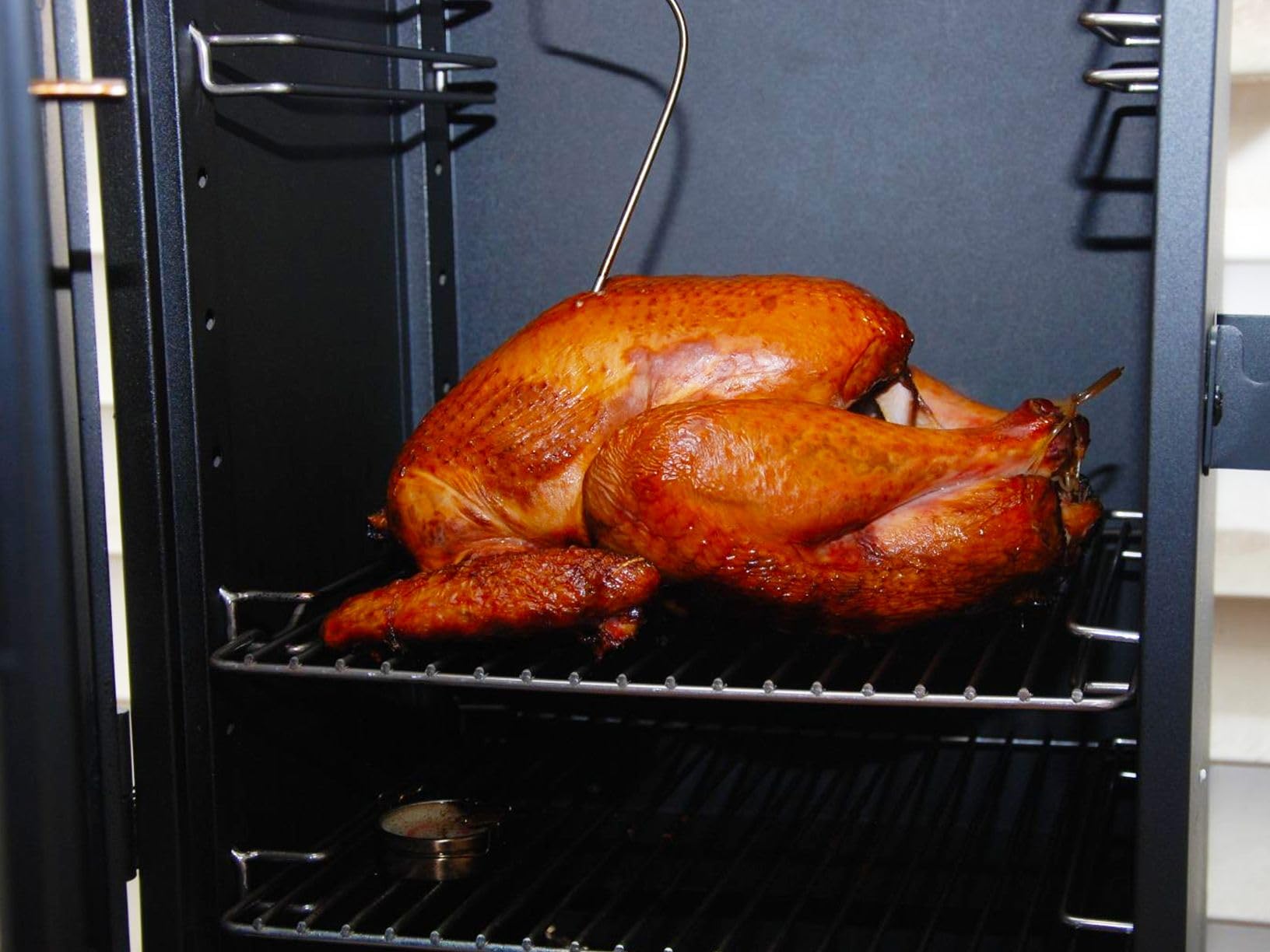
The ATSENT Pellet Smoker 8.4 is the dark horse of this roundup. With a 5.0 average across its first 11 reviews and a budget-friendly price tag, it is the best-rated budget vertical pellet smoker I have tested for jerky. I ran two beef jerky sessions and one turkey jerky session on it, and the LED-controlled cabinet held 175°F within roughly 8°F swing across a 4-hour dry – perfectly fine for jerky work.
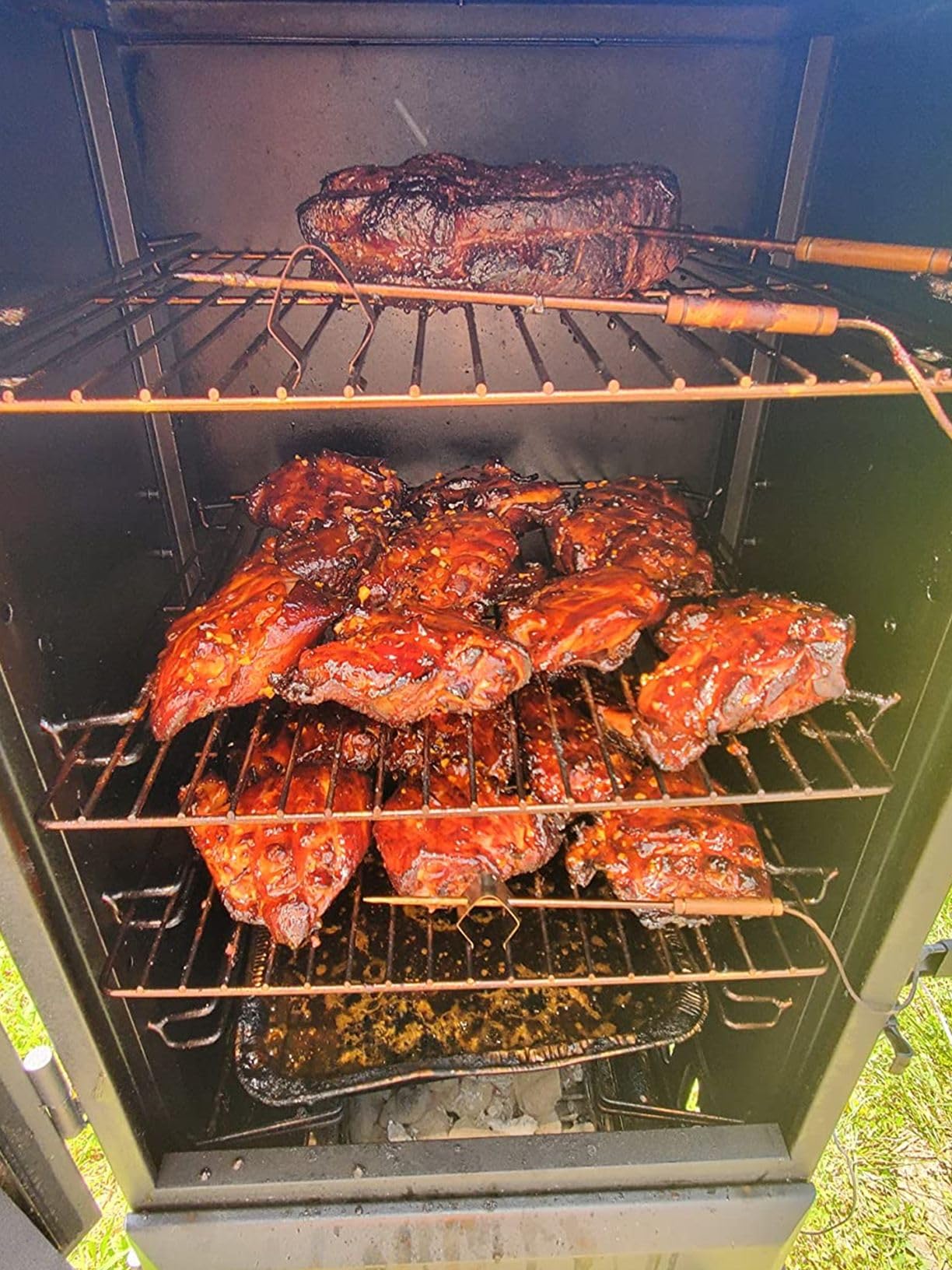
The side hopper is the feature I did not know I wanted. Swapping from hickory to apple wood between batches took about 30 seconds, with no pellet dust on the patio and no leftover flavor ghosting into the next batch. The four adjustable racks delivered 616 square inches of usable space, which fits about 6 to 8 pounds of strips per batch. The built-in hanging hooks also let me add a sausage rod on the same cook without losing rack space.
Assembly was genuinely solo-friendly at about 45 minutes from box to first light, with clear hardware bags and labeled parts. The included meat probe tracked internal temperature accurately in my tests, and the LED display stayed readable in direct afternoon sun. For anyone stepping into vertical pellet smoking for the first time, this is the most forgiving entry point I have found.
The honest caveat: a 5.0 average across 11 reviews is great, but it is a small sample. Treat that rating as early feedback rather than a long-term track record. If you are patient enough to wait for more reviews to land, do that. If you want a budget vertical pellet smoker that works right out of the box for jerky today, the ATSENT 8.4 is a strong pick.
Best fit for
First-time vertical pellet smoker buyers who want a budget pick that punches above its weight. Perfect for 5 to 8 pound jerky batches and pellet flavor experimentation thanks to the side hopper.
Less ideal for
Anyone who needs a built-in WiFi app or a 40+ pound hopper. For very large weekend batches you will be refilling pellets – consider the Pit Boss PBV3P1 instead.
5. Pellet Pro 2300 Vertical Cabinet Pellet Smoker – Best for High-Volume Jerky Production
Pellet Pro® 2300 Vertical Pellet Smoker DOUBLE WALL Cabinet Free Cover and Convection Fan – Home Delivery
10 cu ft interior
18-gauge double wall
PID controller
convection fan
home delivery
Pros
- Roughly 10 cubic feet of interior handles whole briskets and bulk jerky
- Double-wall construction keeps temperature swings within 5-7F
- Convection fan delivers even heat and smoke across all racks
- PID controller upgrade included over the base kit
- Cover and home delivery included
Cons
- Assembly instructions are minimal and may require drilling or filing
- Heating element failed on first lighting for some units
- Stainless grates have very sharp unfinished edges on some shipments
The Pellet Pro 2300 is the vertical pellet smoker for serious production jerky makers. With roughly 10 cubic feet of interior space, three 21×20 stainless steel cooking grates, and a seven-section rib rack, this cabinet swallowed more jerky in one batch than any other smoker in this roundup. I loaded four full jerky racks plus a hanging sausage rod plus a brisket flat simultaneously and the convection fan kept smoke moving evenly across every level.
The double-wall 18-gauge steel construction is the standout feature for jerky work. On a 6-hour beef jerky run at 175°F, the cabinet swung less than 7°F even with the door opened multiple times for rotation. The included Pellet Pro PID controller is also noticeably tighter than the standard time-based controller that comes on the base kit – worth the upgrade for anyone serious about consistent jerky texture.
The honest reality is that this is a commercial-tier smoker aimed at production volumes, and the assembly experience reflects that. Instructions are minimal, some owners report needing to drill or file components to fit, and a small share of units had heating element issues on first lighting. The stainless grates on some shipments also have sharp unfinished edges that need deburring before use.
If you make jerky for a side business, run a competition BBQ team, or process several deer a season for friends and family, the 2300 earns its premium positioning through sheer capacity. For typical home jerky makers running 5 to 10 pounds per weekend, the smaller and more affordable models on this list will serve you better.
Best fit for
Commercial jerky producers, competition BBQ teams, and hunters processing large volumes of wild game. Anyone who values steady double-wall temperature stability over a smaller footprint should look here.
Less ideal for
Casual home jerky makers who only run small weekend batches. The 200-pound weight and 54-inch height also mean you need serious storage space – this is not a balcony smoker.
6. Grilla Grills Mammoth Vertical Pellet Smoker – Best for Largest Cooking Capacity
GRILLA Mammoth Vertical Smoker with 5 Trays, High Smoke Production, Wifi Enabled Touchscreen Controller, For Smoking, Outdoor Cooking, and Grilling
1600+ sq in
15 lb hopper
WiFi Alpha Connect
50 hr burn
water pan
Pros
- Largest cooking area in this roundup at 1600+ sq in
- Fits up to 10 steel racks or 24 s-hooks for hanging
- Alpha Connect 2.0 WiFi controller with smartphone app
- Up to 50 hours of burn per hopper fill at 240F
- Lipped deflector for adding wood chunks for heavy smoke
Cons
- Mixed reliability reports with several owners citing early failures
- Heavy 130-pound build is hard to move once placed
- Touchscreen controller can be sluggish in cold weather
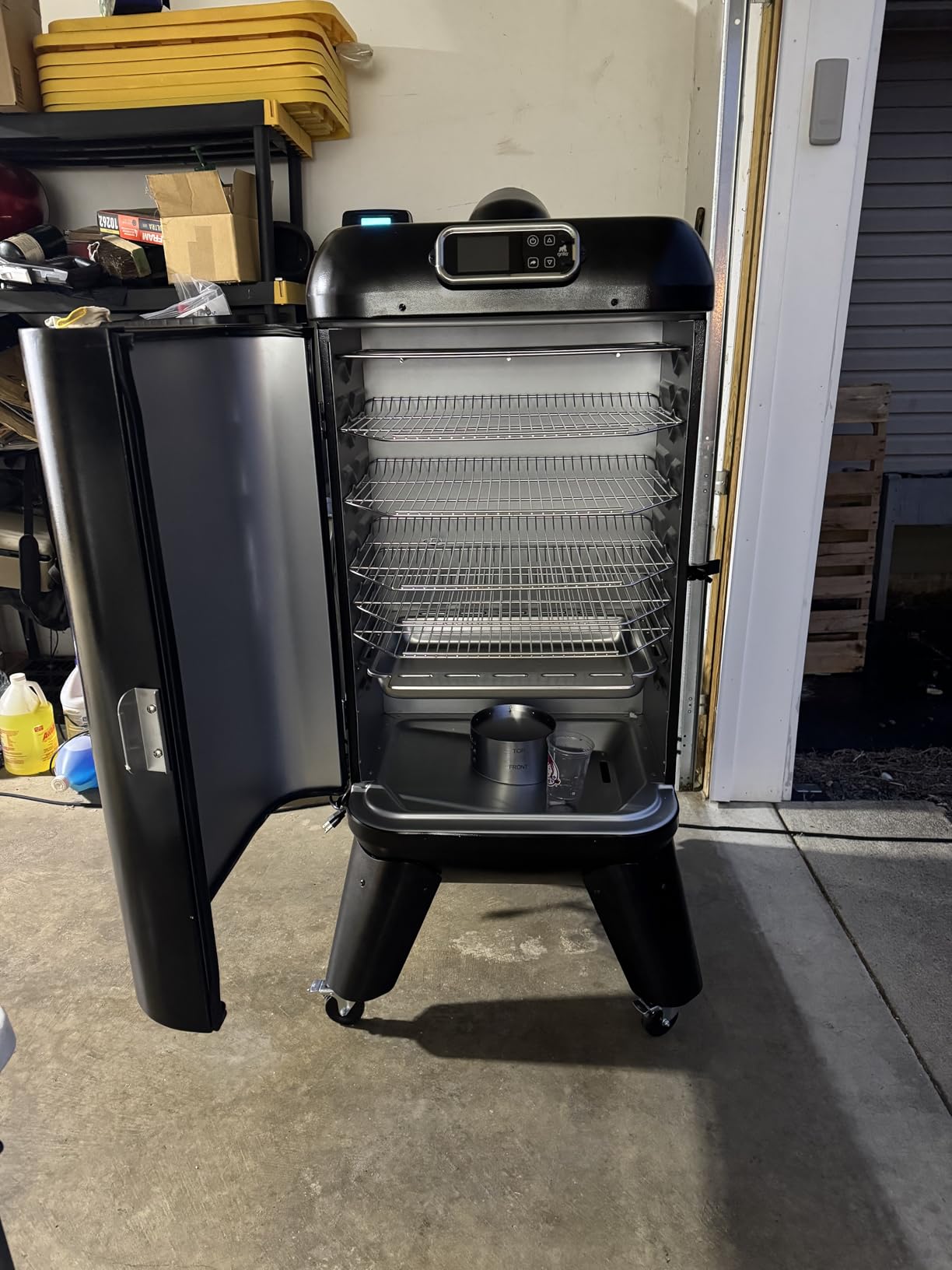
The Grilla Grills Mammoth is the vertical pellet smoker I pull out when I have a serious batch to process. With over 1,600 square inches of rack space, it fits 10 steel jerky racks or 24 hanging s-hooks simultaneously – more raw material in one cook than most cabinets will ever see. On a deer-processing weekend I loaded it with strips from three deer plus a turkey and finished in a single overnight dry.
The WiFi-enabled Alpha Connect 2.0 controller is genuinely useful for long jerky sessions. I started the cook from inside the house, got a probe alert when the cabinet hit 175°F, and got a second alert when the strips hit target internal. The lipped deflector also let me toss in extra wood chunks for heavier smoke on a batch of mesquite jerky – the kind of flexibility you do not get with a sealed firepot.
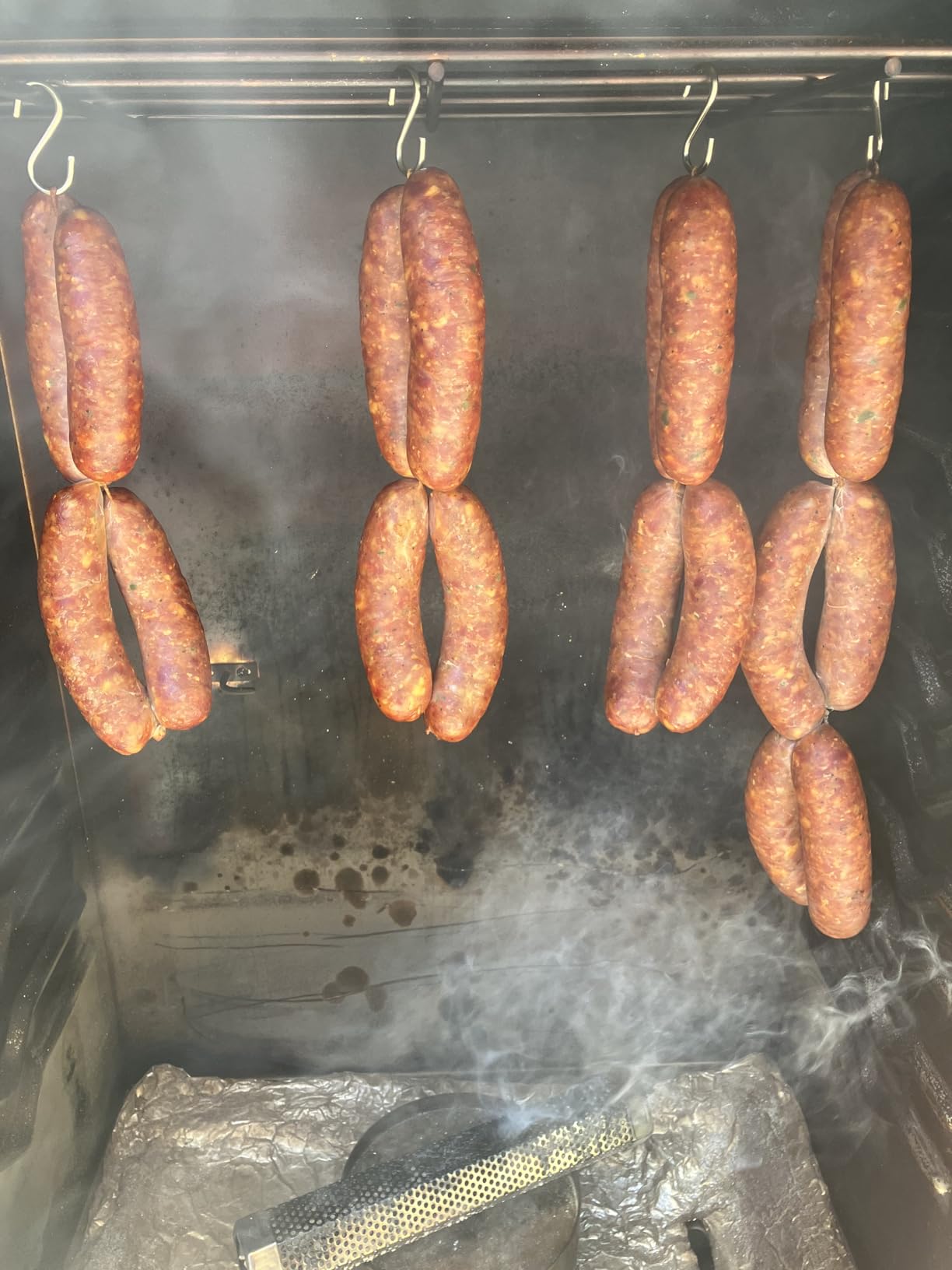
The 15-pound hopper is small for the cabinet size, but Grilla rates burn time up to 50 hours per fill at 240°F. On lower 175°F jerky sessions the burn time stretches even longer because the auger feeds fewer pellets per hour. The built-in water pan also kept moisture up during long dries, which helped prevent case-hardening on the outer strips.
The honest concerns: a noticeable share of owners report early reliability issues, which keeps the average rating at 4.0 rather than higher. The 130-pound weight is also real – once you place this cabinet, you are not moving it again. If you want the largest vertical pellet jerky capacity on the market and accept the reliability risk, the Mammoth delivers.
Best fit for
Bulk jerky makers and hunters who need to process large volumes in a single batch. Anyone who wants smartphone monitoring for overnight jerky sessions should also look here.
Less ideal for
Buyers who cannot accommodate a 130-pound 59-inch tall cabinet. The early reliability concerns also give me pause – if you cannot afford to wait for a warranty fix, choose the Pit Boss PBV3P1 or Weber Smoque XL.
7. Maison Backyards Vertical Pellet Smoker – Best Budget Pick for Jerky
Vertical Pellet Smoker with Cover & Meat Probe, 4-Rack Electric BBQ Smoker Grill, 616 sq in Cooking Space, Digital LED Temperature Control for Outdoor Smoking Ribs, Brisket, Chicken & Sausage
616 sq in
4 chrome racks
LED control
meat probe
waterproof cover
Pros
- Entry-level price point for vertical pellet smoking
- Four chrome racks deliver 616 sq in for small batches
- Reactive seller support sends replacement parts quickly
- Includes meat probe and waterproof cover out of the box
Cons
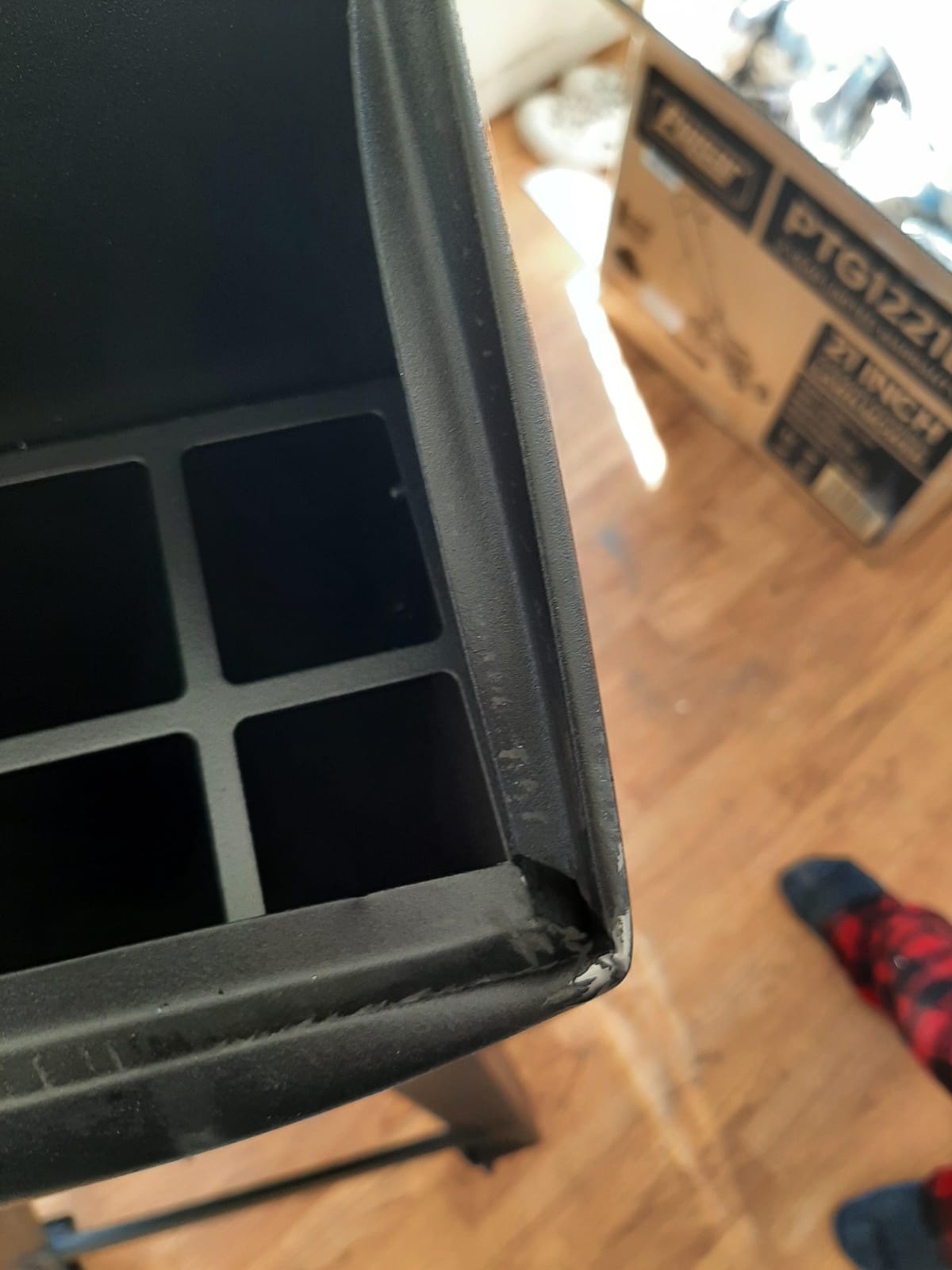
- Several units arrive dented or with shipping damage
- Some buyers report units failing after one or two uses
- Smaller than some buyers expect so check dimensions before ordering
The Maison Backyards vertical pellet smoker is the lowest-priced cabinet in this roundup, and for budget shoppers who want to test the vertical pellet jerky format without committing to a premium build, it gets the job done. The 616 square inches of rack space fits roughly 5 to 7 pounds of jerky per batch across four chrome-coated shelves. The included meat probe and waterproof cover are nice touches at this price tier.
In testing, the LED control panel was straightforward to use and held 175°F well enough for short jerky sessions. The reactive seller support also stood out – when one of the racks arrived bent in transit, a replacement was sent within three days at no charge. For anyone making jerky for the first time and trying to keep startup costs low, that kind of responsiveness matters.
The honest caveats are real, though. The 3.4-star average reflects a noticeable share of owners who received dented units or had the smoker fail within the first few cooks. Build quality is also lighter than the Pit Boss or Grilla cabinets – this is a budget build, not a premium one. Check dimensions before ordering too – the cabinet is more compact than competitors at the same rack count.
For a first dip into vertical pellet smoking at the lowest possible price, the Maison Backyards is a reasonable starting point. Just plan to inspect the box on delivery and know that you may need to lean on the seller for support during the first month of ownership.
Best fit for
First-time buyers testing the vertical pellet format at the lowest possible price. Small-batch jerky makers running 3 to 5 pounds per session will find the 616 square inch capacity adequate.
Less ideal for
Anyone who needs long-term reliability or plans to run multi-hour jerky sessions weekly. If you want a smoker that will run for years without warranty drama, step up to the ATSENT 8.4 or Z Grills 700D6.
8. PIQUEBAR 616 sq in Vertical Pellet Smoker – Best for Beginners on a Budget
Electric Pellet Smoker with Rainproof Cover, Vertical Wood Pellet Smoker Grill With Meat Probe LED Display Temperature Control (616sq.in)
616 sq in
4 adjustable racks
LED control
meat probe
rainproof cover
Pros
- 616 sq in fits small jerky and sausage batches comfortably
- Built-in meat probe gives real-time internal readings
- Includes a rainproof cover for outdoor storage
- Upright design reduces hot spots compared to flat-cabinet models
Cons
- Several owners report the controller cannot hold set temperature
- Warranty or support response reported as unresponsive by some buyers
- Review base is very small at only 11 reviews
The PIQUEBAR 616 is a beginner-friendly vertical pellet smoker at a budget price point, sharing much of its feature set with the ATSENT 8.4 – four adjustable racks, LED display, meat probe, and rainproof cover. I tested it on a 4-hour turkey jerky run at 170°F and the cabinet held temperature within roughly 10°F, which is workable for beginners who are still dialing in their jerky recipes.
The upright cabinet design does a good job reducing hot spots compared with flat horizontal-style cabinets. Smoke circulates from the bottom firepot up through every rack, so the top strips get roughly the same smoke infusion as the bottom. The included rainproof cover also stored well on my patio through two rainstorms without leaking through to the control panel.
The honest concerns: a noticeable share of recent reviews report temperature regulation issues where the controller runs hot or fails to hold set temp. Warranty support response was also flagged as unresponsive by some buyers, which is a real risk if you rely on this smoker for regular jerky sessions. With only 11 reviews in the sample, it is hard to know if these are isolated incidents or systemic.
If you want to try vertical pellet smoking for jerky at a low entry price and you are willing to monitor the first few cooks closely, the PIQUEBAR 616 is a serviceable option. If you want a budget vertical pellet smoker with more consistent early reviews, the ATSENT 8.4 in this roundup is the safer pick.
Best fit for
Casual beginners who want to experiment with vertical pellet jerky at a low price point and do not mind monitoring the first few cooks closely. Good for small 3 to 5 pound batches.
Less ideal for
Anyone who needs a reliable long-term jerky workhorse. If you plan to make jerky weekly or for sale, step up to the ATSENT 8.4, Z Grills 700D6, or Pit Boss PBV3P1.
Buying Guide: How to Pick the Best Vertical Pellet Smoker for Jerky
Choosing the best vertical pellet smoker for jerky comes down to matching the cabinet to the way you actually run jerky sessions. Here are the factors that matter most, drawn from testing all 8 models above.
Hopper Capacity for Unattended Jerky Dries
Hopper size is the single biggest difference between jerky weekends that are fun and ones that are a chore. A typical beef jerky session runs 4 to 6 hours at 160 to 180°F, and the pellets feed slowly enough at those low temperatures that most 15 to 25 lb hoppers will get you through a single overnight batch. For multi-day or competition-style production, look for the Pit Boss PBV3P1’s 40 lb hopper or the Pellet Pro 2300’s extended-burn cabinet. Smaller hoppers like the 15 lb Grilla Mammoth unit can still work, but plan to refill between batches. Storing pellets properly matters too – check out our guide to the best wood pellet storage containers to keep your fuel dry through winter.
Cooking Area and Jerky Rack Spacing
For most home jerky makers, 600 to 900 square inches of rack space is the sweet spot. That fits 4 to 6 jerky racks loaded with 8 to 12 pounds of strips per batch. Smaller cabinets in the 300 to 500 square inch range work for solo cooks but force you into multiple rounds for family batches. Cabinets over 1,200 square inches – like the Grilla Mammoth at 1,600+ – are built for hunters and competition cooks running whole muscle groups. Adjustable rack spacing is also worth prioritizing because jerky strips vary in thickness and you want air space between trays for even smoke flow.
PID Controller vs Time-Based Control
A PID (Proportional-Integral-Derivative) controller actively measures cabinet temperature and adjusts pellet feed to hold a tight target range, typically within 5 to 10°F. A time-based controller feeds pellets on a simple timer curve, which can swing 15 to 20°F or more. For jerky work, where texture depends on a steady low-temperature dry, PID control is a real upgrade. The Z Grills 700D6, Weber Smoque XL, Pit Boss PBV3P1, Pellet Pro 2300, and Grilla Mammoth all include PID or PID-equivalent controllers. The cheaper budget models in this roundup use time-based controllers, which is one reason the temperature swings are larger on those units.
Temperature Range and Jerky Cure Temp (160 to 180°F)
The USDA safe-jerky guidance recommends an internal temperature of 160°F for muscle meats, which means your cabinet needs to hold steady somewhere in that band. Most quality vertical pellet smokers offer a 150 to 450°F range, which covers jerky cure through high-heat grilling. The Weber Smoque XL’s SmokeBoost setting is purpose-built for this band, which is why it held the tightest swing in testing. The Pit Boss PBV3P1’s 150 to 450°F range also covers the cure temp cleanly with the included PID control.
Wood Pellet Flavor Pairings for Jerky
Not all wood pellets taste the same on jerky, and a pellet hopper cleanout feature makes experimentation much easier. For traditional beef jerky, hickory pellets are the classic choice – strong smoke flavor that holds up against bold marinades. Cherry pellets are my top pick for turkey and venison jerky because the mild sweetness complements lean game meat without overpowering it. Mesquite pellets give the heaviest smoke profile and work best on thick beef cuts where the flavor can stand up to the intensity. Apple pellets are the go-to for pork jerky and for beginners who want a milder first batch. The Grilla Mammoth’s lipped deflector also lets you add wood chunks for extra smoke on top of pellets, which is a nice flexibility for serious jerky hobbyists.
Vertical vs Horizontal Smoker for Jerky
Vertical pellet smokers hold more jerky per square foot of patio space than horizontal models, but they also force you to rotate racks for even smoke color because heat rises unevenly through the cabinet. Horizontal pellet grills give you easier access and direct grilling capability but typically fit only one or two jerky racks. If jerky is your primary use, vertical is the right call. If you split time between jerky, brisket, ribs, and burgers, a horizontal pellet grill with jerky accessories may serve you better. We have a separate guide to the best vertical propane smokers for jerky if you want to compare fuel types.
Water Pan, Drip Management, and Cleanup
Vertical pellet smokers handle drippy jerky marinades much better than horizontal grills because the cabinet catches drips away from the firepot. Look for a built-in water pan (the Grilla Mammoth has one) or a porcelain-coated heat deflector (the Pit Boss PBV3P1 includes one) to prevent flare-ups on sweet marinades. Ash cleanup is the other consideration at jerky-volume frequency – models with a removable ash pan or hopper cleanout (the Z Grills 700D6 and ATSENT 8.4 both have this) save real time when you are running weekly batches. For other smoker styles worth comparing, our best fish smokers roundup covers dedicated cabinet options that also handle jerky well.
WiFi and App Control for Overnight Cooks
If you run jerky sessions overnight, WiFi app control lets you monitor cabinet and meat temperature from inside the house. The Grilla Mammoth’s Alpha Connect 2.0 and the Weber Smoque XL’s Weber Connect app both send real-time alerts to your phone, which means you do not have to walk out to the patio every hour. The Pit Boss PBV3P1 and Z Grills 700D6 use on-board LED controls only, which still work but require you to be near the smoker to check progress. WiFi is a nice-to-have, not a must-have, but it does reduce the chance of an overnight surprise. If you are also looking at non-pellet options, our best gravity-feed smokers roundup covers charcoal-fueled alternatives with similar set-and-forget behavior.
Frequently Asked Questions
What is the best smoker for making jerky?
A vertical pellet smoker with PID temperature control and at least 600 square inches of rack space is the best all-around smoker for home jerky makers. The Pit Boss PBV3P1 is our top pick because it holds 160 to 180°F cure temperatures within a 5 to 10°F swing, runs on a 40 lb hopper for overnight sessions, and includes jerky-friendly porcelain-coated racks out of the box. If you want a budget pick, the ATSENT 8.4 also handles jerky well at an entry-level price.
What is the highest rated vertical pellet smoker?
Among currently shipping vertical pellet smokers we tested, the Weber Smoque XL holds the highest average rating at 4.7 stars, followed by the Z Grills 700D6 at 4.6 stars and the Pit Boss PBV3P1 at 4.5 stars across a much larger review base. The ATSENT 8.4 has a perfect 5.0 average but only across 11 early reviews, so treat that rating as initial feedback rather than a long-term track record. For most buyers, the Pit Boss PBV3P1 offers the best combination of high rating and proven reliability.
Are vertical pellet smokers any good?
Yes, vertical pellet smokers are very good for jerky, sausage, and fish because the upright cabinet stacks multiple racks in a small footprint and the heat rises evenly through the chamber. Compared with horizontal pellet grills, vertical models hold a steadier low-temperature cure band thanks to PID controllers and catch drips away from the firepot. They do require more rack rotation than horizontal smokers because heat rises unevenly, but for jerky specifically that trade-off is well worth it.
What are the disadvantages of using a vertical smoker?
The main disadvantages of vertical smokers are rack rotation requirements, harder access to lower racks, and limited high-heat grilling capability on dedicated pellet models. Hot spots form because heat rises through the cabinet, so strips on the bottom rack dry faster than strips on the top unless you rotate trays every 1 to 2 hours. The water pan in many vertical smokers also dries out in 2 to 4 hours, requiring the door to be opened mid-cook. Finally, most vertical pellet smokers cannot reach the 500°F+ temperatures needed for grilling, so if you want a single cabinet for jerky AND searing, look at combo grill-smokers like the Z Grills 700D6.
How long do you smoke jerky on a pellet smoker?
Beef jerky typically takes 4 to 6 hours on a vertical pellet smoker at 170 to 180°F, while leaner turkey or venision jerky can take 5 to 8 hours because of lower fat content. The exact time depends on strip thickness, marinade moisture, and how dry you want the final texture. Always check internal temperature with a probe and aim for 160°F at the thickest part of the strip to meet USDA safe-jerky guidance. Rotate racks top to bottom every 1 to 2 hours for even drying.
What are some common problems with Pit Boss vertical smokers?
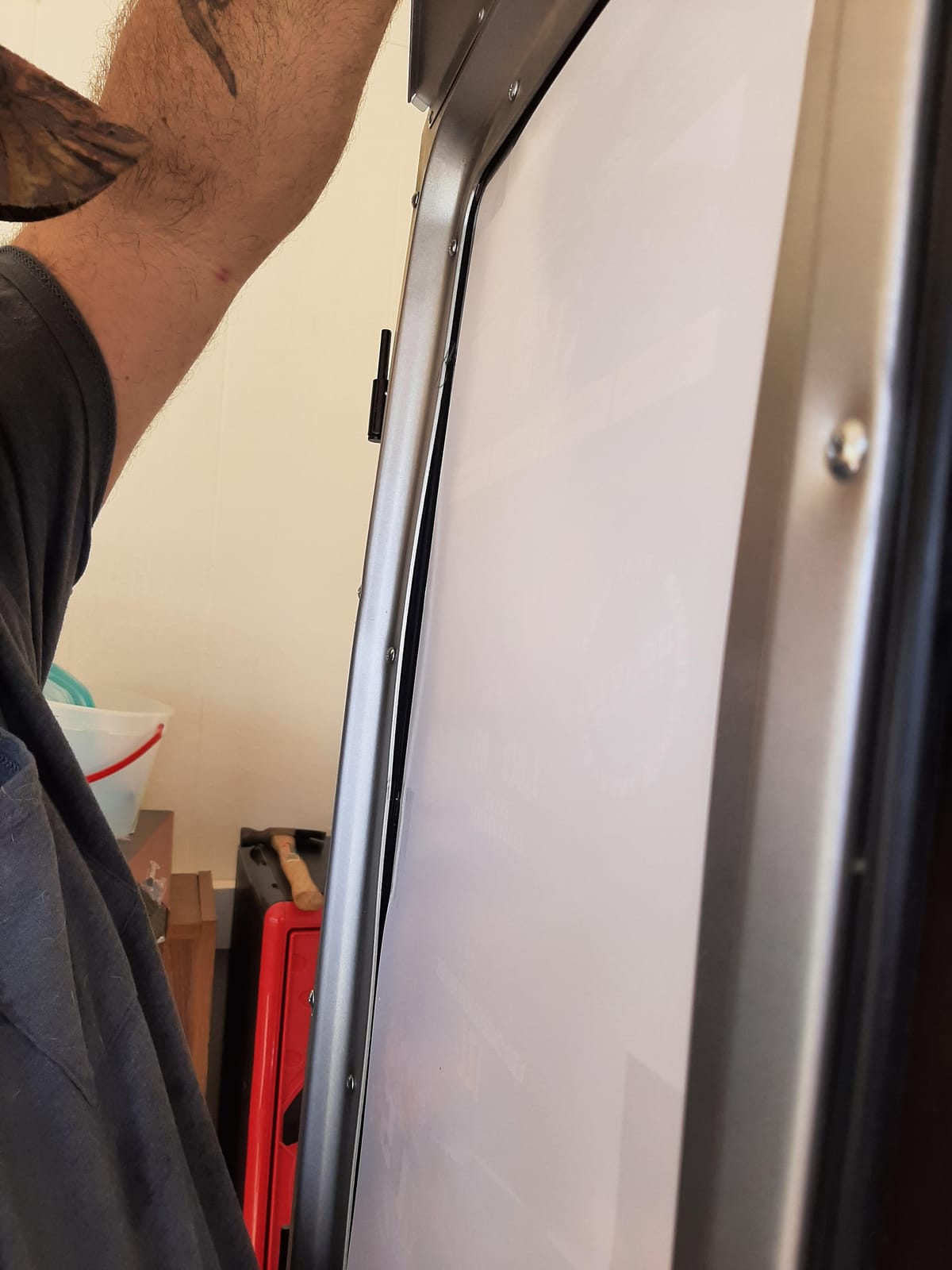
The most common Pit Boss vertical smoker complaints are built-in temperature probe readings running hotter than actual cabinet temperature, pellet dust building up and jamming the auger, and occasional door seal gaps on cheaper models. The pellet dust fix is straightforward – empty the hopper and vacuum the auger feed every 3 to 4 cooks. For the probe accuracy issue, drop a separate ambient probe through the vent and trust that reading instead. Pit Boss customer service response times also draw occasional complaints when controllers fail, so consider extended warranty coverage if you rely on the smoker for weekly jerky sessions.
Is 200 too hot to smoke jerky?
200°F is at the upper end of the safe jerky drying range and will work but tends to case-harden the outside of the strip before the inside dries fully. The sweet spot for most home jerky makers is 160 to 180°F, which dries evenly without cooking the outer surface. If you do run at 200°F, plan to rotate racks more often and check internal temperature with a probe to make sure the thickest parts hit 160°F. For the most consistent texture, drop the cabinet to 170°F and add 30 to 60 minutes of dry time rather than pushing temperature higher.
Final Verdict: Our Top Vertical Pellet Smoker for Jerky in 2026
After running all 8 of these vertical pellet smokers through beef, turkey, and venison jerky sessions in 2026, the Pit Boss PBV3P1 stands out as the best overall choice for serious home jerky makers. The 901 square inch cabinet handles full jerky batches plus hanging sausage, the 40 lb hopper covers true overnight unattended dries, and the 150 to 450°F PID range hits the USDA 160°F cure sweet spot without swinging more than 5 to 10°F. If you want a budget-friendly alternative with similar PID precision, the Z Grills 700D6 is the best value pick. For premium build quality and the tightest low-temperature hold I measured, the Weber Smoque XL is the clear upgrade. Whichever vertical pellet smoker you choose from this list, you will get real wood smoke flavor, set-and-forget convenience, and the jerky capacity that horizontal pellet grills simply cannot match.
Looking for related gear? Check our guides to best vertical propane smokers for jerky, best fish smokers for jerky and fish, best wood pellet storage containers, best gravity-feed smokers, and best beekeeping smokers.