
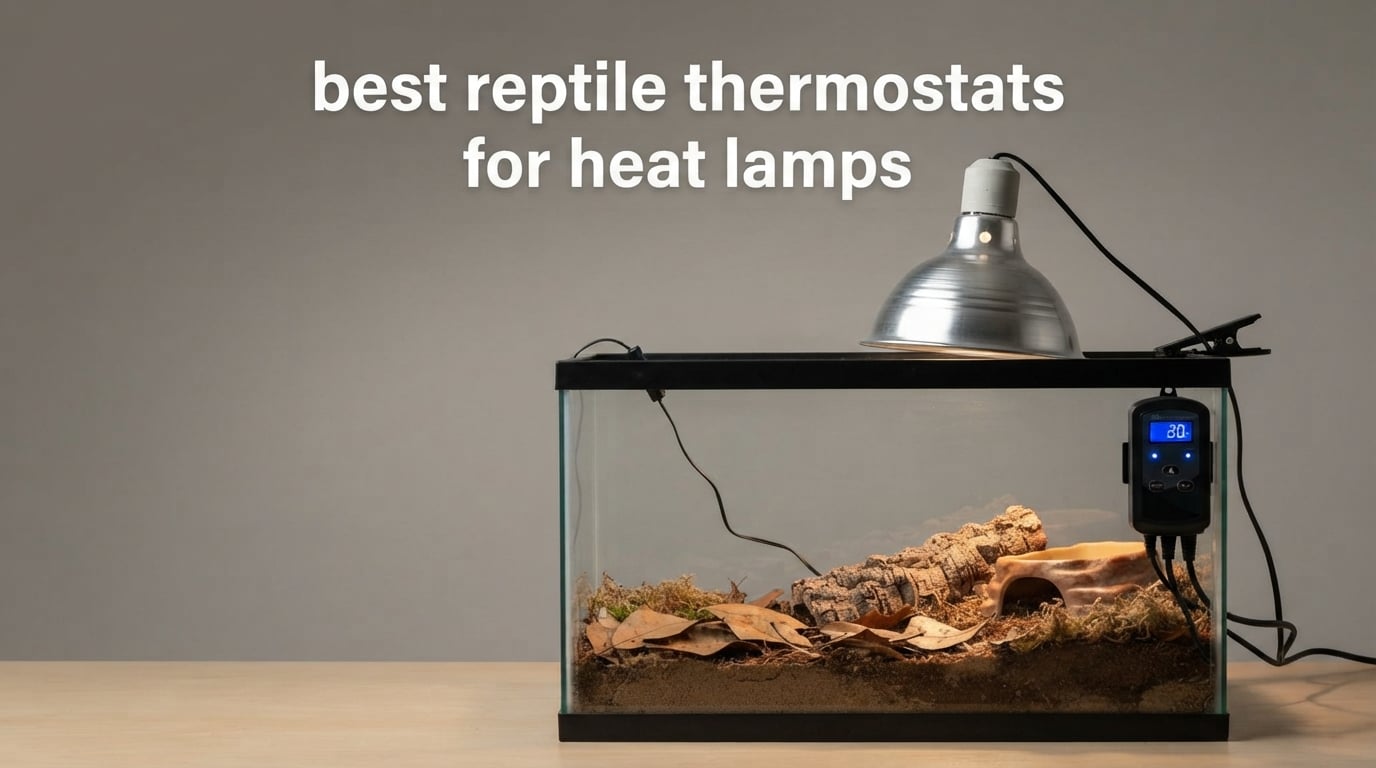
A basking lamp on a mechanical timer is the most common setup in a beginner reptile enclosure, and it is also the setup behind a startling number of thermal burns. A timer does not know how warm the enclosure already is, so a lamp that ran all afternoon keeps delivering full power into a rock that has not cooled. The fix is a probe-based thermostat, and the single most important decision in buying one is how it reduces power.
We compared ten reptile thermostats built around heat lamps rather than heat mats, and read through the customer feedback on each one. The short version: a dimming controller that tapers power continuously is the right choice for a visible basking bulb, an on/off controller is fine for a ceramic emitter or a mat, and a plain dimmer is a manual tool rather than a thermostat. Everything else, from wattage ceilings to probe placement, follows from that one choice.
If you are also shopping the lamps themselves, our livestock heat lamp roundup covers the fixture and bulb side of the equation in more detail, and the smart thermostat comparison explains the Wi-Fi alerting that reptile controllers generally lack.
Table of Contents
Quick Answer: What Is the Best Thermostat for a Reptile Heat Lamp?
The best thermostat for a reptile heat lamp is a PID dimming controller rated above your bulb’s wattage, with the probe mounted at animal level inside the basking zone. Dimming reduces lamp power gradually instead of switching it fully on and off, so the bulb runs cooler, lasts longer, and stops the short cycling that cracks sockets. Save on/off control for heat mats and non-lighting ceramic emitters.
Top 3 Best Reptile Thermostats For Heat Lamps (October 2026)

REPTIZOO TC02 Dimming Thermostat
- PID dimming control
- 300W maximum load
- 41F-140F range
- Memory function


REPTITRIP PT02 Dimming Thermostat
- 1-24 hour timer
- 260W load
- 50F-140F range
- Output power readout
All 10 Picks Side by Side in 2026
| Product | Specifications | Action |
|---|---|---|
| REPTIZOO TC02 Dimming Thermostat |
|
Check Latest Price |
 REPTI ZOO RL04DTC Dome and Thermostat REPTI ZOO RL04DTC Dome and Thermostat |
|
Check Latest Price |
 LUCKY HERP 8.5 Inch Dome and Timer LUCKY HERP 8.5 Inch Dome and Timer |
|
Check Latest Price |
 REPTITRIP SOP24 Day Night Timer REPTITRIP SOP24 Day Night Timer |
|
Check Latest Price |
| CAVACHEW JTC02 Dimming Thermostat |
|
Check Latest Price |
| REPTITRIP PT02 Dimming Thermostat |
|
Check Latest Price |
 ReptiKing X100 Dimming Thermostat ReptiKing X100 Dimming Thermostat |
|
Check Latest Price |
 REPTITRIP DM01 Knob Dimmer Pair REPTITRIP DM01 Knob Dimmer Pair |
|
Check Latest Price |
 LUCKY HERP 300W Dimming Thermostat LUCKY HERP 300W Dimming Thermostat |
|
Check Latest Price |
 ReptiKing K9551T Dome and Thermostat ReptiKing K9551T Dome and Thermostat |
|
Check Latest Price |
1. REPTIZOO TC02 Dimming Thermostat – the Pick Most Keepers Land On
REPTIZOO Dimming Thermostat, PID Temperature Controller with Memory Function, Reptile Thermostat for Reptile Heat lamp, Specifically Designed for Light Heat Bulbs & Heaters
PID dimming control
300W maximum load
41F-140F range
Memory function
Pros
- Smooth dimming holds basking temperatures steady
- 300W ceiling covers most halogen bulbs
- Memory restores settings after power loss
- Simplest set-and-confirm button layout in the group
Cons
- Not usable with sunlamps or mercury vapor bulbs
- Probe must sit at least 15cm from the heat source
- Display can blink when the setpoint is not reached
The TC02 is the unit I keep coming back to, and the reason is not the spec sheet, it is the volume of steady use behind it. With 780 reviews and a 4.2 average, this is the most reviewed thermostat in our group by a wide margin, and the feedback repeats the same things: temperatures hold, the lamp stops visibly cycling, and setup takes under five minutes.
It runs a PID dimming mode across a 41°F to 140°F range and handles up to 300W, which covers a single 80W or 100W halogen basking bulb with plenty of headroom. The LED screen shows ambient temperature and your set value and toggles between Celsius and Fahrenheit with a button press.
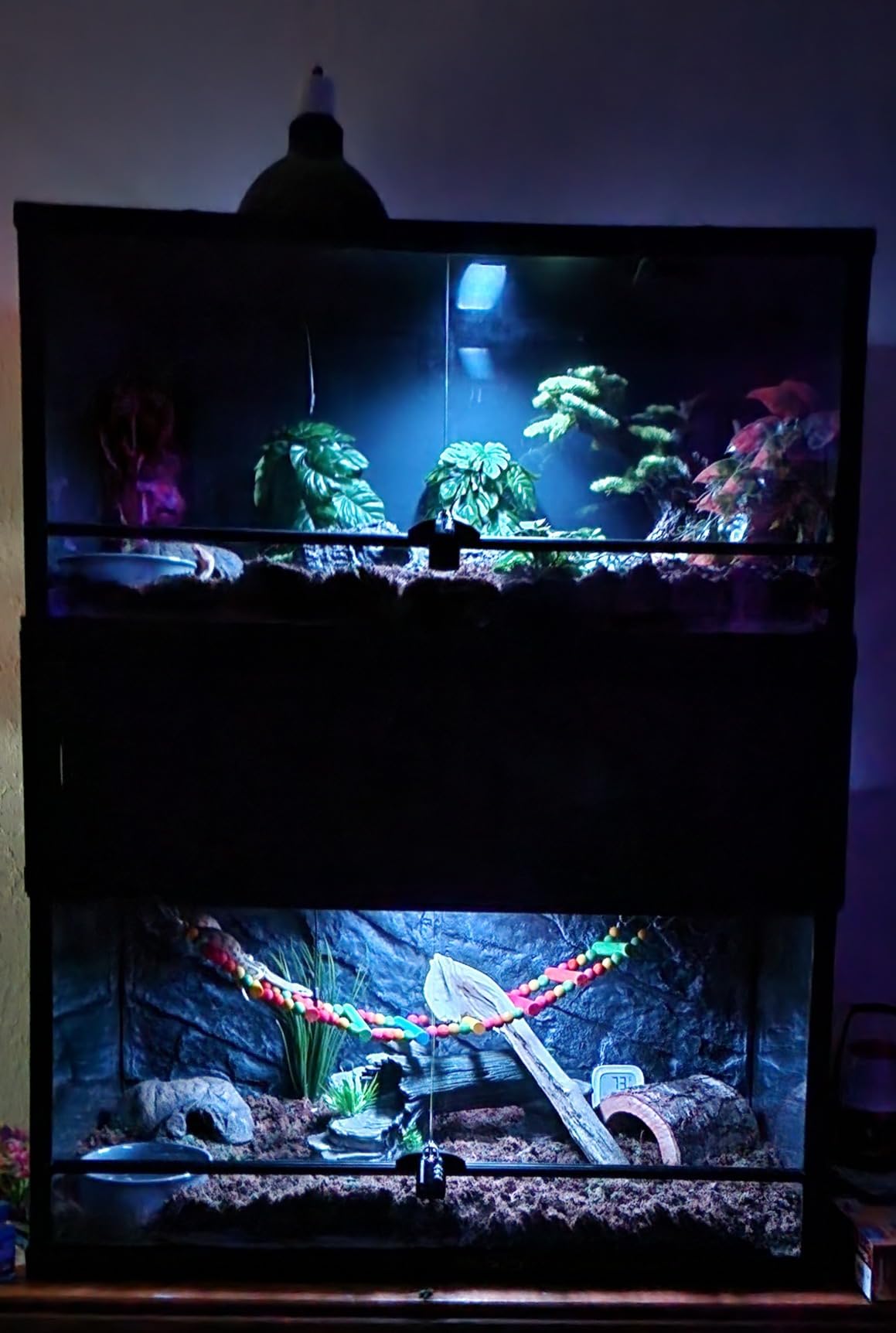
The memory function restores your setpoint after a power cut, which matters more than it sounds in a rack setup where a breaker trip resets everything. Buyers also note the wide 41°F to 140°F span is unusually generous for a dimmer in this class, covering both low-range tropical setpoints and high desert basking temperatures.
What to watch: this is a bulb controller, not a sunlamp controller. The manufacturer explicitly excludes mercury vapor bulbs and anything over 1500W. The probe also needs to sit at least 15cm away from the lamp or the sensor will chase its own heat rather than the air the animal is sitting in.
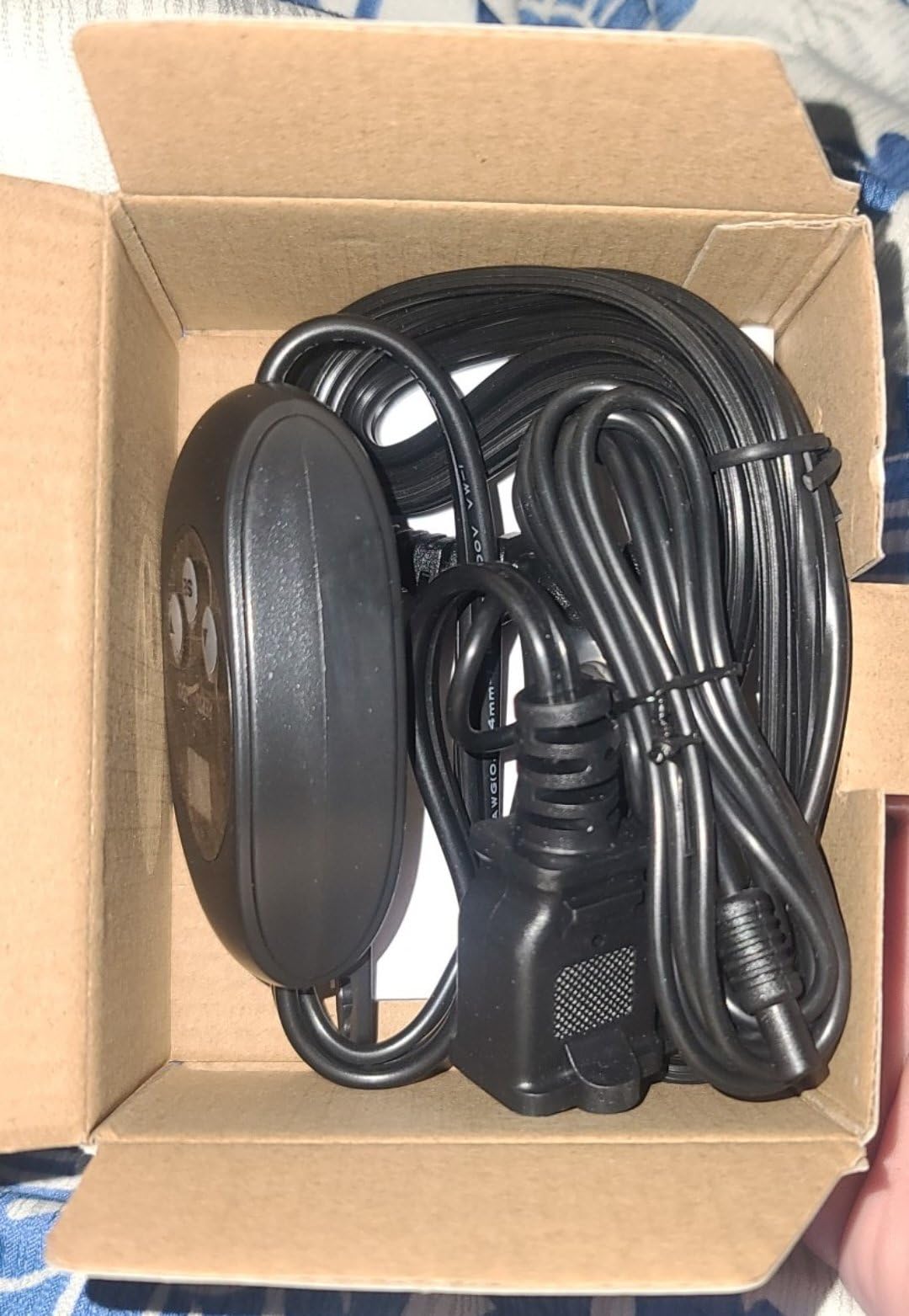
What makes the TC02 the safer lamp controller?
Dimming is the reason this unit behaves well with a visible bulb. Instead of slamming a 100W lamp on for ninety seconds and off for thirty, the controller walks the power down as the probe reads toward setpoint. You never see a full-power bulb fighting a warm rock, which is the exact failure mode behind most lamp burn-outs.
Owners on r/BeardedDragons frequently name the Reptizoo mini dimming thermostat as their go-to, and the same model turns up in leopard gecko and crested gecko threads. It is also among the few budget-priced controllers here with a stated one-year manufacturer warranty, which is longer than several competitors in this roundup.
Where it falls short for you?
If you run UVB tubes, a sunlamp, or a mercury vapor bulb, this is the wrong controller and the manual says so plainly. It is also a single-output device, so a day basking bulb and a night emitter need two separate pieces of hardware or a two-socket controller like the REPTITRIP SOP24 further down.
A 4.2 average is the lower end of the range in this roundup, and the recurring complaint is a display that blinks when the probe area never reaches the set temperature. That is usually a bulb that is too small for the enclosure rather than a faulty controller, but it looks alarming until you work it out.
2. REPTI ZOO RL04DTC Dome and Thermostat – Fixture and Controller in One Box
REPTI ZOO Reptile Light Fixture with Dimming Thermostat, 5.5 Inch Deep Dome Lamp Fixture with Temperature Controller for Reptile Heat Lamp Bulb, Max 100W
5.5 inch deep dome
Max 100W E26 bulb
68F-122F PID control
1600 lumen reflector
Pros
- Fixture and thermostat arrive as one set
- Aluminum reflector boosts UVA and UVB output
- Holds steady basking temperatures
- Available in 5.5 inch and 8.5 inch domes
Cons
- No dedicated power on/off switch
- Bulb not included
- Some owners report it stalls below a certain setpoint
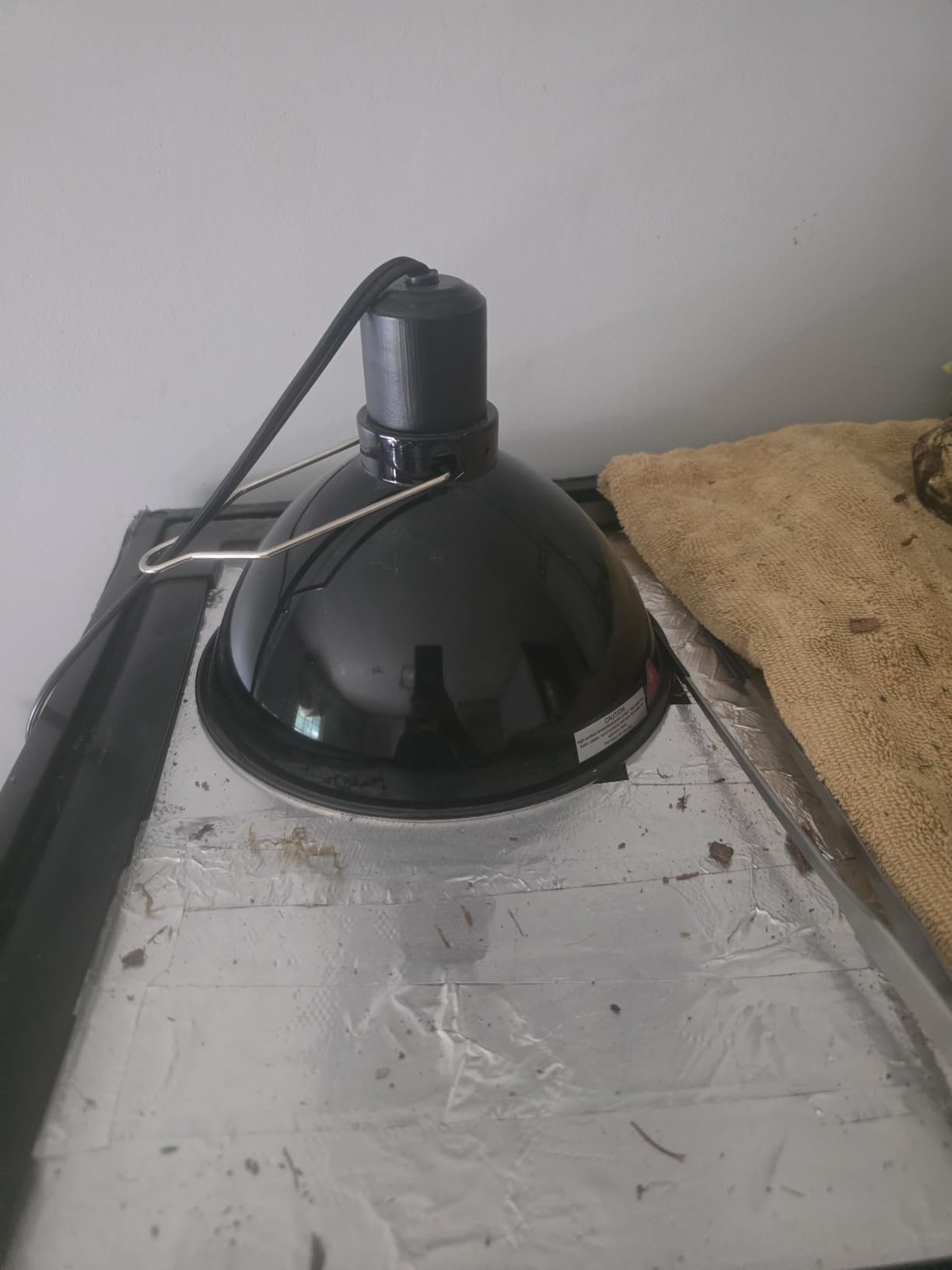
This is the pick for anyone starting from nothing. You get an ETL certified 5.5 inch deep dome aluminum reflector with a PID dimming thermostat built into the housing, so there is no separate controller to mount, no probe wire to route, and one plug instead of two.
Control range is 20°C to 50°C, or 68°F to 122°F, across an E26 ceramic lamp cap rated to a maximum 100W bulb. The high-finish aluminum reflector is designed to push more usable UVA and UVB through the dome, which matters if the basking bulb is doubling as your visible light source.
With 607 reviews at 4.3, this is the second most established option here, and reviewers consistently describe the temperature as steady day after day. The long-press SET button handles setpoint changes and the display switches between Celsius and Fahrenheit.
Ventilation holes in the top of the dome dump heat away from the ceramic socket, which is the detail that keeps a compact all-in-one housing from cooking itself during a long afternoon. The unit weighs about 0.51 kg, so a clamp or bracket holds it without drama.
Why the all-in-one format wins for a first enclosure?
Most of the wiring errors we hear about come from trying to mount a loose controller box on the back of a screen lid with the probe wire pinched. This unit removes that step entirely, which is why it shows up so often in first-time keeper setups for geckos, small snakes, and tortoises.
Reviewers also like that the same product family comes in 5.5 inch and 8.5 inch domes, so you can match reflector diameter to enclosure height instead of compromising on a too-small dome that scorches the basking surface.
Where it falls short for you?
The 100W bulb ceiling is the first limitation to check. A 150W halogen basking lamp will not fit, and that rules out a few of the larger desert setups. The thermostat also has no dedicated power switch, so cutting power means unplugging it at the wall.
There is also a small cluster of reports of units that will not climb past a particular setpoint regardless of bulb size. If the display blinks continuously and the probe reads well below your target, that is the symptom, and it points to a controller fault rather than a placement problem.
3. LUCKY HERP 8.5 Inch Dome with Dimming Thermostat and Timer – for Bigger Bulbs
LUCKY HERP Reptile Light Fixture with Dimming Thermostat & Timer, Aluminum 8.5inch Dome Reptile Lamp Fixture, Heat Lamp Fixture for Reptile Bulb Basking Heat Bulb
8.5 inch aluminum dome
Ceramic E26 head to 250W
68F-122F PID control
2/4/8/12H timer
Pros
- Highest bulb capacity of the dome combos
- Reflector thermostat and timer in one unit
- Aluminum dome improves heating efficiency
- Vented top prevents overheating
Cons
- Timer limited to fixed preset steps
- Button setup sequence takes practice
- No cooling function
The LUCKY HERP 8.5 inch dome answers the one question the smaller dome fixtures cannot: what happens when you need a 150W or 200W basking bulb. The ceramic E26 lamp head here is rated to 250W, which is more than double the ceiling on the 5.5 inch combos in this roundup.
Temperature control runs through PID dimming across 20°C to 50°C, and the aluminum reflective dome is vented at the top to move heat away from the socket. The 8.5 inch diameter also spreads the basking heat over a wider surface, which is what you want in a tall desert enclosure where a small dome would create one dangerously hot spot.
What separates it from the other dome units is the timer. Presets run in 2H, 4H, 8H, and 12H steps, and the timer restarts at its setting once power returns. It is not a programmable clock, but it covers most photoperiod needs without a second device.
How the 250W ceiling changes your bulb choice?
Load headroom matters more than most buyers expect. Running a 200W halogen on a controller rated for exactly 200W leaves no margin for inrush current at cold start, and a controller working at its limit runs its own internals hot. The 250W figure gives you room to run a large bulb without living at the edge.
Because the ceramic socket tolerates high heat and the dome is vented, this is also a reasonable fixture for a ceramic heat emitter used as a night source, which many ball python and corn snake keepers do instead of running a visible bulb overnight.
Where it falls short for you?
The fixed-step timer is the real limitation. A 10H day and 14H night photoperiod, or any schedule that does not land on a multiple of two hours, needs a different controller. The button combination for setting mode also takes a few attempts, so budget a few minutes on first setup.
At a 4.2 average across 309 reviews, satisfaction is solid but not glowing, and the specification makes no mention of cooling output, so this is a heating-only device. If your enclosure runs warm in summer you will need a fan on a separate controller.
4. REPTITRIP SOP24 Day and Night Timer Thermostat – Two Sockets, One Wall Outlet
REPTITRIP Reptile Thermostat, Light Timer for Temperature and Lighting Control, Day-Night Timer Thermostat with Reptile Thermometer for UVB Light, Heat Lamp, Heating Pad, 10A 1250w
Two independent sockets
1250W maximum load
32F-140F day/night
Replaceable probe
Pros
- Runs a light on a timer and a heater on temperature
- Three timing programs for the light socket
- Handles a 1250W load
- Replaceable probe with fast refresh
Cons
- Heating socket switches rather than dims
- Programming is more involved than set-and-go
- No cooling function
The SOP24 solves a problem most enclosures have: two devices competing for one wall outlet. Socket S1 runs your UVB tube or basking light on one of three timing programs, and socket S2 independently controls a heat source by temperature, all from a single 15 inch corded unit.
Load handling is the standout number. A 1250W maximum on a 10A cable rating sits far above every dimming controller in this roundup, most of which top out between 200W and 300W. That headroom means you could run a heavier halogen or several emitters from the temperature-controlled socket without approaching the limit.
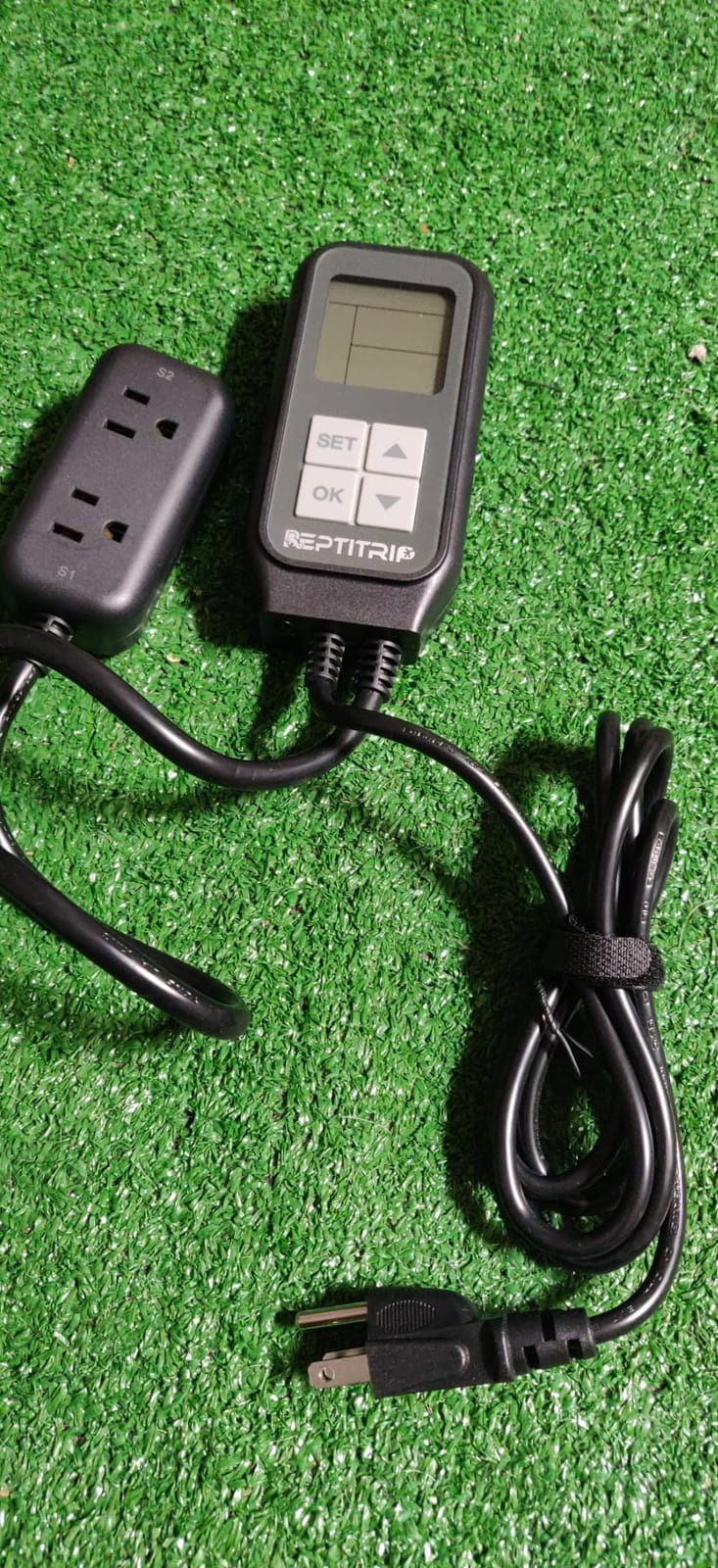
The temperature range is unusually wide at 32°F to 140°F, and the unit supports a day and night temperature program so the animal gets a photoperiod-linked thermal cycle rather than one flat setpoint around the clock. Sensor accuracy is listed at ±2°F with a 500ms refresh rate, which is responsive for a relay-based controller.
The replaceable probe is worth noting on its own. A probe that cannot be replaced is a reason to throw away an otherwise working controller, and reviewers treat this as a genuine advantage over cheaper units.
What the two-socket layout is genuinely good for?
A day basking lamp and an overnight emitter is the standard nocturnal setup, and running both from one controller means one display and one setpoint group instead of two boxes fighting for the same outlet. The lighting socket timing out on schedule also means your visible light is off overnight without a second timer.
This is also the pick for a quarantine or grow-out enclosure where you want a light cycle and independent heat without investing in a programmable unit. The three timing programs give you enough flexibility for most juvenile setups.
Where it falls short for you?
Socket S2 is on/off, not dimming, and that is the whole caveat. For a ceramic heat emitter or a heat mat that is genuinely fine, but on a visible basking bulb you will see the lamp switch hard and you lose the bulb-life and short-cycling benefits that made the earlier picks worth the money.
Programming takes more steps than a single-setpoint controller, and the unit is heating only, so it cannot run a cooling fan. If your basking bulb is your main light source and you care about bulb longevity, this is not the one to buy.
5. CAVACHEW JTC02 Dimming Thermostat – Real Dimming Control on a Tight Budget
CAVACHEW Dimming Thermostat Reptile, Thermostat for Reptile Heat Lamp Mats Bulbs, PID Temperature Controller for Reptile Amphibian Habistat, Memory Function, LED Digital Screen, Sensitive Probe, 300W
PID dimming mode
300W maximum load
68F-122F control range
110V and 240V input
Pros
- Dimming output is much gentler than on/off cycling
- Memory restores settings after a power cut
- Compact body suits a small enclosure
- Sensitive probe holds steady temperatures
Cons
- No built-in timer function
- Some units flicker or fail after a few weeks
- One report of the housing overheating
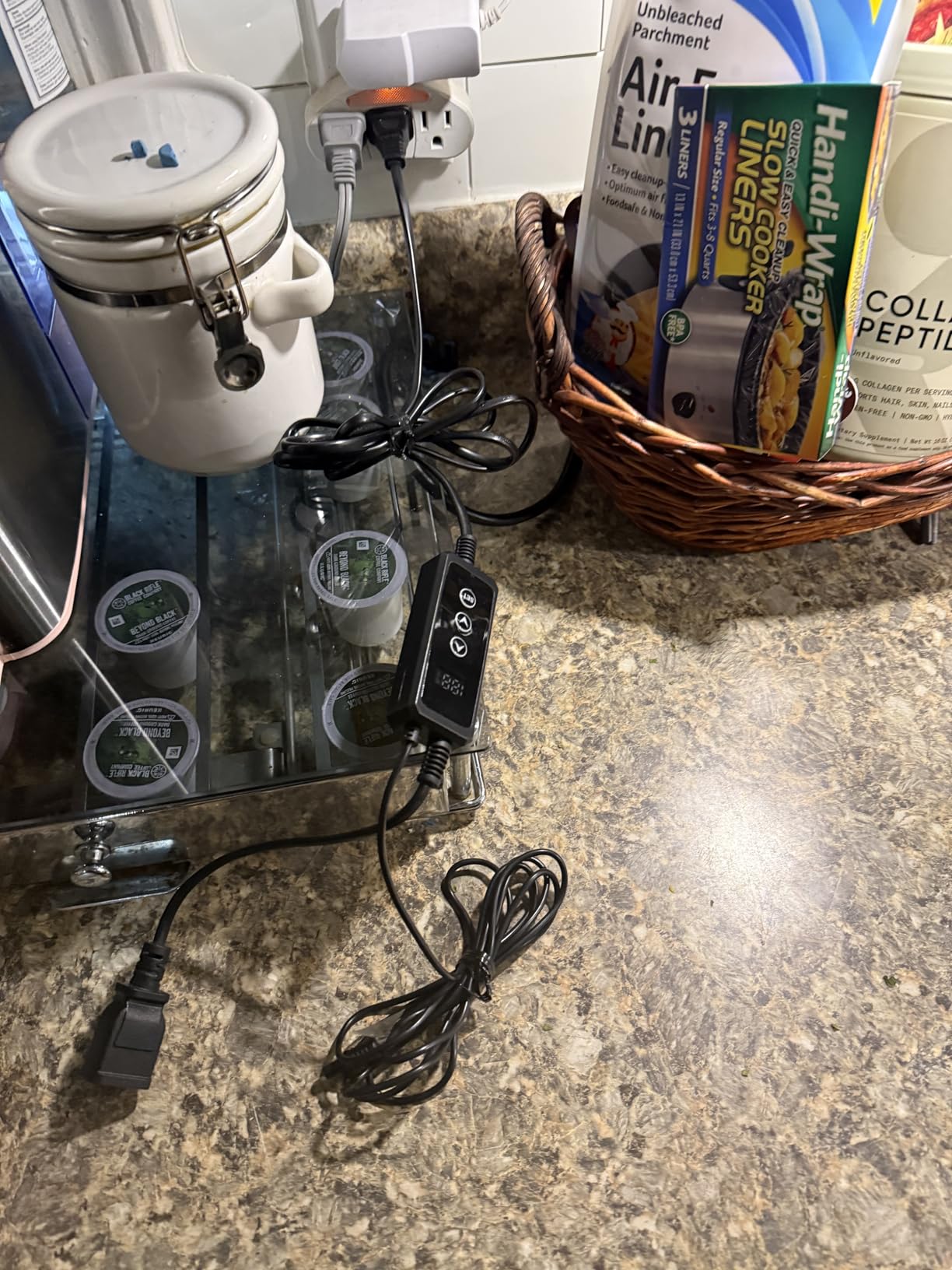
The JTC02 answers a straightforward question: how do you get real dimming control rather than on/off switching without moving up to a premium programmable controller. At 300W and PID dimming across 68°F to 122°F, the specification is nearly identical to units several times more expensive.
Input voltage runs from 110V to 240V, which is unusual in this category and means the unit travels well if you move between regions. The body is small at roughly 0.8 by 1.4 by 3.6 inches, so it mounts easily to the outside of a small terrarium without a bracket.
Reviewers consistently praise two things: the memory function, which restores your setpoint after a power cut or a wall-timer cutoff, and how steady the basking temperature stays once the probe is placed properly. A 4.3 average from 190 reviews backs that up.
Why dimming matters more than any other feature here?
A cheap on/off controller running a visible bulb is the setup that generates the most forum complaints about lamps switching every few minutes. Visible switching is stressful for the animal, hard on the filament and socket, and the reason bulb burn-outs cluster in enclosures controlled that way.
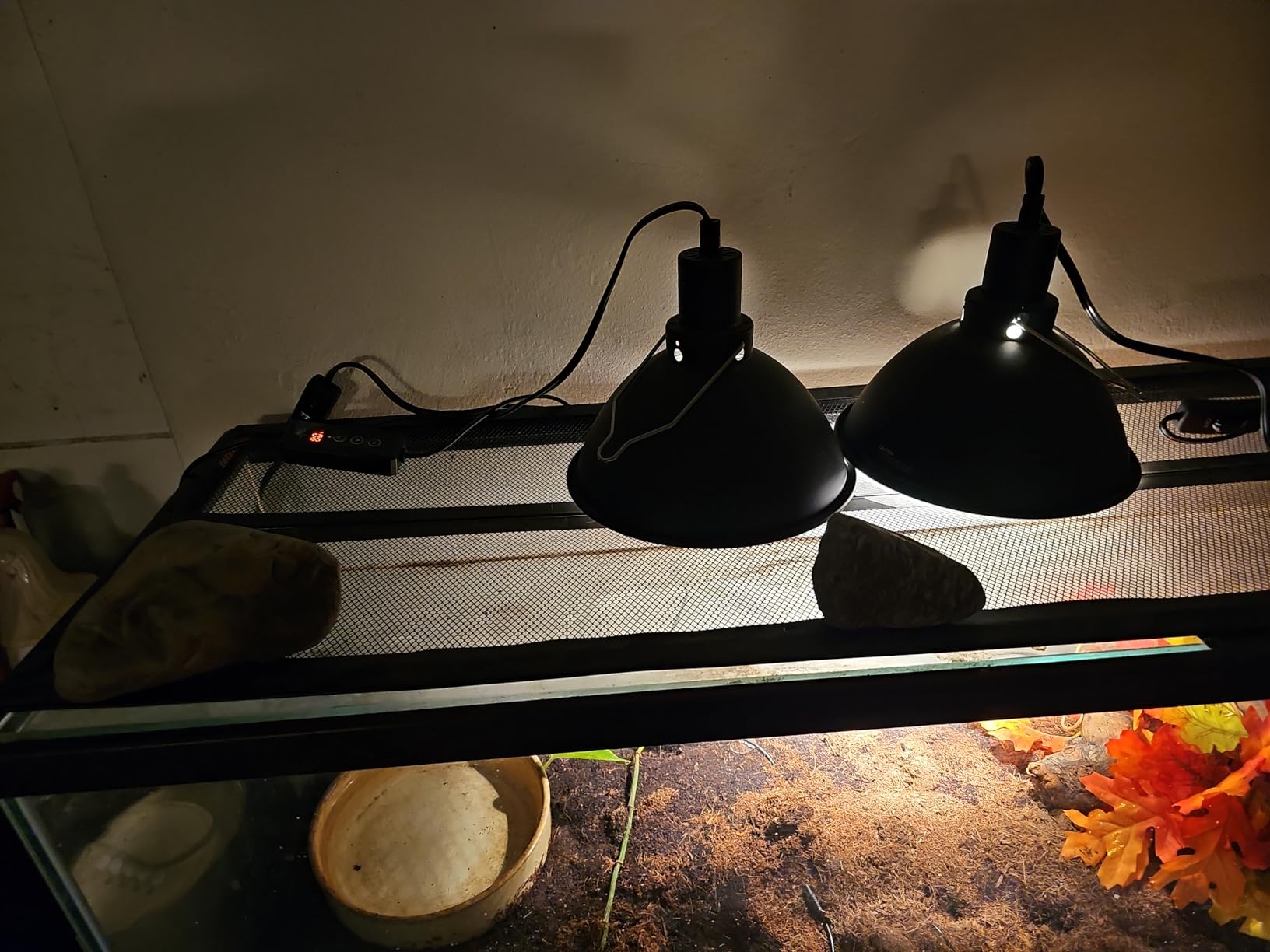
Dimming removes the switching entirely. The lamp never goes fully dark once the setpoint is approached, so the animal sees a stable basking surface, and the filament spends less time at the shock of a cold start. Several keepers on r/leopardgeckos describe this transition as the moment their setups stopped giving them trouble.
Where it falls short for you?
There is no timer. If your setup needs a scheduled photoperiod or a day and night split on a single device, you need to add a separate timer for the light circuit. Some units also ship with a Celsius-only display, which is frustrating for Fahrenheit users and needs manual conversion.
The durability reports sit behind a solid 4.3 average, and they are the reason to mount this one carefully. A handful of buyers report units flickering or failing within a few weeks, and one serious report describes the controller housing overheating in a poorly ventilated enclosure. Mount it outside the enclosure where air can move around it, and do not bury it behind wet substrate or a tight cabinet.
6. REPTITRIP PT02 Dimming Thermostat with 1-24H Timer – the Clearest Readout
Reptile Thermostat, Dimming Thermostat with 1-24H Timer Setting
1-24 hour timer
260W maximum load
50F-140F range
Output power display
Pros
- Combines a timer with PID dimming
- Screen shows live output power
- Backlight shuts off after 20 seconds
- Smooth dimming with accurate holding
Cons
- Not usable with UVB
- LED or sun lamps
- Probe area must be able to reach setpoint
- Two month manufacturer warranty
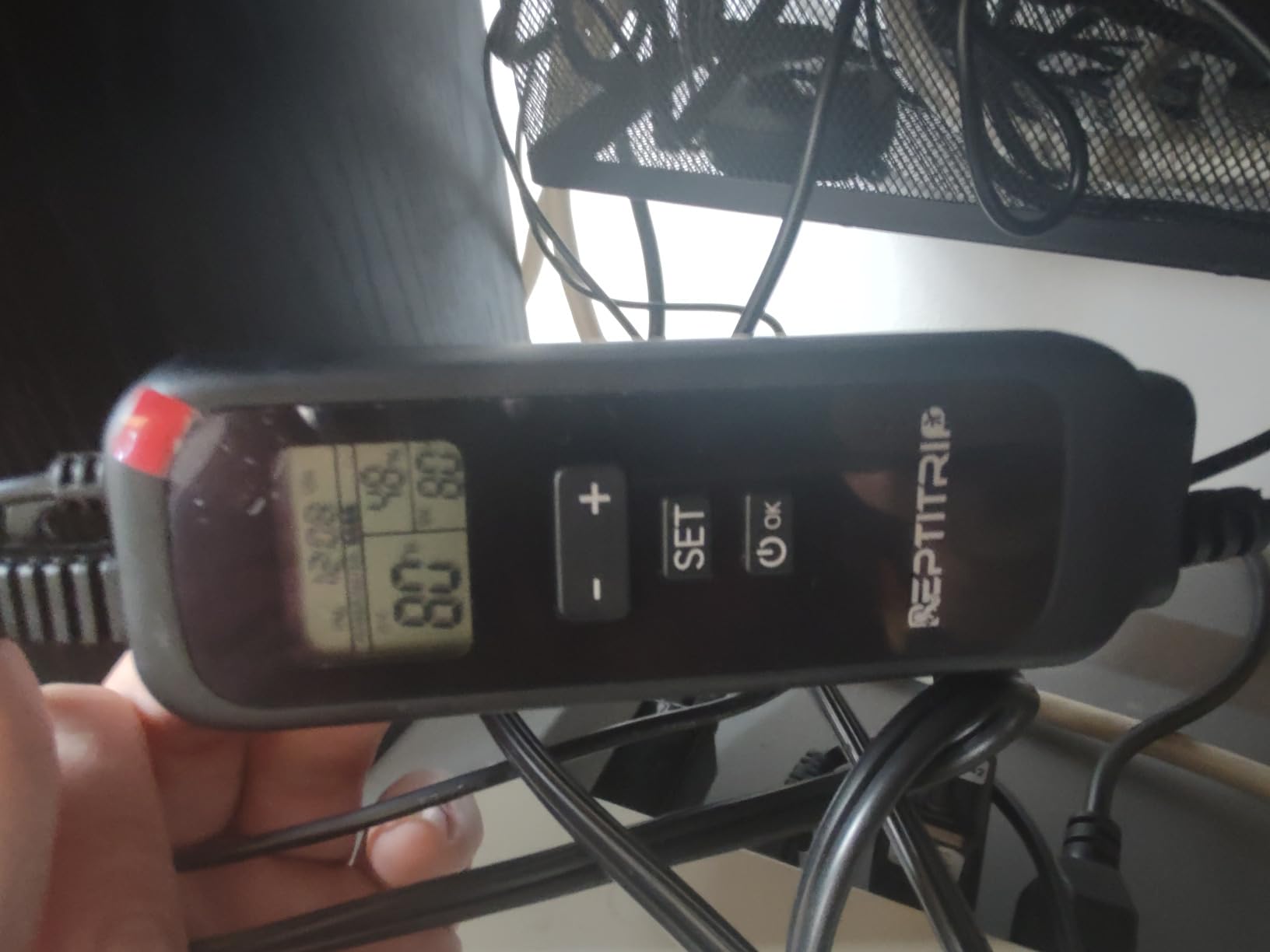
The PT02 is the one I recommend to anyone who keeps checking the enclosure with an infrared thermometer and wondering whether the controller is working hard or barely running. Its LCD shows real-time output power alongside ambient temperature, so you can see exactly how hard the lamp is being driven as the enclosure settles.
That readout also solves the most common early confusion. A bulb that reads 40% output when you expected 90% usually means the enclosure is too large or too tall for that wattage, not that the controller is faulty. Without the power figure you would be guessing.
Control range is 50°F to 140°F with a 260W maximum load, and the 1-24 hour timer handles scheduled heating cycles in single-hour steps, which is finer grained than the fixed presets on the dome fixtures above. Input is 120 volts.
The backlight detail that nocturnal keepers notice
The LCD backlight turns itself off after 20 seconds. For a nocturnal species this is not cosmetic, because a controller screen glowing inside the enclosure all night is a light source the animal cannot ignore and that disrupts the day and night rhythm you are trying to protect.
The same unit family is available in a day and night temperature variant if you would rather have two setpoints than a timer. Reviewers like that the screen shows both the ambient reading and the set value at a glance, which makes probe placement troubleshooting far faster.
Where it falls short for you?
This is a heating controller only. The specification explicitly excludes UVB fixtures, LED lighting, and sun lamps, so you still need a separate timer for the lighting circuit. It is also incompatible with anything expecting more than 260W, which covers most single halogen bulbs but not a 300W fixture.
The warranty is two months, the shortest we saw, which is worth weighing against the 4.4 average from 168 reviews. Buyers also stress that if the probe area never reaches set temperature you need a higher wattage bulb, and the display blinking is the symptom rather than a fault.
7. ReptiKing X100 Dimming Thermostat – Small Enclosures and Modest Bulbs
ReptiKing Reptile Dimming Thermostat, Heat Lamp Temperature Controller, Reptile Terrarium PID Digital Thermostat, Heating Controller for Basking Spot Heat Bulbs and Ceramic Heat Emitter
PID dimming control
200W maximum load
68F-122F set range
UL certified cord
Pros
- Stable dimming without temperature swings
- Suction cup mount makes probe positioning simple
- UL certified power cord
- Manufacturer claims up to 45% less energy use
Cons
- 200W ceiling is the lowest of the dimming units
- Not for mercury vapor sun lamps or UVB bulbs
- Set range is narrower than several rivals
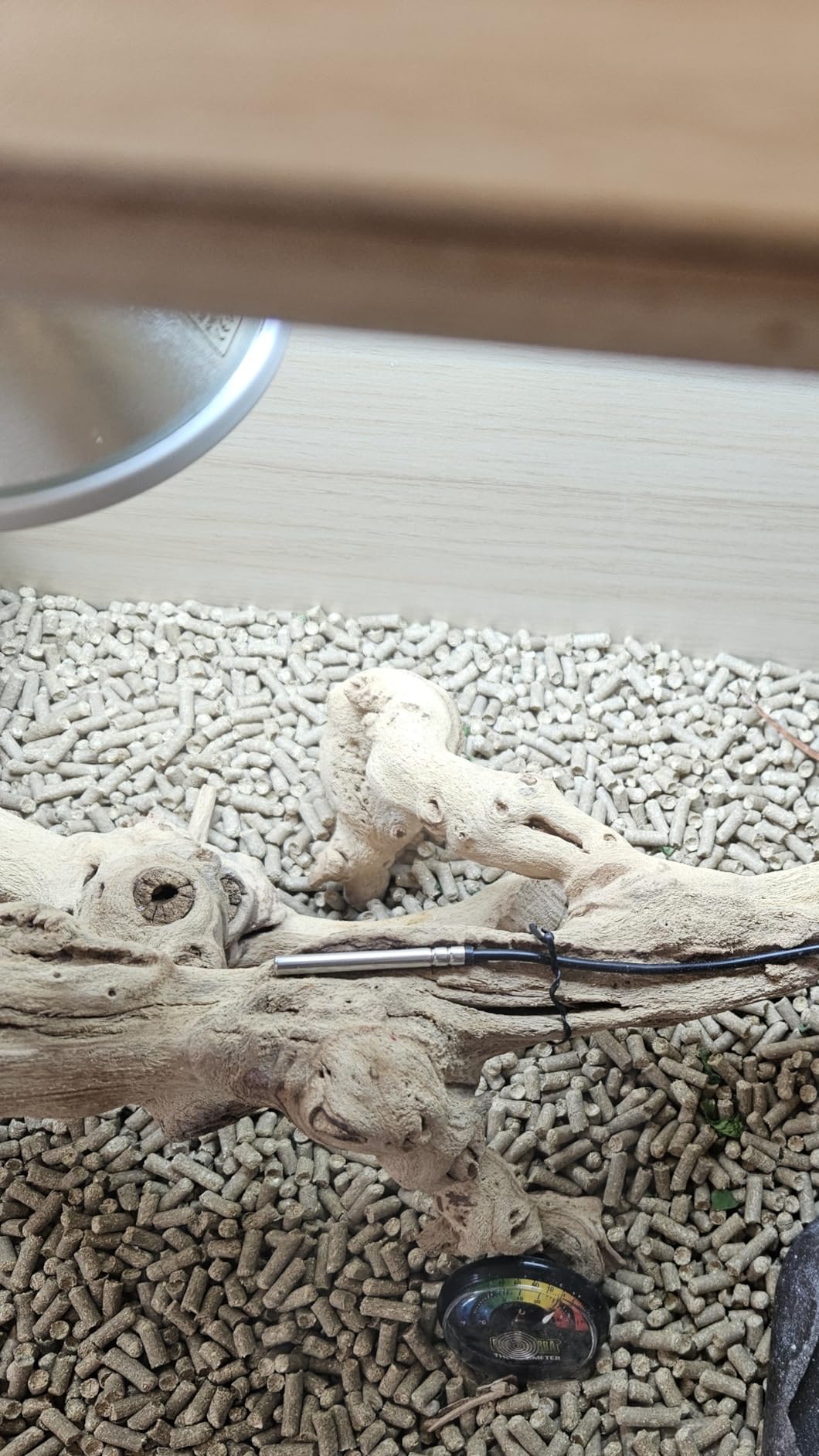
The X100 targets a specific job: a leopard gecko, crested gecko, or juvenile setup where the enclosure is small enough that a 40W to 80W basking bulb is the right call. The suction cup probe mount is the detail that stands out, because affixing the probe at animal level without tape or cable ties is the single hardest part of installing any of these.
Control range is 68°F to 122°F and maximum load is 200W, with a UL certified cord rated for 100-120V at 60Hz. The manufacturer states that PID control extends lamp life by up to 45 percent compared with on/off cycling, which is consistent with how the other dimmers here are described.
At a 4.3 average from 126 reviews, satisfaction is steady rather than glowing, with owners citing straightforward setup and stable holding once the probe is placed. The unit weighs about 0.24 kg, which is light for a clamped or mounted installation.
Why a suction cup mount changes the installation?
Probe placement is where most thermostats fail in practice, not in the specification. A probe taped to the glass reads the enclosure wall, a probe resting on the lamp reads the bulb, and a probe buried in substrate reads the substrate. None of those readings describe the temperature the animal experiences.
A suction cup lets you place the probe at animal level on a branch, a hide wall, or the side of the enclosure and move it when you rearrange the setup. It is a small feature that makes the difference between a controller that measures correctly and one you constantly re-calibrate.
Where it falls short for you?
The 200W ceiling is the lowest among the dimming controllers here, and the specification lists no higher figure, so there is no headroom above it. A 150W halogen on a large adult enclosure is not a combination this unit can serve.
Mercury vapor sun lamps and UVB bulbs are excluded, so if you need to control a high-output UVB lamp you are looking at a different product entirely. The 68°F to 122°F set range is also narrower than the 41°F to 140°F span on the REPTIZOO TC02, which matters for very high desert targets.
8. REPTITRIP DM01 Knob Dimmer Pair – When You Only Need Manual Output Control
2Pcs Reptile Dimming Thermostat for Temperature Control, Dimmer Switches for Heating Pad & Heat Lamp, Reptile Knob Dimmer 200W MAX
Knob adjusted dimming
200W maximum load
Two pack
No probe or PID control
Pros
- Dead simple single knob operation
- Useful for trimming an overly hot basking spot
- Owners report years of service
- Also works as a general dimmer switch
Cons
- Manual only
- no probe and no automatic control
- 200W maximum load
- Not usable with T5
- fluorescent
- LED or sun lamps
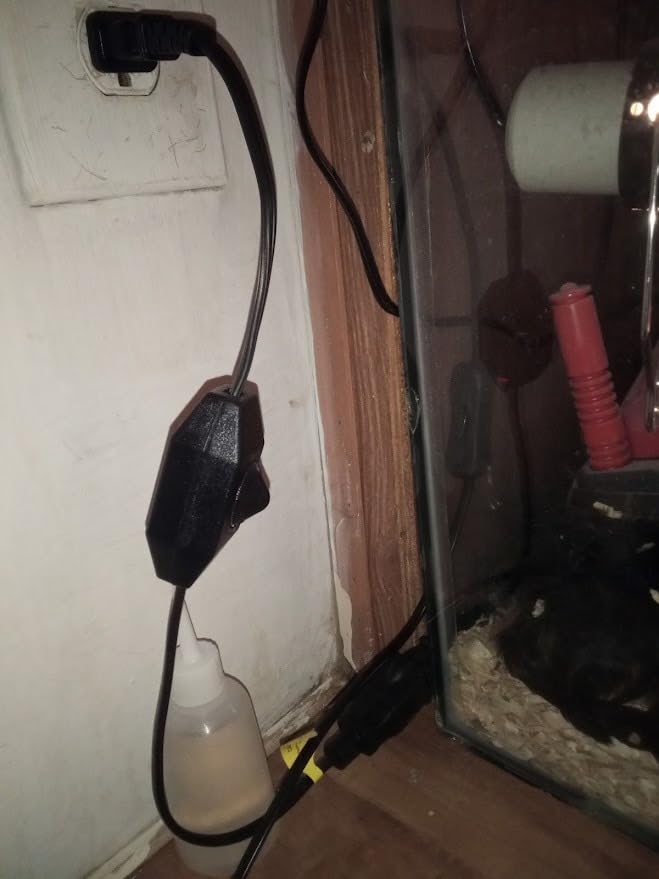
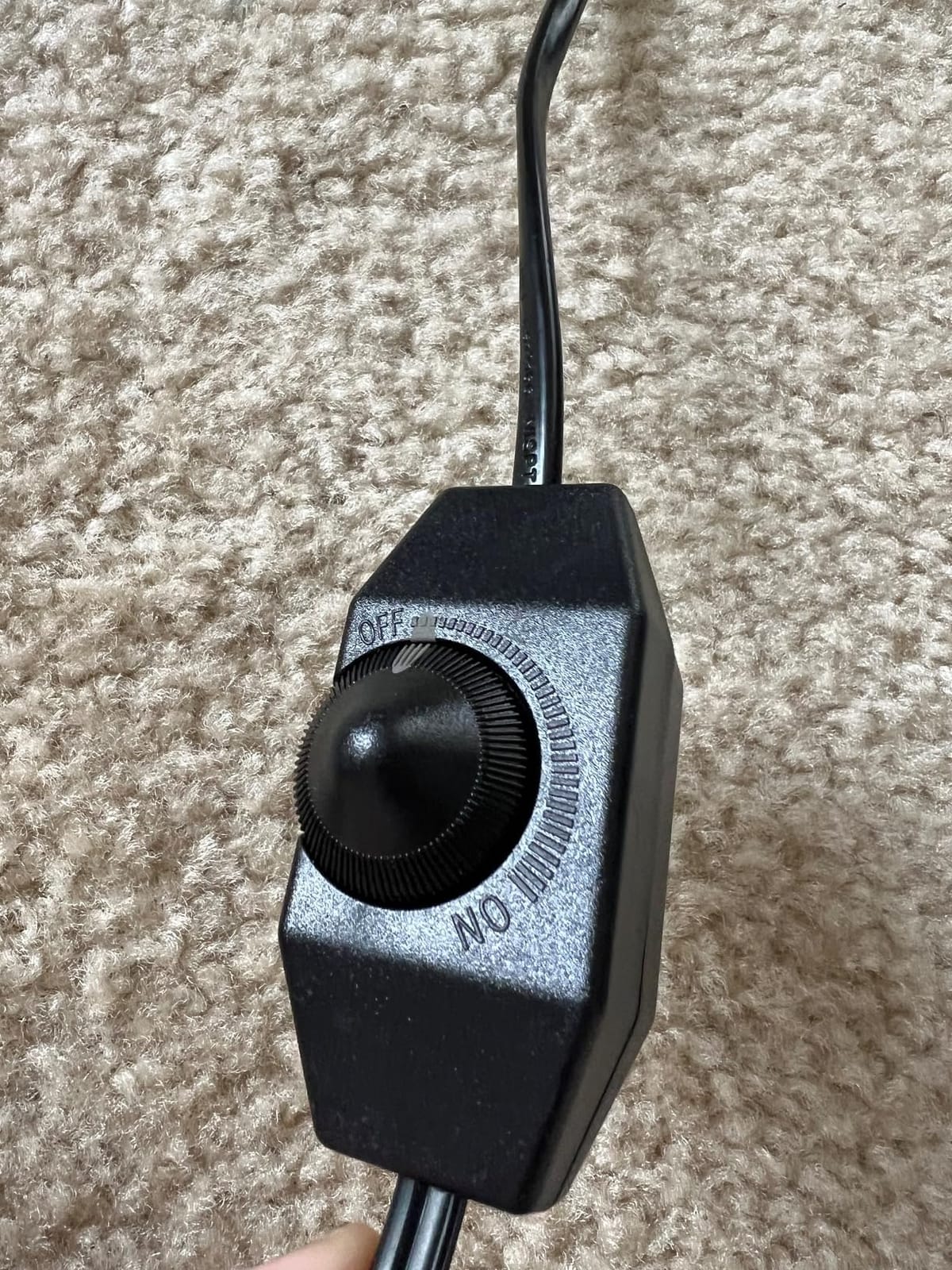
Let us be direct about what this is: the DM01 is not a thermostat. There is no probe, no temperature reading, and no automatic regulation. It is a rotary dimmer that reduces power to a lamp or a heating pad by whatever amount your hand sets, and you adjust it by checking the enclosure with an infrared thermometer.
That said, it solves a genuine problem. If your basking surface runs too hot and the lamp cycles on and off wildly, dialing the output down a notch with a dimmer is often the fastest fix in the enclosure. It also works on a heating pad that is cooking a mat thermostat’s probe.
The knob adjusts output smoothly up to a 200W maximum, and you get two in a pack, which is useful if you run a day lamp and a night emitter from two separate dimmers. Owners describe them as lasting years, and at 4.5 from 112 reviews the satisfaction among people who bought them for the right job is high.
When a manual dimmer beats a thermostat?
There are situations where a thermostat is the wrong tool. A bare incandescent bulb in an oversized dome may scorch a surface long before the air temperature reads high, and a dimmer lets you cut the output without waiting for a probe to react.
It is also the right answer as a temporary measure while you wait for a better controller, and as a tool for trimming a heat mat output that your thermostat’s probe is reading too close to. Several keepers mention using a dimmer to tame a mat before committing to a proper probe-based unit.
Where it falls short for you?
If your animal’s safety depends on the temperature being right while you are asleep or away, a manual knob is a liability. Nothing corrects for a room temperature drop overnight, a shifted probe, or a bulb that ages and changes output. That is the entire reason a thermostat exists.
The 200W limit applies, and T5, fluorescent, LED, and sun lamps are all excluded. One order also arrived with only one controller despite being sold as a pair, so check the package on arrival.
9. LUCKY HERP 300W Dimming Thermostat – Readable Fault Codes When Something Fails
LUCKY HERP Reptile Dimming Thermostat, PID Heat Lamp Temperature Controller with LED Digital Screen for Reptile Heat Lamp Heat Mat & Heaters, Support ℉/℃, Memory Function
PID dimming mode
300W with 18AWG wiring
68F-122F range
LL and HH fault codes
Pros
- PID dimming prevents temperature swings
- Power-off memory restores settings
- 300W capacity with heavier gauge wiring
- Clear fault indicators for troubleshooting
Cons
- Widest rating spread of the dimming units
- No built-in timer function
- Button setup takes a few presses to learn
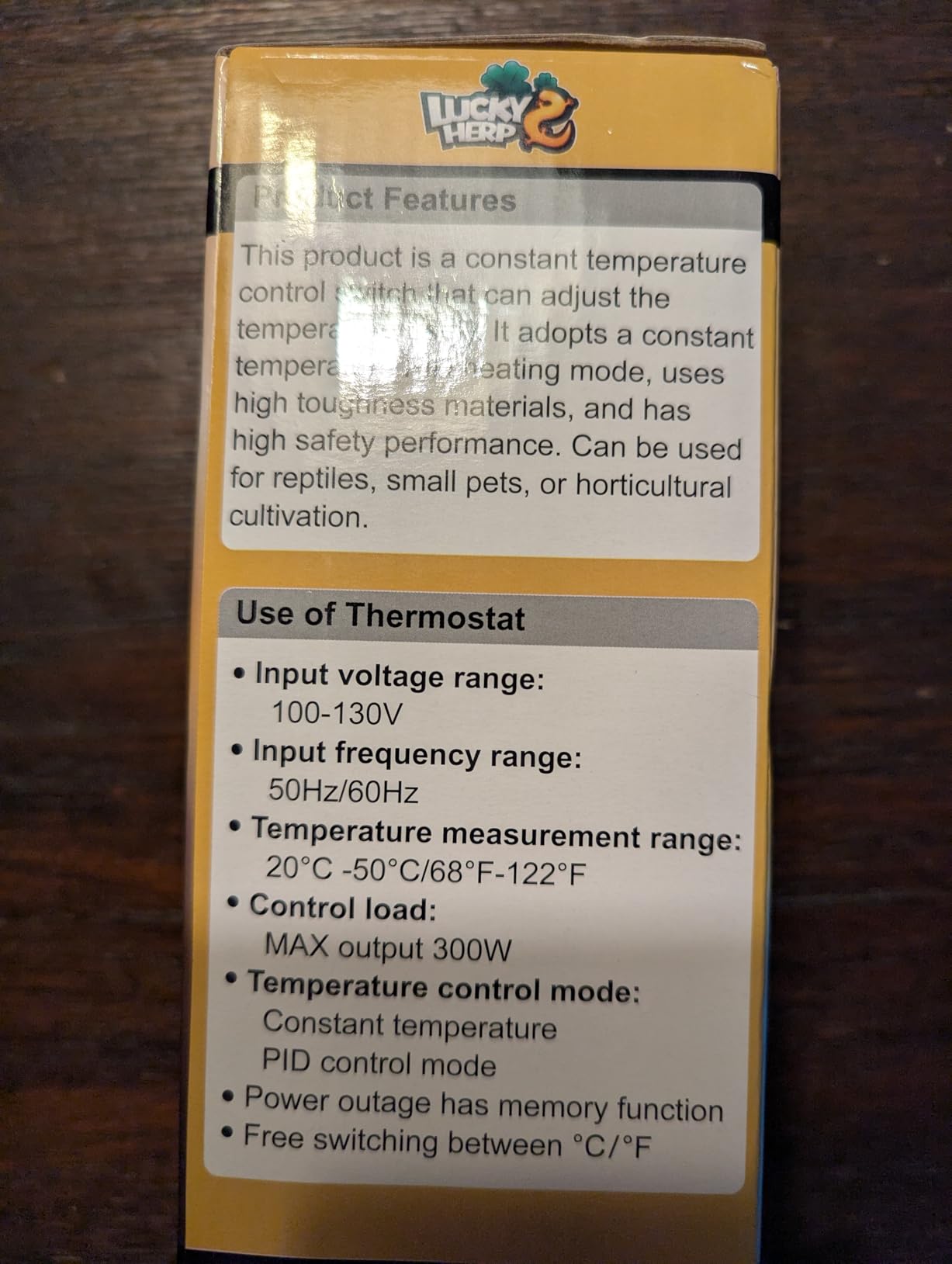
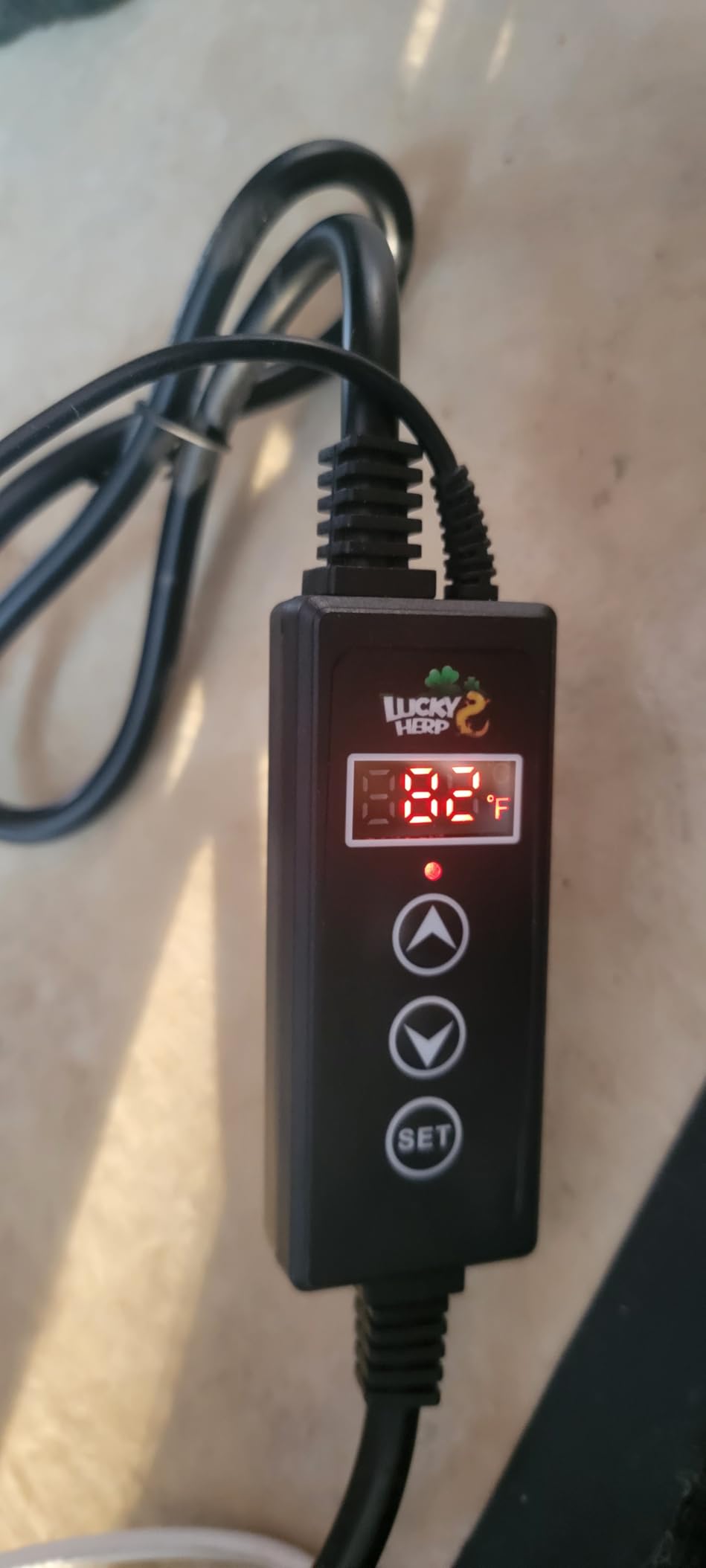
What sets this unit apart is diagnostics. The display shows LL when the probe reads below 0°C and HH above 60°C, and it flashes a warning when the enclosure temperature falls below your setpoint. For a controller at this level that is unusual, and it turns an ambiguous blank screen into something you can act on.
Underneath it is a conventional PID dimming controller rated to 300W with 18AWG wiring for current carrying and heat dissipation, operating across 68°F to 122°F with a switchable Celsius and Fahrenheit display. Power-off memory restores the last set temperature after an outage.
At 4.2 from 100 reviews, this carries the widest spread between one and five stars in the roundup, which tells you build or batch consistency varies. Buyers who received a good unit describe stable holding and no visible cycling, so the experience is genuinely variable.
Why fault codes matter more than they sound?
The most common thermostat complaint in keeper forums is a display that will not come on, followed immediately by a guess about which part failed. An LL or HH indicator tells you the difference between a dead controller and a probe that has separated, cracked, or been chewed, and that saves a lot of blind troubleshooting.
The low-temperature warning flash is the other useful part. If the enclosure drops below setpoint overnight because a bulb burned out, you get told on the display rather than finding a cold animal the next morning.
Where it falls short for you?
There is no timer, so the light circuit needs separate scheduling. The 68°F to 122°F range will not cover the very low setpoints a tropical enclosure might briefly need, and the 4.2 average with a wide star spread means you may need to confirm early operation carefully rather than assuming.
Setup is button driven and takes several presses to learn, which is a small tax paid in exchange for the fault codes. Mount it outside the enclosure where heat can dissipate rather than behind the back wall of a closed cabinet.
10. ReptiKing K9551T Dome and Thermostat – Runs a Ceramic Emitter or a Bulb
Reptile Heat Lamp Fixture with Dimming Thermostat – 5.5” Light Dome with PID Thermostat, for Ceramic Heat Emitter & Basking Light Bulb, for Bearded Dragon, Snake, Tortoise, Lizard Tank Accessories
5.5 inch dome with dimmer
150W maximum
1600 lumens
Adjustable clamp mount
Pros
- Highest average rating in this roundup
- Handles ceramic emitters and basking bulbs alike
- Ceramic socket and metal dome resist heat
- Adjustable clamp secures it above a tank
Cons
- Bulb rating is the lowest of the dome combos
- Dial control is less precise than a digital display
- Not intended for sun lamps
The K9551T is the highest rated unit we tested at 4.6, and the reason is that it does not force a choice. The same fixture accepts a basking bulb during the day and a ceramic heat emitter at night, so you get visible light when you want it and infrared-only heat when you do not, from a single clamped dome.
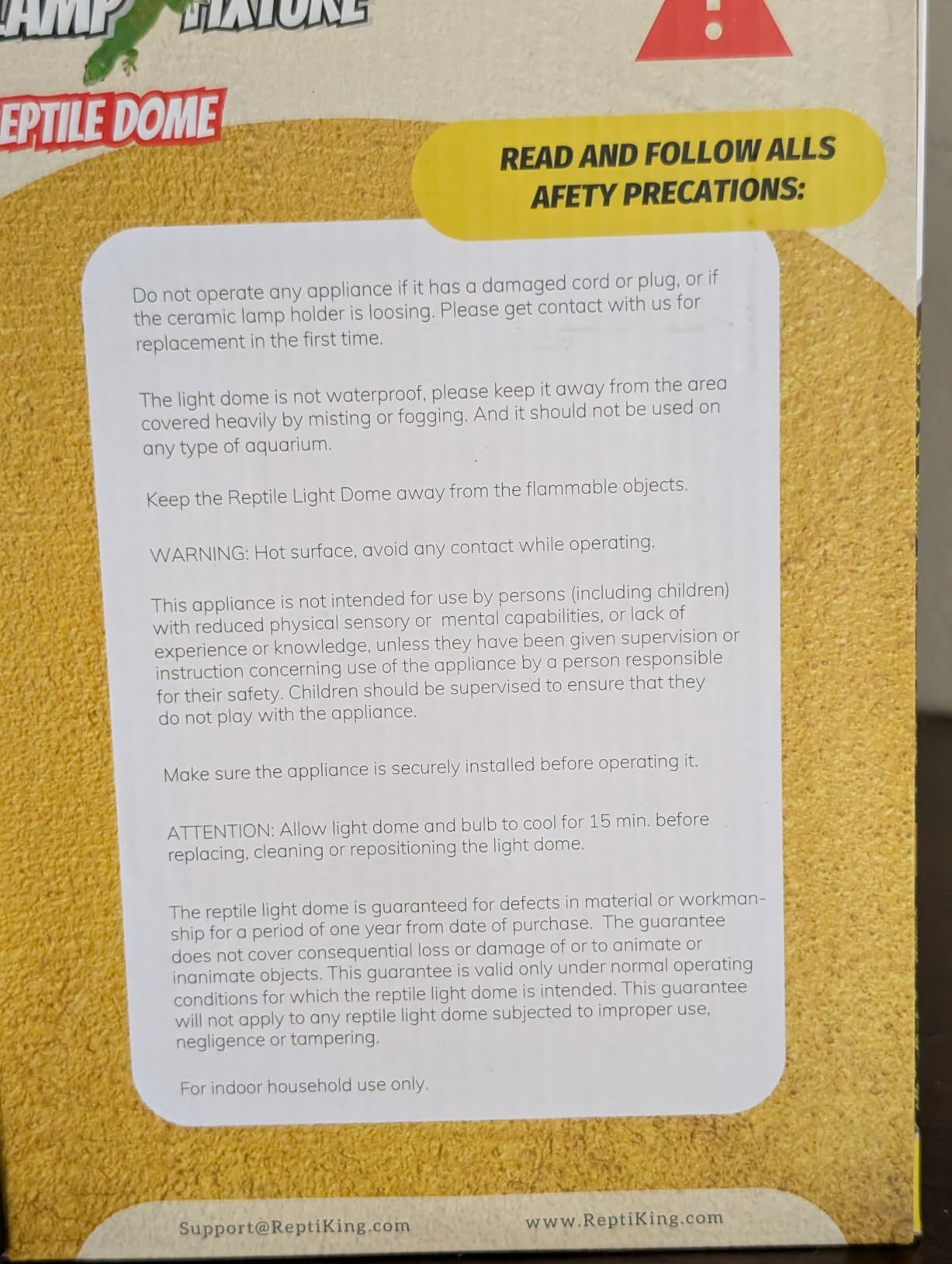
It is a 5.5 inch deep dome rated to 150W with a 62 inch cord, built around a heat-resistant ceramic socket and metal reflector, and it produces 1600 lumens when a bulb is fitted. The adjustable clamp mounts it to a tank rim, table, or cage rather than relying on suction or tape.
Because the emitter option runs without visible light, this is a genuine solution for nocturnal species. Tortoise forum keepers discussing dimmer and ceramic heat emitter combinations consistently rate this style of fixture well for exactly that reason.
Why running an emitter instead of a bulb overnight works better?
A visible bulb that runs all night gives the animal light it does not need during its dark period, which disrupts the day and night cycle that so many reptiles depend on. A ceramic heat emitter produces the same infrared warmth with no visible output, so the animal stays dark and warm at the same time.
Dimming matters more here rather than less, because emitters also benefit from steady power rather than hard switching. Dial-based dimming on this unit is coarser than a digital PID display, so expect to tune it once with an infrared thermometer rather than to change setpoints frequently.
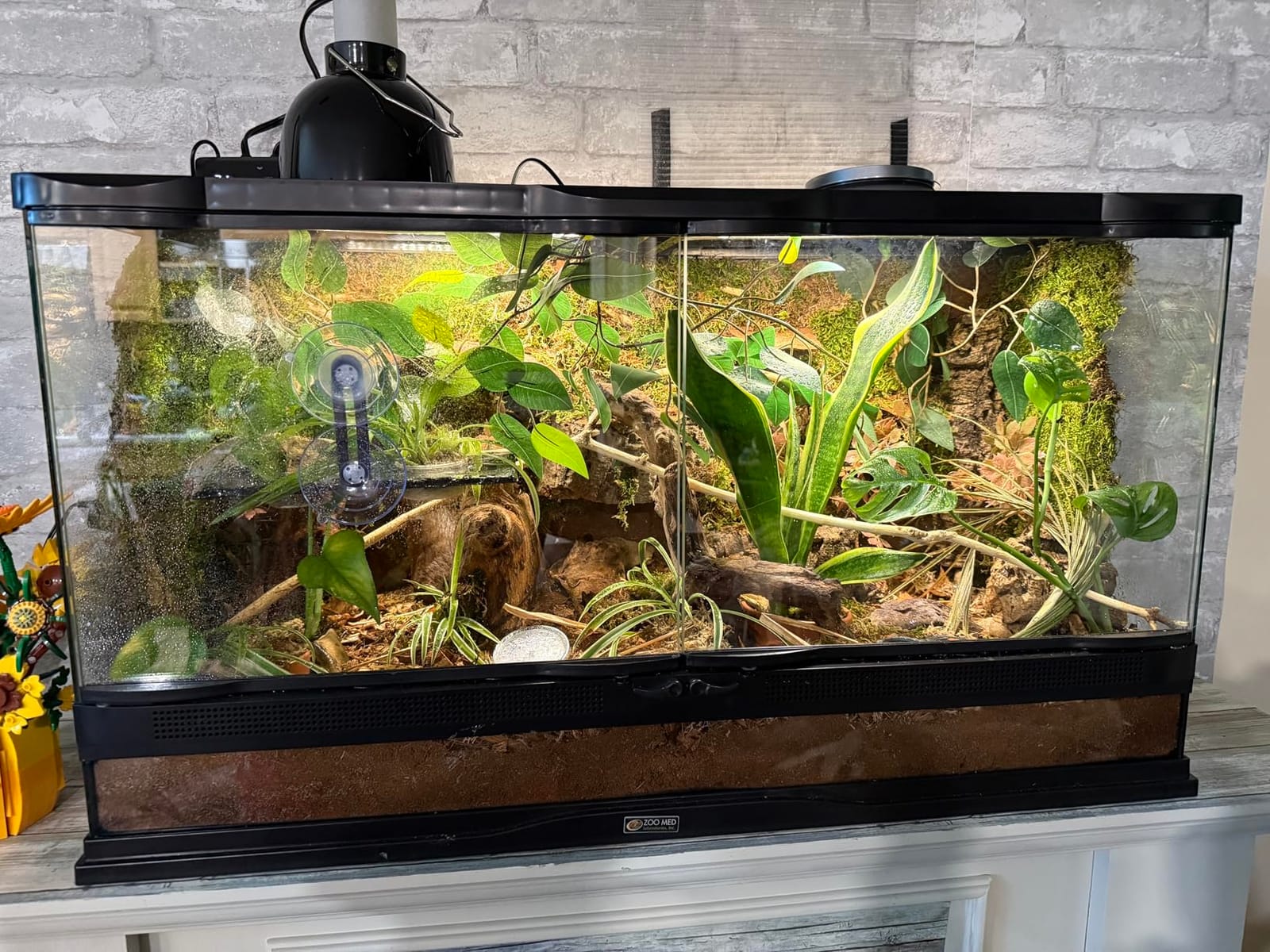
Where it falls short for you?
The listed wattage is 100W, the lowest of the fixture-plus-thermostat combinations here, with a 150W ceiling. That is fine for a 75W to 100W basking bulb but rules out the 150W halogens common in large bearded dragon setups.
The dial is analog rather than a digital PID screen, so you will not see a live output percentage and setup is less precise than the digital units above. Sun lamps and mercury vapor bulbs are outside its intended use, and at 85 reviews the long-term track record is the thinnest of the group.
Dimming vs On/Off vs Pulse: Which Control Type You Actually Need?
Control type matters more than the brand name on the box. A dimming controller reduces power continuously as the probe approaches set temperature, an on/off controller switches the full load at a fixed differential, and pulse control chops the supply rapidly to simulate intermediate power. The bulb type decides which of the three you want.
For a visible basking lamp, choose dimming. The lamp stays lit and the power walks down rather than snapping off, so there is no visible flicker for the animal, no repeated cold-start shock to the filament, and far less short cycling to wear out sockets. Every dimmer in this roundup does this, and it is the single strongest reason to pay more than a bare on/off box.
For a ceramic heat emitter or a heat mat, on/off is genuinely fine. These produce no visible light, so the flicker nobody sees, and a relay switching a resistive load handles it reliably. This is where the cheapest controllers in the market are appropriate, and it is also where the disagreement between roundups comes from: heat mat focused guides under-rate dimming because their picks are mat controllers.
Pulse control is a different mechanism again and needs care. It is well suited to non-lighting emitters where rapid switching is invisible, but running a visible bulb in pulse mode shortens lamp life and gives the animal a flickering light source. Several guides warn against pairing pulse with a halogen, and we agree with them.
One more term worth defining. The differential, also called hysteresis, is the gap between the temperature at which the controller switches on and the temperature at which it switches off. A narrow differential gives tighter control but cycles more often, which is exactly why dimming is preferable to a narrow-band on/off controller on a lamp.
How to Size a Thermostat for Your Heat Source?
Match the controller ceiling to the bulb, with headroom. Most of the dimming units here run between 200W and 300W, so a 40W to 100W halogen sits comfortably inside the range. If you plan to move to a 150W bulb later, buy the 250W or 300W model now rather than replacing the controller in a year.
Add up everything on one output. A dome lamp, a UVB fixture, and an emitter sharing a single socket or splitter can exceed what the internal relay or triac is rated for, and the failure shows up as a tripped breaker or a melted socket rather than a clean error. If your load approaches the ceiling, split it across separate controllers.
Check the temperature range against your species. Most units here cover 68°F to 122°F, which suits the majority of setups. The REPTIZOO TC02 spans 41°F to 140°F, which matters for very high desert basking targets or unusually cool tropical setpoints.
Decide about timers and alarms before you buy. A controller with a 1-24 hour timer, like the REPTITRIP PT02, can run a heating schedule. A two-socket model like the SOP24 can run your lighting and heating from one box. A plain dimmer has neither, and the fault code displays on some units are worth more than a timer if you run unattended.
Look for a replaceable probe and stated warranty. A probe that cannot be replaced turns a sensor failure into a discarded controller, and the REPTITRIP SOP24 is the one in this group that explicitly offers a replacement probe. Warranty length varies from two months on the PT02 to a year on several others.
Nighttime Heating: a Day Basking Lamp and an Overnight Emitter
Nocturnal species should not have a visible bulb on all night. A ceramic heat emitter or deep heat projector provides the same infrared warmth with no light, which protects the photoperiod your animal depends on. The standard setup is a basking bulb by day and an emitter after dark.
One thermostat can run both if it has a day and night temperature program or a timer with two channels, and that is what the two-socket controllers are built for. The lighting circuit follows a schedule while the heating circuit holds its own setpoint, so the two do not have to be the same device.
What one controller cannot do is run two separate zones at two different probe locations. A thermostat regulates the temperature at its probe, not the whole enclosure, so a single probe in one basking spot tells you nothing about a second zone. Multi-zone racks need one controller per zone, and this is the point that causes the most hot basking spots and cold hides in otherwise well-equipped enclosures.
If you want to avoid a visible lamp at night without buying a second controller, the fixture-and-thermostat combos that accept a ceramic emitter, such as the ReptiKing K9551T, let you swap the bulb for an emitter after the basking period.
Probe Placement and the 24-Hour Empty Enclosure Test
Put the probe at animal level inside the basking zone, not at the top of the enclosure and not against the glass. This is the step that decides whether your thermostat is measuring anything useful, and it is the step most often skipped.
Keep clear of the heat source. The REPTIZOO TC02 specification calls for at least 15cm of separation, and the reason is straightforward: a probe sitting under the lamp reads the bulb’s output and the controller will under-run the lamp chasing a number that never settles.
Do not bury the probe in substrate or tape it to the back wall. Substrate conducts heat differently from air and the wall reflects the lamp’s infrared, so both give readings that have no relationship to what the animal feels. Secure it to a branch, a hide wall, or a stake at the height the animal actually occupies.
Run the enclosure empty for 24 hours before an animal moves in. Set your intended setpoint, let the controller settle, and check the basking surface with an infrared thermometer at the end of the run. Adjust the setpoint a few degrees at a time until the surface reads where you want it, not where the thermostat screen says it is.
Test the failure behaviour too. Disconnect the probe while the lamp is running and confirm the controller responds as you expect rather than holding the output indefinitely. Then interrupt power at the wall and confirm the unit restores your settings, since several controllers here include a memory function specifically for that scenario.
Finally, keep an independent thermometer in the enclosure. A cheap analog dial on the cool side of the gradient is a small addition and tells you the moment something has drifted, which no thermostat screen can do on its own.
Frequently Asked Questions
What is the best thermostat for reptile heating elements?
A dimming (PID) controller rated above your bulb wattage, with the probe mounted at animal level inside the basking zone. Dimming reduces lamp power gradually rather than switching it fully on and off, so the bulb runs cooler, lasts longer, and stops the short cycling that wears out sockets. An on/off controller is acceptable for heat mats and non-lighting ceramic emitters.
What is the best dimming thermostat for basking bulbs?
The REPTIZOO TC02 is our overall pick for a visible basking bulb. It runs PID dimming across a 41F to 140F range with a 300W maximum load, so it handles a 80W or 100W halogen with headroom, and it restores your setpoint after a power cut. The REPTITRIP PT02 is the alternative if you also want a 1-24 hour timer in the same box.
Should I use a dimming or on/off thermostat?
Use dimming for a visible basking lamp, because it removes the hard on/off switching that stresses the filament and flickers for the animal. Use on/off for a heat mat or ceramic heat emitter, where there is no visible light and the relay switches a resistive load reliably. Never run a visible bulb in pulse mode, since rapid switching shortens lamp life.
Can you leave a reptile heat lamp on all night?
Not a visible one. A basking bulb that runs all night gives a nocturnal species light during its dark period and disrupts the photoperiod it depends on. Use a ceramic heat emitter or deep heat projector for night heat, controlled by its own setpoint or timer, and run the basking bulb on a day schedule only.
Where should I put the thermostat probe?
At animal level inside the basking zone, on a branch, hide wall, or stake at the height the animal occupies. Keep it at least 15cm from the heat source so it does not read the lamp directly. Do not tape it to glass, bury it in substrate, or rest it on the bulb, since none of those readings describe the temperature the animal feels.
Why did my heat lamp stop working?
Check in this order. First, the bulb itself, since dimming units still burn out after months of use. Second, the socket, which can melt if the controller has been cycling the lamp hard. Third, the probe, which may have separated or been chewed. Fourth, the controller, where a display showing LL or HH means a sensor problem rather than a dead unit. Finally, confirm the unit restored its settings after any power interruption.
How many watts of heat lamp can a thermostat handle?
Look at the maximum output load printed on the controller, which ranges from 200W to 300W for the dimming models in this roundup and up to 1250W on the two-socket REPTITRIP SOP24. Run a bulb comfortably below that ceiling, and add up everything sharing one output, because lamps, UVB fixtures, and emitters on a splitter can exceed what the relay is rated for.
Can one thermostat control two heat lamps or two enclosures?
A thermostat regulates the temperature at its probe, not the whole space, so a single probe cannot safely drive two separate zones. You can run a day lamp and a night emitter from one controller only if it has two channels or a two-socket design. Two enclosures with different basking spots or different species need one controller and one probe per zone.
Final Verdict: Which Thermostat Should You Buy?
For most people running a single visible basking bulb, buy the REPTIZOO TC02. It dims rather than switches, handles up to 300W, covers an unusually wide temperature range, and is the most established of the ten with 780 reviews behind it.
If you are building a first enclosure from scratch, the REPTI ZOO RL04DTC dome and thermostat combo removes the wiring step entirely. If you need a 150W or larger bulb, the LUCKY HERP 8.5 inch dome gives you a 250W ceramic socket. If you want the lowest-cost real dimming, the CAVACHEW JTC02 does the same job as controllers costing several times more.
If your setup runs a day lamp and an overnight emitter, the REPTITRIP SOP24 handles both from one outlet, and the REPTITRIP PT02 covers the case where you need a heating timer inside the controller. For a ceramic emitter that needs no visible light, the ReptiKing K9551T runs either a bulb or an emitter from the same clamped dome.
Whatever you choose, commission it in an empty enclosure for 24 hours, check the basking surface with an infrared thermometer rather than trusting the screen alone, and keep an independent thermometer on the cool side. That habit is worth more than any feature on the list. If you are still choosing lamps, start with our heat lamp roundup for cold barns for fixture and bulb sizing basics that transfer directly to a terrarium setup.