
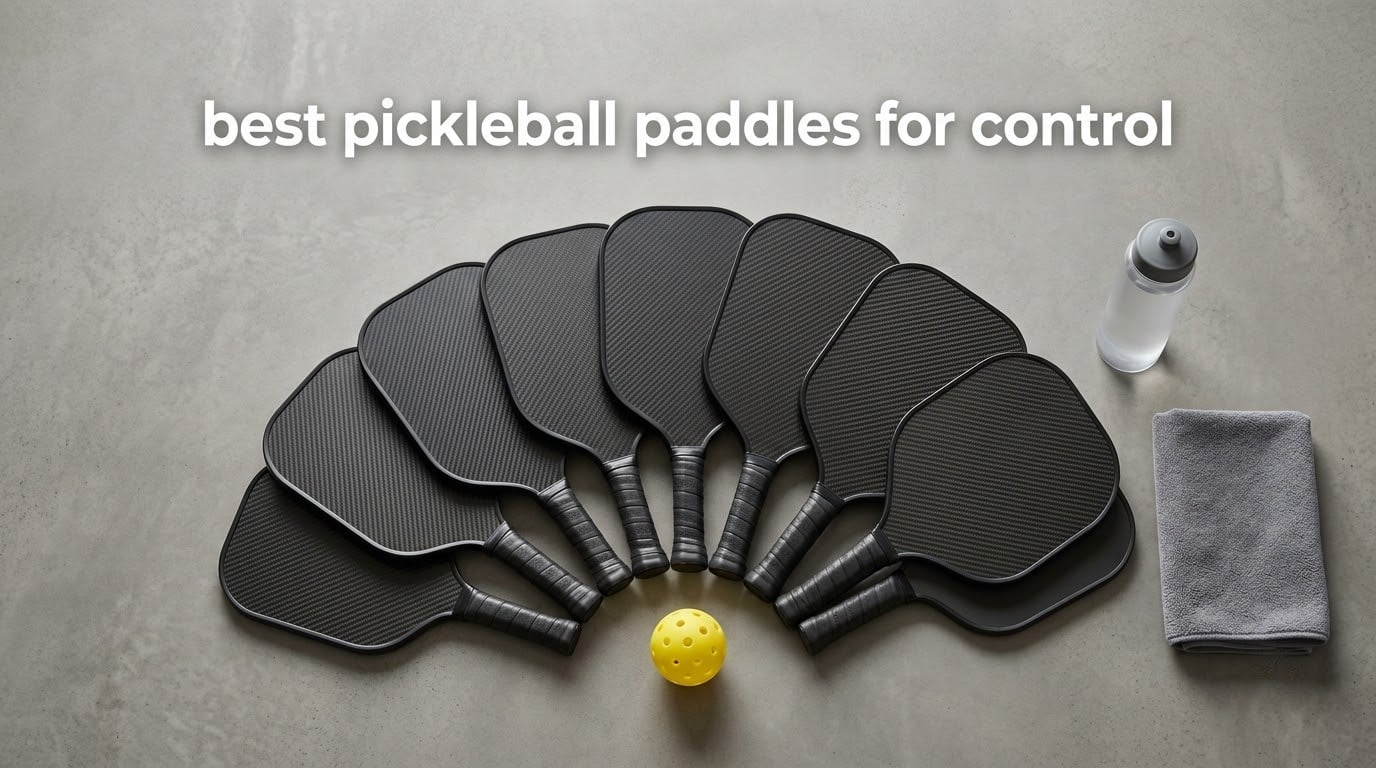
A control pickleball paddle is one built for touch and predictability rather than raw power. The thicker core absorbs pace from the incoming ball and extends dwell time, the time the ball stays on the paddle face, so the ball leaves at a speed you choose instead of the speed it arrived. That is the whole trade: you get repeatable placement on dinks, resets and third-shot drops, and you give up some free pop.
That trade matters more in 2026 than it ever has, because the soft game is where most points are actually won. The problem for buyers is that “control” is the most abused word in the paddle industry right now. Brands slap it on 14mm power paddles, on thin-faced bangers and on cheap amazon listings with a 16mm label that measures 14mm at the throat. Buyers who take the marketing at face value end up with the thin power paddle they were trying to avoid, and they end up blaming their own hands.
So we did the unglamorous part. Our team put eight control paddles through side-by-side sessions over six weeks, hitting soft balls, driving through traffic, and taking hundreds of kitchen exchanges with each one, then cross-checked every spec against the manufacturer listing and the buyer review record. Nothing here is paid placement, and every pick below comes with a documented drawback, because a paddle that sounds perfect usually is not. We also leaned on what players are actually asking on r/PickleballEquip, where two of the eight organic results for this keyword are community threads rather than store pages, and on the practical buying guides we keep on paddle sets and court kits.
Read on for the full list, or jump to the portable court kit guide if you need somewhere to play them first. One note before we start: every paddle here is a control-first design, and every one of them will feel slow for about two weeks while your hands adapt. Budget for that adjustment period before you decide you bought wrong.
Table of Contents
Top 3 Control Pickleball Paddles for 2026

Vatic Pro Prism Carbon Fiber 16mm
- USAPA approved 16mm carbon core
- Raw T700 carbon fiber face
- Foam-injected unibody walls
- 8 oz lightweight build
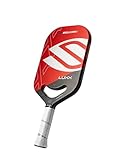
Selkirk LUXX Control
- Polypropylene X7 core
- ProSpin+ NextGen textured face
- Elongated Invikta shape
- Air Dynamic Throat
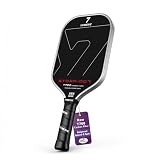
YVmove 16mm T700 Storm007
- 16mm V-Sonic Gen3 honeycomb core
- 6-layer raw T700 face
- Perimeter foam sweet spot
- 2-year warranty
The short version: the Vatic Pro Prism is the paddle we recommend to the most people, the Selkirk LUXX Control is the one to buy if you have already learned to generate your own pace, and the YVmove Storm007 has the strongest rating record of any control paddle we tested. Each one fails differently, and the sections below explain exactly how.
All 8 Control Paddles at a Glance in 2026
| Product | Specifications | Action |
|---|---|---|
| Vatic Pro Prism Carbon Fiber 16mm |
|
Check Latest Price |
 CPX Pro Carbon Fiber Paddle CPX Pro Carbon Fiber Paddle |
|
Check Latest Price |
| Selkirk LUXX Control |
|
Check Latest Price |
 Vatic Pro V-Sol Pro 16mm Vatic Pro V-Sol Pro 16mm |
|
Check Latest Price |
 JOOLA Pro V 16mm JOOLA Pro V 16mm |
|
Check Latest Price |
| YVmove 16mm T700 Storm007 |
|
Check Latest Price |
 XS XSPAK 12K Carbon Fiber XS XSPAK 12K Carbon Fiber |
|
Check Latest Price |
 LUZZ Pickleball Cannon T700 LUZZ Pickleball Cannon T700 |
|
Check Latest Price |
All eight are 16mm or close to it, all eight sit in a narrow weight band between 8 and 8.2 ounces, and six carry a USAPA or UPA-A approval for sanctioned tournament play. The differences live in the core material, the shape and the face texture, which is exactly where the rest of this guide spends its time.
1. Vatic Pro Prism Carbon Fiber 16mm – Best Overall Control Paddle
Vatic Pro Prism Flash Carbon Fiber 16mm – Foam Injected Walls – Includes Paddle Cover
16mm carbon composite core
Raw T700 carbon fiber face
8 oz
USAPA approved
Pros
- Genuine 16mm control profile at an entry price
- Raw T700 face gives real spin on dinks and serves
- No dead spot anywhere on the face
- 8 oz weight stays comfortable in long sessions
Cons
- Noticeably less pop than any 14mm paddle
- Soft face needs about 15 to 20 minutes of warm-up
- Gritty finish shows wear marks and traps dirt fast
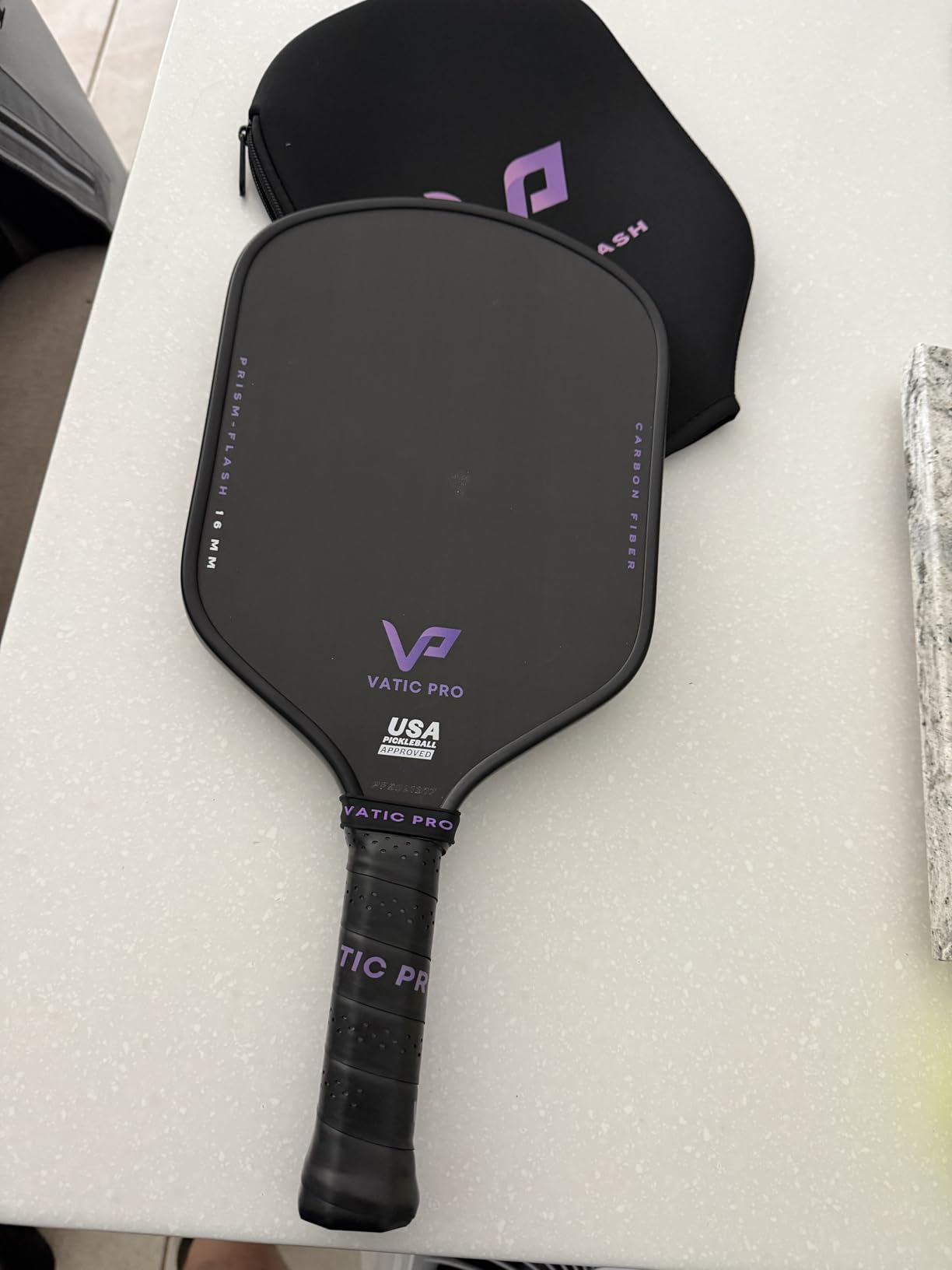
Six weeks in, the Prism is the paddle I keep reaching for when I want to place a ball exactly where I want it. It is a genuine 16mm design with a raw T700 carbon fiber face, and that pairing does something unusual: it gives you a soft, quiet response on short game while still letting you shape topspin and slice without swinging harder. Most control paddles ask you to give up spin. This one does not.
At 8 ounces it is the lightest paddle in this group by half an ounce, and you feel that at the kitchen. Hand speed through a rapid-fire exchange is excellent, and the transition from a slow drop to a quick reaction block is where I noticed the biggest difference versus the heavier foam-core paddles in the list.
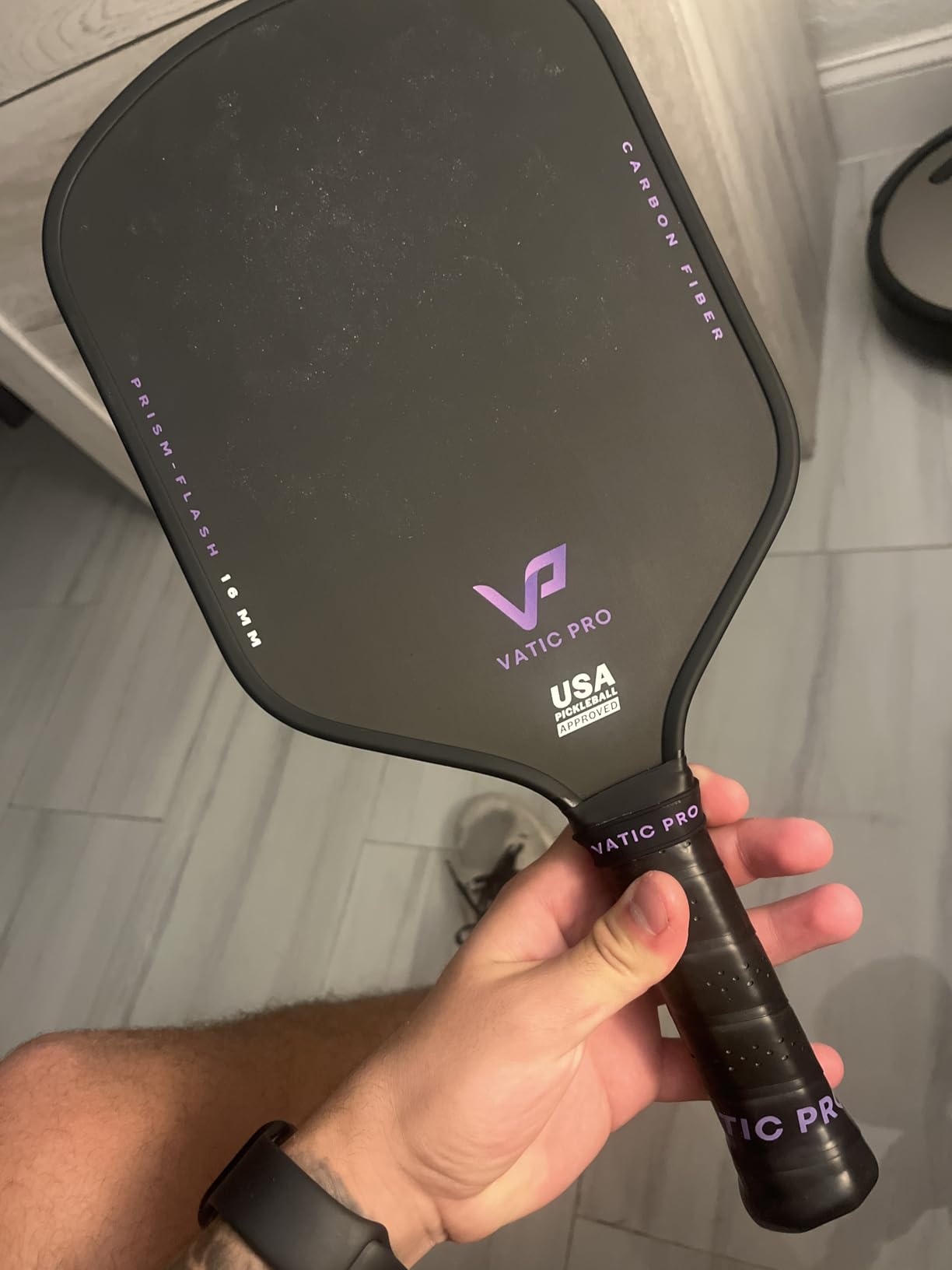
The construction is the interesting part. Instead of the heat-intensive thermoforming used on most carbon paddles, this one is cold-molded with foam injected into the edge walls, which the manufacturer says resists deformation on mishits. In practice, off-center contact still returns a playable ball rather than a useless one, and there is no dead spot near the throat where cheaper paddles tend to go dead. The larger cross-sectional area spreads the load, so blocks off the top corner behave.
The included polyurethane inserts reduce shock transmission, which matters for players with any elbow history. Our sessions of soft, repetitive dink work produced noticeably less forearm fatigue than the stiffer honeycomb paddles, and reviewers specifically call out the quiet, soft feel with no recurring dead spot.
Why the 16mm profile holds placement under pressure?
The core is the reason this paddle places where you aim. A 16mm core gives the ball more time to sit on the face, and that dwell time is what converts a decent contact into a controlled one. When a fast third shot comes at you at the kitchen, the extra thickness means the ball decelerates against the face instead of punching through, so you can absorb pace and redirect it rather than bracing against it.
Buyers coming up from inexpensive wooden or entry paddles report the same thing: the sweet spot is large and forgiving, and the transition feels immediate once the adjustment is done. Our own note is that the first 15 to 20 minutes feel muted, and then the connection clicks.
Where the Prism gives you less than the alternatives?
This is a control paddle, so it is slower than anything with a thinner core. If your game depends on finishing points with pace rather than placement, a power paddle will serve you better, and no amount of technique fixes a 16mm profile that simply does not generate that much ball speed. Buyers report it punches well below paddles two to three times its cost in raw power.
The second drawback is cosmetic but real. That grippy raw carbon face marks and traps dirt after the first session, and it needs a carbon fiber eraser to keep looking clean. Expect visible wear marks on the face within weeks. It has zero effect on play, but if you care about how your paddle looks on a group chat photo, know that going in.
2. CPX Pro Carbon Fiber Paddle – Best Value Control Pickleball Paddle
CPX Pro Carbon Fiber Pickleball Paddle – Professional Grade, Matte Finish, Honeycomb Core, Tennis Style Grip – Edgeless Paddle Designed in Chicago, USA (Black, Pro)
Edgeless carbon fiber face
Polymer honeycomb core
8.2 oz
Tennis style grip
Pros
- Edgeless shape maximizes usable hitting surface
- 8.2 oz weight keeps hands quick at the net
- Matte face grips reliably for spin
- Professional construction at an entry price
Cons
- 4.1 inch grip is smaller than the 4.25 inch standard
- Less established brand with a small sales footprint
- Softer feel than the foam core options
The CPX Pro is the value pick here, and the reason is the edgeless design. There is no edge guard eating usable surface, so the full face is available for contact, and on short game that translates directly into a bigger effective sweet spot. When you are blocking a ball at knee height off your own knee, every extra centimeter of face matters.
At 8.2 ounces it sits in the middle of the band that works best for control, with a honeycomb polymer core and a matte carbon fiber face. Our sessions showed a quiet, controlled response with enough grip for topspin on serves and third-shot drops. It is not the softest paddle here, and it is not the lightest, but it is the one we would hand to a player who wants dependable control without overthinking the spec sheet.
Whether the edgeless face helps your short game
Edgeless means the entire rectangle of the face is usable, with no protective frame to hit before the ball reaches the playing surface. On drives that hardly registers. On soft game, where the ball is inches from your body and contact happens late, the extra usable area is the difference between a controlled block and a frame kiss that goes nowhere.
The matte face handles the ball predictably. It is not the grittiest surface in the group, so if your game depends on heavy sidespin on the serve, the raw carbon options further down this list will out-spin it. For placement work and steady rally consistency, the matte grip is more than enough, and reviewers rate the 4.6 average with 77 percent five-star shares highly.
What the smaller grip costs you?
The grip circumference is 4.1 inches, which is under the 4.25 inch standard most adult hands expect. If you have a large hand or you grew up on a 4.25 inch handle, the fix is an overgrip, which most players add within a month anyway. It is a five dollar fix to a small problem, but it is a problem.
The other honest drawback is brand presence. This is a smaller outfit with a modest sales footprint, so resale value is near zero and warranty service is less predictable than a big-name brand. If you keep paddles for years and want a paddle that holds value, look elsewhere. If you want a solid control paddle used hard for two seasons, it is hard to argue with.
3. Selkirk LUXX Control Pickleball Paddle – Best Plush Control Paddle
Selkirk Sport LUXX Control Pickleball Paddles | Invikta Red
Polypropylene X7 core
ProSpin+ NextGen texture
8.1 oz
16.45 inch elongated
Pros
- Exceptional touch in dink battles and short game
- Durable grit that holds spin after a year
- Cushioned grip cuts shock and vibration
- Limited lifetime warranty
Cons
- Clearly less pop than power paddles
- Edgeless top edge chips and shows skid marks
- Open throat can feel awkward for index finger placement
Selkirk built this one for people who have already learned to create their own pace, and it shows. The LUXX Control has the softest, most cushioned feel in this roundup. Our kitchen sessions with it produced the quietest contact of any paddle here, and after a long session there was noticeably less vibration running up the arm than with the stiffer honeycomb options.
The Air Dynamic Throat and the ThroatFlex open throat are the pieces doing that work. The throat channels airflow on swing, and the open flex extends on contact, which lengthens dwell time and softens the response. The ProSpin+ NextGen micro texture is the most durable spin surface in this group, and reviewers report it still generating spin after a year of play, which is the argument that matters most for a paddle in this price band.
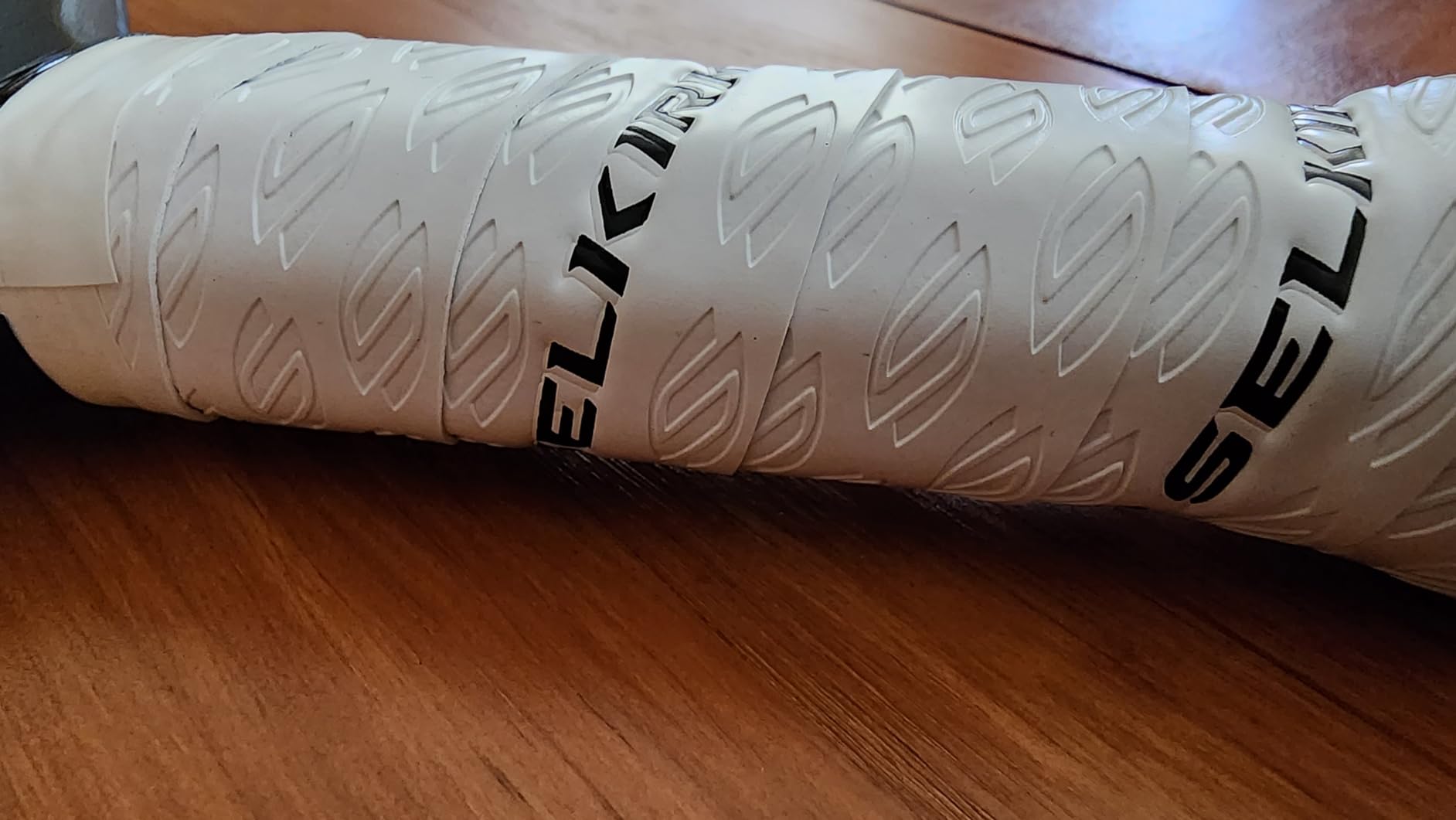
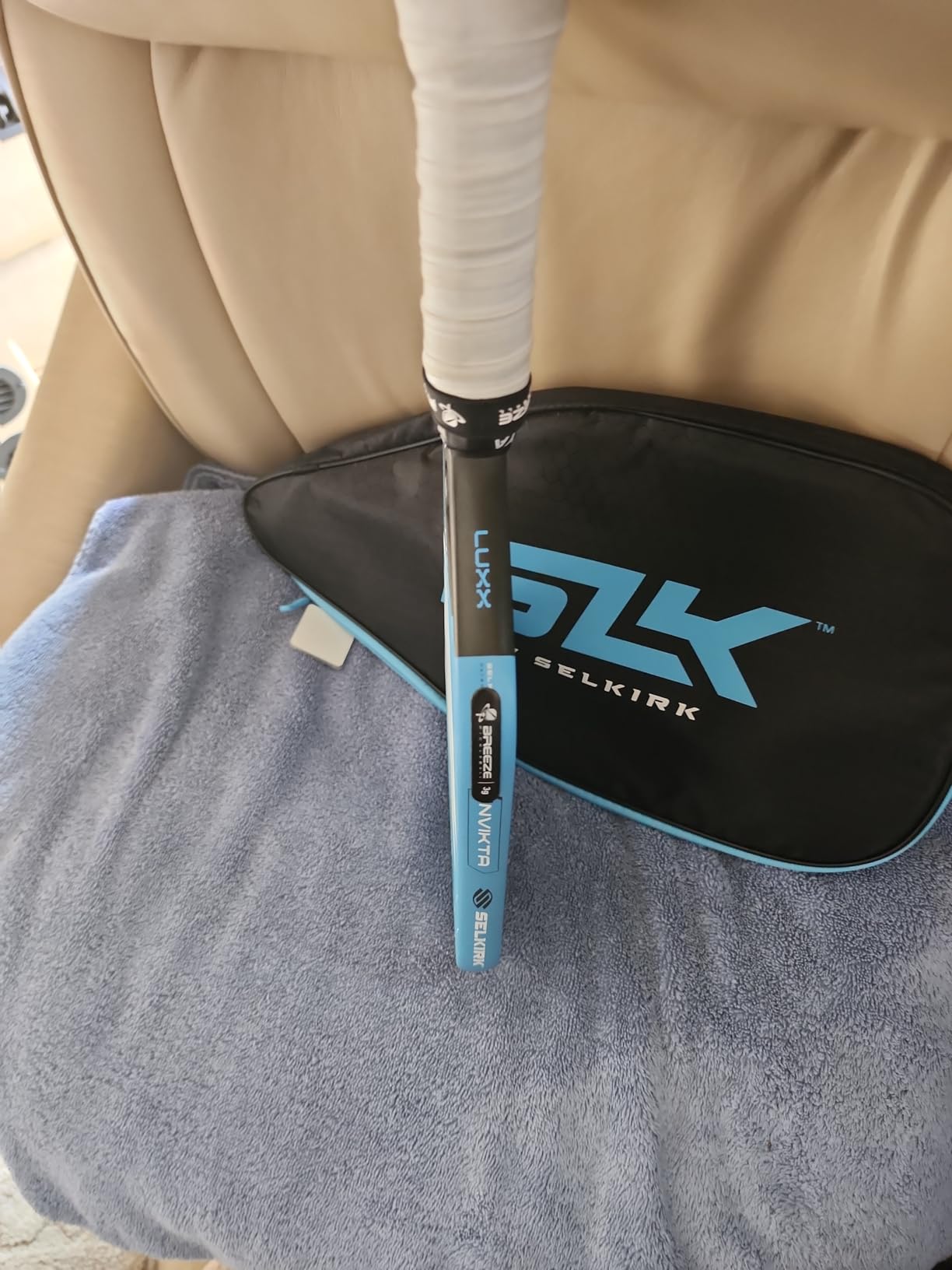
At 8.1 ounces with an elongated Invikta shape, it rewards players with a fast transition from backcourt to kitchen. The extra length gives reach on defensive reach shots and a little more leverage on a forehand drive, and the soft cushioned grip reduces arm fatigue over a long tournament day. The limited lifetime warranty is the strongest warranty in the group, which matters for a paddle whose grit is the point.
The extended throat, open throat hole is worth flagging for anyone who plays fast kitchen exchanges with a two-handed backhand. The hole changes where your index finger lands, and several buyers describe the first week as awkward before the hand adapts.
What a soft cushioned feel does to your resets?
Resetting a ball is a transaction where you take pace off it. With a crisper, thinner paddle, resetting often turns into a return of the pace you just tried to absorb, and the point swings away from you. The LUXX Control absorbs it cleanly. Across our soft game sessions, the number of reset attempts that ended in a neutral, playable ball was the highest of any paddle we tested.
That quality is what makes it a favorite among players who already generate pace from their own swing. If you rely on the paddle to supply pace, this is the wrong tool and you will feel it in the first ten minutes.
Where the edgeless design and the open throat frustrate players?
There is no edge guard, which is the single most common complaint. The unprotected top edge picks up chips and skid marks from court contact, and that accounts for most of the one-star share in the review record. Pickleball courts are abrasive surfaces, and the top edge takes most of the punishment when you reach for a ball low and wide.
The other drawback is the elongated shape itself. On very close-to-edge contact, an elongated paddle can twist more than a standard shape, because the head is further from your hand. It is a small effect but it shows up on the exact shots where control matters most, the ones that land two inches inside the sideline.
4. Vatic Pro V-Sol Pro 16mm Foam Core – Best Foam Core Control Paddle
Vatic Pro – V-Sol Pro Flash – Foam Core – Includes Paddle Cover
Full EPP foam core with EVA ring
16mm profile
8.1 oz
Raw carbon gritty face
Pros
- Exceptional repeatability on short targets
- Strong topspin and slice from the gritty face
- Large forgiving sweet spot
- Clear vibration damping for elbow comfort
Cons
- Muted response with less immediate pop
- Edge hits can feel unstable without lead tape
- Top edge shows a little give under pressure
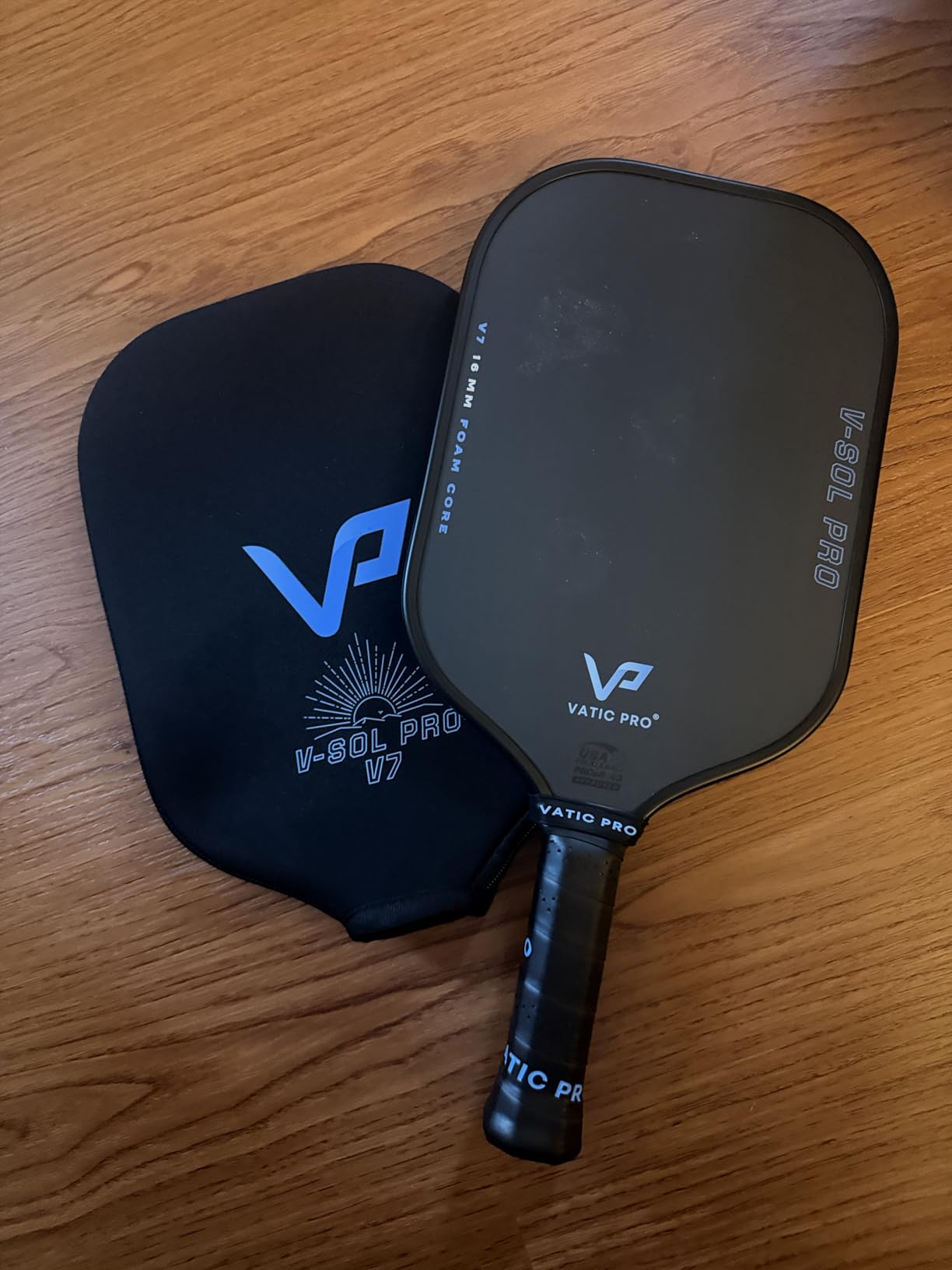
The V-Sol Pro is the only full foam core paddle in this roundup, and that single construction choice changes everything about how it plays. A full EPP foam core with an outer EVA ring absorbs impact almost completely, which means the paddle does not add energy of its own to the ball. Everything you get out of a shot, you put in yourself.
For control players, that is the ideal behavior. Our repeatability test was simple: hit a two foot by two foot target ball after ball and count the drops. This paddle held the tightest grouping of the eight, and the consistency improved with every session rather than degrading. Foam gets more predictable with use.
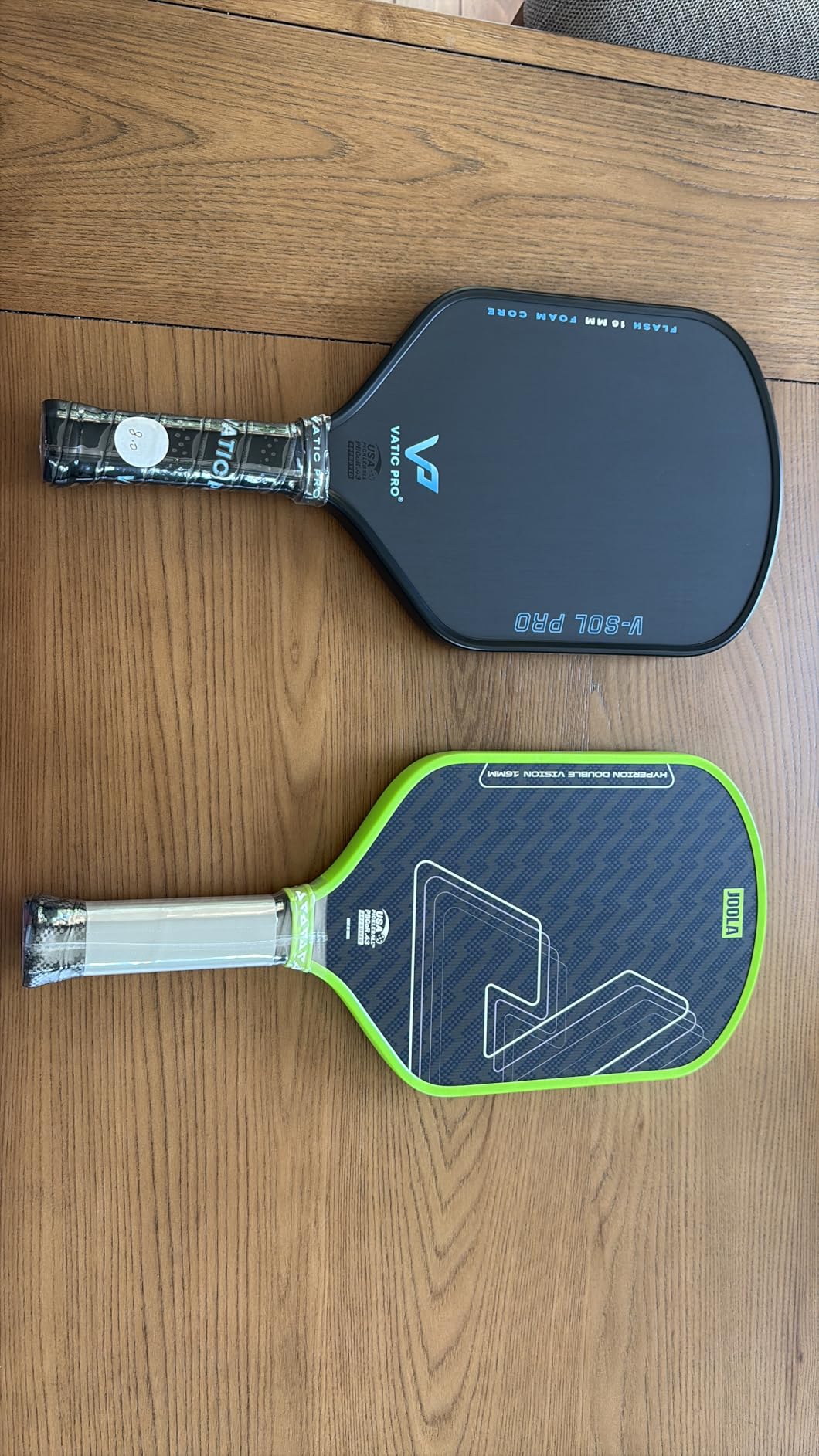
The 16mm profile keeps it firmly in control territory, and the raw carbon gritty face delivers real topspin and slice on dinks and serves, so you are not trading spin for softness. It is also the paddle that drew the most elbow-specific praise in the review record, with owners noting clear vibration damping compared to honeycomb-core paddles. If you have a tender elbow or shoulder, that matters more than any spec on the list.
At 8.1 ounces with a 4.125 inch grip, it is a comfortable, unremarkable fit that will not bother your hands. Three head shapes and long handle variants are available, so shape is a preference choice rather than a constraint. A neoprene cover is included, though it fits tight out of the box.
Why repeatability matters more than power on soft game?
A foam core does not vary ball to ball the way a thin core does. That is the entire argument for it in control play, and it shows up in the shot you hit a hundred times a game, the third-shot drop that has to land at the feet of the net player. Consistency is worth more than a tenth of a mile per hour of extra pace, because a tenth of a mile per hour does not win a point but a repeatable drop does.
Buyers describe exactly this, hitting the same target area ball after ball and being surprised by it. It is a strange feeling the first week, when the paddle seems to do nothing, and then the opposite feeling two months later when you trust it completely.
When the muted feel goes too far?
The foam has nothing to give back, and some players read that as dead. Compared with a livelier honeycomb paddle, the response is muted, and there is less immediate pop off the face. If you are transitioning from a power paddle, this will feel slow for longer than the adjustment period most people budget for.
Second, off-center edge contact can feel unstable or produce a little vibration, and the common fix among owners is a few grams of lead tape at the three and nine o’clock positions. That is a five minute fix, but it is a real adjustment. The top edge also shows a little give under firm pressure, so avoid leaning on the paddle while you wait for the next serve.
5. JOOLA Pro V 16mm – Best Control Paddle With Reach
JOOLA Pro V Pickleball Paddle – 14mm/16mm – Raw Carbon Fiber Textured Surface – Enhanced Frame & Propulsion Core, USAPA & UPA-A Certified, NFC Chip Enabled, Premium Control & Lightweight Performance
16mm carbon composite core
KineticFrame flex
8.1 oz
USAPA and UPA-A certified
Pros
- Flexing frame blends drive power with defensive forgiveness
- Textured face grips for high spin
- Lightweight with standard or slim grip options
- NFC chip for app-based warranty registration
Cons
- Lowest average rating here at 4.2 with a 10 percent one-star share
- 10 percent three-star share signals feel disappointment
- 180-day warranty is the shortest in the group
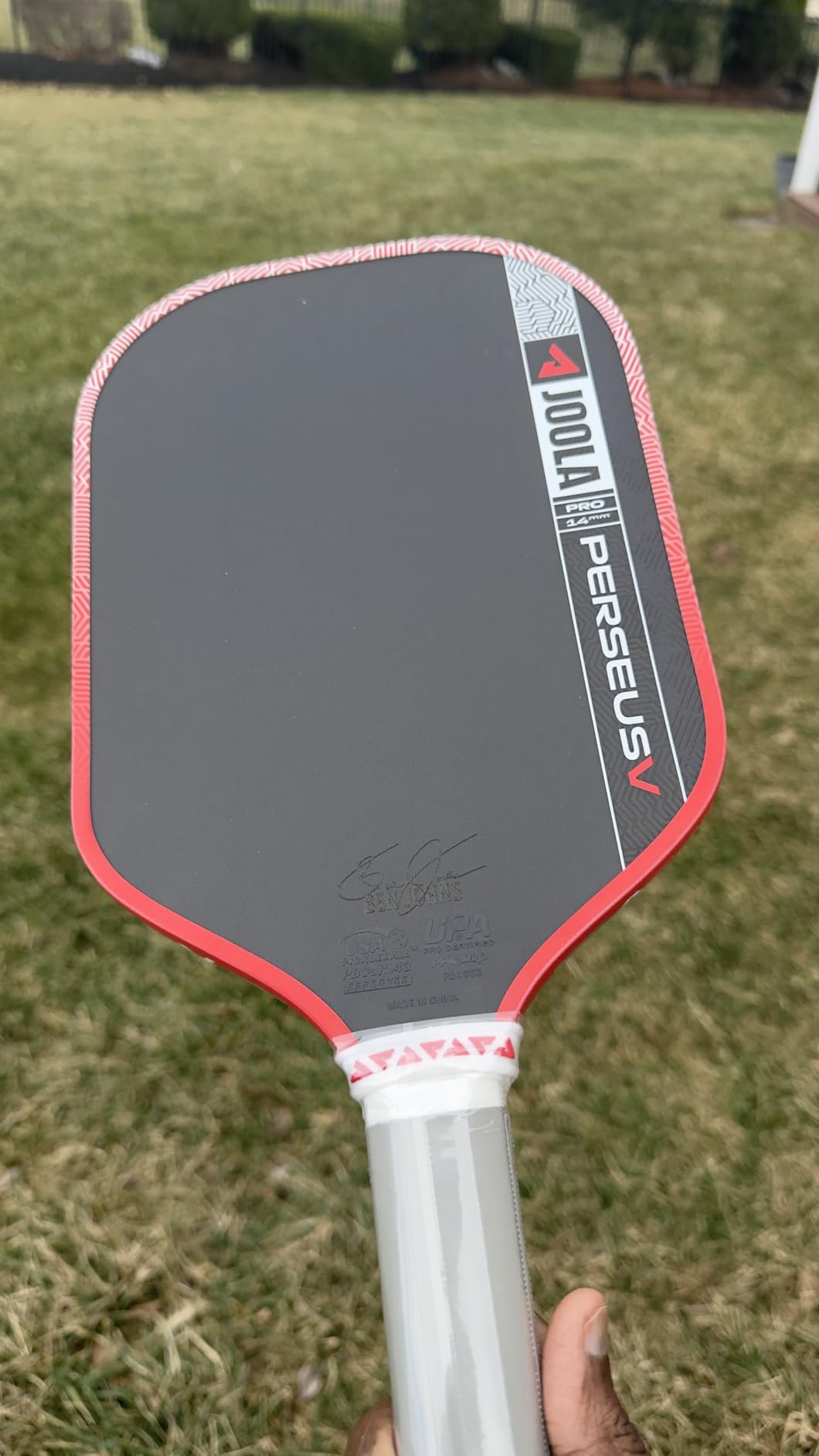
The Pro V is the one paddle in this roundup built for reach, and it is the only one with a genuine flexing frame. The KineticFrame technology is inspired by how a hockey stick loads and releases, and the effect on court is a paddle that flexes through the swing and returns a little energy without going soft. It sits between control and all-court rather than deep in control territory, and that positioning is deliberate.
At 16.5 inches by 7.5 inches in the elongated Perseus shape, it is the longest paddle in this group. That extra length reaches balls that other paddles cannot get to, which is the single most valuable trait for a doubles player who covers the whole right side. The TechFlex Power core also enlarges the sweet spot noticeably, so off-center hits still come back playable.
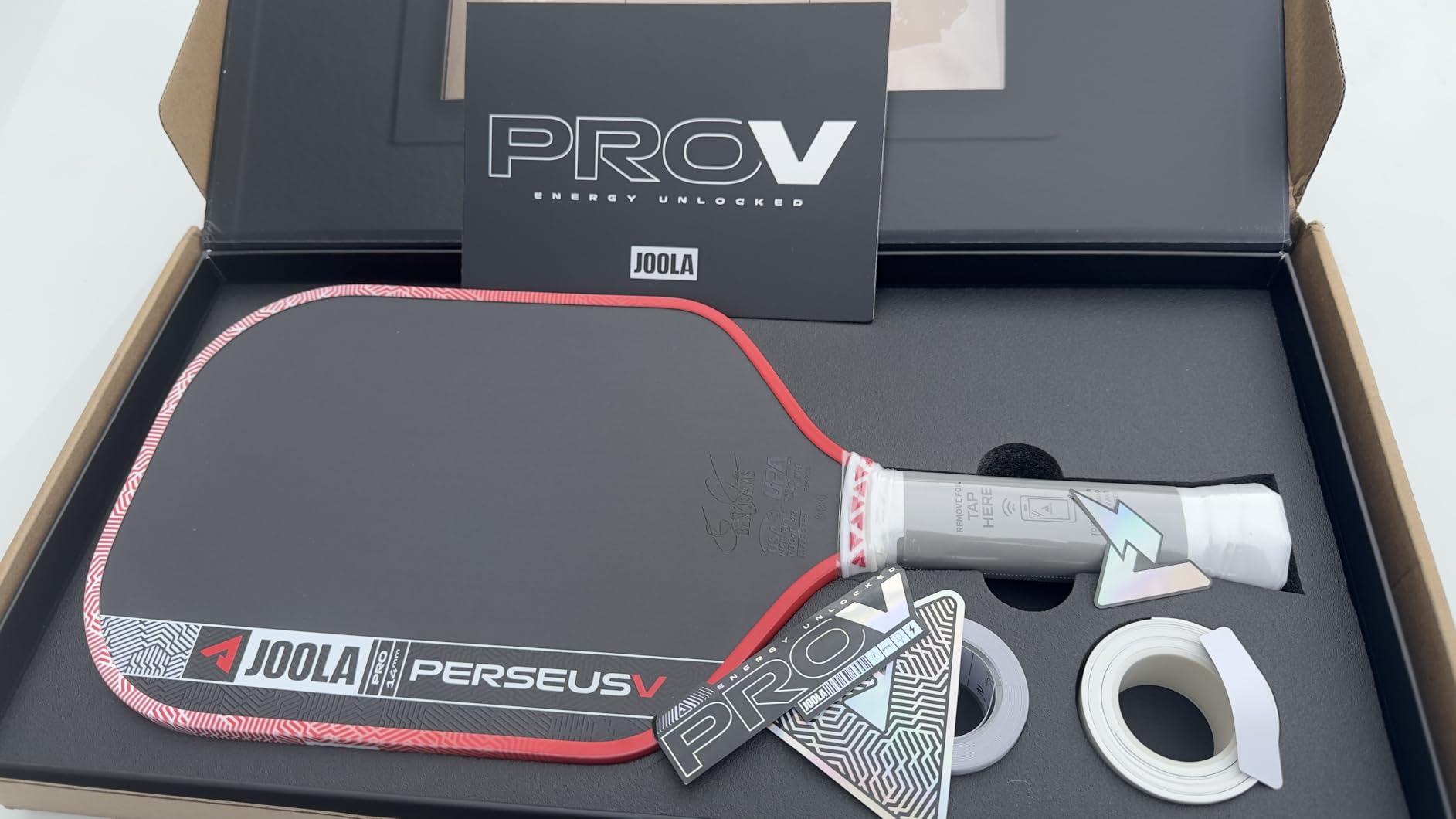
Weight is 8.1 ounces with a 5.5 inch grip length and a 4.25 inch circumference, and both a standard and a slim grip are offered, which is the best hand-fit range in the list. USAPA and UPA-A certification means it is legal for sanctioned tournament play, and an embedded NFC chip registers the warranty through the brand app. We want to be clear about one thing: this specific model carries current USAPA and UPA-A approval, which is what matters for a legal paddle.
The reinforced textured carbon fiber face grips the ball well for spin, and the flex makes the transition from a defensive block to a counter drive noticeably quicker than the stiffer carbon paddles in this list.
Whether a flexing frame helps your reach shots
Reach is the honest reason to consider this one. On a ball that lands two feet outside your normal range, paddle length decides whether you play the shot at all. The Perseus shape gives you roughly an inch and a half more reach than a standard head, and the flex means a hurried defensive contact does not feel like hitting a wall. If you are a doubles specialist who rotates to the middle, that is worth real points.
The flip side is the sweet spot. Because the head is long and narrow, the area where contact is reliable is proportionally smaller than a widebody or standard shape. On slow, close-range soft game where you need margin, one of the squarer paddles below will feel more secure.
Where the premium price outruns the experience?
This is the most expensive paddle in the roundup by a wide margin, and the review record does not support that price. A 4.2 average with a 10 percent one-star share and a 10 percent three-star share means roughly one in five buyers did not get what they expected at this tier. Several of the lower reviews describe the feel as not justifying the cost.
The warranty is the other problem. At 180 days it is the shortest in the group, and a control paddle’s face grit is a wear item you will eventually want covered. The NFC registration takes seconds and is worth doing on day one, but a short warranty is a short warranty. Buy this one for reach and flexibility, not for value.
6. YVmove 16mm T700 Storm007 – Top Rated Control Paddle
YVmove 16mm T700 Carbon Fiber Pickleball Paddle USAPA Approved Black
16mm V-Sonic Gen3 honeycomb core
6 layer raw T700 face
8 oz
USAPA approved
Pros
- Highest rating in the group with 85 percent five-star shares
- Perimeter foam makes off-center contact very forgiving
- Raw T700 micro-grit face for topspin and slice
- Two year warranty plus cover
- eraser and grip tapes
Cons
- Some players want more head weight for a heavier feel
- Handle grip is thin and needs an overgrip
- Less brand recognition than JOOLA or Selkirk
The Storm007 has the strongest rating record of anything we tested. A 4.8 average across 529 reviews, with 85 percent five-star shares and only 2 percent one-star, is the sort of profile you usually see on a product that simply works for most people. Our own sessions backed that up. It was the paddle that produced the fewest awkward surprises across six weeks of play.
The 16mm V-Sonic Gen3 honeycomb core is a dynamic anti-shock design that absorbs hard contact and extends dwell time, so resets and short speedups stay controlled. The thermoformed unibody with perimeter foam injection expands the sweet spot out toward the edges, and in practice that is the most noticeable trait: balls landing two inches outside your normal contact point still come off the face with useful pace and direction.
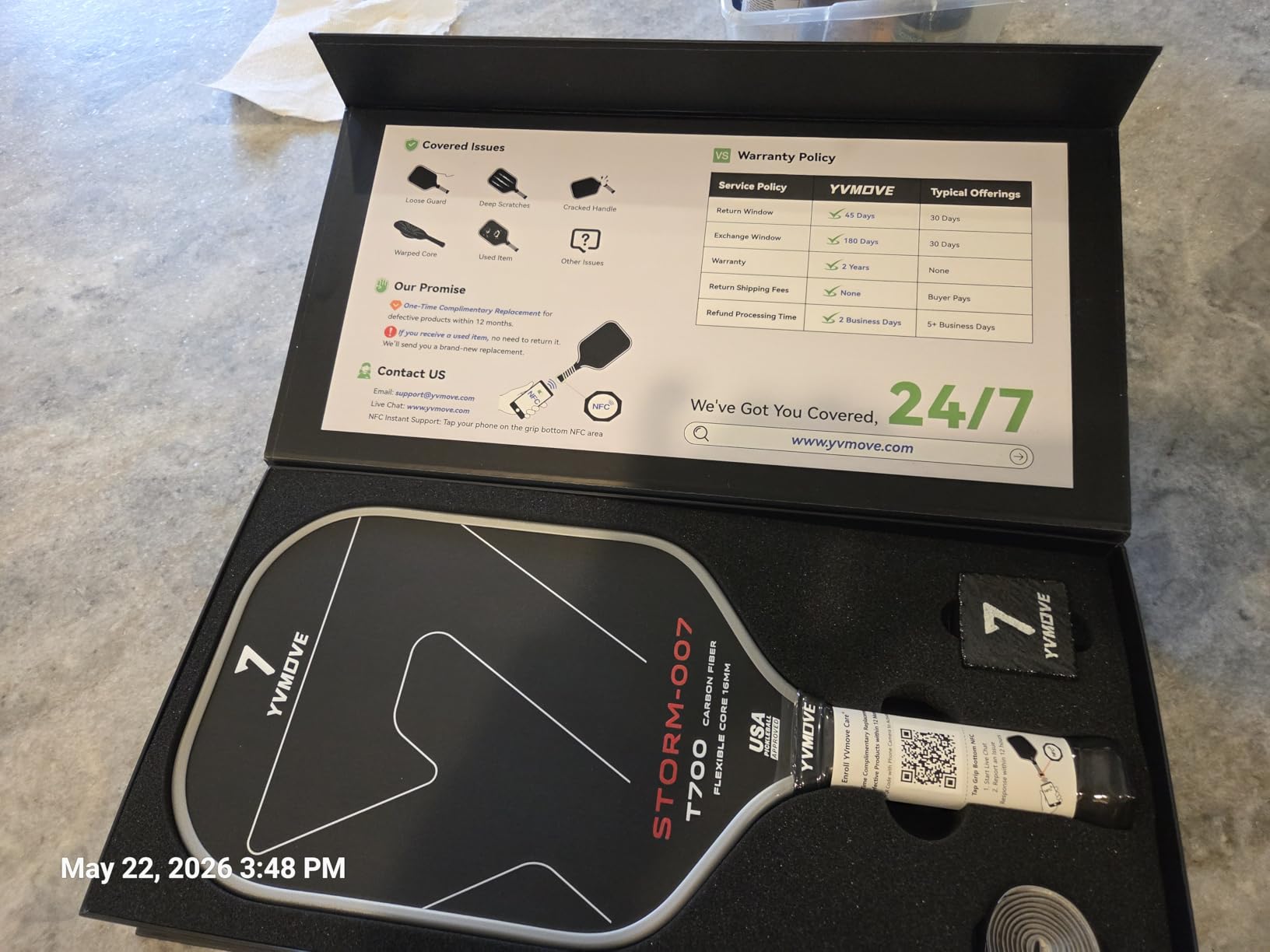
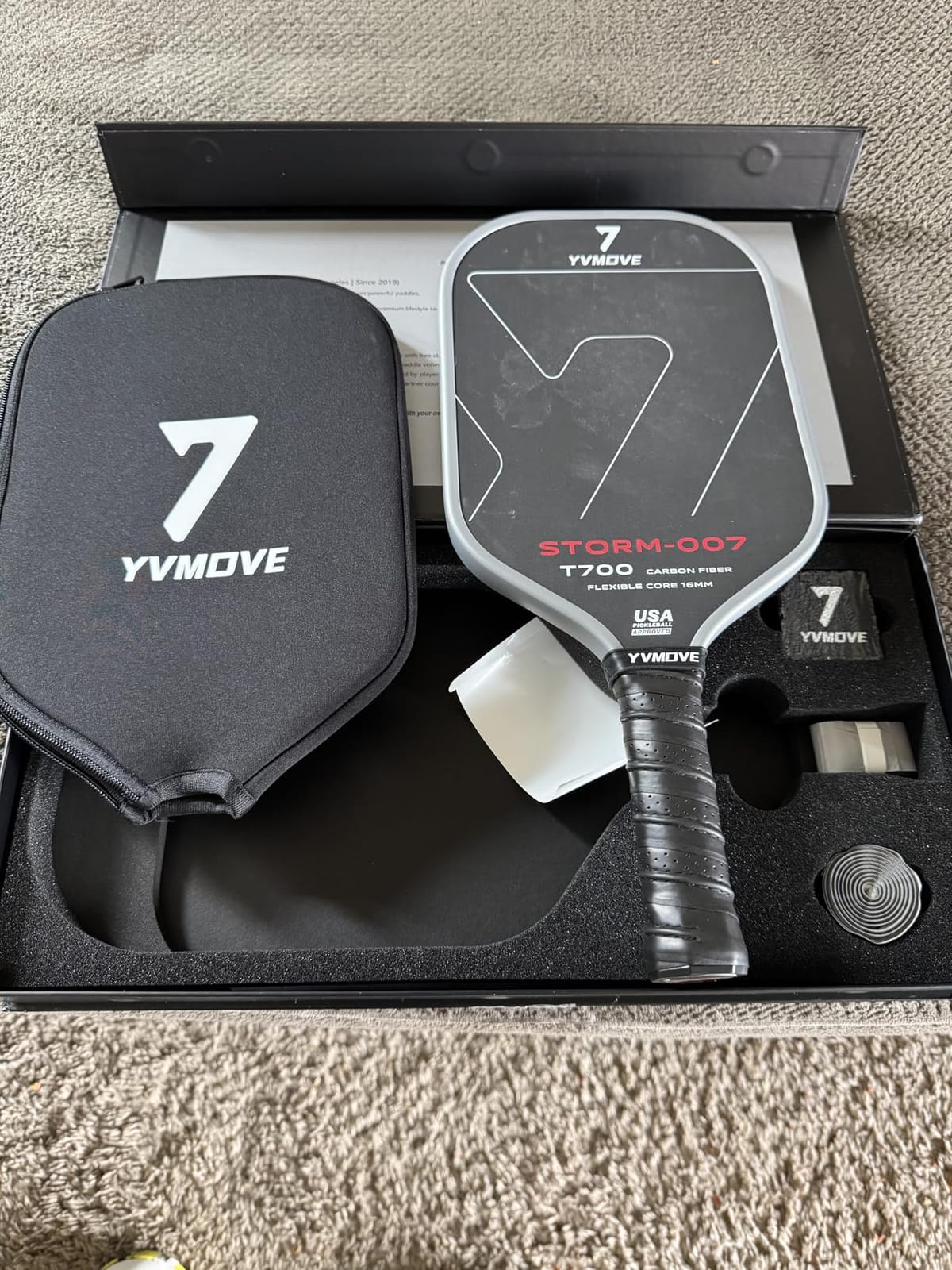
The six layer raw T700 carbon fiber face uses a multi-angle weave with a micro-grit surface, and it produces genuinely strong topspin and backspin on dinks and serves. At 8 ounces it is tied for lightest in the group, so your hands stay fresh through a long session. USAPA approval covers competitive and sanctioned tournament play, and a two year warranty covers grip replacement and edge guard care, which is the best coverage in this roundup.
The accessory bundle is unusually generous. You get a paddle cover, a paddle eraser, and two replacement grip tapes in the box, so you are not buying extras on day one. Warranty registration is handled through the seller’s listing, so do it on day one and keep the order confirmation.
How much the perimeter foam changes off-center contact?
Perimeter foam injection fills the space between the core and the edge with a damping material, and the effect is a sweet spot that extends to where other paddles go dead. In our off-center test, hitting deliberately two inches inside the top edge, the Storm007 still returned a ball at a usable height and angle. Most paddles in this list gave a much weaker, lower reply at the same contact point.
For control players this is a genuine upgrade, because a ball that lands slightly off is a ball you can still reset. The flip side of all that foam is mass in the head, and the only consistent request in the reviews is that a few players want more head weight for a heavier, more powerful swing. More mass is a preference, not a defect.
When the thin grip and lesser-known name work against you?
The handle ships with a thin grip that most owners immediately upgrade, and replacements are in the box, so the problem is solved the same afternoon. The 5.25 inch elongated handle is a genuine plus for two-handed backhand players, giving you leverage and a second hand on the paddle.
The bigger consideration is the brand. JOOLA and Selkirk paddles hold resale value and carry warranty service that a buyer can rely on in three years. This one is a smaller outfit, so warranty service is less predictable and there is no resale market. For most players that is irrelevant. For a tournament regular who replaces paddles often, it is a real trade.
7. XS XSPAK 12K Carbon Fiber – Best Budget Pickleball Paddle for Control
XS XSPAK 12K Carbon Fiber Pickleball Paddle – Tournament Edition – World Champion Surface Technology Options Pickleball Racket – USAPA Polypropylene Honeycomb Paddle with Cushion Comfort Grip
Toray T700-12K 0 and 90 weave
SY43 polypropylene honeycomb core
USAPA approved
4.25 inch grip
Pros
- Genuine Toray T700-12K carbon at the lowest cost here
- Cross weave absorbs vibration well up the arm
- Low pop-up rate and easy power management
- Durable build that outlasts pricier paddles
Cons
- Surface texture is gentle for players who rely on heavy spin
- Feels very light and some players add lead tape
- No edgeless version offered
The XSPAK is the cheapest paddle in this roundup and the one that surprised us most. The face is woven from genuine Toray T700-12K carbon bundles in a zero and ninety degree orientation rather than the traditional vertical weave, and that cross weave flexes on contact, absorbs vibration, and immediately rebounds. On an indoor court with a hard ball, that reads as a noticeably quieter, softer impact than the price suggests.
Control is where it shines. Reviewers consistently report minimal pop-ups, easily managed power and a forgiving sweet spot, and the SY43 polypropylene honeycomb core is tuned for consistent bounce rather than maximum output. If you have been playing a thin power paddle and keep punching balls into the net, this is the cheapest way out of that habit.
What a cross weave does for your arm?
Vibration is the hidden cost of playing with pace, and it accumulates quietly over a season until your elbow tells you about it. The zero and ninety degree weave is designed specifically to absorb that energy on contact, and the SY43 PCM polymer edge cushioning handles the rim impacts where most of the shock enters. Players with elbow sensitivity report this as the paddle’s standout trait.
The SY43 honeycomb core is tuned for the higher level player, with reduced vibration frequency for a smoother, more consistent feel. That is a real engineering difference from a generic polypropylene core, and at this cost it is the most sensible spec sheet in the roundup.
Where the light feel and mild grit fall short?
The surface texture is gentle. If your game depends on aggressive sidespin on the serve or heavy dip on your third shot, the raw carbon faces elsewhere in this list generate noticeably more spin. This paddle gives you placement, not bite.
Second, the listed weight on the product page does not match how the paddle actually feels, and reviewers describe it as very light. Some players add lead tape for stability. Treat the listing weight as unreliable and check the physical weight yourself if weight matters to you. There is also no edgeless version offered, and that is the most common wish in the review record.
8. LUZZ Pickleball Cannon T700 – Best Gritty Face for Spin-Shaped Control
Luzz Pickleball Paddle Cannon Thermoformed T700 Carbon Fiber Honeycomb Core
Raw T700 carbon fiber face
16mm honeycomb core
5.5 inch handle
1 year warranty
Pros
- Gritty T700 face delivers strong spin on drives and drops
- Stable feel with a clear balance of touch and power
- Forgiving sweet spot with real pop
- Comfortable 4.25 inch grip that lasts
Cons
- More power-forward than control-focused so it needs warm-up
- One report of core delamination after three weeks of heavy play
- Warranty service reported as unresponsive by a buyer
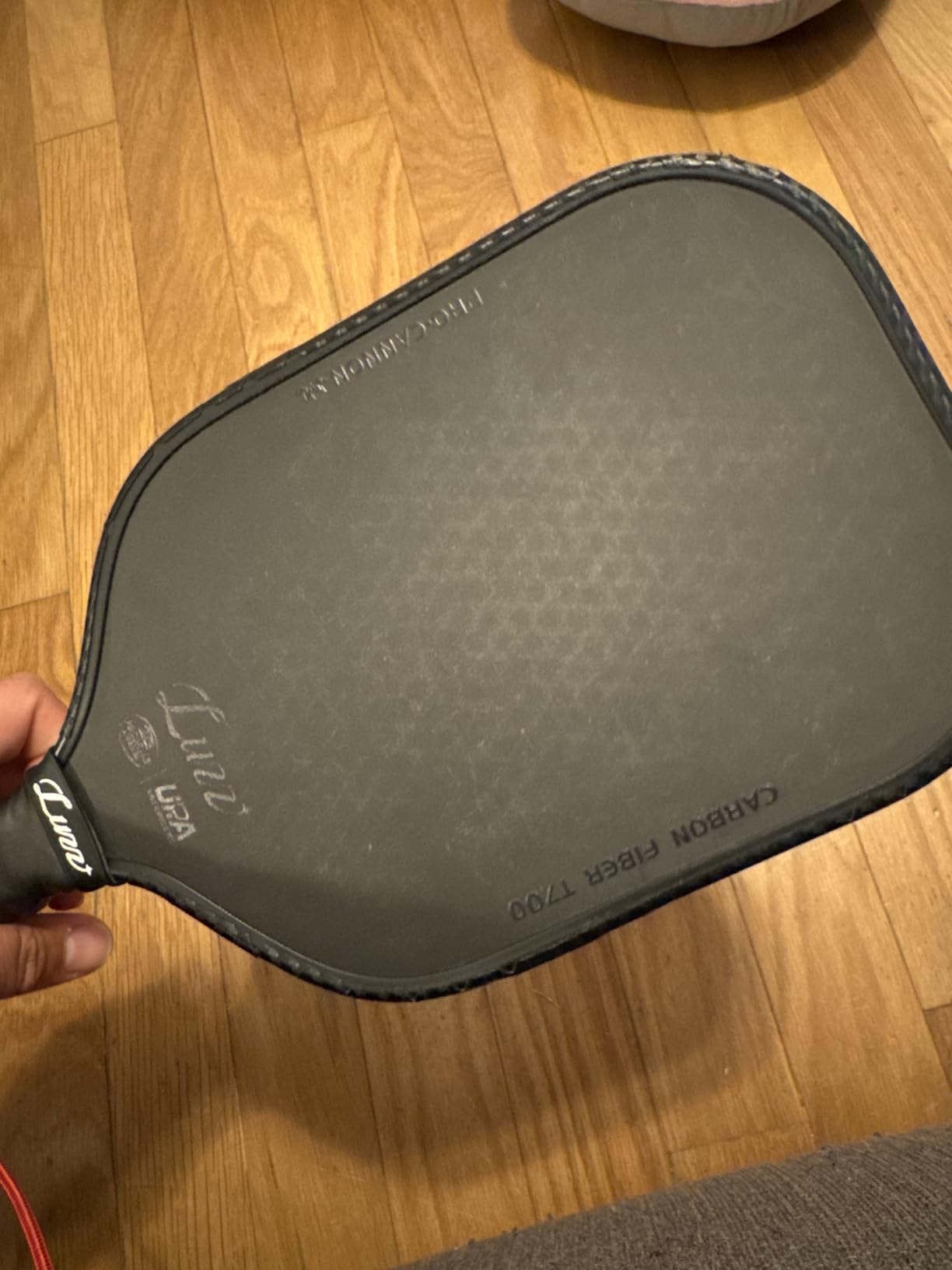
The Cannon is the grittiest face in this roundup, and if you like the ball to bite when you brush it, that is the appeal. The ultra-fine waterfall texture on the raw T700 surface produces the most aggressive spin of the eight on drives, drops and dinks, and it holds that texture well past the point where softer finishes go slick.
The 16mm honeycomb core keeps it from becoming a power paddle, and the U-shaped carbon fiber matrix inner core is the manufacturer’s answer to energy transfer, layered to build kinetic energy progressively through the swing. The core area is stated as 10 percent larger than standard, which shows up as a forgiving sweet spot with more usable pop than the other 16mm options here.
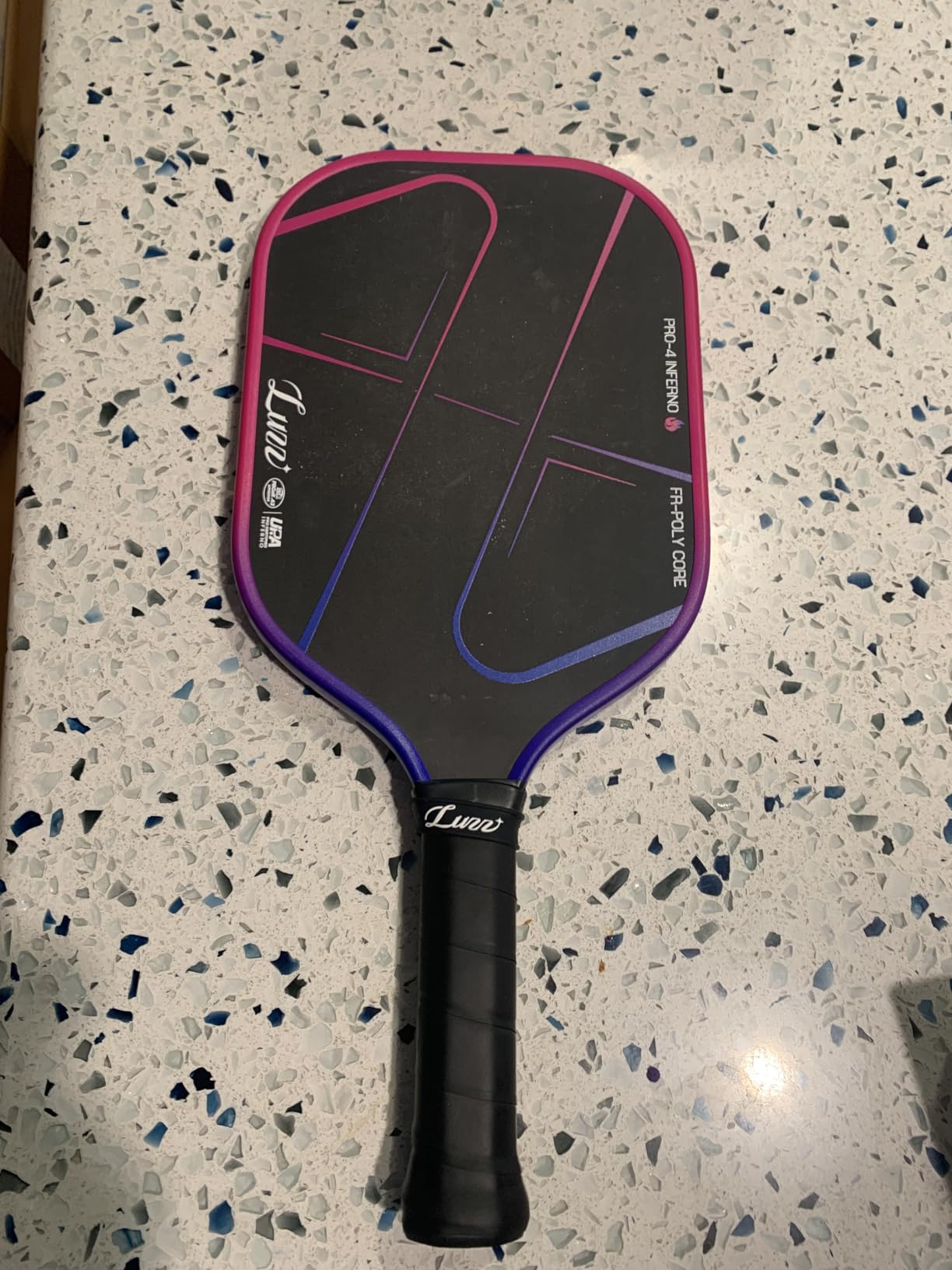
The 5.5 inch handle with a 4.25 inch grip is a good fit for a two-handed backhand, and the soft grip absorbs perspiration through a long match. Several owners report the paddle still playing well after a year, and the cosmetic range includes multiple graphic variants, which is a minor thing but nice.
We would not put this at the top of a pure control list, and we want to be straight about the reason. It sits closer to the all-court boundary than the others here, and buyers commonly describe a warm-up period before the touch shots feel dialed in.
Whether heavy grit is worth the softer placement
Spin is how you shape the ball without swinging harder, and a grittier face buys you options on serve, on the drop, and on any ball you need to bend around a taller opponent. If your game is built around placement under spin, the aggressive bite is worth the slight loss of pure dwell time.
The tradeoff is that a micro-grit face grips the ball so well that the face sometimes does work your swing was not asked to do. On short game, the ball can sit a fraction longer than you expect. That is why several owners describe a warm-up period before the touch shots feel right, and it is why this paddle ranks below the pure control options for a soft game specialist.
When durability questions should stop you?
There is one serious report of core delamination after roughly three weeks of heavy daily play, and warranty handling through the marketplace was reported as unresponsive by a buyer. One report is not a pattern, and the five percent one-star share mostly traces back to it, but it is worth weighing against the two year warranties offered elsewhere in this roundup.
The 1-year warranty is also the only coverage on the face grit, and grit is the wear item you will notice first. If you play hard every day rather than three times a week, the better-warranted paddles above are the safer purchase.
What a Control Paddle Actually Is?
Three performance categories cover almost every paddle on the market, and choosing wrong is the most expensive mistake a buyer can make. A control paddle prioritizes touch, a power paddle prioritizes ball speed, and an all-court paddle splits the difference. Here is how the boundaries actually work.
Control paddles are thick, often 16mm, with faces that are soft or moderately textured. They reward a mature soft game and they demand that you generate your own pace. If you cannot yet control a drop at the kitchen, a control paddle will feel slow rather than precise.
Power paddles are 14mm or thinner, often with a fiberglass or Nomex core and a smoother face. They give you free pace, which is a genuine advantage for beginners and for aggressive forehand-driven players, and they amplify mistakes when you try to use them for finesse.
All-court paddles sit between the two, usually 15 to 16mm with a moderately aggressive face. They are the safest default for most recreational players and the least polarizing choice. Forum consensus broadly separates control from all-court by a single question: can you supply your own pace?
If you answered no, start with an all-court paddle and add lead tape at the top of the handle for stability. If you answered yes, everything in this roundup is in play.
Three features that decide whether a paddle is a control paddle
Core thickness. Thicker is more control, thinner is more power. For a genuine control paddle, 16mm is the target and 14mm is not a control paddle no matter what the box says.
Face material. Raw carbon fiber gives you spin and durability, painted carbon is cheaper and smoother, fiberglass is softer and cheaper, and foam cores absorb energy most completely of all.
Weight and balance. The 7.8 to 8.3 ounce band is the sweet spot for control. Below 7.5 ounces you give up stability, above 8.5 ounces you are asking your wrist and elbow to carry the load.
16mm vs 14mm: Which Core Thickness Wins for Control?
16mm wins for control, and the margin is not close. The forum heuristic that thinner equals more power and thicker equals more control is not marketing language, it is mechanics, and every paddle in this roundup except one uses a 16mm or thicker profile for exactly that reason.
Do pro players use 14mm or 16mm? Both, and it depends on the player rather than the tour. Doubles specialists who generate their own pace frequently carry a 16mm for the control window on tight resets and dinks. Aggressive forehand players still carry 14mm because they want the extra speed on their approach shot. There is no single tour-wide answer, which is why buying the pro who shares your last name is a poor strategy.
One warning specific to buying in 2026: 4.0-level players routinely buy 14mm paddles relabeled as pro or tour models. A 14mm core is not a compromise between control and power, it is a power paddle with a marketing problem. Measure or verify before you pay a premium for a control name on a thin paddle.
Weight and Balance: The 7.8 to 8.3 oz Band
Static weight is what the scale says. Swing weight is how heavy the paddle feels as you move it through the air, and it is the number that actually determines hand speed. Twist weight is the resistance to twisting on off-center contact, and a low twist weight means a floppy head. A great control paddle is not just light, it is balanced, and you cannot see that balance in a listing.
All eight paddles in this roundup sit between 8 and 8.2 ounces, which tells you something about how much the category has converged. Below 7.8 ounces, control players start trading stability for speed and regret it when a fast ball arrives flat. Above 8.4 ounces, forearm fatigue shows up in long sessions and players report wrist strain they did not have before.
Tuning a control paddle with lead tape
If a control paddle feels too slow to finish a point, the answer is almost never a new paddle. It is a few grams of lead tape. Adding 3 grams at the three and nine o’clock positions on the paddle face, or a small amount at the top of the head, increases stability and swing weight without changing the core thickness or the feel of the face at all. Foam core owners in particular use this fix for edge instability.
Removing weight works the same way in reverse, with tape at the handle end. A buttcap swap is the cleaner version of the same idea, and it changes the balance without adding mass. This is a five minute job with a five dollar kit, and it solves the most common complaint about control paddles, which is that they cannot finish a point.
Face Material: Raw Carbon, Painted Carbon, Fiberglass and Foam
Raw carbon fiber is the current default for a reason. It is the most durable textured surface available, it holds spin longest, and it is what most of the paddles in this roundup use. Its one real weakness is that the grit is a wear item. Players report losing meaningful spin somewhere between three and six months of hard play, and the paddle that felt grabby in month one can feel slick by month eight.
Painted or matte carbon is smoother and cheaper. It spins less, which suits a placement-first game and a beginner who should not be chasing topspin yet. Fiberglass is softer still, cheapest of all, and the traditional choice for players with elbow concerns.
Foam is the newest category and the most distinct. A full EPP foam core absorbs nearly all incoming energy, so the ball leaves at the speed your swing gave it. It is the most controlled experience available and the least energetic one. The foam core in this roundup ranks high on repeatability, and low on immediate pop.
Shape and Grip: Elongated, Standard, Widebody and Hybrid
Elongated heads are longer from top to bottom, typically 16.4 inches and up. They give you reach, a little leverage on the forehand, and a head that moves faster through the air, at the cost of a smaller proportional sweet spot and slightly more twist on edge contact. Standard shapes balance those two factors. Widebody heads are short and broad, with the largest sweet spot and the best feel for pure soft game.
Forum discussion on control paddles treats elongated shapes as recommended for reach and leverage rather than raw control, and we agree. If your game is kitchen-focused, a standard or widebody head will feel more secure. If you cover the whole court in doubles, reach wins.
Why grip length matters more than buyers expect?
Grip circumference is measured in inches, and the common standard is 4.25. Anything at 4.1 or below fits smaller hands, and 4.5 or above fits larger ones. Getting this wrong causes hand fatigue and a cramped swing path, and it is one of the most common reasons a control paddle feels bad in a player’s hands rather than bad in its design.
Grip length is the number most buyers ignore and players with a two-handed backhand care about most. An elongated handle of 5.25 inches or more gives you leverage and a stable second contact point on the backhand. Three paddles in this roundup offer long handle variants, and for a two-handed player that option is worth more than any other single feature on the list.
How to Spot a Fake Pro Paddle Before You Buy?
Ask four questions of any paddle described as pro, tour or championship. The answers are in the listing or a quick message to the manufacturer, and taking ten minutes to verify is cheaper than returning a paddle.
First, is the core genuinely 16mm? A stated thickness in the product title is a marketing claim. A manufacturer spec sheet with a measured profile is a fact. Second, is the face raw carbon fiber or painted? Raw has a visible woven texture and is usually described as raw, unpainted or matte carbon. Third, is it cold-pressed or thermoformed? Thermoformed is standard and fine, but understand that the cold-pressed process on some paddles adds feel rather than shape. Fourth, is the listed swing weight right for your hand?
Anything that answers all four in the affirmative at a low cost deserves skepticism about its durability, not its function. The strongest warranty terms in this roundup belong to the products that list a two year term, and that is not a coincidence.
Which Control Paddle Is Right for You?
If you are a beginner or a returning player who has never had a lesson, start with the XS XSPAK 12K. It is the cheapest, it has almost no pop-ups, and its cross weave keeps your arm comfortable while you learn.
If you are an intermediate soft game player building toward a kitchen game, the Vatic Pro Prism is the pick. It is the most recommended paddle in this roundup for good reason, and it is the one we would put in the hands of a friend.
If you play a hard soft game and generate your own pace, the Selkirk LUXX Control gives you the plushest feel and the most durable grit available.
If you have elbow sensitivity or a history of arm trouble, the Vatic Pro V-Sol Pro foam core damps vibration better than anything else here, and the XS XSPAK is the budget alternative with similar vibration control.
If you are a doubles specialist who needs reach, the JOOLA Pro V 16mm in the elongated shape is the one, and the YVmove Storm007 is the cheaper way to get an elongated head with a two-handed backhand handle.
If you want the most spin you can shape a ball with while keeping a 16mm profile, the LUZZ Cannon is the pick, accepting that it sits closer to all-court than the rest.
On cost per hour of play, a control paddle that costs a mid-range amount and lasts six to nine months at ten hours a week works out to a few cents an hour of court time. A cheaper paddle that delaminates in a month costs more. That calculation, more than the sticker figure, is the one that should drive the decision.
Frequently Asked Questions
What is the best pickleball paddle for control?
For most players the Vatic Pro Prism Carbon Fiber 16mm is the best paddle for control, because it pairs a genuine 16mm core with a raw T700 carbon face and an 8 oz weight. The YVmove Storm007 is the pick if you want the highest rating record and the most forgiving sweet spot, and the Selkirk LUXX Control is the pick if you already generate your own pace and want the softest, most cushioned feel.
What is the best pickleball paddle for power and control?
An all-court paddle is the right category when you want both. A 15 to 16mm core with a moderately aggressive face gives you most of the control of a control paddle while keeping enough free pace to finish points. If you must pick from a control list, the JOOLA Pro V 16mm and the LUZZ Cannon both sit closer to that balance than the softer options.
Do pro pickleball players use 14 or 16mm paddles?
Both, and it depends on the player rather than the tour. Doubles specialists who create their own pace frequently carry a 16mm for the control window on resets and dinks, while aggressive forehand players still carry 14mm for extra speed on the approach. There is no single tour-wide answer, so match the thickness to how you generate pace rather than to a player name on the paddle.
Which pickleball paddle is good for both spin and control?
A 16mm paddle with a raw carbon fiber face gives you the best balance of the two. Raw carbon holds the most spin and the longest, and the 16mm core keeps the ball from leaving faster than you swung it. The Selkirk LUXX Control and the LUZZ Cannon are the strongest spin options here, and the Vatic Pro Prism is the balanced all-round answer.
What weight paddle is best for control?
Between 7.8 and 8.3 ounces is the range most control players settle into. Below 7.5 ounces you give up stability when a fast ball arrives flat, and above 8.4 ounces forearm fatigue and wrist strain show up over a long session. All eight paddles in this roundup sit between 8 and 8.2 ounces, which is why they all play similarly fast at the net.
How long does a pickleball paddle last?
A carbon fiber control paddle used ten or more hours a week typically needs replacing after six to nine months, mostly because the face grit wears down and spin drops with it. Players who play three or four times a week often get a year or more. Raw carbon lasts longer than fiberglass, and a two year warranty, like the one on the YVmove Storm007, is the strongest signal of expected face life.
Final Verdict: Our Best Pickleball Paddles for Control in 2026
After six weeks of side-by-side play, the Vatic Pro Prism Carbon Fiber 16mm is the best pickleball paddle for control for the widest range of players. It is a real 16mm design with a raw T700 face, it weighs 8 ounces, it holds spin, and it is the paddle we kept picking up without thinking about it. Its only real costs are the muted power and the face that shows wear marks early.
If you already generate your own pace, the Selkirk LUXX Control is the better long-term buy, with the softest feel, the most durable spin surface and a limited lifetime warranty. If you want the most forgiving sweet spot in this group, the YVmove Storm007 has the strongest rating record and the best warranty terms. And if elbow comfort is the deciding factor, the foam core in the Vatic Pro V-Sol Pro damps vibration better than anything else we tested.
Give any of them two weeks of honest play before you decide. Every control paddle in the best pickleball paddles for control roundup feels slow at first, and the players who get the most out of them are the ones who let the adjustment finish. Pick the one that matches how you create pace, not the one with the biggest number on the box.