
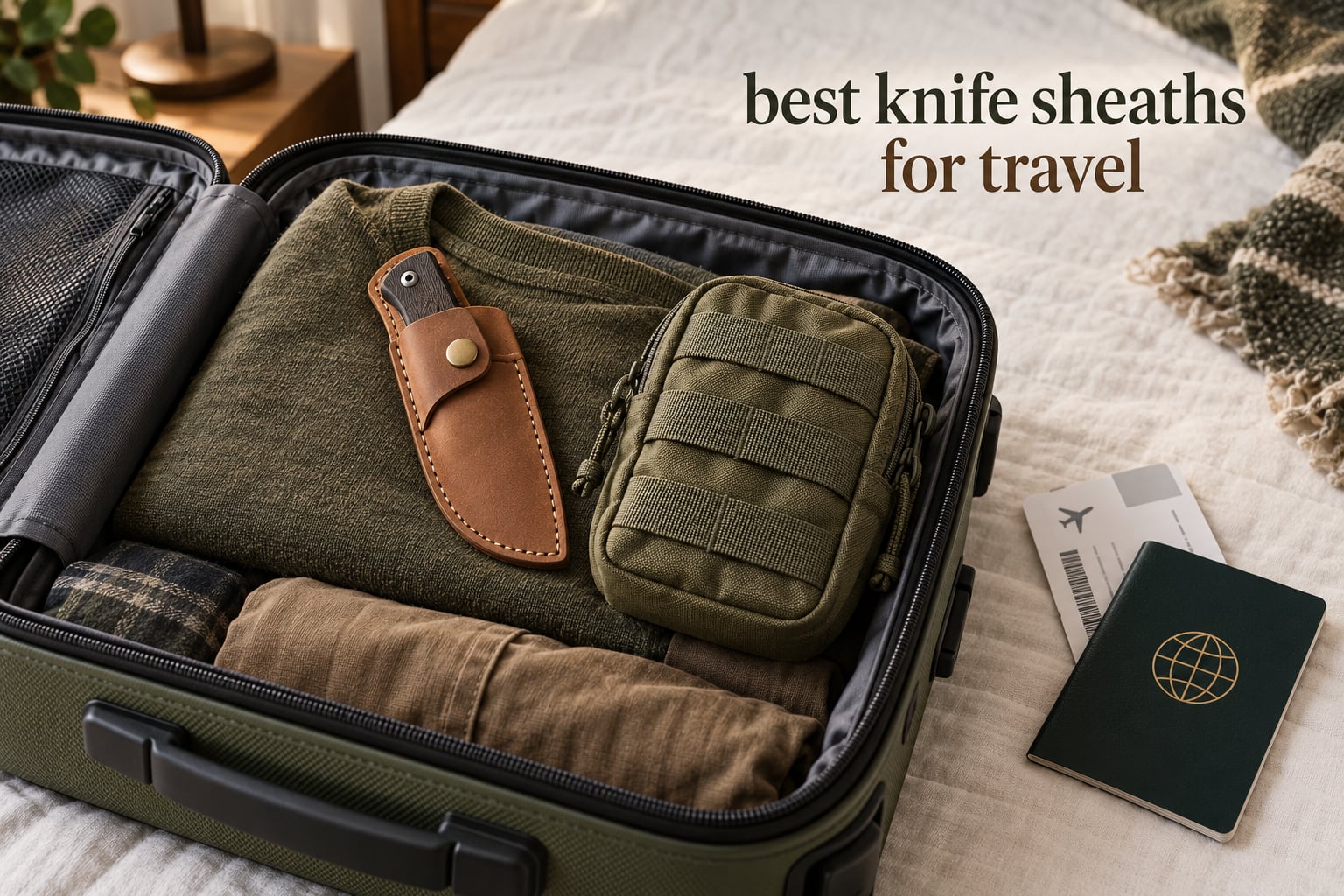
Most travel knives arrive with a thin fabric slip that does one job badly. It stops the edge from nicking other gear, then it stops doing that after a month. The best knife sheaths for travel do more: they keep a carbon steel blade from pitting in a damp bag, they pack down flat enough to sit in a laptop sleeve, and they meet the rule that sharp objects in checked luggage must be sheathed or securely wrapped.
We spent weeks with these ten sheaths in carry-on bags, duffels and checked cases to find out which ones actually survive transit. What came back was a clear split. Leather wins on edge protection and breaks in to your exact knife. Nylon wins on weight, water resistance and how quietly it packs. Nothing in this roundup is a hard case, because a hard case eats more volume than the knife it protects.
A few ground rules before the list. First, in the United States a knife of any kind cannot go through TSA screening in a carry-on, sheath or no sheath. If you want to fly with a blade, it goes in checked luggage, sheathed. Second, the sheath matters less to the officer at the podium than it does to the integrity of your bag, because an unsheathed point will eventually find its way through nylon. Third, arrival rules are not the same as departure rules. TSA covers the airport in the US, and customs in the country you land in sets its own import conditions for knives.
We also kept the whole list honest about fit. Several of the strongest budget sheaths are made for one knife size, and a universal-fit sheath that rattles is worse than a tailored one that does not. Every entry below states the blade length or closed length it takes, so you can measure before you order. If you plan to sharpen at your destination, you will also want to read our belt grinder guide before you pick a steel that will not respond to it.
Table of Contents
Top 3 Best Knife Sheaths For Travel (October 2026)
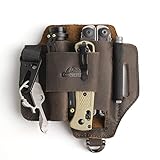
Topstache Leather Multitool Sheath
- Five leather compartments
- Belt and rear stabilizer loop
- Weighs 3.2 oz

WYNEX Tactical MOLLE Pouch
- 600D water-resistant nylon
- MOLLE straps and bungee cords
- Two-way zipper

Omesio Leather Folding Knife Case
- Fits folders up to 4.53 inch
- Quiet metal snap flap
- Dual-direction belt loop
All 10 Knife Sheaths for Travel Compared in 2026
| Product | Specifications | Action |
|---|---|---|
| Topstache Leather Multitool Sheath |
|
Check Latest Price |
 Gentlestache Horizontal Knife Sheath Gentlestache Horizontal Knife Sheath |
|
Check Latest Price |
| WYNEX Tactical MOLLE Pouch |
|
Check Latest Price |
 COHOMELARS Fixed Blade Leather Sheath COHOMELARS Fixed Blade Leather Sheath |
|
Check Latest Price |
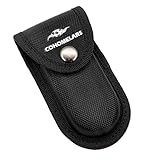 COHOMELARS Nylon Multitool Belt Sheath COHOMELARS Nylon Multitool Belt Sheath |
|
Check Latest Price |
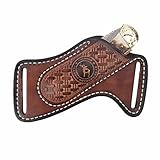 TOURBN Leather Folding Knife Sheath TOURBN Leather Folding Knife Sheath |
|
Check Latest Price |
 Timsec Oxford Cloth Sheath Timsec Oxford Cloth Sheath |
|
Check Latest Price |
 Kitory 6 Inch Boning Knife Sheath Kitory 6 Inch Boning Knife Sheath |
|
Check Latest Price |
| Omesio Leather Folding Knife Case |
|
Check Latest Price |
 Hulara Handmade Leather Scabbard Hulara Handmade Leather Scabbard |
|
Check Latest Price |
TSA and Airline Rules for Flying With a Sheathed Knife
The short version: no knife in carry-on, any sheath or none. The TSA’s carry-on list does not contain exceptions for folding knives, multitools with blades or kitchen knives, and a sheath does not change that outcome at the checkpoint. Every sheath in this roundup is designed for checked baggage, checked sporting equipment cases or ground transport.
In checked luggage the TSA’s guidance is that sharp objects must be sheathed or securely wrapped. That single sentence is the entire legal reason a sheath matters on a trip. It is not about the officer finding your knife. It is about a chef knife sitting loose in a roller bag pressing a hole through the lining into whatever is beside it, and about the blade edge taking a chip from a drop onto tile at the carousel.
How to carry a knife while travelling, step by step: wipe the blade dry, coat it lightly with a food-safe oil, seat the knife fully in the sheath, run a wrap or tape around the sheath if the retention is friction-only, place that inside a zip bag for humidity, and place the zip bag in the middle of your suitcase surrounded by clothing. Middle placement means a dropped bag lands on padding rather than on the point.
One more thing the airport guidance does not cover. When you land, the destination country’s customs authority applies, not the TSA. Several countries restrict the import of knives outright, others limit blade length or restrict hunting knives specifically, and some require you to declare them at the border. Declare it. An undeclared fixed blade discovered at an international arrival is a far bigger problem than a checked-bag knife is at departure.
For knife collections travelling as gear, our butcher knife set guide covers the blade sizes that most often cause packing problems.
1. Topstache Leather Multitool Sheath – Best All-Round Travel Organizer
Topstache Leather Multitool Sheath,EDC Belt Organizer for Work and Daily Use,Leatherman Sheath,EDC Pocket Organizer for Flashlight and Multitool,Gifts for Men for Multitool,Darkbrown
Crazy horse natural leather
6.2 x 5.8 x 1 inches
3.2 oz
Fits belts up to 1.8 inch
Pros
- Five compartments hold a multitool
- folding knife
- flashlight
- pen and keys
- Extra rear belt loop spreads the load
- High back panel keeps tools off your skin
- Finger hole gives fast access to the multitool
Cons
- Roomy Leatherman slot until the leather forms
- No retaining clip so it can slide off an unfastened belt
- Mismatched hardware finishes
This is the sheath we ended up packing for every trip. It is built from 100 percent crazy horse natural leather with tight stitching, and the five compartments swallow an entire EDC load rather than just one blade. On our trips it carried a folding knife, a multitool, a pen, a small flashlight and the car key, which meant one object in the bag instead of four.
The detail that matters for travel is the rear stabilizer belt loop. A single-loop leather sheath with a multitool in it pulls the belt down and twists, which is uncomfortable after four hours in a seat. The second loop spreads that across two points of contact and it stayed put through a long-haul day.
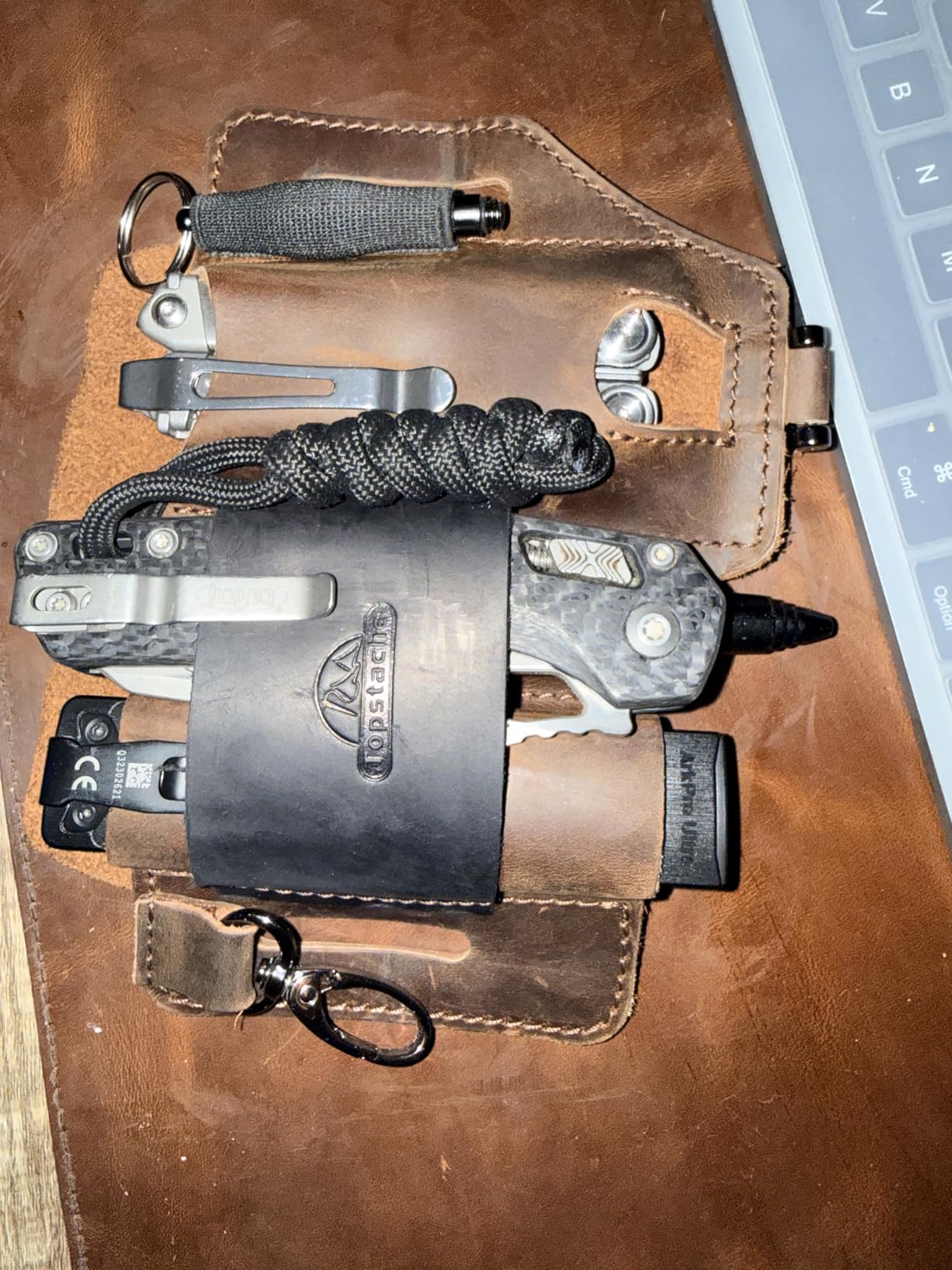
Fit is the one thing to plan around. The multitool pocket fits Leatherman Signal, Rebar, Surge, Charge, Wingman, Free P2 and Wave models, but the larger ones sit loose on day one. That resolves itself within about two weeks as the leather takes the shape, and by the third week the tool does not move at all when you walk.
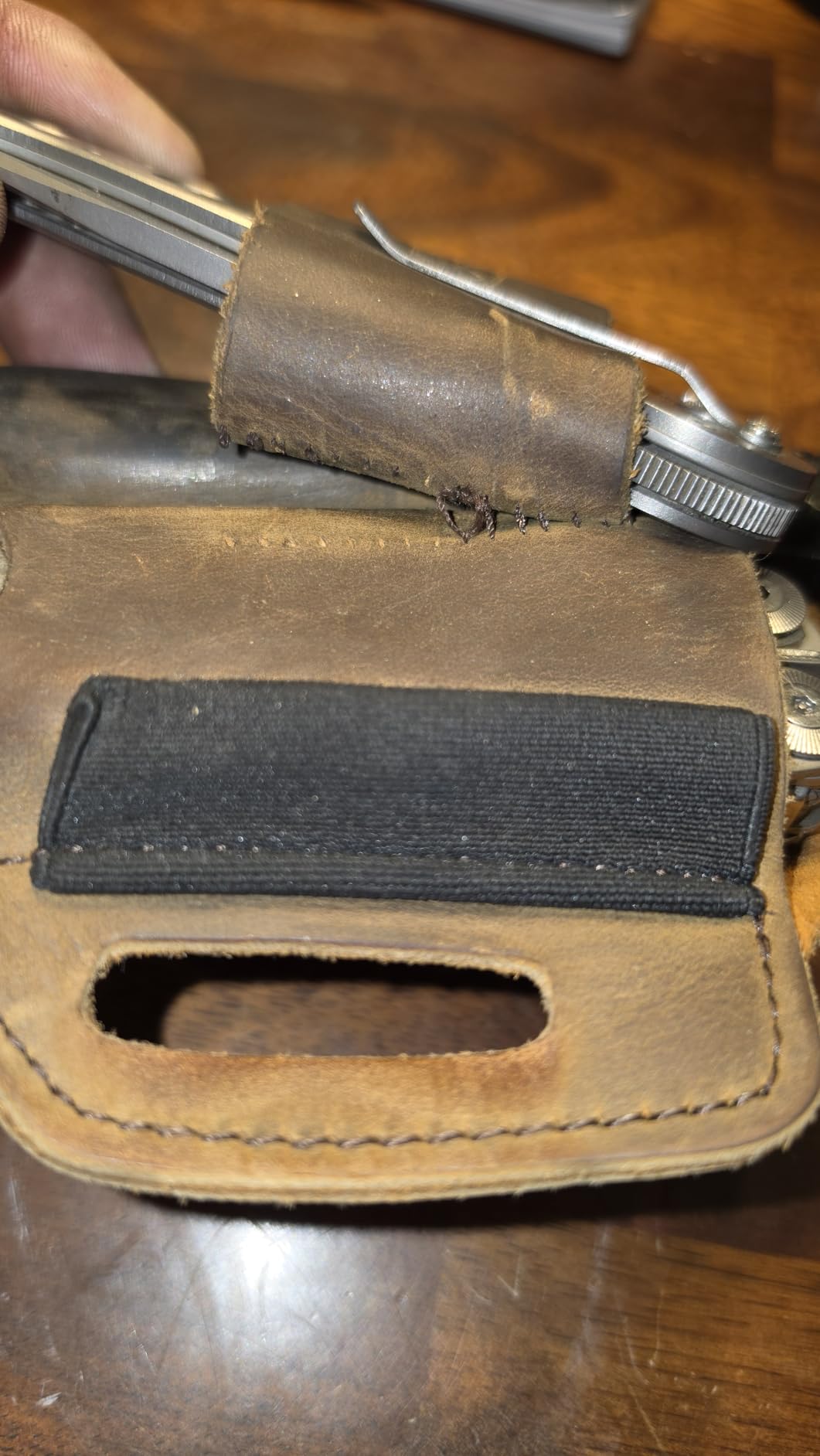
There is also an elastic band for extension kits and a logo band sized to hold a clipped folding knife separately from the multitool. That separation is what keeps a pocket clip from catching on the tool next to it and dulling the clip tip.
Who this sheath suits?
Anyone flying who wants one object to hold the whole load. It is also the right pick if your kit includes a multitool rather than just a blade, because a dedicated multitool sheath has somewhere to put the pliers and drivers that a knife-only sheath forces you to carry loose.
The leather also handles wet conditions better than its reputation suggests. Crazy horse leather is heavily oiled in the tan, so it shrugs off a wet t-shirt and dries without going stiff, which is the opposite of what vegetable-tanned sheath leather does in a damp checked bag.
If your work involves restoring or making knives, the same organizer logic applies to a small tool roll, and our propane forge guide covers the kit most makers already own.
Where it falls short?
There is no retaining clip. Sit down with your belt open and the organizer can slide off your hip, which owners report more often than anything else. We have never lost one, but we have caught it twice.
The leather is thin enough that a minority of buyers question whether it suits heavy trade work, and the metal hardware finishes do not match each other exactly, with a black carabiner sitting next to a chrome loop. Purely cosmetic, but noticeable at close range.
The multitool pocket is also a fit-by-model design. If your tool is not in the named list, check the slot dimensions before you order rather than trusting the category.
2. Gentlestache Horizontal Knife Sheath – Best Minimal Leather Slip
Gentlestache Horizontal Knife Sheath for belt EDC Compact Draw Knife Holster Dark Brown
2 mm natural leather
Blades up to 4 inch
1.8 oz
Fits 1.5 inch belts
Pros
- Genuinely light at about 0.15 lb
- Curved profile sits tight to the belt
- Wears horizontally or vertically
- Open top gives a fast one-handed draw
Cons
- Open top means friction-only retention
- Will not take blades longer than 4 inch
- Belt loop is narrower than most modern belts
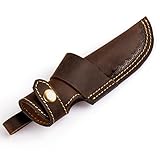
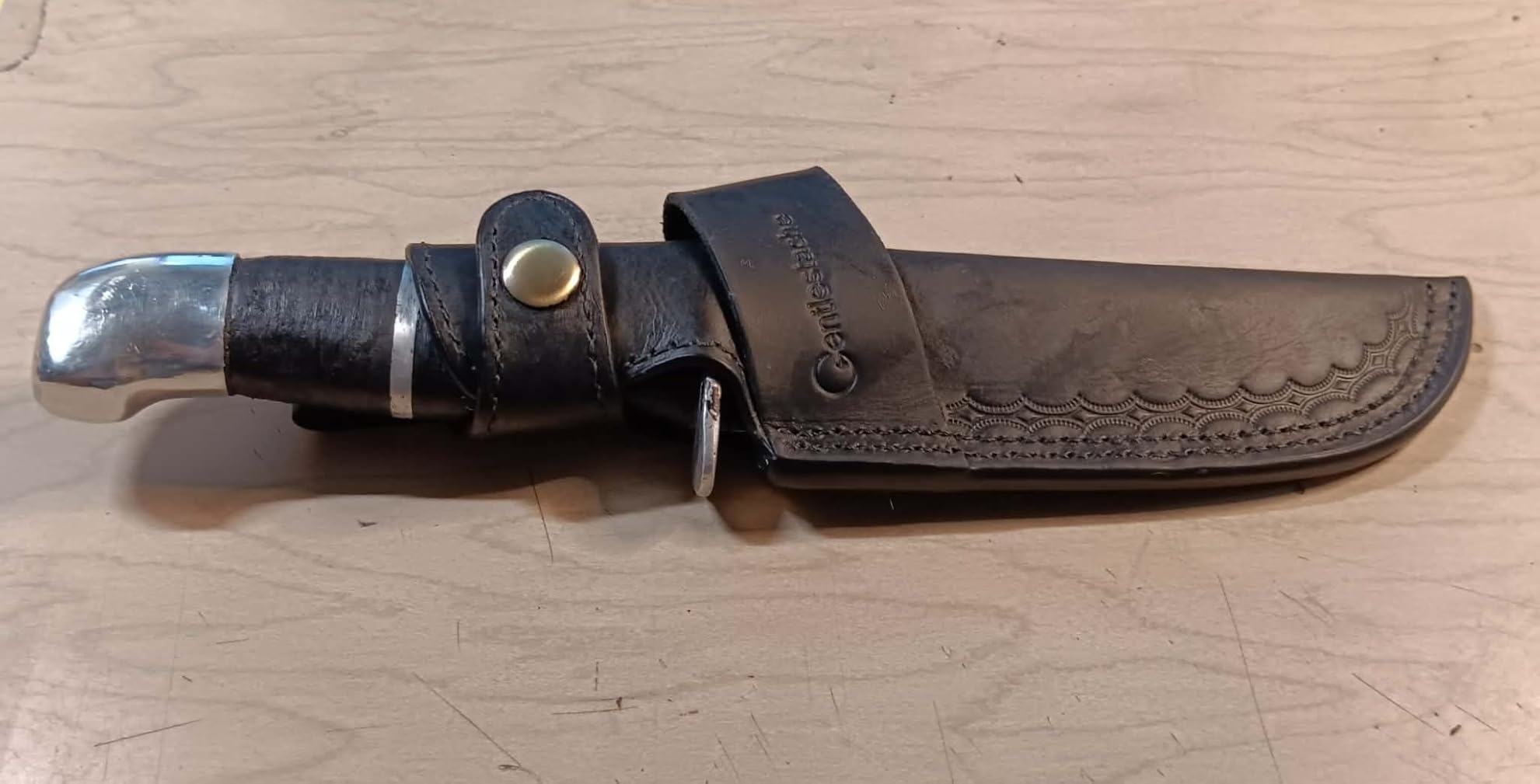
This is the sheath for a small folder on a day trip, not a fortnight in the air. At roughly 0.15 lb, lighter than every other entry here, the curved body means it barely registers on a belt under a shirt.
Construction is straightforward: 100 percent natural leather at 2 mm, an open top, a single slip pocket and a 1.5 inch belt loop. The open top is genuinely a one-handed draw, which is why people who carry it on a belt every day like it, and genuinely no retention at all if you invert.
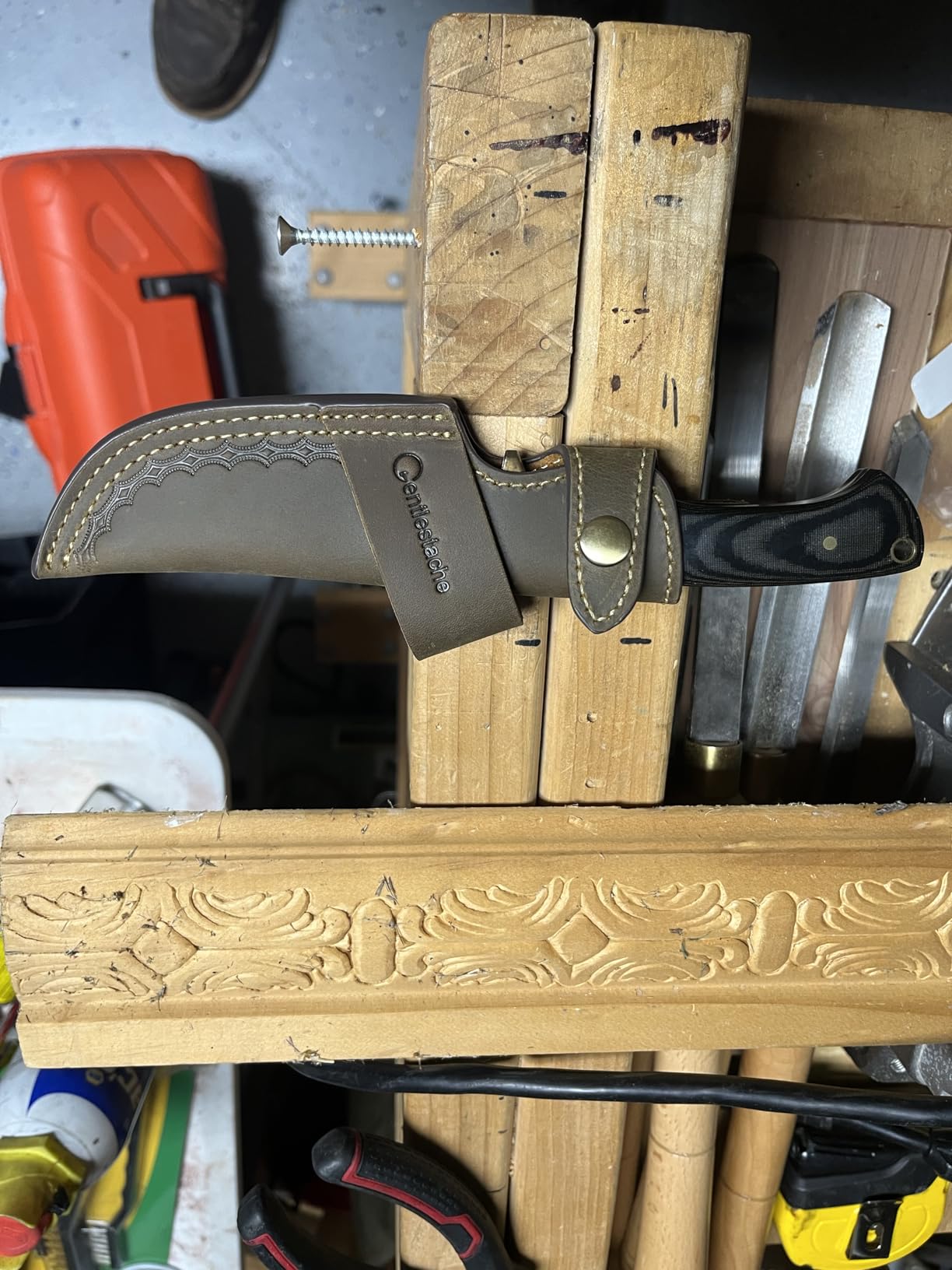
For checked travel it does its job as a protective sleeve rather than a retention device, because in a bag the knife is held by the surrounding clothes and the sheath is there to protect the edge and stop the point finding the lining. That works well.
The 4.2 average rating across 1025 reviews reflects exactly where it struggles, and reviewers are consistent about it: the size ceiling and the unsecured mouth. A larger share of one-star and two-star ratings comes from buyers expecting it to swallow a medium folder.
Who this sheath suits?
A traveller carrying one small folder and nothing else, or someone who wants a belt sheath that disappears under a jacket. The horizontal wear option is useful on a jacket belt where a vertical sheath would sit awkwardly.
It is also a good secondary sheath. If your main kit is a folder and a multitool, this carries the folder while a nylon belt pouch carries the multitool.
If your belt runs thick, check the loop width first. A 1.5 inch loop fits most dress belts and a lot of modern casual belts, but it is tight on wide outdoor or climbing belts.
Where it falls short?
Friction-only retention is the main limitation. On a belt while walking upright the blade stays put, but in a bag, a pocket that gets inverted, or a climb, you should add a wrap.
The 4 inch blade ceiling is hard. It will not take a fixed blade, a tactical folder, or anything with a longer handle, and no adjustment is offered. The 4.2 average is the second-lowest in the group for that reason rather than for build quality.
Open top also means no protection against the handle of a knife with a pocket clip prying the mouth open under pressure in a tightly packed bag.
3. WYNEX Tactical MOLLE Pouch – Best Value Nylon Protection
WYNEX Tactical Small Molle Pouch Nylon Knife Sheath for Belt Hunting Gear
600D water-resistant nylon
8 x 2.8 x 1.4 inch small
1.8 oz
MOLLE strap attachment
Pros
- Elastic straps and bungee cords stop the tool shifting
- Water and abrasion resistant 600D shell
- Attaches to belts
- vests and backpacks
- Doubles as a general utility pouch
Cons
- Included foam is packing material with no protective value
- Nylon is thinner and softer than buyers expect
- Two-way zipper can snag
The highest-rated sheath in this roundup at 4.6, sharing top rating with the TOURBN leather model, across 860 reviews, and the one we recommend when the trip involves water. Nylon does not care about rain, condensation or a dropped bottle, and the MOLLE straps mean it can live on a backpack rather than in a pocket.
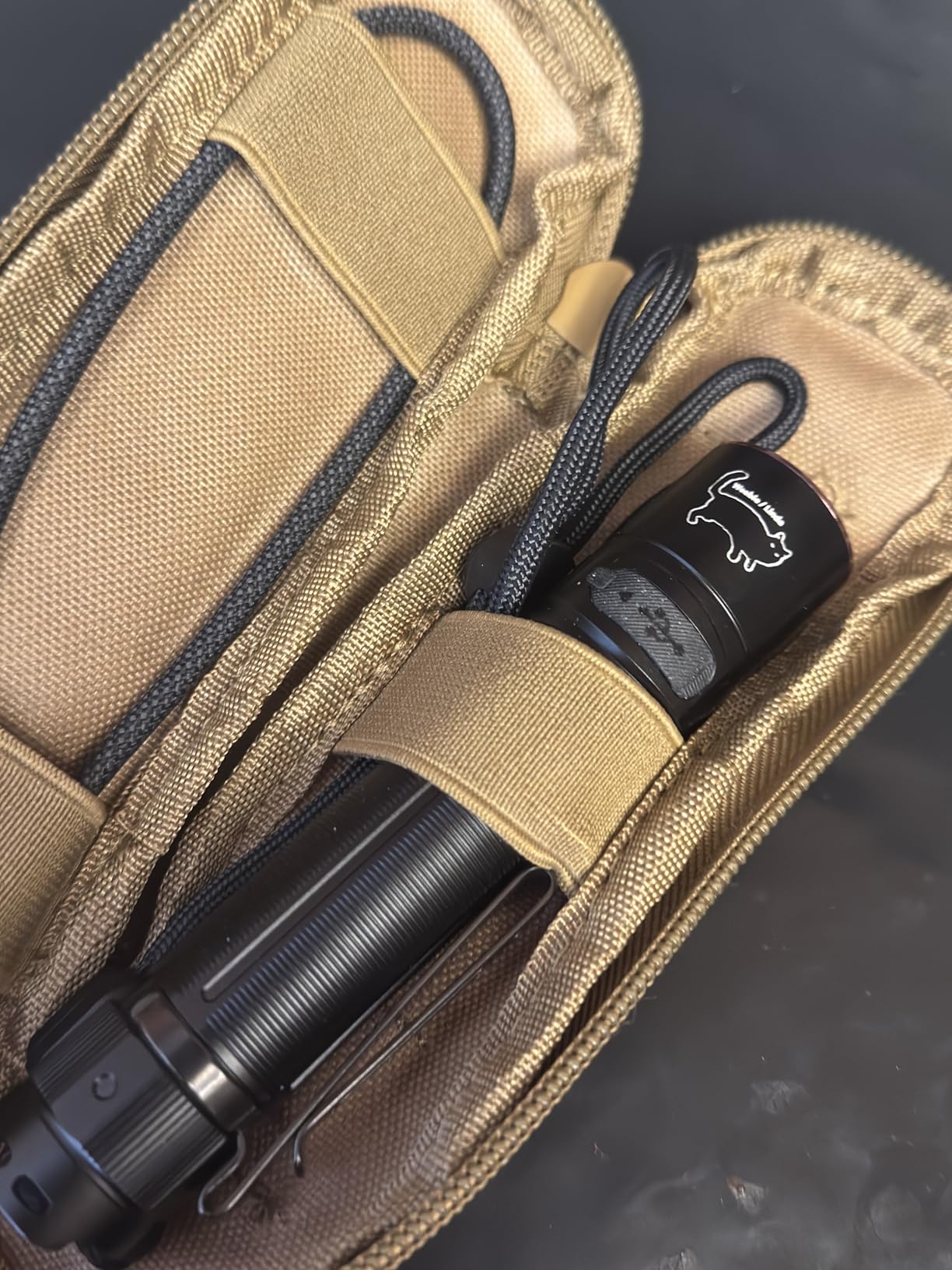
Retention is the part that matters on a knife. The internal elastic straps plus the front bungee cords hold a knife or flashlight against the back panel so the point cannot find the outer fabric, which is the failure that turns a cheap roll into a hole in a duffel.
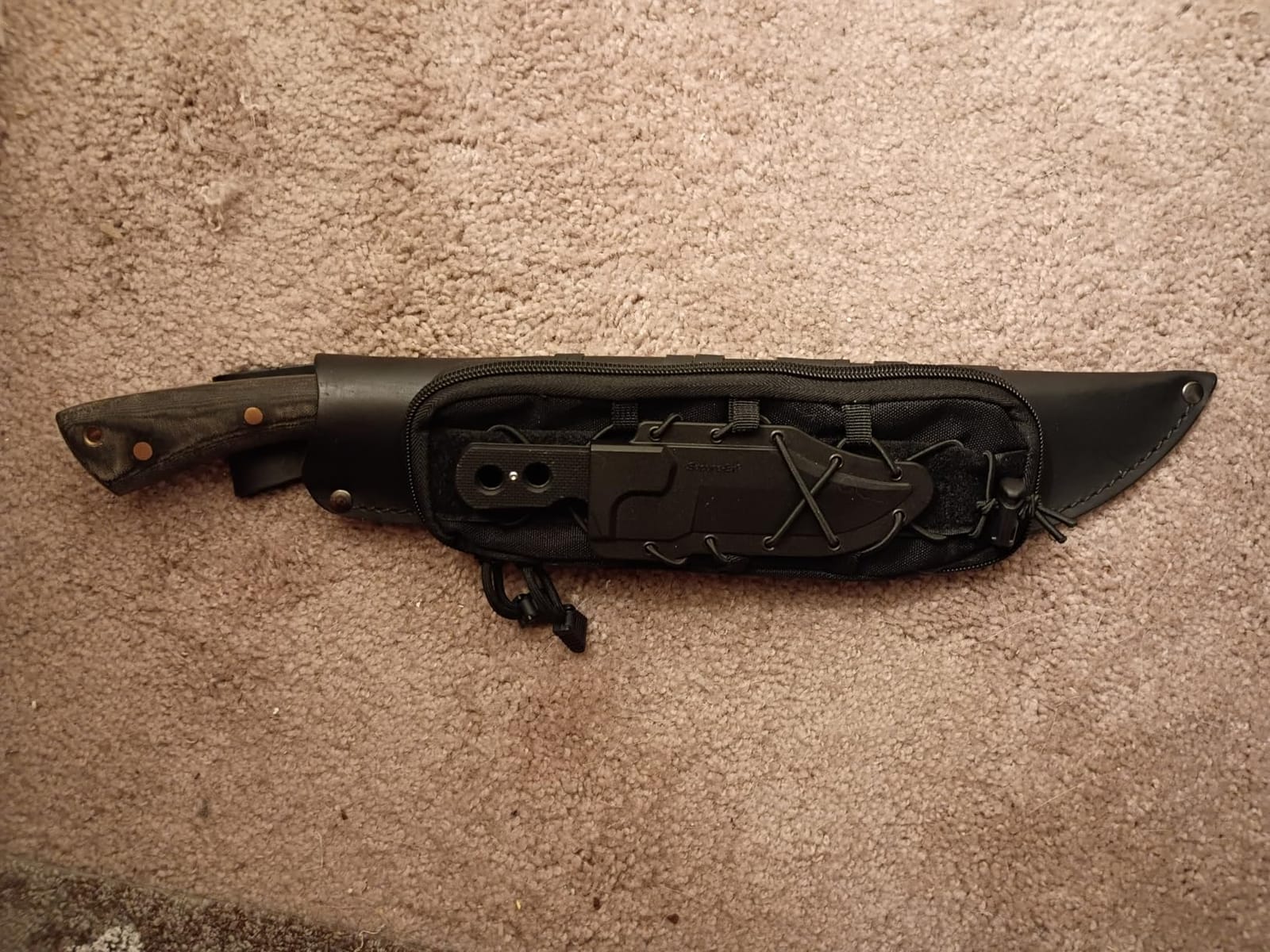
The small version measures 8 by 2.8 by 1.4 inches and takes a small folding knife or torch. The large version at 10.5 by 3.5 by 1.2 inches takes a fixed blade. Both run on the same MOLLE attachment and the same two-way heavy duty zipper, and the front hook-and-loop panel takes a patch if you want to mark the contents.
One thing to know before you rely on it as a knife case: the foam insert in the middle is display padding. The product details are explicit that inserts are packing material, and buyers repeat that they offer no impact protection. The 600D shell is abrasion and water resistant, not rigid.
Who this sheath suits?
Hikers, overlanders and anyone whose bag gets rained on. It is the pick for a knife that lives on the outside of a pack, where it is reachable without unpacking and where nylon noise does not matter.
It is equally good as a general utility pouch. Owners use it for compasses, ferro rods, small torches and survival items, and if you carry two tools the elastic and bungee arrangement handles both.
For an overland build, our beginner belt grinder guide covers the sharpener that pairs with a knife kept this accessible.
Where it falls short?
It is a pouch, not a hard case. If your knife lands under a seat or in a pile of gear, the shell will stop abrasion but it will not stop a concentrated hit to the tip. For that you want a rigid sheath or a hard case.
Some owners find the nylon thinner and less rigid than expected for the money, and the zipper catches occasionally on the corner seam when it is loaded to the top.
There is also a practical warning buried in the reviews: the snap studs on the inside are exposed, and they can melt if you clip a heated tool or a ferro rod to a hot sheath. Keep burning gear out of it.
4. COHOMELARS Fixed Blade Leather Sheath – Best for Straight Hunting Blades
COHOMELARS Fixed Blade Knife Sheath Fits up to 8 Inch Blade,Leather Knife Sheaths Knife Holder Hunting Knife Sheath,Straight Sheath Brown
Genuine leather
Blades 6.6 to 7.9 inch
Up to 1.4 inch wide
Snap button retention
Pros
- Thick needle stitching built for long-term wear
- Single-rivet design reduces breakage points
- Conch button snap holds a fixed blade secure
- Fits straight blades in a defined size range
Cons
- Limited to blades 1.4 inch wide or less
- Straight-fit design will not suit curved or wider blades
- No adjustment for different handle sizes
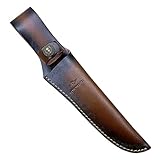
A fixed blade changes the sheath problem entirely. A folder in a loose slip is an inconvenience. A six-inch straight hunting blade rattling in a checked bag is a point finding the outer shell. This sheath is built for exactly that case.
It takes straight knives from 6.6 to 7.9 inch measured from the guard, with blades no wider than 1.4 inch, and it closes with a lion crest conch button. The retention is positive rather than friction-based, so you can invert the sheath in a bag and the blade stays put.
The construction is deliberately minimal: one rivet and thick needle sewing. Fewer penetrations through the leather means fewer places for a seam to open, and buyers who have used it long term report the stitching still holding. The leather is genuine rather than a coated synthetic, which matters on wet trips because coated synthetics peel at the crease.
Weight is not stated by the manufacturer. Hand orientation is listed as ambidextrous, which just means the draw works from either hand rather than that the sheath rotates.
Who this sheath suits?
Travellers with one straight fixed blade, usually a hunting or camp knife, who want something that will not let the tip move. If that is your only blade, this is a strong pick because the snap closes over the handle.
It is also the right choice for a vehicle. A fixed blade that lives in a centre console or a rucksack side pocket benefits from positive retention far more than a folder does.
For anyone moving to a different blade width, note the ceiling. A 1.4 inch limit is narrow enough that many modern tactical and bushcraft blades will not fit, and the listing title mentions up to 8 inch blades while the specified range is 6.6 to 7.9 inch. Measure before you order.
Where it falls short?
There is no adjustment. Fit is fixed to a straight profile within a narrow width range, so a curved blade, a wide blade or a handle of a different length will not seat properly. Owners confirm this as the main limitation in reviews.
Leather still holds moisture. On a multi-week trip with a carbon steel blade, wipe the blade dry, coat it, and take the sheath out of the bag at night rather than sealing a damp blade inside it for a week.
And the care instruction is hand wash only, with no machine cycle and no tumble dry. A leather sheath that gets soaked in a wash cycle will stiffen and shrink.
5. COHOMELARS Nylon Multitool Belt Sheath – Best Factory-Sheath Upgrade
Nylon Case Belt Loop for 4”-4.25” Multitool,Horizontally Carry Knife Sheath for 4.25”-4.5” Wide Folding Pocket Knife,Nylon Pouch for Leatherman,Knife Holder Holster Black (Small Size) COHOMELARS
Nylon snap closure
4.5 by 1.6 by 0.875 inch
30 g
Belt loop or backpack strap
Pros
- Snug tailored fit for Leatherman and Gerber multitools
- Snap closes better than most factory cases
- Wears horizontally or vertically
- Very light at 30 g
Cons
- Belt loops fray with heavy daily use
- Light nylon gives almost no crush protection
- Single-point snap rather than two-point
Most multitools come with a thin slip that folds flat and holds nothing. This is the direct replacement for that, and at 30 g it adds nothing measurable to a packed bag. Reviewers consistently describe it as a step up from the case that came with the tool.
Internal capacity is 4.5 by 1.6 by 0.875 inch, which takes multitools of 4 to 4.25 inch and folding knives up to 4.5 inch closed. It is offered in small, large and paired sets, so if you carry a compact folder and a full-size multitool you can buy both and match each.
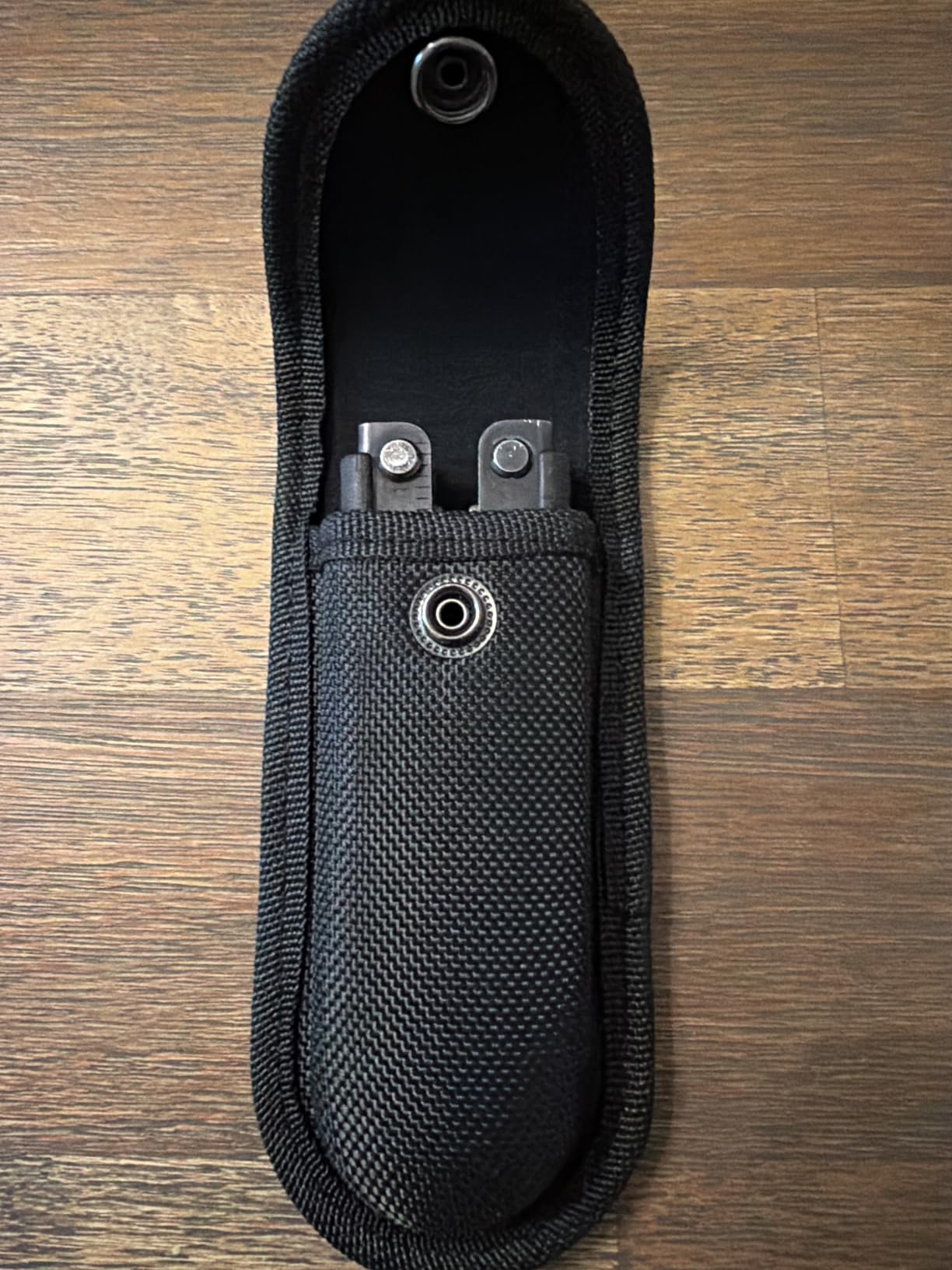
Retention is a snap closure with reinforced stitching, and the fit is tight enough that the tool does not slide out on the draw. The belt loop works in either orientation, and owners note it can also be run over a backpack strap when you do not want it on a belt.
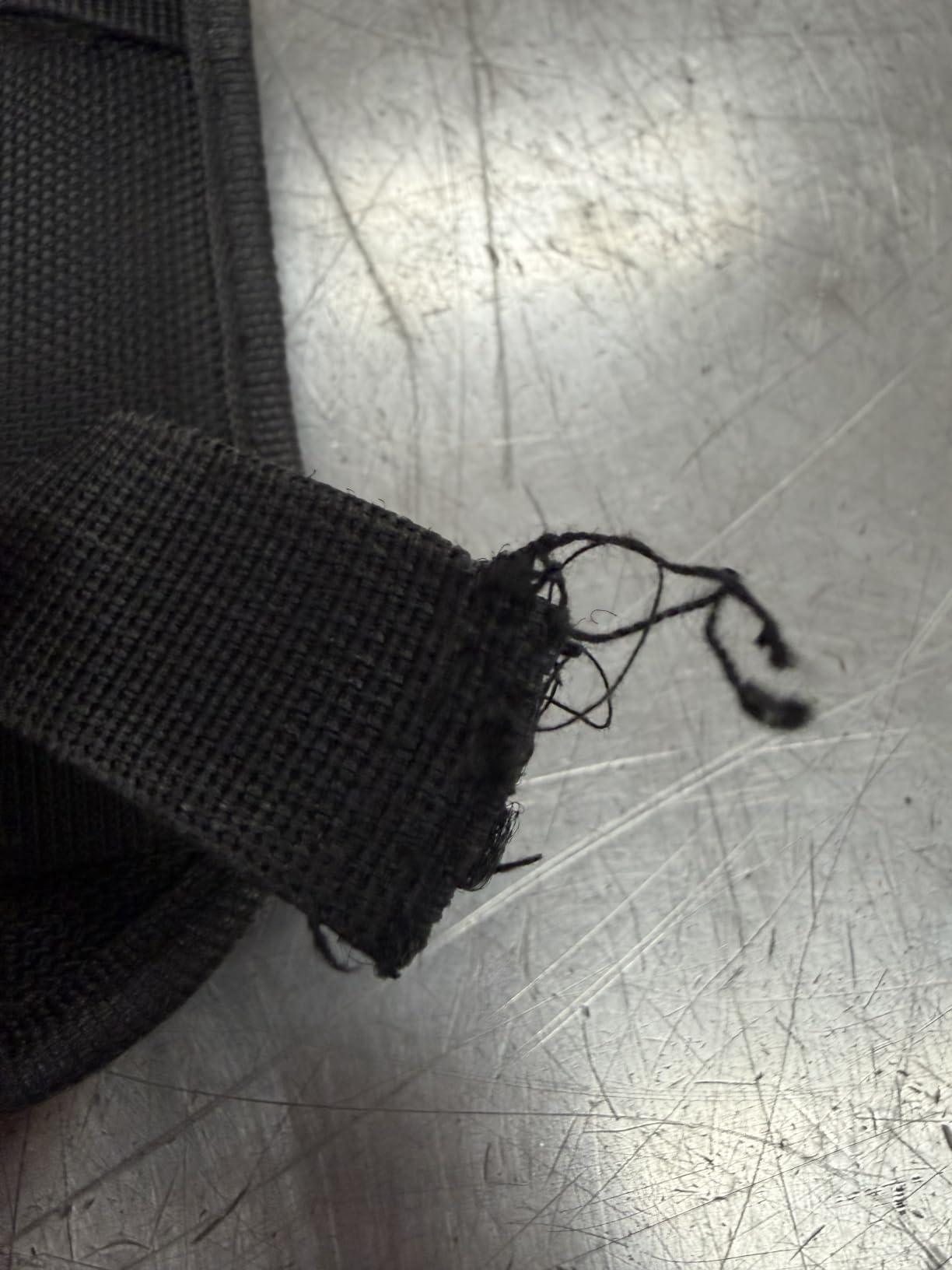
The weakness is the loop itself, not the pouch. Several owners report the nylon belt loops fraying after months of daily wear, and one report of the vertical loop breaking after about a month. If you wear it every day, expect to replace the loop or stitch it rather than expect it to last years.
Who this sheath suits?
Travellers who carry a Leatherman or Gerber multitool and are using the flimsy factory pouch. The step up in fit and closure is immediate and costs very little.
It also works as a carry-on companion piece. If the multitool itself is going in checked luggage, this keeps it with the rest of your EDC kit rather than loose, and the light weight means no packing decisions.
Anyone with a slim folder under 4.5 inch gets the same benefit. Just confirm the width, since the internal width of 1.6 inch is the binding dimension on larger handles.
Where it falls short?
There is no rigid structure. Lightweight nylon gives you abrasion resistance and a snap closure, not crush or impact protection. Do not treat it as a hard case for a checked bag.
The single-point snap is a small design compromise. Two-point snaps do not gape when the pouch is compressed, and this one can, though the reinforced stitching keeps it closed in practice.
If you need to carry a fixed blade, this is the wrong pouch entirely. Nothing more than 4.5 inch closed fits inside, and a fixed blade has no closed length.
6. TOURBN Leather Knife Sheath – Best for the Buck 110
Leather Knife Sheath for Belt EDC Folding Pocket Knife Holster Compact Draw
3 mm top grain leather
Hand stitched
1.44 oz
Belt loop up to 2 inch
Pros
- Thick 3 mm leather with even hand stitching
- Tailored fit for the Buck 110 and similar folders
- Angled cross draw holds the knife firmly
- Light at 1.44 oz and develops a patina
Cons
- Stiff out of the box and needs wet molding
- Loop can be too long for low-rise trousers
- Sized for knives 5 inch by 0.9 inch only
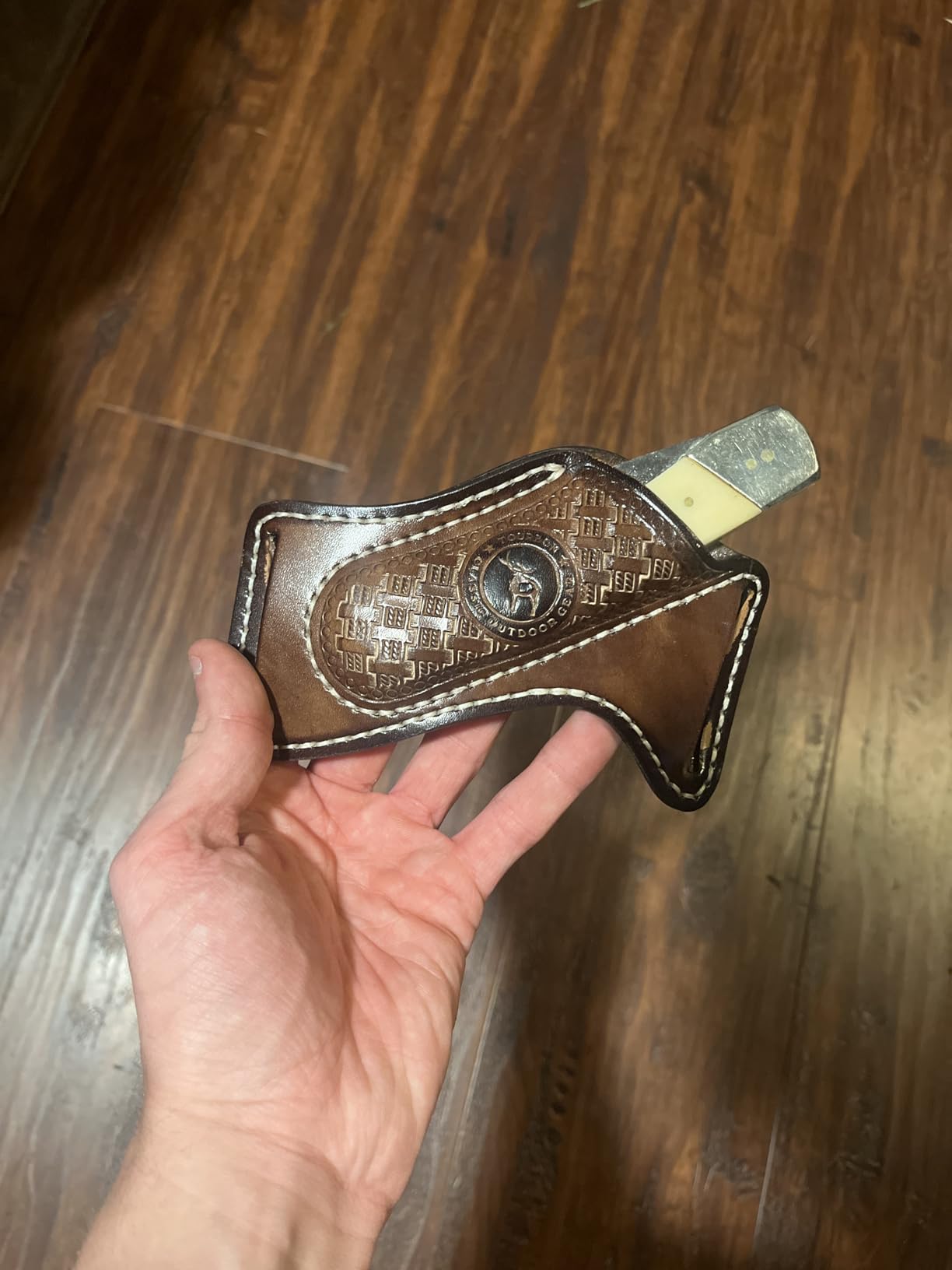
The Buck 110 is one of the most commonly carried folding knives in North America, and this sheath is cut for it specifically. At 3 mm of top grain leather with hand stitching it is one of the thickest stated materials in the roundup, and the angled open-top cross draw holds the knife firmly enough that it does not fall out.
It takes folders up to 5 inch long and 0.9 inch wide, which covers the Buck 110 and similar classic patterns. The belt loop fits belts up to 2 inch wide, so it works with more belts than most leather pouches in this group.
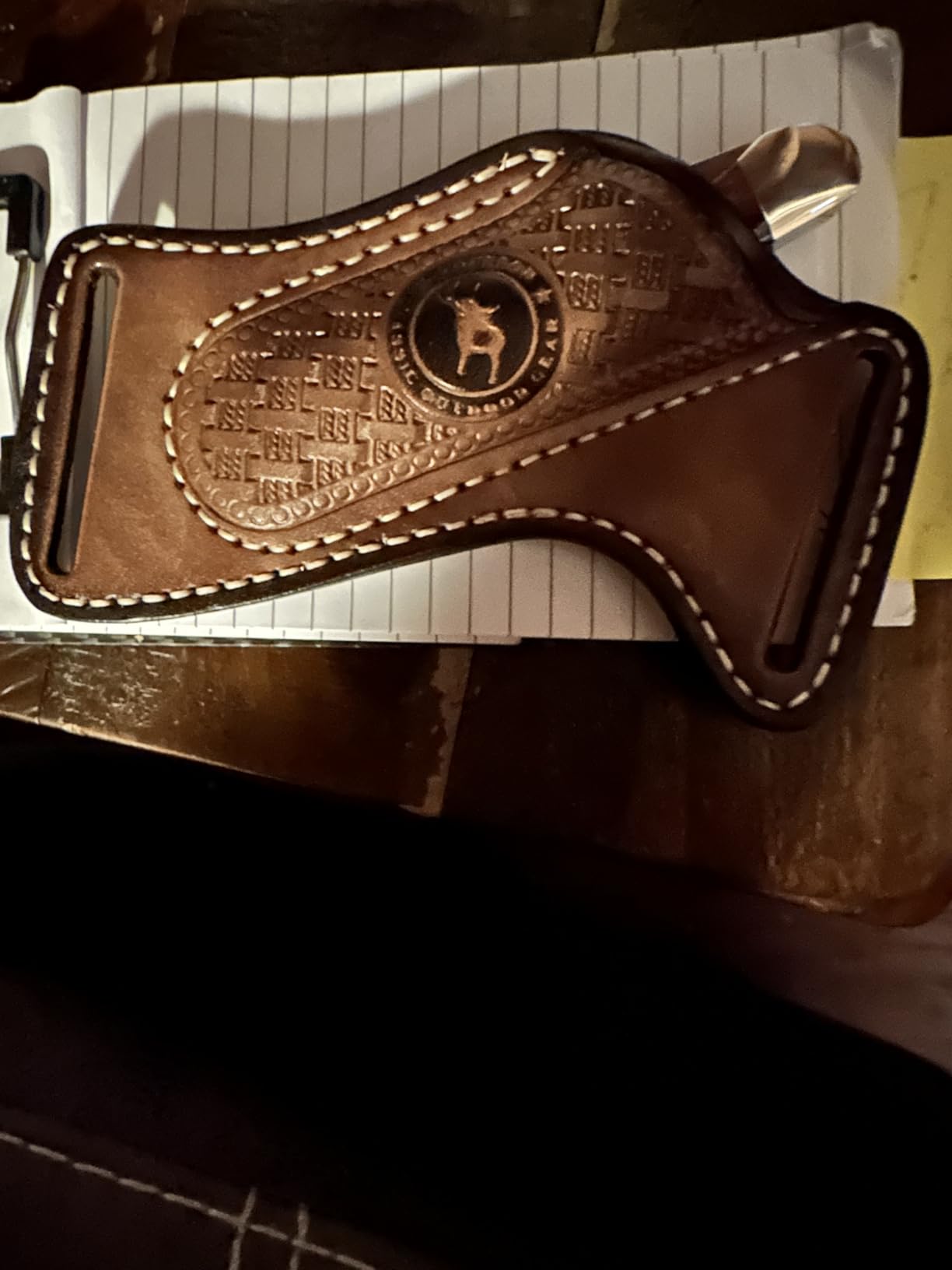
The one thing you must plan for is the break-in. The leather is stiff out of the box, close to the texture of hard plastic, and reviews are consistent that it needs wetting or flexing before it sits properly on a knife. Once it molds, the fit tightens around the handle and stays there, and the leather takes a patina that shows the knife.
Weighing 1.44 oz makes it one of the lightest leather options here, which matters if you are packing for weeks rather than days. Leather also absorbs impact rather than transmitting it, so a dropped bag does less to the edge than the same drop on a hard polymer shell.
Who this sheath suits?
Buck 110 owners, and anyone carrying a classic full-handle folder of similar size. It is a proper sheath rather than a slip, so it works both on a belt and inside a bag.
It also suits anyone who likes leather enough to want the break-in. There is a certain satisfaction in a sheath that takes two weeks and then holds the knife like it was cut for it, and the moulded result is noticeably more secure than a universal pouch.
For the knife itself, our belt sander guide covers restoring an edge that has been in a sheath for a month.
Where it falls short?
Day one is stiff, and if you skip the wet molding step you will judge it unfairly. The most common guidance in reviews is to wet the leather and work the knife in and out of it before first carry.
The size is tight. Knives over 5 inch long or wider than 0.9 inch will not seat, and that excludes many modern folders with deep fluting or thick handles.
The loop length is the second complaint: on narrow or low-rise trousers it hangs low and rotates. One reviewer describes the pre-break-in leather as feeling like hard plastic, which is the same stiffness issue rather than a different material.
7. Timsec Oxford Cloth Sheath – Best for Larger Multitool Loads
Nylon Pocket Knife Sheath, 5”-5.5” Multitool Pouch, Folding Knife Belt Sheath with Snap Closure and Horizontal or Vertical Carry Belt Loop, Multitool Case for Outdoor or Daily Use, Larger Size
Oxford cloth
Snaps knives to 5.5 inch
1.4 oz
Belt loop up to 2 inch
Pros
- Roomy enough for the Gerber MP600 and SAK
- Good stitching and a solid snap closure
- Dual loops allow horizontal or vertical wear
- Holds the knife closer to the body
Cons
- Belt loop feels flimsy although it holds up
- One strap attachment reported as weak
- Minimal rigid protection from the cloth
If your multitool is a full-size model with drivers and scissors, the pocket gets tight. This Oxford cloth pouch takes closed knives up to 5.5 inch by 1.6 inch, and owners single out the Gerber MP600 and SAK as tools that actually fit rather than nearly fitting.
Construction is Oxford cloth with double stitching and an ironed belt loop, which is a step up from the single-stitch pouches at the bottom of the market. The safety snap flap keeps the knife within reach without pinning the handle.
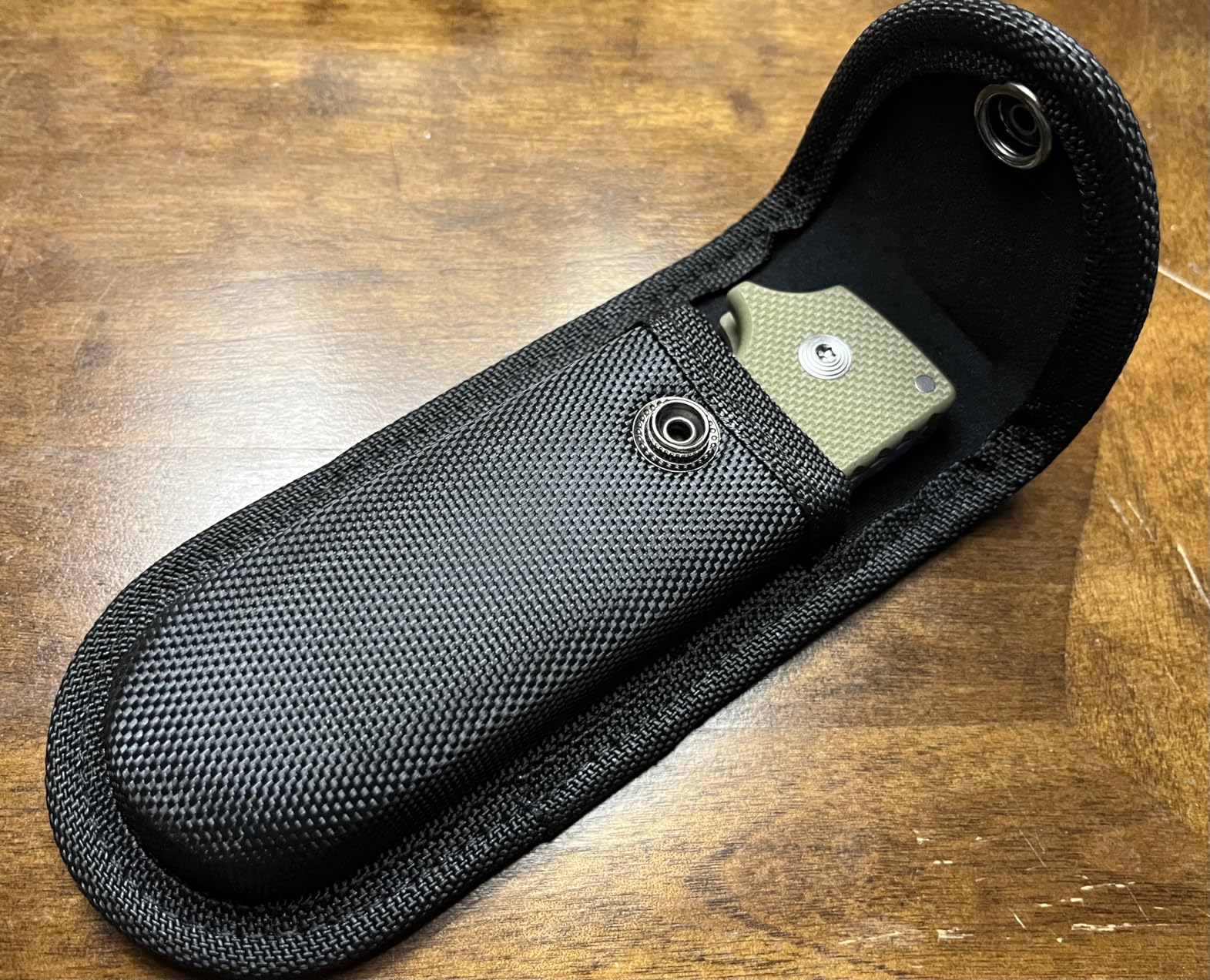
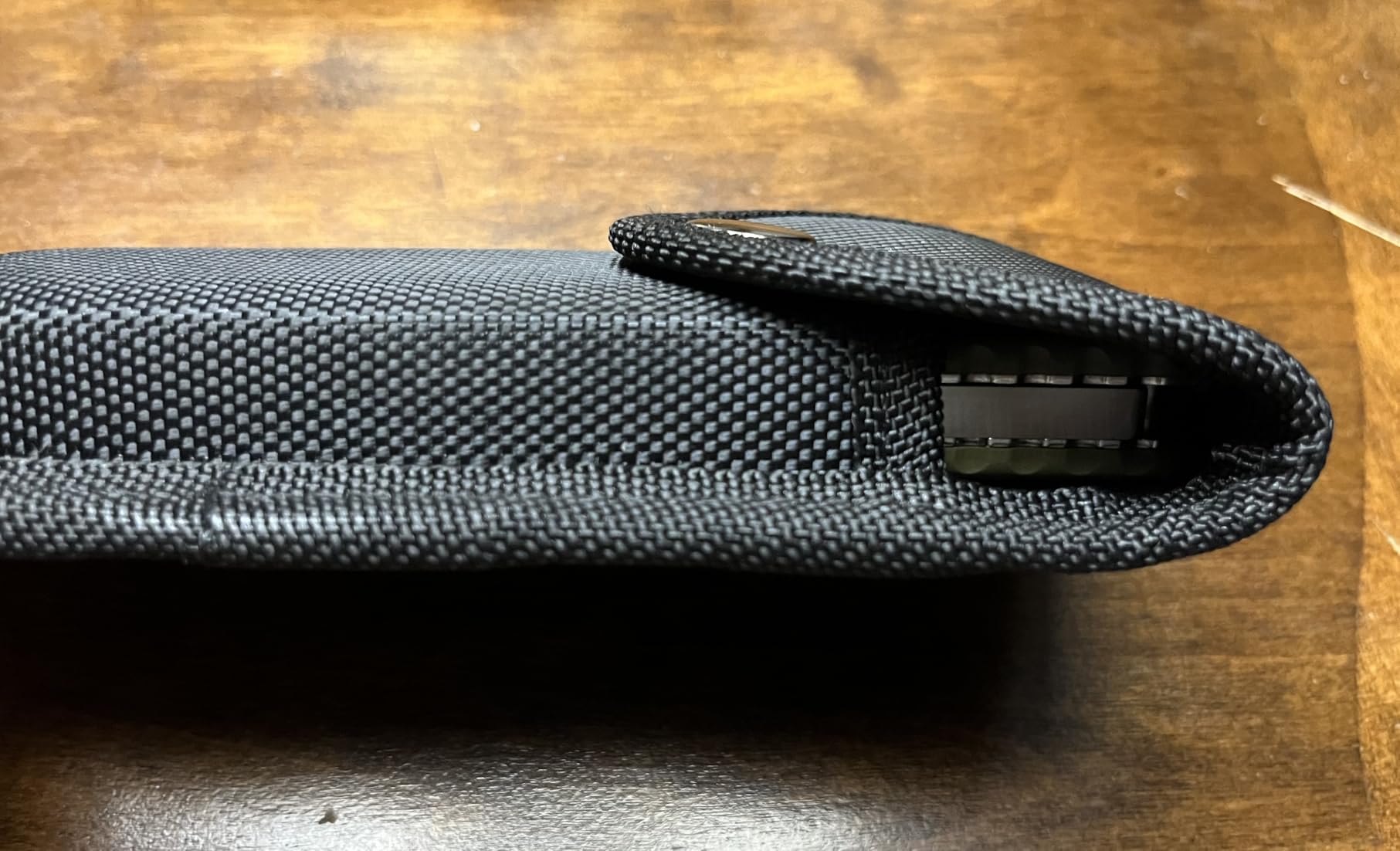
The pouch itself measures 6.1 by 3 inch and fits belts up to 2 inch wide, and the dual belt loops allow horizontal or vertical wear. At 1.4 oz it is the lightest item in the roundup.
There is a sizing floor worth knowing. Reviewers note that anything much shorter than about 5.375 inch closed can slide inside and disappear, so this is a pouch for larger tools rather than a general-purpose folder carry.
Who this sheath suits?
Anyone carrying a large multitool or a chunky folder on a belt and backpack strap. The roomier interior means you are not compressing a tool to force it in, which is what makes cheap universal pouches rattle.
It is also a reasonable cheap replacement for a lost or torn OEM pouch on Buck, Gerber and Schrade tools, which is exactly how most owners use it.
The cloth does not mould to a knife, so if your priority is a permanently tailored fit, a leather sheath is the better route. If your priority is weight and a low replacement cost, this is it.
Where it falls short?
The belt loop is perceived as flimsy even though owners report it holds up. One strap attachment has been reported as weak enough to detach, so if you are clipped to a belt all day, test it before you rely on it.
Lightweight Oxford cloth gives almost nothing in the way of rigid protection. It stops the blade from touching other gear and that is about all. It is not a substitute for a hard case.
Because it is a larger pouch, it takes more room in a bag than the compact options here. That is the trade for fitting a bigger tool.
8. Kitory 6-Inch Boning Knife Sheath – Best for Kitchen Knives
Kitory 6-inch Boning Knife Sheath – Premium Soft Leather Blade Cover with Secure Belt Loop | Durable & Lightweight for Hunting, Camping
Curved leather cover
6 inch blade fit
Belt loop up to 2.5 inch
Knife not included
Pros
- Curved shape matches a 6 inch boning blade
- Retaining strap closes firmly over the handle
- Light and inexpensive
- Protects edges from nicking in a drawer
Cons
- Many buyers report synthetic material rather than leather
- Covering is thin enough that a very sharp blade can cut through
- Slightly oversized for some knives
This is the one entry aimed at kitchen knives rather than pocket knives, and the curved profile matches the belly of a six-inch boning or utility blade better than a straight slip would. The metal retaining strap snaps over the handle, which is the right solution for a wet, greasy, moving kitchen environment.
They weigh almost nothing and the belt loop takes belts up to 2.5 inch wide, among the widest loops in the roundup. The listing describes it as a travel-friendly cover for camping, grilling and kitchen use, and it does protect an edge from nicking in a drawer or bag.
We have to flag the material dispute honestly, because it drives the 4.1 rating. A large share of buyers report that the covering is synthetic vinyl rather than the leather described in the listing. That matters on a travel sheath, because vinyl does not absorb moisture and can stiffen in cold conditions.
Who this sheath suits?
Camp and barbecue setups where a kitchen knife is being carried to a destination and stored at the site. The retaining strap is the right feature here, since a greasy hand is the last thing that will find a friction closure.
It also works as drawer or bag storage for a boning knife, protecting the edge from contact with other utensils. Users mention the knife is not included, so it is a cover rather than a set.
If you are checking your own kitchen knives for a trip, the sizes in our butcher knife set guide are the ones most likely to need a cover this size.
Where it falls short?
The material complaint is the headline issue. Buyers report a synthetic covering, and a minority also report a mouldy or chemical smell on arrival. Test the surface with a drop of water before you commit a good blade to it.
Thin material is the second concern. Several buyers note that a very sharp blade can cut through the covering, which is the exact scenario the sheath exists to prevent. Treat it as an edge protector rather than a puncture barrier.
The fit is also described as slightly oversized for some knives, and the packaging is a plain plastic bag rather than anything premium. Its 4.1 rating is the lowest here, and the reasons are consistent across reviews.
9. Omesio Leather Folding Knife Case – Best Budget Leather Option
Omesio Pocket Knife Sheath, 4.53″ Folding Leather Case, Horizontal Carry
Top grain leather
Fits knives to 4.53 inch
48.7 g
Horizontal or vertical loop
Pros
- Clean stitching and well finished leather
- Quiet metal snap flap avoids pinching the blade
- Dual-direction loop stays comfortable when seated
- Fits slim folders and small lockblades
Cons
- Small interior excludes the Buck 110 and larger folders
- One report of the snap strap breaking early
- Not intended for heavy work
Our budget pick, and one of the least expensive entries in the roundup. It is top grain leather at 4.5 stars across 450 reviews, with a high five-star share, which is unusual at this level of the sheath market.
It fits folding knives up to 4.53 inch long, and the flap is a metal snap rather than a leather strap. That matters in a quiet hotel room or a shared cabin, because a strap flap rattles and a snap does not.
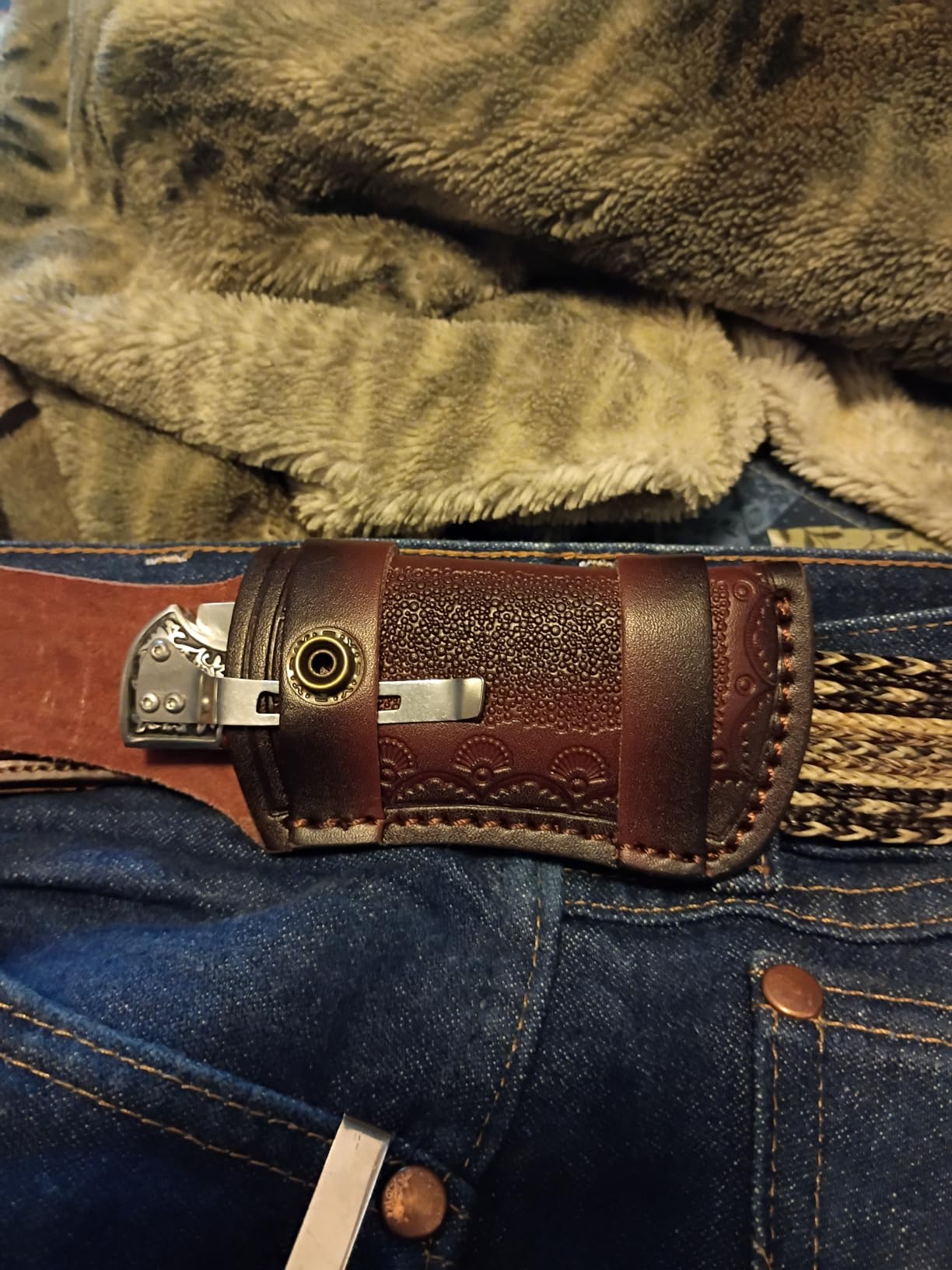
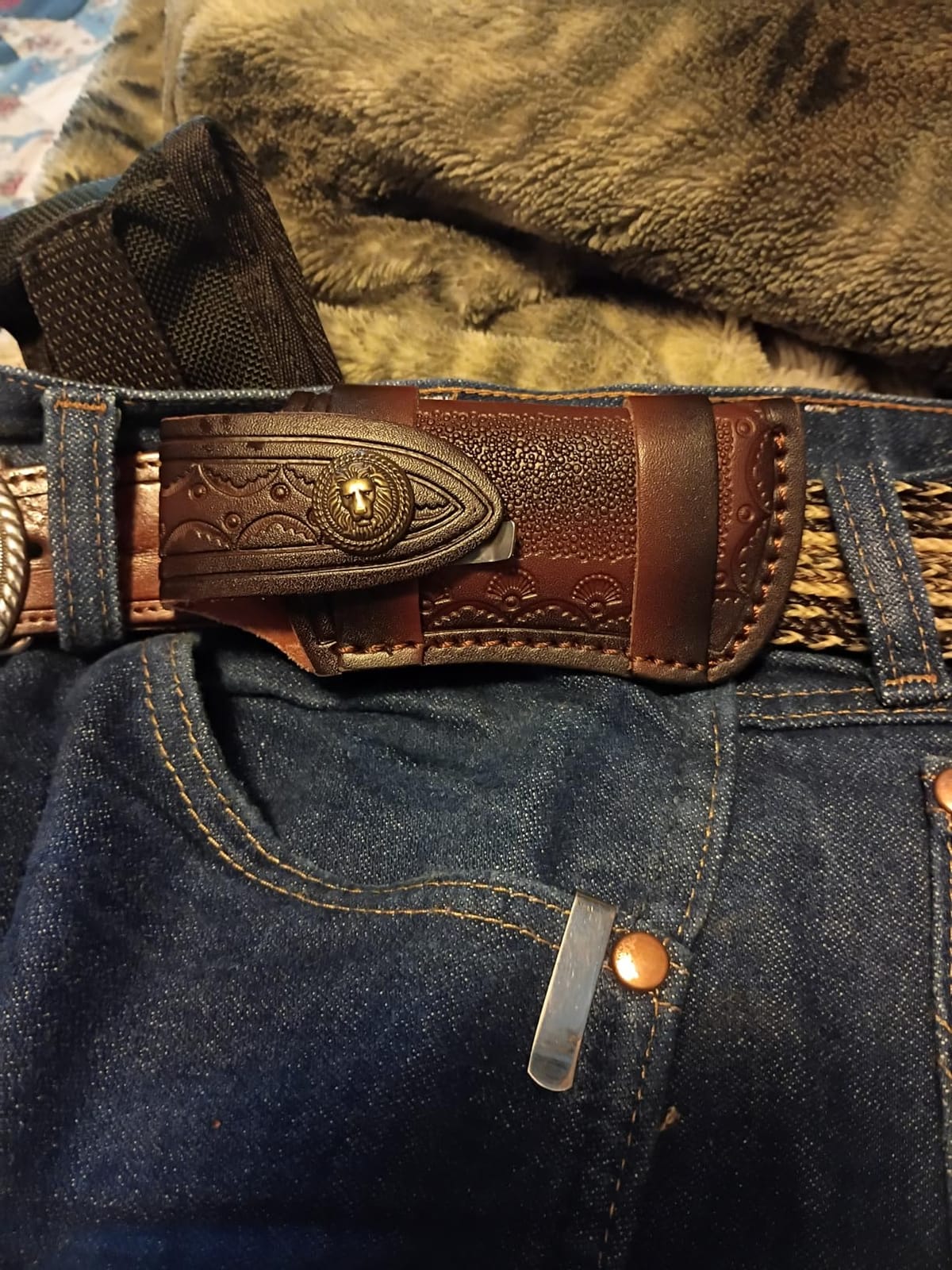
The dual-direction belt loop works horizontally or vertically and is described in reviews as comfortable when seated, which matters more than it sounds on a long flight or a long drive. Dimensions are 5.31 by 2.17 by 0.39 inch, so it packs flat against the outside of a bag or inside a jacket pocket.
It also handles a pocket clip either under or over the top strap, so you do not have to remove the clip from your knife to stow it. Small detail, but it removes one reason to leave a knife out of its sheath.
Who this sheath suits?
Travellers carrying a slim folder such as a Swiss Army style knife or a compact lockblade, and anyone who wants leather at a very low cost. The styling is good enough that it does not look like a compromise.
It is also the right pick for a knife that lives in a jacket pocket rather than on a belt. The horizontal loop sits flat and does not print through a jacket the way a chunky organizer does.
If your main tool is a multitool rather than a knife, look at the WYNEX pouch or the Timsec Oxford cloth model instead. This is a knife case, not an organizer.
Where it falls short?
The interior is small and reviewers are clear about the ceiling. The Buck 110 and any knife wider than roughly 1 and 13/16 inch will not seat, so measure the width across the handle before ordering.
It is not built for heavy work. There is one report of the snap strap breaking within a month of normal wear, and the leather is thinner than the 3 mm option further up this list.
The warranty on this listing is 30 days, which is the shortest in the roundup. That does not tell you how long it will last, but it tells you what the maker will commit to.
10. Hulara Handmade Leather Scabbard – Best Handmade Option
Hulara_Genuine Leather Case Handmade Real Leather Knife Sheaths With Belt Loop Pocket Knife Holder For Belt 4.7″ Blade Fits Knife Holster
Hand-sewn genuine leather
Blades up to 4.7 inch
8 by 2 by 1 inch
Belt loop up to 2.5 inch
Pros
- Thick leather resists the blade poking through
- Snug fit for hunting knives with 4 to 4.5 inch blades
- Loop wide enough for broad belts
- Tooled patterns such as basketweave
Cons
- Belt loop sits low so the knife rides blade-down
- Retaining strap too long for smaller handles
- Loop is narrow and softens as leather breaks in
This is the one scabbard-style option built for a knife carried blade-down or tip-down on a belt, and it is the thickest leather described here. Buyers single out that thickness as the reason the blade does not poke or cut through, which is the failure that ruins most fixed blade sheaths.
It comes in 8 inch and 10 inch versions and takes fixed blades with a blade height up to 4.7 inch. The 8 inch version measures roughly 8 by 2 by 1 inch, so it is not a large object to pack.
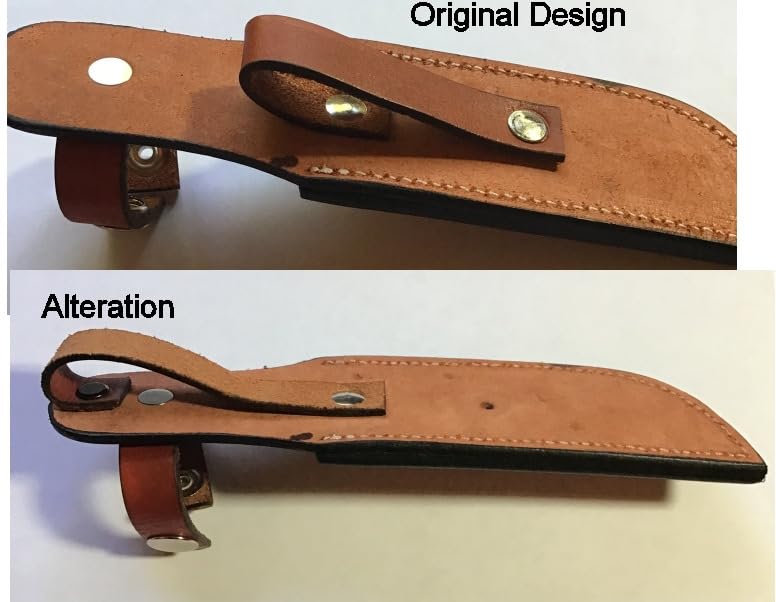
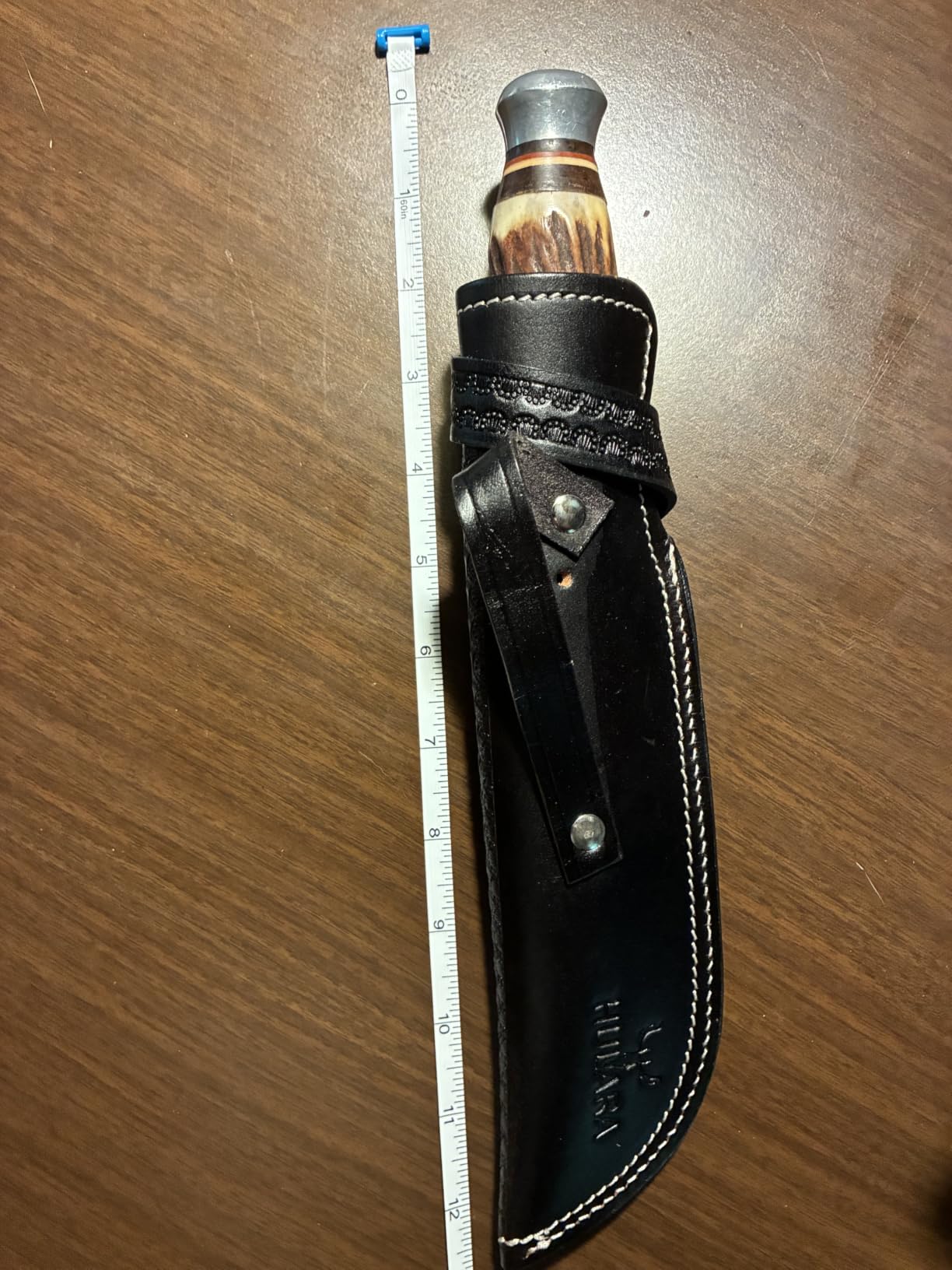
Construction is thread-sewn genuine leather with decorative tooling, including the zig-zag pattern on this listing. Owners describe it as a long-lasting replacement for a worn factory sheath, which is the test that matters for a scabbard you keep for years.
Design is vertical carry with an easy-draw open mouth and a rear belt loop for belts up to 2.5 inch wide. It holds up to weather exposure better than synthetic alternatives, which is why it is our pick for an overlanding load-out.
Who this sheath suits?
Anyone carrying a hunting or camp fixed blade who wants a scabbard that lasts. The thick leather and tight clearances for 4 to 4.5 inch hunting blades are the reason it holds an edge safely in a bag.
The wide belt loop suits broad outdoor belts better than most leather pouches here, and the tooled finish means it does not look out of place worn openly rather than tucked under a jacket.
If you only have one knife and it is a folder, this is overkill. The volume and the vertical profile are wrong for a pocket knife.
Where it falls short?
The belt loop is mounted low on the body. That means the knife rides blade-down unless the loop is repositioned, which is uncomfortable at a seated dinner table and can put the point near a thigh. Owners raise this consistently.
The retaining strap is too long for smaller handles and may need taping to hold the knife properly, and the loop itself is only about half an inch wide, so it softens and loosens as the leather breaks in. Check both before you rely on it.
The 10 inch variant is described as less precisely sized than the 8 inch version. If you are packing for a trip, buy the size you measured, not the bigger one for headroom.
How to Measure Your Knife Before Buying a Sheath?
Most sheath returns come down to one measurement. Get that number right and the fit problem disappears. Every size specification in this roundup refers to the closed knife length or the exposed blade length, and the two are not interchangeable.
Measure the closed length from the base of the handle to the tip of the closed blade. This is the number used for folding knife sheaths, and it is the one to compare against listings that mention a closed length. If a listing says nothing about closed length, assume it does not know.
Measure blade length from the guard to the tip for a fixed blade, and measure blade width at the widest point. Sheaths for fixed blades list both a length range and a maximum width, and the width limit is the one that catches people out. A 7 inch blade is useless if it is 1.8 inch wide and the sheath takes 1.4.
Then measure the blade thickness at the spine. Thick-spined folders and heavy fixed blades will not seat in a thin leather pocket, and this is the most common reason a good-looking sheath gets returned.
Finally, measure your belt. Loops in this roundup range from 1.5 inch to 2.5 inch, and a loop that is too narrow will not go over a thick belt while one that is too long hangs low and rotates. Five minutes with a tape measure removes most of the guessing in this whole guide.
Leather vs Nylon vs Hard Shell for Long Trips
Leather is the better all-round choice for knife protection, and it is what we pack. It absorbs impact rather than bouncing it, so a dropped bag does less to the edge. It moulds to your exact knife within two to three weeks and then holds it more securely than any friction fit. The cost is break-in, weight, and the fact that leather holds moisture if you seal a wet blade inside it.
Nylon is the better choice when water or weight decides it. The 600D shell in this roundup is water resistant and abrasion resistant, will not mould, needs no conditioning, and weighs about the same as the leather options. What you give up is rigidity and the moulded fit. A nylon pouch stops the blade touching other gear; it does not stop a point under a concentrated impact.
Hard shell cases are not in this roundup on purpose. They protect a knife better than anything else here, and they are the right answer when you are putting a valuable chef knife in a checked bag. They also weigh more, take far more volume, and turn a small knife into a bulky object in an overhead locker. For most travellers that trade is not worth it.
For multi-week trips, the deciding factor is corrosion rather than impact. Leather needs a dry blade before it goes back in, and the sheath needs to be out of a sealed bag overnight. Nylon is more forgiving because you can wipe it and put it back immediately. Neither material removes the need for a light coat of oil on a carbon steel blade.
Packing a Sheathed Knife in Checked Luggage
Wrap the sheath rather than trusting the retention alone. A friction-fit open-top sheath is fine on a belt and wrong in a bag that gets thrown onto a conveyor. Two turns of tape or a wrap of cloth around a friction sheath gives you positive hold for the length of the flight.
Zip bag it for humidity. A folded knife that spends three weeks in a sealed roller bag in a humid climate will find moisture even inside a leather sheath. A zip bag makes the sheath breathable enough to dry while protecting the blade from condensation drip.
Coat the blade before it goes in and again when you land. A food-safe oil on the steel takes about ten seconds and removes the most common travel damage to a knife, which is surface rust on a non-stainless blade.
Pack the sheath in the middle of the case, surrounded by clothing. Edges and points fail from outside-in, and a point resting against a stiff bag wall will survive the journey and chip on arrival.
Declare anything in question on arrival. Departure rules belong to the departure country’s authority, and customs at your destination may restrict or ban the import of knives regardless of how you packed it.
Frequently Asked Questions
Can I bring a knife in my carry-on?
No. In the United States, TSA rules do not allow knives of any kind in carry-on baggage, and a sheath does not change that. Folding knives, multitools with blades and kitchen knives are all prohibited at the checkpoint. If you need to fly with a blade, put it in checked luggage, sheathed or securely wrapped, and check your destination country’s import rules before you land.
Do checked bags need to be sheathed?
Yes, TSA guidance states that sharp objects in checked baggage must be sheathed or securely wrapped. That is the rule that makes a sheath worth packing at all. It also protects your bag: an unsheathed point will eventually press through nylon into whatever sits beside it. We recommend a sheath plus a wrap or tape, placed in the middle of the case surrounded by clothing.
What type of knife sheath is best?
For most travellers, a leather sheath is best because it absorbs impact and moulds to your exact knife over two to three weeks. Nylon is best if water or weight decides it, since it will not mould, needs no conditioning and shrugs off rain. A hard shell protects best of all but costs significant packed volume, which is why it is not in our main list. Match the material to the trip rather than to the knife.
Are knife rolls worth it?
A knife roll is worth it if you are travelling with several kitchen knives, because slots keep edges separated and the roll packs flatter than a hard case. For one or two blades a belt sheath or a hard case is simpler and more protective. Cheaper nylon rolls do not reliably stop tips from piercing the fabric, so test the tip coverage with a sharp knife before you commit to one for a long trip.
How do I know if my knife fits a specific sheath?
Measure the closed length of your folder from the base of the handle to the tip, and the blade length from the guard to the tip for a fixed blade. Then measure the widest point of the blade and the spine thickness, and compare both against the width and thickness limits the listing gives. Check your belt width too, since loops here range from 1.5 inch to 2.5 inch.
How do I stop a leather sheath from rusting my knife on a long trip?
Wipe the blade dry, apply a light coat of food-safe oil, and only then seat it in the sheath. Take the sheath out of a sealed bag overnight so trapped humidity can escape, and re-oil every few days in a damp climate. Prefer stainless steel for long humid trips. Never store a wet blade in leather, since moisture trapped against carbon steel is what causes pitting.
Conclusion
The best knife sheaths for travel in 2026 come down to what you are carrying and how long you are gone. For most people the answer is leather, because it protects the edge, packs small and becomes a permanent fit after two to three weeks. For wet trips and heavy packs, nylon is the more forgiving material.
Our pick overall is the Topstache leather organizer, because one object holds the knife, the multitool, the torch and the pen, and the second belt loop keeps it from twisting on a long day. The WYNEX MOLLE pouch is the best value and the safest choice in rain, and the Omesio leather case is the cheapest way to get real leather into a carry-on.
Whatever you choose, measure your knife first, check the width limit rather than just the length, and remember that no sheath makes a knife legal in a carry-on. Check the current price on any of these when you are ready to order.