
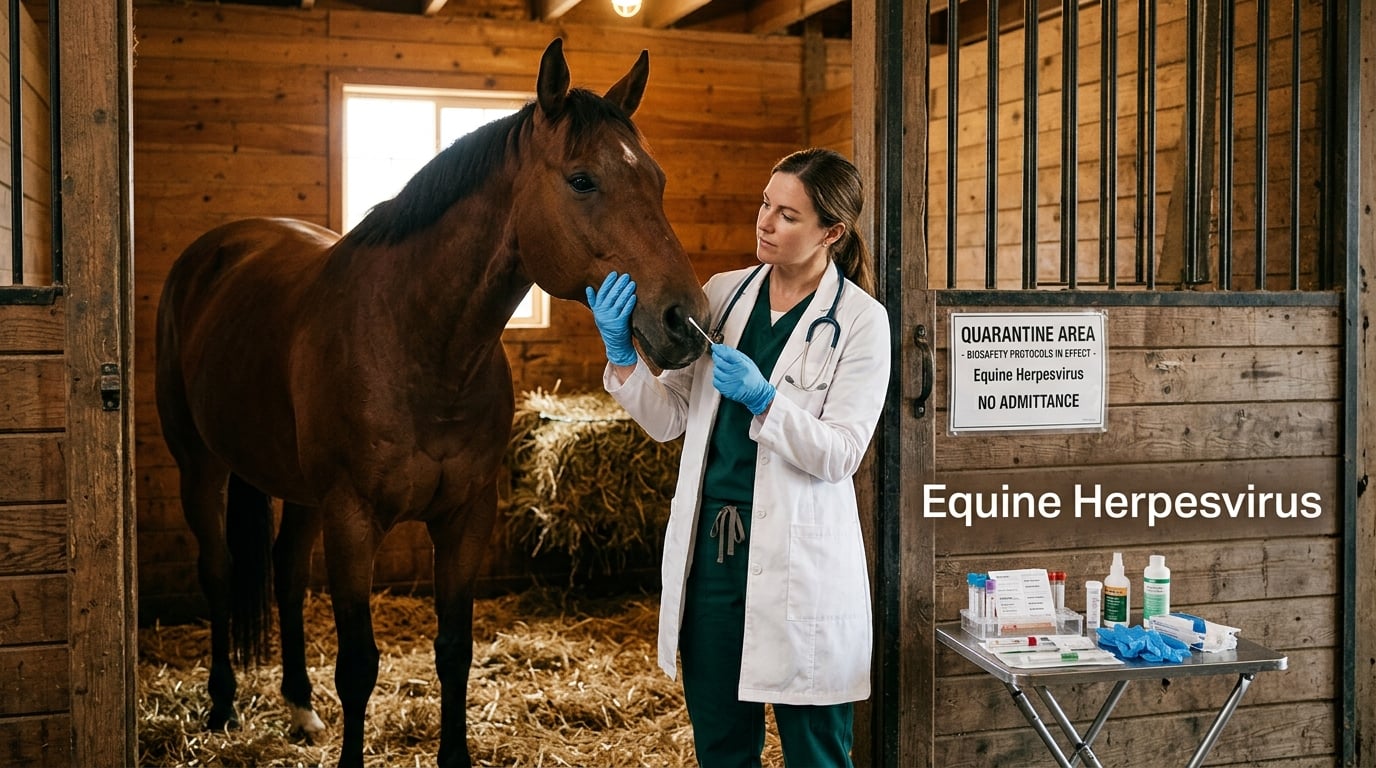
Equine Herpesvirus (EHV) is one of the most widespread and serious viral diseases affecting horses around the world. Most horses will encounter some form of this virus during their lifetime — often without obvious signs — until stress triggers a reactivation that can spread rapidly through an entire herd.
If you own horses or manage a barn, the anxiety around EHV is real. In 2026, outbreak alerts continue to circulate across equestrian communities, especially ahead of show season. New horse owners in particular often feel overwhelmed trying to figure out what steps actually matter.
I’ve put together this guide to answer the questions that come up most often: what EHV actually is, how the different strains compare, what symptoms look like in each form, how the virus spreads, and — most critically — what you can do right now to protect your horses at home and on the road.
Table of Contents
What Is Equine Herpesvirus?
Equine Herpesvirus (EHV) is a family of highly contagious DNA viruses that affect horses, donkeys, and other equids across the globe. The disease caused by this virus is also called equine rhinopneumonitis — a term you’ll see used specifically for the respiratory form.
Scientists have identified at least nine distinct strains, designated EHV-1 through EHV-9. Of these, EHV-1 and EHV-4 are responsible for the most significant disease in domestic horses. The remaining strains generally cause mild or subclinical infections that often go undetected.
What makes EHV particularly difficult to control is its ability to establish latent infections. After a horse is first infected, the virus doesn’t disappear — it retreats into nerve tissue or lymphoid cells and can remain dormant for months or even years. When the horse experiences physical or psychological stress — a long trailer ride, weaning, competition, illness, or a change in environment — the virus can reactivate and the horse may begin shedding it again without showing any symptoms at all.
This latency is why EHV circulates so persistently in horse populations, even in well-managed facilities. A horse that looks perfectly healthy after returning from a show can be silently spreading the virus to every horse it comes in contact with.
According to the USDA Animal and Plant Health Inspection Service (APHIS), EHV — also known as equine rhinopneumonitis — is found in horse populations worldwide, making it one of the most common infectious diseases in equine medicine.
EHV-1 vs EHV-4: Understanding the Key Strains
While EHV-1 and EHV-4 belong to the same virus family, they behave very differently in terms of which diseases they cause and the severity of the threat they pose to your horses.
EHV-1: The Most Dangerous Strain
EHV-1 is the strain that keeps veterinarians, barn managers, and horse show organizers up at night. It can cause three distinct and serious forms of disease:
- Respiratory disease: Fever, nasal discharge, lethargy, and cough — seen most commonly in young horses and horses with limited prior immunity
- Reproductive disease (abortion): Sudden late-term pregnancy loss in mares, typically without warning signs, sometimes triggering “abortion storms” where multiple mares miscarry in quick succession
- Neurologic disease: Equine Herpesvirus Myeloencephalopathy (EHM), the most severe and potentially fatal form of EHV infection
The neurologic form, EHM, develops when the virus infects and damages blood vessels supplying the spinal cord. This triggers inflammation and reduced blood flow to nervous tissue, causing the hindlimb weakness, incoordination, and loss of bladder control that are the hallmark signs of EHM.
Not every horse exposed to EHV-1 will develop EHM. Some circulating strains of EHV-1 are classified as “neuropathogenic,” meaning they carry a significantly higher risk of triggering the neurologic form. Identifying these variants requires specific PCR laboratory testing — standard clinical signs alone cannot distinguish them.
EHV-1 outbreaks at major competitions and events have led to widespread quarantines, venue shutdowns, and the cancellation of entire show circuits. The danger doesn’t end at the event itself — horses return home to facilities across multiple states, unknowingly carrying and spreading the virus.
EHV-4: The Common Respiratory Form
EHV-4 primarily causes respiratory disease, particularly in foals, yearlings, and young adult horses. Unlike EHV-1, it rarely if ever causes the neurologic or reproductive disease forms.
The respiratory illness caused by EHV-4 can still be significant, especially in young horses or those with compromised immune systems. However, the overall risk level is considerably lower than EHV-1. That said, EHV-4 is extremely widespread and moves easily through barns where horses are housed in close contact.
Because EHV-4 and EHV-1 can cause similar respiratory signs, laboratory testing is often needed to confirm which strain is responsible — particularly important when managing an outbreak at a breeding farm or competition facility.
Other EHV Strains Worth Knowing
EHV-3 causes equine coital exanthema, a sexually transmitted condition that produces sores on the genitalia of both mares and stallions. It is not life-threatening and resolves on its own, but affected animals should be rested from breeding until lesions heal.
EHV-2 and EHV-5 are widely distributed but typically cause mild illness. EHV-5 has been associated with a rare and serious lung disease called equine multinodular pulmonary fibrosis (EMPF), though this condition is uncommon. EHV-2 has been linked to eye inflammation (keratoconjunctivitis) and may play a role in making horses more susceptible to other respiratory pathogens.
Symptoms of Equine Herpesvirus
Recognizing EHV symptoms early is one of the most important things you can do to limit the spread of disease. The clinical signs vary significantly depending on which form the infection takes, and sometimes a horse can show signs of more than one form simultaneously.
Respiratory Signs
The respiratory form is the most commonly seen presentation and typically appears 2 to 10 days after exposure. Key signs to watch for include:
- Fever: A rectal temperature above 101.5°F (38.6°C) is often the very first sign — before any other symptoms appear
- Nasal discharge: Starts clear but may become cloudy or yellow-green as secondary bacterial infection sets in
- Dry, harsh cough
- Lethargy and loss of appetite
- Enlarged submandibular lymph nodes (felt under the jaw)
- Mild depression and reduced performance
Younger horses, foals, and yearlings tend to show the most pronounced respiratory signs. Horses with prior immunity — either from vaccination or natural exposure — may show only subtle signs or none at all, even while shedding virus.
Most horses recover from the respiratory form within 2 to 3 weeks with supportive care, though secondary bacterial pneumonia can complicate recovery if a horse is worked too early or stressed during illness.
Neurologic Signs (Equine Herpesvirus Myeloencephalopathy)
EHM is the form that causes the most alarm in the horse community — and the concern is justified. Neurologic signs can appear suddenly, sometimes following a mild fever or even without any obvious preceding illness at all.
The warning signs of EHM include:
- Hindlimb weakness and wobbling (ataxia) — the horse may appear “drunk” or uncoordinated in the back end
- Urine dribbling or difficulty urinating — loss of bladder sphincter control is a classic early EHM sign
- Hind end weakness that may progress toward the front limbs in severe cases
- Leaning against walls or fences for support
- Difficulty rising from the ground
- Recumbency — complete inability to stand, which is a critical emergency sign
The speed at which EHM progresses varies considerably between horses. Some stabilize with mild weakness and recover fully. Others deteriorate within hours. Horses that become recumbent face a significantly worse prognosis and require intensive care to have any chance of survival.
Call your veterinarian immediately at the first sign of any hindlimb weakness or unusual urination in a horse that has recently been ill, attended an event, or been in contact with new horses.
Reproductive Signs (Abortion)
EHV-1 is a major cause of infectious abortion in mares, responsible for significant economic losses in the breeding industry every year. Abortion typically occurs in the last trimester, between months 8 and 11 of gestation, and often happens with very little warning — the mare may appear completely normal the day before.
Multiple mares on the same property can abort within days of each other in what is often called an “abortion storm.” The mares themselves generally recover from the abortion without lasting reproductive effects, but the economic and emotional toll on breeding operations can be severe.
Foals born alive to infected mares frequently die within hours to days due to severe systemic infection — the foal is born without adequate immunity and overwhelmed by the virus. There is very little that can be done once a foal is born infected at this stage.
How Equine Herpesvirus Spreads
EHV spreads through multiple routes, which is part of why it’s so difficult to stop once it enters a population. Understanding exactly how transmission occurs helps you make targeted decisions about where to focus your prevention efforts.
The virus can spread through:
- Direct nose-to-nose contact between horses — the most common transmission route
- Aerosol droplets from coughing or sneezing, which can travel short distances through the air
- Contact with nasal secretions on surfaces, buckets, or equipment
- Shared water troughs and feed containers
- Shared grooming tools, halters, and tack
- Human hands and clothing — handlers can mechanically carry the virus from an infected horse to a healthy one without washing up
- Contaminated trailer bedding, stall walls, and shared barn spaces
Horse shows, competitions, and sales are the highest-risk environments for EHV exposure. Horses from many different backgrounds are concentrated in one space, often stressed from transport and competition, sharing water stations and barn aisles with horses they’ve never met before.
How Long Is a Horse with EHV Contagious?
Horses with active EHV infections typically shed the virus for 7 to 10 days after clinical signs first appear. However, the challenge is that horses may shed the virus for 1 to 2 days before any visible signs develop, meaning they can be contagious before you even know something is wrong.
Horses that have recovered from EHV and carry the virus in a latent state may shed it briefly during periods of high stress — transport, competition, illness — without showing any clinical signs. This silent shedding is one of the main reasons EHV continues to circulate even in vaccinated herds.
How Long Does Equine Herpesvirus Live on Surfaces?
EHV can survive on environmental surfaces for up to 7 days under normal conditions. In cooler, moist environments — such as an unheated barn in winter — some research suggests the virus can remain viable for several weeks.
This is why thorough, repeated disinfection of stalls, trailers, water buckets, and equipment is so important during and after an outbreak. Effective disinfectants against EHV include bleach solutions (1:10 dilution), quaternary ammonium compounds, and accelerated hydrogen peroxide products. Always clean visibly soiled surfaces before disinfecting — organic matter can inactivate disinfectants.
Diagnosing Equine Herpesvirus
If you suspect EHV in any horse on your property, contact your veterinarian immediately — before attempting any treatments and before moving horses to or from the facility. Early diagnosis is the key to containing an outbreak.
PCR (polymerase chain reaction) testing is the gold standard for EHV diagnosis. A nasal swab collected in the early stages of illness gives the most reliable result. PCR testing can not only confirm the presence of EHV but can also identify the specific strain and — critically — determine whether the strain is a neuropathogenic variant of EHV-1 with elevated risk of causing EHM.
Blood samples submitted as paired samples (taken 14-21 days apart) can be tested for antibody titer rises, which confirms recent active infection. This is particularly useful for retrospective diagnosis when nasal swabbing was not done at the time of illness.
In some cases, your veterinarian may coordinate with your state veterinarian’s office or the USDA to ensure proper reporting — EHV-1 outbreaks are reportable in many states, and there are resources available to help with outbreak management.
Treatment Options for Equine Herpesvirus
There is no cure for EHV, and treatment focuses on supportive care — keeping the horse as comfortable as possible, preventing secondary complications, and giving the immune system the best conditions to fight the infection.
Common treatment approaches include:
- NSAIDs (non-steroidal anti-inflammatory drugs): Medications such as flunixin meglumine (Banamine) or phenylbutazone help control fever and reduce inflammation. Fever management is important for comfort and may reduce some aspects of viral replication.
- Antiviral therapy (valacyclovir): This human antiviral drug has been used in horses to reduce the severity of EHM. It works by inhibiting viral DNA replication. Valacyclovir is most effective when given early in the course of illness — ideally at the first sign of neurologic involvement. Cost and availability can be limiting factors, so discuss this with your vet proactively.
- IV fluids and nutritional support: Horses that stop eating and drinking require hydration and calories to maintain organ function and support recovery.
- Bladder management: Horses with EHM frequently lose normal bladder function. Without intervention, the bladder can become severely distended and may rupture. Veterinary catheterization is often required until nerve function returns.
- Physical support and nursing care: Horses with severe EHM that cannot stand may need padded stalls, slings, or mechanical assistance to change positions, preventing pressure sores and aspiration pneumonia.
- Corticosteroids: Sometimes considered in EHM cases to reduce spinal cord inflammation, though their use remains debated among equine neurologists — they may help but can also suppress immune function.
The recovery outlook depends heavily on which form of EHV developed and how severe the illness became. Most horses with the respiratory form recover fully within 2-4 weeks. For EHM, horses with mild hindlimb weakness have a reasonable chance of full or near-full recovery over weeks to months. Horses that become recumbent face a much more serious prognosis, and some do not survive despite intensive care.
Horses that do recover from EHM may have lasting neurologic deficits, and the decision about long-term management and return to work should be made carefully with your veterinarian.
Preventing Equine Herpesvirus: Vaccination and Biosecurity
Protecting your horses from EHV requires both vaccination and strong biosecurity. Neither approach works well in isolation — vaccination without biosecurity leaves gaps, and biosecurity without vaccination misses an important layer of protection.
Vaccination: What It Can and Can’t Do
EHV vaccines are commercially available and play an important role in disease management, but understanding their limitations is just as important as getting your horses vaccinated.
Current vaccines for EHV — including products such as Rhinomune, Prestige series vaccines, and Calvenza — can reduce the severity of respiratory illness and may reduce the amount of virus a horse sheds during infection. However, they do not reliably prevent EHM (the neurologic form), and they do not provide sterilizing immunity that fully blocks infection.
The American Association of Equine Practitioners (AAEP) recommends the following vaccination approach:
- Horses at increased risk (those attending shows, competitions, or boarding facilities with horse turnover): vaccinate every 6 months for respiratory disease protection
- Pregnant mares: vaccinate at months 5, 7, and 9 of gestation with an EHV-1/EHV-4 vaccine specifically labeled for abortion prevention — these are different from general respiratory vaccines
- Young horses: foals from unvaccinated mares may be vaccinated from 4-6 months of age; discuss your farm’s specific protocol with your veterinarian
- During outbreak periods: consult your veterinarian about booster timing — some scenarios may warrant accelerated vaccination schedules
Remember: a vaccinated horse can still become infected and spread EHV. Vaccination reduces severity and shedding — it does not replace biosecurity.
Biosecurity Practices That Actually Work
Good biosecurity is the most reliable tool you have for keeping EHV out of your facility. Here are the measures that make the biggest difference:
- Quarantine all new arrivals: Any horse entering your property for the first time — or returning from an event — should be isolated in a separate area for a minimum of 14 to 21 days. During known outbreak periods, 28 days is the safer standard.
- Monitor temperatures daily: Take rectal temperatures on new arrivals and exposed horses twice daily. A reading above 101.5°F (38.6°C) warrants immediate veterinary contact — fever is often the first sign of active infection.
- Never share equipment between horses from different properties: This means water buckets, feed tubs, hay nets, grooming tools, and halters. If sharing is unavoidable, disinfect thoroughly between uses.
- Practice hand hygiene: Wash hands between handling different horses, especially after handling animals from other properties or public facilities.
- Limit contact at shows: At competition venues, use stall guards or barriers to prevent nose-to-nose contact with neighboring horses. Be cautious around communal water sources.
- Stay informed about outbreaks: Check the Equine Disease Communication Center (EDCC) at equinediseasecc.org, the USDA APHIS website, and your state veterinarian’s office before attending any event. If a confirmed outbreak is nearby, seriously consider whether attendance is necessary.
Quarantine and Outbreak Response
If EHV is confirmed — or even suspected — at your facility, or at a show your horse attended, the time to act is immediately. Every hour of delay gives the virus more opportunity to spread.
The core steps for outbreak response are:
- Isolate all exposed horses right away — physically separate them from the rest of your herd, ideally in a different barn or pasture with no shared airspace
- Restrict all horse movement on your property — no horses in and no horses out until cleared by a veterinarian or state animal health official
- Monitor all horses twice daily for fever, nasal discharge, or any neurologic signs
- Disinfect all high-contact surfaces daily — stalls, aisle floors, water troughs, fencing, and any equipment the affected horses used
- Use dedicated equipment for quarantined horses only — different buckets, brushes, and tools that never cross to the clean area
- Notify your veterinarian and state animal health officials — in many states, EHV-1 is a reportable disease. Reporting helps officials track and contain broader outbreaks.
Quarantine Release Timeline
The standard minimum quarantine period following EHV exposure is 28 days from the last date of known exposure. Releasing horses too early is one of the most common mistakes that allows a contained outbreak to spread to new facilities.
Before any quarantined horse is released, your veterinarian may require:
- No new fever or clinical signs for at least 14 consecutive days
- Negative PCR test results on nasal swabs from affected horses
- Formal clearance from your state veterinarian or animal health official
A Practical Quarantine Checklist for Horse Owners
If an EHV exposure or outbreak is suspected, work through this checklist immediately:
- Contact your veterinarian immediately and describe all known exposures
- Identify every horse that may have been exposed (include horses that shared a venue, a trailer, or barn space)
- Move exposed horses to an isolated area with separate airspace if possible
- Begin recording twice-daily rectal temperatures for all horses on the property
- Stop all non-essential horse movement — no horses leaving or arriving
- Disinfect all high-contact surfaces with an approved virucidal product every 24 hours
- Designate separate equipment (buckets, brushes, pitchforks) for quarantined horses and label clearly
- Change clothes and wash hands before and after handling quarantined animals
- Report confirmed EHV-1 cases to your state animal health official
- Maintain quarantine for a full 28 days from the last exposure date, or until veterinary clearance is granted
I know how overwhelming it feels when you first hear that a horse at a show you attended tested positive. Having a plan in place before an outbreak happens makes it much easier to respond quickly and calmly when it counts.
Frequently Asked Questions About Equine Herpesvirus
Can horses recover from EHV?
Yes, most horses recover from Equine Herpesvirus, though the prognosis depends heavily on which form developed. Horses with the respiratory form typically recover fully within 2-4 weeks with supportive care. Those with the neurologic form (EHM) have variable outcomes — horses with mild hindlimb weakness often recover over weeks to months, while those that become recumbent face a much more serious prognosis. Some horses survive severe EHM but are left with lasting neurologic deficits.
Can humans get equine herpesvirus?
No. Equine Herpesvirus is not zoonotic, meaning it cannot infect humans. EHV is species-specific and poses no known health risk to people who handle infected horses. You can safely care for an EHV-positive horse without risk of contracting the virus yourself, though standard hygiene practices are always recommended when working around sick animals.
What causes equine herpesvirus?
Equine Herpesvirus is caused by members of the Herpesviridae family of DNA viruses, specifically equine alphaherpesviruses. EHV-1 and EHV-4 are the strains most responsible for disease in domestic horses. The virus is spread through direct contact with infected horses, aerosol droplets, or contaminated surfaces and equipment. Stress — including transport, competition, or illness — can reactivate a latent infection in a previously exposed horse.
How long are horses with EHV contagious?
Horses with active EHV infections typically shed the virus for 7 to 10 days after clinical signs appear. However, they may also shed the virus for 1-2 days before any visible symptoms develop. Horses that have recovered and carry a latent infection may shed the virus briefly during periods of high stress — such as transport or competition — without showing any signs at all, which makes tracking contagion difficult.
How to avoid EHV in horses?
To reduce the risk of EHV exposure: vaccinate on a schedule recommended by your veterinarian (every 6 months for at-risk horses); quarantine all new arrivals and horses returning from events for at least 14-28 days; monitor temperatures daily; never share buckets, tack, or grooming tools between horses from different properties; limit nose-to-nose contact at shows; and check the Equine Disease Communication Center (EDCC) for active outbreak alerts before attending events.
How long does equine herpesvirus live on surfaces?
Equine Herpesvirus can survive on environmental surfaces for up to 7 days under normal conditions. In cooler, moist environments such as an unheated barn in winter, the virus may remain viable for several weeks. This is why thorough disinfection of stalls, trailers, water buckets, and shared equipment is essential during any suspected or confirmed outbreak. Bleach solutions (1:10 ratio), quaternary ammonium compounds, and accelerated hydrogen peroxide products are effective against EHV on surfaces.
Equine Herpesvirus is a real and ongoing threat to horses everywhere, but it is manageable with the right combination of vaccination, biosecurity, and a clear response plan. Stay current with outbreak alerts through the EDCC and USDA APHIS, work with your veterinarian to build an appropriate vaccination and monitoring schedule, and don’t wait until there’s a confirmed case nearby to put your quarantine protocols in place. The horses in your care are depending on you to have a plan before you need it.