
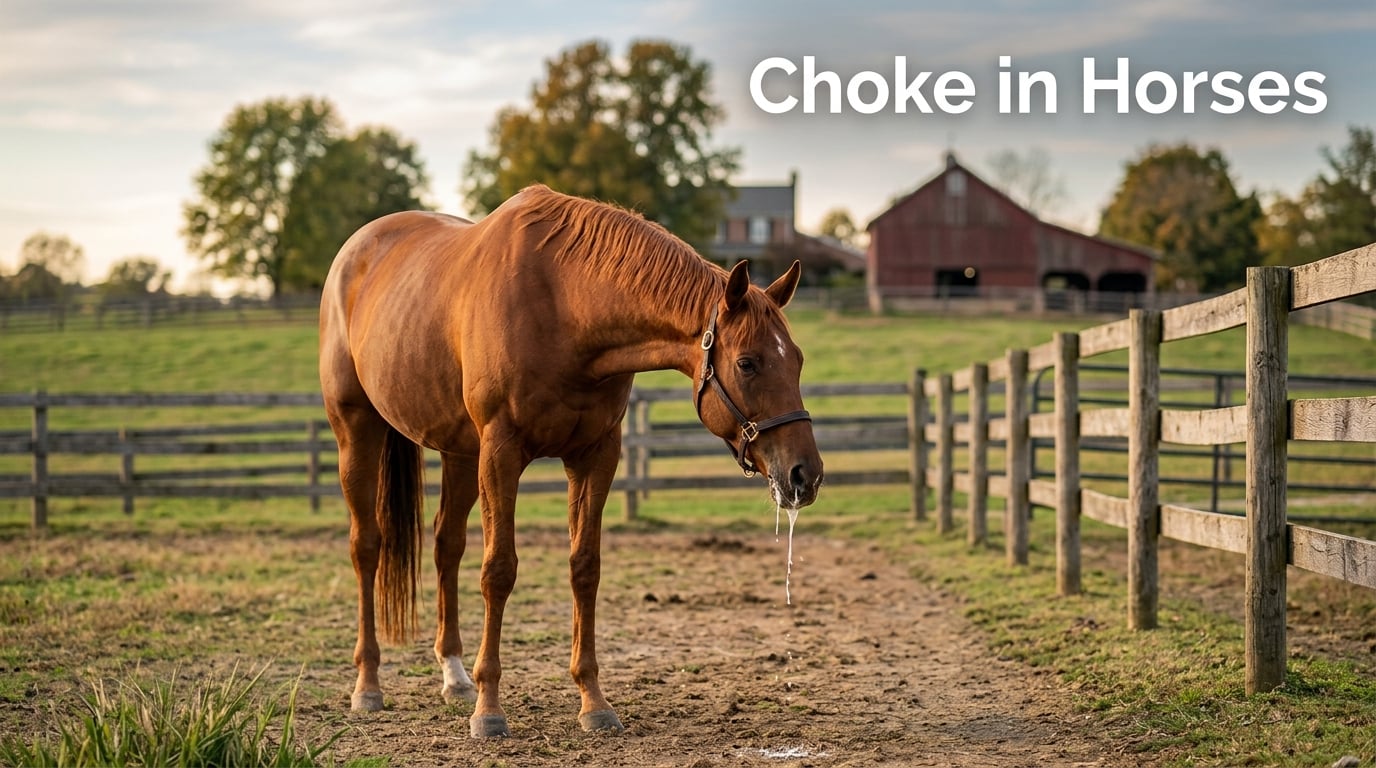
Choke in horses is one of those emergencies every horse owner dreads. I still remember the first time I saw it on a friend’s farm: her gelding stood with his neck stretched out, drooling thick saliva, with green-tinged discharge pouring from both nostrils. Within minutes, the vet was on the phone. That scene is more common than most people realize, and recognizing it fast can save your horse’s life.
In this guide, I’ll walk you through everything you need to know about choke in horses, including what causes it, how to spot the early signs, what to do (and what not to do), and the practical prevention steps our team has seen work best across hundreds of horses. Whether you’re a first-time owner or a seasoned rider, understanding equine choke could be the difference between a quick recovery and a devastating outcome.
Here’s the short version: choke in horses is an esophageal obstruction, not an airway blockage, and it almost always requires a vet. With prompt treatment, most horses recover within hours and are back to normal feeding within two weeks. Slow-feed management is the single biggest prevention lever, which is why our team at Hay Net has spent so much time refining how hay nets can help. Let’s dig in.
Table of Contents
What Is Choke in Horses?
Choke in horses refers to an esophageal obstruction, where food, a foreign object, or a compacted mass becomes lodged in the esophagus. The esophagus is the muscular tube that carries food from the mouth to the stomach.
Here’s the key fact most people miss: choke in horses is not the same as choking in humans. A horse with equine choke can usually still breathe. The blockage sits in the esophagus, not the airway, so air flows freely to the lungs. The danger comes from dehydration, esophageal damage, and the risk of aspiration pneumonia when saliva or feed enters the lungs.
Most cases of equine choke occur in the cervical (neck) portion of the esophagus, about one to two feet behind the throat. You’ll sometimes see a visible lump on the left side of the neck where the obstruction sits. Less commonly, the blockage forms near the chest, where it’s much harder to see or feel. In rare situations, foreign objects like wood chips, dental fragments, or even small stones can lodge in the esophagus.
According to the UC Davis Center for Equine Health, choke is one of the most common equine digestive emergencies. Most horses recover fully with prompt veterinary care, but delays can lead to lasting damage to the esophageal lining, scarring, strictures, or chronic megaesophagus.
Veterinarians classify choke in horses as either simple or complicated. A simple obstruction clears with sedation and gentle flushing. A complicated obstruction involves prolonged impaction, severe inflammation, secondary infection, or rupture of the esophagus. Complicated cases can take weeks to resolve and may require repeated endoscopic exams.
Signs and Symptoms of Choke in Horses
Recognizing the clinical signs of choke in horses quickly is critical. In my experience, the symptoms often appear in this order, and the first three are nearly always present.
Excessive drooling or foaming at the mouth: saliva pours out because the horse cannot swallow it normally.
Feed, saliva, or water coming from both nostrils: this regurgitation is a hallmark sign and may be tinged green or yellow.
Repeated coughing, retching, or gagging: the horse tries to clear the blockage.
Stretching the neck out and lowering the head: a posture that tries to ease the obstruction.
Restlessness, anxiety, or sweating: signs of distress and discomfort.
Refusal of food or water: usually after initial attempts.
Visible swelling or a lump on the left side of the neck: where the bolus sits.
Dehydration if the obstruction lasts hours: due to inability to swallow fluids.
Standing with feet splayed or acting colicky: secondary abdominal discomfort is common.
A mild case might look like a horse that simply drools a lot and seems uncomfortable. A severe case involves heavy nasal discharge, repeated retching, and obvious pain. Both require a vet call. The Merck Veterinary Manual notes that even seemingly mild cases can escalate, and the longer the obstruction sits, the higher the risk of esophageal damage.
One thing horse owners often get wrong: a horse with choke can still eat. A horse may try to take bites of food even while obstructed, which adds to the problem. Don’t be fooled by a horse still showing interest in hay.
Another subtle clue is the smell. As feed sits in the esophagus, it begins to ferment. You may notice a sour or foul odor on the breath or in the nasal discharge within a few hours. This is a sign the obstruction has been there for a while and warrants immediate attention.
Causes and Risk Factors for Choke in Horses
Choke happens when something blocks the esophagus before reaching the stomach. Most cases trace back to one (or more) of these triggers.
Eating Behavior
Bolting feed is the single biggest risk factor for choke in horses. Fast eaters swallow feed without chewing properly, creating dry masses that get stuck. Horses that compete for food in group settings are particularly prone. Our team has seen bolting-related choke most often in young Thoroughbreds and warmbloods, but any horse can be a bolter.
Horses that have been on restricted diets, fasted for surgery, or recently moved to a new environment are at higher risk. Hunger drives them to gulp feed the moment it appears. Slow introduction to meals and pre-soaked feeds help reduce this risk.
Feed Type and Preparation
Dry, pelleted, or extruded feeds are common culprits. The pellets absorb saliva rapidly and swell, creating a tough bolus. Coarse hay or haylage fed without adequate chewing can also cause blockages. Sugar beet pulp that swells after eating, and dry, coarse hay chaff, are both known offenders when fed unprepared.
A useful rule of thumb: any feed that expands when wet should be soaked before feeding. This includes beet pulp, hay cubes, and some senior feeds. Whole grains and oats are actually less likely to cause choke than pellets because they disperse more easily.
Dental Problems
Poorly chewed food is hard to swallow. Horses with sharp points, missing teeth, or dental pain skip proper mastication. Dental care is one of the most overlooked preventive steps. According to the American Association of Equine Practitioners (AAEP), routine dental exams every 6 to 12 months dramatically reduce choke risk.
Older horses (over 20) and horses with a history of dental disease should have their teeth checked more frequently. Even subtle abnormalities like a wave mouth or step mouth can reduce chewing efficiency enough to cause choke on regular hay.
Sedation and Medical Issues
A horse recovering from sedation or anesthesia has reduced swallowing ability. Feeding too soon after a dental procedure or sedation is risky. Underlying conditions like megaesophagus (an enlarged, flaccid esophagus) make some horses prone to recurrent choke regardless of feed choice.
Neurological conditions, severe dehydration, and certain toxin exposures (like botulism) can also impair swallowing. If your horse chokes repeatedly without an obvious cause, your vet may recommend imaging to rule out megaesophagus or other structural issues.
Breed Predispositions
UC Davis research has identified Friesians and American Miniature Horses as breeds with elevated choke risk, often linked to conformational narrowing of the esophagus or higher rates of megaesophagus. Older horses of any breed are also at higher risk due to dental wear and reduced saliva production.
How to Treat Choke in Horses
Here’s the part I want every owner to memorize: call your vet immediately. Even mild choke warrants a phone call. While you wait, follow these steps:
Remove all feed and water: take away hay, grain, and the water bucket. Eating or drinking adds to the impaction.
Keep the horse calm and quiet: stress makes the situation worse.
Do not pass a hose or tube: flushing the esophagus yourself can force material into the lungs and cause aspiration pneumonia.
Do not give oral medications or home remedies: anything swallowed can reflux into the trachea.
Walk the horse gently if it stays calm: light movement may help the bolus move down. Do not force exercise.
Note the time symptoms started: this helps your vet gauge severity and decide on treatment.
Keep the horse away from other horses: isolation reduces stress and prevents herd mates from disturbing a fragile situation.
Once your vet arrives, common treatment steps include:
Sedation: relaxes the esophageal muscles so the bolus can pass on its own. Many mild cases resolve this way within a few hours.
Nasogastric tube and gentle lavage: the vet passes a tube through the nostril into the esophagus and flushes warm water or saline to soften and push the obstruction into the stomach.
Endoscopy: a tiny camera confirms the blockage has cleared and checks for esophageal damage.
Prophylactic antibiotics: often prescribed to guard against aspiration pneumonia, which can develop days later.
Anti-inflammatory medication: reduces swelling in the esophageal tissue.
IV fluids: corrects dehydration in prolonged cases.
Most uncomplicated cases resolve within 1 to 4 hours of veterinary treatment. Horses that suffered prolonged obstruction, repeated choke episodes, or have dental issues may take longer. Severe cases occasionally require surgery to remove a stubborn obstruction, but this is rare.
Recovery and Aftercare
Recovery from choke typically spans 7 to 14 days. Your vet will likely recommend:
Soft feed only: soaked hay pellets, soaked beet pulp, mashes of senior feed, or wet hay slurry for at least 5 to 7 days.
No dry hay: until the esophagus has fully healed.
Reintroducing long fiber slowly: small handfuls of soaked hay, then gradually more.
Watch for fever, cough, or nasal discharge: these can appear 24 to 72 hours later if aspiration occurred.
A follow-up vet check: many vets re-examine the horse 3 to 5 days later to confirm healing.
Monitor temperature twice daily: a fever above 101.5°F may indicate aspiration pneumonia and warrants a callback to your vet.
Forum threads from owners on Reddit’s r/Horses consistently mention that the post-choke feeding phase is the trickiest part. Many horses refuse soaked mashes at first, or get impatient and try to gulp dry feed. Patience here pays off. Adding a small amount of molasses or apple juice to the mash can encourage picky eaters.
How to Prevent Choke in Horses?
Prevention is where we at Hay Net spend most of our energy, because most choke cases are avoidable. Here are the strategies our team has seen work across thousands of feeding situations.
1. Slow Down Fast Eaters
The single most effective change I’ve seen for choke-prone horses is slowing feed intake. Horses evolved to graze 16 to 18 hours a day on rough forage. When meals are dropped in a bucket and gone in 10 minutes, the esophagus is forced to handle large, dry boluses it was never designed to process.
Slow-feed hay nets are the easiest tool for this. They mimic grazing by forcing horses to pull small bites through small holes. Most horses take 2 to 4 times longer to eat the same amount of hay from a slow-feed net compared to a loose pile on the ground. We’ve had owners tell us their horse went from finishing a flake of hay in 20 minutes to taking 90 minutes, with a corresponding drop in choke episodes.
Choose a hole size appropriate for your horse. Small holes (1 inch) work for most horses but can frustrate easy keepers and older horses with limited teeth. Larger holes (1.5 to 2 inches) slow intake without causing frustration. Always introduce a slow-feed net gradually over a week to prevent net-related frustration or weight loss.
2. Soak Pelleted and Extruded Feeds
For horses on concentrates, soaking pellets, cubes, or beet pulp before feeding is one of the simplest prevention steps. Add enough water so the feed breaks down into a wet mash. Ten to fifteen minutes of soaking works for most feeds; sugar beet pulp needs 30 minutes to an hour to fully expand.
3. Keep Up With Dental Care
Schedule dental exams every 6 to 12 months. A floating session sharpens the chewing surface and removes hooks and points. Older horses may need more frequent work. Horses with missing teeth or poor dentition are at much higher choke risk regardless of feed type.
4. Feed Horses Separately
Group-fed horses compete for resources and gulp feed without chewing. If your horse is a fast eater in a herd, separate them for meals. Even visual separation (a stall guard, a partition) often slows intake.
5. Cut Feed Into Smaller Meals
Three or four small meals a day beats one or two large ones. Smaller meals mean smaller boluses. For horses on heavy concentrate rations, this is non-negotiable.
6. Add Chaff or Wetted Roughage
Adding chaff (chopped hay or straw) to grain meals forces the horse to chew more thoroughly before swallowing. Wetting chaff improves its effectiveness further. Many owners in our community have used this trick for years and report a noticeable reduction in choke episodes.
7. Wait After Sedation
Never feed a horse within 1 to 2 hours of sedation or anesthesia. The swallowing reflex is dulled, and the risk of choke or aspiration is high. Confirm with your vet when it’s safe to feed after any procedure.
8. Keep Fresh Water Available at All Times
Dehydration thickens saliva and reduces its lubricating effect in the esophagus. Horses that drink freely produce thinner saliva that helps move feed boluses along. Heated water in winter keeps intake consistent.
For owners with chronic choke cases, combining several of these strategies (slow-feed hay nets, soaked pellets, regular dental work, separated feeding) tends to eliminate recurrence entirely. Prevention is rarely about one change. It’s the combination.
When to Call the Vet?
Call your vet any time you suspect choke. Even if you’re not sure, a quick phone call is worth it. Here’s a clear threshold:
Call immediately if you see feed or saliva coming from the nostrils.
Call immediately if drooling lasts more than 10 minutes without an obvious cause.
Call if the horse shows repeated coughing, retching, or neck stretching.
Call if a horse refuses feed after showing signs of discomfort.
Call if you can feel a lump on the left side of the neck.
Do not wait to see if the choke resolves on its own. The sooner a vet is involved, the lower the risk of esophageal damage and aspiration pneumonia.
Frequently Asked Questions
Can a horse recover from a choke?
Yes, most horses recover fully from choke with prompt veterinary care. Mild cases often resolve within hours of sedation and supportive treatment. Recovery from esophageal damage takes 7 to 14 days, during which soaked feeds are required. Recurrence is possible if underlying causes (dental problems, bolting, dry feed) are not addressed.
How do you treat choke in horses?
Call your vet immediately. Remove food and water while waiting. Do not pass a hose or give oral remedies. The vet will typically sedate the horse, use a nasogastric tube to gently flush the obstruction into the stomach, and may prescribe antibiotics to prevent aspiration pneumonia. Soft, soaked feeds are required for the next 7 to 14 days.
How do you know if a horse has a choke?
The hallmark signs are excessive drooling, feed or saliva coming from both nostrils, repeated coughing or retching, neck stretching, and restlessness. A visible lump on the left side of the neck is sometimes present. Call your vet as soon as you notice these symptoms, even if they seem mild.
Can horses clear choke themselves?
Occasionally, mild choke in horses resolves on its own as the bolus softens with saliva and passes into the stomach. However, this is not something to rely on. Veterinary evaluation is always recommended, since prolonged obstruction risks esophageal damage and aspiration pneumonia, which can develop even a day or two later.
Final Thoughts
Choke in horses is a true emergency, but with the right knowledge it’s a manageable one. The combination of fast recognition, calm handling, and a quick vet call resolves most cases without lasting harm.
If your horse is a fast eater, dry-feed bolter, or has had a previous choke episode, focus on prevention. Slow down feeding with a quality hay net, soak pellets and beet pulp, schedule regular dental work, and feed separately from herd mates. These four changes solve the majority of recurrent cases I’ve seen.
Bookmark this guide for the moment you spot the first signs, and share it with anyone who handles your horse. Equine choke happens fast, and a prepared owner makes all the difference.