
If your horse has been diagnosed with ringbone, or you just noticed a bony swelling above the hoof, you’re probably searching for straight answers. I’ve worked with equine owners for years and walked through this diagnosis with countless riders. The good news: ringbone is manageable, and many horses return to comfortable, useful lives.
This complete guide to ringbone in horses covers what the condition actually is, the different types your vet might mention, what causes it, how to spot the early signs, and every treatment option from corrective shoeing to surgery. We’ll also tackle the questions that keep owners up at night, like whether their horse can still be ridden and how long the prognosis really looks.
Table of Contents
What Is Ringbone in Horses?
Ringbone in horses is a form of osteoarthritis that causes painful new bone growth around the pastern or coffin joints. The condition involves progressive cartilage degeneration followed by bony proliferation, the medical term for the body laying down extra bone in response to inflammation and stress.
That bony ridge you might feel just above the hoof, or higher up around the pastern, is called an exostosis. It’s the body’s attempt to stabilize a joint that’s breaking down. Unfortunately, that extra bone often causes more pain than the original instability it was trying to fix.
Ringbone is degenerative, meaning it gets worse over time without intervention. But “degenerative” does not mean “hopeless.” Many horses with ringbone live full, comfortable careers with proper management. The condition is most common in middle-aged and older horses, though younger performance horses can develop it from repetitive concussion or conformational stress.
Veterinarians classify ringbone based on location and whether the joint surface itself is involved. Understanding these distinctions helps you make better decisions about treatment and long-term care.
Key Terminology
Before we go further, a few terms will keep coming up. Ankylosis is the natural fusion of a joint when the body bridges the bones together, often eliminating pain once complete. Arthrodesis is the surgical version of the same process. Exostosis refers to the bony outgrowth itself. Phalanges are the bones of the lower leg, with the pastern bones being the long pastern and short pastern.
Types of Ringbone in Horses
Not all ringbone is the same. Your vet will likely specify the type, and that classification directly affects treatment choices and prognosis.
High Ringbone vs Low Ringbone
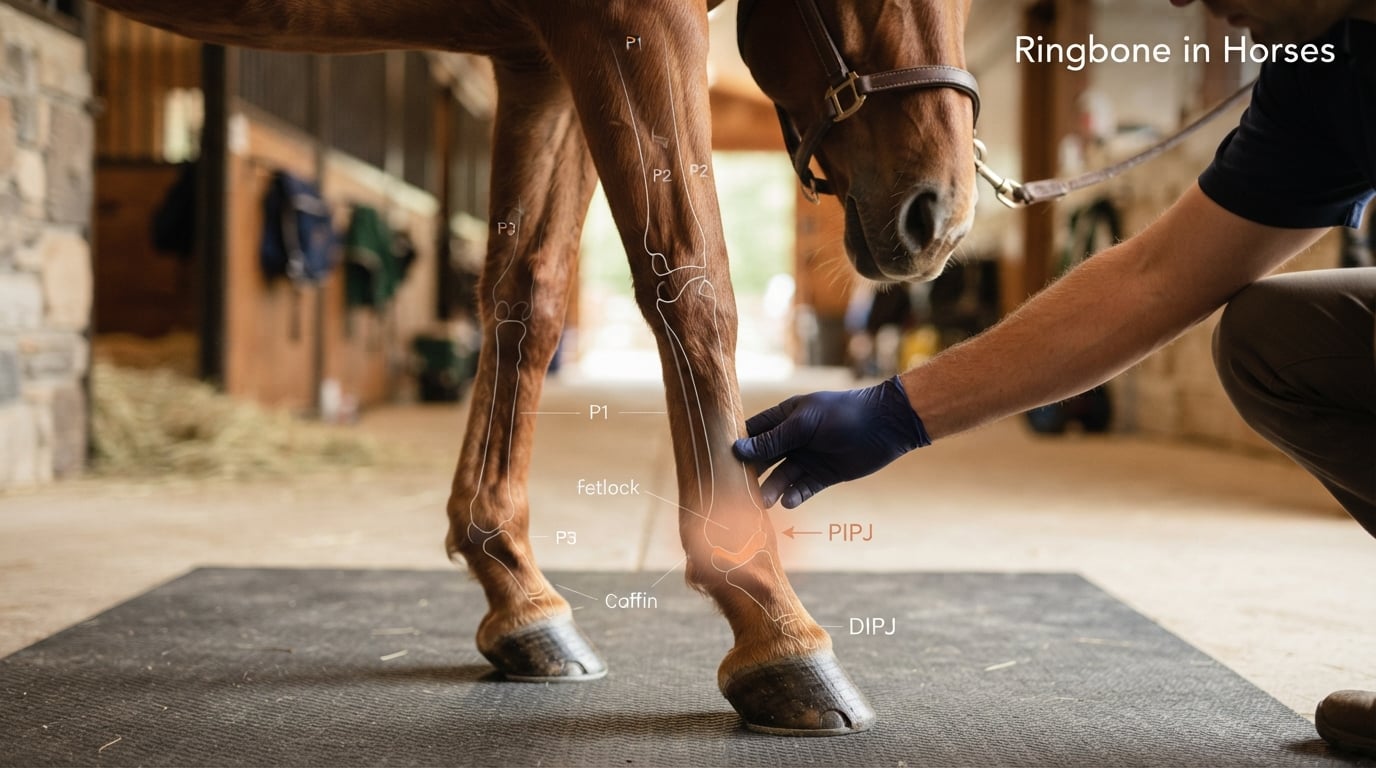
High ringbone affects the proximal interphalangeal joint, also called the pastern joint. This is the joint between the long pastern bone (P1) and the short pastern bone (P2). High ringbone is often visible as a swelling above the hoof, and it tends to develop more slowly because the pastern joint has more mobility and can compensate.
Low ringbone affects the distal interphalangeal joint, known as the coffin joint. This joint sits inside the hoof between the short pastern bone (P2) and the coffin bone (P3). Low ringbone is generally considered more serious because the coffin joint bears more weight and has less capacity to compensate. It can also be harder to spot in early stages because the swelling is hidden inside the hoof capsule.
Here’s a quick comparison of the two main types:
High ringbone: Affects pastern joint, visible swelling above hoof, often slower progression, better prognosis with treatment
Low ringbone: Affects coffin joint inside the hoof, harder to detect early, faster lameness onset, more challenging prognosis
Articular vs Non-Articular Ringbone
The articular distinction matters just as much. Articular ringbone involves the joint surface itself, meaning the cartilage is damaged and the bony growth crosses into the joint space. This form causes more pain and lameness because inflamed joints are extremely sensitive.
Non-articular (or periarticular) ringbone develops around the joint without directly involving the cartilage. Horses with non-articular ringbone often stay sounder for longer because the joint surface remains intact. Bony growth may still limit motion and cause mechanical interference, but the inflammatory pain is typically less severe.
False Ringbone
False ringbone is not actually ringbone at all. The term refers to bony growth on the long pastern bone (P1) or short pastern bone (P2) that does not involve a joint. It’s often the result of an old injury, trauma, or splints that calcified over time. Horses with false ringbone usually remain sound because the joint surface is untouched, and many cases are incidental findings on X-rays taken for other reasons.
What Causes Ringbone in Horses?
Ringbone develops when chronic stress, trauma, or conformational defects overwhelm the joint’s ability to repair itself. Most cases fall into a few common categories.
Poor Conformation
Conformation is the single biggest risk factor. Horses with upright pasterns, toed-in or toed-out front legs, or mismatched hoof angles carry weight unevenly. That uneven loading concentrates stress on specific areas of the pastern and coffin joints, accelerating cartilage wear.
Breeds with naturally short, upright pasterns, like many Quarter Horses and some Warmbloods, are overrepresented in ringbone cases. That doesn’t mean these breeds can’t be ridden, but they need careful farrier work and workload management.
Repetitive Concussion
Every stride on hard ground sends shockwaves up the leg. Horses that compete on hard footing, jump frequently, or do extended work on pavement accumulate concussive damage over time. Jumpers, eventers, and endurance horses all show higher rates of ringbone than horses in lighter work.
Hoof Imbalance
Long toes and low heels, or uneven trimming, change the breakover point and shift weight onto parts of the joint that weren’t designed to handle it. Correcting the trim often slows ringbone progression dramatically, even if it can’t reverse existing damage.
Age and Wear
Cartilage thins with age. Senior horses simply have less cushion between bones, which makes any joint stress more damaging. Most horses over 15 show some degree of osteoarthritis on X-ray, though not all become lame.
Trauma and Infection
A direct injury to the pastern or coffin joint, including puncture wounds to the hoof or joint capsule, can trigger ringbone. Septic arthritis from infection is another cause, and it’s why any puncture wound near a joint deserves immediate veterinary attention.
Ligament and Tendon Strain
The lower leg structures are tightly connected. Chronic strain on the suspensory ligament, deep digital flexor tendon, or collateral ligaments of the joints changes the way forces travel through the bones and can promote ringbone formation over time.
Ringbone in Horses: Symptoms and Early Warning Signs
Catching ringbone early gives you the best shot at slowing it down. Symptoms range from subtle to obvious, depending on the type and how long it’s been developing.
Lameness
Lameness is the hallmark sign. In early cases, you might notice the horse is slightly off at the trot, especially on a circle or hard ground. The lameness often worsens with work and improves with rest, which can fool owners into thinking the problem is soft tissue rather than joint-related.
Ringbone lameness is typically worse when the horse first steps out, then improves as the joint warms up. If your horse takes a few minutes of walking before seeming sound, that’s a red flag.
Shortened Stride
Painful horses shorten their stride to reduce the range of motion in the affected joint. You might notice the horse isn’t tracking up as well as it used to, or that the steps look more “pottery” than fluid.
Stiffness
Stiffness, especially after standing in a stall, is a classic ringbone sign. Horses with low ringbone often look worse coming out of their stall than after they’ve walked around for a few minutes.
Bony Swelling
High ringbone produces visible swelling above the coronary band, often feeling firm or hard to the touch. Low ringbone swelling is hidden inside the hoof, though you may notice the hoof wall changes shape or the coronary band bulges slightly.
Pain Response
Pressing on the pastern area or using hoof testers may cause a pain response. Horses often pull the leg away or react when the affected area is squeezed.
Heat in the Lower Leg
Increased warmth around the pastern or hoof, particularly compared to the opposite leg, suggests active inflammation.
How Veterinarians Diagnose Ringbone
Diagnosis starts with a lameness exam and almost always includes X-rays. Here’s what to expect when you bring your horse in.
Visual and Physical Exam
Your vet will watch the horse move at the walk and trot, on straight lines and circles, on both soft and hard surfaces. They’ll palpate the lower leg for swelling, heat, and pain response. Any visible bony enlargement will be noted.
Flexion Tests
The vet holds the leg in a flexed position for about a minute, then trots the horse off. Increased lameness after flexion points to a joint problem. Flexion of the pastern or coffin joint often exacerbates ringbone symptoms.
Nerve Blocks
If lameness is present, the vet will numb specific areas to localize the pain. A palmar digital nerve block at the heel eliminates sensation in the back of the foot and lower pastern. If the horse goes sound after the block, the problem is in that region. Abaxial nerve blocks at the fetlock can isolate pain higher up.
X-rays
Radiographs confirm the diagnosis. X-rays show the bony proliferation characteristic of ringbone, the degree of joint involvement, and whether the joint space is narrowing. They’re also useful for tracking progression over time. Most vets recommend re-X-raying every 6 to 12 months once ringbone is diagnosed.
In some cases, ultrasound or MRI may be used to evaluate soft tissue involvement, particularly if ligament damage is suspected alongside the bony changes.
How to Treat Ringbone in Horses
Treatment for ringbone follows a stepped approach, starting with conservative options and escalating only when needed. There’s no single right answer, because the best plan depends on the type of ringbone, the horse’s age, and the work expected of it.
Anti-Inflammatory Medications
Non-steroidal anti-inflammatory drugs (NSAIDs) like phenylbutazone (“Bute”) and firocoxib (Equioxx) reduce pain and inflammation. They’re useful for flare-ups but aren’t a long-term solution because of side effects on the stomach and kidneys. Many horses need NSAIDs during acute phases and can taper off once other treatments kick in.
Joint Injections
Intra-articular injections deliver medication directly into the affected joint. Common options include:
Corticosteroids (like triamcinolone): Strong anti-inflammatory effect, often provides months of relief
Hyaluronic acid (HA): Helps lubricate the joint and supports cartilage health
PSGAG (Adequan): A systemic injectable that supports cartilage repair; can be given intramuscularly
IRAP: Uses the horse’s own blood to produce anti-inflammatory proteins
Many vets combine hyaluronic acid with a corticosteroid for both immediate relief and longer-term joint support.
Corrective Shoeing
Therapeutic shoeing is one of the most effective long-term treatments. A skilled farrier can change breakover, add rolling or rockered toes, and provide heel support to reduce stress on the affected joint. Egg bar shoes, wedge pads, and rolled toes are common tools.
The goal is to ease the horse’s breakover, so it doesn’t have to flex the painful joint as much with each step. Many owners report dramatic improvement after a single shoeing cycle with a knowledgeable farrier.
Joint Supplements
Oral supplements won’t reverse ringbone, but they support overall joint health and may slow progression. Common ingredients include:
Glucosamine and chondroitin sulfate: Building blocks for cartilage
MSM (methylsulfonylmethane): Anti-inflammatory support
HA (hyaluronic acid): Joint lubrication
Omega-3 fatty acids: Reduce inflammation
Avocado soybean unsaponifiables (ASU): Support cartilage matrix
For a horse with ringbone, I usually recommend a comprehensive joint supplement containing glucosamine, chondroitin, MSM, and HA at therapeutic doses. The exact product matters less than consistent daily use over months.
Systemic Injectables
Adequan (PSGAG) and Legend (hyaluronic acid) are systemic treatments that support joint health throughout the body. Adequan is given as a series of intramuscular injections, while Legend is intravenous. Many owners see noticeable improvement within 4 to 6 weeks of starting Adequan.
Extracorporeal Shockwave Therapy
Shockwave therapy uses sound waves to stimulate healing and reduce pain. Many performance horse practices offer it, and it’s often used as a complement to other treatments.
Surgical Options
When conservative treatment fails, surgery becomes an option. Two main procedures exist:
Facilitated ankylosis: The vet surgically irritates the joint surface to encourage the bones to fuse naturally. Best for low ringbone in the coffin joint.
Surgical arthrodesis: The joint is fused using plates and screws. This is a major surgery with a long recovery, but it eliminates the source of pain by removing joint motion entirely.
Both procedures work best in low ringbone cases because the coffin joint tolerates fusion better than the pastern joint.
Bisphosphonates
Drugs like Tildren and Osphos are sometimes used for navicular syndrome and may help in some ringbone cases by reducing bone resorption. They’re not first-line treatments and require careful vet supervision.
Can You Ride a Horse with Ringbone? Management and Prognosis
This is the question every owner wants answered. The honest answer: it depends.
Riding with Ringbone
Many horses with ringbone can continue light to moderate work, especially with proper management. Horses in low-impact disciplines like trail riding, dressage at lower levels, and pleasure hacking often stay comfortable for years. High-impact work like jumping, eventing, and racing may need to stop once ringbone is diagnosed.
The key is matching the workload to the horse’s comfort. If the horse stays sound on NSAIDs and joint injections, light riding is usually fine. If lameness persists even at the walk, retirement is the kinder choice.
One owner on the Horse and Hound forum shared that her horse, diagnosed in 2019, was still hacking comfortably in walk five years later with corrective shoeing and regular joint injections. Another owner on the Chronicle of the Horse forum noted that her gelding returned to light dressage work after a year of rest and treatment.
Long-Term Management
Long-term management usually combines several approaches:
Corrective shoeing every 6 to 8 weeks
Daily joint supplement
Joint injections as needed (every 6 to 12 months for many horses)
Adequan or Legend loading doses followed by maintenance
Workload adjustments based on soundness
Pain management during flare-ups
When to Retire a Horse with Ringbone
Retirement becomes the right call when a horse is consistently lame even with treatment, when pain management requires daily medication at concerning doses, or when the horse’s quality of life suffers. Some horses do well as pasture pets and light companions even when they’re no longer rideable.
Talk honestly with your vet about your horse’s comfort. If the horse is painful on turnout, the kindest choice is full retirement with pain management, not forced work.
Life Expectancy with Ringbone
Ringbone itself does not shorten a horse’s lifespan. Horses with ringbone can live into their 20s and 30s with proper care. The condition affects quality of work, not quantity of life. Many horses diagnosed in their early teens live another decade or more as comfortable companions or light riding horses.
Natural Fusion as a Positive Sign
When a joint fully fuses (ankylosis), the pain often disappears because there are no more bones grinding together. This natural process can take months to years, but it represents the body’s own solution to a chronic problem. Vets often monitor X-rays for signs of progressing fusion as a positive indicator.
Preventing Ringbone in Horses
You can’t change a horse’s conformation, but you can reduce the stress that leads to ringbone.
Keep up with regular farrier work to maintain balanced hooves
Avoid excessive work on hard ground
Address conformational weaknesses with appropriate shoeing
Warm up horses properly before demanding work
Treat any joint injury or infection promptly
Monitor athletic horses for early signs of stiffness
For young horses with known conformational issues, early corrective trimming and a thoughtful career plan can prevent or delay ringbone development.
Frequently Asked Questions
How long can a horse live with ringbone?
Ringbone does not shorten a horse’s lifespan. Horses diagnosed with ringbone in their early teens routinely live into their 20s and beyond. The condition affects the horse’s ability to work, not how long it will live. With proper management including corrective shoeing, joint support, and appropriate exercise, many horses enjoy comfortable lives for many years after diagnosis.
How do you treat ringbone in horses?
Ringbone treatment follows a stepped approach starting with the least invasive options: anti-inflammatory medications like phenylbutazone or firocoxib, joint injections with corticosteroids and hyaluronic acid, corrective shoeing to reduce joint stress, and daily joint supplements containing glucosamine and chondroitin. Systemic treatments like Adequan or Legend support cartilage health. For advanced cases, surgical options like facilitated ankylosis or arthrodesis can eliminate pain by fusing the affected joint.
Can you still ride a horse with ringbone?
Yes, many horses with ringbone can continue light to moderate riding. Horses used for trail riding, pleasure hacking, and lower-level dressage often stay comfortable for years with proper management. High-impact disciplines like jumping and eventing are usually not feasible after diagnosis. The decision depends on the horse’s soundness with treatment and the type of ringbone present.
How painful is ringbone in horses?
Ringbone can range from mildly uncomfortable to severely painful depending on the type and stage. Articular ringbone, which involves the joint surface, is typically more painful than non-articular ringbone. Many horses show obvious lameness, especially at the start of work. Low ringbone in the coffin joint often causes more intense pain than high ringbone. Effective pain management is available through medications, injections, and in severe cases, surgical fusion of the joint.
Can a horse recover from ringbone?
Ringbone cannot be reversed, but horses can recover functionally through natural joint fusion (ankylosis) or surgical fusion. When the affected joint fully fuses, the pain often resolves because the bones no longer move against each other. Many horses return to comfortable light work with the help of corrective shoeing, joint injections, and appropriate management. The goal is comfort and soundness, not reversal of the bony changes.
What is the best joint supplement for horses with ringbone?
A comprehensive joint supplement containing glucosamine, chondroitin sulfate, MSM, and hyaluronic acid at therapeutic doses is generally recommended for horses with ringbone. Popular options include Cosequin, Lubrigen, and various combination products. The best supplement is one your horse eats consistently and that you can afford to feed long-term, since joint support requires daily use over months to show benefits.
What is false ringbone in horses?
False ringbone refers to bony growth on the long or short pastern bone that does not involve a joint. It is usually the result of an old injury, trauma, or splints that calcified over time. False ringbone typically does not cause lameness because the joint surface is unaffected. It is often discovered incidentally on X-rays taken for other reasons and generally requires no treatment beyond monitoring.
Final Thoughts on Ringbone in Horses
Ringbone in horses is a manageable condition, not a death sentence. With prompt diagnosis, a thoughtful combination of corrective shoeing, joint support, and appropriate workload, most horses stay comfortable and useful for years. The keys are early detection, consistent management, and honest conversations with your vet and farrier about what’s realistic for your horse.
If you suspect ringbone, schedule a lameness exam and X-rays. The sooner you know what you’re dealing with, the more options you’ll have.