
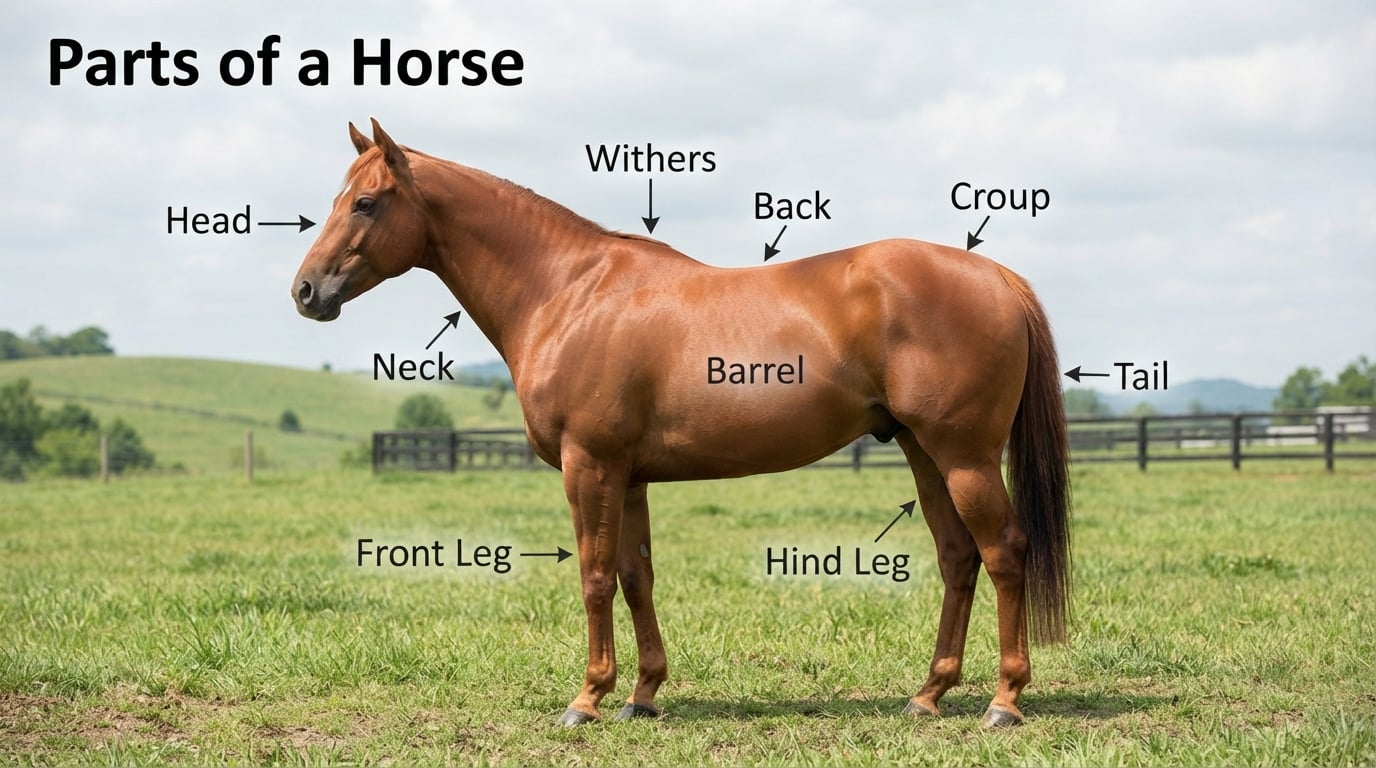
Knowing the parts of a horse is the foundation of every equestrian skill you’ll ever learn. Whether you’re grooming, tacking, riding, or calling the vet, you need to speak the language of horse anatomy fluently.
I remember the first time I walked into a barn and heard someone call out “check his left front fetlock.” I had no idea what they meant. After 15 years of riding and three horses of my own, I can name every external part in seconds. I’ll show you exactly what each part is, where it sits, and why it matters.
Equine anatomy might look overwhelming at first. There are roughly 30 named external points, plus dozens more inside the skeletal and muscular systems. We’re going to focus on the parts you’ll actually use as a rider, owner, or student. By the end of this guide, you’ll recognize every region, know its function, and be able to talk about horses with confidence.
The 15 most commonly referenced parts of a horse are:
Poll, ears, forelock, eyes, and muzzle (head)
Mane, crest, and throat latch (neck)
Withers, back, barrel, and loins (body)
Shoulder, knee, cannon, fetlock, pastern, and hoof (front leg)
Stifle, gaskin, hock, and croup (hind end)
Let’s break each region down so you can picture it clearly.
Table of Contents
Parts of a Horse’s Head and Neck
The head and neck contain the sensory organs, the brainstem connection, and several sensitive areas you’ll need to handle gently. Each part has a specific name used in riding, grooming, and veterinary care.
Poll: The Sensitive Spot Between the Ears
The poll is the area right between a horse’s ears, on top of the head, where the bridle’s crownpiece sits. It’s one of the most sensitive parts of the entire horse. Press lightly there and most horses will lower their heads as a relaxation response.
Ears: Listening, Mood, and Communication
Horses have roughly 16 muscles in each ear, allowing them to rotate 180 degrees. Ears pinned flat signal anger or fear, while ears forward show interest. You should never trim whiskers around the ears since these help horses sense their environment.
Forelock: The Bangs on a Horse
The forelock is the tuft of mane that falls between the ears down the forehead. In everyday terms, you might call these the “bangs.” The forelock helps keep flies out of the eyes and protects the forehead from sun.
Forehead: The Flat Area Below the Forelock
The forehead is the flat front of the face between the eyes and the forelock. A wide forehead is often associated with intelligent, calm horses in classical conformation judging.
Eyes: Side-Mounted and Wide-Angle
Horses have the largest eyes of any land mammal. Because their eyes sit on the sides of the head, they have nearly 360-degree vision, with two small blind spots directly in front of the nose and directly behind the tail.
Muzzle: The Nose, Lips, and Chin Combined
The muzzle includes the nose, nostrils, lips, and chin area. It’s the soft, hairless end of the face used for grasping grass and investigating objects. The muzzle is one of the few places a horse tolerates being scratched.
Nostrils: Flared for Exercise, Relaxed at Rest
The nostrils flare wide during hard work to bring in more oxygen. At rest, they should sit soft and quiet. One nostril flaring more than the other can sometimes indicate a blockage or injury on one side.
Cheek: The Side of the Face
The cheek runs along the side of the face from the eye to the muzzle. It houses the cheek teeth, which grind forage. The cheek also gives shape to the side profile and is part of conformation assessment.
Chin Groove: Behind the Lower Lip
The chin groove is the indentation behind the lower lip where the curb chain of a bit rests. It’s a sensitive area, and a poorly fitted curb strap can cause pain here.
Throat Latch: The Curve Under the Jaw
The throat latch is the area on the side of the head where the cheek meets the neck, just below the jawbone. A clean, refined throat latch allows flexibility for breathing and flexion. A thick throat latch can restrict breathing.
Crest: The Topline of the Neck
The crest runs along the top of the neck from poll to withers. A strong, slightly arched crest is desirable in most breeds. An overly thick or fallen crest can indicate age, weight, or hormonal issues.
Mane: Hair Along the Crest
The mane is the long hair growing from the crest. It falls on one side or both, depending on breed and genetics. The mane protects the neck from weather and insects.
Neck: Connecting Head to Body
The neck links the head to the body and contains the cervical vertebrae, which give flexibility. A well-proportioned neck balances the horse’s overall conformation and helps with balance and steering.
Parts of a Horse’s Front Legs
The front legs carry about 60% of a horse’s body weight, so understanding their anatomy matters more than any other region. Lameness in the front legs is easier to spot than in the hind legs because of the way horses move.
Shoulder: The Powerhouse of the Front End
The shoulder is the large, sloping area from the withers down to the chest. A long, sloped shoulder allows for a longer stride and smoother gaits. Short, upright shoulders produce shorter, choppier movement.
Elbow: Where the Front Leg Bends
The elbow is the joint at the back of the front leg where the forearm meets the upper limb. It points backward and should never rub against the girth or the horse’s belly.
Forearm: The Muscular Upper Leg
The forearm sits between the elbow and the knee. Well-developed forearm muscles provide strength and stamina. The forearm is one of the main areas evaluated when judging muscle tone.
Knee: The Wrist of the Horse
The knee is the joint in the middle of the front leg, equivalent to your wrist. It should be flat, wide, and clean when viewed from the side. Swelling at the knee often points to injury.
Cannon Bone: The Lower Leg Below the Knee
The cannon bone is the long, hard bone between the knee and the fetlock. You can feel it easily by running your hand down the front leg. The cannon bone supports most of the horse’s weight during movement.
Fetlock: The Knuckle Above the Pastern
The fetlock joint sits at the back of the leg where the cannon meets the pastern. It includes a small tuft of hair called the ergot. The fetlock flexes during every step and absorbs concussion.
Pastern: The Sloped Section Above the Hoof
The pastern is the short, slanted area between the fetlock and the hoof. The angle of the pastern affects how the hoof hits the ground. Pasterns that are too upright or too sloped can lead to joint problems over time.
Coronet Band: The Hairline Above the Hoof
The coronet band is the soft ring just above the hoof where hoof wall growth begins. Any swelling, cut, or constant heat here can signal hoof problems developing.
Hoof: The Foundation of the Whole Horse
The hoof is the hard, horny capsule that touches the ground. It includes the wall, sole, frog, heel, and toe. Horses walk on the tip of one toe per leg, which makes them “unguligrade” animals.
A healthy hoof is essential. Cracks, soft spots, or unusual growth rings can all hint at nutrition or health issues.
Parts of a Horse’s Body (The Torso)
The body, sometimes called the barrel, holds the heart, lungs, stomach, and most of the major organs. The shapes and angles here directly influence riding comfort and athletic ability.
Withers: The Highest Point of the Horse
The withers are the bony ridge at the top of the shoulders, just behind the neck. This is the standard measurement point for a horse’s height, measured in “hands.” Prominent withers help keep a saddle from sliding forward.
Back: The Area Behind the Withers
The back runs from the withers to the loins, where the saddle sits. A back that’s too long is often weak, while a short back usually pairs with strong loin coupling. Saddle fit depends heavily on back length and shape.
Barrel: The Ribcage and Belly Combined
The barrel is the large, rounded area from behind the elbows to the flank. It contains the heart, lungs, and digestive organs. A deep barrel gives more room for lungs and stamina.
Loins: The Coupling Behind the Saddle
The loins are the short area behind the saddle where the back meets the hips. Strong, broad loins transfer power from the hindquarters to the front of the horse. Weak loins cause the back to sag.
Flank: The Soft Area in Front of the Hip
The flank is the hollow area on the side of the belly in front of the hind leg. You can see the flank rise and fall with breathing. Excessive hollow flanks can indicate dehydration, weight loss, or age.
Chest: The Front of the Body Between the Front Legs
The chest runs between the front legs and is sometimes called the “breast.” A wide chest indicates strong lungs and good athletic capacity. Narrow chests restrict stride and breathing.
Parts of a Horse’s Hind Legs
The hind legs are the engine of the horse. Every stride, jump, and burst of speed starts here. Knowing these parts helps you talk about lameness, performance, and conformation confidently.
Stifle: The Horse’s Knee Equivalent
The stifle is the joint at the top of the hind leg, equivalent to your knee. It sits high on the hindquarter, near where the flank meets the thigh. The stifle is the largest joint in the horse’s body and frequently involved in locking issues.
Gaskin: The Muscular Thigh
The gaskin is the muscular area between the stifle and the hock. It corresponds to your calf muscle. Well-developed gaskins give a horse explosive power for jumping and galloping.
Hock: The Complex Hind Leg Joint
The hock is the large, angular joint halfway down the hind leg, equivalent to your ankle. It’s made up of several small bones and is the most common site for arthritis in performance horses. Hock lameness usually shows up as a shortened stride behind.
Hind Cannon Bone: Below the Hock
The hind cannon mirrors the front cannon and runs between the hock and the hind fetlock. The hind cannon tends to be slightly longer than the front cannon.
Hind Fetlock, Pastern, and Hoof
These three parts match the front leg versions in name and structure. The hind hoofs often appear slightly more pointed than the front hoofs, and the hind pasterns are usually a bit more sloped.
Parts of a Horse’s Rear: Croup, Dock, and Tail
The rear of the horse includes the rump area and the tail. These parts matter for balance, communication, and fly protection.
Croup: The Topline of the Rump
The croup is the area from the top of the hips to the tail. In some breeds, a flat or slightly sloped croup is preferred. A steep croup often pairs with limited hindquarter power.
Dock: The Base of the Tail
The dock is the bony root of the tail, just below the croup. It’s a sensitive area covered by short hair. The dock is part of conformation scoring and indicates muscle development at the top of the hindquarters.
Tail: Long Hair for Balance and Flies
The tail grows from the dock and consists of long hair plus the tailbone underneath. Horses use the tail to swat flies, signal mood, and counterbalance during sharp turns.
Buttock: The Muscular Rear
The buttock is the large, rounded muscle at the back of the hindquarter. It works with the gaskin to power every stride. Strong, rounded buttocks indicate good athletic ability.
Why the Parts of a Horse Matter: Functions, Health, and Conformation
Knowing horse parts isn’t just trivia. It directly affects how you ride, train, and care for your horse. We use anatomy knowledge every single day at the barn.
How Each Part Works in Movement
Horses move through a chain reaction of body parts. The hind legs push forward, the back and loins transfer energy, the shoulders and front legs absorb impact, and the neck and head balance the whole body. Understanding this chain helps you feel where a horse is stiff or sore.
Health Indicators You Can Spot Externally
Many health problems show up on the outside before they show up under the skin. Heat in a hoof can mean laminitis. Swelling at the fetlock can mean a sprain. A sunken flank can mean dehydration. Checking these parts daily takes 30 seconds and catches problems early.
What “Conformation” Means
Conformation is the overall structure and proportions of a horse, judged by looking at all the parts together. Good conformation means the angles and lengths line up to reduce stress on joints and tendons. Poor conformation leads to lameness and early arthritis. Vets, judges, and buyers evaluate conformation constantly.
Common Beginner Mistakes in Identifying Parts
Most beginners confuse the cannon bone with the forearm, or call the hock the ankle. They mix up the pastern and the fetlock. The fastest way to fix this is to stand next to a real horse and run your hand over each region while saying the name out loud.
I tell my riding students to point and name one part every time they lead a horse. Within a week, the vocabulary sticks.
Frequently Asked Questions
What are the 15 main parts of a horse?
The 15 main parts of a horse are the poll, ears, eyes, muzzle, mane, withers, back, barrel, loins, shoulder, knee, cannon, fetlock, pastern, and hoof. Some lists include the croup, dock, gaskin, stifle, and hock, bringing the total to 20 essential points. Each part has a specific function in movement, balance, or health monitoring.
What are the body parts of a horse?
The body parts of a horse include the head, neck, withers, back, barrel, loins, flank, chest, croup, and tail. These central regions hold the major organs and connect the front and hind ends. The legs (front and hind) are usually described separately from the body proper.
What are the bangs on a horse called?
The bangs on a horse are called the forelock. The forelock is the tuft of mane that falls between the ears down the forehead. It helps keep flies out of the eyes and shields the forehead from sun glare.
What is the most sensitive part of a horse?
The most sensitive part of a horse is the poll, the area right between the ears. Light pressure on the poll causes most horses to lower their heads as a relaxation response. The muzzle, flanks, and coronet band are also highly sensitive and should be handled with care.
What are the 3 F’s for horses?
The 3 F’s for horses refer to the forelock, fetlock, and frog. These three parts all begin with F and are important external features. The forelock is the bangs on the head, the fetlock is the joint above the pastern, and the frog is the V-shaped pad on the underside of the hoof.
Final Thoughts on Learning the Parts of a Horse
Mastering the parts of a horse is the first step to becoming a confident rider, owner, or horse enthusiast. Start with the major regions, learn the 15 most common parts, and expand outward as you grow.
Print this guide. Tape it in the tack room. Point and name one part every time you walk past a horse. Within a few weeks, you’ll speak the language of horse anatomy fluently, and every future skill you learn will build on that foundation.