
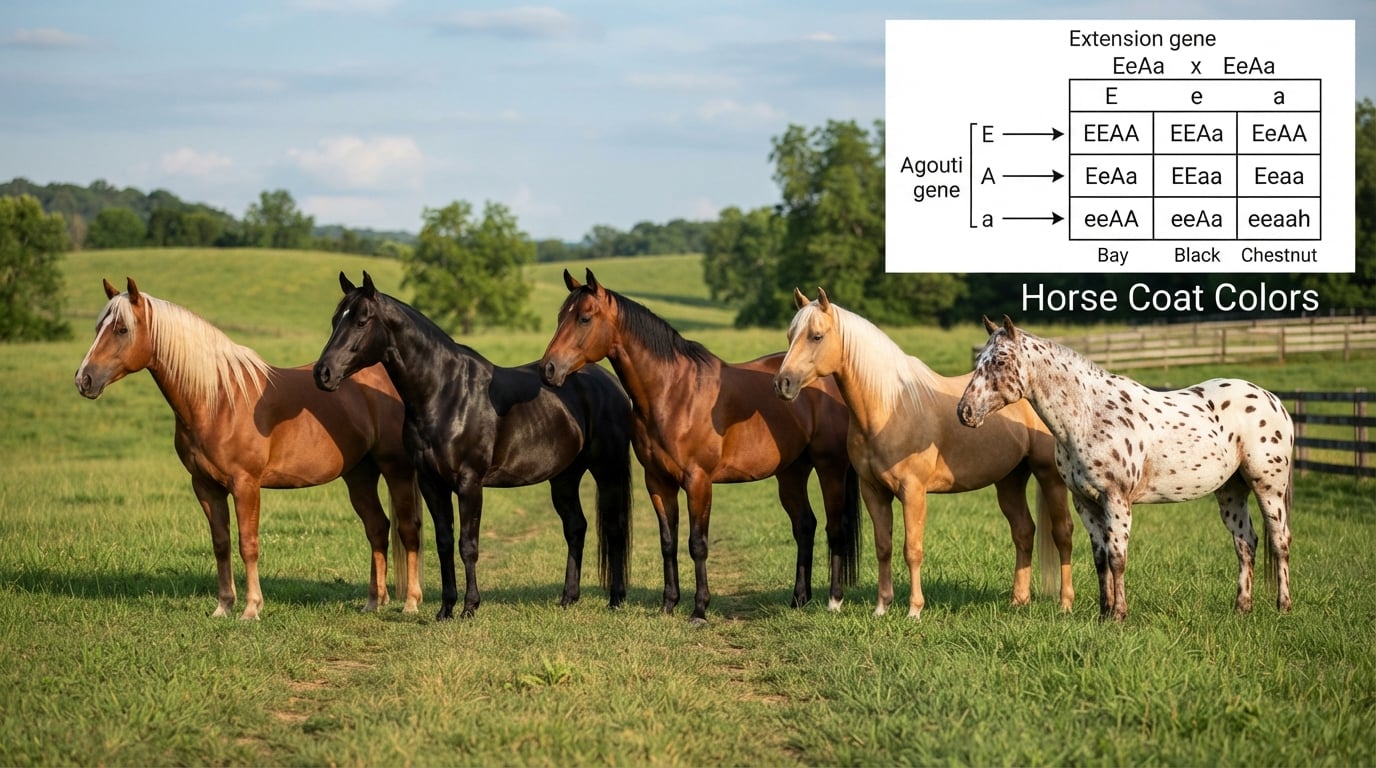
I have spent years around horses, and the variety in horse coat colors still amazes me. From the deep black of a Friesian to the golden glow of a palomino, every coat tells a genetic story.
Horse coat colors come down to just two pigments. That’s right. Every single color and pattern you see on a horse comes from a mix of red pigment (pheomelanin) and black pigment (eumelanin), plus a handful of modifying genes.
The rarest horse coat color is a white pattern called “White” or “Sabino-White.” True white horses are extremely rare. They are not albinos (true albinism doesn’t exist in horses). They carry specific dominant white genes that produce a pure white coat from birth.
In this guide, I will walk you through everything you need to know about equine coat colors. We will start with the science behind the colors, then cover each major color and pattern with breed examples. By the end, you will be able to identify most horse colors on sight and understand the genetics behind them.
Table of Contents
The Two Base Pigments Behind Every Horse Coat Color
Every horse coat color in the world starts with two pigments. Understanding these two pigments unlocks the entire color system.
- Pheomelanin (red pigment): Creates red, yellow, and chestnut tones. Found in the hair shaft and skin.
- Eumelanin (black pigment): Produces black and brown tones. Also colors skin, hooves, and eyes.
The MC1R gene (Melanocortin 1 Receptor) controls whether a horse produces black pigment or red pigment. The ASIP gene (Agouti Signaling Protein) controls where black pigment shows up on the body. Together, these two genes create the three base coat colors.
This is why horses can be black all over, red all over, or black with red points. It all depends on which version of these two genes the horse inherits.
The 3 Base Coat Colors Every Horse Has
These three base colors are the foundation of all horse coat colors. Every other color you see is a modification of one of these.
Bay Horses
A bay horse has a reddish-brown body with black points. Black points mean the mane, tail, lower legs, and ear tips are black. The body color ranges from light reddish-bay to dark mahogany-bay.
- Body color: Reddish-brown to dark brown
- Points: Black mane, tail, legs, and ear edges
- Skin: Dark
- Genetic basis: Horse has at least one dominant E allele (MC1R) and at least one dominant A allele (ASIP)
Bay is one of the most common horse coat colors. You will find bay in nearly every breed. Thoroughbreds, Quarter Horses, Arabians, and Clydesdales all show bay variations. The black points are the key identifier. Without them, the horse is not a true bay.
Chestnut (Sorrel) Horses
A chestnut horse is entirely red. There are no black hairs anywhere on the body, mane, or tail. The color ranges from a pale sandy chestnut to a deep liver chestnut.
- Body color: Red to dark red, never brown
- Mane and tail: Same color as body, or lighter (flaxen)
- Skin: Dark gray or brown
- Genetic basis: Horse is homozygous recessive at MC1R (ee)
Sorrel and chestnut are the same color genetically. “Sorrel” is the term many Western riders use for a lighter chestnut with a flaxen mane. “Liver chestnut” describes the darkest shade, where the coat looks almost black in some lights.
I have noticed that chestnut horses often sun-bleach in summer, giving their coats a faded appearance. This is not a different color. It is the same chestnut with sun damage to the hair tips.
Black Horses
A true black horse has a fully black body, mane, and tail with no reddish or brown tones. Some black horses fade in the sun and look brownish. That does not make them bay. It just means they lack protective black pigment intensity.
- Body color: True black (may sun-fade to brown)
- Points: Black, like the body
- Skin: Black
- Genetic basis: Horse has at least one dominant E allele (MC1R) and is homozygous recessive at ASIP (aa)
Black is less common than bay or chestnut. Friesians, Murgeses, and some Fell Ponies are known for true black coats. A “smoky black” horse has a cream dilution gene. This makes the body color appear dark brown rather than black.
Dilution Colors: How Genes Lighten and Modify Base Colors
Dilution genes do not change the underlying base color. They modify how pigment appears in the hair. A single cream dilution can turn a chestnut into a palomino. Two cream dilutions turn that chestnut into a cremello.
Cream Dilution (Palomino, Buckskin, Cremello)
The cream gene (Ccr) is the most common dilution gene. It acts on both red and black pigment, but with a different effect on each.
- Palomino: One cream dilution on chestnut. Golden body with a white or flaxen mane and tail.
- Buckskin: One cream dilution on bay. Tan or gold body with black points (mane, tail, legs).
- Smoky black: One cream dilution on black. Looks like a faded black or dark brown.
- Cremello: Two cream dilutions on chestnut. Nearly white coat with blue eyes and pink skin.
- Perlino: Two cream dilutions on bay. Similar to cremello but with slightly more yellow tone.
- Smoky cream: Two cream dilutions on black. Looks identical to perlino.
Palominos are popular in many breeds. Quarter Horses, Arabians, and Morgans often produce palominos. The golden body with the light mane is unmistakable.
Buckskins have black points just like bays, but the body is significantly lighter. Dun factor markings (the dorsal stripe and zebra stripes on legs) are sometimes confused with buckskin. A true buckskin does not have a true dorsal stripe.
Dun Coloring
The dun gene (D) is one of the oldest dilution genes. It lightens the body but leaves the points darker. It also creates “primitive markings.”
- Classic dun (bay dun): Tan or mouse-colored body with black points, dark dorsal stripe, and often zebra stripes on legs.
- Red dun: Dilutes chestnut to a pale tan or pinkish body with a red dorsal stripe.
- Grullo (blue dun): Dilutes black to a smoky gray or slate-blue body with black points and dorsal stripe.
The dorsal stripe is the key. It runs from the withers down the back to the tail. Duns also often show zebra-like horizontal stripes on the upper legs and sometimes dark-tipped ears. These are not mutations. They are signs of the dun factor.
Norwegian Fjord horses, Przewalski horses, and many mustang herds show classic dun coloring.
Champagne Dilution
Champagne is a dilution gene (Ch) that creates golden coats with freckled skin and amber or green eyes. It works on all base colors.
- Gold champagne: Champagne on chestnut. Golden body with flaxen mane.
- Amber champagne: Champagne on bay. Golden body with darker points.
- Classic champagne: Champagne on black. Looks dark olive or tan with darker points.
Champagne horses have pink skin with freckles. Their eyes are born blue and usually darken to amber by adulthood. This is rare but found in Tennessee Walking Horses, Quarter Horses, and some Missouri Foxtrotters.
Silver Dapple
The silver dilution gene only affects black pigment. It turns black hair silver or chocolate.
- Silver dapple: Dilutes black body to a chocolate brown or taupe with a silver or flaxen mane and tail.
Silver dapple appears most often in Rocky Mountain Horses and Icelandic Horses. The contrast between the dark body and light mane can be striking.
Pearl Dilution
Pearl is a rare dilution gene. It acts like a cream dilution but only shows strong effects when paired with a second pearl allele.
- Pearl on chestnut (one copy): Subtle lightening, often with a metallic sheen.
- Pearl on chestnut (two copies): Pale apricot coat with blue eyes.
Pearl is rare. It shows up most often in Quarter Horse bloodlines. Some Andalusian and Lusitano horses carry it too.
Pattern Colors and White Markings
Pattern genes create designs on top of base coat colors. White markings, spots, and roaning are all controlled by separate genes.
Roan Patterns
A roan horse has white hairs mixed evenly throughout the body. The head and legs usually stay darker. The pattern is named by the underlying base color.
- Red roan: White hairs mixed into a chestnut body, creating a pinkish or strawberry appearance.
- Blue roan: White hairs mixed into a black body, creating a slate-blue or grayish color (this is what a “blue” horse is called).
- Bay roan: White hairs mixed into a bay body, creating a mix of red and white with black points.
A blue roan is not actually blue. The black base coat mixed with white hairs creates a grayish-blue appearance. This often confuses people, but the horse still has black skin and black points under the white hairs.
Roans often have a “reverse dappling” effect in winter, where the coat looks brighter due to seasonal coat changes. Their foals are usually born solid color and roan out after the first shedding.
Gray Horses
Gray is progressive. A gray horse is born a darker color and gradually lightens with age. Most gray horses end up nearly white by their teenage years.
- Gray: A modifier gene that gradually turns all hair white over time.
- Flea-bitten gray: White coat with small specks of red or brown.
- Dappled gray: Pattern of dark rings over a lighter coat, often during the transition phase.
Gray is common in Andalusians, Lipizzaners, and Percherons. The graying gene is dominant. So if one parent is gray, the foal has a 50% chance of being gray too.
Many gray horses develop melanomas as they age. Studies show that roughly 70-80% of gray horses over 15 years develop some form of melanoma. Most are benign. Still, gray owners should monitor their horses closely.
Appaloosa Patterns
Appaloosa is a pattern group, not a single color. The Appaloosa breed is known for several distinct coat patterns that come from the LP gene (Leopard Complex).
- Leopard: White body with dark spots scattered throughout.
- Blanket: White blanket over the hips with or without spots.
- Snowflake: Dark coat with white spots scattered throughout.
- Varnish roan: Mix of dark and light hairs, often with darker bony areas (face, knees, hocks).
Appaloosas also have mottled skin, striped hooves, and a visible white sclera around the eye. These traits help identify the breed pattern. Not all spotted horses are Appaloosas. Some are pinto or sabino patterns.
Pinto Patterns
Pinto refers to a horse with large patches of white and another color. There are two main pinto pattern types.
- Tobiano: White crosses the back between the withers and tail. Legs are usually white. The head is mostly colored.
- Overo: White usually does not cross the back. The head is often heavily white (bald or apron face). Legs are usually dark.
- Tovero: A mix of tobiano and overo characteristics.
The term “Paint horse” specifically refers to registered Paint Horses, which are Quarter Horse or Thoroughbred crosses with pinto patterns. “Pinto” is a more general term.
Overo is itself a group. Frame Overo can produce “lethal white syndrome” when two frame overo genes combine in a foal. The affected foal is born white and lacks intestinal nerves. This is always fatal within days. Genetic testing has nearly eliminated this.
Horse Color Genetics Explained Simply
You do not need to be a geneticist to understand basic horse color inheritance. The key genes work in predictable ways.
The MC1R gene has two main versions. E allows black pigment production. e (recessive) blocks black pigment. A horse with ee will be chestnut regardless of any other gene. A horse with EE or Ee can produce black pigment, which may show up depending on the ASIP gene.
The ASIP gene controls where black pigment goes. A (dominant) restricts black to the points, creating bay. a (recessive) lets black spread across the whole body, creating black. So a chestnut horse has ee at MC1R. A bay horse has at least one E and at least one A. A black horse has at least one E and is aa.
Dilution genes are modifiers on top of base colors. A palomino is chestnut (ee) plus one cream allele (Ccr). A buckskin is bay (E_, A_) plus one cream allele. A cremello is chestnut (ee) plus two cream alleles.
Genetic testing can now identify most coat color genes. Tests cost around $30 to $75 per gene. Many breed registries require color testing for stallions. The UC Davis Veterinary Genetics Laboratory is the leading academic source for these tests.
Frequently Asked Questions About Horse Coat Colors
What is the rarest coat color for a horse?
The rarest horse coat color is true white. True white horses are extremely uncommon because they require very specific dominant white (W) gene variants. Another rare color is the true blue roan, since many ‘blue’ horses are actually gray. Albino horses do not exist as a true color in horses. They are all white pattern variants.
What are the 5 basic horse coat colors?
The five basic horse coat colors every owner should know are: Bay (brown body with black points), Chestnut (solid red coat with no black hairs), Black (solid black coat with no red hairs), Gray (born dark, lightens with age), and Dun (tan to mouse body with dorsal stripe and primitive markings).
What is a blue horse coat called?
A blue horse coat is called blue roan. The horse has a black base color with white hairs mixed throughout, creating a slate-blue or grayish appearance. The skin and points remain black. Blue roans should not be confused with gray horses, which gradually lighten with age and may eventually appear white.
What determines a horse’s coat color?
A horse’s coat color is determined by two base pigments (red and black) controlled by the MC1R gene, with distribution controlled by the ASIP gene. Dilution genes like cream, dun, champagne, and silver modify these base colors. White pattern genes like Tobiano, Frame Overo, and LP add white patches or spots on top.
How many horse coat colors are there?
There are three base colors (bay, chestnut, black), at least five main dilution colors (palomino, buckskin, cremello, dun, champagne), four major pattern categories (roan, gray, appaloosa, pinto), and dozens of named color combinations. In total, the standard equine color chart lists around 30 to 40 distinct named colors, though many overlap genetically.
Final Thoughts on Horse Coat Colors
Horse coat colors combine simple base pigments with complex genetic modifiers. The two-pigment foundation makes the system easier to learn than it first appears.
Whether you are identifying your own horse’s color, planning a breeding, or simply curious about horses, the patterns we covered in this guide should give you a solid foundation. From the three base colors to rare dilutions like champagne and pearl, every equine coat has a story.
For 2026, genetic testing is more affordable than ever. Many breed registries include color tests in their DNA panels. If you want certainty on your horse’s genetic color, a $40 to $75 test can answer it for life.
Stay curious about what you see in the barn. Every horse you meet has at least three genetic messages written into its coat. Knowing how to read them brings you closer to these amazing animals.