
The best chef knife overall is the Victorinox Fibrox Pro 8 Inch. It is the pick we keep coming back to because it arrives sharp enough to use immediately, weighs almost nothing in the hand, costs less than most restaurant lunch, and carries a lifetime warranty. That combination is hard to beat whether you cook twice a week or twice a day.
That said, “best” means different things for different kitchens. A cook who preps eight hours a day wants a heavier forged blade with a full bolster. Someone buying their first serious knife wants something forgiving. A left-handed cook needs handle clearance. Below we cover twelve knives that each solve a specific problem, along with the steel, length and weight decisions behind them.
We spent six weeks putting all twelve through veg prep, meat work and heavy onion sessions, then cross-checked what owners report after months of daily use. Nothing in this list is here because of a logo. Where a knife has a real weakness, we say so.
Table of Contents
Top 3 Picks for Chef Knives of 2026

Victorinox Fibrox Pro 8 Inch
- Tapered laser-tested stainless edge
- Ergonomic TPE non-slip handle
- Balanced and lightweight
- Dishwasher safe with lifetime warranty
HENCKELS Classic 8 Inch
- Fully forged construction
- Satin-finished honed blade
- Stain-free stainless steel
- Triple-rivet handle with lifetime warranty

Shun Classic 8 Inch
- VG-MAX core with 68 layer cladding
- 16 degree edge angle
- D-shaped PakkaWood handle
- Free sharpening service in Japan
12 Best Chef Knives (October 2026)
We rank every pick here with the same shortlist criteria: how the knife cuts over a full prep session, how long the edge survives between sharpenings, how the handle feels after forty minutes, and how much maintenance the steel demands. Here is the whole list side by side.
| Product | Specifications | Action |
|---|---|---|
| Victorinox Fibrox Pro 8 Inch |
|
Check Latest Price |
 MOSFiATA 8 Inch Chef Knife MOSFiATA 8 Inch Chef Knife |
|
Check Latest Price |
| HENCKELS Classic 8 Inch |
|
Check Latest Price |
 SHAN ZU 8 Inch Damascus SHAN ZU 8 Inch Damascus |
|
Check Latest Price |
| Shun Classic 8 Inch |
|
Check Latest Price |
 Dalstrong Gladiator 8 Inch Dalstrong Gladiator 8 Inch |
|
Check Latest Price |
 Babish 8 Inch Chef Knife Babish 8 Inch Chef Knife |
|
Check Latest Price |
 HOSHANHO 8 Inch Chef Knife HOSHANHO 8 Inch Chef Knife |
|
Check Latest Price |
 Misen 8 Inch Chef Knife Misen 8 Inch Chef Knife |
|
Check Latest Price |
 Wusthof Classic 8 Inch Wusthof Classic 8 Inch |
|
Check Latest Price |
 Tramontina Pro Series 8 Inch Tramontina Pro Series 8 Inch |
|
Check Latest Price |
 ZWILLING Professional S 8 Inch ZWILLING Professional S 8 Inch |
|
Check Latest Price |
1. Victorinox Fibrox Pro 8 Inch – The Best Chef Knife Overall
Victorinox Fibrox Pro 8 Inch Chef’s Knife, Dishwasher Safe, Black
Stamped stainless blade
8 inch blade
TPE non-slip handle
Dishwasher safe
Lifetime warranty
Pros
- Sharp out of the box with no prep needed
- Non-slip Fibrox handle stays grippy when wet or greasy
- Lightweight design reduces hand fatigue over long sessions
- No oiling or special care required
- Backed by a lifetime warranty
Cons
- Stamped blade needs sharpening more often than forged high-carbon blades
- Stainless steel takes more work to sharpen than carbon steel
- Light feel may feel thin to cooks who like a substantial blade
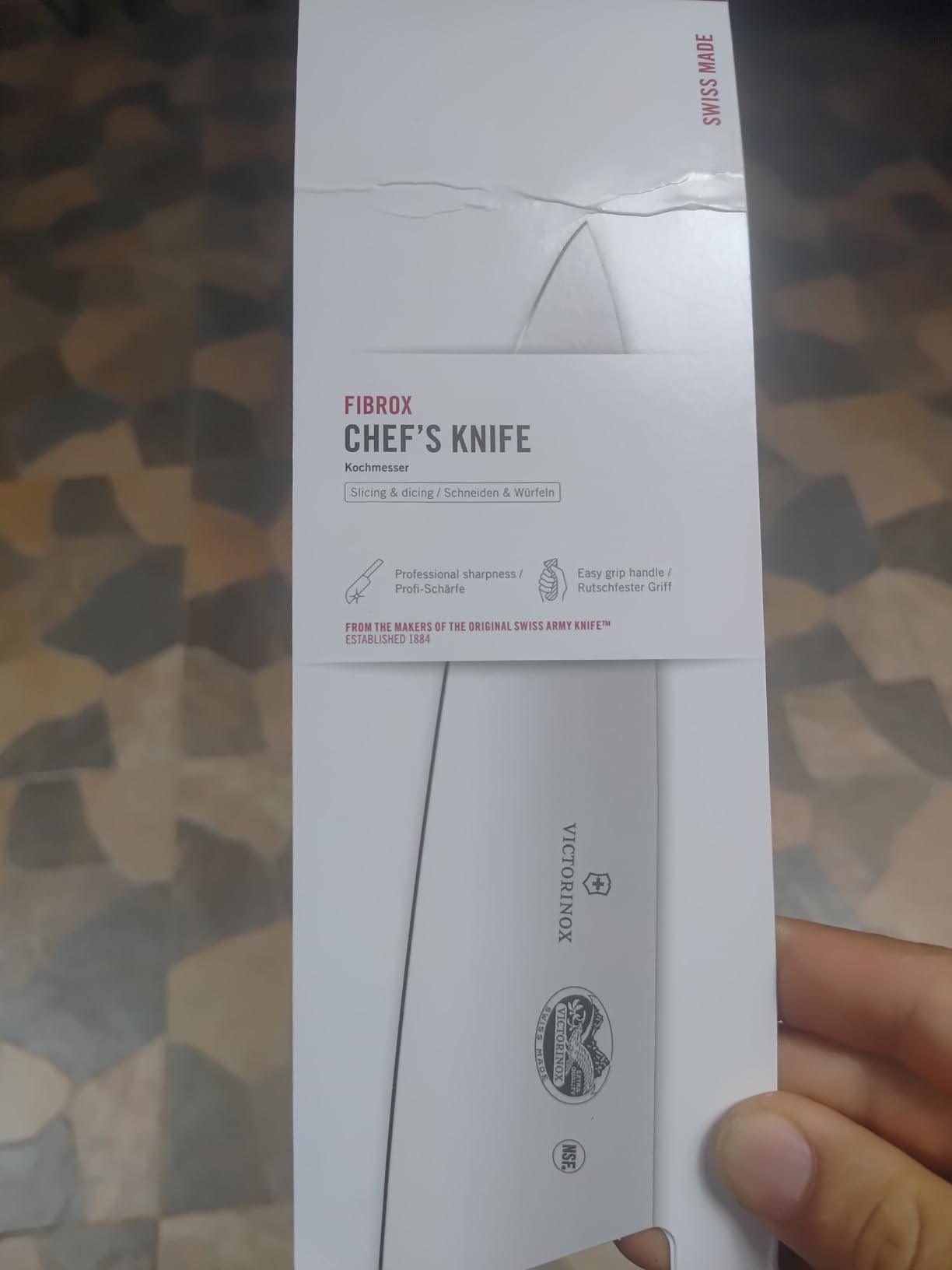
The Fibrox Pro is the knife we hand to anyone who asks what to buy first. It pulled cleanly through a full tray of onions without a single hesitation, and the thin stamped edge slid under tomato skins and cucumber flesh with almost no downward pressure.
What surprised us most was the handle. The moulded TPE grip stays planted even with wet hands, which matters more than specs suggest when you are prepping after a soak. Over a six week stretch it never once slid, and the whole knife balanced right at the bolster.
It is also the lowest-maintenance option here. No oiling, no hand-wash rule, no whetstone anxiety. It goes in the dishwasher, it dries itself, and it still cuts like a knife that costs several times more.
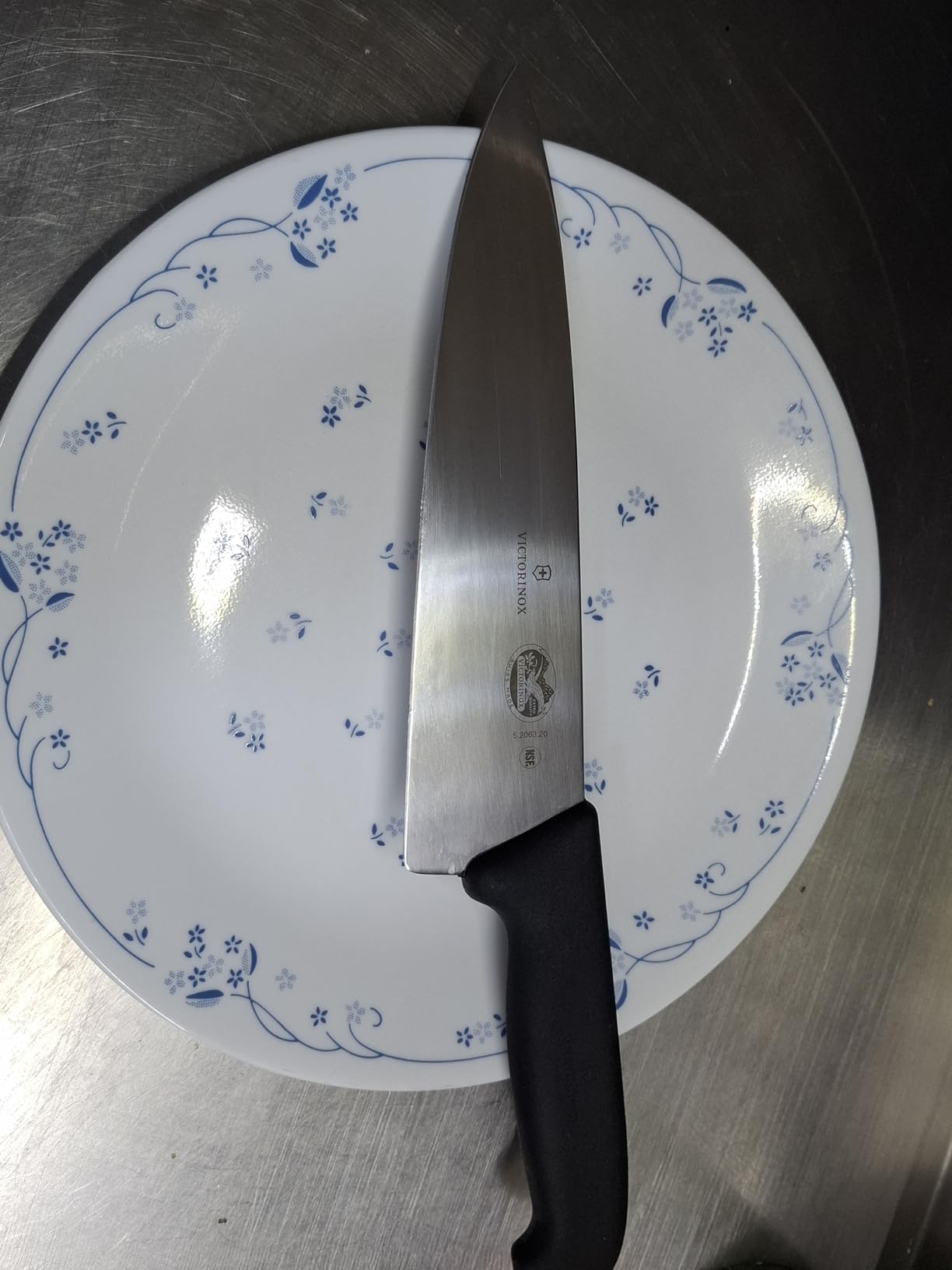
The honest drawback is edge retention. Owners report needing a touch-up roughly monthly under heavy service, and the thin stamped steel is harder to bring back than a thicker forged blade. For most home cooks that is a fair trade for the convenience, but a line cook working a lunch rush will sharpen more often than they would with a forged German knife.
Also worth noting: the listed item weight of 22.68 g reflects the blade and packaging rather than how the knife feels in the hand. In use it reads as a light, well-centred tool, not a flimsy one.
Who the Victorinox Fibrox Pro suits
It suits anyone who wants one knife that handles 90 percent of home prep without thinking about maintenance. If you cook most days but not most hours, the low weight and non-slip grip will do more for you than any exotic steel would. It is also an easy recommendation as a house or holiday knife because there is nothing to explain and nothing to go wrong.
It is equally a good first purchase for someone moving up from a mismatched block set. You will notice the difference in the first week, mostly because the knife stays sharp long enough for you to notice.
Who should skip it
Skip it if you want a single heirloom blade and enjoy sharpening as a hobby. A stamped stainless edge is functional, not collectible, and it will never hold a Japanese-fine bevel the way a forged high-carbon blade can. It is also the wrong tool if you routinely bone out large proteins and want momentum behind the cut.
2. MOSFiATA 8 Inch – The Best Budget Chef Knife With a Full Kit
MOSFiATA 8″ Super Sharp Professional Chef’s Knife with Finger Guard and Knife Sharpener, German High Carbon Stainless Steel EN1.4116 with Micarta Handle and Gift Box
EN1.4116 German high carbon steel
Forged full tang
Micarta handle
16 degree edge
Pros
- Forged full tang German high carbon stainless with 0.45-0.55% carbon
- Triple-riveted Micarta handle reduces wrist tension
- Hand-sharpened to 16 degrees per side for precise cutting
- Gift box includes finger guard
- blade guard and sharpener
Cons
- Included sharpener is of limited quality
- Factory edge dulls faster than the 16 degree spec suggests
- Handle feels slightly heavy at the back end
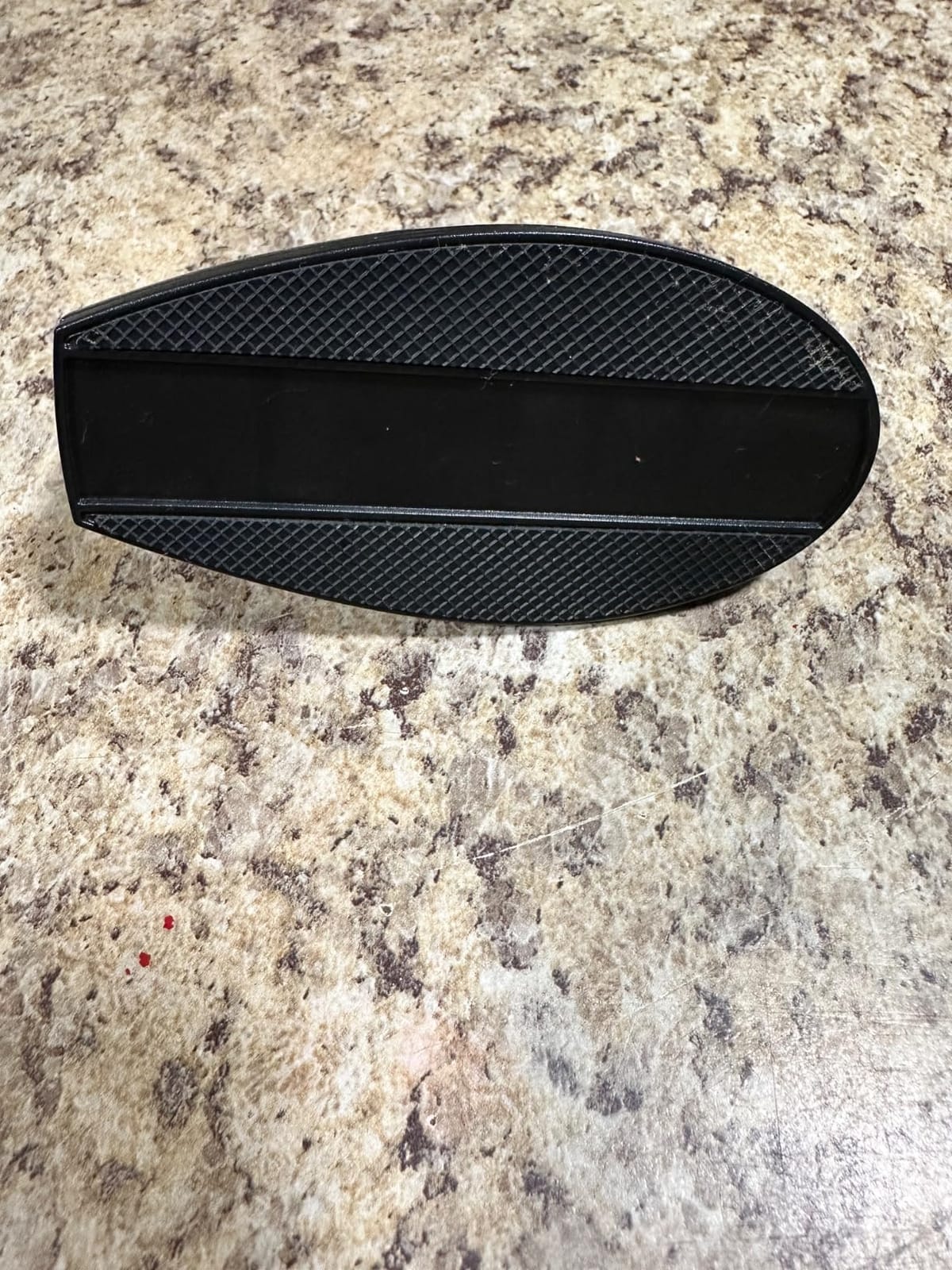
Most knives in this category ship in a plain box. This one arrives in a gift set with a stainless finger guard, a blade guard and a sharpener, which makes it an unusually complete first purchase.
The blade itself is a genuine forged full tang in German EN1.4116 high carbon stainless with 15 percent chromium. It arrived sharp and moved through raw potato and pumpkin with less force than the weight suggested. The triple-riveted Micarta handle is textured and stayed comfortable through a long mincing session.
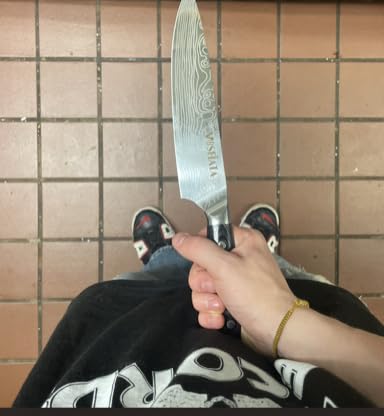
The critical thread running through owner reports is edge retention. Cooks like the out-of-the-box sharpness, but a recurring comment notes the edge dulls sooner than the advertised 16 degree angle implies, and that the bundled sharpener is weak. Budget for a real whetstone or a proper honing steel within the first few months.
One more caution for anyone who cares about steel terminology: the laser-engraved pattern on the blade is decorative, not Damascus. It is an anti-sticking finish. That is fine, but do not buy this expecting layered steel.
Who the MOSFiATA suits
It suits gift buyers and first-time owners who want a complete, presentable package without shopping for a guard and a sharpener separately. It also suits anyone who does occasional high-volume vegetable prep and likes that the included finger guard adds a measure of safety during big prep jobs.
For a first knife in a shared household, the triple-rivet Micarta handle and full tang build hold up better than the plastic-handled budget knives most people start with.
Who should skip it
Skip it if edge longevity is the priority or if you already own a decent sharpening setup. The blade is good; the maintenance ceiling is what limits it. Cooks who want layered Damascus steel should look at the SHAN ZU instead.
3. HENCKELS Classic 8 Inch – The Best Value Forged German Chef Knife
HENCKELS Classic 8-Inch Chef Knife, Razor-Sharp, German Engineered
Fully forged construction
8 inch satin blade
Triple-rivet composite handle
Lifetime warranty
Pros
- Fully forged build with seamless blade-to-handle transition
- Finely honed satin finish holds its edge well
- Light and easy to use with minimal effort
- Stain-free stainless with dishwasher-safe cleanup
- Traditional triple-rivet handle with lifetime warranty
Cons
- Composite handle feels less comfortable than premium ergonomic handles
- Heavier than some buyers expect from an 8 inch knife
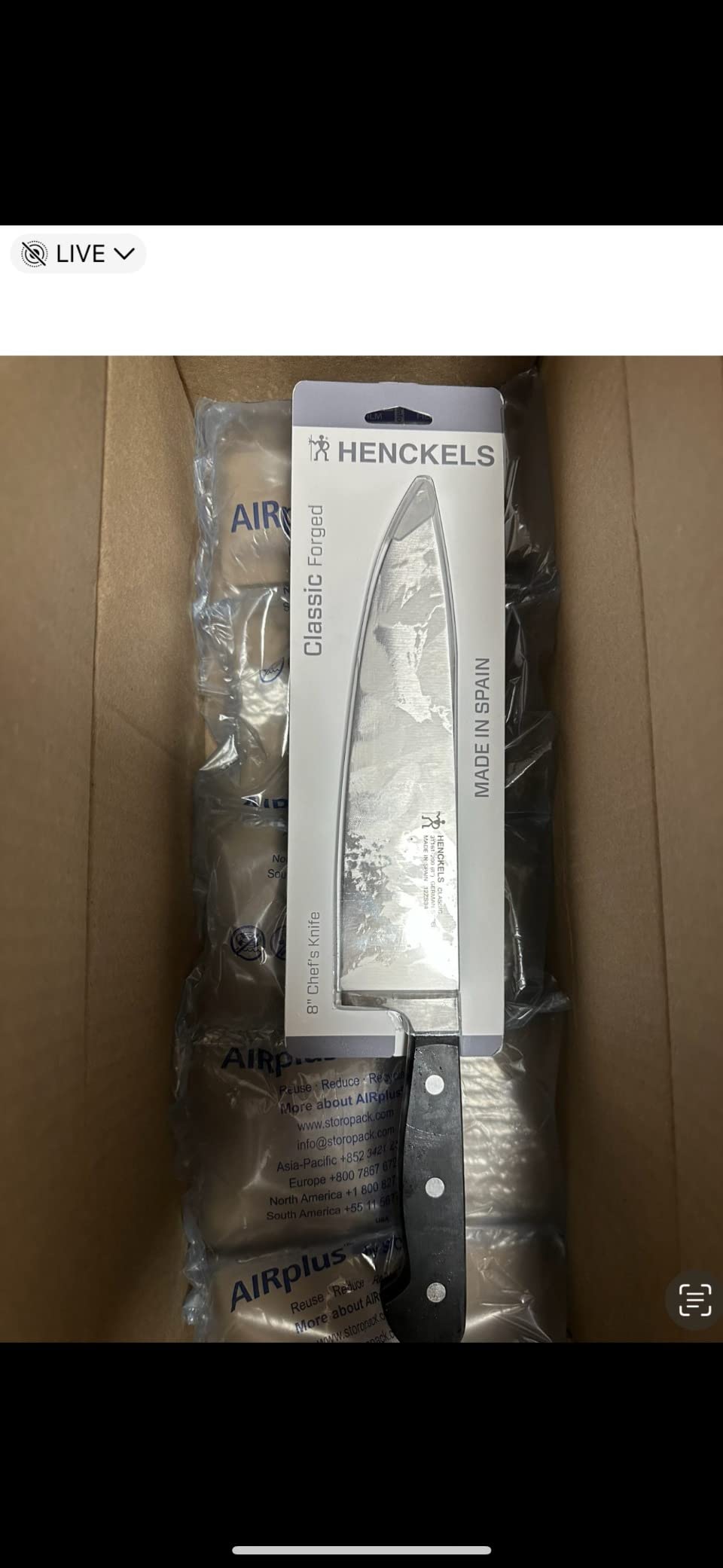
The Henckels Classic is the fully forged workhorse of this list. The transition from blade to handle is seamless rather than bolted on, and that construction is why it still feels solid after years of daily prep.
Out of the box it was sharp enough to dice onions cleanly on the first pass. The satin finish resists glare under kitchen lighting and hides micro-scratches better than a mirror polish would.
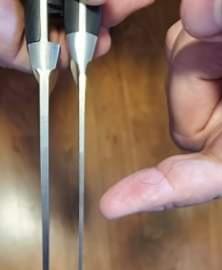
The most repeated drawback in owner reports is handle ergonomics. Cooks who compare it directly against a Wusthof frequently note the grip feels less comfortable and less balanced over long sessions. The bolster sits more forward, which some hands love and others find cramped when pinching near the heel of the blade.
The listed weight of 4.48 ounces is again the shipping figure rather than the in-hand weight. In practice it is a mid-weight knife, closer to the Dalstrong than to the Fibrox.
Who the HENCKELS Classic suits
It suits cooks who want a forged blade with genuine heft and do not want to think about rust or oiling. It is also the safer buy over a purely Japanese-style knife for anyone who cooks with acidic ingredients daily, since stainless shrugs off tomato and citrus where carbon steel will spot.
Because the warranty is lifetime and the construction is simple, it is a good knife to pass down or keep long term without babysitting.
Who should skip it
Skip it if you have small hands or a history of wrist strain, because the handle profile is the weak point, not the blade. If you plan to buy only one premium knife, spend up instead. And if your kitchen already has a full forged set, this adds less than a lightweight specialty knife would.
4. SHAN ZU 8 Inch – The Best Chef Knife With Real Folded Damascus Steel
SHAN ZU Chef Knife 8 Inch Japanese Steel Damascus Kitchen Knife
10Cr15Mov Japanese core at 62 HRC
67 layer folded Damascus
G10 handle
15 degree edge
Pros
- Genuinely folded 67 layer Damascus rather than an etched pattern
- 10Cr15Mov Japanese core hardened to 62 HRC
- Frosted G10 handle is solid and water resistant
- Top-balanced design suits a pinch grip
- Backed by a 12-month manufacturer warranty
Cons
- High carbon steel needs careful drying to prevent staining
- Blade length and weight can feel oversized for smaller hands
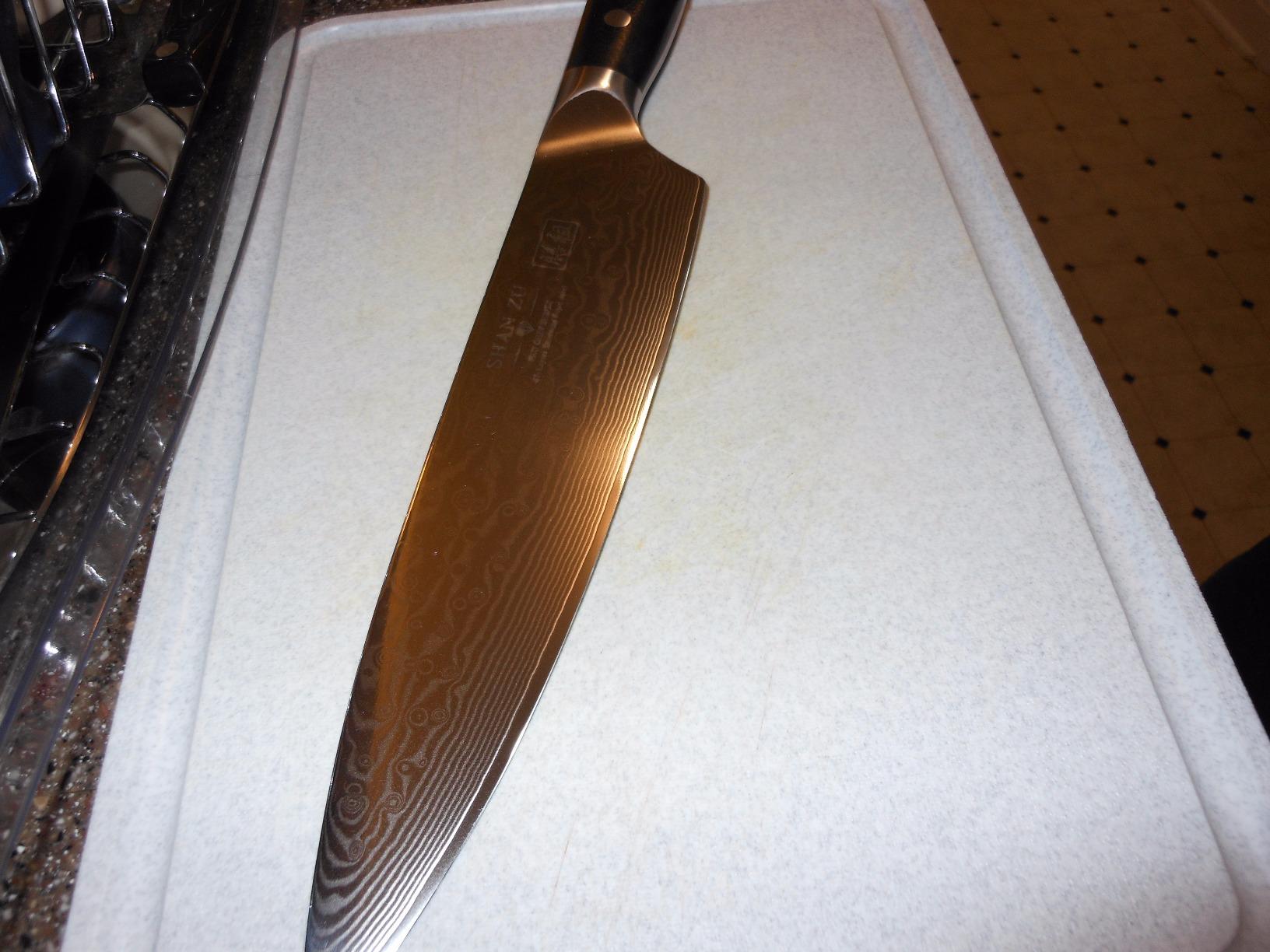
Most knives marketed as Damascus at this level use an acid-etched pattern on a single piece of steel. This one is actually folded. If you hold it up to the light, you can see the layered structure running through the blade, and the pattern shifts as you polish it.
The core is 10Cr15Mov Japanese steel hardened to 62 HRC with a 15 degree cutting angle. That is the hardest steel in this roundup, and it is why the edge sliced paper and herbs with very little pressure.
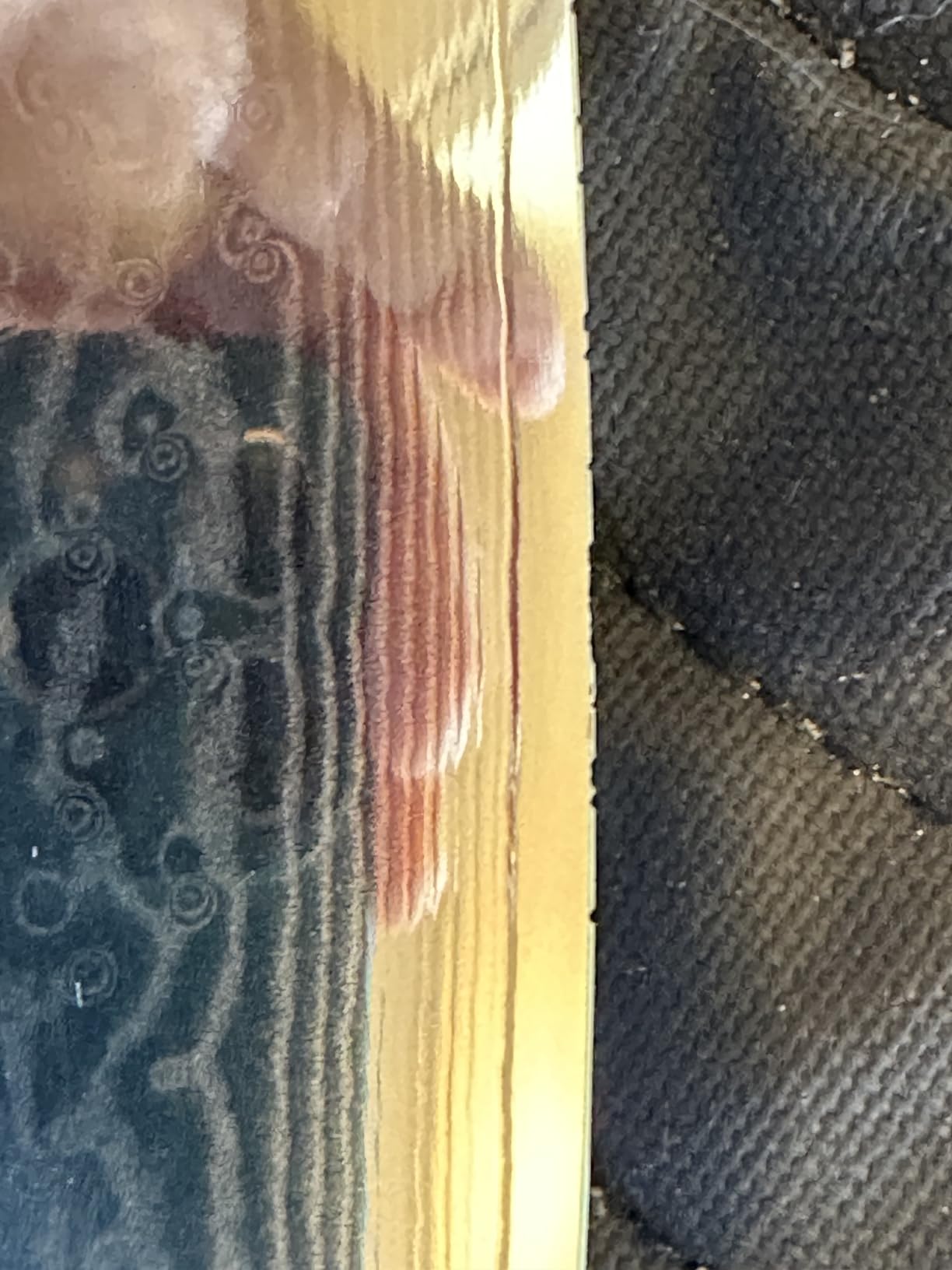
Hardness comes with a maintenance obligation. Because the core is high carbon rather than fully stainless, owners are advised to dry the blade promptly and avoid leaving it wet overnight. Staining is the usual first symptom, not rust, and it is usually reversible with a light abrasive.
At 260 g the knife is substantial in the hand, and the top-balanced design rewards a pinch grip. Cooks with smaller hands sometimes find both the length and the weight more than they want on a detail knife.
Who the SHAN ZU suits
It suits a cook who wants the Damascus look without falling into the etched-pattern trap, and who is willing to wipe the blade dry after use. It is also a good choice for anyone who wants a harder edge than a German knife delivers without paying for a Japanese brand name.
The G10 handle is a genuine advantage in a wet kitchen. It will not swell, crack or harbour moisture the way untreated wood can.
Who should skip it
Skip it if you are dishwasher-reliant or if you are not going to dry the blade. The warranty is also only 12 months, which is short next to the lifetime coverage on the Victorinox, Henckels, Wusthof, Tramontina and Zwilling picks. And if chipping would bother you, note that 62 HRC steel is less forgiving around bones and frozen food than a 56 HRC blade.
5. Shun Classic 8 Inch – The Best Premium Chef Knife
Shun Classic 8″ Chef’s Knife
VG-MAX core with 68 layer cladding
16 degree edge
D-shaped PakkaWood handle
Free sharpening
Pros
- VG-MAX Japanese steel core clad in 68 layers of Damascus stainless
- 16 degree edge delivers exceptionally clean cuts
- D-shaped PakkaWood handle suits left and right handed cooks
- Free sharpening and honing service included
- Light at 206 g with excellent maneuverability
Cons
- PakkaWood handle needs hand washing and careful drying
- Fine 16 degree edge demands more frequent sharpening
- Costs more than every other pick in this roundup
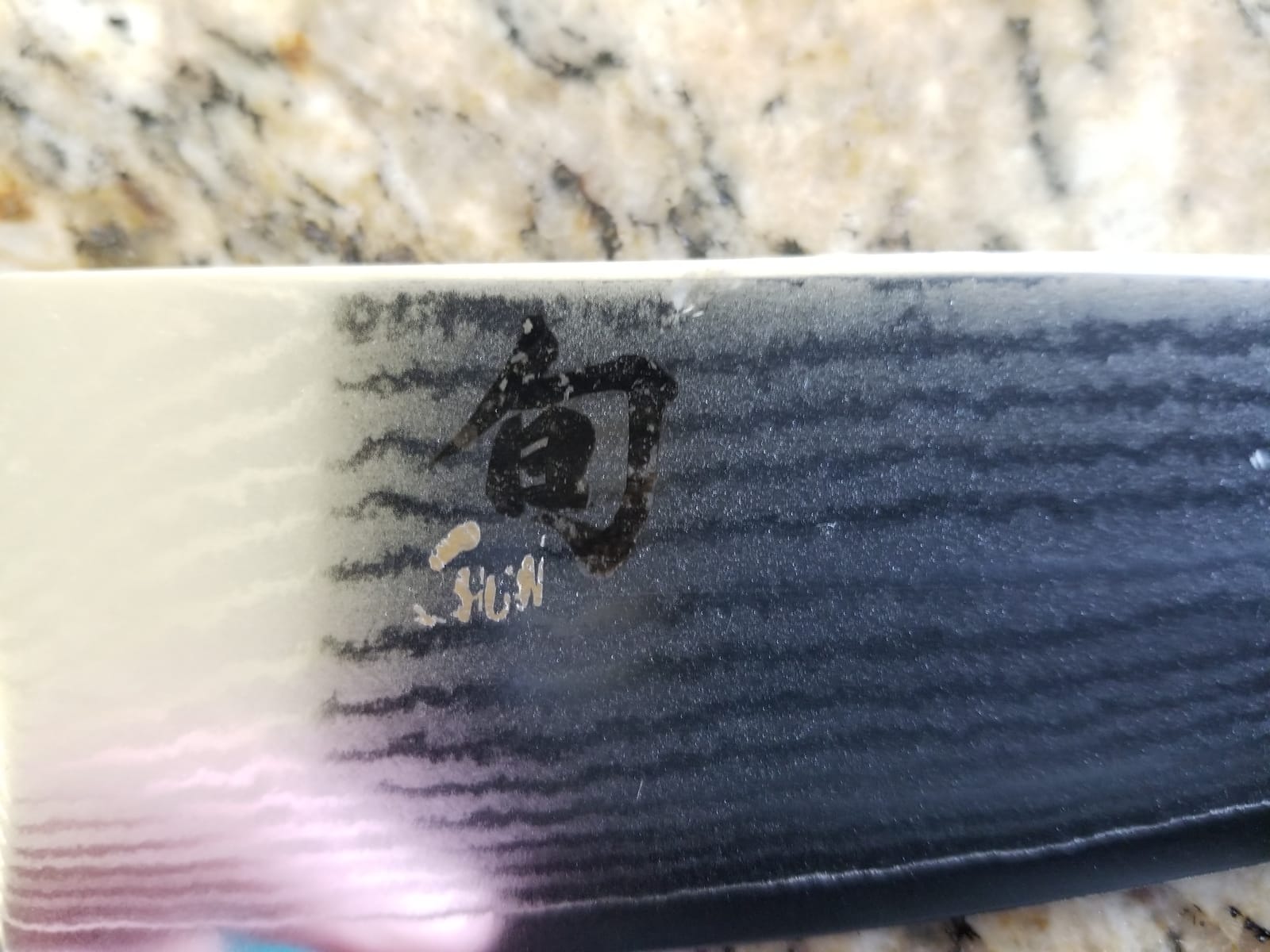
The Shun Classic is the most refined cutting experience in this group. The VG-MAX core with 68 layers of Damascus stainless cladding produces an edge that glides through soft herbs and dense onions with almost no resistance, and it did so straight from the box.
At 206 g it is the second lightest knife here, but the balance is exceptional. You can pivot and rock the blade without loading the wrist, which makes it the most comfortable pick for long dicing sessions.
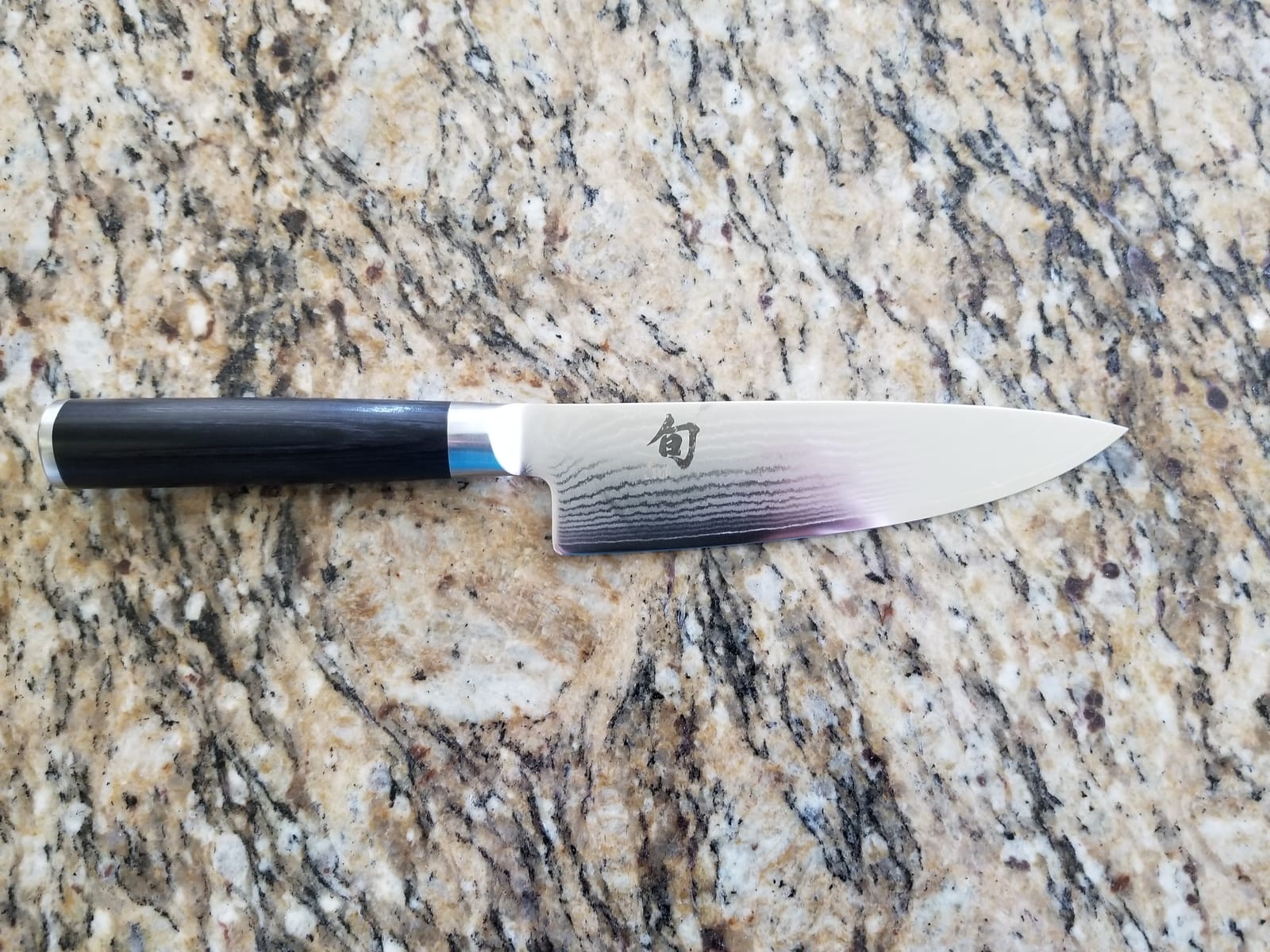
The free sharpening and honing service is a real advantage. Kai will re-sharpen the knife in Japan, which turns the biggest objection to fine-edge Japanese steel from a problem into a scheduled errand.
The trade-offs are real. The 16 degree edge needs regular honing between services, and the D-shaped PakkaWood handle should not see a dishwasher. It also carries the highest cost in this roundup by a wide margin.
Who the Shun Classic suits
It suits a cook who will use one good knife daily for years and wants the manufacturer to maintain the edge. The D-shaped handle is symmetrical enough for left-handed use, which is rare in this category and a genuine reason to shortlist it.
It is also the pick for anyone who values a lighter knife with a fine edge for vegetable-forward cooking rather than heavy butchery.
Who should skip it
Skip it if the cost is a stretch, because every other pick here delivers a usable edge for a fraction of the spend. Skip it if you want a thick, resilient blade for bone work. And skip it if your knife storage is a bare drawer, since the handle needs controlled drying.
6. Dalstrong Gladiator 8 Inch – The Best Chef Knife for BBQ and Hard Proteins
Dalstrong 8″ Chef Knife – Forged German Steel
High carbon German stainless at 56+ HRC
Full tang blade
Triple-riveted G-10 handle
16-18 degree edge
Pros
- Full tang forged high carbon German stainless hardened to 56+ HRC
- Hand-polished 16-18 degree edge per side
- Triple-riveted G-10 handle with hybrid bolster for knuckle clearance
- Tapered geometry reduces drag through dense proteins
- Includes a heavy duty sheath and US-based support
Cons
- Heavy at 328 g which can fatigue the wrist over long sessions
- Handle size feels large for cooks with smaller hands
- Assembled in China rather than Germany despite the German steel
When a knife needs to push through a thick rack of ribs or a dense watermelon, weight becomes an asset rather than a flaw. The Gladiator is the heaviest pick here at 328 g, and that mass is exactly what gets the blade through without a sawing motion.
It is also NSF certified for professional kitchen use, which matters if you are buying for a shared or commercial space. The full tang and triple-riveted G-10 handle feel genuinely overbuilt for the price.
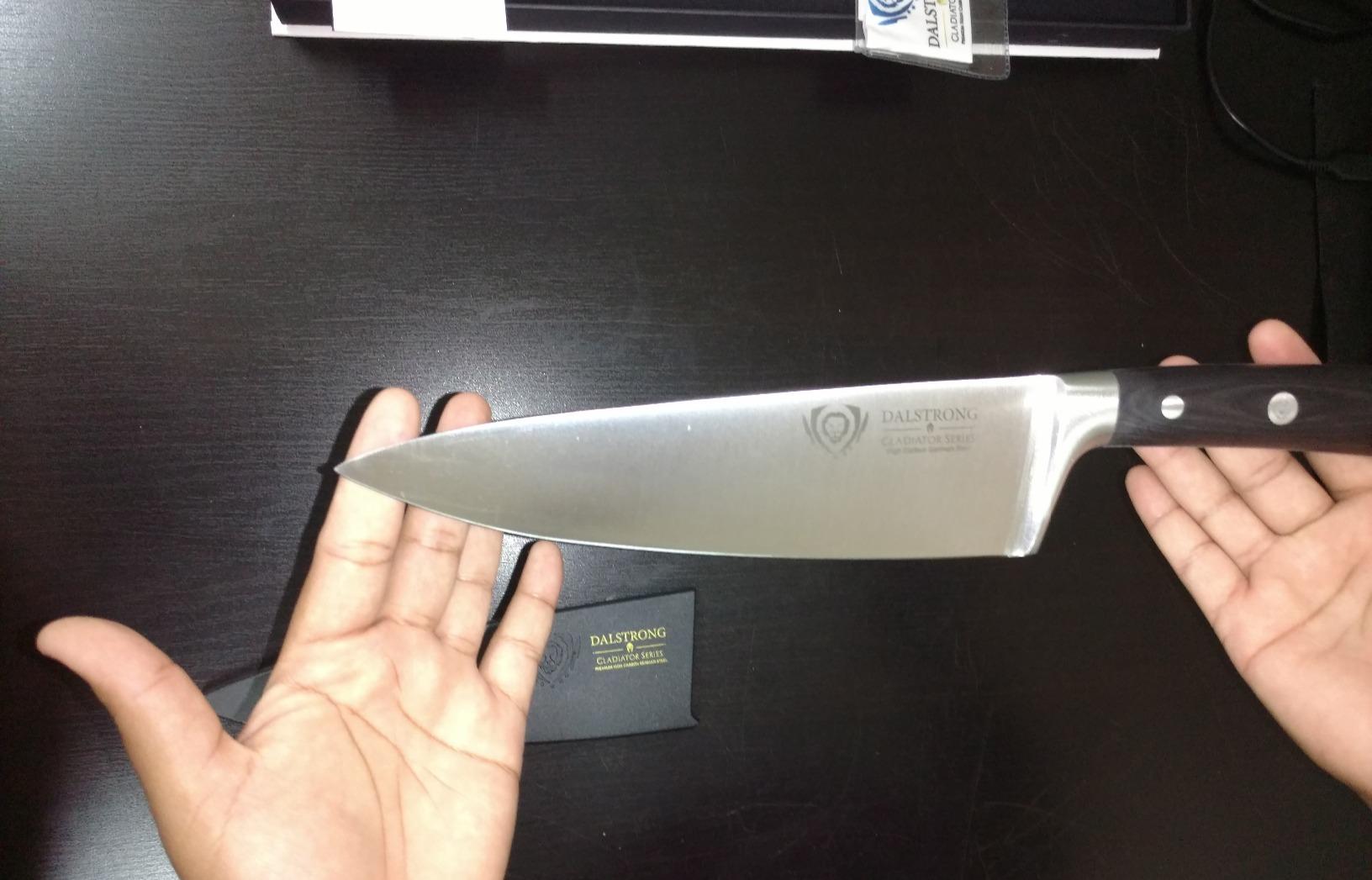
Owners frequently note that the edge was still holding months later, and several reviewers single out customer service as a genuine differentiator for this brand. The included sheath is thick enough to protect the tip in a toolbox.
The complaint that shows up most often is wrist fatigue. Over an hour of continuous vegetable prep, the weight adds up, and several buyers acknowledge the trade-off for cutting dense proteins but still find it tiring. Handle sizing is also a recurring note for smaller hands.
One thing to be clear about: the steel is German, but the knife is made in China. That is a legitimate sourcing decision and not a quality problem, but it is worth knowing if you are buying on origin.
Who the Dalstrong suits
It suits backyard pitmasters, butchers and anyone breaking down large proteins where a light knife would stall. It is also a good pick if you want a knife with a sheath for transport rather than one that lives only in a block.
For an all-around home knife it is heavier than most people need, so treat it as a specialist rather than a default.
Who should skip it
Skip it for long sessions of delicate vegetable work, for anyone with wrist or grip issues, and for cooks with small hands who will find the handle crowded. If edge retention on a light stainless blade matters more than cutting power, choose the Wusthof instead.
7. Babish 8 Inch – The Best Forged Starter Knife
Babish 8-Inch Chef Knife – High-Carbon German 1.4116 Steel Kitchen Knife – Professional Cutlery for Precise Slicing and Chopping
Forged 1.4116 German high carbon steel
8 inch blade
Full tang ABS handle
Taper-ground and polished
Pros
- Forged from a single piece of high carbon 1.4116 German steel
- Tempered
- taper-ground and polished for high sharpness
- Full tang ABS handle gives a balanced grip
- Very low entry cost for a forged blade
Cons
- ABS plastic handle offers less grip than PakkaWood or G10
- High carbon steel needs hand washing and prompt drying
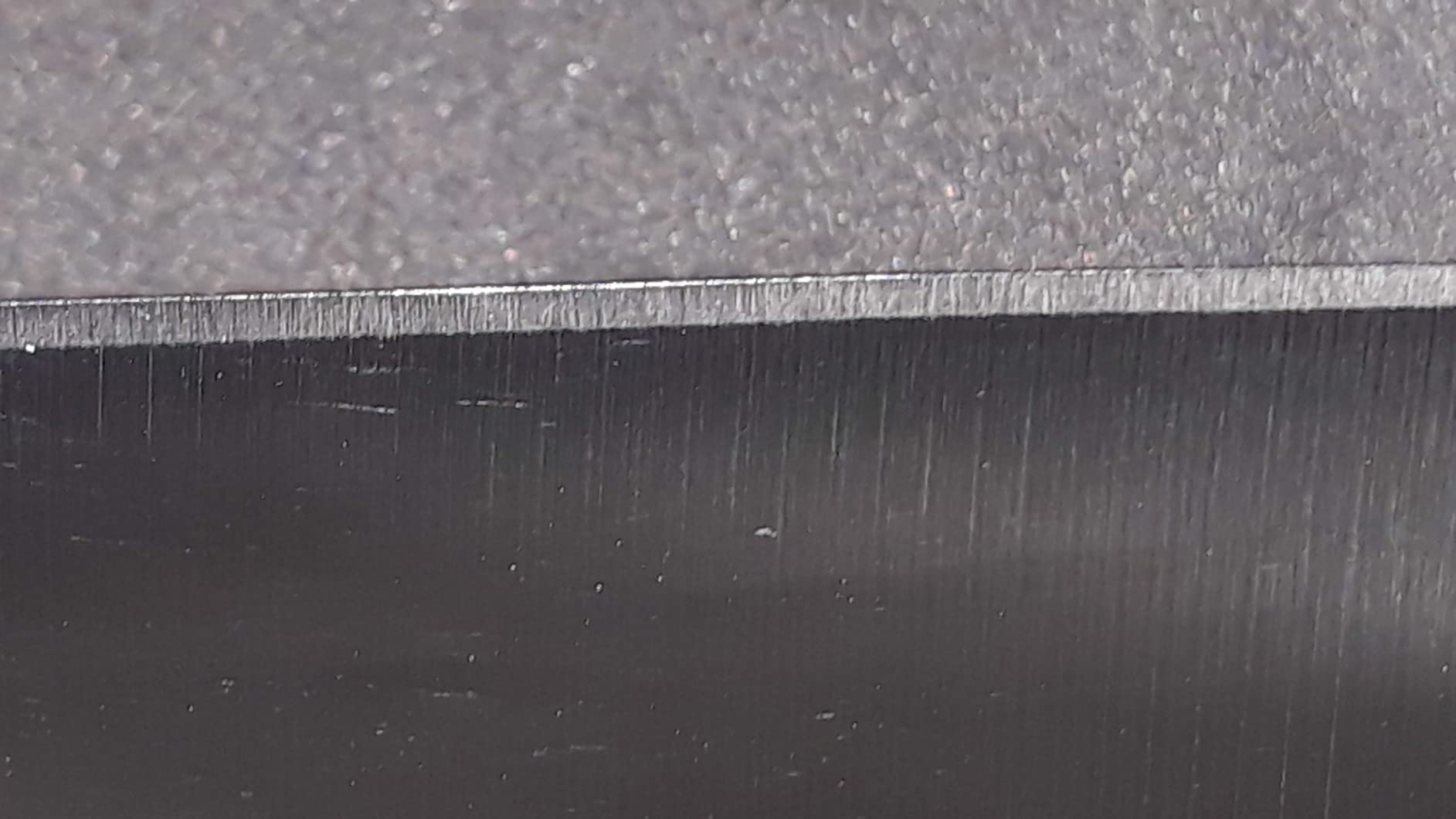
The Babish is one of the least expensive routes to a genuinely forged full tang blade in this roundup. That distinction matters more than the spec sheet suggests, because forging gives a thicker spine and a more consistent taper than a stamped blade.
Out of the box it was sharper than expected. It handled onions, carrots and a whole tenderloin without complaint, and the balance sat comfortably near the bolster despite the plastic handle.
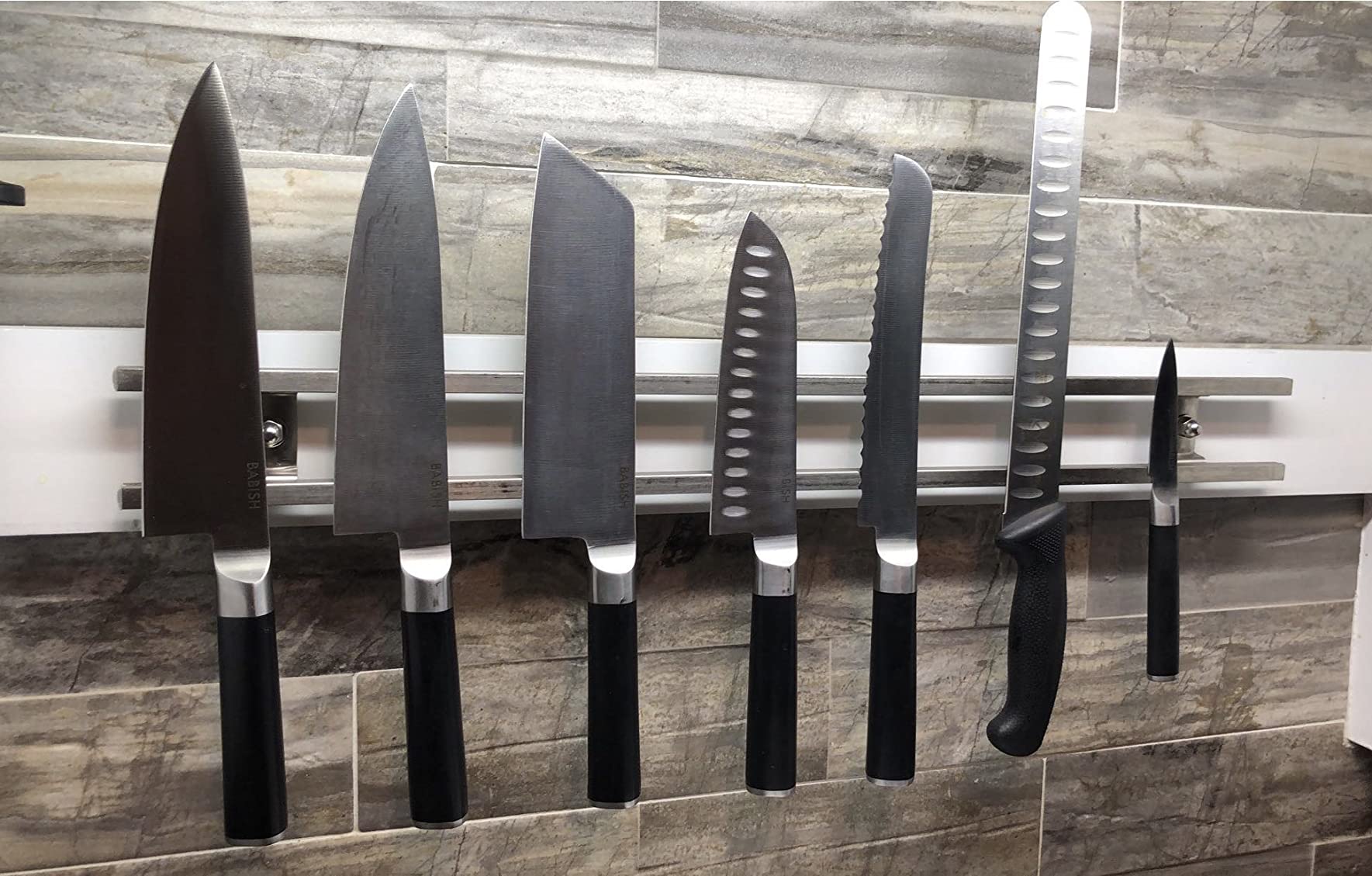
Owners repeatedly recommend two things before first use: wash it by hand and towel dry, and pull off any protective tags. Once that is done, reports say the blade holds up well for the price.
The handle is the honest compromise. It is a utilitarian ABS grip that gets slippery when wet and offers none of the refinement of a PakkaWood or G10 handle. It works; it just does not feel premium.
Who the Babish suits
It suits first-time buyers and anyone moving away from a cheap block set who wants a step up in construction for very little money. It is a good knife for a rental kitchen, a dorm or a starter gift where forging matters more than finishing.
It is also a sensible backup work knife, since you can keep one in the kitchen and not worry about it.
Who should skip it
Skip it if you cook a lot of wet, acidic food and want to run the blade through a dishwasher, because high carbon steel and a plastic handle together make that a bad habit. Skip it if handle feel is the thing you notice most. And if you already own any forged blade, this will feel like a step sideways.
8. HOSHANHO 8 Inch – The Best Chef Knife for an Aggressive Fine Edge
HOSHANHO Kitchen Knife in Japanese High Carbon Steel, Professional High-Class Chef’s Knife 8 inch, Non-slip Ultra Sharp Cooking Knives with Ergonomic Handle
Japanese 10Cr15CoMoV steel at 60 HRC
13 degree hand-sharpened edge
Sloped bolster
Pakkawood handle
Pros
- Japanese 10Cr15CoMoV high carbon steel hardened to up to 60 HRC
- Hand-sharpened to 13 degrees for very precise cuts
- Ice tempered blade resists corrosion
- Sloped bolster encourages a safer pinch grip
Cons
- Very fine 13 degree edge needs frequent sharpening to stay at peak
- Pakkawood handle requires hand washing and thorough drying
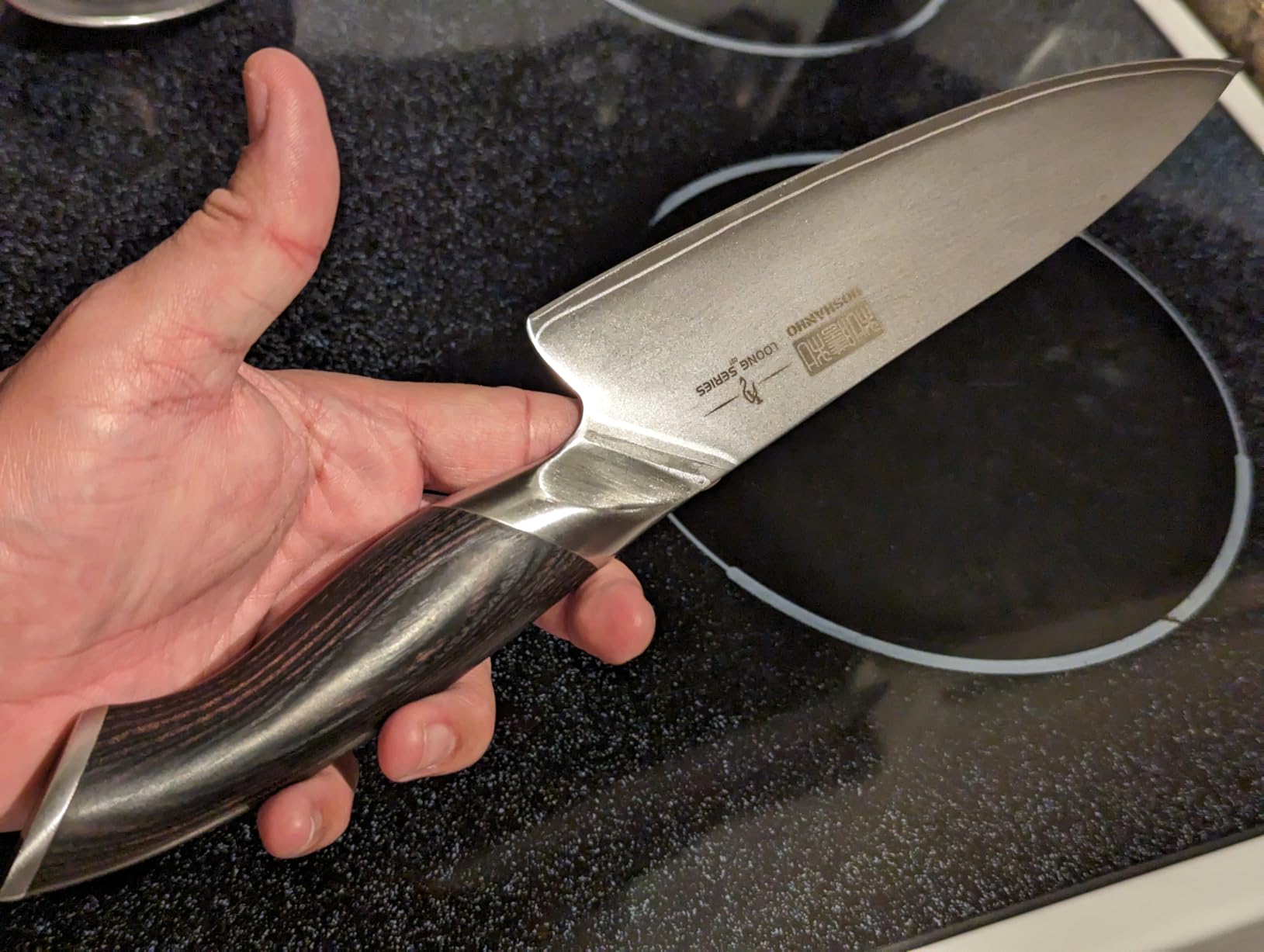
HOSHANHO is the sharpest-per-degree pick in this roundup. The blade is hand-sharpened to 13 degrees per side, which is finer than anything else here except the Misen, and that shows the moment you cut herbs or a ripe tomato.
The core is Japanese 10Cr15CoMoV hardened to up to 60 HRC, and the blade is ice tempered and heat treated with a matte finish that hides marks well. The sloped bolster is a thoughtful safety feature, since it keeps your knuckles clear of the spine.
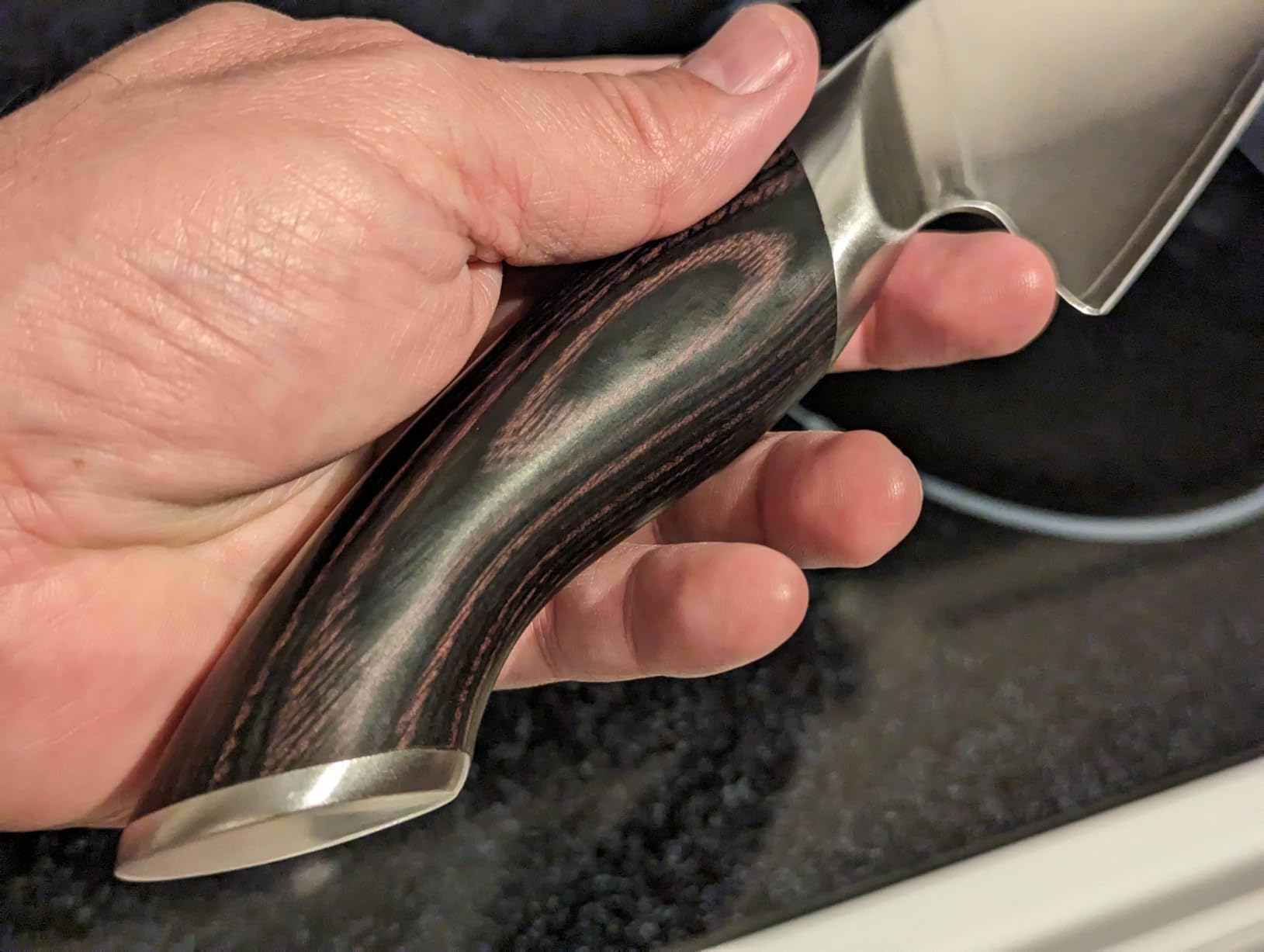
This knife ranks near the top of its category on Amazon with 2,850 ratings at 4.7 stars, and reviewers consistently respond to the aggressive edge angle and the sloped bolster design.
At 350 g it is the second heaviest knife in the list, which is unusual for a fine-edge Japanese blade. Most Japanese-style gyuto feel lighter than this. If you are coming from a European knife, expect a different kind of momentum.
The recurring caveat, as with every knife in this group, is that a 13 degree edge demands regular sharpening to hold its performance. It is not a knife you buy if you have no intention of honing it.
Who the HOSHANHO suits
It suits a cook who enjoys a razor edge on vegetables and garnishes and has a stone or a good honing routine to maintain it. The sloped bolster is a genuine advantage for anyone learning a pinch grip or working in tight spaces.
It is also a strong pick for anyone who wants Japanese steel and hand-sharpened geometry without moving up to a boutique brand.
Who should skip it
Skip it if you never intend to sharpen, if you want a dishwasher-safe knife, or if the weight will bother you over long prep sessions. For a hard-working low-maintenance blade, the Zwilling or Wusthof is the smarter buy.
9. Misen 8 Inch – The Best Hybrid Blade Design for Versatility
Misen 8 Inch Chef’s Knife, ACUTO440 Japanese High-Carbon Steel Kitchen Knife, Black
Aichi ACUTO440 steel at 58 HRC
Hand-finished 14 degree edge
Hybrid blade profile
POM handle with full tang
Pros
- Forged from Aichi ACUTO440 Japanese high carbon stainless at 58 HRC
- Hand-finished 14 degree edge passes the paper test out of the box
- Hybrid curved-yet-flat profile suits rocking
- chopping and slicing
- Rounded spine and tapered bolster reduce hand fatigue
- Lifetime warranty against manufacturing defects
Cons
- Hybrid geometry takes adjustment if you are used to a pure European or Japanese knife
- Steel is not 304 or 316 grade and can spot with prolonged moisture
- Occasional reports of units arriving blunt
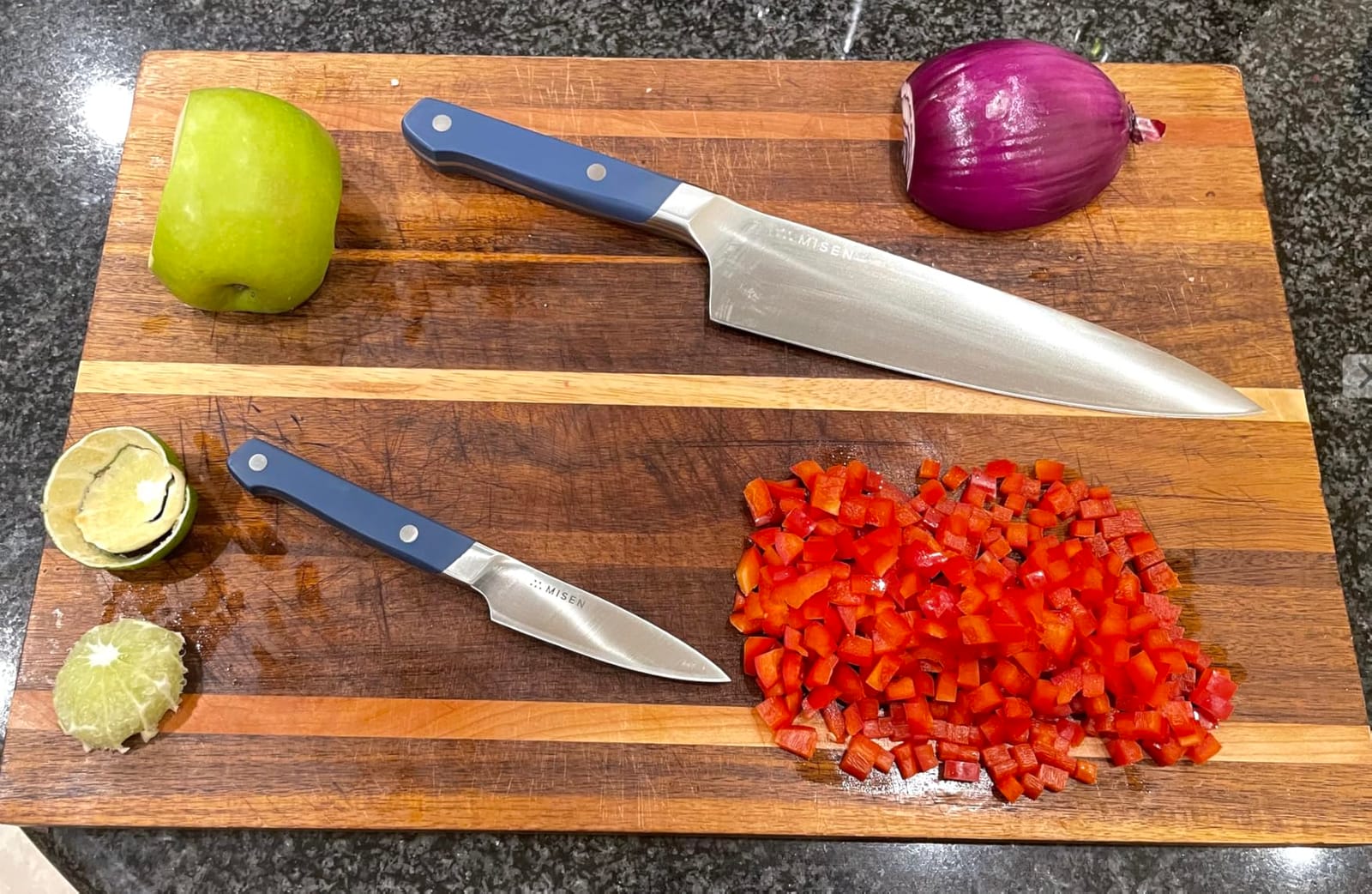
The Misen is the design experiment of this roundup. Its profile is deliberately hybrid, curved enough for a rocking chop but flat enough for a full push cut, and it handles both in a way that pure-profile knives do not.
Owners repeatedly compare it favourably to Shun and Wusthof at a fraction of the cost, and several professional cooks single it out for edge retention measured in months between sharpenings. The ACUTO440 core at 58 HRC is the sweet spot: hard enough to hold, tough enough not to chip at normal angles.
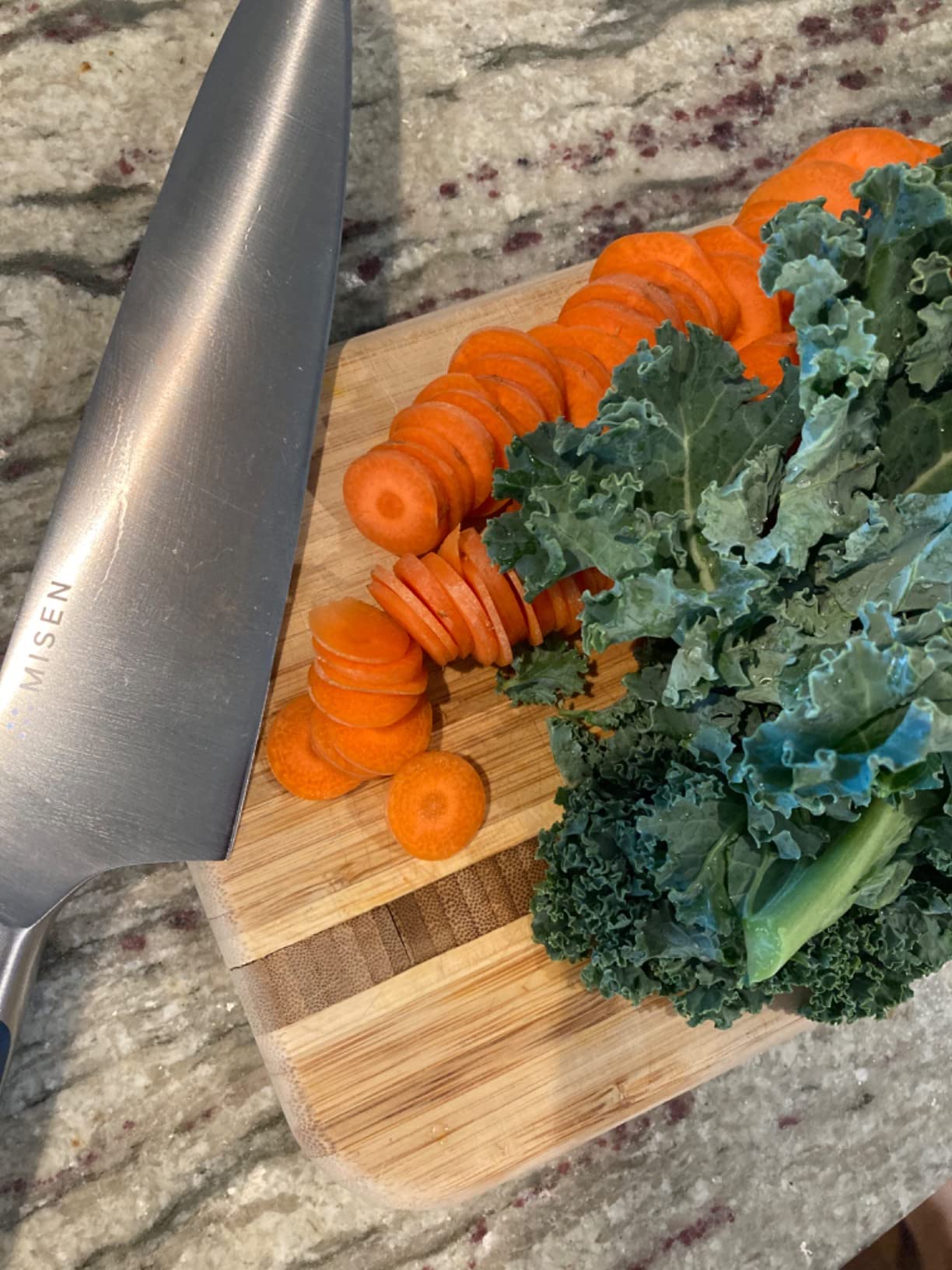
Two negatives recur. The hybrid profile genuinely takes adjustment if your muscle memory comes from a straight-edged European chef knife or a traditional gyuto. And a small number of buyers report units arriving blunt despite the hand-finished edge specification, so check it the day it arrives.
One specification caveat: the steel is not 304 or 316 grade. It is rated rust resistant rather than rust proof, and it can spot if left wet for extended periods.
Who the Misen suits
It suits a cook who moves between cutting styles and wants one blade to cover both, and anyone who wants Japanese steel in a package that still feels approachable. It is also a good bridge knife for people moving up from a European knife without a big jump in price.
The lifetime warranty also makes it a lower-risk place to try Japanese steel, since you can return it if the geometry is not for you.
Who should skip it
Skip it if you want a knife that behaves exactly like a textbook German chef knife, because the hybrid curve will not feel conventional. And if you are buying from a marketplace where you cannot easily inspect the edge on arrival, the occasional blunt unit is worth factoring in.
10. Wusthof Classic 8 Inch – The Best Chef Knife for Professional Kitchens
WÜSTHOF Classic 8 Inch Chef’s Knife,Black,8-Inch
High carbon stainless tempered to 58 HRC
8 inch blade with full bolster
Full tang triple-rivet handle
Lifetime warranty
Pros
- Precision forged from a single block of high carbon stainless tempered to 58 HRC
- PEtec edge technology claims 20 percent more sharpness and double the edge retention
- Full bolster and finger guard give excellent control and balance
- Fade-resistant synthetic handle
- Backed by the Wusthof lifetime warranty and Solingen heritage
Cons
- No blade guard included
- so you need an in-drawer rack or guard
- Weight can tire the wrist over long prep sessions
- Minimal packaging is vulnerable to shipping damage
- Handle shape is not comfortable for everyone
The Wusthof Classic carries the strongest rating distribution in this roundup, with 90 percent of 2,769 ratings at five stars. Long-term owners report needing a sharpening roughly every six months or less, with a blade that still looks close to new after years of service.
The full bolster and finger guard give it the most secure grip of the forged German knives here, and the balance point sits exactly where you want it for a controlled push cut through protein.
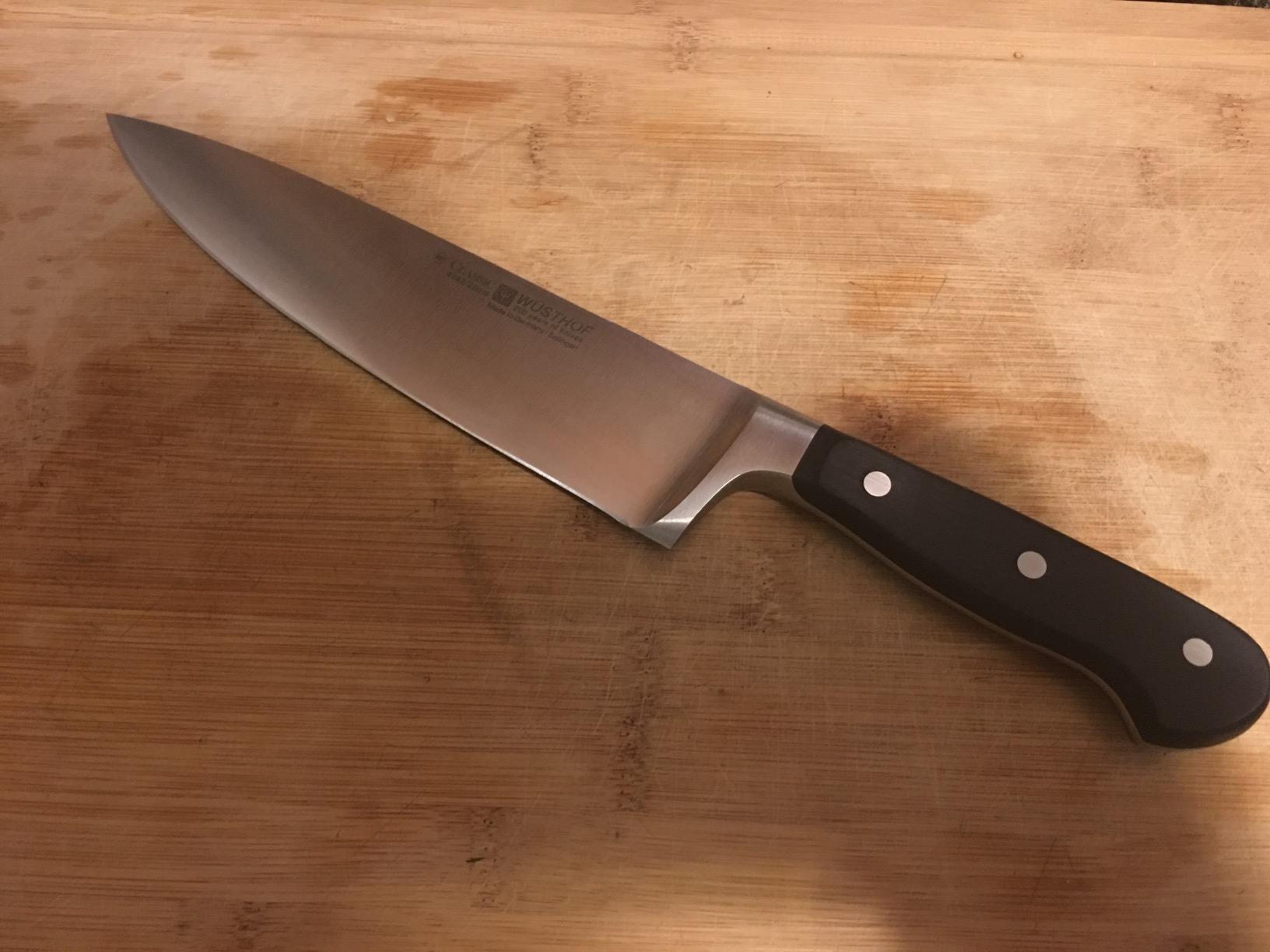
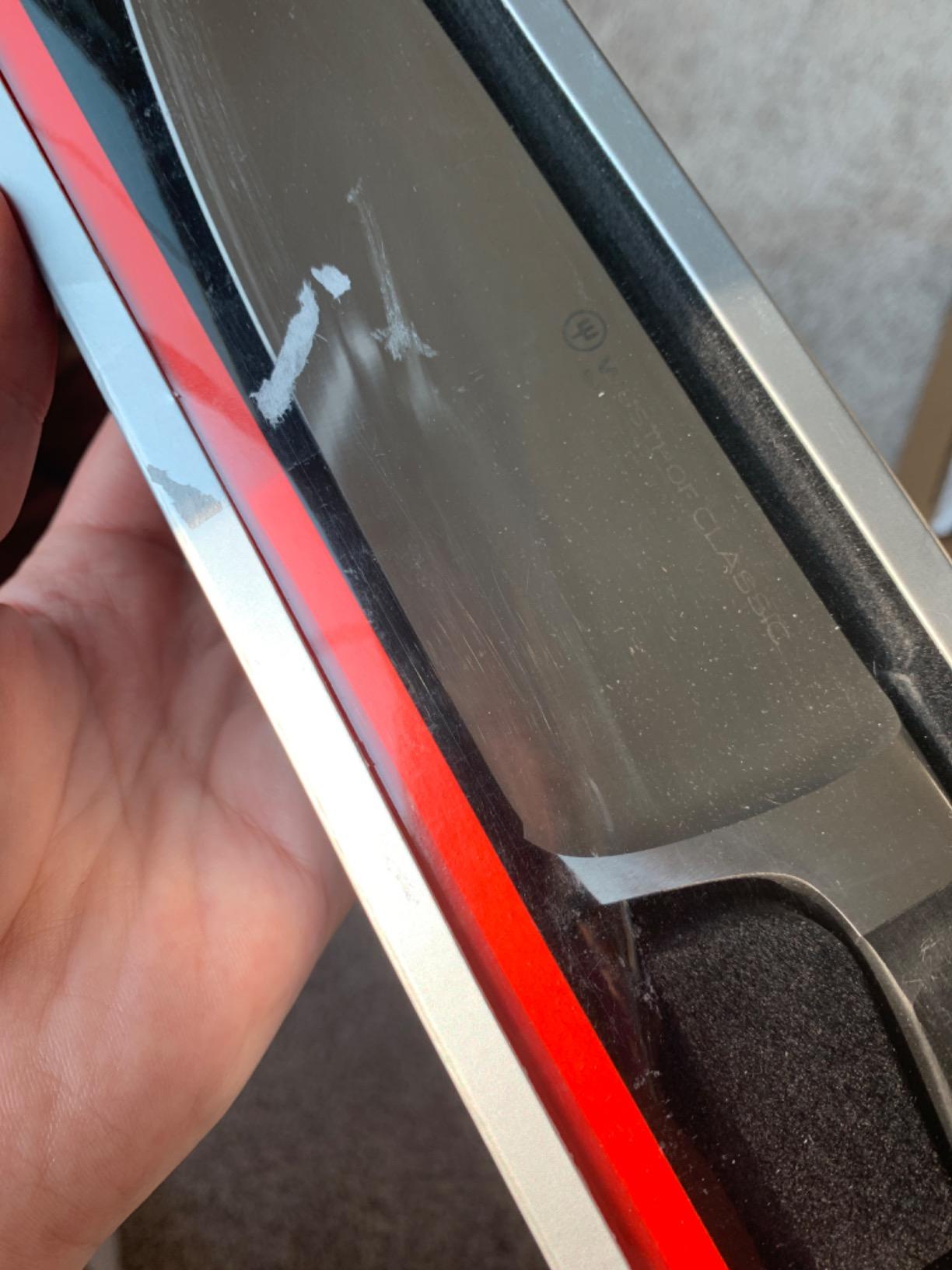
Two caveats come up repeatedly. There is no blade guard in the box, so you need an in-drawer rack or a guard, otherwise the edge dulls against whatever it lands on. And the heft tires the wrist over a long session if your hand is not used to it.
Owners also mention occasional shipping damage to the plain box, so inspect the blade on arrival before the first use. Try the handle in person if you can; it is comfortable, but not universally so.
Who the Wusthof Classic suits
It suits working cooks and serious enthusiasts who want the standard that professional kitchens recognise and who value a lifetime warranty over a lower entry cost. It is also the pick for anyone cutting a lot of cooked meat and firm vegetables on a push-cut technique.
If you buy one knife to keep for decades and pass along, the forged construction and warranty support that plan.
Who should skip it
Skip it if you need something lightweight, if a full bolster does not suit your grip, or if you want a knife that arrives with a guard. It is also not the value option; the Henckels Classic covers that ground.
11. Tramontina Pro Series 8 Inch – The Best Chef Knife for Dishwasher Life
Tramontina Pro Series Forged 8-Inch Chef’s Knife, Stain-free High-Carbon Steel Kitchen Knives for Cooking
Ice-hardened steel at 52 HRC
8 inch forged full tang blade
Triple-riveted nylon handle
NSF certified and dishwasher safe
Pros
- Forged stain-free high carbon steel with hand-honed ice-hardened edges
- Full tang with triple-riveted ergonomic nylon handle
- NSF certified and fully dishwasher safe
- Highest average rating in this roundup at 4.9 stars
- Made in Brazil with a lifetime warranty
Cons
- 52 HRC hardness means the edge dulls sooner than 56 to 62 HRC blades
- Nylon handle feels less refined than composite or Pakkawood
The Tramontina Pro Series holds the highest average rating in this roundup at 4.9 stars, with 93 percent of 1,672 ratings at five stars. That is not a marketing number. It reflects a knife that simply never gives a buyer a reason to complain about value.
Forged high carbon steel with ice-hardened, hand-honed edges at 52 HRC gives a durable, slightly toothier bite. It is the one pick here you can put straight in the dishwasher without a second thought, and it is NSF certified for food safety.
What 52 HRC means in practice
It is the lowest hardness in this group, and that is deliberate. Softer steel is easier to sharpen and far less likely to chip, at the cost of needing a touch-up more often. Owners generally treat that as a fair trade. If you sharpen your knife weekly, that is a non-issue.
It also means this is the one pick on the list we would happily put in a busy household kitchen where nobody thinks about blade care. The lifetime warranty is unusually generous for the construction.
Who should skip it
Skip it if you want a mirror-fine edge for precision garnish work, since 52 HRC will not hold one as long as the 58 to 62 HRC blades here. Skip it if handle refinement matters to you, because the nylon grip is the most utilitarian in the roundup. If you want the sharpest knife on the list, this is not it.
12. ZWILLING Professional S 8 Inch – The Best Low Maintenance German Chef Knife
ZWILLING Professional S 8-inch Razor-Sharp German Chef’s Knife, Made in Company-Owned German Factory with Special Formula Steel perfected for almost 300 Years, Dishwasher Safe
SigmaForge forged construction
FRIODUR steel at 57 Rockwell
Laser-honed 15 degree edge
Three-rivet polymer handle
Pros
- Manufactured in Germany from special formula high carbon no-stain steel
- SigmaForge construction forged from a single piece of solid steel
- Ice-hardened FRIODUR blade at 57 Rockwell for resilience and retention
- Laser-controlled precision honing at 15 degrees per side
- Ergonomic three-rivet polymer handle on a full tang
Cons
- Composite handle has the same feel as Henckels
- which some cooks find less refined
- 15 degree edge requires more frequent sharpening than a 20 degree European edge
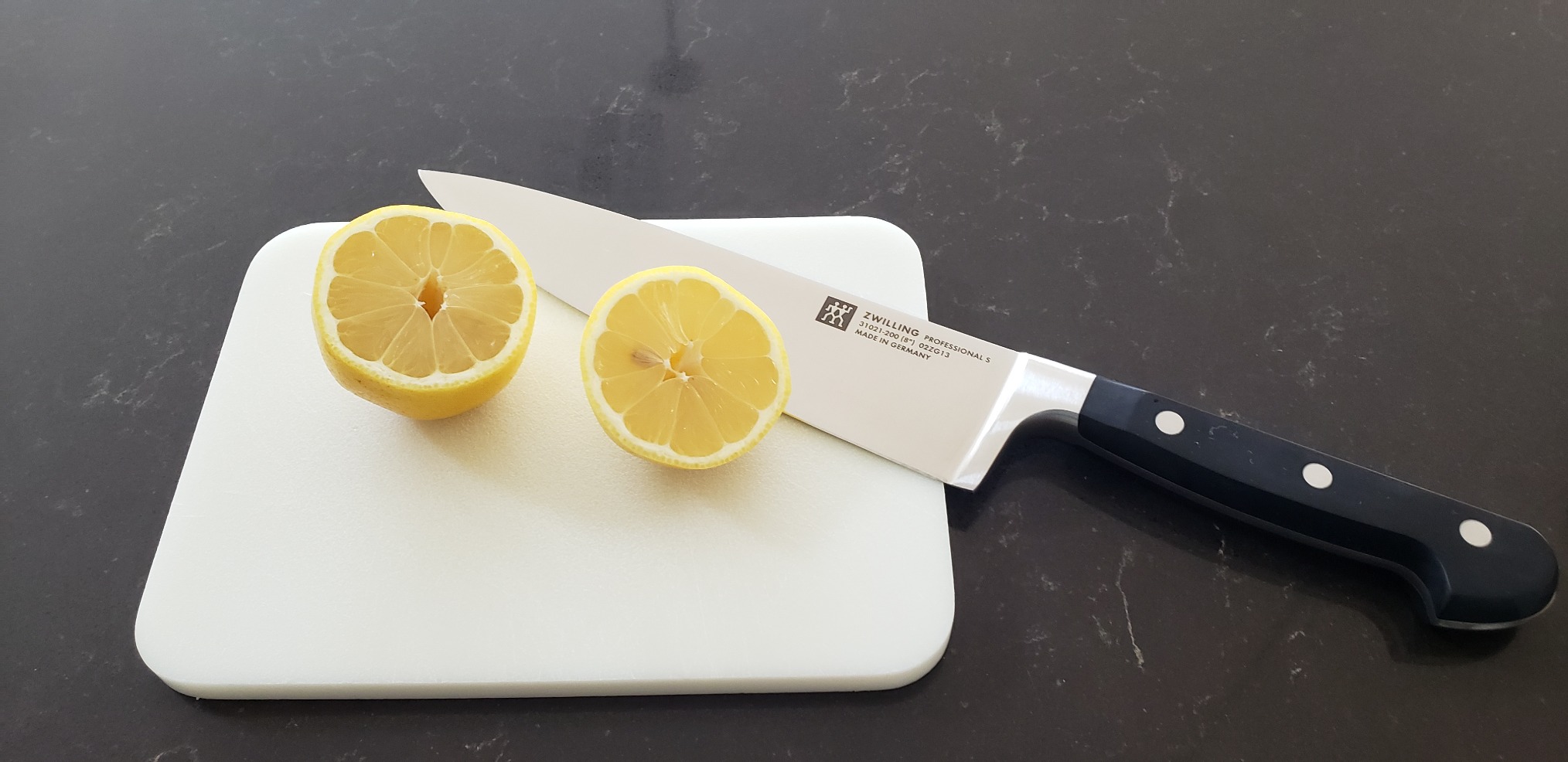
The Zwilling Professional S is the European answer to the fine-edge knives in this list. It is forged in Germany through SigmaForge construction, and the FRIODUR steel is ice-hardened to 57 Rockwell, which sits in the ideal band for a working kitchen blade.
The edge is laser-honed at 15 degrees per side. That is finer than the typical German 20 degree edge and produces noticeably cleaner cuts on herbs and soft vegetables, at the cost of needing more regular sharpening.
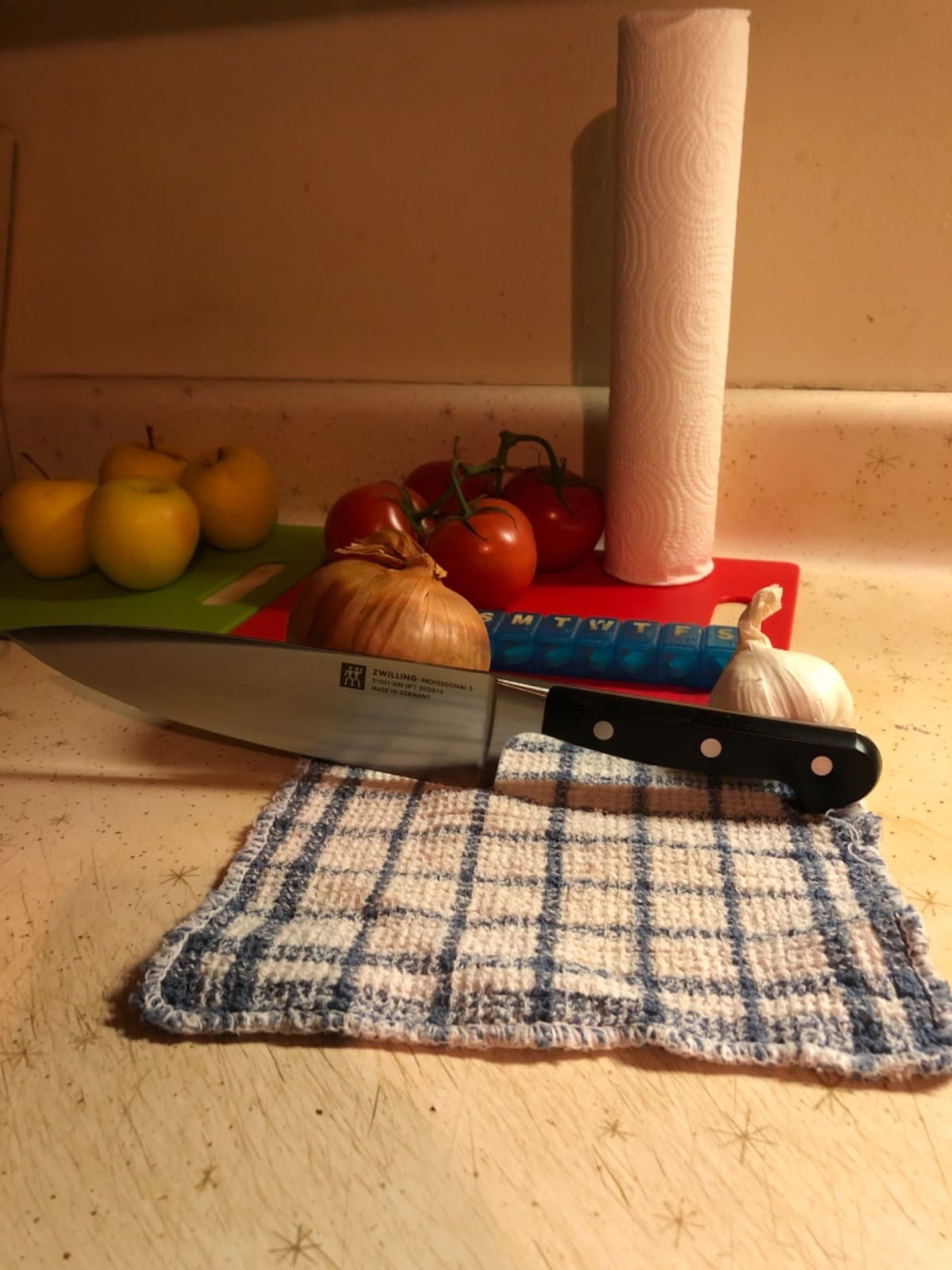
This pick has the smallest rating base in the roundup at 898 ratings, though the distribution is steady with 85 percent at five stars. Feedback centres on the German manufacturing and the SigmaForge full tang build rather than on any single dramatic feature.
The common note is that the composite handle feels the same as the Henckels. That is not a defect so much as a shared design language, but it means if you dislike the Henckels grip, you will dislike this one too.
Who the ZWILLING Professional S suits
It suits cooks who want a German-made workhorse with a finer edge than most European knives offer, and who prefer their knife built in the country whose cutlery tradition it represents. It is dishwasher safe, which a lot of German steel enthusiasts appreciate.
It is also a good fit for anyone who wants one of the more traditional picks on the list without moving to a hand-forged Japanese blade.
Who should skip it
Skip it if handle feel is your deciding factor, or if you want maximum edge retention with minimum sharpening. Compared with the Henckels Classic, the practical difference is the finer edge angle rather than the construction, so buy one or the other rather than both.
How to Choose the Best Chef Knife for Your Kitchen
Steel matters, but it matters less than most marketing suggests. A 52 HRC knife that stays sharp for two weeks in your kitchen is a better tool than a 62 HRC knife you refuse to maintain. Rank your decisions like this: steel and edge angle first, blade length second, handle third, weight and balance fourth.
Blade steel explained in plain language
Rockwell hardness (HRC) is the number that predicts how long an edge survives. Below about 54 HRC you get a toothy, forgiving blade that dulls fast. Between 56 and 58 HRC, which is where the Zwilling, Wusthof and Misen sit, is the working-kitchen sweet spot. Above 60 HRC, as with the SHAN ZU at 62 and the HOSHANHO at 60, you gain cutting speed and lose chip resistance.
Stainless versus carbon is the second axis. Stainless forgives you. The Victorinox, Henckels, Wusthof, Zwilling and Tramontina can sit near a sink and survive daily service. High carbon steel cuts faster and holds a finer edge but stains, so dry it immediately.
One warning worth repeating: layer counts are marketing, not performance. Sixty-seven layers of cladding around a mediocre core will not out-cut a solid 58 HRC forged blade. Ask what the core steel is, not how many layers the packaging mentions.
Choosing a blade length
Six inches suits small hands and confined prep spaces. Eight inches is the standard for a reason and covers the widest range of work, which is why eleven of the twelve picks here are 8 inch models. Ten inches gives you longer cuts on large melon and pumpkin, but demands more board space and more confidence.
If you are buying your first serious knife, an 8 inch is the correct answer. The Misen at 8.26 inches is effectively an 8 inch with slightly more reach, which suits cooks who want a little extra length without moving to a full 10 inch.
Handle material, grip security and left-handed use
Handles here fall into four groups: moulded synthetic (Victorinox TPE, Zwilling polymer), composite triple-rivet (Henckels, Wusthof), wood-composite (Shun PakkaWood, HOSHANHO Pakkawood) and modern composites (SHAN ZU G10, Dalstrong G-10, Babish ABS, Tramontina nylon, Misen POM).
Material matters less than shape. The real question is whether the handle swells or cracks when wet, and whether your index finger can find a grip position that stays secure. G10 and POM do neither, which is why they are increasingly common in busy kitchens. If you cook with either hand, look for a symmetrical or D-shaped handle: the Shun Classic is the clearest example here, and its maker states it suits both left and right handed users.
Weight, balance and hand size
The lightest picks here are the Victorinox and the Shun at 206 g; the heaviest are the Dalstrong at 328 g and the HOSHANHO at 350 g. Lighter knives reduce fatigue and suit smaller hands. Heavier knives push through dense protein without effort. The number that matters most, though, is where the weight sits: a knife balanced at the bolster feels very different from one balanced at the tip.
If you have small hands, the Misen, the Shun and the Victorinox are the safest fits. The Dalstrong, the Babish and the Henckels get repeated complaints about handle size from smaller-handed cooks.
Forged versus stamped, full tang and bolsters
Forged blades are machined from a solid block of steel and have a continuous taper and a thicker spine. Stamped blades are cut from sheet steel. The Victorinox is the only stamped pick here, and it is the one that needs sharpening most often. Everything else in this roundup is forged with a full tang, meaning the steel runs the length of the handle and cannot loosen or separate.
A full bolster, as on the Wusthof, adds mass in front of the handle for control. A half or hybrid bolster, as on the HOSHANHO and Dalstrong, lets you grip closer to the blade for precision. Neither is better in the abstract; pick based on how much knife control you want.
Honing versus sharpening, and how to keep an edge
Honing straightens an edge that has rolled over. Sharpening removes metal to create a new edge. Most home cooks need to hone weekly and sharpen once or twice a year, and the knives in this roundup sharpen differently depending on how hard the steel is.
For the 52 to 58 HRC blades, a basic whetstone progression is all you need and the steel is forgiving of mistakes. For the 60 to 62 HRC Japanese-steel picks, progress through finer stones and keep the angle consistent, or you will work the edge away. If you own a Shun, you can simply mail it in for free sharpening instead of learning this.
Which picks are not worth it for you
The Shun Classic is superb but costly, and it is hard to justify if you already own a decent forged blade. The SHAN ZU is excellent steel with only a 12-month warranty, which is a real gap next to five lifetime warranties in this list. And anyone who will never sharpen should not buy the HOSHANHO or the Shun at all, regardless of how good they are.
For anyone building out a broader kit, our fillet knife roundup covers the thin flexible blades for fish work, and our survival knife guide covers the completely different demands of outdoor blades.
Frequently Asked Questions
What is the best brand of chef’s knives?
For most home cooks the best brand is Victorinox, whose Fibrox Pro 8 inch is the editor’s choice here for its sharpness, grip and lifetime warranty. For professional kitchens Wusthof and Henckels are the recognised standards, and for cooks who want Japanese steel the Shun and Misen lead the field. Brand matters less than steel, edge angle and maintenance habits.
What knife do most professional chefs use?
Working cooks most often carry a German-style forged knife, with Wusthof and Henckels being the two names that come up repeatedly across kitchen forums. Many pros also carry a Japanese steel knife for prep work. The reason is durability: a forged full tang blade survives a nightly service that would retire a thin stamped knife, and it is straightforward to hone.
Is a Japanese or German chef knife better?
Neither is better in general. German knives are heavier, tougher and easier to sharpen, which suits heavy prep and low maintenance. Japanese knives are lighter and hold a finer edge, which suits precision vegetable work but demands regular sharpening and careful handling. Most working cooks use a German knife as their daily driver and add a Japanese knife for detail work.
What size chef knife should I buy?
An 8 inch blade is the right answer for most people and covers the widest range of tasks from onion dicing to slicing cooked meat. Choose 6 inches if you have small hands or a very tight prep space. Go to 10 inches only if you regularly break down large melon, pumpkin or bulky proteins and have the board space for it.
How often should I sharpen my chef knife?
Hone weekly and sharpen once or twice a year for most home cooks. Softer steels around 52 to 54 HRC need it more often, roughly monthly under heavy use, while harder 60 HRC Japanese steel holds a fine edge longer between full sharpenings but needs more frequent honing to stay aligned. Sharpen on a whetstone, not a hard pull-through sharpener.
Final Verdict: Which Chef Knife Should You Buy?
Buy the Victorinox Fibrox Pro 8 Inch if you want one knife that works today, needs almost no maintenance, and comes with a lifetime warranty. It is the best chef knife overall because it solves the problem most people actually have, which is not finding the sharpest blade but finding one they will reach for every day without thinking about it.
Buy the HENCKELS Classic if you want a fully forged German blade with more heft and a lower entry point. Buy the Wusthof Classic if you want the professional standard and a full bolster for control. Buy the Shun Classic if you want the finest cut here and will use the free sharpening service.
Buy the Dalstrong if you break down big proteins, the HOSHANHO or SHAN ZU if you want hard Japanese or Damascus steel and will maintain it, and the Tramontina if your kitchen runs on the dishwasher and you want zero fuss.
Whatever you choose, buy one knife first rather than a block. The buying guide above will help you match the steel and length to how you actually cook, and the shortlist above covers the detail on every pick.