
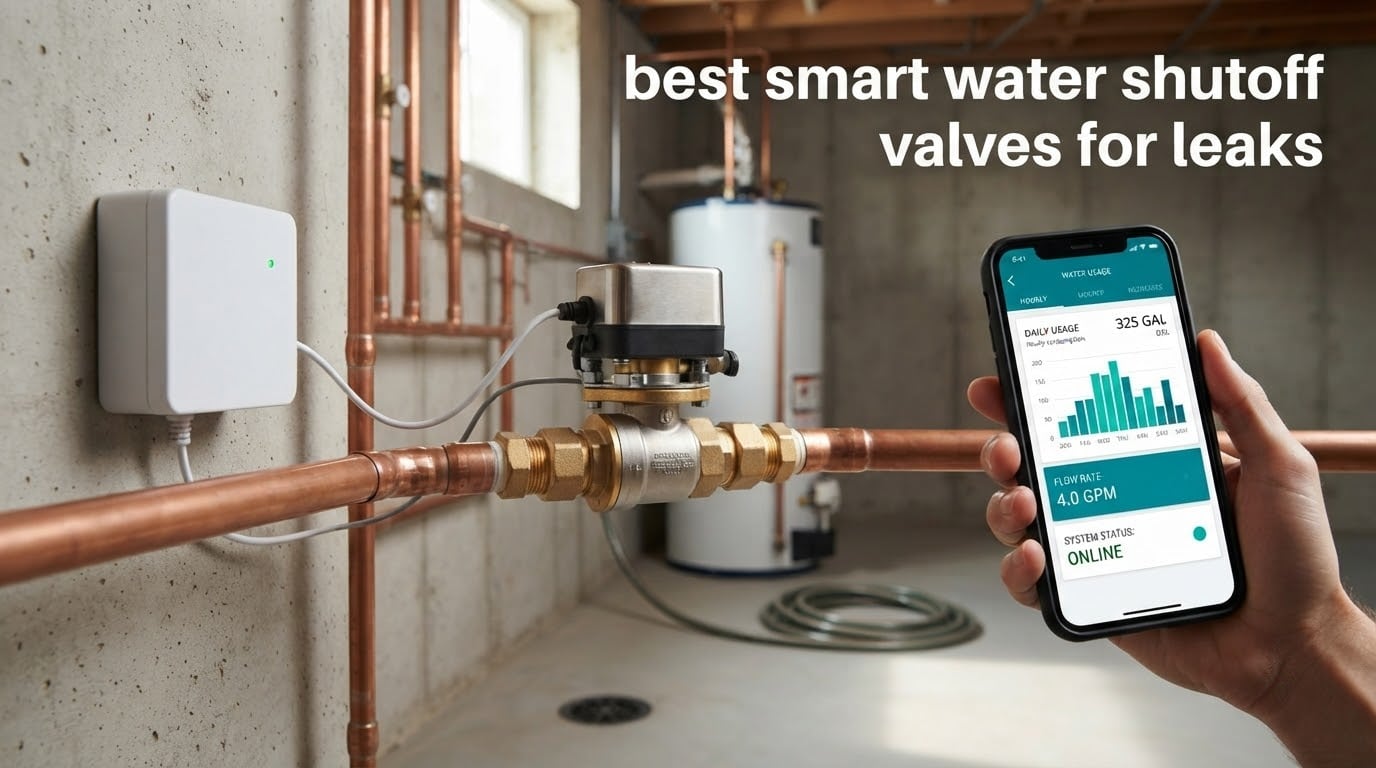
Water damage gets worse while you sleep. A supply hose behind a washing machine can put thousands of dollars of water on a floor in one afternoon, and most of that happens when nobody is home to hear it. A smart water shutoff valve is the fix that buys you time: it watches flow, pressure or moisture, closes the water itself, and tells your phone what it did.
We compared ten of the best smart water shutoff valves for leaks, grouped by how they install and what they actually protect. The whole-house filtration side of a plumbing setup matters here too, because everything downstream is only protected if the main itself is monitored.
Our picks span three install paths: plumbed-in systems on the main line, clamp-on retrofit actuators that need no pipe cutting, and point-of-use devices guarding a single appliance line. The YoLink Water Shutoff Kit is the best overall, the Frizzlife LP365 is the one to buy for real flow and pressure data, and the Zooz ZAC36 Titan wins for Home Assistant and Hubitat.
The basis for these picks is spec sheets, fitment analysis and owner write-ups across more than two thousand buyer reviews, not an afternoon of unboxing. Every product here has enough owner feedback to shortlist, and we flag where owners and spec sheets disagree.
Table of Contents
Top 3 Best Smart Water Shutoff Valves For Leaks (October 2026)
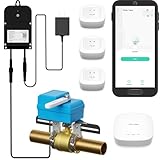
YoLink Water Shutoff Kit
- Hub
- EVO clamp-on actuator and 3 sensors
- Device-to-device shutoff without Wi-Fi
- LoRa range up to 1/4 mile
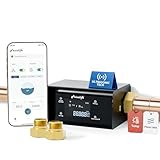
Frizzlife LP365
- Ultrasonic micro-leak detection to 0.01 GPM
- Flow
- temperature and pressure reporting
- Fits 1 inch and 3/4 inch pipes

Zooz ZAC36 Titan
- Clamp-on retrofit
- no pipe cutting
- Z-Wave Long Range with S2 security
- Self-calibrating torque motor
Every Pick at a Glance in 2026
| Product | Specifications | Action |
|---|---|---|
| YoLink Water Shutoff Kit |
|
Check Latest Price |
| Frizzlife LP365 |
|
Check Latest Price |
| Zooz ZAC36 Titan |
|
Check Latest Price |
 YoLink Motorized Ball Valve YoLink Motorized Ball Valve |
|
Check Latest Price |
 FloodStop Water Heater Kit FloodStop Water Heater Kit |
|
Check Latest Price |
 Tokatuker BT-511Wifi Actuator Tokatuker BT-511Wifi Actuator |
|
Check Latest Price |
 E-SDS Leak Detector with Shutoff E-SDS Leak Detector with Shutoff |
|
Check Latest Price |
 Taco LeakBreaker 3/4 in Taco LeakBreaker 3/4 in |
|
Check Latest Price |
 Savant AS-414 Savant AS-414 |
|
Check Latest Price |
 FloodStop Washing Machine Kit FloodStop Washing Machine Kit |
|
Check Latest Price |
How We Evaluated These Valves?
Reliability claims in this category are hard to test honestly, so we graded each product on six confirmable things. Detection method, behaviour when power or network drops, pipe and valve fitment, owner review volume, documentation quality, and total cost including labour.
Review volume matters more here than in most categories. Ratings across this list range from 4.0 to 4.7, but the sample sizes range from 84 to more than 500, and a 4.3 across a few dozen reviews tells you far less than a 4.5 across several hundred. Fitment matters equally, because most returns trace back to a size or valve-type mismatch rather than a defect.
What we did not do is install all ten units in a test house. Fitment details come from manufacturer spec sheets cross-checked against recurring owner reports, and we say so rather than presenting them as measured results.
What Smart Water Valves Cannot Detect?
Every smart water shutoff valve on this list watches the supply side of your plumbing. That single fact rules out the leaks people most often assume are covered, because a valve sits upstream of everything downstream of it.
Drain-side leaks. A failed shower pan, a cracked waste line or a sewer line leak moves no water through the supply main, so no flow-based valve sees it.
Very slow drips. Detection thresholds have a floor. The Frizzlife LP365, the most sensitive unit here at 0.01 GPM, still cannot catch a drip slower than roughly 0.001 GPM.
High water pressure. Some models report pressure, but none of them fix a pressure problem. A regulator does that job.
Leaks with no flow at all. A fitting that has already closed itself, or a tank-type heater leaking from a seam, may never move enough water to register.
Everything at once. A main-line valve covers the whole home only if the leak is supply-side and large enough to trip the threshold.
That is the strongest argument for pairing rather than choosing. A valve plus a few inexpensive moisture sensors is a system, and the valve alone is half of it.
1. YoLink Water Shutoff Kit – Best Overall and Best for Outage Protection
YoLink Water Shutoff Kit: Controller + EVO + 3-Pack Sensors + Hub
Hub, EVO clamp-on actuator and 3 sensors
Offline D2D shutoff
LoRa range to 1/4 mile
Pros
- Highest rating in this roundup at 4.7 stars across 511 reviews
- Shuts off device-to-device even with hub
- internet and AC power down
- EVO operator clamps onto an existing valve with no pipe cutting
- LoRa range up to 1/4 mile reaches basements
- attics and detached structures
- Complete system in the box with hub and three leak sensors
Cons
- Hub and app setup takes real configuration before sensors pair
- Only five free SMS alerts per month per account
- Extra sensors and controllers sold separately for whole-home coverage
The decisive feature is device-to-device pairing. Once the sensors and the valve operator know each other, they close the water without the hub, your router or mains power. For a device whose job is to act when something has gone wrong, taking the network off the critical path is a design advantage rather than a spec-sheet trick.
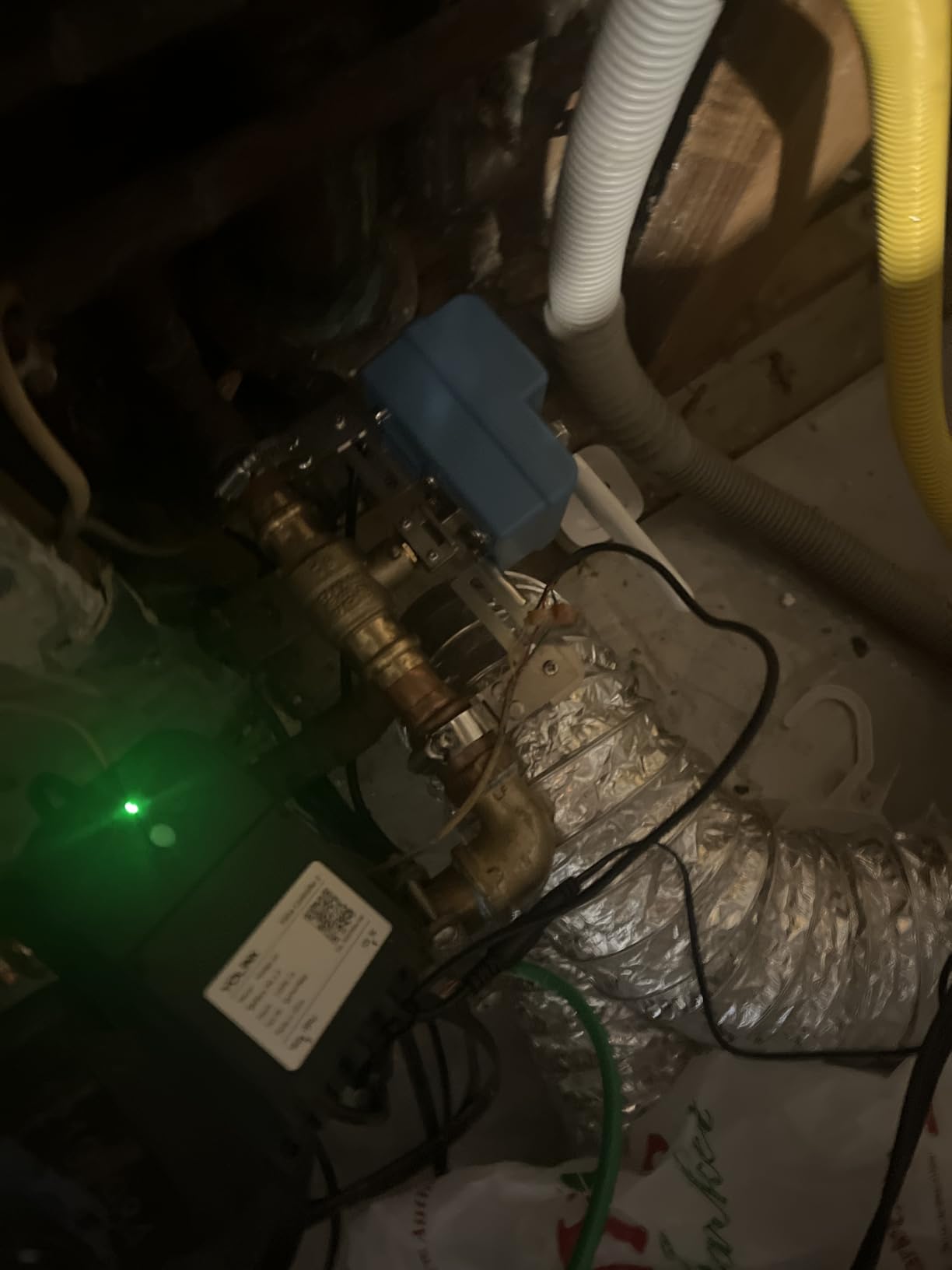
The EVO operator clamps onto an existing ball valve, so there is no pipe cutting and no plumber for the mechanical work. Owners credit the kit with catching a running garden hose within the hour, and with cutting off a second incident during an internet outage.
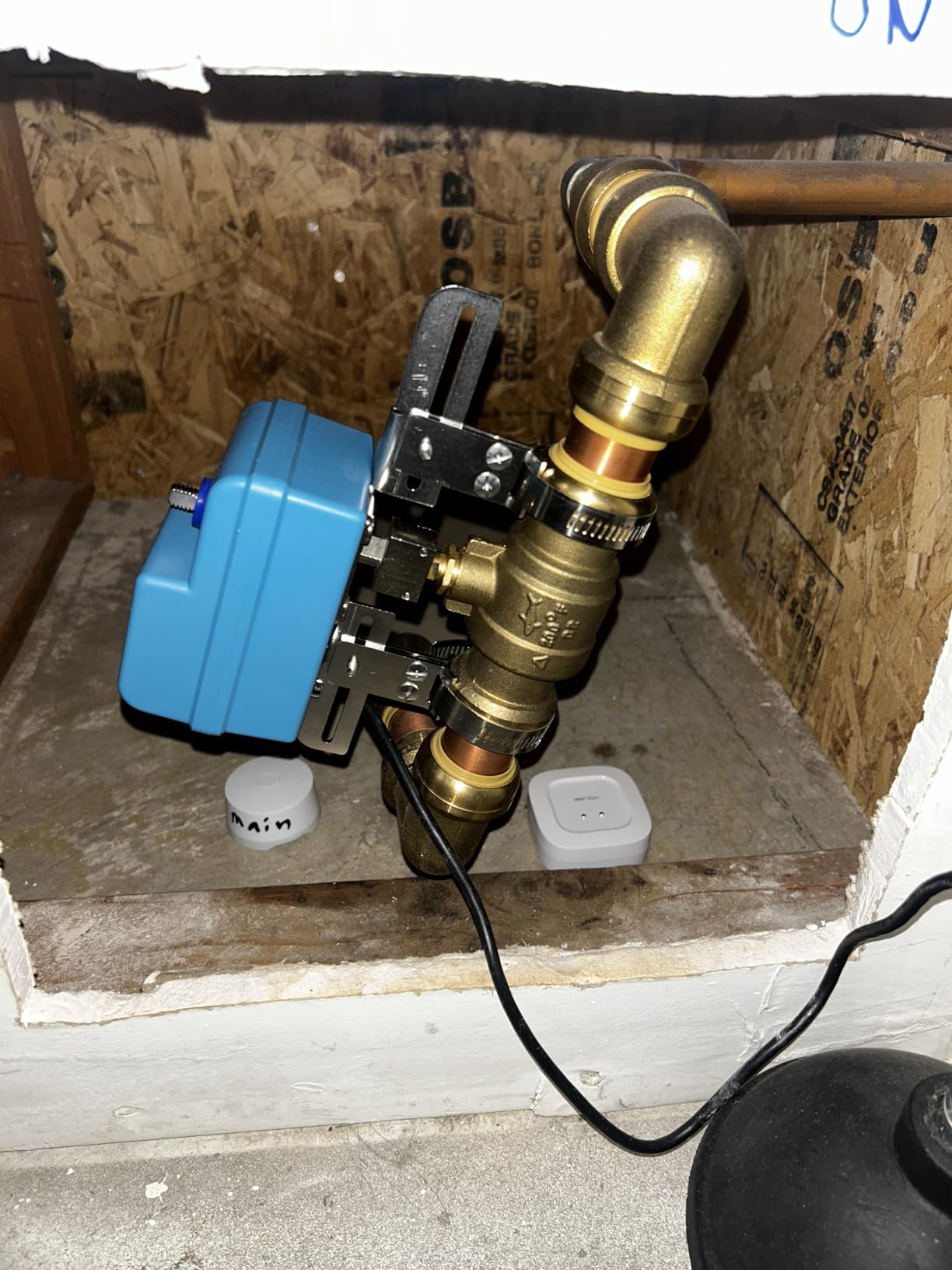
The bundle is genuinely complete, which is unusual when you often buy a valve, a hub and sensors separately. Sensors are rated for up to five years of battery life and the controller runs two years on backup cells, with SMS, app and email alerts plus Alexa, Google Assistant, IFTTT and Home Assistant support. Configuration is the part people complain about most: budget an evening and expect to re-pair a sensor or two before everything reports cleanly.
When this kit is the right call?
Choose it if you want whole-home protection without touching your plumbing and care most about behaviour when power and internet fail. A crawlspace, garage or outbuilding with thin Wi-Fi is still fine, because the radio path does not run through your router.
Where it falls short?
Coverage beyond the bundled three sensors means buying more, so the cost of real whole-home protection climbs. The clamp-on EVO also needs a ball valve with clear space around the handle, ruling it out on gate valves and cramped meter pits.
If you want continuous flow and pressure data rather than sensor-triggered protection, this is the wrong tool. It reacts to sensors, not flow anomalies.
2. Frizzlife LP365 – Best Whole-Home Flow and Pressure Monitor
Frizzlife LP365 Smart Water Monitor and Automatic Shutoff Valve – 0.01GPM Ultrasonic Micro Leak Detection, APP Wi-Fi Remote Control, Real-Time Flow/Temp Alarm, 24/7 Water Usage Reports, 3/4″ and 1″
Ultrasonic sensing to 0.01 GPM
Fits 1 inch and 3/4 inch pipes
Reports flow, temperature and pressure
Pros
- Ultrasonic micro-leak detection down to 0.01 GPM with no moving parts to wear out
- Automatic shutoff triggered reliably in owner drip and burst-pipe simulations
- App shows daily
- 24-hour
- 7-day and monthly usage plus temperature and pressure
- Works with Home Assistant
- Alexa
- Google Assistant and SmartThings
- Battery backup held charge for over a month unplugged
Cons
- Printed manual is hard to follow and does not explain battery replacement
- Cannot detect leaks slower than roughly 0.001 GPM
- Brass adapters lack wrench flats so NPT connections are awkward
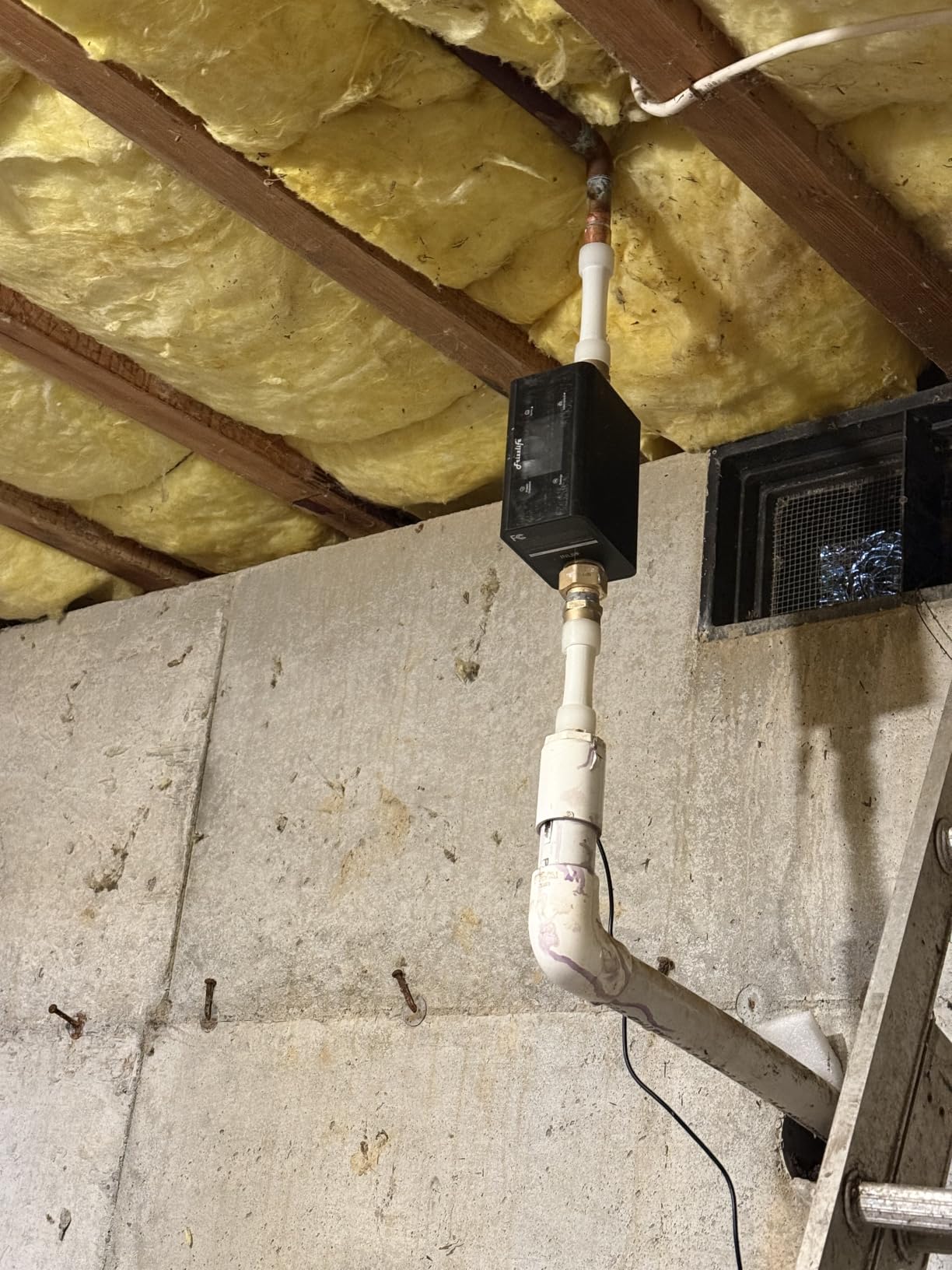
If you want to see what your water is doing rather than react when a sensor gets wet, this is the unit. It sits inline on the main and measures flow ultrasonically with no moving parts, so there is no impeller to jam on sediment. Detection to 0.01 GPM catches the small continuous drips a moisture sensor never sees.
The app is the other half of the appeal. Owners report readings that line up with municipal meter data, with usage broken into daily, 24-hour, 7-day and monthly views. Customizable protection modes let you set a threshold that fits a household running irrigation or a home office full of appliances.
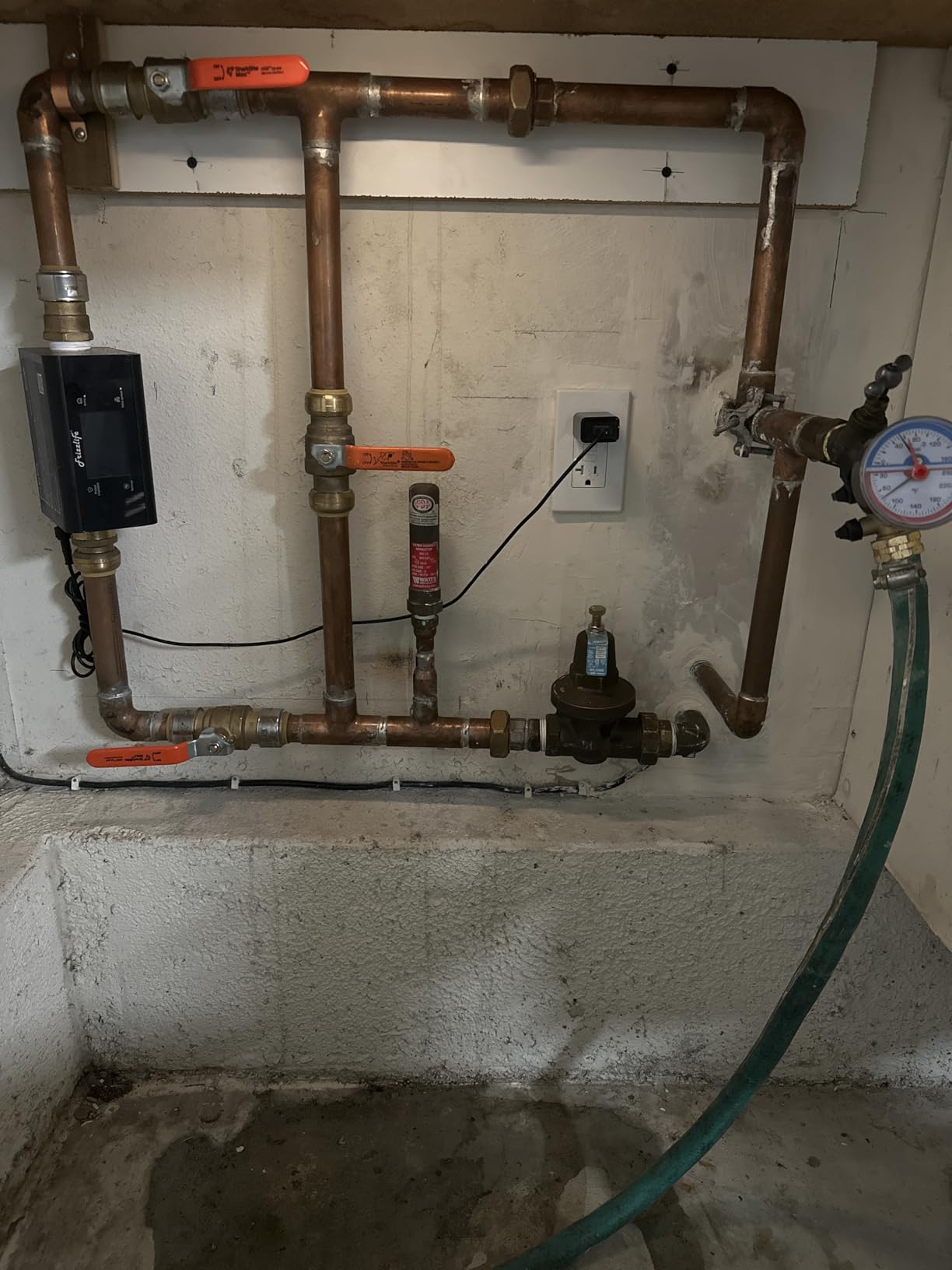
Fitment is straightforward on a standard residential main, with included NPT adapters covering 1-inch and 3/4-inch pipe and NSF/ANSI 61 and 372 certification. It runs on corded electric with a lithium-ion backup that held charge for over a month unplugged in owner testing, so it keeps monitoring through an outage. Documentation is the weak point: the manual is confusing, does not cover internal battery replacement, and the adapters lack wrench flats, which makes the NPT connections more of a fight than they should be.
Who should buy the LP365?
Buy it if a slow drip is your real fear, or if you want to know where your household water actually goes. Usage history turns a shutoff valve into a conservation tool as well as a leak-prevention one, and owners already running Home Assistant report the Smart Life integration working reliably.
Who should skip it?
Skip it if your main is anything other than 1 inch or 3/4 inch, since the adapters are the limit and there is no clamp-on fallback. It also will not catch a drip slower than roughly 0.001 GPM.
Installation on a live main is a plumber job, so plan for that visit and keep a wrench-flat coupling on hand for the awkward adapters.
3. Zooz ZAC36 Titan – Best for Home Assistant and Hubitat
Zooz Z-Wave Long Range 700 Series Titan Water Valve Actuator ZAC36 | Compatible with Z-Box, SmartThings, Works with Ring Alarm
Clamp-on retrofit over a ball valve
Z-Wave Long Range with S2 security
Self-calibrating torque motor
Pros
- Retrofit actuator clamps onto an existing ball valve with no pipe cutting
- Strong motor opens and closes even stiff
- hard-to-turn valves reliably
- Tool-free installation typically reported in 15 minutes or less
- Works with Z-Box
- SmartThings
- Hubitat
- Ring Alarm and Home Assistant
- Z-Wave Long Range holds signal even far from the hub
Cons
- Needs a 0.5 to 1.25 inch ball valve plus clearance on both sides
- Bundled leak probe cord is too short unless the valve sits near floor level
- A Z-Wave hub is sold separately and some devices pair with one ecosystem only
This is the pick for people running a local-first automation system. Z-Wave Long Range with S2 Security and SmartStart pairs locally to your hub, so once it is on the network your automations genuinely run without a vendor cloud staying online. Hubitat and Home Assistant users get the full experience.
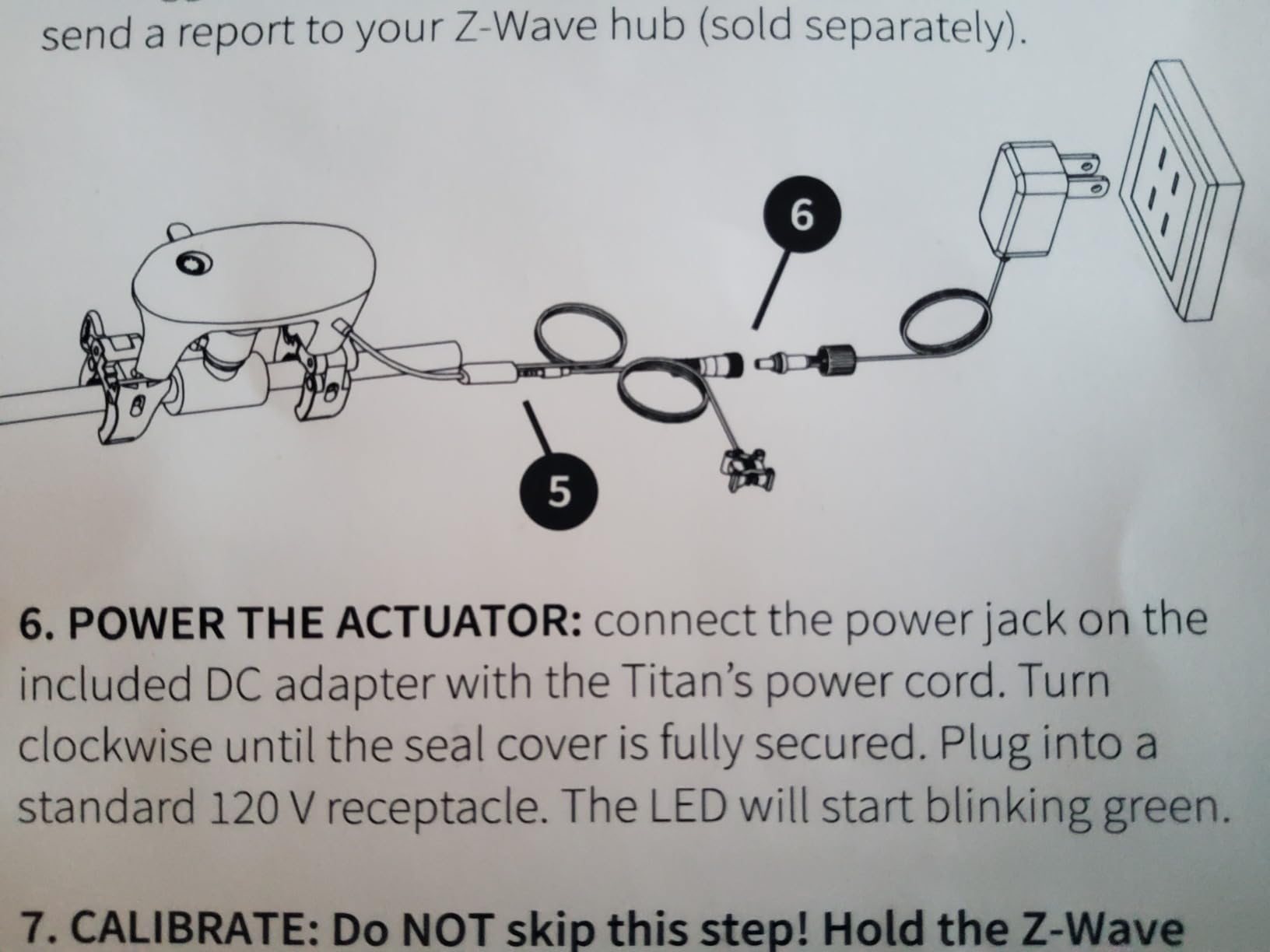
The motor is what enthusiasts praise most. It self-calibrates to each valve on first run to work out the torque needed, which is how it closes a stiff handle that a cheaper actuator would stall on. Installation is tool-free in most cases, typically under 15 minutes.
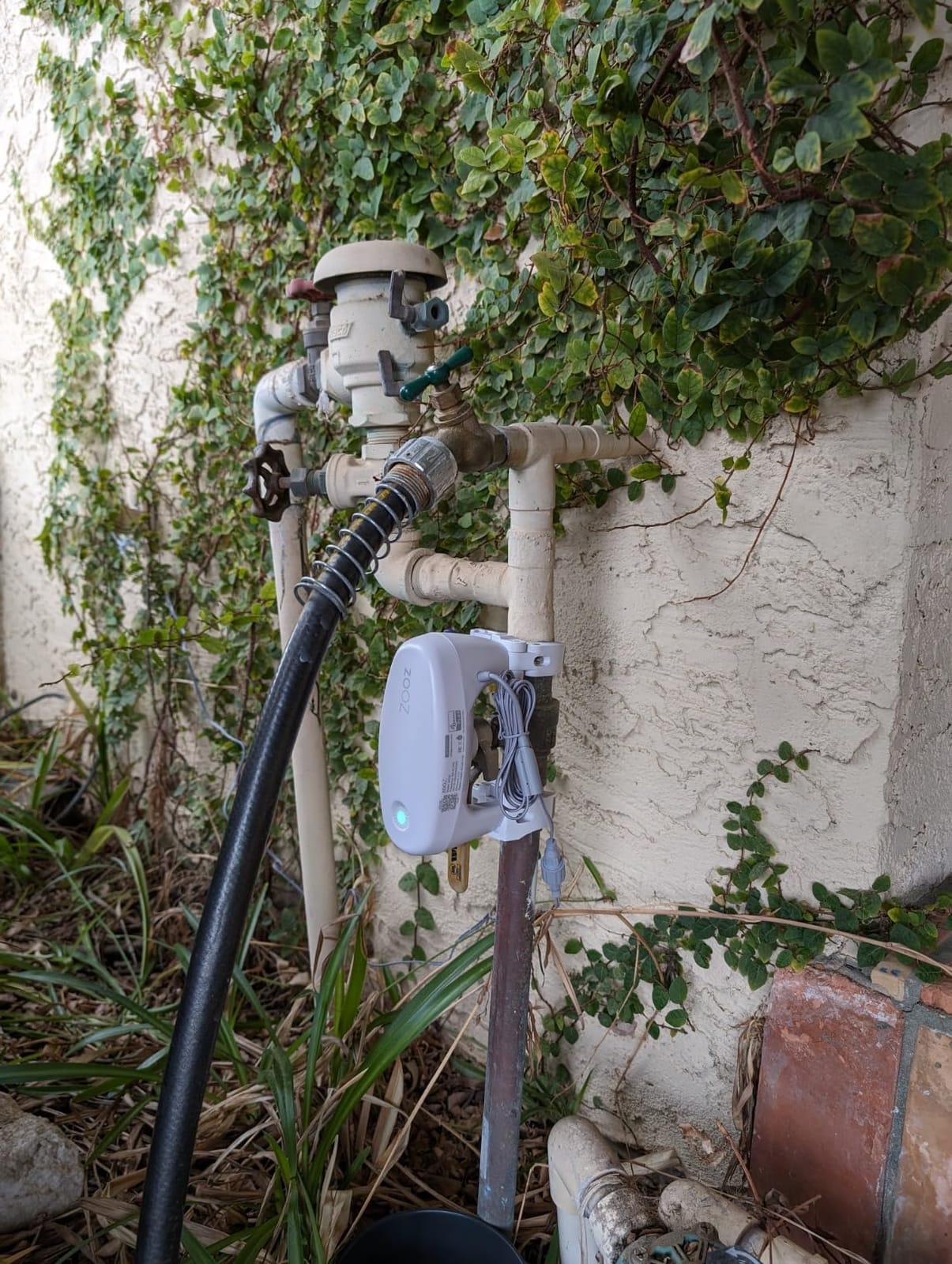
A bundled plug-in water probe gives standalone shutoff without the hub, and the actuator is usable outdoors, an advantage when your main is in an exterior pit. That combination of local control and outdoor tolerance is why it keeps appearing in smart-home plumbing threads.
Two details matter before you order. The probe cord is very short and only useful when the valve sits near floor level, and you need real clearance on both sides of the pipe, which older cramped meter boxes often lack.
When to pick the Titan?
It suits anyone who wants shutoff inside real automation, with routines that close the main when you leave, and it pays off if you already own a Z-Wave hub. Z-Wave Long Range also solves the dead-zone problem in large homes where the main is at the far end of the house.
When to pick something else?
Choose another product for a gate valve, or for a pipe smaller than 0.5 inch or larger than 1.25 inch. Clamp-on actuators are physically limited to that range, and forcing one outside it is how housings get damaged.
Also skip it if you need a complete kit in one box, and verify hub compatibility before buying, since some devices refuse to pair with two ecosystems at once.
4. YoLink Motorized Ball Valve – Best for Half-Inch and Smaller Mains
YoLink 1/2″ Commercial Grade Smart Motorized Stainless Steel Ball Valve LoRa Wireless Up to 1/4-Mile Open Air Range Battery-Powered, IFTTT, Alexa, Home Assistant
Motorized stainless steel 1/2 inch ball valve
LoRa range up to 1/4 mile, no Wi-Fi
Two AA batteries, up to 3 years standby
Pros
- Integrated motorized stainless steel ball valve with controller
- no separate valve purchase
- Operates without Wi-Fi so shutoff works during an internet or power outage
- Two AA batteries provide up to three years of standby operation
- Device-to-device pairing with a key fob allows control without a hub or phone
- SharkBite fittings make the install achievable without soldering
Cons
- Progressive female NPT threads tighten unevenly and caused leaks for some buyers
- Not sealed against condensation
- which corroded the board on one outdoor install
- A hub is required for app
- Alexa and IFTTT functionality
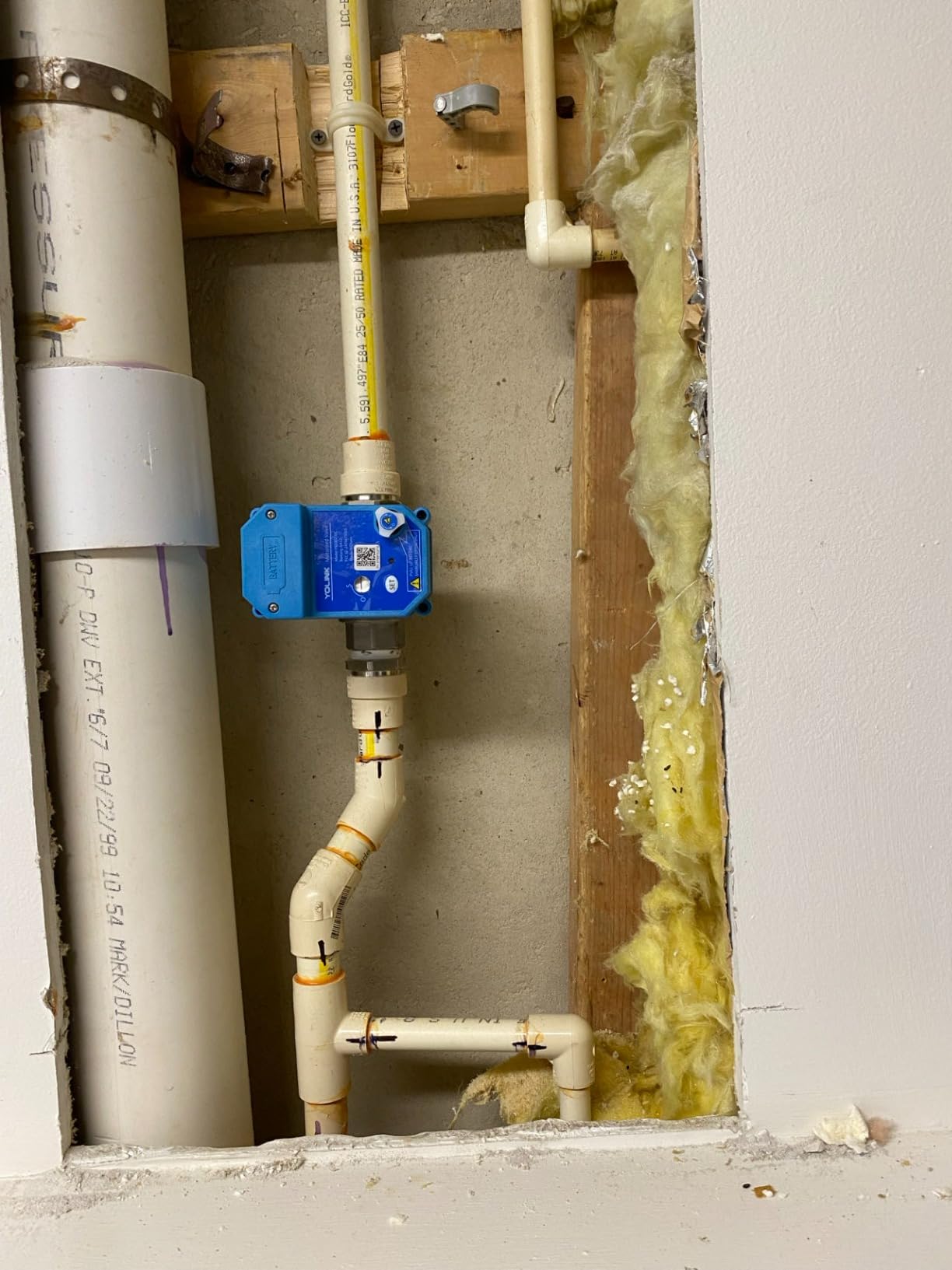
Most devices in this category assume a 3/4-inch or 1-inch main. This one is built for the other case, a 1/2-inch line common in older homes and some well and irrigation setups. It is also the rare product here that is a complete valve rather than a controller that bolts onto one.
Because the ball valve and controller ship as one unit, there is no separate purchase and no calibration step. Owners report the main closing within seconds of a paired sensor tripping, and the LoRa radio means the shutoff path never runs through your Wi-Fi network.
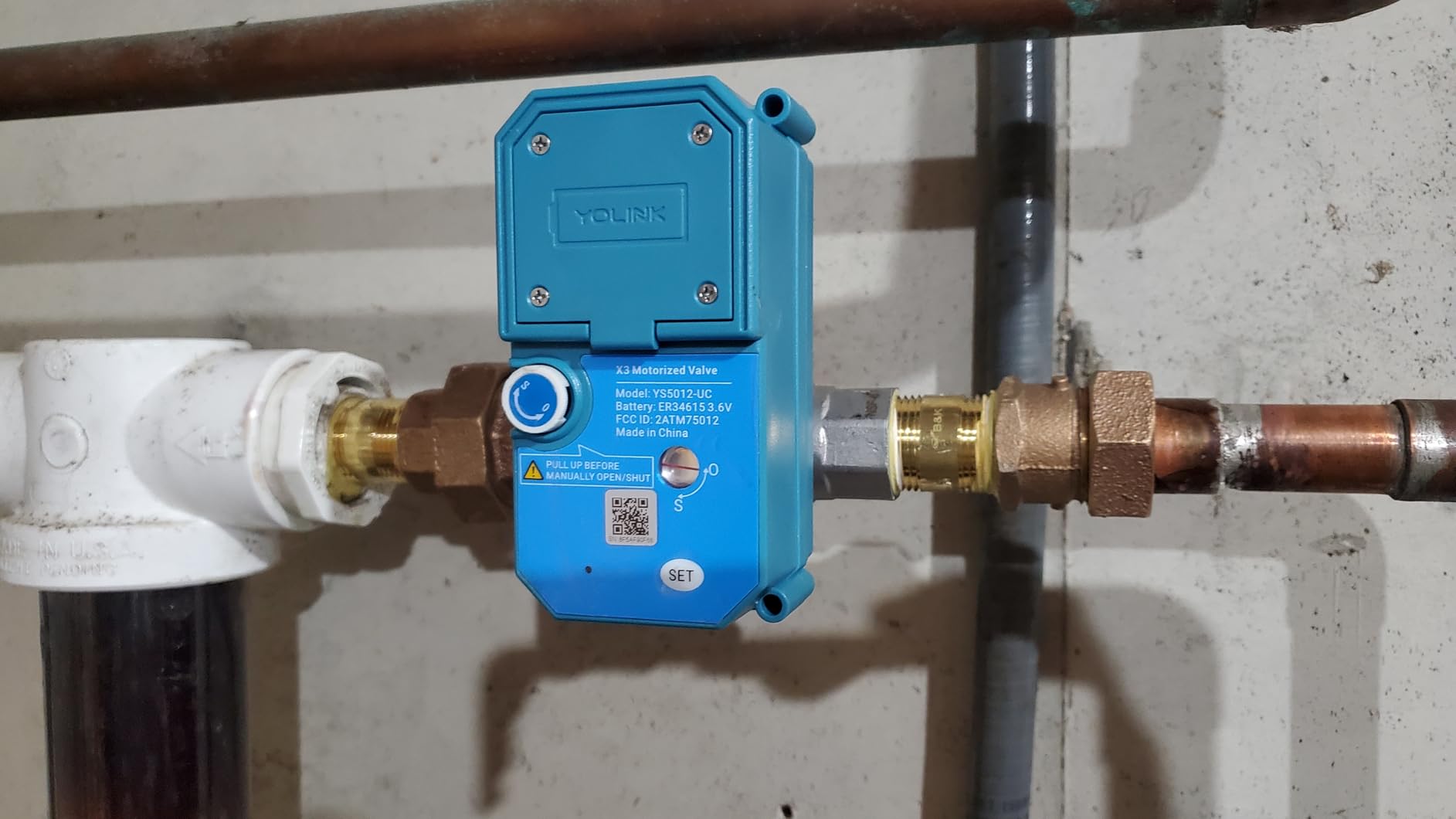
Cloud supervision monitors signal strength and battery level continuously, so a dying battery becomes a notification rather than a surprise. SharkBite fittings let a competent DIY installer work without soldering, and 3/4-inch and 1-inch versions exist in the same line. Installation reports are the honest caveat: the internal progressive female NPT threads tighten unevenly, and several buyers had leaks there until they switched to blue thread compound.
Where this valve makes sense?
It is the answer for the reader whose main is 1/2 inch and who has been told nothing fits. The same no-Wi-Fi operation suits a well house, crawlspace or outbuilding with no router nearby, and the key fob gives a physical trigger that works regardless of network state.
Where it does not?
A hub is still required for app, Alexa and IFTTT functionality, so this is not a no-hub product in the way the clamp-on kit is. And if you install it outdoors, protect it from condensation, because the housing is not sealed.
Have blue thread compound ready and expect to redo a connection once. Check your main diameter before ordering rather than after.
5. FloodStop Water Heater Leak Detector Kit – Best for Water Heater Protection
FloodStop Water Heater Leak Detector Kit, 3/4″ NPT MIP x FIP
3/4 in NPT motorized ball valve
87 dB alarm on sensor contact
AC power with 4 AA backup
Pros
- Purpose-built for water heater leaks
- the highest-risk appliance leak in a home
- Valve stays open until water is actually detected
- avoiding nuisance shutoffs
- Includes an 87 dB audible alarm plus visual LED indication
- Runs on AC power with optional 4 AA battery backup
- Available in many thread and press-fit sizes for retrofit or new construction
Cons
- Point-of-protection only
- covering the water heater rather than the whole home
- Contact sensor must be seated correctly at the base of the water heater
- Not app-connected
- so alerts are local audio and visual only
A water heater is the most likely source of a catastrophic indoor leak, a large reservoir of water behind a valve that may be original to the house. This kit targets exactly that risk and nothing else, which is a virtue when you understand what you are buying.
The design logic is simple and correct. The contact sensor sits at the base of the tank, and the motorized ball valve closes the heater supply only when the sensor contacts water, so humidity or a passing broom will not cause a nuisance trip.
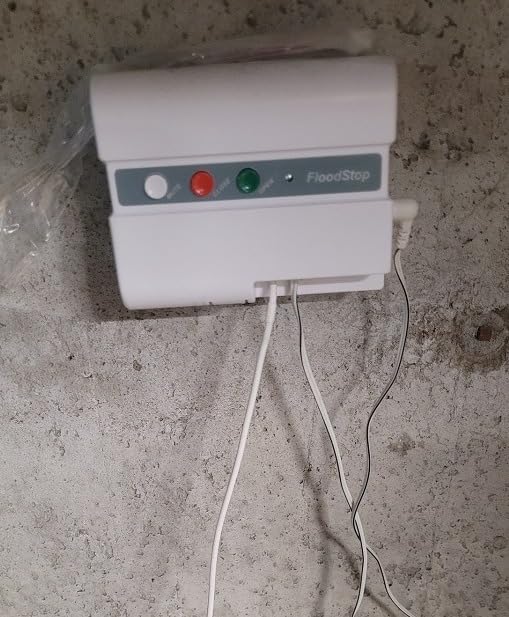
Alerts are local rather than remote: an 87 dB audible alarm plus LED indication on a wall-mount controller, enough to wake a household at 2 a.m. and free of any Wi-Fi failure mode. Power comes from the wall adaptor with optional 4 AA battery backup, and with 339 reviews at 4.5 stars this is one of the better-established products here, with plumbers recommending it and many thread and press-fit sizes making retrofit realistic across heater brands.
Why it earns its place?
If your heater tank is more than about eight years old, or you have seen corrosion on the pan, this is cheap targeted protection for the highest-risk appliance in the house. It pairs well with a main-line flow monitor: the main catches supply lines, this catches the tank.
Where it stops?
It protects the water heater and nothing else. If you want whole-home coverage you still need a main-line valve, and this kit will not tell you what your phone is doing while you are on a flight.
The sensor must be seated correctly at the base of the tank, and a mispositioned sensor is the main reason owners report disappointing results.
6. Tokatuker BT-511Wifi Actuator – Best Budget Wi-Fi Retrofit
Motorized Smart Valve Actuator (Valve Sold Separately) WiFi & Bluetooth Electric Water Shutoff Controller Robot Automatically, Tuya Smart & Smart Life App Control, Work with Alexa, No Hub Required
Retrofit Wi-Fi and Bluetooth clamp-on
2.4 GHz network, no hub required
Valve is sold separately
Pros
- Entry-level pricing and a cheap Wi-Fi upgrade for an existing ball valve
- No hub required
- so setup is limited to a 2.4 GHz network and the Tuya app
- Works with Alexa and Google Assistant for voice control
- Built-in timer function for scheduled open and close
- Fits over existing 1/2 inch
- 3/4 inch and 1 inch lever ball valves without special tools
Cons
- Valve is sold separately so the real system cost is higher than the headline figure
- Precise pivot alignment is critical and misalignment reduces force
- 14 percent of reviews are one-star
- the highest one-star share in this set
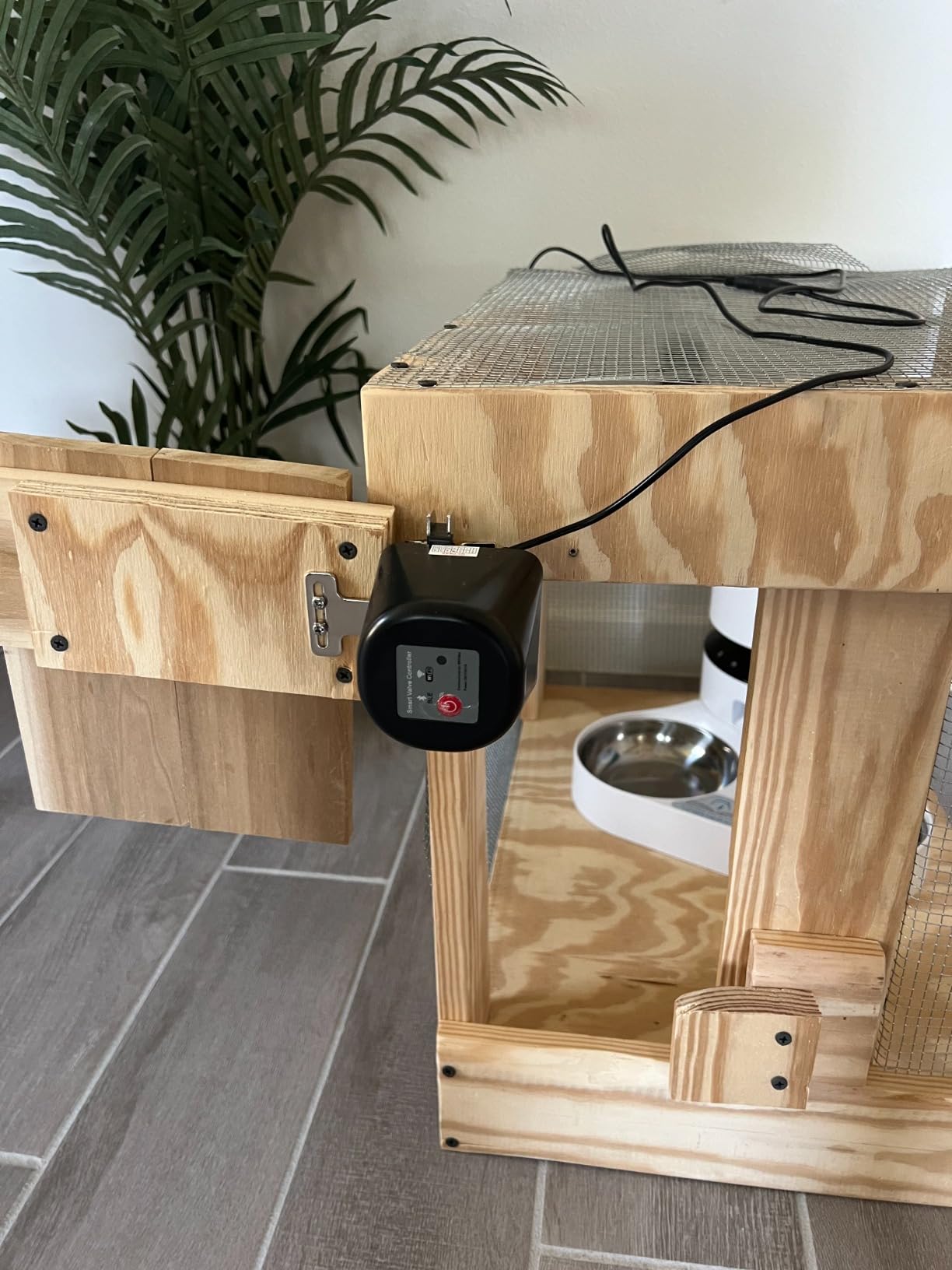
This is the cheapest way to add remote control to a ball valve you already own. It clamps over the handle, needs no hub, and joins the Tuya Smart or Smart Life app over 2.4 GHz Wi-Fi. There is no monthly subscription, and it works with Alexa and Google Assistant.
The built-in timer is more useful than it sounds. Scheduling the valve to open for an irrigation window or close when you are out is a real automation rather than a novelty, and Bluetooth gives a local fallback when the network drops.
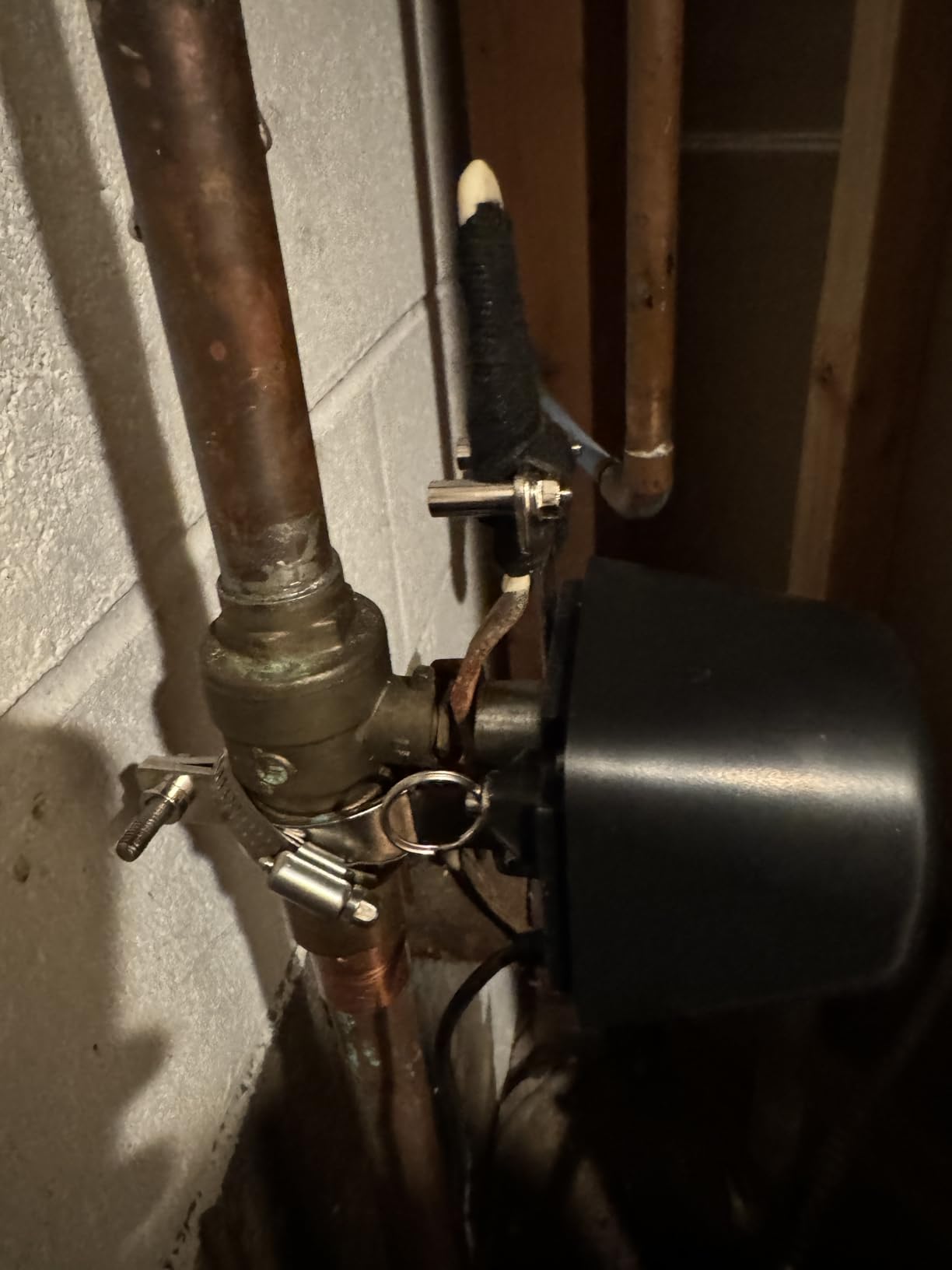
Fitment is broad for a clamp-on device, covering 1/2 inch, 3/4 inch and 1 inch lever ball valves without special tools. The trade-off is honest: the valve is not included, so the headline figure is not what you end up owning.
At 4.0 stars across 287 reviews this has the lowest average and the highest one-star share here, at 14 percent. Complaints cluster around alignment: if the pivot is not centered on the handle, the motor has less force and can be damaged over time. It does not work with SmartThings.
Reasons to consider it
Choose it when you already have a lever ball valve, want app control for the least outlay, and do not run Home Assistant. It is the easiest entry point into remote water control and a sensible first device for a rental unit. Note that anything larger than a 1-inch lever valve is outside its range, which is where a lot of installs end.
Reasons to look elsewhere
If you need shutoff during an outage, this device has no battery. If you need Z-Wave, SmartThings or genuinely local control, it is the wrong radio entirely. A gate valve will not fit at all.
Take your time with the alignment step. That detail is the difference between a valve that closes reliably for years and one that ends up in a drawer.
7. E-SDS Water Leak Detector with Shutoff Valve – Best for Laundry and Utility Rooms
E-SDS Water Leak Detector with Shutoff Valve,Sensors and Sounds Alarm
3/4 in NPT solid brass ball valve
Shutoff in about two seconds
19.68 foot probe and 120 dB alarm
Pros
- Shuts water off within about two seconds of the sensor contacting water
- Loud 80 to 120 dB alarm with flashing LED indicators
- Solid brass 3/4 NPT ball valve rated for hot water up to 212 F
- 19.68-foot sensor probe reaches drains
- floors and tight spaces
- Manual open
- close and reset buttons make post-repair restart simple
Cons
- Two fixed female threads make the bulky assembly hard to fit in tight spaces
- Local alarm only with no app or remote notification
- Sensor cable is described as flimsy and needs protecting
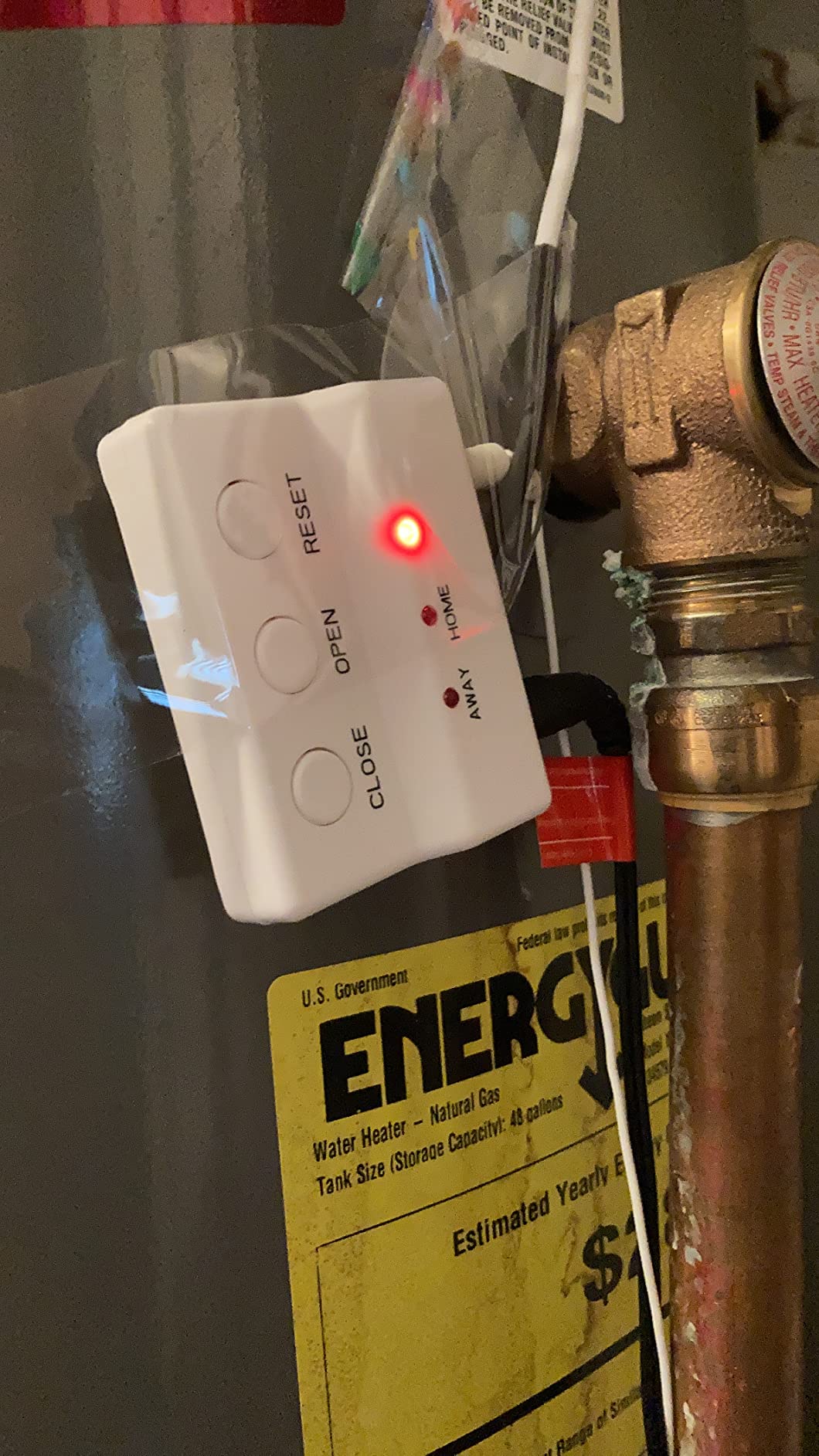
This is the point-of-use workhorse for a laundry room, a utility closet or a basement floor drain. It closes the local supply about two seconds after the sensor contacts water, and the 120 dB alarm is loud enough to hear over a running dryer. Several owners say they buy multiples.
The 3/4 NPT solid brass ball valve handles hot water up to 212 F, which matters when the leak source is a hot line rather than a cold one. Manual open, close and reset buttons mean restarting after a repair needs neither a phone nor an app.
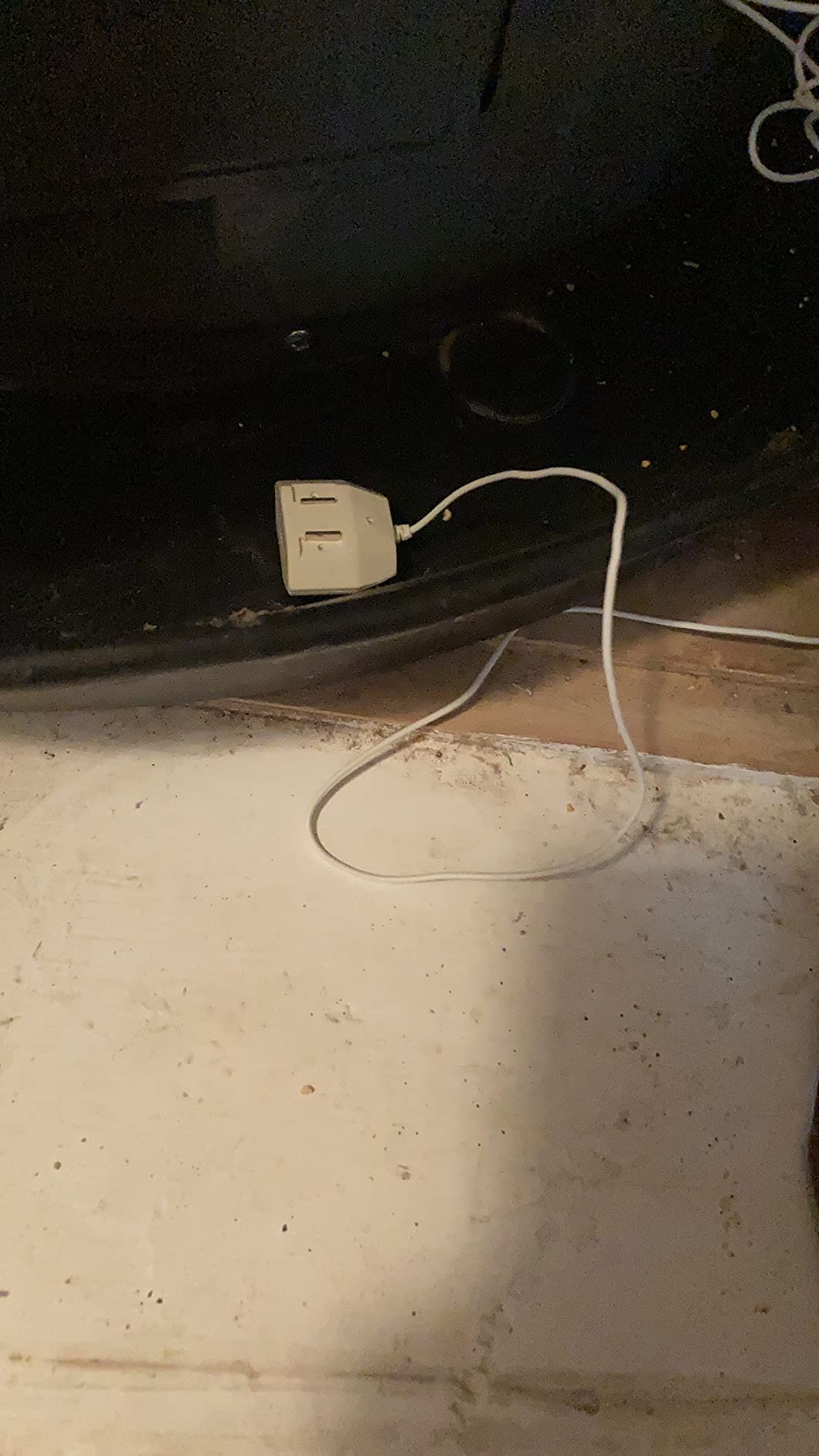
The 19.68-foot probe is the practical hero, reaching a floor drain several feet away so you can place the sensor where overflow water actually arrives. The bulk is the compromise: two fixed female threads make the assembly awkward in a tight closet, the thread type may not match your connectors without adapters, and one reviewer raised questions about lead content for potable use.
Where it fits best?
It suits a laundry room with older washer hoses, a basement utility area, or any spot where a loud local alarm would be heard immediately. Installing it during a washer replacement means the plumbing is already open, which removes most of the difficulty.
Where it does not?
There is no app and no remote notification, so you find out from the alarm or from a neighbor. Away for a week, that is not much protection, and it is not a substitute for a whole-home valve.
Measure your clearance first. The double-female configuration is why several owners could not fit it where they wanted, and the cable needs routing that will not be pinched.
8. Taco LeakBreaker 3/4 in – Best for High-Heat Water Heater Service
LeakBreaker 3/4″ NPT Water Heater Shut-Off Valve & Actuator
3/4 in NPT water heater valve and actuator
Metal body for high-heat service
5 x 5 x 5 inch footprint
Pros
- Purpose-designed shutoff valve and actuator from an established plumbing manufacturer
- Metal construction suits high-heat water heater environments
- Automatically isolates the water heater supply when a leak is detected
- Compact 5 x 5 x 5 inch footprint
- 3/4 in NPT sizing matches most residential water heater connections
Cons
- Protects only the water heater
- not the rest of the home
- No app or smart-home integration is indicated in the listing data
- Listing documentation is sparse on connectivity and notification options
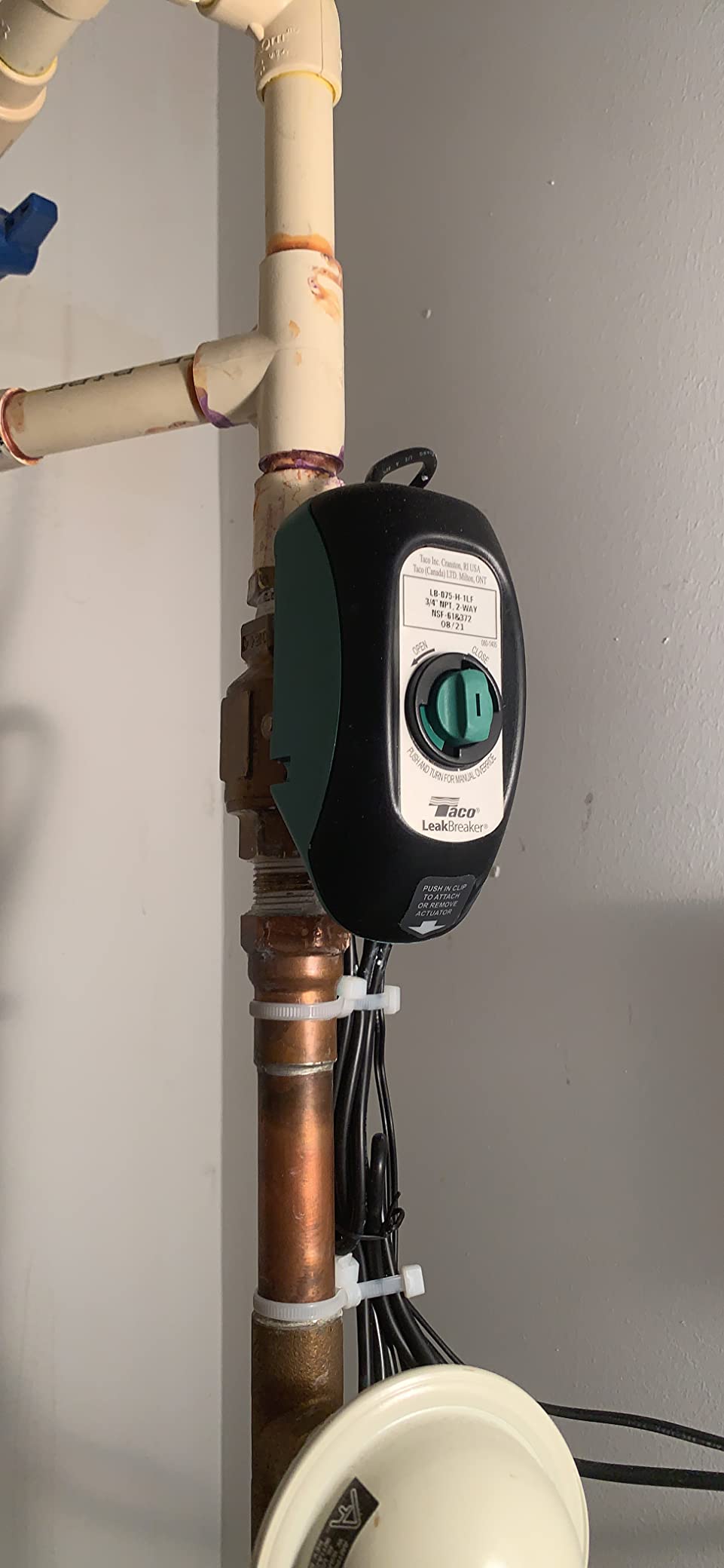
Where most products on this list are electronics, this is plumbing hardware from an established water-heating manufacturer. The metal valve body and actuator suit the ambient heat of a heater closet, and the assembly is a compact 5-inch cube that fits under a tank without crowding the pan.
It does one job, isolating the water heater supply when a leak is detected. With 84 reviews at 4.3 stars, roughly two-thirds five-star, the feedback is steady in the best way. There is no app, no radio and no cloud, so there is nothing to fail electronically.
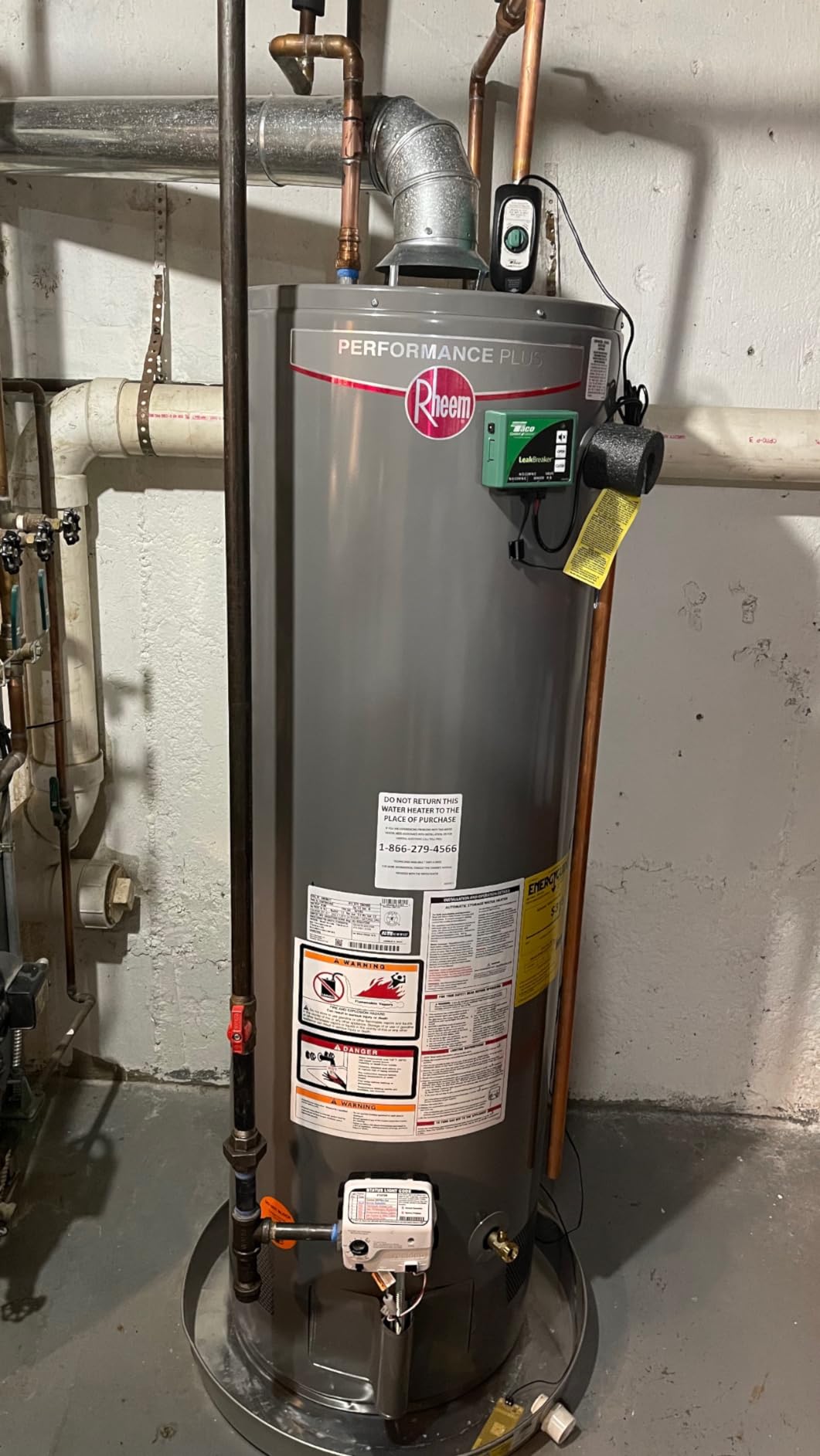
The 3/4 NPT sizing matches most residential heater connections, which removes the most common install problem. The catch is that the listing documentation is thin on how detection is triggered.
Confirm with the manufacturer whether a separate sensor is required at the tank base before you commit to a plumbing change.
Why it is worth considering?
Pick it when heat is the concern, such as a heater in an unconditioned garage or a tight closet next to a furnace. Metal does not care about ambient temperature the way a plastic housing does, and it also works as a second layer with the main protecting the house.
Why it is not a whole-home answer?
It covers the water heater only. Every other supply line, from washing machine hoses to upstairs fixtures, is outside its scope, and there is no remote notification when it acts.
If you need phone alerts while away, this is the wrong category. If you need a valve that still functions in ten years without a firmware update, it is exactly right.
9. Savant AS-414 – Best for Appliance and Filter Lines
Savant AS-414 Auto Water Shut-Off Valve for Leak Protection
Point-of-use shutoff for filters and appliances
9V alkaline battery operation
Shuts off automatically on low battery
Pros
- Very inexpensive way to protect a single appliance or appliance line
- Automatically shuts off water as soon as the sensor senses moisture
- Loud audible alarm plus visual notification
- 9V alkaline battery operation keeps it working without mains power
- Fails safe by shutting off automatically when the battery runs low
Cons
- Point-of-protection device with no whole-home or app-based coverage
- One owner reported a device stuck shut and needing replacement after about two years
- Not water resistant
- though one owner found it recovered after drying out
The cheapest real protection here targets the lines that cause appliance-scale damage: water filters, softeners, reverse osmosis systems and ice maker lines. One owner credits the device with catching four separate pinhole leaks in a refrigerator supply line over four years, the slow boring failure that does enormous damage.
Because it runs on a 9V alkaline battery, there is no wiring and no outlet to find, and included adapters for 1/4 inch and 3/8 inch reverse osmosis lines mean it can be plumbed in as shipped. It shuts off automatically when the battery runs low rather than dying open.
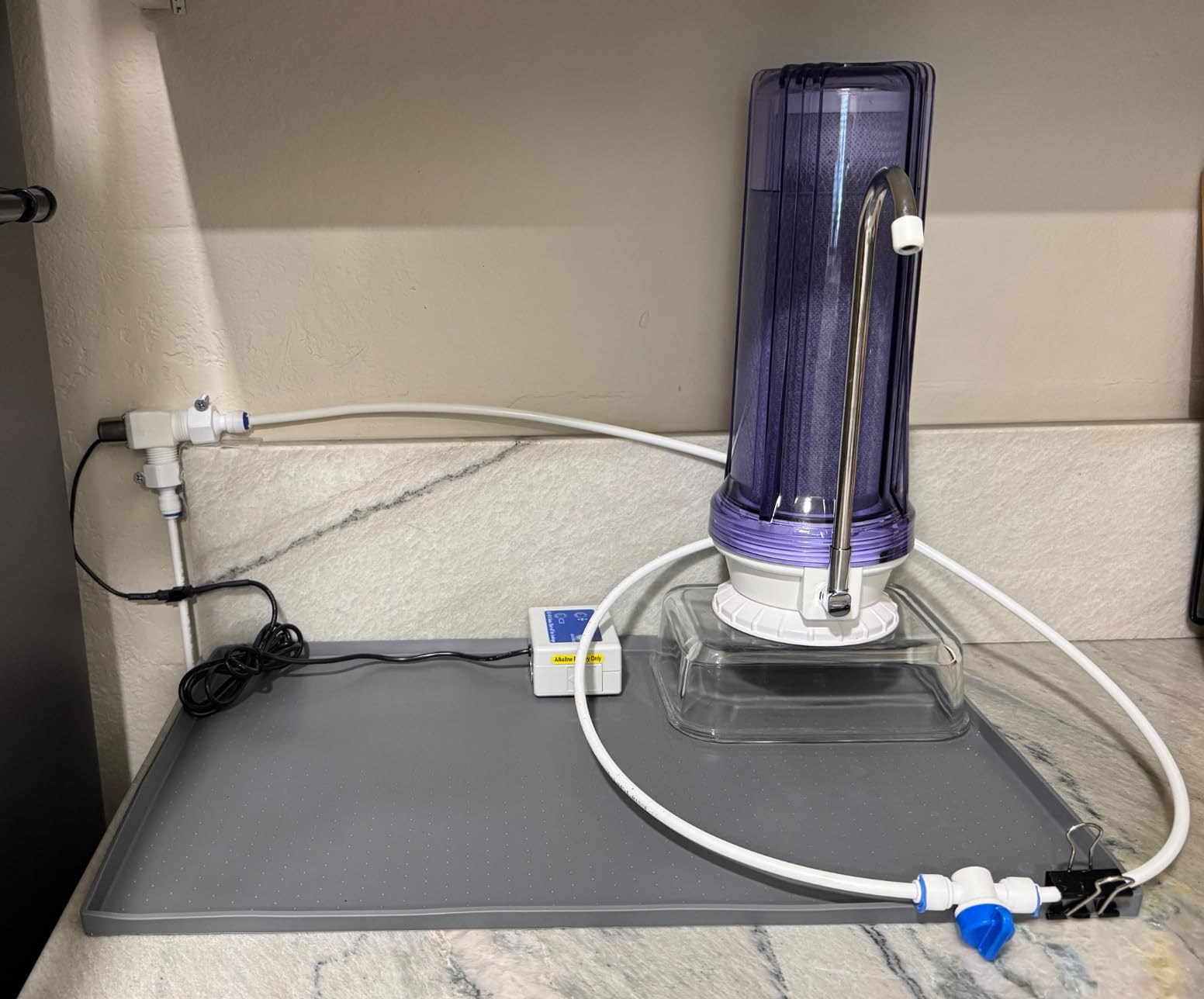
An audible alarm plus LCD status indicator gives local awareness, and the 16-ounce housing is easy to mount out of sight near the appliance it protects. Durability is the fair reservation: owners report a device stuck shut after about two years and a plastic housing cracking after four years, with operating temperature limited to 80 C and no water resistance.
When it makes sense?
Choose it for a softener, reverse osmosis system, fridge ice maker or filter housing where a pinhole leak would quietly soak a cabinet for months, and where the main is inaccessible since it needs no plumber and no electrical work.
When to buy something else?
Do not rely on it for a burst supply line in a wall. A point sensor at one appliance will not see a leak three rooms away, and there is no app here for remote notification.
Check the enclosure for condensation before you commit, since that is where the long-term failure reports come from.
10. FloodStop Washing Machine Valve Kit – Best for Washing Machine Overflows
New Floodstop Washing Machine Valve Shutoff Kit FS3/4H v4 Inline Valves
Motorized hot and cold inline valves
Floor sensor behind the washer
Lead-free brass, S. 3874 and AB1953
Pros
- Motorized inline hot and cold ball valves that attach to the washer hose bibs
- Valves stay open until water is actually detected
- limiting false shutoffs
- Leak sensor on the floor behind the washer catches overflow quickly
- Audible alarm and push-button manual shutoff for use when away
- Lead-free brass certified under S. 3874 and AB1953
Cons
- Power cord is about 10 feet so a nearer outlet may be needed
- One reviewer reports corrosion in the battery housing that led to a stuck valve
- Not a networked device
- with a local alarm only
Washer supply hoses are among the most common indoor plumbing failures there are, and this kit is built for exactly that one. The motorized inline ball valves attach to the hot and cold hose bibs, and a floor sensor behind the washer closes both sides and sounds an alarm when overflow reaches it.
Several owners report the kit caught a washer overflow and prevented all floor damage, the outcome that justifies the whole category. The hot and cold pairing is a real improvement over a single-lever kit, because a failed hose on either line triggers the same response.
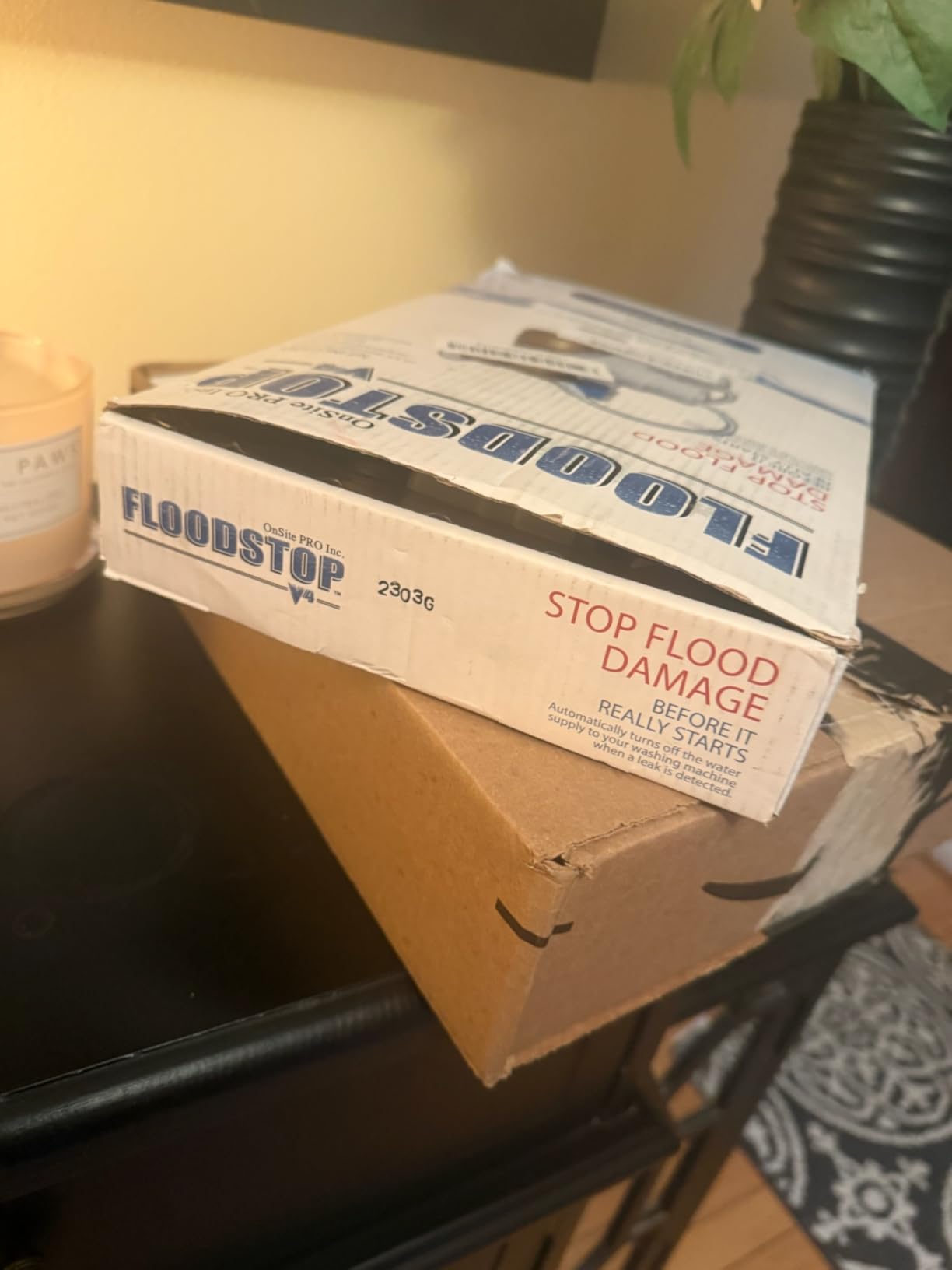
Construction details are solid where it counts, with lead-free brass certified under S. 3874 and AB1953 for potable compliance. The push-button manual shutoff lets you close supply while away, and the valves stay open until water is detected.
Plan around the 10-foot power cord, which may need a nearer outlet in a tight closet, and keep the controller board accessible because that is the part you touch during any service.
Why it belongs on the list?
If you are replacing a washer, install it during the same visit. The incremental labor is small and the failure it prevents is one of the most expensive in residential water damage, and it complements a main-line valve that catches whole-home flow anomalies.
Where it is not enough?
This is a local alarm with no app and no remote notification, so it protects the room rather than the household. If you travel regularly, you want something that can tell you what happened from another state.
Confirm the outlet position before ordering, and avoid sealing the controller behind a finished wall.
How to Choose: 7 Criteria That Decide the Purchase?
Start with where the valve sits, because that decides everything else. A main-line device protects the whole home but needs a plumber and a pipe size you must measure. A clamp-on retrofit avoids the plumbing work but fits a ball valve only within a narrow diameter range. A point-of-use kit protects one appliance and often needs no plumber at all.
1. Measure the pipe before anything else
Record the outside diameter and nominal size of your main. Most of this list fits 3/4-inch and 1-inch lines, clamp-on units work within roughly 0.5 to 1.25 inch, and only a few address a 1/2-inch main. Note the material too, since copper, PEX and CPVC each constrain what will seal.
2. Confirm it is a ball valve
Nearly every clamp-on actuator here requires a standard ball valve with a lever handle. Gate and butterfly valves will not work, and that is the most common reason a retrofit ends up in a drawer. Check clearance on both sides for the housing.
3. Choose flow monitoring or sensor triggering
Flow-based units measure water moving through the valve and catch a slow drip with no sensor present. Sensor-triggered units wait for moisture, which is cheaper and more reliable but only protects the locations you have covered.
4. Ask what happens when power is gone
Three answers appear here. Some devices close the valve on a low battery, which is fail-safe. Some run on backup cells for a period, which is fail-temporary. Some stop monitoring, which is fail-open and worth avoiding.
5. Check whether control is local
If you run Home Assistant or Hubitat, Z-Wave keeps your automations local and the Zooz Titan is the pick. Wi-Fi products need a 2.4 GHz network and a vendor app, and some have no local API at all.
6. Think about where the hardware lives
A main in an exterior pit, crawlspace or garage faces condensation, temperature swings and limited power. Some products are usable outdoors and some are not, and a non-sealed controller in a damp box has a shortened life.
7. Weigh review volume, warranty and total cost
Review counts here range from 84 to more than 500, and the larger samples are meaningfully more informative. Add labour to the equation, since a plumber cutting into a live main is often a larger line item than the device itself, and check for any permanent subscription.
Installation: What a Plumber Does and How to Test Your Shutoff?
Clamp-on retrofit and point-of-use kits are genuine do-it-yourself work. Mounting an actuator over a ball valve takes under half an hour with no tools, and an appliance kit goes in during an equipment replacement. Plumbed-in systems are different: cutting into a live main and restoring pressure is plumber territory unless you have done it before.
Treat labour as part of the purchase rather than an afterthought. If the main sits in a finished wall or a cramped meter box, the plumbing work can run several times the device cost. Get the install quote first, and give the plumber the exact model and pipe size so nobody discovers a mismatch on arrival. On install day, test the shutoff physically rather than trusting a device you have never seen actuate. It takes five minutes.
Locate the upstream shutoff first. Know where the main is and confirm you can close it before anything is opened.
Command a remote close. Use the app, hub or key fob rather than the manual override, so you test the path you will depend on.
Run a faucet. With the valve commanded closed, confirm flow stops. This tests the mechanical seal, not just the motor.
Confirm the alert arrives. Check the push notification, SMS or alarm actually reached your phone.
Test the power-loss path. Unplug the unit or pull its batteries and see whether the valve closes, stays put or becomes inoperable. Write down which.
Reopen and re-verify. Restore service, run a faucet again, and confirm the valve seats without dripping at the union.
That last power-loss test is the one people skip, and it determines what your protection actually is during a storm. If the valve simply stops responding, you now know to add backup sensors rather than assume coverage.
Frequently Asked Questions
What’s the best water shutoff system that works with leak detection?
The best smart water shutoff valve for most households is the YoLink Water Shutoff Kit, because it bundles a hub, a clamp-on EVO valve operator and three leak sensors in one box and can close the water device-to-device with the hub, internet and mains power all down. If catching a slow drip with no sensor nearby is the priority, the Frizzlife LP365 monitors flow ultrasonically to 0.01 GPM and reports flow, temperature and pressure.
What is the most reliable water shut-off valve?
Reliability comes down to six checkable things: a detection method that matches your leak risk, a power source with a defined failure behavior, an install type that fits your actual pipe, local rather than cloud-dependent control, owner review volume, and a fail-safe mode when power is lost. On those criteria the YoLink kit leads, pairing device-to-device, running on backup batteries, needing no pipe cutting and carrying 511 owner reviews at 4.7 stars.
Are automatic water shut off valves worth it?
Judge them against one real incident rather than the device cost. A burst supply line, an overflowing toilet or a failed washing machine hose can cause tens of thousands of dollars in damage within hours, and the valve acts while you are asleep, at work or travelling. Two things improve the return: an insurer may offer a discount for an installed automatic shutoff, and pairing a main-line valve with a few appliance sensors closes the gaps a main cannot see.
What is the best automatic water shutoff valve for a whole house?
Whole-house protection means a plumbed-in unit on the main line, not a clamp-on actuator or an appliance kit. On current owner feedback the Frizzlife LP365 is the strongest whole-house choice, with ultrasonic micro-leak detection to 0.01 GPM, flow, temperature and pressure reporting, and 356 reviews at 4.5 stars. It fits 1-inch and 3/4-inch mains, needs a plumber to cut into the line, and still cannot catch drain-side or sewer leaks.
What are the common problems with automatic water shut off valves?
The most common problems are buying a device that does not fit the pipe or a gate valve instead of a ball valve, false alarms during showers or other high-flow fixtures on flow-based models, cloud-dependent apps that stop working when a vendor server does, devices that fail after two or more years of service, and a valve that fails open, meaning it stops protecting you, when power is lost. Checking install location and clearances before ordering avoids most fitment problems.
Do smart water shutoff valves still work if the power or internet goes out?
It depends entirely on the product, and you should know which category yours falls into. Some devices pair directly to each other and close the water with no hub, internet or mains power involved, which is why the YoLink kit is our top pick. Others run on backup batteries for a period. Some mains-powered units can report an outage but cannot actuate. Ask the manufacturer, then test it on install day by pulling power and checking whether the valve closes.
Which Smart Water Shutoff Valve Should You Buy?
The best smart water shutoff valve for a typical household in 2026 is the YoLink Water Shutoff Kit. It is the only device here that keeps working when the hub, the internet and mains power all go down at once, and it installs over an existing ball valve without cutting a pipe. If you want to see your water rather than react to it, the Frizzlife LP365 gives you flow, pressure and temperature history a sensor-triggered system cannot.
Choose by household type. Renters and apartment dwellers should pair a FloodStop washer kit or a Savant AS-414 on the filter line with a couple of contact sensors. Home automation owners should buy the Zooz ZAC36 Titan and run it locally on Z-Wave. Owners of an older home with a 1/2-inch main have one good option here, the YoLink motorized ball valve. If your biggest fear is a heater tank failure, add a FloodStop water heater kit regardless of what else you install.
Whatever you choose, measure the pipe, confirm you have a ball valve, and physically test the shutoff on install day. Related reading on the rest of your setup: water softeners for hard well water, our picks for tankless water heaters, and whole-house water filters for the treatment side of the same plumbing run.