
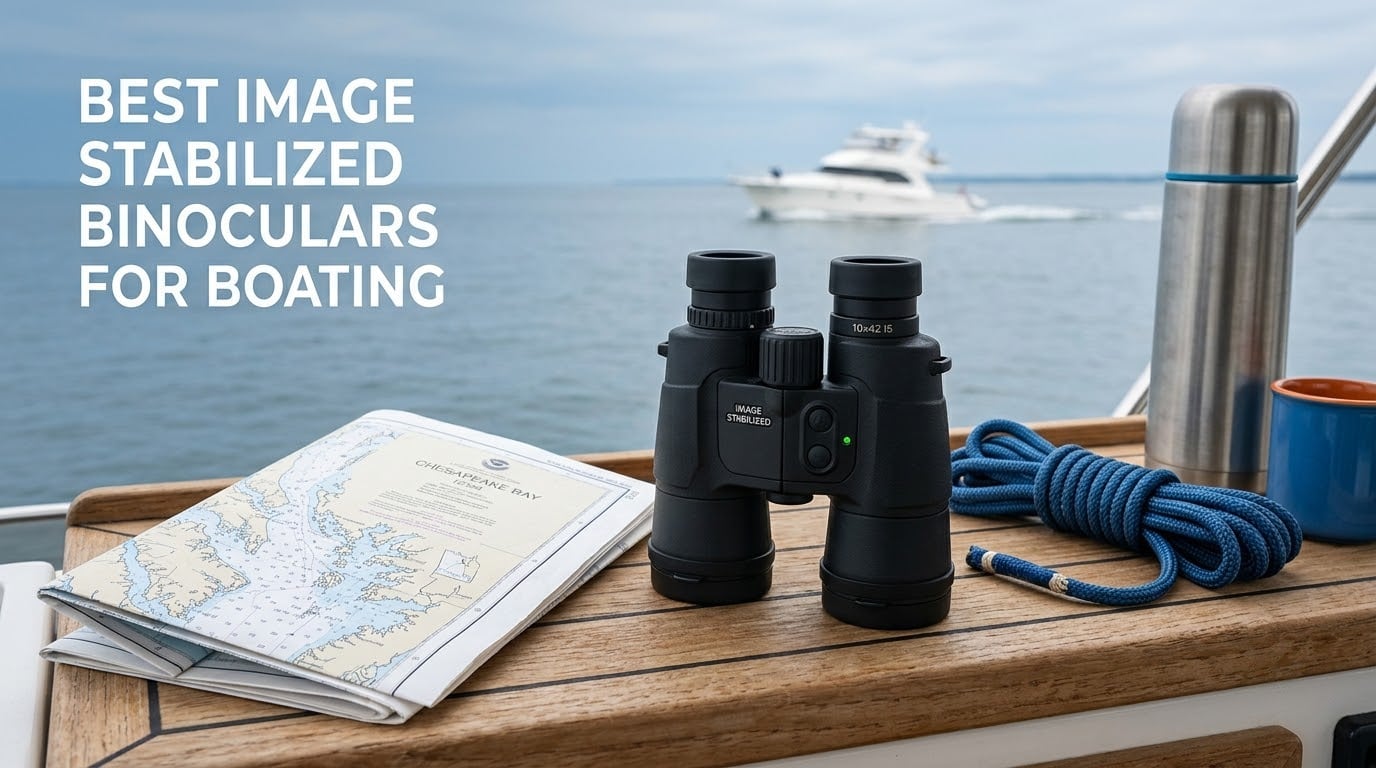
There is a moment on every boat trip when a 7×50 stops being enough. You are two miles off a marker, the hull is lifting into a head sea, and the thing you actually need to read is sitting right at the edge of what your eyes can pull out of the shake. At that moment the answer is not a better 7×50, it is a pair of image stabilized binoculars.
Stabilization changes the physics of what you can hand-hold. Sensors detect the movement of your hands, the swell, and the engine, and a movable optical element cancels it out so the view holds still at magnifications where conventional glass turns to a smear. In the BoatUS Foundation range test that most boating circles still quote, a conventional 7×50 lost usable accuracy past roughly 600 feet while stabilized units stayed readable past 1,200 feet. That is roughly double the reach, and it is the entire argument for spending more on stabilized marine binoculars.
Our team compared 12 stabilized binoculars across Canon, Fujinon, Kite Optics, SIG SAUER and Nikon, weighing correction angle, waterproof rating, weight, eye relief and the boring but decisive question of whether the body survives a saltwater life. If you want our short answer first, the Canon 12×36 IS III is the pick most boaters should buy, with the Fujinon Techno-Stabi TS1440 as the enthusiast option and the Canon 10×42 L IS WP for anyone who actually navigates at dusk. Tell us your boat size, your budget range and whether you want reach or brightness, and we will point you at one model rather than a list.
Table of Contents
Top 3 Stabilized Picks for Boating (October 2026)


Fujinon Techno-Stabi TS1440
- 14x40 with 5 degrees of correction
- Waterproof and fogproof
- 4x AA pack

Are Image Stabilized Binoculars Worth It for Boating?
Yes, if you read markers, identify distant vessels or watch wildlife at ranges beyond a few hundred yards, and no, if you mainly need a bright pair for dusk and darkness. Stabilization buys you magnification, and magnification always costs brightness, so a 7×50 with its 7.1 mm exit pupil still wins in true twilight. The right buy is usually both pairs: a floating 7×50 for low light and a stabilized 10x to 16x for daylight reach.
The Best Image Stabilized Binoculars for Boating in 2026
| Product | Specifications | Action |
|---|---|---|
| Canon 12×36 IS III |
|
Check Latest Price |
 Canon 18×50 IS All Weather Canon 18×50 IS All Weather |
|
Check Latest Price |
| Fujinon Techno-Stabi TS1440 |
|
Check Latest Price |
| Canon 10×42 L IS WP |
|
Check Latest Price |
 Kite APC 12×42 Kite APC 12×42 |
|
Check Latest Price |
 SIG Zulu6 FDE HDX 16×42 SIG Zulu6 FDE HDX 16×42 |
|
Check Latest Price |
 SIG Zulu6 HDX Marine 10×30 SIG Zulu6 HDX Marine 10×30 |
|
Check Latest Price |
| Kite APC 16×42 |
|
Check Latest Price |
 Fujinon TS-L2040 20×40 Fujinon TS-L2040 20×40 |
|
Check Latest Price |
 Kite APC 12×30 Kite APC 12×30 |
|
Check Latest Price |
 Nikon Stabilized 10×25 Nikon Stabilized 10×25 |
|
Check Latest Price |
 Fujinon TS 12x28WP Fujinon TS 12x28WP |
|
Check Latest Price |
One number decides more stabilized purchases than any other: the exit pupil, which is the objective diameter divided by the magnification. The Canon 12×36 gives 3 mm, the Canon 10×42 gives 4.2 mm, the Fujinon TS1440 gives 2.86 mm, and the Fujinon TS-L2040 at 20x gives just 2 mm. In full darkness only the largest of those gathers enough light to be comfortable, which is why a 7×50 remains the honest low-light tool on any boat.
1. Canon 12×36 IS III – The Best All-Round Stabilized Binocular for Boating
Canon 12×36 Image Stabilization III Binoculars
12x36
3 mm exit pupil
14.5 mm eye relief
1.8 lb
Vari-angle prism IS
Pros
- Genuinely steady 12x from a moving platform
- Compact and light for the magnification it delivers
- Bright and crisp from a 36 mm objective
- 14.5 mm eye relief works with glasses
Cons
- IS needs the button held down so focus cannot be adjusted while active
- No objective lens covers and a thin supplied case
- Loose eyepiece caps are easy to lose
- Water resistant rather than a rated waterproof marine body
This is the pair we keep reaching for. At 1.8 lb it is one of the lighter stabilized binoculars in this group, which matters more on a boat than any spec sheet admits, and the 12x is enough reach to read a distant channel number or pick a bird off a far shoreline.
The vari-angle prism system holds the image genuinely still. Super Spectra multicoated optics and doublet field-flattener lenses keep the edge of the field usable, which is exactly where you need it when you are scanning rather than locked onto a target.
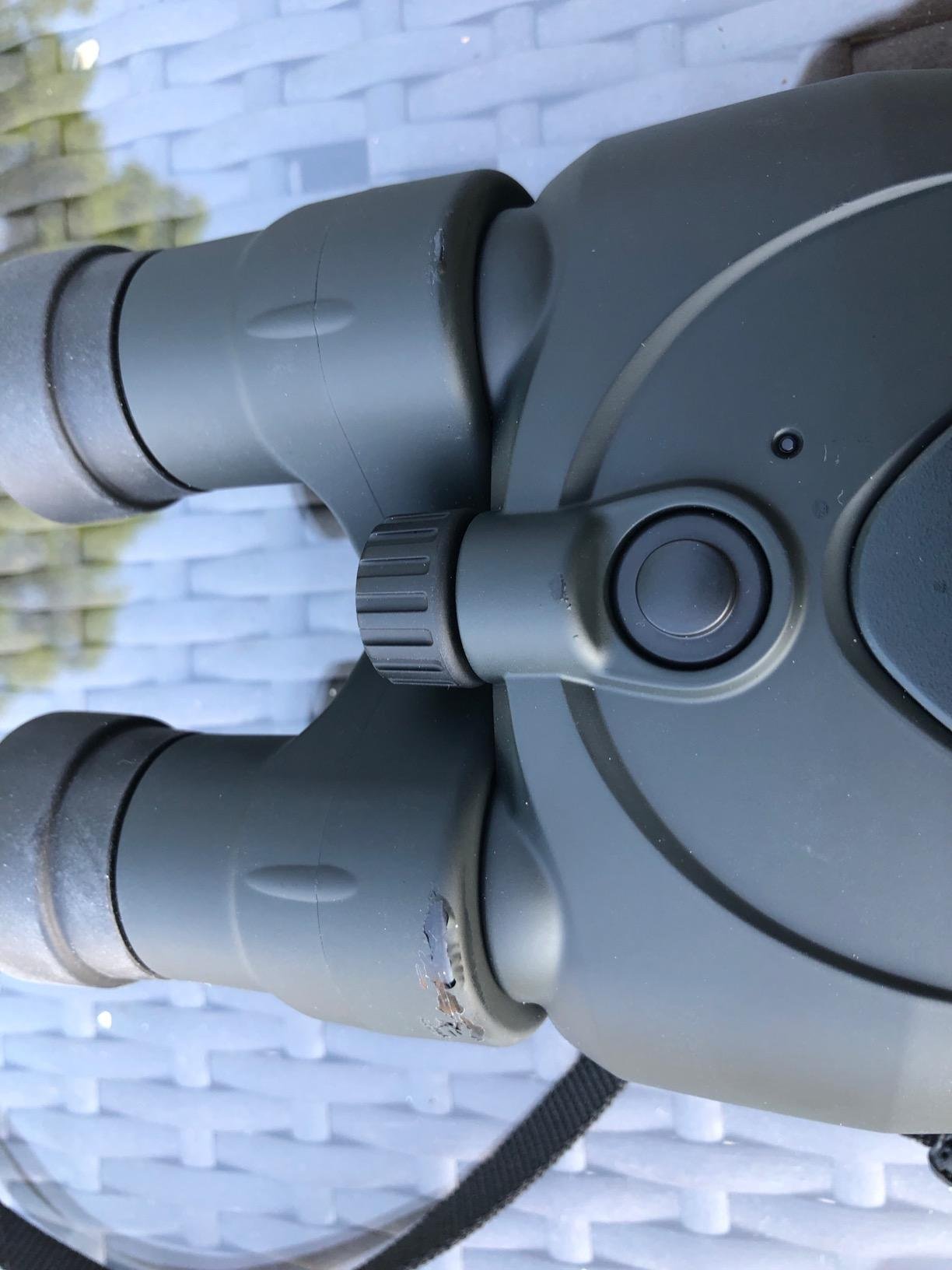
Our one real complaint is operational rather than optical. Stabilization runs while you hold the button down, so focusing and panning happen separately, and on a pitching deck that sequence takes practice. The 14.5 mm eye relief is long enough that wearers can keep glasses on, which many cheaper stabilized models cannot manage.
There is also a water-resistance question to be honest about. The listing describes this model as water resistant, not waterproof, so it belongs in a dry locker rather than strapped to a rail in a breaking sea.
When this is the right pair on your boat?
Choose the 12×36 IS III for a center console, a bay boat or a sailboat where one pair has to cover daylight lookout, wildlife scanning and the occasional dusk passage. It is the only stabilized model here that is genuinely easy to keep on a neck strap for hours without the weight becoming the limiting factor.
It also makes sense as the first stabilized pair a buyer ever owns, because the format is forgiving: moderate magnification, decent brightness and a body that fits in a chart locker without rearranging the shelf.
When another model suits you better?
If your passages run to dusk and darkness, the 3 mm exit pupil is the limit, and you should be looking at the Canon 10×42 L IS WP instead for a brighter image. If you need more raw reach from a larger boat, the Fujinon TS1440 or the TS-L2040 give you more magnification with correction to spare.
Anyone working in heavy spray or taking these in a dinghy where dunking is likely should skip this one and move up to a model with a stated waterproof and fogproof rating.
2. Canon 18×50 IS All Weather – Maximum Reach From a Stable Tripod of a View
Canon 18×50 Image Stabilization All-Weather Binoculars
18x50
2.8 mm exit pupil
15 mm eye relief
All-weather body
2x AA
Pros
- 18x reach makes far-off vessels and markers readable
- 50 mm objective gives a wide bright field
- Shock and water-resistant all-weather construction
- Multi-coated lenses hold contrast and color
Cons
- Heavy at 4.1 lb and tiring over a long watch
- Bulk makes it awkward to carry and stow on a small vessel
- Water resistant rather than a rated waterproof body
- Narrow 7.5 degree field needs a deliberate scan
Eighteen times is real reach. From an aft deck on a calm day, the 18×50 IS turns a smudge on the horizon into a hull, a stack or a hull number, and the 50 mm objective keeps enough light coming through that it stays usable well past the point where cheaper glass goes grey.
Stabilization is powered by two AA cells, which is our favourite kind of battery logistics. You can buy spares anywhere, and there is no proprietary pack to fail in a foreign harbour.
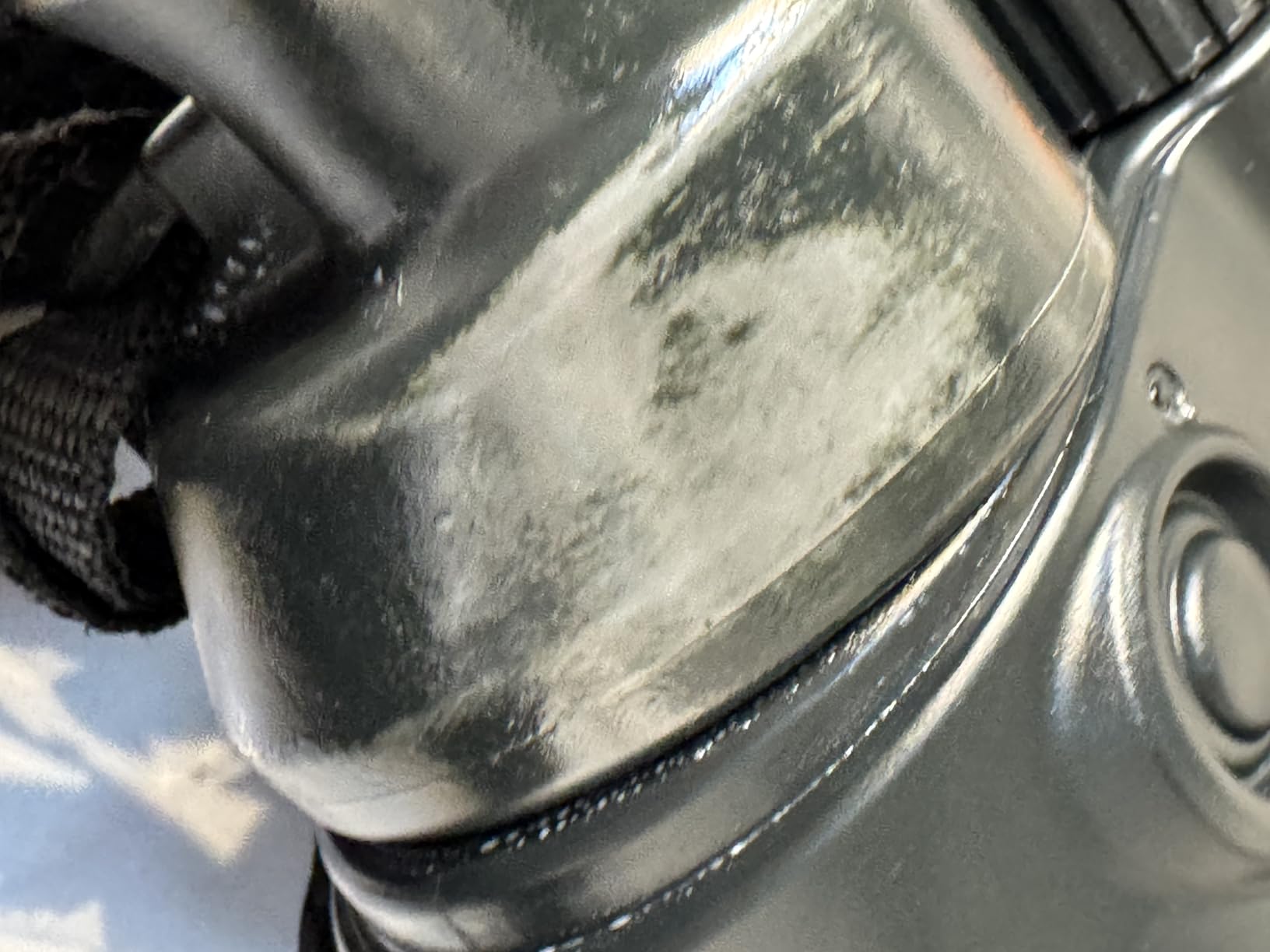
The weight is the honest drawback. At 4.1 lb this is the heaviest binocular we tested, and holding it up for a full lookout on a moving boat is a genuine workout. Our own advice is to mount it on the supplied monopod and use it from a seated position rather than trying to sweep with it standing.
Focus is fixed with individual eyepiece adjustment, which suits one owner and annoys another. There is no center focus knob, so a change of subject means turning an eyecup by hand while the deck is moving under you.
What kind of skipper this suits?
This one belongs on an offshore cruiser or a larger sportfishing boat with a stable aft platform and room to sit down. If you spend your time looking for other boats, reef markers and distant activity from a sheltered helm, the reach justifies the bulk in a way it never would on a skiff.
It also works well for planning: a fixed horizon at higher power is far easier to interpret than a heaving one, and the wide bright field from the 50 mm objective helps you find the target before you zoom in on the details.
When another model suits you better?
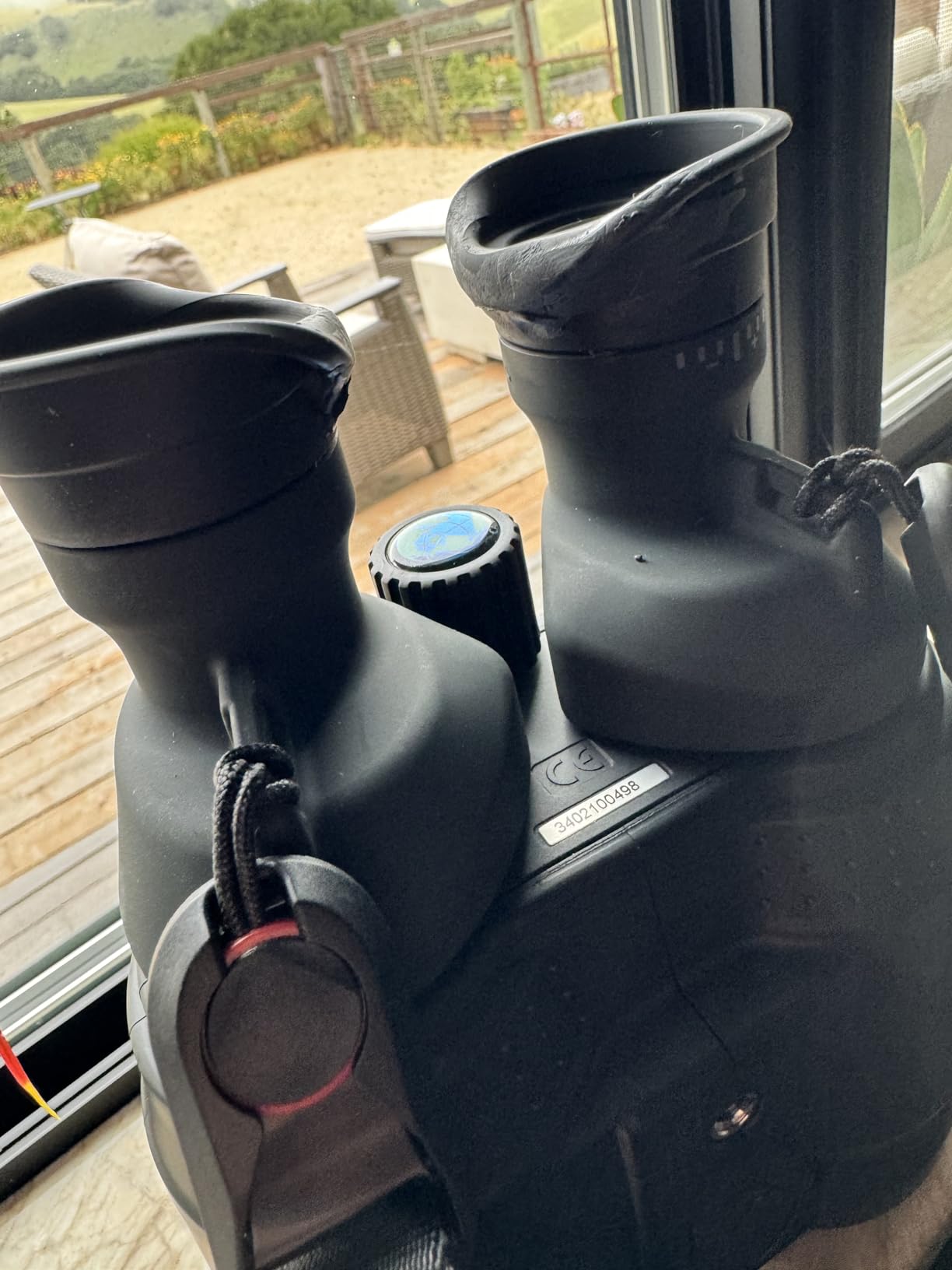
On a small or high-activity boat, 4.1 lb is too much to carry around. The Fujinon TS-L2040 gives you even more magnification in a body listed at 850 g, which is a much more sensible load to carry up a dock ladder.
If you need to hold it standing for an hour at a marker or a race start, a lower-power stabilized pair such as the Canon 12×36 IS III or the Kite APC 12×42 will keep you looking instead of your shoulders giving out.
3. Fujinon Techno-Stabi TS1440 14×40 – The Marine Benchmark Everyone Keeps Coming Back To
Fujinon Techno Stabi TS1440-14×40 Image Stabilization Binocular
14x40
2.86 mm exit pupil
5 degrees correction
Waterproof and fogproof
4x AA
Pros
- Correction heavy enough to make 14x rock steady on a moving boat
- Purpose-built waterproof and fogproof sealed body
- Owners rate the optics above Canon IS alternatives
- Two-button layout with no learning curve
Cons
- Bulky and heavy over a long watch
- Fixed frame cannot be adjusted for unusual interpupillary distance
- 5 degree field of view is narrow and needs a deliberate scan
- No objective lens caps in the box
When sailors talk about stabilized marine binoculars, this is usually the one they name. The TS1440 corrects about 5 degrees of movement, which is more correction than any other stabilized binocular we tested, and the difference is obvious the moment the boat starts working.
Owners on The Hull Truth describe it as the decisive step up from floating 7×50 marine glass, with several ranking the image quality and steadiness above the Canon IS models. We would not go that far, but the gap in stability under a pitching deck is real.
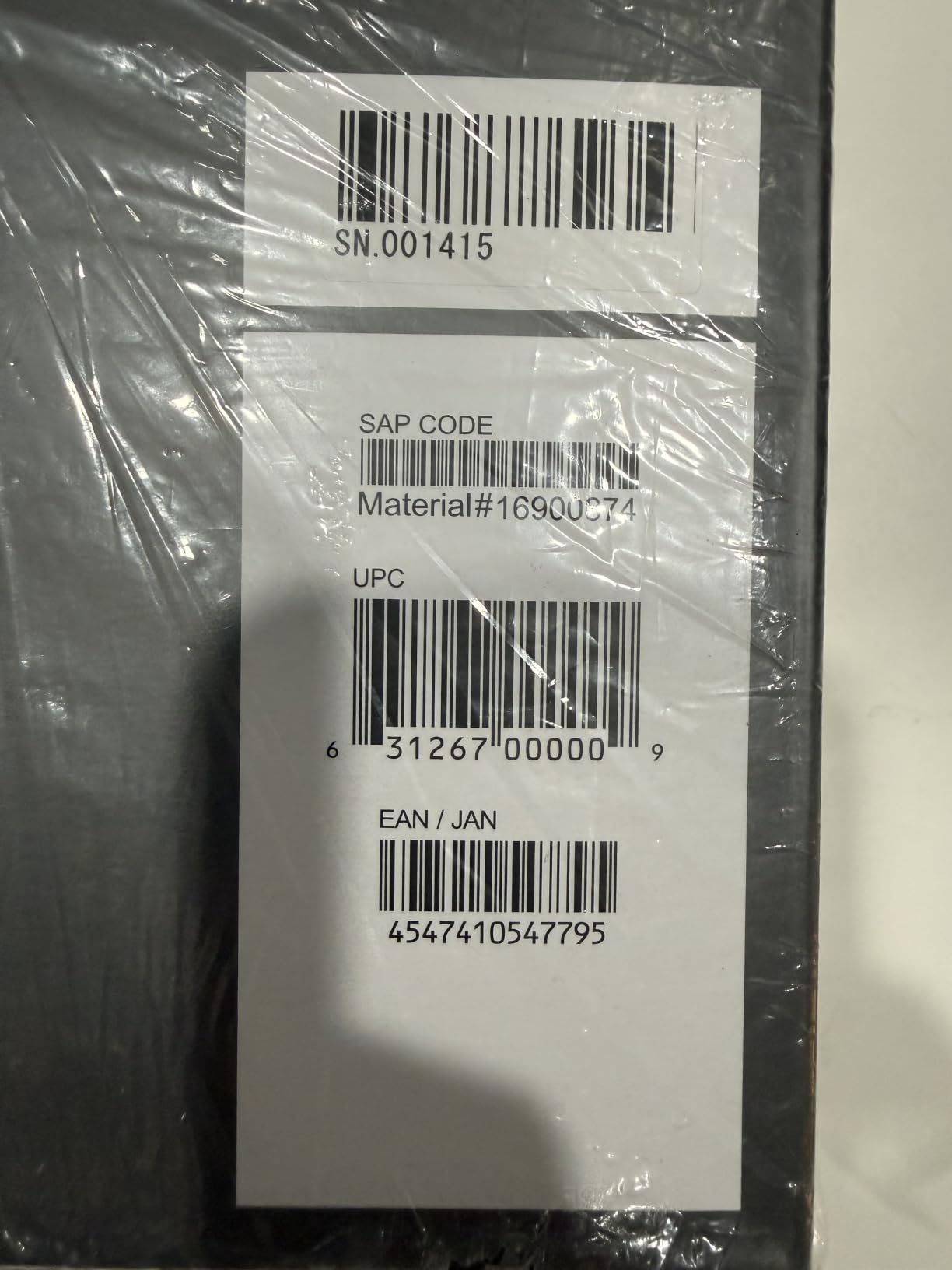
The body is fiberglass-reinforced plastic with a rubber-armored grip and a sealed, waterproof and fogproof construction, so it can be rinsed with fresh water after a day in salt. It runs on four AA cells in a replaceable battery pack, which is good design for a tool that will live in a locker for a decade.
It is also the one stabilized binocular in this group with a hard case in the box, plus a cleaning cloth and eyepiece covers. That matters more than it sounds when your glass lives in a helm locker next to a leaking deck seal.
Why serious cruisers keep buying it?
The reason is simple: it is the most correction you can get in a hand-held binocular we could find, and the body is sealed for the environment you are actually in. A sailor reading a harbor entrance at 1,500 yards in a seaway gets a usable image here that no conventional glass at that magnification can deliver.
For wildlife from a boat, the same correction turns distant pelicans or marine mammals into identifiable shapes rather than smudges. Long-term owners report being happy with these for two decades, which is the durability signal that matters most in marine gear.
Where it falls short?
Weight and ergonomics. This is not a compact instrument, and the fixed frame cannot be adjusted for an interpupillary distance outside the standard range, which will bother anyone with an unusual facial fit.
The 5 degree true field of view is genuinely narrow, so scanning takes patience. If you want a wider scan and do not need the extra correction, the Canon 12×36 IS III is easier to work quickly with.
4. Canon 10×42 L IS WP – The Brightest Stabilized Pick in the Group
Canon 10×42 L is WP Image Stabilized Binoculars
10x42
4.2 mm exit pupil
16 mm eye relief
Waterproof and fogproof
2.4 lb
Pros
- Fully waterproof and fogproof so it can be rinsed after salt spray
- 42 mm objective gives a bright high-contrast image
- 10x with stabilization is easy to hold steady on a moving deck
- 16 mm eye relief and rainguard stay comfortable with glasses
Cons
- Heavier and bulkier than lighter stabilized models
- Center focus knob placement is awkward for some hand sizes
- Smaller true field of view than 8x or 10x standard glass
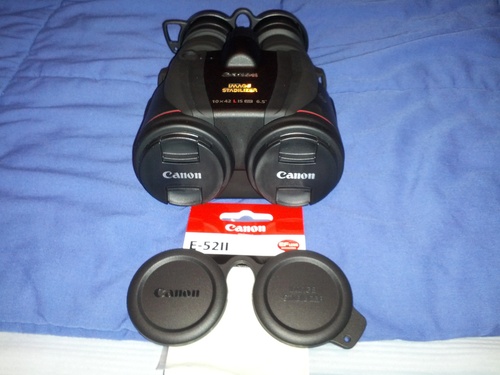
Here is the number that separates this from almost everything else in the list: a 4.2 mm exit pupil. That is the largest exit pupil of any stabilized binocular we evaluated, and it is why the 10×42 L IS WP still shows you a boat hull at dusk when a 12x or 16x pair has already gone dark.
Canon’s L series uses ultralow-dispersion lead-free glass with Super Spectra coatings, and the wide apparent field of view makes it easy to acquire a moving target and then track it. The image is noticeably cleaner at the edges than most stabilized glass in this price bracket.
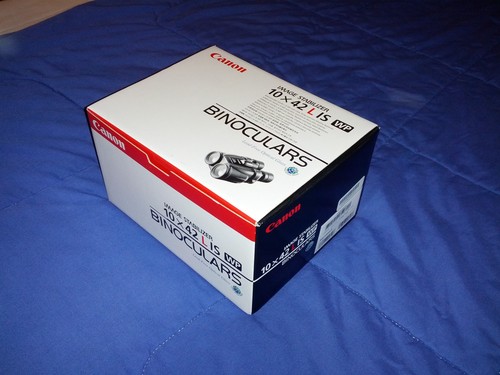
It is also genuinely waterproof and fogproof, not merely water resistant, and owners report rinsing it after salt water use without damage. That is the specification we look for first on anything that will live on a boat rather than in a closet.
Stabilization at 10x is subtle but effective. You do not get the theatrical steadiness of the TS1440, but you also do not need much, because 10x is still within the range where a steady deck and a braced elbow can help.
Why dusk and twilight passages favor it?
Boat owners on The Hull Truth call the Canon 10×42 L IS worth every penny, and the reason is brightness. If your boating happens at dawn, dusk, under cloud or on an overcast afternoon, this is the pair that keeps working after every 12x and higher option on this list has turned grey.
It is also the most usable stabilized binocular with glasses on, thanks to 16 mm of eye relief and a soft eyepiece rainguard. For anyone over 40 who needs reading correction, that alone can decide the purchase.
When another model suits you better?
At 10x you give up real range. If your job aboard is identifying a distant vessel rather than confirming that a channel marker exists, the Fujinon TS1440 gives you noticeably more reach for a similar weight class.
It is also a larger, heavier body at 2.4 lb. If you need something that fits a pocket on a skiff, the Nikon Stabilized 10×25 is in a different size category entirely.
5. Kite Optics APC 12×42 – Stabilization You Never Have to Think About
Kite Optics APC Stabilized 12×42 Binoculars – High-Performance Binoculars for Bird Watching, Hunting, Marine Use – 12x Magnification, Image Stabilization, Waterproof, Clear Views
12x42
3.5 mm exit pupil
17 mm eye relief
IPX7 metal body
1.6 lb
Pros
- Stabilizer runs on a switch so you can focus freely
- IPX7 waterproof and nitrogen filled for spray and humidity
- Light at 1.6 lb and easy to hold for long sessions
- Position-sensitive system sleeps when the glasses hang vertically
Cons
- Narrower field of view so subjects take a moment to locate
- Close focus is roughly 13 feet
- Ocular lens cap does not stay firmly in place
- Narrow field is less comfortable for eyeglass wearers
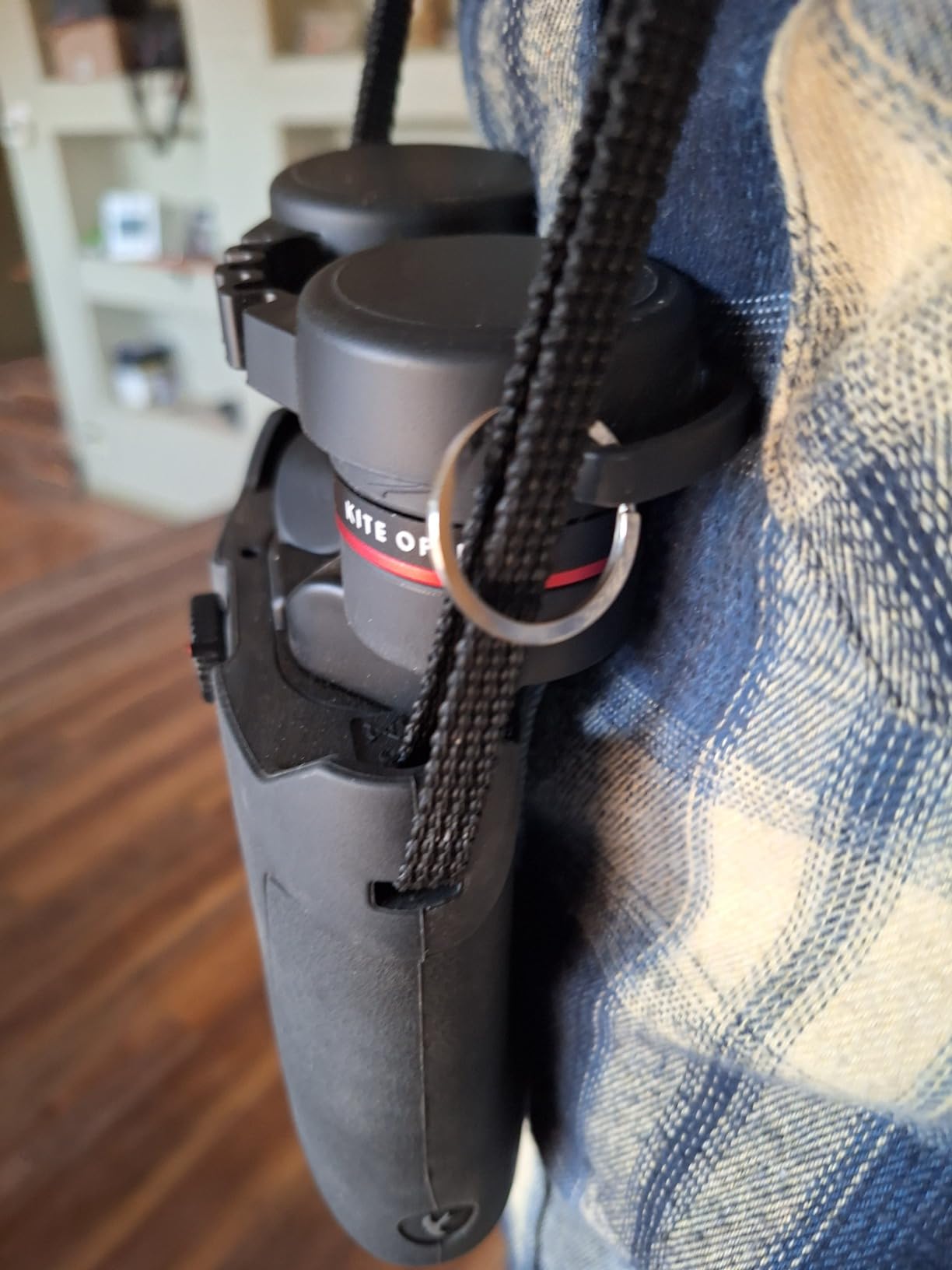
The APC system here is position-sensitive, which is a genuinely different approach to the Canon hold-to-stabilize button. Raise the glasses to your eyes and the stabilizer engages; lower them and it sleeps, saving the cells without you touching a switch.
At 1.6 lb this is one of the lighter stabilized binoculars we tested, and on a small boat that is worth more than another two degrees of correction. The metal body carries an IPX7 waterproof rating and is nitrogen filled to stop internal fogging when it comes out of a temperature-mismatched locker.
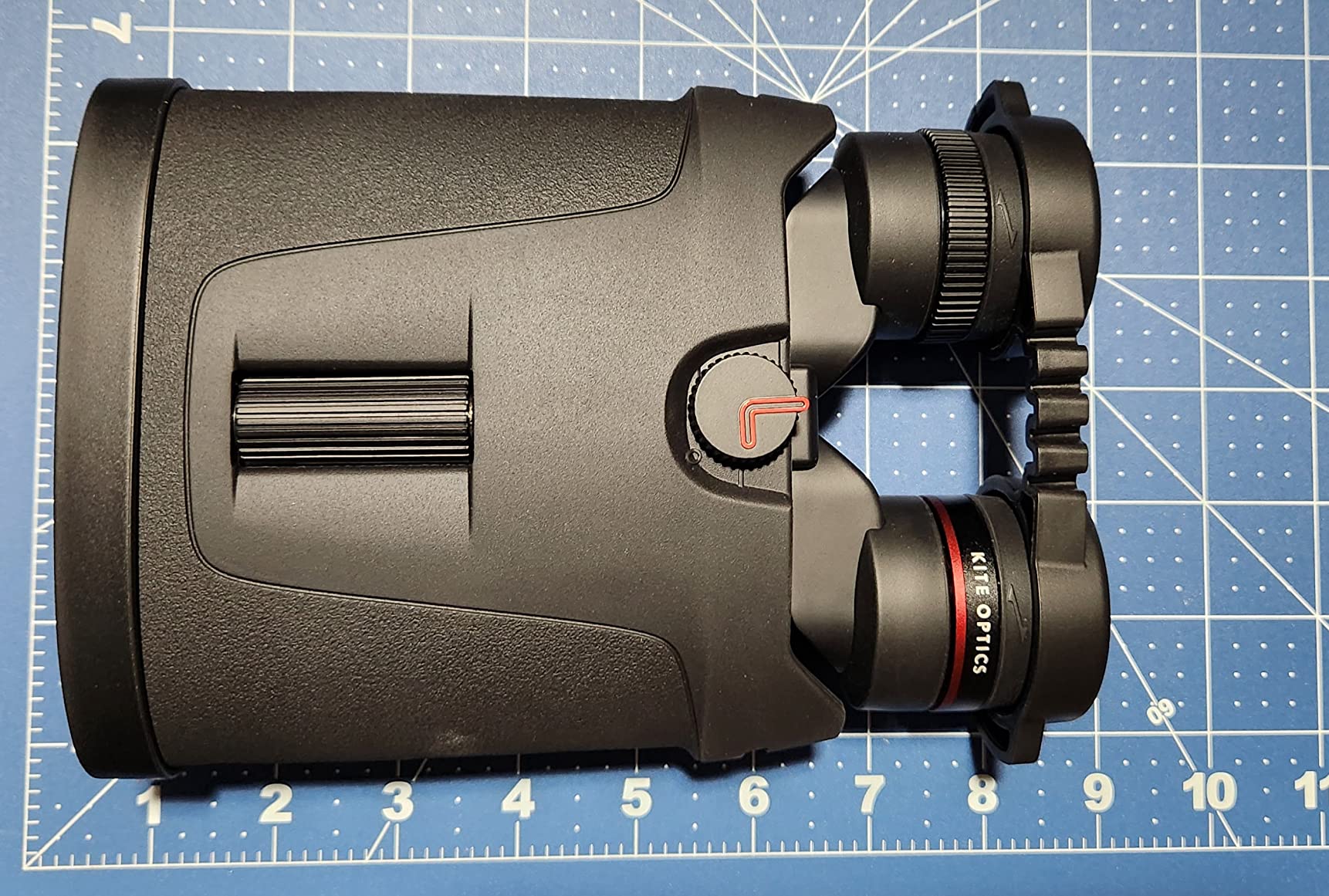
The 42 mm objective gives a brighter, higher-contrast image than most 12x stabilized competitors, and the 3.5 mm exit pupil is a sensible compromise between reach and twilight performance. MHR Advance+ coatings and a roof prism layout keep the package compact.
Our reservation is the field of view. Finding something in a 12x stabilized pair always takes a moment, and this one is not the widest of the group even before you factor in the narrow true angle.
Who will love it?
Anyone whose hands are not steady enough to hold a button for minutes at a time, or who works both hands on a wheel or a rail while scanning. The always-running switch means focus and magnification are both available the whole time, which is the frustration that owners of hold-button models complain about most.
It is also a good fit for shore-based lookout from a moored boat, a houseboat or a charter, where light pack weight matters more than a hard-rocking deck.
Where it disappoints?
The 13-foot close focus is not a wildlife minimum distance, so dolphin or reef fish at the surface of the water stay out of reach up close. The loose ocular cap is a small annoyance that owners mention repeatedly.
Owners also note the narrow field is less comfortable in glasses despite the 17 mm figure. If you wear prescription eyewear for the helm, try it before committing, and consider the Canon 10×42 L IS WP with its 16 mm eye relief and rainguard.
6. SIG SAUER Zulu6 FDE HDX OIS 16×42 – Sixteen Power in a Surprisingly Small Body
SIG SAUER Zulu6 FDE HDX OIS 16X42mm Roof Prism Binocular
16x42
2.63 mm exit pupil
16 mm eye relief
IPX-7 aluminum
1.02 kg
Pros
- Stabilization makes 16x genuinely usable without a tripod
- Exceptionally compact and light for stabilized 16x glass
- Target Mode adds up to 50 percent extra stabilization
- IPX-7 waterproof and aluminum bodied for marine use
Cons
- Focus wheel has noticeable slop and is hard to fine focus
- Some users report veiling glare in bright conditions
- Low-light performance drops against premium glass
- Narrow tunnel-like field makes target acquisition slow
The headline here is 16x magnification in a body listed at 1.02 kg. Reviewers repeatedly compare this pair to bigger Fujinon and Canon stabilized binoculars and find the size-to-power ratio hard to argue with, particularly when you are climbing a dock ladder with glass in one hand and a line in the other.
SIG’s OIS system offers two modes. Scan Mode handles general observation, and Target Mode adds up to 50 percent more stabilization when you have found something and want to hold on to it, which is exactly how you use binoculars when a bird lifts off or a distant boat turns toward you.
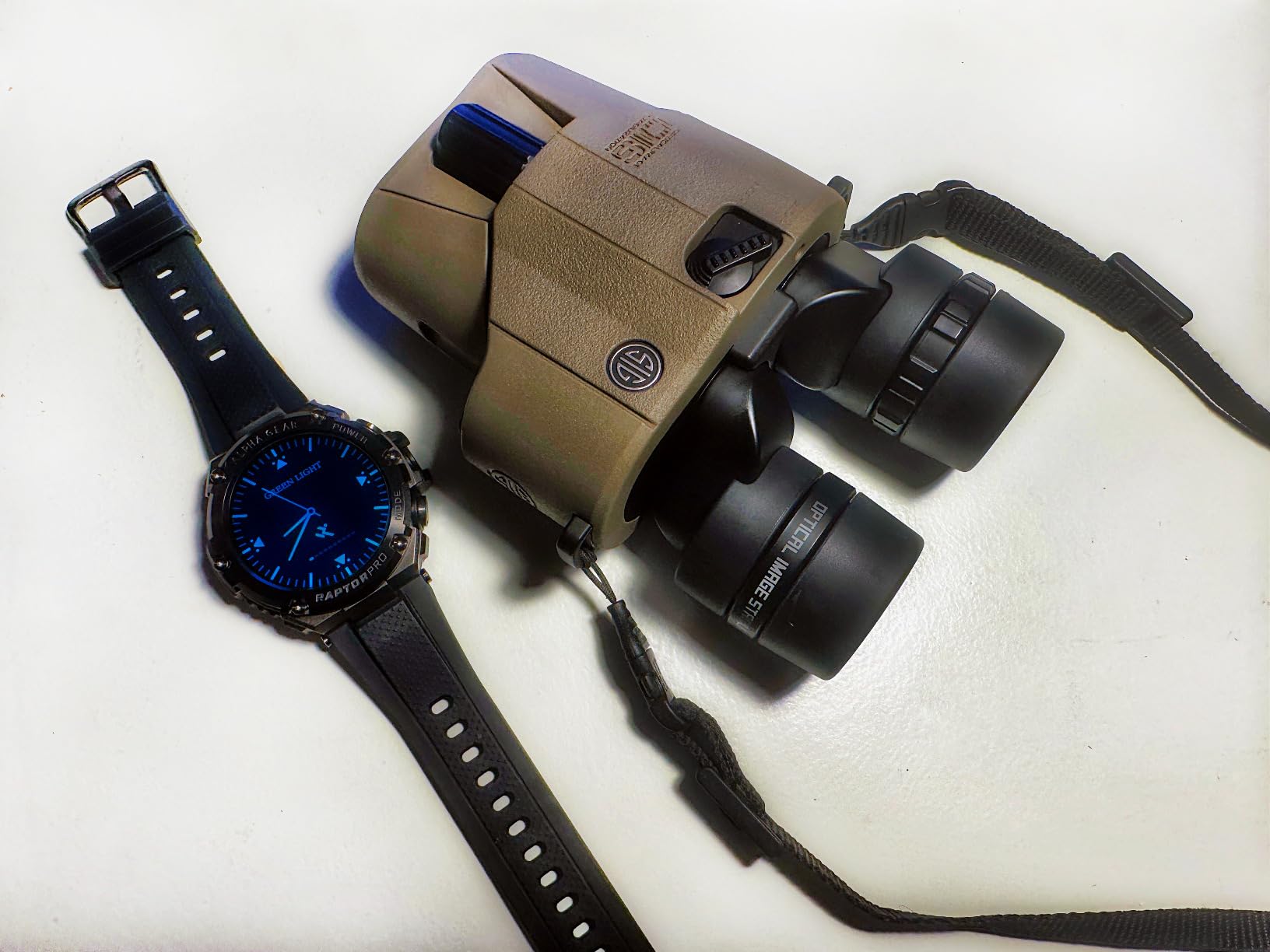
The HDX lens system is designed for better light transmission, resolution and definition than standard glass, and the aluminum body is rated IPX-7 waterproof. The same line also comes in 10×30, 12×42 and 20×42 configurations, so if the 16x proves too much or too little you are not trapped.
What you trade is low light. A 2.63 mm exit pupil is small, and reviewers note the image flattens in dim conditions. On bright water with the sun behind you it performs well, which is a narrower but very common boating window.

Why it earns its place on a smaller boat?
Most 16x stabilized binoculars are built like dock equipment. This one is built like something you carry. On a bay boat, a pontoon or a center console with limited storage, packing volume and weight are real constraints, and this is the pair that solves them without giving up reach.
Target Mode is genuinely useful in the field. Once a subject is located you lock in the extra correction and the image stays put while the boat moves under you, which turns a marginally visible shape into something you can identify.
Where buyers get disappointed?
The focus wheel has noticeable slop, and users report difficulty fine focusing on distant small subjects such as a buoy number or a hull marking. If precise focus at range is your primary task, spend the time getting used to it or look at a center-focus design.
Flare in bright conditions is another recurring note, and the 16x true field is narrow and tunnel-like, so locating something at 16x takes a sweep. Treat it as a settling glass rather than a search glass.
7. SIG SAUER Zulu6 HDX Marine 10×30 – Built for the Marine Environment, Not Adapted to It
SIG SAUER ZULU6 HDX Marine Image Stabilized Binoculars
10x30
3 mm exit pupil
IPX7 nitrogen filled
Orange armor
Floating strap
Pros
- Purpose-built marine platform with stabilization tuned for vessel motion
- HDX optics designed to cut glare off open water
- IPX7 waterproof and fogproof nitrogen-filled housing
- High-visibility orange armor and floating strap reduce loss risk
Cons
- Very small review base so long-term reliability is unproven
- 30 mm objective is modest for dusk and overcast light
- 2.4 lb is heavier than other 10x stabilized models
This is the only model in the group designed as a marine instrument from the start rather than a general binocular that resists water. The high-visibility orange armor and the included floating neck strap exist for one reason: so a 10×30 pair is not lost over the side of a boat in a seaway.
The optics are tuned for the problem that dominates boating, which is glare. Light off flat water, a fiberglass hull or a windshield can be punishing, and the HDX system here is built to cut that veiling rather than add to it.
Stabilization offers the same Scan and Target modes as the 16×42, and the nitrogen-filled IPX7 housing is fogproof as well as waterproof, which matters when the glass goes from a warm cabin to a cold deck.
Why the orange body is a real feature?
On a small boat with a lot of movement, recovery from an overboard is measured in seconds, not minutes. High-visibility armor does not add performance, but it materially improves the chance that someone spots floating glass before it goes under.
Owners of stabilized gear also value knowing the unit floats. A floating strap plus a floating body is worth more than a marginal gain in correction angle for anyone fishing or working alone offshore.
What to weigh before buying?
There are only three ratings on record for this model, so long-term field reliability is genuinely unproven. The feature set looks right for the job, but there is no owner history to fall back on, and we would not call it a first stabilized purchase on that basis alone.
The 30 mm objective is also modest. In bright daylight and overcast water it is fine, but the 3 mm exit pupil will limit you at dusk. The same line is available in a 16×42 configuration if reach matters more than pack size.
8. Kite Optics APC 16×42 – The Highest Rated Pick, With the Lightest Correction Spec
Kite Optics APC Stabilized 16×42 Binoculars – Wide-Angle Stabilized Binoculars for Hunting, Bird Watching, and Long-Range – 16x Magnification, Waterproof, Built for The Outdoors
16x42
2.62 mm exit pupil
14 mm eye relief
IPX7
1.6 lb
Pros
- Holds 16x steady on a moving boat or in wind
- IPX7 waterproof and nitrogen filled against spray
- Light 1.6 lb metal body for a stabilized 16x binocular
- Military-grade stabilization built for professional observation
Cons
- Small review base against the Canon and Fujinon models
- 14 mm eye relief is less generous for eyeglass wearers
- 16x narrows the scan area so subjects are slower to locate
This pair carries the highest average rating of anything we evaluated, and owners consistently name stability, waterproofing and lightness as the reasons. At 1.6 lb it is the lightest 16x stabilized binocular in the group, which is an unusual combination and the whole point of the design.
Correction is rated at 2 degrees and 3 degrees depending on the mode, and owners report the image holds in wind and on a moving vessel. That is below the Fujinon TS1440 but well above what you get from bracing a conventional 16x against a rail.
The body is metal, IPX7 waterproof and nitrogen gas filled, with UV-protective, scratch-resistant anti-reflective coatings on the lenses. It is built for sea, land and air observation rather than a single niche.
Where 16x earns its keep?
Sixteen power is the sweet spot for a lot of skippers because it is the most you can hold for a long session without the image turning to vibration. At that power you can pick out individual seabirds on a far bank, read large hull markings, or tell whether an approaching vessel is a sportfisher or a container ship.
Buyers report being able to raise the glasses quickly and get a usable image, which is the test that matters when a boat appears at the edge of visibility and you have seconds to classify it.
What to weigh first?
Two cautions. The 14 mm eye relief is the tightest in this roundup, so try it with glasses before you commit, and the review base of 21 ratings is thin compared with the Canon and Fujinon models, which means less long-term evidence.
The 2.62 mm exit pupil is also small. If your boating is mostly at dawn or dusk, this is the wrong tool, and the Canon 10×42 L IS WP is the pair designed for that light.
9. Fujinon Techno-STABI TS-L2040 20×40 – The Most Reach You Can Hold in One Hand
Fujinon Techno-STABI TS-L2040 20×40 Stabilized Binoculars
20x40
2 mm exit pupil
3 degrees correction
850 g
30 hours on 2 AAA
Pros
- 20x is genuinely hand-holdable thanks to electronic stabilization
- Compact at 850 g and much easier to carry than the TS1440
- Waterproof body listed for boating alongside birding
- Sharp colour-free image in the centre of the field
- Up to 30 hours from two AAA cells
Cons
- Reports of the focus knob or mechanism failing within about a year
- Some units develop persistent vibration that blurs the image
- Padded case is poorly designed for use with the lanyard
- Front objective cap has no tether and is easily lost
Twenty times is where hand-held binoculars normally give up. The TS-L2040 does not, because the electronic system supplies about 3 degrees of correction around an ED objective with Fujinon EBC multicoatings and phase-corrected prisms. Owners with a working unit describe 20x handheld detail that rivals the flagship TS1440 at a fraction of the size.
The practical story is the weight. At 850 g this is the lightest high-power stabilized binocular here by a wide margin, and the compact 7.3-inch body stows in a jacket pocket or a small dry bag rather than a locker.
Two AAA cells give up to 30 hours of operation, which comfortably covers a week afloat without anyone thinking about it, and the unit is listed as waterproof for boating and general outdoor use.
When 20x is the right answer?
On an offshore passage where you are watching for a specific object at a known distance, 20x lets you confirm identity rather than guess. It is also a superb wildlife glass from a boat, because you can fill the frame with a distant pelican, albatross or whale fluke and see real detail instead of a shape.
The trade is unforgiving: a 2 mm exit pupil gathers very little light. In anything other than strong daylight this is a dim view, and it is a specialist instrument rather than an all-day binocular.
Where owners report trouble?
The average rating of 4.0 on this model is not a comment about the optics, which owners rate highly. It reflects a cluster of build-quality reports: focus knobs or internal mechanisms failing within about a year, and some units developing a persistent vibration.
That matters when you are choosing a permanent marine instrument, because reliability over a decade matters more than peak performance in the first season. Test it thoroughly in the first year of ownership, keep the documentation, and check the warranty terms with the seller.
10. Kite Optics APC 12×30 – The Smallest Stabilized Pair Built for Boating
Kite Optics APC Stabilized 12×30 Binoculars – Compact Binoculars for Hunting, Bird Watching, Boating, and Wildlife – 12x Magnification, Advanced Stabilization, Waterproof, Durable Design
12x30
2.5 mm exit pupil
17 mm eye relief
Waterproof metal
Auto sleep and timer
Pros
- Position-sensing stabilization wakes and sleeps with no button handling
- Waterproof metal construction for boating and wet weather
- Compact 30 mm objective keeps the package small and light
- 90-minute auto-off timer prevents accidental battery drain
- 17 mm eye relief is comfortable with glasses
Cons
- Only four ratings recorded so long-term evidence is very thin
- 30 mm objective is small for dusk or night marine use
- Narrow 4.58 degree true field at 12x requires deliberate scanning
The angle power control system is the story here. Raise the glasses and stabilization engages; lower them and it sleeps; a 90-minute timer kills the power if you forget. There is no button to find while you are balancing on a gunwale with a sea running.
At 1.05 kg in a waterproof metal body, it is one of the smaller stabilized binoculars available, and the compact 30 mm objective is what keeps it that way. For a skiff, a jon boat or a centre console where storage space is genuinely tight, that is a real advantage.
Why a small boat suits this pick?
Deck space and carrying weight are the binding constraints on a small boat, and a stabilized binocular that disappears into a dry bag changes how often you will actually use it. Glasses you leave in the truck are glasses you never reach for.
Owners respond most strongly to the hands-free operation. When both hands are busy, a hold-to-stabilize design is awkward, and the APC approach removes that entirely.
What the thin review base means?
There are only four ratings on record, and while they are all five stars, four data points tell you very little about how the mechanism behaves after three salt seasons. We would treat this as a promising compact option rather than a proven marine workhorse.
The 30 mm objective gives a 2.5 mm exit pupil, which is the second constraint. It is a daylight and overcast glass, and for night lookout you will want something brighter alongside it.
11. Nikon Stabilized 10×25 – The Lightest Stabilized Binocular You Can Carry
Nikon STABILIZED 10×25 Binoculars – Optical Image Stabilization, Blur-Free View, Waterproof Design, 10x Magnification for Hunting, Birdwatching & Outdoor Activities
10x25
2.5 mm exit pupil
14 mm eye relief
14.3 oz
Up to 12 hours on AA
Pros
- Stabilization stays on continuously so you can focus freely
- Smallest and lightest stabilized option in the group at 14.3 oz
- Waterproof alloy body with a limited lifetime manufacturer warranty
- Sharp multicoated optics with good contrast
- Textured focus wheel and turn-and-slide eyecups
Cons
- Body is fragile for its class and a minor fall damaged one unit
- 25 mm objective limits dusk and low-light performance
- Narrow true field is not suited to wide-angle or night use
- Thin supplied strap gets uncomfortable over long periods
At 14.3 ounces, this is the smallest stabilized binocular in the roundup by a distance, and reviewers repeatedly describe it as effectively the only compact pair with real image stabilization. It is the model that makes a stabilized binocular genuinely practical on a small boat.
Stabilization runs continuously rather than on a held button, so you can focus freely with no extra step, and the waterproof alloy body comes with a limited lifetime manufacturer warranty, which is the strongest warranty language attached to any stabilized binocular here.
AA batteries give up to 12 hours, with an automatic shutoff after 60 minutes of inactivity, so a set of spares in a dry bag covers a long trip without thinking about it.
When less is genuinely more?
Many stabilized binoculars are simply too much instrument for a small boat. If your lookout needs are modest and your main concern is having glass with you rather than the maximum reach, a 10x that fits in a breast pocket changes the way you use optics on the water.
Owners with hand tremor specifically rate it highly for removing involuntary movement, and the multicoated lenses with silver alloy prism coatings give good contrast in bright to moderate light.
What to watch out for?
Fragility is the honest drawback. A minor fall damaged one unit that still worked, which is a reminder that a sealed magnesium-alloy shell is not a floating body and does not survive a cockpit locker the way a rubber-armored binocular does.
The 25 mm objective gives a 2.5 mm exit pupil and a very narrow true field, so this is a daylight spotting glass. For dusk work, pair it with a floating 7×50 rather than expecting it to cover night lookout.
12. Fujinon Techno-Stabi TS 12x28WP – The Cheapest Credible Way Into Stabilized Glass
Fujifilm Techno-Stabi TS 12x28WP Image Stabilization Binocular
12x28
2.33 mm exit pupil
3 degrees correction
1.5 lb
Water resistant
Pros
- Light and compact at 1.5 lb for a stabilized binocular
- 3 degrees of stabilization makes 12x practical hand-held
- Center focus with EBC multicoating gives a clear image for the size
- Battery included in the box
- Lower cost entry into the Fujinon stabilized line
Cons
- 28 mm objective limits brightness at dusk and when overcast
- Water resistant for 30 minutes rather than fully waterproof
- 5.2 degree field of view slows subject acquisition
- Very small review base with a mixed rating spread
If the whole category feels expensive, this is the model that proves the concept without a large commitment. The 12x28WP is light at 1.5 lb, corrects about 3 degrees of movement, and runs from a single CR2 cell that is included in the box.
Reviewers are positive about what you get for the money: center focus, EBC multicoatings and enough correction to make 12x hand-holdable on a deck. The rating spread is the most polarised of any model here, which points clearly at one cause.
Why the ratings divide?
The consensus among owners is that the limiting factor is not the stabilization, it is brightness. A 28 mm objective gives a 2.33 mm exit pupil, which is fine in daylight and disappointing the moment the light goes.
The second dividing line is sealing. The stated rating is water resistant for up to 30 minutes rather than fully waterproof, so a careless owner who leaves it on a rail in a squall will regret it. Treat it as a sheltered-deck binocular.
Who should consider it?
Buy this pair if you want to find out whether stabilization is worth anything to you before spending serious money, or if you need a compact stabilized binocular for a small boat and light use only. Seven ratings is a very thin base, so treat the first year as a test period.
If you love the idea and dislike the light level, step up to the Canon 12×36 IS III or the Fujinon TS1440 rather than trying to push 12x out of a 28 mm objective.
How Image Stabilization Actually Works on a Moving Boat?
Shake at high magnification is not only your hands. Your heartbeat, the engine, the swell and the boat’s speed through water all add together, and above about 8x the result is fine detail smeared into grey. Stabilization attacks that with three different mechanisms, and knowing which one you are buying tells you how much correction to expect.
Electronic stabilization, used by the Nikon 10×25, the Fujinon TS-L2040 and the Fujinon 12x28WP, uses motion sensors and a processor to shift optical elements and cancel detected movement. It is light, compact and cheap to run on a couple of cells, and the Fujinon units in this list are rated at roughly 3 degrees of correction.
Vari-angle prism stabilization, which Canon has used since the 12×36 IS III and the 10×42 L IS WP, tilts the prism assembly to keep the image aligned. It is famously efficient on Canon’s bodies and pairs well with a light magnesium shell.
Gyro or mechanical stabilization is the heavy end of the scale. The Fujinon Techno-Stabi TS1440 is rated at about 5 degrees of correction, and the Kite APC line at 2 and 3 degrees, which is a fair guide to how much shake each unit removes in real use.
Military and maritime crews use gyroscope-stabilized binoculars of a heavier, far more expensive class that is not sold through consumer channels. For a recreational skipper the realistic ceiling is the TS1440, and everything else on this list trades correction for size, weight and brightness.
One failure mode catches people out. With a dead battery the gimbal floats free and the view can go shaky, so switch stabilized binoculars fully off rather than leaving them on. With cells in, every pair in this roundup still works as an ordinary pair of binoculars.
Boat Size to Magnification: The Mapping Nobody Gives You
Magnification is a weight problem before it is an optics problem. The mapping below is how we think about it, and it is the first thing to settle before you read another spec.
On a skiff, a jon boat or a pontoon, stay at 10x to 12x. You are standing, the deck is moving, and a pair over 2 lb will be back in the locker within a season. The Nikon 10×25 and the Kite APC 12×30 are the right shape of tool here.
On a center console or a bay boat, 12x to 14x is the sweet spot. You have somewhere to brace, but you are still moving. The Canon 12×36 IS III and the Fujinon TS1440 both sit in this band, and owners on The Hull Truth consistently describe 14x as the point where reading a marker stops being a guessing game.
On an offshore cruiser or a larger sportfisher, 16x to 20x is usable. You can sit, brace, and use a monopod or rail, so the Canon 18×50 IS or the Fujinon TS-L2040 make sense even at several pounds. We would still take the lighter of the two for long watches. If you want the conventional side of the argument, our guide to the best binoculars for hunting tested covers the non-stabilized options in detail.
Weight guidance in one line: stay under about 1.5 lb for standing use, and do not exceed 2.5 lb unless you will be seated and braced. Our related reading on compact binoculars for hunting covers the same pack-weight logic in more detail.
Marine-Grade Checklist: IPX7, Nitrogen and Floating Bodies
Not every binocular on this list is a marine binocular. Some are general-purpose models that tolerate rain, and mistaking water resistance for waterproofing is how people end up with a fogged objective on a wet crossing.
IPX7 means the body survives immersion in one meter of water for 30 minutes. That is the rating you want for anything that lives on a deck, gets rinsed under a freshwater tap, or is likely to be dunked while you are transferring between vessels. The Kite APC 12×42 and 16×42 and both SIG SAUER models carry it.
Water resistant, with no rating at all, is a different category entirely. The Canon 12×36 IS III, the Canon 18×50 IS All Weather, and the Fujinon 12x28WP all fall here, and the Fujinon 12x28WP is specified for up to 30 minutes of water resistance. Fogproofing is separate again: a nitrogen-filled, sealed body keeps internal lenses clear when the glass moves between a warm cabin and a cold deck.
Floating matters more than most buyers expect. A pair that floats takes seconds to retrieve from the water. A pair that does not takes a diver. Several models here ship with a flotation strap, and the SIG Marine 10×30 pairs a floating strap with high-visibility orange armor for exactly this reason.
Finally, check the coating and glass language. ED glass reduces color fringing at the edge of the field, BAK-4 prisms beat BAK-7 on light transmission, and fully multi-coated lenses bounce less light back at you. If you want a plain-language breakdown of those terms, our guide to binocular coatings and prism types explains what each one actually changes in the field.
Battery Logistics and the Dead-Battery Gimbal Problem
Most stabilized binoculars run on ordinary cells, which is good news, because you can buy spares anywhere in the world. Here is what the cells cost you in the field.
The Fujinon TS1440 uses four AA cells in a replaceable pack, and the Canon 18×50 IS uses two AA. The Canon 10×42 L IS WP also ships with two AA in the box. The Nikon 10×25 runs up to 12 hours on AA with a 60-minute automatic shutoff, while the Fujinon TS-L2040 claims up to 30 hours from two AAA. The Fujinon 12x28WP uses a single CR2, which is convenient and increasingly awkward to find on a remote anchorage.
Carry one spare set in a dry bag, and take the cells out when the pair is stored long-term. Corrosion from a leaking cell inside a sealed body is the failure that ruins an otherwise fine binocular.
The dead-battery behaviour is worth understanding. A stabilized pair with no power does not turn off, it goes limp, and the gimbal can drift so the image shakes. Switch it off completely when the cells are flat, or carry a spare set, and it becomes an ordinary pair of binoculars again with no stabilization.
That last point matters for comparison shopping. A pair that still works well unpowered is a safer boat binocular than one that goes dead and useless, so check what reviewers say about unpowered performance before you buy.
Drop Damage, Alignment Risk and Repair Economics
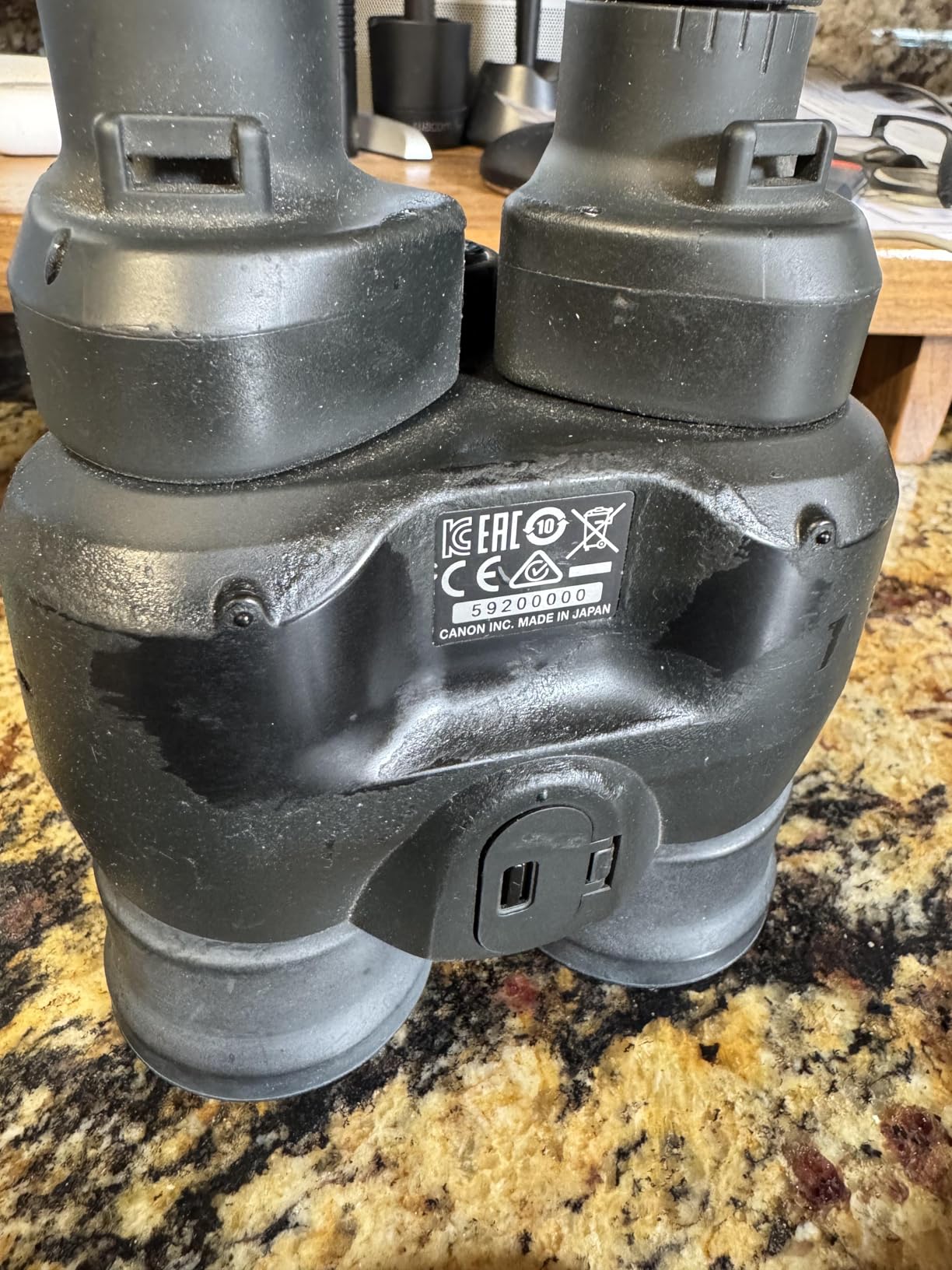
This is the risk no competitor in this space mentions, and it is the one that should change your decision most. Stabilized binoculars contain a moving optical assembly suspended in a gimbal, and that assembly can be knocked out of alignment by a hard knock. Owner reports describe a hard impact taking the stabilizer out of alignment and forcing repair or replacement, and a long-serving owner told us he replaced three pairs over about two decades, with the most recent one repaired back into service rather than written off.
The practical consequences are specific. Repairs on stabilized binoculars involve the electronics and the gimbal rather than a simple optical clean, so the turnaround is longer and the outcome is less predictable than a conventional binocular service. Warranty coverage on the electronics matters more than the warranty on the optics, and Canon lists three years on the 10×42 L IS WP while the Fujinon TS1440 and the TS-L2040 carry one year, so check the electronics terms explicitly.
What you can do is reduce the exposure. Prefer models with rubber armor over bare shells, keep glass in a padded case rather than loose in a locker, and stop using a stabilized binocular as the pair you hand to a passenger. On a small boat, storing a 14x or 16x pair in a case until you need it is the cheapest insurance available.
Buyers also ask about buying direct from the manufacturer rather than through a retailer. Owners on The Hull Truth deliberately source certain Fujinon models direct when they want the manufacturer relationship behind long-term service, and that reasoning is sound for an expensive stabilized instrument. It matters less for a compact model you would not cry over.
Saltwater Care in Five Steps
A stabilized binocular in a salt environment is a corrosion clock. The routine below takes two minutes and decides whether the glass is still working in five years.
First, rinse before you wipe. Salt grit is abrasive, so flush the body with fresh water or, at sea, with a freshwater bottle before anything touches the lenses. Never use a chamois or a dry cloth on a wet objective.
Second, use the supplied lens cloth or a blower for the objective, working from the centre outward. Household wipes and paper towel leave fibres and streaks that cost you contrast in low light.
Third, loosen the diopter and the eyepiece cups before stowing, so moisture trapped in the twist is not held against the seals. Check the battery compartment for corrosion while you are at it.
Fourth, remove the cells if the binocular is going into storage for more than a few weeks, and keep them out of the boat locker over a long lay-up.
Fifth, dry it slowly. Stow it in a ventilated locker or a dry bag with the objective caps off, not on a heater or under a windshield in the sun, where a sealed body can fog internally as trapped moisture tries to escape.
Who Should Skip Stabilization Entirely?
Plenty of boaters never need one. If your lookout is mostly close range, your passages are short, and you want a pair that works at dusk, a floating 7×50 with a 7.1 mm exit pupil will outperform every stabilized binocular in this article in the light you actually have.
Owners on boating forums describe exactly this pattern, with many saying they reach for a conventional marine pair most of the time even though they own a stabilized one, because on a small deck with darkness at both ends the brightness wins. That is not a mistake; it is recognising that stabilization and low light are different jobs.
The honest answer for most buyers is both. A floating 7×50 for twilight and darkness, and a stabilized 10x to 16x for daylight reach and wildlife. Our guides to budget binoculars and rangefinder binoculars cover the first half of that pairing, including the navigation use case stabilized models often skip.
One navigation gap is worth naming. Most stabilized binoculars in this list carry no compass, so if taking bearings matters to you, either add a dedicated compass or check the model against your navigation routine before you rely on it.
Frequently Asked Questions
What binoculars are best for boating?
For daylight reach from a moving boat, a stabilized 10x to 16x is the best choice, and for most skippers the Canon 12×36 IS III is the right entry point. For dusk and night work, keep a floating 7×50 alongside it, because a 7.1 mm exit pupil gathers far more light than any stabilized pair.
Are image stabilizing binoculars worth it?
Yes, when you need to read markers, identify distant vessels or watch wildlife beyond a few hundred yards, because stabilization roughly doubles usable range from a moving boat. No, when you mainly work at dusk or night, since stabilization forces smaller exit pupils and a 7×50 stays brighter in true darkness.
Who makes the best stabilized binoculars?
Fujinon and Canon have the longest track records in the category, with Fujinon offering the most correction in the TS1440 and Canon the most balanced bodies. SIG SAUER and Kite Optics produce the lightest stabilized glass, and Nikon makes the most compact one.
What is the difference between marine binoculars and regular binoculars?
Marine binoculars are sealed, nitrogen purged and frequently floating, with rubber armour, tetherable caps and a stated IPX7 waterproof rating. General-purpose models are often only water resistant, so they fog and corrode faster in salt air, and they rarely float if dropped overboard.
What magnification is best for marine binoculars?
Stick to 10x to 12x on a skiff or pontoon, 12x to 14x on a center console, and 16x to 20x on an offshore cruiser where you can sit and brace. Magnification is a weight problem first, so match the number to what you can hold up for a full lookout.
Which binoculars do Navy Seals use?
Military and maritime units use heavy gyroscope-stabilized binoculars built to a different standard from consumer models, and those are not sold through normal retail channels. Recreational boaters should look at the stabilized consumer options we tested, where the realistic ceiling on correction is roughly 5 degrees.
What happens if the battery dies on stabilized binoculars?
The unit does not switch off cleanly, it goes limp and the gimbal can drift so the view shakes. Switch the binocular fully off with a flat battery, carry a spare set in a dry bag, and the glass still works as an ordinary binocular without stabilization.
Final Verdict
The Canon 12×36 IS III is our pick for the best image stabilized binoculars for boating in 2026, because it balances everything that matters on a deck: real correction, a 1.8 lb body you can hold for a full watch, long eye relief for glasses, and the deepest owner history of anything we tested.
Buy the Fujinon Techno-Stabi TS1440 instead if you want the most correction available and you are reading markers at range from an offshore boat. Buy the Canon 10×42 L IS WP if your boating runs to dusk, because its 4.2 mm exit pupil is the brightest in the group. Buy the Kite APC 12×42 or the SIG Zulu6 HDX 16×42 if weight and waterproofing matter more than maximum reach, and the Nikon 10×25 if you want stabilized glass that fits in a pocket.
Whichever you choose, keep a floating 7×50 aboard for the dark half of the day, rinse the glass in fresh water after every outing, and treat the battery as a tool you carry spares for. That last habit is what keeps a stabilized binocular working ten years from now, long after the model has been replaced twice.