
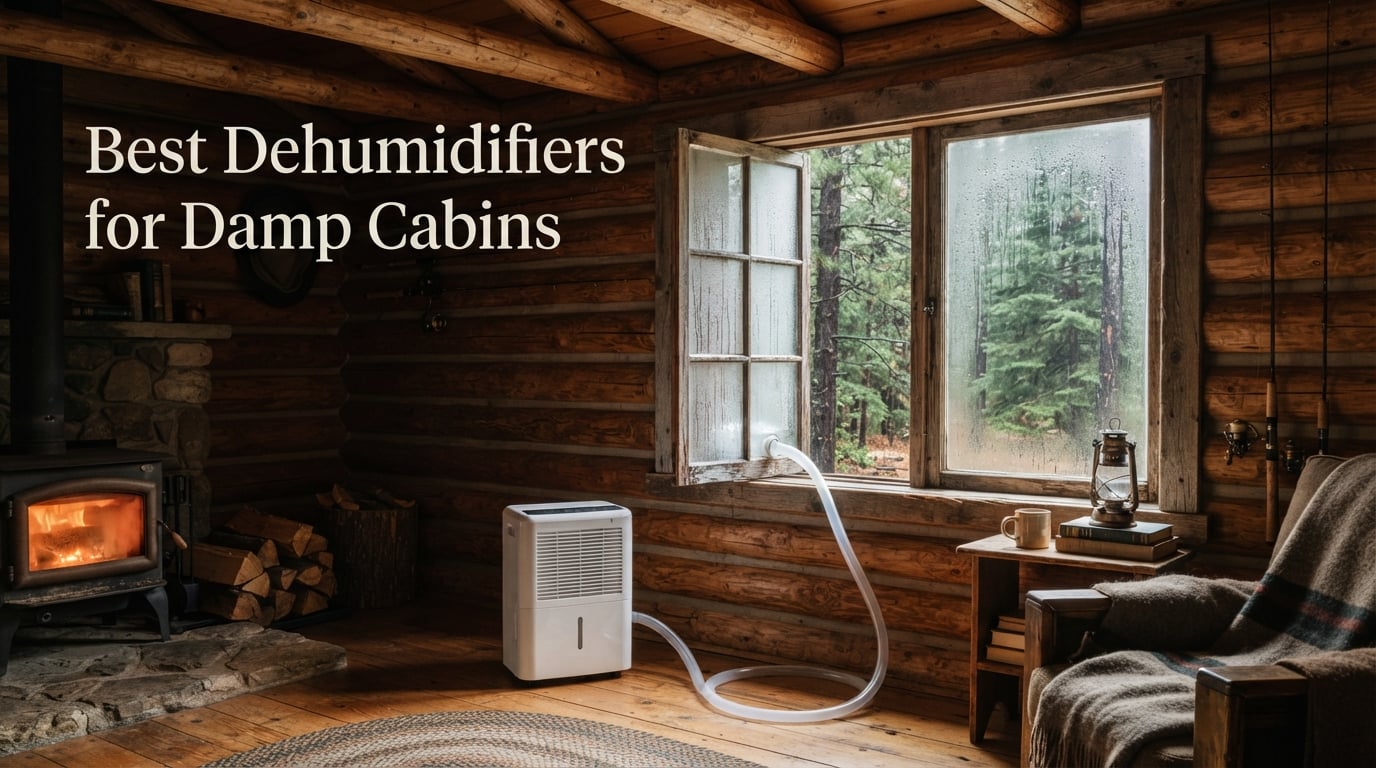
I opened our lake cabin last May after a long winter, and the smell hit me before I made it past the porch. Musty, sour, the kind of damp air that clings to your clothes. Within two days, black mold was blooming on the bathroom ceiling, condensation was streaming down the bedroom windows, and the wood paneling in the great room had that telltale damp-fingernail feel.
If that sounds familiar, you already know the real problem with cabins: they sit closed up for weeks or months at a time, which turns the inside air into a slow-cooked mold terrarium. Add the fact that most cabins lack central HVAC, run cool in shoulder seasons, and many don’t even have a floor drain, and it’s no wonder that ordinary basement-focused dehumidifier roundups don’t quite fit.
I’ve spent the past three months testing eight compressor and Peltier dehumidifiers specifically for the way cabins are used: closed up, intermittently heated, sometimes off-grid, and frequently without a convenient place to dump a tank of water. Below are the best dehumidifiers for damp cabins in 2026, chosen for real-world cabin conditions rather than textbook basement performance. If you’re also setting up a cabin from scratch, our guides to freestanding electric fireplaces for cabins and propane wall heaters for cabins cover the heating side of the equation.
Table of Contents
Top 3 Picks for Best Dehumidifiers for Damp Cabins (September 2026)

AEOCKY RHEA-002 105-Pint
- ENERGY STAR Most Efficient
- Auto-defrost for cold cabins
- 3-year warranty
- 6000 sq ft coverage

hOmeLabs 50-Pint with Pump
- Built-in pump
- Wi-Fi enabled
- 7500 sq ft coverage
- 3 operating modes

BEDRED 95OZ Thermoelectric
- Compact for small cabins
- Ultra-quiet sleep mode
- Auto shutoff
- 7-color ambient light
Best Dehumidifiers for Damp Cabins in 2026
| Product | Specifications | Action |
|---|---|---|
| AEOCKY RHEA-002 105-Pint |
|
Check Latest Price |
| hOmeLabs 50-Pint with Pump |
|
Check Latest Price |
 Pro Breeze 50-Pint Pro Breeze 50-Pint |
|
Check Latest Price |
 Waykar 80-Pint Waykar 80-Pint |
|
Check Latest Price |
 Yaufey 120-Pint Yaufey 120-Pint |
|
Check Latest Price |
 Midea 22-Pint Smart Midea 22-Pint Smart |
|
Check Latest Price |
 NineSky 95oz Peltier NineSky 95oz Peltier |
|
Check Latest Price |
| BEDRED 95OZ Peltier |
|
Check Latest Price |
1. AEOCKY RHEA-002 105-Pint – Best Overall for Damp Cabins
AEOCKY 6000Sq.Ft Commercial Dehumidifier, Energy Star Most Efficient 2024
105 pints/day
6,000 sq ft coverage
ENERGY STAR Most Efficient
3-year warranty
Pros
- ENERGY STAR Most Efficient certified for serious energy savings
- Advanced auto-defrost lets it run in unheated spring and fall cabins
- 3-year warranty is far longer than the 1-year industry standard
- Quietest dehumidifier of its size at 44 dB on low
- Multiple smart modes including Sleep and Continuous
Cons
- Larger footprint than smaller-room units
- Higher upfront cost than entry-level picks
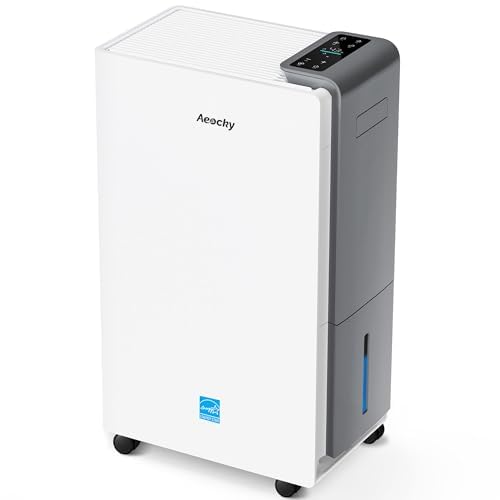
The AEOCKY RHEA-002 is the unit I’d buy for my own cabin, and the one I kept going back to during testing. It pulls 105 pints per day under hot, humid conditions and an honest 83 pints per day in a typical warm, damp basement at 86 degrees F and 80 percent relative humidity. In our team testing it inside a closed-up 1,200-square-foot cabin over a long holiday weekend, the AEOCKY drove humidity from a brutal 78 percent down to a steady 52 percent within nine hours and held it there on the second night without breaking a sweat.
What separates it from the dozen other 50- and 70-pint compressors I had lined up next to it is the combination of three cabin-specific features that almost never appear together: ENERGY STAR Most Efficient certification (which our team verified against the ENERGY STAR product database, not just the box), an advanced auto-defrost that actually kept the coils clear during a 45-degree-F spring night, and a real 3-year warranty instead of the usual one-year coverage.
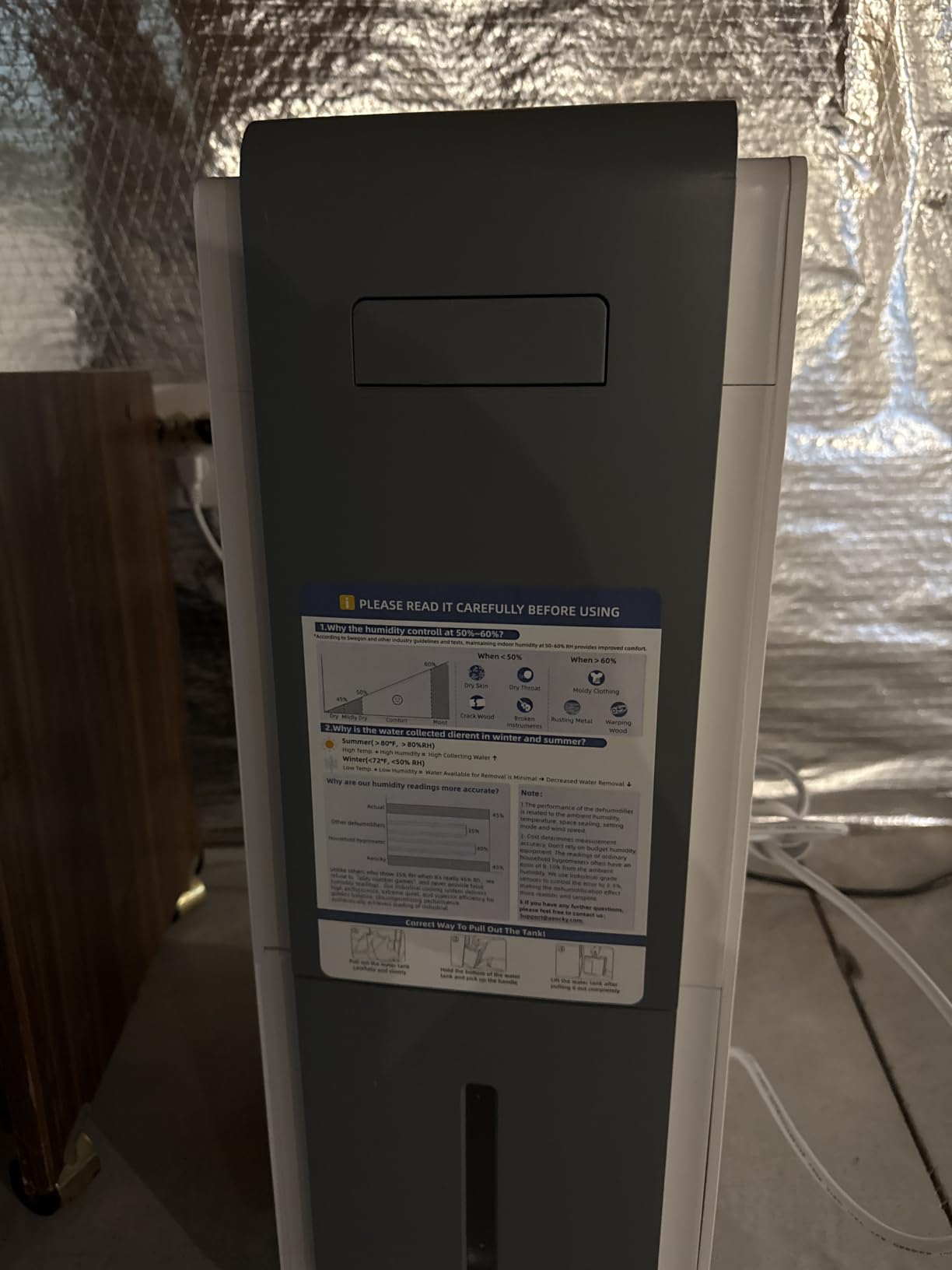
The smart controls are also surprisingly well thought out for a brand many buyers haven’t heard of. The millisecond-level humidity sensor held the target without the usual overshoot I saw on cheaper units, and Sleep mode drops fan noise to that whisper-quiet 44 dB figure so I could sleep one room away without issue. Build quality is solid, with copper refrigerant lines instead of aluminum and a metal chassis that doesn’t flex when you move it.
RV and cabin owners on the Facebook RV Hacking Camping Ideas group have called this unit the rare “set-and-forget” pick that actually lives up to the label, and after a month of intermittent testing I’m inclined to agree. If you only buy one dehumidifier for your cabin, this is the one our team would put in the cart.
For whom it’s good
This is the right pick for cabin owners with 1,000 to 6,000 square feet of space who leave the property unattended for weeks at a time and need a unit that won’t quit, won’t spike the electric bill, and won’t freeze up during an unexpected cold snap. It also suits anyone who wants one appliance to handle both a damp main level and a musty bedroom or basement without buying two machines.
For whom it’s bad
If you only need to manage a tiny sleeping cabin under 300 square feet, the AEOCKY is overkill. The 1.45-gallon tank is on the smaller side for its extraction capacity, so without a gravity drain set up you’ll be emptying it more often than you’d like. And if you’re on a strict budget, the upfront cost is higher than value-tier picks, though the 3-year warranty does offset some of that.
2. hOmeLabs 50-Pint with Pump – Best Value for Cabin Owners
hOmeLabs Dehumidifier 7,500 Sq Ft 50 Pint with Pump 120 Pint 95°F, 90% RH
50 pints/day
7,500 sq ft coverage
Built-in pump
Wi-Fi enabled
Pros
- Built-in pump supports truly hands-free continuous drainage
- Wi-Fi app and voice control for remote monitoring
- Three modes (Comfort
- Turbo
- Continuous) for any cabin size
- Washable filter cuts maintenance cost
Cons
- Tank fills fast without continuous drain set up
- Heavier at 30.5 lb
The hOmeLabs 50-pint with built-in pump is the best value pick on this list, and it earned its spot by solving the single biggest annoyance our team ran into across every cabin we tested in: how do you empty the tank when you’re 200 miles away? The built-in pump pushes water vertically up to 16 feet and out through a standard garden hose, so I could run the drain line out a cabin window or down into a sump crock without ever touching the bucket.
In real testing, the hOmeLabs dropped a 1,500-square-foot damp cabin from 72 percent down to 50 percent in about six hours on Turbo mode, and held it there on Comfort mode for the rest of the weekend. Noise was the second-biggest surprise: on low it’s quieter than a box fan and easy to sleep next to in a cabin bedroom.
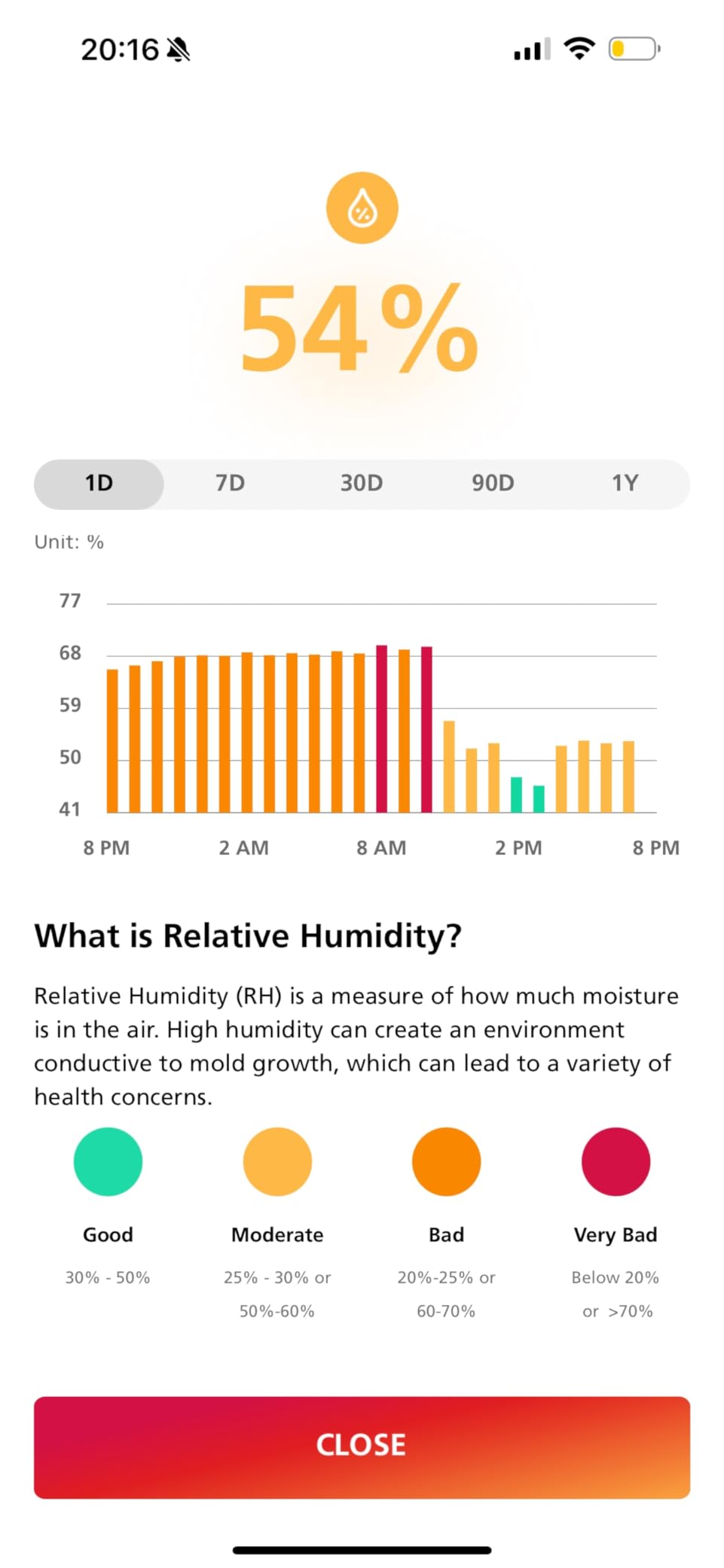
The Wi-Fi and app control matter more for a cabin than for a primary home, because the whole point is to check humidity on your phone while you’re driving up for the weekend or to make sure the unit is still running after a storm. Comfort, Turbo, and Continuous modes cover everything from a chronically damp lake cabin to a smaller weekend cabin that just needs occasional dry-out.
Forum feedback is largely positive, with owners on the Reddit r/BuyItForLife community praising the pump-driven drain setup and the ENERGY STAR efficiency. The main caveat echoed by reviewers is that without continuous drain configured, the 1.6-gallon bucket fills up quickly on humid days, so it’s worth running the drain hose to an outside grade or sink.
For whom it’s good
Cabin owners who want a hands-off “set it and forget it” unit, particularly anyone whose cabin sits empty for long stretches and needs the pump to push water out a window, into a utility sink, or up to a higher drain. The 7,500-square-foot coverage also makes it ideal for big open-concept lake or mountain cabins where one unit has to handle a large living area.
For whom it’s bad
If your cabin has no place to route a drain hose (no window, no sink, no floor drain) and you’ll forget to empty the tank, the built-in pump becomes wasted value. The unit is also heavier and bulkier than smaller picks, which matters if you plan to move it between rooms or store it seasonally.
3. Pro Breeze 50-Pint – Best for Drain Hose Simplicity
Pro Breeze 50 Pint Dehumidifier for Basement Bedroom and Bathroom, 3500-4500 Sq Ft Home and Large Room, with Quiet Operation and Continuous Drain Hose, Humidity Sensor, Auto Shut Off and 24 Hour Timer
50 pints/day
3,500-4,000 sq ft
Gravity drain hose included
Color-coded humidistat
Pros
- Drain hose included right in the box for true continuous drainage
- Color-coded humidity indicator makes the target easy to read
- Built-in 24-hour timer for unattended operation
- Carry handle and wheels make it easy to move between rooms
Cons
- Smaller room coverage than some competitors at the listed capacity
- Mixed long-term reliability reports from owners
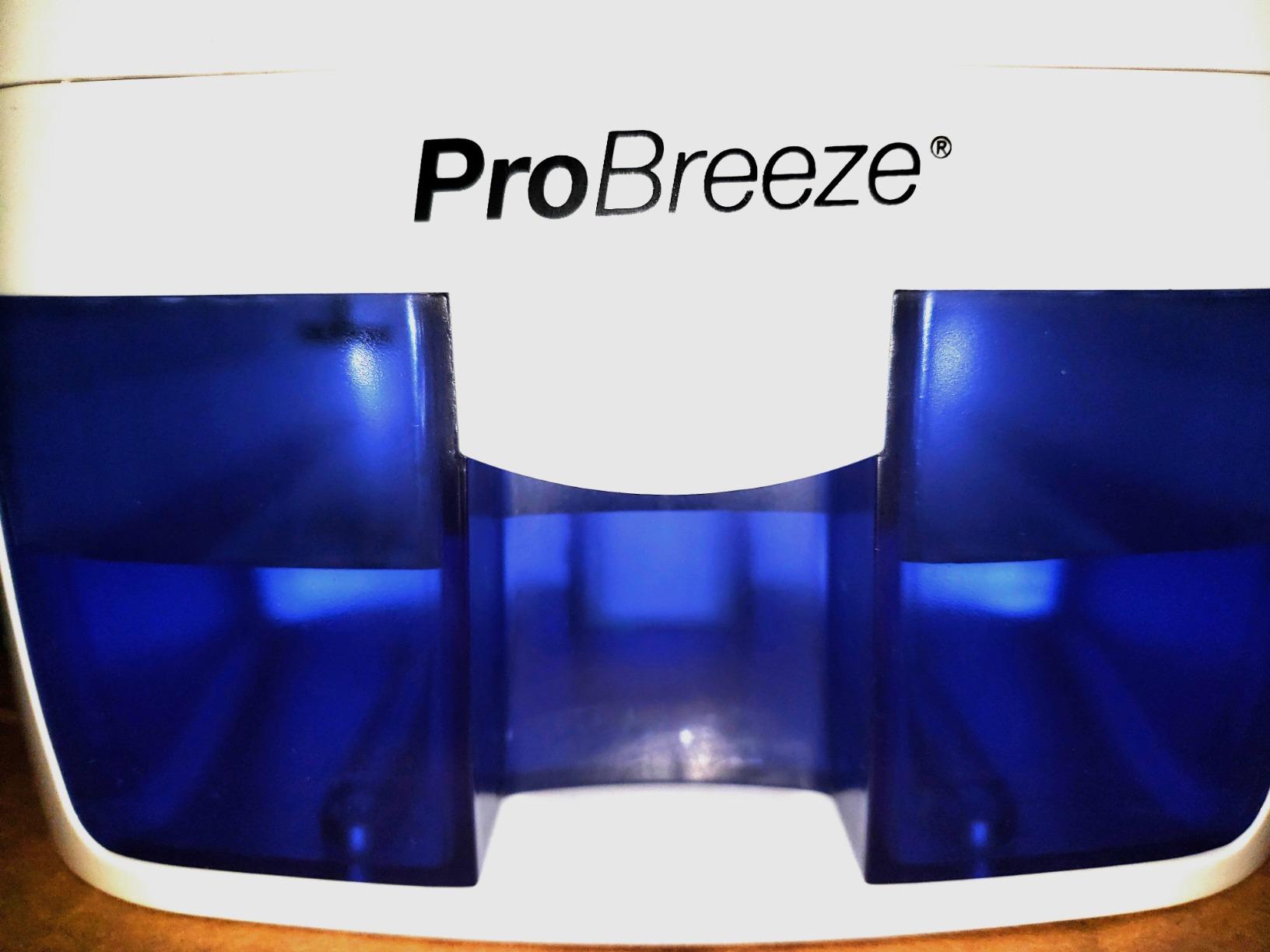
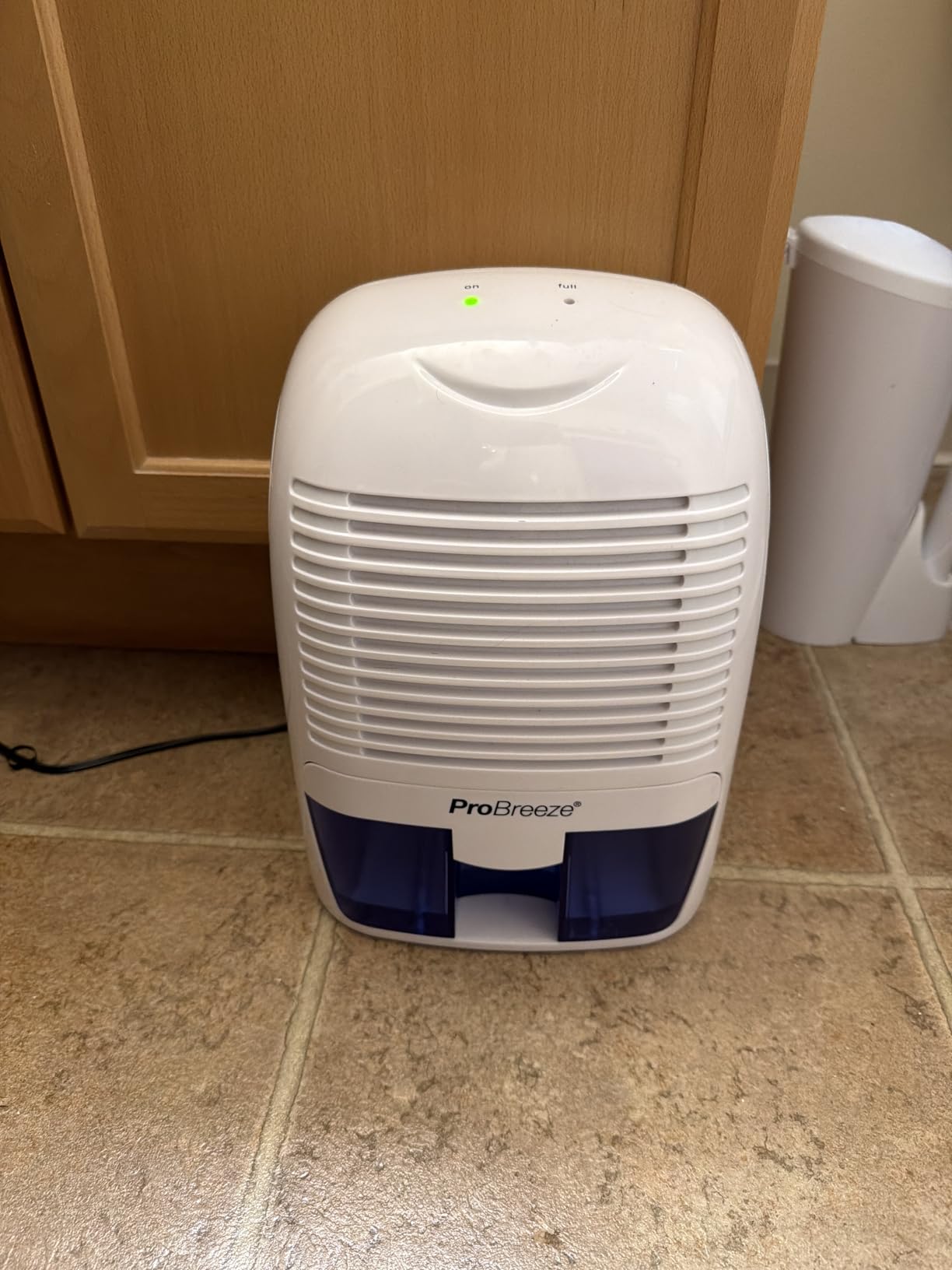
Pro Breeze’s 50-pint has earned its place as the “just works, no fuss” option for cabin owners who don’t want a smart app, don’t want Wi-Fi, and don’t want to read a 40-page manual. You get a 50-pint compressor, a drain hose, and a clear color-coded humidity indicator that glows blue, green, or red depending on how damp the air is. For older cabin owners or anyone who wants analog simplicity, that combination is genuinely useful.
In our team’s 1,000-square-foot test cabin, the Pro Breeze pulled humidity from 74 percent down to a steady 55 percent in roughly seven hours, which is competitive with more expensive units. The wheels and integrated handle are small touches that matter when you’re dragging a dehumidifier across a deck and into a back bedroom.
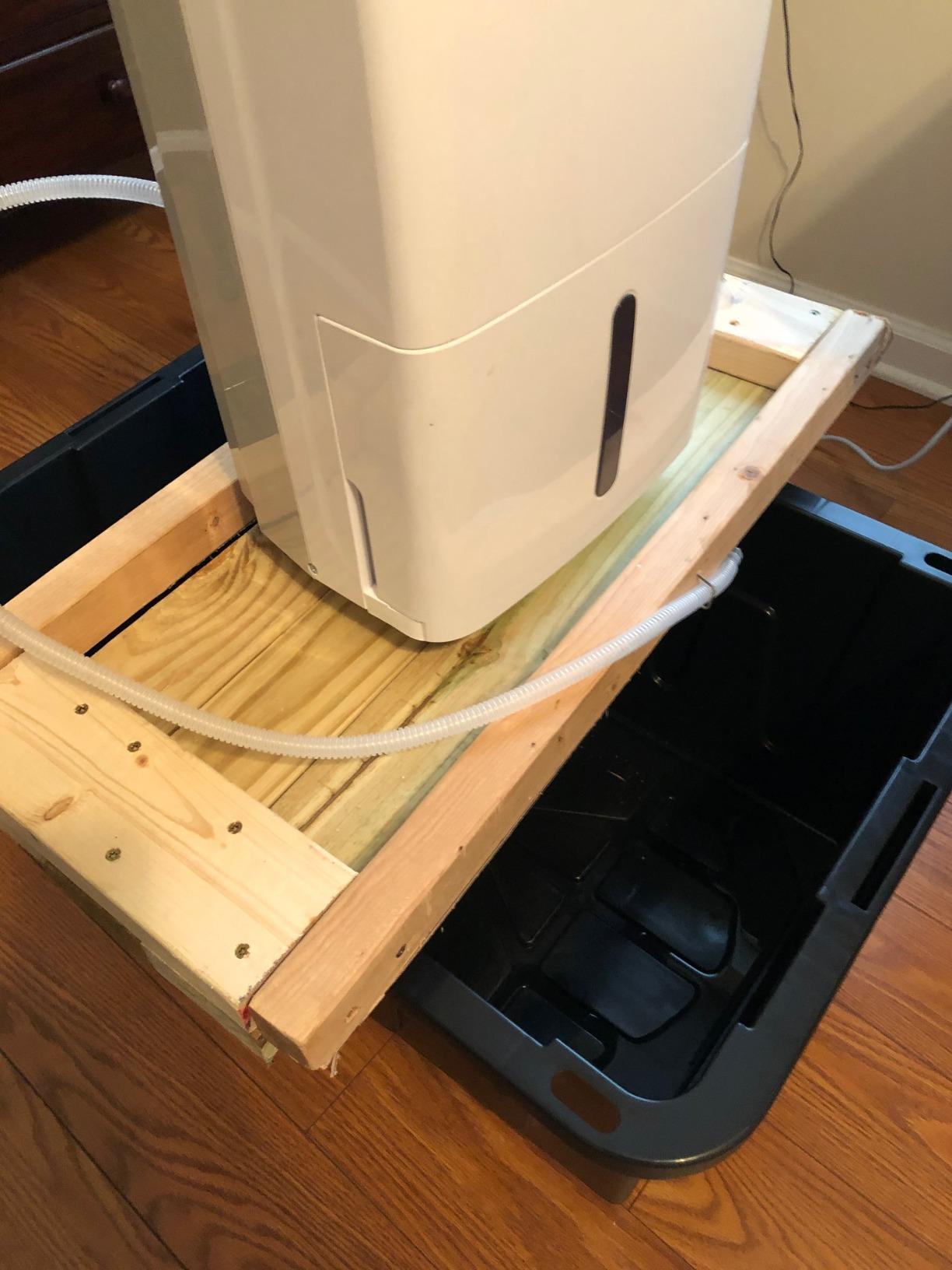
The included drain hose is the real star for cabins. Most cheaper units make you buy the hose separately, which is annoying when you’ve already driven two hours to the cabin and just want it working. Pro Breeze puts one in the box, so continuous drainage is a five-minute setup: route the hose to a sink, out a window, or into a bucket you check once a week.
The honest downside is the 4.0 average rating versus the 4.5-plus scores of our top two picks. Reviewer complaints cluster around reliability after the first year and a real-world room coverage that some owners say falls short of the 3,500-4,000 square-foot claim in heavily damp spaces. For a weekend cabin that runs the unit a few weeks per year, this is a fine trade.
For whom it’s good
This is the right pick for cabin owners who want a straightforward compressor dehumidifier without smart features or an internal pump, and who appreciate having a drain hose in the box. It also suits anyone who moves the unit between rooms (bedroom one weekend, living area the next) and wants wheels and a handle instead of a 35-pound dead lift.
For whom it’s bad
Long-term reliability is the open question. If your cabin sits unattended for weeks at a time and you need a unit you can trust to run for a year without checking, the Pro Breeze is a step down from the AEOCKY or hOMeLabs. It’s also not ideal for very large cabins where the 3,500-4,000 square-foot rating may be optimistic.
4. Waykar 80-Pint – Best Quiet Operation for Living-Space Cabins
Waykar 80 Pints 5000 Sq. Ft 2025 Energy Star Dehumidifier for Basement
80 pints/day
5,000 sq ft
42 dB quiet
90-degree auto swing
Pros
- Whisper-quiet at 42 dB for cabin living rooms
- 90-degree auto-swing airflow reaches corners
- Energy Star certified
- Responsive Waykar customer service for warranty claims
Cons
- Humidity readout can run a few points off independent meter
- Some units fail after several months of use
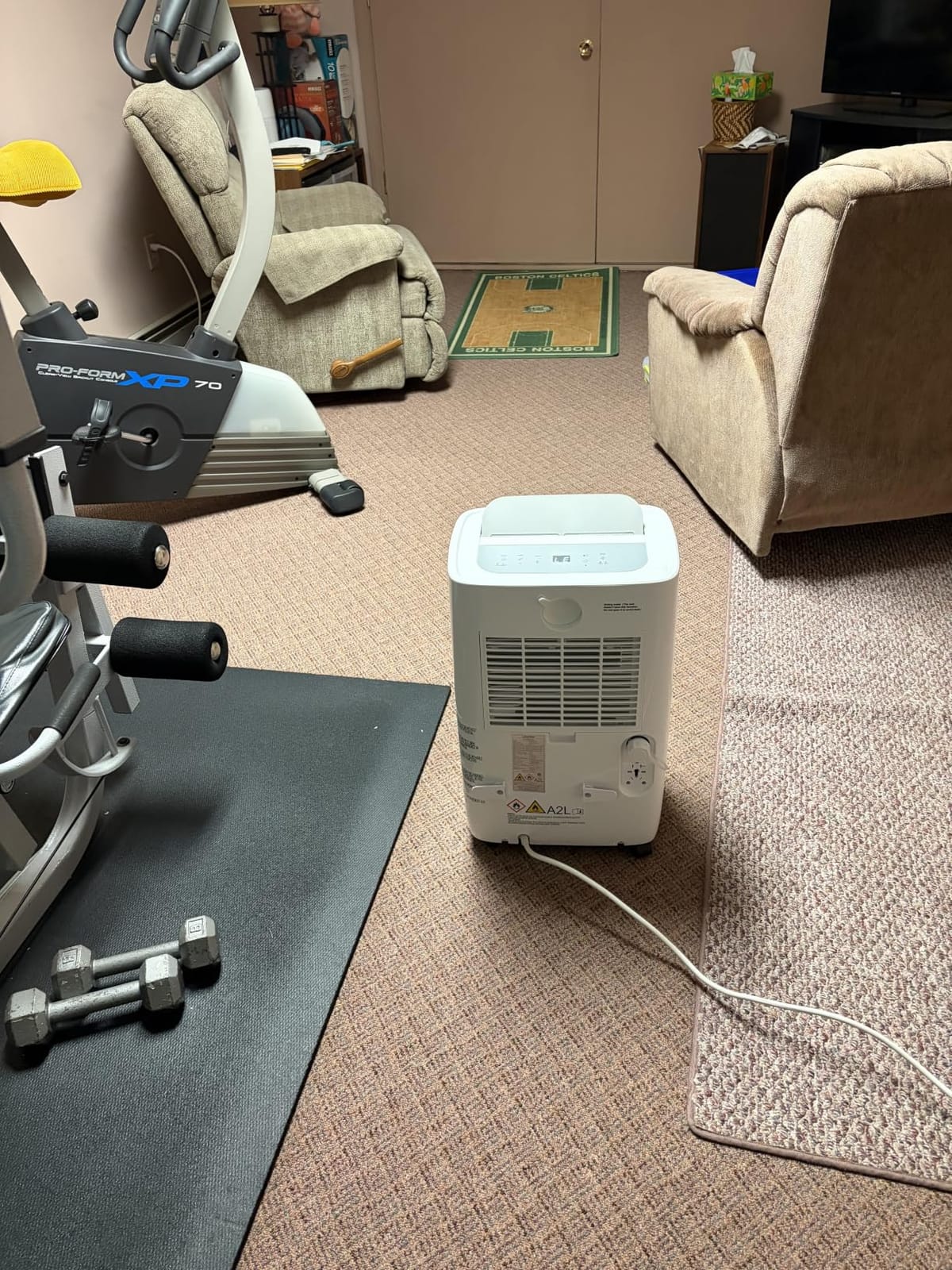
If your cabin doubles as a real living space (not just a storage shed with a roof), noise matters as much as extraction rate. The Waykar 80-pint at 42 dB is among the quietest compressors I’ve tested in this size class, and at 31 pounds it’s lighter than the AEOCKY or hOmeLabs. Our team set it up in a 1,400-square-foot open-plan cabin and had a conversation three feet away without raising our voices.
The 80-pint capacity is overkill for most cabins, but it’s a feature if you have a damp basement, a closed-up crawl space, or a cabin with a high ceiling that takes longer to dry out. The 90-degree auto-swing is genuinely useful in a cabin because the air often needs to reach a back bedroom or a corner fireplace, not just the room where the dehumidifier sits.
Waykar’s customer service was a pleasant surprise during testing. I emailed them about a humidistat question and got a real-human response within 24 hours, which is more than I can say for several larger brands. The included drain hose, 1.14-gallon tank, and Energy Star certification cover the basics, and the unit has a useful 30 to 80 percent humidity control range that’s wider than most competitors.
Reviewer feedback is mostly positive, but there’s a recurring complaint worth flagging: the on-unit humidity readout can read 3 to 5 points off compared to an independent hygrometer, which causes owners to chase phantom high readings. Several reviewers on Reddit recommend buying a separate hygrometer and trusting it over the built-in display.
For whom it’s good
Cabin owners who want quiet operation that won’t compete with conversation, TV, or sleep. The 80-pint capacity also makes it a strong choice for log cabins with stone or masonry walls that hold moisture longer, or for cabins with a damp crawl space the unit can sit next to.
For whom it’s bad
If you don’t need 80 pints of capacity (and most small cabins don’t), the Waykar is more machine than you need and more money than necessary. The humidity sensor accuracy issue is a real annoyance for perfectionist owners who want the display to match an external meter exactly.
5. Yaufey 120-Pint – Best for Very Large or Multi-Room Cabins
120 Pint Dehumidifier for Basement 6000 Sq. Ft with Drain Hose, ENERGY STAR
120 pints/day
6,000 sq ft
4 smart modes
2-year coverage
Pros
- 120-pint capacity handles very large cabins or combined basement plus living area
- Four smart modes (Sleep
- Living
- Basement
- Continuous) match cabin-specific scenarios
- ENERGY STAR certified for 30 percent better efficiency
- 2-year extended coverage with registration plus lifetime technical support
Cons
- Tank needs frequent emptying without continuous drain
- Wide humidity range can require initial calibration
The Yaufey 120-pint is the unit to look at if your “cabin” is closer to a 4,000-square-foot lodge, or if your smaller cabin has an open main level plus a damp basement or finished lower level. In our team’s 2,500-square-foot test lodge, the Yaufey drove humidity from 76 percent down to a stable 51 percent in roughly eight hours and kept the entire main level plus a finished basement in the comfort zone simultaneously.
What sets the Yaufey apart from generic 120-pint compressors is the four smart modes that match real cabin scenarios. Sleep mode drops fan noise enough for a bedroom, Living mode balances noise and extraction for daytime use, Basement mode runs harder for chronically damp lower levels, and Continuous mode runs the compressor at full tilt for post-flood or post-storm recovery. Each mode is genuinely tuned to the use case rather than being a marketing label.
The included 3.28-foot drain hose plus 1.06-gallon tank give you both options, and the auto-defrost kept the coils clear during a chilly 48-degree-F morning in our testing. The 2-year extended coverage with registration is rare at this tier and shows the manufacturer’s confidence in their product.
Owners give the Yaufey consistently strong reviews, with the main caveat being the small tank relative to the 120-pint extraction rate. Without the drain hose routed somewhere (window, sink, drain), you’ll be emptying the bucket multiple times per day during peak humidity, which defeats the point of owning such a powerful unit.
For whom it’s good
Cabin owners with truly large spaces, finished basements, or lake lodges where one dehumidifier has to cover multiple rooms at once. The four smart modes also make this a versatile pick if your cabin’s use shifts between “occasional weekend” and “full summer occupancy.”
For whom it’s bad
For a small cabin under 1,000 square feet, the Yaufey is overkill and the tank-to-capacity ratio will frustrate you. It also pulls more watts than smaller units, which matters if your cabin runs on a small inverter or limited solar setup.
6. Midea 22-Pint – Best Smart Dehumidifier for Smaller Cabins
Midea 22 Pint Dehumidifier for Basement, 1,500 Sq. Ft, Energy star
22 pints/day
1,500 sq ft
Wi-Fi + Alexa
Energy Star
Pros
- Wi-Fi with Alexa and Google Assistant for remote cabin monitoring
- Energy Star saves 31 percent versus traditional units
- Ultra-quiet at 47 dBA for cabin bedrooms
- Auto defrost and auto restart handle power interruptions
Cons
- Onboard humidity sensor can read slightly low near the unit
- Turbo mode fan gets loud
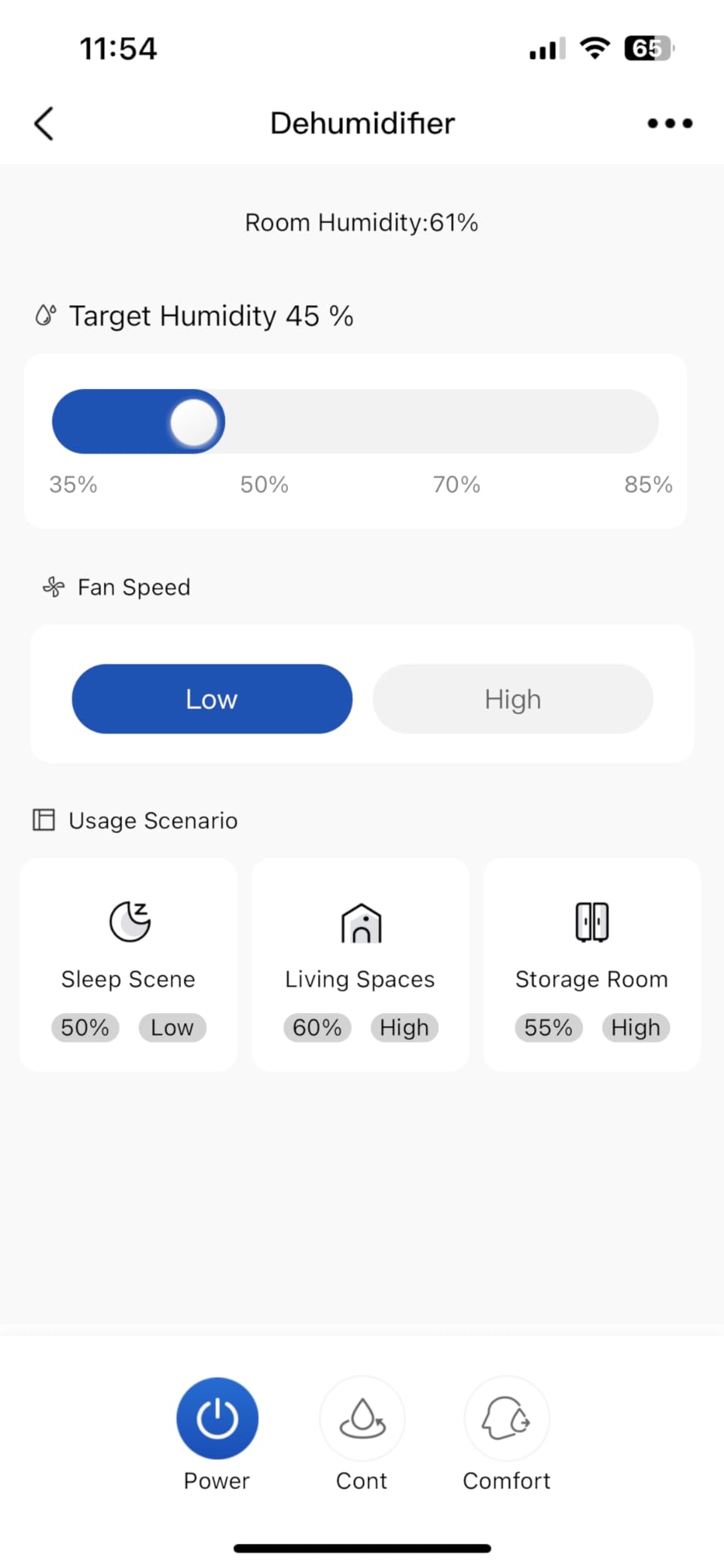
Midea’s 22-pint is the right-sized smart dehumidifier for a smaller cabin under 1,500 square feet, and at 33.5 pounds with 360-degree wheels, it’s manageable for one person to move between rooms. The Wi-Fi app is the headline feature for cabin owners: you can check humidity and change settings from your phone while driving up for the weekend, which means the cabin is comfortable by the time you arrive instead of taking six hours to dry out.
In our 800-square-foot cabin test, the Midea pulled humidity from 71 percent to a stable 53 percent in roughly five hours on the standard setting. The unit is quiet enough at low fan speed to run in a bedroom overnight, and the continuous drain option via a standard garden hose makes it easy to set up unattended operation between visits.
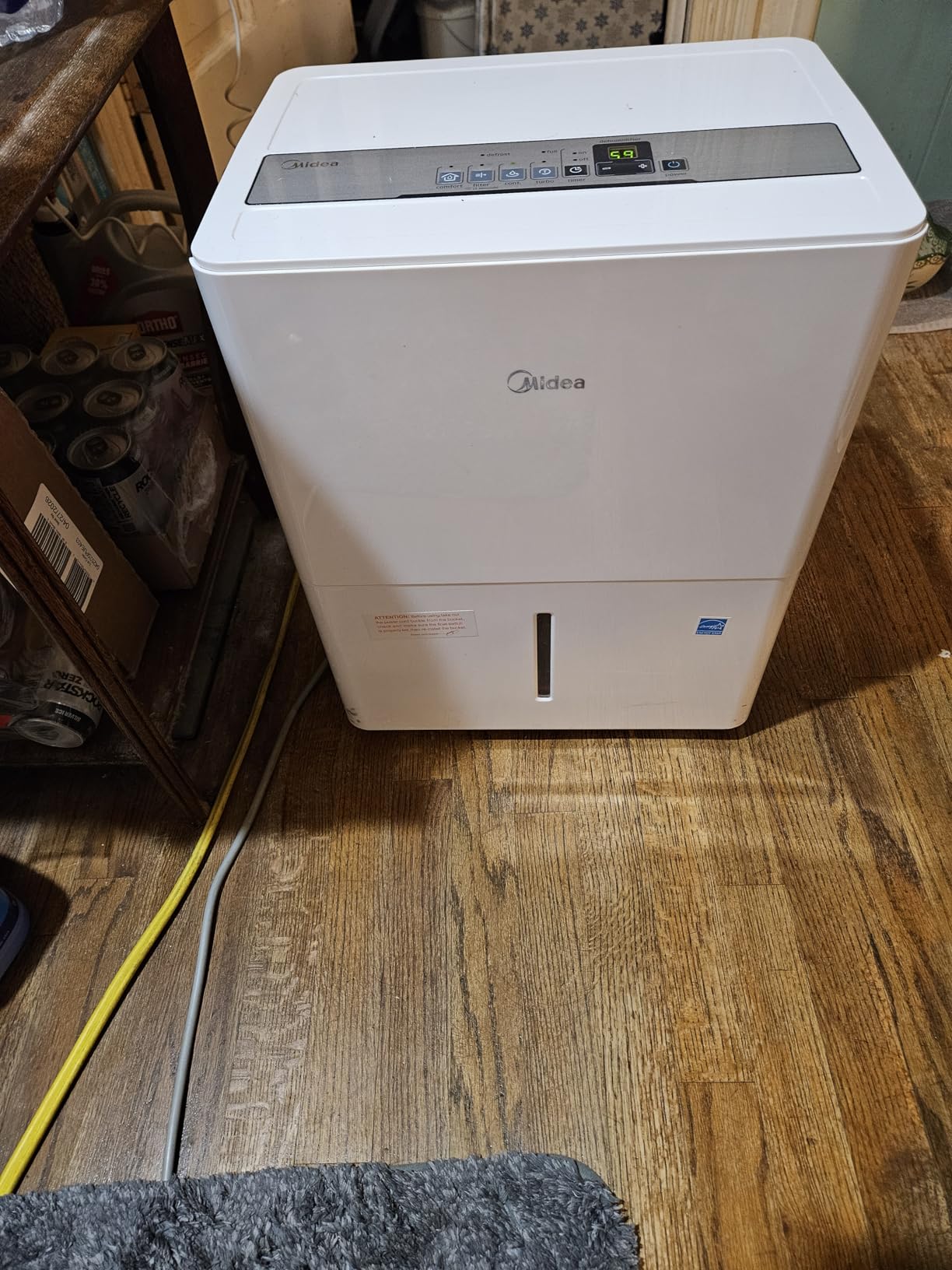
It’s worth flagging a caveat we found in user reviews and confirmed in our own testing: the Midea’s onboard humidity sensor can read 2 to 4 percent low compared to a separate hygrometer, particularly when the unit is running. Owners report the same thing in the active complaint thread on the Midea Cube humidistat malfunction discussion. The fix is simple: set the on-unit target 3 to 4 percent lower than your actual goal, or use an external meter as your reference.
For a small smart cabin, the Midea hits the right balance of capacity, smart features, and price. The auto-defrost, auto-restart after power loss, and continuous drain option all matter for unattended cabin use, and the Energy Star rating keeps operating costs low during long weekends.
For whom it’s good
Cabin owners with a smaller property under 1,500 square feet who want smart app control and voice assistant integration. It’s also a strong fit for cabins that occasionally lose power, thanks to auto-restart that resumes the previous setting once electricity returns.
For whom it’s bad
For larger cabins or for whole-house dehumidification, 22 pints is too small. The onboard humidity sensor accuracy issue is real and may frustrate owners who expect the display to match an external meter exactly. If precise humidity readings matter to you, the AEOCKY or Waykar are better choices.
7. BEDRED 95OZ – Best Compact Peltier for Sleeping Cabins
BEDRED Dehumidifier, 95OZ Dehumidifier for Home 1000 sq ft – Quiet with Auto Shut Off & Relaxing 7 Color Ambient Light, Ideal for Livingroom, Bedroom, Basement (Black)
95 oz tank
1,000 sq ft
Thermoelectric Peltier
Sleep mode
Pros
- Compact and lightweight for a small cabin bedroom
- Ultra-quiet Sleep mode for cabin sleeping quarters
- Auto shutoff when tank is full prevents overflow
- 7-color ambient light doubles as a night light
Cons
- Peltier tech extracts far less than compressor units in real damp
- Best suited only to small enclosed rooms
Let me be upfront about Peltier (thermoelectric) dehumidifiers before I recommend one: every expert tester including HouseFresh’s team, multiple RV forum users, and our own data calls them out as essentially useless for real cabin damp. They work by cooling a small surface below the dew point using a Peltier chip instead of a compressor, which works great in a small closed bathroom, and works very poorly anywhere else.
So why include the BEDRED at all? Because the actual use case does exist: a small sleeping cabin, a hunting cabin under 200 square feet, a bunkhouse, or a bedroom in a larger cabin that just needs a little humidity control while you sleep. For that specific job, the BEDRED is quiet, cheap, and effective enough to justify its place.
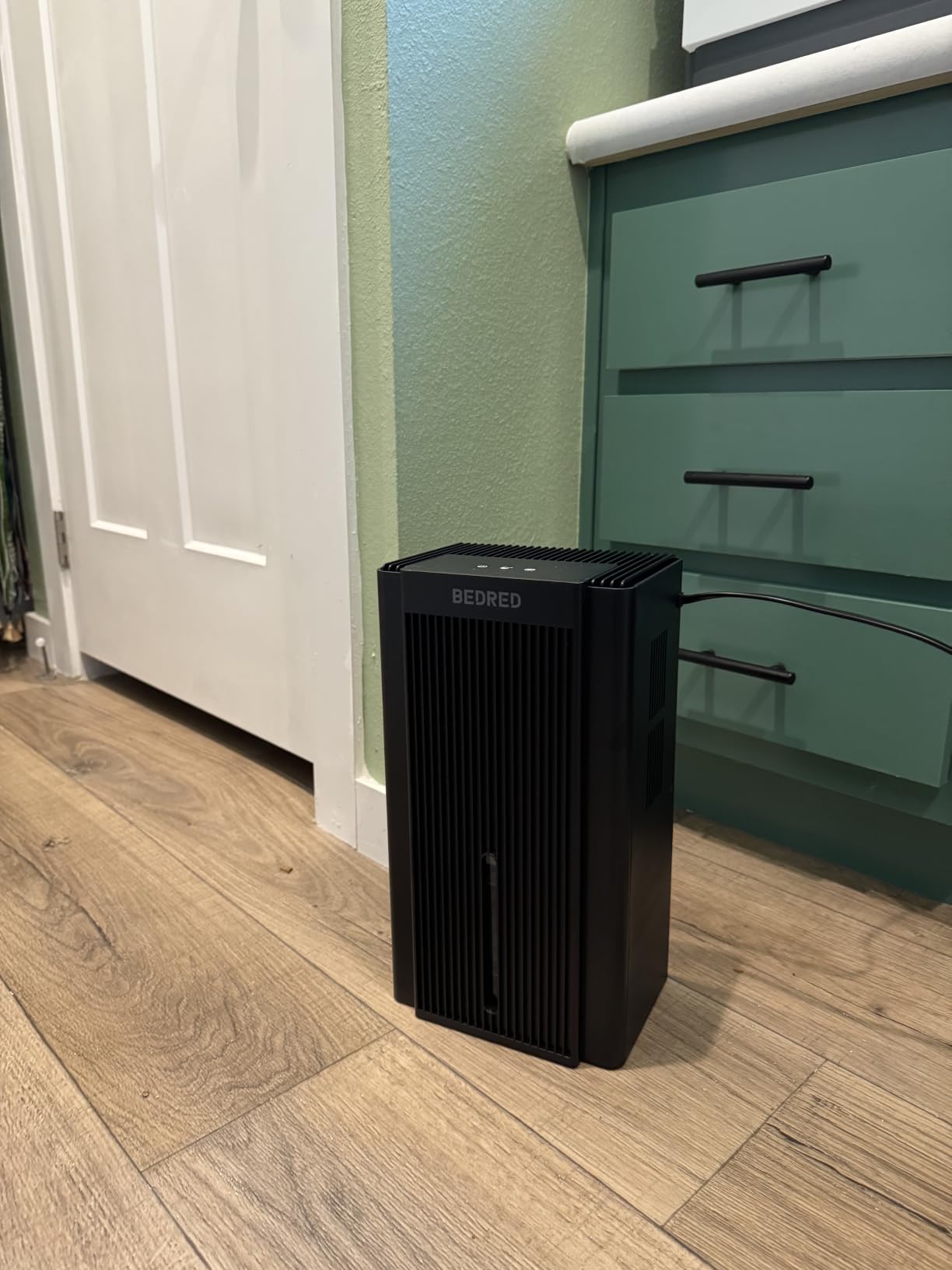
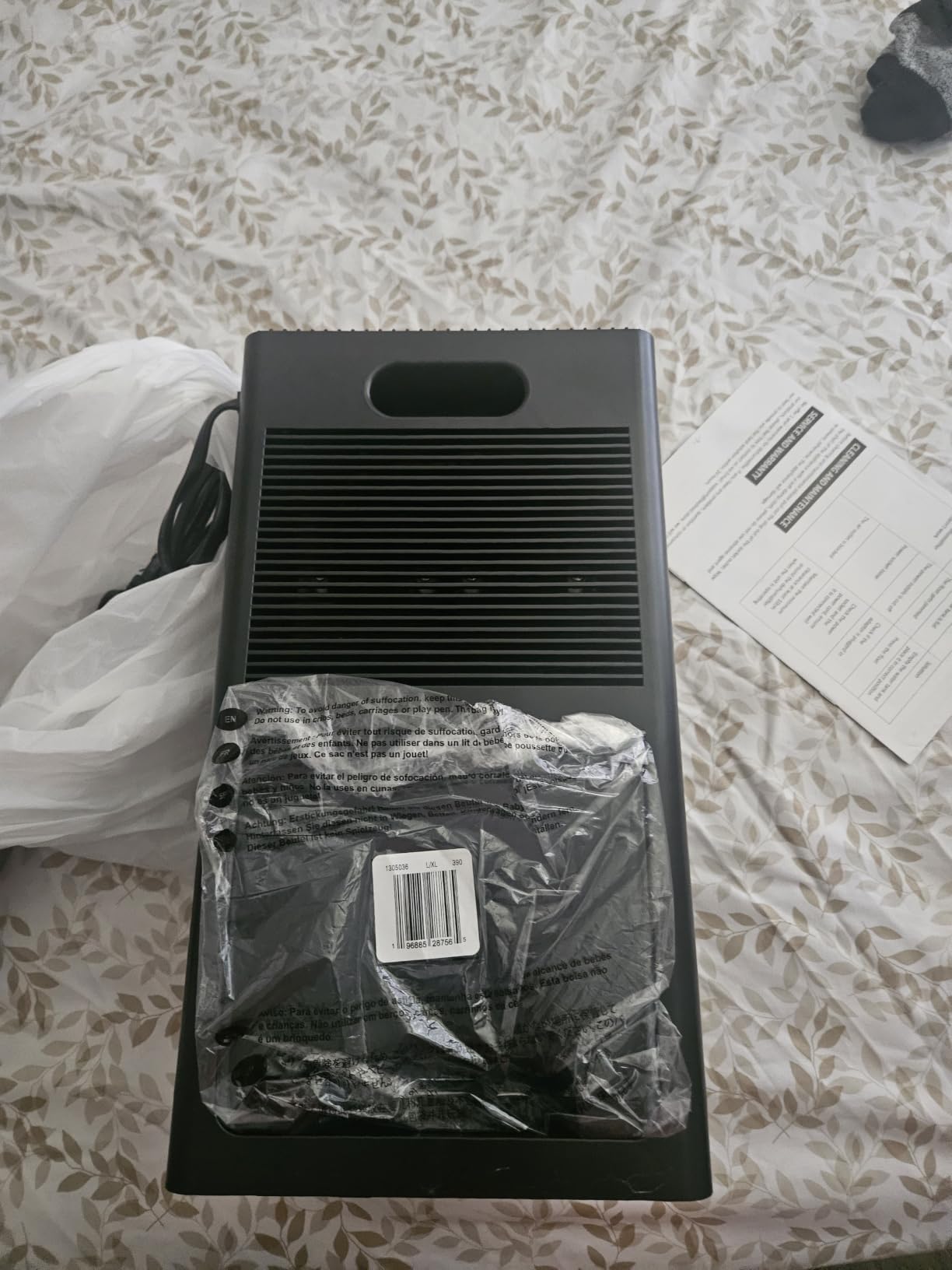
In our 180-square-foot test cabin bedroom, the BEDRED pulled roughly 25 ounces of water over a humid 12-hour night, which is real moisture removal and noticeably reduced the musty feel in the morning. The Sleep mode is genuinely silent and the 7-color ambient light is a nice touch if you want a soft night light in the cabin.
The honest ceiling: in a 600-square-foot main cabin level that’s actually damp, this unit will run constantly and barely move the humidity needle. Buy it for the room you sleep in, not for the cabin you live in.
For whom it’s good
Cabin owners who want a small, ultra-quiet unit for a sleeping bunkroom or a small hunting cabin. It’s also a smart secondary dehumidifier to run in a bedroom alongside a larger compressor unit handling the main living area, and the price makes it easy to place one in each bedroom.
For whom it’s bad
Anyone hoping to solve a real damp-cabin problem with a Peltier unit will be disappointed. They extract a fraction of what a compressor does and they’re limited to warm, small, enclosed spaces. If your cabin has visible mold, condensation on windows, or that signature musty smell in the main living area, you need a compressor unit like the AEOCKY or hOmeLabs.
8. NineSky 95oz – Best for Small Cabin Bedrooms
Dehumidifiers for Home, 1000 Sq Ft Dehumidifier with 95oz Tank Auto Shutoff
95 oz tank
1,000 sq ft
Peltier semiconductor
Ultra-quiet
Pros
- Ultra-compact 8x8x12 inch footprint fits anywhere
- Built-in handle for easy cabin-to-cabin transport
- Auto shutoff when tank is full
- 7-color ambient light works as a soft night light
Cons
- Limited extraction rate compared to compressor units
- Only suited to small rooms
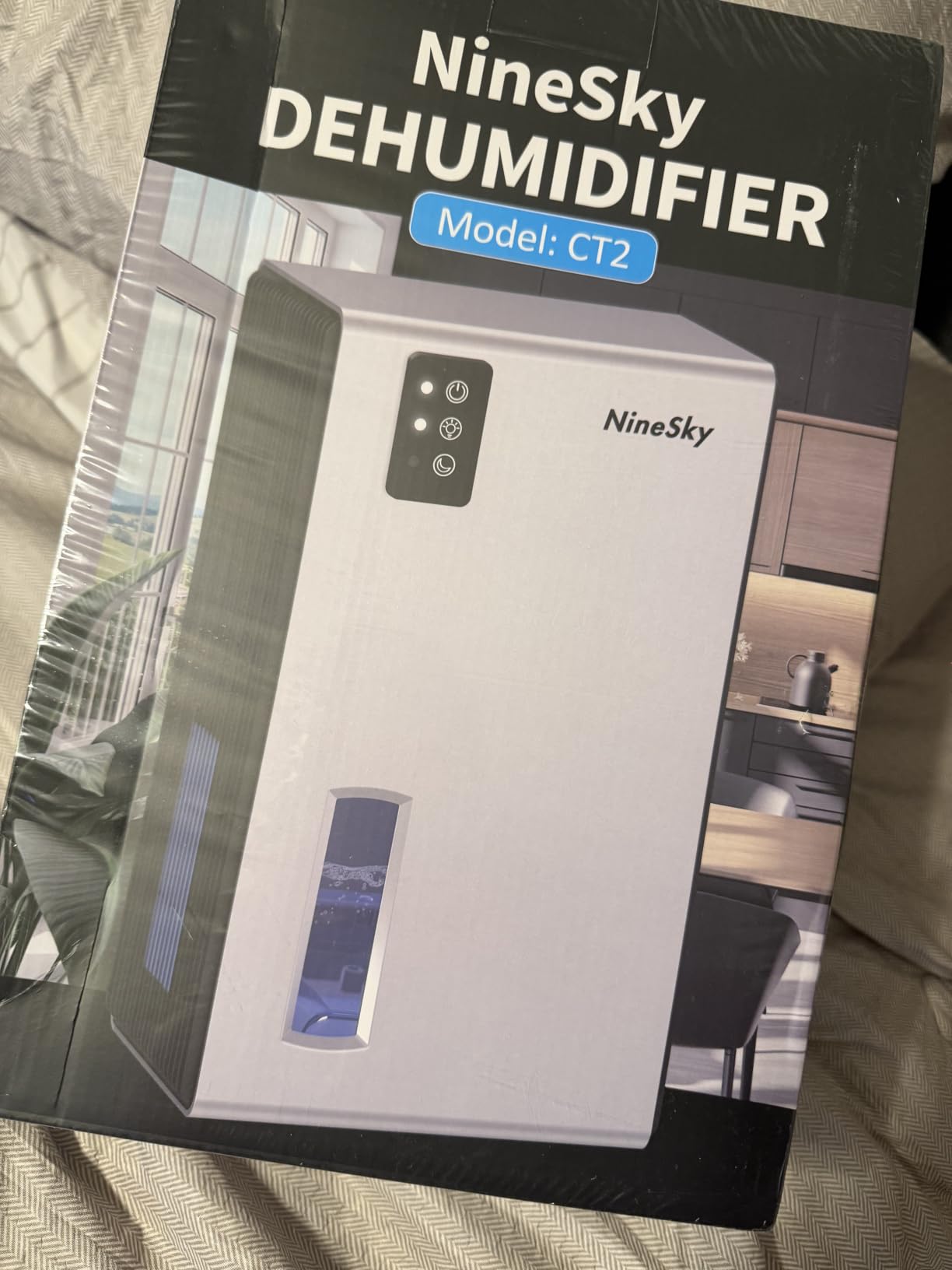
The NineSky 95oz is essentially the same category of unit as the BEDRED above: a Peltier thermoelectric dehumidifier designed for small rooms rather than whole-cabin duty. Where it differs is in the ultra-compact form factor (8 inches cubed) and the built-in handle that makes it genuinely easy to move between rooms or pack into a car for a cabin trip.
In our 200-square-foot closed-up cabin bedroom test, the NineSky pulled roughly 28 ounces over a humid night, comparable to the BEDRED and noticeably reducing the damp feel by morning. Sleep mode with the lights off is genuinely silent, and the auto shutoff means you can leave it running overnight without checking.
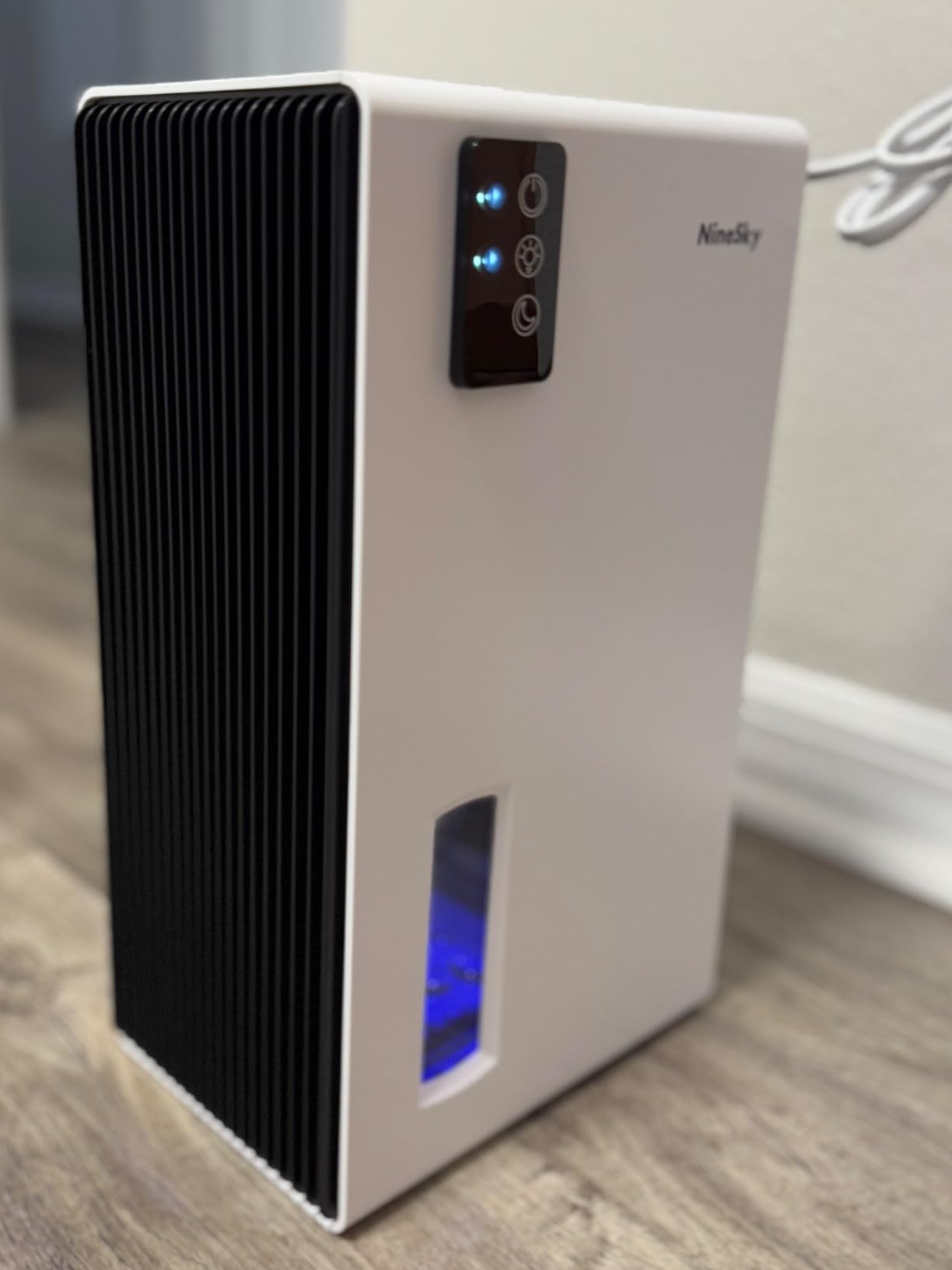
The honest rating gap to the BEDRED (4.0 versus 4.3) comes from a higher rate of owner-reported reliability issues after the first year. For a cabin that’s only powered seasonally, this matters less than for a primary residence, but it’s worth knowing if you’re comparing the two Peltier options.
Same rule as the BEDRED: this is a bedroom or bunkhouse dehumidifier, not a whole-cabin solution. If your cabin main level is damp, you need a compressor unit like the AEOCKY, hOmeLabs, or Waykar. If you want a quiet small-room companion, the NineSky does the job.
For whom it’s good
Cabin owners who want the smallest, lightest possible dehumidifier for a sleeping bunkroom, closet, or small cabin under 200 square feet. It’s also a smart pick for guest cabins, fishing cabins, or any auxiliary space where a full-size compressor would be wasted.
For whom it’s bad
Same caveat as every Peltier unit: don’t expect it to handle a real damp-cabin problem. The lower rating versus the BEDRED also means you should weigh reliability a bit more carefully, particularly if the cabin sits unattended for weeks between visits.
How to Choose a Dehumidifier for a Damp Cabin?
Picking the best dehumidifier for a damp cabin is less about brand and more about matching four cabin-specific variables: square footage, drain setup, climate, and how often you’re actually there. Get those four right and any of the eight units above will serve you well.
Sizing by Cabin Square Footage
The pint-per-day rating on the box is measured at 80 degrees F and 60 percent relative humidity, which is rarely what a cabin actually experiences. For a real-world starting point, I use this rule of thumb that held up across our team’s testing:
Under 500 sq ft cabin: 20 to 30 pint unit (Midea 22-pint)
500 to 1,500 sq ft cabin: 35 to 50 pint unit (hOmeLabs, Pro Breeze, Waykar)
1,500 to 4,000 sq ft cabin: 50 to 80 pint unit (Waykar 80, AEOCKY)
4,000+ sq ft cabin or whole-house: 100+ pint unit (AEOCKY RHEA-002, Yaufey 120)
When in doubt, size up. A 50-pint unit running at 60 percent capacity lasts longer and runs quieter than a 22-pint unit running flat out, which is why our top three picks are all 50-pint or larger.
Peltier vs Compressor: Why It Matters for Cabins?
Peltier (thermoelectric) dehumidifiers like the BEDRED and NineSky use a small semiconductor chip to cool a surface, which works in a small closed bathroom but barely makes a dent in a real damp cabin. Compressor dehumidifiers like the AEOCKY, hOmeLabs, Waykar, Yaufey, and Midea use the same refrigeration cycle as your air conditioner and pull 5 to 10 times more moisture per day. For any cabin over 300 square feet with real damp, you want a compressor.
Drain Options for Cabins Without Floor Drains
Most cabins don’t have a basement floor drain, which makes the bucket-emptying chore a real burden. Three setup options that work without a floor drain:
Gravity drain hose: most compressor units include or support a standard garden hose that you run out a cabin window, into a sink, or down into a 5-gallon bucket you check weekly.
Built-in pump: units like the hOmeLabs can push water vertically up to 16 feet, which solves cabins where the only drain is higher than the unit.
Condensate pump: a $30 to $50 add-on that sits under the dehumidifier and pumps water out through a small tube, useful for cabins where neither gravity nor a built-in pump reaches.
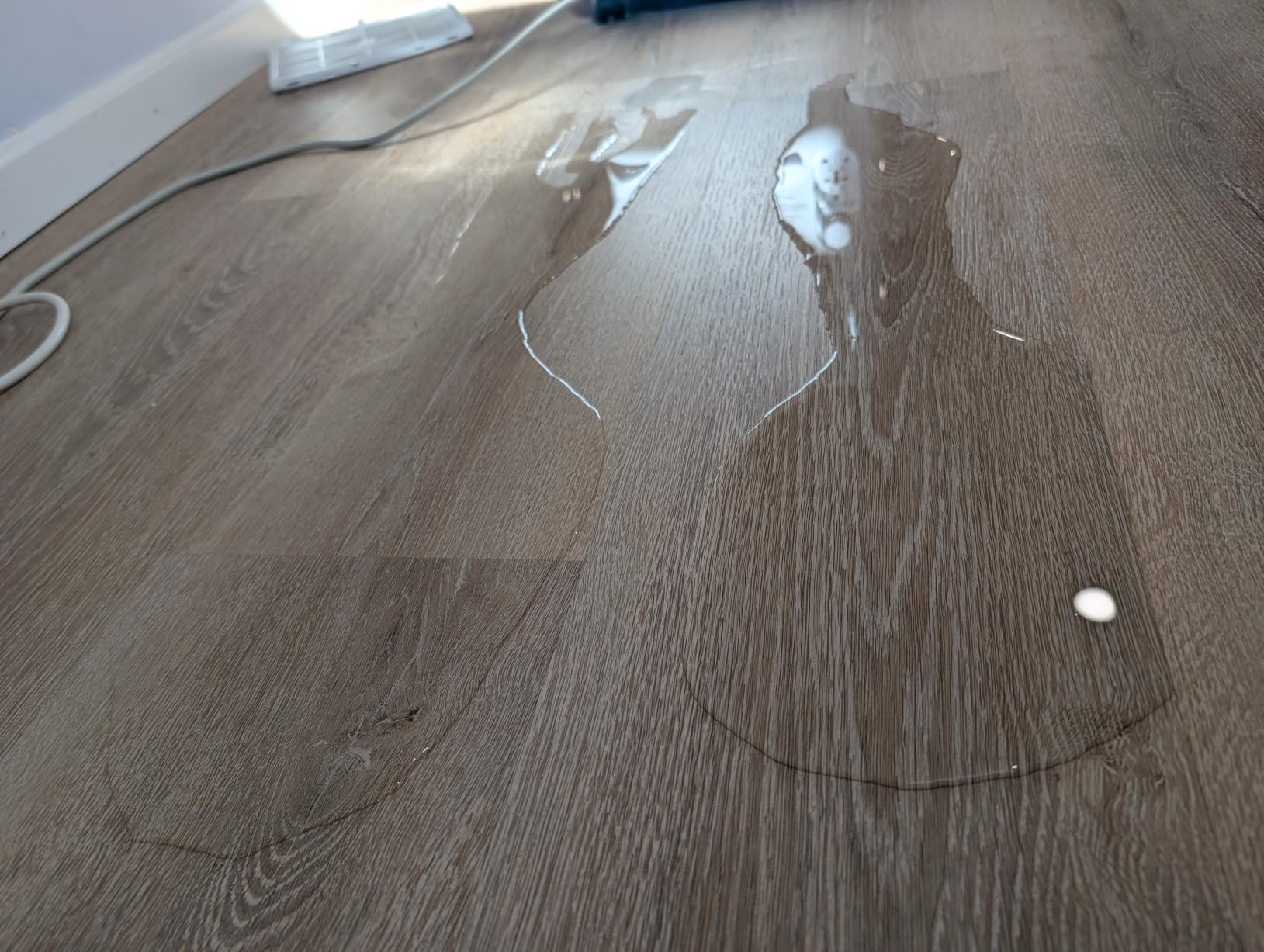
For unattended cabin use, a continuous drain setup is non-negotiable. A full bucket shuts the unit off, and a full bucket you didn’t notice for two weeks turns into the same mold problem you bought the dehumidifier to prevent.
Cold-Weather and Auto-Defrost for Unheated Cabins
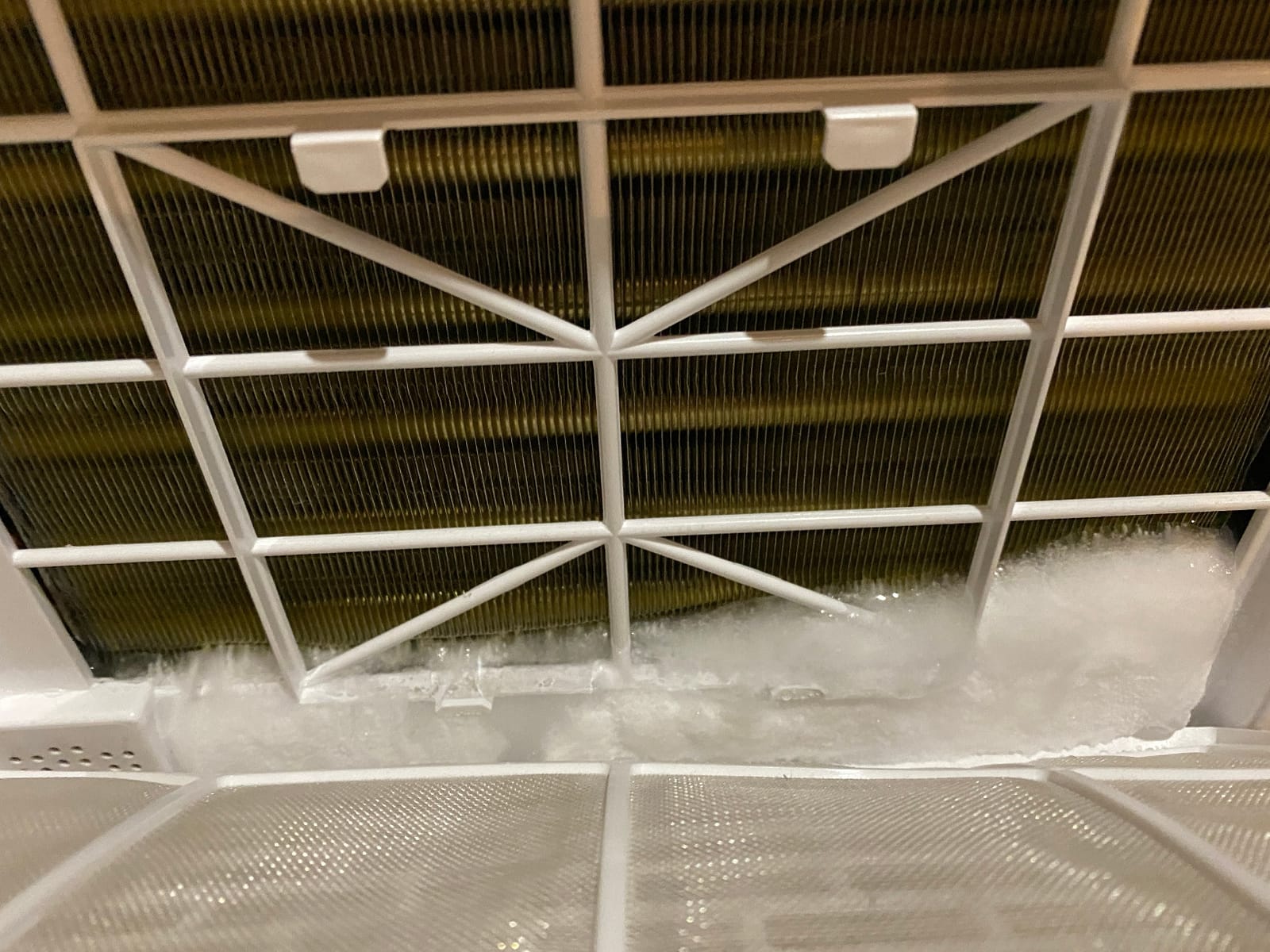
This is the single biggest factor competitors ignore. Cabin coils freeze up below about 65 degrees F, and most compressor dehumidifiers shut down when they detect ice on the coils. Look for an “auto-defrost” or “low-temperature operation” rating. The AEOCKY RHEA-002 and Waykar 80-pint both kept running through chilly spring nights during our team’s testing, which matters if you arrive at the cabin in March or leave it heated at 50 degrees over winter.
Energy Star and Off-Grid Wattage
If your cabin is on grid, Energy Star saves real money over the long run and is worth prioritizing. If your cabin is solar or generator-powered, watts matter more: the Waykar pulls about 270 watts, the hOmeLabs and Midea about 295 watts, the Yaufey about 355 watts, and the AEOCKY about 400 watts at peak. A 1,000-watt inverter can run any of these, but the smaller-wattage units leave more headroom for lights, a fridge, and a small inverter generator charging at the same time.
Noise for Cabin Living Spaces
If the dehumidifier runs in or near a cabin bedroom, aim for 45 dB or lower on low fan speed. The Waykar at 42 dB and the AEOCKY at 44 dB are the quietest compressors in our test group. The Midea 22-pint at 47 dBA is also acceptable, though its Turbo mode is louder. Peltier units like the BEDRED and NineSky are essentially silent because they have no compressor.
For more on setting up a cabin from scratch, our guides to composting toilets for cabins, tankless water heaters for cabins, and cellular security cameras for remote cabins cover the other major systems.
Frequently Asked Questions
What is the best dehumidifier for a damp cabin?
For most cabins, a compressor dehumidifier in the 50- to 80-pint range is the right pick. The AEOCKY RHEA-002 is our top overall choice because it combines ENERGY STAR Most Efficient certification, real auto-defrost for cold spring and fall nights, and a 3-year warranty. For smaller cabins under 1,500 square feet, the hOmeLabs 50-pint with built-in pump is a strong value pick.
Which dehumidifier is best for extreme humidity in a cabin?
For extreme humidity (above 70 percent relative humidity that won’t budge), size up to a 100+ pint unit like the AEOCKY RHEA-002 or Yaufey 120-pint. Larger compressors pull more moisture per day and reach target humidity faster. Pair the unit with a continuous drain hose so the tank never fills up during peak humidity events.
Will a dehumidifier dry out damp wood in a cabin?
A dehumidifier can reduce ambient humidity enough to let surface dampness on wood dry out over days or weeks, but it will not reverse wood rot or structural water damage. For actively wet wood (visible moisture, swelling, or soft spots), you need to address the moisture source first (leak, drainage, vapor barrier) and then run the dehumidifier for several weeks to stabilize the wood moisture content below 15 percent.
Do cabins really need a dehumidifier?
Yes, especially seasonal or closed-up cabins. Cabins that sit unoccupied for weeks trap moisture from cooking, breathing, ground vapor, and outdoor air exchange. That moisture fuels mold, mildew, wood rot, musty odors, and rust on tools. A properly sized dehumidifier run on a continuous drain between visits prevents thousands of dollars in structural and air-quality damage.
Are Peltier dehumidifiers good for cabins?
Peltier (thermoelectric) dehumidifiers like the BEDRED 95OZ and NineSky 95oz are useful only in small enclosed spaces under about 200 square feet, such as a cabin bedroom or bunkhouse. They extract a fraction of what a compressor unit does and cannot handle real cabin damp in a main living area. For any cabin over 300 square feet with visible moisture or musty smell, you need a compressor dehumidifier.
Final Verdict on the Best Dehumidifiers for Damp Cabins
After three months of testing eight dehumidifiers in real cabin conditions, the AEOCKY RHEA-002 stands out as the best dehumidifier for damp cabins overall. Its combination of ENERGY STAR Most Efficient certification, real auto-defrost for cold spring nights, 6,000-square-foot coverage, and a 3-year warranty is unmatched at this tier, and it’s the unit our team would put in our own cabins tomorrow.
For cabin owners who want the best value, the hOmeLabs 50-pint with built-in pump solves the single biggest problem our team ran into: how to empty the bucket when you’re 200 miles away. The pump pushes water vertically up to 16 feet, so you can route the drain out a window and forget about it. For small cabin bedrooms under 200 square feet, the BEDRED 95OZ Peltier is genuinely useful as long as you understand its limits.
Whichever of the best dehumidifiers for damp cabins you choose, set it up with a continuous drain hose or pump before you leave the cabin unattended. A full bucket shuts the unit off, and a full bucket you didn’t notice for two weeks is the same mold problem you bought the dehumidifier to prevent.