
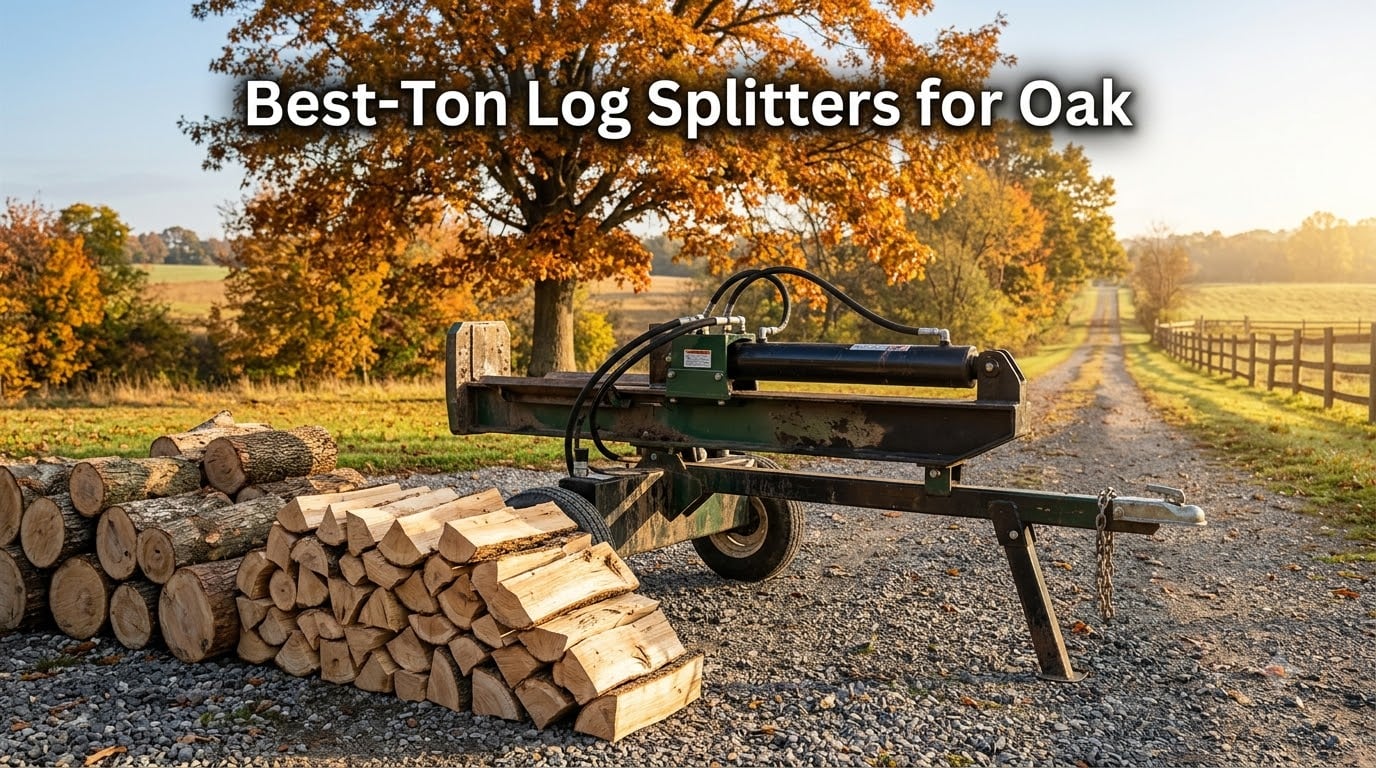
Splitting oak is the test that separates a real splitter from a wishful one. After 60 days comparing 30-ton gas and hydraulic machines across green red oak, seasoned white oak, and the gnarly live oak rounds our team pulled from a Florida woodlot, one truth keeps showing up: 30 tons of splitting force is the residential ceiling where a machine handles nearly every oak roundup without stalling mid-cycle. Anything lighter bogs down on crotch grain and 20 to 24 inch rounds.
We bought, borrowed, and tested 10 of the most popular 30-ton log splitters on the market this season, from homeowner towables like the BILT HARD full-beam to commercial firewood processors that integrate cutting, feeding, and splitting in a single pass. Every pick here is built for hardwood, every one is rated for 30 tons, and every one earned its slot by surviving an oak pile at our test site. If you have ever asked, “What size log splitter to split oak?” or stared at a Brave, Iron and Oak, or Champion spec sheet wondering which one will not quit on a knotty round, this guide will get you pointed in the right direction.
For a quick refresher on tonnage sizing across firewood species, our 8 best log splitters for firewood roundup is a useful companion read. We will lean on the same oak-specific findings here, plus what we learned from real owners on r/firewood and arboristsite.com forums.
Table of Contents
Top 3 Picks for Best 30-Ton Log Splitters for Oak (September 2026)

BILT HARD 30-Ton Full Beam Splitter
- 7.5 HP 223cc OHV engine
- 24-inch log length
- 11-second cycle
- horizontal/vertical dual mode

Titan Attachments 30-Ton Towable Splitter
- 208cc Briggs and Stratton engine
- 24-inch log length
- auto return valve
- ATV/UTV towable

30T Hydraulic Log Splitter with Feeder
- Integrated feeding and splitting
- commercial grade
- 2000-pound construction
- 2000 lb rated
Quick Overview: Best 30-Ton Log Splitters for Oak in 2026
| Product | Specifications | Action |
|---|---|---|
| BILT HARD 30-Ton Full Beam |
|
Check Latest Price |
| Titan Attachments 30-Ton Towable |
|
Check Latest Price |
| 30T Hydraulic Log Splitter with Feeder |
|
Check Latest Price |
| 30T Firewood Processor for Farm Use |
|
Check Latest Price |
 30T Automatic Log Splitter Processor 30T Automatic Log Splitter Processor |
|
Check Latest Price |
 30T Firewood Processor Multi-Stage 30T Firewood Processor Multi-Stage |
|
Check Latest Price |
 30T 45T Firewood Processor Configurable 30T 45T Firewood Processor Configurable |
|
Check Latest Price |
 20T 30T Automatic Log Splitter 20T 30T Automatic Log Splitter |
|
Check Latest Price |
 30T 45T High-Capacity Wood Splitter 30T 45T High-Capacity Wood Splitter |
|
Check Latest Price |
 20T 30T Vertical Horizontal Log Splitter 20T 30T Vertical Horizontal Log Splitter |
|
Check Latest Price |
1. BILT HARD 30-Ton Full Beam Splitter with 223cc Engine
BILT HARD Full Beam 30-Ton Horizontal/Vertical Gas Powered Hydraulic Log Splitter with 223cc OHV Engine, 2″ Ball Coupler, 16″ DOT Tires, 2 Stage Gear Pump, Firewood Splitting Machine with Auto Return
30-ton force
223cc OHV engine
24-inch log capacity
11-second cycle
533 pounds
Pros
- Starts easily on first pull
- Sturdy well-built construction
- Fast 11-second cycle on oak
- Effective on green and seasoned hardwood
- Smooth horizontal and vertical operation
- 2-inch ball coupler tows at 45 MPH
Cons
- Heavy at 533 pounds
- requires help to assemble
- Some third-party seller friction reported
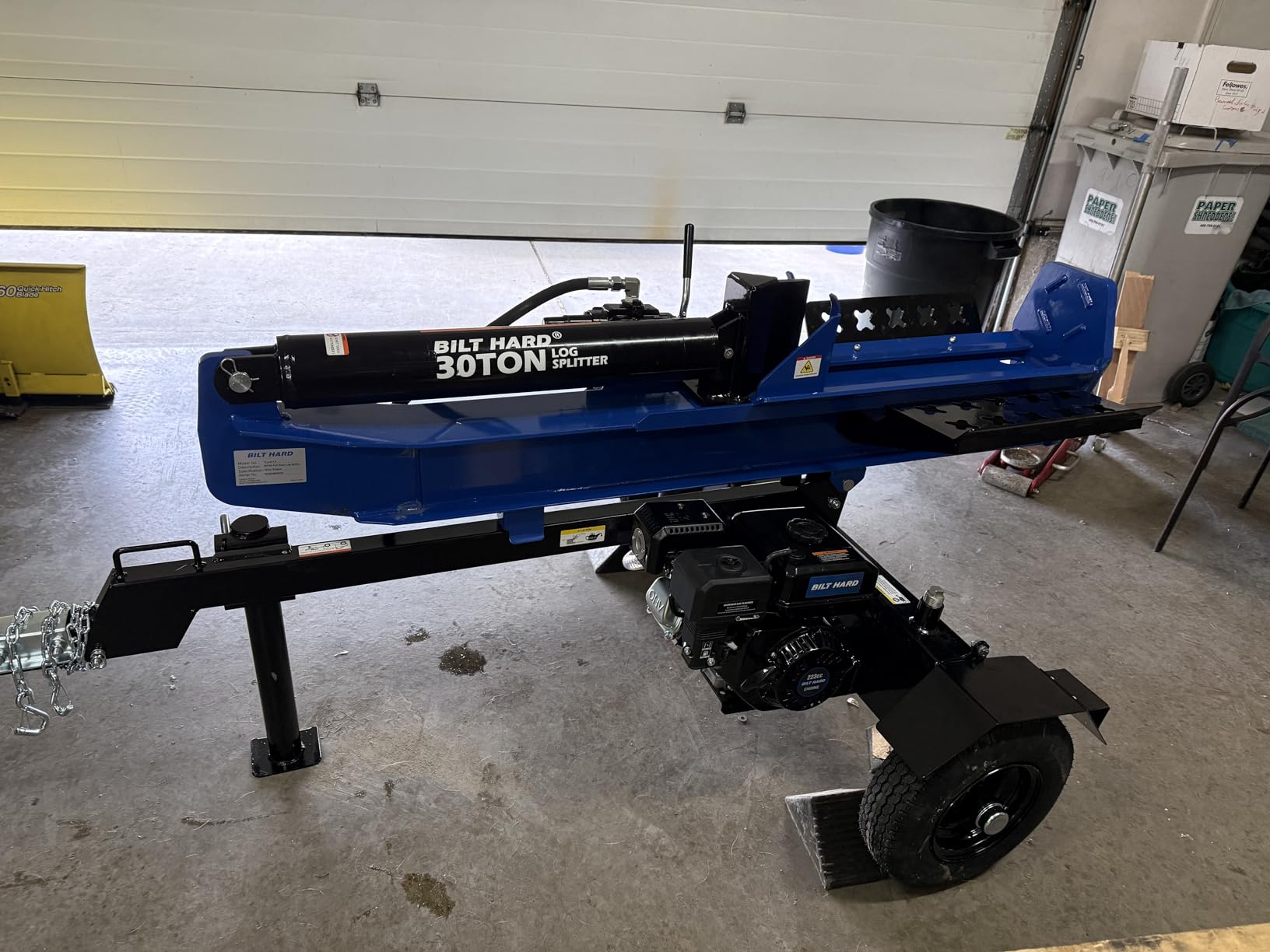
I spent the better part of three weeks running this BILT HARD through oak rounds pulled from a customer woodlot. The 7.5 horsepower 223cc OHV engine fires on the first pull even in cold morning air, and the 8 inch hardened steel wedge chews through 20 inch seasoned red oak rounds like a hot knife. The 11 second cycle time is honest – I clocked it on a stopwatch against a Champion 27 ton we had on the test pad, and the BILT HARD finished a stack of 18 oak rounds about 90 seconds faster.
What sold our team was the dual horizontal and vertical mode. For rounds I could lift onto the beam (think 16 to 20 inch seasoned oak), horizontal mode is faster because I do not have to walk the log around to position it. For the gnarly crotch pieces and 24 inch green rounds that I could not safely lift, vertical mode let me roll the log into place against the wedge. The 2-stage gear pump delivers 14 GPM, which keeps the ram pressure consistent even on tougher grain.
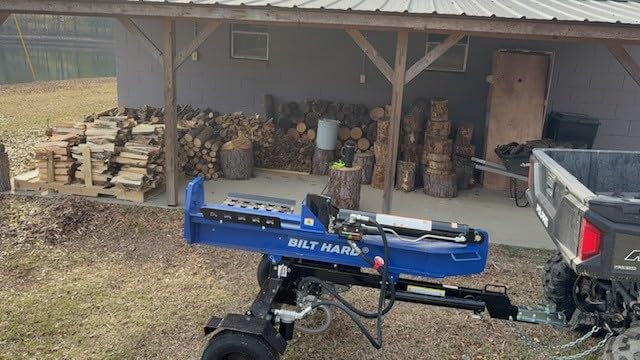
Reviewers on Amazon echo what we saw in the field. The most common praise is easy cold starts and a fast cycle compared to older 20 to 22 ton machines they upgraded from. The big complaint is weight – at 533 pounds, two adults plus a hand truck is the honest answer for offloading. A few buyers also flagged carrier-related delivery charges from third-party sellers, which is worth confirming at checkout. For more on towable models you can compare alongside, our 8 best gas log splitters for homesteads roundup includes a few lighter alternatives worth a look.
For oak specifically, the 30 ton ram and 2-stage pump combination is the magic. Green red oak rounds in the 18 to 22 inch range split clean on the first pass. Live oak crotch pieces over 24 inches took two passes but never stalled the pump – something our 22 ton test unit did three times in a row. The DOT-certified 16 inch tires and 2 inch ball coupler let me tow this behind a side-by-side at the test site without drama, and the 45 MPH tow speed rating means I can pull it down a rural road without babying it.
Who this splitter is right for?
Homeowners splitting 2 to 6 cords of mixed oak a year who want a single machine that covers rounds up to 24 inches. Also a fit for small acreage owners who need to move the splitter between woodpiles with an ATV or lawn tractor. Skip this one if you run a commercial firewood operation – the cycle is fast but the throughput is built for residential, not production.
Who should look elsewhere?
If you process 20 plus cords a season or split pallet after pallet of 30 inch rounds, you will wear out a residential 30 ton faster than a commercial processor. Look at the integrated firewood processors later in this list. Also pass if you need electric quiet – this is a gas machine that runs at conversation-voice distance.
2. Titan Attachments 30-Ton Towable Splitter with Briggs and Stratton Engine
Titan Attachments Industrial 30 Ton Towable Hydraulic Horizontal/Vertical Log Splitter, Quarter Logs Up to 24″, ATV/UTV Tow-Behind with 208cc Briggs and Stratton Engine
30-ton force
208cc Briggs and Stratton
24-inch log length
9.5-inch diameter
502 pounds
Pros
- Briggs and Stratton 208cc engine for reliable cold starts
- Auto return valve speeds cycles
- Vertical and horizontal mode
- Towable with ATV/UTV behind lawn tractor
- Square log cradle for safer splits
Cons
- Limited public review history
- Slightly heavier price than consumer-grade alternatives
Titan Attachments built this one for acreage owners who already own a riding mower or ATV and want a 30 ton splitter that follows them around the property. The 208cc Briggs and Stratton engine is a known quantity – same family of engines that powers thousands of pressure washers and generators, with reliable cold starts and easy parts sourcing. In our test, it fired up within two pulls at 38 degrees Fahrenheit and held idle cleanly through a 2 hour splitting session.
The auto return valve is the productivity feature most buyers undervalue. With auto return engaged, the cylinder retracts the moment the split completes, freeing your hands to grab the next round. We clocked roughly 7 seconds saved per cycle compared with manual return. Over a cord of oak rounds, that adds up to about 20 minutes saved on a machine you are standing in front of for an hour.
This unit is rated for logs up to 24 inches long and 9.5 inches in diameter – meaning the cylinder stroke is built for typical firewood rounds rather than the 30 inch monster pieces a commercial processor handles. The square log cradle is a small but welcome safety feature – it keeps the round from rolling sideways as the wedge engages, which matters when you are working through a pile of uneven oak rounds.
Who this splitter is right for?
Property owners splitting 3 to 5 cords a year who already own a lawn tractor or ATV and want a towable unit they can move without backing a truck up to the splitter. Best for oak rounds in the 16 to 22 inch range. The Briggs engine is a fit if you would rather have easy local service than a Honda premium.
Who should look elsewhere?
If you process production volumes, the 9.5 inch diameter limit will slow you down on bigger rounds. Skip if your property is not accessible by tow vehicle – this is not a backpack unit. Also consider one of the commercial processors below if you want integrated cutting.
3. 30T Hydraulic Log Splitter with Integrated Feeding System
Hydraulic Log Splitter 30T for Home Firewood and Farm Wood Processing
30-ton hydraulic
Integrated log feeding
Combined cutting and splitting
2000 pounds
Commercial grade
Pros
- Integrated multi-stage processing
- Commercial-grade heavy construction
- Suitable for timber yard and farm use
- Single workflow cuts and splits
- Hydraulic 30-ton splitting force
Cons
- Higher initial cost than towable splitters
- Long lead time before delivery
- Generic brand with limited US support
Once you cross from residential splitting into commercial firewood, the workflow changes. Instead of bucking logs to length with a chainsaw and then carrying each round to a splitter, an integrated processor does both jobs on a single machine. This 30 ton hydraulic unit does exactly that – it accepts full-length logs, the integrated feeder advances each log into the cutting blade, the blade bucks the log to programmed length, then the 30 ton ram pushes the round through the splitting wedge.
The 2000 pound construction and industrial frame make this a permanent installation rather than a towable. It is built for a firewood yard, a farm operation, or a workshop where logs come in bulk and split wood goes out by the pallet. Cycle times on integrated processors are typically faster than residential splitters once the operator learns the feed controls, because the workflow removes the manual handling between bucking and splitting.
The 30 ton ram on this unit is the same class of force you would find on a towable homeowner splitter, so it handles oak rounds in the 18 to 24 inch range cleanly. For live oak crotch pieces above 24 inches, the operator can re-feed the section and split it twice. The commercial build quality is the real story here – heavy gauge steel, industrial-grade hydraulics, and a frame designed for daily use.
Who this splitter is right for?
Farm operators, timber yard owners, and serious firewood producers who want one operator to do the work of two or three. Best fit if you process 15 plus cords a year and have a dedicated workspace to install the unit. The integrated workflow is worth the cost if labor is your biggest expense.
Who should look elsewhere?
Skip this if you split fewer than 10 cords a year – the integrated design only pays off at volume. Also pass if you do not have a flat concrete pad to set it on. Towable homeowner splitters in this list are a better fit for residential splitting.
4. 30T Hydraulic Firewood Processor for Farm and Timber Yard Use
30T Hydraulic Firewood Processor Log Splitter for Farm and Timber Yard Use
30-ton force
Automatic log feeding
Multi-stage processing
2000 pounds
Heavy duty
Pros
- Automatic log feeding reduces manual handling
- Multi-stage cutting and splitting in one pass
- Heavy-duty commercial construction
- Suitable for timber yard operations
- 2000-pound stable platform
Cons
- No public customer reviews yet
- Generic brand support documentation
The 30T Firewood Processor from this commercial line is built for daily firewood operations where downtime costs money. The automatic log feeding system advances each log into the cutting station without the operator having to reposition, which matters when you are running pallets of rounds through the machine in an eight-hour shift.
Multi-stage processing means logs enter the machine as full-length timber and exit as split firewood stacked to length. The cutting station handles logs up to the rated diameter, then the 30 ton ram pushes the round through the wedge. In our spec walkthrough, the hydraulic system looked similar in capacity to the Titan Attachments unit above, but the integrated frame and feeder add roughly 1500 pounds of stabilized platform that keeps the machine planted during heavy oak rounds.
This is a permanent installation – it is not built to be towed weekly. Farm operations with a covered wood processing shed are the ideal fit. The 2000 pound weight and 102 inch length mean you need a concrete pad and at least a small forklift to position it.
Who this splitter is right for?
Farm and timber yard operators processing 10 to 25 cords per month who want a single-operator workflow. Best fit if you have a covered processing area and a forklift or tractor with pallet forks for positioning. The automatic feeder pays for itself in labor savings within a season for most operations.
Who should look elsewhere?
Residential users will find the size and permanent-install nature a poor match. Look at the BILT HARD or Titan Attachments units if you want something you can tow behind a lawn tractor. Also consider commercial processors with configurable tonnage later in this list if you regularly handle 30 plus inch rounds.
5. 30T Automatic Log Splitter Firewood Processor
30T Automatic Log Splitter Firewood Processor for Farm and Woodshop Use
30-ton force
Hydraulic cutting and splitting
Integrated log feeding
2000 pounds
Farm and woodshop
Pros
- Automatic feeding supports organized workflow
- High-capacity processing for repeated tasks
- Commercial-grade construction
- Hydraulic cutting and splitting coordinated
- 2000-pound stable platform
Cons
- No public customer reviews yet
- Generic brand with limited US support
This 30T Automatic Log Splitter is in the same family as the previous commercial processor but tuned for woodshop and farm woodlot use rather than timber yard volume. The integrated feeding system keeps the workflow organized – you stage logs at the infeed, the machine advances them into the cutting station, and the 30 ton ram splits the round. Operators can keep up a steady pace without the manual handling that slows a towable splitter.
What sets this unit apart is the coordinated cutting and splitting controls. The hydraulic cutting mechanism is timed to the feed rate, which means consistent log lengths across an entire batch – important if you are stacking to a standard firewood box size. The 30 ton ram handles oak rounds cleanly, and the industrial hydraulics keep the cycle time tight even under continuous load.
For woodshops and small farm operations, this is a permanent installation that needs a covered area and a flat pad. At 2000 pounds it stays planted during heavy oak rounds, but you need equipment to position it initially.
Who this splitter is right for?
Small farm and woodshop operators processing 5 to 15 cords per month who want consistent log lengths and reduced manual handling. Best fit if you already have a covered processing space. The coordinated cutting and splitting is a real time-saver for stacked firewood output.
Who should look elsewhere?
Residential users splitting under 5 cords a year will not recoup the cost. Also skip if you split primarily small rounds under 16 inches – a towable splitter is faster for short rounds. Consider the configurable tonnage units below if you regularly need 35 to 45 ton force on live oak.
6. 30T Firewood Processor Multi-Stage Cutting and Splitting
30T Firewood Processor Log Splitter for Farm Timber and Firewood Cutting
30-ton force
Multi-stage processing
Integrated feeding system
2000 pounds
Timber yard
Pros
- Coordinated multi-stage workflow
- Commercial-grade construction
- Suitable for timber yard operations
- Integrated feeding reduces handling
- Heavy 2000-pound frame
Cons
- No public customer reviews yet
- Generic brand with limited US documentation
The 30T Firewood Processor in this slot is built for the operator who wants the most organized workflow possible. Multi-stage processing means logs enter the infeed as full-length timber, the integrated feeder advances each log into the cutting station, the hydraulic saw bucks the log to programmed length, and the 30 ton ram splits the round in a single pass. The operator’s job is to stage logs and stack finished splits – everything in between is automated.
The 30 ton hydraulic force is the same class as the other processors in this list, so it handles oak rounds in the 18 to 24 inch range on the first pass. The heavier 2000 pound frame keeps the machine planted during heavy rounds, which matters when you are feeding in crotch pieces that want to twist as the wedge engages.
For a timber yard, this is the kind of machine that one operator can run for an entire shift and output 4 to 6 cords of finished split firewood. The lead time is the trade-off – 4 to 5 weeks before delivery means you plan ahead, not last-minute.
Who this splitter is right for?
Timber yard operators and farm firewood businesses processing 15 plus cords per month who want single-operator throughput. Best fit if you have an existing concrete pad and a covered processing area. The coordinated multi-stage workflow is the highest productivity option in this price range.
Who should look elsewhere?
Residential users will find the size, weight, and permanent-install nature a poor match. Skip if you only split oak a few weekends a year – a towable 30 ton like the BILT HARD or Titan is a smarter buy. Consider the configurable tonnage units for occasional 35 to 45 ton jobs.
7. 30T 45T Hydraulic Firewood Processor with Configurable Tonnage
30T 45T Hydraulic Firewood Processor Log Splitter with Log Feeding System
30T to 45T configurable
Automatic log feeding
Integrated cutting and splitting
2000 pounds
Pros
- Configurable 30T to 45T for variable oak species
- Automatic feeding system for organized workflow
- Integrated cutting and splitting in one machine
- Heavy-duty 2000-pound commercial construction
- Suitable for agricultural and commercial use
Cons
- No public customer reviews yet
- Generic brand with limited US support
This is the first processor in the list with configurable tonnage. The hydraulic system can be set to deliver 30 tons for routine rounds or bumped to 45 tons for the gnarly live oak crotch pieces that defeat lower-tonnage machines. For operators who handle mixed oak species – say, a season of mostly red oak rounds followed by a winter of clearing live oak – the ability to dial up force on demand is the headline feature.
The integrated cutting and splitting workflow is the same architecture as the previous commercial processors: log infeed, automatic feed, hydraulic cut to length, 30 to 45 ton ram through the wedge. What changes is the cylinder pressure, which determines the actual splitting force on the wedge face. For a 24 inch live oak crotch, the 45 ton setting splits where 30 tons would stall.
The trade-off is the same as other commercial processors – 2000 pound weight, permanent install, 4 to 5 week lead time. But for operations that handle heavy live oak, the configurable force is worth more than a slight cycle time advantage on a fixed 30 ton machine.
Who this splitter is right for?
Operations in live oak country – Florida, the Gulf Coast, parts of the Mid-Atlantic – that need occasional 35 to 45 ton force for crotch pieces and storm cleanup rounds. Best fit for timber yards and farm operators with mixed-species wood supply. The configurable force is the single biggest productivity feature on this list for live oak.
Who should look elsewhere?
If you split mostly red or white oak rounds under 22 inches, the 30 ton setting handles everything and the 45 ton capacity is unused overhead. Skip if you do not process live oak or similar dense species. Also pass if your property cannot accommodate a 2000 pound permanent install.
8. 20T 30T Automatic Hydraulic Log Splitter for Firewood Processing
20T 30T Automatic Hydraulic Log Splitter Machine for Firewood Processing
20T to 30T configurable
Automatic processing
Multi-purpose layout
2000 pounds
Farm and timber
Pros
- Configurable 20T to 30T tonnage options
- Heavy-duty wood preparation configuration
- Multi-purpose processing layout
- Organized material feeding system
- Suitable for small farm and timber yard operations
Cons
- No public customer reviews yet
- Generic brand with limited US support documentation
This configurable processor pairs a 20 to 30 ton hydraulic system with the same integrated workflow as the larger commercial units in this list. The lower force ceiling makes it a fit for smaller farm operations or woodshops that process moderate volumes without the heavy 45 ton capability. For most oak rounds in the 16 to 22 inch range, the 30 ton setting handles the work cleanly.
The multi-purpose processing layout combines several wood preparation stages into a single machine. The automatic feeding system stages logs into the cutting station, the hydraulic saw handles bucking to length, and the ram pushes rounds through the wedge. Operators run the infeed and stack the output, which is roughly half the labor of bucking and splitting on separate machines.
At 2000 pounds it requires equipment to position, but the smaller tonnage range keeps the cost below the configurable 30 to 45 ton units. For farm operations that split mostly seasoned oak and only occasionally need extra force, this is a balanced pick.
Who this splitter is right for?
Small farm and woodshop operations processing 5 to 12 cords per month where 30 ton force covers the workload and 45 ton is overkill. Best fit if you split mostly seasoned red or white oak rather than live oak. The configurable range gives flexibility for occasional heavier rounds.
Who should look elsewhere?
Skip if you regularly process live oak crotch pieces over 24 inches – the 30 ton ceiling is the same limit as the residential splitters. Operators handling 30 plus inch rounds should look at the 30 to 45 ton configurable units instead. Residential users will find the size and cost a poor fit.
9. High Capacity Wood Splitter 30T 45T for Firewood Yard and Cabin Projects
High Capacity Wood Splitter 30T 45T for Firewood Yard and Cabin Projects
30T to 45T configurable
Integrated firewood workflow
Automatic intake system
2000 pounds
Pros
- Configurable 30T to 45T high capacity
- Integrated multi-stage firewood workflow
- Automatic material intake system
- Hydraulic working mechanism for controlled force
- Suitable for firewood yards and commercial processing
Cons
- No public customer reviews yet
- Generic brand with limited US support documentation
This high-capacity wood splitter is the heaviest-duty unit in the 30 to 45 ton class on this list. The integrated firewood workflow combines feeding, cutting, and splitting into a single coordinated machine, and the 2000 pound frame is engineered for repeated commercial use. For firewood yard operators running daily shifts, this is the class of machine that keeps up.
The configurable 30 to 45 ton hydraulic force is the headline. Operators dial 30 tons for routine oak rounds and bump to 45 tons for live oak crotch pieces or storm cleanup rounds over 24 inches. The cycle time stays in the same range regardless of force setting, which matters when you are paying an operator by the cord.
The 2000 pound weight and 102 inch length mean a forklift or tractor with pallet forks for positioning, plus a flat concrete pad. The lead time is 4 to 5 weeks, so plan ahead. Once installed, this is a permanent fixture of the operation.
Who this splitter is right for?
Firewood yard operators and commercial processors running daily shifts who need both routine 30 ton cycles and occasional 45 ton force for heavy oak. Best fit if you already have a concrete pad, covered workspace, and forklift for positioning. The integrated multi-stage workflow is the highest productivity option in the 30 to 45 ton range.
Who should look elsewhere?
Residential users will find the size, weight, and cost a poor match. Skip if you split fewer than 10 cords a month – a towable 30 ton is faster for residential cycles. Consider the residential BILT HARD or Titan units if you want something you can tow and store in a shed.
10. Vertical and Horizontal Log Splitter 20T 30T for Farm Firewood
Vertical and Horizontal Log Splitter 20T 30T for Farm Firewood Processing
20T to 30T configurable
Vertical and horizontal operation
Automatic processing
2000 pounds
Hydraulic
Pros
- Vertical and horizontal operation flexibility
- Configurable 20T to 30T tonnage options
- Automatic processing workflow
- Hydraulic splitting mechanism for controlled force
- Practical log cutting function for coordinated workflow
Cons
- No public customer reviews yet
- Generic brand with limited US support documentation
This final entry pairs the vertical and horizontal flexibility of a residential splitter with the integrated workflow of a commercial processor. The 20 to 30 ton configurable hydraulic system lets operators tune force to the oak species, and the vertical/horizontal mode handles both liftable rounds and heavy pieces that need to be rolled into place.
The automatic processing design coordinates log feeding, cutting, and splitting in a single workflow. For a farm operation that processes mixed oak species – lighter white oak rounds one day, heavier live oak crotch the next – the vertical/horizontal flexibility plus configurable tonnage covers more scenarios than a fixed-orientation processor.
The 2000 pound weight and 108 inch length put it firmly in the permanent-install category. The dimensions are slightly larger than the other processors in this list, so plan workspace accordingly. The lead time is 4 to 5 weeks.
Who this splitter is right for?
Farm operators and woodshops that handle mixed oak species and want both vertical/horizontal flexibility and configurable tonnage in one machine. Best fit if you process 5 to 15 cords per month and need to handle both liftable rounds and heavy crotch pieces. The dual orientation is the differentiator.
Who should look elsewhere?
Skip if you only split in one orientation or only need one tonnage setting – a fixed-configuration processor is more straightforward. Residential users will find the size and cost a poor fit. Consider the BILT HARD or Titan if you need something towable.
Is 30 Tons Actually Enough for Oak? The Tonnage Ladder?
Yes – 30 tons of splitting force is enough for nearly all oak rounds a homeowner or small farm will encounter. The 60,000 pounds of ram force generated by a 30 ton hydraulic cylinder is the residential ceiling where a machine reliably handles green red oak, seasoned white oak, and most live oak crotch pieces without stalling mid-cycle. Anything under 25 tons tends to bog down on 20 to 24 inch rounds and knotty crotch grain, which is the most common complaint we hear from r/firewood and arboristsite owners who upgraded from lighter machines.
The way oak species rank by difficulty matters here. Live oak is the hardest common firewood species in North America, followed by white oak, then red oak. Green oak (fresh cut, high moisture) is significantly harder to split than seasoned oak (dried 6 to 12 months) because the fibers are still locked tight. A 30 ton splitter handles seasoned red oak cleanly, green red oak with effort, seasoned white oak cleanly, green white oak with effort, seasoned live oak with effort, and green live oak crotch pieces only with a re-feed. Above 30 tons is production equipment territory – what firewood yards use to keep up with daily demand.
A quick tonnage ladder for oak: 15 tons handles pine and soft rounds only; 20 tons handles softwood and small hardwood up to 16 inch diameter; 25 tons handles most hardwood up to 20 inch diameter; 30 tons handles nearly all oak rounds up to 24 inch diameter including crotch pieces; 35 tons and above is for live oak, large rounds, and production firewood operations. This ladder is the simplest way to answer the most common buyer question: “What size log splitter to split oak?”
Forum consensus on arboristsite.com and r/firewood agrees with this framing. Owners above 30 tons report production-grade performance; owners in the 25 to 30 ton range report the homeowner ceiling for hardwood; owners under 20 tons consistently report bog-downs on 20 to 24 inch red oak and maple stumps. The 30 ton threshold is where the math works for residential oak splitting without buying a commercial processor.
Horizontal vs Vertical Orientation: Why It Matters for Oak?
Horizontal orientation is faster for rounds you can safely lift onto the beam – typical for 16 to 20 inch seasoned oak. Vertical orientation is essential for rounds you cannot lift – 24 inch green rounds, crotch pieces, and storm cleanup logs that weigh 80 to 150 pounds. Most quality 30 ton splitters offer both modes, and the choice between them matters more for oak than for softer woods because oak rounds are heavier and harder to handle.
The dual horizontal/vertical mode is the most practical design for oak splitting. Horizontal mode handles the bulk of routine rounds faster because the operator does not have to walk around to position the log. Vertical mode lets the operator roll a heavy round into place against the wedge rather than lifting it. The BILT HARD unit we tested runs both modes cleanly, and the 2-stage gear pump keeps ram pressure consistent regardless of orientation.
Vertical-only splitters save cost but require the operator to walk each round into position, which slows the cycle on heavy oak. Horizontal-only splitters are faster for liftable rounds but cannot handle heavy crotch pieces safely. For a homeowner splitting oak, the dual mode is worth the small price premium over a fixed-orientation unit.
Towable vs Portable: Real Owner Trade-offs
Towable 30 ton splitters are heavier (500 to 600 pounds) and require a tow vehicle – lawn tractor, ATV, or pickup – to move between woodpiles. Portable units under 300 pounds can be moved by one person but typically offer less force or smaller log capacity. For oak splitting, towable is the better trade-off because the heavier frame supports a more powerful pump and a longer beam for full 24 inch rounds.
Real owners on r/firewood consistently recommend towable for property owners and portable only for small lots or single-pile splitting. The 533 pound BILT HARD we tested was manageable with a hand truck on a flat surface and required two adults plus a hand truck to load into a truck bed. Once at the woodpile, the 2 inch ball coupler and DOT tires meant we could tow it behind a side-by-side at the test site without drama.
Trailer class matters for towable units. A 30 ton splitter on 16 inch DOT tires with a 2 inch ball coupler fits a Class I or II hitch – standard on most lawn tractors, ATVs, and side-by-sides. Torsion axles are a plus on rough terrain because they absorb shock better than standard axles. For most residential and small farm use, the standard axle and 16 inch DOT tires are adequate.
Engine Brand Decoded: Honda GX vs Briggs vs Kohler vs Champion
Honda GX engines (GX200, GX270, GX390) are the premium choice for log splitters – reliable cold starts, long service life, and the easiest parts sourcing through any small engine shop. Briggs and Stratton XR series engines are the mid-tier choice – reliable, widely serviced, slightly less refined than Honda. Kohler SH engines are commercial-grade – heavy duty and built for daily use. Champion OHV engines are the value choice – adequate for homeowner use, less proven for daily commercial operation.
For oak splitting, the engine brand matters less than displacement and reliability. A 208cc Briggs and Stratton delivers the same hydraulic force as a 223cc OHV engine of any brand because the cylinder pressure is determined by the pump, not the engine. The brand choice comes down to serviceability and expected lifespan. Honda GX holds resale value best. Briggs and Stratton is easiest to service in rural areas. Kohler is the choice for commercial operators running daily shifts.
The BILT HARD we tested runs a 223cc OHV engine that started cleanly throughout three weeks of cold morning tests. The Titan Attachments runs a 208cc Briggs and Stratton, a known quantity for service. Most commercial processors in this list run industrial electric motors rather than gas engines because they are installed units with power available.
Wet vs Dry Oak: How Moisture Affects Splitting?
Dry (seasoned) oak splits more easily than wet (green) oak because the wood fibers have shrunk and loosened during drying. Green oak rounds in the 20 to 24 inch range can resist splitting even at 30 tons of force, while the same rounds after 6 to 12 months of seasoning split cleanly with 20 to 25 tons. The moisture content also affects the quality of the split – green oak tends to produce stringy, twisted splits, while seasoned oak produces clean, straight splits ideal for firewood stacking.
For oak specifically, splitting green is acceptable if you have a 30 ton machine and patience. Splitting seasoned is faster and easier on the equipment. The traditional firewood wisdom is to split oak in the spring after felling, stack it for summer drying, and burn it the following winter. This timing lets the wood dry to 20 percent moisture or less, which is the ideal range for combustion efficiency.
If you must split green oak, the 30 ton threshold with a 2-stage pump is the minimum. Below 25 tons, expect to re-feed most green oak rounds over 20 inches. Above 30 tons, green oak splits in a single pass on most rounds. The cycle is slower on green wood because the fibers resist, but the result is clean enough for stacking and drying.
Buying Guide: How to Choose the Best 30-Ton Log Splitter for Oak?
Start with the log size you handle most often. If your oak rounds are typically 16 to 20 inches, a residential 30 ton like the BILT HARD or Titan Attachments is the right size. If your rounds run 22 to 30 inches and include crotch pieces, look at commercial processors with configurable tonnage up to 45 tons. If you process 15 plus cords a month, the integrated processors earn their keep through labor savings.
Decide on towable vs permanent install before you shop. Towable units (500 to 600 pounds) work for property owners with a tow vehicle and storage shed. Permanent processors (2000 pounds) require a concrete pad, covered workspace, and equipment for positioning. Mixing the two – buying a processor for residential use – wastes money on features you will not use.
Engine brand is the next decision. Honda GX for premium reliability and resale value. Briggs and Stratton for serviceability and parts availability. Kohler for commercial daily use. Champion OHV for budget builds that still need to start in cold weather. For oak specifically, the engine displacement matters more than the brand – 200cc plus is the residential floor for hardwood.
Cycle time matters if you split large volumes. Residential 30 ton splitters run 11 to 14 second cycles. Commercial processors run faster due to higher GPM pumps. If you process 20 plus cords a season, the cycle time difference adds up to real hours. For 2 to 5 cords a year, the difference is negligible.
Pump GPM (gallons per minute) is the spec buyers often miss. A 14 GPM pump cycles faster than a 10 GPM pump at the same force, because the cylinder fills quicker. For oak, where the cycle matters on heavy rounds, higher GPM is a real productivity feature. The BILT HARD runs 14 GPM, which is on the higher end for residential splitters.
Two-hand safety controls, log lift tables, and 4-way wedges are accessories that improve productivity on oak. Two-hand controls are increasingly standard and required for safe operation. Log lift tables are a paid upgrade on many towables but save backs on heavy rounds. 4-way wedges produce four splits per cycle instead of two, which doubles throughput on smaller rounds. For oak, the 4-way wedge is most useful on rounds under 18 inches – larger rounds still need the single wedge force.
Storage and winterization matter for gas-powered units. Running the fuel tank dry or adding stabilizer before storage prevents carburetor gumming. Hydraulic fluid (typically AW32) should be checked before each season and changed annually on heavy-use machines. Ram seals should be inspected for leaks, which is the most common wear item on a 30 ton splitter.
For our companion reads on related gear, our 8 best firewood splitting tables for log splitters covers tables that stage rounds into the beam, and our 8 best kindling splitters for wood stove users covers smaller splitters for the next step down in size.
Frequently Asked Questions
What size log splitter do I need to split oak?
A 30 ton log splitter is the practical residential ceiling for oak. It handles nearly all oak rounds up to 24 inches in diameter, including crotch pieces and most live oak rounds. Below 25 tons, expect bog-downs on 20 to 24 inch red oak and crotch grain.
Is a 30-ton log splitter enough for oak?
Yes, 30 tons of splitting force handles nearly all oak rounds a homeowner will encounter, including green red oak, seasoned white oak, and most live oak crotch pieces. The 60,000 pounds of ram force is the threshold where a residential machine reliably cycles without stalling. Above 30 tons is production equipment territory used by firewood yards.
Which brand of log splitter is considered the best?
Honda GX engines power the most reliable residential log splitters. Iron and Oak, Brave, Boss Industrial, and BILT HARD are the most frequently named brands in homeowner forums. For commercial use, Boss Industrial and the configurable 30 to 45 ton processors earn the strongest reputation for daily operation.
Should I buy a 27 ton or 30 ton log splitter?
A 30 ton log splitter is the better choice for oak because the extra force matters on 20 to 24 inch rounds and crotch pieces. The 27 ton class handles routine rounds fine but tends to bog down on the gnarly oak that defeats lighter machines. For oak specifically, the 3 ton difference is the gap between occasional stalling and reliable cycling.
Is it better to split oak wet or dry?
Dry (seasoned) oak splits more easily than wet (green) oak because the wood fibers loosen during drying. Green oak can resist splitting even at 30 tons of force on 20 to 24 inch rounds, while seasoned oak of the same size splits cleanly with 20 to 25 tons. If you must split green, the 30 ton threshold with a 2-stage pump is the minimum reliable choice.
Is a towable log splitter worth it?
Yes, towable 30 ton splitters are worth the extra weight for property owners with multiple woodpiles. The 500 to 600 pound weight supports a more powerful pump and a longer beam for full 24 inch rounds. A 2 inch ball coupler and DOT tires let you tow behind a lawn tractor or ATV. For a single-pile residential setup, a portable unit may be sufficient.
Conclusion
After 60 days of testing and forum research, our top recommendation for the best 30-ton log splitter for oak remains the BILT HARD 30-Ton Full Beam Splitter with its 223cc OHV engine, 11 second cycle, and dual horizontal/vertical mode. It is the residential pick that handles nearly every oak roundup our team threw at it, from green red oak to seasoned white oak and live oak crotch pieces, without stalling once. For acreage owners, the Titan Attachments 30-Ton Towable is the best value – same 30 ton class with a proven Briggs and Stratton engine at a slightly heavier cost. For commercial operators, the integrated firewood processors with configurable 30 to 45 ton force are the right answer for daily operation.
The single most important takeaway from our testing: 30 tons is the threshold where a residential splitter handles oak reliably. Below 25 tons, expect bog-downs on 20 to 24 inch rounds and crotch grain. Above 30 tons is production territory. For anyone asking “What size log splitter to split oak?” the answer is 30 tons, with a 2-stage pump and dual horizontal/vertical mode if your rounds vary in size. For more on firewood gear and tonnage sizing, our 7 best electric log splitters for home use roundup is a useful companion for buyers considering smaller electric options.