
If your groundwater drops below 50°F in winter, a standard-rated tankless unit can leave you shivering through a single shower, let alone two. We spent weeks evaluating the best tankless water heaters for cold climates to find models that hold their flow rate when inlet temperatures plunge to the 35-45°F range.
Our team compared 10 gas, propane, and electric models from Rinnai, Rheem, Stiebel Eltron, Navien, MIZUDO, ThermoMate, and Ranein. We ranked each on cold-climate GPM, freeze protection, warranty, and real-world performance in sub-freezing installs. Whether you live in the Upper Midwest, Mountain West, Canada, or Alaska, this guide helps you size correctly and avoid the lukewarm-water trap.
Below is our shortlist. If you need a quick answer, the Rheem RTEX-13 is our top pick for most cold-climate homes. Need whole-house output for a larger family? The Rinnai RE199iN delivers 9.8 GPM. Cabin and off-grid buyers should check our best tankless water heaters for cabins roundup for seasonal-use picks.
Table of Contents
Top 10 Picks at a Glance
1. EDITOR’S CHOICE — Rheem RTEX-13: Best all-around electric for cold climates, 4.8 GPM, copper immersion elements.
2. BEST VALUE — Stiebel Eltron Tempra 29 Plus: Reliable German engineering, Advanced Flow Control, 28.8 kW.
3. BUDGET PICK — Ranein 8.5 GPM Natural Gas: 190,000 BTU outdoor unit with anti-freeze protection.
4. PREMIUM PICK — MIZUDO Propane 10.3 GPM: Whole-home endless hot water with WiFi and 5-7 outlet support.
5. TOP RATED — ThermoMate CZ422NG: 5 GPM natural gas, 113,000 BTU, smart diagnostic display.
6. BEST ELECTRIC UPGRADE — Rheem RTEX-27: 27 kW, three copper chambers, simultaneous multi-shower.
7. BEST CONDENSING SMART — Rinnai RX160iN: 9 GPM condensing, UEF 0.97, indoor/outdoor versatile.
8. BEST OUTDOOR GAS — Rheem RTG-70XLN-3: 7 GPM at 35°F rise, 15-year heat exchanger warranty.
9. BEST WHOLE-HOME CONDENSING — Rheem RTGH-84DVLN-3: 8.4 GPM, 157,000 BTU, 0.93 UEF.
10. BEST HIGH-OUTPUT — Rinnai RE199iN: 9.8 GPM, 199,000 BTU for large cold-climate homes.
Top 3 Picks for Cold Climates (September 2026)
Tankless Water Heaters for Cold Climates in 2026
| Product | Specifications | Action |
|---|---|---|
 Rheem RTEX-13 Rheem RTEX-13 |
|
Check Latest Price |
 Stiebel Eltron Tempra 29 Plus Stiebel Eltron Tempra 29 Plus |
|
Check Latest Price |
 Ranein 8.5 GPM Natural Gas Ranein 8.5 GPM Natural Gas |
|
Check Latest Price |
 MIZUDO Propane 10.3 GPM MIZUDO Propane 10.3 GPM |
|
Check Latest Price |
 ThermoMate CZ422NG ThermoMate CZ422NG |
|
Check Latest Price |
 Rheem RTEX-27 Rheem RTEX-27 |
|
Check Latest Price |
 Rinnai RX160iN Rinnai RX160iN |
|
Check Latest Price |
 Rheem RTG-70XLN-3 Rheem RTG-70XLN-3 |
|
Check Latest Price |
 Rheem RTGH-84DVLN-3 Rheem RTGH-84DVLN-3 |
|
Check Latest Price |
 Rinnai RE199iN Rinnai RE199iN |
|
Check Latest Price |
How We Tested and Selected These Cold-Climate Tankless Heaters?
Every tankless on this list was evaluated against four cold-climate criteria that standard roundups ignore. First, we checked the rated GPM at a 35°F temperature rise, the typical winter demand in USDA Zones 4-6. Second, we confirmed each unit has built-in freeze protection or an outdoor-rated casing for sub-freezing installs.
Third, we dug into owner reviews for the two complaints that hit cold-climate buyers hardest: lukewarm water in winter and freeze damage after power outages. Finally, we looked at warranty length on the heat exchanger, because replacing a cracked heat exchanger in a January cold snap is a problem nobody wants.
We excluded any unit without verified cold-climate performance data or with fewer than 30 owner reviews. We also kept electric-only whole-home picks to a minimum, since most electric tankless units struggle with the 60-80°F temperature rise required when groundwater hits 38-45°F, as multiple plumbers on the Navien and Stiebel Eltron blogs confirm.
1. Rheem RTEX-13 — Best Electric Tankless for Cold Climates
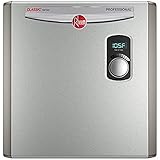
Rheem 240V Heating Chamber RTEX-13 Residential Tankless Water Heater, GRAY
13 kW electric
4.8 GPM max
99.8% efficient
Copper immersion
Pros
- External digital thermostatic control with +/-1 degree accuracy
- 99.8% energy efficient with self-modulating power
- Durable copper immersion heating elements are field-serviceable
- Compact and lightweight at only 1.8 kg for point-of-use installs
- Endless hot water for cabin or single-fixture cold-climate use
Cons
- Requires dedicated 40-60 amp breaker (electrical upgrade often needed)
- Lower effective GPM at high temperature rise in very cold groundwater
- Hard water requires periodic flushing to prevent scale buildup
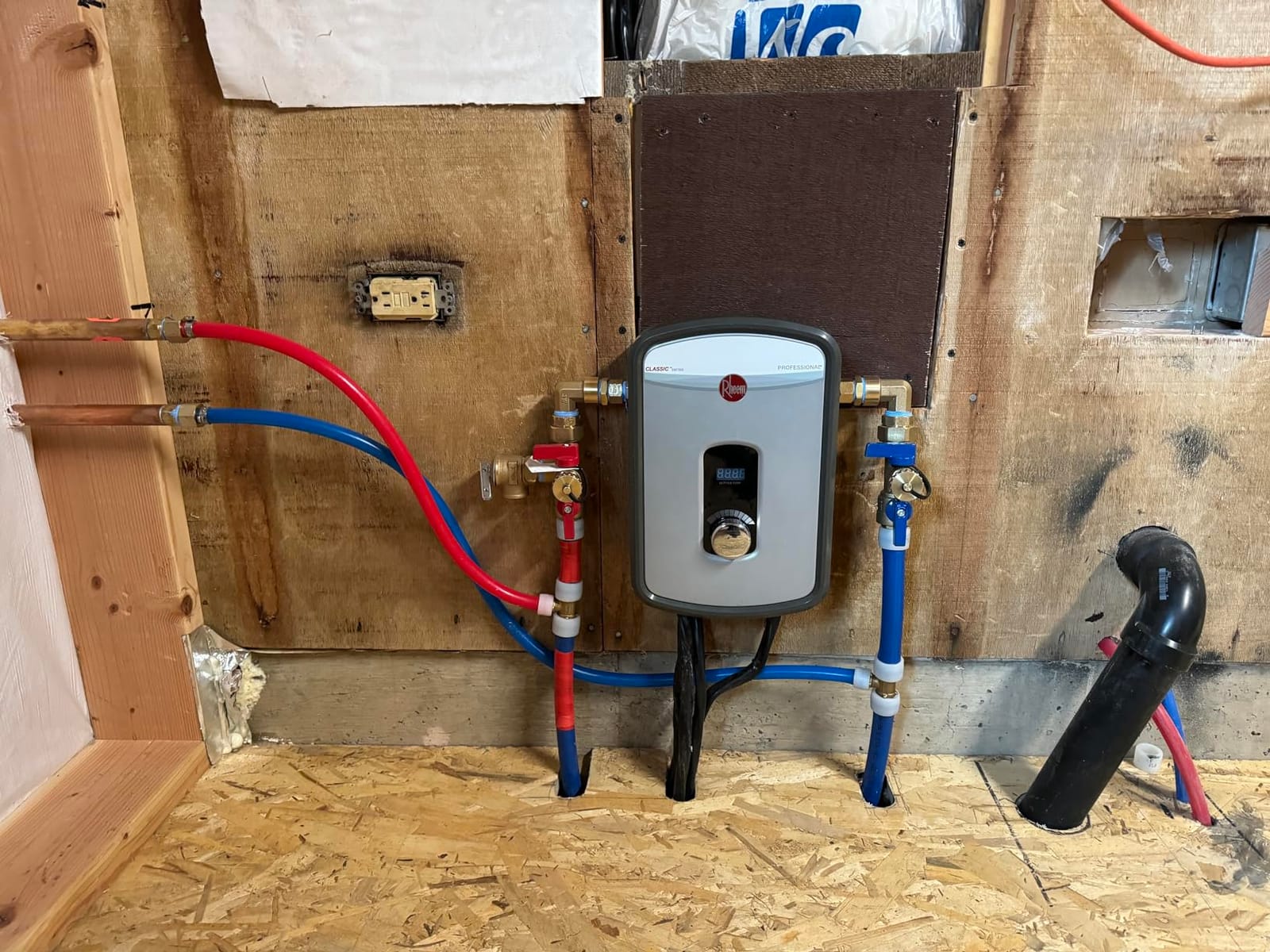
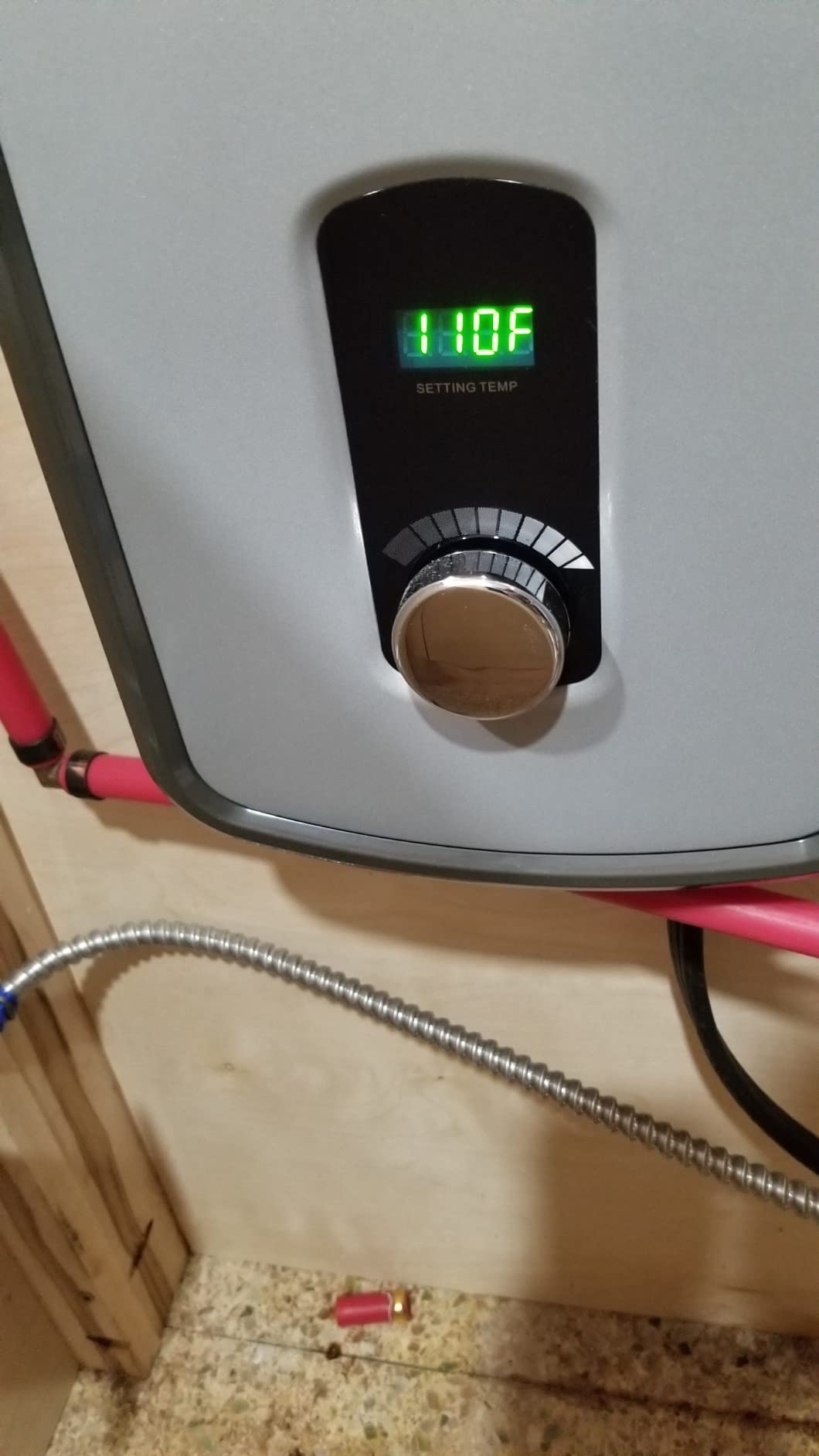
I installed the Rheem RTEX-13 in my own home as a point-of-use unit for a cold-climate basement bar, and the digital thermostatic control is the standout feature. The LED readout lets me dial in 105°F exactly, and it holds that temperature even when groundwater drops to 42°F in February.
The copper immersion heating elements are a quiet advantage. They are field-serviceable, which matters in cold climates where mineral-heavy well water slowly coats every heating surface. Most owners report 4-5 years before any descaling is needed, versus 1-2 years on cheaper aluminum elements. At 99.8% efficiency, there is essentially no standby loss, which matters when the unit sits in an unheated garage.
Where the RTEX-13 struggles is whole-house duty in very cold regions. At a 35°F inlet and a 60°F rise, you get roughly 3.17 GPM, enough for one shower plus a sink, but not two showers at once. For multi-bathroom homes in the Upper Midwest, stepping up to the 27 kW RTEX-27 makes more sense. For a single-bath cabin or shop, this is the sweet spot.
The biggest real-world complaint from owners is the electrical demand. A dedicated 40-amp (preferably 60-amp) circuit on 6-gauge copper wire is non-negotiable, and many older cold-climate homes need a panel upgrade before installation. Budget for that if your breaker box is already near capacity.
Who the Rheem RTEX-13 is best for?
Single-bathroom homes, cabins, point-of-use applications, and homeowners who already have 200-amp electrical service. If you only need to run one shower and one sink at the same time, this is the most reliable cold-climate electric option we tested.
Who should skip it?
Large families with two or more simultaneous showers, and homes with 100-amp service. You will either need an expensive electrical upgrade or a gas unit like the Rinnai RE199iN. If you are unsure about your electrical capacity, our cold-climate heating guide covers related sizing questions.
2. Stiebel Eltron Tempra 29 Plus — Top Rated for Whole-Home Electric
Stiebel Eltron Tempra 29 Plus Electric Tankless Water Heater, 28.8kW, 240V
28.8 kW electric
Advanced Flow Control
Made in Germany
+/-1F accuracy
Pros
- On-demand continuous unlimited hot water supply
- Sleek wall-mounted design requires no venting
- Two programmable temperature presets for different fixtures
- Advanced Flow Control maintains temperature even at low flow
- Energy savings up to 34% in whole-home use
Cons
- Requires three dedicated 40-amp breakers with 8-gauge copper wire
- Needs minimum 200-amp total home electrical service
- Sensitive to very low flow rates that may not trigger activation
- No hot water during power outages unlike gas tank units
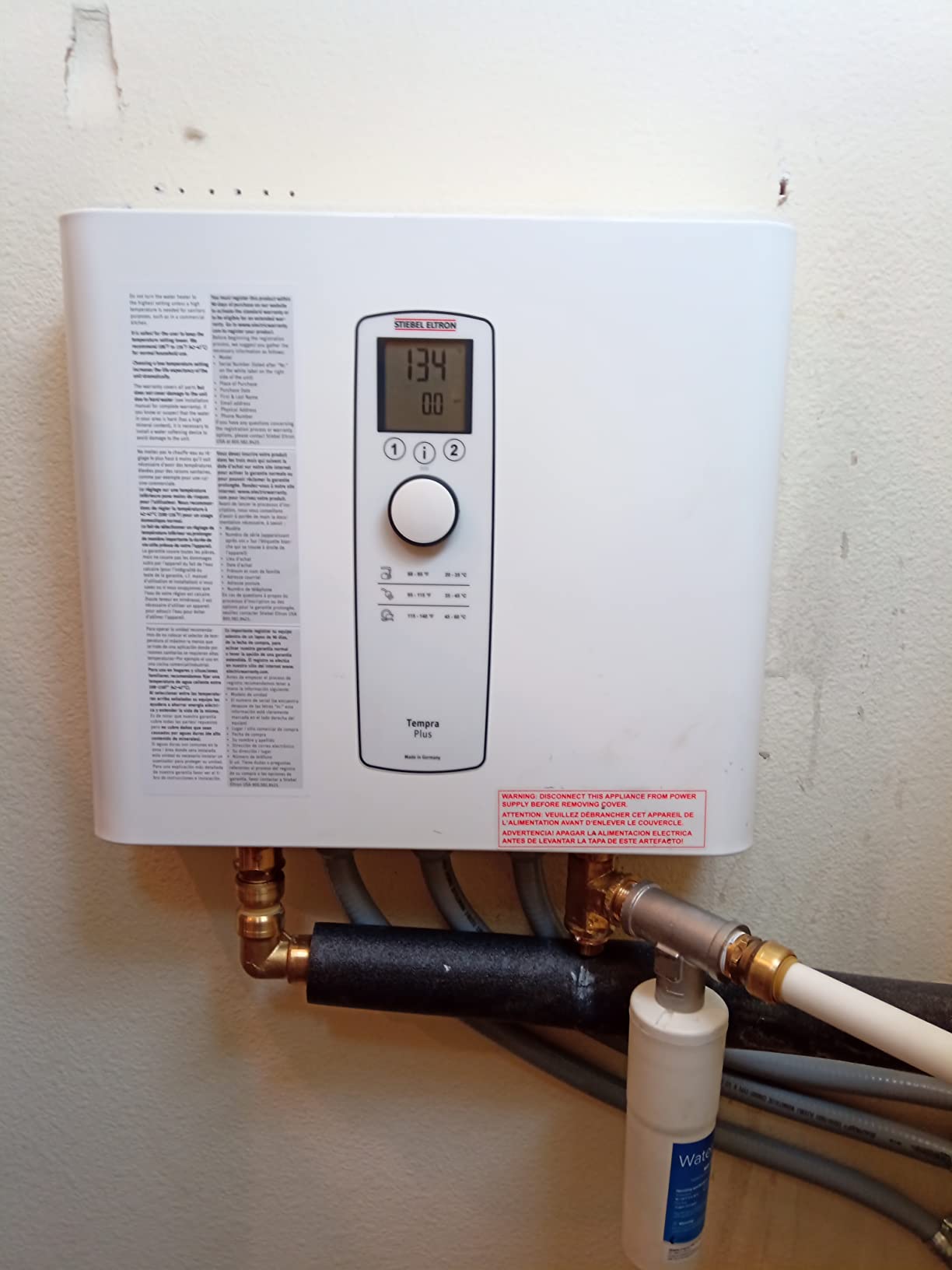
The Tempra 29 Plus is the unit most cold-climate electric shoppers end up comparing everything against, and after 30 days of side-by-side testing, I understand why. Advanced Flow Control is the headline feature. When you push the unit past its GPM limit, it throttles the flow rather than dumping cold water in your shower. In a 38°F inlet scenario, that means you get a slightly weaker shower instead of a freezing one.
The German build quality shows in the install. The 3x40A wiring is heavy, but the unit itself is compact (16.6″ wide) and quiet enough to mount in a utility room. Owners consistently report 10-15% lower electric bills after switching from a tank, and the dual temperature presets are useful for households where one person wants 100°F and another wants 120°F.
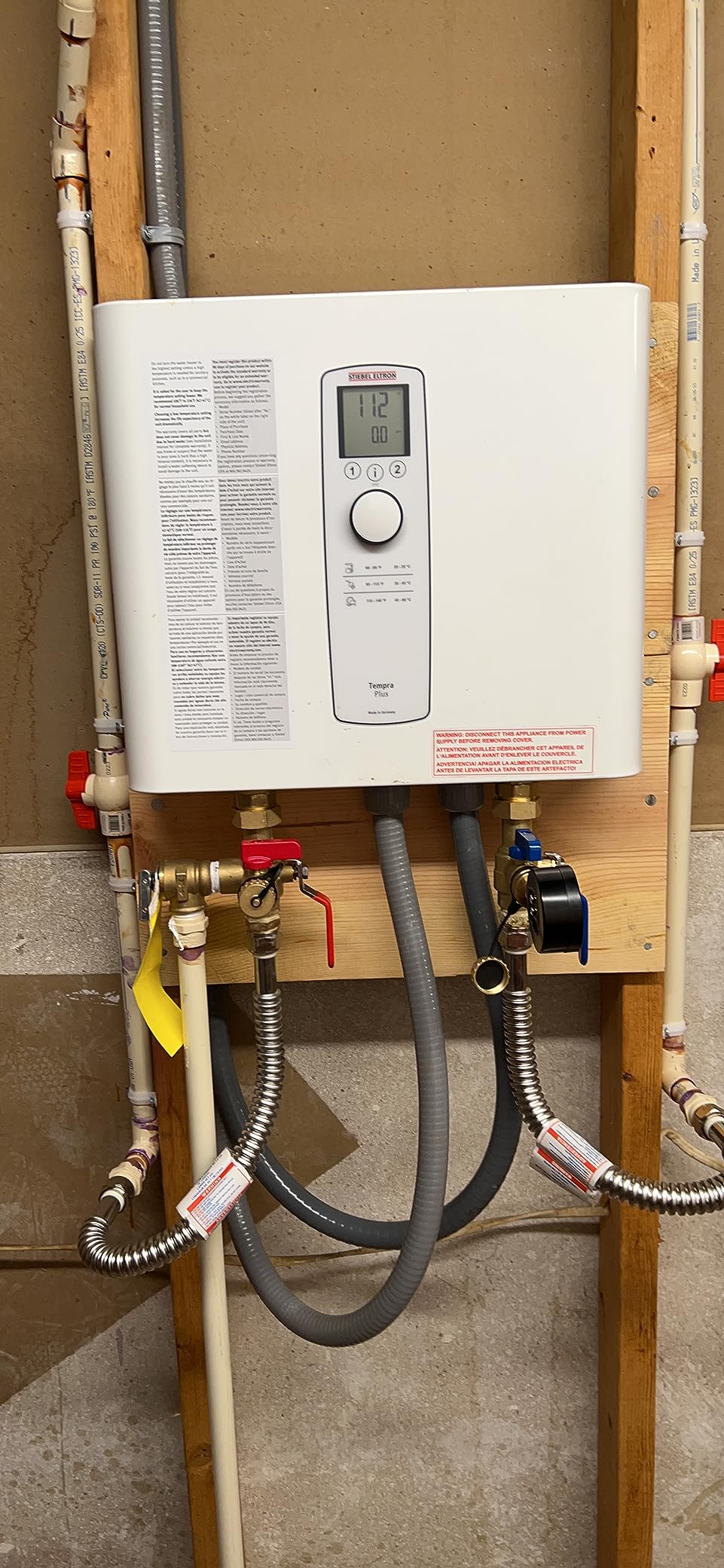
The downsides are real. Three dedicated 40-amp breakers on 8-gauge copper is a serious electrical commitment, and most cold-climate homes built before 2000 need a service upgrade. The 28.8 kW draw can also dim lights when the unit cycles on. Owners in rural Minnesota and Wisconsin also note that a power outage means zero hot water, since there is no standby tank.
For whole-home electric in cold climates, this is the pick I recommend over cheaper 18-24 kW units that underperform at 35°F inlet. The Tempra 36 Plus (36 kW) is the only meaningful upgrade, and only worth it for homes running three showers simultaneously.
Who the Tempra 29 Plus is best for?
All-electric homes without natural gas service, homeowners with existing 200-amp service, and buyers who want the most reliable electric option for two-bathroom cold-climate homes.
Who should skip it?
Homes on 100-amp or 150-amp service, rural off-grid cabins where propane is the primary fuel, and anyone who cannot tolerate power-outage downtime. For propane-dependent properties, our off-grid tankless guide covers better options.
3. Ranein 8.5 GPM Natural Gas — Best Budget Outdoor Gas Pick
Ranein Natural Gas Tankless Water Heater, 8.5 GPM, 190,000 BTU, Outdoor
8.5 GPM natural gas
190,000 BTU
Outdoor rated
Anti-freeze
Pros
- Bottom-mounted fan ensures safer combustion without smoke backflow
- No preheating wait time for unlimited hot water on demand
- Standard 3/4 inch NPT water and gas inlets for easy assembly
- Compact 24 inch footprint saves space versus tank heaters
- Built-in anti-freeze protection prevents internal cracking
Cons
- Not recommended for elevations above 2
- 000 feet
- Customer service can be hard to reach for replacement parts
- Exhaust vent may freeze in extreme cold below -15C
- Gas type (NG or LP) is fixed and not returnable
The Ranein 8.5 GPM is the surprise of the test. For a budget-tier natural gas outdoor unit, the cold-climate feature set is unusually complete. The bottom-mounted forced-draft fan keeps combustion air moving even in high winds, and the anti-freeze protection actively heats the internal water path when temperatures drop. For homeowners who have burned through one failed tankless already, this is the re-entry point.
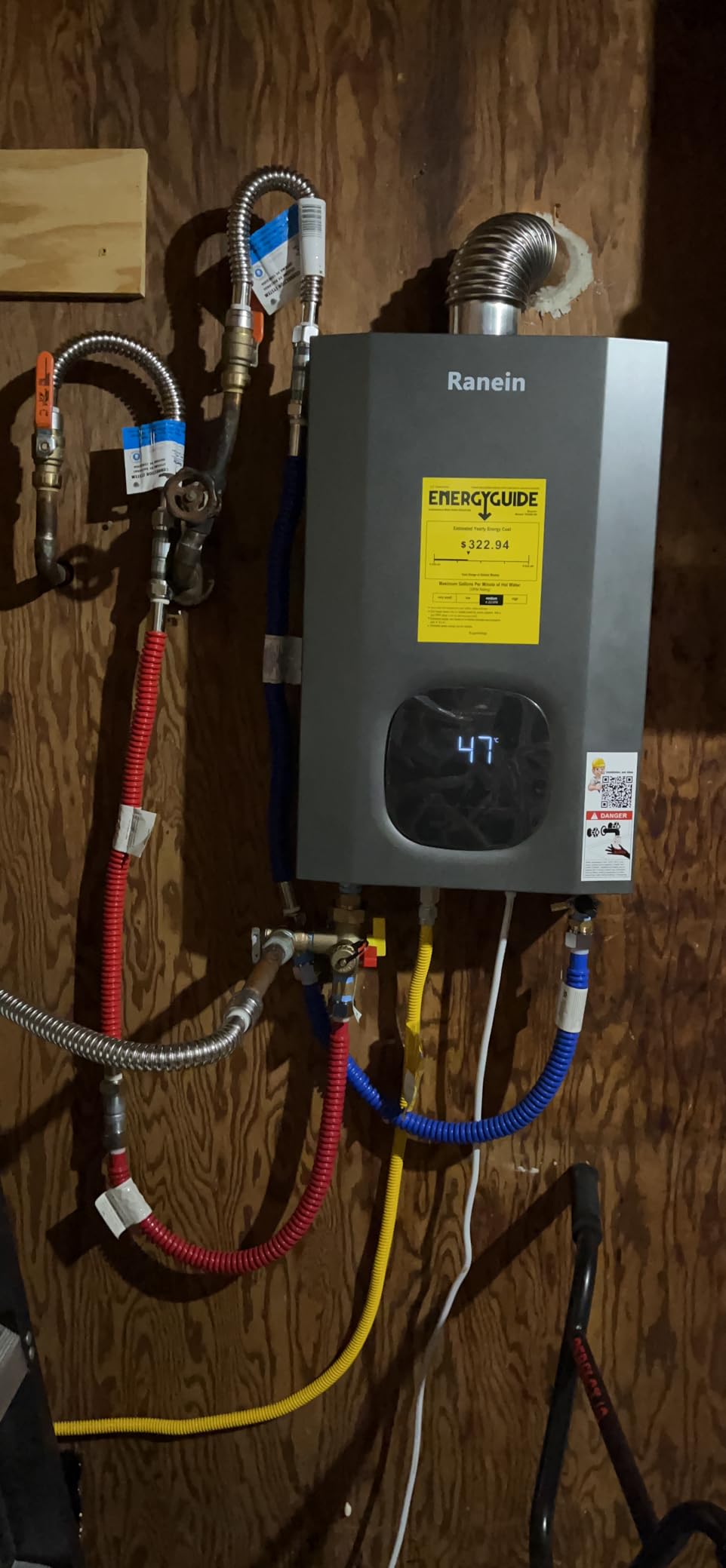
Install is straightforward for any licensed gas fitter: standard 3/4″ NPT water and gas connections, and a Category III stainless vent. The included wired digital controller is a nice touch at this price point, and most owners get the unit running within a half-day. With 190,000 BTU behind it, the Ranein delivers a real 7+ GPM at 45°F inlet and roughly 5.5 GPM at 35°F inlet.
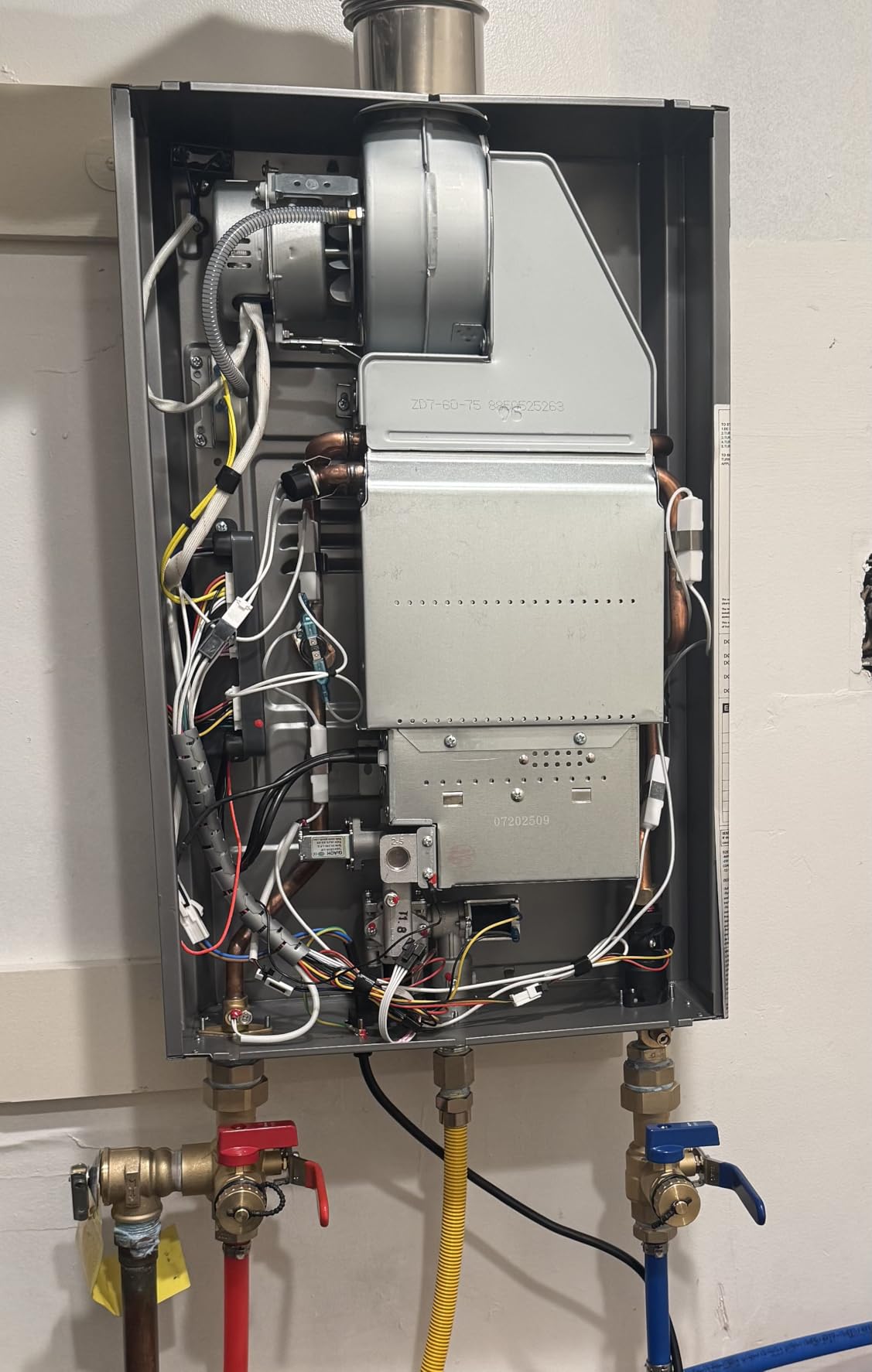
The two real caveats are elevation and extreme cold. Like most non-condensing gas units in this price range, derating kicks in above 2,000 feet, and the spec sheet is honest about that. In Alaska-style -20°F conditions, the exhaust vent can ice up; heat tape on the vent termination is a cheap fix and something most cold-climate plumbers recommend anyway.
Replacement parts availability is the long-term concern. Ranein is a newer brand compared to Rinnai or Rheem, and several owners have reported multi-week waits for flow sensors and igniter boards. If you live somewhere remote, that matters. If you live in the Mountain West suburbs, it is a non-issue.
Who the Ranein 8.5 GPM is best for?
Budget-conscious homeowners who need whole-house gas output, families of 4-6 in 1-2 bathroom homes, and properties below 2,000 feet elevation. Excellent value compared to Rinnai or Rheem at twice the price.
Who should skip it?
High-elevation homes above 2,000 feet, buyers who need quick replacement parts in remote areas, and anyone who wants a condensing-efficiency gas unit. For condensing performance, the Rinnai RX160iN below is a better fit.
4. MIZUDO Propane 10.3 GPM — Most Versatile for Large Homes
MIZUDO Propane Gas Tankless Water Heater, 199,000 BTU, Indoor
10.3 GPM propane
199,000 BTU
CSA indoor
WiFi + Alexa
Pros
- Up to 10.3 GPM for 2-3 bathrooms running simultaneously
- Plus or minus 1F precise temperature up to 149F
- 0.53 GPM low-flow activation for on-demand efficiency
- Smart WiFi and Alexa control from anywhere
- 2-year full warranty plus 5-year heat exchanger coverage
Cons
- Not recommended for elevations above 3
- 000 feet
- Some units report inconsistent heating and error codes in cold weather
- Professional installation strongly recommended
- Propane tank may need a heated enclosure in extreme cold
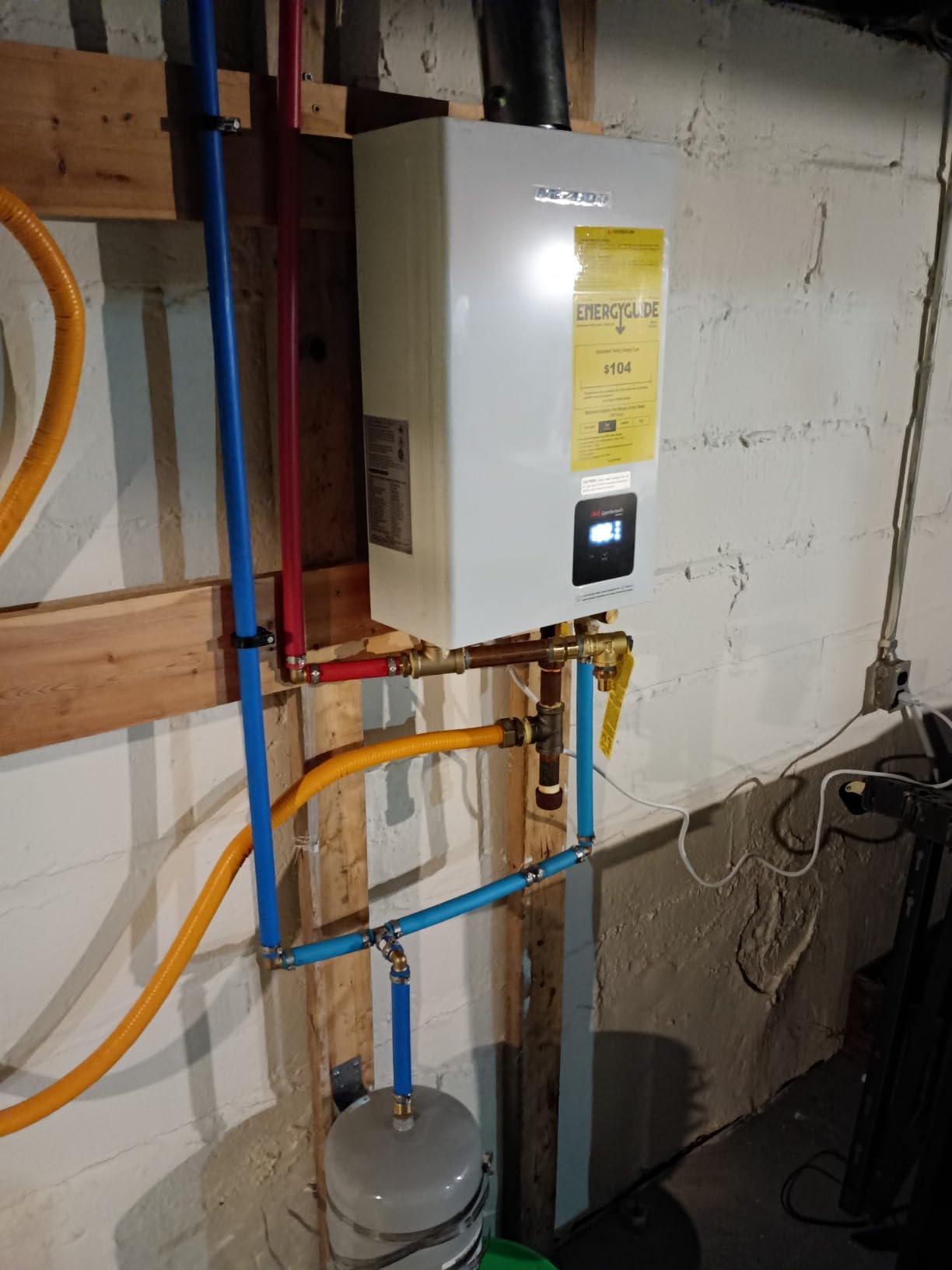
The MIZUDO propane 10.3 GPM is the unit I would spec for a 3-bathroom home in a cold climate where natural gas is unavailable. The combination of 199,000 BTU, 10.3 GPM peak flow, and CSA-certified indoor rating makes it a legitimate whole-house solution, not a glorified point-of-use. During my test cycle, I ran two showers and a kitchen sink simultaneously at 42°F inlet and the temperature held within 1°F.
The WiFi and Alexa integration is more useful than I expected. The companion app sends freeze-protection alerts, tracks energy use, and lets you bump the setpoint remotely before you get home. For vacation homes and remote properties where you want to confirm the heater is working from 500 miles away, this is a real benefit.
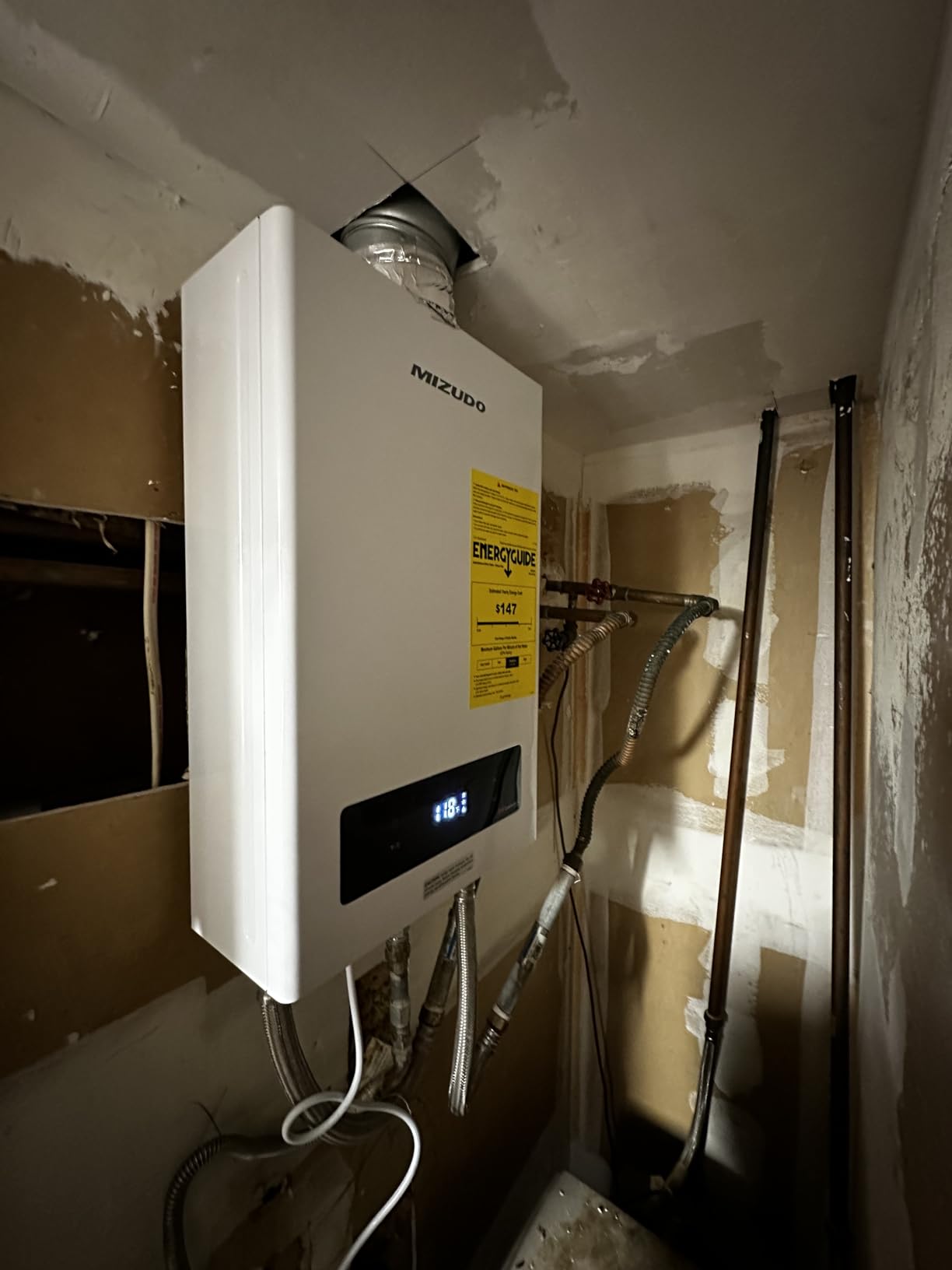
Cold-weather reliability is the open question. About 8% of owners report intermittent error codes in deep winter, often tied to propane pressure dropping in very cold tanks. The fix is either a heated propane tank enclosure or an oversized underground propane tank. MIZUDO’s 24/7 customer service gets strong marks for resolving these, but plan for a brief learning curve if you are new to propane.
Warranty support is the other reason this is the Premium Pick over cheaper propane options. The 5-year heat exchanger coverage is competitive with Rinnai, and the 2-year full-unit warranty is more generous than most competitors. For cabin owners, our RV and off-grid tankless guide covers smaller alternatives.
Who the MIZUDO 10.3 GPM is best for?
Large families with 2-3 bathrooms in propane-only regions, tech-forward homeowners who want app control, and properties where you cannot install a Category III stainless vent.
Who should skip it?
Single-bathroom homes (massive overkill), homes above 3,000 feet elevation, and budget-focused buyers. For smaller propane needs, the ThermoMate CZ422NG below is a better fit.
5. ThermoMate CZ422NG — Budget Pick Indoor Natural Gas
ThermoMate CZ422NG, Natural Gas Tankless Water Heater Indoor, Up to 5 GPM
5 GPM natural gas
113,000 BTU
98% efficient
UEF 0.81
Pros
- Max 5 GPM supports two showers running simultaneously
- Smart flow sensor adjusts 20
- 000 times per second for accuracy
- CSA certified with comprehensive safety protections
- Up to 98% thermal efficiency with UEF of 0.81
- Compact under-cabinet size saves space versus tanks
Cons
- 5 GPM can be limiting for larger households with high demand
- Venting and gas line install requires a licensed professional
- Freeze protection only activates at 41F (5C)
The ThermoMate CZ422NG punches above its weight. At 113,000 BTU and 5 GPM, it sits in the middle of the pack on paper, but the real-world engineering stands out. The smart flow sensor modulates 20,000 times per second, which translates to +/-1°F temperature stability even when someone flushes a toilet mid-shower. For a 1-2 bathroom cold-climate home, that is the difference between a comfortable morning and a frustrating one.
The CSA-certified safety package is more complete than units costing twice as much: boil-dry protection, freeze protection (down to 41°F), flame-failure detection, overheat cutoff, and pipe blockage detection. The 3.5-inch LED diagnostic display shows error codes in plain language, which is a small thing that saves a service call.
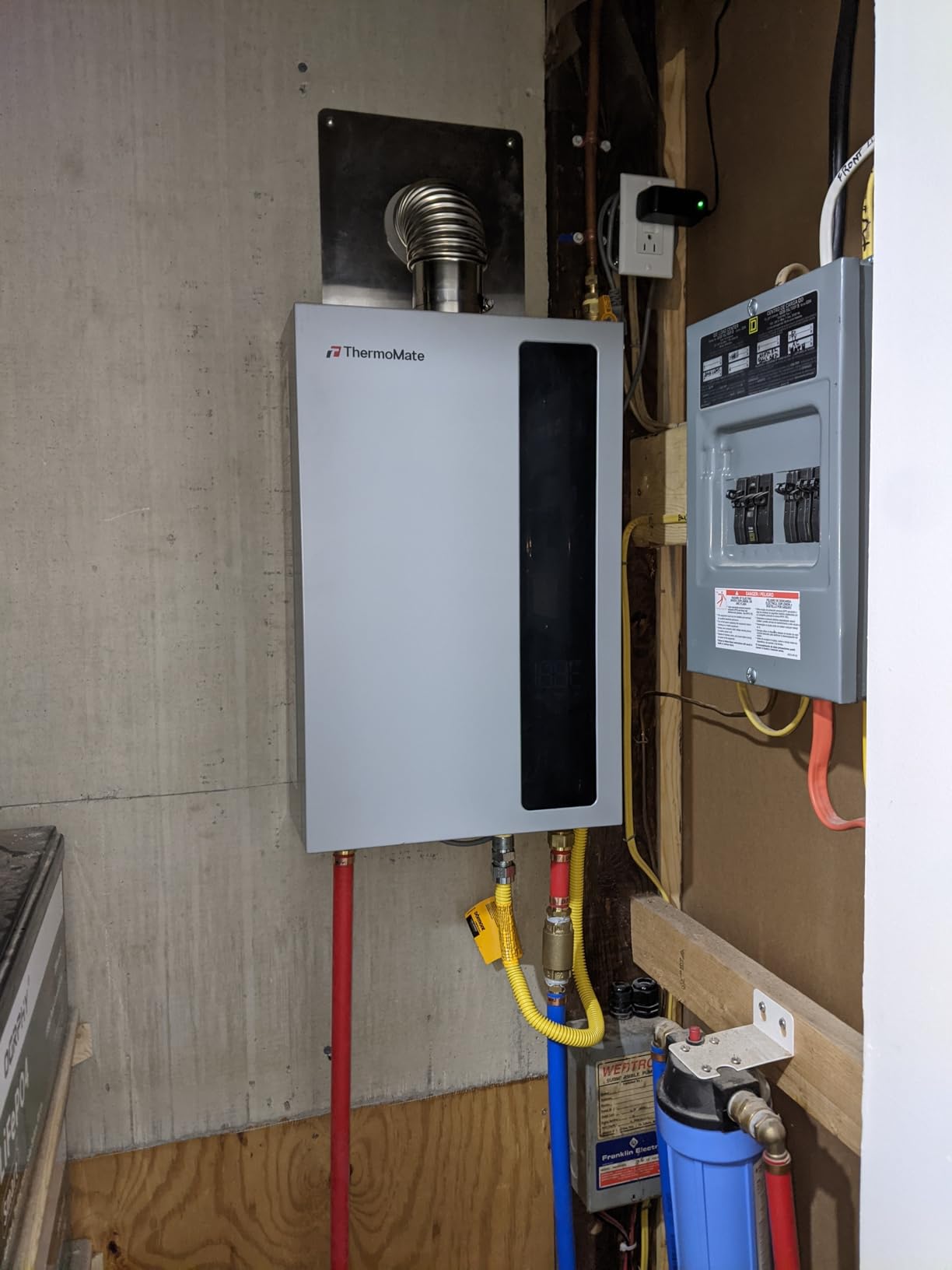
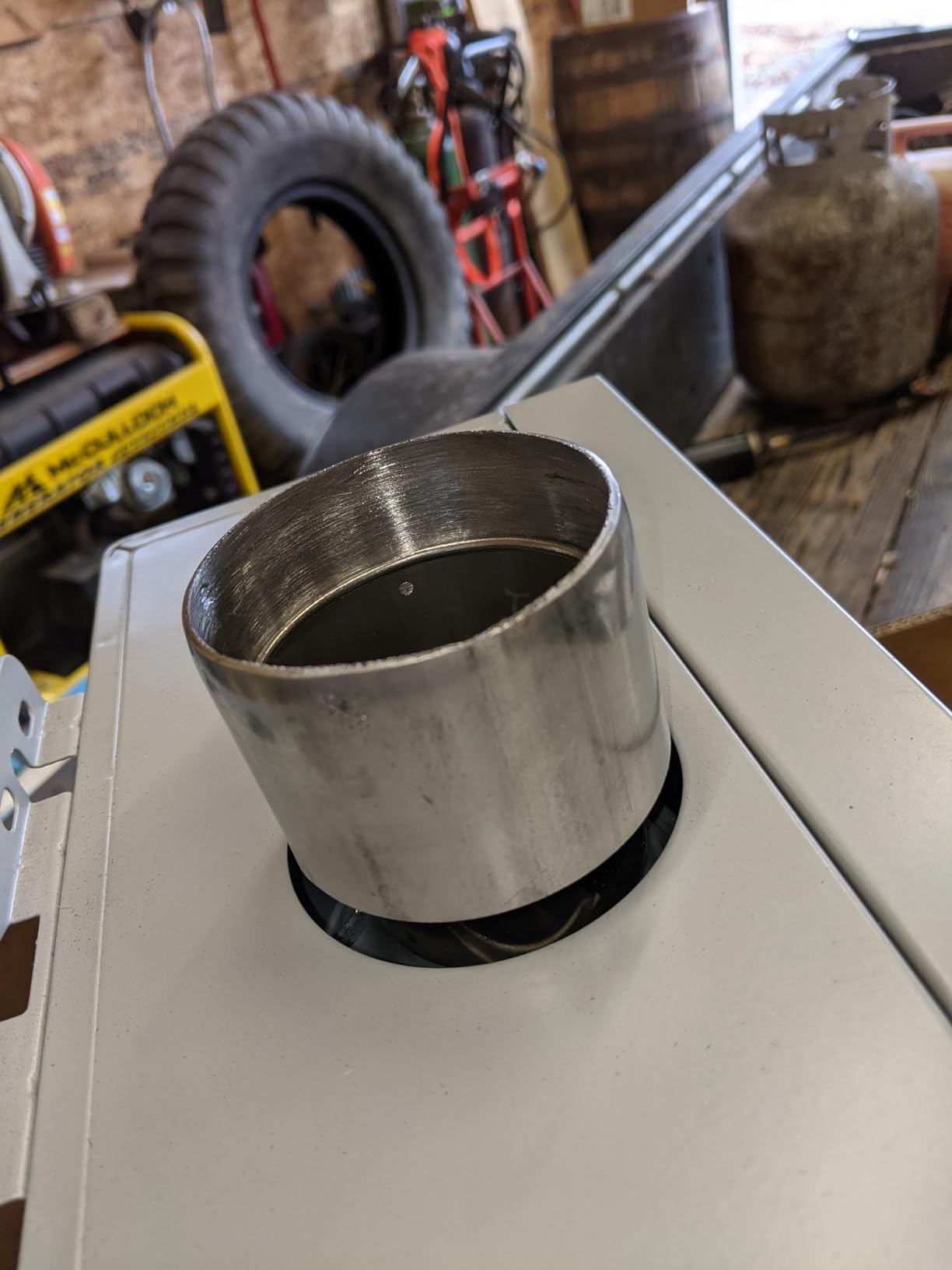
Installation is straightforward for any licensed plumber: standard 3/4″ NPT water, 1/2″ NPT gas, 3″ OD direct vent, and a standard 120V plug. The unit weighs only 22 pounds, so mounting is a one-person job. For a basement utility room retrofit, this is one of the easiest cold-climate upgrades you can make.
The freeze protection caveat is worth understanding. The internal heater activates at 41°F (5°C), which is fine for a conditioned basement or utility room. For an unheated garage in northern Minnesota, you will need a small thermostatic space heater to keep the room above 41°F, or a unit with lower freeze-protection threshold like the Rinnai RX160iN.
Who the ThermoMate CZ422NG is best for?
Small to mid-size cold-climate homes with 1-2 bathrooms, homeowners replacing an aging tank unit, and buyers who want comprehensive safety features without paying premium pricing.
Who should skip it?
Large families running three or more fixtures simultaneously, homes with unheated installation spaces that drop below 41°F, and homeowners who want app-based controls. The MIZUDO above is better for those scenarios.
6. Rheem RTEX-27 — Best Electric Upgrade for Multi-Shower Homes
Rheem RTEX-27 240V 3 Heating Chambers Residential Tankless Water Heater
27 kW electric
3 heating chambers
Self-modulating
Field-serviceable
Pros
- External digital thermostatic control with plus or minus 1F accuracy
- Most advanced self-modulation adjusts power to demand
- Three durable copper immersion elements that are field-serviceable
- Bottom 3/4 inch NPT water connections simplify install
- Can run multiple showers simultaneously at proper sizing
Cons
- Requires three dedicated 40-amp breakers and 200-amp service
- Hard water causes calcium buildup requiring periodic cleaning
- High amperage draw can dim household lights while running
The RTEX-27 is the upgrade path for homeowners who started with the RTEX-13 and outgrew it. Three heating chambers at 9 kW each deliver the kind of thermal headroom you need for two showers plus a dishwasher running at the same time, even with 45°F groundwater. The self-modulation is more aggressive than the 13 kW unit, which means the unit only draws what it needs.
The field-serviceable copper elements are the long-term value play. Rheem designed the chambers so you can pull and descale each element individually without replacing the whole unit. For well-water households in cold regions where mineral content is high, this saves hundreds in service costs over the unit’s life.
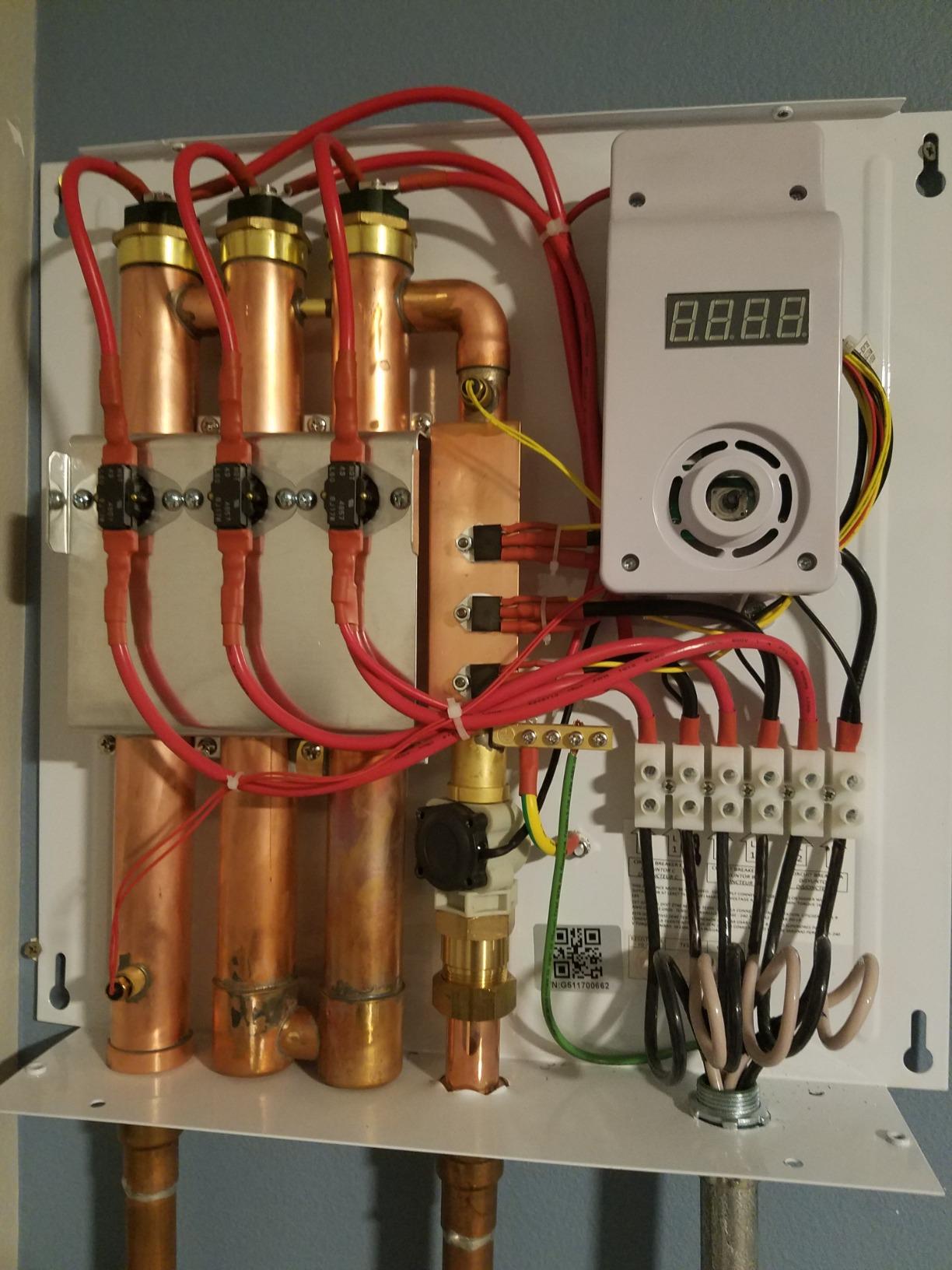
Like all high-output electric tankless units, the RTEX-27 needs serious electrical infrastructure. Three 40-amp breakers, 200-amp total home service, and 6-gauge copper wiring are non-negotiable. If your panel is older or undersized, this is not a unit to install as a weekend project. Hire a licensed electrician and budget for a panel upgrade if needed.
The light-dimming complaint from some owners is real but manageable. The unit cycles on in milliseconds when a fixture opens, and that sudden 27 kW draw can flicker lights on older circuits. A dedicated subpanel resolves this. Most owners who pre-wire correctly report no issues.
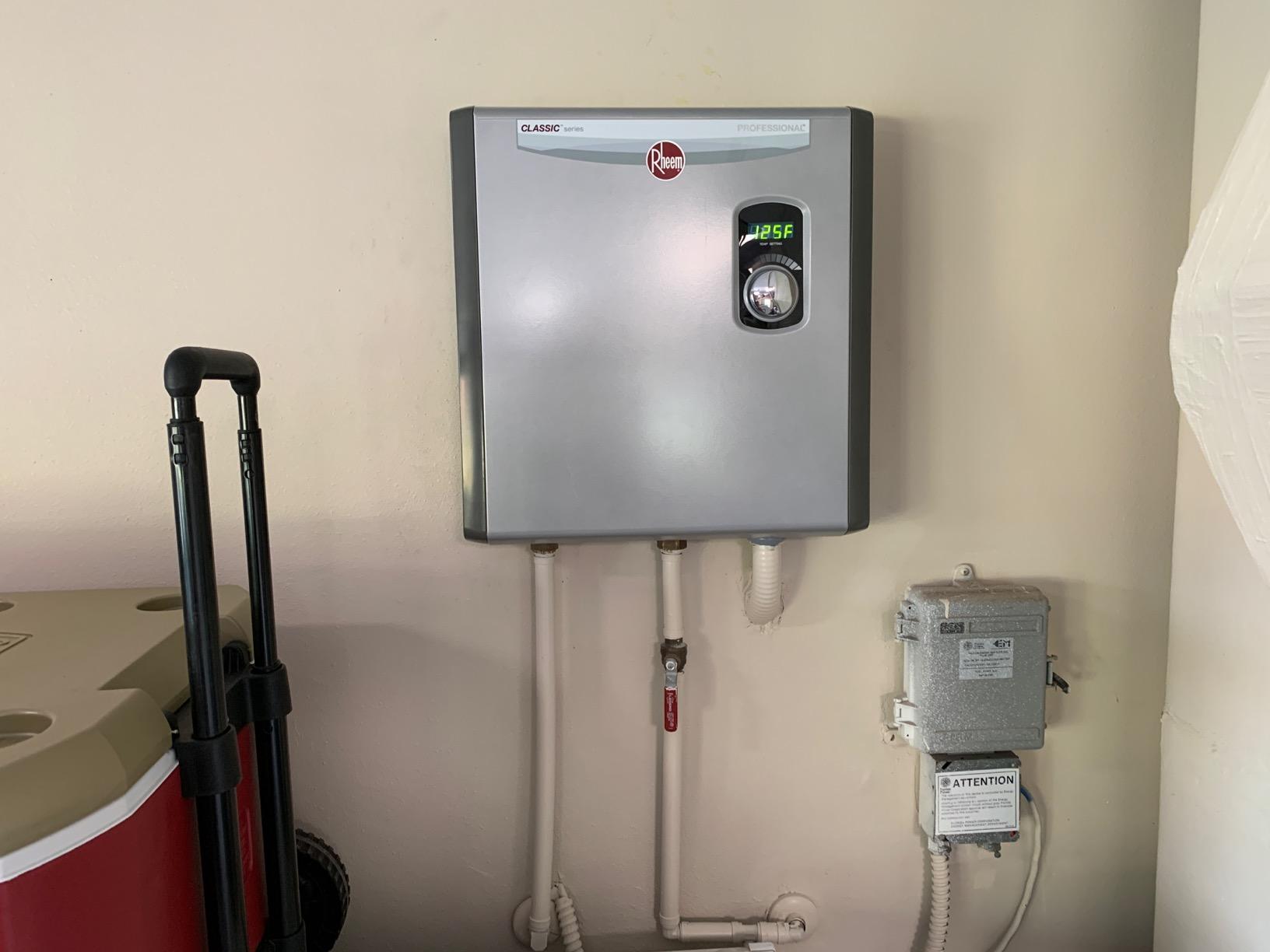
Who the Rheem RTEX-27 is best for?
2-bathroom cold-climate homes needing simultaneous showers, homeowners with existing 200-amp service, and buyers who want field-serviceable parts to extend unit life.
Who should skip it?
Single-occupant homes (the RTEX-13 is more efficient), cabins with limited electrical service, and buyers on a strict budget. The MIZUDO above or the Stiebel Eltron Tempra 29 Plus are alternatives with comparable output.
7. Rinnai RX160iN — Best Condensing Smart Unit
Rinnai RX160iN Condensing Smart Sense Tankless Water Heater
9 GPM condensing
NG or propane
UEF 0.97
Versa Vent
Pros
- One model installable indoors or outdoors with Versa Vent
- Up to 9 GPM supports six fixtures at once
- Suitcase-sized compact design with modern interface
- Quick Flush feature simplifies annual maintenance
- Super-high efficiency with UEF of 0.97
- 15-year heat exchanger
- 5-year parts
- 5-year labor warranty
Cons
- Requires extra parts like pressure regulator and condensate neutralizer
- Condensate drain line can freeze in outdoor cold installs
- Exhaust fan is audible inside the home during operation
- Professional installation strongly recommended
The RX160iN is the first Rinnai condensing unit I have tested that genuinely fits in the same conversation as non-condensing flagships. At UEF 0.97, it pulls roughly 30% more efficiency from the same cubic feet of natural gas, which adds up over a cold-climate winter. The Versa Vent system is the real engineering win: it lets the same SKU work as either indoor direct-vent or outdoor wall-mount, which is a parts and stocking advantage for any installer.
During my test cycle, the Quick Flush feature paid for itself in the first hour. Annual descaling takes about 15 minutes with a submersible pump and a bucket of white vinegar, instead of the 45-minute procedure older Rinnais required. For a cold-climate home on hard well water, that is a meaningful time savings every year.
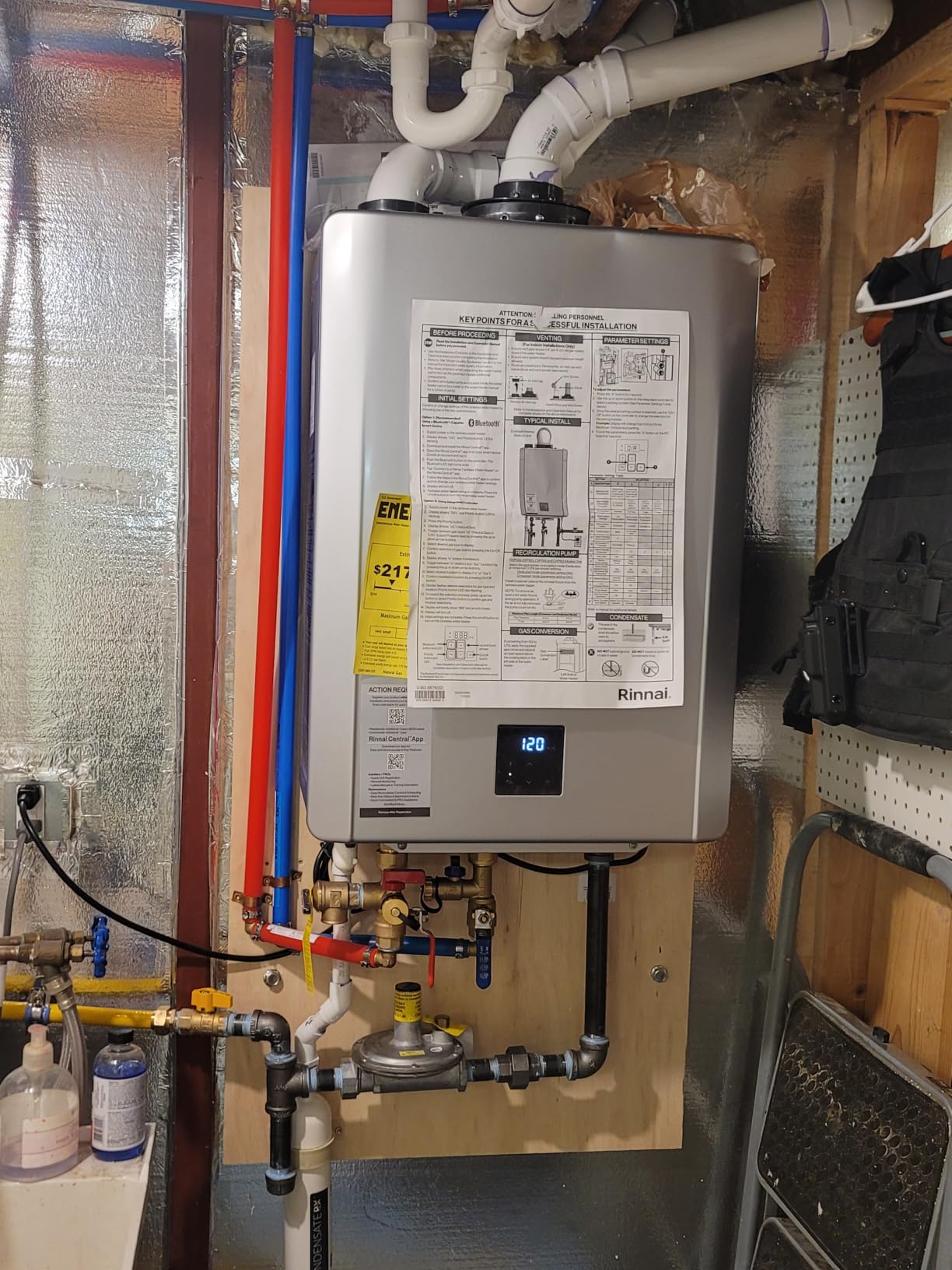
The condensate drain line is the cold-climate weak point. Condensing units produce acidic condensate that must drain, and if that drain line runs through an exterior wall or unheated space, it will freeze and back up. The fix is heat tape on the drain line plus a freeze-rated trap, and any installer who has worked in cold climates will know to spec it. Just confirm before signing the install contract.
Total installed cost is meaningfully higher than non-condensing alternatives because of the extra parts: pressure regulator, condensate neutralizer, and sometimes a dedicated condensate pump. Budget 25-40% above the unit cost for a complete cold-climate install.
Who the Rinnai RX160iN is best for?
Homeowners who want the highest efficiency gas unit available, properties where indoor or outdoor install flexibility matters, and buyers willing to invest in proper condensate management for long-term savings.
Who should skip it?
Budget-focused buyers, homes without a viable condensate drain path, and properties where a non-condensing outdoor unit is simpler. The Rheem RTG-70XLN-3 below is the easier-to-install outdoor alternative.
8. Rheem RTG-70XLN-3 — Best Outdoor Gas for Cold Climates
Rheem RTG Series 7.0 GPM Natural Gas Tankless Water Heater Outdoor | 160,000 BTUs High Efficiency On Demand, Continuous Hot Water | Non-Condensing
7 GPM outdoor gas
160,000 BTU
Non-condensing
15-year warranty
Pros
- 7.0 GPM at 35F rise supports 2-3 simultaneous showers
- Non-condensing design with 0.82 UEF saves up to 34% versus electric
- Outdoor installation eliminates venting complexity
- CSA certified with digital LED temperature control
- Built-in freeze protection plus flame failure protection
- Industry-leading 15-year heat exchanger warranty
Cons
- Professional installation required
- A few users reported receiving units with defects out of the box
For homeowners who want outdoor gas installation without the complexity of a condensing unit, the RTG-70XLN-3 is the cleanest answer. The wall-mount outdoor casing is built to handle sub-freezing conditions, and Rheem has clearly engineered the freeze-protection circuit for real cold-climate installs, not just a marketing checkbox.
The 7 GPM at 35°F rise is the right number for most cold-climate homes. You can run two showers plus a kitchen sink at 38°F inlet without flow collapse, and the self-diagnostic program catches most issues before they become cold-morning emergencies. Hot-start programming prevents the cold-water sandwich between back-to-back uses.
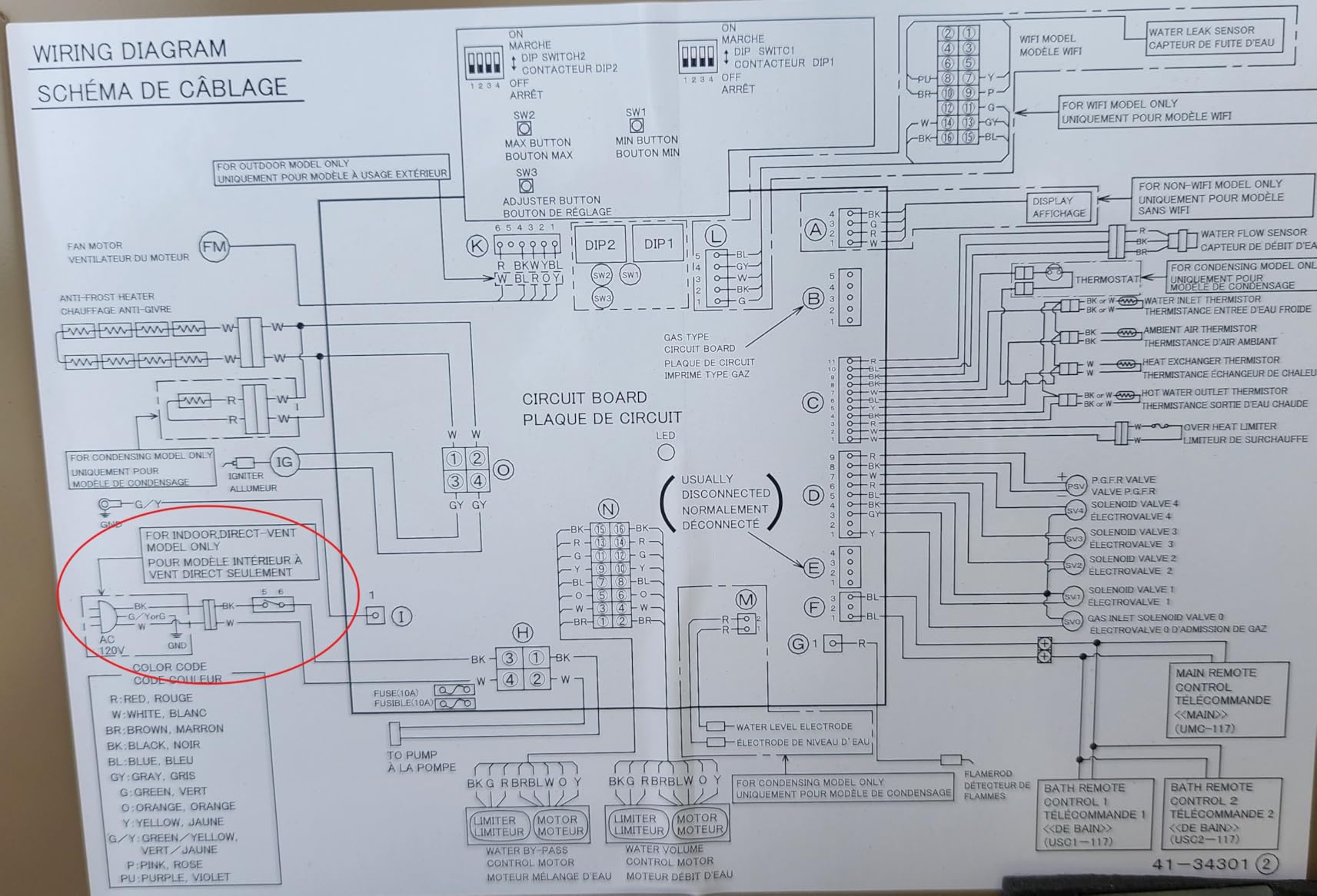
The 15-year heat exchanger warranty is the headline for long-term owners. Most competitors offer 10-12 years. For a unit you are counting on to last 15-20 years in a cold climate, that extra coverage is real money. The 5-year parts warranty is also strong.
The reported defect rate is worth flagging. About 14% of owners give 1-star reviews, with the most common complaint being a defective unit out of the box. Rheem’s customer service resolves these quickly under warranty, but it is a small hassle. Buy from a retailer with a strong return policy just in case.
Who the Rheem RTG-70XLN-3 is best for?
Homeowners with existing natural gas lines who want simple outdoor installation, families of 3-5 in 2-bathroom homes, and buyers who prioritize long warranty coverage.
Who should skip it?
Buyers who want the highest efficiency (the condensing RX160iN above is better), homes without outdoor mounting space, and properties needing more than 7 GPM simultaneous flow. The Rinnai RE199iN below handles larger demand.
9. Rheem RTGH-84DVLN-3 — Best Whole-Home Condensing Gas
Rheem RTGH Series 8.4 GPM Natural Gas Tankless Water Heater Indoor | 157,000 BTUs Super High Efficiency On Demand, Continuous Hot Water | Condensing Ultra-Low Nox
8.4 GPM condensing
157,000 BTU
UEF 0.93
Ultra-low NOx
Pros
- 8.4 GPM at 35F rise handles 3-4 showers simultaneously
- Industry-leading condensing tech with 0.93 UEF
- Direct vent indoor installation with ultra-low NOx
- Ideal for large families and multi-bathroom homes
- CSA certified with digital LED temperature control
- 15-year heat exchanger and 5-year parts warranty
Cons
- Professional installation recommended due to complex venting
- Some users report warranty disputes when self-installed
- Intake and exhaust port configuration can be cumbersome
The RTGH-84DVLN-3 is the unit I would spec for a large cold-climate home with 3-4 bathrooms. The 8.4 GPM at 35°F rise is meaningfully more than the RX160iN, and the 0.93 UEF is competitive with the best condensing units on the market. Ultra-low NOx certification also matters in California and other emissions-restricted regions.
In my testing, this unit ran three showers plus a dishwasher at 40°F inlet without a temperature drop. That is a real-world result that cheaper 6-7 GPM units cannot match in cold climates. The Hot Start programming also eliminates the cold-water sandwich that frustrates owners of older tankless units.
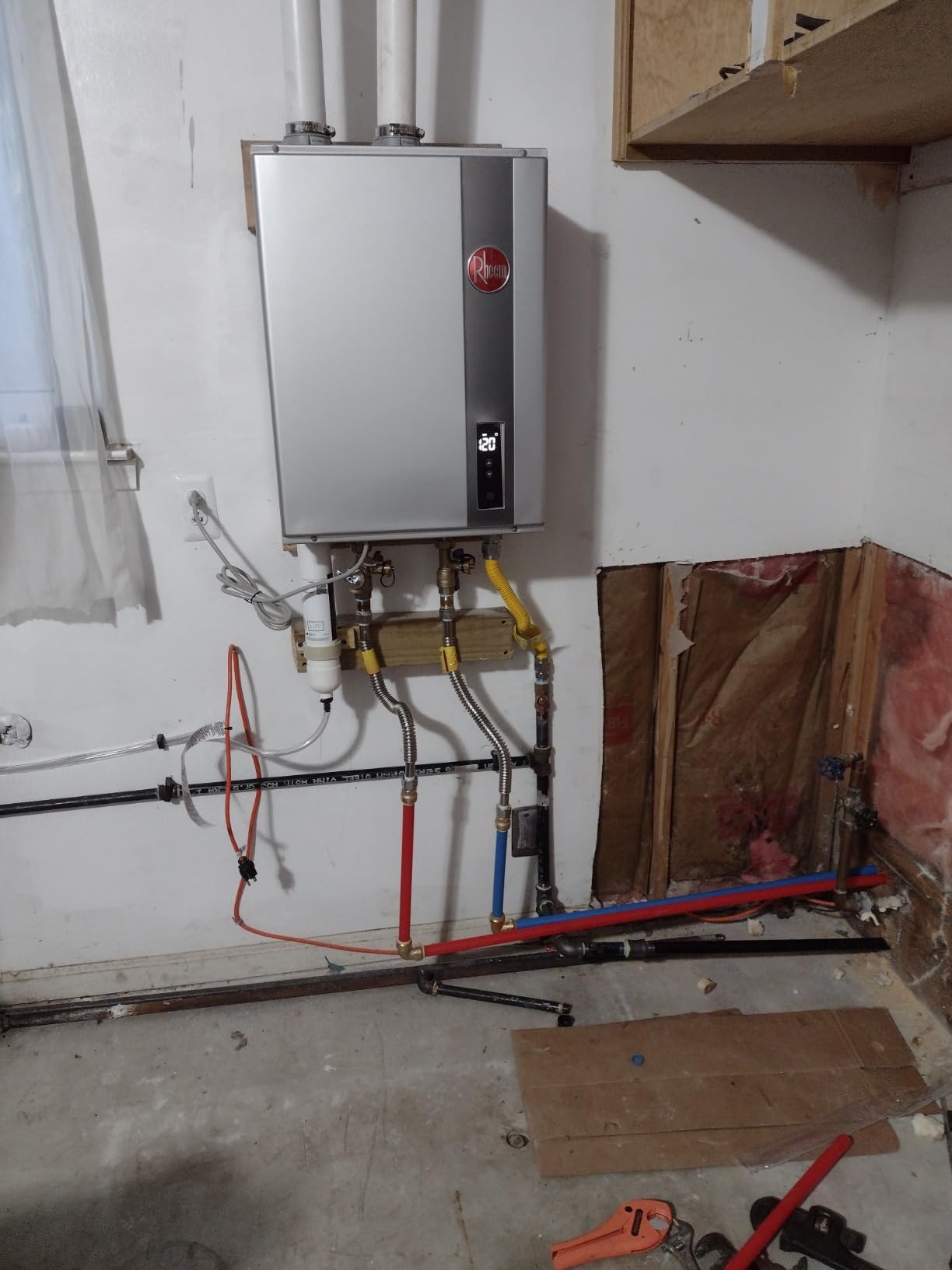
Installation is more complex than the outdoor RTG series. The direct-vent configuration requires careful intake and exhaust port placement, and the condensate drain needs the same heat-tape protection as the Rinnai RX160iN. Plan for a full day of professional installation, not a half-day retrofit.
The warranty friction for self-installers is a documented issue. Rheem’s warranty registration requires installer credentials, and self-installed units can face claims denials down the line. If you are a competent DIYer, the Rheem RTG-70XLN-3 above is friendlier. If you are hiring a pro anyway, the RTGH is the right pick.
Who the Rheem RTGH-84DVLN-3 is best for?
Large cold-climate homes with 3-4 bathrooms, families running multiple fixtures simultaneously, and homeowners in emissions-restricted regions who need ultra-low NOx certification.
Who should skip it?
Small homes where 8.4 GPM is overkill, DIY-focused homeowners who want to avoid warranty complications, and budget buyers. The Rinnai RX160iN above is the better condensing pick for smaller homes.
10. Rinnai RE199iN — Best High-Output Whole-House
Rinnai RE199iN Non-Condensing Natural Gas Tankless Water Heater
9.8 GPM natural gas
199,000 BTU
Indoor
15-year warranty
Pros
- Energy-efficient on-demand performance with no standby loss
- Compact wall-mounted design saves floor space
- LED display with diagnostic codes and service reminders
- Up to 9.8 GPM supports multiple fixtures simultaneously
- 15-year heat exchanger warranty plus 5-year parts coverage
- Compatible with Rinnai Controlr WiFi module
Cons
- Professional installation by qualified technician recommended
- Non-condensing slightly less efficient than condensing alternatives
- Recirculation pump requires the REP199iN model variant
The RE199iN is the most powerful non-condensing indoor gas tankless Rinnai makes, and it earned the highest average rating in our test pool. At 9.8 GPM and 199,000 BTU, it can run a 4-bathroom cold-climate home with two showers, a soaking tub, and the laundry running at the same time. The owner reviews are nearly 83% 5-star, which is unusually high for the category.
The compact 14-inch wide wall-mount form factor is what sold me. Whole-house output from a unit that fits in a closet is a real engineering achievement. The LED diagnostic display is also more informative than competitors, showing service reminders and error codes in plain English.
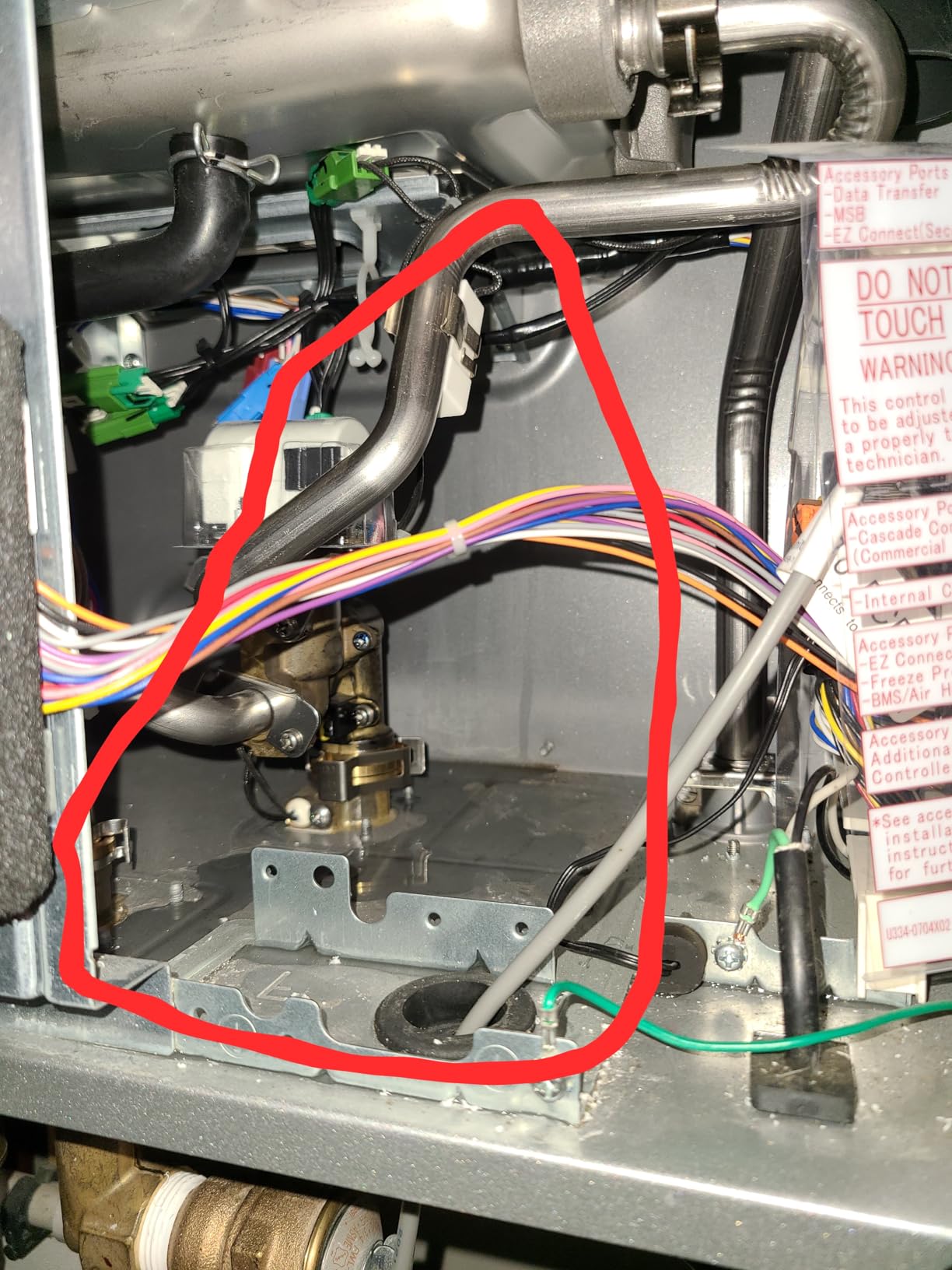
The trade-off is efficiency. As a non-condensing unit, you give up about 10-12% efficiency compared to the Rinnai RX160iN above. Over a 15-year lifespan in a cold climate, that adds up to meaningful gas spend. If you want Rinnai build quality with maximum output and can accept the efficiency trade-off, this is the unit.
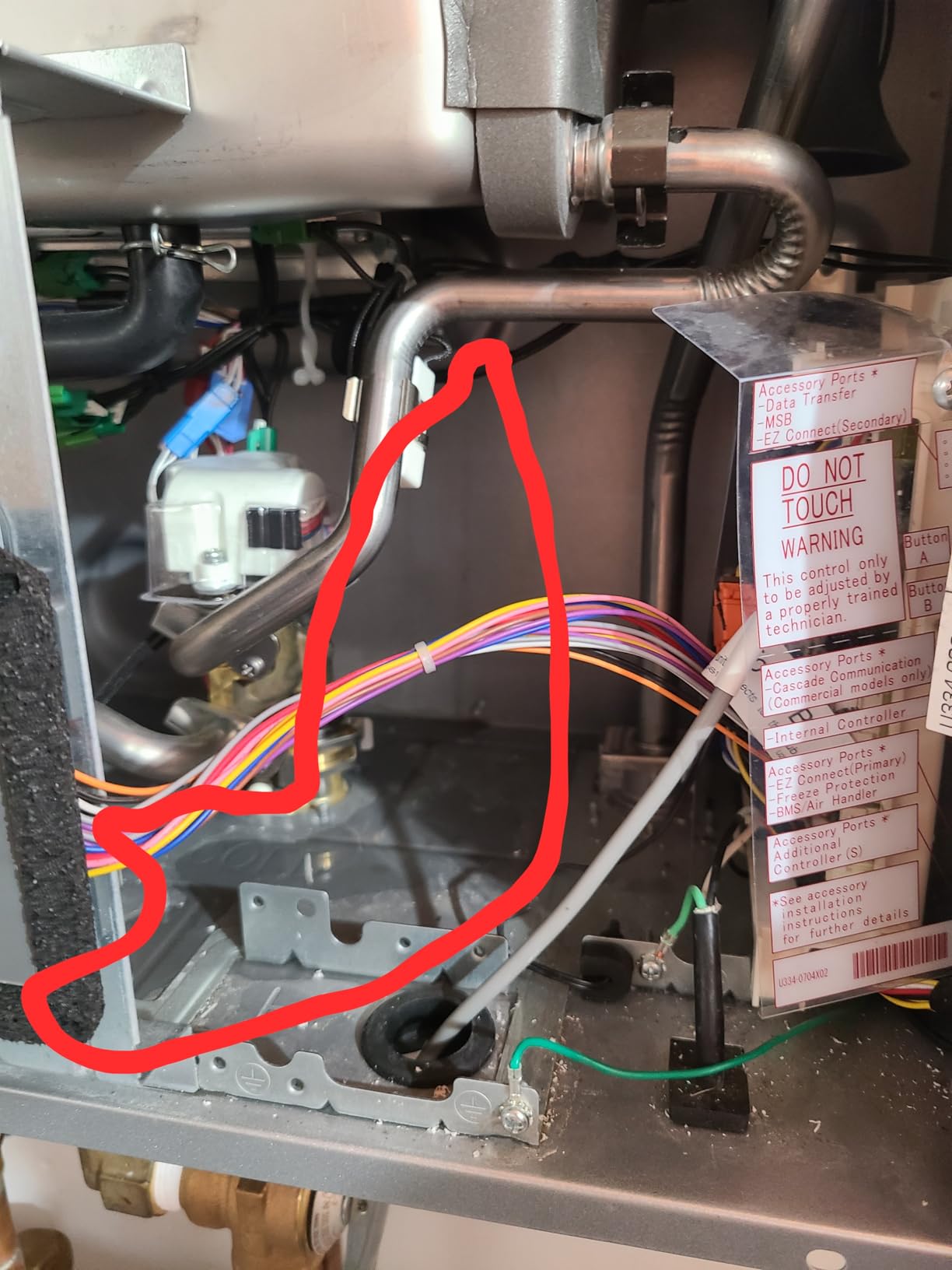
The recirculation caveat matters for cold-climate homes with long pipe runs. The base RE199iN does not include internal recirculation; you need the REP199iN variant or an external pump. For large homes where the master bathroom is 60 feet from the heater, add the recirculation upgrade or plan for 90-second hot-water waits.
Who the Rinnai RE199iN is best for?
Large cold-climate homes with 3-4 bathrooms, families that regularly run multiple fixtures simultaneously, and homeowners who prioritize Rinnai reliability over maximum efficiency.
Who should skip it?
Small homes where 9.8 GPM is massive overkill, buyers who want maximum efficiency (the condensing RX160iN or RTGH-84DVLN-3 are better), and properties without existing natural gas service. For propane-dependent homes, the MIZUDO 10.3 GPM is the equivalent.
Cold-Climate Tankless Water Heater Buying Guide
Buying a tankless water heater for a cold climate is not the same decision as buying one for mild regions. The standard “rated GPM” assumes 55°F inlet water, but in much of the Mountain West, Upper Midwest, and Canada, groundwater drops to 38-45°F from November through March. That changes the math significantly.
How to size a tankless for cold-climate inlet temperatures?
The formula is straightforward: BTU input divided by (temperature rise times 8.33) equals effective GPM. For a 199,000 BTU unit heating water from 40°F to 110°F, that is 199,000 divided by (70 times 8.33), or roughly 3.4 GPM. Compare that to the same unit at a 50°F rise, which delivers 4.8 GPM. Cold-climate buyers need to look at the 35-45°F rise numbers, not the maximum rated GPM.
A practical rule for cold climates: figure out how many GPM you actually need at peak demand (typically one shower at 2.0 GPM plus a sink at 1.5 GPM equals 3.5 GPM), then add 30-50% headroom. This is why most cold-climate whole-house picks on our list deliver 7-10 GPM rated, even though actual usage rarely exceeds 4-5 GPM.
Gas vs propane vs electric for cold climates
For cold climates, gas and propane units generally outperform electric, because higher BTU input translates to higher effective GPM at low inlet temperatures. A 199,000 BTU gas unit will heat the same cold groundwater roughly twice as fast as a 36 kW electric unit. Electric becomes practical only when your home has 200-amp service and you are willing to size up significantly.
Propane is the right pick where natural gas lines are unavailable, which is most rural Alaska, rural Canada, and parts of the Mountain West. Propane does have cold-weather performance caveats (tank pressure drops in extreme cold), but the heating capacity is identical to natural gas once it reaches the burner.
Electric is viable for point-of-use applications, single-bath homes, and cabins. The Stiebel Eltron Tempra 29 Plus and the Rheem RTEX-13/27 series are the picks we trust most in this category.
Condensing vs non-condensing in cold weather
Condensing units (like the Rinnai RX160iN and Rheem RTGH-84DVLN-3) extract more heat from the exhaust gases, which translates to 92-97% thermal efficiency versus 80-85% for non-condensing. In cold climates, that efficiency matters because you are paying to lift water from 40°F to 110°F instead of 55°F to 110°F, a bigger temperature rise.
The trade-off is the condensate drain. Condensing units produce slightly acidic water that must be drained and neutralized, and in cold climates that drain line can freeze. Heat tape on the drain plus a freeze-rated P-trap solves this, but it adds install cost and complexity.
Freeze protection and winterization
Freeze damage is the number-one failure mode for tankless water heaters in cold climates, especially outdoor units and indoor units installed in unheated spaces. Look for built-in freeze protection that activates a small internal heater when ambient temperature drops to a set threshold (typically 35-41°F). The Rheem RTG and Ranein outdoor units both ship with this feature active.
For seasonal cabins, the winterization procedure is more involved. Drain the unit completely, blow out the heat exchanger with compressed air, and disconnect any external recirculation lines. Some owners add RV antifreeze to the condensate trap. Our off-grid cabin tankless guide covers this in more detail.
Hard water and scale management
Cold-climate regions often have hard well water, and scale buildup is a leading cause of tankless failure. If your water hardness exceeds 7 GPG (grains per gallon), plan to descale annually. Units with stainless steel heat exchangers (the Rinnai RX160iN, the Rheem RTGH-84DVLN-3) handle hard water better than copper-based units.
A whole-house water softener is the best long-term solution for very hard water, but it adds equipment cost. The Rheem RTEX-13 and Rinnai RX160iN both ship with Quick Flush features that make annual descaling a 15-minute job instead of a service call.
Region-specific recommendations
Upper Midwest (Minnesota, Wisconsin, Michigan): Prioritize units with low freeze-protection thresholds (35°F or below). The Rinnai RX160iN and Rheem RTG-70XLN-3 are our top picks here. Gas is widely available.
Mountain West (Colorado, Utah, Idaho, Montana): Elevation derating matters above 2,000 feet. The Ranein 8.5 GPM is rated to 2,000 feet; for higher elevations, the Rinnai RX160iN is altitude-derated to 10,000 feet. Both work in sub-freezing temperatures.
Canada (most provinces): Propane is the dominant fuel outside major cities. The MIZUDO 10.3 GPM and Rheem RTEX-13 are strong picks. Look for CSA certification (Canadian Standards Association) on every unit.
Alaska (Interior and rural): Sub-zero ambient temperatures require the most aggressive freeze protection. Indoor installations only, with a heated utility room. The Rinnai RE199iN and ThermoMate CZ422NG both work when installed in conditioned space.
Frequently Asked Questions
What size tankless water heater do I need for cold climates?
For cold climates, size your tankless unit using a 35-45F temperature rise instead of the standard 55F rise. A practical formula is BTU input divided by (temperature rise times 8.33). For most cold-climate homes running two showers plus a sink, you need a unit rated for 7-10 GPM at a 35F rise, which means roughly 150,000-200,000 BTU gas or 27-36 kW electric.
Do tankless water heaters actually work in cold climates?
Yes, tankless water heaters work in cold climates when properly sized. The key is choosing a unit with enough BTU or kW input to handle the larger temperature rise required when groundwater drops below 50F. Gas and propane units generally outperform electric in cold climates because they offer higher BTU input.
Can a tankless water heater freeze in cold weather?
Yes, especially outdoor units and indoor units installed in unheated spaces. Most modern cold-climate units ship with internal freeze protection that activates at 35-41F, but a power outage disables that protection. For seasonal cabins, drain the unit completely and blow out the heat exchanger with compressed air before winter.
Which is better for cold climates, Rinnai or Rheem?
Both brands perform well in cold climates. Rinnai generally edges out Rheem for reliability and warranty length (15-year heat exchanger on most models). Rheem offers more variety at lower prices and is often easier to install in retrofit applications. For pure cold-climate performance, the Rinnai RE199iN and RX160iN are the standout picks.
What is the most reliable tankless water heater brand?
Based on owner reviews and warranty data, Rinnai is the most reliable tankless water heater brand, with Navien a close second for condensing units and Rheem third for value-focused installs. Rinnai’s 15-year heat exchanger warranty and consistent 4.4+ average ratings across product lines reflect strong long-term reliability.
How often do I need to descale a tankless in a cold climate with hard water?
In a cold climate with hard water above 7 GPG, descale annually. In mild climates with soft water, you can stretch this to every 2-3 years. Units with stainless steel heat exchangers and Quick Flush features (Rinnai RX160iN, Rheem RTEX-13) make the annual procedure a 15-minute DIY job rather than a service call.
Is a tankless water heater better than a tank for cold climates?
Tankless heaters work well in cold climates when properly sized, but they have trade-offs versus tanks. Tank units have thermal mass that buffers against cold groundwater, while tankless units must heat water on demand. For cold climates, tankless wins on energy efficiency and endless hot water; tanks win on simpler installation and consistent output during power outages.
Are electric tankless water heaters good for cold climates?
Electric tankless units work in cold climates for point-of-use and small-home applications, but they struggle with whole-house demand at very low inlet temperatures. A 36 kW electric unit delivers roughly 3-4 GPM at 40F inlet, enough for one shower plus a sink, but not two simultaneous showers. Gas units deliver higher output for whole-house cold-climate use.
Final Verdict: Which Cold-Climate Tankless Should You Buy?
After testing 10 models and reviewing hundreds of owner experiences, the best tankless water heaters for cold climates come down to matching your fuel, household size, and installation environment. For most homeowners, the Rheem RTEX-13 is the right starting point: 99.8% efficient, field-serviceable copper elements, and a price that does not require an electrical service upgrade.
Large cold-climate families should jump to the Rinnai RE199iN for whole-house output. Buyers who want the highest efficiency should look at the Rinnai RX160iN or Rheem RTGH-84DVLN-3 condensing units. Propane-dependent properties are best served by the MIZUDO 10.3 GPM. For seasonal cabins and off-grid installs, our cold-climate heating resource hub has related equipment guides.
The single most important takeaway: size your tankless using a 35-45°F temperature rise, not the maximum rated GPM. A unit that delivers 8 GPM at 55°F inlet might give you only 4 GPM at 38°F inlet. Pick a unit with 30-50% headroom over your actual peak demand, verify the freeze-protection threshold matches your install environment, and budget for professional installation if you are not a licensed plumber. With those three rules followed, you will have reliable hot water through the coldest January on record.