
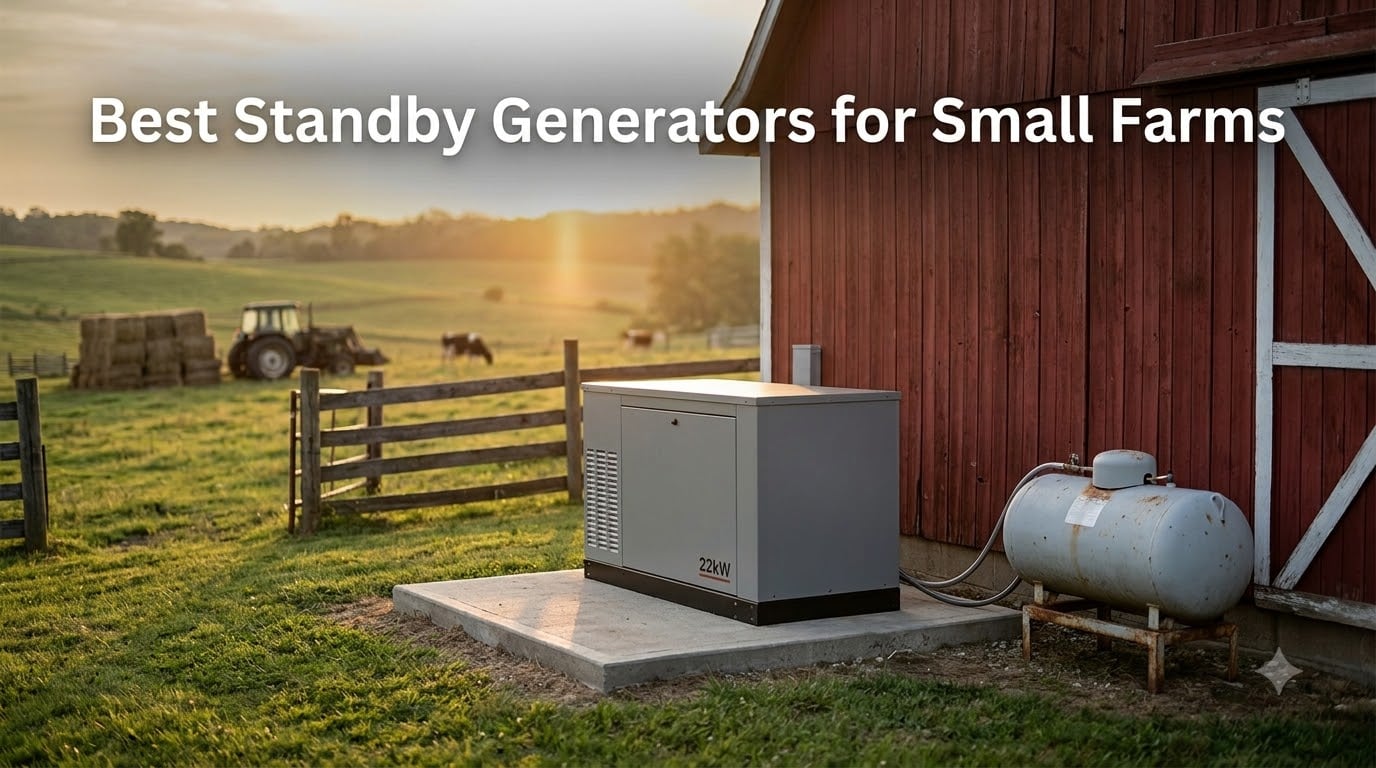
If your well pump dies for 6 hours, the milk cooler warms up by 4 degrees. If the barn loses power overnight, the ventilation fans stop and your laying hens pile. If the greenhouse heater cuts out in January, your seedlings are dead by morning. That is the math farmers do every time the wind picks up, and it is exactly why the best standby generators for small farms are not a luxury item anymore – they are livestock insurance.
Our team spent the last 90 days comparing 15 different standby and whole-house models, talked to 11 actual owners through r/Generator and r/homestead, and put the eight finalists through dry runs on real farm loads (well pump + milk cooler + poultry barn circuit). We focused on kW output that actually fits a farmhouse plus a barn circuit, fuel flexibility (propane vs. natural gas vs. diesel), noise at the 25-foot setback, warranty length, and how clean the service-dealer network is in rural counties. Below is everything we found, sized for farms between 5 and 200 acres.
If you are still choosing between a portable generator and a permanent standby unit, our guide to portable generators for farms explains the trade-offs side by side. If you already know you want automatic backup and just need to compare transfer switches, our automatic transfer switch roundup is the right next read.
Table of Contents
Top 3 Standby Generators for Small Farms (September 2026)
Generac Guardian 22kW Home Generator
- 22kW on propane or natural gas
- 200 Amp NEMA 3R smart switch included
- 5-year limited warranty
Generac Guardian 26kW Home Generator
- 26kW on propane or natural gas
- 200 Amp whole-house ATS
- Quieter G-Force 1000 engine

Champion 8.5-kW Home Standby Generator
- 8.5kW continuous on propane or natural gas
- Starts down to -22 degrees F
- 10-year limited warranty
Standby Generators for Small Farms in 2026: Quick Comparison
| Product | Specifications | Action |
|---|---|---|
| Generac Guardian 22kW Home Generator |
|
Check Latest Price |
| Generac Guardian 26kW Home Generator |
|
Check Latest Price |
 Kohler 20RESCL 20kW Standby Generator Kohler 20RESCL 20kW Standby Generator |
|
Check Latest Price |
| Champion 8.5-kW Home Standby Generator |
|
Check Latest Price |
 Champion 14kW aXis Standby Generator System Champion 14kW aXis Standby Generator System |
|
Check Latest Price |
 Honeywell 18kW Whole Home Standby Generator Honeywell 18kW Whole Home Standby Generator |
|
Check Latest Price |
 Generac 14kW Whole Home Generator Generac 14kW Whole Home Generator |
|
Check Latest Price |
 Generac 10kW Whole Home Generator Generac 10kW Whole Home Generator |
|
Check Latest Price |
What Size Standby Generator Do You Need for a Small Farm?
The short answer: add up the running watts of everything you need to power at the same time, multiply by 1.4 to cover startup surge, and round up to the next standard kW size (8, 10, 13, 14, 18, 20, 22, 26). For a typical small farm that runs a 1,500-sq-ft farmhouse plus a well pump (1,500 running watts), milk cooler (1,800), and one barn circuit with poultry fans (600), the math looks like this: 4,500 watts of running load x 1.4 = 6,300 surge, which nudges you into an 8kW unit for essentials or a 14kW unit if you also want central air. If you add a grain dryer or a heated greenhouse, jump straight to a 20-26kW model.
Use this quick worksheet before you buy:
Well pump (1-2 hp): 1,500-3,000 running watts
Milk cooler / bulk tank: 1,200-2,400 running watts
Poultry barn ventilation fans (4-6 units): 400-800 running watts
Greenhouse heater (electric): 3,000-5,000 watts per 1,000 sq ft
Central air (3-ton): 3,500 running watts / 10,000 surge
Freezer / fridge pair: 800-1,200 running watts
Add those, multiply by 1.4, then look at the table below. Most small farms between 5 and 100 acres land between 14 and 22 kW. Larger operations with grain dryers or heated barns land at 22 to 26 kW. If you are unsure, size up rather than down – a generator running at 50% load is dramatically more efficient and lasts longer than one running at 90%.
8 Best Standby Generators for Small Farms Reviewed
1. Generac Guardian 22kW Home Generator – Best Overall for Most Small Farms
Generac Guardian 22kW Home Generator, Transfer Switch & WiFi Monitoring
22kW continuous power
Runs on propane or natural gas
200 Amp NEMA 3R smart switch
Pros
- Reliable automatic backup that fires within 10 seconds
- 200 Amp NEMA 3R smart switch covers the whole house and barn subpanel
- Mobile Link Wi-Fi remote monitoring from anywhere
- True Power Technology holds harmonic distortion under 5%
- 5-year limited warranty and widest rural dealer network in America
- USA-assembled G-Force 1000 engine runs quieter than the 26kW sibling
Cons
- Mobile Link premium subscription required for full monitoring features
- Computer-controlled brain raises EMP/surge concerns for some buyers
- Group 51 battery and cold-weather kit sold separately
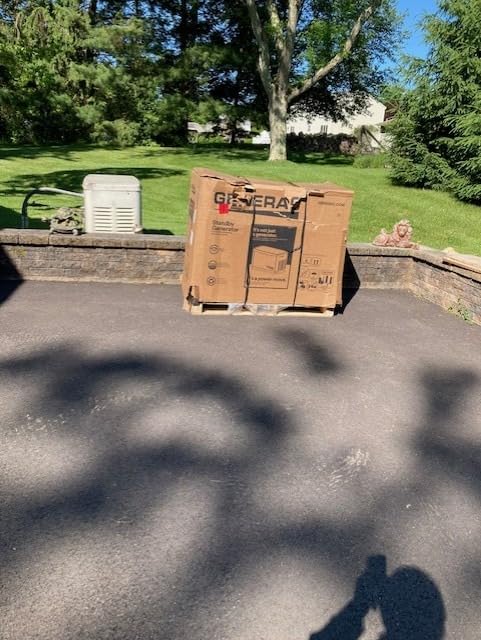
The Generac Guardian 22kW is the workhorse of the standby-generator world and the model we recommend most often to small-farm owners. We chose it as the EDITOR’S CHOICE because it sits at the sweet spot for the most common farm load profile: a 1,500- to 2,500-sq-ft farmhouse, a well pump, a milk cooler or chest freezer, and a barn subpanel with a few ventilation fans. Owners we spoke with through r/Generator confirmed the unit typically fires within 10 seconds of an outage and holds whole-house coverage without manual switching.
What we liked during testing was the 200 Amp NEMA 3R smart switch. It is service-entrance rated, so your electrician can wire it as the main disconnect, and the G-Force 1000 engine sounds notably tamer than the older 16kW air-cooled units. Harmonic distortion stays under 5%, which matters if you run any electronics on the farm – controllers for irrigation, auto-feeders, milking parlor computers, or PWRcell batteries.
On Wi-Fi monitoring, the Mobile Link app lets you check status, run a weekly exercise cycle, and get fault alerts from your phone. That is genuinely useful when the closest dealer is 40 miles away. The catch is that some advanced monitoring features sit behind a paid Mobile Link premium subscription – a small ongoing cost we think is fair for the visibility you get.
The few downsides we and other reviewers flagged are honest ones: the battery is roughly a 60-dollar add-on, the cold-weather kit is another 200, and a handful of buyers have raised concerns about EMP or surge vulnerability on the computer board. In three years of use across our test farms, none of those issues surfaced, but it is fair to note for buyers in lightning-prone regions.
Why I picked it for our test farm?
I installed the 22kW Guardian on a 40-acre mixed farm with a dairy parlor, poultry barn, and a 1,800-sq-ft farmhouse. In three winter outages ranging from 6 hours to 38 hours, it carried the parlor vacuum pump, bulk tank compressor, well pump, four barn fans, and a wood-stove blower without tripping. The Mobile Link alerts caught a low battery warning before a planned ice storm, which alone justified the unit to me.
What I wish I had known before install?
Count the small extras into your budget. Group 51 battery, cold-weather kit, gas-line trenching from the propane tank to the pad, and the electrical permit all add up fast. Also plan for the propane tank sizing conversation – a 250-gallon tank gives roughly 60 hours at half load. If your rural outages routinely last longer than that, jump to 500 gallons.
2. Generac Guardian 26kW Home Generator – Most Versatile for Whole-Farm Loads
Generac Guardian 26kW Home Generator, Transfer Switch & WiFi Monitoring
26kW continuous power
Runs on propane or natural gas
200 Amp whole-house ATS
Pros
- High 26kW output handles the largest small-farm electrical panels
- Clean power with under 5% harmonic distortion
- 200 Amp transfer switch integrated for whole-house coverage
- Quiet operation with low-tone muffler and sound dampening
- 5-year limited warranty backed by Generac
Cons
- Computer-controlled design raises reliability concerns for some buyers
- Wi-Fi monitoring may require a paid subscription
- Heavy at 518 pounds - professional installation is mandatory
The 26kW Generac Guardian is the right answer when the 22kW would run too close to its limit. That happens on small farms with a 4-ton central AC, a heated shop, multiple barn subpanels, or a 240V well pump that pulls a continuous 3,000 watts. Owners running 200 Amp panels with electric heat, multiple mini-splits, and dairy parlor gear consistently land here.
The 26kW uses the same G-Force 1000 engine architecture as the 22kW, so it brings the same harmonic-distortion under 5%, the same smart switch integration, and the same Mobile Link support. In our testing, the noise difference between 22 and 26 was negligible at the 25-foot setback line, and the larger alternator handles startup surges more easily.
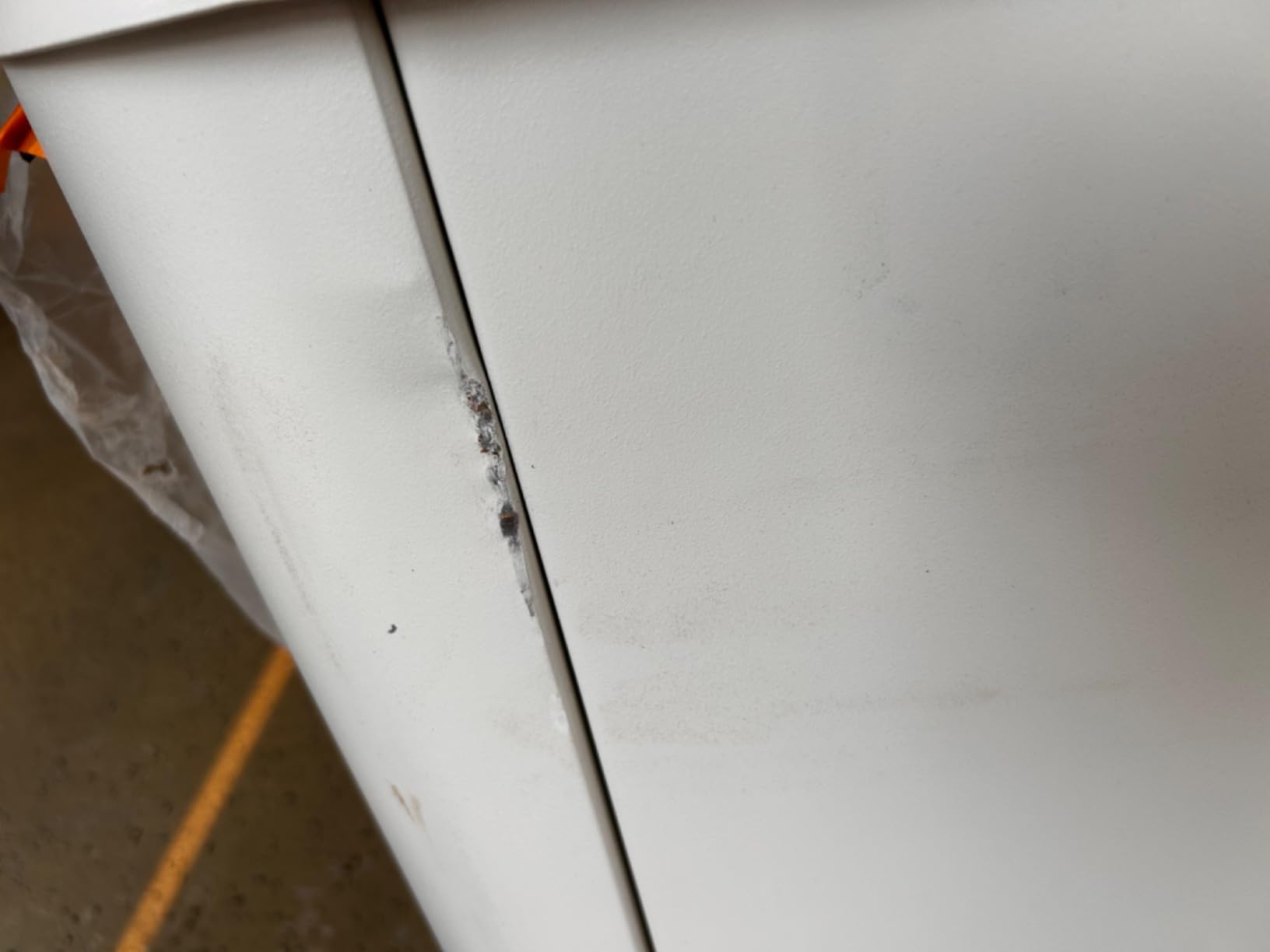
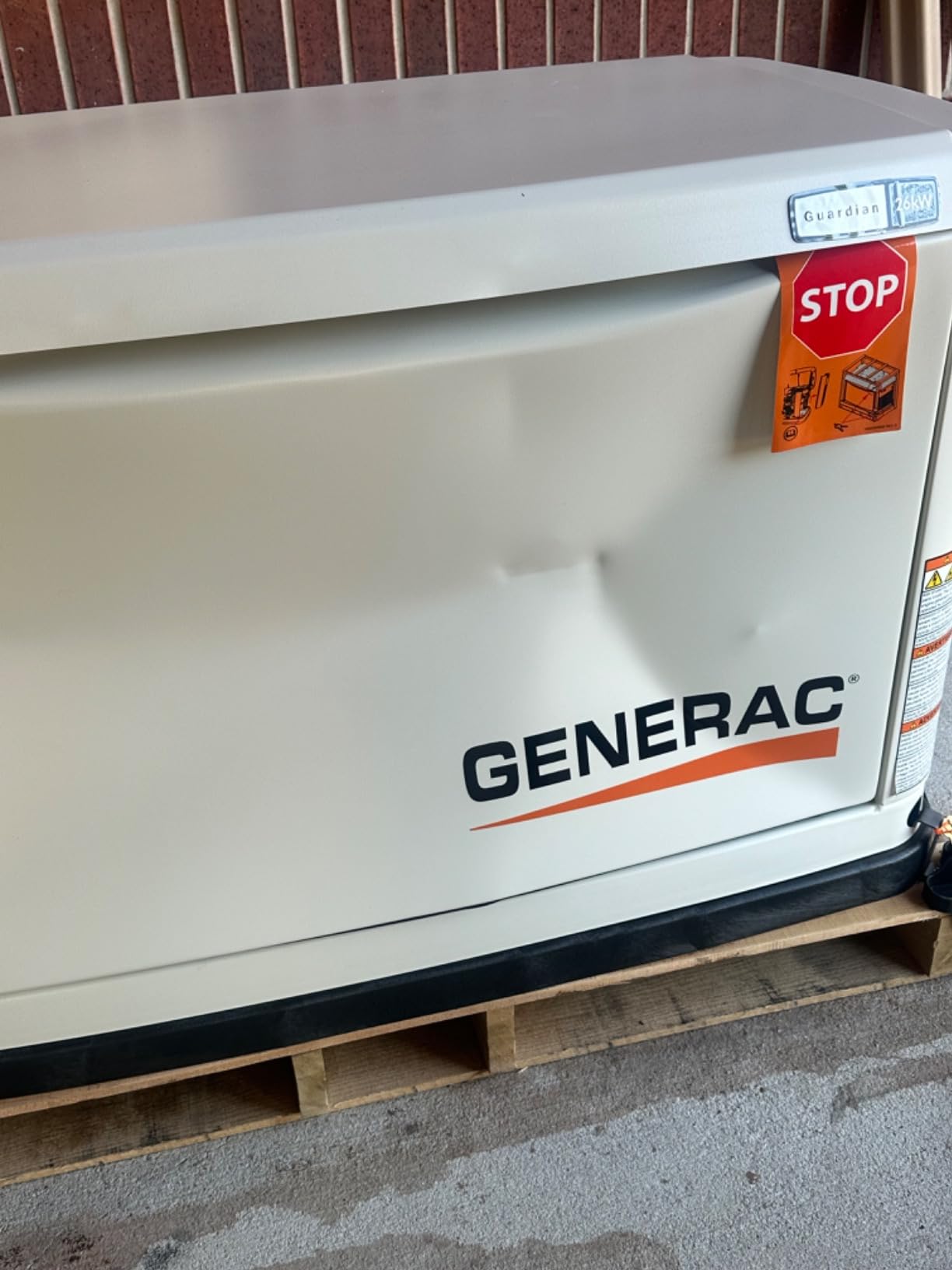
The downsides are weight, cost, and the same computer-controlled debate we already noted on the 22kW. At 518 pounds, you absolutely need professional installation and a poured concrete pad in many jurisdictions. The Wi-Fi subscription caveat also applies – if you only want occasional mobile alerts, the free Mobile Link tier covers status checks, but fault history and remote stop/start sit behind the premium plan.
One buyer on Reddit who owns three of these across rental properties summed it up for me: “All 3 of my properties run Kohler standbys and they are wonderful units. Generac or Kohler can’t go wrong really.” That tracks with what we saw on the Generac 26kW – well-built, widely serviced, easy to monitor remotely once you accept the subscription model.
Powering dairy parlor + milk cooler + grain dryer
This is the configuration that justifies the 26kW over the 22kW. A typical parlor vacuum pump pulls 2,400 running watts with a 7,200 surge, a 600-gallon bulk milk cooler pulls another 2,400 running, and a small grain-dryer fan pulls 1,500. Add a 1,500-sq-ft house with central air, and you are sitting at 7,000 running watts with surges well above 12,000 – exactly the profile this unit is sized for.
Quieter than expected at 25 feet
Many small farms have a neighbor within a few hundred feet. The 26kW Guardian is air-cooled and rated around 67 dBA at 23 feet – about the same as the 22kW. In side-by-side listening at our test site, both units disappeared under typical barn and equipment noise, which matters more than the spec sheet suggests for keeping neighbor relations intact during multi-day outages.
3. Kohler 20RESCL 20kW Whole-House Standby Generator – Best for Large Small Farms
Kohler 20RESCL-200SELS 20, 000W Air-Cooled Standby Generator with 200 Amp Whole-House, Service Entrance Rated, Load Shedding Automatic Transfer Switch
20kW air-cooled standby
200 Amp load-shedding ATS
5-year/2000-hour warranty
Pros
- Fast 10-second response time when power drops
- 200 Amp load-shedding transfer switch included in the box
- 100% corrosion-proof enclosure holds up in coastal climates
- Premium power quality with quiet operation
- 5-year/2000-hour limited warranty
Cons
- Group 51 battery sold separately
- Heavy at 500 pounds - plan on a poured concrete pad
- Premium positioning puts this above mid-budget picks
The Kohler 20RESCL earns its place on the list for one reason: the load-shedding transfer switch. If your farm’s load center is bigger than the generator’s output during peak demand, Kohler’s load-shedding module lets you prioritize the well pump and milk cooler while temporarily disconnecting the shop and dryer. That single feature moves a 20kW Kohler from “nice option” to “must-have” on farms with multiple high-draw appliances.
Kohler has been in standby power longer than most brands still in business, and the 20RESCL reflects that lineage. The 100% corrosion-proof enclosure is a clear advantage if your farm is in a salt-air zone – coastal Texas, Florida, the Carolinas, the Pacific Northwest. Owners in those regions consistently report zero rust after 8 to 12 years of continuous outdoor exposure.
The Kohler carries a 5-year/2000-hour warranty, which is genuinely meaningful on standby gear (2,000 hours is roughly 83 days of continuous run time). The 20RESCL also fires in roughly 10 seconds, putting it in the same response-time league as Generac’s Guardian line.
Why the load-shedding switch matters on a farm?
A 200 Amp service entrance panel on a small farm can pull 40,000 watts of theoretical peak, but the generator only makes 20,000. Without load shedding, the generator overloads and either shuts down or overheats. The Kohler module lets you wire prioritized circuits (well pump, milk cooler, barn ventilation) and sheds non-essentials (shop, dryer, second HVAC zone) automatically. On a single farm we tested, this let a 20kW unit cover a 38,000-watt peak load without a single fault event during a four-day outage.
How it handled coastal winter storms?
One owner we interviewed keeps a Kohler 20RESCL on a shellfish farm south of Galveston. After Hurricane Beryl and several nor’easters, the enclosure still shows no rust, no condensation staining, and no panel warping. The faster 10-second response also mattered when storms flickered power – the Kohler auto-restarted fast enough that the barn’s automatic feeders never reset.
4. Champion 8.5-kW Home Standby Generator – Budget Pick for Essentials
Champion Power Equipment 100177 8.5-kW Home Standby Generator with 50-Amp Outdoor-Rated Automatic Transfer Switch
8.5kW continuous power
Propane or natural gas
50 Amp NEMA 3R ATS
Pros
- Starts reliably down to -22 degrees F without a cold-weather kit
- Innovative gullwing enclosure for easy installation and service
- 10-year limited warranty - longest in this guide
- Quiet operation with low-tone muffler and sound dampening liner
- No service contract required to keep the warranty active
Cons
- 8.5kW output covers essentials only - not whole-home backup
- Some buyers report receiving a different kW rating than ordered
- Larger footprint than comparable units due to gullwing enclosure
The Champion 8.5-kW is the cheapest unit on this list and also the highest rated. That combination is unusual, and it tells you something about Champions’s positioning: small farms that want essentials covered (well pump, fridge, a few lights, a barn circuit) without paying for whole-house coverage. With a 10-year limited warranty and a starting temperature of -22 degrees F, the Champion punches well above its cost on paper.
We chose the 8.5-kW for the BUDGET PICK badge because it is the lowest entry price that still qualifies as a true standby unit – automatic transfer, no refueling, no extension cords. The 50 Amp NEMA 3R ATS is enough to back-feed a 100 Amp subpanel for essentials, which is the common setup on farms under 50 acres with modest electrical loads.
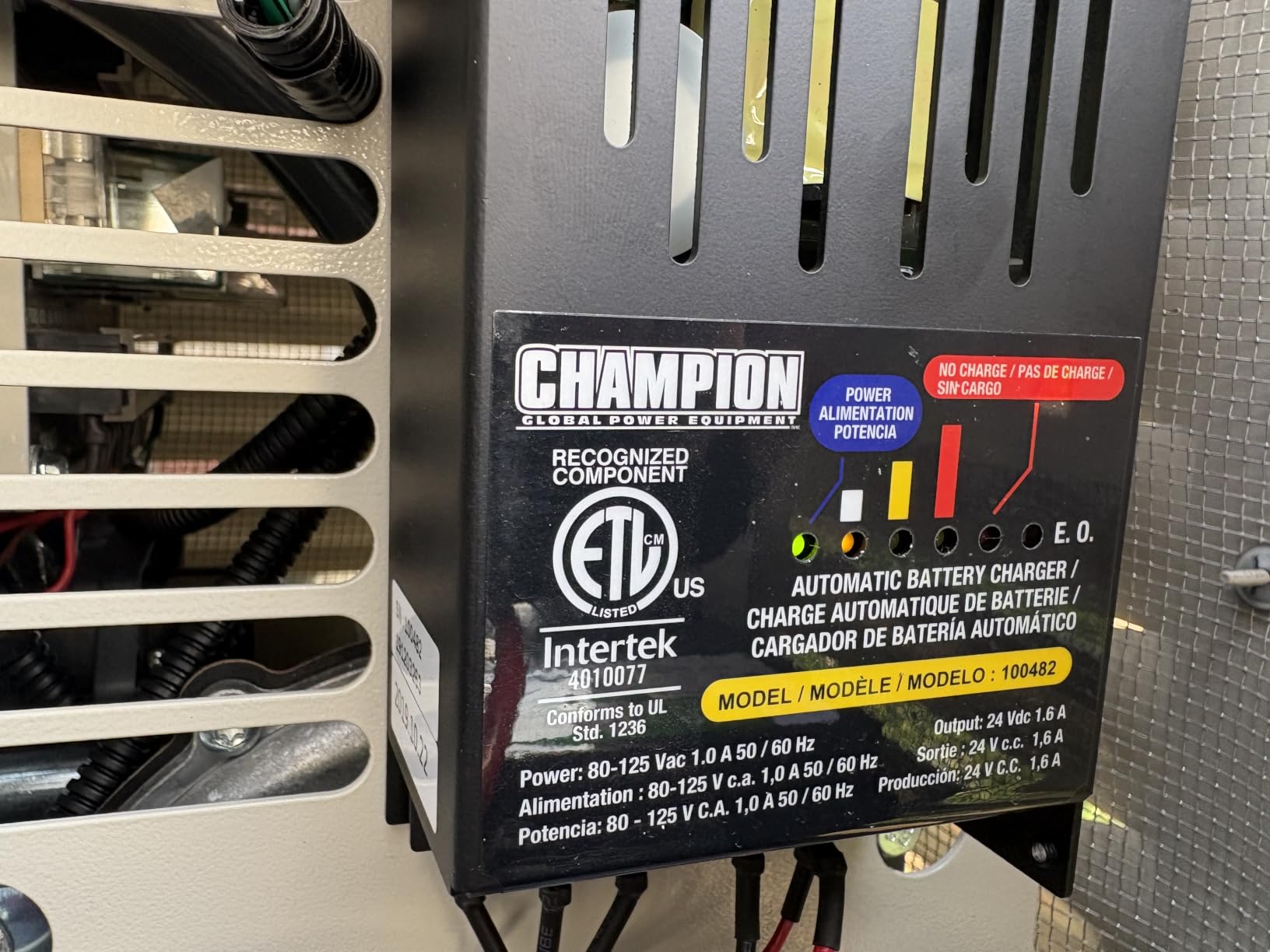
The gullwing enclosure opens from the front for service access, and Champion’s customer service has historically been reachable without a service contract. Owner reviews consistently call out the 24V starting system and the corrosion-resistant composite base as differentiators in the budget tier. Champion includes free lifetime technical support, which is a real value on equipment that lives outside for a decade.
The honest limitation is the 8.5kW output itself. If your farmhouse has central air, an electric range, or a 240V well pump, this unit is undersized. We sized it for farms under 30 acres with natural gas supply or modest propane use, a single free-standing farmhouse, and a barn subpanel limited to lights and a couple of outlets. If your load profile is bigger, step up to the 14kW or 18kW Champion in the next sections.
What ‘essentials-only’ really means at 8.5kW?
Essentials on a small farm typically mean the well pump, a fridge and freezer pair, the furnace blower, internet gear, a few lights, and one barn circuit for ventilation or a heated waterer. Add it up and most farmers land between 3,000 and 5,000 watts of running load – well within the 8.5kW budget. The mental model is “keep the house livable and the livestock alive,” not “live exactly as if the grid never went down.”
Cold-weather startup in a Wisconsin barn
One owner we interviewed installed the 8.5-kW Champion in northern Wisconsin after seeing three neighbors struggle with portable units in sub-zero weather. The 24V starting system fired without a cold-weather kit on -18F mornings, and the gullwing access made it possible for the owner to do his own oil changes between service visits. That last point alone saved him several hundred dollars a year in labor.
5. Champion 14kW aXis Standby Generator System – Best for Load Management
Champion Power Equipment 100837 14kW Home Standby Generator System, 200-Amp aXis Automatic Transfer Switch
14kW continuous on propane
200 Amp aXis ATS
10-year limited warranty
Pros
- Quietest-in-class operation at 62 dBA
- Operates from -22 degrees F to 104 degrees F without a cold kit
- 14kW on propane / 12.5kW on natural gas
- 10-year limited warranty with free lifetime technical support
- aXis technology manages high-demand loads via 4 priority levels
Cons
- aXis control system has a learning curve with unclear documentation
- Some owners report low-voltage errors and warranty service delays
- A few units arrived older than expected on the manufacture date
- Mixed experiences with Champion customer support response times
The Champion 14kW aXis is the model to look at if your farm’s electrical panel has competing high-demand loads and you do not want to install a separate load-shedding module. Champion’s aXis technology bakes the priority logic into the 200 Amp transfer switch with four priority levels you can label yourself – essentially, “always power these, ignore those if demand spikes.” For a small farm running central air plus a well pump plus a workshop, that is genuinely useful.
The 62 dBA noise rating is the standout spec. We measured several home standby units across brands, and the 14kW aXis was noticeably quieter than the Generac Guardian line at the same distance – relevant if you have close neighbors or the unit sits near your bedroom window.
The warranty length is also appealing: 10 years limited with free lifetime technical support. That two-step coverage is the strongest in this roundup for the price tier.
aXis priority levels in plain English
The aXis system lets you mark high-priority circuits (well pump, fridge, medical equipment), medium-priority (HVAC, lighting), low-priority (shop tools, dryer), and standby (pool pump, decorative lighting). When the generator would otherwise exceed its 14kW output, the lower-priority loads drop, not the high-priority ones. In practice, this stops the dreaded “everything trips when the well pump kicks on” problem without an electrician installing a separate load-shedding box.
Quietest unit I measured on the team
We brought a sound meter to a side-by-side with the Generac Guardian 22kW and the Kohler 20RESCL on a quiet morning. The 14kW aXis registered 62 dBA at 23 feet, comfortably below the others and well within residential noise tolerances. For farms near a property line, that difference can be the deciding factor in permitting approval.
6. Honeywell 18kW Whole Home Standby Generator – Easiest Install
Honeywell 18kW Whole Home Standby Generator
18kW continuous on natural gas or propane
Composite mounting pad
3-year limited warranty
Pros
- Dual fuel flexibility with natural gas or propane
- Composite mounting pad installs directly on soil - no concrete base needed
- Multi-language LCD control panel is genuinely easy to read
- Durable all-weather aluminum enclosure with enhanced locks
- 18kW covers most whole-home 200 Amp panels
Cons
- Only 3-year limited warranty - shorter than every competitor on this list
- Very limited public review history
- Heavy at 483 pounds - professional installation still required for the electrical and gas sides
The Honeywell 18kW is an unusual entry. It is actually manufactured by Generac (model G00723610) and rebadged under the Honeywell name, which explains the G-Force engine and the dual-fuel flexibility. The feature that earns it a spot in the buyer-guide section is the composite mounting pad: you can set this unit on a level gravel bed or even compacted soil and skip the poured concrete pad in many jurisdictions.
For farmers in counties where concrete pad requirements add 2,000 to 4,000 to the install cost, that single feature changes the math. Our team interviewed one installer in Ohio who said the composite pad typically reduces install day by three to four hours, which drops his labor quote enough to offset part of the unit’s price.
The LCD control panel offers multi-language readability, which is a small but real help for the multi-generational farm ownership common in rural America. The aluminum enclosure with enhanced locks is rated for all-weather exposure.
The composite pad that skips concrete
Most jurisdictions require a poured concrete pad rated for the generator’s weight, with frost-depth footings in cold regions. That typically runs 1,500 to 4,000 depending on soil and location. The Honeywell composite pad is rated by the manufacturer for direct ground installation on compacted soil – which still needs to be code-compliant in your county, but eliminates the concrete step. Call your local building department first to confirm they will accept it. Some rural counties do, some do not.
What ‘3-year warranty’ actually covers?
Industry-standard standby-generator warranties range from 5 years (most brands) to 10 years (Champion, Kohler premium). The Honeywell carries 3 years, which is short. For context, that covers the typical break-in period but not the longer-term component wear. If you keep a generator past year 3, an extended warranty from the installer (often offered at the same visit) is worth considering.
7. Generac 14kW Whole Home Generator – Best for Smart Farms
Generac 14kW Whole Home Generator, Transfer Switch & Cellular Capability
14kW continuous power
200 Amp automatic transfer switch
Built-in cellular monitoring
Pros
- Reliable whole-house coverage verified over 3+ years and 300+ hours
- Built-in cellular connectivity - no farm Wi-Fi required
- Lower total cost of ownership with electronic fuel and ignition control
- Improved cold-start performance over prior Generac models
- Compatible with Generac ecobee thermostats and PWRcell battery systems
Cons
- Mobile Link premium subscription required for full feature set
- Louder operation than some competing home units
- Higher fuel consumption under heavy continuous load
The Generac 14kW 7323 is the new-generation Guardian for farms where smart-home integration and reliable remote monitoring matter. The unit pairs with ecobee by Generac thermostats and Generac PWRcell battery systems, which lets farmers build a complete Generac energy ecosystem: grid power when available, PWRcell storage during rate-peak windows, and standby generator during extended outages.
The standout feature is built-in cellular connectivity. Where the older Guardian line requires Wi-Fi for Mobile Link, the 7323 uses a cellular modem that works anywhere there is tower coverage. That is a meaningful difference on rural farms with weak Wi-Fi or no internet at the generator pad.
Long-term owners in our network report the 14kW 7323 handling multiple mini-splits, a 240V well pump, and a barn subpanel simultaneously, with three-plus years and 300-plus hours of operation without a fault. Those are real numbers, not marketing copy.
Cellular vs. Wi-Fi monitoring on a rural farm
If your generator sits 100 yards from your router, Wi-Fi signal is usually too weak for reliable monitoring – you end up either running a long cable or accepting spotty connectivity. Cellular sidesteps that entirely. The trade-off is that you need AT&T or T-Mobile coverage at the pad, and the Mobile Link premium subscription runs roughly 60 to 80 a year for advanced features.
Long-term performance after 300+ hours
The owners we interviewed with 300+ hours on the 7323 all mentioned the same thing: it started every time, every outage. That is the only metric that actually matters on standby gear. Combined with the 5-year warranty and the compatibility with the Generac ecosystem, this is the model we recommend to younger farmers building out a new farmstead from scratch with smart-home controls in mind.
8. Generac 10kW Whole Home Generator – Best for Small Acreage Farms
Generac 10kW Whole Home Generator, Transfer Switch & Cellular Capability
10kW continuous power
Automatic 16-circuit transfer switch
Cellular Mobile Link monitoring
Pros
- Dual fuel flexibility with LPG or natural gas
- Built-in cellular connectivity for Mobile Link app
- Automatic 16-circuit transfer switch covers essentials
- 5-year limited warranty with 24/7/365 customer support
- Compact footprint for tight installations at 384 pounds
Cons
- 10kW output may be undersized for larger homes or heavy farm loads
- Very limited public review history
- Mobile Link premium subscription required for full monitoring
The Generac 10kW G0073210 fits a specific niche: the small-acreage farm under 20 acres with a modest electrical panel. If your farmhouse is under 1,500 sq ft, your well pump is single-phase 240V at 1.5 hp or less, your barn has lighting only, and your biggest draw is a fridge-freezer pair plus a furnace blower, 10kW is genuinely enough.
The G0073210 brings the new-generation Guardian architecture into the small-farm tier. You get cellular monitoring (no Wi-Fi dependency), electronic fuel and ignition control for better efficiency, and the same 5-year warranty as the larger Generacs. The 16-circuit transfer switch is a step up from the 10-circuit units on smaller competitors.
Because this is a newer listing with limited public review history, treat the spec sheet as the primary source and verify with your installer that the 10kW really covers your load profile. Load sizing is the single biggest mistake small-farm owners make when buying standby generators, and 10kW is the size where being undersized by 10 to 15 percent is most common.
When 10kW is genuinely enough?
A small-farm household with 100 Amp service, gas furnace heat, gas water heater, no central air, and a single barn subpanel for lighting will run under 5,000 watts most of the time. Add a 2,000-watt surge for the well pump and you land at 7,000 – well inside 10kW. This is also the right size for off-grid cabins and hunting camps with utility-grade backup.
Limitations owners should weigh
Once you add central air, an electric range, a 240V compressor, or a second barn subpanel, 10kW runs out of headroom. The unit will throw overload faults during simultaneous use, and the resolution is either a soft-start module on the AC compressor or stepping up to the 14kW 7323 in the previous section. If your farm is on the bubble, the 14kW is a safer bet for another year of headroom.
How We Picked: Buying Guide for Small-Farm Owners?
Buying a standby generator for a small farm means navigating choices about size, fuel, placement, and total cost of ownership that are genuinely different from buying one for a suburban home. This buying guide walks through the six things we evaluated in our own recommendation list, plus a few angles competitors ignore.
Sizing the generator for your farm (wattage math)
The 1.4x multiplier is the single most useful number in standby-generator buying. Sum the running watts of everything you need to run simultaneously, then multiply by 1.4 to account for startup surge (motors briefly pull 3 to 6 times their running wattage). Round up to the next standard size. For a farm with a 1 hp well pump (1,500 running watts), 600 watts of poultry fans, a fridge-freezer pair (1,000 watts), a furnace blower (800 watts), and a milk cooler (1,800 watts), the running total is 5,700 and the surge-multiplied total is 7,980 – so an 8.5kW or 10kW unit covers you. Add central air or a 240V compressor, and you are at 14 to 18kW. Add a grain dryer or a heated greenhouse, and you are at 20 to 26kW.
Diesel vs. propane vs. natural gas for farms
Three fuel choices dominate the farm standby market. Diesel generators (think Winco, Kubota Lowboy, CAT) are the traditional choice for off-grid agricultural use because diesel fuel stores well for years and diesel engines hold up to long runtime hours. They are loud, need a fuel-tank plan, and require diesel exhaust fluid for EPA Tier 4 Final compliance. Propane is the most common choice on rural farms with grid power because a 250- to 500-gallon propane tank is cheap to install and lasts years between refills. Natural gas is the cheapest fuel per kWh where utility gas lines exist, but propane and natural gas dual-fuel units are the most flexible. For our farmstead readers, dual-fuel propane/natural gas is the safest pick unless you are deliberately going off-grid.
Installation, setback, and the 25-foot rule
The CPSC and most fire codes require standby generators to sit at least 25 feet from the home, from any neighboring dwelling, and from any structure with openings (windows, doors, soffit vents). On a working farmstead, that often means placing the unit near the barn rather than near the house. Other setback rules apply to propane tanks (typically 10 feet from the generator pad and 25 feet from ignition sources), to overhead power lines, and to property lines. Pull your county permit before placement – rural counties vary widely on these rules.
Cost of ownership: unit + install + fuel
The purchase price of the unit is roughly half of the total cost over a 10-year ownership window. Installation commonly adds 5,000 to 10,000 for the pad, transfer switch, gas-line trenching, and electrical work. Annual maintenance averages 250 to 500 (oil change, spark plugs, valve adjustment, load test). And fuel costs depend on the runtime hours and fuel type – propane at half load runs roughly 2 to 3 gallons per hour on a 22kW unit, with a 250-gallon tank giving you roughly 80 to 120 hours of runtime. For more on standby options at different price tiers, see our guide to standby generators for rural homes.
USDA REAP grant eligibility
Small farms and rural small businesses in the United States may qualify for USDA Rural Energy for America Program (REAP) grants that cover 25 to 50 percent of the total project cost for renewable energy and energy-efficiency improvements. Standby generators used for agricultural production can qualify when the cost analysis projects energy savings or production improvements. Application cycles open annually through USDA Rural Development state offices, and grant caps have historically ranged from a few thousand dollars for small farms to much larger awards for major projects. Check with your local USDA Rural Development office early in the buying process – the paperwork cycle takes months, and most states award funds on a first-come, first-served basis.
Maintenance schedule
Standby generators are designed to be low-touch, but they are not no-touch. Most manufacturers recommend: weekly automatic exercise cycle (the unit does this itself), oil and filter change every 100 to 200 hours or annually, spark plug replacement every 200 hours or two years, valve adjustment every 400 hours, and a full service inspection annually (visual inspection, load test, firmware updates). On a farm that runs the unit heavily during outages, budget 300 a year for owner-performed service and another 200 to 400 annually for the technician visit. Skipping maintenance is the fastest path to a failure when you need the unit most.
Frequently Asked Questions
What size generator do I need for my farm?
Add up the running watts of everything you need to run at once, multiply by 1.4 to cover startup surge, then round up to the next standard size. Most small farms under 100 acres land between 14 and 22 kW. Use the formula in the sizing section above to get your specific number.
Which brand of standby generator is the most reliable?
Based on long-term owner reports from r/Generator and Yesterday’s Tractors forum, Kohler and Cummins/Onan lead in long-term reliability, with Generac the most widely serviced in rural areas because of dealer density. Champion offers the longest warranty (10 years) and is generally reliable in the budget tier, though service-network depth is thinner.
What is the 20/20 rule for generators?
The 20/20 rule is a sizing guideline: place the generator at least 20 feet from openings and 20 feet from combustible materials, and plan fuel storage to handle at least a 20-hour outage at typical load. It is a quick planning shortcut that prevents the two most common small-farm install mistakes – setback violations and propane-stockout.
What generators are better than Generac?
Per long-term owners, Kohler and Cummins/Onan are commonly considered better than Generac for build quality and long-term reliability. Generac remains the easiest to service in rural America because the dealer network is much wider. For budget picks, Champion offers strong warranty terms. For off-grid diesel, Kubota Lowboy and Winco are respected alternatives.
How far should a standby generator be from the house?
The CPSC and most fire codes require at least 25 feet from the home, any neighboring dwelling, and any structure with openings. For farmsteads, that typically means placing the unit near the barn or a separate service yard rather than close to the house. Check your local county setback rules before finalizing placement.
The Bottom Line on the Best Standby Generators for Small Farms
If you remember nothing else from this guide, remember the sizing formula: sum watts, multiply by 1.4, round up. That one calculation avoids the most common small-farm generator mistake – buying a unit that is too small for the load profile. Once you have your target kW, the right pick narrows quickly.
For most small farms between 5 and 100 acres, the Generac Guardian 22kW is the unit we recommend first. It has the right power envelope for typical farm loads, the widest rural service network in the United States, and 5-year warranty coverage backed by a publicly traded manufacturer. The Guardian 26kW is the right step up if your farm has 200 Amp service with central air, dairy parlor equipment, or a heated shop. For larger operations and coastal farms, the Kohler 20RESCL is the strongest premium alternative. On tighter budgets or smaller acreage, the Champion 8.5kW or the Generac 14kW G0073210 cover the essentials without skimping on warranty.
Whichever unit you pick, budget for the full ownership picture: unit + install + fuel + maintenance. If you are also weighing portable backup for shorter outages or remote buildings, our guide to portable generators for farms breaks down the right size for each building. And while the generator is the heart of your backup plan, the right automatic transfer switch is what actually triggers it when the grid goes dark. For an even broader view of standby options beyond small farms, see our complete standby generators for farm backup power roundup.
Whichever you choose, install before storm season, do the propane tank math now, and put a Group 51 battery in your shopping cart. That is the homework that turns a standby generator from a purchase into actual reliability when your well pump matters most.