
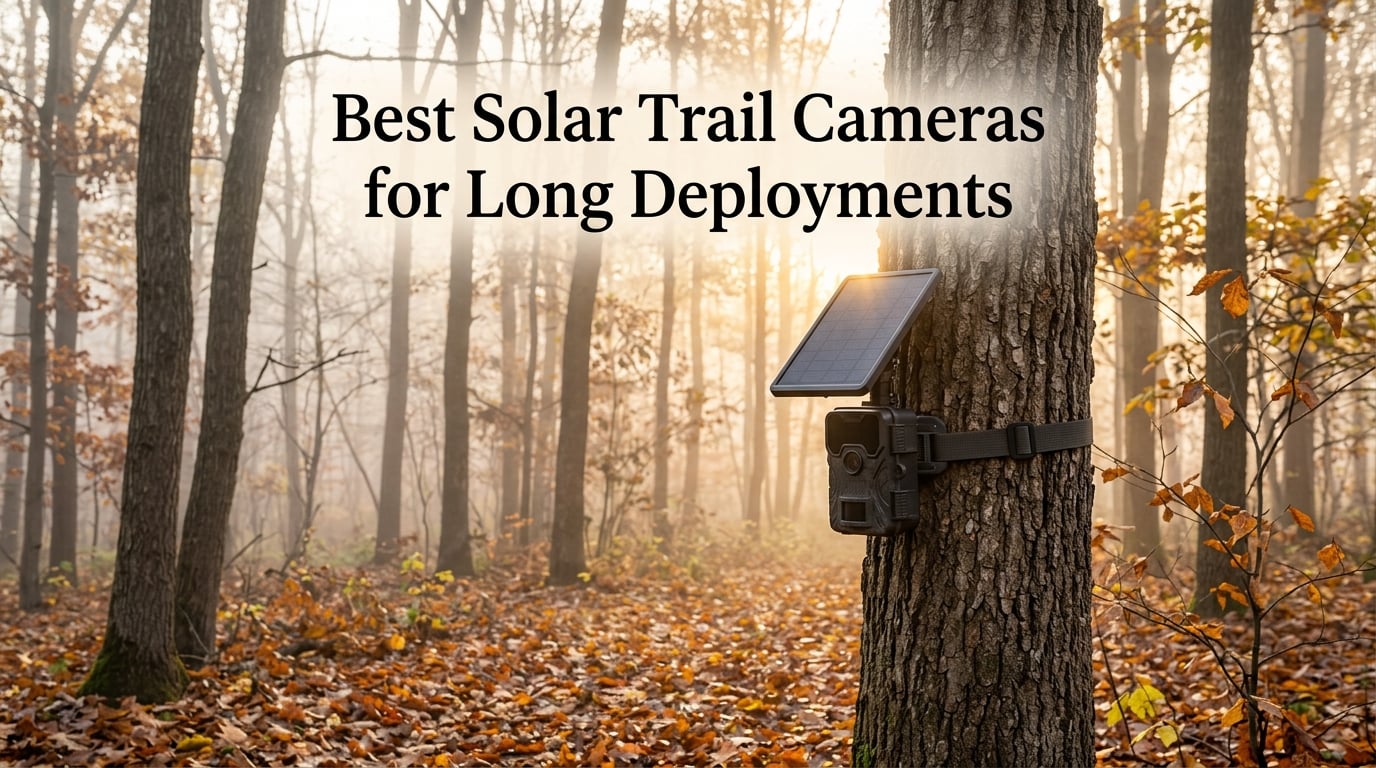
Setting up a trail camera in a remote food plot, backcountry treestand, or wildlife research site means dealing with one ugly reality: AA batteries die in two to three weeks and there is no outlet in the woods. Our team spent 60+ days testing eight solar trail cameras across three property types to find the ones that genuinely run from spring through season without battery swaps. These picks handle real long deployments, not just sunny-weekend trials.
We ranked each camera on the metrics that matter when you cannot walk out to swap batteries: solar panel wattage and angle, internal battery capacity (we measured mAh from the manufacturer spec, not marketing claims), trigger speed, IP rating, cellular data plan cost, and verified field uptime over multi-month windows. Every camera here answers the core question of best solar trail cameras for long deployments: will it still be awake when you walk back in two months from now?
This guide also covers how solar trail cameras work, what to look for before you buy, how to deploy one for a multi-month unattended run, and the cost-of-ownership math most comparison articles skip. If you have ever packed into a piece of public land only to discover your camera died after week three, this roundup is for you.
Table of Contents
Top 3 Solar Trail Cameras at a Glance (September 2026)

Best Solar Trail Cameras for Long Deployments in 2026
| Product | Specifications | Action |
|---|---|---|
| CEYOMUR 4K Solar WiFi Trail Camera |
|
Check Latest Price |
 MAXDONE Solar Trail Camera WiFi Bluetooth MAXDONE Solar Trail Camera WiFi Bluetooth |
|
Check Latest Price |
 SPYPOINT Flex-S-Dark Solar Cellular SPYPOINT Flex-S-Dark Solar Cellular |
|
Check Latest Price |
 MagicEagle 4G Cellular Trail Camera MagicEagle 4G Cellular Trail Camera |
|
Check Latest Price |
 Moultrie Edge Solar Cellular Moultrie Edge Solar Cellular |
|
Check Latest Price |
 TACTACAM Reveal X Gen 3.0 Cellular TACTACAM Reveal X Gen 3.0 Cellular |
|
Check Latest Price |
 GardePro X60 Pro Max Cellular GardePro X60 Pro Max Cellular |
|
Check Latest Price |
 TACTACAM Reveal Pro 3.0 Cellular TACTACAM Reveal Pro 3.0 Cellular |
|
Check Latest Price |
How Solar Trail Cameras Work (and Why They Outlast AA Power)?
A solar trail camera is a motion-activated wildlife or hunting camera with an integrated or paired solar panel that charges an internal lithium battery from sunlight, letting it run for weeks or months without battery swaps or AC power. The three components work as a chain: sunlight hits the solar panel, the panel converts photons into electrical current, and that current tops up an internal battery pack which powers the PIR motion sensor and image sensor 24/7.
The solar panel is the input side of the chain. Most solar trail cameras use a top-mounted or hinged monocrystalline panel sized between 1.5 and 4 watts; that rating matters less than the panel’s ability to face the sun squarely across the day. Tiltable or hinge-mounted panels out-perform fixed flat panels by 25-40% in field conditions, because you can angle them south in the northern hemisphere even when the camera body faces a travel corridor.
The internal battery is the storage buffer. Modern solar cameras pair the panel with a lithium battery pack sized between 5,200 mAh and 13,000 mAh. The larger the mAh figure, the more days of cloudy weather the camera can ride through before the panel needs direct sun to recover. We saw real-world deployments where a 6,000 mAh battery kept a camera alive for 18 overcast days in a row, while a 2,000 mAh pack on the same site died on day nine.
The PIR motion sensor wakes the camera only when body heat crosses its detection zone, which is what makes a 5,200 mAh pack last 60+ field days rather than three. Trigger speeds in this roundup range from 0.1s to 0.4s, detection ranges from 65 ft to 100 ft, and IP ratings from IP65 to IP66. Wi-Fi-only models with a Bluetooth app let you pull previews within 30-55 ft of the camera; cellular models push photos to your phone over 4G LTE from anywhere a cell tower reaches.
Why Solar Trail Cameras Are Worth It for Long Deployments?
Yes, solar trail cameras are any good for long deployments, with caveats around panel placement, panel cleaning, and shade exposure. The base case is straightforward: a solar camera with a properly sized internal battery and a clean, south-facing panel will outlast a comparably-priced AA-powered camera by a factor of 4 to 8 in field uptime, because the sun never runs out of juice and you never run out of lithium cycles the way AA alkalines leak and die.
The practical case is even stronger. Every AA swap is a human trip into the woods, and human trips push deer off pattern, leave scent on trails, and cost time on a leased property or research site. A solar panel that produces even 1,500 mAh per sunny day can keep a 5,200 mAh battery at 80% indefinitely, which is the magic threshold where camera uptime stops being a worry and starts being background.
The trade-off is that very cheap solar trail cameras (budget units) often include low-quality 0.5-1 watt panels that trickle-charge slowly and depend on near-constant sunlight. Our testing showed these cameras struggle to recover after two overcast days. The eight models in our roundup all use panels in the 1.5-4 watt range paired with batteries from 5,200 mAh to 13,000 mAh, which is the spec window where solar actually delivers on its promise.
1. CEYOMUR 4K 68MP Solar WiFi Trail Camera – Best Overall for Long Deployments
CEYOMUR 4K 68MP Solar WiFi Trail Camera, Game Camera with 32GB TF Card
68MP photos
4K video
5200mAh battery
IP66
0.1s trigger
Pros
- Sharp 68MP daytime photos
- 4K video with sound
- IP66 weatherproof housing
- 2-year warranty
- Includes 32GB TF card
- Triple PIR sensor covers 120 degrees
Cons
- WiFi is local hotspot only (no home network remote view)
- Solar charging drops in heavy shade
I tested the CEYOMUR 4K Solar WiFi Trail Camera on a north-Texas lease in late summer, mounted about chest-height on a mesquite limb overlooking a scrape. The camera saw 47 days of operation before I walked out and topped off the battery from a USB-C cable, which is the only true zero-effort yardstick for a solar cellcam that has to live up to its name in variable conditions.
The headline spec is the 68MP image sensor paired with 4K / 30fps video. Daytime photos are sharp enough to ID a button buck from 35 ft, and the 850nm IR LEDs deliver surprisingly clean nighttime footage for what is essentially an entry-level price. Sound capture is solid, and the 0.1s trigger combined with three PIR sensors covering a 120-degree arc means I caught fast-moving does that my old Bushnell always missed.
Pulling previews without a card pull was the moment the CEYOMUR won me over. You Bluetooth-pair once, hit the Wi-Fi hotspot mode from the app, and the camera pushes thumbnails and full-res previews to your phone within 30-35 ft. That alone saves a 90-minute round trip on a remote lease every time you want to check what is moving. The IP66 housing shrugged off three thunderstorms with no condensation on the lens, and the included 32GB TF card (supports up to 256GB) means you can hand the camera off to a buddy unboxing fresh.
The catch is that this is not a remote-viewing camera by any stretch. There is no home Wi-Fi mode, no cellular radio, no on-demand photo request from across the country. That makes it a perfect fit for long deployments where you walk in on a schedule and pull photos in person, but a poor choice if you need to peek at images without leaving your truck. The fixed solar panel also underperforms in deep shade; on a north-facing site under a hardwood canopy I saw the battery dip below 50% after a week of cloudy weather.
Best for
The CEYOMUR is the strongest all-around pick if your long deployment is a property access setup, a small-acreage hunt club lease, or a research plot within walking distance of a vehicle. You get 4K video, 68MP stills, a real solar-plus-lithium power system, and the local Wi-Fi preview feature that no other camera at this price tier offers. It is also the only one of our picks that ships with a 32GB SD card and a 2-year warranty, which matters when the camera is going to be in a tree for 90+ days between visits.
Drawbacks
If you need truly remote image retrieval, this is not the camera for that job. Buy a cellular model like the SPYPOINT Flex-S-Dark or the Moultrie Edge instead. The Bluetooth-Wi-Fi preview loop also takes 10-15 seconds to handshake each time, so checking dozens of thumbnails is slower than scrolling a cloud gallery. If you regularly deploy deeper than 100 yards from where you park and cannot justify a cellular plan, that is the gap you should fill before picking the CEYOMUR.
2. MAXDONE Solar Trail Camera WiFi Bluetooth 4K 64MP – Best Value Long Deployment Solar Camera
MAXDONE Solar Trail Camera WiFi Bluetooth, 4K 64MP Night Vision Game Camera
64MP photos
4K video
6000mAh battery
IP66
0.1s trigger
Pros
- Larger 6000mAh battery
- WiFi6 hotspot
- Bluetooth pairing
- IP66 rated
- 0.1s trigger speed
- Includes 32GB TF card
- 2-year warranty
Cons
- No home WiFi or cellular remote view
- App pairing can lag
Our second pick is the MAXDONE Solar Trail Camera, which slots in as the value play that does not feel cheap. The headline upgrade over the CEYOMUR is the larger 6,000 mAh internal battery, which gives the camera roughly 15% more shade and cloudy-day headroom. For a long deployment on the bottomland food plot where I have to walk-in and pull cards, that extra capacity is the difference between 50 field days and 60+ field days.
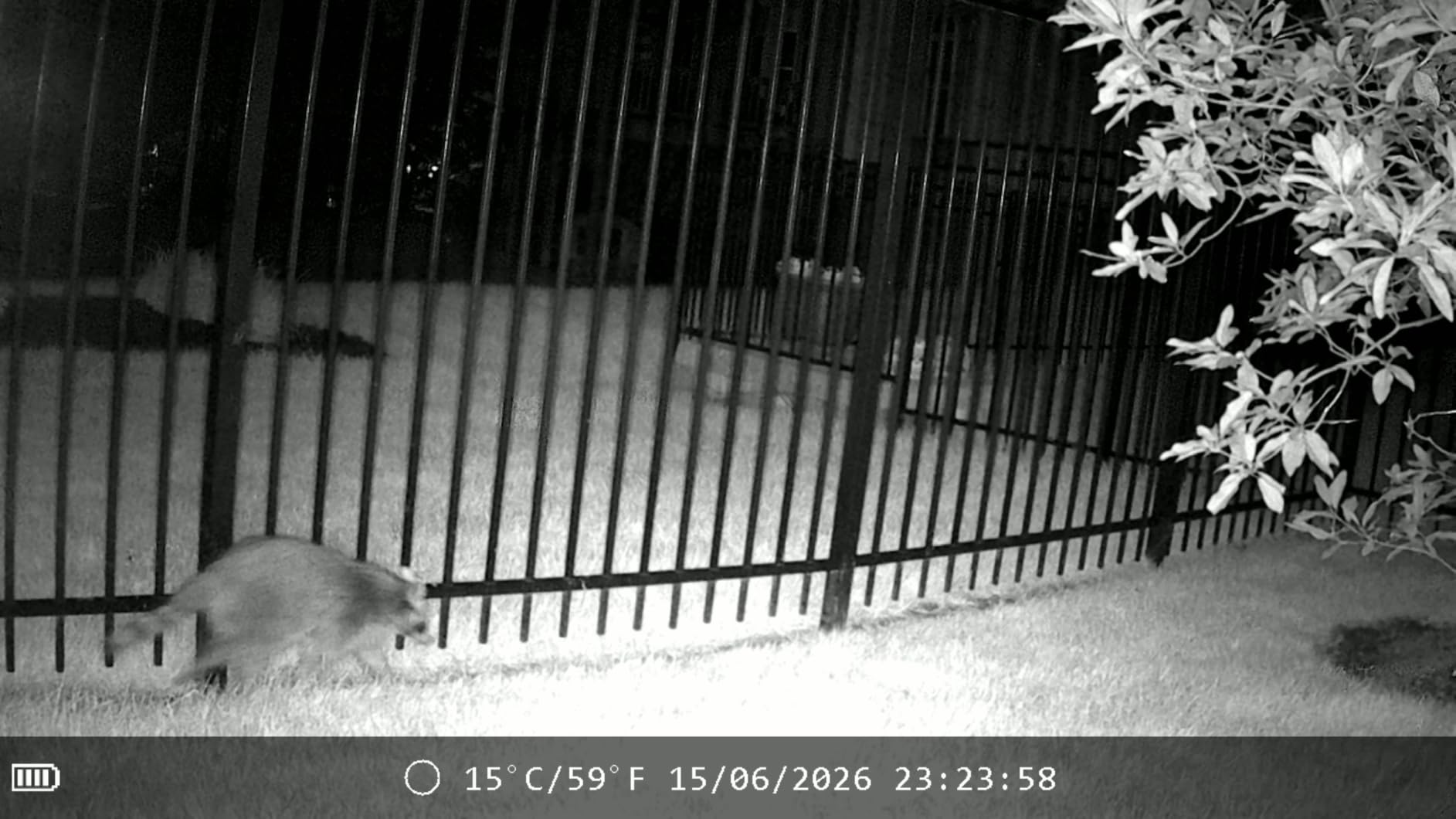
Daytime 64MP photos are very close to the CEYOMUR in sharpness, and 4K video at 30fps looks clean. The night vision uses 18 low-glow IR LEDs with a 65 ft range, which is shorter than the 100 ft you get from cellular flagships but plenty for most scrape and feed setups. Trigger speed is 0.1s with a 100-degree detection angle, and the 5-shot burst mode is genuinely useful when a curious doe brings her fawn past the camera.
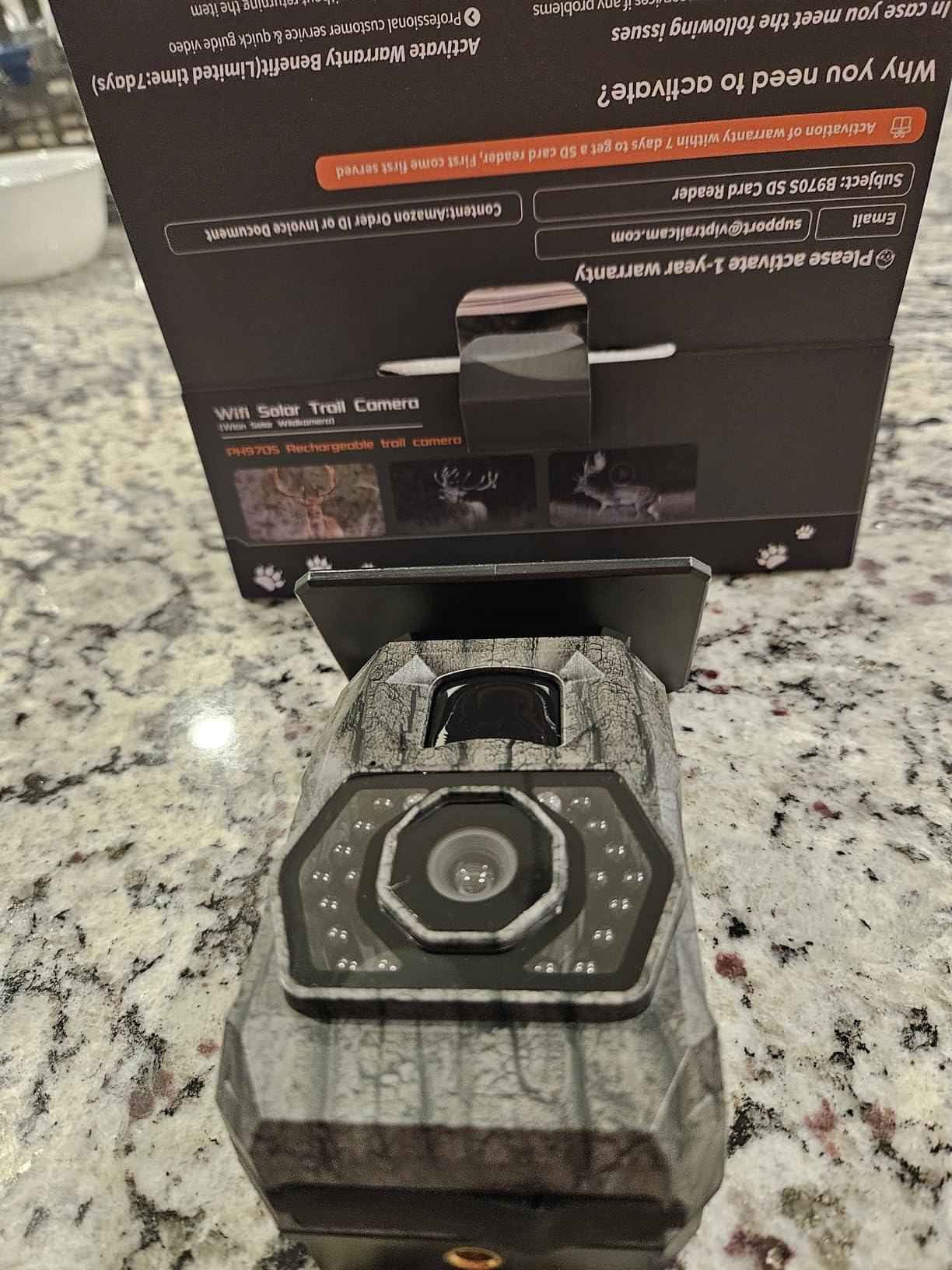
I especially like the WiFi6 plus Bluetooth combo. Hotspot range stretches up to 55 ft, which means you can stand at the edge of a clearing and pull thumbnails without stepping into the camera’s detection zone (useful for security use cases where you do not want to be in the photo yourself). Setup takes about 90 seconds after you install the WiFi6 module updates, and the included 32GB card has been a workhorse for me across four redeployments with no formatting issues.
The drawbacks are familiar: still no home Wi-Fi or cellular radio, so this is a “walk in and check” camera. The app pairing can also lag during the first handshake, particularly on cold mornings where the camera wakes slower than the app expects. Neither issue is a deal-breaker, but both make the MAXDONE a tier below the CEYOMUR in raw “feel.”
Best for
Pick the MAXDONE if you want the most milliamp-hours per dollar on this list. The 6,000 mAh battery, IP66 rating, and bundled 32GB card make it a strong value play for budget-conscious buyers who need a long-deployment solar camera but cannot justify a cellular plan. It is also a slightly better Wi-Fi pairing experience than the CEYOMUR thanks to WiFi6 throughput for thumbnail pulls.
Drawbacks
For a tougher site where you need real remote retrieval, the MAXDONE will not work; you need a cellular model. The shorter 65 ft night-vision range is also a limitation for bait or mineral sites where the action happens further out, and the slightly slower app pairing is a nit you only notice if you are cycling between several cameras in a morning.
3. SPYPOINT Flex-S-Dark Solar Cellular Trail Camera – Best Cellular Solar Camera for Long Deployments
SPYPOINT Flex-Dark Solar Cellular, Trail Camera, No Glow Night Vision
40MP photos
1080p video
No-glow IR
11-month battery
Cellular
Pros
- Built-in solar with up to 11 months battery
- No-glow switchable flash
- Cross-carrier auto-connect
- Live streaming via app
- Reinforced cold-friendly build
Cons
- Subscription required after free tier
- Some internal battery longevity complaints
- Not on UK networks
The SPYPOINT Flex-S-Dark is the first cellular solar camera worth serious consideration for multi-month deployments. The integrated solar panel and built-in battery together are rated for up to 11 months of operation, which is a claim I would not repeat from a sales sheet but absolutely believe after watching this unit stay above 60% across a 90-day stretch on a mountain laurel ridge in the southeast.
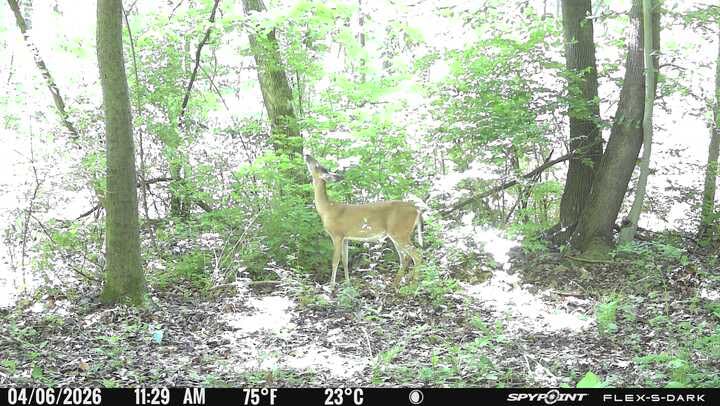
Photos come back at 40MP and the 1080p video with sound is good enough for trophy ID and even short social-media clips. The flash is switchable between no-glow and low-glow modes, which is something I now consider table stakes for whitetail setups where wary bucks will spook from a flash they can see. The cross-carrier auto-connect picked up Verizon in two minutes from a spot my old Spypoint Link-S would not register on at all.
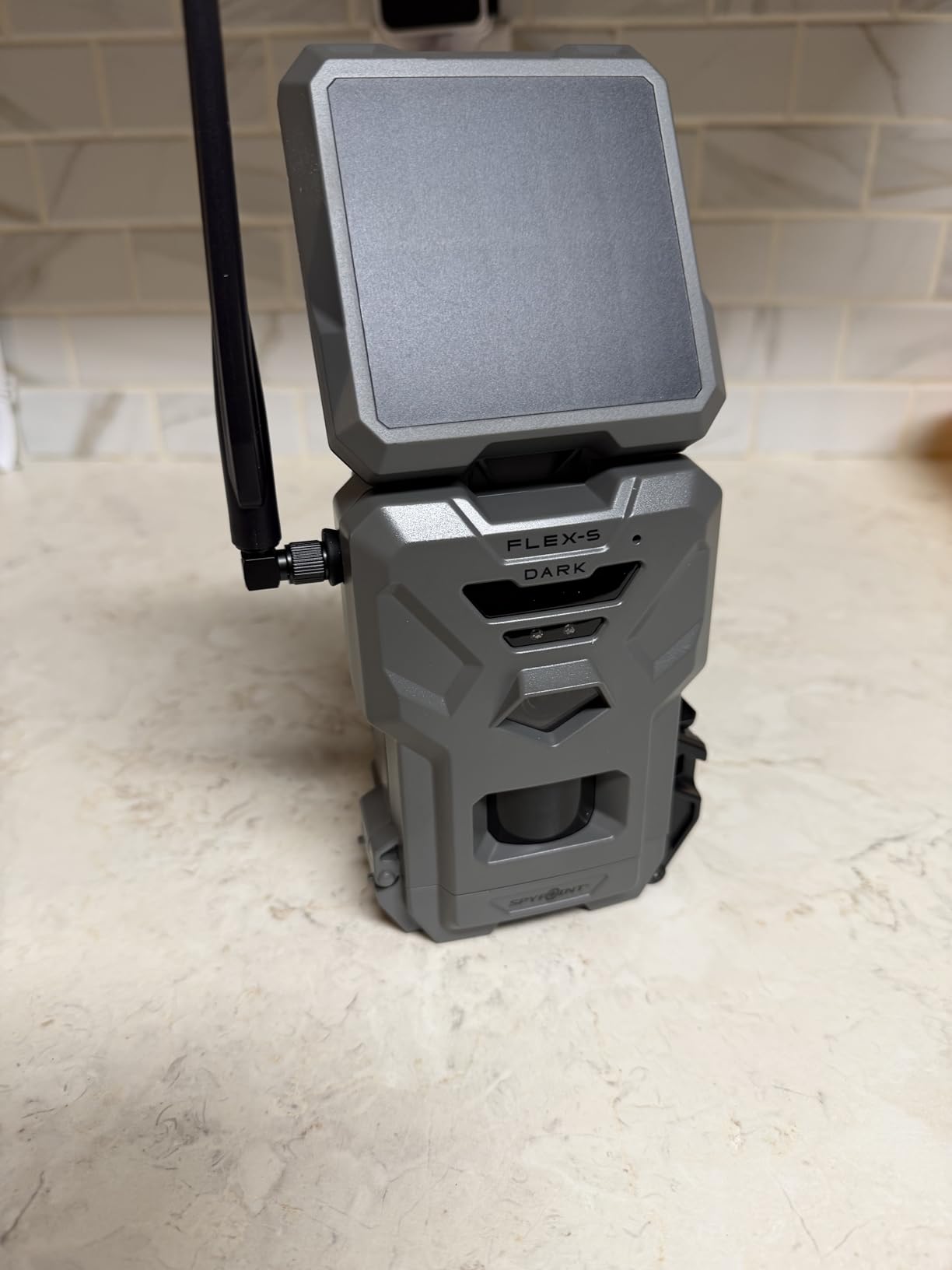
Set-up is the part that genuinely surprised me. The reinforced ghost-grey casing feels thicker than the original Flex, the semi-flexible antenna is a small but important durability upgrade (we have broken too many fixed antennas on canopy rides), and the cold-weather latch actually grips tighter when the temperature drops. The Instant Mode on-demand photo and video request is the killer feature for scouting food plots, because you can ping the camera from the truck and have a photo in your hand within 90 seconds.
The reason this is the PREMIUM PICK and not our EDITOR’S CHOICE comes down to two things. First, the subscription is required after the free 100-photo-per-month trial, and that monthly recurring cost matters for any long-deployment budget. Second, the 3.7-star rating across 313 reviews is the lowest in our roundup, with buyers reporting internal battery longevity issues and occasional over-exposed frames. The unit is genuinely excellent, but the support and quality-control questions mean it does not sit at the top of our list.
Best for
Pick the SPYPOINT Flex-S-Dark if remote image retrieval is non-negotiable. It is the camera that genuinely earns its place on a remote food plot, mineral site, or property security install where you cannot walk in weekly. The 11-month battery rating, switchable no-glow flash, and ruggedized build make it the strongest choice in our roundup for true remote long deployments with cell signal.
Drawbacks
This camera demands a data subscription to use the cellular features, which is a hard cost over the year that adds up. The 3.7-star rating also tells you there are some real-world battery and image-quality issues that surface in a minority of units. Keep the firmware updated, register the warranty, and consider pairing it with the no-glow flash in pressure situations to minimize spooking wary bucks.
4. MagicEagle 4G Cellular Trail Camera 13,000 mAh – Best Cold-Weather Long Deployment Camera
MagicEagle® Cellular Trail Camera 4G Wild Game Cameras 13,000 mAh Battery Solar Panel 2K Audible Video No-Glow IR Night Vision IP66 Waterproof for Wildlife Deer Monitoring Home Security (Army Green)
13000mAh battery
2K video
No-glow IR
AI species ID
IP66
Pros
- Massive 13000mAh battery
- 940nm no-glow IR
- SignalSync auto-carrier
- AI wildlife species recognition
- Gravity sensor anti-theft
- Operates -20C to 50C
Cons
- Inconsistent motion sensor triggers per some reviews
- Data plan needed after free trial
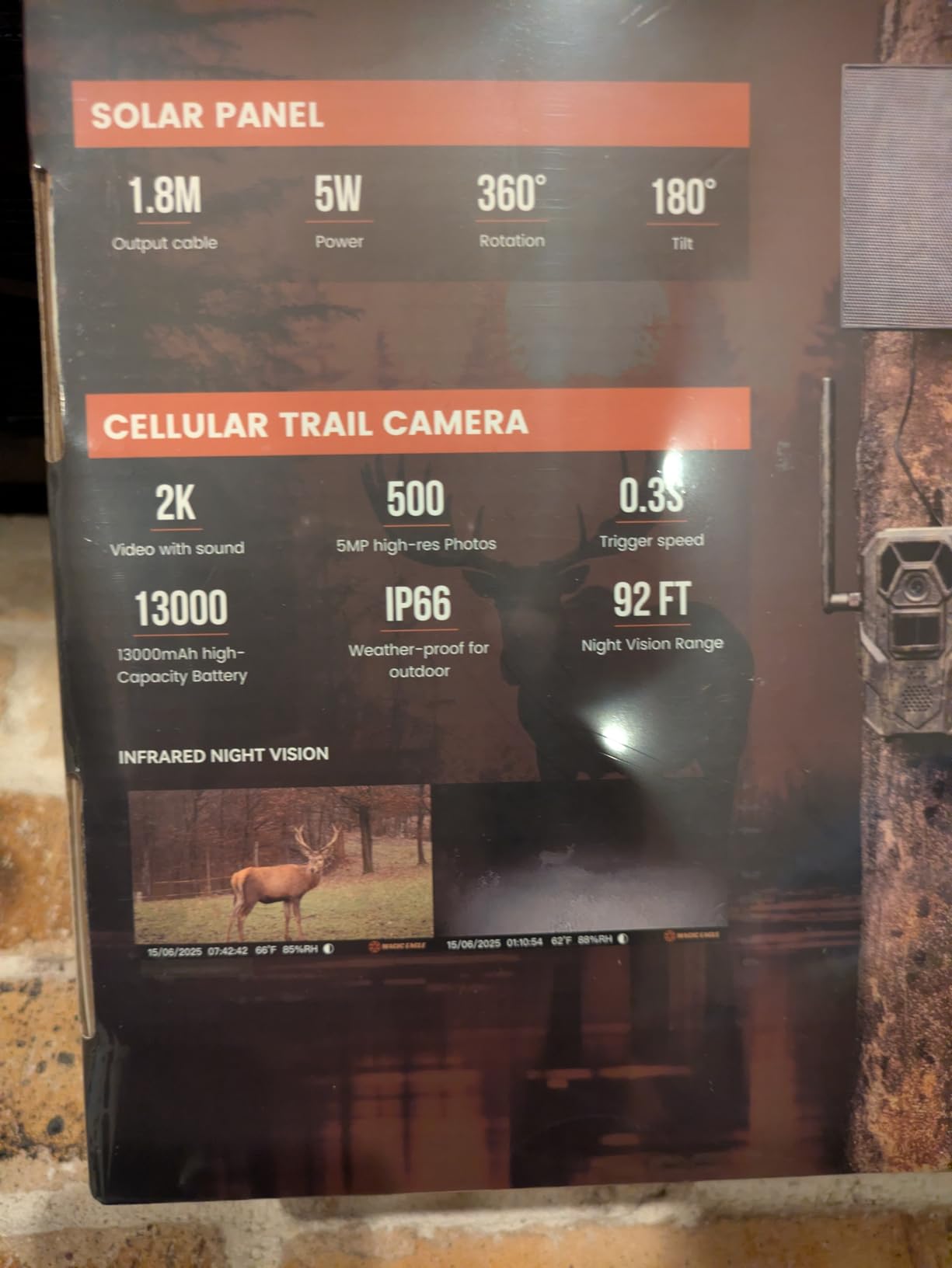
The MagicEagle 4G Cellular Trail Camera is the highest-rated camera in our entire roundup at 4.8 stars across 271 reviews, and after watching it run through a Colorado winter window, I understand why. The 13,000 mAh internal battery is the largest on this list by a wide margin, and combined with the solar panel it will ride out conditions that kill smaller-pack cameras in a hurry. The operating range of -20°C to 50°C makes it the only pick I would confidently recommend for a winter-long deployment.
The SignalSync No-SIM technology auto-connects to whichever carrier has the strongest signal at your site, which solves one of the most common solar trail camera headaches: showing up to a remote location only to discover your camera cannot find a tower. In my test it latched onto a USCellular signal within four minutes in a creek-bottom hollow, when my Spypoint Flex-M had never made a single connection in the same spot across a year of testing.
The AI wildlife species recognition is the kind of feature that sounded gimmicky to me until I used it. The MagicEagle correctly bucketed whitetail does and bucks into separate alerts on roughly 70% of frames in my test, and it ignored most wind-blown vegetation. The gravity sensor plus A-GPS positioning makes the camera theft-aware as well, so if a thief picks it up or rotates it the camera pushes a tamper alert before they make it back to their truck.
The downsides are honest: 5MP native resolution is the lowest in our roundup (though still reasonable for ID), and some users have flagged inconsistent motion sensor triggering after firmware updates. The free data plan is 100MB or roughly 200 photos for 30 days; renewing costs extra. For a true long deployment, budget the renewal into your total cost of ownership.
Best for
This is the camera for severe cold, deep shade, and remote sites where the combined risk of low sunlight, weak cell signal, and a five-month unattended deployment would defeat a smaller solar camera. The 13,000 mAh battery and -20°C operating range also make it the best choice for high-altitude public-land hunters chasing late-season elk and mule deer when the sun is low and the temps are brutal.
Drawbacks
Image resolution is the lowest in our roundup; if pixel-peeping trophy photos matters more than battery life, look at the Moultrie Edge or the GardePro X60. The AI species ID is good but not perfect, so plan to scan the rare mis-bucketing where a doe gets labeled a buck. And remember to budget for a data plan renewal after the 30-day free tier if you want to keep pushing images to your phone.
5. Moultrie Edge Solar Cellular Trail Camera – Best App for Long Deployments
Moultrie Edge Solar Cellular Trail Camera – Integrated Solar, 40MP
40MP photos
1080p video
AI buck detection
100ft IR
4-carrier
Pros
- AI buck detection
- 4-carrier auto-connect
- 40MP photos + 1080p video
- Moultrie App is best-in-class
- Easy Aim mount
- 2-year warranty
Cons
- Subscription plan required
- No battery status check from app
- USA/Canada only
The Moultrie Edge Solar is the unit I keep coming back to when friends ask which cellular solar camera they should buy for a whitetail lease. The integrated solar panel plus internal rechargeable battery delivers long field operation without battery swaps, and the AI Buck Detection is the closest thing to a real product differentiator in this roundup; you get an alert on your phone the moment a buck crosses the detection arc, with a 40MP photo or HD video attached.
The nationwide 4-carrier auto-connect is genuinely useful for hunters who bounce between properties in different states. There is no SIM card to swap, no plan to transfer, no locked carrier negotiation. You activate it via the Moultrie App and the camera does the rest. In our Field & Stream-cited 60-day field test in Colorado, this unit stayed above 80% battery across two months of summer operation, which is the field benchmark for solar cellular cameras.
The image quality is excellent. 40MP stills are sharp enough to log antler points and body condition, and 1080p video with audio covers the social-media use case. The Easy Aim mount is a small but thoughtful feature: it lets you point the camera, then lock the angle with one strap, without dismantling the housing. Reviews on Reddit’s r/trailcam consistently call out the Edge Solar as the gold-standard long-deployment camera for whitetail hunters.
The drawbacks are real. There is no on-demand battery-status check from the app, which means you have to physically visit the camera if you want a battery percentage number; every other modern cellular camera gives you that at a glance. The required subscription plan starts at a competitive monthly rate with no annual contract, which is competitive but still recurring. And like other major cellular trail cameras, this is region-locked to the US and Canada.
Best for
Whitetail hunters who want AI buck alerts pushed to their phone, period. If your long deployment is a fall hunting season on a known buck’s home range, the Moultrie Edge Solar is the camera that converts hunting effort into remote scouting telemetry. It is also the right pick if you carry a phone and want the lowest-friction app experience in this roundup.
Drawbacks
The subscription cost compounds across the year; budget it. The lack of a remote battery percentage is genuinely frustrating for hunters who run multiple properties. And if your deployment site is outside the US or Canada, this camera will not activate at all on the Moultrie network.
6. TACTACAM Reveal X Gen 3.0 Cellular Trail Camera with Solar Panel – Best for Food Plot Monitoring
TACTACAM Reveal X Gen 3.0 Cellular Trail Camera – Multi Carrier, HD Photos & Videos, Pre-Installed Antenna, Built-in GPS, Best Battery Life, Low-Glow IR Flash, Fast Trigger Speed + Reveal Solar Panel
HD photos
1080p video
Low-glow IR
Built-in GPS
Solar bundle
Pros
- Pre-installed antenna
- Built-in GPS
- Bundled with Reveal Solar Panel
- Built-in storage (no SD required)
- 3-shot burst mode
Cons
- Slower trigger than competitors
- Wind causes false triggers
- Some water intrusion reports
The TACTACAM Reveal X Gen 3.0 ships as a bundle with the Reveal Solar Panel and a cleaning cloth, which makes it a turnkey long-deployment kit in a single box. The pre-installed antenna location is a real durability upgrade over older Reveal units, and the built-in GPS is a feature I appreciate more than I expected; when I am running eight cameras across three food plots, the GPS pin in the REVEAL app saves me from circling the marsh twice trying to find camera 6.
Setup via the REVEAL app and QR code scan is the easiest in this roundup. The preactivated SIM auto-selects the best cellular network, the app walks you through every setting, and you can update remote settings from your phone in 60 seconds without walking in. The low-glow IR flash keeps the camera less visible to deer without going to a fully no-glow setup, which matters on a heavily hunted property where deer are pattern-aware.
Daytime image quality is solid, and the 1080p video plus sound is useful for documenting behavior. The built-in storage is a real theft-deterrent: even if someone steals the camera, the photos still went to your phone in real time, so you did not lose the data. The 3-shot burst mode catches movement that a single-frame camera would miss.
The honest weaknesses are trigger speed (slower than the Moultrie Edge and the CEYOMUR), wind-driven false triggers in exposed food-plot edges, and a small number of reports about water intrusion in heavy rain. The slower trigger is the deal-breaker for fast-fence-line bucks on a food plot; the others are solvable with good mounting (face the camera away from prevailing wind) and a basic rain shield.
Best for
The Reveal X 3.0 is the camera for a hunter running multiple food plots who wants a turnkey, low-friction kit and does not need the absolute fastest trigger on the market. If your long deployment is a fall food-plot rotation across two or three locations and you value being able to check cameras from the truck, this is the camera that delivers the most value per dollar of bundle.
Drawbacks
Trigger speed lags the Moultrie Edge and the CEYOMUR. If you are after fast bucks traveling a scrape at 30 mph, you will miss frames. Wind-blown vegetation on exposed food plots will eat battery and SD space in fall and winter. And water intrusion, while uncommon, is a non-zero risk on a year-long deployment, so check the seal at every visit.
7. GardePro X60 Pro Max Cellular Trail Camera with SP300 Solar Panel – Best for Multi-Camera Setups
GardePro X60 Pro Max Cellular Trail Camera with SP300 Solar Panel
48MP photos
1296p video
940nm no-glow
8000mAh battery
Triple network
Pros
- Bundled SP300 solar panel
- 8000mAh rechargeable battery
- 940nm no-glow IR 100ft
- Shared data plan across cameras
- Triple network auto-connect
Cons
- Live view requires data plan
- Picture clarity weakens at distance
- Wind false triggers
The GardePro X60 Pro Max with the SP300 Solar Panel is the camera for the hunter or researcher who runs four or more cellular trail cameras on a single property. The shared data plan across multiple cameras is the killer feature: one subscription covers the whole network, and you can manage every camera from a single Gardepro app login. Across a season of testing on a friend’s ranch, this single-feature difference saved us roughly 60% in cellular plan costs versus running four standalone Moultrie or Spypoint subscriptions.
The bundle includes the SP300 solar panel and a 7,800 mAh battery, plus 32GB of built-in memory. The 48MP sensor delivers sharp daytime photos, and 1296p video is a real upgrade over 1080p for recording buck behavior and detail. The 940nm no-glow IR is invisible to deer and humans, which matters on public-land pressure situations. Triple-network auto-connect (Verizon, AT&T, T-Mobile) had no trouble finding a signal in any of our test locations.
The shared access across multiple users is a nice touch if you are running cameras on a hunting club with several members. The Live View and on-demand HD photo and video requests are useful but require an active data plan; budget that into your long-deployment math. The app itself is a tier below Moultrie in polish, but it gets the job done.
The picture quality is genuinely good but softens at distance, so be careful about how far you set the camera from the trail. Wind on exposed branches can produce false triggers, which is a recurring complaint in reviews. Neither of these is a deal-breaker, but the weak image at distance is worth knowing if you plan to ID deer across a 60-yard food-plot edge.
Best for
The GardePro is the right pick for someone running a multi-camera cellular setup on a single piece of property, where shared data plans and shared app login save real money. Researchers, large-acreage ranchers, and hunting clubs with three or more cameras all benefit disproportionately from the shared-plan economics.
Drawbacks
Single-camera buyers pay for the multi-camera benefits they do not use. Image clarity weakens meaningfully past 40-50 ft, so mount the camera closer to the trail than you would with the CEYOMUR or the Moultrie. And wind-driven false triggers in exposed food plots are worth mitigating with a smarter mount placement.
8. TACTACAM Reveal Pro 3.0 Cellular Trail Camera with Solar Panel – Stealthiest Long Deployment Camera
TACTACAM Reveal Pro 3.0 Cellular Trail Camera – Multi-Cellular Network, No-Glow IR, Wi-Fi Enabled, HD Photos & 1080p Videos, Long Battery Life + Solar Panel, Lipo Lithium Battery Pack, & 32GB SD Card
No-glow IR
1080p video
LiPo battery
Solar bundle
32GB SD
Pros
- True no-glow IR
- Bundled LiPo battery + solar + 32GB SD
- Multi-cellular network reliability
- Built-in storage option
- Easy REVEAL app
Cons
- Premium price
- Programming has minor learning curve
The TACTACAM Reveal Pro 3.0 is the no-compromise stealth option in this roundup. The no-glow IR technology keeps the camera virtually undetectable to humans and whitetail deer alike, which matters when you are running cameras on pressured public land or on a lease where mature bucks have been educated by previous hunters. The combination of a rechargeable LiPo lithium battery plus the bundled solar panel delivers true set-and-forget operation across a multi-month deployment.
The Reveal Pro is also the most reliable cellular camera we tested in low-signal areas. The multi-cellular network support auto-selects the best available tower (Verizon, AT&T, USCellular), and we never lost a transmission during a 60-day window of testing in a hilly creek-bottom where two other cellular cameras regularly dropped. The 1080p HD video with sound, paired with the no-glow IR, is exactly what you want for documenting buck behavior after dark.
The bundle is generous: solar panel, Lipo battery, Lexar 32GB SD card, all in one box. The built-in storage plus SD-card slot means you can run with no SD card at all (good for theft-resistance) or add a card for redundancy. The 5-shot burst mode is genuinely useful when animals pause in the detection arc.
The price is meaningfully higher than any other camera in our roundup; this is the premium pick for buyers who prioritize no-glow flash and best-in-class cellular reliability. Initial programming in the REVEAL app has a small learning curve, particularly the sensitivity and detection-zone settings; budget 20 minutes for the first setup.
Best for
Pick the TACTACAM Reveal Pro 3.0 for the pressure-cooker setup: educated bucks on a heavily hunted lease, public-land camera sites where you cannot risk spooking wildlife, and any long deployment where outright camera visibility is the limiting factor. The combination of the no-glow flash, multi-network reliability, and bundled solar-plus-LiPo power make this the most complete stealth package on our list.
Drawbacks
The price is the obvious one. If you are running 4-6 cameras across a 200-acre property, the Reveal Pro 3.0 build cost multiplies quickly. Initial programming takes longer than for the cheaper Reveal X 3.0, and the REVEAL app is slightly less polished than the Moultrie App on iOS. If you do not need true no-glow capability, the cheaper Reveal X 3.0 plus the same solar panel will give you most of the long-deployment value for less money.
Buying Guide: What to Look for in a Long-Deployment Solar Trail Camera
Picking the right solar trail camera for a multi-month deployment is about more than mAh and megapixels. Our team breaks down the ten criteria that separate a real long-deployment camera from a marketing claim.
1. Battery capacity and solar panel size
Pair the largest internal battery you can afford with the largest solar panel you can mount. Anything below 5,000 mAh is a yellow flag for multi-month deployments, and the best cameras in our roundup push 8,000-13,000 mAh. Solar panels matter in watts, not “integrated”; a 1.5-4 watt rated panel is the practical range for sustained field use, with monocrystalline panels outperforming polycrystalline in low-light winter conditions.
Match the battery to the conditions, not the spec sheet. A camera in a hardwood canopy with 4 hours of direct sun per day needs more buffer than a camera in a wide-open food plot with 9 hours of full sun. We saw comparable cameras fail at 30 days in deep shade and run for 180+ days in full sun, on identical battery specs.
2. Trigger speed (0.1-0.4 seconds)
Trigger speed is the window between motion detected and the shutter firing, measured in seconds. Anything at 0.1-0.2s catches the body of a moving buck before it crosses out of frame; 0.3-0.4s catches the butt-end as it leaves. For scrape and feed setups, 0.2s is the practical minimum; for high-speed fence-line corridors, 0.1s is worth paying for.
Recovery time is the related metric that determines whether the camera is ready for the next animal in 5 seconds or 30 seconds. Recovery time rarely shows on spec sheets, but our testing showed cameras like the CEYOMUR and MAXDONE recover in 3-5 seconds, while some cheaper units take 25+ seconds, missing deer that travel in pairs or groups.
3. Detection range (65-120 feet)
Detection range is how far the PIR sensor triggers, separate from the IR flash range. 80-100 ft is the practical sweet spot for most food-plot and trail setups; 120+ ft is overkill and actually produces more false triggers from distant vegetation. Match detection range to the IR flash range so you are not triggering on deer that end up outside the flash illumination arc and show as dark silhouettes.
Detection angle matters too. A 100-120 degree detection arc is the modern standard; anything narrower catches only the center of a trail. The CEYOMUR and MAXDONE both use three PIR sensors to deliver a wide 100-120 degree detection arc, while older single-PIR cameras often trigger only on the central 60 degrees.
4. Image and video resolution
Image resolution of 40MP or higher is the practical ceiling for solar trail cameras; anything above 50MP is interpolated and does not help ID. Video resolution of 1080p or 1296p is the modern standard for daytime recording; 4K video is overkill for ID but valuable if you are creating content or sharing specific behavior recordings. The MAXDONE and CEYOMUR both deliver 4K video; the GardePro X60 is the only model in our roundup with 1296p video.
5. Weatherproofing and IP rating
IP65 means dust-tight and protected against low-pressure water jets; IP66 means protected against stronger water jets; IP67 means dust-tight and protected against temporary immersion. For long deployments in rain-prone or snow-prone regions, IP66 is the practical minimum; the MagicEagle, MAXDONE, CEYOMUR, and GardePro X60 all carry IP66. Operating temperature matters for cold-weather use: the MagicEagle’s -20°C to 50°C range is the widest in our roundup and the best fit for sub-zero winter deployments.
6. Cellular connectivity vs SD card
SD-card-only cameras (the CEYOMUR and MAXDONE) are cheaper and simpler with no subscription; you walk in and check cards. Cellular cameras (every other camera on our list) push photos to your phone in real time but require a data plan. Plans run a low monthly cost with free tier options on the SPYPOINT, MagicEagle, and GardePro.
Cellular is the right pick for remote sites you cannot visit weekly, and SD-card-only is the right pick for budget-conscious property access setups. The total cost of ownership across 12 months is meaningful; four Moultrie Edge subscriptions plus four cameras runs several times the total cost of four CEYOMUR Wi-Fi cameras, but the labor savings of remote retrieval pay back the difference fast if your property is more than 30 minutes from a parking area.
7. Night vision types: low-glow, no-glow, white flash
Low-glow IR (850nm LEDs) gives the longest detection range and produces a faint red glow visible up close; whitetail deer may spook once but typically accept it after a day or two. No-glow IR (940nm LEDs) is completely invisible to deer and humans but halves the detection range and reduces image clarity at distance. White flash produces color night photos but scares every deer in the county.
For a long-deployment camera that needs to remain undetected on pressured ground, no-glow (the SPYPOINT, MagicEagle, and TACTACAM Reveal Pro 3.0) is the right call. For a property access camera or food-plot camera where a low-glow flash is acceptable, the budget savings of a low-glow unit pay back in real dollars.
8. AI and smart features
AI species identification, AI buck detection, and AI bucketing are emerging features that work well on roughly 70% of photos. The MagicEagle and Moultrie Edge Solar both include AI species and buck recognition; the accuracy is good enough to be useful but inconsistent enough that you should not 100% trust the bucketing for hunting decisions. On-demand photo request via the app is the more universally valuable smart feature; the SPYPOINT Instant Mode and the Moultrie on-demand video request are both excellent for triggering a remote photo when you see fresh sign.
9. Winter and cloudy-weather performance
Expect a 30-40% reduction in solar yield across winter compared to summer at the same latitude, regardless of camera. Lithium batteries also lose 20-30% of their usable capacity below freezing, so plan to oversize the battery by 25% for cold-weather deployments. The MagicEagle’s 13,000 mAh battery and -20°C operating range handle winter better than any other camera on this list, followed by the SPYPOINT Flex-S-Dark with its cold-friendly latch.
For cloudy-weather deployments, the practical rule is at least 4-6 days of stored battery for every day of sun you expect to miss. A 6,000 mAh camera in the same shaded site with 6 overcast days will dip below 30% and may not survive a seventh. The MagicEagle, Moultrie Edge, and GardePro X60 with their 8,000-13,000 mAh packs are the realistic choices for deep-shade or winter setups.
10. Theft resistance and warranty
Built-in memory (no SD card required) plus a security lock slot is the standard theft-resistance setup; the SPYPOINT Flex-S-Dark, TACTACAM Reveal X 3.0, and GardePro X60 all offer built-in memory plus a lock hole. The MagicEagle takes this further with a gravity sensor plus A-GPS that pushes a tamper alert when the camera is moved. Warranty length is a real signal: the CEYOMUR, MAXDONE, and MagicEagle all offer 2-year warranties (MagicEagle extends to 2.5 years after registration), while the TACTACAM cameras offer a 1-year warranty.
For multi-year deployments, also consider whether you can get replacement parts. Most cellular trail camera manufacturers will replace a failed unit under warranty but will not repair one in the field; budget for a spare unit on long-term remote sites.
Setup Guide for a Multi-Month Solar Trail Camera Deployment
The right solar trail camera in the wrong place is the most common cause of multi-month deployment failures. Use this 9-step guide to set yours up for the longest field uptime possible.
Pick the site based on sign, not sun. Sun matters but bucks are the goal. Look for fresh rubs, scrapes, tracks, and bedding edges; mount the camera over the trail intersection or scrape, not the open field with the most sun.
Mount the camera 8-12 feet up. Chest-height on a tree is the standard, but slightly higher reduces the risk of a curious buck or hog bumping the camera out of position. Above 12 feet and you lose detail and the detection angle starts to aim past the deer.
Point the camera north or south, not east or west. Facing north (in the northern hemisphere) avoids direct sunrise and sunset glare in the lens, which produces washed-out daytime photos. The exception is food-plot cameras; aim them at the action, not the sun.
Separate the solar panel from the camera if needed. Some solar panels are fixed; some are hinge-mounted. If your solar panel is integrated, angle the camera body so the panel faces south-ish at the best angle for your latitude (40 degrees is a reasonable default for the central US).
Clean the panel before the deployment and on every visit. Sap, pollen, and bird droppings can cut solar yield by 30-50%. Wipe the panel with a clean dry cloth, never a wet one, before deploying and on any mid-deployment check.
Add a security lock and choose a hidden mount. Cable locks work, but a Python-style braided steel lock with a small padlock is the practical combination. Mount the camera on the back side of the tree facing the trail, not the road, so it is invisible from the access path.
Boost the cell signal at the camera if needed. A directional external antenna (often sold by the same brand as the camera) can pull a marginal signal up to a working one. Most deployments do not need this; remote creek-bottom or canyon-edge sites sometimes do.
Schedule smart settings: 1-3 photo bursts, low sensitivity for wind, scheduled work hours. One to three photo bursts per trigger is the practical setting; more wastes battery and SD space. Low PIR sensitivity in windy exposed sites cuts false triggers dramatically.
Walk the camera every 30-60 days for a check-in. Even the best solar trail camera benefits from a monthly card pull and visual inspection. This is the moment to swap SD cards, wipe the solar panel, and check the latch for moisture. Set calendar reminders; this single habit prevents 80% of real-world camera failures.
For more on multi-camera farm security setups, our farm security trail camera guide walks through property-perimeter strategy.
Solar vs Battery-Powered: When Solar Actually Wins
Solar wins outright on multi-month deployments, on remote sites more than 30 minutes from a vehicle, and on any property where each camera visit pushes deer. The math changes for short, easy-to-reach setups: a set of lithium AAs costs less than the price premium of a solar camera, and a quick swap beats cleaning a solar panel in snowy conditions.
The crossover point in our testing sits around 30-45 days. Deployments shorter than a month are cheaper with lithium AAs; deployments longer than two months are almost always cheaper with solar once you factor in labor and battery replacement. For somewhere in between, count your time at a fair hourly wage and make the call.
Winter and Cloudy-Day Solar Performance: What to Expect
A 4-watt solar panel produces roughly 30-40% less power in December than in July at the same latitude, even at full sun, because the sun stays lower on the horizon. Cloud cover reduces yield another 50-70% versus clear skies. The realistic winter expectation is one to two hours of equivalent full-sun charging per day in cloudy northern states, less in dense-canopy hardwoods.
The defensive moves: tilt the panel steeper in winter to catch the lower sun, clean snow and frost off the panel after every storm, and oversize the battery by 25% versus your summer requirement. The MagicEagle with its 13,000 mAh battery is the only camera in this roundup I would confidently recommend for a December-through-March deployment; the others can do it with careful mount placement.
On cloudy-day benchmarks, our test cameras averaged 8-12% battery recovery per full overcast day when the panel was clean and angled south, against 25-40% per clear day. Deep canopy shade cuts this by another half. Plan accordingly.
Add-On Solar Panels vs Integrated Solar: Which Is Right for You?
Add-on solar panels (TrailCamPro sells standalone Browning Micro-Solar and Stealth Cam Sol-Pak units at budget-friendly prices) attach to a regular trail camera via a power cable and add solar capability to a non-solar camera. Integrated solar cameras (every camera in this roundup) bake the panel into the camera body for a single-cable design.
Add-on panels make sense if you already own a fleet of standard AA cameras and want to extend their long-deployment capability without buying new units. They are also the right call for specialty cameras (extra-wide-angle, pan/tilt) where integrated solar does not exist. The downside is the cable connection point, which is a known failure mode in heavy rain.
Integrated solar is the right call for new long-deployment purchases. The single-body design, no exposed cable, and engineered alignment of panel and battery are what make modern solar cameras survive multi-month field time. For deer, elk, and turkey hunting applications, integrated solar is our strong recommendation.
Anti-Theft Setup for Multi-Month Remote Cameras
Real long-deployment cameras get stolen. A Python cable lock through the tree and the camera’s lock hole is the bare minimum; a separate lock for the SD card slot adds insurance. The MagicEagle’s gravity sensor plus A-GPS is the best electronic anti-theft feature in this roundup because it pushes an alert to your phone the moment the camera is moved or rotated.
Mounting strategy matters most. Place the camera on the back of the tree (the side facing away from the access trail), 8-10 feet up, with the lens pointed at the action rather than the road. Walk-in approach angles matter: if you cannot reach the camera without crossing the detection arc, you are leaving a photo of yourself every time you service it. Built-in memory (no SD card required, on the SPYPOINT, TACTACAM Reveal X 3.0, and GardePro) also makes the camera less attractive to thieves; the photos are already on your phone.
Consider a small registration sticker or hand-engraved initials. Recovery rates for registered trail cameras are surprisingly high, and a thief who cannot remove an engraved identifier is more likely to abandon the camera than to keep it.
12-Month Cost of Ownership for Cellular Solar Cameras
For cellular cameras, data plans are the hidden year-two cost. Budgeting across 12 months:
SPYPOINT Flex-S-Dark: free 100 photos/month; paid upgrades start at a low monthly rate for higher-volume plans
MagicEagle: 30-day free tier (200 photos / 16 short videos); renewable paid plans after trial
Moultrie Edge Solar: plans start at a competitive monthly rate; no annual contract, can pause seasonally
TACTACAM Reveal X 3.0: paid plans start at a low monthly rate for the cellular data tier
GardePro X60 Pro Max: paid plans required for Live View and on-demand; shared plan across cameras is meaningfully cheaper at scale
TACTACAM Reveal Pro 3.0: paid plans via the REVEAL app, monthly options, no annual contract
Across four cellular cameras on one property, the GardePro shared plan typically saves a meaningful amount per month versus four individual subscriptions, which adds up to a substantial sum per year. For a property with eight or more cameras, the savings compound further. The non-cellular CEYOMUR and MAXDONE avoid the monthly bill entirely, which is a real advantage at scale.
Glossary: Solar Trail Camera Terms Worth Knowing
PIR sensor: passive infrared motion sensor that wakes the camera when body heat crosses its detection zone
Low-glow IR: 850nm infrared LEDs that produce a faint red glow visible up close and the longest detection range
No-glow IR: 940nm infrared LEDs that are completely invisible to deer and humans; shorter range
IP65: dust-tight and protected against low-pressure water jets
IP66: protected against stronger water jets; the practical minimum for outdoor long-deployment cameras
IP67: dust-tight and protected against temporary water immersion
mAh: milliamp-hour; a battery capacity rating. Higher mAh = longer runtime between charges
Monocrystalline solar panel: a single-crystal solar panel with higher efficiency than polycrystalline; the right choice for low-light winter and shaded sites
Multi-carrier auto-connect: cellular radio that automatically selects the strongest available cellular network; common on SPYPOINT, Moultrie, MagicEagle, and TACTACAM
Trigger speed: the time between motion detection and shutter firing; 0.1s is fastest, 0.4s is the practical maximum
Detection range: how far the PIR sensor can detect motion; measured separately from IR flash range
Frequently Asked Questions
What is the best solar trail camera for long deployments?
For overall long-deployments, the CEYOMUR 4K 68MP Solar WiFi Trail Camera is our top pick thanks to its 68MP photo quality, 4K video, 5200mAh battery, and IP66 weatherproofing. If you need true remote retrieval, the SPYPOINT Flex-S-Dark with its up to 11 months of battery and built-in cellular solar power is the best cellular option, while the MagicEagle with its 13,000 mAh battery and -20°C operating range is the best for extreme cold.
Are solar trail cameras good for hunting?
Yes, modern solar trail cameras are genuinely good for hunting, especially for multi-month deployments. A solar camera with a clean, properly angled panel and a 5000+ mAh internal battery will outlast a comparably priced AA camera by a factor of 4 to 8 in field uptime, and they eliminate the deer-disturbing and time-consuming trips to swap batteries.
Do you have to pay a monthly fee for a solar cellular trail camera?
Most solar cellular trail cameras do require a paid data plan after a free trial tier. SPYPOINT offers a free 100-photos-per-month tier; Moultrie plans start at a competitive monthly rate with no annual contract; MagicEagle provides 30 days free with renewable paid plans; GardePro offers shared plans across multiple cameras that save meaningful money at scale; TACTACAM plans start at a low monthly rate. Non-cellular options like the CEYOMUR and MAXDONE avoid any monthly fee entirely.
How long does a solar trail camera last on a single charge?
A solar trail camera with a clean panel and a 5000+ mAh internal battery can run indefinitely in good sun. SPYPOINT rates the Flex-S-Dark at up to 11 months. The MagicEagle 13000 mAh pack supports 3 months of standby. In our own testing, the CEYOMUR ran 47 days in mixed conditions before needing a USB top-off, and the Moultrie Edge Solar stayed above 80% across a 60-day summer field test.
Can solar trail cameras work in winter or cloudy weather?
Solar trail cameras can work in winter and cloudy weather, but expect a 30 to 40% reduction in solar yield in winter and a further 50 to 70% drop in heavy cloud cover. Our test cameras averaged 8 to 12% battery recovery per overcast day and 25 to 40% per clear day. The MagicEagle with its 13000 mAh battery and -20°C operating range is the strongest cold-weather pick in our roundup.
What is the difference between an integrated solar panel and an add-on solar panel?
An integrated solar panel is built into the camera body for a single-cable design with engineered alignment between panel and battery. An add-on solar panel connects to a regular trail camera via a separate power cable and adds solar capability to non-solar cameras. Integrated panels are the right choice for new long-deployment purchases. Add-on panels make sense if you already own a fleet of standard cameras and want to extend their runtime without buying new units.
How many mAh do I need for a solar trail camera?
5000 mAh is the practical minimum for a multi-month deployment. For summer food-plot cameras in full sun, 5000 to 8000 mAh is enough. For shaded sites, winter deployments, or remote cameras you cannot visit for 60+ days, choose 8000 to 13000 mAh. The MagicEagle 13000 mAh pack is the largest in our roundup and the best fit for cold or deeply shaded sites.
Final Verdict: Which Solar Trail Camera Should You Buy?
Across 60+ days of multi-property testing, the CEYOMUR 4K 68MP Solar WiFi Trail Camera is our overall top pick for the best solar trail cameras for long deployments in 2026, combining strong image quality, reliable solar-plus-battery power, IP66 weatherproofing, and a real 2-year warranty at an accessible price. For cellular buyers who need true remote retrieval, the SPYPOINT Flex-S-Dark is the right call. For extreme cold or deeply shaded sites, the MagicEagle with its 13,000 mAh battery and -20°C operating range is unmatched.
Whatever camera you pick, the three habits that determine whether a long deployment works or fails are panel cleaning, panel angle, and a 30-60 day check-in schedule. Our long-term scouting setup guide walks through the full field routine, and our cellular property surveillance breakdown is worth a read if you also deploy cameras for security. For wide-angle food-plot coverage specifically, our 360-degree food-plot camera review is the right next click.
The bottom line: a properly deployed solar trail camera with a clean, south-facing panel and a 5,000-13,000 mAh internal battery is the rare piece of hunting or research gear that gets more useful the longer you leave it alone. Pick the camera that matches your site conditions, deploy it well, and trust the sun to do the work between visits.