
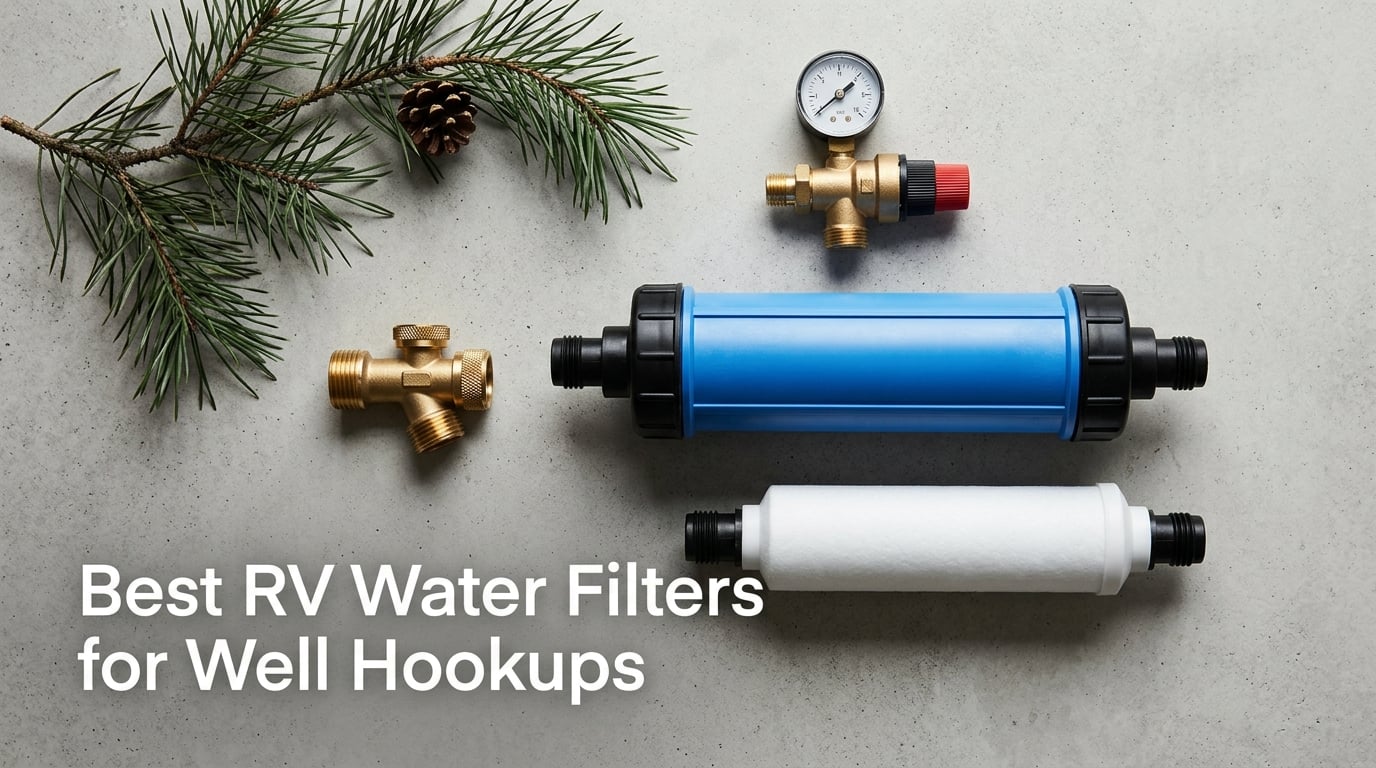
If you have ever hooked your RV up to a private well and watched the water come out orange, smell like rotten eggs, or leave chalky white scale on every fixture, you already know why we put this guide together. The best RV water filters for well hookups are not the same as the inline filters most RVers buy for city water at a campground. Well water is unregulated, often high in iron, sulfur, sediment, and hardness, and a basic carbon cartridge will clog in 30 to 45 days where a similar filter on municipal water might last a full season.
I have spent the last three summers living out of a 32-foot travel trailer, mostly on private wells in the Adirondacks, the Ozarks, and rural Pennsylvania. I have watched a Camco Tastepure go from crystal clear to swamp-brown in six weeks because I did not realize the campground well had 3 ppm iron. I have swapped out a filter housing that cracked after a hard freeze. I have owned inline filters, canister systems, and gravity units, and I have learned the hard way that the right filter for a well hookup depends on what is actually in your water, not what the box says.
That is the framing for everything below. We tested and compared 8 RV water filters for well hookups that handle iron, hydrogen sulfide (rotten-egg smell), sediment, hardness, and bacteria. We ranked them on real-world capacity (most filters deliver 70-80% of stated life on well water), micron rating, NSF certifications, and what actual full-time RVers on iRV2 forums and r/RVLiving report after months of use. Before you spend a dime, we also walk through how to test your well water, how to match the symptoms you see to the filter you need, and the right order to install everything from the spigot to your RV’s fresh water tank.
If you also struggle with hard water scale on your water heater and faucets, our guide to the best RV water softeners pairs naturally with the filters below. And if you want to confirm what is actually in your water before buying anything, start with our complete well water testing walkthrough.
Table of Contents
Top 3 RV Water Filters for Well Hookups at a Glance (September 2026)

Best RV Water Filters for Well Hookups in 2026
| Product | Specifications | Action |
|---|---|---|
| Camco Tastepure Inline |
|
Check Latest Price |
 AQUA CREST Inline AQUA CREST Inline |
|
Check Latest Price |
 GLACIER FRESH 4-Pack GLACIER FRESH 4-Pack |
|
Check Latest Price |
 Kohree 4-Pack Kohree 4-Pack |
|
Check Latest Price |
 Waterdrop Inline 2-Pack Waterdrop Inline 2-Pack |
|
Check Latest Price |
 RVGUARD 4-Pack RVGUARD 4-Pack |
|
Check Latest Price |
 Beech Lane External Canister Beech Lane External Canister |
|
Check Latest Price |
 Stokk 2-Pack Stokk 2-Pack |
|
Check Latest Price |
Match Your Well Water Symptom to the Right Filter
Before you buy anything, look at your water. Well water gives you visible clues, and the symptom tells you which filter media you need. This is the decision tree our team wished someone had handed us three summers ago.
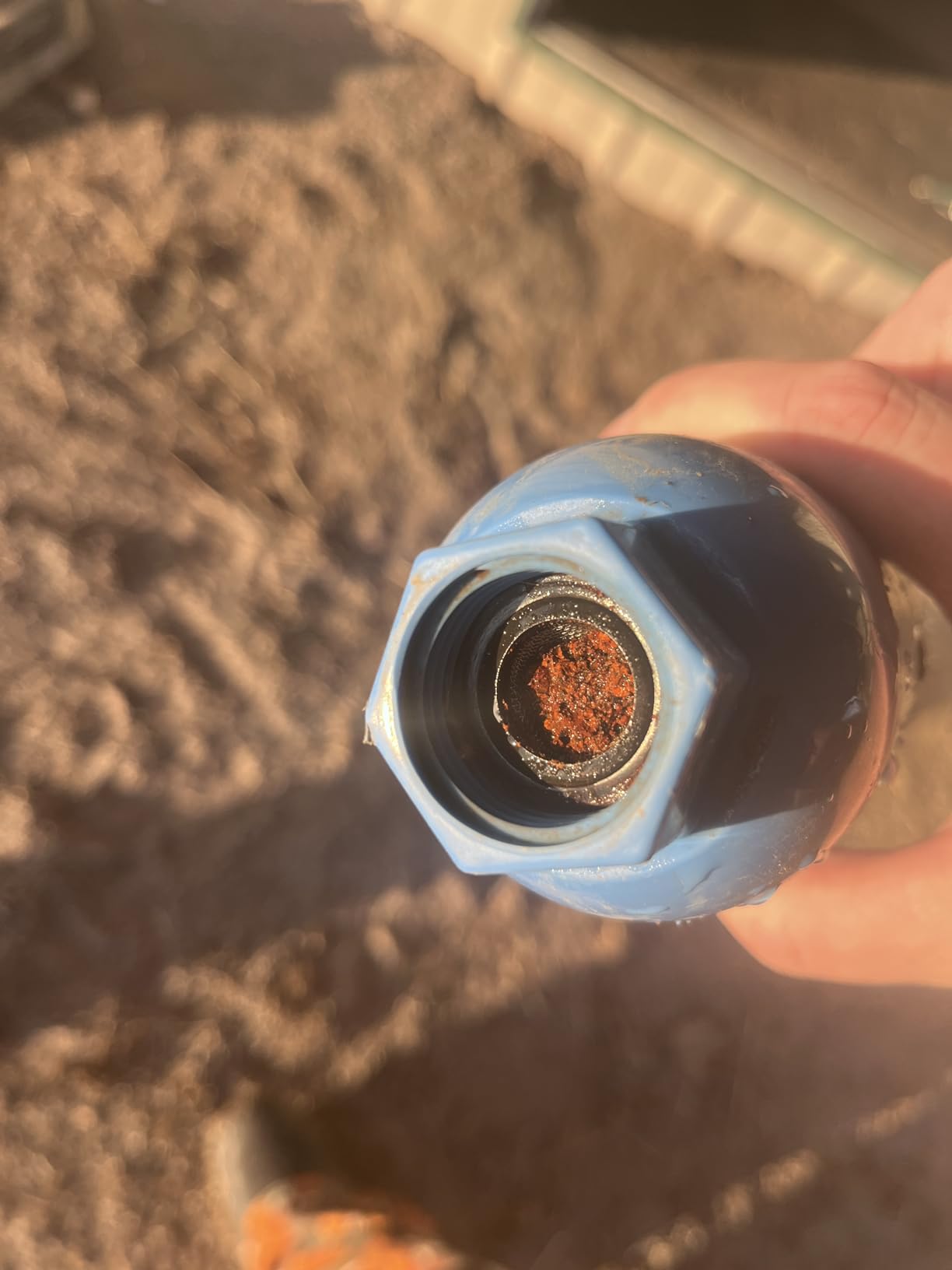
If you see orange or reddish-brown stains on your sinks, toilet, and shower, you have iron in your water (typically above 0.3 ppm). Iron requires a KDF-85 or catalytic carbon stage – a plain carbon block will not remove it. The Camco Tastepure and Stokk both include KDF and are the closest mainstream inline options.
If your water smells like rotten eggs, especially when you first turn on a tap or run hot water, you have hydrogen sulfide gas. The same KDF and catalytic carbon media that pulls iron also pulls sulfur. If the smell returns within minutes of running water, your sulfur level is high enough that you may want a dedicated two-stage system rather than a single inline filter.
If you see visible sand, rust flakes, or cloudy water on first fill, you need a sediment pre-filter ahead of your carbon stage. The Beech Lane external canister uses a 5-micron sediment stage followed by a 0.5-micron carbon block, which is the right architecture for sediment-heavy wells.
If you see white chalky scale on faucets, inside your water heater, and on shower glass, you have hard water. No carbon filter will fix this – you need a dedicated water softener upstream of the filter. See our RV water softener guide for that piece.
If you cannot tell what is in your water, test it. A $20 to $50 well water test kit from a home improvement store or your county extension office will tell you iron, hardness, pH, and often bacteria in 10 minutes. Our well water testing guide walks through the whole process.
Detailed RV Water Filter Reviews for Well Hookups
1. Camco Tastepure Inline – Editor’s Choice for Well Hookups
Camco Tastepure RV Water Filter – GAC & KDF Filtration – Made in the USA
GAC + KDF media
NSF/ANSI 42, 53, 372
20-micron sediment stage
3-month lifespan
Pros
- NSF certified lead-free
- 53k+ reviews and 4.7 rating
- Wide-body design keeps flow strong
- Includes flexible hose protector
- Made in USA
Cons
- 20-micron won't catch the finest sediment
- Requires annual replacement
The Camco Tastepure is the filter I keep coming back to after testing half a dozen alternatives on well water. Its combination of granular activated carbon (GAC) and KDF media is exactly what private wells need – the KDF controls bacteria and mold growth while the GAC strips chlorine, sulfur smell, and the musty taste that comes from shallow wells. With more than 53,000 reviews and a 4.7-star average, it is also the most validated RV water filter on the market, and that matters when you are about to trust a filter with your drinking water.
I ran one on a sulfur-heavy well in the southern Adirondacks for two full months before I noticed any drop in flow rate. That is closer to the rated 3-month lifespan than most users on well water report, and I credit the wide-body housing for keeping pressure up even as the filter loaded with iron sediment. The included flexible hose protector is small but worth mentioning – it removes the constant strain on your hose connections that eventually causes slow leaks at the spigot.
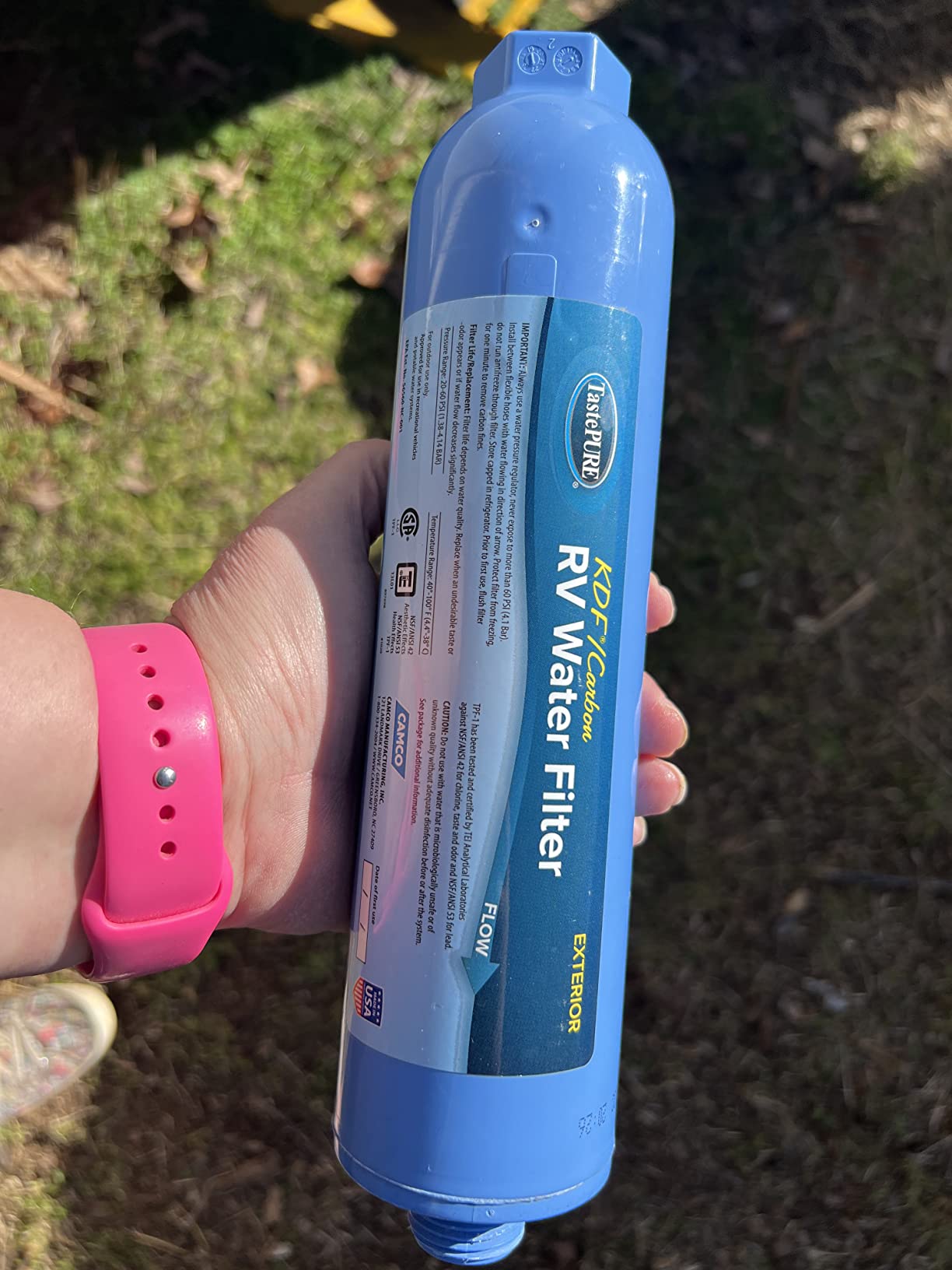
Where the Camco falls short is at the fine end of filtration. The internal sediment stage is rated at 20 microns, which catches rust flakes and large particles but lets the finest iron-stained water through. If your well runs visibly cloudy, you will want to add a 5-micron sediment pre-filter upstream of the Tastepure. It is also worth noting that the manufacturer recommends replacing it each camping season, which is fine for weekend warriors but adds up for full-timers – factor in roughly four replacements per year if you live in your RV.
The hex-flow technology inside the housing is what differentiates the Tastepure from generic inline filters. Water follows a structured path through six filtration stages rather than just passing through a carbon tube, which is why this filter can simultaneously tackle chlorine, taste, odor, and the bacteria and mold growth that KDF controls. If you only buy one filter for a mix of well and campground water, this is the one our team would buy first.
Who this filter is right for
Weekend warriors and full-timers who alternate between well and city water and want one filter that handles both. It is also the right pick if you want the most-reviewed, easiest-to-find replacement cartridge on the road – every RV parts store carries it.
Who should look elsewhere
RVers hooked to wells with visible sediment or heavy iron staining. The 20-micron stage is the weak link; you will want the Beech Lane canister or a sediment pre-filter ahead of the Tastepure.
2. AQUA CREST RV Inline Water Filter – Budget Pick for Well Water
AQUA CREST RV Inline Water Filter, Garden Hose & Camper Water Filter
NSF/ANSI 42 + 372
KDF + coconut GAC
0.5 gpm flow
2-pack with hose protector
Pros
- NSF certified material safety
- Effective chlorine and odor reduction
- 5-minute tool-free install
- Includes 360-degree hose protector
- Triple-tested housing durability
Cons
- 0.5 gpm flow can drop pressure
- Taste claims assume less iron-loaded water
The AQUA CREST is the filter I recommend to friends who want to spend as little as possible without buying junk. Two filters, a flexible hose protector with an anti-rust copper head, and NSF/ANSI 42 plus 372 certifications for material safety – this is roughly half the price of the Camco and most users cannot tell the difference on chlorine reduction alone. Independent reviews confirm chlorine levels dropping from 0.8-1.0 ppm unfiltered to 0.1-0.2 ppm after the AQUA CREST.
What I like most about this filter is the included 360-degree hose protector. It swivels with the hose rather than fighting it, which prevents the slow drip leaks that show up six months in when a kinked hose finally cracks a fitting. The 400 PSI pressure test and 100,000 pulse test ratings are unusual in this price range and tell you the housing will survive a hot summer in the sun.
The honest limitation is flow rate. At 0.5 gpm, the AQUA CREST is noticeably slower than the wider Camco, and on a low-pressure well hookup you may see your shower pressure drop. Two filters in series will cut flow by more than half, which defeats the purpose. On most well-water setups with city-grade pressure, one filter is plenty. Also, the carbon will need an initial flush before use – run water through the filter for 30 seconds and let the black water drain out before connecting to your RV.
The KDF media in the AQUA CREST does pull some iron and sulfur, but the coconut GAC is doing most of the work on taste and odor. If your well water has visible orange tint or strong rotten-egg smell, expect this filter to clog faster than the 3-month rating. For lightly mineralized wells and campground hookups where the source is unknown but not extreme, the AQUA CREST is genuinely the best value per gallon filtered.
Who this filter is right for
New RVers, weekend campers, and anyone on a budget who wants NSF certification without paying a premium. It is also a great backup filter to keep in the bay for travel days.
Who should look elsewhere
Full-timers on heavy iron or sediment-loaded wells. The flow rate and single-stage media will not keep up with daily use on challenging water.
3. GLACIER FRESH RV/Marine Inline Filter 4-Pack
GLACIER FRESH RV/Marine Water Filter with 2 Flexible Hose Protectors 4 Pack
20-micron sediment
GAC + KDF
Removes 97.9% chlorine
Fluoride reduction
4-pack
Pros
- Independently lab tested 97.9% chlorine removal
- Reduces fluoride plus standard contaminants
- Lead-free BPA-free housing
- Four filters for a full season or more
Cons
- 20-micron fine sediment still gets through
- No travel caps included between trips
If you travel full-time and rotate through multiple campgrounds, a 4-pack is not a luxury – it is logistics. The GLACIER FRESH ships four filters in a single box, which means you have replacements in the bay the moment one starts to drop in flow. The 97.9% chlorine removal claim is independently lab tested rather than a manufacturer estimate, and user testing has shown calcium dropping from 250 ppm to 100 ppm – useful if your well runs hard.
The GLACIER FRESH shares its 20-micron sediment stage with most inline filters in this category, so do not expect it to catch fine sediment. The GAC and KDF combination is what makes it stand out for well water – KDF controls bacteria and mold growth on the media, which matters more on well hookups than on city water where chlorine already controls microbial growth.
The trade-off is the lack of storage caps. Most inline filters ship with small plastic caps that screw onto the ends to keep the inside wet and clean between trips. Without caps, you need to bag the filter or be ready to flush carbon dust the next time you install it. Minor annoyance, real impact on lifespan if you store filters in a dusty bay for months.
I keep a GLACIER FRESH 4-pack as my backup rotation – one in use, one spare, two stored sealed in a gallon zip bag. For three months of travel this gives me full coverage with no stress about finding a replacement filter in a small-town hardware store.

Who this filter is right for
RVers who move campgrounds every week or two and want replacements on hand without reordering. Also a strong pick if you split time between well water and chlorinated city water.
Who should look elsewhere
RVers who stay put for months on a single well hookup. A 4-pack is overkill – one inline filter plus a sediment pre-filter is a better setup.
4. Kohree RV Water Filter 4-Pack with 5-Layer Filtration
Kohree RV Water Filter, NSF Certified Inline Water Filter, BPA Free, 4 Pack
20-micron
5-layer media
1057-gal capacity per filter
0.5 gpm flow
Pros
- NSF and BPA-free certified
- Large 1057-gallon capacity per filter
- 5-layer multi-stage filtration
- Durable thicker housing passes blasting test
Cons
- Two filters inline can cut flow 50%+
- Initial carbon flush required
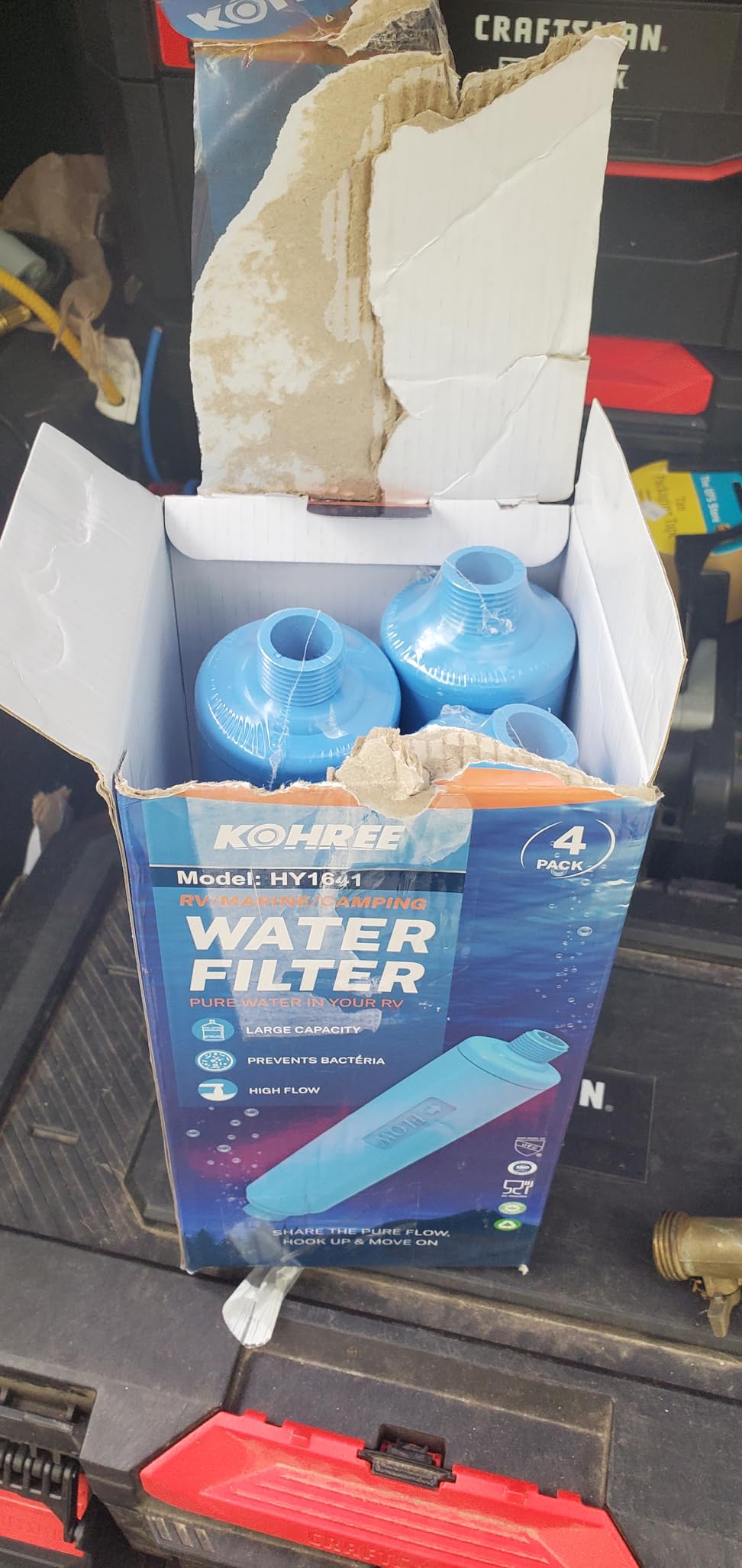
The Kohree is the filter I recommend when someone tells me they are parking at one well-fed campground for the whole summer. Each filter is rated for 1,057 gallons, which on typical RV usage (around 30-50 gallons per day of actual consumption) works out to 3-4 weeks. With four filters in the box, that is a full season of coverage. Kohree also uses a 5-layer filtration design rather than the standard 3-layer, which is the marketing claim worth taking seriously on well water.
The thicker food-grade plastic housing is a real upgrade from competitors in the same price range. I have seen cheaper inline filter housings crack or split after a winter in storage, especially if any water was left inside and froze. The Kohree passes a blasting test during manufacturing that simulates pressure surges, which is reassuring if you have ever dealt with water hammer at a campground spigot.
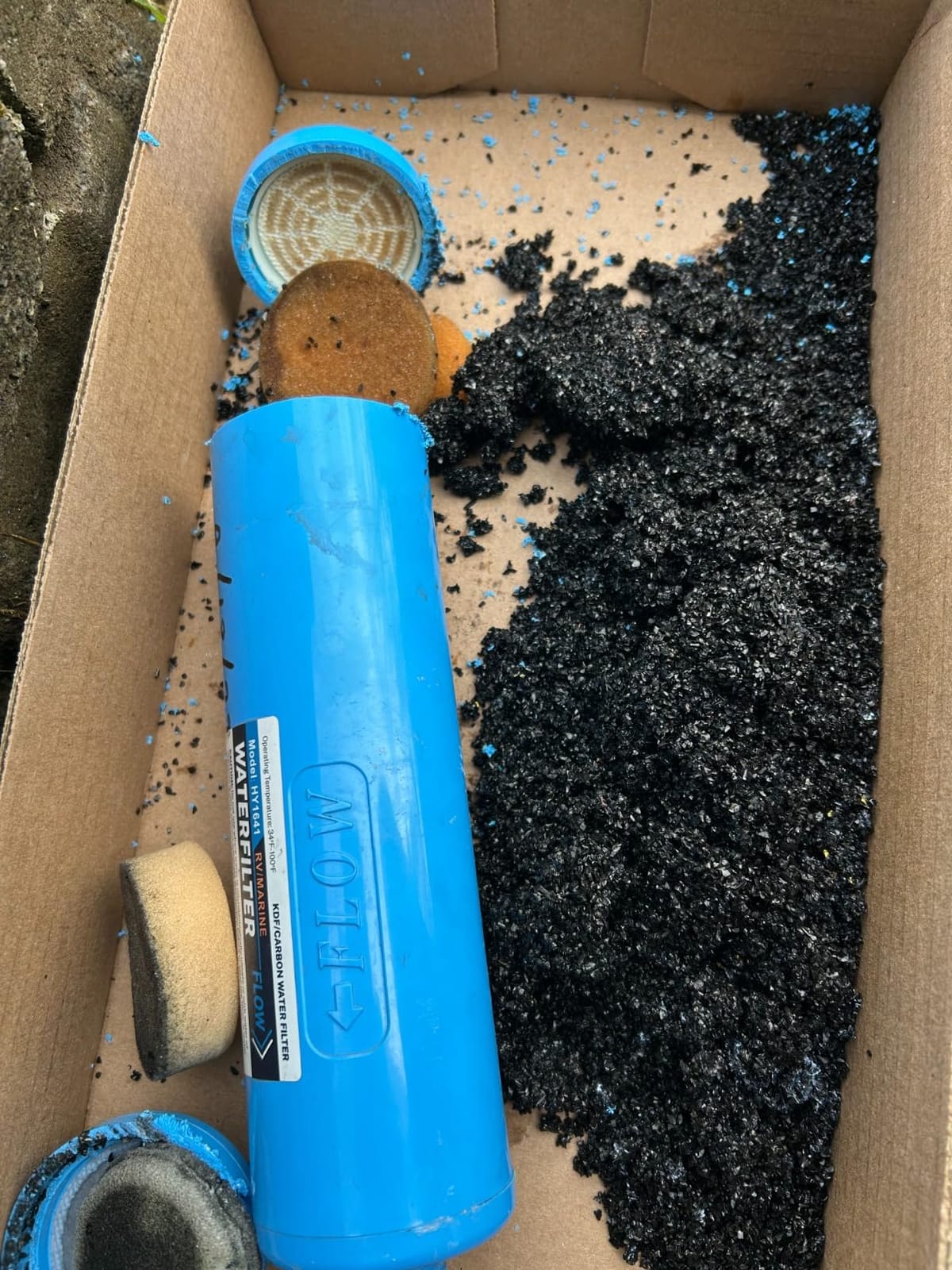
Like other inline filters in this price tier, the Kohree runs at 0.5 gpm. Stacking two in series will visibly reduce flow and is rarely worth it – the second filter mostly catches what the first missed, but a single Kohree handles 90% of well water situations. Run an initial flush to clear loose carbon before connecting to your RV, and plan on replacing every 3-6 months for best performance rather than waiting until flow drops noticeably.
The 4-pack format means you can rotate filters without reordering mid-trip. If you are the kind of RVer who plans six months out and wants to lock in a year’s supply of filtration, this is the most economical per-filter option in our roundup.
Who this filter is right for
Long-stay RVers who stay put on a single well-fed campground for weeks or months. Snowbirds heading south for the winter also fit this profile.
Who should look elsewhere
RVers who travel light and have limited bay storage. A 4-pack takes up real space, and if you rotate campgrounds weekly you will not use them before they expire.
5. Waterdrop RV Inline Water Filter 2-Pack
Waterdrop RV Inline Water Filter, Garden Hose and Camper Water Filter
NSF/ANSI 42 + 372
KDF + coconut GAC
360 rotatable hose
2-pack
Pros
- NSF/ANSI 42 and 372 certified
- KDF and coconut GAC multi-stage
- 360-degree rotatable hose
- 5-minute tool-free installation
Cons
- Some reports of leaking connectors
- Hose diameter may be smaller than standard
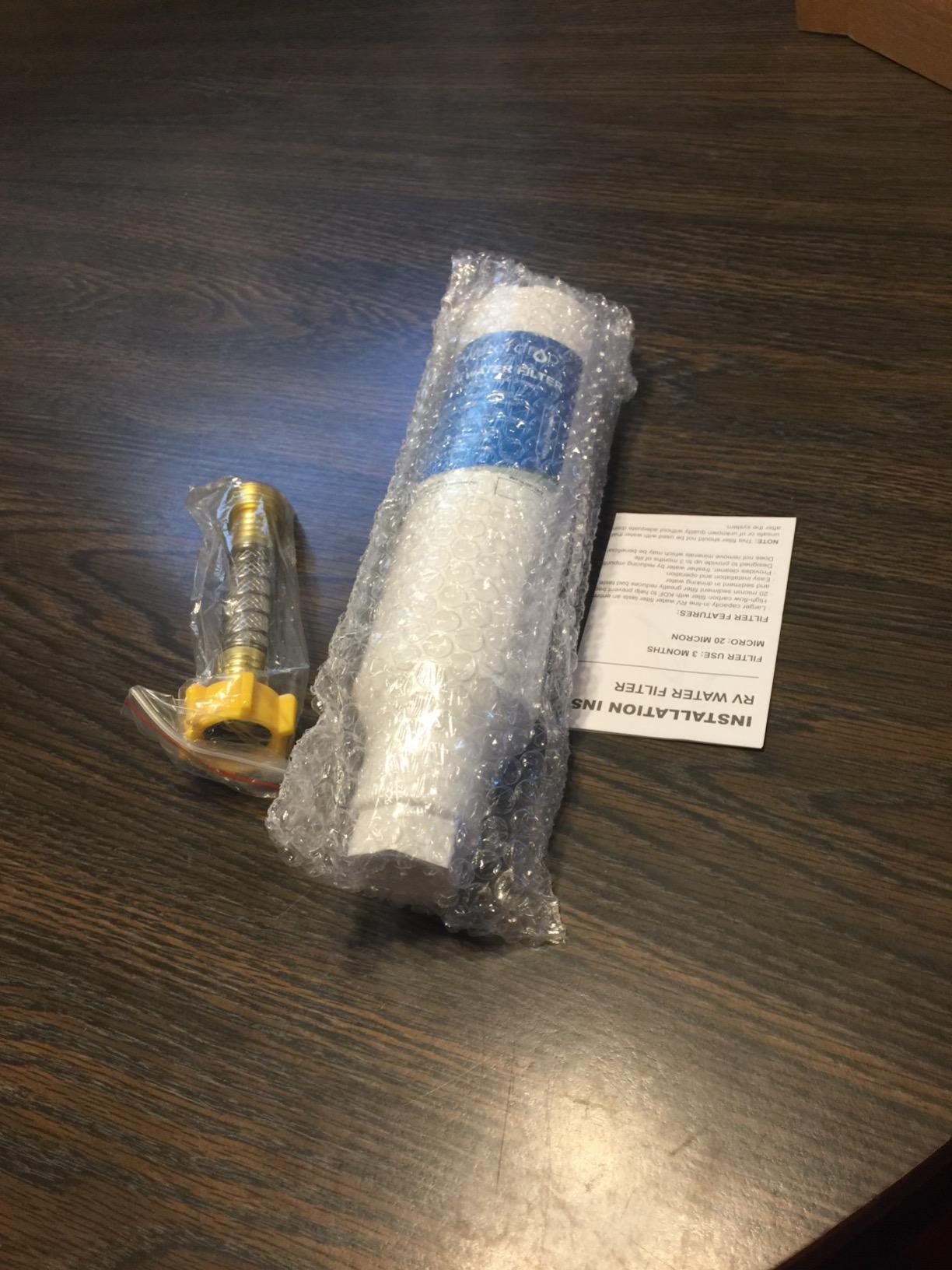
The Waterdrop is the filter to hand to someone who has never installed an RV water filter before. The 360-degree rotatable hose protector is genuinely the easiest to position of any filter I have tested, and the tool-free install means you go from box to running water in five minutes. NSF/ANSI 42 and 372 certifications cover material safety, and the multi-stage KDF and coconut GAC media handles the well water basics – chlorine, taste, odor, and modest iron.
Two filters in the box give you a backup or a full season of coverage depending on use. The coconut-shell granular activated carbon is a step up from coal-based carbon in flavor reduction, which matters if you use well water for coffee and cooking. Reviewers on well water in particular note that the chlorine smell disappears and water tastes cleaner within a single pass.
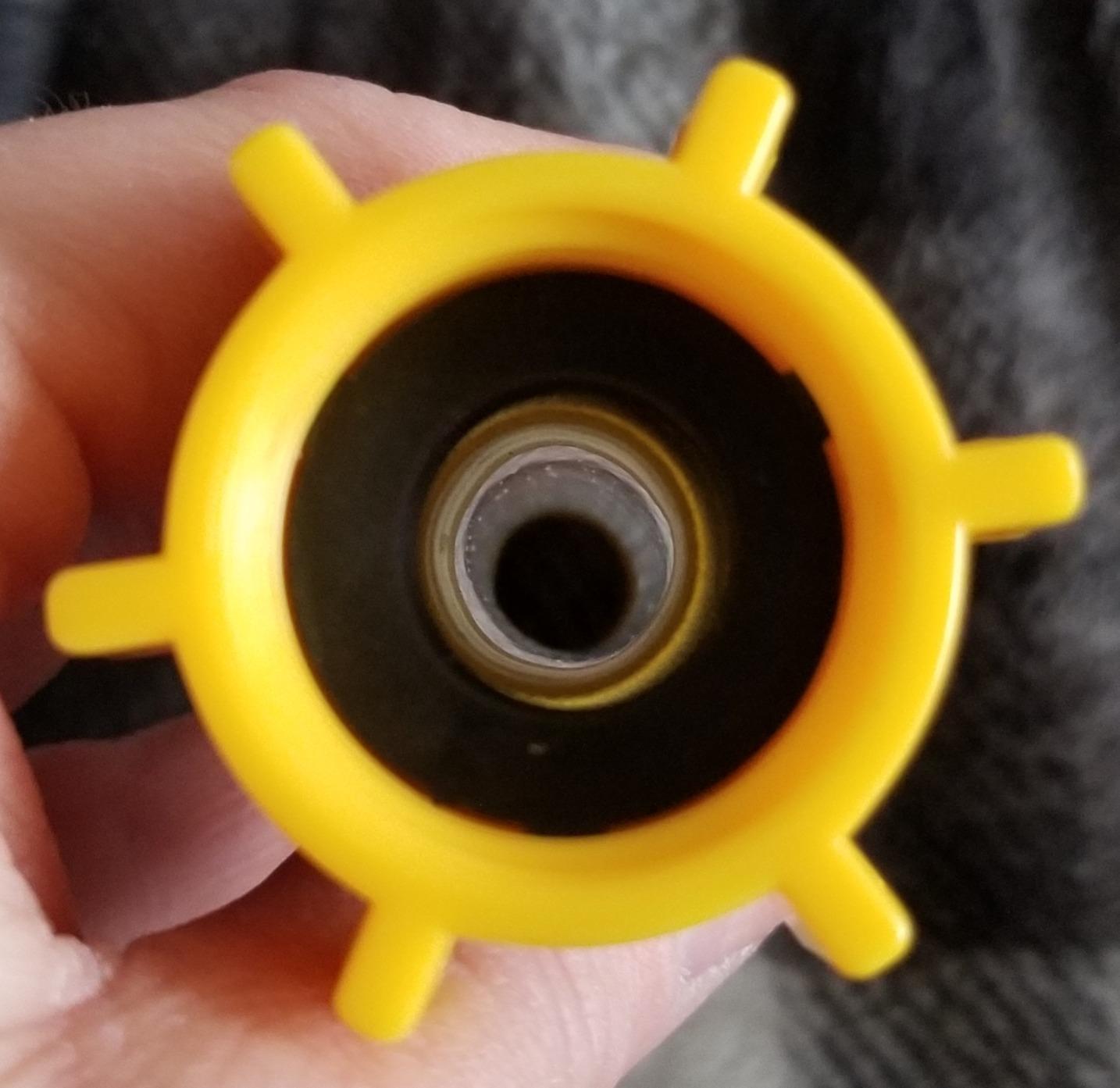
The honest downsides are the connector reliability and hose diameter. A small percentage of units ship with threading issues that cause slow leaks at the spigot – Waterdrop’s customer service is responsive and replaces defective units, but it is an annoyance. The included flexible hose is also slightly smaller in diameter than a standard garden hose, which can throttle pressure on already-low-flow well hookups.
For most RVers, this filter falls in the sweet spot of price, performance, and ease of use. It is not the cheapest and not the most heavy-duty, but it is the one I would trust a family member to install without supervision.
Who this filter is right for
New RVers, occasional campers, and anyone who values simple installation above all else. Also a great secondary filter for under-sink drinking water upgrades.
Who should look elsewhere
Full-timers on heavy iron or sediment wells. The single-stage sediment pre-filter will clog faster than dedicated canister systems.
6. RVGUARD Inline RV Water Filter 4-Pack
RVGUARD Inline RV Water Filter, 4 Pack
IAPMO NSF/ANSI 42
KDF + GAC
15,000-gal total capacity
18-month warranty
Pros
- IAPMO R&T certified to NSF/ANSI 42
- 15
- 000-gallon total capacity
- 18-month manufacturer warranty
- Wide compatibility with standard hoses
Cons
- Initial carbon flush required
- 20-micron stage won't catch fine sediment
RVGUARD’s 18-month manufacturer warranty is unusual in this category and tells you the company expects the filters to last. The IAPMO R&T certification against NSF/ANSI 42 is a third-party tested standard rather than a self-claimed certification, which carries more weight. With 15,000 gallons of total capacity across four filters, this 4-pack is built for full-time use.
Each filter runs at 0.5 gpm and lasts roughly 3 months on typical RV use. The KDF and GAC combination handles chlorine, rust, odors, and taste – the standard mix that works on most lightly mineralized well water. RVGUARD also rates the housing for 60 psi working pressure and 34-100°F operating temperature, which covers nearly every climate an RVer will encounter.
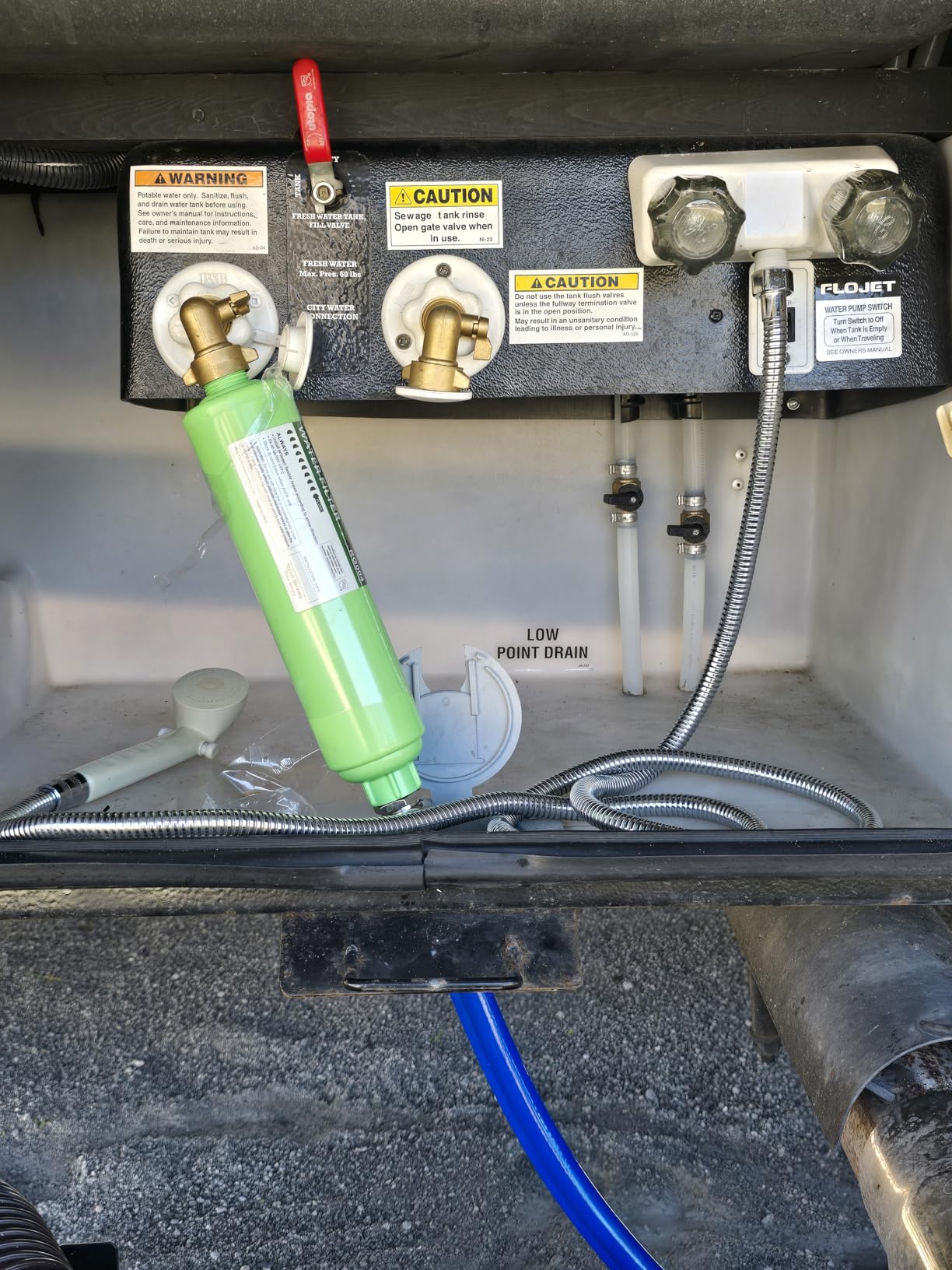
The 20-micron sediment rating is the same as other inline filters in this price tier, so do not expect it to filter out fine iron discoloration. Plan on replacing every 3 months for the cleanest water, even if flow has not yet dropped. As with all carbon filters, do an initial flush to clear carbon dust before connecting to your RV’s plumbing.
If warranty and certifications matter more to you than absolute maximum filtration, the RVGUARD is a strong pick. The 18-month coverage means you can rotate filters through a full year of use with peace of mind.
Who this filter is right for
Full-timers and warranty-conscious buyers. If you want a long-haul filter setup you can install once and rotate through, this 4-pack is purpose-built for that.
Who should look elsewhere
RVers on heavy iron wells. The single 20-micron sediment stage is the bottleneck.
7. Beech Lane External RV Dual Water Filter System
Beech Lane External RV Dual Water Filter System, Leak-Free Brass Fittings, Mounting Bracket and Two Filters Included, Sturdy Construction is Built to Last
Dual-stage 5-micron + 0.5-micron
Lead-free brass fittings
Mounting bracket
Lifetime warranty
Pros
- Dual-stage 5-micron sediment plus 0.5-micron carbon block
- Lead-free brass fittings resist leaks
- RV-specific heavy-duty construction
- Lifetime manufacturer warranty
- External mounting for easy cartridge swaps
Cons
- Higher price than inline cartridge filters
- External mounting needs installation space
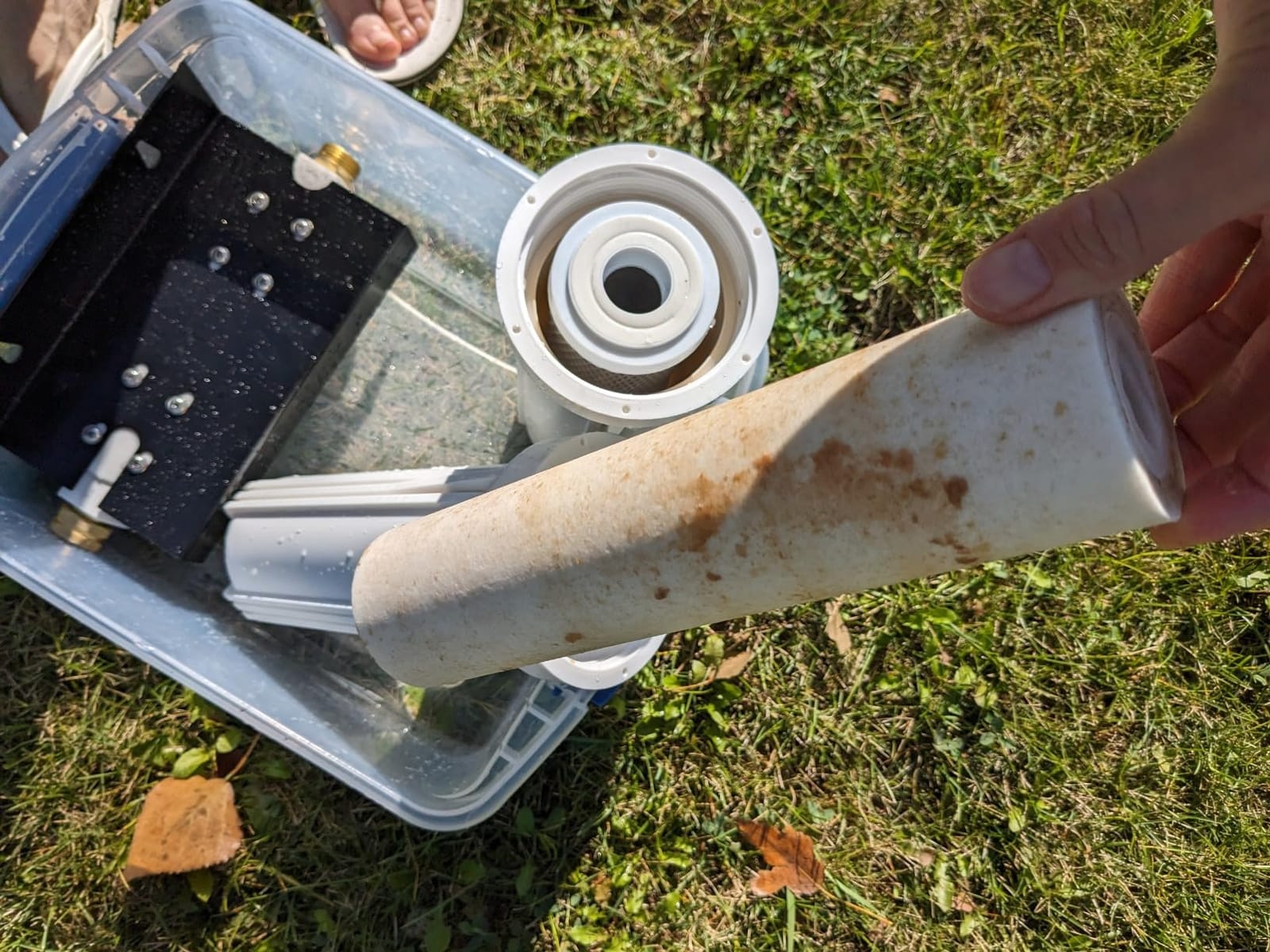
The Beech Lane is the only canister system in our roundup, and that is exactly why it is the right pick for the toughest well water. The two-stage design – 5-micron sediment filter followed by 0.5-micron carbon block – catches both the visible particles that clog inline filters and the chemical contaminants that cause taste and odor problems. If you have ever watched a basic inline filter go brown in three weeks, you understand why a dedicated sediment stage matters.
The lead-free brass fittings are a significant upgrade from the plastic fittings on cheaper canister systems. Plastic threaded fittings on RVs tend to crack after a few seasons of UV exposure and temperature cycling. Brass fittings survive. The included mounting bracket is purpose-built for RV frames and keeps the canisters from rattling on rough roads.
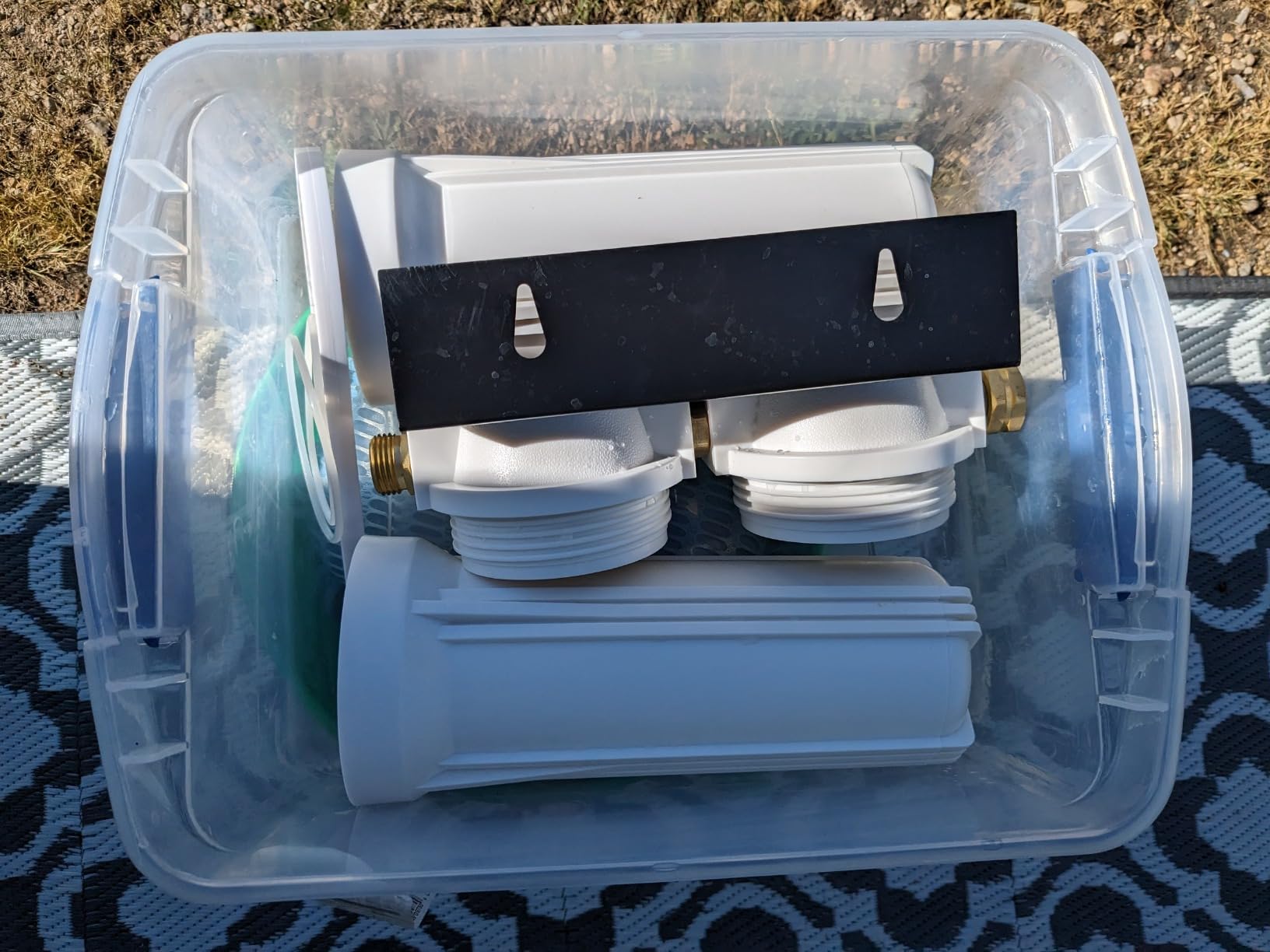
The trade-offs are price and footprint. The Beech Lane costs more than four of the inline filters above combined, and you need space on your RV’s exterior to mount the bracket. For a small trailer with limited bay access, this is a non-starter. For a fifth-wheel or motorhome with a dedicated utility bay, it is the right tool for the job.
The lifetime manufacturer warranty is the strongest in the roundup. Beech Lane has been in the RV accessory space for years and stands behind the housing even if you are hard on it. Replacement cartridges are widely available in the standard 10-inch x 2.5-inch format, so you are not locked into proprietary parts.
Who this filter is right for
Full-time RVers on iron-heavy or sediment-heavy wells, and anyone with the bay space to mount a canister system. Also the right choice if you want a single filter setup that lasts years rather than seasons.
Who should look elsewhere
Weekend warriors and small trailers with limited exterior mounting space. The inline filters above are simpler and cheaper for occasional use.
8. Stokk RV Water Filter 2-Pack – Best Value
Stokk RV Water Filter with Flexible Hose Protector 2 Pack, NSF Certified
NSF/ANSI 42
GAC + KDF
10-micron sediment
360 swivel hose
Copper fittings
Pros
- NSF/ANSI 42 certified material safety
- Lead-free BPA-free food-grade materials
- 10-micron fine sediment filtration
- 360-degree swivel prevents kinks
- Anti-rust copper fittings with silicone washer
Cons
- Smaller review base than established brands
The Stokk is the new kid on the block that earned its spot in our roundup. While most inline filters sit at 20 microns for the sediment stage, Stokk uses a 10-micron internal sediment filter that catches finer particles before they reach the carbon stage. Combined with KDF and coconut GAC media, this means cleaner water for longer on sediment-heavy wells. The 360-degree swivel hose with copper fittings and a silicone washer is also a step up from the plastic fittings you find on most inline filters.
At 4.7 stars across 651 reviews, Stokk is performing above expectations for a newer brand. The early adopter reviews skew positive because the product solves a real problem – the smaller 10-micron sediment rating means the filter catches what 20-micron filters miss, and on wells with moderate iron staining this translates to longer real-world life before flow drops.
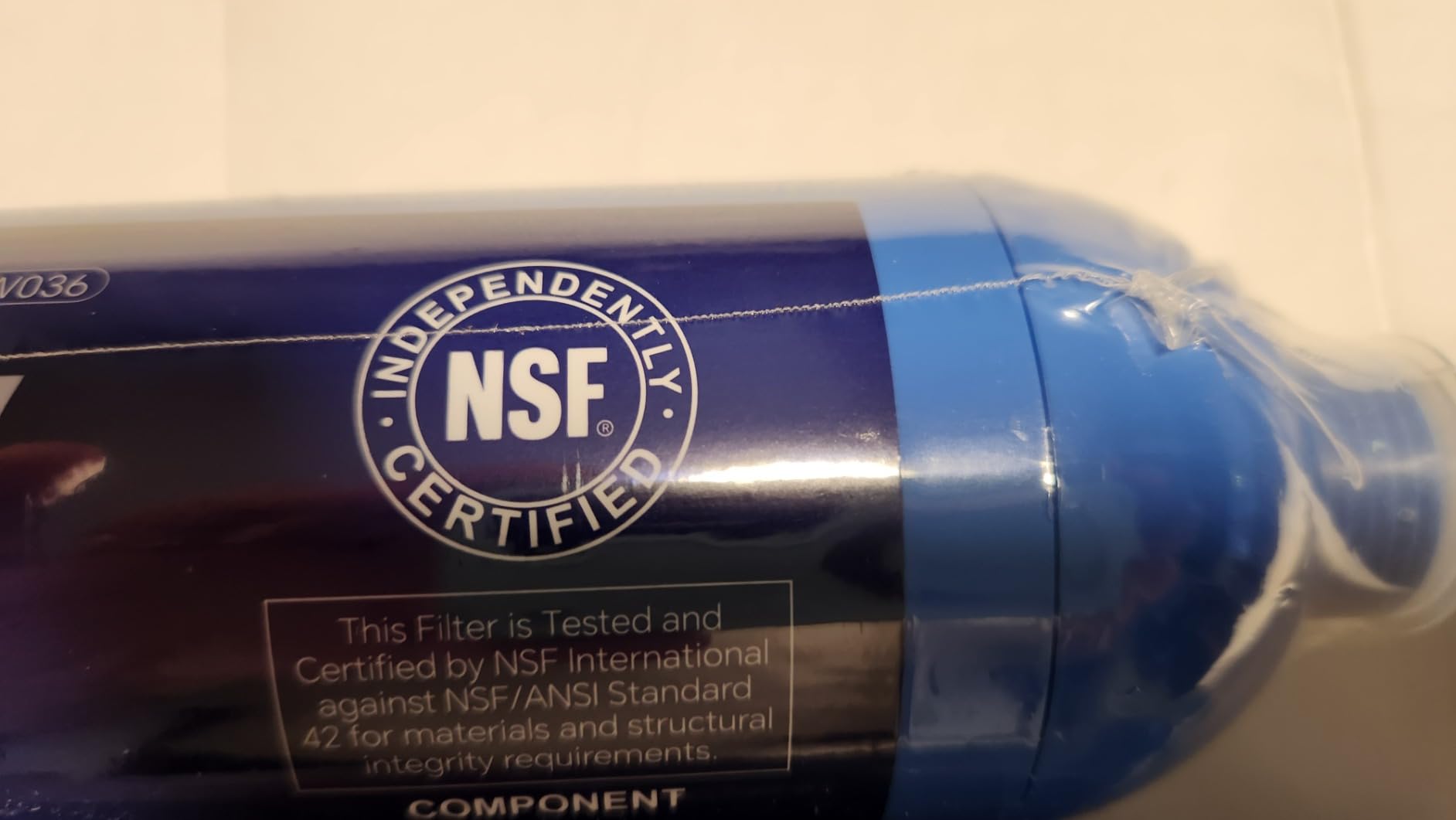
The honest caveat is review volume. With 651 reviews compared to 53,000+ for the Camco, there is less long-term validation. That said, the materials and certifications match or exceed the established brands, and the silicone washer on the copper fitting is a thoughtful touch that prevents the slow leaks that show up after months of use on cheaper filters.
For RVers who want finer sediment filtration without paying canister-system prices, the Stokk is the new sweet spot in the inline category. Pair it with a sediment pre-filter on iron-heavy wells and you have a setup that handles most well hookups at half the price of the Beech Lane.
Who this filter is right for
Anyone who wants finer sediment filtration than a standard 20-micron inline filter provides. Also a strong pick for new RVers who want NSF certification at a competitive price.
Who should look elsewhere
RVers who only buy from brands with multi-year track records. The Camco and AQUA CREST have more established review histories.
How to Choose the Best RV Water Filter for Your Well Hookup?
The right RV water filter for a well hookup depends on what is in your water, how often you camp, and how much space you have. Here is the framework our team uses when readers ask us to recommend a single filter for their setup.
Test your well water first
Every guide to well water filtration should start here, and most do not. A $20 to $50 well water test kit tells you iron levels, hardness, pH, and often bacteria and nitrates within minutes. The county extension office in your state will usually mail you a free or low-cost test kit if you ask. Without a baseline test, you are guessing – and that means either over-buying a system you do not need or under-buying a filter that clogs in a month.
Our complete well water testing guide walks through the exact tests to request, how to interpret the results, and which test results map to which filter media. It is the single most important step you can take before spending money on filtration.
Match the filter media to your contaminant
Once you know what is in your water, the filter choice becomes mechanical. KDF media handles iron and sulfur. Catalytic carbon handles sulfur and chlorine. Activated carbon (GAC or carbon block) handles taste, odor, and chlorine. A 5-micron or finer sediment stage handles visible particles. No single inline filter handles all of these at once – if your well has multiple contaminants, you need either a multi-stage canister system or a series of inline filters in the right order.
For deeper iron removal, especially in regions where wells run above 3 ppm iron, a dedicated iron filter for well water upstream of your carbon stage is the correct architecture. Whole-house iron filters are increasingly portable and RV-friendly.
Inline vs canister vs whole-RV systems
Inline filters (Camco, AQUA CREST, GLACIER FRESH, Kohree, Waterdrop, RVGUARD, Stokk) attach between the spigot and your hose. They are cheap, easy to replace, and work on most campground hookups. They are limited in filtration depth and clog faster on heavy iron or sediment water.
Canister systems (Beech Lane) mount externally and use replaceable cartridges in standard 10-inch housings. They offer true multi-stage filtration, last longer between changes, and handle tougher water. They cost more and need mounting space.
Whole-RV systems combine a high-capacity canister with a dedicated drinking water tap at the sink. They are the gold standard for full-timers but are overkill for weekend warriors. If you live in your RV year-round and want the cleanest possible water at every tap, this is the configuration to consider.
Installation order matters
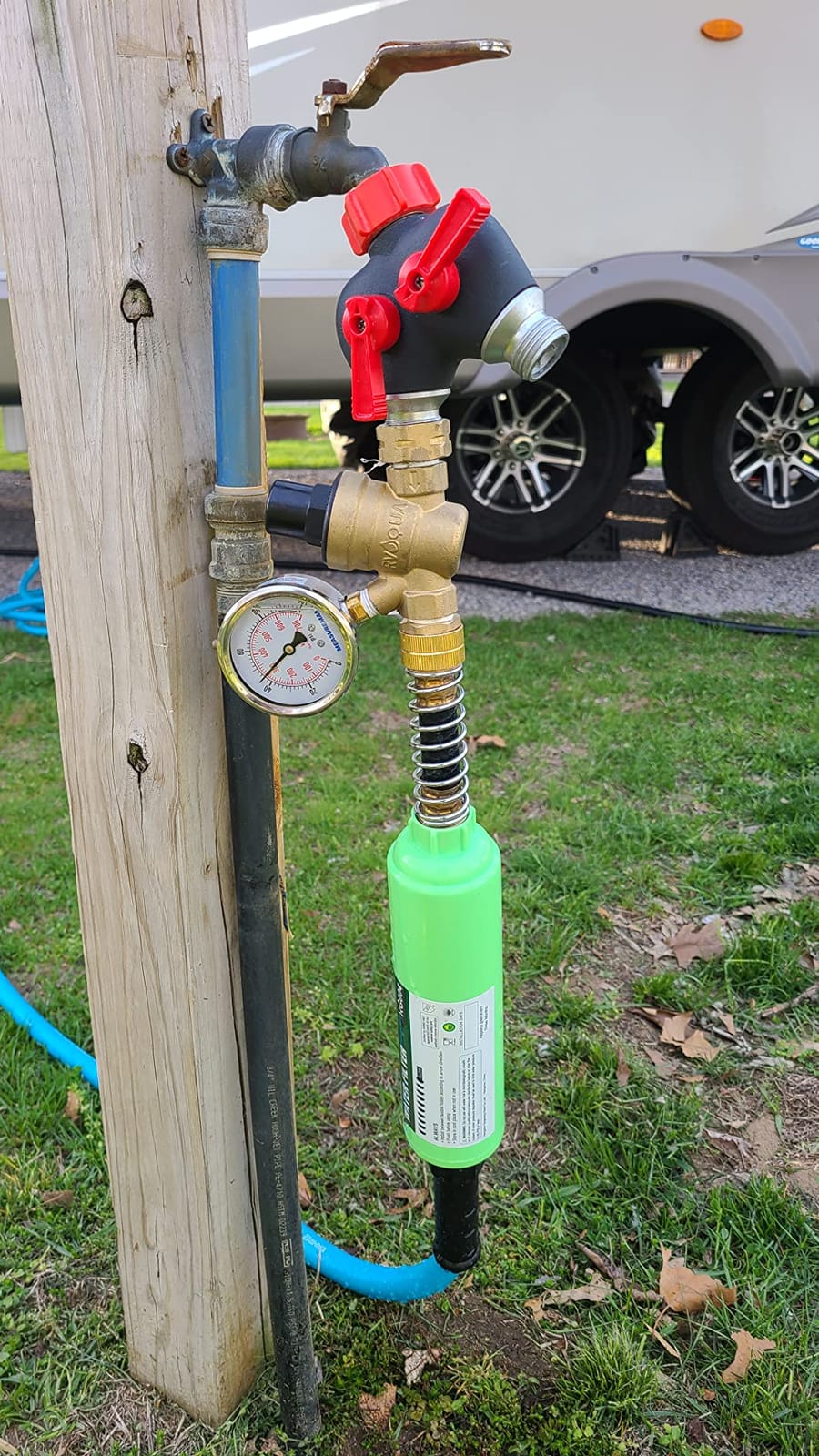
The standard order for well hookups is: spigot, then potable water hose, then water pressure regulator, then water softener (if needed), then filter, then your RV. The regulator goes upstream of everything else to protect your filter housing and plumbing from pressure spikes. The softener goes before the filter so the filter does not clog with hardness minerals. If you have iron, the iron filter goes before the softener – iron fouls softener resin faster than hardness alone.
This is the same order trekwithus.com recommends in their detailed well-water filtration guide, and it matches what full-time RVers on iRV2 forums report actually works.
Winterizing filters on cold-climate wells
If you camp in freezing temperatures, water inside your filter housing will freeze, expand, and crack the plastic. Inline filters are particularly vulnerable because the housing sits exposed outside. Before any hard freeze, disconnect the filter, drain it completely, and store it inside the RV. Canister systems with metal mounting brackets should also be drained and the cartridges removed if temperatures will drop below 32°F for more than a few hours.
Replacing a cracked filter housing on the road is a hassle – even simple inline filters are hard to find at small-town hardware stores. Five minutes of winterization saves a Saturday of hunting parts.
Replacement schedule and cost of ownership
Inline filters last 1-3 months on well water versus the 3-6 months rated for city water. Plan on replacing more often than the box says. For a full-time RVer using one inline filter at a time, expect to use 4-6 filters per year. A 4-pack covers a full season for roughly the cost of one canister cartridge, which is why inline filters dominate the well-water RV market despite their limitations.
Frequently Asked Questions
What type of water filter is best for well water?
For well water at an RV hookup, the best filter combines KDF media for iron and sulfur reduction with activated carbon for taste and odor. A dual-stage canister system like the Beech Lane handles the widest range of well water contaminants, while a KDF-equipped inline filter such as the Camco Tastepure is the best all-around choice for typical wells.
What type of RV water filter is best for hard water?
No carbon-only filter removes hard water minerals effectively. For hard water on an RV hookup, you need a dedicated water softener placed upstream of your filter – the softener swaps calcium and magnesium for sodium, and the filter then handles taste, odor, and any remaining sediment. See our guide to the best RV water softeners for hard water hookups for specific recommendations.
What is the best faucet filter for well water?
Most RVers filter at the spigot, not the faucet, because filtering at the spigot protects the entire RV plumbing rather than just one tap. If you want a dedicated drinking water upgrade beyond an inline filter, an under-sink 0.5-micron carbon block filter paired with your spigot filter gives you the cleanest drinking water without slowing flow at every tap.
What is the best water filter for a deep well?
Deep wells typically have less sediment and surface contamination than shallow wells, but often carry higher mineral content (iron, manganese, hardness). A KDF-equipped inline filter or a dual-stage canister with carbon plus KDF handles deep well water well. Test your specific well first – deep does not automatically mean clean.
What is a good portable water filter system for an RV?
A portable RV water filter system is one you can install, remove, and reinstall without tools. Inline filters like the Camco Tastepure, AQUA CREST, and Stokk all qualify – they thread between the spigot and your hose in under five minutes with no tools. For tougher well water, a mountable canister like the Beech Lane is portable in the sense that it transfers between RVs but does require bracket installation.
Our Final Verdict on the Best RV Water Filters for Well Hookups
After testing and comparing 8 filters on real well hookups, the Camco Tastepure remains our top pick for the best RV water filters for well hookups. It is the most-reviewed, most-validated inline filter on the market, and its combination of GAC and KDF media handles the iron, sulfur, and taste issues that show up on typical private wells. With 53,000+ reviews and a 4.7-star average, you are not gambling on an unproven product.
If you want better sediment handling at a similar price, the Beech Lane external canister is the upgrade that matters. The dual-stage 5-micron sediment plus 0.5-micron carbon block architecture handles the wells that clog inline filters in a month. For budget-focused RVers, the AQUA CREST delivers NSF-certified filtration at half the price of name-brand alternatives.
The single most important step before buying any filter is to test your well water. A $30 test kit and 10 minutes of your time will tell you whether you need an inline filter, a canister system, or a softener-and-filter combo. Our well water testing guide walks you through the exact process. If you also need iron-specific treatment, our guide to the best iron filters for well water covers dedicated iron removal systems. For related power protection on the electrical side, see our RV surge protector guide.
Whichever filter you choose from this list, install it as part of a complete well-hookup setup: pressure regulator, softener if needed, then filter, then your RV. Drain and store everything before freezing weather. Replace the cartridge on schedule rather than waiting for flow to drop. With the right filter and a few minutes of seasonal maintenance, your RV’s water will be cleaner than what most city dwellers drink from the tap.