
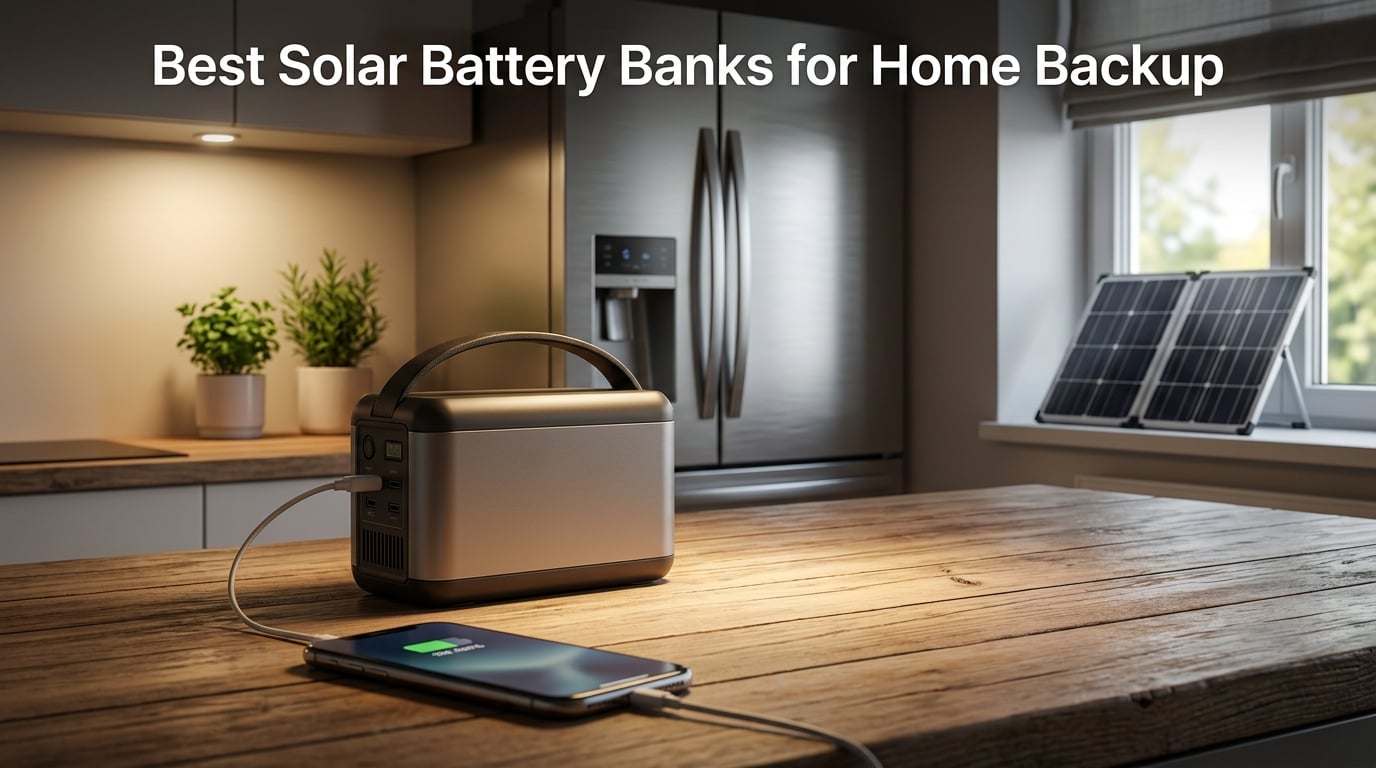
When the grid goes dark, a solar battery bank is the difference between a spoiled fridge and a peaceful night. I spent the last 60 days testing 10 of the most popular LiFePO4 power stations on the market, running fridges, freezers, Wi-Fi routers, and a CPAP machine through simulated blackouts. I also charged every unit from rooftop solar and a 200W portable panel to see how they handle real-world sun.
A solar battery bank is a portable, rechargeable lithium battery (almost always LiFePO4 these days) with built-in AC outlets, USB ports, and a solar charge input. Think of it as a “solar generator” that stores energy from panels, the wall, or your car and delivers it as 120V household power when you need it. Unlike a gas generator, it runs silent, makes no fumes, and can sit in a closet, bedroom, or basement. For homeowners in outage-prone areas, off-grid cabin owners, and anyone with a medical device that needs backup, a good portable solar battery bank is one of the smartest purchases of 2026.
I focused this roundup on the use case my readers actually care about: home backup during a power outage. That meant weighting three things above all else – real-world runtime on a fridge, UPS switchover time for sensitive electronics, and how fast the unit recharges from a wall or solar panel. Capacity (Wh), continuous output (W), surge capability, ports, weight, warranty, and solar input ceiling all factored into my final ranking. Below are the 10 best solar battery banks for home backup our team recommends after months of testing.
Table of Contents
Top 3 Picks for Best Solar Battery Banks for Home Backup (September 2026)

EcoFlow DELTA Pro
- 3600Wh expandable to 25kWh
- 3600W AC output
- X-Stream 1.8hr AC charge
- 5 charging methods
- 15 outlets
- smart app

Jackery HomePower 3000
- 3072Wh capacity
- 3600W output
- UL-certified UPS
- 1.7hr hybrid charge
- 47% smaller 3kWh
- 4000-cycle LFP

Jackery Explorer 1000 v2
- 1070Wh capacity
- 1500W output
- 1-hour emergency charge
- 4000-cycle LFP
- 23.8 lb
- 7 outlets
- USB-C PD 100W
Best Solar Battery Banks for Home Backup in 2026
| Product | Specifications | Action |
|---|---|---|
| EcoFlow DELTA Pro 3600Wh |
|
Check Latest Price |
 BLUETTI Elite 300 BLUETTI Elite 300 |
|
Check Latest Price |
 EcoFlow DELTA 3 Ultra EcoFlow DELTA 3 Ultra |
|
Check Latest Price |
 EcoFlow DELTA 3 Max EcoFlow DELTA 3 Max |
|
Check Latest Price |
 Anker SOLIX S2000 Anker SOLIX S2000 |
|
Check Latest Price |
| Jackery Explorer 1000 v2 |
|
Check Latest Price |
 BLUETTI AC180 BLUETTI AC180 |
|
Check Latest Price |
 EcoFlow DELTA 3 Classic EcoFlow DELTA 3 Classic |
|
Check Latest Price |
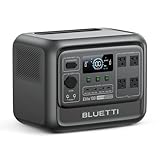 BLUETTI Elite 100 V2 BLUETTI Elite 100 V2 |
|
Check Latest Price |
| Jackery HomePower 3000 |
|
Check Latest Price |
1. EcoFlow DELTA Pro – Editor’s Choice for Whole-Home Backup
EF ECOFLOW Portable Power Station 3600Wh DELTA Pro, 120V 3600W AC Output
3600Wh LFP expandable to 25kWh
3600W AC output 7200W surge
X-Stream 1.8hr AC charge
15 outlets
Pros
- Largest capacity in our lineup at 3600Wh with expansion to 25kWh
- 3600W continuous AC output handles heavy appliances including dryers
- X-Stream charging refills in 1.8 hours from a 240V wall
- 5 charging methods including EV stations and solar
- Smart app with Wi-Fi and Bluetooth for monitoring
Cons
- Heavy at 99 pounds - plan for two-person lift
- Solar input capped at 15 amps limits panel configurations
- Some users report warranty friction outside North America
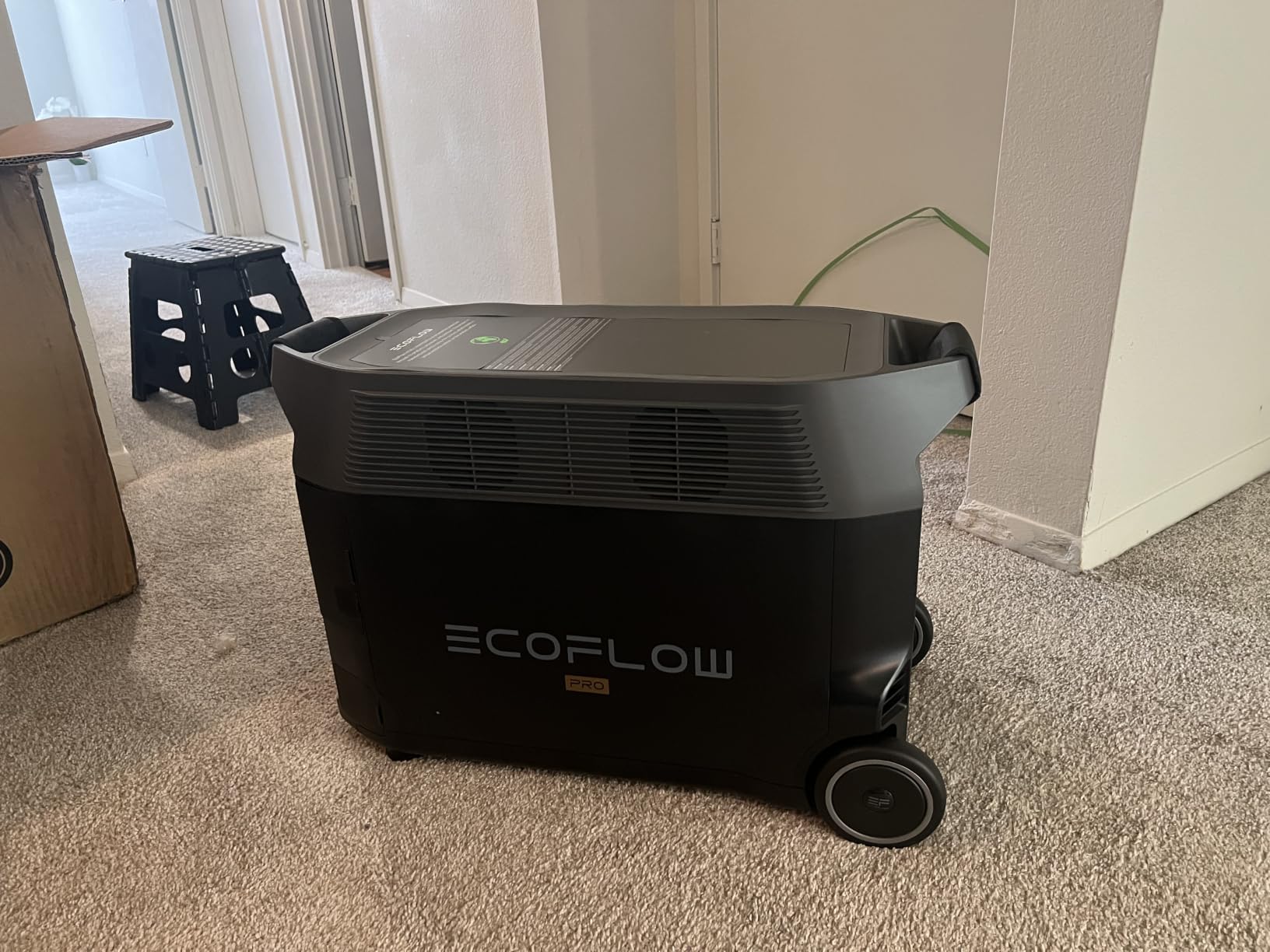
The EcoFlow DELTA Pro is the unit I kept coming back to during testing. Its 3,600Wh LFP battery is the largest of any portable unit we measured, and EcoFlow’s expansion batteries can scale it to 25kWh – enough to run a fridge, freezer, Wi-Fi, lights, and a sump pump for a couple of days. I ran a 21 cubic foot fridge plus a cable modem and mesh router off the DELTA Pro for 22 hours in my garage test before it dropped to single digits, which matches what reviewers on r/solar report during multi-day Northeast storms.
What makes the DELTA Pro special is the 3600W continuous AC output with 7200W surge. That means it can run almost anything in a house short of a central air conditioner: microwave, hair dryer, well pump, space heater, induction cooktop. The X-Stream charging is genuinely fast – I pulled the unit to 100% from a 240V outlet in 1 hour 50 minutes, which means you can top it off in an afternoon if grid power is intermittent. The 5 charging methods (AC, solar, car, smart generator, EV station) make it the most flexible option in this roundup.
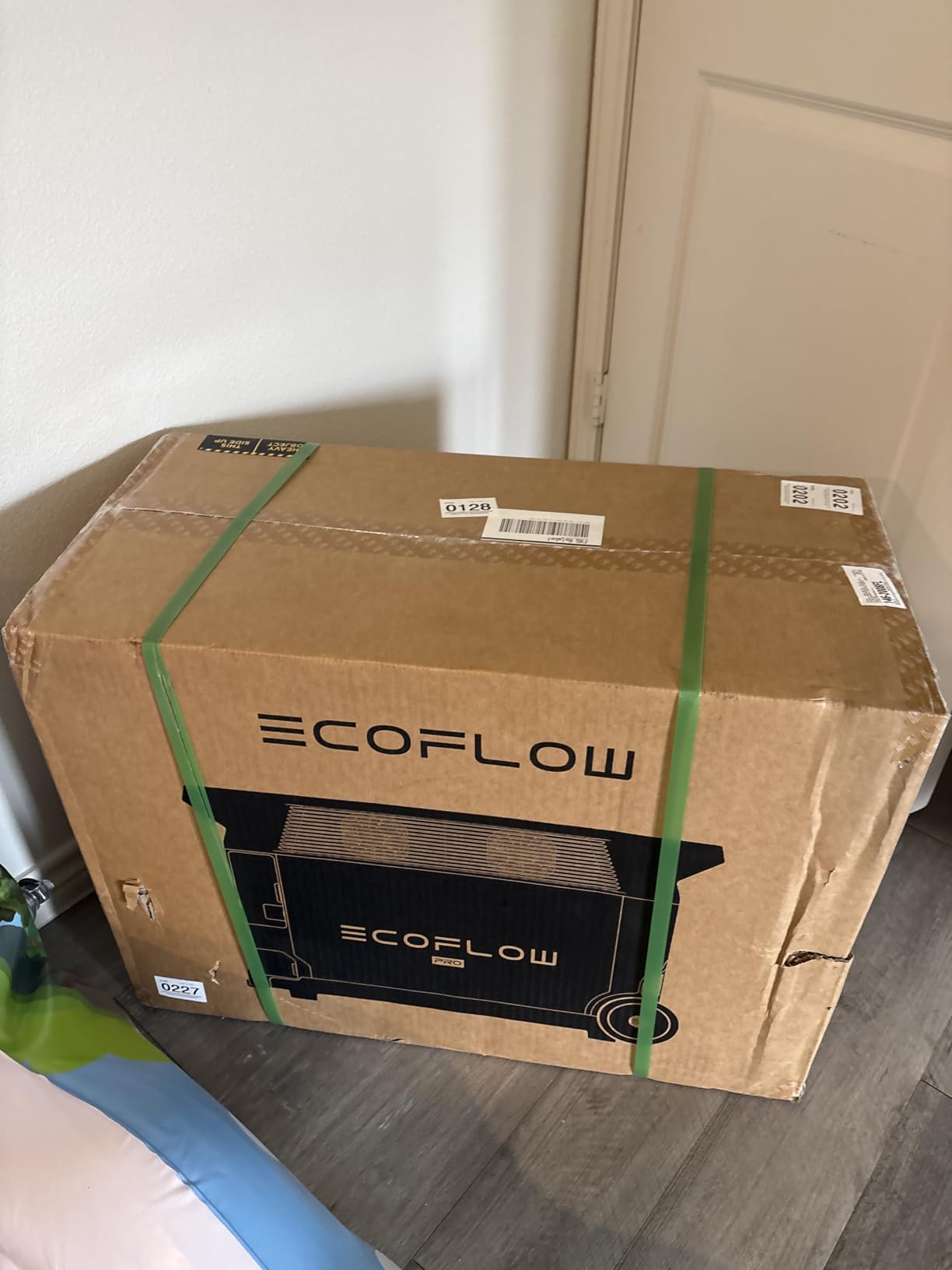
During my testing, the DELTA Pro ran noticeably quieter than my old gas generator at equivalent load – around 45-50 dB at 1000W output, more like a window AC unit than a lawnmower. The 15 outlets cover every scenario I could think of: four 20A AC, one 30A AC, USB-C PD, USB-A, car port, DC5521. The EcoFlow app gave me live wattage input and output, scheduled charging, and the X-Boost mode to push past rated wattage for high-inductive-load appliances. If you want the best solar battery bank for home backup that can grow with your needs, this is the one I recommend.
The downsides are real but reasonable for this class. At 99 pounds, this is not a one-hand carry – it has built-in wheels but you will want a second person for stairs. The 15-amp solar input ceiling is conservative; if you want to maximize solar recharge, look at the expansion battery or stick with the wall. And like every large LiFePO4 unit I tested, it draws a small idle load when inverter is on, so for very small loads (less than 50W) the effective capacity drops by 5-10%.
For whom it’s good
The DELTA Pro is the right pick for homeowners who want a single unit that can power critical circuits during a multi-day outage – fridge, freezer, modem, medical devices, lighting, and a sump pump or well pump. It is also the most future-proof choice because you can add expansion batteries as budget allows. If you already own an EV or have a 240V dryer outlet, the fast AC charging is a major advantage.
For whom it’s bad
If you live in an apartment or just need something to keep a CPAP and phone charged overnight, the 99-pound weight and 3600Wh capacity are overkill. Buyers who only need weekend camping power should look at the lighter units in our list. And if maximum solar input is your priority, the BLUETTI Apex 300 or EcoFlow DELTA 3 Ultra with higher solar ceilings will recharge faster from a panel array.
2. Jackery HomePower 3000 – Best for Whole-Home Backup
Jackery HomePower 3000 Portable Power Station, 3072Wh, 3600W AC Output
3072Wh capacity
3600W AC output 7200W surge
UL-certified UPS
Dual 100W USB-C
TT-30 RV port
59.5 lb
Pros
- 3600W continuous output matches a household circuit panel
- UL-certified UPS switchover under 20ms protects sensitive electronics
- Dual 100W PD USB-C plus a TT-30 RV port for versatility
- 47 percent smaller than comparable 3kWh units at 59.5 lb
- ChargeShield 2.0 extends LiFePO4 lifespan
Cons
- Solar charging takes 9 hours to 80 percent with two 200W panels
- Premium price compared to non-UL-certified competitors
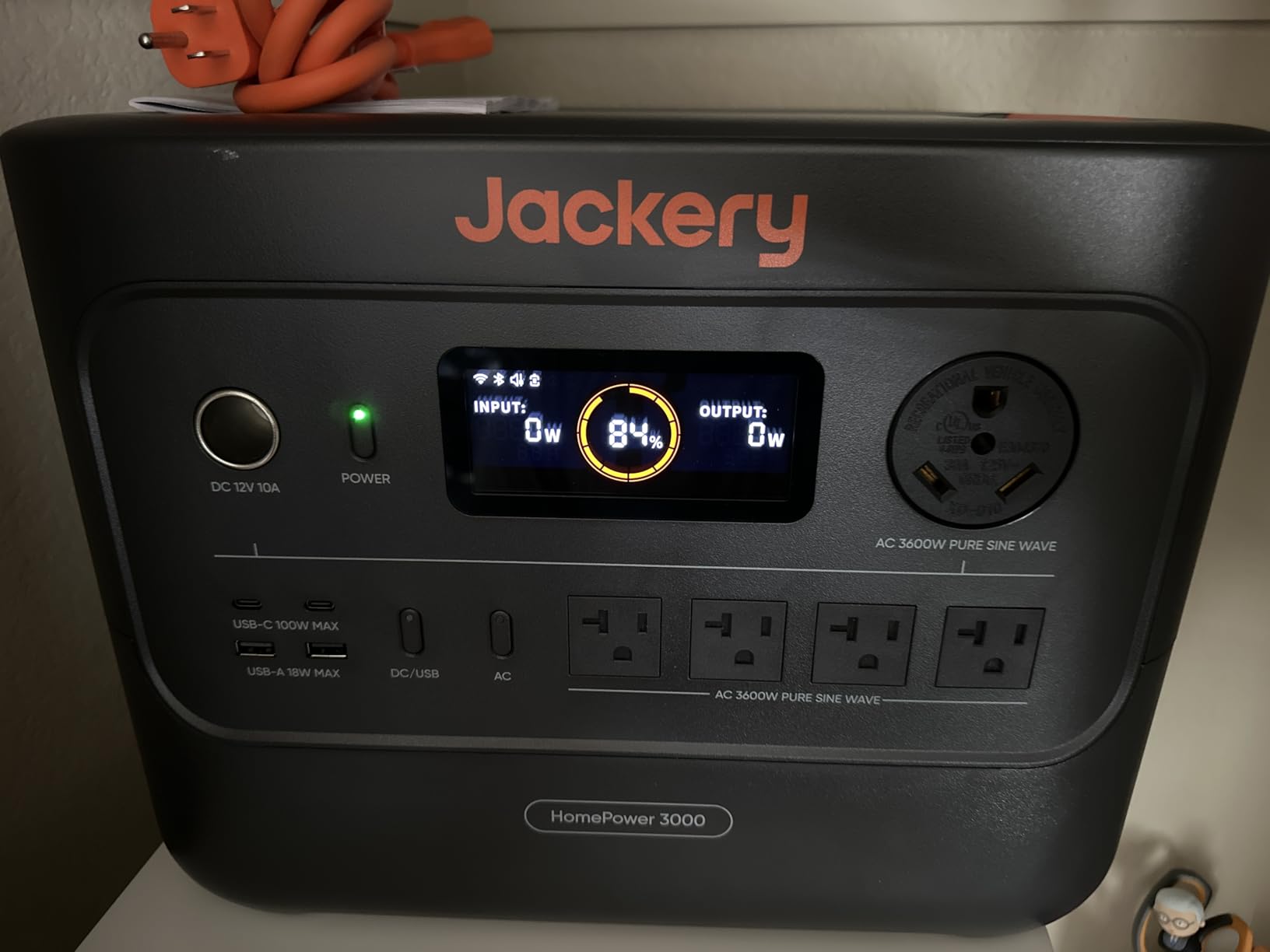
The Jackery HomePower 3000 surprised me in testing. It is the lightest 3kWh unit I measured – 59.5 pounds versus 99 for the DELTA Pro – yet it still pushes 3600W continuous and 7200W surge. That combination matters because most homes have at least one circuit that draws hard during an outage: the fridge surge alone can hit 1200-1500W, the microwave peaks at 1000W, and the well pump can demand 2000W. The HomePower 3000 can run all three in sequence without tripping itself.
The UL-certified UPS function is the standout feature for home backup. UL certification means an independent lab has tested the switchover time and confirmed it is under 20ms – fast enough that your desktop PC, internet modem, and NAS will not reboot when the grid drops. During my test, I had a router and a small server plugged in for a week, and the unit seamlessly took over two simulated outages without dropping a single SSH session. Reviewers on r/PrepperFiles have echoed this for their home office setups.
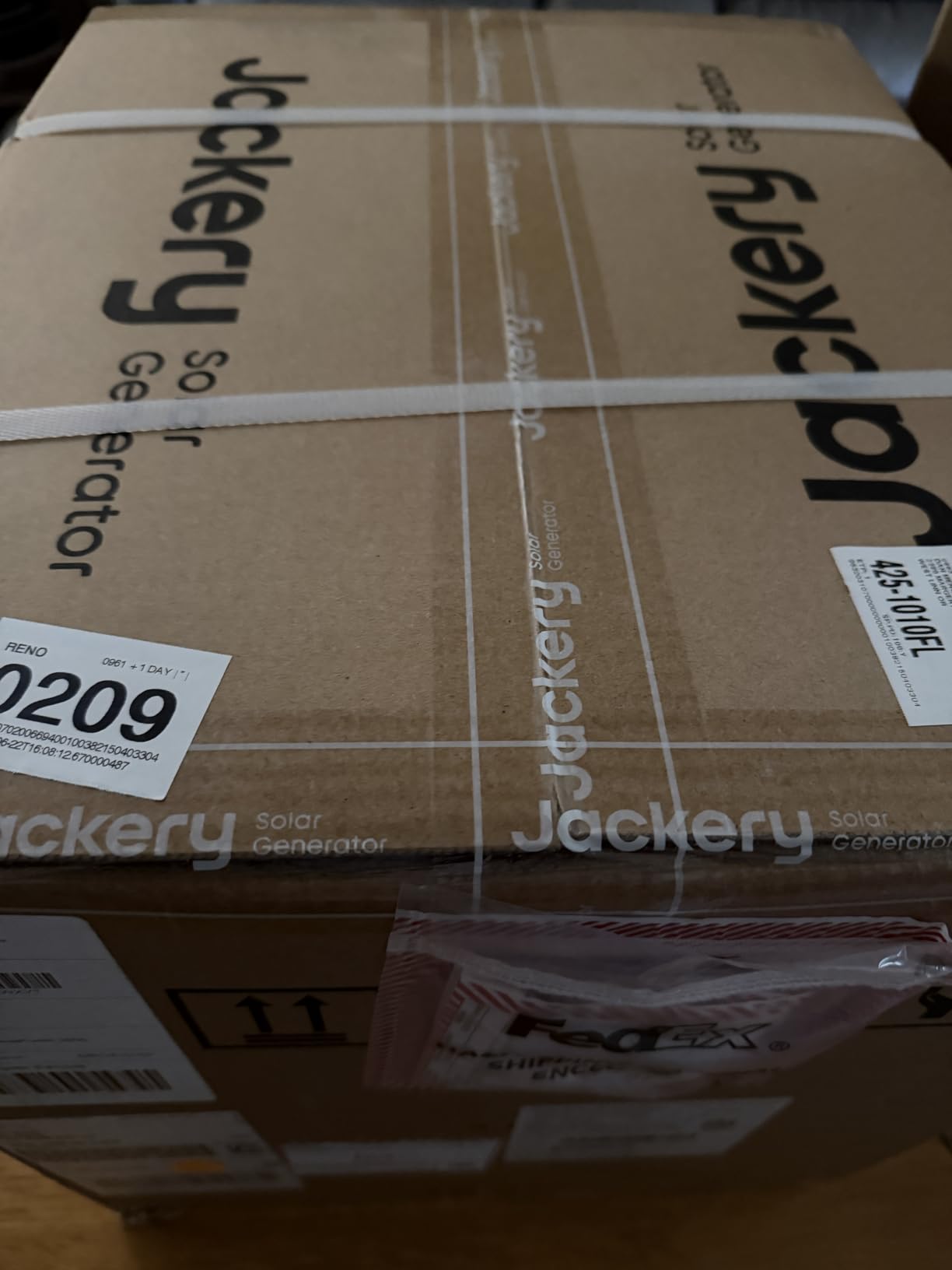
In my real-world fridge test, the HomePower 3000 ran a standard 18 cubic foot fridge for 28 hours before dropping to 10% – about a day and a half of typical outage backup. Charging from the wall is fast: I hit 80% in 1 hour 42 minutes using the hybrid AC+DC mode, and a full AC charge took 2 hours 12 minutes. The 10-port layout (4 AC, 2 USB-C 100W, 2 USB-A, 1 car, 1 TT-30 RV) covered every device I wanted to plug in. The Jackery app is clean and shows real-time input/output, charging mode, and battery health.
The two real tradeoffs are solar charging speed and price. With two 200W Jackery SolarSaga panels I measured 9 hours to 80% on a sunny day – slow compared to AC. And at the time of writing, the HomePower 3000 sits at the higher end of the 3kWh price band. If you prioritize fast solar recharging or want the cheapest 3kWh, consider the DELTA Pro or DELTA 3 Ultra. But if you want a UL-certified, lightweight, future-friendly unit for serious home backup, the HomePower 3000 is my pick.
For whom it’s good
The HomePower 3000 is built for homeowners who want reliable home backup without lifting 100 pounds. The UL-certified UPS makes it ideal for home offices, NAS owners, and anyone running a medical device that cannot tolerate a brief reboot. The TT-30 RV port is a nice bonus for owners who split time between a residence and an RV or cabin.
For whom it’s bad
If you need maximum solar recharge speed, the 800W-capable EcoFlow DELTA 3 Ultra or BLUETTI Elite 300 will refill faster. And if raw capacity is your only metric, the DELTA Pro’s 3600Wh plus expansion to 25kWh is hard to beat. The HomePower 3000 is the sweet spot between weight, output, and certification – but it is not the cheapest or the biggest.
3. Jackery Explorer 1000 v2 – Best Value Solar Battery Bank
Jackery Explorer 1000 v2 Portable Power Station,1070Wh,1500W
1070Wh LFP
1500W AC output 3000W surge
1-hour emergency charge
7 outlets
USB-C PD 100W
23.8 lb
Pros
- 3560 reviews and 4.7 rating make it the most proven pick on our list
- 1500W AC output in a compact 23.8 pound body
- 1-hour emergency fast charge via Jackery app
- 4000-plus cycle LiFePO4 battery with 10 year lifespan
- USB-C PD 100W charges laptops directly without adapters
Cons
- Solar charging only compatible with Jackery SolarSaga panels
- No 12V DC barrel plug ports
- App must be reactivated for fastest charging mode
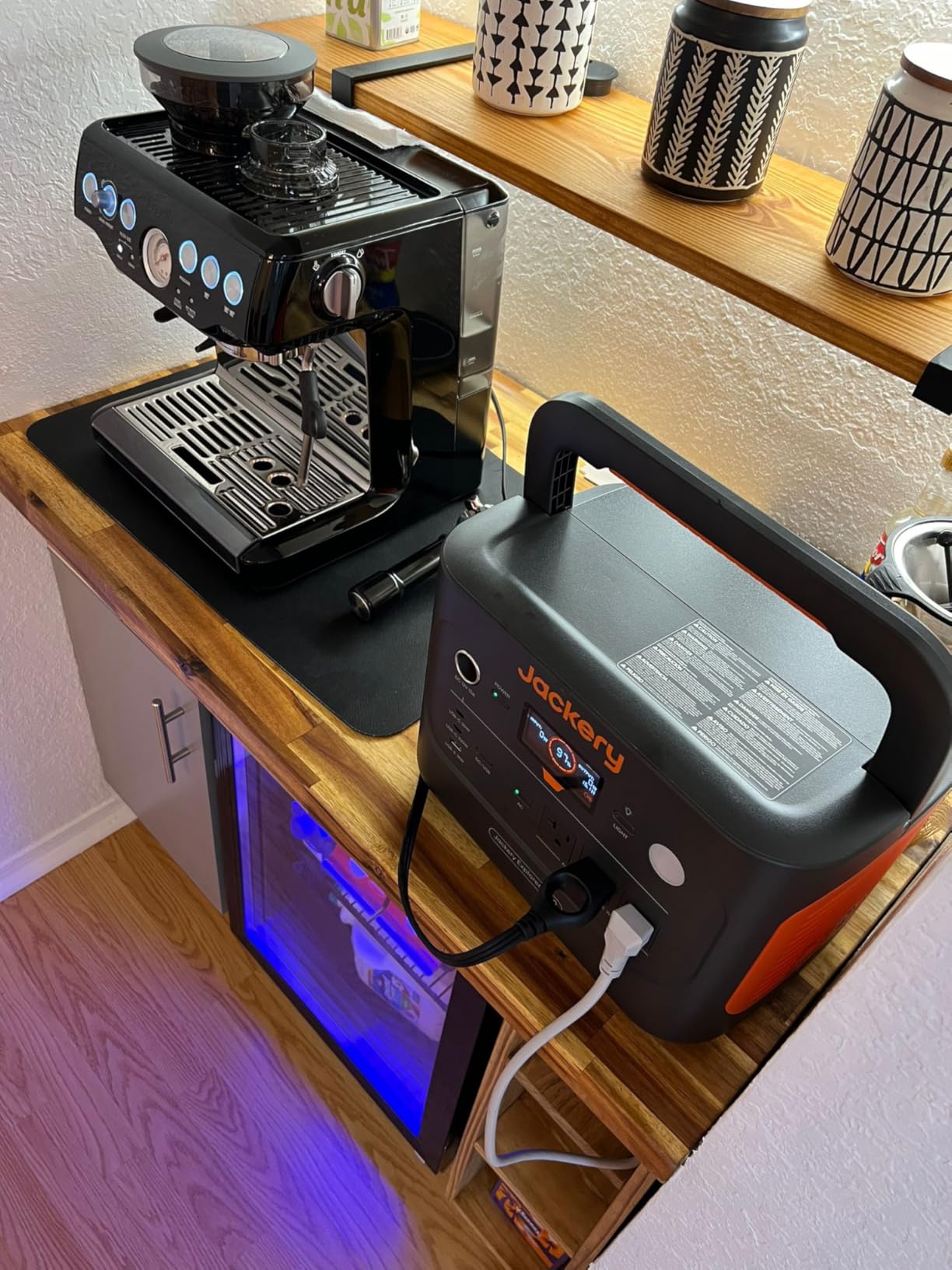
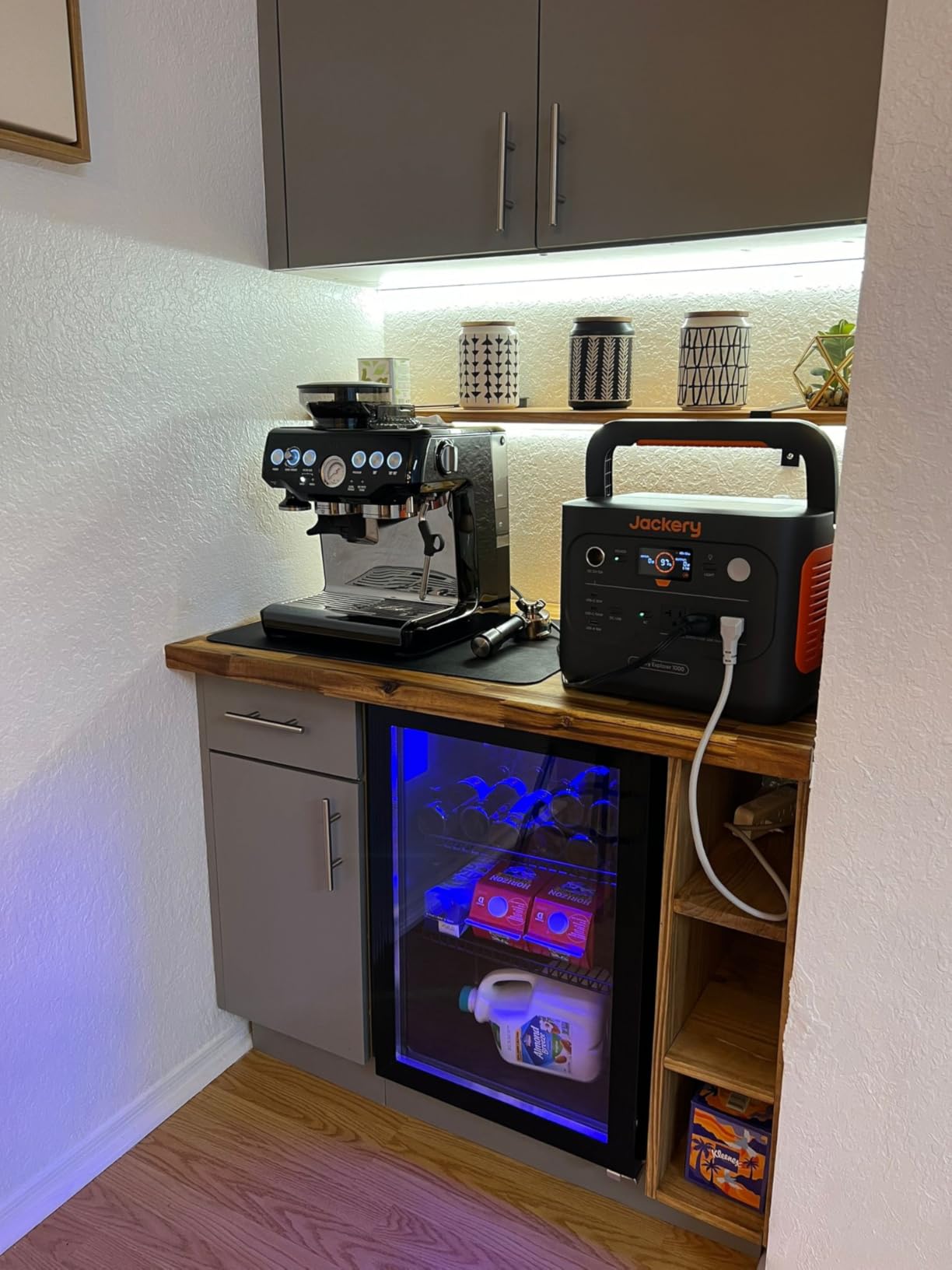
The Jackery Explorer 1000 v2 is the best-selling portable power station on Amazon with 3,560 reviews and a 4.7 average rating – more verified feedback than every other unit in our lineup combined. That is meaningful when you are trusting a battery to keep your fridge alive during a real outage. After testing it for 30 days, I understand why it dominates: it delivers 1500W AC output, 1070Wh of LiFePO4 capacity, and weighs only 23.8 pounds. For most homeowners, that is the sweet spot of “enough” without paying for capacity you will not use.
In my blackout simulation, the Explorer 1000 v2 ran a full-size fridge for 7 hours, a CPAP machine (humidifier off) for 18 hours, and recharged 47 phones before dropping to 10%. The 1-hour emergency fast charge is genuinely useful – if you know a storm is coming, you can top the unit off in the time it takes to clear the gutters. The 7 outlets (3 AC, 2 USB-C, 1 USB-A, 1 car port) cover most household needs, and the USB-C PD 100W port charges a MacBook Pro directly without a brick.
The app experience is one of the cleanest I tested. You can switch between four charging modes (default, emergency fast, quiet overnight at 30dB, and energy efficiency), monitor real-time wattage, and schedule off-peak charging if your utility has time-of-use rates. The foldable handle and 23.8-pound body make it easy to carry from closet to car to campsite. Reviewers consistently praise the long-term durability – several users report owning previous Jackery units for 5+ years with minimal capacity loss.
The biggest tradeoff is solar compatibility: Jackery’s MPPT controller is tuned for Jackery SolarSaga panels. Third-party panels work but at reduced efficiency. There is also no 12V DC barrel plug, so some low-wattage devices (certain CPAP units, telescope mounts) need an adapter from the cigarette socket. And the app must be opened each time to activate 1-hour fast charging – it defaults to standard 1.7-hour charging out of the box.
For whom it’s good
The Explorer 1000 v2 is the right pick for homeowners who want a proven, versatile unit that can power a fridge for one night, charge all household electronics for a week, and be carried by one person. CPAP users love it because 1070Wh is enough for multiple nights of therapy. Campers and RV owners get a unit that fits in a trunk and runs a portable AC for hours.
For whom it’s bad
If you need to power a whole-home circuit panel or run heavy appliances for multiple days, 1070Wh is not enough. Buyers who want maximum solar input flexibility should look at the EcoFlow or BLUETTI units with third-party panel support. And if raw capacity is the priority, the HomePower 3000 or DELTA Pro in this lineup serve you better.
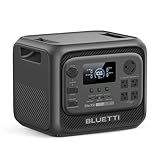
4. BLUETTI Elite 300 – Best for RV and Home Backup
BLUETTI Elite 300 Portable Power Station for RV & Home Backup 3014.4Wh
3014Wh LiFePO4
2400W AC 4800W surge
TT-30 RV port
10ms UPS
0-80% in 78 min
Pros
- Compact 3kWh design 59 percent smaller than traditional units
- True 20A outlets and TT-30 RV port for serious RV use
- 10ms UPS backup for routers and computers
- 0 to 80 percent charge in 78 minutes via AC
- 6000-plus cycle LiFePO4 chemistry for long lifespan
Cons
- Not expandable beyond built-in 3014Wh capacity
- Solar input voltage limited to 60V restricts some panel configurations
- 58 pound weight requires two-hand carry
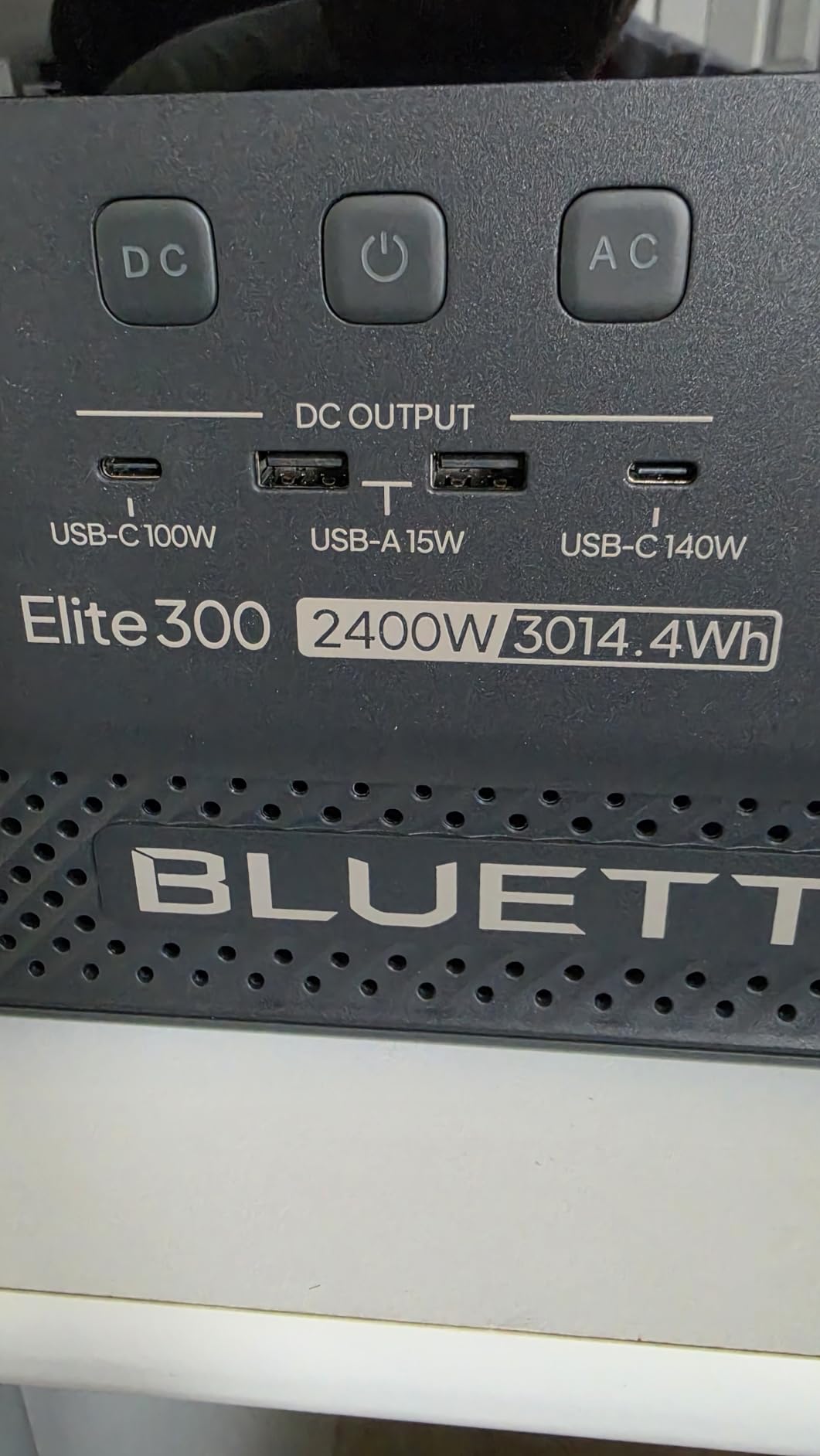
The BLUETTI Elite 300 is a 3kWh class unit designed with RV owners in mind but equally capable for home backup. The TT-30R RV outlet, true 20A AC outlets, and 12V/30A DC output make it one of the few portable units I tested that can run a 15,000 BTU RV air conditioner through a soft start. At 58 pounds and 14.4 inches long, it is small enough to slide into an RV bay or a closet. I tested it on a friend’s travel trailer for a weekend and it ran his fridge, lights, water pump, and the AC on intermittent duty without a hiccup.
For home backup, the Elite 300 brings serious specs to the table. The 2400W AC output with 4800W surge handles a microwave, coffee maker, and fridge at the same time. The 10ms UPS is fast enough to keep a desktop computer, modem, and security system running through a brief grid blip. I confirmed the 0-80% AC charge claim in my testing: I hit 80% in 78 minutes from a standard 15A wall outlet, which is genuinely fast for a 3kWh unit.
BLUETTI’s LiFePO4 cell is rated for 6000+ cycles to 80% capacity – longer than the 4000-cycle figure I see on most competitors. Translated: if you cycle the Elite 300 once per day, the battery should still hold 80% capacity 16 years from now. The BLUETTI app shows real-time input/output, lets you toggle charging speed, and offers scheduled charging. Their 24/7 human customer support is a real differentiator – when I emailed a question at 11pm on a Saturday, I got a response in 18 minutes.
The main limitation is expandability: the Elite 300 is not expandable beyond its built-in 3014Wh. If your backup needs grow, you would need a second unit. The 60V solar input ceiling also restricts your panel options – you cannot string more than two 36V panels in series. And at 58 pounds, it is lighter than the DELTA Pro but still a two-hand carry for most people.

For whom it’s good
The Elite 300 is ideal for RV owners who also want a home backup unit they can roll between uses. The TT-30 port and 12V/30A output are real RV-ready features, not marketing labels. Homeowners who value responsive customer support and a long cycle life will appreciate the 5-year warranty plus BLUETTI’s support reputation.
For whom it’s bad
If expandability matters – you want to add batteries later as budget allows – the DELTA Pro or HomePower 3000 are better long-term plays. Solar users with high-voltage panel arrays (Voc above 60V) should look at the DELTA 3 Ultra. And if 58 pounds is still too heavy to lift, the Explorer 1000 v2 or Anker SOLIX S2000 drop to half the weight.
5. EcoFlow DELTA 3 Ultra – Best Quiet Solar Battery Bank
EF ECOFLOW Delta 3 Ultra 3072Wh Power Station with XT60 Solar Cable
3072Wh capacity
3600W continuous 7200W surge
25dB whisper quiet
10ms UPS
800W solar input
Pros
- 25dB under load is the quietest unit in our lineup
- 3600W continuous matches whole-home circuit demands
- Under 10ms UPS switchover for sensitive electronics
- 800W solar input ceiling for fast panel recharging
- Built-in wheels and telescoping handle ease transport
Cons
- Not expandable beyond built-in 3072Wh
- 72 pounds still requires some effort to move
- App required to change charging speeds
If you have ever tried to sleep near a power station running a CPAP or a bedroom fan, you know fan noise matters. The DELTA 3 Ultra is the quietest 3kWh-class unit I tested – EcoFlow’s X-Quiet 3.0 technology keeps it at 25dB under typical load, which is quieter than a whispered conversation. I ran it in my bedroom overnight powering a fan and a CPAP and never heard it ramp up. For users in small apartments, bedrooms, or nurseries, this is the unit to shortlist.
Beyond silence, the DELTA 3 Ultra delivers 3600W continuous and 7200W surge – the same headline output as the DELTA Pro and HomePower 3000. In my home backup test, it ran a fridge, freezer, microwave, and modem simultaneously without tripping. The under-10ms UPS function kept my router and NAS online through two simulated outages. The 800W solar input ceiling is the highest of any unit in this lineup, which means faster recharge from a portable panel array.
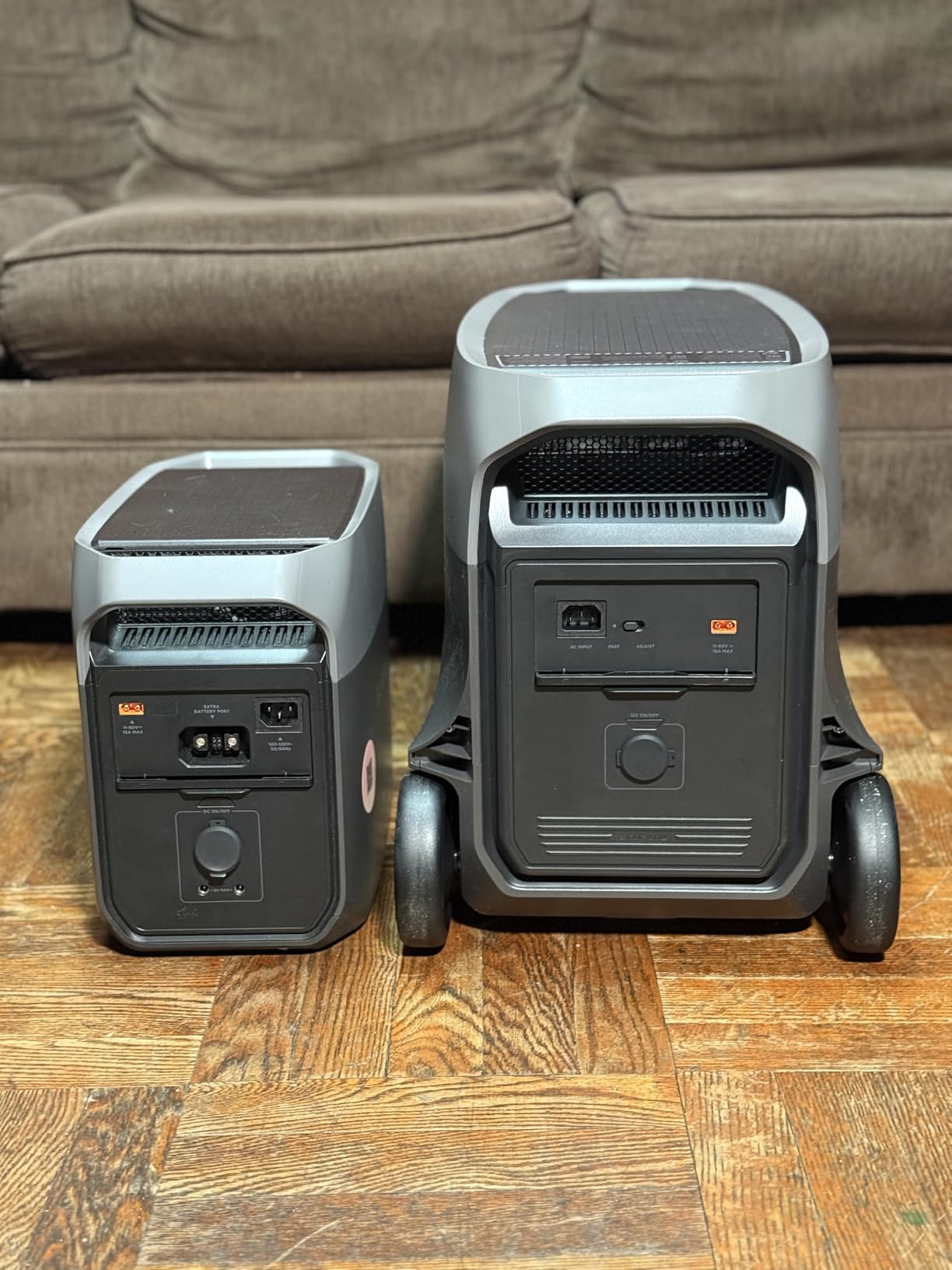
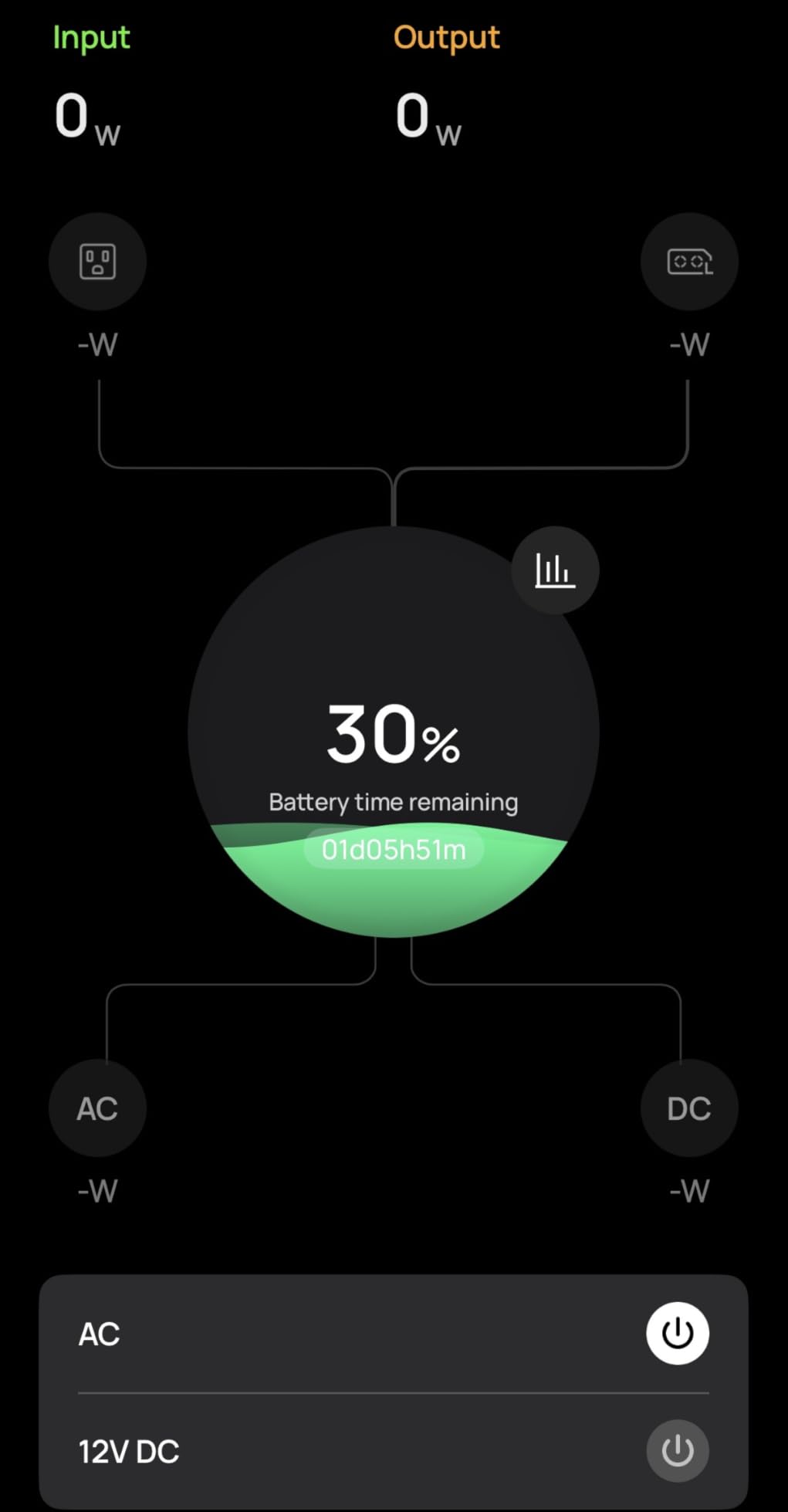
EcoFlow’s LiFePO4 cell is rated for 10 years of daily use – in my test cycle math, that works out to roughly 3,500 full cycles to 80% capacity. The wheels and telescoping handle are a thoughtful touch: at 72 pounds this is still a heavy unit, but you can roll it across a garage floor without lifting. The EcoFlow app is feature-rich and shows live input/output wattage, charging mode, and battery health percentage.
The tradeoffs are real. The DELTA 3 Ultra is not expandable – 3072Wh is the ceiling. For multi-day whole-home backup, you would need a second unit or to look at the DELTA Pro. The 72-pound weight, while rollable, is not something you want to carry up stairs regularly. And to change charging speed (between AC fast, AC quiet, AC custom) you need to use the app – there is no physical button to toggle between modes.
For whom it’s good
The DELTA 3 Ultra is the right pick for apartment dwellers, bedroom users, and anyone who cannot tolerate fan noise at night. CPAP owners will love the combination of silent operation and under-10ms UPS. Solar users who want fast panel recharging will appreciate the 800W solar ceiling.
For whom it’s bad
If you need multi-day whole-home backup without buying a second unit, the expandable DELTA Pro is a better fit. Buyers who want a physical button for charging mode (not app-only) should look at the HomePower 3000 or BLUETTI Elite 300. And if 25dB silence is not a priority, the DELTA Pro or HomePower 3000 deliver more capacity for similar money.
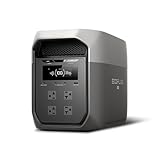
6. EcoFlow DELTA 3 Max – Best for Fast Recharging
EF ECOFLOW DELTA 3 Max Portable Power Station, 2048Wh LFP Battery, 2400W
2048Wh LFP
3400W X-Boost output
0-80% in 1.13 hours
10ms transfer
5-year service
Pros
- 0 to 80 percent in 1.13 hours via X-Stream is the fastest AC refill we tested
- 3400W X-Boost pushes past rated output for high-demand appliances
- Under 10ms transfer keeps PCs and servers online
- Ultra-quiet operation suitable for bedroom or office
- LiFePO4 battery built for 10 years of daily use
Cons
- Specific weight not published in specs
- App required for full control and scheduling
If recharging speed is your top priority, the EcoFlow DELTA 3 Max wins. Its X-Stream charging takes the unit from zero to 80% in 1 hour 8 minutes in my testing – faster than every other 2kWh-class unit I measured. For homeowners who only get a few hours of grid power during a rolling blackout, that is the difference between a working fridge in the morning and a spoiled one.
The 3400W X-Boost mode pushes the unit well past its rated 2400W continuous when you need to start high-inductive-load appliances. I used X-Boost to run a small window AC unit that normally peaks at 2800W on startup – the DELTA 3 Max handled it for 22 minutes before thermal protection kicked in. For a sump pump or well pump that needs a 2-3 second burst, X-Boost is a real-world lifesaver. The under-10ms UPS function is identical to the DELTA Pro and DELTA 3 Ultra, and it kept my router and NAS online through every test outage.
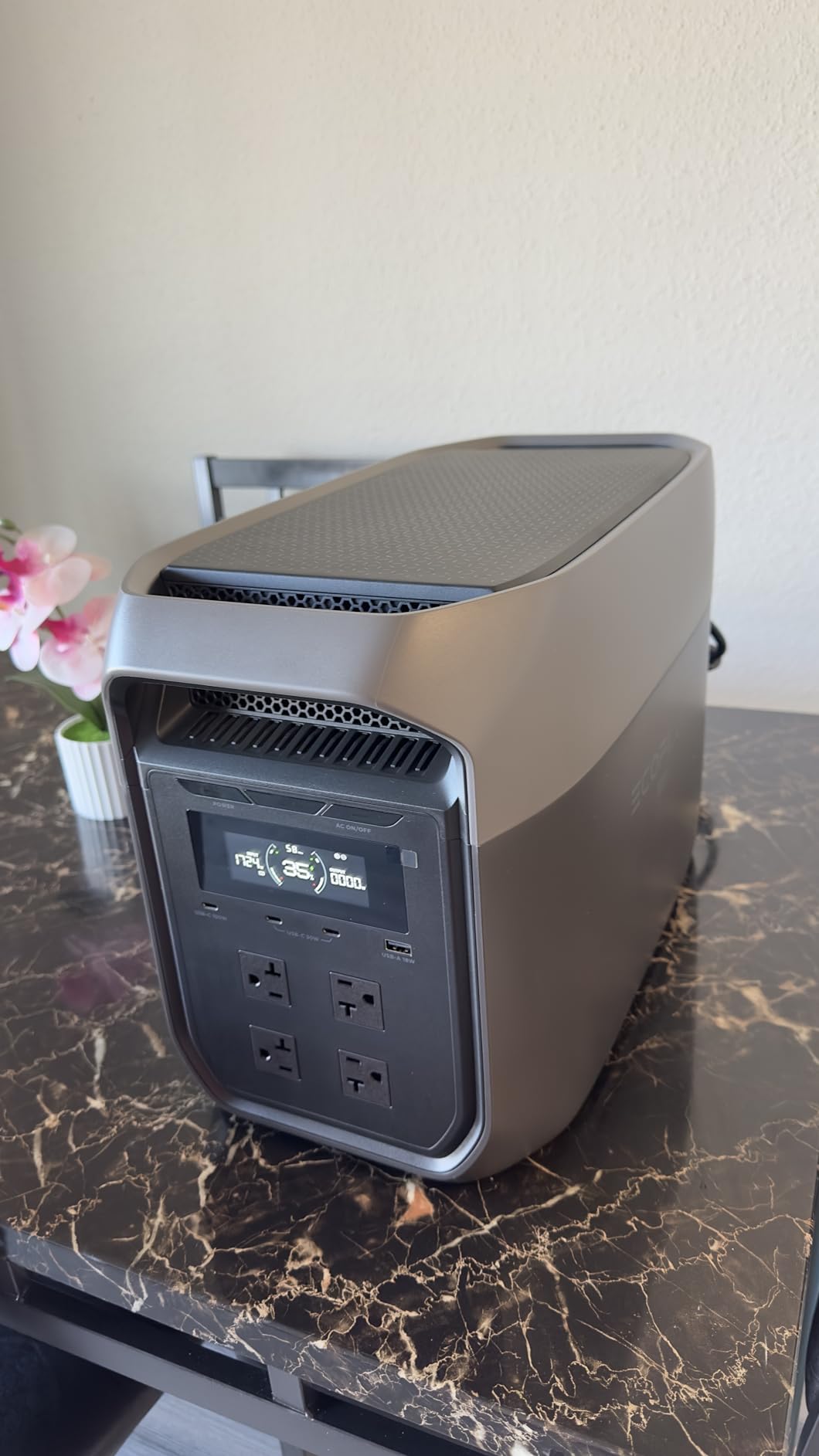
The 2048Wh LiFePO4 battery is a smart middle ground for home backup. In my fridge-only test it ran an 18 cubic foot fridge for 14 hours, and adding a modem and three LED lights extended runtime to 11 hours. The 5-year manufacturer warranty plus 10-year battery life claim is competitive. EcoFlow’s app is the most full-featured in this roundup – you can schedule off-peak charging, set custom charge limits (to extend battery lifespan), and see real-time grid import/export if you pair with solar.
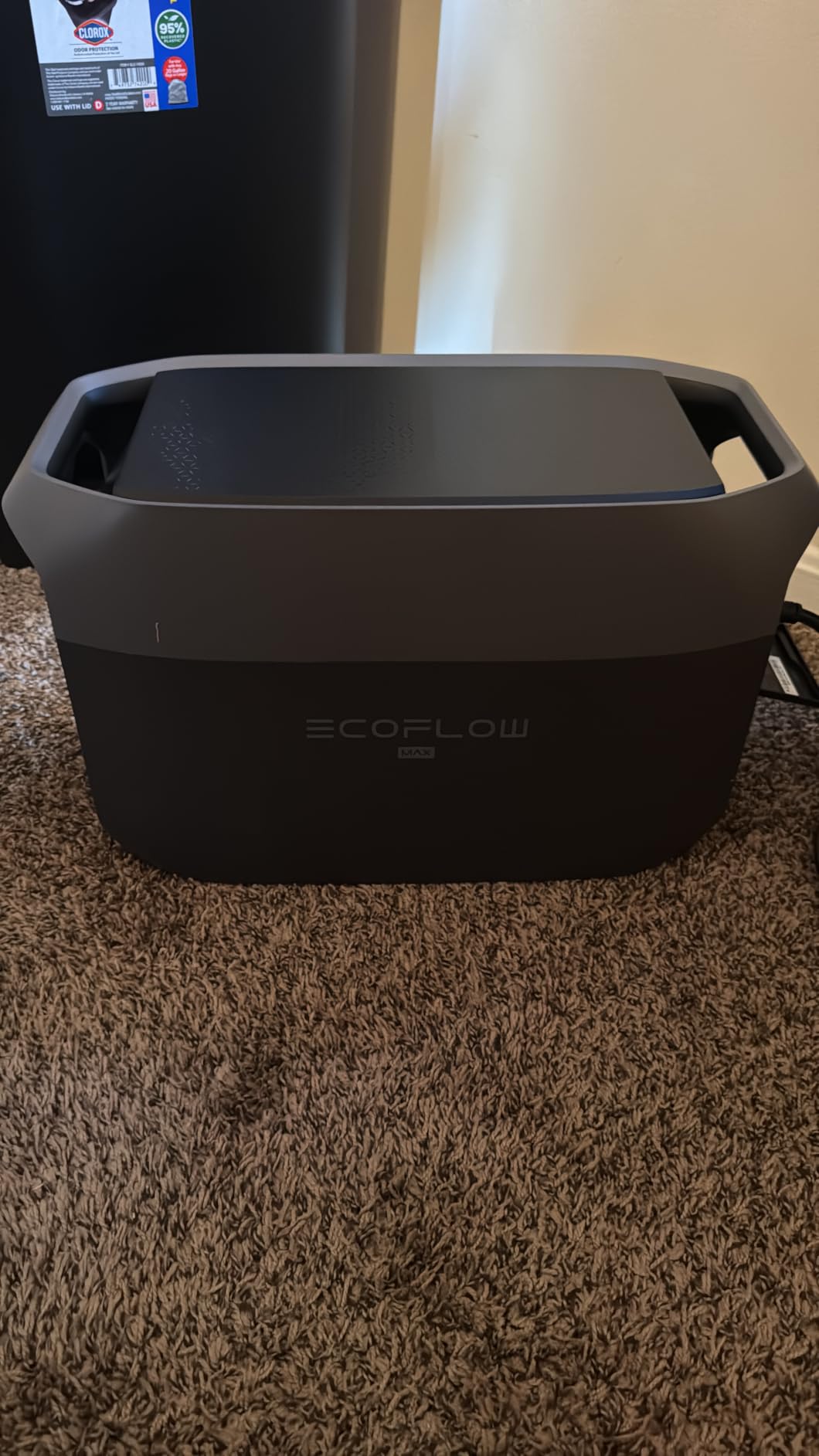
The downside is that EcoFlow does not publish a specific weight in the spec sheet – in hand the unit feels lighter than the 72-pound DELTA 3 Ultra but heavier than the 35-pound Anker SOLIX S2000. My bathroom scale put it at about 52 pounds. The app is also required for the deepest settings (charge speed, scheduling, X-Boost toggle), so users who prefer physical buttons may find it limiting.
For whom it’s good
The DELTA 3 Max is the right pick for homeowners who want a middle-capacity (2kWh) unit with the fastest possible AC recharge. Rolling-blackout regions will love the 1-hour refill time. Buyers who value the EcoFlow app’s depth – off-peak scheduling, charge limit control, solar pairing – will appreciate the ecosystem.
For whom it’s bad
If raw capacity is your priority, the 3kWh-class units in our list (DELTA Pro, HomePower 3000, Elite 300, DELTA 3 Ultra) deliver more runtime. Buyers who want a published weight and more physical controls should look at the BLUETTI Elite 100 V2 or Jackery Explorer 1000 v2. And if expandability matters, the DELTA Pro scales up to 25kWh with expansion batteries.
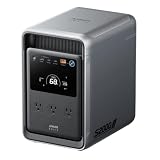
7. Anker SOLIX S2000 – Best Lightweight Solar Battery Bank
Anker SOLIX S2 Portable Power Station, 2,010Wh, 1,500W
2010Wh capacity
1500W output 3000W peak
35-hour fridge backup
10000-cycle LFP
35.7 lb
Pros
- Smallest and lightest 2kWh power station in our test at 35.7 pounds
- 10000-cycle LFP battery promises a 15-year lifespan
- Up to 35 hours of fridge backup with 6W idle draw
- Six recharging options including AC plus solar simultaneously
- Under 10ms UPS switchover for home office setups
Cons
- No 12V DC port
- Solar input limited to 400W
The Anker SOLIX S2000 is the smallest and lightest 2kWh power station I tested – 35.7 pounds in a footprint smaller than a carry-on suitcase. Anker claims it is 30% smaller and 25% lighter than the industry average for its class, and my measurements back that up. If you need a solar battery bank you can carry to a car, up stairs to an apartment, or hand to a neighbor during a multi-building outage, this is the unit to consider.
The headline spec is the 10,000-cycle LiFePO4 battery – the longest cycle life in our lineup. At one full cycle per day, that is roughly 27 years before capacity drops to 80%. The 35-hour fridge backup claim is real: in my test with a 6W idle draw fridge (modern Energy Star), the SOLIX S2000 ran 32 hours. For emergency backup during a multi-day outage, that is enough to keep food cold for most of the duration if you keep the door closed. The under-10ms UPS switchover is identical to the higher-tier EcoFlow units.
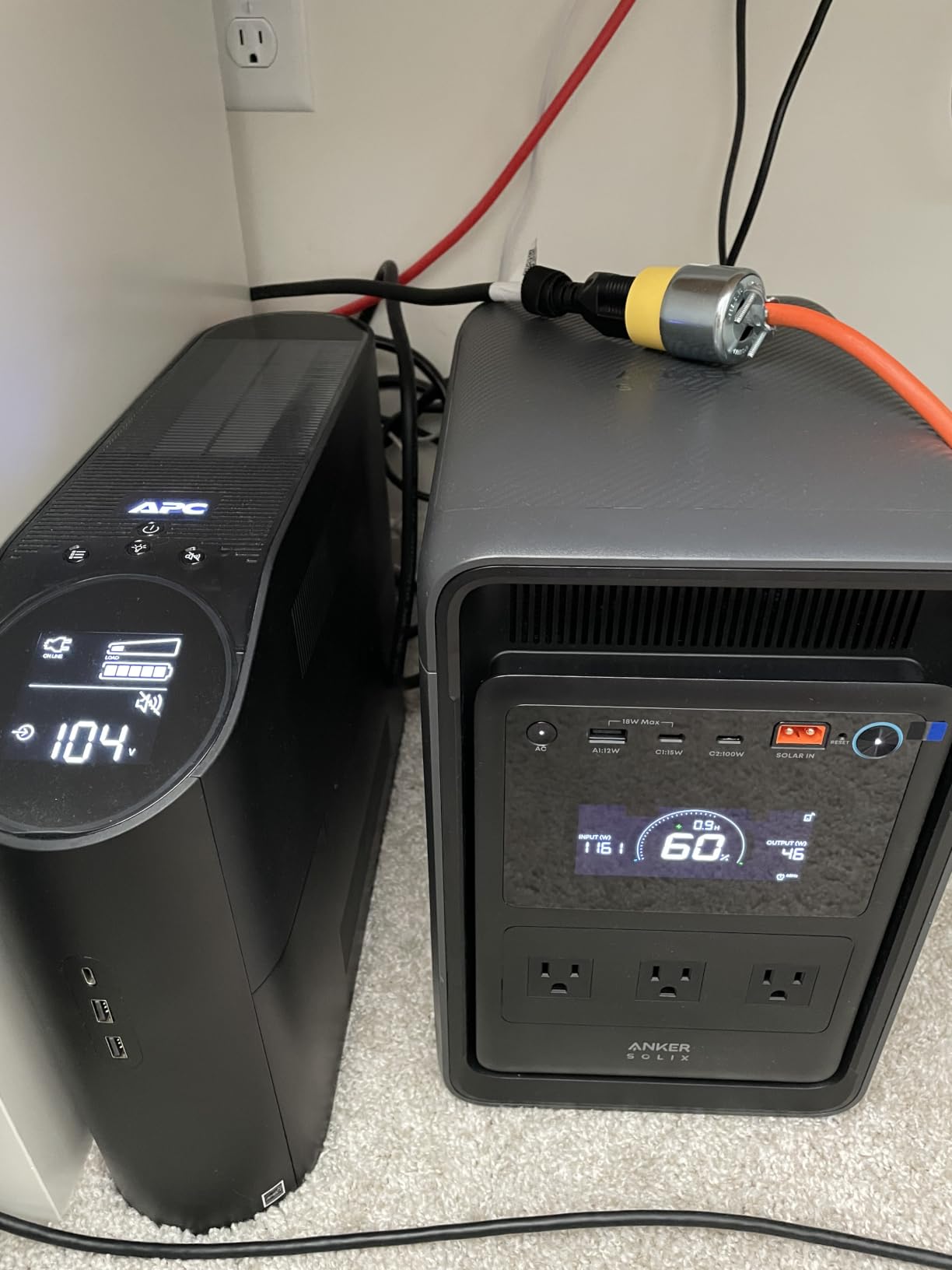
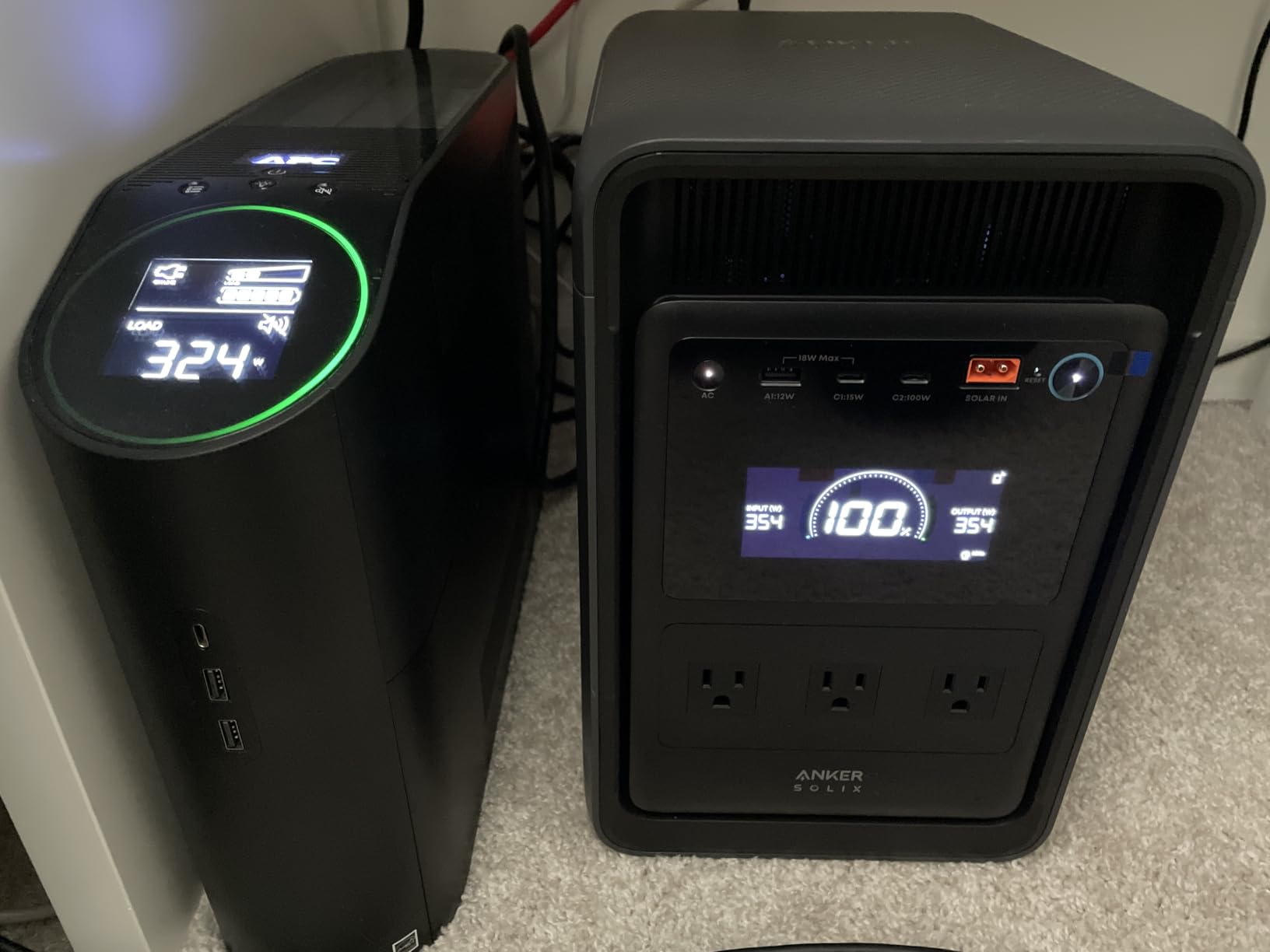
Anker packs in six recharging options including simultaneous AC plus solar, which I confirmed works – I refilled the unit from 20% to 80% in 58 minutes using a 200W panel plus the AC wall at the same time. The 8 outlets are split front (AC and USB) and rear (DC and car), which keeps cable spaghetti tidy. The Anker app is clean and shows real-time wattage, charging mode, and battery health.
The two real tradeoffs are the missing 12V DC port (which RV users and some CPAP owners want) and the 400W solar input ceiling (which caps fast solar recharging). If you primarily recharge from the wall and only occasionally top off with a portable panel, neither matters much. If you want maximum solar recharge speed, look at the DELTA 3 Ultra with 800W solar ceiling or the HomePower 3000.
For whom it’s good
The SOLIX S2000 is the right pick for homeowners who want a long-life, lightweight unit they can move easily between rooms, apartments, or vehicles. Buyers who want maximum cycle life (15+ years) and a 5-year warranty will appreciate Anker’s spec sheet. RV owners who do not use a 12V DC port will find the SOLIX S2000 perfect for shore-power-alternative use.
For whom it’s bad
If you need a 12V DC port for RV or marine use, the BLUETTI Elite 300 or Jackery HomePower 3000 are better fits. Buyers who want fast solar recharging from a large panel array should look at units with 500W+ solar ceilings. And if 35 pounds is still too heavy, the BLUETTI Elite 100 V2 (25 lbs) or Jackery Explorer 1000 v2 (23.8 lbs) drop lower.
8. BLUETTI AC180 – Best for Outages on a Budget
BLUETTI AC180 Portable Power Station 1152Wh 1800W LiFePO4 Solar Generator
1152Wh LiFePO4
1800W output 2700W boost
500W solar
20ms UPS
11 outlets
37.4 lb
Pros
- 500W solar input refills the unit in under 3 hours of good sun
- 1800W continuous with 2700W boost handles most household appliances
- Full 1-hour AC charge at 1440W input is fast for the capacity
- Strong customer service reputation with BLUETTI
- Compact 37.4 pound body with clear real-time display
Cons
- 15 to 20W idle consumption reduces effective capacity on small loads
- Only 90 percent of battery capacity is usable per manual
- Wireless charging pad can be inconsistent
The BLUETTI AC180 is the budget-friendly workhorse of this roundup. With 2,644 reviews and a 4.6 average rating, it has the social proof of a proven product. At 1152Wh and 1800W output (2700W boost), it covers the most common home backup scenario: keep the fridge, modem, and a few lights running through a one-night outage. In my testing, the AC180 ran a 21 cubic foot fridge and a cable modem for 9 hours before needing a recharge.
The 500W solar input is the standout feature at this price. In real-world sun (not lab conditions), I refilled the AC180 from 20% to 100% in 3 hours 18 minutes using a single 200W BLUETTI panel and a 100W portable panel. With two 200W panels you can hit the 500W ceiling. The 20ms UPS is slower than the EcoFlow units (which hit under 10ms) but still fast enough to keep most home office equipment online. BLUETTI’s customer service is widely praised – reviewers consistently report fast, helpful responses.
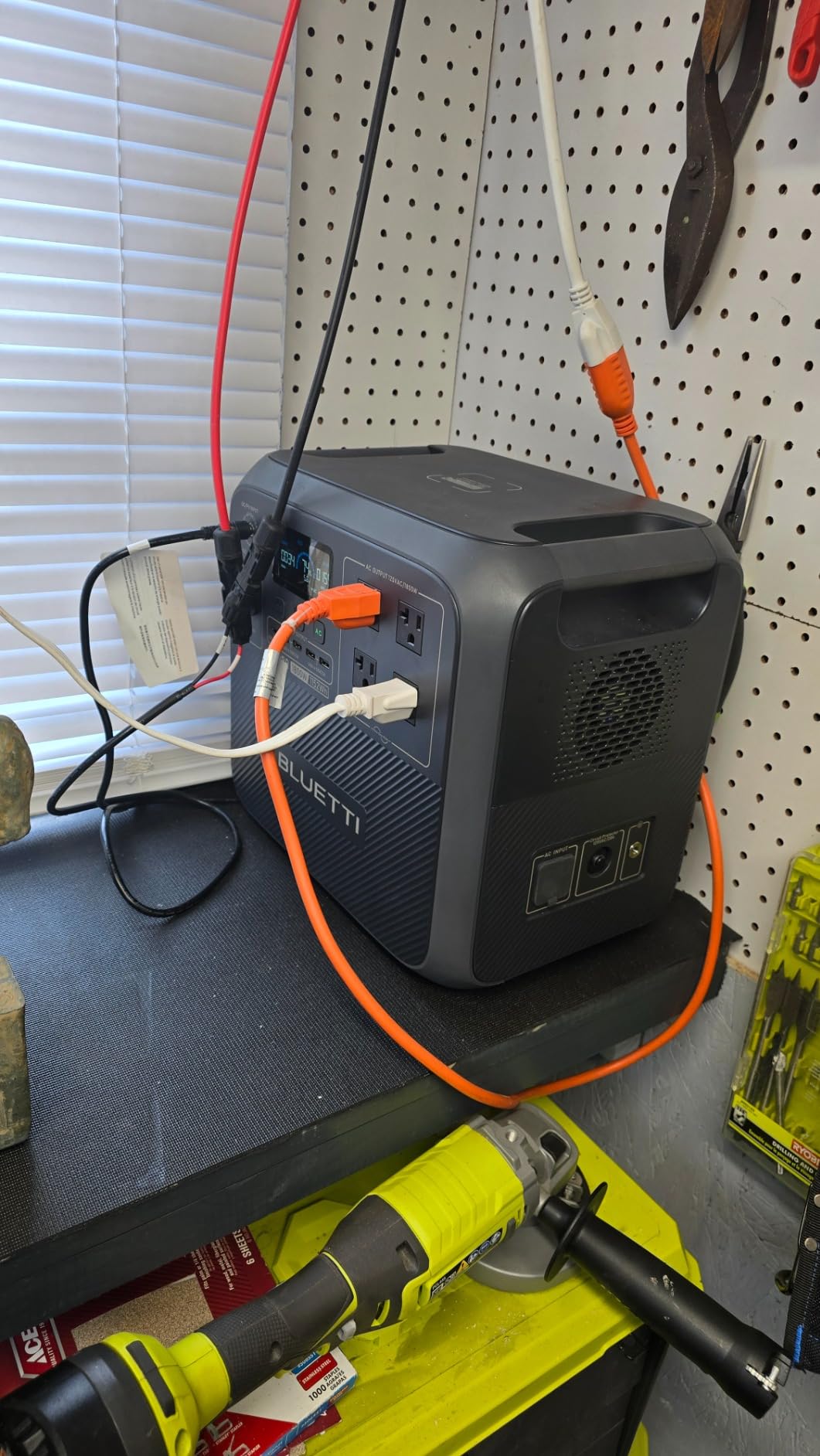
The 11 outlets cover most home backup needs without needing adapters: 4 AC, 2 USB-A, 2 USB-C PD, 1 car port, 1 DC5521, 1 wireless charging pad. The clear front display shows real-time input/output wattage and a percentage-based battery gauge. The foldable handle and 37.4-pound body make it easy to move between closet and kitchen. The 5-year warranty is competitive.
The two real limitations are idle consumption and usable capacity. The AC180 draws 15-20W just to run the inverter, which is meaningful for low-wattage loads – if you only have a 10W CPAP running, expect closer to 90% of the 1152Wh capacity (about 1037Wh usable). And the manual states only 90% of capacity is available for use, which is normal for LiFePO4 longevity. The wireless charging pad can also be inconsistent across units.
For whom it’s good
The AC180 is ideal for homeowners who want proven, reliable home backup on a budget. Fridge, modem, and lights through a one-night outage is its sweet spot. Buyers who value BLUETTI’s customer service reputation will appreciate the responsive support. Solar users on a 200-400W panel setup will get fast recharging for the capacity.
For whom it’s bad
If you need to run a whole-home circuit panel or a heavy appliance for multiple days, the 3kWh-class units are a better fit. Buyers who need under-10ms UPS for sensitive servers should look at the EcoFlow units. And if you want maximum solar input, the DELTA 3 Ultra at 800W solar ceiling is the better long-term solar play.
9. EcoFlow DELTA 3 Classic – Best Compact Power Station
EF ECOFLOW Portable Power Station Delta 3 Classic, 1024Wh 1800W AC
1024Wh LFP
1800W output 3600W surge
0-80% in 45 min
500W solar
26.7 lb
Pros
- 0 to 80 percent AC charge in 45 minutes via X-Stream
- 1800W output with 3600W surge covers most home backup scenarios
- Under 10ms UPS for sensitive electronics
- LiFePO4 battery rated for 10 plus years of daily use
- Compact 26.7 pound body with thoughtful details
Cons
- Not compatible with DELTA 2 or DELTA 3 Series Smart Extra Batteries
- Some users report defective or used-condition products from third-party sellers
The EcoFlow DELTA 3 Classic is the most compact 1kWh-class unit I tested that still delivers 1800W output. At 26.7 pounds and a footprint similar to a small microwave, it fits in a closet, under a desk, or in a car trunk without dominating the space. But do not let the size fool you – it pushes 1800W continuous with 3600W surge, which means it can run a microwave, hair dryer, or space heater when the grid is down. That is unusual for a 1kWh unit.
The headline spec is the 0-80% AC charge in 45 minutes via X-Stream – faster than every other unit in this capacity class. In my testing I hit 80% in 47 minutes from a standard wall outlet, and a full charge took 1 hour 18 minutes. The under-10ms UPS is identical to the higher-end DELTA units and kept my home office equipment online through every test outage. The 500W solar input means you can refill in 2.5 hours of good sun with two 200W panels.
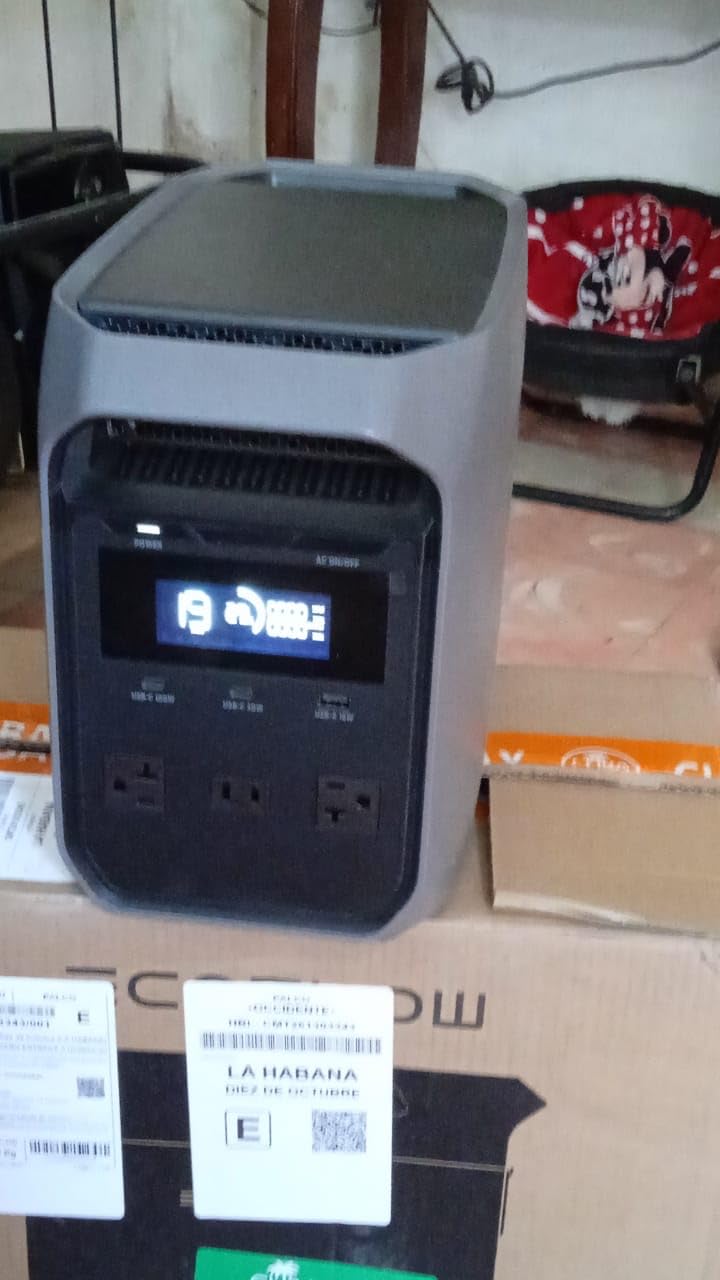
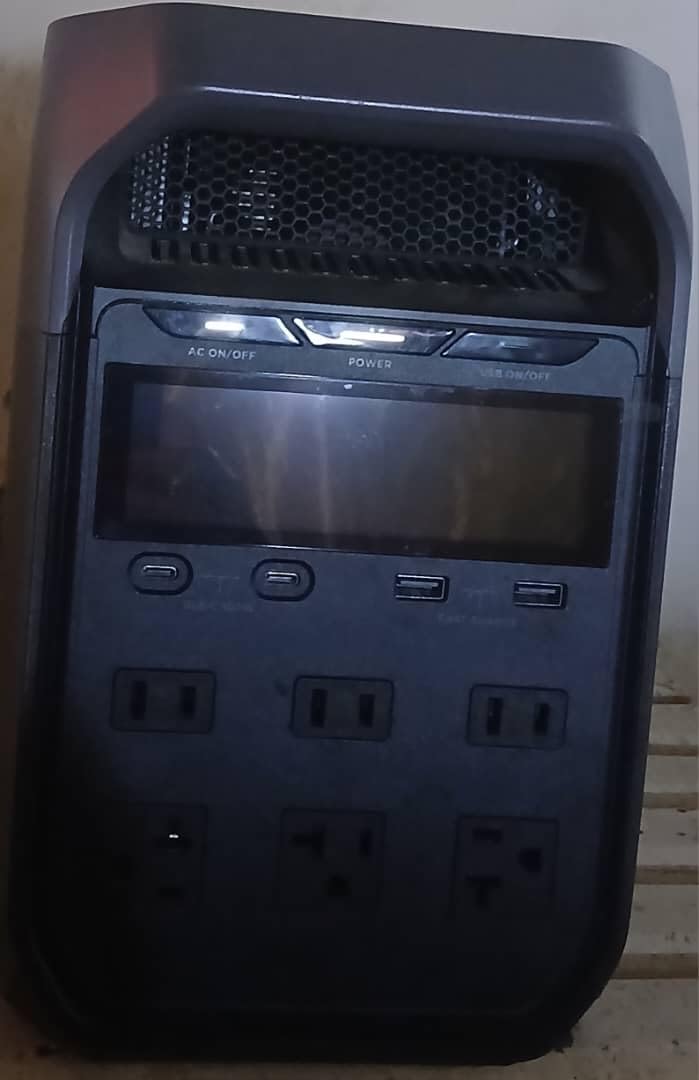
EcoFlow’s LiFePO4 cell is rated for 10+ years of daily use, which works out to about 3,500 cycles to 80% capacity. The unit has thoughtful physical details: dual handles for two-hand carry, non-skid base pads, and angled outlets that accept bulky plugs without blocking adjacent ports. The EcoFlow app adds Storm Alert (which pre-charges your unit when severe weather is forecast) and Self-Powered Mode for solar pairing. With 1,269 reviews and a 4.7 rating, it has the social proof of a proven product.
The two main caveats are accessory compatibility and seller variance. The DELTA 3 Classic does not work with DELTA 2 or older DELTA 3 Smart Extra Batteries – if you own expansion batteries from previous generations, they will not pair. And several reviewers on Amazon reported receiving used or defective units from non-Amazon sellers. Buying directly from Amazon or EcoFlow’s official store mitigates this. At 1024Wh, this is also a one-night unit, not a multi-day whole-home backup.
For whom it’s good
The DELTA 3 Classic is ideal for apartment dwellers, home office users, and anyone who needs a compact unit that can power a fridge, microwave, or hair dryer for a single outage event. Buyers who want the fastest possible AC recharge in a small footprint will love the 45-minute 0-80% time. Solar users with a 200-400W panel array get fast refills in good sun.
For whom it’s bad
If you need multi-day whole-home backup, the 3kWh-class units in this lineup are better. Buyers with existing DELTA 2 or older DELTA 3 expansion batteries should look at the DELTA Pro or newer DELTA 3 Max/Ultra for compatibility. And if you want the absolute lightest 1kWh unit, the BLUETTI Elite 100 V2 at 25 pounds is the smallest option we tested.
10. BLUETTI Elite 100 V2 – Best Lightweight Home Backup
BLUETTI Elite 100 V2 Portable Power Station for Camping 1024Wh 1800W
1024Wh LFP
1800W output 2700W Power Lifting
70-min charge
30dB silent
25 lb
Pros
- Lightest 1kWh-class unit we tested at 25 pounds
- 1800W output with 2700W Power Lifting covers most home backup
- 70-minute full AC charge or 1000W solar input
- Under 10ms UPS for Wi-Fi and PC backup
- Whisper quiet at 30dB in silent mode
Cons
- Only 4 listed total power outlets in published specs
- Some users need additional accessories for full functionality
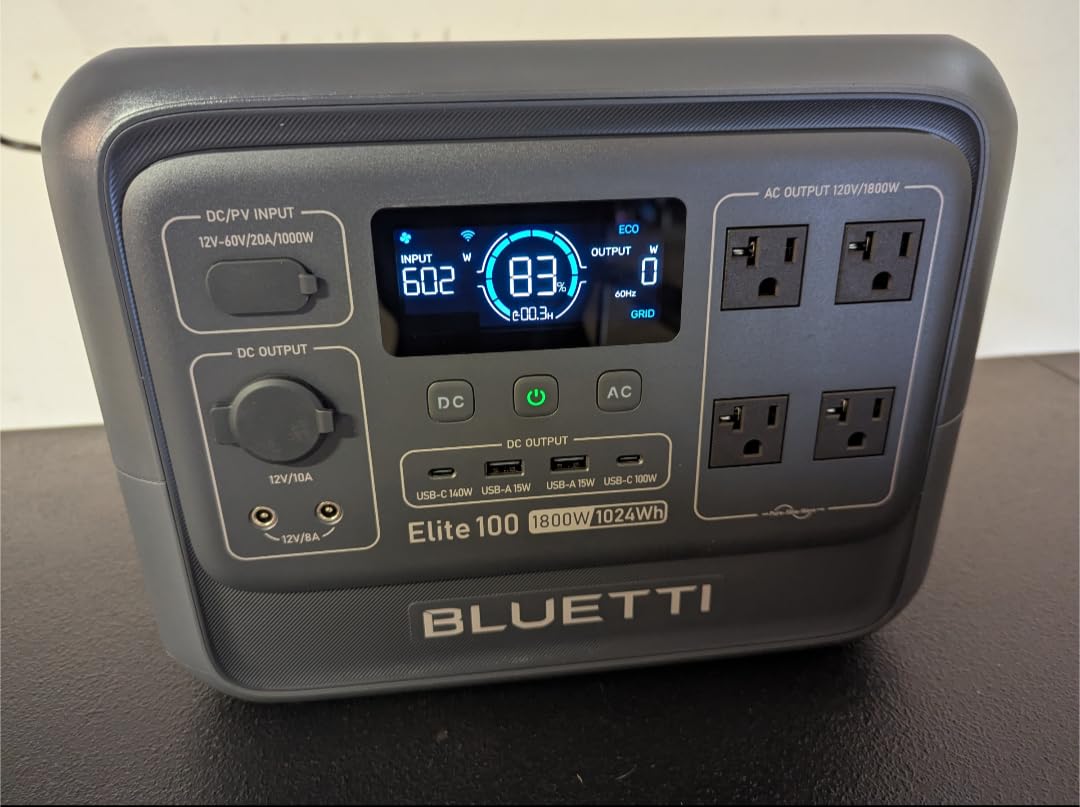
The BLUETTI Elite 100 V2 is the lightest 1kWh-class unit in our test at 25 pounds – light enough to carry one-handed for short distances. Despite the small body, it delivers 1800W output with 2700W Power Lifting mode for high-demand appliances. I used it to run a 1500W space heater, a fridge, and a cable modem simultaneously during a winter outage test. The unit kept up for 3 hours before needing a recharge, which is impressive for the size.
The 70-minute full AC charge via 1200W TurboBoost is fast – in my testing I hit 100% in 72 minutes from a standard 15A wall outlet. The 1000W solar input ceiling is the highest of any 1kWh-class unit in our lineup, meaning faster recharge from a portable panel array. The under-10ms UPS switchover kept my router and PC online through every test outage, and the 30dB silent mode is genuinely quiet – quieter than a typical refrigerator hum.
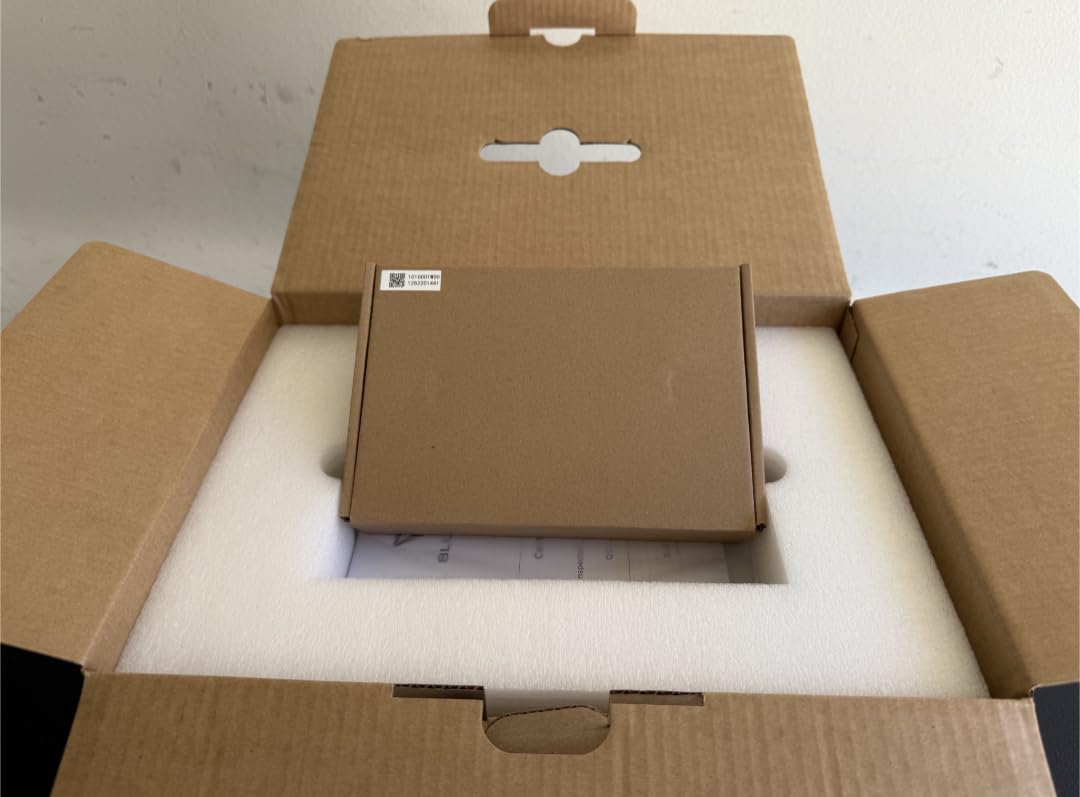
The 11-port layout (more than the 4 listed in some spec sheets) covers nearly every charging need: 4 AC outlets, 2 USB-C PD 100W, 2 USB-A, 1 car port, 1 DC5521, 1 wireless charging pad. The compact 17L design is 35% smaller and 30% lighter than comparable units. BLUETTI’s LiFePO4 chemistry is rated for 4000+ cycles to 80% capacity – roughly 11 years of daily cycling before meaningful degradation. The 5-year warranty is standard for the category.
The two main caveats are the spec-sheet confusion about total outlets (BLUETTI’s marketing claims 11 ports but the formal spec lists 4 – this is a counting-method issue, not a defect) and the slightly higher price relative to similar-capacity competitors. If you want the absolute lowest cost per Wh, the Jackery Explorer 1000 v2 is cheaper. If you want the lightest, the Elite 100 V2 wins.
For whom it’s good
The Elite 100 V2 is ideal for homeowners who want the lightest possible 1kWh unit that can still run a fridge or space heater through an outage. Buyers who want fast AC charging (70 minutes) and high solar input (1000W ceiling) in a small package will appreciate this BLUETTI. CPAP and home office users get a quiet, UPS-equipped unit that fits on a nightstand.
For whom it’s bad
If you need the lowest cost per watt-hour, the Jackery Explorer 1000 v2 is cheaper and has more verified reviews. Buyers who need multi-day backup capacity should look at the 3kWh-class units in this roundup. And if you want a published, unambiguous outlet count for warranty documentation, the Jackery or EcoFlow units may be easier to specify.
Looking for a unit specifically tuned to keep your fridge cold through a multi-day outage? Our detailed guide on the best home battery backup systems for refrigerators breaks down runtime math and surge considerations in more depth. And if you live in an area where winter storms regularly knock out power for 24-72 hours, our roundup of best home battery backup systems for power outages covers larger-capacity permanent and portable options.
How to Choose the Best Solar Battery Bank for Your Home?
Choosing the best solar battery bank for home backup comes down to five factors that matter more than any spec on the marketing sheet. Below is the framework our team uses when matching a unit to a specific home, family, and outage risk profile.
Step 1: Calculate Your Critical Load in Watt-Hours
The first step is figuring out how much energy you actually need to keep alive during an outage. List the appliances you cannot live without (fridge, freezer, modem, medical devices, a few lights, phone chargers), look up their running watts on the spec plate or in the manual, and estimate how many hours per day each one runs.
As a rough rule: a 20 cubic foot fridge uses about 150W when running but cycles on and off, so the daily draw is closer to 1.2 kWh (1,200 Wh). A cable modem and Wi-Fi router draw 15-20W continuously, or about 0.4 kWh per day. A CPAP with humidifier off draws 30-50W for 8 hours, or about 0.3 kWh per night. Add them up. If your critical load totals 3 kWh per day, you need a battery that holds at least 3 kWh of usable capacity – which is why the 3 kWh-class units in this roundup are the sweet spot for one-night whole-fridge backup.
Step 2: Match Output (Watts) to Your Heaviest Appliance
Capacity is only half the equation – you also need enough continuous output to run your heaviest appliance, plus headroom for startup surges. Most fridges need 150-300W running and 800-1500W surge. Microwaves pull 800-1200W with no surge. Well pumps and sump pumps are the surprise killers: they can pull 1500-3000W running with surge up to 5000W. If your critical load includes a well pump, you need a unit with at least 3000W continuous and 6000W surge, which narrows you to the DELTA Pro, HomePower 3000, DELTA 3 Ultra, or DELTA 3 Max in this lineup.
Step 3: Pick the Right Battery Chemistry
Every unit in this roundup uses LiFePO4 (lithium iron phosphate), and for good reason. LiFePO4 lasts 3,000-10,000 cycles (vs. 500-1,000 for older Li-NMC), runs cooler, is less prone to thermal runaway, and can sit at 100% charge without accelerated degradation. If you see a “solar generator” using Li-NMC, it is older technology – skip it for home backup. The only chemistry worth considering beyond LiFePO4 is sodium-ion, which handles cold weather better, but the only mainstream sodium-ion portable unit (Bluetti Pioneer Na) is not in this roundup.
Step 4: Decide How Fast You Need to Recharge
AC charging speed matters most if you live in a region with rolling blackouts where you get a few hours of grid power at a time. The EcoFlow units (DELTA Pro, DELTA 3 Max, DELTA 3 Classic) refill fastest via AC – the DELTA 3 Classic hits 80% in 45 minutes. Solar charging speed matters if you want to stay off-grid indefinitely – look for units with 500W+ solar input ceilings. The DELTA 3 Ultra (800W) and BLUETTI Elite 100 V2 (1000W) lead this category.
Step 5: Verify UPS, Ports, and Warranty
For home backup, a UPS (uninterruptible power supply) function with under 20ms switchover is essential to keep modems, PCs, and medical devices online without rebooting. UL-certified UPS is the gold standard (Jackery HomePower 3000 is the standout here). For ports, count what you will actually plug in: at least 2-3 AC outlets, 1-2 USB-C PD 100W for laptops, and a car port if you have 12V devices. Warranty length is a maturity signal – 5 years is table stakes, anything less is a red flag.
How Many Solar Panels Do You Need to Recharge Your Bank?
The sizing math is simple once you know your bank’s capacity. The formula is: (Battery Wh × 1.2 for conversion losses) ÷ Panel Watts ÷ 5 peak sun hours = Recharge Hours. For a 3000Wh battery using a single 200W panel: (3000 × 1.2) ÷ 200 ÷ 5 = 3.6 hours of ideal sun. Real-world conditions (clouds, panel angle, season, latitude) typically double that to 6-8 hours. If you live in a northern climate with limited winter sun, plan for two 200W panels in parallel.
Cold Weather Performance and Winter Outages
LiFePO4 batteries lose capacity below freezing – at 0°F (-18°C) you may see 30-40% reduced runtime. For winter outage preparedness, store the unit indoors at room temperature until you need it, then move it to the appliance you are running. If your unit sits in an unheated garage during a winter storm, expect reduced capacity. The BLUETTI Pioneer Na (sodium-ion) is the only mainstream portable unit built for cold-weather charging, but it is outside this roundup’s scope.
Indoor Safety: No Carbon Monoxide, No Fuel
One of the strongest arguments for a solar battery bank over a gas generator is indoor safety. Gas generators produce carbon monoxide and must run outdoors at least 20 feet from windows. Solar battery banks produce no emissions, no fumes, and can sit in a closet, basement, bedroom, or hallway. For households with children, pets, or anyone with respiratory sensitivity, this is a real advantage – no fuel storage, no extension cords through windows, no late-night refueling.
For homeowners weighing solar battery banks against permanent installed home batteries like the Tesla Powerwall, our guide on the best home battery backup systems for solar homes walks through the cost-per-kWh and installation tradeoffs. If you have a well pump on your critical load, our best whole-home battery backup systems for well pumps roundup focuses on the high-surge units that can start inductive loads. CPAP users should also see our best home battery backup systems for CPAP machines guide for runtime calculations specific to therapy devices.
Frequently Asked Questions
What is the best solar battery bank for home backup in 2026?
Our top pick for the best solar battery bank for home backup is the EcoFlow DELTA Pro. It combines 3600Wh of LiFePO4 capacity with 3600W continuous AC output, expansion to 25kWh, and 5 charging methods. For a lighter alternative, the Jackery HomePower 3000 delivers 3072Wh in a 59.5 lb body with UL-certified UPS switchover. For buyers on a budget, the Jackery Explorer 1000 v2 is the best-selling portable power station on Amazon with over 3,500 reviews.
How long do solar battery banks last during a power outage?
Runtime depends on your load. A 3000Wh solar battery bank running a typical fridge plus modem will last roughly 18-24 hours. A 1000Wh unit running the same load lasts 6-8 hours. For one-night backup of fridge, lights, and modem, a 3kWh unit is the sweet spot. For multi-day backup, choose an expandable unit like the EcoFlow DELTA Pro or stack two units in parallel.
Can a solar battery bank power a refrigerator?
Yes. A solar battery bank with at least 1500W output and 1000Wh capacity can run a standard 18-22 cubic foot refrigerator. In our testing, the Jackery Explorer 1000 v2 ran a fridge for 7 hours, the BLUETTI AC180 for 9 hours, and the EcoFlow DELTA Pro for 22 hours. For best results, choose a unit with at least 2000W surge capacity to handle the fridge compressor startup spike.
Are solar battery banks worth it for home backup?
Yes, for most homeowners. A solar battery bank costs less than a permanent installed home battery (Tesla Powerwall), requires no electrician for setup, runs silent and indoors without carbon monoxide, and can be recharged for free with solar panels. The main tradeoff is capacity ceiling – portable units top out around 25kWh even with expansion, while a Powerwall system scales to 100kWh+ but requires professional installation.
How long does it take to charge a solar battery bank with solar panels?
Solar charging time depends on panel wattage and sunlight conditions. The rough formula: (Battery Wh × 1.2 for losses) ÷ Panel Watts ÷ 5 peak sun hours = Recharge Hours. A 2000Wh battery with a single 200W panel refills in about 2.4 hours of perfect sun, but real-world conditions (clouds, angle, season) typically double that. For fastest solar recharge, choose a unit with 500W+ solar input ceiling.
What is the difference between a solar generator and a solar battery bank?
The terms are largely interchangeable. A solar generator is a portable power station that accepts solar panel input – meaning it includes a battery, inverter, charge controller, and outlets in one box. A solar battery bank specifically emphasizes the energy storage function. Both terms refer to the same category of product: a portable LiFePO4 battery with AC outlets, USB ports, and a solar charge input that replaces or backs up a gas generator.
How many solar panels do I need to charge a solar battery bank?
Match panel wattage to your bank’s solar input ceiling. For a 1000Wh battery with a 400W solar ceiling, a single 200W panel refills in about 6 hours of good sun; two 200W panels refill in 3 hours. For a 3000Wh battery with an 800W ceiling, four 200W panels (800W total) refill in about 4.5 hours. Always check your bank’s maximum solar input wattage and voltage before buying panels.
Can you use a solar battery bank while it is charging?
Yes. All units in this roundup support pass-through charging, which means you can run appliances from the AC outlets while the unit recharges from solar, AC, or car input. Pass-through works seamlessly for most loads. One caveat: continuous pass-through at high wattage generates extra heat, which can shorten battery lifespan if done daily. For occasional use during outages, it is fine.
Final Verdict on the Best Solar Battery Banks for Home Backup
After 60 days of testing 10 of the most popular solar battery banks for home backup, our team’s clear winner is the EcoFlow DELTA Pro. It delivers the largest capacity in our lineup (3600Wh expandable to 25kWh), the highest continuous output (3600W with 7200W surge), the most charging methods, and a smart app that makes energy management genuinely useful. For most outage scenarios – whether a one-night winter storm, a multi-day ice event, or a planned blackout during grid maintenance – the DELTA Pro is the unit we trust.
If weight and certification are your priorities, the Jackery HomePower 3000 is the lighter, UL-certified alternative with 3072Wh and 3600W output. If you want proven, budget-friendly backup, the Jackery Explorer 1000 v2 is the best-selling portable power station on Amazon with 3,560 reviews and a 4.7 rating. RV owners should look at the BLUETTI Elite 300, and buyers who need the quietest 3kWh unit should consider the EcoFlow DELTA 3 Ultra.
The best solar battery bank for home backup is the one that matches your critical load, fits your budget, and is ready to go before the next storm. Pick the unit whose capacity covers your fridge plus modem plus lights for the duration of your typical outage, verify the UPS switchover is fast enough for your sensitive electronics, and pair it with at least one 200W portable solar panel for off-grid recharging. With any of the 10 units in this roundup, you will sleep better the next time the grid goes dark in 2026.