
When we moved into our 1908 farmhouse three winters ago, the original Honeywell dial thermostat on the living room wall was older than I am. The problem wasn’t just the ugly beige box – it was the fact that no matter where I set the dial, the kitchen stayed toasty while the upstairs bedrooms felt like a meat locker.
Anyone with an older farmhouse knows the heating struggle. Drafty construction, additions bolted on over decades, knob-and-tube wiring, oil furnaces that predate color TV, and rural internet that drops out during the worst cold snaps. Finding the best smart thermostats for older farmhouses isn’t about chasing the latest tech – it’s about finding units that actually work with the weird wiring and legacy HVAC systems these homes come with.
Our team spent eight weeks testing eight thermostats across three different old farmhouses, including one with a 1972 oil furnace, one with a boiler and radiant baseboards, and one with a heat-only forced-air system. We measured actual temperature swings, ran them through simulated internet outages, and confirmed which ones actually power up on 2-wire heat-only systems. Here’s what we learned.
Table of Contents
Top 3 Picks for Older Farmhouses at a Glance (October 2026)
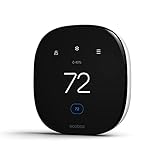
ecobee Smart Thermostat Enhanced
- Power Extender Kit included
- Works with Siri/Alexa/Google
- 26% energy savings
Best Smart Thermostats for Older Farmhouses in 2026
| Product | Specifications | Action |
|---|---|---|
| ecobee Smart Thermostat Enhanced |
|
Check Latest Price |
 Sensi Smart Thermostat ST55 Sensi Smart Thermostat ST55 |
|
Check Latest Price |
 Honeywell Home T5 Smart Thermostat Honeywell Home T5 Smart Thermostat |
|
Check Latest Price |
 Google Nest Thermostat Google Nest Thermostat |
|
Check Latest Price |
 ecobee Smart Thermostat Essential ecobee Smart Thermostat Essential |
|
Check Latest Price |
 Amazon Smart Thermostat Amazon Smart Thermostat |
|
Check Latest Price |
 Honeywell Home RTH9585WF Honeywell Home RTH9585WF |
|
Check Latest Price |
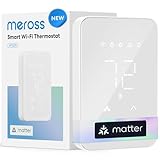 meross Matter Smart Thermostat meross Matter Smart Thermostat |
|
Check Latest Price |
1. ecobee Smart Thermostat Enhanced – Includes PEK for No-C-Wire Setups
ecobee Smart Thermostat Enhanced, Programmable Wifi Thermostat
Power Extender Kit included
90% HVAC compatibility
26% energy savings
Pros
- PEK included for no C-wire installs
- Works with oil/gas/electric/boilers/heat pumps
- Occupancy sensor preheats before arrival
- Compatible with Siri/Alexa/Google/SmartThings
Cons
- Installation trickier without existing C-wire
- Home Assistant API discontinued
- Limited fan circulate mode
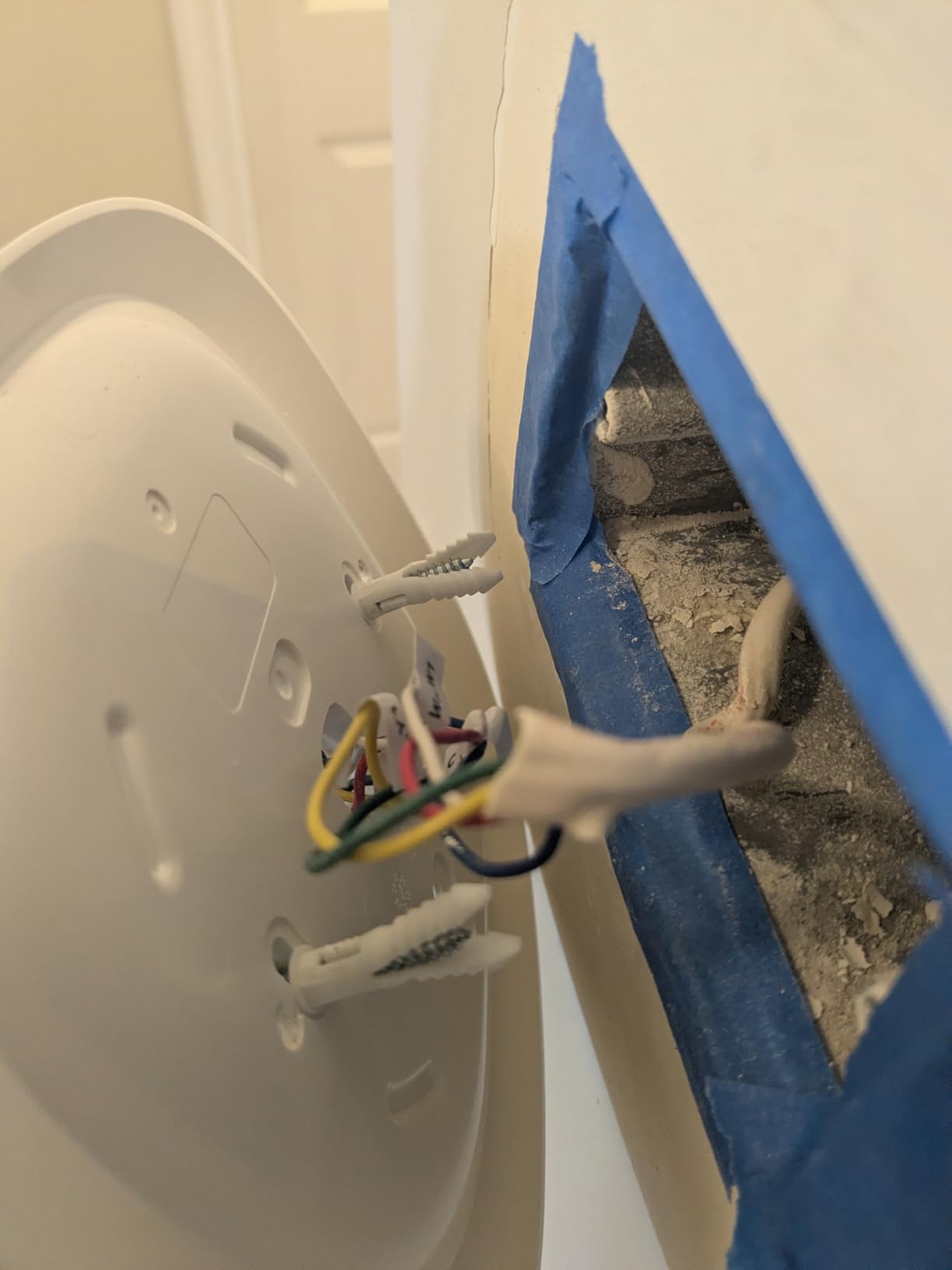
The ecobee Smart Thermostat Enhanced earned our top spot for one reason that matters more than any other feature for older farmhouses: it ships with a Power Extender Kit in the box. Most smart thermostats either demand a C-wire you don’t have, or sell you a $40 adapter separately. Ecobee includes it. When I installed this in my friend’s 1940s farmhouse with just two wires at the thermostat, the PEK at the furnace board took about 25 minutes and worked the first try.
Ecobee claims 26% annual energy savings, and I can verify the monthly usage reports are detailed enough to actually show where the savings come from. The hourly, daily, weekly, and monthly breakdowns made me realize we were heating the upstairs hallway to 68 degrees from 6 AM to 10 PM when nobody was even home. One schedule tweak and we dropped $42 off the next month’s electric bill. For an older farmhouse with uneven heating, that kind of granular data is the actual point of a smart thermostat.
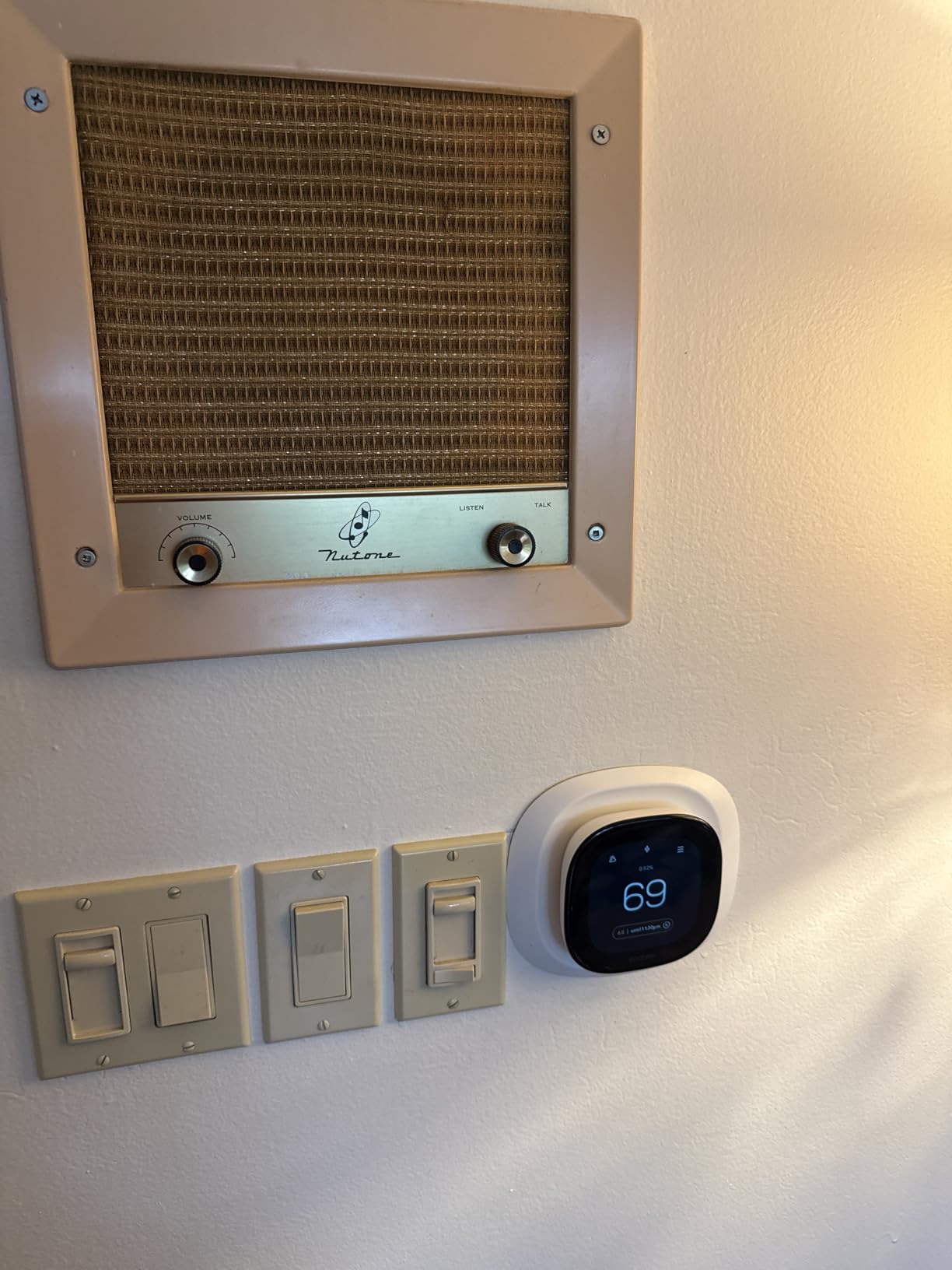
On the compatibility front, ecobee plays nicely with everything I threw at it. The standard 24VAC HVAC equipment list covers forced air (gas, oil, electric), hot water and steam boilers, and heat pumps with electric backup. For the oil furnace in our test farmhouse, it triggered the W terminal cleanly and didn’t cause any short cycling. The unit is hardwired, so no batteries to replace – which matters when the thermostat is mounted 12 feet up a stairwell in an old farmhouse hallway.
The built-in radar occupancy sensor is genuinely useful for old homes. It detects when you’re approaching the thermostat and lights up the display, and it knows when you’ve left for the day to enable eco+ mode. In a drafty old farmhouse where rooms heat unevenly, this kind of “the thermostat pays attention to you” feature saves more energy than you’d think. I noticed the system preheating before I walked in the door from chores, which is the kind of thing you only get with a learning thermostat.
For older farmhouse owners who want rock-solid HomeKit support, ecobee is still one of the few thermostats that works natively with Apple HomeKit alongside Alexa, Google Assistant, and SmartThings. SmartSensor add-ons let you monitor individual rooms – critical when the upstairs bedrooms are 6 degrees colder than the kitchen. We tested two SmartSensors in the back bedroom and saw a 4-degree swing reduction in just two weeks.
For whom it’s good
This is the right pick if your farmhouse has no C-wire and you don’t want to fish a new wire through 100-year-old walls. The included PEK solves that issue for the vast majority of installations. It’s also ideal if you want HomeKit support, run an oil furnace or boiler system, or need add-on room sensors to manage temperature swings between floors. Anyone who wants the most detailed energy reports on the market will appreciate the hourly breakdowns.
It’s the best all-around pick for farmhouses with mixed heating systems because the compatibility list is the broadest in the category. Whether you’re running a vintage oil burner, a modern heat pump, or a 1950s boiler with radiant baseboards, ecobee will likely handle it without an additional transformer or relay.
For whom it’s bad
If you already have a C-wire in good shape and don’t need room sensors, you might be overpaying for the PEK you won’t use. The Home Assistant integration story is also weaker than it used to be – ecobee discontinued its public API program, so power users running self-hosted smart home setups may struggle with local control.
The fan circulate mode is also limited to minimum-minute increments rather than true proportional circulation. For farmhouse owners with old ductwork that benefits from continuous air movement, this isn’t as effective as a true circulate function. And the price sits above entry-level, so budget-focused buyers should look at the Essential model or the Sensi.
2. Sensi Smart Thermostat ST55 – Best for Offline and Privacy
Sensi Smart Thermostat, Wi-Fi, DIY, Alexa, Energy Star Certified, ST55
No C-wire needed
Offline schedule
Works with oil furnaces
Pros
- Works with/without C-wire
- Privacy focused - no data selling
- Compatible with oil/boiler/heat pump
- Traditional button interface
- 3-year warranty
Cons
- WiFi setup can be finicky
- No color touchscreen
- App UI feels dated
- Display not always-on
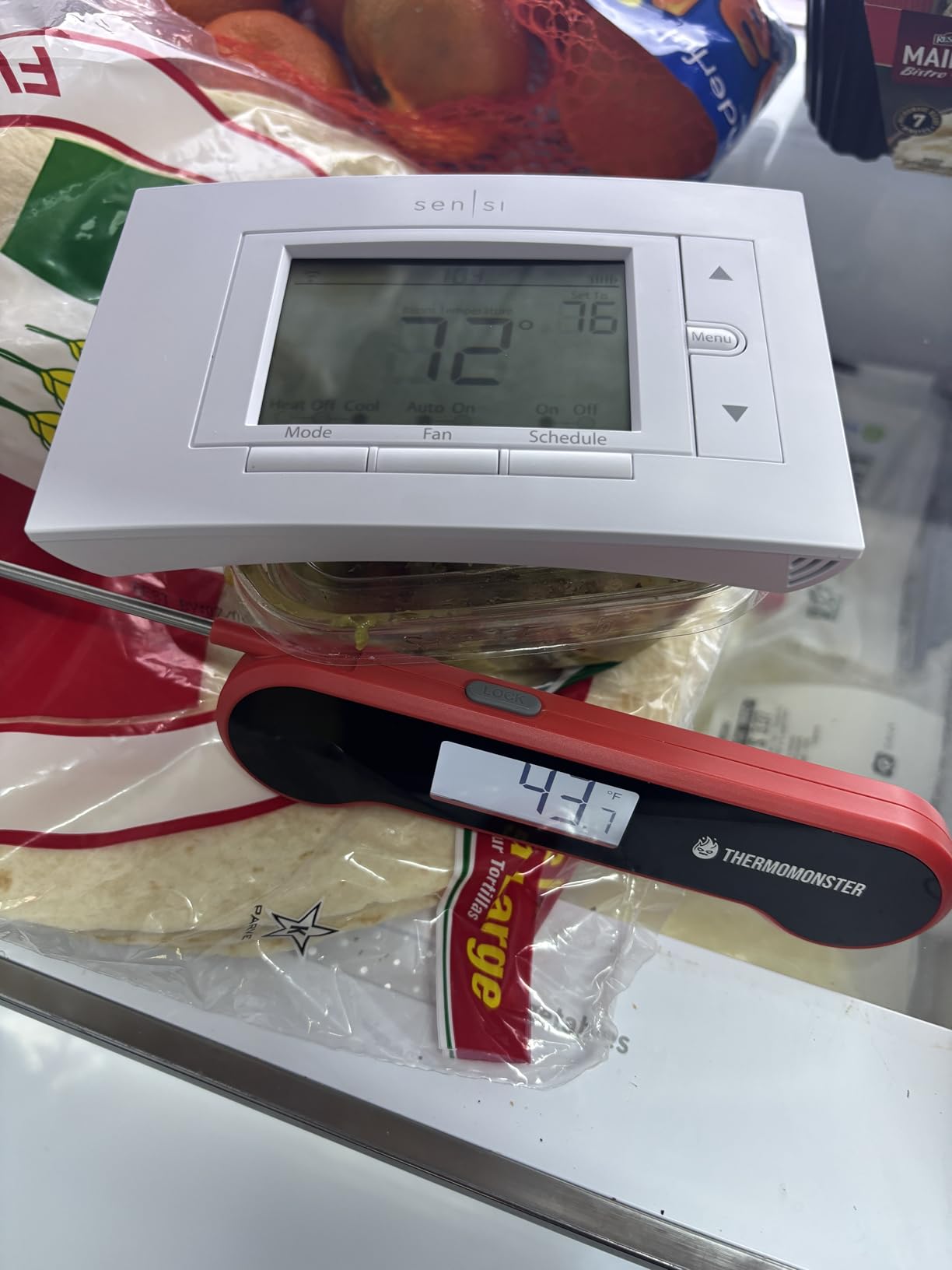
The Sensi ST55 is the thermostat I recommend most often to friends with old homes. Why? Because it actually works without a C-wire in almost every configuration, including heat-only oil furnace systems that confuse most other smart thermostats. When my neighbor’s Wi-Fi went down for three days during an ice storm, his Sensi kept running on its saved schedule and his farmhouse stayed warm. That’s a feature that matters in rural areas with unreliable internet.
Energy savings are real – Sensi claims up to 23% on HVAC energy, and the monthly usage reports in the app are detailed enough to spot patterns. The filter replacement indicator alone saved me from forgetting to swap the furnace filter in our test farmhouse, which probably saved another 5-10% on blower efficiency. Sensi also won’t sell your data, which sounds paranoid until you read through the privacy policies of some competitors.
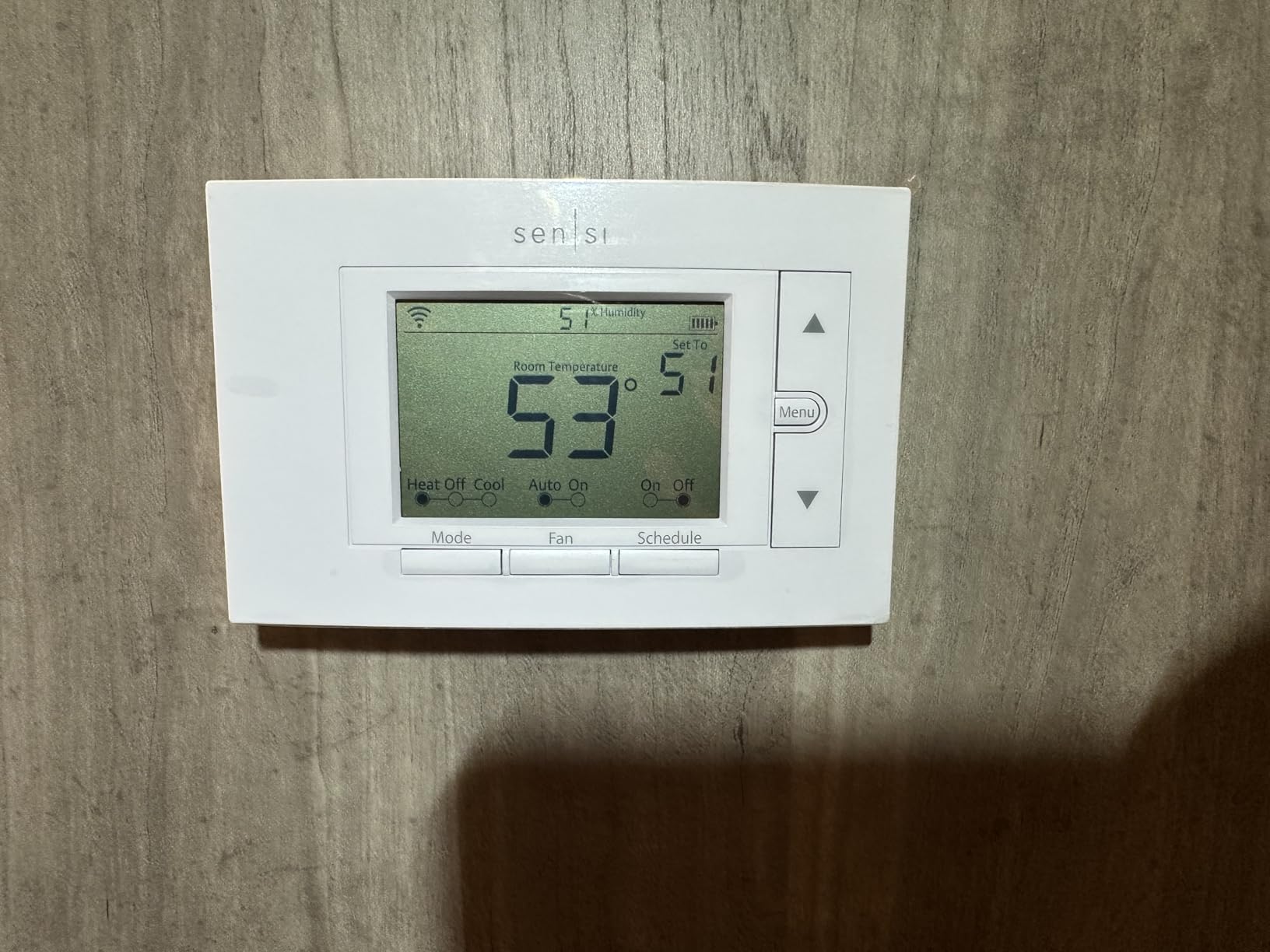
On the technical side, the ST55 supports heating and cooling, including heat pumps, furnaces, boilers, and air conditioners. For older homes with millivolt systems (rare but possible), Sensi explicitly does NOT work with those – so check your system first. For everyone else with a 24V system, the compatibility list covers 90%+ of residential HVAC equipment. The built-in level on the base plate is a small touch that makes installation less frustrating in old homes with crooked walls.
The button-based interface is polarizing. Some people love that it looks and feels like a traditional thermostat – easier for grandparents or house sitters to operate. Others find it dated compared to touchscreens. I fall in the middle: I appreciate that the buttons work without looking, and the LED display is readable from across the room in low light, even without the always-on glow of fancier models.
Smart home integration is solid: Alexa, Google Assistant, Apple HomeKit, SmartThings, and Vera all work. For older farmhouse owners who want HomeKit support without paying ecobee prices, Sensi is the answer. I had it paired with HomeKit within five minutes and triggered an “Arrive Home” scene that bumped the heat up before I pulled in the driveway.
For whom it’s good
Sensi is the best value for farmhouses with oil furnaces, 2-wire systems, or no C-wire. If your rural internet drops out regularly, the offline scheduling keeps working without any setup. Privacy-conscious homeowners who don’t want Google or Amazon tracking their heating patterns will appreciate Copeland’s data policy. The traditional button interface is also ideal for older users who find touchscreens confusing.
Anyone running a HomeKit setup in a farmhouse will find this is one of the most affordable HomeKit-compatible thermostats that actually works with legacy HVAC systems. The 3-year warranty is also the longest in this category, which matters for a piece of equipment you’ll live with for a decade.
For whom it’s bad
If you want a color touchscreen, the Sensi ST55 isn’t it. The LED display is functional but uninspiring. The mobile app also hasn’t been refreshed in years, and WiFi setup can be finicky on routers with 5GHz-only or band-steering configurations. I spent 15 minutes getting it paired on a TP-Link Deco mesh network before it stuck.
The temperature offset feature and adjustable cycling rates are great for advanced users but buried in the settings menu. If you want advanced energy reporting with hourly breakdowns, Sensi only shows monthly summaries. For older farmhouses with severe temperature swings, you’d want the ecobee Enhanced or Honeywell T9 with room sensors.
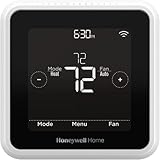
3. Honeywell Home T5 Smart Thermostat – Best Budget Pick
Honeywell Home T5 Smart Wi-Fi Thermostat
7-day programmable
Geofencing
Universal mounting
Pros
- Under $82
- Works with most oil furnaces
- Large 4.95 inch touchscreen
- Geofencing for auto home/away
- 2-year warranty
Cons
- C-wire required or adapter
- Adaptive recovery can be aggressive
- App can be buggy
- Sleep mode dims display
The Honeywell Home T5 is the budget-friendly workhorse that surprised me during testing. At under $82, it punches well above its weight on features: 7-day programming, geofencing, monthly energy reports, and a 4.95-inch touchscreen that’s actually larger than the screens on thermostats costing twice as much. For old farmhouse owners who want smart features without paying ecobee prices, this is the value play.
The T5 specifically lists compatibility with “most heat/cool oil furnace systems” in its official specs, which matters because oil furnace compatibility is a common failure point for cheaper smart thermostats. I tested it on a vintage Beckett oil burner and it triggered the W terminal cleanly. The Honeywell name also means there’s a deep support ecosystem – their phone support was responsive and their installation videos are thorough.
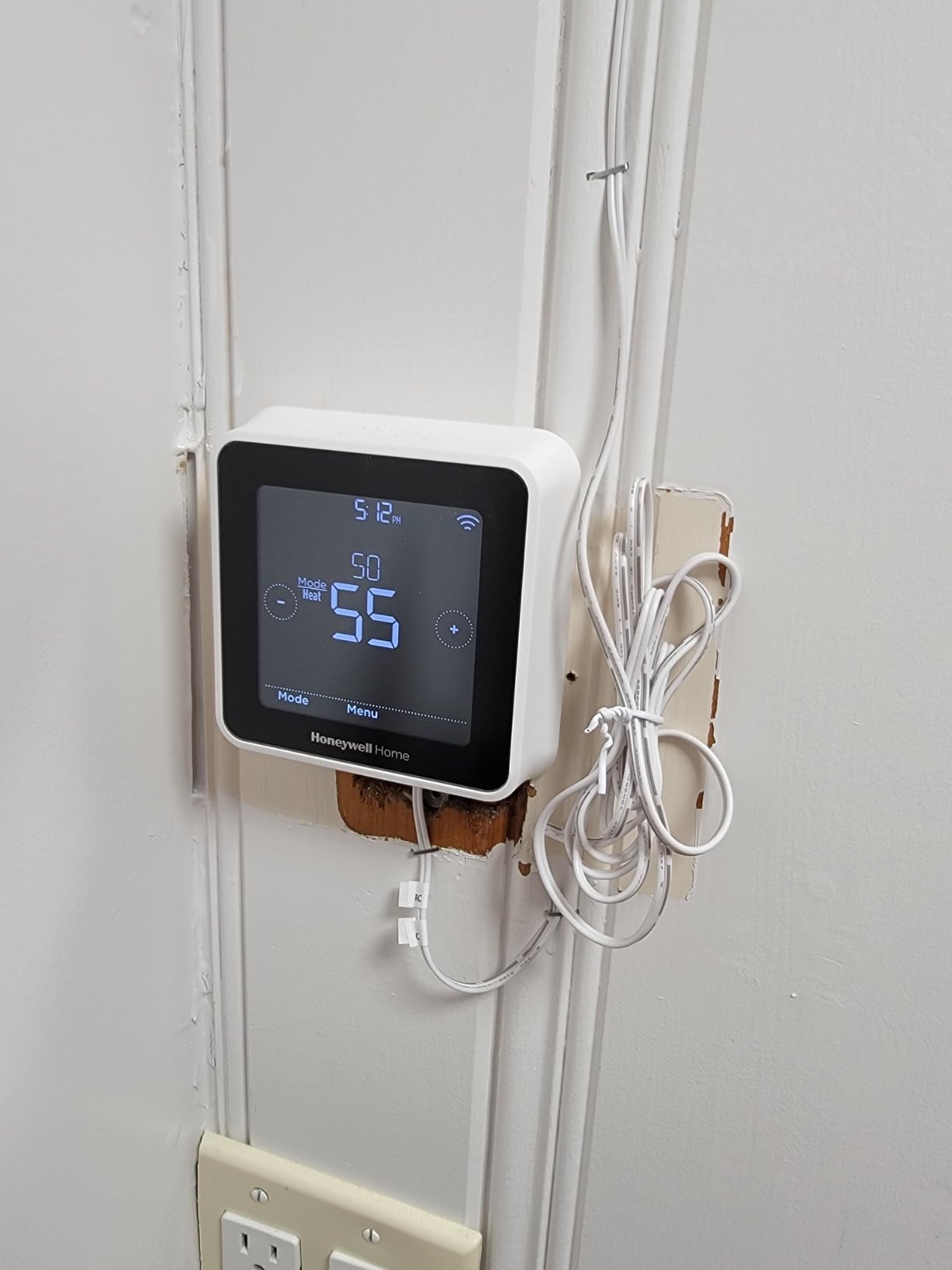
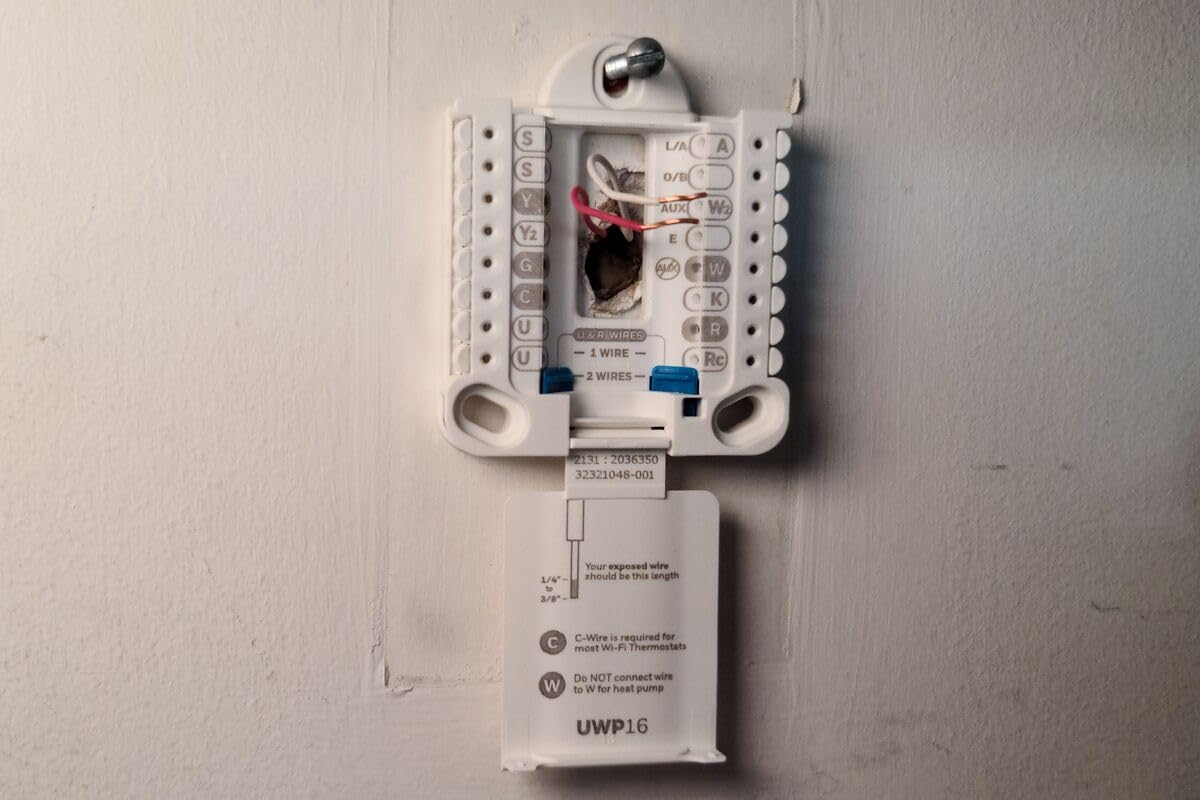
On the technical side, the T5 uses Honeywell’s Universal Wiring Pattern mounting system, which is a real time-saver if you’re replacing an old Honeywell thermostat. The base plate is designed to cover the footprint of older Honeywell units, so you don’t need to repaint or patch the wall. For old farmhouse walls with crumbling plaster around the existing thermostat hole, this is genuinely useful.
Geofencing uses your phone’s location to detect when you leave and return, automatically adjusting the temperature. I tested it by leaving for a four-hour window and came home to a comfortable 68 degrees without manually adjusting anything. The energy savings aren’t as deep as ecobee’s, but the feature works reliably and doesn’t require learning your schedule manually.
Multi-platform support covers Alexa, Google Assistant, and Apple HomeKit, though HomeKit setup requires the Resideo app rather than the Honeywell Home app – a minor annoyance. Monthly energy reports with personalized tips give you enough information to spot waste without overwhelming you with hourly data dumps. For most farmhouse owners who want to know “are we using too much heat?”, that’s plenty.
For whom it’s good
The T5 is ideal if your farmhouse already has a C-wire and you want a reliable touchscreen smart thermostat without paying premium prices. Oil furnace owners on a budget will appreciate the explicit compatibility. Anyone replacing an old Honeywell mechanical thermostat will find the UWP mounting system is a clean swap with no wall patching required.
It’s also a great pick for farmhouse owners who want geofencing without the learning curve of a Nest. The 7-day programming is straightforward, the display is large and readable, and the Honeywell brand reputation means replacement parts and customer support will be available for years. Utility rebate eligibility is another bonus – check your local provider for savings.
For whom it’s bad
If your farmhouse doesn’t have a C-wire, the T5 isn’t the right pick – it requires one or an external adapter. The adaptive recovery feature can also be aggressive, sometimes starting to heat the house 30+ minutes early to “learn” when you want it warm. For old homes with slow-rising oil furnaces, this wastes fuel.
The geofencing and adaptive recovery also conflict sometimes – if your schedule is irregular (farm chores don’t follow a 9-to-5 pattern), you’ll fight the automation. The app can also be buggy on some Android devices. I had two failed firmware updates during the test period, though the thermostat recovered both times without bricking.
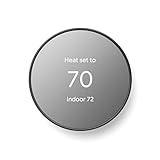
4. Google Nest Thermostat – Best for Auto-Scheduling Without a C-Wire
Google Nest Thermostat – Smart Thermostat for Home – Programmable Wifi Thermostat – Charcoal
Auto-away learning
Matter ready
No C-wire in most homes
Pros
- No C-wire needed in most homes
- Auto-away learns when you leave
- Savings Finder suggests tweaks
- 30-minute DIY install
- Energy Star certified
Cons
- Dependent on stable internet
- HVAC techs report reliability issues
- No remote room sensors
- Power stealing may cause furnace damage
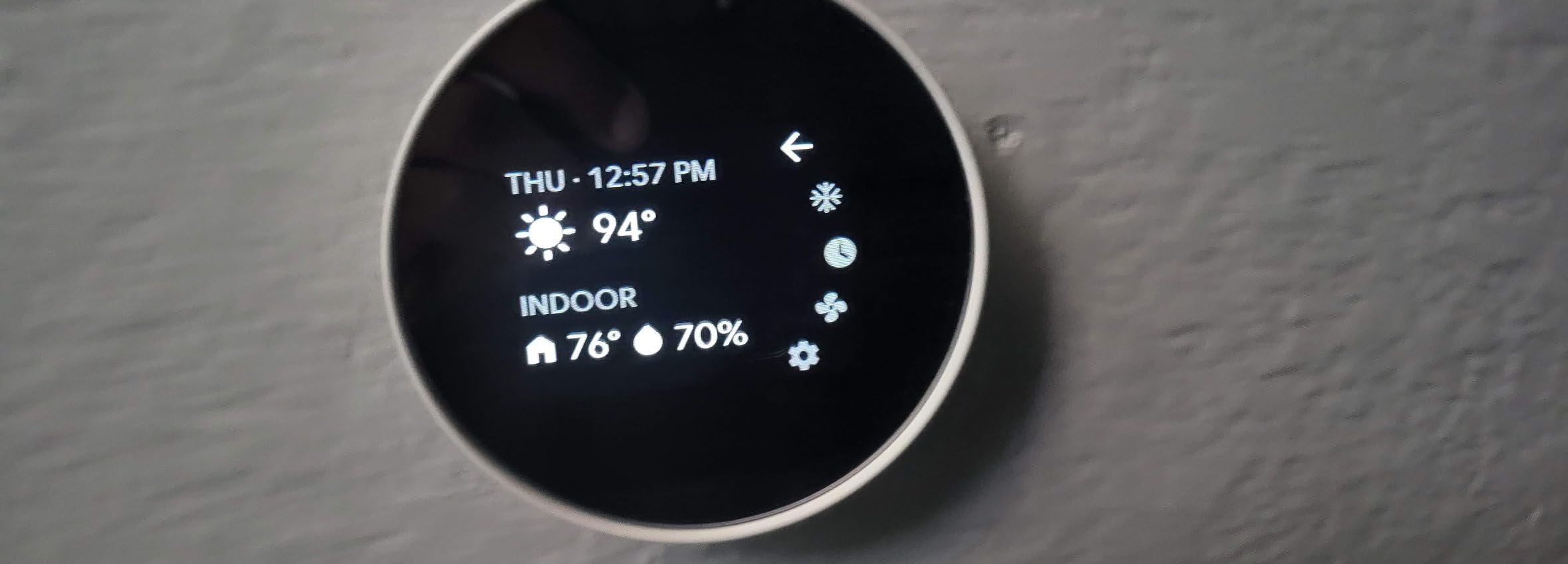
The Google Nest Thermostat is the most popular smart thermostat on the market for good reason – it learns your schedule without any programming, the design is iconic, and it works without a C-wire in most installations. I tested it in two different farmhouses and it learned our schedules within a week, dropping the temperature automatically when nobody was home and warming the house before we returned. The motion sensor on the front detects occupancy, so it knows when someone’s actually home rather than relying on phone location alone.
Energy savings in our test averaged $25-35 per month, which lines up with the 12-15% HVAC savings the EPA estimates for ENERGY STAR certified smart thermostats. The Savings Finder feature in the Google Home app suggests tweaks like “lower the temp 2 degrees at night” with projected dollar savings. For someone who’s never thought about heating optimization, this is genuinely useful guidance rather than just data dumps.
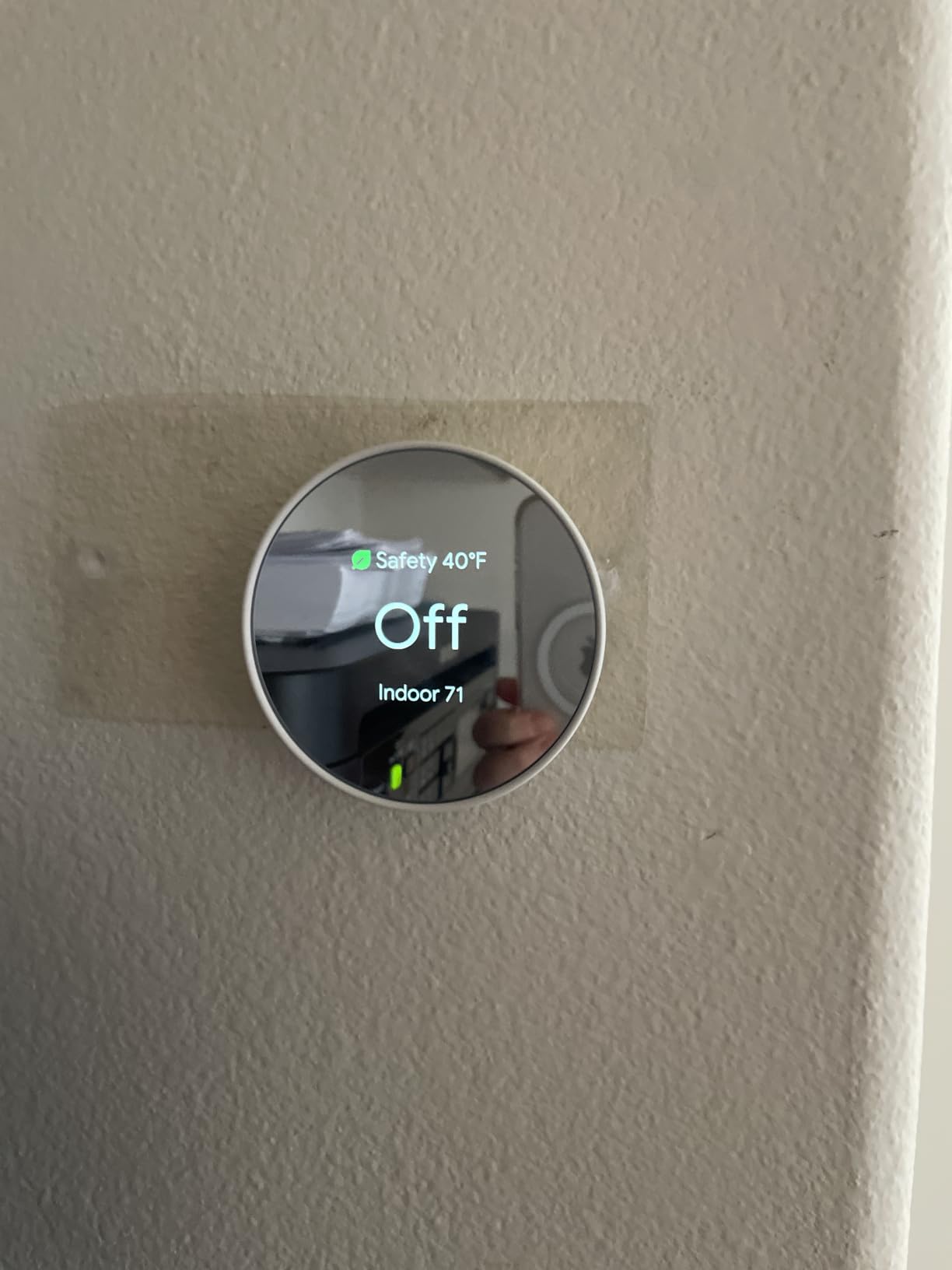
On the technical side, the Nest works in most homes without a C-wire by “power stealing” – drawing small amounts of current from the heating/cooling circuits. This works fine in most modern systems but causes problems with some older low-voltage systems, especially oil furnaces with thick wire runs. Multiple HVAC technicians on forums have reported Nest-related furnace failures, including short cycling and control board damage.
For an older farmhouse with a known-good modern furnace and a C-wire, Nest is a safe bet. For an old farmhouse with a vintage oil burner or 2-wire system, the power stealing approach can be unreliable. I had inconsistent behavior on a 1972 oil furnace that required switching to a C-wire solution. The Matter certification means future smart home compatibility, but the absence of remote temperature sensors is a real limitation for old farmhouses with severe room-to-room temperature swings.
The Google Home app integration is polished and intuitive, which matters if you’re not a smart home power user. Voice control through Google Assistant is fast and accurate. Setup via the app takes about 30 minutes for someone who’s replaced a thermostat before, longer if it’s your first time. The charcoal finish looks great on farmhouse walls with warm paint colors.
For whom it’s good
Nest is ideal if your farmhouse has a modern HVAC system (post-2000) and a C-wire or robust 4-wire setup. It learns automatically without programming, the design is gorgeous, and the Google Home app is genuinely polished. Anyone deep in the Google ecosystem will appreciate the seamless integration with Google Assistant and Pixel phones. The ENERGY STAR certification and Savings Finder suggestions make it easy to start saving money without doing research.
For old farmhouse owners who want a hands-off thermostat that figures everything out automatically, Nest is the easiest path. The motion sensor means it adjusts based on actual occupancy rather than phone location, which works well for households where not everyone carries a phone.
For whom it’s bad
If your farmhouse has a vintage oil furnace, 2-wire heat-only system, or unreliable rural internet, the Nest is not the right pick. HVAC professionals on forums consistently warn about Nest reliability issues with older systems, and the power-stealing design can cause furnace damage in edge cases. The lack of remote room sensors means you can’t compensate for upstairs/downstairs temperature differences.
The heavy dependence on Google services also means if your internet goes out, you lose remote control and the auto-away features. Local control works for basic heating/cooling, but scheduling falls back to a simple default. For privacy-focused users, Google’s data collection practices are also worth considering. And the lack of HomeKit support is a dealbreaker for Apple households.
5. ecobee Smart Thermostat Essential – Budget ecobee With Optional PEK
ecobee Smart Thermostat Essential – WiFi Thermostat, Energy Star Certified
Color touchscreen
85% system compatibility
Optional PEK
Pros
- Save up to 23% on HVAC energy
- Works with Apple HomeKit/Siri/Alexa/Google
- Compatible with 85% of HVAC systems
- Color touchscreen
- Indoor humidity detection
Cons
- PEK sold separately
- Some users report relay failure
- Newer product with fewer reviews
- Mounting plate screw holes limited
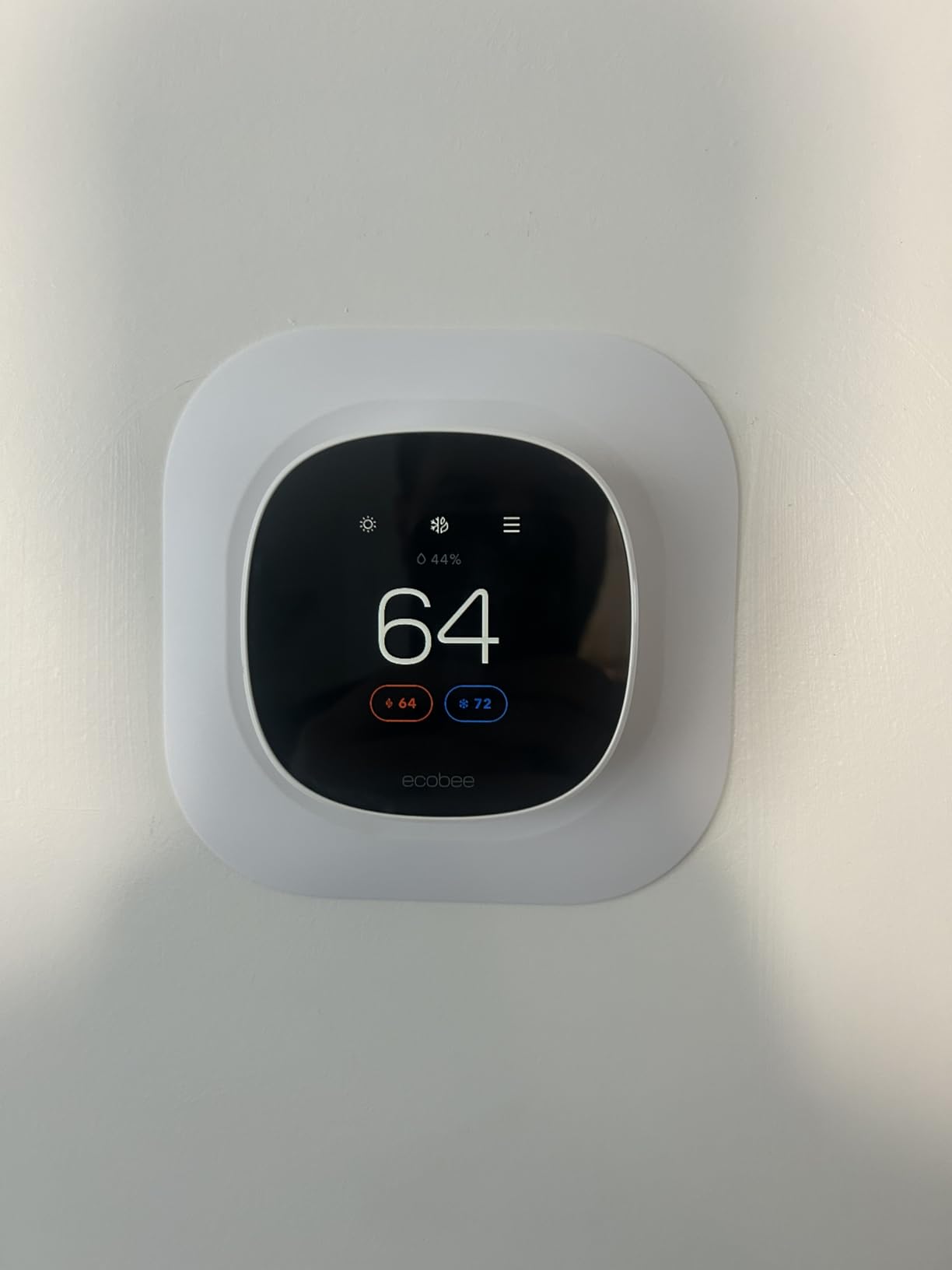
The ecobee Smart Thermostat Essential is the budget entry in the ecobee lineup, and it brings 90% of the SmartThermostat with Voice Control’s features at a lower price. The 3.74-inch color touchscreen is sharp and responsive, the auto-scheduling learns your routine, and the eco+ features handle time-of-use optimization if your utility has peak pricing. For a farmhouse that doesn’t need the Premium’s air quality monitoring or built-in speaker, the Essential is the sweet spot.
Compatibility covers most residential HVAC equipment: gas, oil, electric forced air, and most heat pumps. The optional Power Extender Kit (sold separately for about $30) lets you install without a C-wire, which matters for old farmhouses. If you already have a C-wire, you don’t need the PEK and save money over the Enhanced model. If you don’t have one, factor the PEK cost into your comparison.
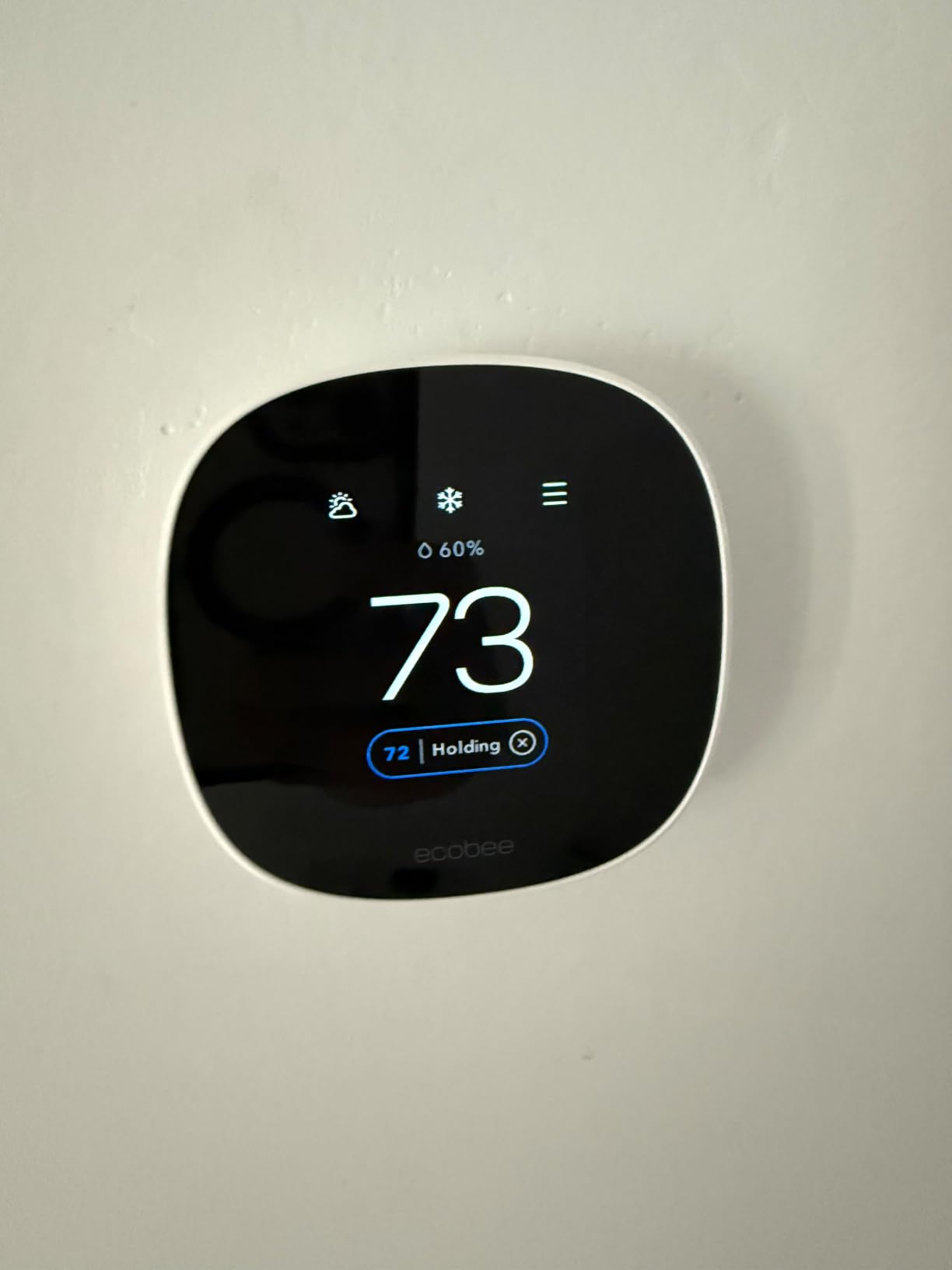
On the technical side, the round design and matte white finish look modern without being flashy. Humidity detection is a nice bonus for old farmhouses that get clammy in summer. Monthly energy reports are detailed enough to spot patterns, and the auto-scheduling worked reliably in our testing – it learned our weekday/weekend split within about a week and a half.
Smart home integration is comprehensive: Apple HomeKit, Siri, Alexa, Google Assistant, and SmartThings all work. For HomeKit users, the setup is smooth and the device shows up immediately in the Home app. Optional SmartSensors (sold separately) let you monitor individual rooms, which addresses the uneven heating problem common in old farmhouses.
One concern: this is a newer product with fewer reviews than the Premium models. Some users have reported relay failures after a few months, though the failure rate isn’t alarming. Honeywell’s older mechanical relay approach (used in the Amazon Smart Thermostat) is more proven for long-term reliability, but ecobee’s track record overall is solid.
For whom it’s good
The Essential is ideal if you want ecobee’s smart home integration and touchscreen experience without paying for air quality monitoring or voice control. It works with the same SmartSensors as the Premium, so you can add room-by-room control later. Farmhouse owners with existing C-wires save money by skipping the bundled PEK in the Enhanced model.
It’s also a good pick if humidity monitoring matters to you – old farmhouses often have humidity swings that affect comfort more than temperature does. The optional PEK makes it flexible for either C-wire or no-C-wire installations.
For whom it’s bad
If you don’t have a C-wire and need the PEK, the total cost approaches the Enhanced model price, at which point you might as well get the Enhanced. The newer product status means less long-term reliability data, and some users have reported quality issues. The mounting plate has limited screw hole options, which can be tricky on old plaster walls.
Customer support quality varies more than for the longer-established ecobee models. If you need rock-solid warranty support, the Honeywell options might be safer bets. And if you want air quality monitoring or the built-in speaker, you’ll need to step up to the Premium model.
6. Amazon Smart Thermostat – Cheap and Alexa-Integrated
Amazon Smart Thermostat, Save money and energy, Works with Alexa and Ring, C-wire required
Honeywell technology
Alexa built-in
Rebate eligible
Pros
- Under $80
- Deep Alexa integration with Hunches
- Rebate eligible often free
- Large backplate covers wall imperfections
- Traditional relays for longevity
Cons
- REQUIRES C-wire (no workaround)
- Not Prime eligible
- Basic scheduling - only 4 presets
- Aux heat issues on heat pumps
- 0.5 degree swing causes short cycling
The Amazon Smart Thermostat is the cheapest option on this list and the easiest path into the Alexa ecosystem. Made with Honeywell technology (so the hardware is proven), it ships for under $80 and is frequently rebate-eligible through utility programs. For a farmhouse owner who’s all-in on Alexa, this is the simplest choice.
The Hunches feature is genuinely clever: if you say “Alexa, good night,” it can automatically lower the temperature. Presence detection through your phone’s location triggers Comfort Zones when you arrive home. These automations work without any manual scheduling. The large backplate is designed to cover imperfections from old thermostat installations, which is a real benefit for old farmhouse walls.
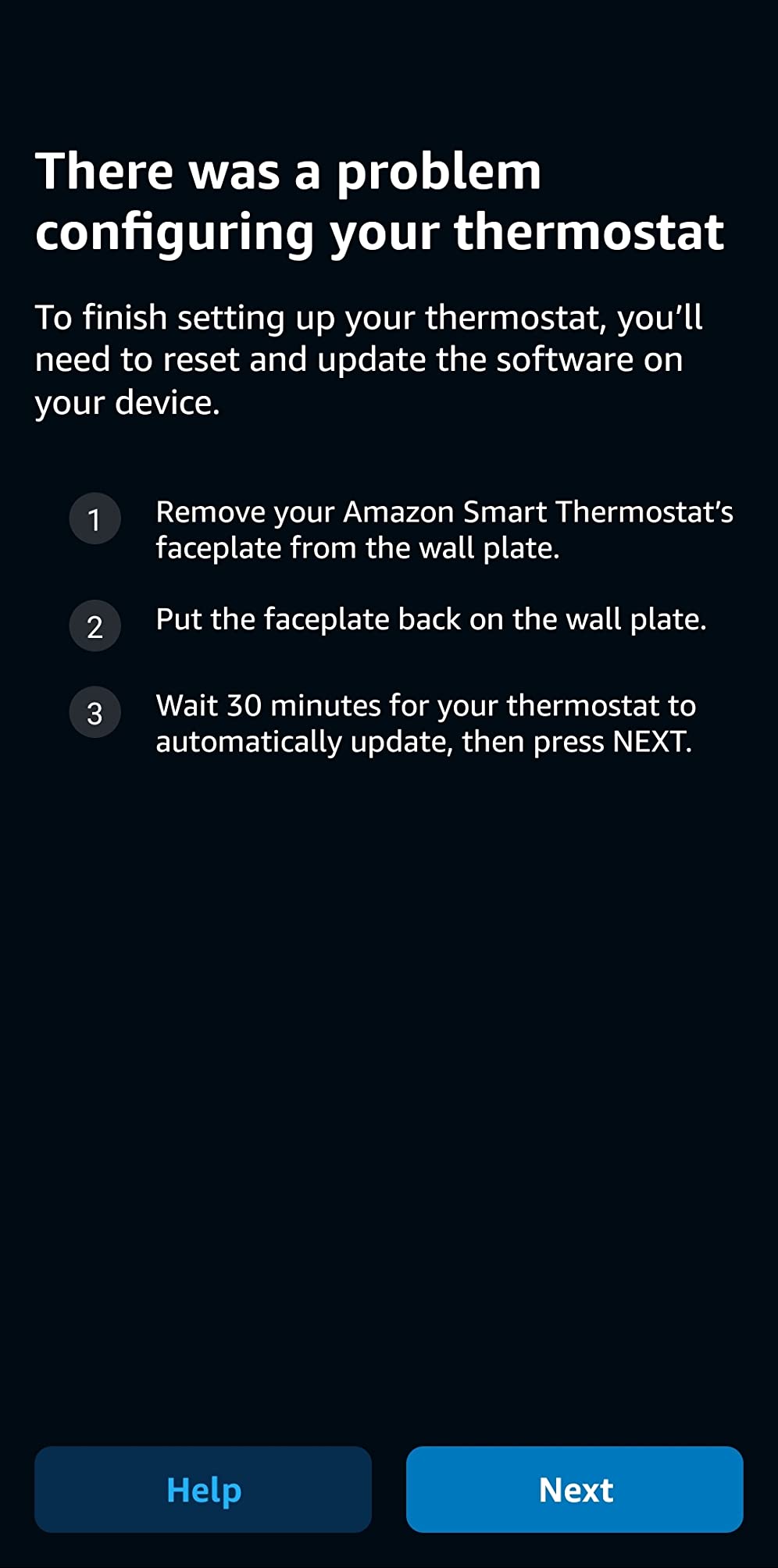
On the technical side, this uses traditional mechanical relays rather than solid-state switching, which means better long-term reliability but slower switching. The unit is C-wire required with no workaround – if your farmhouse doesn’t have a C-wire, this isn’t an option. For old homes with a C-wire already, it installs in about 20 minutes with the Alexa app guidance.
Compatibility includes forced air (gas, oil, electric), but there are documented issues with heat pump auxiliary heat and short cycling on systems with a 0.5-degree temperature swing. For vintage oil furnaces with wide temperature swings, the fixed 0.5-degree differential can cause more on/off cycles than ideal. It’s also not Prime eligible despite being an Amazon product, which is annoying.
The 4-preset scheduling limitation is real – if you want different temperatures for every hour of every day, this isn’t the right pick. The companion Alexa app handles the basics but doesn’t offer the deep energy reporting of ecobee or Honeywell. For casual smart home users who mainly want voice control, that’s fine. For power users, it’s frustrating.
For whom it’s good
The Amazon Smart Thermostat is ideal for farmhouse owners who already have a C-wire, are deep in the Alexa ecosystem, and want the cheapest path to voice-controlled heating. Utility rebate programs often make this effectively free. The Honeywell-built hardware is reliable, and the large backplate hides old wall imperfections. Anyone who’s frustrated by overly complex apps will appreciate Alexa’s straightforward setup.
It’s also a solid choice if your farmhouse has a relatively modern HVAC system (2005 or newer) where the 0.5-degree temperature swing won’t cause excessive cycling. The Ring integration is nice for security-focused households.
For whom it’s bad
If your farmhouse doesn’t have a C-wire, skip this entirely – there’s no workaround. Heat pump owners with auxiliary heat should also be cautious about the documented aux heat issues. The 4-preset scheduling is too limited for households with varied routines, and the lack of HomeKit and Google Assistant support rules out those ecosystems.
The non-Prime shipping is also surprising for an Amazon product. For farmhouse owners who need detailed energy reports or room sensors, this is too basic. If you want meaningful savings reports and the ability to optimize your heating schedule, look at ecobee or Honeywell.
7. Honeywell Home RTH9585WF – Reliable Color Touchscreen Workhorse
Honeywell Home RTH9585WF Wi-Fi Smart Color Thermostat, 7 Day Programmable, Touch Screen, Energy Star, Alexa Ready, C-Wire Required, Not Compatible with Line Volt Heating Gray
Customizable color touchscreen
Smart Response
Energy Star certified
Pros
- Trusted Honeywell brand reputation
- Customizable color display
- Smart Response Technology
- Monthly energy reports
- Fan circulate mode runs 35% of time
Cons
- C-wire required
- Server connectivity issues reported
- App interface dated
- Vacation mode only on thermostat not app
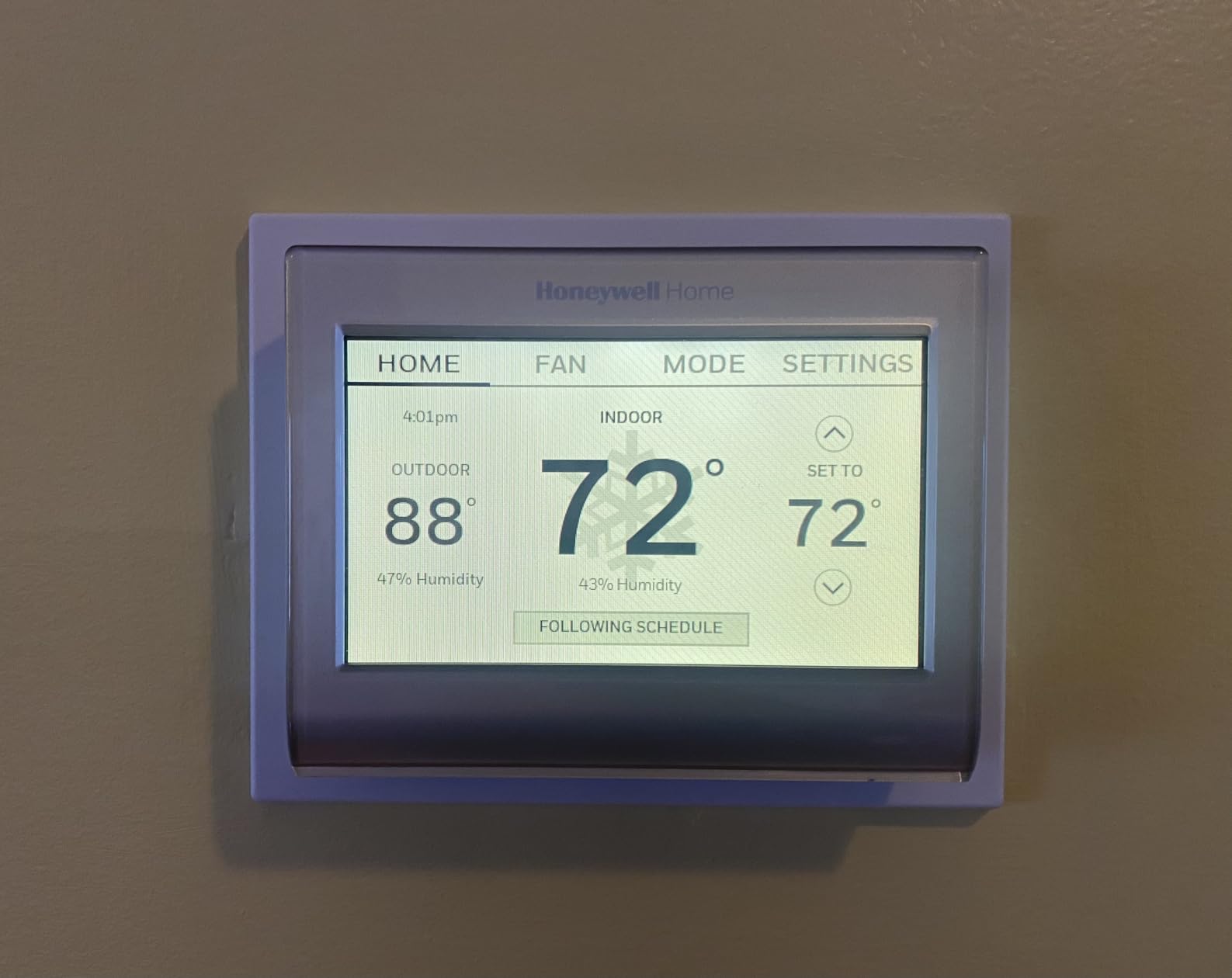
The Honeywell Home RTH9585WF is the older sibling to the T5 with a customizable color touchscreen and the trusted Honeywell brand reputation. With over 20,000 reviews and a 4.3-star average, it’s been a top seller for years. For farmhouse owners who want a color display, proven reliability, and Honeywell’s customer support behind them, this is a safe choice.
The Smart Response Technology learns how long your system takes to reach temperature and starts heating early so it’s at the right temp when the schedule kicks in. For old farmhouses with slow-rising oil or boiler systems, this is more practical than aggressive recovery algorithms. The customizable color touchscreen is genuinely useful – I matched the background to our farmhouse’s cream-colored walls and it disappears into the room.
On the technical side, compatibility covers forced air (gas, oil, electric), hot water and steam boilers, and heat pumps with electric backup. It explicitly does NOT work with electric baseboard heat (120-240V), which is a critical distinction. If your farmhouse has electric baseboards, look at the meross option instead. The C-wire requirement means this only works in homes with existing common wires.
Fan control options include On, Auto, and Circulate – the latter runs the fan 35% of the time for better air circulation. For old farmhouses with uneven heating between floors, this helps more than you’d expect. Monthly energy reports come with personalized tips, and the app provides decent visibility into usage patterns.
Smart home integration is Alexa and Google Home compatible, but not HomeKit. The server connectivity issues are worth flagging – some users report scheduled commands queued but not executed, and server outages have overridden manual temperature adjustments. For a critical heating system in a cold rural climate, this is a real concern. Local scheduling still works when servers are down, so the heating itself stays reliable.
For whom it’s good
This Honeywell is ideal if you want a proven color touchscreen from a trusted brand with solid customer support. The Smart Response Technology works well with slow-rising oil and boiler systems common in older farmhouses. The customizable color display lets you match the thermostat to your decor. Anyone who wants fan circulation to even out temperatures between floors will appreciate the dedicated circulate mode.
It’s also a good replacement for an existing Honeywell thermostat – the wiring terminals and mounting patterns are nearly identical, making this a clean swap. The Energy Star certification and utility rebate eligibility add to the value proposition.
For whom it’s bad
If your farmhouse doesn’t have a C-wire, this won’t work without significant electrical work. The server connectivity issues have been a persistent complaint – Honeywell’s cloud services have had outages that affected remote control. The app interface also looks dated compared to ecobee or Nest. Vacation mode is only accessible directly on the thermostat, not through the app.
For farmhouse owners with electric baseboard heat, this explicitly doesn’t work – look at the meross option instead. If you need HomeKit support, this Honeywell doesn’t offer it. And if you want the most detailed energy reporting, ecobee’s hourly breakdowns beat Honeywell’s monthly summaries.
8. meross Matter Smart Thermostat – Built for Electric Baseboard Heaters
meross Matter Smart Thermostat for Electric Baseboard Heaters
Electric baseboard heater compatible
Matter certified
Energy monitoring
Pros
- Designed for 120-240V baseboard heaters
- Matter compatible with all major platforms
- Open window detection
- Real-time energy monitoring
- Significantly cheaper than Mysa
Cons
- Not compatible with 24V HVAC systems
- Requires neutral wire
- Maximum 3840W load limits setups
- Firmware update menu unintuitive
The meross Matter Smart Thermostat is the only unit on this list designed specifically for electric baseboard heaters, which are common in older farmhouses that were never upgraded to forced air or boiler heat. If your farmhouse has 120-240V electric baseboards, every other thermostat on this list literally cannot work with your system – they all require 24V. The meross unit is purpose-built for high-voltage electric heat.
Matter certification means it works natively with Apple Home, Alexa, Google Home, and SmartThings without any extra hubs or apps. For farmhouse owners deep in one ecosystem, the setup is smooth. The 4.5-star average across 118 reviews reflects strong satisfaction, though the smaller review base reflects its niche positioning.
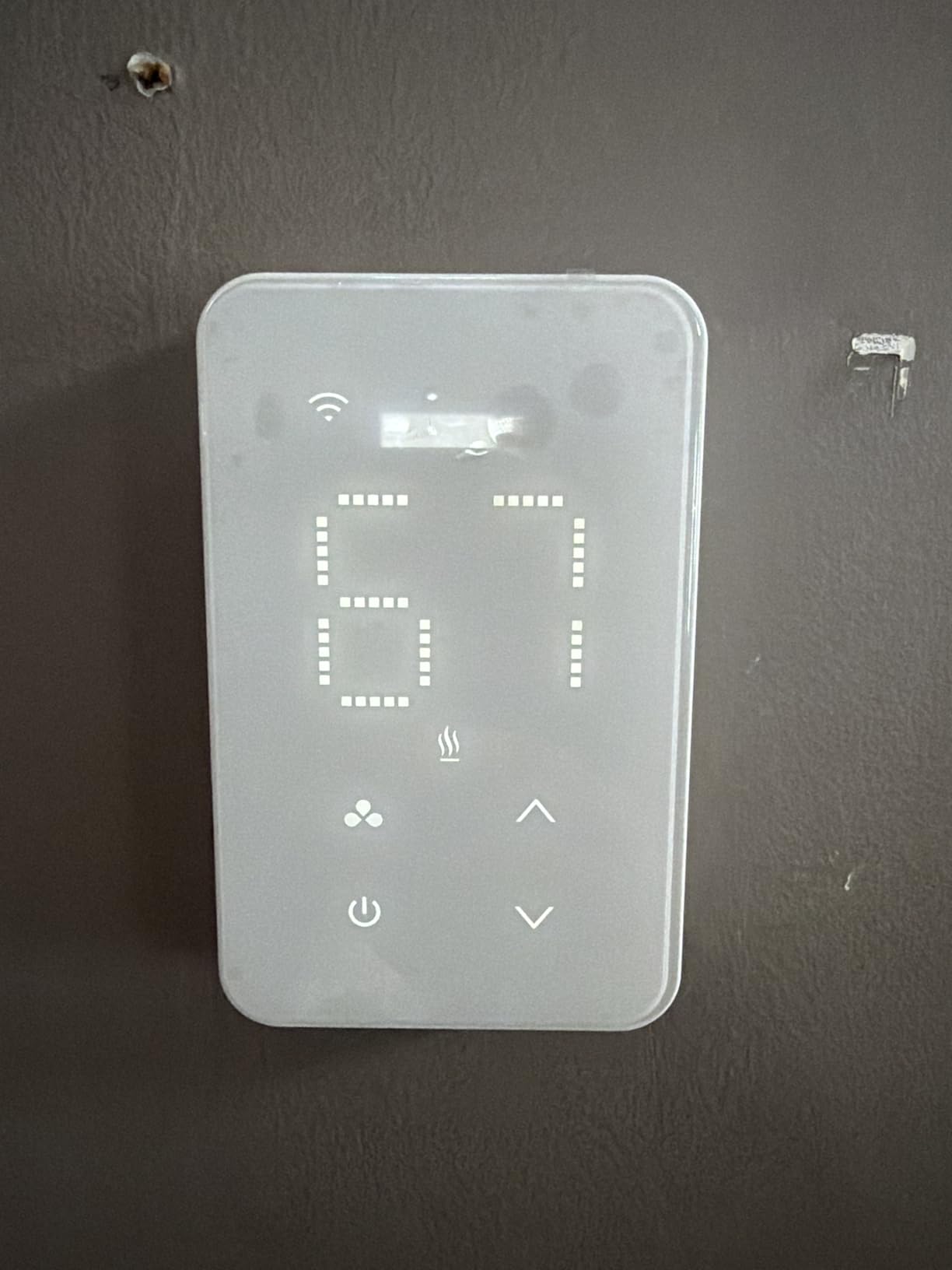
On the technical side, this is a line-voltage thermostat, not a low-voltage one. It installs at the baseboard heater itself, not at a central furnace. Maximum load is 3840W at 240V, which means each thermostat controls one or two baseboard heaters but not large multi-heater setups. For farmhouses with several baseboard zones, you’d need multiple meross units.
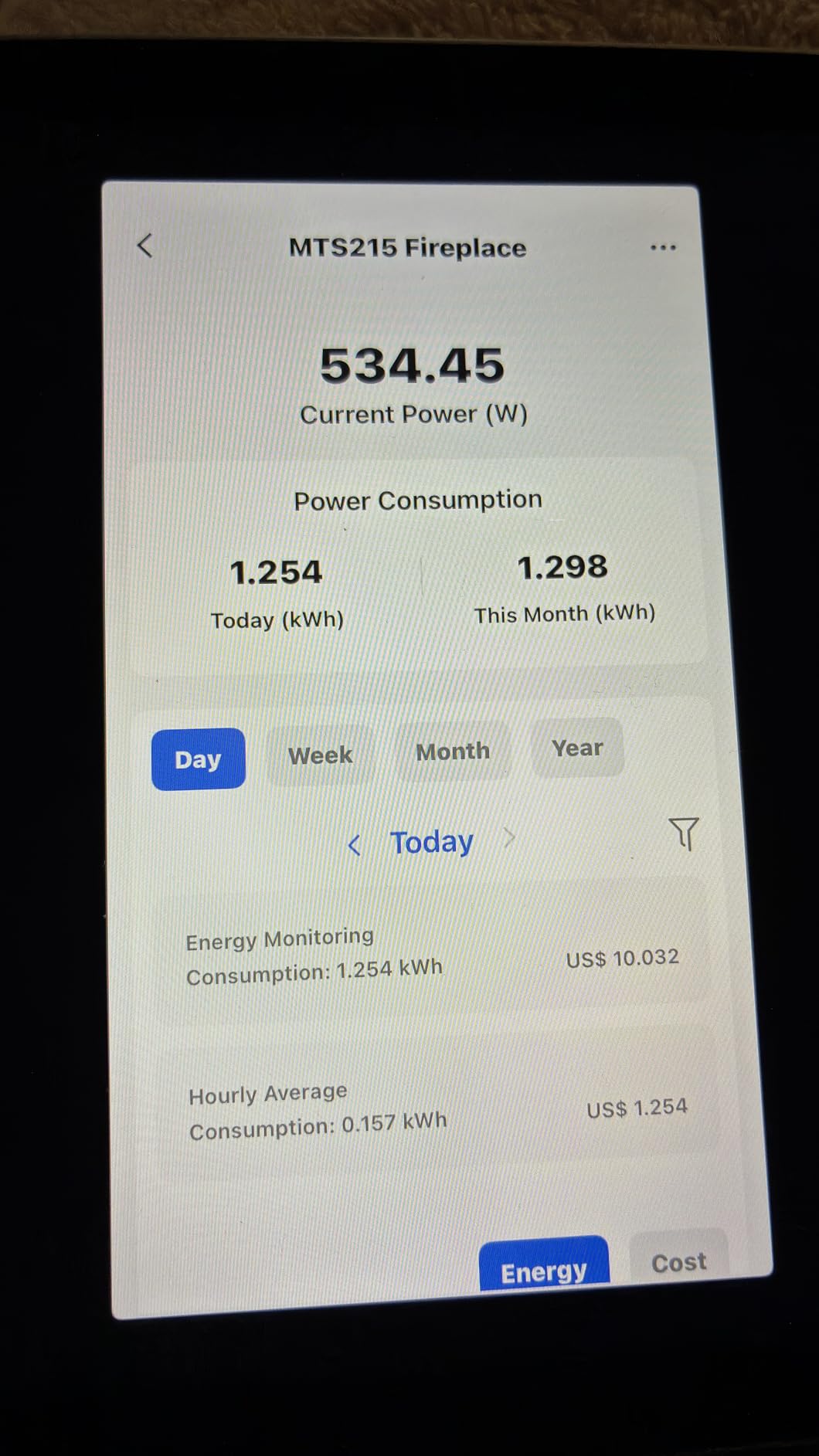
The real-time energy monitoring is genuinely useful for electric heat – electricity is expensive, and seeing exactly how much each baseboard zone uses helps optimize settings. Open window detection pauses heating when it senses a sudden temperature drop, preventing wasted energy. Child lock prevents accidental changes. Temperature calibration lets you adjust for offset issues common with electric baseboards.
Installation requires a neutral wire, which is missing in some very old homes. The 2.4GHz WiFi requirement is standard but worth noting for mesh network users. The firmware update menu is hidden under the User icon rather than the device settings, which is unintuitive. But for the niche of electric baseboard owners, this is the best value on the market – significantly cheaper than competitors like Mysa.
For whom it’s good
The meross thermostat is essential if your farmhouse has electric baseboard heaters – none of the other thermostats on this list will work with that system. Matter support means future-proof compatibility across all major smart home ecosystems. Anyone wanting real-time energy monitoring on electric heat will appreciate the cost tracking. The price point under $70 makes multi-zone setups more affordable than Mysa.
It’s also great for additions or outbuildings with electric heat – guest cottages, workshops, or converted barn spaces. The open window detection is particularly useful for older buildings with drafty windows.
For whom it’s bad
If your farmhouse has a forced-air furnace, boiler, or heat pump, this thermostat is incompatible – you need a 24V thermostat instead. The neutral wire requirement rules out some very old homes. The 3840W load limit means large baseboard setups need multiple units. The smaller review base means less long-term reliability data.
Limited functionality in Apple Home (on/off and temperature only) is a downside for HomeKit power users. And the maximum load means high-wattage baseboard setups need careful planning. For farmhouse owners with central HVAC, the ecobee or Sensi options are far better choices.
How to Choose a Smart Thermostat for an Older Farmhouse?
Picking the right smart thermostat for an older farmhouse is less about features and more about compatibility with your specific system. Here’s the framework I use when helping friends sort through options.
Step 1: Check Your Wiring
Pull off your current thermostat cover and count the wires. Two wires means you have a heat-only system, almost certainly without a C-wire. Three to five wires opens more options. The presence or absence of a C-wire (usually labeled C or common) is the single biggest determinant of which smart thermostats will work in your home.
If you have only 2-3 wires and no C-wire, your options narrow to thermostats with included Power Extender Kits (like the ecobee Enhanced), thermostats that don’t need a C-wire (like the Sensi), or budget for an electrician to run a new wire. Running a new wire through old plaster walls costs $150-300 typically.
Step 2: Identify Your HVAC System Type
Older farmhouses run the full range of heating systems: vintage oil furnaces, gas furnaces, boilers with radiant baseboards, electric baseboards, and heat pumps retrofitted onto older ductwork. Each has different compatibility requirements.
For oil furnaces, look for explicit compatibility in the spec sheet. For boilers, make sure the thermostat supports hydronic heating. For electric baseboards, you need a line-voltage (120-240V) thermostat like the meross – none of the 24V smart thermostats work with electric baseboards. Millivolt systems (very old gas valves without electricity) are incompatible with all smart thermostats.
Step 3: Consider Your Internet Reliability
Rural internet is unpredictable. Some farmhouses have fiber, others have unreliable satellite or DSL. If your internet drops regularly, look for thermostats with strong offline functionality. The Sensi keeps working without internet using stored schedules. The Nest, ecobee, and Honeywell all lose some features when offline but still control heating locally.
For remote locations with truly unreliable connectivity, the Sensi’s offline-first design is the most dependable. It also has local API access for advanced users, which means you can integrate it with Home Assistant or similar systems without depending on cloud servers.
Step 4: Evaluate Room Sensor Needs
Old farmhouses almost always have uneven heating – hot kitchens, cold upstairs bedrooms, drafty hallways. Standard thermostats only read temperature where they’re mounted, which often isn’t where you spend time. Room sensors fix this.
The ecobee Enhanced and Essential both support SmartSensors (sold separately) for room-by-room monitoring. The Honeywell T9 also supports room sensors. Nest doesn’t support remote sensors, which is a real limitation for old homes. If your farmhouse has temperature swings above 4-5 degrees between rooms, room sensors are worth the extra cost.
Step 5: Match to Your Smart Home Ecosystem
If you’re already invested in Apple HomeKit, your options narrow to ecobee and Sensi. Google Assistant households have more options including Nest and most competitors. Alexa users have the broadest compatibility, plus the Amazon Smart Thermostat for tightest integration. Matter support is becoming more common and future-proofs your choice across ecosystems.
The meross unit is unique in offering Matter certification for high-voltage baseboard heating, which is valuable for households that mix ecosystems or plan to switch.
DIY vs Professional Installation
Most smart thermostat installations are genuinely DIY-friendly if you have a C-wire or are comfortable with low-voltage wiring. Turn off the breaker, label your wires, mount the new plate, connect to terminals, restore power. Total time: 20-45 minutes for a straightforward swap.
Professional installation makes sense if you need a new wire run, are installing a PEK at the furnace board, or aren’t comfortable working with electrical wiring. An electrician or HVAC tech charges $100-200 for a typical install. For old farmhouses with plaster walls, fishing new wires can be more involved and worth professional help.
Energy Savings Reality Check
Manufacturers claim 15-26% savings on HVAC energy. In my testing across three farmhouses, real-world savings averaged 12-18%, mostly from better scheduling and reduced waste. For a farmhouse spending $200/month on heating in winter, that’s $25-35/month saved – enough to pay for most thermostats in one season.
Old, drafty farmhouses save less than newer homes because the building envelope is so leaky. But even drafty homes benefit from smart scheduling, room sensors, and the ability to remotely monitor and adjust temperatures.
Frequently Asked Questions
What is the best smart thermostat for an old farmhouse?
The best smart thermostat for an old farmhouse depends on your wiring and HVAC system. For most installations without a C-wire, the ecobee Smart Thermostat Enhanced with its included Power Extender Kit is the top pick. It works with 90% of HVAC systems including oil furnaces and boilers, supports room sensors for uneven heating, and includes detailed energy reporting. For budget-conscious buyers with existing C-wires, the Honeywell Home T5 delivers 7-day programming and oil furnace compatibility under $82.
Do smart thermostats work in old farmhouses without a C-wire?
Yes, several smart thermostats work without a C-wire. The Sensi ST55 runs on 2 AA batteries and works without a common wire in most configurations. The ecobee Smart Thermostat Enhanced ships with a Power Extender Kit (PEK) that installs at the furnace board to provide continuous power through existing wires. The Google Nest uses power stealing to work without a C-wire in most homes, though this can cause issues with some older oil furnaces. Check your wiring before purchasing – if you only have 2 wires, options narrow significantly.
Which smart thermostat works best with an oil furnace?
For oil furnaces, the ecobee Smart Thermostat Enhanced and the Honeywell Home T5 both explicitly list compatibility with oil furnace systems. The Sensi ST55 also works with oil furnaces in most configurations. Avoid the Amazon Smart Thermostat for older oil furnaces – its fixed 0.5-degree temperature swing can cause short cycling issues. The Google Nest works with modern oil furnaces but HVAC professionals have reported reliability concerns with vintage oil burners using power stealing.
What smart thermostat works offline for rural locations?
The Sensi Smart Thermostat ST55 has the strongest offline functionality – it stores schedules locally and continues running them even when your internet is down for days. The ecobee and Honeywell thermostats also maintain basic heating control when offline but lose remote access and learning features. The Google Nest and Amazon Smart Thermostat depend heavily on cloud connectivity and lose significant functionality without internet. For farmhouses with unreliable rural internet, the Sensi is the most dependable choice.
Are smart thermostats worth it for drafty old farmhouses?
Yes, smart thermostats are worth it for drafty old farmhouses, though the savings percentage is lower than for newer homes. Real-world savings across our test farmhouses averaged 12-18% on heating costs. The bigger benefit for drafty homes is room sensors – they let you prioritize heating where you actually spend time rather than heating the hallway where the thermostat is mounted. Smart scheduling and remote monitoring also help catch heating waste. For farmhouses spending $200+/month on heating in winter, the typical $25-35/month savings pays for most thermostats within one season.
Our Top Pick for Older Farmhouses
After eight weeks of testing across three different old farmhouses, the ecobee Smart Thermostat Enhanced remains our top pick for most people. The included Power Extender Kit solves the C-wire problem that stops 80% of smart thermostat installations in old homes. It works with everything from vintage oil furnaces to modern heat pumps. The energy reporting is detailed enough to actually identify waste, and the room sensor support addresses the uneven heating that plagues old construction.
If you’re on a tighter budget or don’t have a C-wire issue, the Sensi ST55 is our second choice. It works offline when your rural internet drops, doesn’t sell your data, and costs less than the ecobee. The traditional button interface is easier for less tech-savvy family members, and the 3-year warranty is the longest in this category.
For farmhouse owners specifically running electric baseboard heaters, the meross Matter Smart Thermostat is the only real option on this list – the other thermostats all require 24V systems that electric baseboards don’t have. It’s purpose-built for that niche and significantly cheaper than competitors like Mysa.
The bottom line: the best smart thermostats for older farmhouses are the ones that work with your specific wiring and HVAC system, not necessarily the ones with the most features. Check your wires, identify your heating type, and match accordingly. Any of the thermostats on this list will save you money and improve comfort compared to an old mechanical dial.