
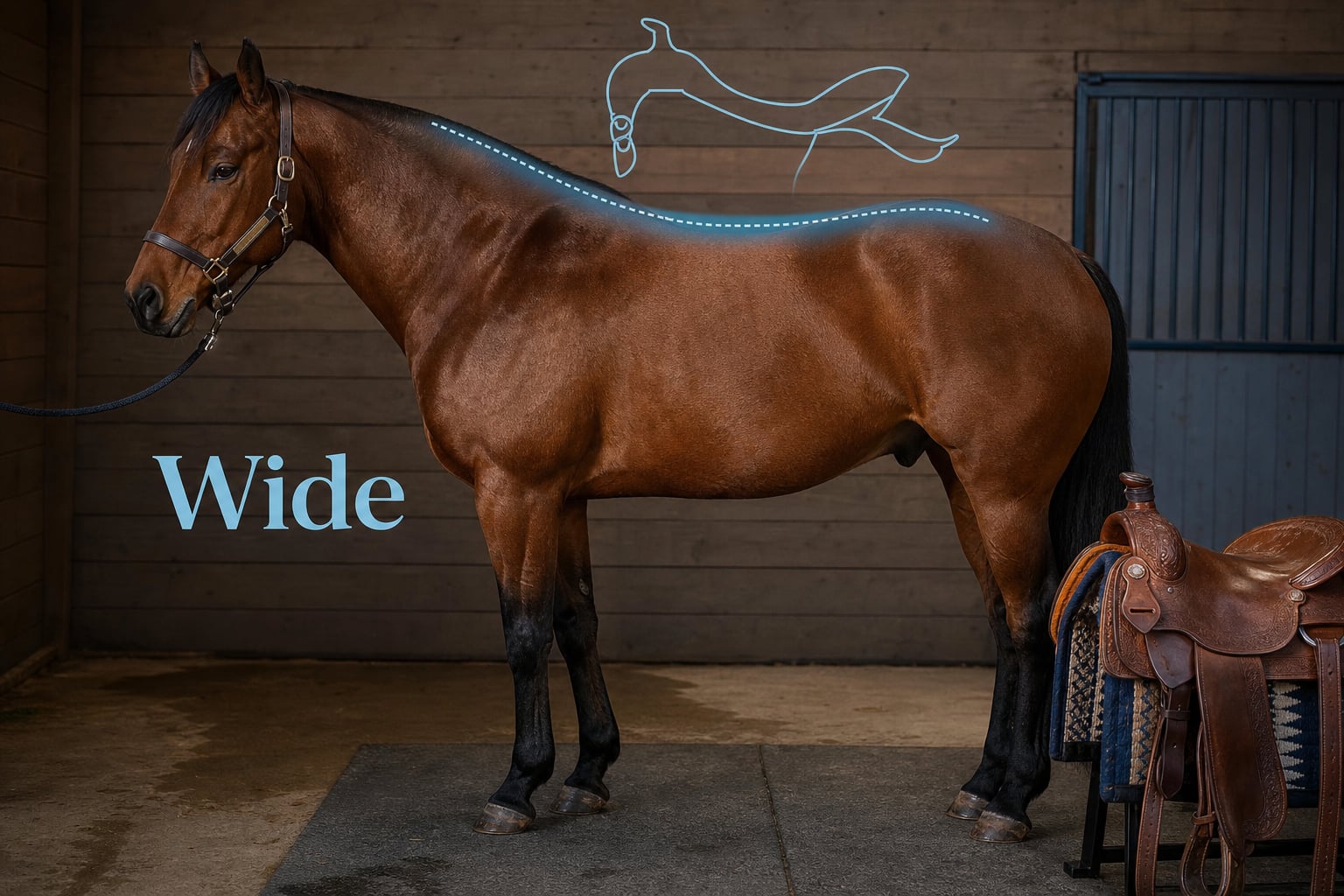
A wide saddle tree is commonly associated with a gullet around 7 inches or more, but that number alone cannot tell you whether the saddle fits your horse. The tree must match the shape behind the shoulder, the width and height of the withers, the contour of the back, and the bar angle that contacts the horse.
That distinction matters because saddle labels sound more exact than they are. A saddle called wide by one maker can differ from another, and a horse that looks broad from the ground may still need a different tree angle rather than a wider gullet.
This guide explains wide saddle tree gullet width for a horse build in plain terms. You will learn what the labels mean, how to make a wither tracing, what poor fit looks like, and when a qualified saddle fitter should make the final call.
Table of Contents
A wide saddle tree works only when its width and angle match the horse.
The saddle tree is the rigid or semi-rigid framework that gives a saddle its shape. In a Western saddle, the front of that framework includes the fork and bars; in an English saddle, it includes the head and points, with panels carrying much of the contact.
Gullet width, sometimes called bar spread, describes the open space across the front of the tree. On Western saddles, sellers often measure it about 2 inches below the narrowest part of the gullet rather than at the very top, so comparing measurements taken by different methods can mislead you.
Tree width and tree angle must be considered together. A tree can have a broad gullet but bars that meet a horse too steeply, or a narrower gullet with bars that lie flatter than the horse’s shoulders; neither combination gives balanced contact.
Gullet width describes space, while bar angle describes contact.
Think of gullet width as the distance between the sides at the front and bar angle as the slope of those sides against the horse. Both need to correspond with the horse’s shape at the same location behind the shoulder blade.
A broad, low-wither horse often needs a flatter bar angle as well as more room across the front. A horse with defined withers can need more angle even if the visible back looks wide, which is why “wide horse equals wide gullet” is a poor shortcut.
Spine clearance protects tissue, but clearance is not the entire fitting test.
There should be clear space over the withers, spine, and sensitive connective tissue under the channel. Riders often use a two- to three-finger check at the front as a rough observation, but finger width varies and the saddle must also be checked under the rider’s weight.
A saddle can clear the spine and still concentrate pressure beside it. Look for stable, even bearing surface from front to back instead of relying on one clearance measurement.
A wide saddle tree gullet label is a reference point rather than a universal size.
Western terminology is particularly inconsistent. SQHB means semi quarter horse bars, QHB usually means quarter horse bars, and FQHB means full quarter horse bars, but these names do not set one identical width or angle across every manufacturer.
The following ranges are common reference points, not a fitting prescription. Measure a specific saddle in its stated method and compare its shape to a tracing and a hands-on fit check.
- SQHB or semi quarter horse bars: often about 6 1/4 to 6 1/2 inches, with a comparatively steeper bar angle for horses with more defined withers.
- QHB or regular quarter horse bars: often about 6 1/2 to 6 3/4 inches, though the label varies widely by maker.
- FQHB or full quarter horse bars: commonly around 7 inches, usually with a flatter angle for broader, more muscular stock-horse builds.
- Wide tree: often 7 inches or more in Western terminology, intended for a broad or low-wither build when the angle also fits.
- Extra-wide or draft tree: commonly wider and flatter still, but the actual dimensions and bar shape remain manufacturer-specific.
English saddle trees are commonly described as narrow, medium, medium-wide, wide, and extra wide rather than by one standard inch measurement. Their panels, flocking or foam, point angle, and channel width add variables that make a direct conversion from a Western gullet unreliable.
A seven-inch gullet is often wide, but it is not automatically right for every wide horse.
In many Western saddle lines, a 7-inch gullet is considered wide or falls in the FQHB range. Its fit still depends on how and where it was measured, the bar angle, the rock of the bars, and the horse’s shape immediately behind the scapula.
Forum discussions repeatedly point to this problem: riders sometimes move to FQHB because a horse is broad, then find that an SQHB tree with a different angle sits better. The useful lesson is to compare the whole front shape, not to chase a label.
A six-inch gullet is usually narrower than a wide-tree reference.
A 6-inch gullet is generally a narrow measurement in the Western context and may suit a horse with higher, narrower withers when the angle matches. It is not a safe choice merely because a saddle looks tidy or sits high at rest.
A tree that is too narrow can perch above the back, pinch near the withers, and restrict the shoulder. A saddle that sits high is not proof of good clearance; it can be held up by pressure.
A 155 mm measurement equals about 6.1 inches.
Divide millimeters by 25.4 to convert to inches, so 155 mm is approximately 6.1 inches. That is below the frequently cited 7-inch wide reference, although its real meaning still depends on the maker’s measuring point and the tree’s angle.
Do not call a 155 mm saddle too wide or too narrow from the number alone. Place it correctly, assess contact, and watch the horse move before treating the conversion as a verdict.
A wither tracing gives you a repeatable starting point for tree-width decisions.
A wither tracing does not replace a full fitting, but it records the shape you are trying to match better than a photograph or breed label does. It is especially helpful when you are comparing saddles away from the barn or asking a fitter for preliminary guidance.
Use a flexible curve, a piece of heavy wire covered in tape, or a dedicated tracing tool. Work with the horse standing square on level ground, relaxed, and without a saddle pad.
Step 1: Find the shoulder blade and mark the tracing location.
Feel the rear edge of the scapula, then select a point a few inches behind it where the front of the tree will sit during normal riding. The exact location matters because a tracing made too far forward can show a shape that the working saddle should not occupy.
Ask an experienced person to show you the landmarks if you are unsure. The saddle must not be placed on the shoulder blade, since the scapula needs room to rotate during each stride.
Step 2: Mold the flexible curve across the back without pressing into tissue.
Center the curve over the spine at the marked location and shape it down both sides of the withers. Use light contact, following the coat rather than pushing into muscle, and keep the curve perpendicular to the spine.
Lift it away carefully so it does not spring open. Repeat the trace once or twice; repeatable outlines build more confidence than a single hurried attempt.
Step 3: Transfer the shape to paper and label it clearly.
Lay the curve on paper, trace the inside edge, and mark the date, the horse, and the location behind the scapula. Write down whether the horse was freshly conditioned, changing weight, or returning to work, because topline can change.
Take another trace farther back if you are evaluating a longer saddle. A tree’s rock, or its front-to-back curve, needs to follow the back as well as its width needs to follow the withers.
Step 4: Compare the tracing with the bare saddle, then repeat on the horse.
Hold the tracing under the front of the bare tree as a screening tool, looking for a similar overall width and angle. Gaps at the top or pressure at the lower ends flag a mismatch, but panels, rigging, pad thickness, and saddle placement can change what happens on the horse.
Set the saddle directly on the clean back in its natural resting place before adding a pad or cinching. Run a flat hand beneath the bearing surfaces and compare left and right sides for even contact, room through the channel, and a balanced seat.
A correct tree fit shows even contact, stable balance, and free movement.
Start with the horse standing, then check again after walking, trotting, turning, and riding with normal tack. Fit is dynamic: a saddle can appear acceptable in the aisle yet shift or create pressure as the horse raises the back and moves the shoulders.
The saddle should rest behind the shoulder blade and appear level enough that it does not place the rider far behind or ahead of balance. There should be usable clearance over the withers and through the channel, with no part of the tree bearing on the spine.
Even panel or bar contact distributes the rider’s load.
With the saddle correctly placed and lightly secured, slide a flat hand under the bearing surface. You are looking for broad, comparable contact rather than one tight hotspot and several loose gaps.
After a ride, inspect the horse’s coat, skin, behavior, and response to grooming. Uneven sweat can suggest uneven contact, but it is only one clue; heat, hair pattern, workload, and grooming can affect it as well.
Shoulder freedom shows that the front is not trapping the horse.
Watch the horse walk and trot in a straight line and on turns. Shortened stride, resistance to moving forward, ear pinning during saddling, or a sudden change in willingness can be worth investigating, particularly when these signs are new.
These behaviors are not proof that the gullet is wrong. Lameness, training, ulcers, teeth, hoof balance, and other sources of discomfort can look similar, so treat saddle fit as one part of a wider welfare check.
A too-wide or too-narrow tree leaves different clues on the horse and saddle.
A too-narrow tree typically pinches near the front, while a too-wide tree may drop too low around the withers or become unstable. Both can cause pressure, so the answer is not simply to go wider whenever a horse has a broad build.
Check the fit before mounting and after a normal ride. Ask for professional help promptly if you find swelling, soreness, persistent white hairs, broken skin, marked behavior change, or repeated saddle movement.
A too-narrow tree often sits high and concentrates pressure at the front.
- The saddle appears perched, with limited bearing surface lower down the bars or panels.
- Your hand meets firm pressure or cannot pass smoothly under the front bearing area.
- The horse objects to girthing, brushing, mounting, or forward movement.
- Dry patches, heat, tenderness, or hair changes occur near the withers and shoulder area.
- The rider may feel tipped backward because the front is held up.
A too-wide tree often drops, rolls, or lacks front stability.
- The pommel or fork sits low and may approach the withers when the rider is mounted.
- The saddle shifts side to side, rolls on a round horse, or slides forward despite correct placement and cinching.
- There is a visible gap or reduced contact in a place that should carry weight, paired with pressure elsewhere.
- The rider may feel tipped forward because the front settles down.
- The horse may develop sore spots from movement or pressure even though the gullet looks roomy from above.
Bridging means a middle gap, while rocking means end-to-end movement.
Bridging occurs when the front and rear contact but the middle of the saddle does not. The rider’s load then concentrates at the contact points, and the gap can be easier to feel with a flat hand than to see.
Rocking occurs when the saddle pivots from front to back like a seesaw because its curve does not follow the back. A saddle can bridge, rock, or show both faults, and either pattern deserves more than a thicker pad.
A horse’s build offers useful clues, but breed is never a measuring tool.
Broad backs, low or mutton withers, and muscular shoulders often point toward a wide or extra-wide tree discussion. Draft breeds, Haflingers, Friesians, draft crosses, and some heavily muscled stock horses may fall into this group, but individuals within every breed vary greatly.
A wide, short-backed horse can be especially challenging because the saddle also needs an appropriate length and front-to-back curve. A wide tree that is too long or has the wrong rock can still bridge or interfere with the loin.
Low-wither and round horses often need stability as well as width.
On a round barrel, a saddle can roll even when the gullet appears generous. The answer might involve a tree that matches the shape more closely, correct rigging and cinch placement, or professional adjustment—not a tight cinch that creates discomfort.
Check whether the saddle maintains its position after ordinary movement rather than judging it only while the horse stands square. A slipping saddle can create a cycle of instability and pressure that no label solves.
High-wither horses often need angle and clearance more than raw gullet width.
A horse with taller, more defined withers frequently needs a tree that opens at the appropriate angle while retaining adequate wither relief. Selecting a very wide tree just to avoid visible contact can let the saddle sink and load the sides incorrectly.
The same principle applies to narrow tree saddle and medium tree saddle labels in English tack. Shape, panel contact, and balance tell you more than the printed width stamp by itself.
A saddle pad can refine a sound fit but cannot change the tree’s fundamental shape.
A properly selected pad can provide cushioning, manage sweat, and make modest adjustments within a saddle that already fits reasonably well. It cannot turn a narrow tree into a wide tree, change bar angle, correct major bridging, or create safe clearance when the tree drops onto the withers.
Very thick padding under a too-narrow saddle can make the pinch worse by taking up the little room that exists. Building up pads under a too-wide saddle can also hide an unstable fit temporarily while changing balance and pressure.
A professional fitting assessment is the right next step when the clues conflict.
Call a qualified saddle fitter when you are between sizes, your horse changes condition, the saddle shifts, or you cannot explain the contact pattern. Bring the horse, the saddle, normal pad and cinch, and any old tracings so the fitter can assess the complete setup.
Traditional Western saddles generally do not have a gullet that can simply be exchanged or widened. Some English saddles have adjustable systems, but an adjustable headplate still does not solve panel, balance, or tree-shape mismatches on its own.
A wide saddle tree FAQ answers the most common measurement and fit questions.
Is a 7 inch gullet considered wide?
In many Western saddle lines, a 7 inch gullet is considered wide or falls in the full quarter horse bar range. It is only a reference point because tree angle, the maker’s measurement method, bar shape, and the horse’s own withers and shoulders decide fit.
What size gullet fits most horses?
There is no single gullet size that fits most horses safely. Many riding horses fall somewhere within common SQHB or FQHB references, but individual back shape, wither height, shoulder angle, condition, and saddle construction must be checked on the horse.
How do you measure saddle tree width?
For a Western gullet reference, measure the saddle at the maker’s stated point, often about 2 inches below the narrowest part of the gullet. Then make a wither tracing at the saddle’s working location behind the shoulder and compare width and angle; confirm the result through an on-horse contact and movement check.
What size is a 6 inch gullet?
A 6 inch gullet is generally a narrow Western reference and is below the commonly cited 7 inch wide reference. It may fit a horse with more defined, narrower withers when its angle and the rest of the tree shape are also correct.
Is a 155 mm saddle too wide?
A 155 mm measurement is about 6.1 inches, so it is not usually described as a 7-inch wide Western gullet. Whether it is too wide depends on where and how the saddle was measured, its bar angle, and how it contacts the individual horse.
How can you tell if a saddle is too wide for a horse?
A too-wide saddle may sit low at the front, approach the withers when mounted, roll or shift, tip the rider forward, or create uneven contact and soreness. Check it in motion as well as at rest, because a roomy-looking gullet can still be unstable or create pressure.
A wide saddle tree fits best when you verify the whole shape, not just the number.
Start with the horse’s working shape behind the shoulder, make and label a wither tracing, and compare both gullet width and bar angle. Then assess clearance, contact, balance, stability, and movement with your normal tack.
The right wide saddle tree supports a broad horse without pinching the shoulders or dropping onto the withers. If any evidence conflicts, pause the search for a bigger number and ask a qualified fitter to assess the horse and saddle together.