
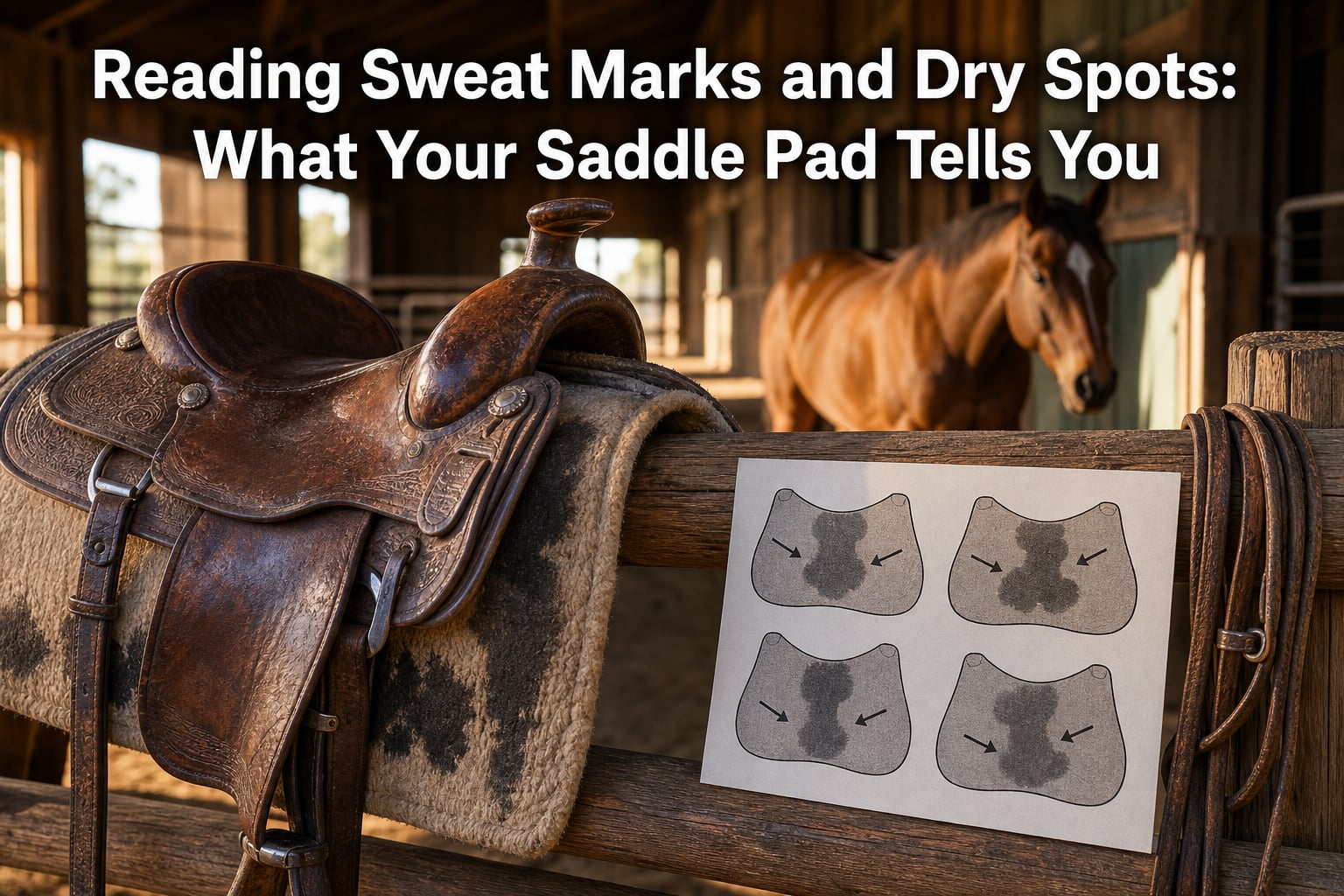
Every rider has stared at a sweaty saddle pad after a ride and asked the same question: does this mean my saddle fits? Reading sweat marks and dry spots on a saddle pad is one of the most talked-about tools in equine care, and one of the most misunderstood. After 17 years of fitting saddles and listening to riders talk through their panic over uneven patterns, I can tell you this: sweat marks are a clue, not a verdict.
In this guide, I will walk you through how horse sweating actually works, why sweat patterns are so often misleading, what dry spots really mean, and the practical steps to take when something looks off. The goal is to replace guesswork with confidence.
Table of Contents
How Horses Sweat: The Science Behind the Marks
To read sweat marks accurately, you have to understand what is happening under the pad. Horses sweat through apocrine glands distributed across their skin, and unlike humans, they rely on sweating as a primary cooling mechanism during exercise.
When a saddle sits on a horse’s back, three things happen at once. The skin warms up. Blood flow increases to manage heat. Sweat glands activate to release moisture. Where pressure is highest and air circulation is lowest, the skin cannot dissipate heat efficiently, and the glands can be temporarily suppressed.
[note]The center of the saddle panel typically shows the most consistent contact. That means less air movement, less evaporation, and often less visible sweat, even when the fit is fine.[/note]
This is the foundation of every interpretation that follows: sweat marks reflect the interaction between pressure, heat, and air circulation. They do not directly measure fit.
Why Sweat Patterns Can Be Misleading
If sweat marks were a reliable indicator of saddle fit, every saddle fitter in the world would use them as their primary diagnostic. They do not. Pressure pad readings, manual palpation, and dynamic movement assessment all beat visual sweat patterns for accuracy. Here is why sweat marks can fool you.
Five factors that change the pattern on any given day
Pad material. Cotton, wool, synthetic fleece, and honeycomb materials each wick and hold moisture differently.
Weather and humidity. A cool morning ride produces very different marks than a hot summer afternoon.
Ride intensity and duration. A five-minute warm-up leaves a faint pattern. A vigorous 30-minute workout leaves a darker, more defined one.
Rider balance and weight shifts. An unbalanced rider changes the pressure map and therefore the sweat map.
Coat condition. A clipped horse sweats differently than a woolly winter coat.
[warning]The same horse, with the same saddle, on the same pad, can produce visibly different patterns on consecutive days. Treat any single sweat pattern reading as a snapshot, not a diagnosis.[/warning]
I have personally seen forum riders post panic-stricken photos of “weird” sweat patterns, only to learn the next day’s ride looked completely different. The pad was the constant; everything else had shifted.
Understanding Dry Spots: Pressure vs Non-Pressure
Dry spots are where this topic gets tricky, because a dry spot on your saddle pad can mean two opposite things. Both are real, both are common, and confusing them leads to bad saddle-fitting decisions.
Pressure dry spots
When pressure on a sweat gland area becomes high enough, blood flow is restricted and the gland temporarily shuts down. The result is a small, often hand-sized dry area surrounded by sweat. These can indicate a true pressure point where the saddle tree or panel is digging in.
Non-pressure dry spots
The opposite cause also produces dry spots. If the saddle is not making contact at a certain location, air circulates freely and the skin stays cooler and drier. A dry spot with sweat on either side of it can mean the saddle is bridging, that is, touching only at the front and back while leaving the middle unsupported.
[tip]Look at the size and shape, not just the fact that a dry spot exists. A small circular dry spot in a sea of sweat is more likely pressure-related. A long dry stripe running across the back is more likely a bridging or non-contact issue.[/tip]
When to relax vs when to investigate
Some dry spots are completely normal. Most horses show small dry patches behind the shoulder blade where the stirrup bars and tree points create natural pressure zones. These are often fine. What is not fine is a dry spot that grows over time, is paired with behavioral changes, or coincides with white hair growth.
How Pad Material Changes What You See?
Before you interpret any sweat pattern, look at what your pad is made of. Material changes both the picture on the pad and the contact conditions underneath it.
Cotton pads absorb sweat quickly and show patterns sharply.
Wool pads wick moisture away from the skin and produce softer, more diffuse patterns.
Synthetic fleece traps heat and may suppress sweating under the panel.
Honeycomb or 3D mesh pads create air channels and can mask pressure-related dry spots entirely.
[note]Switching pad materials can dramatically change your sweat pattern even if nothing about your horse, saddle, or riding has changed. Always compare like with like.[/note]
This is one reason saddle fitters rarely diagnose from a single photo. They want to know the pad, the weather, the ride, and the horse’s recent history before drawing conclusions.
Common Sweat Pattern Locations and What They Mean
Once you understand the basics, location becomes the next layer of interpretation. Here are the most common patterns riders see and what they usually indicate.
Dry spots behind the shoulder blade
This is the single most posted-about pattern on equestrian forums. A dry area just behind the shoulder blade is often caused by the tree points or stirrup bars. For many horses, this is normal anatomy. For others, it signals a tree that is too narrow or panels that have shifted forward.
Dry in the center, wet at the front and back
This pattern strongly suggests bridging. The saddle is making contact at the front (shoulders) and back (cantle area) but not through the middle of the panel. Bridging causes pressure concentration at the contact points and can lead to back soreness over time.
Even sweat coverage along the panel
A consistent, even sweat pattern that follows the shape of the saddle panel usually indicates good contact distribution. But even coverage alone is not proof of fit. Many horses with poor-fitting saddles sweat evenly because they are compensating elsewhere.
Dry spots on the withers
Dryness right at or just behind the withers often indicates that the saddle is too wide or that the gullet channel is too narrow. Either condition reduces air flow in an area that needs it most.
[warning]Western and English saddles produce different patterns because the contact area, panel shape, and tree design are different. Do not compare your sweat pattern to a photo taken on a different saddle style.[/warning]
Behavioral Signs That Matter More Than Sweat Marks
If I had to rank diagnostic tools, horse behavior would sit at the top, far above sweat patterns. After more than a decade of saddle fitting conversations with riders, the most common thread is this: riders noticed a behavior change long before they noticed a sweat pattern problem.
Behavioral red flags to watch for
Ears pinned back during tacking up or mounting
Reluctance to move forward, bucking, or sudden stops
Tail swishing more than usual under saddle
Head tossing or above-the-bit tension
Hesitation when asked to canter or collect
Sensitivity to brushing or palpation along the back
[tip]One rider I spoke with spent months trying to fix “weird” sweat patterns. The answer turned out to be her horse pinning his ears at the mounting block, a behavior she had dismissed as attitude. Switching saddles resolved both the behavior and the pattern.[/tip]
Behavior is a real-time signal. Sweat marks are a delayed snapshot. When the two conflict, trust the behavior.
Physical Warning Signs: White Hairs, Swelling, and Muscle Atrophy
Some signs go beyond sweat marks entirely and indicate that damage has already happened. These require action, not interpretation.
White hairs
White hairs appearing under the saddle area are evidence of past tissue damage to the hair follicles. They do not grow back to their original color. If you see them, the saddle has caused pressure-related damage at some point, whether from current use or a previous saddle.
Dry spots that persist for hours
A normal dry spot should resolve within an hour or two after riding. If the skin remains visibly dry, swollen, or indented well after the pad is removed, that is a sign of real pressure trauma.
Muscle atrophy
If the muscles behind the shoulder or along the back appear to be wasting away, the saddle has been restricting movement or blood flow for an extended period. This is a sign to call a certified saddle fitter, not to keep adjusting your pad.
[note]Forum users frequently report that white hairs began to fade once they switched to a properly fitting saddle, though they never fully disappeared. The damage was real, and so was the recovery.[/note]
A Practical 5-Step Saddle Fit Check Using Sweat Marks
Here is a simple diagnostic process I share with riders who want to use sweat marks as one part of a broader saddle fit check.
Step 1: Control the variables
Use the same pad, ride at similar intensity, in similar weather, for a few rides in a row before drawing conclusions. One unusual pattern is just data, not a diagnosis.
Step 2: Look at the whole pad, not just the spots
Check the overall sweat distribution first. Then zoom in on dry spots and ask whether they indicate pressure or non-contact.
Step 3: Cross-check with behavior
Compare the sweat pattern to how your horse is moving, behaving, and recovering. If behavior is good and pattern is odd, give it a few more rides. If behavior is off, address it now.
Step 4: Inspect the horse’s back
Run your fingers along the back after riding. Look for heat, swelling, dry patches that persist, tenderness, or white hairs. Document anything you find.
Step 5: Call a professional when in doubt
A certified saddle fitter brings pressure mapping, professional palpation, and years of pattern recognition. Sweat marks are a starting point for that conversation, not a substitute for it.
[tip]Take dated photos of your saddle pad after each ride for a month. Patterns over time are far more informative than patterns from a single day.[/tip]
Frequently Asked Questions
What do dry spots under a saddle pad mean?
Dry spots under a saddle pad can indicate either excessive pressure, which temporarily shuts down sweat glands, OR too little contact, where air circulates freely. Small dry spots surrounded by sweat may indicate pressure problems, while larger hand-sized dry spots are often normal.
How can I tell if my saddle fits by sweat marks?
You cannot definitively tell if a saddle fits from sweat marks alone. Uneven patterns, dry spots only in specific locations, or dramatic asymmetry may warrant investigation, but always combine sweat pattern observation with behavioral checks and physical inspections.
Are dry spots always a sign of poor saddle fit?
No. Many dry spots are completely normal, especially small patches behind the shoulder blade or in areas where stirrup bars and tree points create natural contact points. Concern grows when dry spots are paired with behavioral changes, swelling, or white hairs.
What other signs indicate my saddle does not fit?
Behavioral signs like ear pinning, bucking, reluctance to move forward, and tail swishing under saddle are stronger indicators than sweat marks. Physical signs include white hairs, persistent dry spots lasting hours after riding, swelling, and muscle atrophy along the back.
Final Thoughts on Reading Sweat Marks and Dry Spots
Reading sweat marks and dry spots on a saddle pad is a useful skill, but it is one tool in a larger toolbox. The most experienced riders and saddle fitters I know treat sweat patterns as a starting point for investigation, not as a final answer. They pair pattern observation with behavioral checks, physical inspection, and, when needed, professional pressure mapping.
If you take one thing from this guide, let it be this: a sweat pattern that looks “weird” in isolation rarely tells you much. A pattern that looks weird, paired with a horse that is moving differently or showing white hairs, tells you a lot. Trust the combination, not the snapshot. And when in doubt, call a certified saddle fitter. Your horse’s back will thank you for 2026 and every year after.