
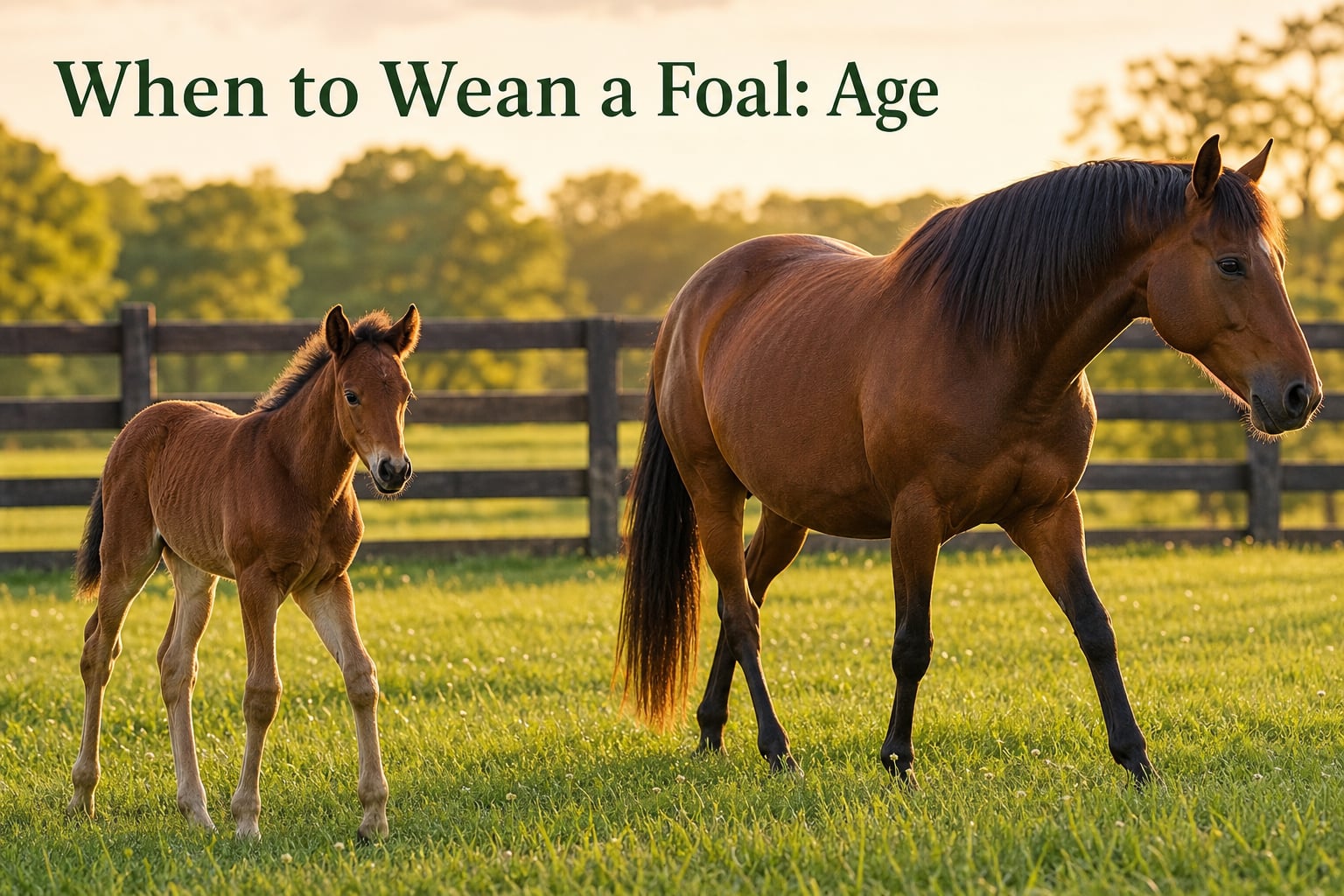
Deciding when to wean a foal is one of the most important choices you’ll make as a breeder or horse owner. After months of watching a mare and her foal develop that close bond, separating them too early can cause lasting stress, while waiting too long creates management challenges for the mare’s recovery and breeding cycle. Our team has compiled research-backed guidance to help you make this decision with confidence.
Domesticated foals are typically weaned between 4 and 7 months of age, with most breeders settling on the 5 to 6 month range as the sweet spot. This window balances the foal’s growing nutritional independence with the mare’s need to recover and rebreed. Read on to learn the exact signs of readiness, the methods that reduce stress, and what new research says about waiting a bit longer.
Table of Contents
When to Wean a Foal: The Ideal Age Range?
The short answer is that domesticated foals are typically weaned between 4 and 7 months of age. Most horse owners settle on 5 to 6 months because the foal has had time to build a strong digestive system and start eating solid feed consistently. Waiting this long also gives the foal’s immune system a critical boost through continued milk antibodies and maternal contact.
Some breeders wean as early as 3 months when circumstances demand it, but this should be reserved for situations like the mare’s declining health, an emergency, or a need to rebreed quickly. I generally recommend treating 4 months as the absolute floor for routine weaning. Going earlier than that increases the risk of digestive upset, behavioral issues, and developmental stress that can affect the foal for months.
On the older end, some operations let foals nurse until 8 or even 9 months, especially in pasture-based settings. Research published in recent years suggests there are real benefits to this extended window, which I’ll cover in detail below. The “right” age depends on your specific mare, foal, facilities, and breeding goals.
Natural Weaning vs Domestic Weaning Timelines
Wild and feral horse herds follow a much slower weaning timeline than domesticated operations. Under natural conditions, weaning happens gradually over several months, beginning when the foal is 9 to 11 months old. Mares in the wild typically don’t conceive again until their foal is weaned, which extends the nursing period naturally.
Domestic breeding operations work on tighter timelines because we want mares to return to breeding condition quickly. By weaning at 4 to 7 months, most mares cycle back within 14 to 30 days, allowing for an annual foaling schedule. This reproductive pressure is the main reason our domestic timelines differ so sharply from wild horse behavior.
The gap between natural and domestic weaning creates an important question. Are we weaning too early? Some researchers and welfare-focused breeders think so. Recent studies have started tracking the long-term effects of early versus late weaning on bone development, behavior, and stress resilience. Early indicators suggest that waiting longer, closer to the natural timeline, may produce healthier, more confident horses.
That said, domestic life also requires domestic solutions. Wild horses don’t deal with confinement, transportation, or show schedules. The 4 to 7 month range represents a compromise that fits most breeding programs while still respecting the foal’s basic developmental needs.
Factors That Affect Weaning Timing
Age alone doesn’t tell the whole story. Several other factors should shape your decision about when to wean a foal:
Mare’s body condition. A mare that has lost significant condition through lactation may need weaning earlier to recover. If your mare’s body condition score drops below 4 on the Henneke scale, pulling the foal off gives her a chance to regain weight before winter or before rebreeding.
Foal’s size and growth rate. A foal that is small for its age or struggling to grow may benefit from continued nursing. Larger, faster-growing foals often self-wean earlier by spending more time grazing and less time nursing.
Health status. Sick or weak foals should stay with the mare longer whenever possible. Maternal antibodies in the milk provide immune protection that commercial feeds cannot replicate.
Temperament of mare and foal. Mares that are aggressive or rejecting their foals signal that weaning is overdue. Foals that are highly dependent and still nursing frequently at 6 months may need a more gradual separation approach.
Time of year. Many breeders plan weaning for late summer or fall when pasture quality declines and foals are naturally eating more grass. Weaning into bad weather adds unnecessary stress, so plan accordingly.
Mare’s breeding schedule. If the mare was bred back while nursing, weaning earlier makes sense to support the next pregnancy. Mares that weren’t rebred can often nurse longer without issue.
Signs Your Foal Is Ready to Be Weaned
Beyond just age, certain developmental signs tell you a foal is ready for the transition. I watch for these markers before scheduling separation:
Eating solid feed consistently. The foal should be readily consuming its creep feed or grain ration, eating at least 2 to 3 pounds daily for several weeks before weaning.
Grazing actively. Foals that spend hours nibbling pasture are building the gut flora they need for life without milk. This behavior usually appears by 3 to 4 months.
Drinking water independently. The foal should know where the water source is and drink regularly without following the mare.
Healthy body condition. A ready-to-wean foal has good fat cover, a shiny coat, and steady weight gain from solid feed sources.
Curious and confident behavior. Foals that wander away from the mare to investigate their environment are showing the independence needed for separation.
If your foal checks most of these boxes by 5 to 6 months, you’re in the ideal weaning window. If several signs are still missing, waiting another 30 to 60 days is usually the better call.
Weaning Methods: Abrupt vs Progressive
Choosing the right weaning method is just as important as picking the right age. There are two main approaches, and they produce very different stress levels for both mare and foal.
Abrupt (Cold Turkey) Weaning
Abrupt weaning means separating the mare and foal completely on a single day, removing all visual and physical contact. This method is fast and logistically simple, but it’s also the most stressful for the foal. Research has shown that abruptly weaned foals experience sharp spikes in cortisol, vocalize for hours, pace fence lines, and may develop stereotypies like cribbing or weaving within weeks.
I only recommend abrupt weaning when there’s no other option, such as a medical emergency with the mare or an immediate relocation. If you must use this method, pair the foal with a calm older horse (a “babysitter”) immediately to reduce isolation stress.
Progressive (Gradual) Weaning
Progressive weaning spreads the separation over days or weeks, reducing the shock to both animals. The most common approach uses adjacent stalls or pens where mare and foal can see, hear, and smell each other without nursing access. Over 7 to 14 days, you gradually increase the distance until contact is minimal.
Another progressive method involves removing the mare from the herd for increasingly longer periods while leaving the foal with familiar companions. This works especially well in pasture settings where foals have groupmates to lean on.
Research consistently shows progressive weaning produces lower cortisol levels, fewer vocalizations, and faster return to normal feeding behavior. If you have the facilities and time, this is the clear winner.
Pasture and Group Weaning
For breeding operations with multiple foals, weaning two or more foals together into a familiar pasture produces excellent results. The foals have each other for social comfort, they keep moving and exploring instead of pacing the fence, and the mares can be removed as a group or one at a time. This approach combines progressive separation with social support and tends to be my favorite method when the herd structure allows it.
How to Reduce Stress During Weaning?
Stress reduction starts before the actual separation and continues for several weeks after. These are the strategies our team has seen work best in real breeding operations:
Start creep feeding 6 to 8 weeks before weaning. Familiarize the foal with solid feed so the digestive transition is already underway when separation happens.
Wean in familiar surroundings. Keep the foal in its usual pasture or stall. Move the mare, not the foal. Removing both at once doubles the stress.
Provide a calm companion. An older gelding, a dry mare, or another foal of similar age gives the weanling someone to bond with immediately.
Avoid stacking stressful events. Don’t wean the same week you deworm, vaccinate, or trim the foal. Space major events at least a week apart.
Maintain a consistent routine. Same feeding times, same handler, same turnout schedule. Predictability calms stressed weanlings.
Monitor for stereotypies. Watch for cribbing, weaving, stall walking, or fence pacing in the first two weeks. Catching these early lets you intervene with more turnout, companionship, or environmental enrichment.
Most foals settle into their new routine within 7 to 14 days. If extreme stress behaviors persist past three weeks, talk to your veterinarian about underlying anxiety or nutritional gaps.
Creep Feeding: Preparing the Foal Before Weaning
Creep feeding is the practice of offering foals solid feed separately from the mares, using a feed station designed so only the smaller foals can access it. This is the single most useful thing you can do to set up a low-stress weaning.
Start creep feeding at around 8 to 10 weeks of age. The foal’s digestive system is mature enough to process concentrates by this point, and early exposure builds lifelong eating habits. A good creep feed contains 16 to 18% protein, balanced calcium and phosphorus for bone development, and modest energy to support growth without causing growth spurts.
Offer creep feed free-choice initially, allowing the foal to nibble as curiosity dictates. By 4 months, the foal should be eating 1 to 2 pounds per 100 pounds of body weight daily. This intake is your main indicator that the foal can transition smoothly off milk.
Creep feeder design matters too. The opening must be wide enough for foals but too narrow for mares to follow them in. Most operations use a simple barred opening at chest height, adjusted as foals grow. Position the feeder in a high-traffic area where foals naturally follow the mare, so they discover the feed on their own.
New Research: The 8-Month Weaning Advantage
A growing body of research suggests that waiting until 7 or 8 months to wean may produce measurable benefits in foal health and behavior. Studies tracking weanlings for 12 months post-weaning have found that late-weaned foals show better bone density, lower cortisol response to stress, and stronger social skills when grouped with other horses.
The mechanism is fairly intuitive. Longer nursing gives the foal’s skeleton more time to develop under the protective influence of balanced milk nutrition, reducing the risk of developmental orthopedic disease. Slower separation also mirrors the natural herd timeline, which appears to support psychological resilience.
If your management allows it, waiting until 7 months is a reasonable middle ground between traditional domestic practice and natural timelines. Operations with good pasture and no pressure to rebreed the mare can comfortably push weaning to 8 months without any downside.
Post-Weaning Care for Mare and Foal
Both halves of the pair need attention in the days and weeks after separation.
For the mare: Reduce grain gradually over 5 to 7 days to slow milk production and lower the risk of mastitis. Watch her udder for heat, swelling, or hardness. Cold hosing and limited grain for two weeks usually prevents problems. If the udder becomes hot or the mare shows signs of fever, call your vet promptly.
For the foal: Continue the same creep ration for at least two weeks post-weaning to avoid disrupting digestion during an already stressful time. Slowly transition to a weanling-specific feed over the following month, with free-choice forage always available. Monitor water intake, especially in cold weather, since weanlings sometimes forget how to drink reliably.
Reintroduction: After 4 to 6 weeks of separation, many operations reintroduce the mare and foal in adjacent pastures where they can see each other without nursing. This often allows the mare to return to her normal social group while giving both animals closure. Full reintroduction typically happens after the foal is weaned for several months.
Practical Weaning Timeline and Decision Framework
Here’s a simple framework our team uses with first-time breeders to decide when to wean a foal in their specific situation:
Start creep feeding at 2 to 3 months. This is when the foal’s rumen-equivalent (cecum) starts functioning well enough to handle concentrates.
Assess at 4 months. Ask these questions: Is the foal eating 2+ pounds of creep feed daily? Is the mare in good body condition? Is the foal healthy and growing well?
Plan separation at 5 to 6 months for most situations. This is the default window that works for the majority of breeding operations.
Consider waiting until 7 to 8 months if: The mare doesn’t need to rebreed, pasture is plentiful, the foal is on the slower end of growth, or you’re able to provide gradual separation. New research supports this longer window when management permits.
Wean earlier only when necessary: Mare health crisis, foal rejection, emergency rebreeding required, or the foal is already eating substantial solid feed at 3 to 4 months.
Choose progressive methods whenever possible. Adjacent stalls, gradual distance increase, and group weaning all reduce stress dramatically compared to abrupt separation.
Following this framework keeps you close to natural timelines while still fitting domestic breeding realities. If you have any doubts, your veterinarian or an experienced breeder in your discipline can offer discipline-specific advice, particularly for sport horse, racehorse, or show breeding programs where timing carries extra performance considerations.
Frequently Asked Questions
How early is too early to wean a foal?
Anything before 3 months is generally too early for routine weaning. The foal’s digestive system is still developing, and the immune system benefits significantly from continued milk antibodies. Weaning before 3 months risks nutritional deficiencies, severe stress, and developmental setbacks. Most breeders treat 4 months as the absolute floor for any weaning decision.
Can you wean a foal at 3 months old?
Three months is possible in emergency situations but not recommended for routine weaning. At 3 months, the foal’s cecum is still developing its full capacity to digest forage and concentrates. A 3-month weaning should only happen when the mare’s health is at serious risk, the foal is already eating solid feed well, and you can pair the foal with a calm companion. Most foals weaned this early show significantly higher stress behaviors.
What is the 1/2/3 rule for foals?
The 1/2/3 rule for foals refers to a basic feeding guideline: 1% of body weight in forage, 2 to 3 pounds of creep feed per 100 pounds of body weight, and access to clean water at all times. Some breeders use a variation referencing the first three months: 1 month nursing, 2 months creep feeding started, and 3 months showing readiness signs. The exact interpretation varies by program, but the underlying principle is matching feed intake to the foal’s developmental stage.
What is the least stressful way to wean a foal?
The least stressful method is progressive separation combined with group weaning. Place the foal in a familiar pasture with at least one calm companion (preferably another foal of similar age), and remove the mare to an adjacent but separate area where they can still see each other. Over 7 to 14 days, gradually increase the distance until contact is minimal. This approach produces the lowest cortisol spikes, the fewest vocalizations, and the fastest return to normal feeding behavior.
What signs of stress should I watch for after weaning?
Watch for these stress signs in the first two to three weeks post-weaning: excessive vocalizing (whinnying for more than a few hours daily), pacing the fence line, reduced feed intake, weight loss, weaving or stall walking, cribbing, weaving in place, and decreased social interaction with companions. Mild anxiety is normal for the first 48 to 72 hours. If symptoms persist past two weeks or worsen, consult your veterinarian to rule out illness or discuss anxiety management.
Final Thoughts on Weaning Your Foal
When to wean a foal comes down to balancing age, readiness, and your specific management situation. The 4 to 7 month window works for most domesticated horses, with 5 to 6 months as the most common choice. Starting creep feeding early, choosing progressive separation methods, and watching closely for stress signs all contribute to a smooth transition. Talk to your veterinarian if you have any concerns about your mare or foal’s individual timeline, especially if this is your first breeding experience.