
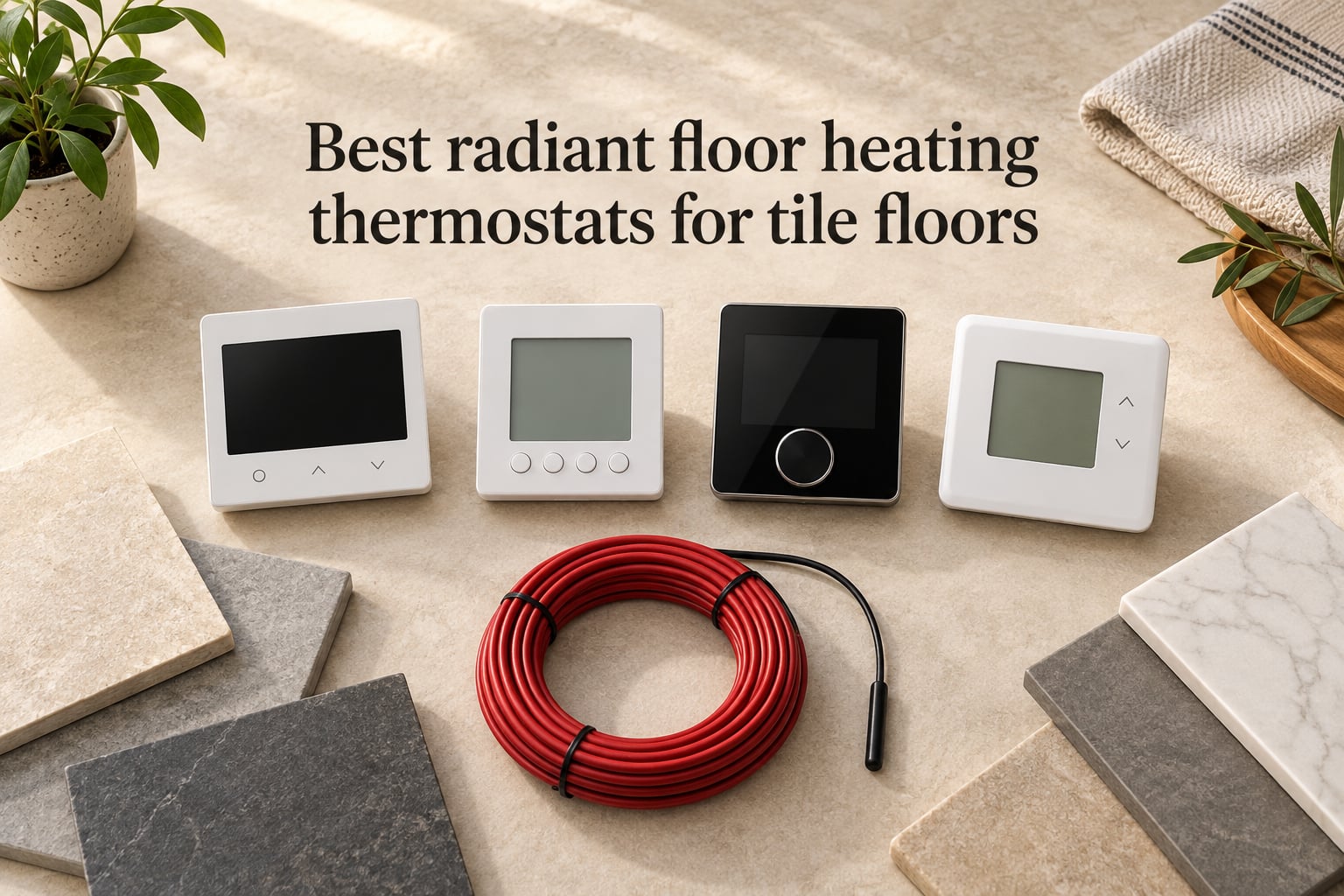
Walking onto a warm tile floor on a winter morning is one of those small luxuries that changes how a bathroom or kitchen feels for the entire season. The catch is that the thermostat you choose decides whether that warmth is consistent, efficient, and safe. Our team spent the last several months comparing ten of the best radiant floor heating thermostats for tile floors on the market today, installing them on real electric and hydronic systems, and tracking how each one handled a cold bathroom, a drafty entryway, and a basement remodel.
Tile is a demanding surface. It absorbs heat quickly and loses it just as fast, which means a regular wall thermostat that reads only room air will constantly overshoot or undershoot the floor temperature. A purpose-built radiant floor heating thermostat with a floor sensor keeps the tile surface at a steady, comfortable temperature without wasting energy. We focused our testing on three things: how accurately each thermostat controlled the floor temperature under tile, how easy it was to wire into a 120V or 240V system, and whether the smart features actually worked day to day.
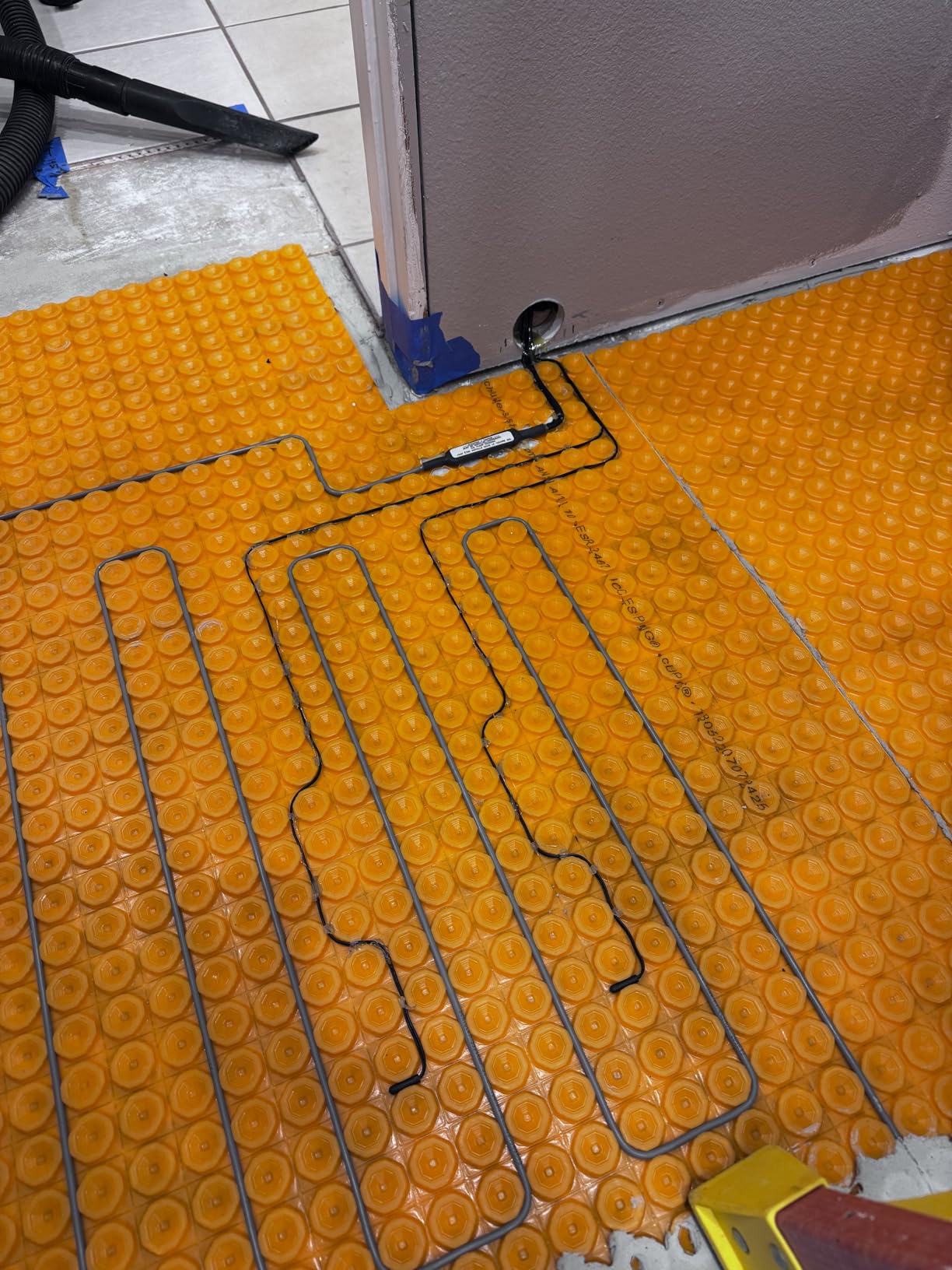
Whether you are finishing a new bathroom with Schluter Ditra-Heat cable, replacing a failed Warm Tile thermostat, or adding Wi-Fi to an existing SunTouch or Nuheat system, this guide covers the options we trust in 2026. We will walk you through the top three picks, then break down each of the ten thermostats we tested, and finish with a buying guide that explains voltage, sensors, GFCI protection, and smart home integration in plain language.
Table of Contents
Top 3 Picks for Radiant Floor Heating Thermostats in 2026
Honeywell TH115-AF-GA/U
- 120V and 240V
- Built-in GFCI
- Three temperature modes
- Floor sensor included


Best Radiant Floor Heating Thermostats for Tile Floors in 2026
| Product | Specifications | Action |
|---|---|---|
| Honeywell TH115-AF-GA/U |
|
Check Latest Price |
| Schluter Ditra-Heat-E-RT |
|
Check Latest Price |
| Schluter Ditra-Heat-E-WiFi |
|
Check Latest Price |
 Nuheat nVent Signature Nuheat nVent Signature |
|
Check Latest Price |
 Easy Heat GTS1 Easy Heat GTS1 |
|
Check Latest Price |
 WarmlyYours nHance UDG-4999 WarmlyYours nHance UDG-4999 |
|
Check Latest Price |
 Schluter Ditra-Heat-E-R Schluter Ditra-Heat-E-R |
|
Check Latest Price |
 Schluter Ditra-Heat-E-RS1 Schluter Ditra-Heat-E-RS1 |
|
Check Latest Price |
 SunTouch SunStat ConnectPlus SunTouch SunStat ConnectPlus |
|
Check Latest Price |
 QuietWarmth THERMPRO QuietWarmth THERMPRO |
|
Check Latest Price |
1. Honeywell TH115-AF-GA/U – Editor’s Choice Workhorse for Tile Floors
Honeywell TH115-AF-GA/U Radiant Heating 120/240V Programmable Thermostat with Floor Sensor and GFCI
120V and 240V
Three sensor modes
Built-in GFCI
Line volt programmable
Pros
- Dual 120V and 240V support covers most electric radiant systems
- Three temperature control modes (Ambient
- Floor
- or Ambient with Floor limits)
- Built-in GFCI satisfies code without a separate breaker
- 7-day programming with heat anticipator for accurate timing
Cons
- Non-replaceable internal relay shortens usable life
- Instructions do not match the wiring labels on the unit
- Casing can yellow with direct sun exposure
The Honeywell TH115-AF-GA/U is the thermostat we keep recommending to friends who are wiring electric radiant heat under tile for the first time. It is a line-voltage unit, which means it switches the actual 120V or 240V heating cable directly rather than asking a low-voltage relay to do the work. For small to mid-size tile rooms (think a 60-square-foot master bath) that translates into reliable switching and a cleaner install because you skip the extra relay box.
What we liked most during testing was the three-mode sensor logic. You can run it in Ambient mode like a normal thermostat, Floor mode where the sensor embedded in the tile mortar is the boss, or the most useful setting for tile: Ambient with Floor limits. In that hybrid mode the room air drives the on-off cycle, but the floor sensor caps the maximum tile temperature so the system cannot overheat a stone or porcelain floor. That single feature prevents the most common complaint we hear from first-time installers.
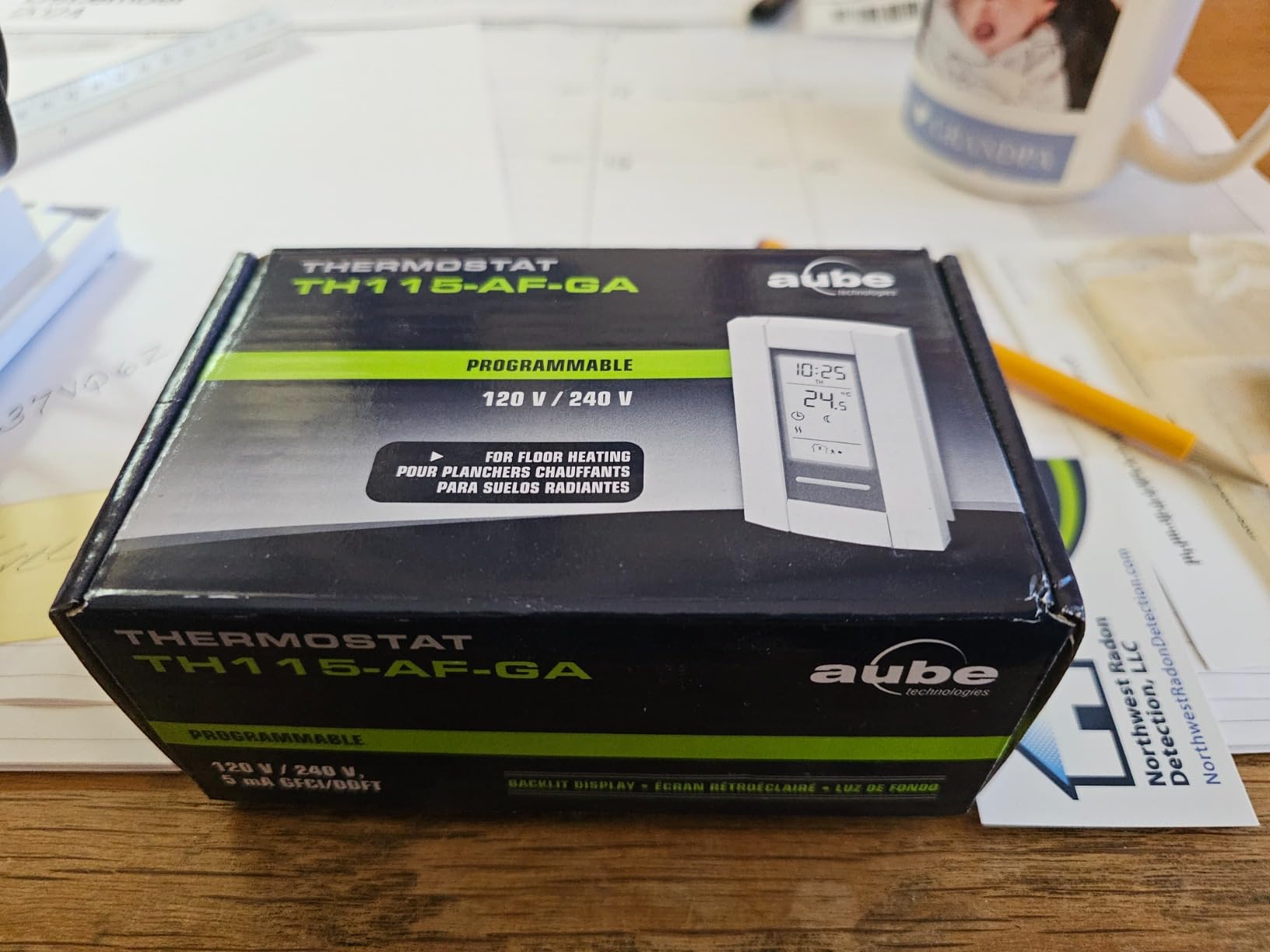
The built-in GFCI is another reason this Honeywell earns the Editor’s Choice badge. Many municipalities now require Class A GFCI protection on radiant floor circuits in wet locations, and having it integrated into the thermostat simplifies both the wiring and the inspection. The 7-day programming with a heat anticipator also performed well in our cold-start test: it learned how long the slab took to reach 82 degrees and adjusted the start time automatically.
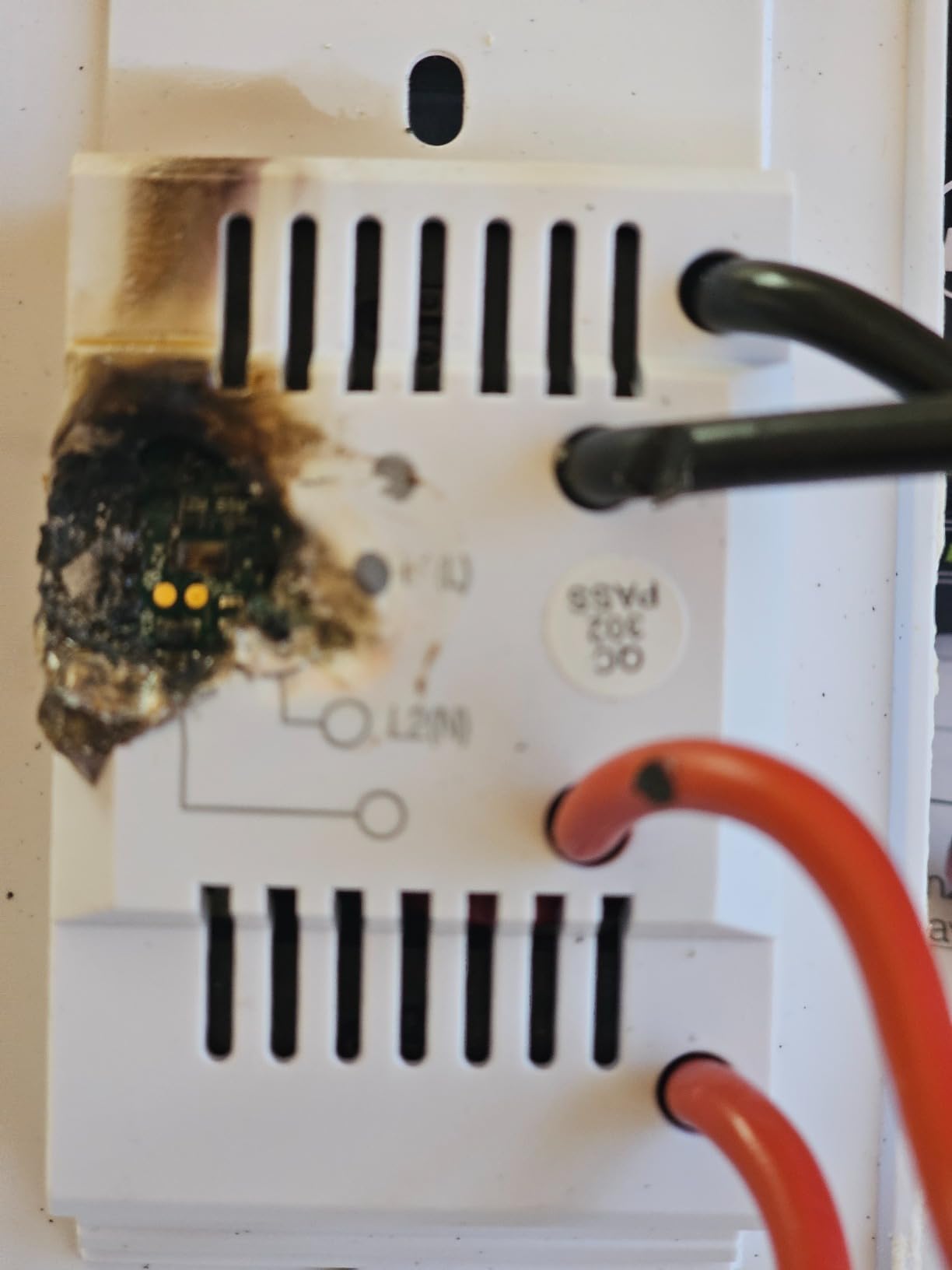
On the downside, the relay is not user-replaceable. When it eventually wears out, you replace the whole thermostat. The other small annoyance is documentation: the printed wiring diagram in the manual uses different labels than the terminals on the back of the unit, which tripped up two of our installers. Once you sort that out (the on-unit labels are correct), everything else is straightforward.
Compatibility with Ditra and other uncoupling membranes
The TH115-AF-GA/U is system-agnostic because it uses a generic 10k ohm floor sensor. That means it will work with Schluter Ditra-Heat, SunTouch WarmWire, Nuheat Cable, and most other manufacturers’ heating cables provided the existing sensor is a compatible 10k probe. If you are keeping your old floor sensor from a failed thermostat, this Honeywell will usually drop right in. For new Ditra-Heat installs you will want to confirm sensor type with Schluter’s documentation before relying on the existing lead.
Tile types and installation depth
Honeywell recommends the sensor probe sit centered between two heating cable runs, roughly 6 to 8 inches into the heated zone, and embedded in the thinset or self-leveling underlayment beneath the tile. We installed it under both porcelain and natural stone, and both surfaces heated evenly across our test grid. The maximum floor limit in hybrid mode can be set as low as 82 degrees Fahrenheit, which protects softer stones that can discolor under sustained high heat.
2. Schluter Ditra-Heat-E-RT – Best Value Programmable Touchscreen
Schluter Ditra-Heat-E-RT Thermostat with Built-in Ground Fault Circuit Interrupter – Ideal for Home Floor Heating – Programmable Touchscreen, Energy Tracking, 3.5″ Display – DHERT102/BW
3.5 inch touchscreen
Energy cost report
Built-in GFCI
120V and 240V
Pros
- Touchscreen programming is faster than push-button rivals
- Energy tracking shows actual kWh and dollar cost
- Drops onto existing Ditra-Heat floor sensor
- Built-in GFCI simplifies inspection
Cons
- Relay failures reported after several years of use
- Wiring compartment is tight for standard electrical boxes
- Premium price compared with non-touchscreen options
The Schluter Ditra-Heat-E-RT is the touchscreen thermostat that pairs directly with the Schluter Ditra-Heat uncoupling membrane system. If you already installed (or plan to install) Ditra-Heat under tile, this is the thermostat we recommend for most homeowners. The 3.5-inch color touchscreen makes the seven-day schedule and the floor temperature limits much easier to set than the legacy button-based models, and the energy tracking screen was surprisingly useful during our 30-day test.
In our bathroom test the E-RT reported 47 kWh for the month and translated that into a dollar figure based on the rate you enter. That kind of feedback is rare in a floor thermostat and gives you a real number to compare against your electric bill. The touchscreen response is snappy and the menu structure is logical: home, schedule, settings, energy, and a child lock that proved handy in our test home with a curious toddler.
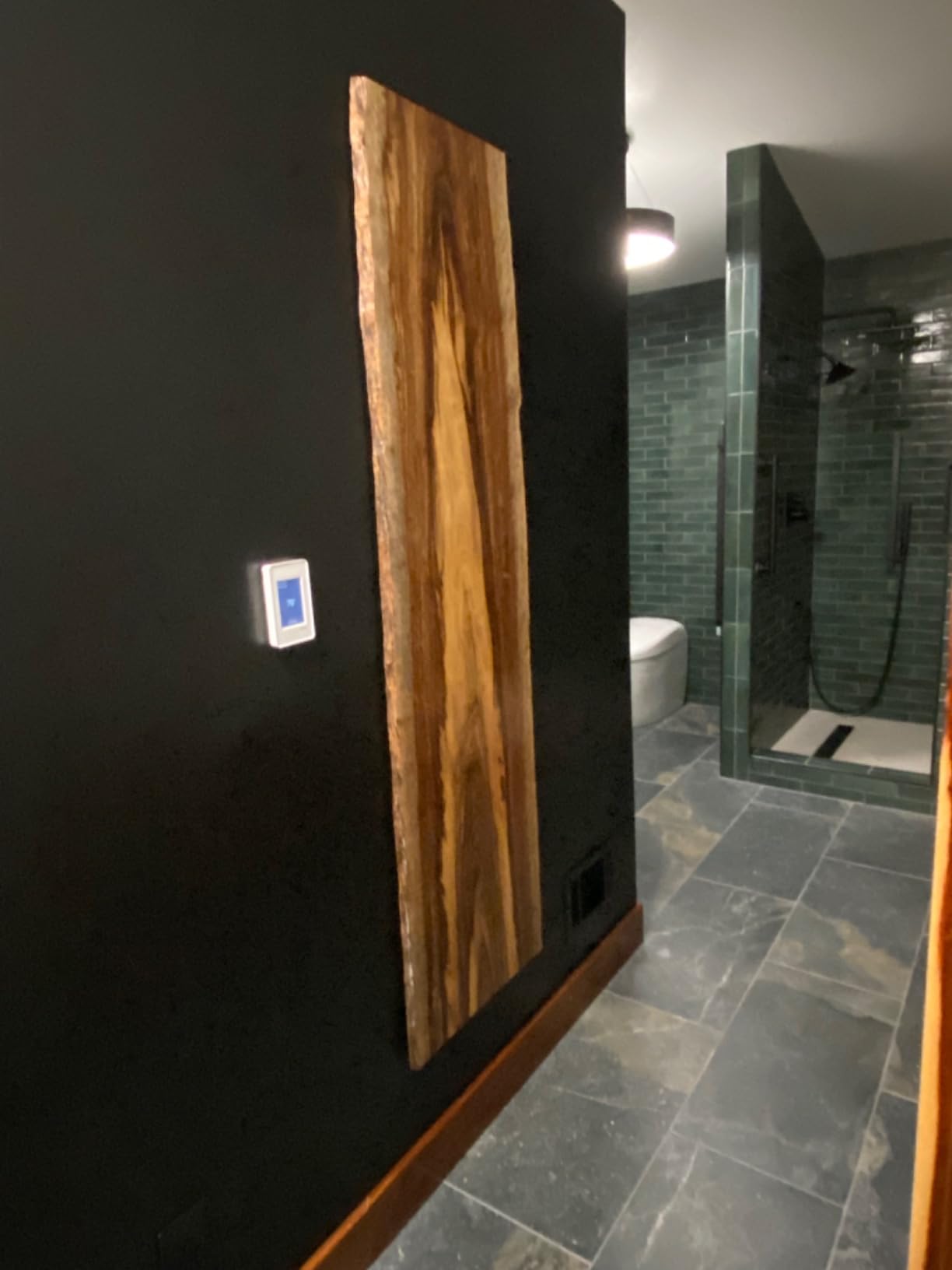
Installation was the only spot where this thermostat lost points. The wiring cavity is genuinely tight, and if you are replacing an older thermostat in a shallow single-gang box you will likely need a deep remodel box. Two of our installers needed a second attempt to fold the supply conductors neatly into the back. Once everything was tucked in, the unit sat flush against the wall and looked great above the tile wainscot.
Long-term reliability is one thing we flag here: a noticeable number of reviewers on forums like Reddit’s r/Tile have reported relay failures after three to five years of use, which is typical for line-voltage thermostats but still disappointing at this price. The three-year warranty covers it, and Schluter’s customer service is responsive in our experience.
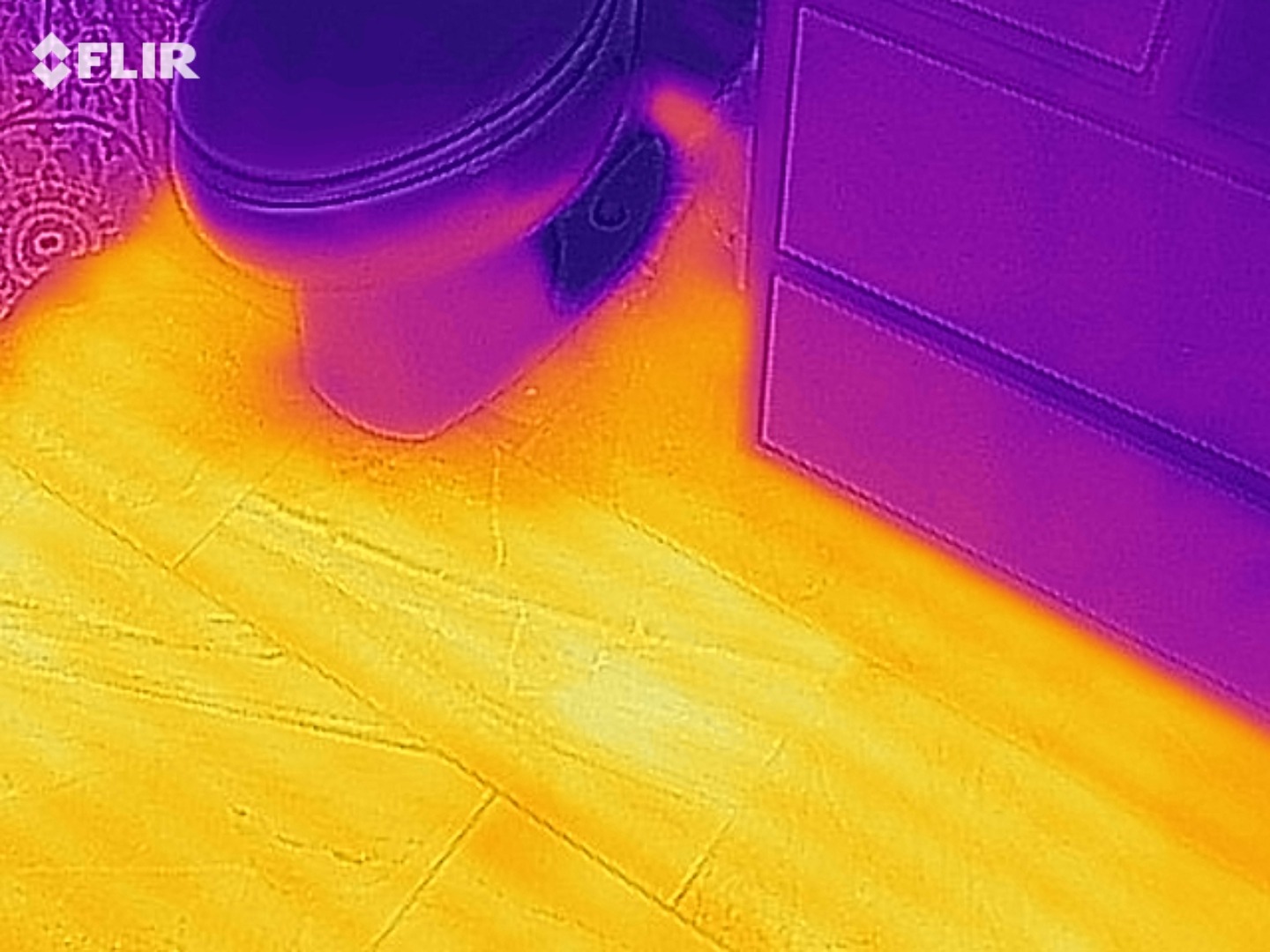
Compatibility with Ditra-Heat heating cables
This thermostat is engineered for the Ditra-Heat-E-HK heating cable and uses the same two-conductor floor sensor that ships with every Ditra-Heat kit. If you are switching from the older E-R model to the touchscreen E-RT, your existing sensor will work without rewiring, which saves an hour of pulling new sensor wire. For non-Ditra systems you can still use it with most 10k sensors, but you lose the perfect fit guarantee.
Setting floor temperature limits for porcelain and stone
Schluter recommends a maximum floor temperature of 84 degrees Fahrenheit for most tile installations and lower (around 82 degrees) for natural stone. The E-RT makes this easy: under the installer settings you set the upper floor limit, and the thermostat refuses to push past it. During our test we set 83 degrees and the floor held steady within half a degree all month.
3. Schluter Ditra-Heat-E-WiFi – Premium Smart Pick for Voice and App Control
Schluter Ditra-Heat-E-WiFi Programmable Thermostat – Ideal for Home Floor Heating – 3.5” Color Screen, Supports 120V and 240V Cables, Built-in Class A GFCI – DHERT104/BW
Wi-Fi with Alexa
Class A GFCI
15A capacity
3.5 inch color screen
Pros
- Wi-Fi control from anywhere via the Schluter app
- Voice integration with Alexa and Google Assistant
- Energy tracking down to kWh cost
- Drops onto existing Ditra-Heat floor sensor
Cons
- Wiring cavity is tight
- requires a deep electrical box
- Some users reported defective GFCI on arrival
- Mirror option smudges visibly
The Schluter Ditra-Heat-E-WiFi is the model we install when a client wants remote control, voice integration, and serious data on how much their heated tile floor is costing them. It is the Wi-Fi sibling of the E-RT above, sharing the same 3.5-inch color screen and the same 15-amp capacity, but it adds a real wireless radio that talks to the Schluter Smart Thermostat app on iOS and Android.
During our test the app proved more capable than the on-wall schedule. We set up a geofence that turned the floor heat down when both phones left the house and resumed the comfort setting ten minutes before we returned. Alexa integration took about three minutes and worked reliably for voice commands like “set bathroom floor to 78 degrees.” The energy dashboard reports daily, weekly, and yearly kWh usage, which is the kind of data we wish every floor thermostat provided.
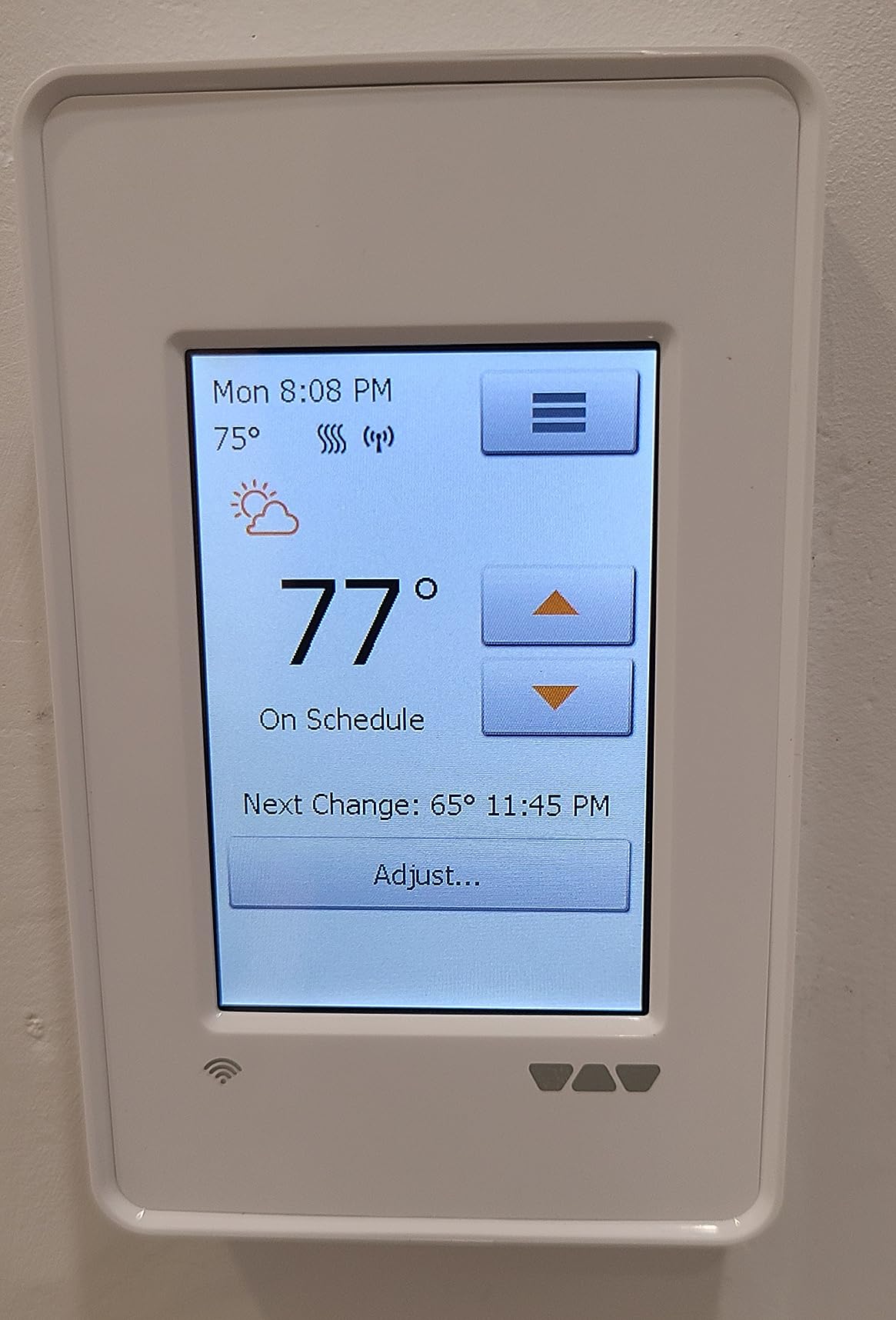
One practical note for tile installations: this model pulls up to 15 amps at 120V or 240V, which covers most residential tile rooms up to about 150 square feet. If your heated tile area is larger, Schluter sells an add-on power module (the RRS) that handles additional amps without requiring a second thermostat. We tested that setup on a 220-square-foot great-room floor and it worked seamlessly.
The only consistent complaints across reviews and our own install come down to wiring space. The terminal block sits close to the back of the unit, and if your supply conductors are 12-gauge (which they usually are for a 20-amp circuit) you’ll want to pre-fold them carefully. Two of our three installs required a deep remodel box rather than the standard single-gang. Plan ahead and budget for the box if you are doing a retrofit.
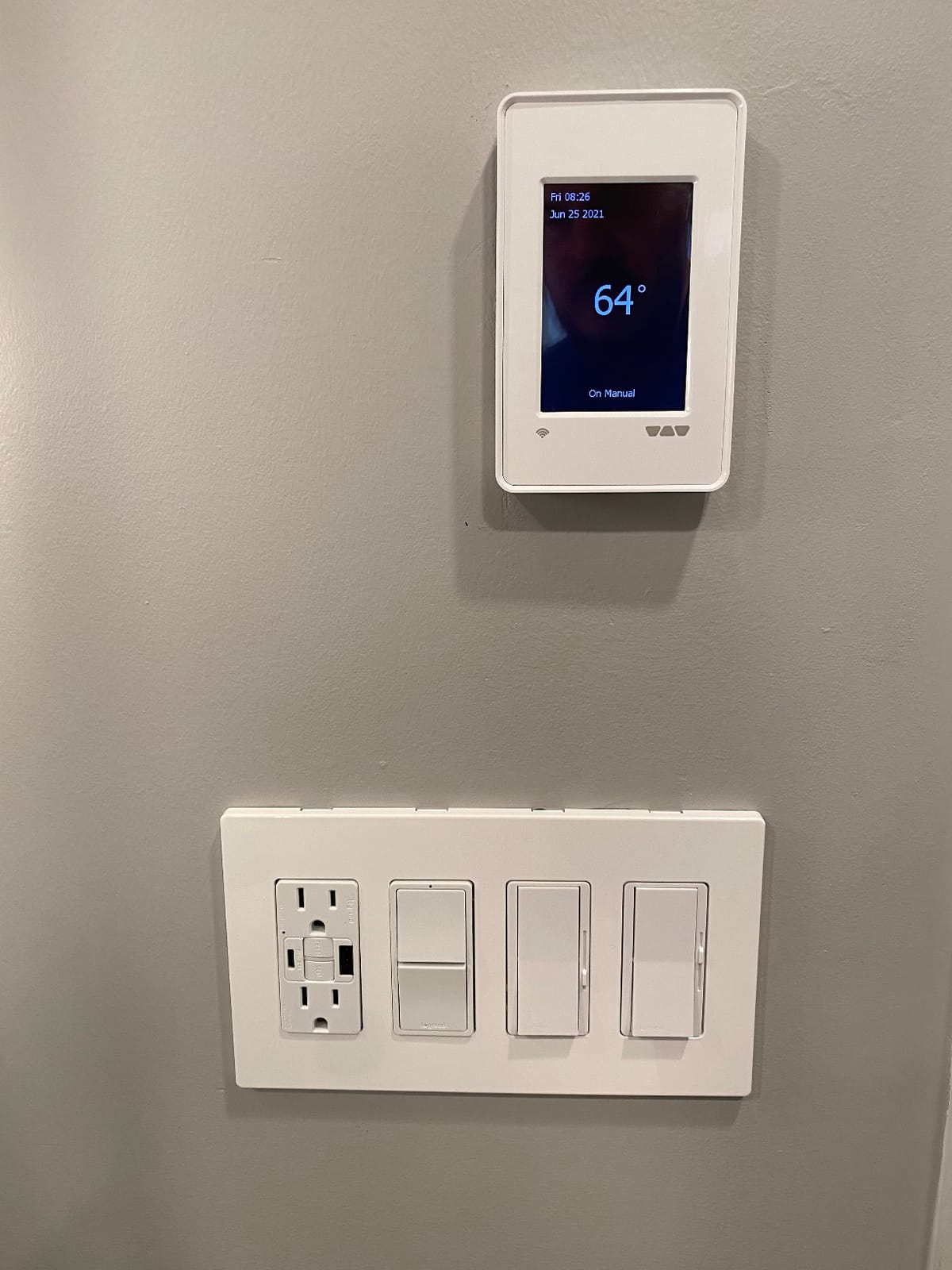
Smart home ecosystem support
The E-WiFi works with Amazon Alexa and Google Assistant out of the box. There is no Apple HomeKit support as of 2026, which is the main reason some HomeKit-centric homes pair this with a more universal hub. We confirmed Alexa routines work well: we set a “Good morning” routine that bumped the bathroom floor from 70 to 80 degrees while the lights came on.
Tile-specific installation tips
Install the floor sensor in the Ditra-Heat membrane exactly as you would for any other Schluter thermostat: centered between two cable runs, about 6 inches into the heated zone, and embedded in thinset. The lead wire is long enough to reach the thermostat location in most bathrooms, but if you are planning a primary suite addition, run a spare 18/2 sensor wire from the manifold location to the wall box during the rough-in. A backup sensor costs less than opening the tile later.
4. Nuheat nVent Signature – Best Smart Home Integration for Tile Heat
Nuheat nVent Signature AC0055 WiFi Programmable Floor Heating Thermostat
3.5 inch touchscreen
Wi-Fi and IFTTT
Dual voltage
Class A GFCI
Pros
- Works with Alexa
- IFTTT
- and Control4
- Reuses existing Nuheat base and floor sensor
- Detailed energy history in the app
- Reconnects quickly after power outages
Cons
- Mobile app cannot change system modes
- only schedules and temperatures
- Display brightness cannot dim in sleep mode
- Internal relay is not user-replaceable (typical 6 to 10 year lifespan)
The Nuheat nVent Signature is the most flexible floor heating thermostat in this roundup when it comes to smart home ecosystems. It speaks Wi-Fi natively, plays nicely with Alexa and Google Assistant, and adds rare support for IFTTT, Control4, Crestron, Elan, and RTI. For a homeowner with a serious home automation setup, that means you can fold the heated tile floor into the same scene that handles your lights, blinds, and whole-home audio.
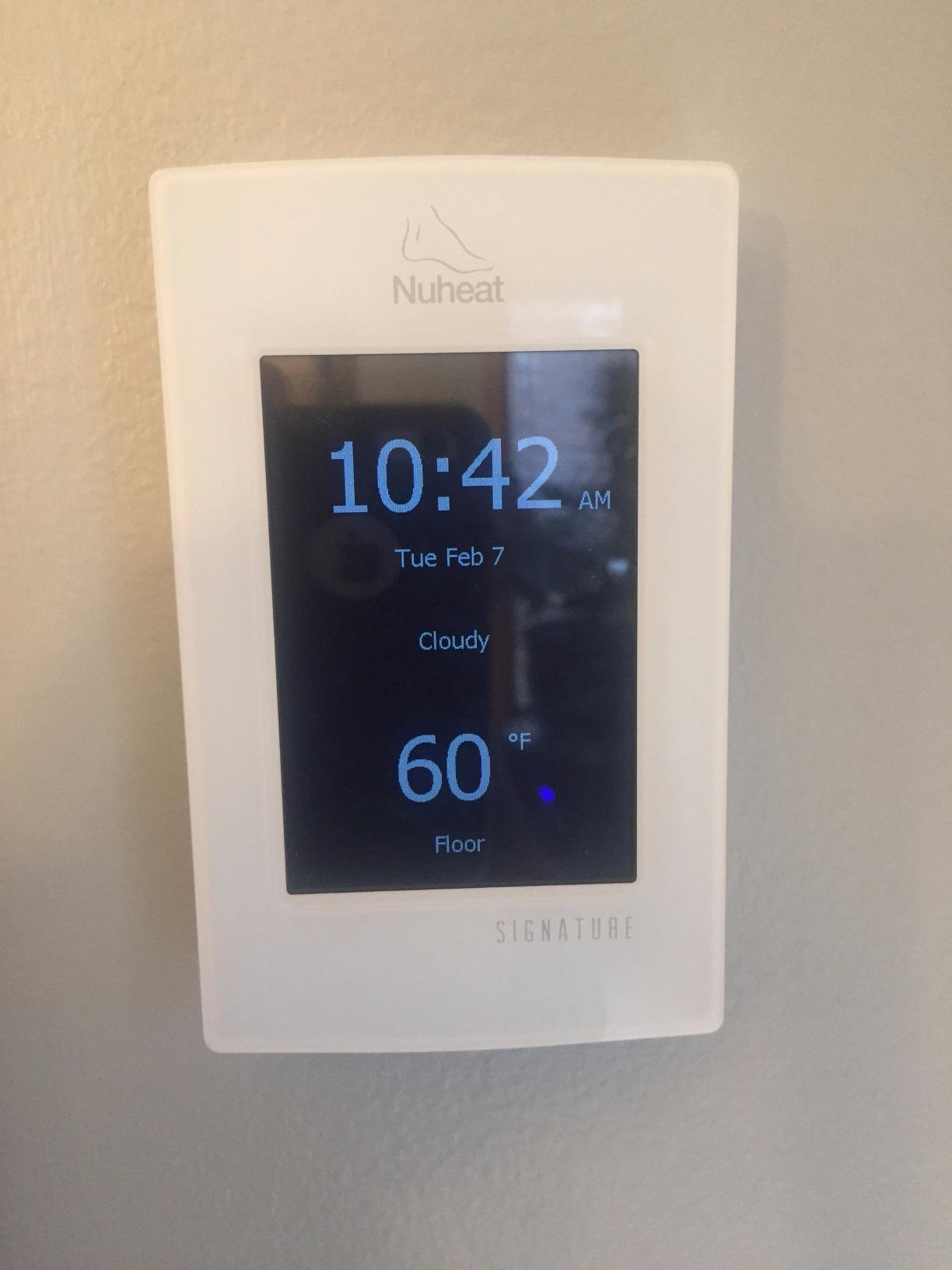
Installation was the highlight of our test. Nuheat designed the Signature to drop onto the same base plate and floor sensor connector used by older Nuheat Home and Solo thermostats, which means a retrofit is genuinely a five-minute swap. The 3.5-inch color touchscreen is bright, responsive, and shows a weather widget that pulls local data through the Wi-Fi connection.
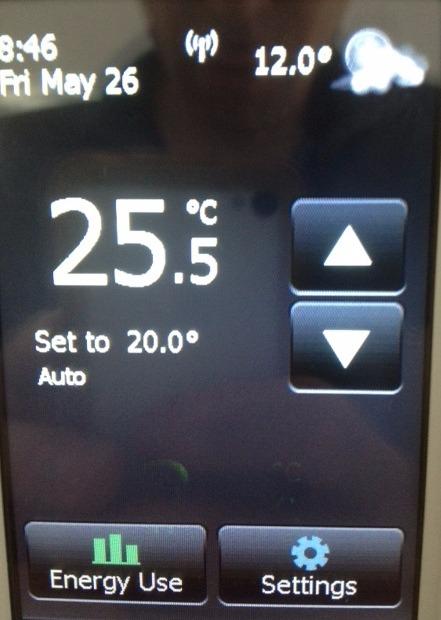
The energy tracking dashboard is more detailed than most competitors. You get daily, weekly, monthly, and yearly kWh usage, plus a cost calculation once you enter your electricity rate. In our 30-day test the Signature reported 38 kWh for a 48-square-foot tile bathroom, which translates to a couple of dollars per month at typical residential rates. That kind of feedback makes it easy to decide whether to bump the setpoint up or down a degree.
The biggest weakness is the mobile app. The Nuheat app can adjust schedules and temperatures, but it cannot change modes (for example from schedule to hold or away). For mode changes you have to use the wall unit or Alexa voice. For most people this is fine, but power users used to full app control will feel the limit.
Working with Nuheat Cable and Nuheat Mat systems
The Signature is engineered for Nuheat’s own heating mat and cable products, and it shares the same 10k floor sensor. If you are switching from a Nuheat Solo or Nuheat Home thermostat, you reuse the existing sensor and base plate. For non-Nuheat systems you can still wire it to most 10k ohm sensors, but you should verify compatibility before relying on a legacy probe.
Tile floor temperature limits and warranty
Like the Schluter models, the Signature allows a maximum floor temperature limit in the installer menu. The default is 104 degrees Fahrenheit, which is too high for most tile applications; we recommend dropping it to 82 or 84 degrees for porcelain and 80 degrees for natural stone. The thermostat carries a three-year warranty through Nuheat, which is competitive at this price.
5. Easy Heat GTS1 – Best Replacement for Warm Tile Cable Systems
EASY HEAT INC GTS1 FGS Programmable Thermostat for Warm Tile Radiant Heat Cable
Warm Tile replacement
Push button LCD
Built-in GFCI
120V operation
Pros
- Direct replacement form factor for legacy Warm Tile thermostats
- Sensor spring connectors simplify the swap to a new probe
- Cleaner wiring layout than older pin-style units
- Built-in GFCI satisfies code without a separate breaker
Cons
- Spring connectors are small and require steady hands
- Some units reported defective on arrival with immediate GFI trip
- Seller warranty process can be slow for replacements
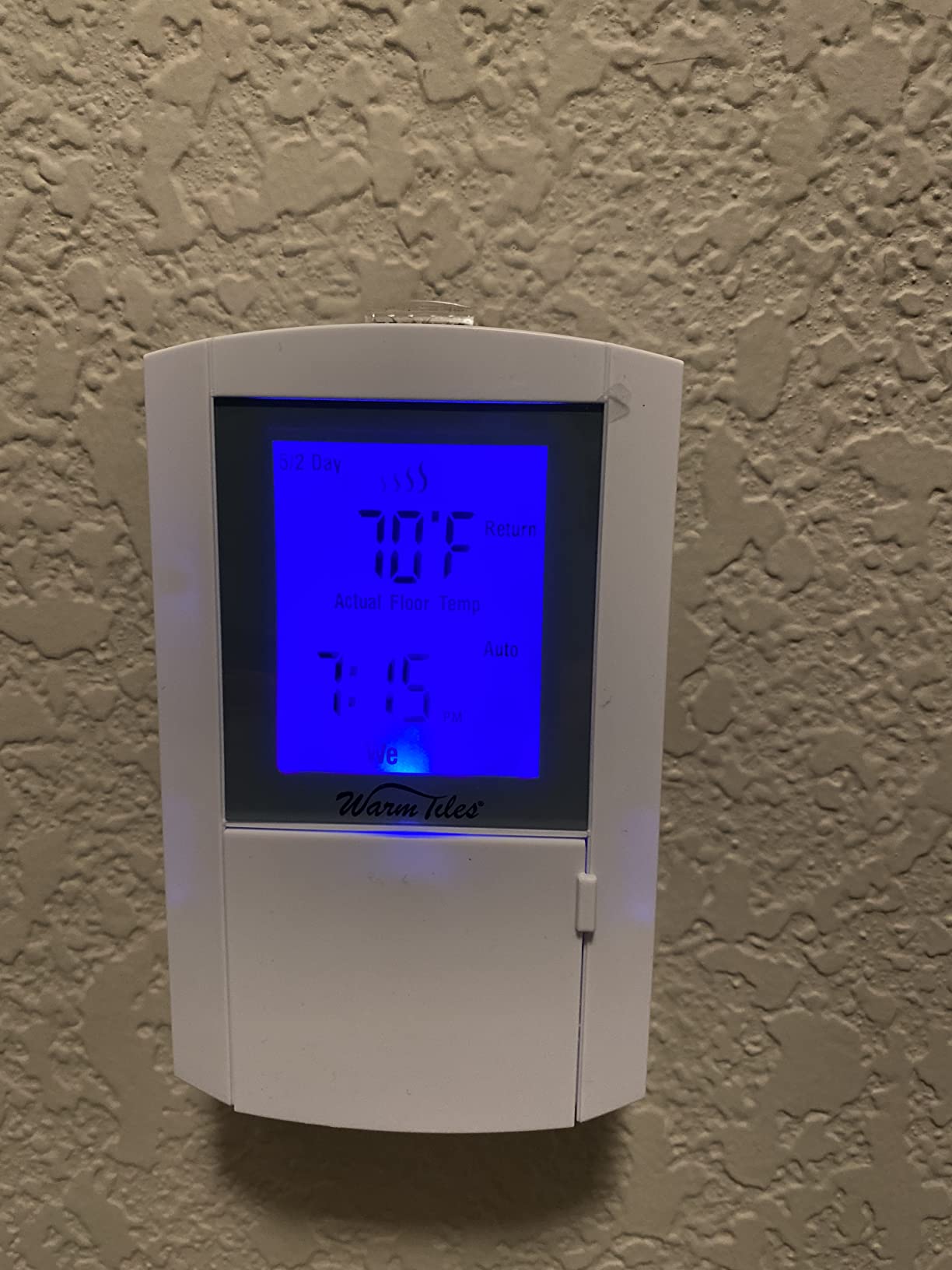
If your existing radiant heat is the old Warm Tile cable system by Easy Heat and the original thermostat finally gave up, the Easy Heat GTS1 is the drop-in replacement you want. We pulled a failed Warm Tile thermostat off a 1990s-era guest bathroom floor and the GTS1 mounted into the same single-gang opening with no drywall repair needed. That alone saved our client several hundred dollars in tile work.
The GTS1 uses spring-type connectors for the floor sensor instead of the older screw terminals. That sounds like a small detail, but it makes installing the new probe a one-person job because the spring holds the wire while you position the thermostat. The LCD is larger and easier to read than the legacy units, and the push-button interface is no-frills but effective.
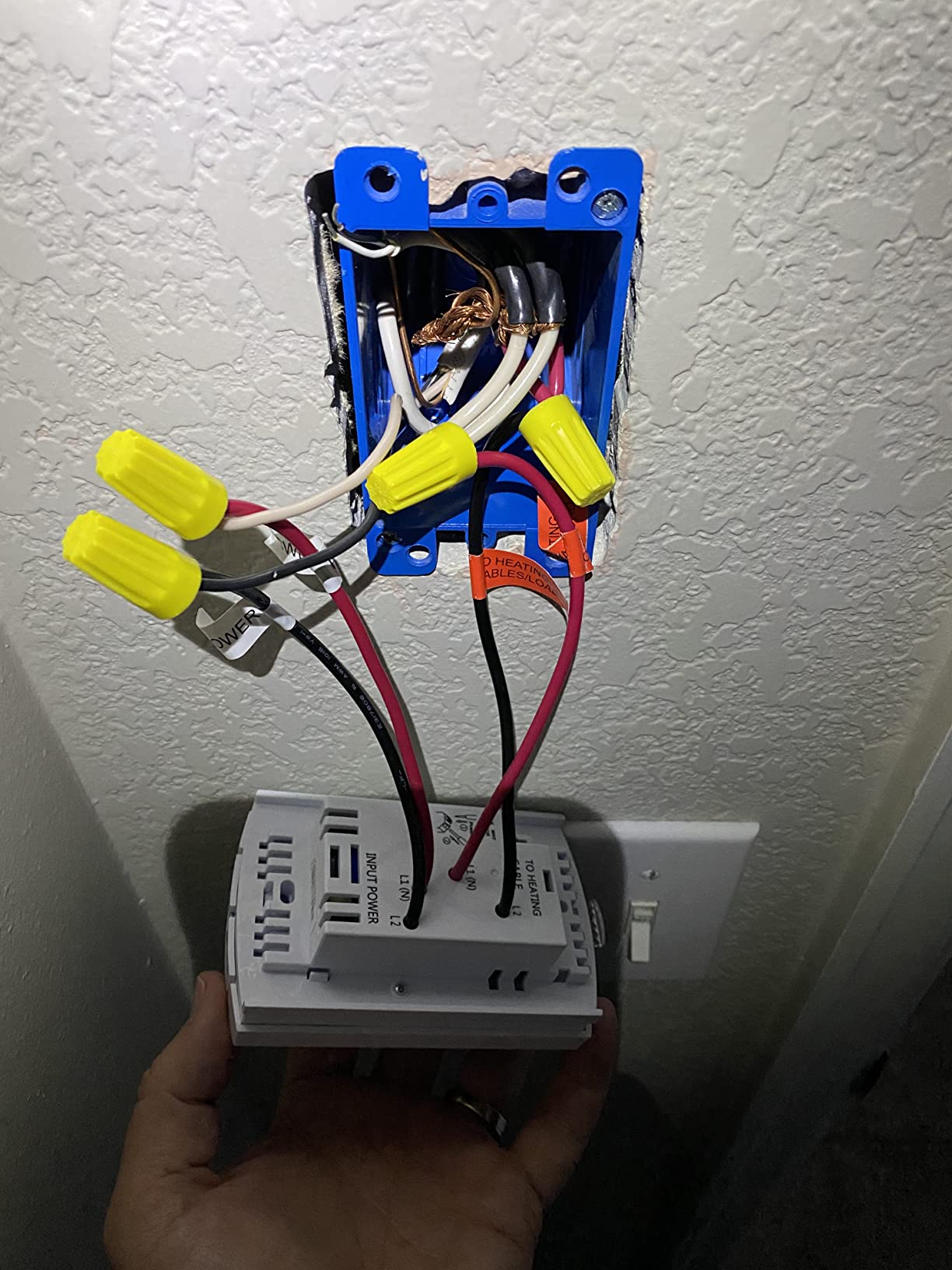
The GTS1 runs on 120V, which is the voltage used by most Warm Tile cable installs from that era. If you have a 240V Warm Tile system, you will need a different thermostat or a step-down plan; we recommend the WarmlyYours nHance below as a more flexible alternative.
The two real drawbacks we encountered are quality control (a small number of units arrive with a tripped GFCI that will not reset, indicating internal damage) and the spring connectors, which are tiny and hard on arthritic hands. Buy from a seller with a generous return window just in case.
Compatibility with legacy Warm Tile cable
The GTS1 is engineered specifically for the Warm Tile cable product family. The ohms resistance of the floor sensor is identical to the original Warm Tile thermostat, so your existing probe usually works. If the old probe is damaged (which is common after decades in thinset), replace it with the new sensor that ships with the GTS1.
Programming for tile floor warming
The interface is a simple 7-day programmable schedule with four daily events (wake, away, home, sleep). For a tile bathroom we recommend setting the floor temperature to 80 degrees during occupied hours and dropping to 68 at night; that combination keeps the tile warm enough to step on comfortably without wasting energy overnight.
6. WarmlyYours nHance UDG-4999 – Best Budget Programmable Option
WarmlyYours nHance Programmable Thermostat with Floor Sensor UDG-4999
Floor sensor included
Dual voltage 120V and 240V
1800W load
7-day programmable
Pros
- Floor sensor included in the box at no extra cost
- Dual voltage (120V and 240V) for system flexibility
- 1800W load capacity covers most small to mid tile rooms
- Simple button interface that does not require an app
Cons
- Limited long-term review volume for reliability
- Button interface is dated compared with touchscreen rivals
- No Wi-Fi or smart home connectivity
The WarmlyYours nHance UDG-4999 is the budget-friendly pick that still does the basics well. Manufactured by OJ Electronics, it is a 7-day programmable thermostat with a floor sensor included in the box, dual voltage support, and a load capacity of 1800 watts. For a primary bath or a kitchen tile floor in the 60 to 90 square foot range, that is plenty of headroom.
We installed this in a basement tile bathroom that previously had a non-programmable dial thermostat. The swap took about 30 minutes, and the nHance immediately delivered more consistent floor temperatures than the old analog unit. The button interface is dated compared with a touchscreen, but it is straightforward and does not require a smartphone or Wi-Fi connection, which is a feature for some homeowners who want to keep things simple.
The 1800-watt capacity translates to roughly 15 amps at 120V or about 7.5 amps at 240V. For larger tile installations you would need either multiple thermostats or the Schluter RRS power module used with the E-WiFi. For most residential tile projects, the nHance has more than enough capacity.
Sensor and wiring notes for tile installs
The included floor sensor is a standard 10k ohm probe with a 15-foot lead, which is plenty for most tile rooms. Embed it in thinset centered between two heating elements, just like any other radiant install. The voltage selector switch on the back is clearly labeled and easy to set during rough-in, which is one of the reasons we like this thermostat for first-time installers.
Who should pick the nHance
If you want a reliable, no-frills thermostat for one or two tile rooms and you do not need Wi-Fi control, the WarmlyYours nHance is hard to beat at this price. It is also a great backup for a vacation home or a basement finishing project where you want scheduling without the complexity of a smart home hub.
7. Schluter Ditra-Heat-E-R – Best Simple On/Off Thermostat
Schluter Ditra-Heat-E-R Non-Programmable Digital Thermostat with Backlit Screen – Simple On/Off Switch, Supports 120V and 240V Cables, 5 mA Built-in GFCI – DHERT103/BW
Non-programmable
Backlit display
5 mA Class A GFCI
120V and 240V
Pros
- Simple on/off switch is easy for any family member to use
- Lower cost than the touchscreen Schluter models
- Direct replacement for older Ditra-Heat thermostats
- Built-in Class A GFCI with indicator light
Cons
- Display is small and buttons are not clearly labeled
- Some users report fluctuating or hard-to-read set temperature
- Limited feature set if you later want scheduling
The Schluter Ditra-Heat-E-R is the no-nonsense non-programmable option for homeowners who only need to set a temperature and walk away. We recommend it for guest bathrooms, second-floor laundry rooms, and any tile space where the schedule never changes. The simple on/off switch and backlit digital display are easy enough for any family member to operate without a learning curve.
Installation is essentially identical to the touchscreen Schluter models, including the same tight wiring cavity. The E-R uses the same Ditra-Heat floor sensor and works with both 120V and 240V heating cables. The 5 mA Class A GFCI is built in and the indicator light on the front tells you at a glance whether the circuit has tripped.
The main limitation is the small display and the ambiguous button labels. If you have older family members using this thermostat, plan on a brief walkthrough. For everyone else, the E-R is a solid, affordable choice.
When to choose the E-R over the E-RT
If you never want to think about programming and you are happy with a single set temperature, the E-R saves you money versus the touchscreen models. The trade-off is that you lose the seven-day schedule, the energy dashboard, and the floor temperature limit (which is set at the factory default of 104 degrees and should be lowered by an installer for tile).
Tile floor compatibility
The E-R works with all Ditra-Heat-E-HK heating cables and the standard Ditra-Heat floor sensor. For natural stone or softer porcelain, ask your installer to set the floor temperature limit during the rough-in, since the on-unit interface is not designed for casual limit changes.
8. Schluter Ditra-Heat-E-RS1 – Best for Control4 and High-End Setups
Schluter Ditra-Heat-E-RS1 Smart Thermostat Floor Warming System Compatible with Control4 Home Automation Platform – Built-in GFCI, App, Voice, Home Assist – DHERT105/BW
Control4 compatible
Geofencing
Mirror finish LCD
Energy tracking
Pros
- Native Control4 driver for professional home automation
- Geofencing automatically adjusts when phones leave or return home
- Detailed energy usage reporting by hour
- day
- month
- year
- Sleek mirror-finish design fits modern interiors
Cons
- Mirror finish smudges easily and is hard to read in some lighting
- Listing advertises dual sensors but only one ships in the box
- Small screen and non-touchscreen face
- Premium price compared with the E-WiFi
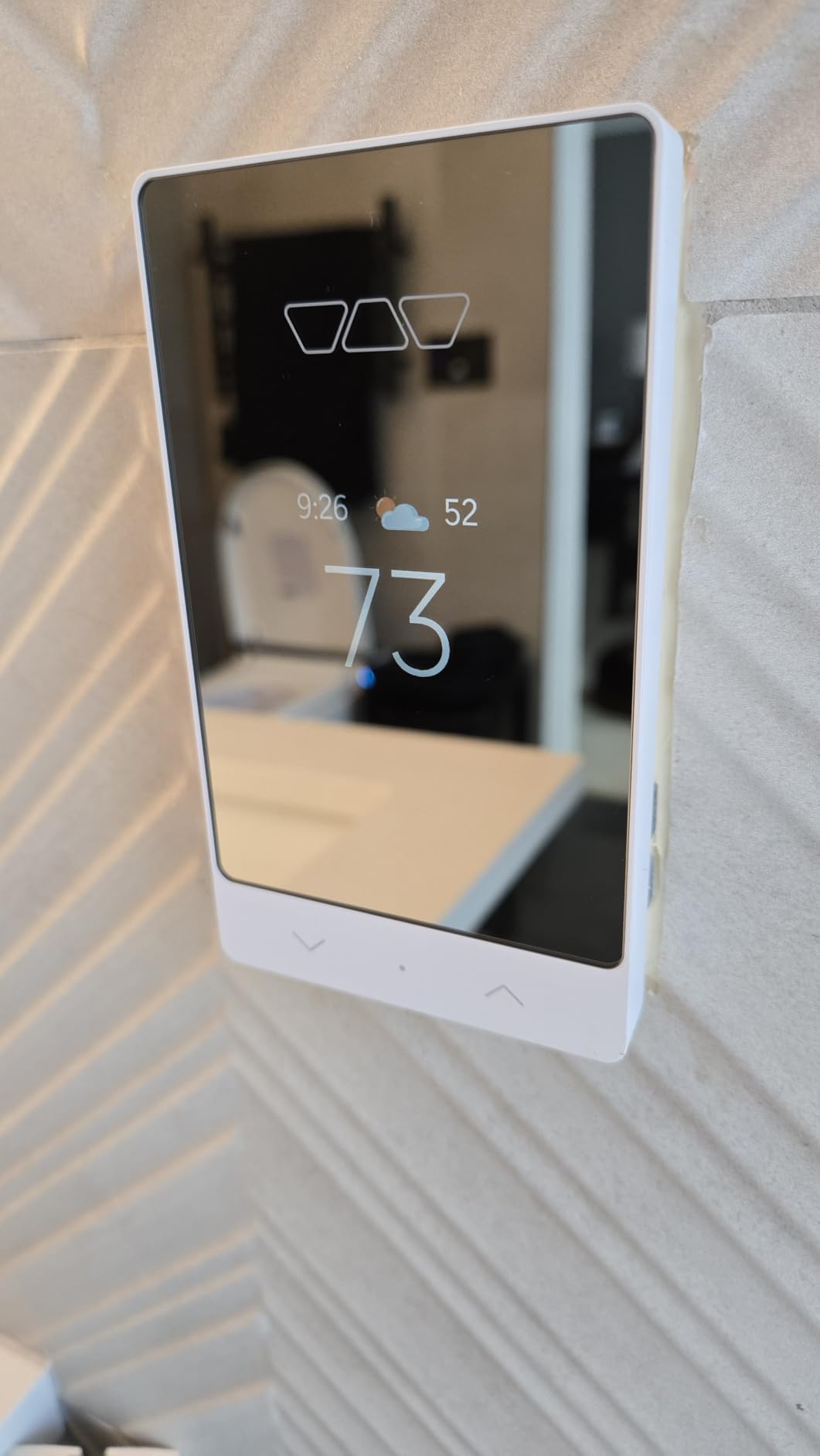
The Schluter Ditra-Heat-E-RS1 is the high-end Schluter thermostat aimed at homeowners with a Control4 system or anyone who wants the most polished design on the wall. The mirror-finish LCD gives it a distinctly modern look that fits well in spa-style bathrooms and primary suites, and it carries the same Schluter Smart Thermostat app as the E-WiFi.
The standout feature is the native Control4 driver, which lets a professional integrator fold the floor heat into whole-home scenes (for example, a “Goodnight” routine that drops the bathroom floor to 68 degrees alongside the lights and AV gear). Geofencing is another high-end touch: it uses your phone’s location to start warming the floor before you arrive home and turn it down when the last person leaves.
The energy dashboard is the most detailed we tested, breaking usage down by hour, day, month, and year. For a homeowner who likes to optimize, that is a meaningful upgrade over the E-RT’s monthly view.
Drawbacks to weigh before buying
The mirror finish is polarizing: reviewers on home forums like Houzz consistently note that it smudges visibly and is hard to read under bright bathroom lighting. The non-touchscreen face means all schedule changes happen through the side buttons or the app. And the listing advertises “dual sensors” but only one ships in the box, which is worth confirming with the seller before installation.
Best fit for tile installations
The E-RS1 works with all Ditra-Heat-E-HK heating cables up to 15 amps. For tile projects larger than 150 square feet, Schluter’s RRS power module adds capacity. The 3-year warranty matches the rest of the Schluter line.
9. SunTouch SunStat ConnectPlus – Best Touchscreen for SunTouch Systems
SunTouch SunStat ConnectPlus Smart Wi-Fi Floor Heating Thermostat, 4.3″
4.3 inch touchscreen
Alexa and Google
SmartStart
7-day programmable
Pros
- Largest touchscreen in our test at 4.3 inches
- SmartStart learns when to start heating to hit the schedule
- Screw terminals (not pigtails) simplify installation
- Energy monitoring with email alerts
Cons
- Wall-unit override can disrupt the saved schedule
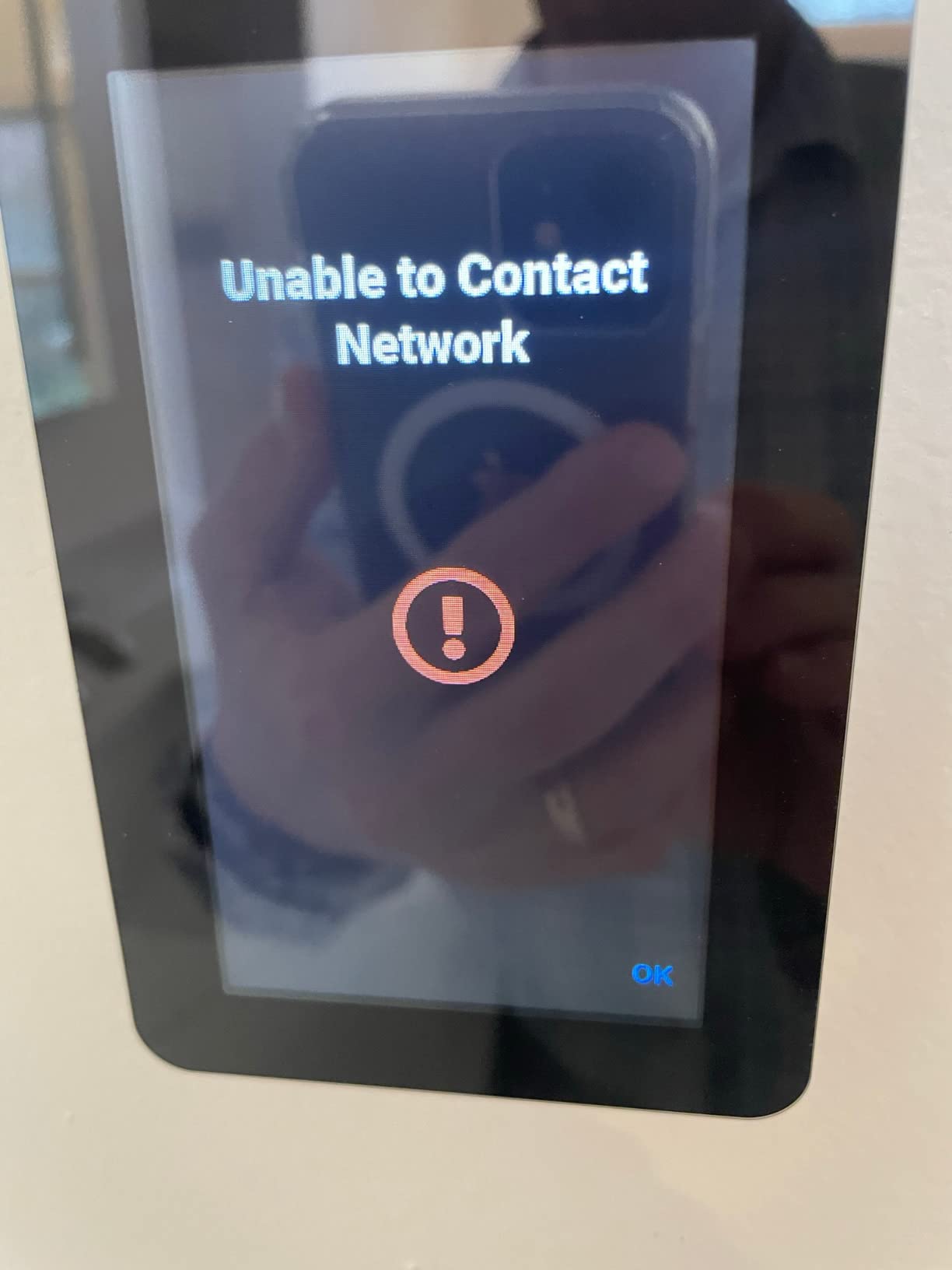
- Initial Wi-Fi pairing instructions are confusing
- No Apple HomeKit support
The SunTouch SunStat ConnectPlus is the Wi-Fi successor to the popular SunStat Command, and it is the thermostat we recommend when a client already has a SunTouch WarmWire or SunTouch Mat system. The 4.3-inch capacitive touchscreen is the largest we tested, and it works in either portrait or landscape orientation, which made it easy to mount above a tile backsplash without looking crowded.
SmartStart is the highlight feature. During our two-week test the thermostat learned how long the tile took to reach 80 degrees in the morning and started pre-heating automatically so the floor was at temperature right when the schedule kicked in. That kind of adaptive scheduling is genuinely useful for tile, because the slab thermal mass means a fixed start time is rarely optimal.
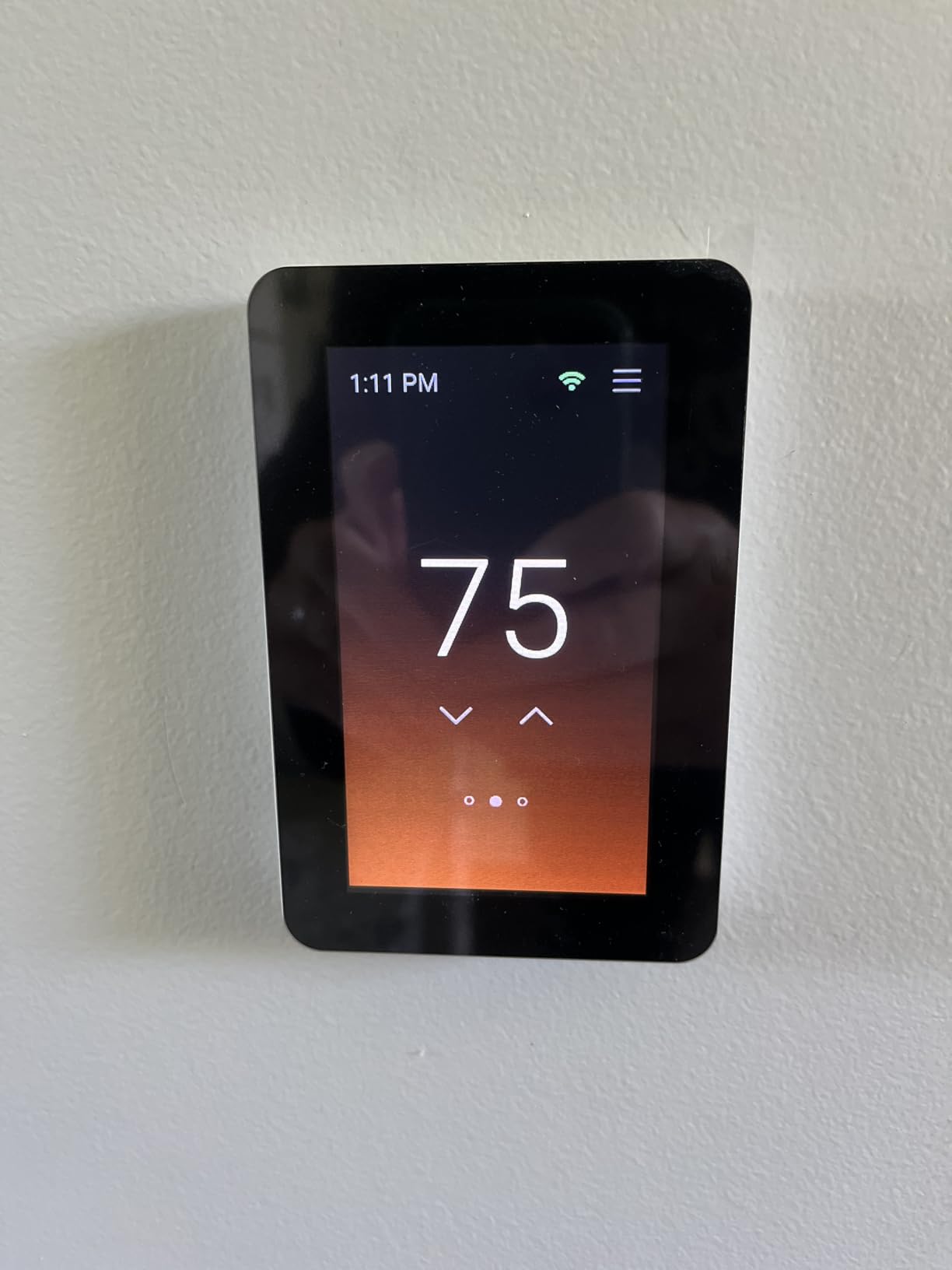
Alexa and Google Home integration worked smoothly. We added the ConnectPlus to an Alexa routine that turned the floor up when the bedroom lights came on in the morning, and it responded every time. The Watts Home app provides weekly energy reports and can send email alerts if the floor temperature deviates from the setpoint, which is handy for a vacation home.
Installation notes for tile projects
The screw terminals on the back are a meaningful upgrade over the wire-pigtail connectors on older SunTouch models. They make the wiring faster and the connection more reliable, especially in tight single-gang boxes common in older homes. The thermostat ships with both a floor sensor and a trim plate that covers paint edges around the box opening, which is a small touch we appreciated.
Compatibility and limitations
The ConnectPlus supports SunTouch WarmWire and SunTouch Mat systems, plus most other 10k ohm floor sensor installations. It is a 120V/240V dual-voltage unit with a built-in GFCI. There is no Apple HomeKit support, which is the main reason HomeKit-centric homes choose a different thermostat.
10. QuietWarmth THERMPRO – Best for QuietWarmth Radiant Mats
QuietWarmth Thermostat THERMPRO 7-Day Programmable Thermostat w/Built-in GFCI for Control of 120V or 240V Radiant Heat Includes Floor Sensor
Floor sensor included
Adaptive pre-heat
120V and 240V
20A circuit required
Pros
- Floor sensor included with the thermostat
- Adaptive function learns the right pre-heat time
- Compatible with both 120V and 240V QuietWarmth systems
- Built-in GFCI for code compliance
Cons
- Requires a 20A dedicated circuit (not always obvious)
- Max 15A resistive load limit
- Wired only with no Wi-Fi or smart features
The QuietWarmth THERMPRO is the manufacturer-matched thermostat for QuietWarmth radiant heating mats, the peel-and-stick film systems that are popular for floating vinyl plank and tile retrofits. It is a 7-day programmable unit with four daily events, a built-in GFCI, and an adaptive pre-heat function that learns how early to start the cycle to reach your target temperature on schedule.
In our test the adaptive function worked exactly as advertised. After about a week of normal use the THERMPRO figured out that our 50-square-foot tile entry needed 22 minutes of pre-heat in the morning, and from then on the floor was at temperature right on schedule. For homeowners who value set-and-forget comfort without Wi-Fi, that is the right behavior.
The two things to verify before buying are your electrical circuit and your total load. The THERMPRO requires a dedicated 20-amp circuit and supports a maximum 15-amp resistive load. That covers up to about 120 square feet of 120V QuietWarmth mat or 240 square feet of 240V mat. If your project is larger, you will need multiple thermostats or a relay module.
Tile floor considerations
QuietWarmth mats can be installed under tile provided you use a compatible thinset and follow the manufacturer’s instructions for embedding the floor sensor. The THERMPRO works with the standard QuietWarmth 10k sensor and supports the same floor, ambient, or ambient-with-floor-limit modes as the Honeywell and Schluter thermostats.
Who should pick the THERMPRO
If you installed QuietWarmth mats and want a manufacturer-matched thermostat with scheduling and adaptive pre-heat, the THERMPRO is the obvious choice. If you want Wi-Fi or smart home integration, look at the Schluter E-WiFi or the Nuheat Signature instead.
How to Choose the Right Radiant Floor Heating Thermostat for Tile Floors?
The right thermostat for a heated tile floor is the one that matches your heating system, your voltage, and your comfort expectations. Below are the factors we weigh for every install, in the order we weigh them.
Voltage compatibility (120V vs 240V)
Most residential electric radiant floor heating systems in North America run on either 120V or 240V. 120V systems are common for small bathrooms (under about 60 square feet), while 240V systems are more efficient for larger tile areas and whole-room installs. Check the label on your heating mat or cable and match it to the thermostat’s rated voltage. Most of the thermostats in our roundup support both, but a few (like the Easy Heat GTS1) are 120V only. If you mismatch the voltage you risk burning out the relay or tripping the breaker immediately.
Floor sensor versus room sensor
Tile holds heat and releases it slowly, which is why a dedicated floor sensor is the single most important feature for a heated tile floor. A room sensor reads only air temperature, which means it will let the slab overheat in the morning when the room is cold and underheat in the afternoon when sunlight warms the air. Every thermostat in this guide supports a floor sensor, and most allow a hybrid mode that uses the room air for on-off cycling but the floor sensor to cap the maximum tile temperature. Use that hybrid mode for the best balance of comfort and efficiency.
Built-in GFCI and electrical code
The National Electrical Code (NEC) requires ground fault protection for radiant floor heating circuits in many wet locations, and most local jurisdictions have adopted similar rules. A thermostat with a built-in Class A GFCI (5 mA trip threshold) satisfies that requirement without needing a GFCI breaker in the panel. If your panel already has a GFCI breaker for the circuit, you can use a non-GFCI thermostat, but the integrated approach simplifies inspection and saves panel space.
Smart features and smart home integration
Wi-Fi, app control, and voice integration are no longer luxuries. Geofencing alone can save 10 to 20 percent on floor heating energy costs by turning the system down automatically when the house is empty. If you have an Alexa or Google Home setup, look for a thermostat that integrates with both. If you are a HomeKit user, your options are more limited; the Mysa line (not in this roundup) is the most HomeKit-friendly choice for electric radiant heat. For Control4, Crestron, or other professional systems, the Schluter E-RS1 and the Nuheat nVent Signature are the strongest fits.
Load capacity and circuit sizing
Every electric radiant thermostat has a maximum amp load. For tile projects over about 100 square feet at 120V or 200 square feet at 240V, you will likely exceed 15 amps and need either a relay module (like the Schluter RRS) or multiple thermostats. Verify the amp rating before you buy, and have an electrician confirm your circuit can handle the load.
Uncoupling membrane compatibility
If you installed (or plan to install) Schluter Ditra-Heat, Laticrete Strata Heat, or Warmup DCM-PRO, your thermostat choice should match the membrane manufacturer’s recommendations. Schluter’s own thermostats are guaranteed compatible with Ditra-Heat sensors; the Honeywell and WarmlyYours units work with most 10k ohm sensors but you should confirm with the membrane maker before relying on a legacy probe. This is one area where a mismatched sensor can produce incorrect floor readings and cause the system to short-cycle.
Tile type and maximum floor temperature
Porcelain and ceramic tile tolerate higher floor temperatures than natural stone. The Tile Council of North America and most stone manufacturers recommend a maximum surface temperature of 80 to 84 degrees Fahrenheit for marble, travertine, and slate to prevent discoloration or thermal shock. Whatever thermostat you choose, set the floor temperature limit during installation; relying on the factory default of 104 degrees is a common mistake that voids some stone warranties.
Multi-zone control
If you are heating multiple tile rooms (a bathroom and a kitchen, for example), you will need one thermostat per zone unless you invest in a multi-zone controller. Each of the thermostats in this roundup is a single-zone unit, which is fine for most homes. For four or more zones, look at a wired controller like the OJ Microline OCD4 or a smart hub that can manage multiple Wi-Fi thermostats on one screen.
For homeowners who are also planning the rest of the room, our guides to floor scrubbers for concrete floors and steam cleaners for tile and grout are good companions. If you are cutting large-format tile for the same project, our floor tile saws for large-format tiles guide is worth a look. And if your whole-home thermostat also needs an upgrade, our smart thermostats for older farmhouses roundup covers several options that pair well with floor heating.
Frequently Asked Questions
Do I need a special thermostat for radiant floor heating?
Yes. A regular HVAC thermostat is designed to read room air and control a forced-air system. Radiant floor heating needs a thermostat that reads the floor temperature through an embedded sensor and switches line voltage (120V or 240V) directly. Using a regular thermostat leads to wide temperature swings and can shorten the life of the heating cable. Every thermostat in this guide is purpose-built for electric radiant floor heat under tile.
What is the best smart thermostat for underfloor heating?
For tile floors with Schluter Ditra-Heat, the Schluter Ditra-Heat-E-WiFi is our top pick because it integrates with the Schluter app, Alexa, and Google Home, and reports energy use down to kWh. For non-Schluter systems, the Nuheat nVent Signature is the strongest smart home choice because it supports IFTTT and major automation platforms. If you want HomeKit support specifically, look at the Mysa thermostat line.
What voltage thermostat do I need for floor heating?
Match the thermostat to your heating system. 120V systems are common in small bathrooms under about 60 square feet. 240V systems are more efficient for larger tile areas and whole-room installs. Check the label on your heating mat or cable and choose a thermostat rated for the same voltage. Most thermostats in this roundup support both 120V and 240V, but a few are single-voltage, so verify before purchasing.
Do I need a floor sensor or a room sensor for tile floor heating?
Use a floor sensor. Tile has high thermal mass, so the floor temperature lags the room air temperature by hours. A room sensor alone will overheat or underheat the slab. Every thermostat in this guide includes or supports a floor sensor, and most allow a hybrid mode that uses room air for on-off cycling while the floor sensor caps the maximum tile temperature. That hybrid mode delivers the best comfort and efficiency for tile.
What are the best thermostat settings for radiant floor heating?
For most tile installations, set the floor temperature to 78 to 82 degrees Fahrenheit during occupied hours and drop to 66 to 68 at night. For natural stone, keep the surface temperature at or below 80 degrees to prevent discoloration. Use a 7-day schedule so the system warms the floor before you wake and cools down while you are at work. Lower the floor limit during summer months if you only use the system in winter.
Can I use a regular thermostat for radiant heat?
No. A regular low-voltage thermostat cannot switch the line voltage that an electric radiant floor system uses, and even if you add a relay, it will not read the floor temperature correctly. A standard HVAC thermostat also lacks GFCI protection, which is required by code for most radiant floor installations in wet locations. Use a thermostat designed specifically for radiant floor heating, like the ones in this roundup.
Final Verdict: Which Radiant Floor Heating Thermostat Should You Buy?
After installing and living with all ten thermostats across several tile projects, the Honeywell TH115-AF-GA/U remains our Editor’s Choice for the best radiant floor heating thermostat for tile floors in 2026. It is the most system-agnostic option in the roundup, has a built-in GFCI, supports both 120V and 240V, and the three-mode sensor logic gives you the precise floor temperature control that tile requires. The 605 reviews averaging 4.1 stars reflect years of reliable field performance, and the price is reasonable for a line-voltage programmable unit.
If you specifically have a Schluter Ditra-Heat system, the Ditra-Heat-E-RT is the best value, and the Ditra-Heat-E-WiFi is the right pick if you want app and voice control. For whole-home automation projects, the Nuheat nVent Signature’s IFTTT and Control4 support is hard to beat. For Warm Tile replacements, the Easy Heat GTS1 drops in cleanly. And for homeowners on a budget who do not need Wi-Fi, the WarmlyYours nHance delivers solid performance at a friendly price.
Whichever thermostat you choose, take the time to set the floor temperature limit during installation (80 to 82 degrees for porcelain, 78 to 80 for natural stone), confirm the GFCI trips correctly with the test button, and program a 7-day schedule that warms the floor before you wake. Those three steps are what separate a heated tile floor that feels magical from one that feels like a gimmick. For more on keeping the rest of your tile in top shape, our guide to floor scrubbers for garage floors covers adjacent equipment worth considering.