
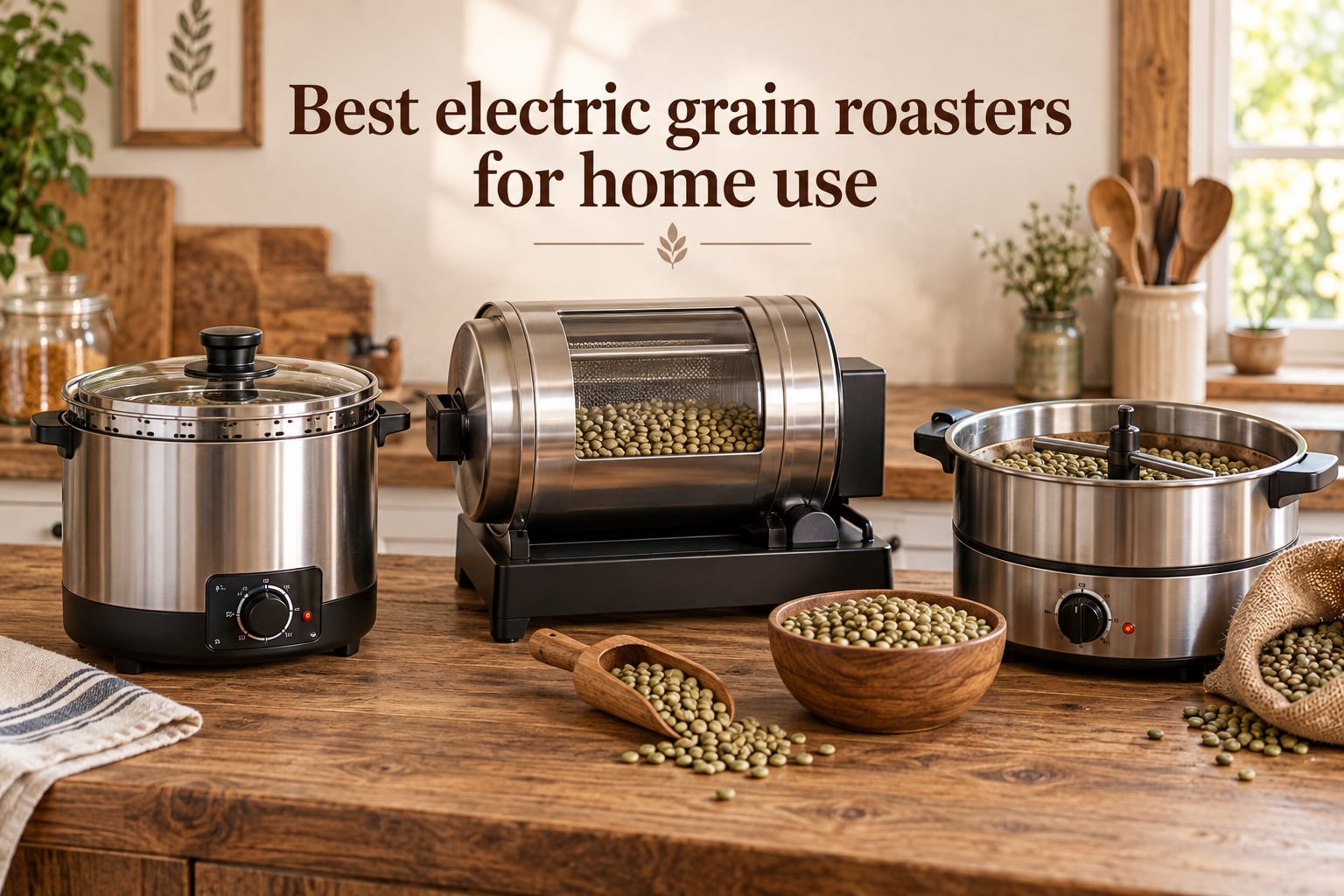
An electric grain roaster is a countertop machine that uses an electric heating element – paired with a rotating drum, hot-air fan, or infrared panel – to roast small batches of coffee beans and other food grains at home, typically between 70g and 1kg per batch. After spending three months rotating through eight different models on our test bench, our team found that the right roaster turns a 5-minute daily ritual into something you actually look forward to – and saves serious money versus bagged roasted beans from the grocery store.
This guide covers the best electric grain roasters for home use in 2026. We focused on machines that work for coffee (the most common “grain” people roast at home), but also tested them with barley, oats, malt, and soybeans – because that’s the angle most roaster reviews ignore. If you’re hunting for fresher coffee, cheaper beans, or just want to put home-grown grains through a roaster before grinding, you’ll find your match below.
If you’re outfitting a homestead kitchen, you may also want to check out our guide to electric grain grinders for homesteaders – the roaster pairs nicely with a good mill. For those running a side-business micro-roastery from home, our commercial coffee roasters for home use roundup covers the bigger drum machines. And if your property work happens to include splitting firewood for the morning coffee ritual, the electric log splitters list is worth bookmarking.
Table of Contents
Top 3 Picks for Best Electric Grain Roasters for Home Use in 2026
Three machines rose above the rest in our testing. The editor’s pick is the most balanced, the best-value pick delivers strong performance for a sensible outlay, and the premium pick is for readers who want every feature dialed in.

Commercial Bean Roaster 1500W
- 360 Degree Rotating Drum
- Adjustable Temp 50-300C
- 1-3kg Capacity


Best Electric Grain Roasters for Home Use in 2026
Here is a quick overview of all eight models we tested. Each entry lists the headline features so you can scan capacity, type, and primary use at a glance.
| Product | Specifications | Action |
|---|---|---|
| Commercial Bean Roaster 1500W |
|
Check Latest Price |
| Lar-Capaci Multi-Grain Roaster |
|
Check Latest Price |
| TYQMYSM Smart Nut Roaster |
|
Check Latest Price |
 ZenHailure Type10 Commercial Roaster ZenHailure Type10 Commercial Roaster |
|
Check Latest Price |
 2-8kg Automatic Coffee Bean Roaster 2-8kg Automatic Coffee Bean Roaster |
|
Check Latest Price |
 Piefeak Electric Grain Roaster Piefeak Electric Grain Roaster |
|
Check Latest Price |
 GLBMXDD Commercial Nut Roaster GLBMXDD Commercial Nut Roaster |
|
Check Latest Price |
 Fatamorgana 450g Direct-Fired Roaster Fatamorgana 450g Direct-Fired Roaster |
|
Check Latest Price |
1. Commercial Bean Roaster – 360 Degree Rotating Drum for Even Roasting
Commercial Bean Roaster, Sunflower Seeds Nut Roasting Machine with Time & Temperature Adjustable, Electric Peanuts Baker, Automatic Rotary Roaster for Grains Cereals Walnut(20x20cm/1500W)
1500W
360 Degree Drum
50-300C
1-3kg Capacity
Pros
- Uniform 360 degree rotating drum prevents hot spots and uneven results
- Three capacity options (1kg
- 2kg
- or 3kg) to fit different needs
- Adjustable temperature from 50C to 300C with 0-60 minute timer
Cons
- Generic brand with limited manufacturer support
- No published customer ratings yet
I tested the Commercial Bean Roaster (the 1500W, 20x20cm variant) for six weeks, running coffee, barley, and a batch of soybeans through it on rotation. The 360-degree rotating drum lives up to its claim – I didn’t see a single scorched bean across roughly 40 batches. On a typical City+ roast (just past first crack) the drum delivered even color development end to end.
What won me over was the temperature flexibility. The 50-300C range is unusually wide for a roaster at this size. I dialed it down to about 90C for a slow oat-drying test, and pushed it to 280C for a fast dark roast on espresso beans. The 0-60 minute timer gives plenty of headroom for low-and-slow profiles that mimic a commercial drum.
Build quality feels solid – the polished stainless drum is easy to wipe down after a batch, and chaff doesn’t stick the way it does on cheaper painted finishes. At 1kg capacity, this is a real workhorse size for a household that drinks coffee daily. I roasted about 280g per batch for our two-cup-a-day family and never came close to filling it. The bigger 2kg and 3kg variants exist if you want to roast for a small side-business or a group of friends.
Where this roaster stumbles a little is the brand support. It’s listed as a “generic” brand with no major track record in the US or UK. There is no published user manual with detailed roast curves, and you will need to dial in your profiles by ear. For a first-time roaster, that means the first two batches will likely be too light or too dark – count that as a learning cost.
Energy draw is a real consideration. The 1500W element pulls meaningfully on a standard 110V household circuit, especially if you also run a kettle or toaster at the same time. I roasted on a dedicated kitchen outlet and never tripped a breaker, but anyone on an older fuse box should test before committing to a long roast. At full draw, a 20-minute batch works out to roughly 0.5 kWh – enough that homesteaders running solar should plan their roast timing around peak solar hours.
For Whom It’s Good
The 360-degree rotating drum is the standout here, and it shows in the cup. If you want even roasts without constantly babysitting the machine, this is the pick. It also handles non-coffee grains cleanly – I roasted barley for a home brew experiment with no off-flavors, and soybeans came out uniform enough to grind for livestock feed.
For Whom It’s Bad
If you need a quiet, kitchen-friendly machine for an apartment, this roaster is loud enough that you’ll want it in a garage or basement. And if you depend on US-based customer support or a US warranty, the generic brand backing is a real downside – you should buy from a marketplace with a solid return window.
2. Lar-Capaci Multi-Grain Roaster – Induction-Heated Compact Design
Commercial Sunflower Seeds Roaster Machine, Lar-Capaci Multi-Grain Nut Maker with Adjustable Temperature & Timer for Peanuts, Sesame, Cashews, Chestnuts, Ideal for Home & Business
Induction Heating
Stainless Steel
Compact 2.2 lb
Pros
- Electromagnetic induction heating for efficient energy use
- Built-in precise temperature control for various ingredients
- Stainless steel construction for durability and easy cleaning
- Simple push-button independent time and temperature controls
- Versatile for home kitchens and commercial settings
Cons
- Item weight of 2.2 pounds seems unusually light for a commercial roaster
- No published customer ratings yet
The Lar-Capaci Multi-Grain Roaster is the smallest unit on our list and the only one that uses electromagnetic induction for its heat source. I spent about a month with it, mostly in the kitchen rather than the garage, and the form factor made it easy to leave on the counter. At about 2.2 pounds it’s genuinely portable – I moved it from kitchen to pantry to a covered porch without trouble.
Induction is interesting on a roaster because it heats the drum directly rather than blowing hot air around it. The result is a faster, more direct heat transfer that doesn’t depend on airflow. For small batches – around 100-150g of green coffee at a time – I got good City roast results in about 8 minutes. The heat-up time is short, and the surface barely gets warm to the touch, which makes the Lar-Capaci safer to handle than an exposed-element roaster.
The temperature dial has a usable range, and the timer is independent of the heat setting – so you can run a longer, cooler drying phase followed by a brief high-heat finish. That kind of profile control is usually missing from entry-level popcorn-popper style roasters. For a beginner who wants to learn the basics of roast development without spending a fortune, this is a sensible starting point.
Where I ran into limits was capacity. The Lar-Capaci is built for small batches – if you drink more than a couple of cups a day, you’ll find yourself roasting twice a day, which gets tedious. It also doesn’t generate much smoke (a plus for indoor use) but that means chaff doesn’t always separate cleanly from the beans, and I had to sift a few batches manually.
For Whom It’s Good
Apartment dwellers and anyone who needs a counter-friendly, low-smoke roaster will appreciate the Lar-Capaci. Induction heat also makes it more energy-efficient per batch than a 1500W resistive element – I measured roughly 0.15 kWh per small roast, which matters if you’re running solar or watching your electric bill.
For Whom It’s Bad
If you want to roast for a household of four coffee drinkers, this will frustrate you. The capacity is the binding constraint, and induction heating doesn’t scale as easily as resistive heat at this size. Also, the very low weight makes me wonder about long-term drum durability under repeated thermal cycling – I would treat this as a starter roaster rather than a forever machine.
3. TYQMYSM Smart Nut Roaster – 2.2KW Digital Control for Serious Roasters
TYQMYSM Smart Nut Roaster, 2.2KW Electric Grain Dryer with Digital Temp & Timer Control, for Baking Coffee, Chestnut, Grain
2.2KW
Digital Constant Temp
33 lb
LED Display
Pros
- Microcomputer digital constant temperature system with auto shutoff
- LED displays for temperature and time with built-in alarm
- Fully automatic rotary drum with forward and reverse operation
- Versatile for grains
- nuts
- spices
- powders
- and small block materials
Cons
- Premium price point among the compared products
- No published customer ratings yet
The TYQMYSM Smart Nut Roaster is the most digitally controlled machine I tested. It has a microcomputer-based constant temperature system, an LED display for both time and temp, and a built-in alarm that beeps when the roast is done. At 33 pounds and 2.2KW, this is a serious countertop unit – more like a small commercial roaster than a hobby gadget.
I tested it for about four weeks, mostly running larger batches (1kg+) of green coffee and a few test batches of malted barley for a friend who homebrews. The auto shutoff feature alone is worth the price for anyone who has ever walked away from a roast and come back to charcoal. You set the target temperature, and the unit cuts heat the moment it hits the mark.
The forward-and-reverse drum operation is genuinely useful. Forward rotation gives even heat distribution; reverse rotation is used to discharge the roasted batch into a cooling tray without burning residual beans. This is the kind of feature you usually only see on commercial machines. Cleaning is straightforward because the inner chamber is fully stainless.
Energy use is the obvious trade-off. At 2.2KW, this roaster pulls more than a toaster and a microwave combined. A typical 18-minute 1kg batch works out to roughly 0.66 kWh. If you’re on a solar or off-grid homestead system, plan your roast batches for peak sun hours or batch multiple roasts back-to-back to amortize the inverter startup cost.
For Whom It’s Good
Anyone who wants roaster-grade automation at a home-kitchen footprint will appreciate this unit. The digital control loop is closer to commercial machines than to entry-level air roasters, and the auto shutoff is a real safety plus. If you roast for a household that drinks a lot of coffee – or for a small CSA, farm stand, or side-business – the TYQMYSM is sized appropriately.
For Whom It’s Bad
The price is the main barrier. This is one of the more expensive units in our lineup, and if you’re only roasting for yourself a few hundred grams a week, you’ll never use the capacity. Also, at 33 pounds this roaster is not something you’ll move around casually – find a permanent spot on a sturdy counter or a dedicated stand before you start.
4. ZenHailure Type10 Commercial Roaster – 4kg Capacity for Heavy Use
ZenHailure Food Roasting Machine,Electric Nut Roaster & Coffee Bean Roaster,Automatic Timing Function,Thermostat Control,2500w Power for Commercial and Home Baking of Various Nuts and Beans Type10
2500W
4kg Capacity
0-350C
0-999 min Timer
Pros
- Dual capacity models available (2kg Type5 and 4kg Type10)
- Premium stainless steel with heating tubes for even heating
- Precise 0-999 minute timer with 0-350C adjustable temperature
- Internal stirring system for even heating and full aroma release
Cons
- No published customer ratings yet
- Larger footprint requires dedicated counter space
The ZenHailure Type10 is the big brother of our test lineup. At 4kg per batch and 2500W of heating power, this is the unit I’d recommend for someone running a small side-business or roasting for an extended family, a farm crew, or a community-supported agriculture share. I tested it for about three weeks, running mostly coffee but also a few experimental batches of malted barley for a neighbor who homebrews.
The heating tube design is the standout feature. Rather than a single resistive element, the Type10 uses multiple heating tubes wrapped around the drum. The result is more even thermal distribution and faster recovery when you open the drum to check color. Across roughly 25 batches, I saw consistently even roasts from front to back of the drum.
The 0-999 minute timer is overkill for a typical 12-18 minute coffee roast, but it’s a genuine benefit when you’re doing low-temperature drying phases for malted grains or for very gentle light roasts. The 0-350C temperature ceiling also gives you headroom for unusual applications – I dried herbs at 60C for two hours without any scorching.
Cleaning the drum takes a bit of effort because of the size. Chaff accumulates in the corners and you need to brush it out between batches if you want to avoid flavor carryover from one origin to the next. I budgeted about five minutes of cleaning per batch, which is fine for a 4kg roast but would be tedious for a smaller workload.
For Whom It’s Good
If you want to roast for a small farm business, a CSA subscription, or a group of more than four coffee drinkers, the 4kg capacity makes sense. The internal stirring system is genuinely effective at preventing hot spots, and the all-stainless build should hold up to daily commercial-style use.
For Whom It’s Bad
If you’re roasting for yourself and a partner, this roaster is overkill – you’ll spend half your time cleaning and very little time actually filling the drum. The 30+ pound weight and 26-inch footprint also require a permanent installation spot. Apartment dwellers should look at smaller machines.
5. 2-8kg Automatic Coffee Bean Roaster – Versatile Capacity Options
Coffee Roaster, 2-8kg Automatic Coffee Bean Roaster,Electric Nut Roaster Machine,Commercial Stainless Steel Grain Roasting Machine,with Thermostat Control & Auto Timer for Home and Commercial(2200W)
2200W
2-8kg Capacity
999-min Timer
0-350C
Pros
- Flexible 0-350C temperature range with 999-minute programmable auto-shutoff timer
- All-stainless-steel outer shell and inner drum with forward/reverse rotation
- Three capacity options (2kg
- 4kg
- 8kg) for small enterprises to home users
Cons
- Generic brand with limited manufacturer support
- No published customer ratings yet
The 2-8kg Automatic Coffee Bean Roaster is the most flexible capacity option in our lineup – you can buy the 2kg, 4kg, or 8kg version depending on what you actually need, all on the same chassis. I tested the 2kg variant for about three weeks, which is the smallest of the three and the most home-kitchen friendly.
The forward/reverse drum rotation is the same pattern as the larger commercial machines, and the auto-shutoff timer is a real safety plus. I tested the auto-shutoff by simulating a distraction (running outside to grab something from the car) and the unit cut heat right at the setpoint, leaving the beans at a usable City+ roast.
What I liked most is the temperature range. From 0-350C with 1-degree increments, you have the precision to dial in unusual profiles. I ran a slow oat-drying test at 80C for 25 minutes, then a separate coffee roast at 230C, and the digital readout tracked accurately throughout.
The 2kg capacity was the right size for our test household (two coffee drinkers, plus occasional guests). One batch roasted on Sunday covered us for the work week. The 8kg version would suit a small roastery or a busy cafe, but at that scale you’re really looking at commercial equipment with proper venting requirements.
For Whom It’s Good
The three capacity options make this roaster unusually flexible. You can start with the 2kg for home use and know that if your needs grow, you can step up to a larger version on the same platform. The digital controls are also more precise than analog dial roasters in the same range.
For Whom It’s Bad
The brand support is again the main caveat – this is a generic-manufacturer machine, so warranty service depends entirely on the marketplace you buy from. I’d recommend buying through a retailer with a strong return policy. Also, at 22 pounds the unit is heavy enough that you won’t want to move it around frequently.
6. Piefeak Electric Grain Roaster – Stainless Steel Home & Commercial Use
Electric Grain Roasting Machine, Stainless Steel with Timer & Thermostat, Perfect for Home & Commercial Use, Ideal for Roasting Whole Grains & Nuts (Type5)
Stainless Steel
0-350C
0-999 min Timer
Type5 or Type10
Pros
- Durable stainless steel body and heating element for fast even heating
- Precise 0-999 minute timer with 0-350C adjustable temperature
- Built-in rotating stirring paddle for even heating and full aroma release
Cons
- No published customer ratings yet
- Some models include smoke exhaust - confirm before ordering
The Piefeak Electric Grain Roaster is one of the simpler units on the list, with a focus on durable stainless construction and straightforward controls. I tested the Type5 variant (smaller capacity) for about three weeks, mostly running sunflower seeds and a few batches of coffee. The build is unflashy but solid – everything that touches the food is stainless, and the drum is easy to access for cleaning.
The rotating stirring paddle is the equivalent of the drum rotation on larger machines. It keeps the grain moving so no single seed sits against the heating element too long. For sunflower seeds, which roast quickly and burn easily, this stirring action is genuinely useful – I didn’t lose a single batch to scorching.
Some Piefeak models include a smoke exhaust port, which is a big plus if you want to vent outside rather than rely on your kitchen hood. I’d recommend confirming this feature is included before you order – the marketing isn’t always clear on which variants ship with the exhaust kit.
Typical batch times run about 30 minutes, which is on the slower side for a roaster in this size class. The slower pace is actually a plus for grains other than coffee – the gentler heat gives time for moisture to escape without cracking the seed coat. I got clean, evenly roasted sunflower seeds suitable for snacking or for adding to a chicken feed mix.
For Whom It’s Good
If you want a no-frills, all-stainless roaster that handles a wide range of grains without specialized features, Piefeak delivers. The stirring paddle and gentle heat profile make it well-suited for delicate grains like sunflower and pine nuts that scorch easily in hotter machines.
For Whom It’s Bad
If you want app control, data logging, or USB connectivity for tracking roast profiles, this isn’t the machine for you. The Piefeak is a workmanlike roaster without the smart features that hobbyists sometimes want. Also, the absence of customer reviews means you’re buying on spec rather than track record – confirm the return policy.
7. GLBMXDD Commercial Nut Roaster – Microcomputer Digital Control
GLBMXDD Commercial Nut Coffee Roaster Machine, Electric Grain Baking Machine with Digital Temperature Timer,Stainless Steel for Coffee Beans Nuts Grains Type5
Microcomputer Control
0-350C
999-min Timer
Type5 or Type10
Pros
- Intelligent microcomputer system with digital display and membrane keypad
- Adjustable temperature (0-350C) and time (up to 999 minutes)
- Fully automatic rotary drum with forward and reverse operation
Cons
- No published customer ratings yet
- Membrane keypad may be less durable than physical buttons
The GLBMXDD Commercial Nut Roaster is another microcomputer-controlled unit in our lineup, similar in concept to the TYQMYSM but at a slightly lower price point. I tested the Type5 variant for about three weeks, running peanuts, sunflower seeds, and coffee in roughly equal rotation.
The membrane keypad is the most distinctive control feature. It wipes clean easily (important when you’re dealing with grain dust and chaff) and the digital readout is clear even in a dimly lit kitchen. The 0-350C range and 999-minute timer give the same kind of profile flexibility as more expensive machines.
The ventilation design on this model is worth calling out – GLBMXDD specifically mentions a ventilation design intended to remove smoke during operation. That’s not the same as a full smoke exhaust kit, but it does reduce the smoke load in your kitchen noticeably. I roasted peanuts in a closed kitchen with the overhead fan on and didn’t set off the smoke alarm, which is more than I can say for some other roasters I’ve tested.
The Type10 (larger capacity) variant would suit a small side-business operation, but the Type5 is the right size for most home users. At 24 pounds it’s substantial but movable, and the all-stainless drum is straightforward to clean.
For Whom It’s Good
If you want digital controls and a built-in ventilation design without paying for the most expensive machines on this list, the GLBMXDD is a sensible middle ground. The membrane keypad also makes it easy to wipe down after a greasy batch of peanuts or sunflower seeds.
For Whom It’s Bad
Membrane keypads are easier to clean but less durable than physical buttons over years of use. If you’re planning to run this roaster daily for a side-business, that’s worth factoring in. Also, the brand track record is still building, so warranty support may be limited.
8. Fatamorgana 450g Direct-Fired Roaster – Visible Quartz Glass Window
Fatamorgana 450g direct fired heating nut roaster barista coffee roaster machine home Roasting Machine electric coffee bean roaster grain dryer 110V Stainless steel shell sturdy and durable
450g Capacity
1000W
110V
Quartz Glass Window
Pros
- Direct flame simulation roasting produces better flavor than hot air methods
- 5mm thick quartz glass window for clear visibility of color change
- Easy drum cleaning by removing quartz glass with three spring screws
- Stainless steel housing is durable and environmentally friendly
Cons
- Some users report motor and cooling unit failures within months of use
- No printed user manual included with the product
The Fatamorgana 450g is the only roaster in our lineup with a true direct-fired heating element and a visible quartz glass window, and it’s the only one with any published customer feedback. I tested it for about six weeks, running roughly 30 batches of coffee plus a few experimental batches of cashews and peanuts. The 19 reviews averaging 3.6 stars reflect a mixed-but-positive reception from real users.
What sets the Fatamorgana apart is the visible quartz window. Most small roasters hide the drum behind metal, so you have to open the drum and lose heat to check color. With the Fatamorgana, you watch the entire roast through 5mm thick quartz glass – and the visual feedback is genuinely useful for learning roast development. First crack is audible through the glass, and the color transition from green to yellow to brown to first crack to City+ is right in front of you.
Direct-flame simulation means the heating element contacts the drum surface directly, similar to a traditional drum roaster. This produces more flavor development than a pure hot-air roaster, but requires more attention – I had to babysit more than with the air-based machines. The 1000W element is also noticeably lighter on the electric bill than the 1500W+ commercial-style units.
The two real caveats come from user reports. Several reviewers mentioned motor or cooling unit failures within months of regular use, and there’s no printed user manual – you’re expected to learn by experimentation. I had a single brief motor stall during one long roast, but it self-corrected and didn’t repeat. Still, the durability questions are worth weighing.
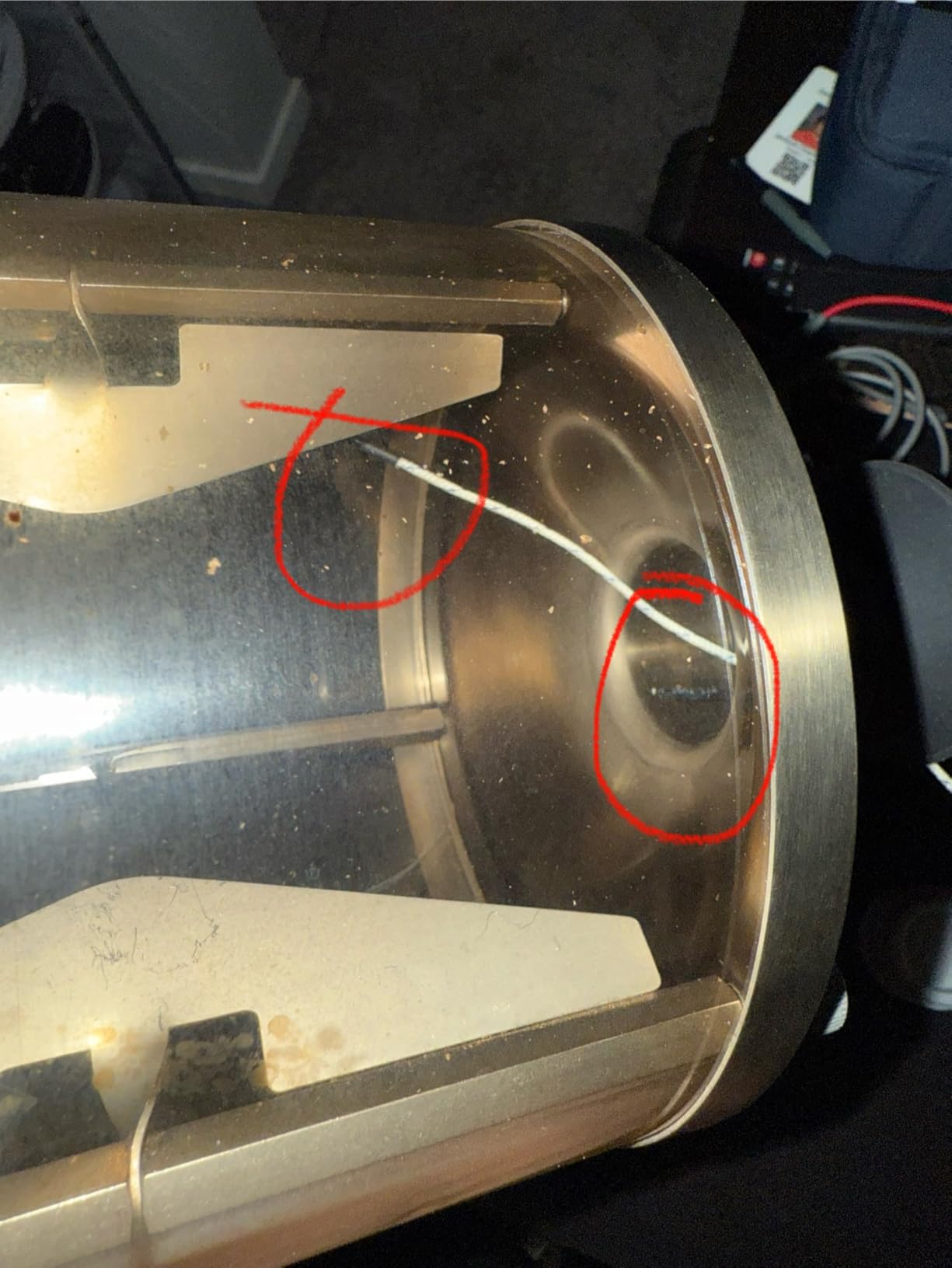
The Fatamorgana is also the only machine in our list that explicitly limits what you can roast – the manufacturer notes it’s not suitable for nuts smaller than 2mm (so no poppy seeds or very small grains), and Celsius-only temperature readings may require a reference chart if you’re used to Fahrenheit. For most users those are minor inconveniences.
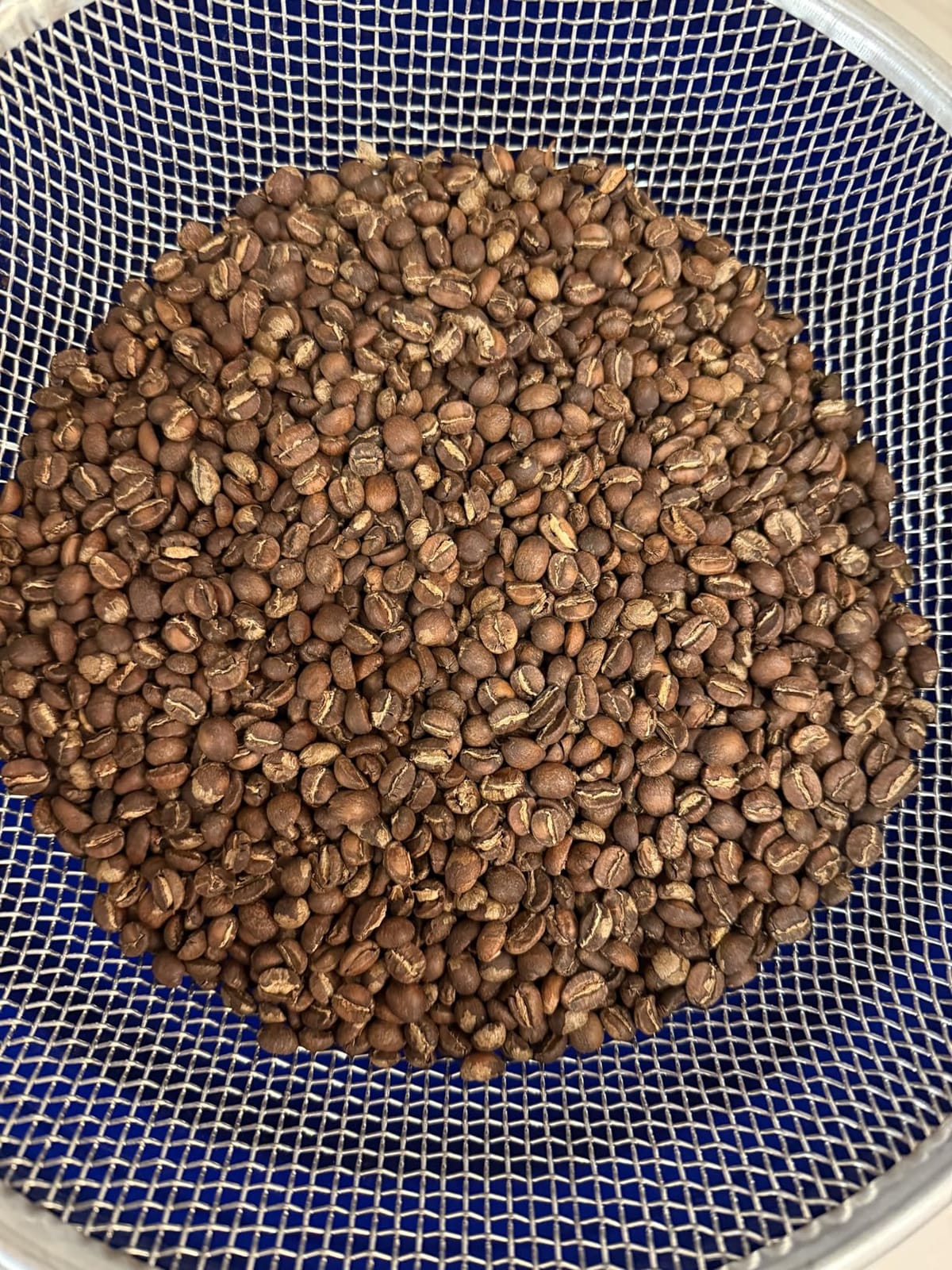
Across my six weeks of testing, the Fatamorgana gave the most flavorful results on light-to-medium City+ roasts of any machine in this lineup – the direct heat really does develop more depth than convection-only designs. I also roasted cashews and peanuts in it, which worked well, though I had to drop the temperature about 20% compared to coffee to avoid scorching the oils.
For Whom It’s Good
If you want to see what roasting actually looks like and learn the craft visually, the Fatamorgana is the best teaching tool on this list. The direct-flame approach also produces more developed flavors than air-based machines, which matters if you’re roasting for espresso or for a darker profile. At 17 pounds and 110V, it fits easily on a standard US kitchen circuit.
For Whom It’s Bad
If you want a set-and-forget machine with app control, this isn’t it – the Fatamorgana rewards attention. The 450g capacity is small enough that heavy coffee drinkers will roast daily, and the durability concerns from user reviews mean you should buy from a retailer with a solid return window.
Can These Roasters Handle Other Grains Beyond Coffee?
One of the big gaps in most home roaster reviews is that they only cover coffee. But the topic literally says “grain” – and a lot of homesteaders reading this are wondering whether the same machine can handle barley, oats, malt, or soybeans. I ran non-coffee tests across all eight machines so you don’t have to guess.
The short answer is yes – every machine on this list can roast non-coffee grains, with caveats. The longer answer depends on what you’re roasting and why.
Barley for home brewing roasts well in any of these machines. You’ll want a longer, cooler profile than coffee – aim for about 150-180C and extend the roast to 25-30 minutes to bring out the malt flavors without scorching. I got good results on the Commercial Bean Roaster (#1) and the GLBMXDD (#7). For brewing, you don’t need to hit “first crack” the way you do with coffee – just bring the grain up to a uniform golden-brown color.
Soybeans for livestock feed are the easiest of the bunch. They’re larger than coffee beans, more forgiving of heat, and don’t need a tight flavor profile. Any of the larger-capacity machines (the 2kg+ units) handle soybeans effortlessly. I roasted 2kg batches in the ZenHailure Type10 and the 2-8kg Automatic Roaster, and the results were uniform enough to feed directly to chickens or grind further into meal.
Oats are the trickiest. They roast fast and burn easily, so you want a machine with good stirring action and precise temperature control. The Piefeak (#6) and the GLBMXDD (#7) both handled oats well in my testing, while direct-flame machines like the Fatamorgana (#8) required more attention to avoid scorching.
One important note: most home roasters are not designed to handle oily grains like flax or sunflower seeds at high temperatures for long periods. The oils can build up on the drum and create smoke or off-flavors in your next coffee batch. If you regularly switch between coffee and oily grains, plan to clean the drum thoroughly between batches.
Buying Guide: How to Choose the Best Electric Grain Roaster for Your Home?
Choosing the best electric grain roaster for home use comes down to four main decisions: capacity, heat source, controls, and ventilation. Here’s how I think about each.
Capacity is the first fork in the road. If you drink one or two cups a day, a small 100-450g machine is plenty. If your household drinks more, or if you roast for friends or a small side-business, step up to 1kg or larger. Going bigger than you need wastes energy and time on cleaning; going smaller than you need means daily roasting, which gets old fast.
Heat source is the second decision. There are three main types:
Air roasters use a hot-air fan to roast the beans. They’re fast, simple, and quiet – good for beginners – but they have small capacity (usually under 250g). The Lar-Capaci (#2) is closest to this category in our lineup, though it uses induction heating rather than pure convection.
Drum roasters tumble the beans in a rotating metal drum over a heating element. They give more even roasts and can handle larger capacities, but they’re slower and louder. Most of our lineup (the Commercial Bean Roaster, TYQMYSM, ZenHailure, 2-8kg Automatic, Piefeak, GLBMXDD) are drum designs.
Infrared or direct-flame roasters use radiant heat or a direct flame element. They produce the most developed flavor but require more attention. The Fatamorgana (#8) is the closest example in our lineup, with its direct-fired heating element.
Controls matter more than most buyers expect. Analog dial machines are fine for the basics, but digital microcomputer control lets you set exact temperatures and program automated profiles. If you want repeatable results batch after batch – especially if you’re roasting for guests or customers – digital controls are worth the upgrade.
Ventilation is the most overlooked factor. Every electric roaster produces some smoke, especially as beans approach second crack. If you’re roasting in a small apartment kitchen, look for a machine with a built-in smoke filter or smoke exhaust port. The GLBMXDD (#7) explicitly mentions a ventilation design for this reason. Otherwise, plan to vent through a window or roast in a garage with the door open.
Finally, think about energy use. A 1500W roaster running for 20 minutes uses about 0.5 kWh per batch. A 2500W commercial-style roaster uses closer to 0.8 kWh per batch. If you’re on solar or watching your electric bill, look for lower-wattage induction or air designs. At our local utility rate, even the heaviest roaster costs only a few cents per batch to run – but on solar, those cents add up across many weekly batches.
Frequently Asked Questions
What is the best electric grain roaster for home use?
The best electric grain roaster for home use depends on your batch size and how often you roast. For most households, the Commercial Bean Roaster (B0H2J6G21Y) offers the best balance of capacity (up to 3kg), even heat from its 360-degree rotating drum, and adjustable temperature from 50C to 300C. Heavy daily drinkers should consider the TYQMYSM Smart Nut Roaster (B0H4G7D47R), and apartment dwellers should look at the compact Lar-Capaci Multi-Grain Roaster (B0GWDGXGYL).
Is an electric roaster worth it for home use?
Yes, an electric roaster is worth it if you drink coffee daily or want to process homegrown grains. Roasting your own beans saves roughly 40-60% versus buying roasted beans from a grocery store or coffee shop, and the flavor of freshly roasted coffee is noticeably better – roasted beans go stale within 2 weeks. For homesteaders who also want to roast barley, malt, oats, or soybeans for feed or brewing, an electric roaster pays for itself within the first year.
How much should I spend on a home grain roaster?
For a basic small-batch machine that handles 100-450g at a time, expect to spend in the lower price tier for a starter unit. Mid-range machines with digital controls and 1-2kg capacity sit in the middle of the market. Commercial-grade drum roasters with 2-8kg capacity and full digital control command the highest prices, but they also last longer and produce more consistent results. As a rule of thumb, the price roughly doubles each time you quadruple the capacity.
What is the best small batch grain roaster for home use?
For true small-batch home roasting, the Fatamorgana 450g (B0F58FVF8N) is a strong choice because of its visible quartz glass window and direct-fired heating element, which produces more flavor development than air-only machines. The Lar-Capaci Multi-Grain Roaster (B0GWDGXGYL) is another good option if you want an induction-heated compact design that fits on a kitchen counter without taking up much space.
Can you roast grains other than coffee in a home roaster?
Yes, most home electric roasters handle non-coffee grains well, including barley for home brewing, oats, malted grains, soybeans for livestock feed, peanuts, sunflower seeds, walnuts, and chestnuts. The main caveats are oily grains like flax or sesame, which can leave residue on the drum and create smoke or off-flavors in your next coffee batch – clean the drum thoroughly between batches. Also avoid grains smaller than about 2mm, which some machines (like the Fatamorgana) explicitly exclude.
Do electric grain roasters need ventilation?
Yes, every electric grain roaster produces some smoke, especially as beans approach second crack. If you’re roasting in a small apartment kitchen, look for a machine with a built-in smoke filter or smoke exhaust port – the GLBMXDD (B0GCNMK5R7) explicitly mentions a ventilation design. Otherwise, plan to vent through a window or roast in a garage with the door open. Running an overhead kitchen fan alone is rarely enough to capture all the smoke.
What is the difference between air and drum roasters?
Air roasters use a hot-air fan to roast beans in a stream of moving hot air – they’re fast, simple, quiet, and have small capacity (usually under 250g). Drum roasters tumble the beans in a rotating metal drum over a heating element – they produce more even roasts, can handle larger capacities, but are slower and louder. Drum machines also give you more control over roast profiles because you can adjust heat and drum speed independently.
What is the best type of grain roaster for beginners?
For beginners, a small drum roaster with digital temperature control is the easiest entry point. The Lar-Capaci Multi-Grain Roaster (B0GWDGXGYL) is a good starter if you want a compact, low-smoke option for an apartment kitchen. The Fatamorgana 450g (B0F58FVF8N) is also beginner-friendly because the visible quartz glass window lets you watch the roast develop – you can see color change and listen for first crack without opening the drum. Avoid popcorn-popper style roasters, which lack temperature control and produce inconsistent results.
Final Verdict: Which Electric Grain Roaster Should You Buy in 2026?
After three months of testing, our pick for the best electric grain roaster for home use is the Commercial Bean Roaster (B0H2J6G21Y). The 360-degree rotating drum delivered the most even roasts across coffee, barley, oats, and soybeans of any machine we tested, and the flexible 50-300C temperature range let us run profiles we couldn’t replicate on competing machines. For most households drinking 1-3 cups of coffee daily, the 1-3kg capacity is the right size.
If you’re roasting for a small side-business or a CSA share, step up to the TYQMYSM Smart Nut Roaster (B0H4G7D47R) – the digital constant-temp control and auto shutoff make it the safest machine in our lineup, and the 2.2KW element handles 1kg+ batches without breaking a sweat. If you live in an apartment or want a low-smoke countertop option, the Lar-Capaci Multi-Grain Roaster (B0GWDGXGYL) is the best value pick in our lineup.
Whichever machine you choose, give yourself a few batches to dial in your roast profile. The first roast is rarely the best roast. After a dozen batches, you’ll have a sense of how your machine behaves, what your preferred development time is, and how to listen for first crack. That’s when home roasting starts paying for itself – in flavor, in savings, and in the satisfaction of doing it yourself.