
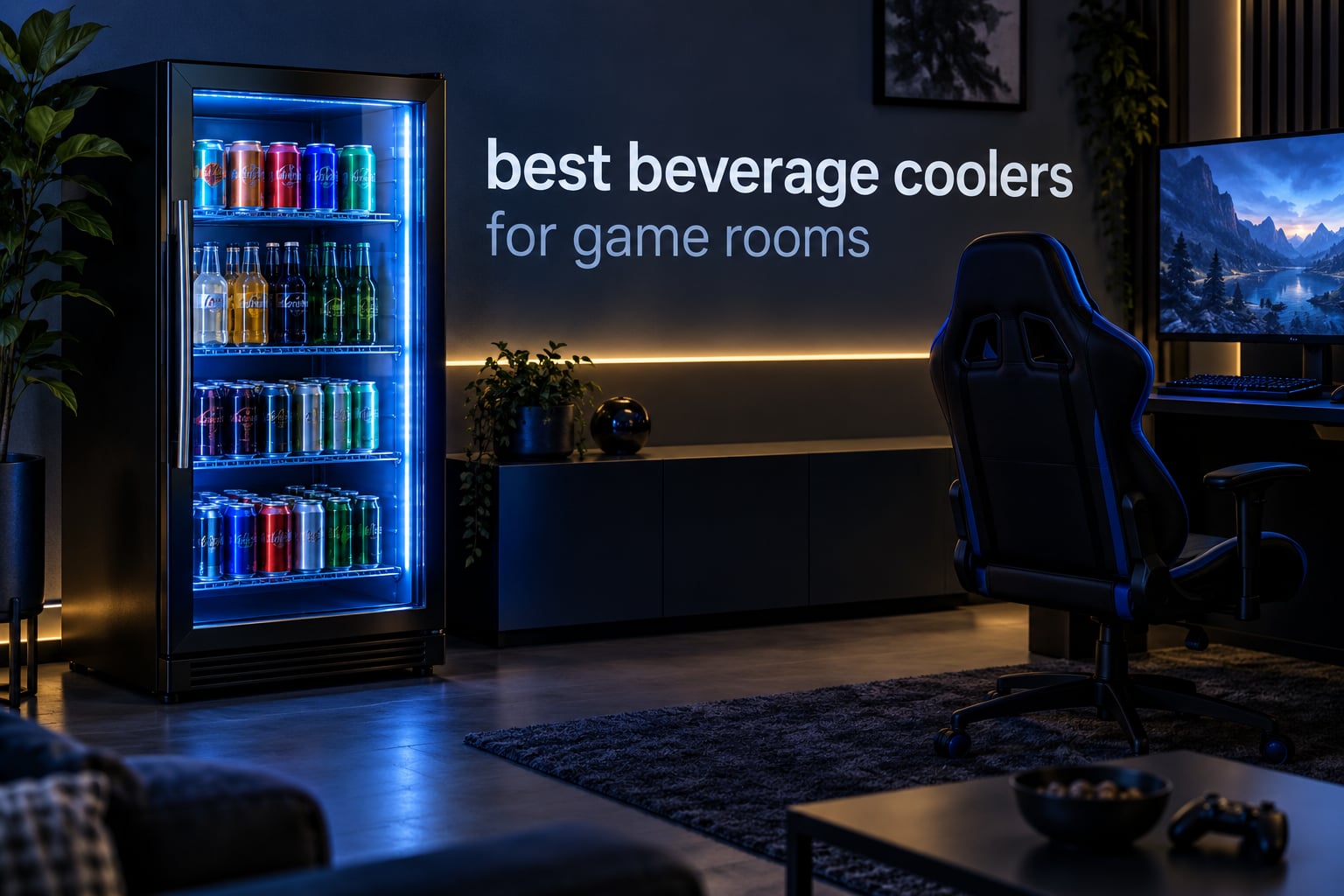
A beverage cooler is a refrigerator built to hold cans and bottles flat on adjustable shelves instead of storing fresh food, and in a game room that single design choice is what keeps a wall of drinks cold and grabbable all night. The best beverage coolers for game rooms are compressor units rated around 34 to 40 degrees, sized between 68 and 145 cans, and quiet enough to sit a few feet from a microphone.
That last requirement is where most buyers go wrong. A game room is the one room in the house where an appliance runs for six hours straight during a session, so a compressor hum that would disappear under kitchen noise becomes the loudest thing in the room. We compared eight coolers across capacity, footprint, cooling method, energy draw, and stated noise levels, and put them through the lens that matters for gaming: how they sound at three in the evening during a ranked match, and how they look lit up behind a desk.
The shortlist below covers the whole ladder, from a 68-can compact that fits beside a gaming chair to a 145-can cabinet that serves a man cave bar. Our top pick is the hOmeLabs 120-Can, which pairs the highest rating in the group with the largest review base we could find, while the EUHOMY 130-Can is the quietest option with a published decibel figure. If your room leans hard on looks, the Velieta’s illuminated door is the one that turns the cooler into part of the rig. For anyone building out a second space, our notes on outdoor beverage refrigerators cover the same capacity logic in a different environment.
Table of Contents
Top 3 Picks for Game Room Beverage Cooling in 2026

hOmeLabs 120-Can Cooler
- 4.5 stars from 6908 reviews
- Whisper quiet compressor
- Automatic defrost
- UL certified

EUHOMY 130-Can Cooler
- 130 can capacity
- 36 dB published rating
- Frost free defrost
- 0.69 kWh per day

Velieta 128-Can LED Cooler
- Illuminated glass door
- Child safety lock
- 43 dBA at 1 meter
- Hidden condenser coils
Best Beverage Coolers for Game Rooms in 2026
Every cooler below is freestanding or undercounter rated, so you can place them against a wall or beside a desk. The capacity figures are the manufacturers’ can ratings measured with standard 12 oz cans, and the noise figure is the published decibel level where one exists. Read the quick table, then jump to the full review for the model that fits your room.
| Product | Specifications | Action |
|---|---|---|
| hOmeLabs 120-Can Beverage Refrigerator |
|
Check Latest Price |
 Antarctic Star 68-Can Glass Door Cooler Antarctic Star 68-Can Glass Door Cooler |
|
Check Latest Price |
| EUHOMY 130-Can Beverage Refrigerator |
|
Check Latest Price |
 Honeywell 116-Can Commercial Cooler Honeywell 116-Can Commercial Cooler |
|
Check Latest Price |
 Icyglee 126-Can Beverage Refrigerator Icyglee 126-Can Beverage Refrigerator |
|
Check Latest Price |
| Velieta 128-Can LED Light Up Cooler |
|
Check Latest Price |
 Electactic 145-Can Wine and Beverage Cooler Electactic 145-Can Wine and Beverage Cooler |
|
Check Latest Price |
 Tehanld 68-Can RGB Gaming Mini Fridge Tehanld 68-Can RGB Gaming Mini Fridge |
|
Check Latest Price |
1. hOmeLabs 120-Can Beverage Refrigerator – the one most game rooms should buy
hOmeLabs Beverage Refrigerator and Cooler, 120 Cans Capacity, 3.2 Cu Ft
120 cans in 3.2 cu ft
Compressor cooling to 34F
Automatic defrost
UL certified
Pros
- 4.5 stars across 6908 reviews
- Whisper quiet compressor
- Automatic defrost
- UL certified build
- Reinforced glass door
Cons
- Only 3 shelves
- Heaviest build at 68.3 lbs
- Fixed right-side hinge
The hOmeLabs is the pick we keep coming back to because the two things buyers care about most in a game room, steady cold and low noise, are the two things its owners report most consistently. It cools down to 34 degrees on a digital touch panel and does it with a compressor the brand describes as whisper quiet. Across nearly seven thousand reviews, the recurring theme is a unit that stays cold overnight and does not make itself known on a headset mic.
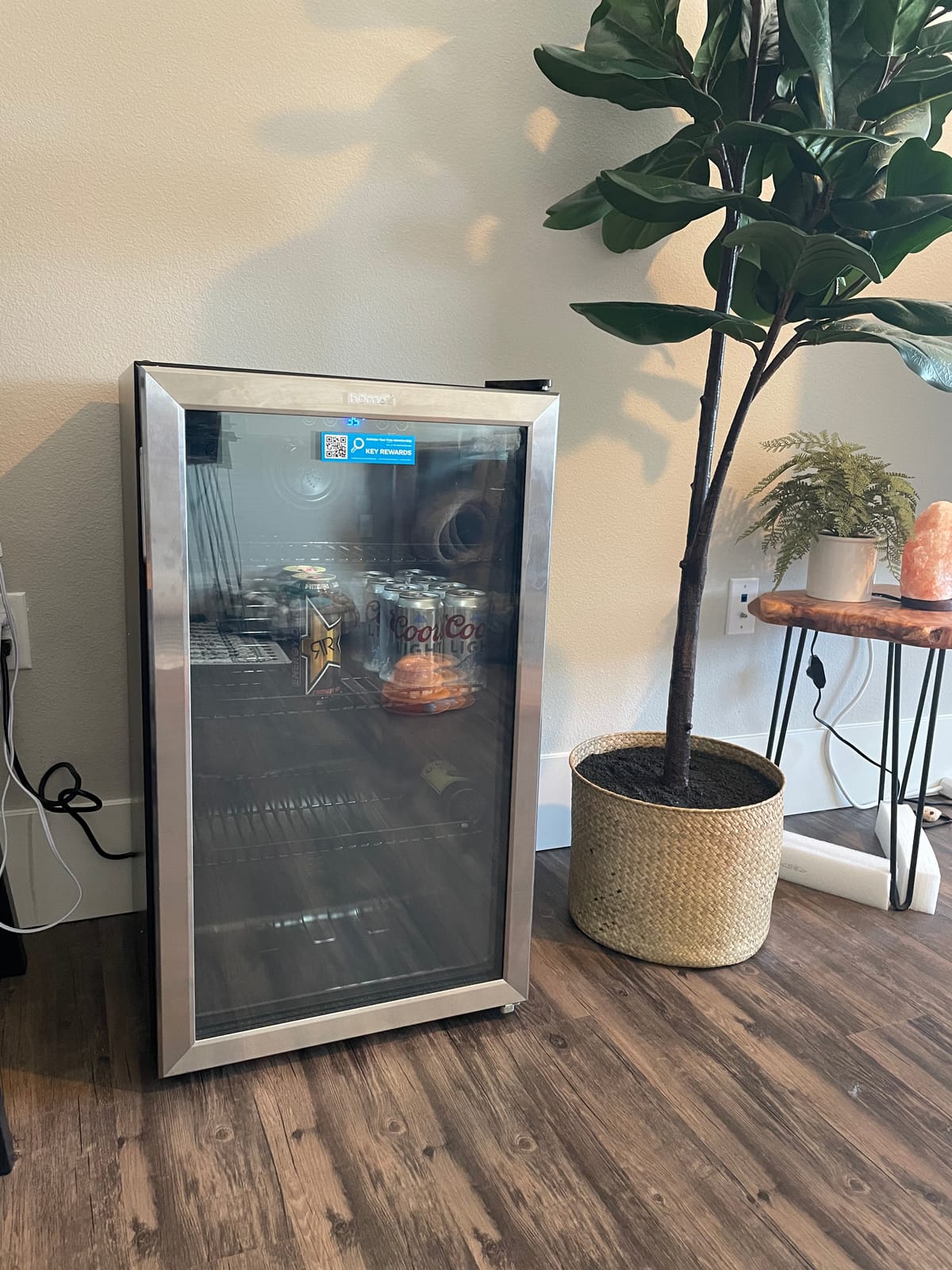
Capacity is 120 standard cans across 3.2 cubic feet, spread over three removable chrome wire shelves. That is fewer shelves than most of the field here, and it is the single most common complaint, because configuring the shelves for tall cans costs you a shelf position. We think it is a fair trade for the reinforced glass door with its matte silver stainless frame and the white LED interior light, which is what makes the cooler read as part of a finished game room rather than a dorm-room appliance.
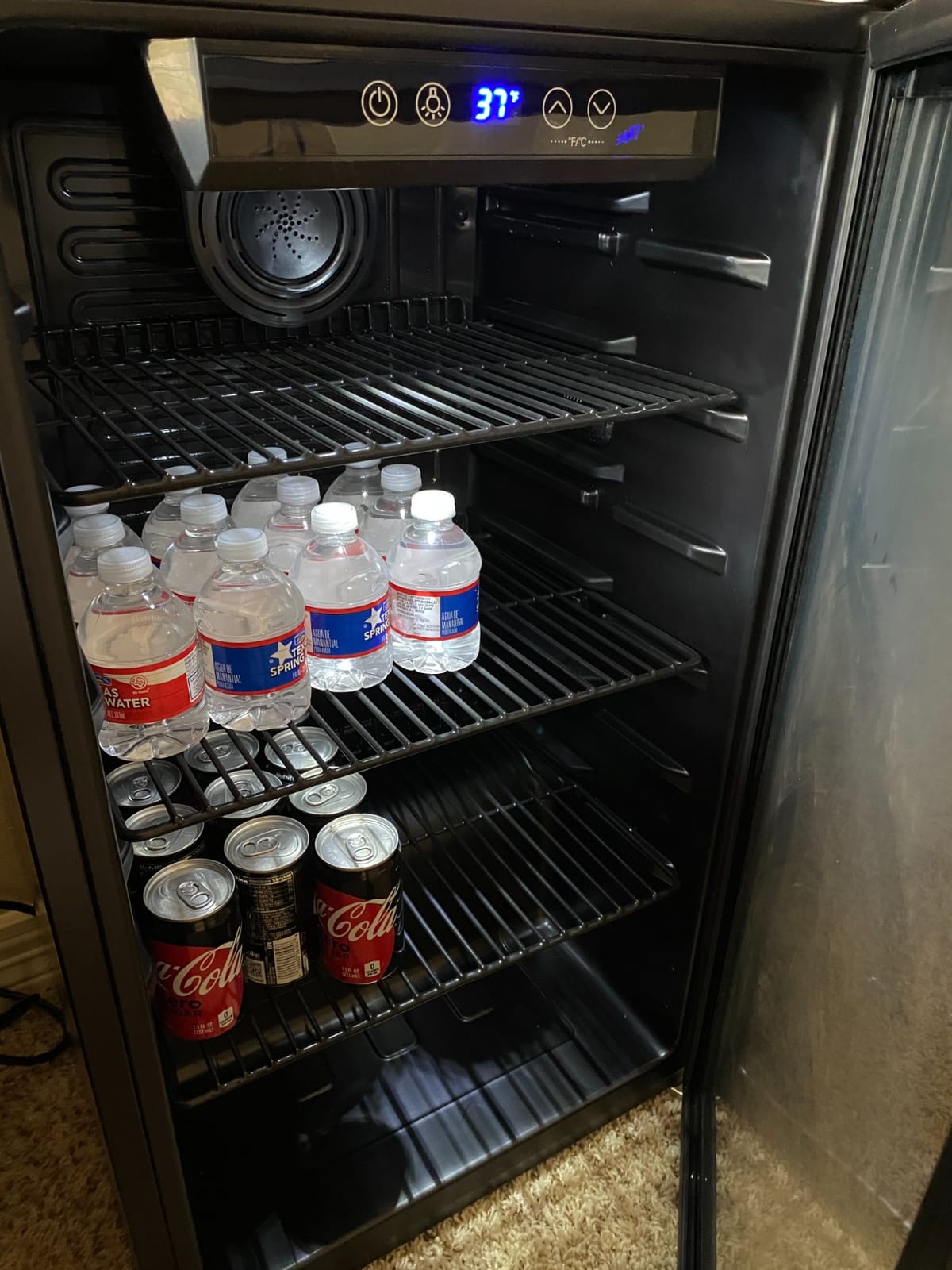
Automatic defrost is the feature that will matter most over a two to three year ownership cycle. Several manual-defrost competitors in this roundup ask you to power them down and wipe ice off the coil periodically, and that is a chore nobody wants to remember in the middle of a gaming session. The hOmeLabs handles it on its own, and the automatic cycle is the difference between a cooler you forget about and one you maintain.
The footprint is 17.3 inches deep by 18.9 inches wide by 33.3 inches tall, so it clears a standard knee space under a desk or sits neatly beside a side table. Energy use is rated at 288 kWh per year. It is also the heaviest cabinet here at 68.3 pounds, which matters if you plan to move it, so plan the spot before it arrives rather than after.
What to check before you buy the hOmeLabs
Measure the height first. At 33.3 inches it is close to standard counter height but not quite, and it will not fit under a shallow desk without blocking your knees. The width at 18.9 inches is the number to compare against the gap between a desk leg and a wall.
Decide whether you need more than three shelves. If your group drinks mostly standard cans, three chrome wire shelves are genuinely enough for a full evening. If you rotate in tall craft cans or large-format bottles, plan to remove a shelf and accept the loss of a level.
Who should look elsewhere
Buy the Electactic if you want more internal volume and a wider temperature floor, or the EUHOMY if you want a published decibel number and five shelves. Both give up a little of the hOmeLabs rating and review depth in exchange for flexibility.
Skip it if you need a reversible door. The hinge is fixed on the right side, so if your only viable position has the door opening into a walkway, this cabinet will not work without moving the appliance somewhere else.
2. Antarctic Star 68-Can Cooler – best compact footprint
Antarctic Star Beverage Refrigerator Cooler 68 Can, Mini Fridge with Glass Door for Beer Drinks Wine,Freestanding Small Fridge with Electronic Temperature Control for Home and Bar,1.7 cu.ft
68 cans in 1.7 cu ft
Digital 40F-61F control
Key lock
16.9 in wide
Pros
- Very small 16.9 in footprint
- Digital temperature control
- Double pane glass door with LED
- 4.3 stars from 4747 reviews
Cons
- Manual defrost
- Smallest cabinet in the group
- Beverages only
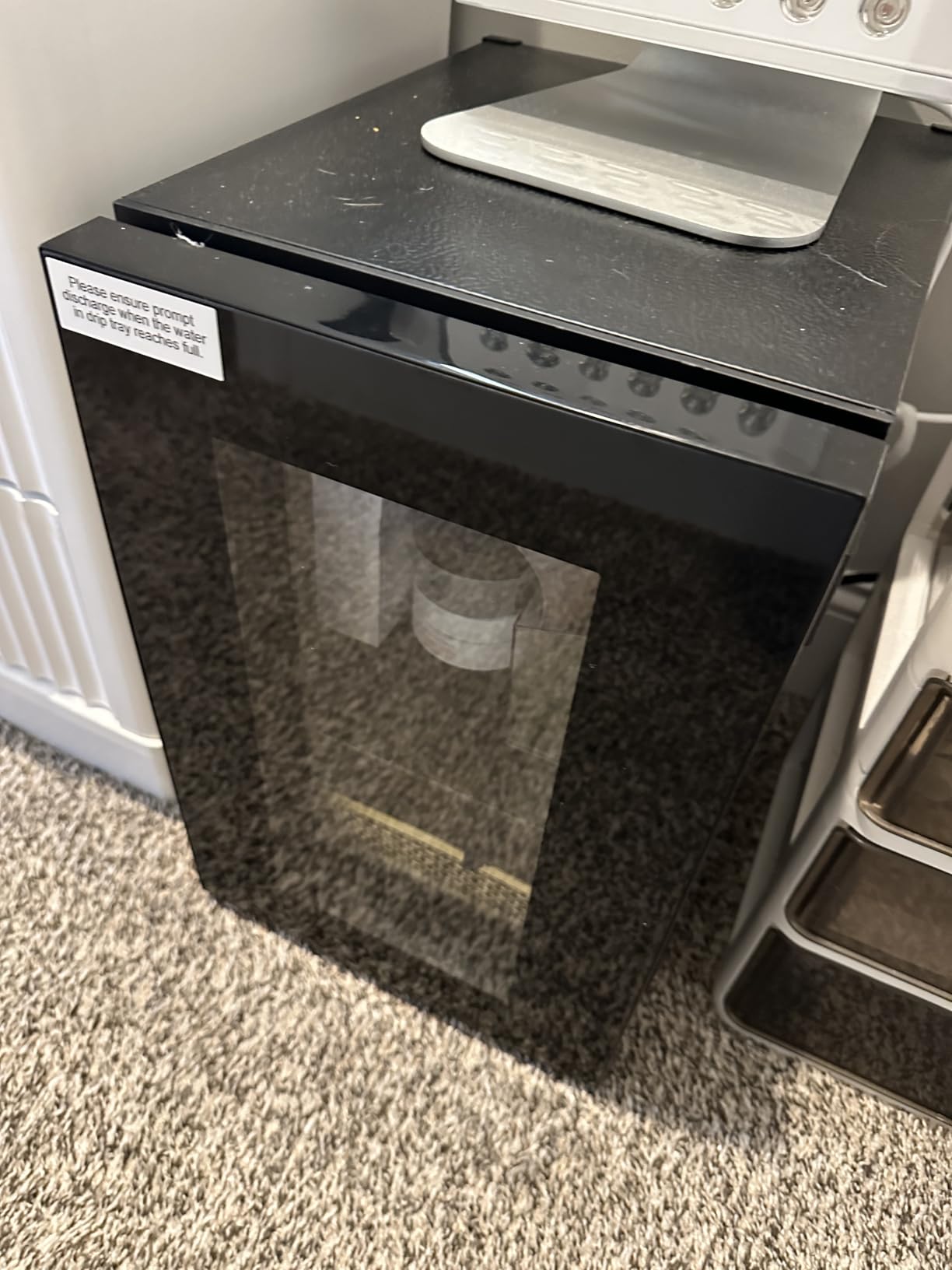
When the room is the constraint, this is the cooler that solves it. The Antarctic Star packs 68 cans into 1.7 cubic feet and stands 22.24 inches tall on a 16.93 inch wide base, small enough to sit on a side table next to a gaming chair or under a desk that will not take a full-height cabinet. It is the pick for a dorm room setup, a streaming corner, or a basement game room where every inch of floor is spoken for.
Cooling is compressor based with a digital control panel that adjusts from 40 to 61 degrees, which is a wide enough band for soda, beer, and canned energy drinks. The tinted double pane glass door does real insulation work rather than just showing off the contents, and there is a built-in blue LED light for when the room lights are down. It also carries a key lock, a nice touch in a shared or streamable space where you do not want a twelve year old working the door at midnight.
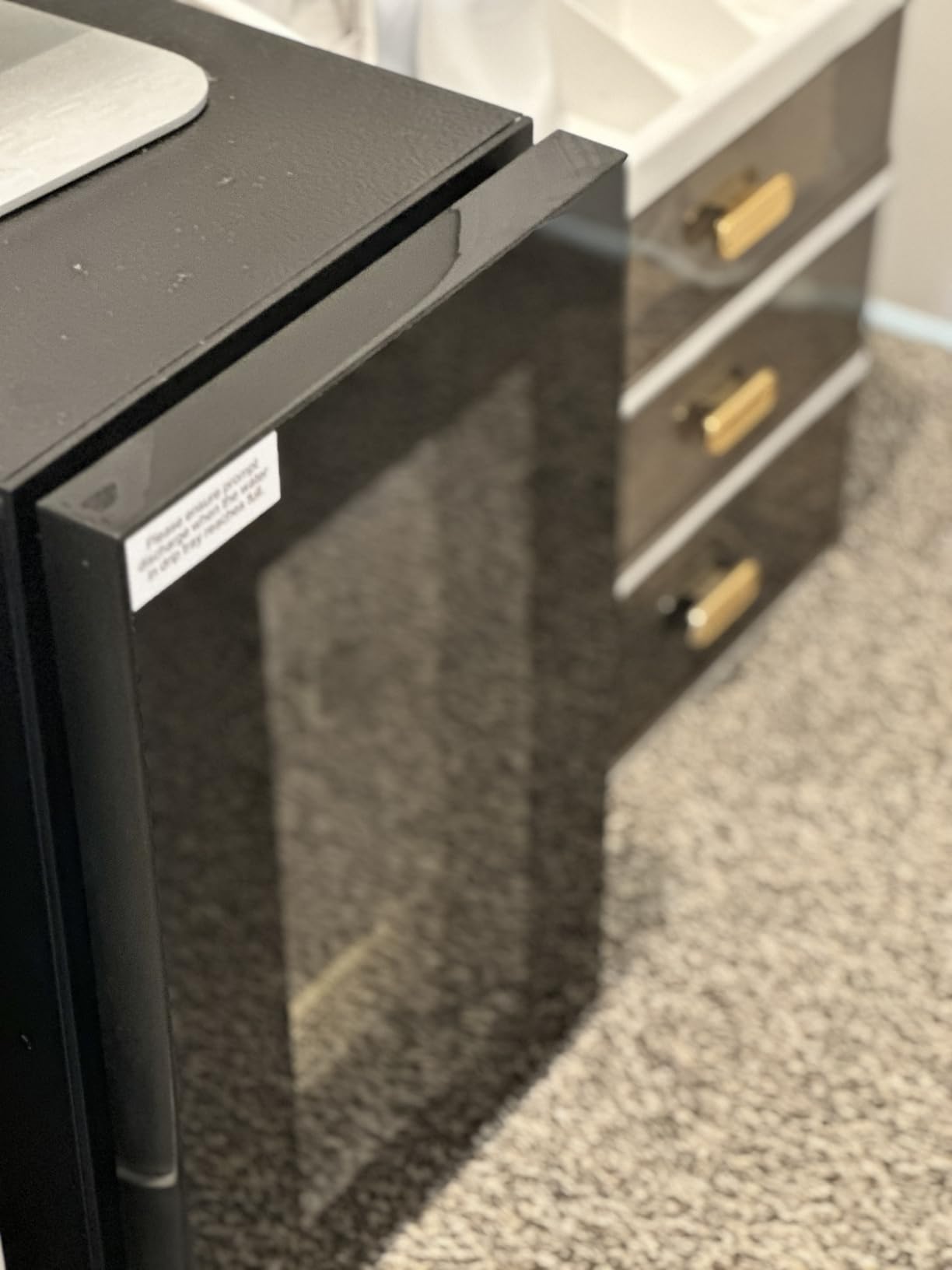
Two things keep this out of contention for a larger room. The first is capacity: 68 cans is roughly one full round for four players, which means a LAN party or a big tournament night will empty it faster than a larger cabinet would. The second is manual defrost. Ice builds on the coil and needs clearing by hand, and in a room where you are not thinking about the appliance every day, that maintenance quietly gets skipped until cooling suffers.
Against that, the 4747 reviews at 4.3 stars are the second largest review base in this group, and the recurring feedback is consistently positive on quiet operation and the digital controls. Warranty coverage is one year from the manufacturer, and the reversible door hinge means it can go on either side of a cabinet run.
What to check before you buy the Antarctic Star
Check the shelf count and shelf type. There are two glass shelves, which is enough for cans but tight once you start mixing in taller bottles, and glass shelves are easier to load than wire racks because cans do not slide through.
Look at where you will put it. The unit weighs 35.5 pounds, which is manageable but not effortless, and a unit that has to be dragged around to clear the defrost is an irritation you will notice every time.
Who should look elsewhere
Choose the Tehanld instead if you want the same compact footprint with an RGB illuminated door and a warmer-looking internal glow, rather than the plain blue LED this model offers.
Choose the hOmeLabs or the Electactic if you are hosting. Sixty-eight cans is a single-session quantity, not a party quantity, and neither of those two will need a defrost break in the middle of the night.
3. EUHOMY 130-Can Beverage Refrigerator – top rated for capacity and quiet
EUHOMY 130 Can Mini Fridge, Beverage Refrigerator with Glass Door, Black
130 cans in 3.2 cu ft
36 dB published noise level
Frost free
0.69 kWh per day
Pros
- 36 dB published noise rating
- 130 can capacity on 5 shelves
- Frost free defrost
- Energy efficient at 0.69 kWh per day
Cons
- Needs a 24-hour upright settle before first use
- Footprint deeper than compact models
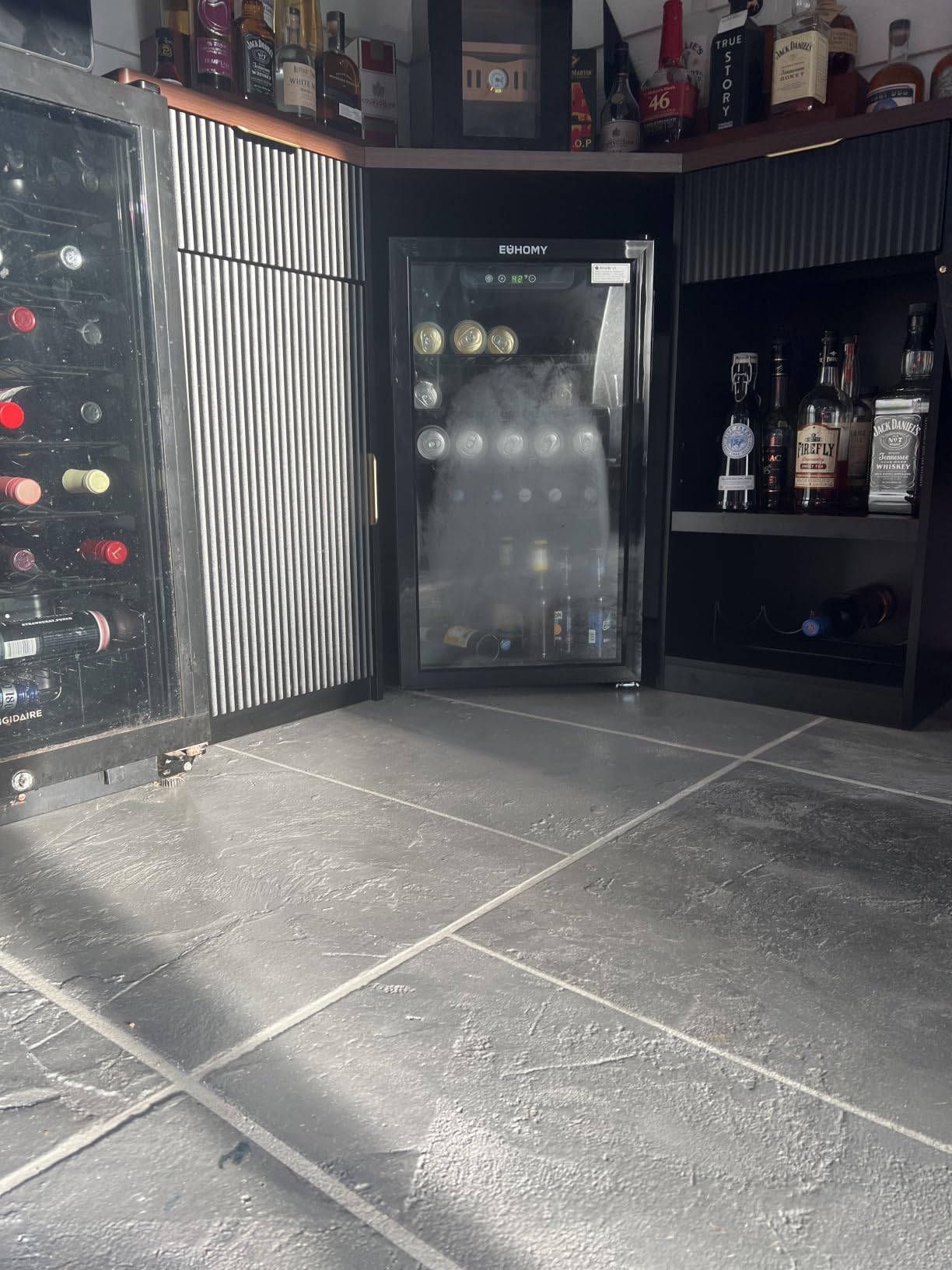
The EUHOMY is the pick to beat on the numbers that a game room actually cares about. It is rated at 36 decibels, the only figure in this roundup that comes with a published decibel measurement attached to a full-size compressor cabinet, and it holds 130 standard cans across five removable shelves. If you are streaming with an open microphone and cannot tolerate background hum, this is the one to shortlist first.
Cooling is compressor based with an internal air circulation fan and a digital touchscreen panel that runs from 37 to 61 degrees. The door is double layer UV blocking glass, which means the drinks are shaded from direct light as well as being visible, and it sits at the number one position in the Beverage Refrigerators category with a 4.4 star rating from 3489 reviews. Defrost is automatic, so nothing about upkeep interrupts a session.
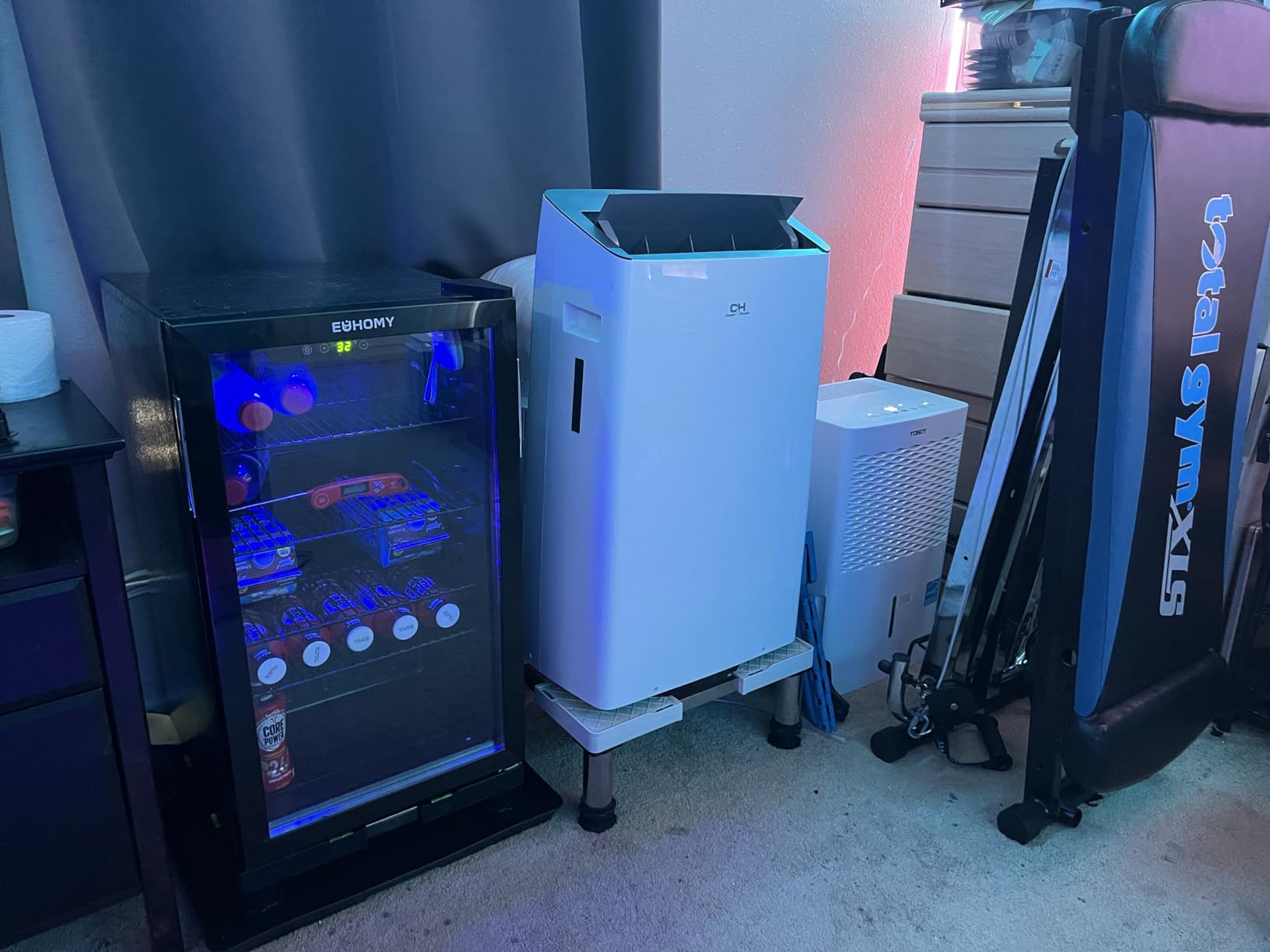
Energy use is the other number worth knowing. Rated at 252 kWh per year, or 0.69 kWh per day, this is the lowest daily draw among the full-size cabinets here, which matters more than it sounds if the cooler runs twelve hours a day through a long gaming year. The door is reversible, there is a built-in handle, and adjustable feet let you level it on an uneven basement floor.
The one thing owners mention most is not a fault but a ritual. The unit should stand upright for 24 hours before you plug it in for the first time, which lets the refrigerant settle after shipping. Plan that around a delivery day rather than the evening you planned to use it, and treat the first night as a cooling-down period rather than an immediate drink service.
What to check before you buy the EUHOMY
Measure the depth. At 18.5 inches deep by 17.8 inches wide, it is deeper than the compact models but shallower than full-size glass-door cabinets, which makes it a good fit for a tight nook between a desk and a wall.
Think about shelf configuration. Five shelves is the most in this group, but fitting 130 cans on all five requires standard cans. Mixed tall cans and large bottles will mean dropping a shelf, and the real capacity is closer to the low hundreds.
Who should look elsewhere
The hOmeLabs has a higher rating and a far larger review base, and its automatic defrost and UL certification are worth having. Choose it over the EUHOMY if you care more about build certification and long-term review depth than about shelf count.
Choose the Velieta if you want the quiet specification to come with an illuminated door and a child safety lock, both of which matter in a family game room.
4. Honeywell 116-Can Commercial Cooler – best for a bar look
Honeywell Beverage Refrigerator and Cooler, 116 Can Mini Fridge with Glass Door for Soda Beer or Wine for Office or Bar with Adjustable Removable Shelving, Commercial Grade
116 can undercounter cabinet
Thermoelectric cooling
UL certified
Electronic door lock
Pros
- Holds a steady 34F
- UL certified commercial build
- Slide out coated wire shelves
- Electronic door lock
Cons
- Two pane door on some units rather than three
- Interior light is dim
- Shelves can sag when loaded
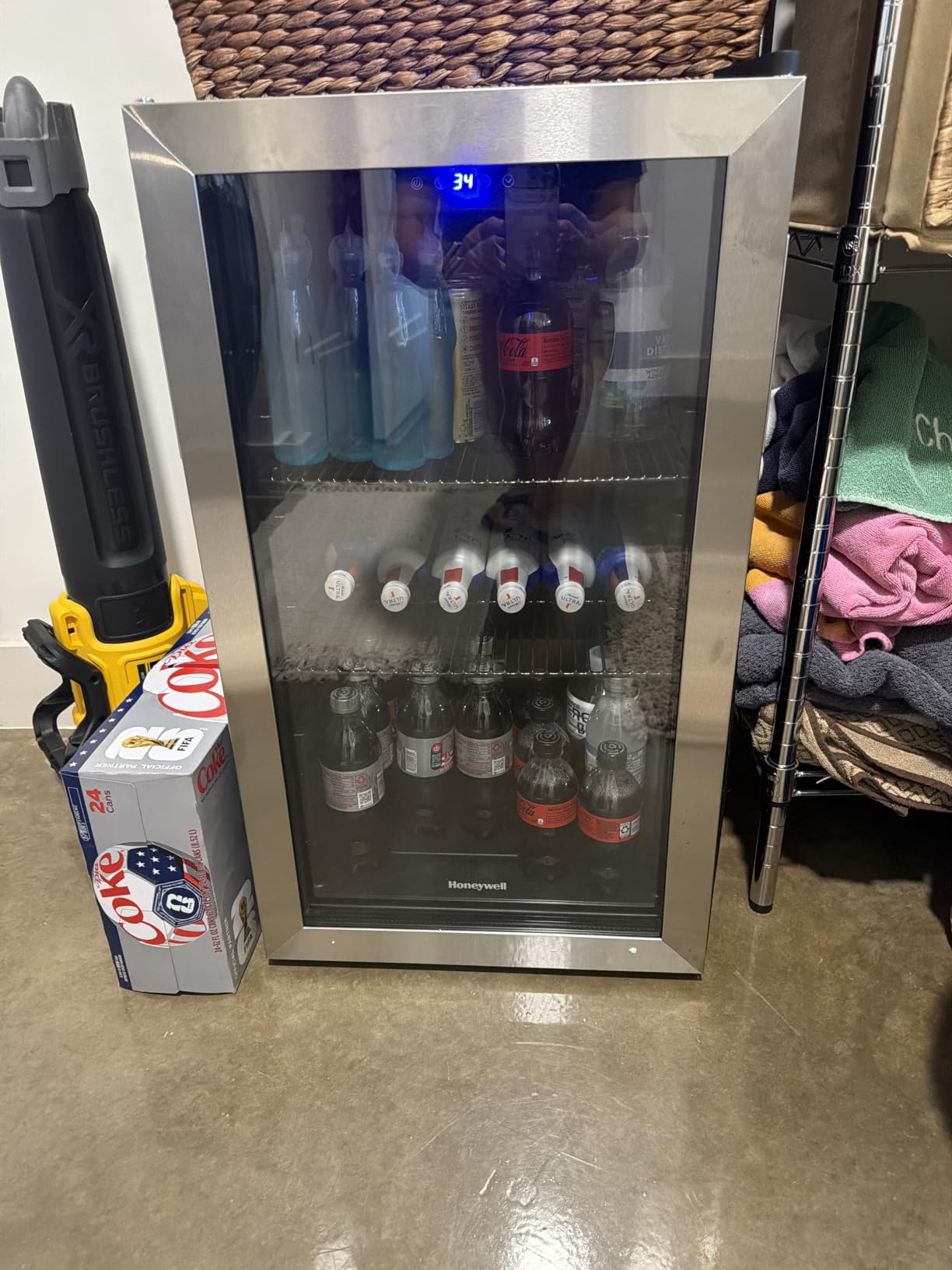
The Honeywell is the one in this roundup that looks like it belongs behind a home bar. The stainless steel body, the undercounter height, and the three pane tempered glass front give it a commercial display look that the black plastic-framed competitors do not. At 17.3 inches deep by 18.9 inches wide by 33.1 inches tall it fits under a counter run, which is where most man cave bars have a dedicated appliance slot.
It holds 116 cans across four slide out plastic coated wire shelves on a 3.0 cubic foot cabinet, and it uses thermoelectric cooling rather than a compressor. That means no compressor hum at all, which is a genuine advantage in a media room, and the temperature holds at 34 degrees consistently according to owners. The downside is equally real: thermoelectric cabinets depend on room temperature, and their performance drops in a warm or poorly ventilated space.
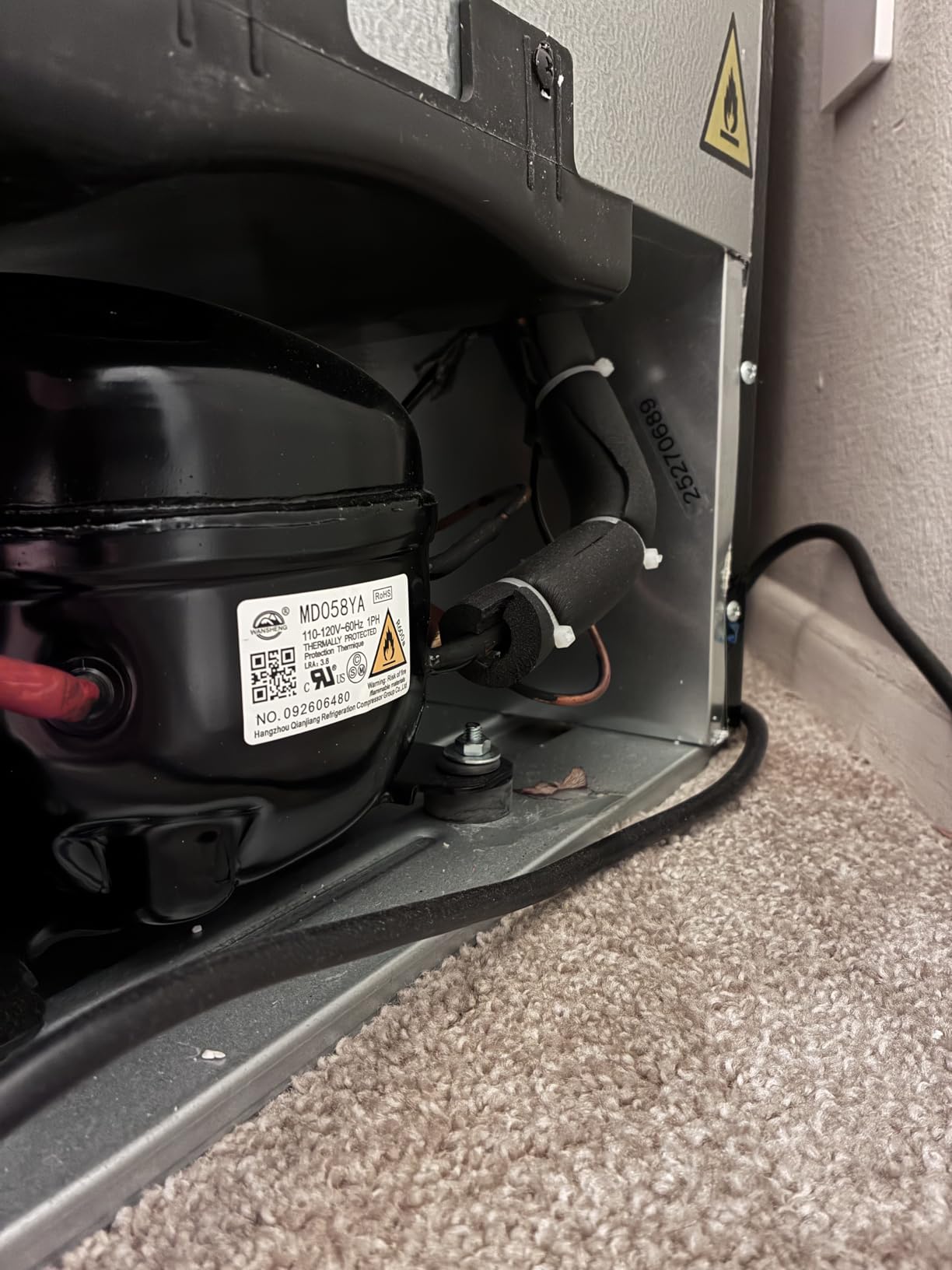
Two practical details separate this from a generic glass-door fridge. It has an electronic door lock, and it is rated at 288 kWh per year with R-600A refrigerant and adjustable legs for leveling. The complaint that shows up most often in reviews concerns the door: some units arrive with two panes rather than the three advertised, and the interior LED is dim enough that owners add their own lighting.
A second recurring note is that the coated wire shelves can sag under a full load of cans, so distribute weight rather than stacking everything on one level. A handful of long term owners also report fan noise developing after several months, which is worth weighing if the cooler sits in a quiet streaming room rather than a social one.
What to check before you buy the Honeywell
Check the room temperature, not the fridge. Thermoelectric cabinets are rated against ambient conditions, so a basement game room with a radiator or a garage that heats up in summer is a poor match. If your room reliably sits near 70 degrees, this works well. If it runs warm, pick a compressor model.
Confirm the venting. It is an undercounter unit, so the clearance around the back and sides matters more than it would for a front-vented built-in. Push it flush against a wall and the cooling performance drops noticeably.
Who should look elsewhere
Pick the Electactic if you want a larger cabinet that can be built in or freestanded and holds both wine bottles and cans, with a wider temperature range down to 32 degrees.
Pick the EUHOMY or the hOmeLabs if you need compressor cooling in a room that gets warm, since both hold temperature independently of how hot the game room gets.
5. Icyglee 126-Can Beverage Refrigerator – best value for a big room
Icyglee 126 Can Mini Fridge, 3.2 Cu.Ft Beverage Refrigerator, Drink Cooler
126 cans in 3.2 cu ft
34F-64F range
Low-E glass door
50 lb cabinet
Pros
- 4.4 stars from 1221 reviews
- Cools to 34F
- Reversible hinge
- Low-E glass cuts condensation
Cons
- Display can read 6F warmer than actual
- Manual defrost
- Interior light stays on
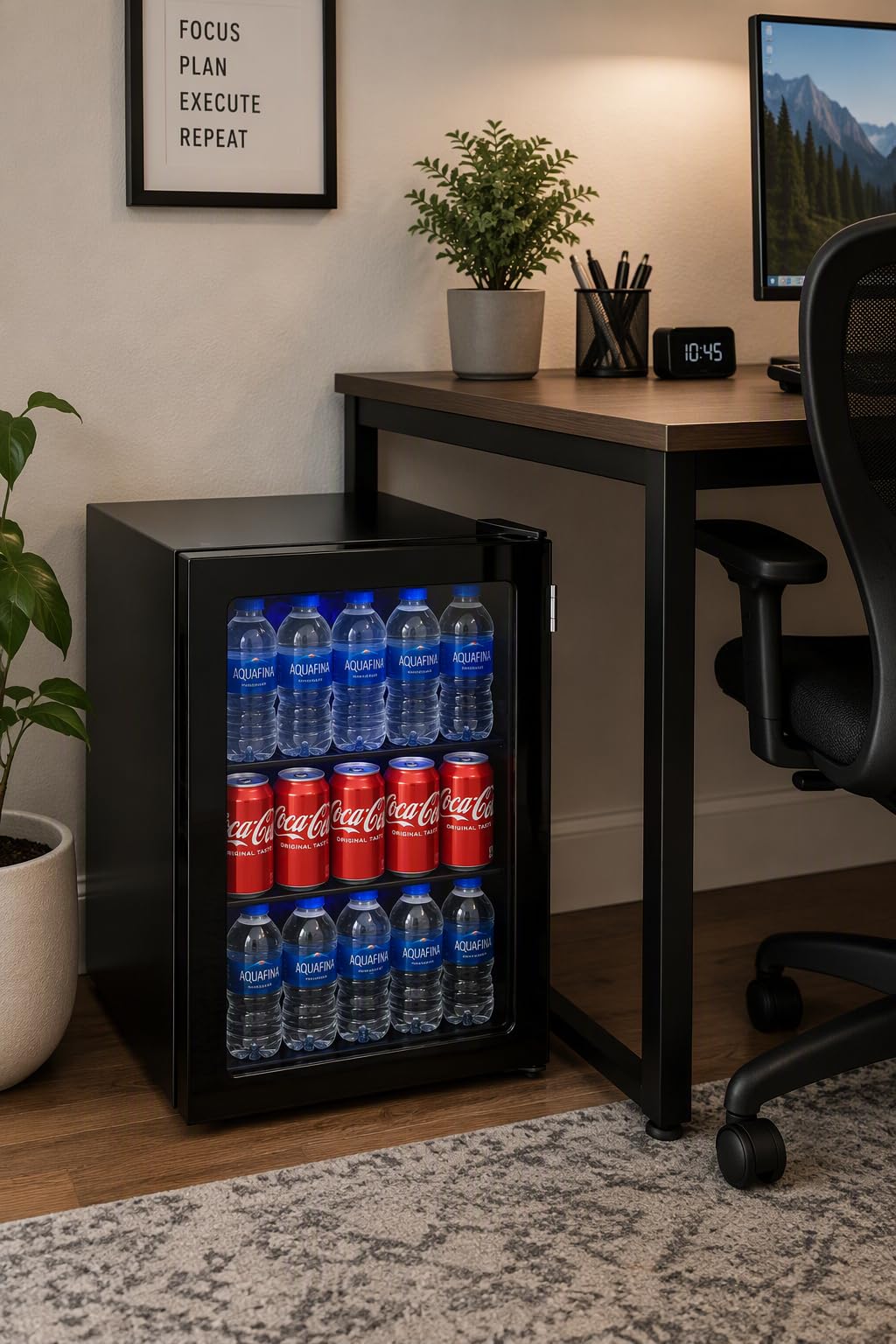
The Icyglee is the balance pick for a room where a lot of people drink at once. It holds 126 standard cans across 3.2 cubic feet on four removable shelves, cools from 34 to 64 degrees on a digital touch panel, and at 50 pounds is the lightest of the full-size cabinets in this roundup, which makes it far easier to reposition when you rearrange the room. It carries a 4.4 star rating from 1221 reviews.
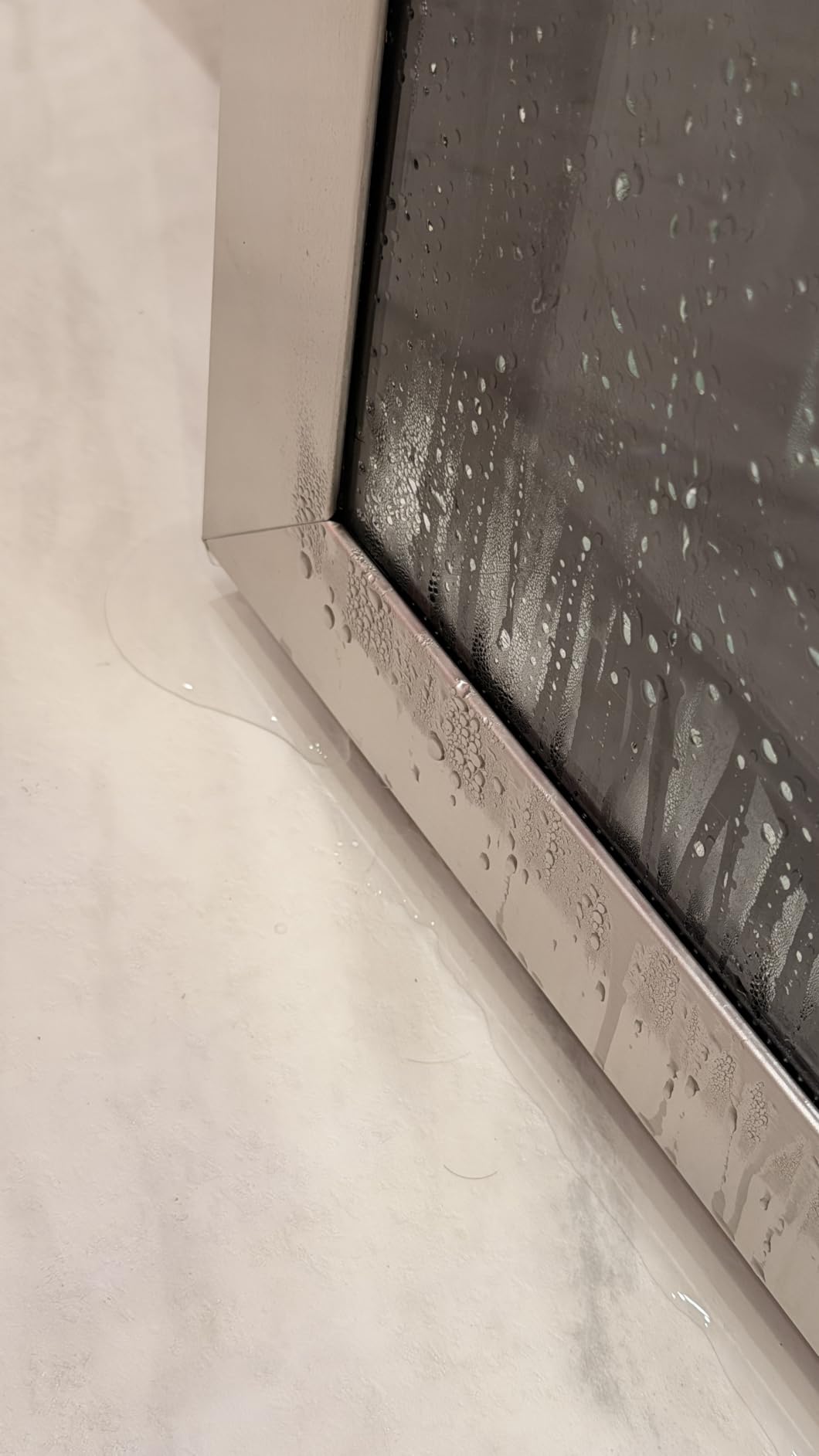
The glass door is tempered with a low-E film, which is a real technical choice rather than a marketing word. Low-E coatings cut heat transfer through the glass, so the cabinet holds temperature better in a warm room and the interior glass fogs less when someone opens the door mid-session. Soft LED interior lighting is included, and the hinge is reversible so you can decide which way the door swings after it is in place.
Owners do flag one thing that is worth planning around: the displayed temperature can read six degrees or more warmer than the air inside the cabinet. If you are serving beer and want precision, put a cheap independent thermometer on the middle shelf. The same review set reports that the can rating is generous, so treat 126 as a ceiling rather than a promise, and that manual defrost is required.
There is also a specific placement warning here. Some owners report items freezing against the back wall when the unit is pushed into a cold corner, which happens when the rear coil gets good airflow and the cabinet is against a cold surface. Leave the recommended clearance and the problem goes away. Energy use is rated at 289 kWh per year.
What to check before you buy the Icyglee
Bring your own thermometer. The display is not accurate enough to run a beer cellar on, and the gap between displayed and actual temperature is the most common complaint in reviews. A ten dollar probe thermometer on the middle shelf removes the doubt entirely.
Confirm where the defrost happens. Manual defrost means you will be powering it down and wiping the coil occasionally. If the room is a space you use most days, factor in whether you will actually do that.
Who should look elsewhere
The hOmeLabs is the better long-term buy if you want automatic defrost and a much larger review base, and the EUHOMY adds frost-free operation and a published noise figure at the same capacity class.
Choose the Velieta if the room is dark most of the time and you want the cabinet itself to be a light source rather than only lighting the interior.
6. Velieta 128-Can LED-Door Cooler – best for LED gaming setups
Velieta 17″ Beverage Refrigerator with LED Light Up Door – 128 Can Freestanding Drink Fridge, Small Beer Cooler with 4 Removable Shelves, Child Safety Lockfor Gaming Room Home Bar Party,Cyberpunk
Illuminated glass door
128 can capacity
Child safety lock
43 dBA at 1 meter
Pros
- Illuminated door reads as part of the gaming rig
- Child safety lock with two keys
- Automatic defrost every 13 hours
- Hidden coils allow flush wall placement
Cons
- Door light is bright at night
- Shelf temperature varies bottom to top
- Display may not match cabinet temperature
This is the aesthetic pick. The Velieta has an LED illuminated glass door that reads as part of a gaming setup rather than as an appliance, and at 128 can capacity across four removable wire shelves it is a full-size cooler underneath the styling. If your game room already has coordinated lighting, this is the cabinet that stops looking like an afterthought in the corner.
The practical specification is solid. Compressor cooling runs from 34 to 64 degrees, defrost is automatic on a 13-hour cycle, and the door controls sit on the outside of the door so you can adjust without opening it and letting the cold air out. There is a child safety lock with two keys, which matters in a house where younger players have access to the room.
Two engineering details stand out. The condenser coils are hidden rather than exposed at the back, which means the cabinet can sit closer to a wall than a standard exposed-coil model, a real advantage in a narrow game room. And the published noise rating is about 43 dBA measured at one meter, so you know what you are getting acoustically even though the figure sits higher than the EUHOMY’s 36 dB.
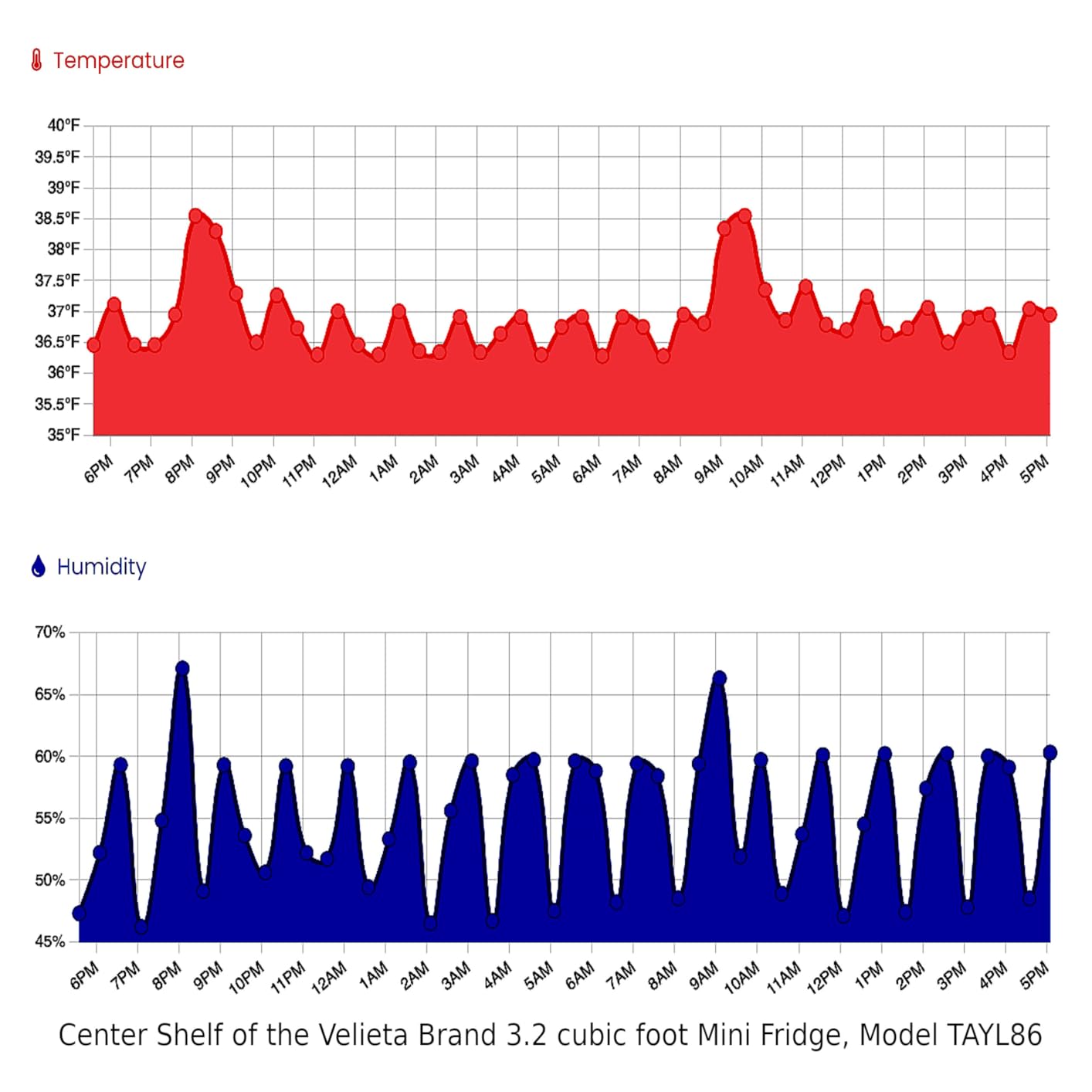
The trade-offs are worth being clear about. Owners note the door light is genuinely bright after midnight, and that temperature varies by shelf position with the bottom shelf running warmest. Reviewers also point out that the exterior display may not match the actual cabinet temperature, the same display accuracy issue seen elsewhere in this group. Use a separate thermometer if precision matters.
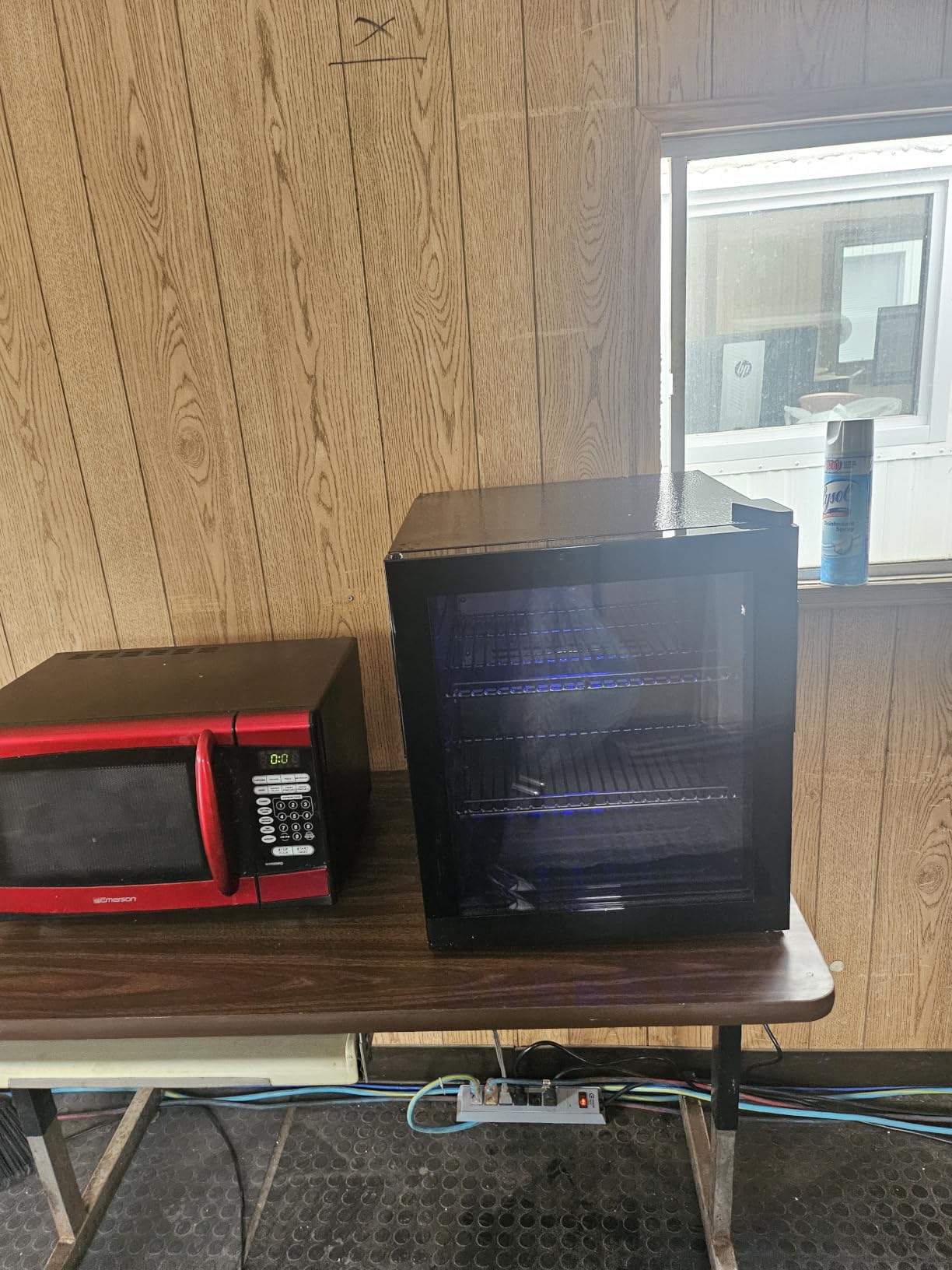
What to check before you buy the Velieta
Look at the light after dark. A door panel that reads as great in a product photo can be too much at one in the morning during a late session. If your room stays dim, weigh this against a model with interior-only lighting.
Check the outlet position. With the controls on the door face, the cabinet works best when the door swings toward you rather than into a walkway, and the hidden coil layout means you have more freedom on the wall side than with an exposed-coil fridge.
Who should look elsewhere
Choose the Tehanld if you want color lighting but only 68 cans, or the EUHOMY if quiet operation matters more than appearance and you would rather have five shelves and a 36 dB rating.
Skip it if the room is shared with small children and the light strip is going to be on all night, because the safety lock does not dim the panel.
7. Electactic 145-Can Wine and Beverage Cooler – best for wine plus cans
Electactic Wine Cooler 37 Bottle Freestanding Fridge with Stainless Steel Reversible Glass Door, 145 Can Beverage Refrigerator Quiet Compressor for Home Kitchen Bar, 4.5 Cu.ft Silver
145 cans or 37 bottles
32F-61F range
4.5 cu ft cabinet
190.5 kWh per year
Pros
- Largest capacity in the roundup
- Lowest energy draw of the full-size models
- Built-in or freestanding install
- Reversible stainless glass door
Cons
- Largest footprint at 20.28 in wide
- Manual defrost
- Only 4 shelves
The Electactic is the one to buy if your group drinks wine as well as soda. It holds 145 standard cans or 37 bottles in 4.5 cubic feet, which makes it the largest cabinet here, and it runs from 32 to 61 degrees so you can hold reds, whites, and canned drinks in the same cabinet without fighting over the setting. It also sits at the number one position in the Beverage Refrigerators category with a 4.3 star rating from 1856 reviews.
Energy use is rated at 190.5 kWh per year, the lowest annual figure among the full-size models in this roundup. For a cooler that runs through twelve-hour gaming days, that is the number that shows up in your electricity bill months later, and it makes the larger cabinet easier to justify. Installation is flexible, rated for either built-in or freestanding placement, and the stainless steel door with a reversible swing means it fits under a bar counter or against an exposed wall.
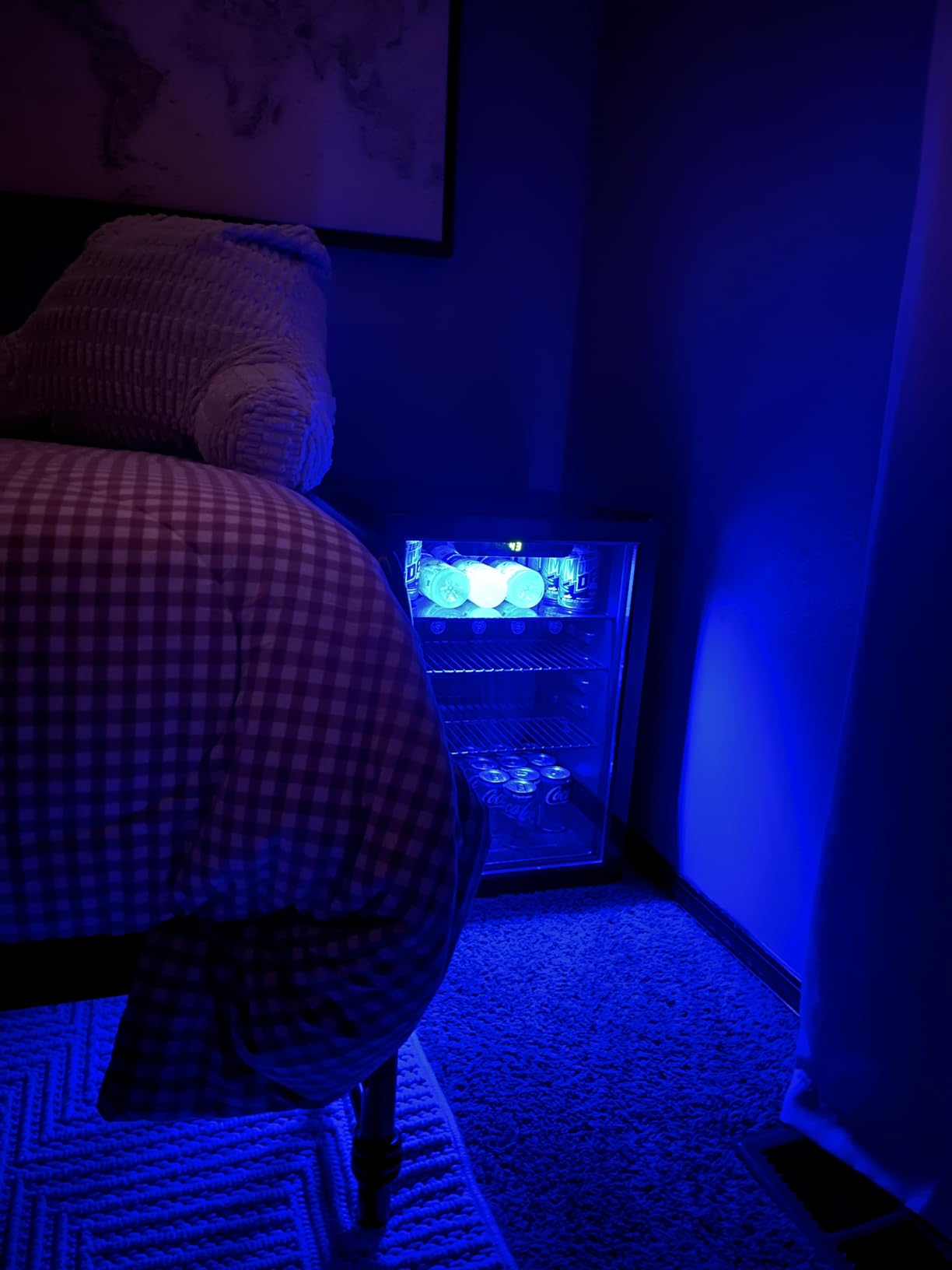
There is a caveat about the door and the room. A glass door is a display feature first, which is exactly what you want behind a bar, but glass is also the least insulating surface on the cabinet. In a hot room you will be running the compressor more often to hold 34 degrees. The airtight glass seal is tight enough that condensation on the outside of the door is uncommon in reviews, which is the failure mode to watch for.
Shelving is three glass shelves and one wire shelf, and glass shelves are easier to wipe clean after a spill than coated wire. Defrost is manual, so this is a cabinet you will need to power down occasionally. The unit is ETL certified and carries a one year warranty.
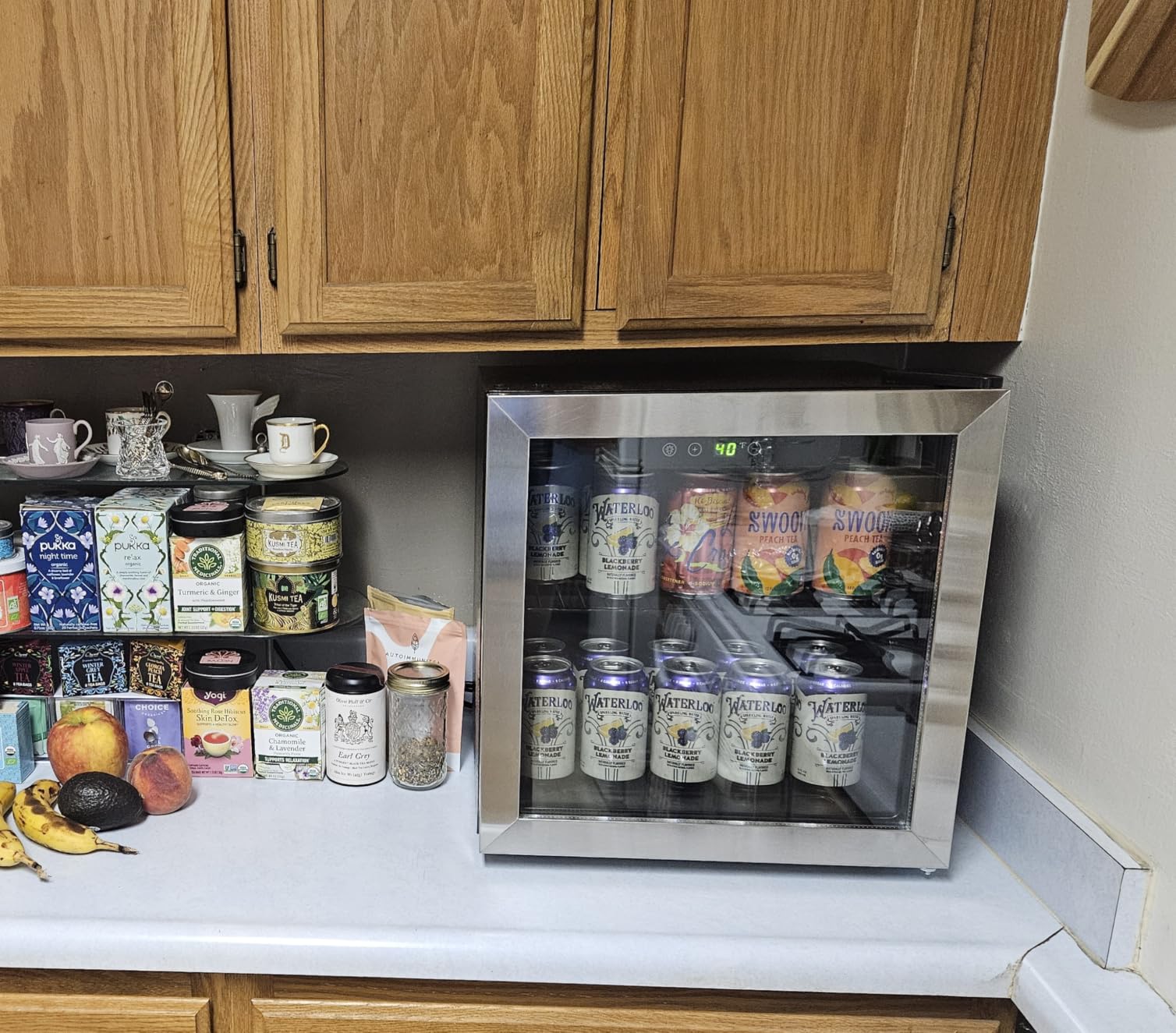
What to check before you buy the Electactic
Measure twice, because this is the widest cabinet here at 20.28 inches wide by 21.85 inches deep. That footprint will not fit beside a standard desk, and it needs a dedicated wall or counter position rather than a side table.
Decide about the glass door seriously. It looks excellent lit up in a dark bar, and it shows fingerprints and hand smears quickly in a bright room. If your game room is well lit, a solid door is easier to keep presentable.
Who should look elsewhere
The hOmeLabs or the EUHOMY are both far narrower and fit a desk run without a dedicated wall. Either will also make less noise relative to the room, which matters if the cooler is not in a corner.
Choose the Honeywell instead if you want the commercial look and an electronic door lock at a smaller footprint, and you do not need to store wine bottles.
8. Tehanld 68-Can RGB Gaming Mini Fridge – best small RGB accent
Tehanld Lighted Beverage Refrigerator, 68-Can Gaming Mini Fridge
RGB lit glass door
68 cans in 1.8 cu ft
35F-65F control
Frost free defrost
Pros
- RGB illuminated door for dark rooms
- Frost free defrost
- Compact 17.55 in width
- Low 39.1 lb weight
Cons
- Only 1 adjustable shelf
- Smallest capacity here
- Fixed hinge that cannot be reversed
The Tehanld is the smallest illuminated option here and the simplest way to get colored light into a game room. It carries an RGB illuminated glass door on a 1.8 cubic foot cabinet that holds 68 standard cans, and it stands 17.55 inches wide, so it fits a side table or a shelf where a full-height cabinet never would. Frost free defrost means no manual coil cleaning, which is a genuine advantage over the compact Antarctic Star.
Cooling is compressor based with a digital panel running from 35 to 65 degrees, and owners describe it as quiet enough for bedrooms, offices, and small gaming setups. At 39.1 pounds it is one of the lighter cabinets here, which matters for a shelf-height placement. It runs on 110 volts with a one year warranty.
The limits are real. There is only one adjustable shelf, so stacking is minimal and the usable layout is two levels at most. The hinge is fixed and cannot be reversed, which is the detail that catches people out when they plan the placement around a desk. And with 538 reviews, this is the thinnest review base in the roundup, so there is less long-term owner data behind it than the other seven.
Treating it as an accent rather than the main cooler is the right framing. It looks the part in a dark room, it holds a session of drinks for a couple of players, and it frees up floor space for the chair and the cable runs.
What to check before you buy the Tehanld
Confirm the door swing before you commit. With a fixed hinge, the cabinet only works in the position where the door opens away from the nearest wall or desk leg, and there is no reversing it after delivery.
Check the published dimensions against your shelf. Listings for this model list both a 19.65 inch and a 20.47 inch height, so measure the actual unit on arrival rather than trusting the number on the box.
Who should look elsewhere
Choose the Antarctic Star if you want a compact cabinet with two glass shelves, a key lock, and a much larger review base, and you are happy with a plain blue interior light instead of RGB.
Choose the Velieta if you want the illuminated look at full size with 128 cans, five usable levels, and a child safety lock, rather than a decorative 68-can cabinet.
How to Choose a Beverage Cooler for a Game Room
Most cooling mistakes in a game room come down to three things: buying too small, ignoring clearance, and assuming a published decibel number means the same thing as your own experience of it. Work through those three, and the rest of the specification sheet mostly takes care of itself.
Capacity tiers explained
Capacity is where can ratings stop being honest. Manufacturers measure standard 12 oz cans on an even grid, so a 130 can rating often means something closer to 95 once you mix in tall craft cans, large bottles, and rows with a shelf removed for clearance. Treat the rating as a ceiling.
A practical tier map looks like this. Under 70 cans is a session cooler for one or two players. Between 100 and 130 cans covers four players through an evening with restocking. Above 140 cans is a party cabinet that lets you stop walking to the kitchen. If your group is four or more, do not go below the middle tier, because the walk to the main fridge mid-match is exactly what the cooler is supposed to end. Our own notes on walk-in cooler sizing work through the same logic at a larger scale.
Compressor vs thermoelectric cooling
Compressor cooling holds a set temperature no matter how warm the room gets, and it is what every unit in this roundup uses except the Honeywell. Thermoelectric cooling runs no compressor, so it is silent, but it can only pull the cabinet a limited number of degrees below room temperature. In a warm room that gap shrinks and your drinks land closer to 50 degrees than to 40.
What cooler keeps drinks cold the longest? A compressor model, in a room that is not excessively hot. Compressors reach the low 30s and hold it all night; thermoelectric units depend on the room being cool to begin with, so in a basement or a hot garage they underperform exactly when you need them most.
Noise level and why decibels are missing
Only two models in this roundup publish a decibel figure: the EUHOMY at 36 dB and the Velieta at about 43 dBA at one meter. That is a real gap, and it is the number to compare first when your room has a microphone or a streaming setup.
For reference on the scale, a quiet bedroom sits near 30 dB, normal conversation around 60 dB. A compressor fridge that cycles every few minutes in a silent room is audible, and users in home theater communities routinely reject beverage coolers for being too loud in a media space. The forum consensus we found matches what the specs suggest: a rating in the mid 30s is comfortable, and anything above 45 dB will compete with headset audio. For transport and cold storage rather than room cooling, the rules are different, as we cover in marine cooler picks.
Ventilation clearance in a tight room
Every freestanding cooler here needs air around the sides and rear. The common rule is 2 to 3 inches on each side and 3 to 5 inches behind. Compressors push heat out the back, and a cabinet crammed flush into a corner runs hotter, works harder, and wears out sooner. This is the single most common self-inflicted failure in a game room.
If your space cannot give a rear-vented model that clearance, look for a built-in front-vented model instead, or pick a unit with hidden rear coils. The Velieta is the one here with concealed coils, which gives you a little more freedom against a wall. And every compressor unit should stand upright for 24 hours before its first plug-in so the refrigerant settles after shipping.
Energy draw for a 12-hour gaming day
Multiply the daily figure by 12 hours and then by 365 to get an annual estimate, then apply your own utility rate. The EUHOMY at 0.69 kWh per day is the most efficient full-size cabinet here, the Electactic at 190.5 kWh per year is the lowest annual figure among the larger models, and the rest cluster in the 252 to 289 kWh per year range. A compact cabinet like the Antarctic Star or the Tehanld uses a fraction of that.
The difference is small in absolute terms but it compounds, because this is the one appliance in the room that runs all night without anyone thinking about it. A thermostat set two degrees warmer than you need, and a door that gets closed, are worth more than the gap between models.
Glass door vs solid door
Glass doors show the drinks, which is the point in a display setup and part of the fun in a lit room. They also let more heat in, they fog when opened repeatedly, and they collect fingerprints. Solid doors insulate better and stay presentable in a bright room, but you will not see what is inside without opening it, which means more cold air loss during a session.
In a game room, the deciding factor is usually how dark the room is and how much you care about the visual. If the lighting is part of the build, glass or an illuminated door earns its place. If the room is bright and practical, a solid door is the quieter choice thermally.
Lighting, app control, and the privacy trade-off
None of the eight coolers here depends on an app or a wireless connection to cool anything, and that is a deliberate feature of this roundup. Owners in appliance forums report that networked coolers add setup friction, lose their pairing, and put a device on your home network for the sake of a light you could switch on manually.
Basic cooling should never require a phone. If a model only reaches its temperature through an app, that is a dependency you do not need in a room where you might not have your phone. For a look at how the cooling side works when the appliance has to survive heat and movement, see our wheeled cooler reviews.
The pre-purchase checklist
Measure the opening, not the cabinet. Compare width against the gap and height against the space, and add the clearance the manual specifies. If the numbers do not work, the model does not work, no matter how good the reviews look.
Then check four things in this order: the noise rating if one is published, the defrost type, the energy figure, and the warranty length. Most of these come with a one year manufacturer warranty, so that is the baseline rather than a differentiator. The defrost type is the one that changes how you will live with the appliance.
Frequently Asked Questions
What cooler keeps drinks cold the longest?
A compressor-based beverage cooler keeps drinks coldest and holds that temperature longest, because it pulls heat out regardless of room temperature. Thermoelectric units depend on the room already being cool and lose ground in a warm space.
What is the best brand of beverage cooler for a game room?
The best brands are the ones with a large body of long-term owner reviews and a stated warranty. In this roundup the hOmeLabs leads on rating and review volume, the EUHOMY on capacity and a published noise figure, and the Honeywell on commercial build and UL certification.
What are the top 5 best coolers in this roundup?
Our top five are the hOmeLabs 120-Can for overall reliability, the EUHOMY 130-Can for quiet capacity, the Velieta 128-Can for its illuminated door, the Antarctic Star 68-Can for small rooms, and the Electactic 145-Can for wine and beer storage at the lowest annual energy draw.
Which 24-inch beverage cooler is best rated?
Among cabinets near 24 inches wide, the hOmeLabs at 18.9 inches wide is the best rated at 4.5 stars from 6908 reviews, with the EUHOMY at 4.4 stars from 3489 reviews a close second. The Electactic is wider at 20.28 inches and rated 4.3 stars.
How noisy is a beverage cooler in a game room?
The two models here with published figures rate 36 dB for the EUHOMY and about 43 dBA at one meter for the Velieta. A quiet bedroom sits near 30 dB, so anything in the mid 30s is comfortable and anything above 45 dB will compete with headset audio.
Can I run a beverage cooler 24/7 in a game room?
Yes, and most owners do. Compressor coolers are built for continuous duty with an automatic or frost-free defrost cycle, which is why we favor them over manual-defrost models for a room that is used most days.
How much clearance does a freestanding beverage cooler need?
Plan for 2 to 3 inches of clearance on each side and 3 to 5 inches behind. Compressor cabinets expel heat out the rear, and pushing one flush against a wall makes it run hotter and wear out faster. A built-in front-vented model is the alternative when space is tight.
Is a beverage cooler better than a mini fridge for a gaming room?
A beverage cooler is better when drinks are the priority, because shelves hold cans flat and at a consistent height. A mini fridge suits a room where you also need snacks and fresh food, and it is worth the extra shelf adjustment for mixed use.
The Verdict on Game Room Beverage Coolers in 2026
The hOmeLabs 120-Can is our choice as the best beverage cooler for game rooms, because it is the only unit here combining the highest rating, the deepest review base, automatic defrost, and UL certification. Pick the EUHOMY if quiet operation is non-negotiable, the Velieta if the lighting is part of the build, and the Antarctic Star if the room is small enough that footprint beats capacity.
Whichever you choose, give it clearance, let it stand upright for a day before you plug it in, and set the thermostat two degrees colder than feels necessary. That is all the advice the appliance needs for the next few years.