
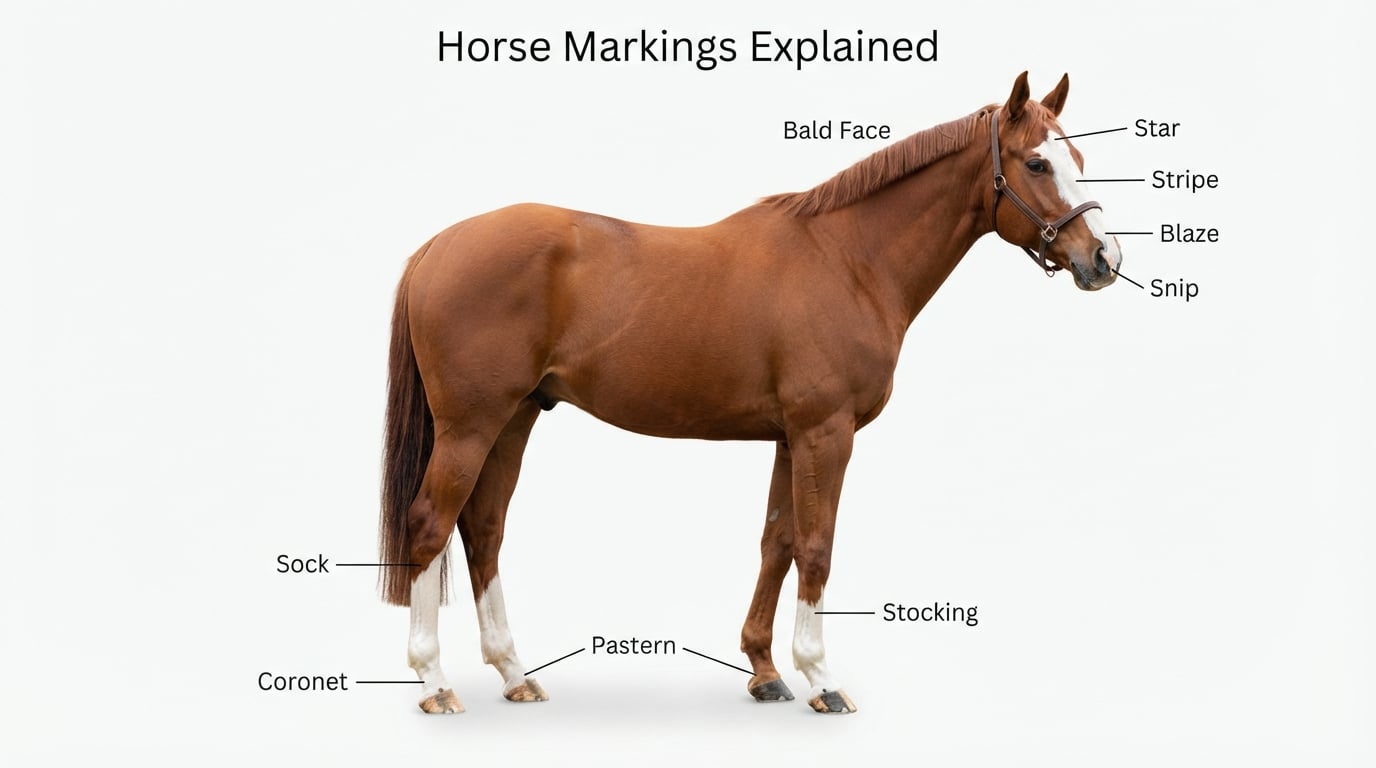
Horse markings are the natural white or dark patterns on a horse’s face and legs that make each animal instantly recognizable. Think of them as fingerprints: no two horses carry exactly the same pattern, even when they share the same sire, dam, or base coat color.
I grew up calling every white blaze a “star on the face” and every tall white sock a “stocking.” It took working with breed registrars and a couple of equine vets before I learned how precise these terms actually are. Our team pulled together this guide so you can skip that learning curve.
Markings confirm identity for breeding, racing, and sale records. They also help with theft recovery, insurance claims, and proof of ownership. We’ll cover facial markings, leg markings, combinations, documentation best practices, and how to care for the pink skin that often comes with white patches.
Table of Contents
Horse Markings Explained: The Basics
Horse markings fall into three broad groups that every owner should learn. Facial markings sit on the head and forehead, leg markings cover the lower limbs, and non-white markings add small color spots anywhere on the body.
The terminology in this guide comes from breed registries like The Jockey Club, the American Quarter Horse Association, and the International Federation for Equestrian Sports. These bodies require precise markings on registration papers because markings confirm identity for breeding, sale, and racing records.
Most markings are white patches caused by unpigmented skin and hair. A few markings are dark spots inside white patches (called ermine spots) or tiny dark body spots (Bend-Or spots and Birdcatcher spots). Both kinds are normal and worth knowing for accurate ID.
Before we jump into the diagrams, run through this quick reference list:
Facial markings: star, stripe, blaze, snip, bald face, apron
Leg markings: coronet, pastern, fetlock, sock, stocking
Special features: ermine spots, whorls, chestnuts, scars
Markings are usually permanent from birth, though seasonal coat changes can make white hair look bigger or smaller. Gray horses are the main exception: their white markings can disappear completely as the rest of the coat turns gray or white with age.
Horse Face Markings: Complete Identification Guide
Face markings are described by their shape, width, and where they sit between the eyes, nose, and muzzle. Use this section as your visual dictionary the next time you look at an unfamiliar horse.
Star Marking
A star is a white patch between or above the eyes on the forehead. Stars can be round, oval, diamond, heart, or crescent shaped.
Stars vary wildly in size. Some are barely a fingertip wide. Others spread three inches across. The shape matters too: a star with a stripe that runs down the face is usually called a star and stripe combination rather than just a star.
Look for color traces at the edges. A few stray dark hairs inside a star don’t change the classification, but visible pigmented spots do matter for registration photos. Common star shapes include oval, round, crescent, and irregular, and some breeders add the shape as a prefix when filing paperwork.
Stripe (Strip) Marking
A stripe is a narrow white marking that runs down the bridge of the nose from the forehead toward the muzzle. A stripe stays narrower than the nasal bone itself.
Stripe and strip are interchangeable in most registries. The British spelling is “stripe” while “strip” is more common in American terminology, though both appear on the same papers.
Stripe markings are usually straight, but they can curve, fork, or break. A broken stripe that becomes a star at one end is often written as “broken stripe” on paperwork. Some horses carry a stripe that narrows to nothing partway down, which gets called a “faded stripe.”
Blaze Marking
A blaze is a wider white marking that runs down the center of the face, covering the full bridge of the nose. Blazes are noticeably wider than stripes.
Blazes vary from a tidy inch-wide stripe to a wide band that covers most of the face. The widest extreme is called a bald face, which we’ll cover below.
Three recognized variations sit between a stripe and a blaze:
Race blaze: a very thin blaze running down the face
Wide blaze: covers most of the front of the face but stops short of the eyes
Apron: a wide blaze that extends out onto the cheeks or chin
Some blazes are “offset,” meaning the white sits slightly to one side of the nose rather than running straight down the center. Offset blazes are perfectly normal and still recorded as blazes, just with a note about the position.
Snip Marking
A snip is a white marking between or just above the nostrils on the muzzle. Snips can be small dots, vertical lines, or wider patches.
A snip can stand alone or pair with a star or stripe on the forehead. Many gray horses carry just a snip once their coat lightens with age, and the snip sometimes becomes the only visible marking on an older gray.
Owners often miss smaller snips. Check the area between the nostrils in good light before assuming your horse has no face markings. A snip on the upper lip is sometimes recorded separately from a snip between the nostrils.
Bald Face Marking
A bald face is a very wide blaze that covers most of the front of the head, often extending past the eyes and onto the lips. Bald-faced horses typically have pink skin across much of their face.
Bald-faced horses need extra sun protection because the large patches of pink skin sunburn easily. We’ll cover that in the care section below.
Some bald faces are partial, covering the upper face but stopping above the muzzle. Others extend onto one or both sides of the cheeks, which gets called an “apron face” by some breed associations.
Bald-faced horses often have one or two blue eyes. That’s not a separate marking, but it’s a feature many owners like to note on registration charts.
Apron and Chin Markings
An apron is a wide facial marking that extends down past the muzzle onto the chin and sometimes the lower lip. Apron markings often pair with a bald face.
Chin spots are isolated patches of white on the chin or lower lip with no marking on the forehead or bridge. They get recorded separately when filling out a horse description.
Lower lip markings appear as white or pink patches on the lip itself. They are common on horses with snip or bald face markings, and they often get documented alongside the main facial marking.
Horse Leg Markings: From Coronet to Stocking
Leg markings are named by height, starting at the hoof and climbing up the cannon bone. The four standard leg markings are coronet, pastern, sock, and stocking.
Coronet Band
A coronet is a narrow white band that wraps around the very top of the hoof, just above the coronary band. It usually rises about an inch up the leg.
Coronet markings often look uneven because the hair lays differently around the heel. The white band may “dip” lower at the front and rise higher behind the pastern. That’s normal and doesn’t change the marking’s classification.
A “partial coronet” covers only part of the coronary band, such as just the front or just one side of the heel. Some coronets wrap fully around the leg; others stop at the heel and look more like an upside-down U.
Half Pastern and Pastern
A pastern marking covers the area from the coronary band up to the top of the pastern bone, just below the fetlock joint. A half pastern covers only the lower half of this region.
Pastern markings are easy to spot because the pastern sits between the hoof wall and the fetlock joint. Many gray horses carry pastern markings that disappear as the coat lightens.
If the white extends just past the fetlock joint, it stops being a pastern and becomes a sock. Pastern markings often pair with coronets when the white is broken into two visible bands, and breeders usually record both rather than treating them as one marking.
Fetlock Marking
A fetlock marking reaches up to the bottom of the fetlock joint. It’s the shortest leg marking above the pastern but below the sock.
The fetlock joint sits at the back of the pastern above the hoof. Because this joint is a small target, fetlock markings are usually narrow bands or partial wraps.
Some registries treat fetlock markings as a sub-category of the sock rather than a separate marking. Always check the breed’s official naming chart when in doubt. Fetlock markings are common on horses with short cannon bones, like many ponies.
Sock Marking
A sock is a white marking that extends from the hoof up to the middle of the cannon bone. On most horses, the cannon runs from just below the knee down to the fetlock.
Socks usually stay about halfway up the cannon bone. A common way to remember: sock = halfway. Stocking = taller.
On shorter horses with shorter cannons, what looks like a sock might actually be a stocking. Measure against the leg, not the overall body size. Socks are the most common leg marking on riding horses and show up on most breeds.
Stocking Marking
A stocking is a white marking that extends from the hoof up past the knee or hock. On the front legs, stockings reach the knee. On the hind legs, they reach the hock.
Full stockings that hit the knee often show “white knees,” which means the white covers the knee joint itself. Partial stockings stop just below the knee but well above mid-cannon.
Stockings are the most common leg marking on draft breeds and pinto horses. They are also the markings most prone to skin issues like pastern dermatitis, which we’ll address in the care section.
Asymmetric stockings (one leg higher than the others) are common and can help tell two similarly marked horses apart. Registries usually note this on the ID diagram.
Ermine Spots
An ermine spot is a small dark dot or patch of colored hair inside an otherwise white marking, usually on the leg. They appear on coronets, socks, and stockings alike.
Ermine spots are also called “ermine marks” or “bear marks” in older texts. They are normal and don’t change the marking classification. Registries typically record their presence on the ID chart.
One horse can carry several ermine spots scattered across different legs. They stay permanent throughout the horse’s life because the underlying skin is pigmented even when the hair grows white.
Ermine spots are especially useful when two horses look almost identical from a distance. They often show up on x-rays and close-up ID photos when general body markings aren’t enough to tell the horses apart.
Non-White Markings and Body Patterns
Not every marking is white. A few patterns add dark spots, stripes, or patches on top of the base coat. Knowing these patterns helps when you see a horse that doesn’t quite match the white marking descriptions.
Bend-Or Spots
Bend-Or spots are small, dark, random spots scattered across the body of palomino, chestnut, and chestnut-based horses. They show up most often on the flank, shoulder, and hindquarters.
The name comes from the famous Thoroughbred stallion Bend Or, who carried these spots in the 19th century. They are inherited but unpredictable in placement and number.
Birdcatcher Spots
Birdcatcher spots are tiny white spots, usually the size of a coin, that appear randomly across the body of darker horses. They are most often seen on dark bay and chestnut horses.
These spots get their name from the Irish Thoroughbred Birdcatcher, who carried them. They can appear or disappear seasonally and aren’t tied to a single genetic cause.
Rabicano Ticking
Rabicano causes white hairs to spread up the horse’s flanks and tail base in a roan-like pattern. The ticking usually starts at the flank and tail, leaving the head and legs darker.
True rabicano is different from classic roan because the white stays concentrated on the flank and tail rather than spreading across the whole body. It’s a subtle pattern that’s easy to miss without close inspection.
Leopard Complex Spots
The leopard complex gene causes spotted coat patterns on Appaloosas and related breeds. Patterns include the full leopard (white coat with dark spots), snowflake (dark coat with white spots), and blanket (white patch over the hips with or without spots).
Appaloosas also carry other visible traits like mottled pink skin around the muzzle and striped hooves. These features help confirm the breed even when the spotting pattern is minimal.
Common Horse Marking Combinations and Naming Conventions
Most horses carry more than one marking. Registries and owners name horses using a head-to-toe reading order that starts at the forehead and works down to the hooves.
Standard naming order for a horse with multiple markings:
Head markings, listed top to bottom (star, stripe, blaze, snip)
Left front leg markings, listed outside to inside
Right front leg markings, listed outside to inside
Left hind leg markings, listed outside to inside
Right hind leg markings, listed outside to inside
Worked example: a horse with a star on the forehead, a strip down the nose, a sock on the left front, and a stocking on the right hind would read “star, strip, sock LF, stocking RH” on a chart.
Common combinations you’ll see on registration papers:
Star and snip: a forehead star plus a muzzle snip, no stripe connecting them
Blaze and four socks: a wide facial marking plus matching leg markings on all four legs
Bald face and four stockings: maximum white on both head and legs, often seen in Clydesdales
Irregular blaze: a wavy or crooked blaze that doesn’t run straight down the face
When a marking doesn’t match a standard category, describe it with the closest term plus a qualifier like “irregular,” “broken,” or “partial.” Avoid inventing names that breed registrars won’t recognize.
How Markings Are Inherited?
White markings are influenced by genetics, but the inheritance isn’t simple. Researchers have identified several genes that play a role, including the KIT gene, the MITF gene, and a region called the W20 allele.
Two solid-colored parents can produce a foal with white markings if both carry the genes for white patterning. Likewise, two heavily marked parents can produce a solid foal. There are no guarantees, which is why breeders don’t select for markings alone.
Most white markings are present at birth and stay permanent, though they can appear to grow slightly as the foal matures. Seasonal shedding can make a star look sharper in spring and softer in fall without changing the actual extent.
Markings on Gray Horses
Gray horses present a special challenge. They are born a darker color and gradually turn lighter, often becoming nearly pure white by their teens. White markings on a gray horse often disappear over time because they blend into the lighter coat.
For ID purposes, gray horses need photo records at each life stage. A horse born with a blaze can look unmarked by age 12, but the underlying pink skin still shows the original pattern in close-up photos.
Some breed associations require gray horses to have annual photos to track the change. Without those photos, distinguishing two older grays can become nearly impossible from appearance alone.
How to Document Horse Markings for Identification?
Documentation starts with a diagram showing the horse’s white areas and goes into owner paperwork like registration papers, microchip records, and insurance forms.
Pull mane and tail hair carefully to expose all the relevant skin. Markings hidden under thick winter coats are the top reason horses get misidentified on intake forms.
A complete marking record should include:
A diagram with white areas shaded
Written descriptions using standard terminology
High-resolution photos from each side, front, back, and above
Note any whorls (hair swirls), scars, and chestnuts (the small horny growths inside the legs)
Whorls deserve a special mention. They are cowlicks in the hair coat that stay in fixed locations. The police used whorls to identify horses long before microchips existed, and breeders still record them on registration papers.
Take new photos every time markings look different. Seasonal shedding can make a star look smaller in spring and larger in fall. Keep photo records timestamped to defend against disputes.
Here’s a quick documentation checklist I use when reviewing a new horse’s file:
Stand the horse on level ground in good light
Photograph the head from front, both sides, and slight angles
Photograph each leg from the side and from the front
Brush white markings clean so the edges show clearly
Add any scars, whorls, or chestnuts to the chart
For breeding stock, breed registries often require a specific marking diagram. Check the rule book before drawing on the official chart.
Freeze branding and lip tattoos are also used for permanent ID, especially in racehorses. These work alongside white markings rather than replacing them, and a complete ID file usually includes both the natural markings and any human-applied identifiers.
Caring for Horses With White Markings
White hair almost always grows from pink skin beneath it. That pink skin sunburns easily, picks up stains, and is more prone to scratches and dermatitis.
Horses with bald faces, large blazes, and white leg markings need a slightly different care routine than solid-colored horses. These tips come from equine veterinarians and longtime grooms on working farms.
Sun Protection for Pink Skin
Apply sunscreen or zinc oxide paste to bald faces and pink muzzles before turnout in sunny months. SPF 30 or higher works for most horses.
Fly masks with UV protection help horses with white face markings during the brightest part of the day. Choose a mask with at least 60% UV block rating.
Keep turnout time flexible. Midday sun is the most damaging, so bring horses in during peak hours when possible. Stalls with shade access give bald-faced horses a break from direct sunlight.
Watch for early signs of sunburn on pink skin: pink skin turning red, slight swelling, or the horse rubbing its face more than usual. Catching it early avoids painful blistering.
Grooming White Markings
White leg markings stay cleaner with regular brushing and quick rinses after turnout. Dried mud makes the hair yellow and harder to clean later.
Use a whitening shampoo designed for equine skin when normal brushing isn’t enough. Avoid human products, which can dry out the skin and cause flaking.
Drying wet legs thoroughly after a bath prevents pastern dermatitis, sometimes called “scratches” or “greasy heel.” Towel dry and add a thin layer of barrier cream if your horse is prone to the condition.
Whitening shampoos and stain removers work best when applied to a clean coat and rinsed thoroughly. Residue left on the skin can actually attract more dirt and stain over the next few days.
Preventing Pastern Dermatitis
Pastern dermatitis shows up as scabby, cracked, or oozing skin around the pastern and fetlock. White socks and stockings are more vulnerable because the skin underneath is unpigmented.
Keep bedding clean and dry. Standing in wet shavings or muddy paddocks for long periods is the leading trigger.
Clip long hair around the pastern during wet seasons so the skin can dry faster. Some grooms use barrier creams like zinc oxide or lanolin-based products to repel moisture.
If dermatitis sets in, call your vet. Left untreated, it can spread up the leg and lead to cellulitis, which requires antibiotic treatment.
For chronic cases, consider rotating turnout onto drier ground or using waterproof leg guards during heavy rain. Prevention is much easier than treating an established infection.
Horse Markings FAQ
How do I identify horse markings?
Start at the forehead and work down the face, then move to each leg from the top of the cannon to the hoof. Use standard names like star, stripe, blaze, snip, sock, and stocking. Photograph every angle in good light and add whorls, scars, and chestnuts to round out the ID record.
What are the different patterns and markings on horses?
The main categories are facial markings (star, stripe, blaze, snip, bald face), leg markings (coronet, pastern, sock, stocking), and special features (ermine spots, whorls, scars). Non-white markings include Bend-Or spots, Birdcatcher spots, and rabicano ticking.
What is an ermine spot on a horse?
An ermine spot is a small dark patch of colored hair inside a white marking, usually on the leg just above the hoof. Ermine spots are normal, permanent, and don’t change the marking’s classification. Registrars record them because they help identify individual horses.
What are the markings on a horse called?
White markings on the face are called facial markings and include star, stripe, blaze, snip, and bald face. White markings on the legs are called leg markings and include coronet, pastern, sock, and stocking. Each marking has a precise location on the head or leg, and breeders name horses using a head-to-hoof order.
Do horse markings change over time?
Most markings are present at birth and stay permanent. Seasonal shedding can make the white look slightly larger or smaller, and gray horses often appear to lose their markings as the coat lightens with age. In both cases, the underlying skin pattern stays the same and shows up in close-up photos.
What is the difference between a sock and a stocking on a horse?
A sock reaches about halfway up the cannon bone. A stocking extends past the knee on the front legs or past the hock on the hind legs. Measure against the cannon bone itself rather than the horse’s overall size, because short-legged horses can look like they have shorter socks than they actually do.
Common Beginner Mistakes in Marking Identification
Most beginners make the same handful of mistakes when first learning horse markings. Here are the ones we see over and over again.
The biggest mistake is calling any wide facial marking a “blaze” without checking how far the white extends. A bald face is a different category and needs to be recorded that way on registration papers.
Second, beginners often forget to check the inside of the legs. Markings on the inside of the cannon or hock can be easy to miss but matter for accurate ID.
Third, beginners sometimes confuse ermine spots with scars or scrapes. Ermine spots are present at birth and stay permanent, while scars come and go with injury and healing.
Fourth, beginners often skip photographing whorls. Whorls are permanent and easy to record, but they’re hidden under the coat and easy to forget about.
Finally, beginners sometimes assume markings change with the season. They don’t usually change, but the surrounding coat length and color can make them look different. Always check the photo record before assuming a marking has changed.
Final Thoughts on Horse Markings
Horse markings do more than make each horse look unique. They are the simplest, oldest identification system in the equine world, and they still appear on registration papers, insurance forms, and theft recovery posters across the industry.
Spend five minutes with your horse in good light and brush the markings clean. Write down what you see using the terms in this guide, take fresh photos, and store them where you can find them. That small habit saves a lot of heartache if anything ever happens to your horse.
If you’d like to keep this guide handy, bookmark it and come back whenever you meet a new horse or spot a marking you can’t quite place. The terms become second nature after a few barn visits, and pretty soon you’ll be the one explaining the difference between a stripe and a blaze to your friends.