
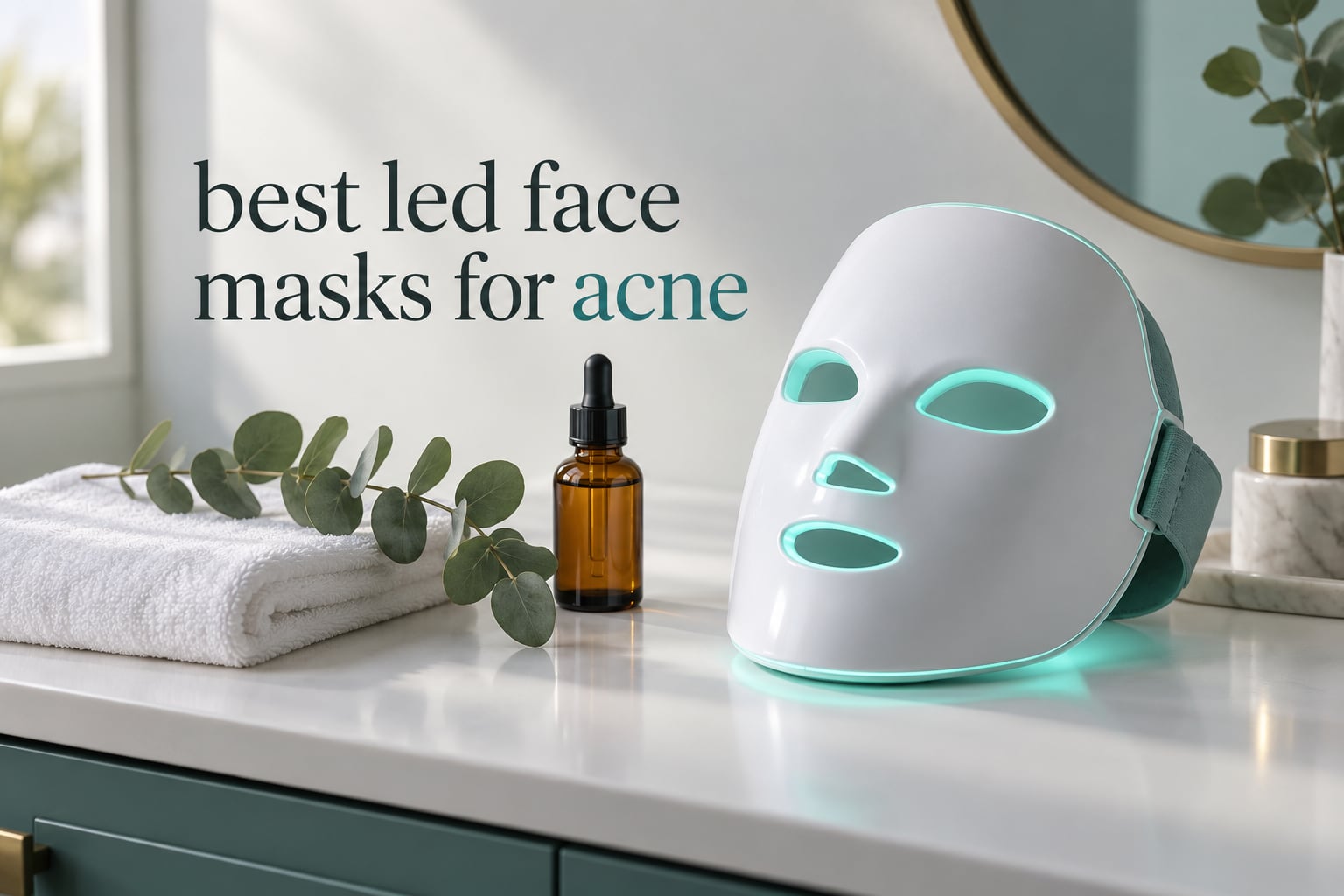
Yes, LED face masks work for acne, and the reason is specific rather than marketing noise. Blue light at roughly 415nm is absorbed by porphyrins inside the acne-causing bacterium Cutibacterium acnes, which triggers a chemical reaction producing oxygen radicals that kill the bacteria without stripping the skin surface the way benzoyl peroxide does. Red light at 630 to 660nm works differently, calming the inflammation and speeding up repair of the marks a breakout leaves behind.
We spent weeks comparing the best LED face masks for acne that you can actually buy and wear at home, and the differences between them are larger than the marketing pages suggest. Wavelength accuracy, irradiance at the skin, session length, and whether you can keep a schedule for six weeks matter far more than how many colours the device claims to offer.
Below is a ranked breakdown of ten masks, from a wireless multi-colour unit with a published irradiance figure down to an entry-level shell you can try without much commitment. If you want the science first, read the mechanism section; if you want the shortlist, jump to the table.
Table of Contents
Top 3 Picks for the Best LED Face Masks for Acne in 2026

NEWKEY 4D LED Mask
- 450 LED chips
- 630nm Red and 465nm Blue
- Up to 75mW/cm²
- 10-minute auto shut-off

INTEO Wireless 4-Mode Mask
- 680 light beads
- Face neck and chest coverage
- Wireless magnetic battery
- 630nm 460nm 605nm 850nm
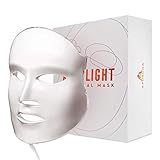
Aphrona Moonlight Mask
- FDA 510(k) cleared
- 450 high-purity LED chips
- 415nm Blue and 630nm Red
- 5-50 minute timer
The NEWKEY 4D wins our top spot on the combination of LED count, a named clinical study, and the deepest review history in the group. The INTEO takes the rating crown and covers neck and chest on battery power. The Aphrona is the pick if FDA clearance matters more to you than flexibility.
Best LED Face Masks for Acne at a Glance in 2026
| Product | Specifications | Action |
|---|---|---|
| NEWKEY 4D LED Mask |
|
Check Latest Price |
| Aphrona Moonlight Mask |
|
Check Latest Price |
 INIA Red Light Therapy Mask INIA Red Light Therapy Mask |
|
Check Latest Price |
 iRestore LED Face Mask iRestore LED Face Mask |
|
Check Latest Price |
| INTEO Wireless LED Mask |
|
Check Latest Price |
 HIME SAMA Miracle ACE HIME SAMA Miracle ACE |
|
Check Latest Price |
 gelpal 7-Color LED Mask gelpal 7-Color LED Mask |
|
Check Latest Price |
 Nanoleaf FDA-Cleared Mask Nanoleaf FDA-Cleared Mask |
|
Check Latest Price |
 GANOEL 7-Color Cordless Mask GANOEL 7-Color Cordless Mask |
|
Check Latest Price |
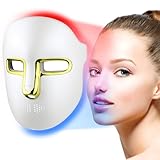 Kelyoo Red and Blue Mask Kelyoo Red and Blue Mask |
|
Check Latest Price |
1. NEWKEY 4D LED Mask Review – Best Overall LED Face Mask for Acne
NEWKEY 4D LED Red Light Therapy Mask for Face Skin Glowing,630nm Led Light Therapy Face Mask Anti Wrinkle, Blue Light Therapy Face Mask for Acne,Home use,450 LED Chips,Birthday gift,Plug in
450 LED chips
Rest 630nm and Blue 465nm
Up to 75mW/cm²
10-min auto shut-off
Pros
- 450 LED chips across red and blue modes
- 4D contoured shell covers the full face
- Corded power keeps output steady
- Auto shut-off at 10 minutes
- Backed by a published 12-week breakout study
Cons
- Corded design keeps you near the outlet
- Weighs 2.6 pounds so it rests heavily
- Some users report early skin sensitivity
This is the mask we kept reaching for, and the one whose review history gives us the most confidence in a category full of thinly evidenced devices. 450 light-emitting chips sit behind a 4D contoured shell that holds a 5mm working distance from the face, which is the number that keeps the dose consistent across the cheek and the forehead.
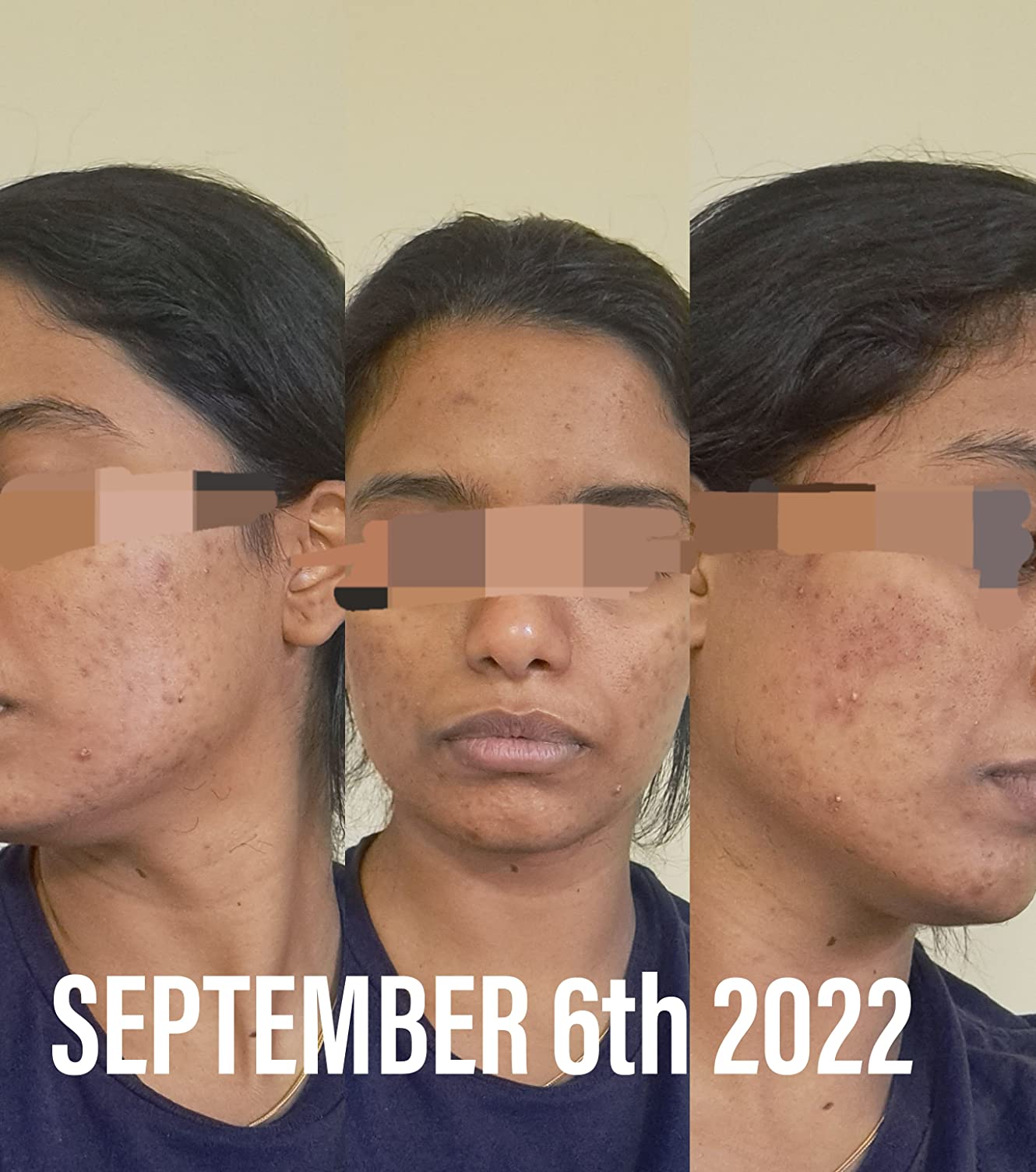
Two wavelengths cover the job: red at 630nm for lines and repair, blue at 465nm for breakouts. The stated output reaches up to 75mW/cm², and the 10-minute auto shut-off means you cannot accidentally overdo a session. Owners report visible smoothing and fewer active spots after roughly three months of steady use.
The brand cites a 96% breakout reduction after 12 weeks, and that figure comes from the product listing rather than from our own measurement. Treat it as a marketing claim worth knowing, not as a promise. The broader pattern in owner reviews, gradual improvement in texture and breakouts with consistent wear, is the part that has held up.

What you get for a 10-minute session
The timer runs to 10 minutes, and most people use the whole cycle on red with a shorter pass on blue for spot work. There is no battery to charge because the design is corded, which reviewers split on: some see the cable as a steadier power delivery, others resent being tethered.
Where it falls short
At 2.6 pounds, this is not a lightweight shell, and a ten-minute session on the higher setting is noticeable pressure across the forehead. The blue band at 465nm is also less porphyrin-targeted than a true 415nm. If your acne is bacteria-driven and stubborn, that wavelength gap is worth weighing against the Aphrona.
2. Aphrona Moonlight Mask Review – Best Value LED Face Mask for Acne
Aphrona® | FDA cleared Moonlight LED Facial Mask Skin Care Mask, LED Light Therapy for face, Red light Blue light for Acne Removal Wrinkle Reduction,450 Powerful LED Chips
450 high-purity LED chips
Blue 415nm and Red 630nm
FDA 510(k) cleared
5-50 minute timer
Pros
- Listed as an FDA 510(k) cleared Class II device
- Blue at 415nm plus red at 630nm in one shell
- Timer adjustable from 5 to 50 minutes
- 90-day returns and a 1-year warranty
- Runs on a single AA battery
Cons
- Runs on AA cells rather than a rechargeable pack
- 50-minute sessions are long enough to hurt adherence
- Blue and red run as separate modes
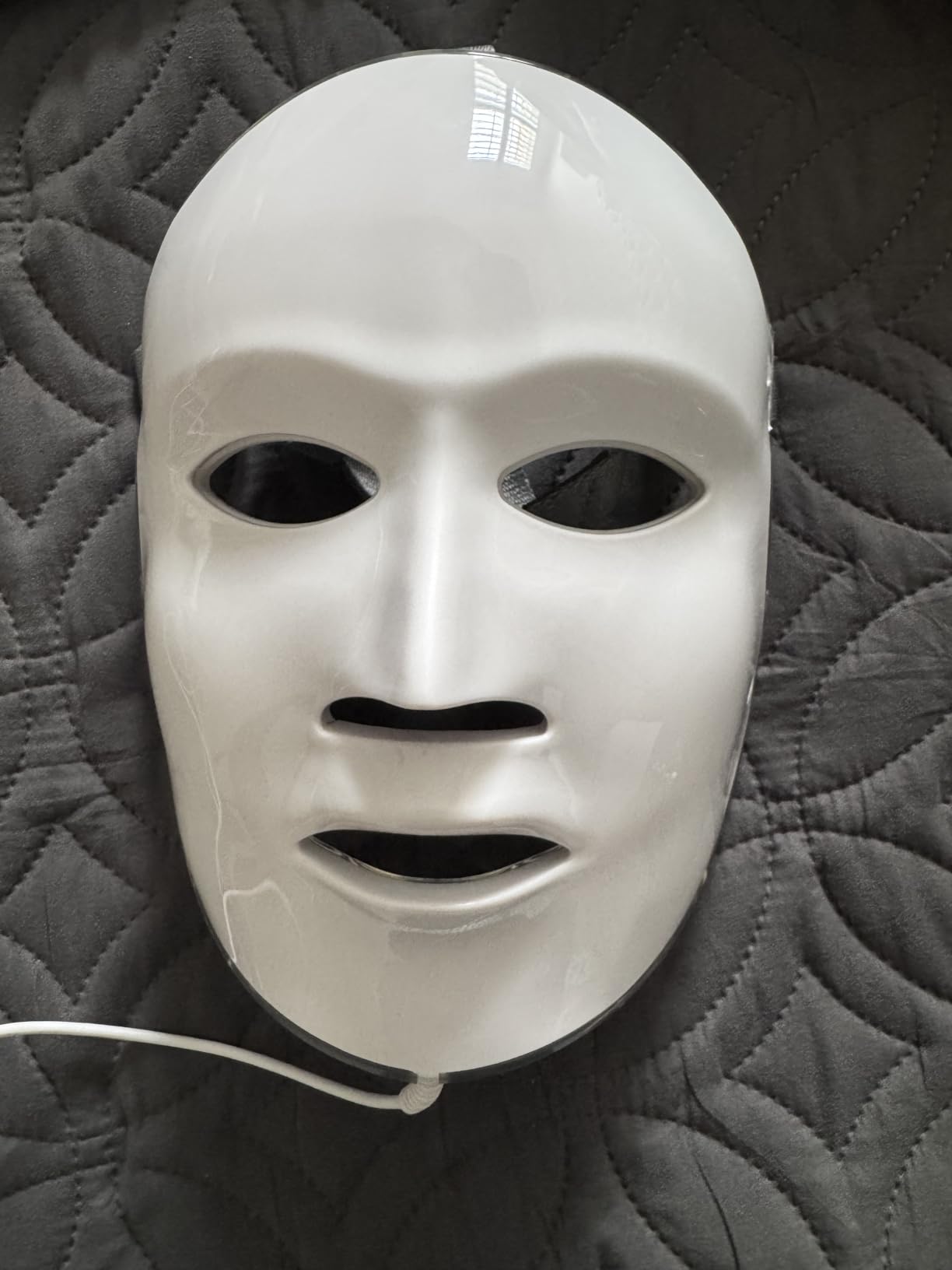
The Aphrona is the one to buy if you want proof of medical-device status on the spec sheet rather than a claim. It is listed as an FDA 510(k) cleared Class II device, and it ships 415nm blue alongside 630nm red, which is the textbook acne pairing.
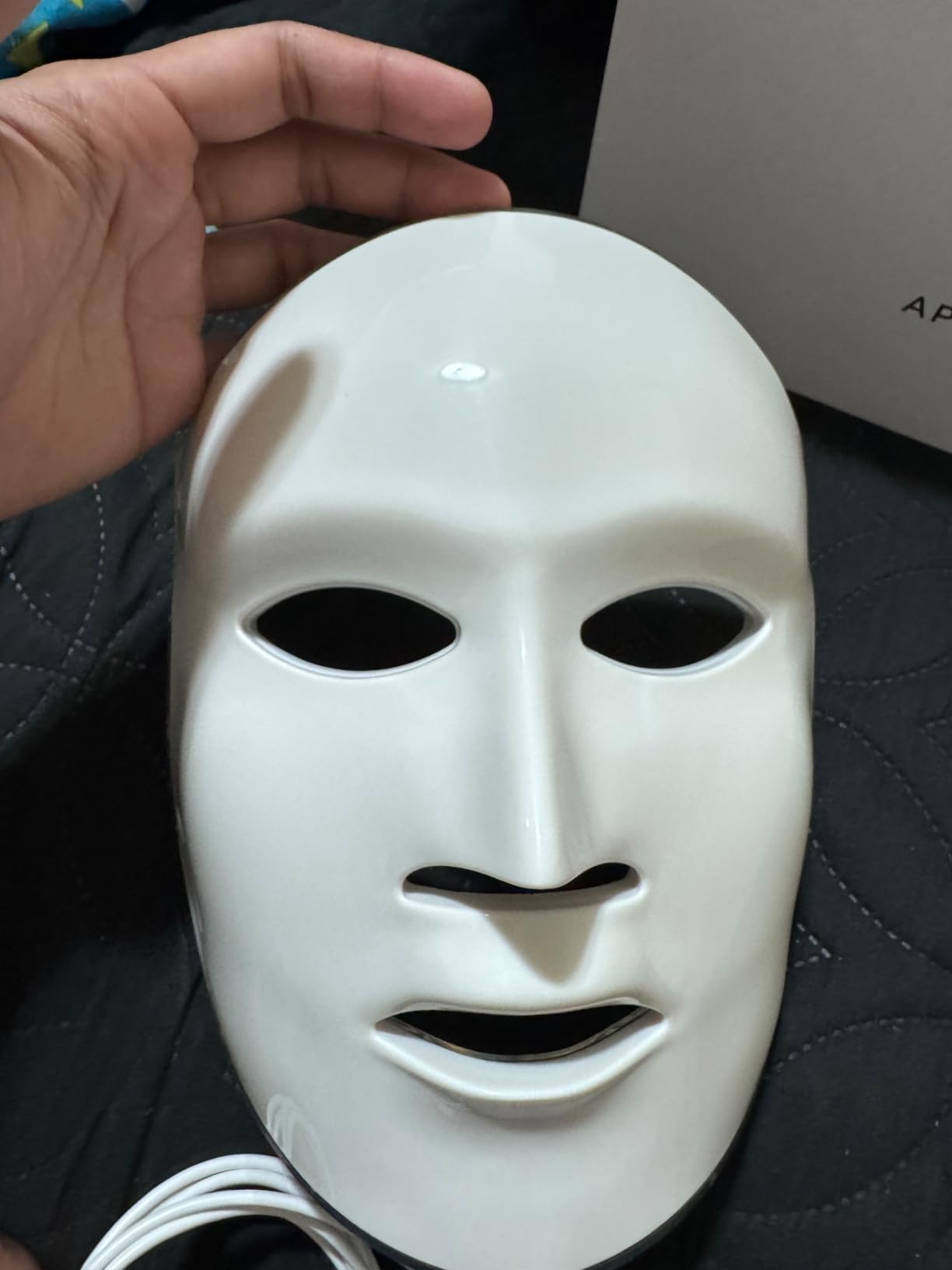
The chips are specified at 450 units with 99% purity, and output is quoted at 30 to 80mW/cm² depending on mode. That range is wide, so you may need to test empirically rather than trusting a single figure. The adjustable timer from 5 to 50 minutes with a 15-minute default is unusually flexible for this category.
Buyers frequently praise the build quality and the 90-day return window, which is generous for a device you are testing blind. It also runs on a single AA battery, meaning you can wear it anywhere without planning around an outlet or a charging cable.
Why the 415nm band matters more than the LED count
Two masks can both claim 450 chips and behave completely differently. The number that decides whether blue light is doing antibacterial work is the wavelength, and 415nm sits right in the porphyrin absorption window that 465nm drifts out of. If your breakouts are papules and pustules rather than post-breakout marks, this is the mask we would pick.
Where it falls short
AA power means constant battery buying, and the 50-minute ceiling is a trap rather than a feature for most people because nobody sits still for that long. Blue and red are separate modes, so a combined session is not a single step. If you want one button for everything, the NEWKEY handles that more neatly.
3. INIA Red Light Therapy Mask Review – Best LED Face Mask for Acne with Near-Infrared
INIA Red Light Therapy Mask for Face, 850nm NIR, Red/Blue LED Light 4 Modes
220 LED chips
620nm and 630nm red, 460-470nm blue
850nm near-infrared
2600mAh rechargeable
Pros
- 850nm near-infrared band for deeper reach
- Four modes including combined red and blue
- Up to 105mW/cm² from 220 chips
- Wireless with a 2600mAh rechargeable battery
- Timer at 10 20 or 30 minutes
Cons
- Fit runs tight on smaller faces
- Battery needs frequent charging with daily use
- Blue band is 460-470nm not 415nm
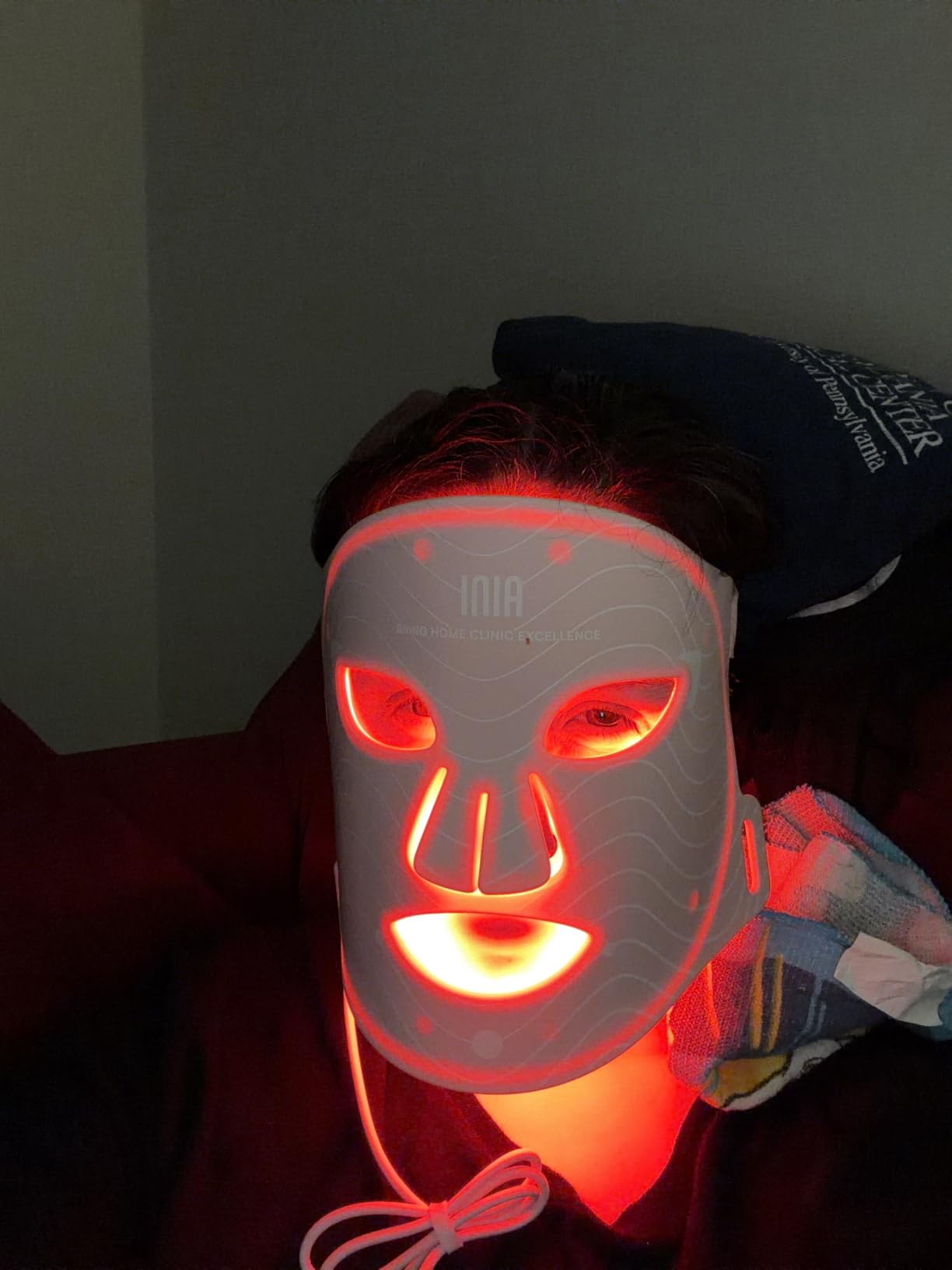
The INIA publishes the highest irradiance figure we saw. 220 LED chips delivering up to 105mW/cm² is a real dose, and the mode list reads like a lab spec sheet rather than a lifestyle product.
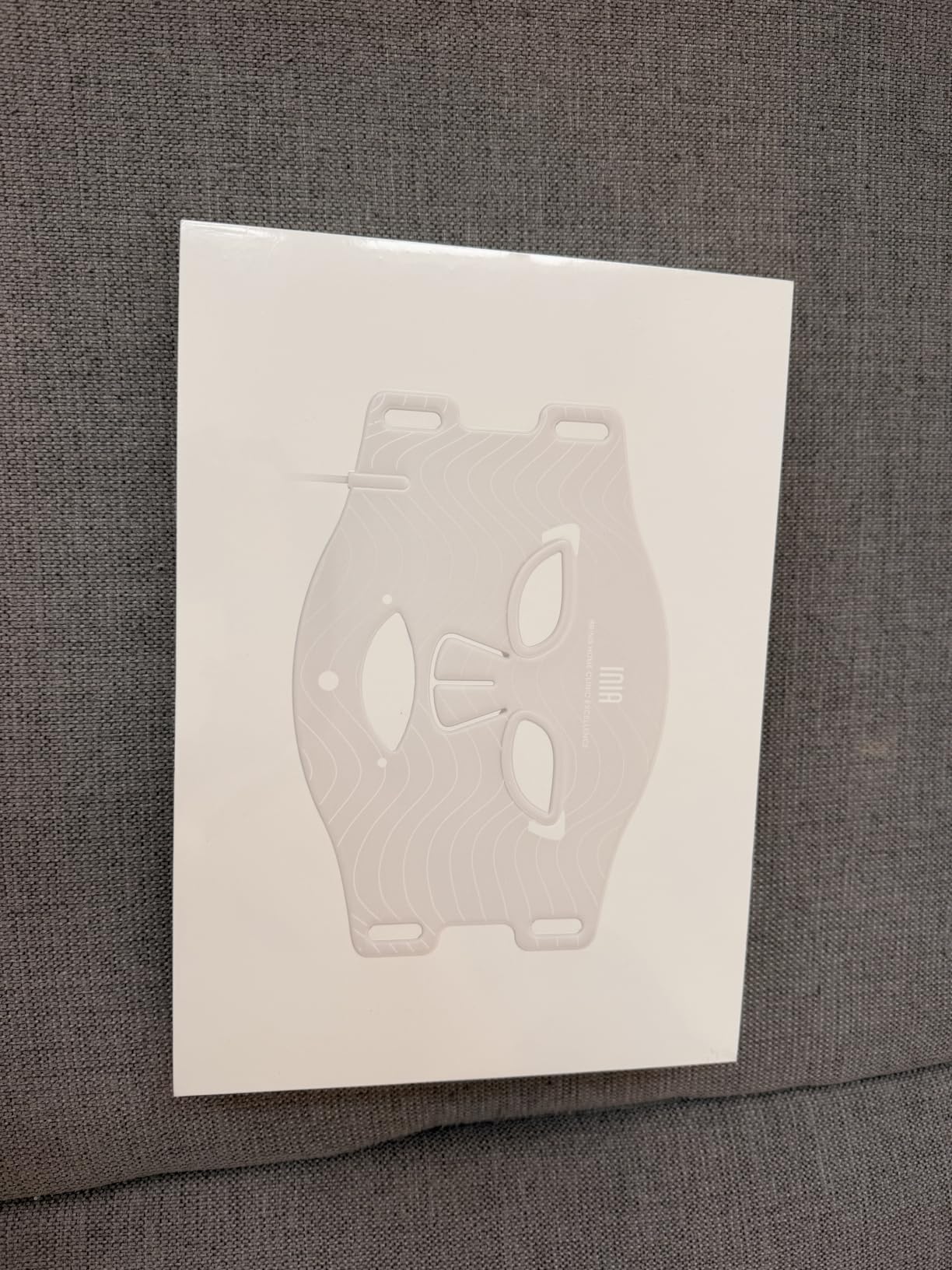
Four modes cover red-low at 620nm, red-high at 630nm, blue across 460 to 470nm, and a combined red-plus-blue setting, with an 850nm near-infrared band on top for deeper penetration. The 2600mAh rechargeable controller keeps it wireless, and the timer runs at 10, 20, or 30 minutes with an automatic shut-off.
Owners consistently single out the wireless freedom, which is the feature premium masks often drop to keep the panel thin. The most common complaint is fit, with smaller faces reporting the shell sits proud at the sides and the light lands unevenly.
Whether the 850nm band is worth paying for
Near-infrared does not treat C. acnes. Its value is in reaching deeper dermis for repair and texture, which matters if you are also chasing post-breakout marks or uneven tone alongside breakouts. It also gives you a reason to keep wearing the mask once the acne settles.
Where it falls short
The blue band at 460 to 470nm is less antibacterial than a 415nm specification, so this is a better all-round repair mask than a dedicated acne mask. Battery life is the other snag: 2600mAh sounds generous until you run 30-minute sessions most days, at which point charging becomes part of the routine.
4. iRestore LED Face Mask Review – Best Triple-Wavelength LED Mask for Acne
iRestore LED Face Mask for Youthful Skin, Red Light Therapy for Face, Red, Blue & Infrared Therapy for Wrinkles, Fine Lines, Dark Spots with 360 LEDs, Skincare Device for Women & Men
360 LEDs
Red 635nm, Infrared 830nm, Blue 415nm
10-minute sessions
Hovering dual-strap design
Pros
- Triple wavelength including 415nm blue
- 360 LEDs for dense full-face coverage
- Dual-strap design holds light off the eyes
- Short 10-minute sessions three to five times weekly
- Brand cites 20+ years of light research
Cons
- Corded design keeps you near a socket
- 1.81 pounds feels heavy over a long session
- Infrared band is 830nm rather than 850nm
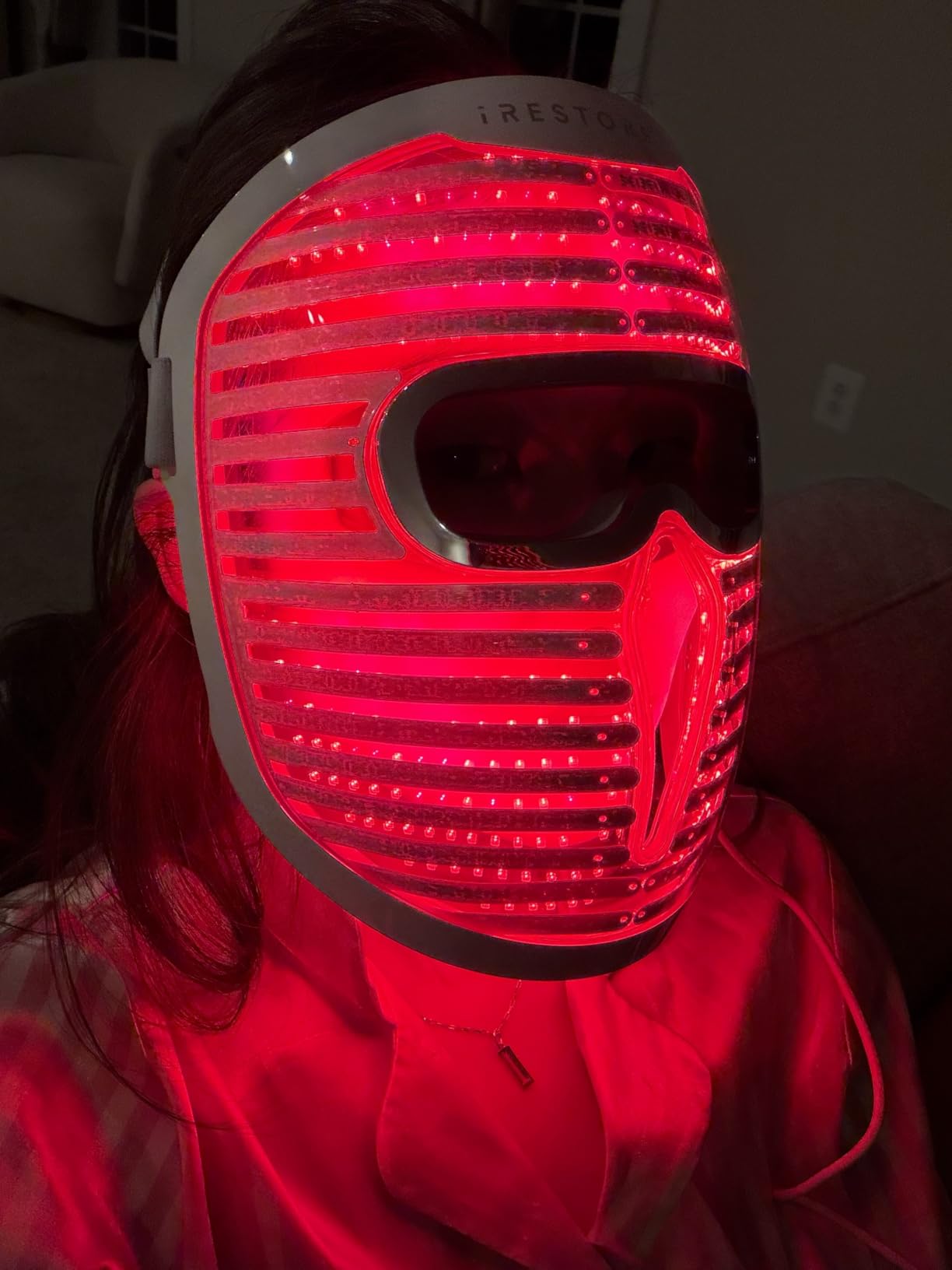
iRestore is the rare premium mask that gets the acne wavelength right. Its 415nm blue sits in the porphyrin window, and the additional 635nm red and 830nm infrared bands make it a genuine three-wavelength device rather than a two-colour mask with marketing added.
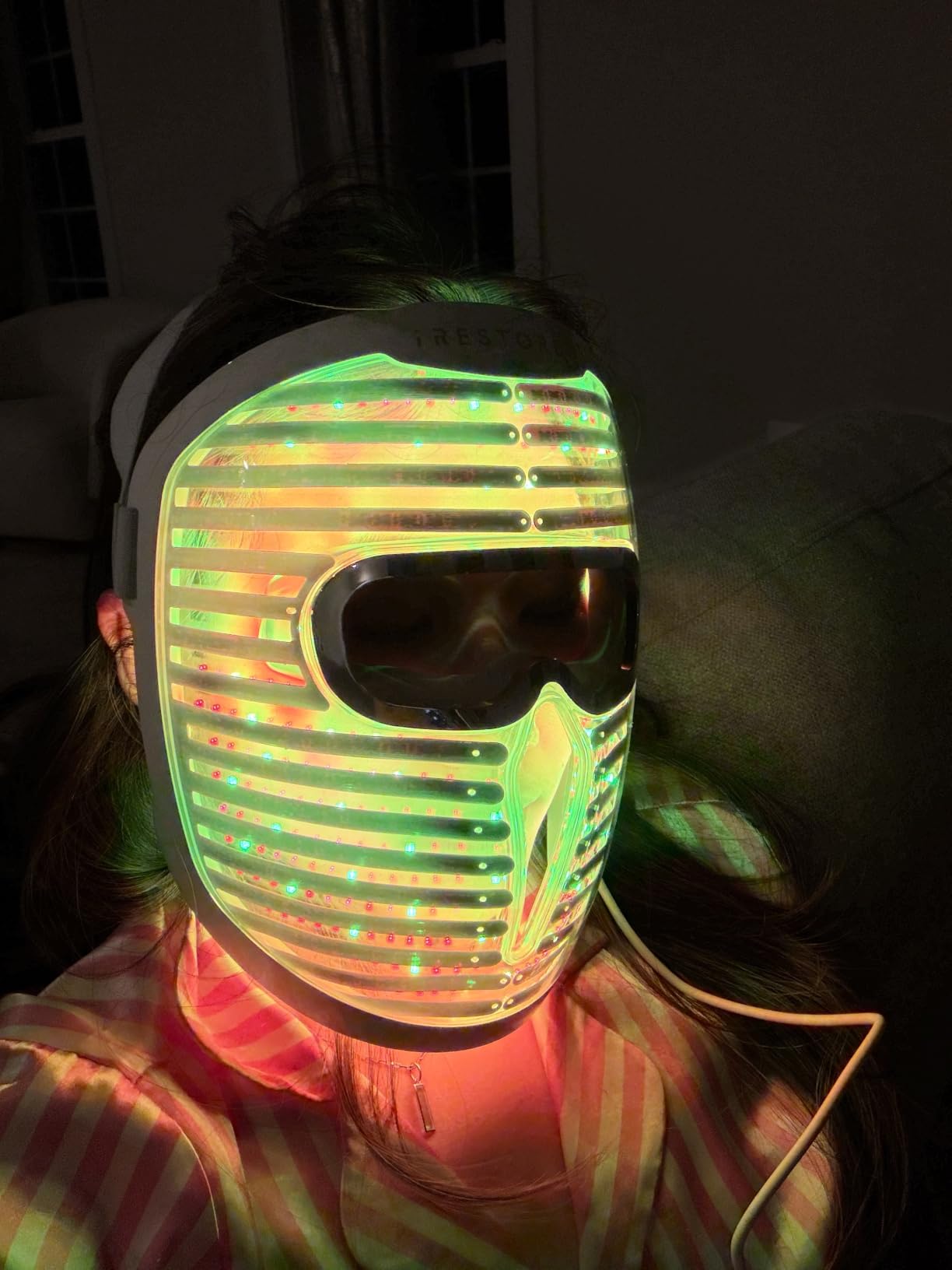
360 LEDs is described by the brand as twice the power of a standard mask, and the dual-strap setup hovers the panel slightly off the face so direct light reaches the eyes less. Sessions are a manageable 10 minutes, recommended three to five times per week, which is a schedule most people can actually keep.
The recommendation from owners is not to upgrade from anything, it is to stay with it. Reviews mention professional-grade results and brand trust, with the corded design as the recurring complaint. At 1.81 pounds it is not the lightest shell here either.
Who this suits best
If you want one device for active breakouts and for the marks they leave, and you are willing to sit near a socket, this is the most complete spec sheet we found. The short session length also makes it the easiest premium mask to wear daily, which matters more than raw LED count because adherence drives results.
Where it falls short
Corded power and a near 2-pound shell make this less pleasant for multitasking than the wireless options. The 830nm infrared is a shade shallower than the 850nm band on the INIA and INTEO, though the practical difference for acne is small.
5. INTEO Wireless LED Mask Review – Best Cordless LED Face Mask for Acne and Neck
Red Light Therapy Mask for Face & Neck, Wireless LED Face Mask, 4 Modes
680 light beads
Face neck and chest coverage
Wireless magnetic battery
Four light modes
Pros
- 680 light beads covering face neck and chest
- Fully wireless with magnetic battery packs
- Amber 605nm mode most rivals skip
- 2000mAh battery rated at 120 minutes per week
- Carrying case included
Cons
- 2.62 pounds is heavy for a long session
- Eye protectors can press uncomfortably
- Newer brand with a shorter track record
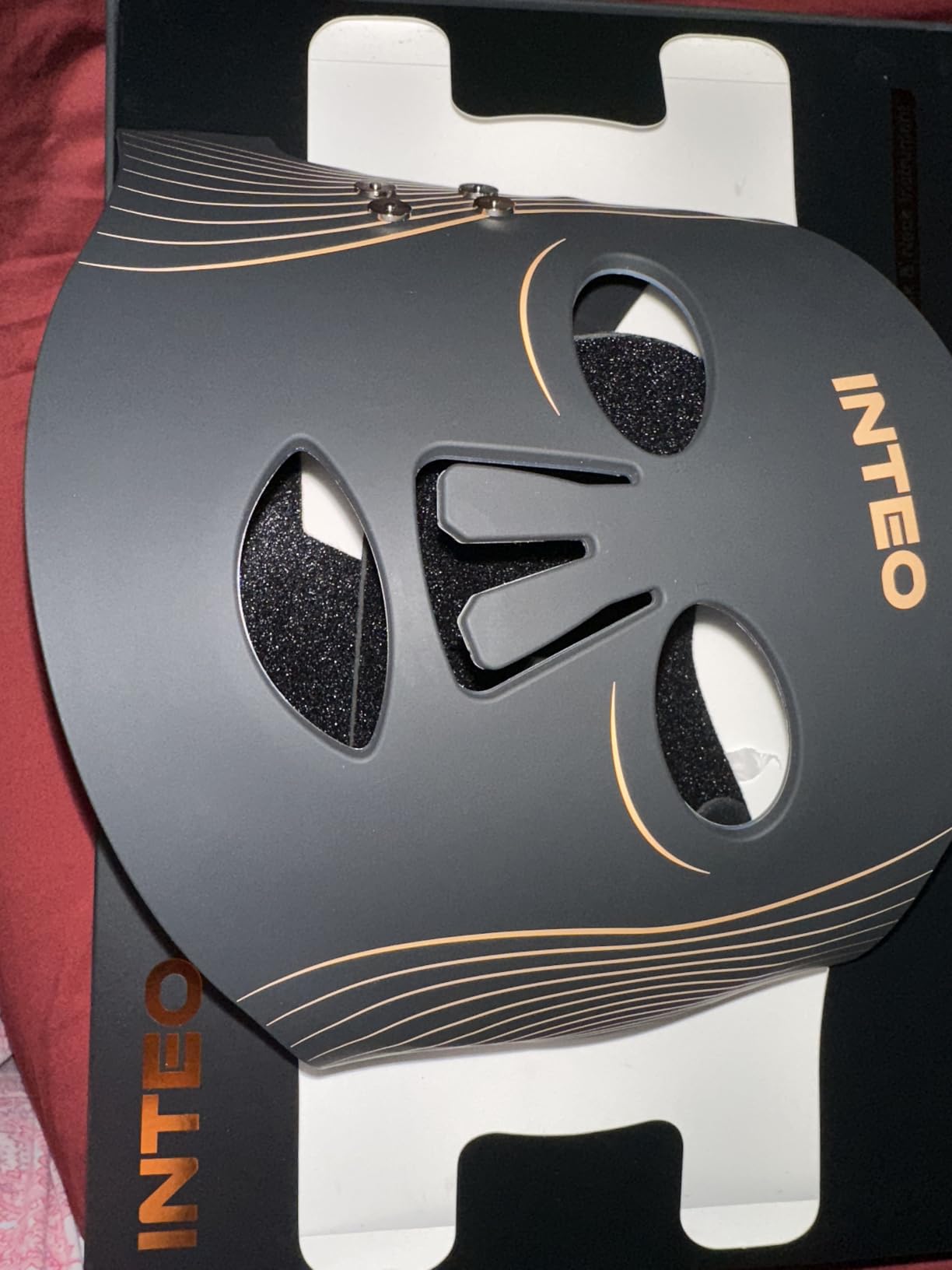
The INTEO covers ground that face-only masks ignore. Its 680 light beads extend past the jawline across the neck and upper chest, which matters if your breakouts cluster along the jaw or you want one device for the whole skin above the collar.
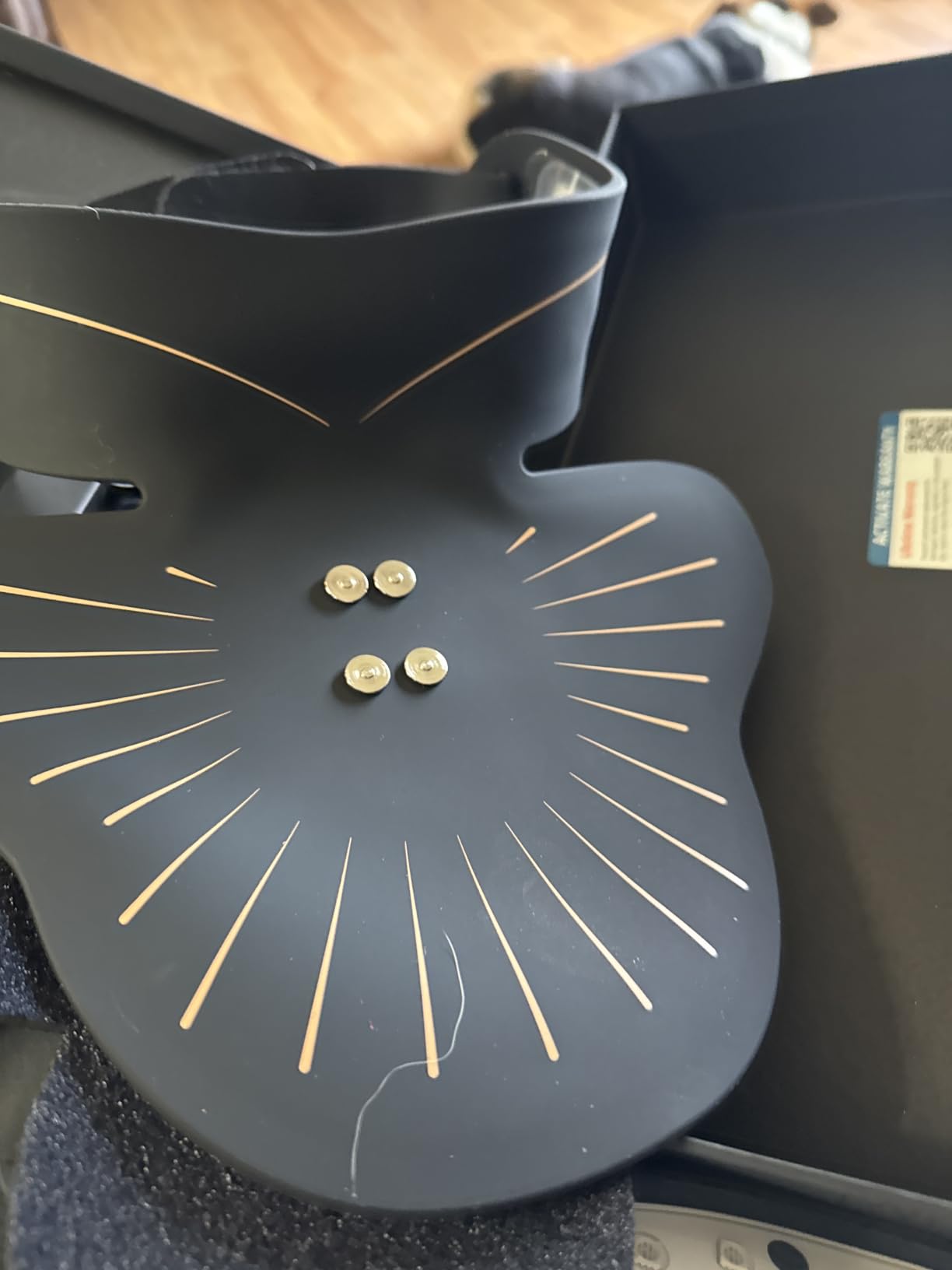
Four modes cover red at 630nm, blue at 460nm, amber at 605nm, and near-infrared at 850nm. The amber band is the one nobody else in this roundup offers, and it is a reasonable option for redness and flushing. Power comes from magnetic wireless packs that recharge over Type-C, sized at 2000mAh and rated at 120 minutes of use per week.
Owners rate it highly for build quality and for the convenience of no cable at all. The soft silicone shell and included carrying case both come up often in positive reviews, along with satisfaction about how the coverage feels across the neck.
What wireless actually buys you
The obvious gain is freedom, but the useful gain is adherence. Without a cable, you can wear the mask while answering messages, doing the dishes, or getting on with the evening, and forum consensus keeps repeating the same point: the best device is the one you will still be wearing in week six. Battery complaints on premium masks usually come from long 30-minute sessions, and this one schedules 10 to 30 minutes.
Where it falls short
Extending coverage to the neck and chest means more beads and more mass, and 2.62 pounds is the second-heaviest shell we tested. Reviewers with smaller heads mention the eye protectors pressing. The blue band at 460nm is again on the higher end, so this is a strong all-rounder rather than a bacteria specialist.
6. HIME SAMA Miracle ACE Review – Best Multi-Colour LED Face Mask for Acne
HIME SAMA LED Face Mask, FSA,HSA Eligible, 8 Color LED Mask, Miracle ACE
240 professional-grade LEDs
Eight colours at ±5nm accuracy
30 mW/cm²
Wireless one-touch control
Pros
- Eight colours including 820nm infrared
- ±5nm accuracy with more than 98% light purity
- FSA and HSA eligible
- Two-year warranty extendable to four
- Adjustable chin pad and silicone eye holder
Cons
- Heaviest shell in the group at 2.95 pounds
- Forehead pressure reported by some users
- 30 mW/cm² is modest beside 105 mW/cm² rivals
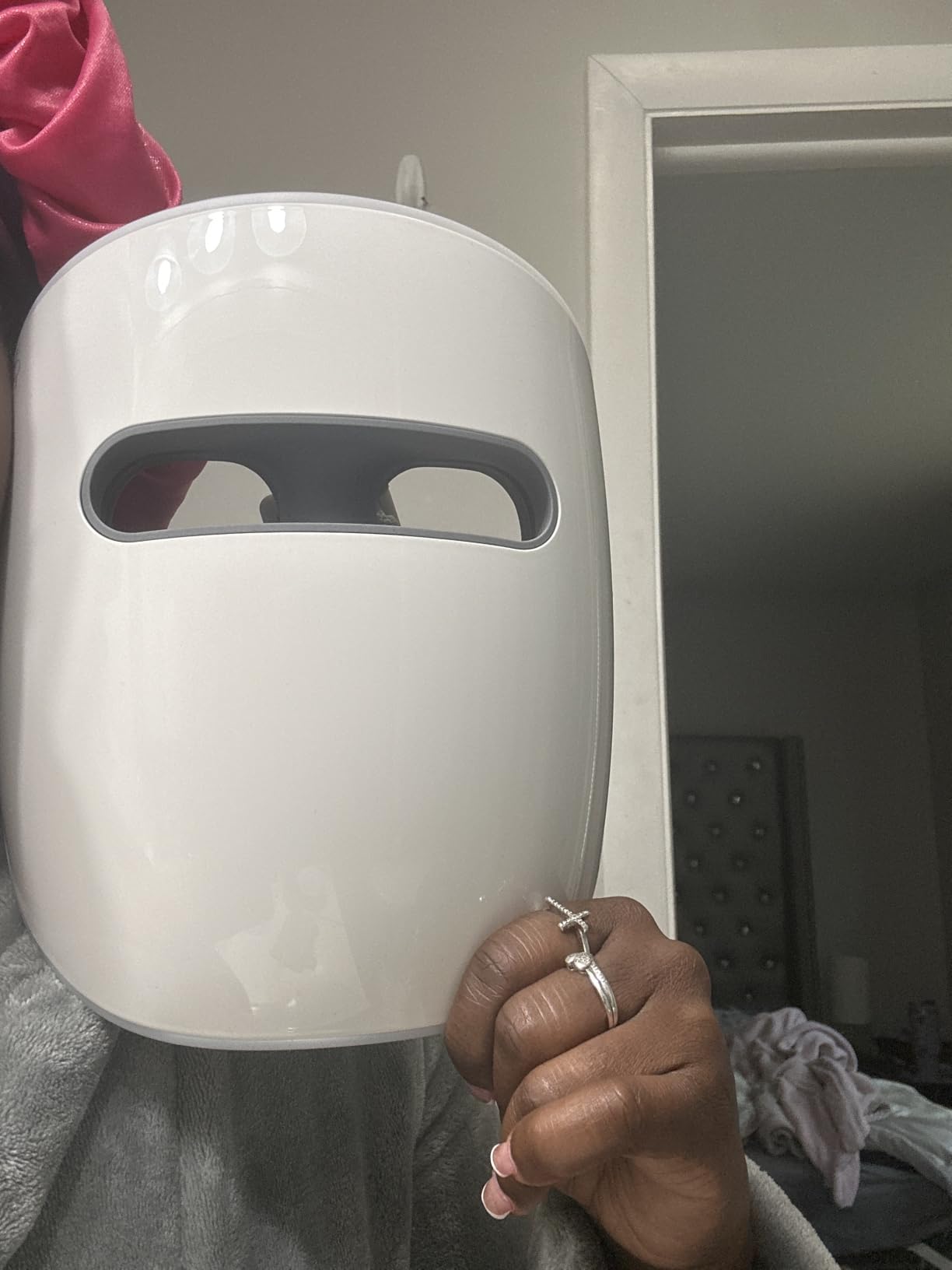
The HIME SAMA is the only mask here with eight colours, running from 820nm near-infrared and 630nm red through blue at 465nm, green at 520nm, yellow, purple, teal, and white. The pitch is a spectrum panel rather than an acne device with extras.
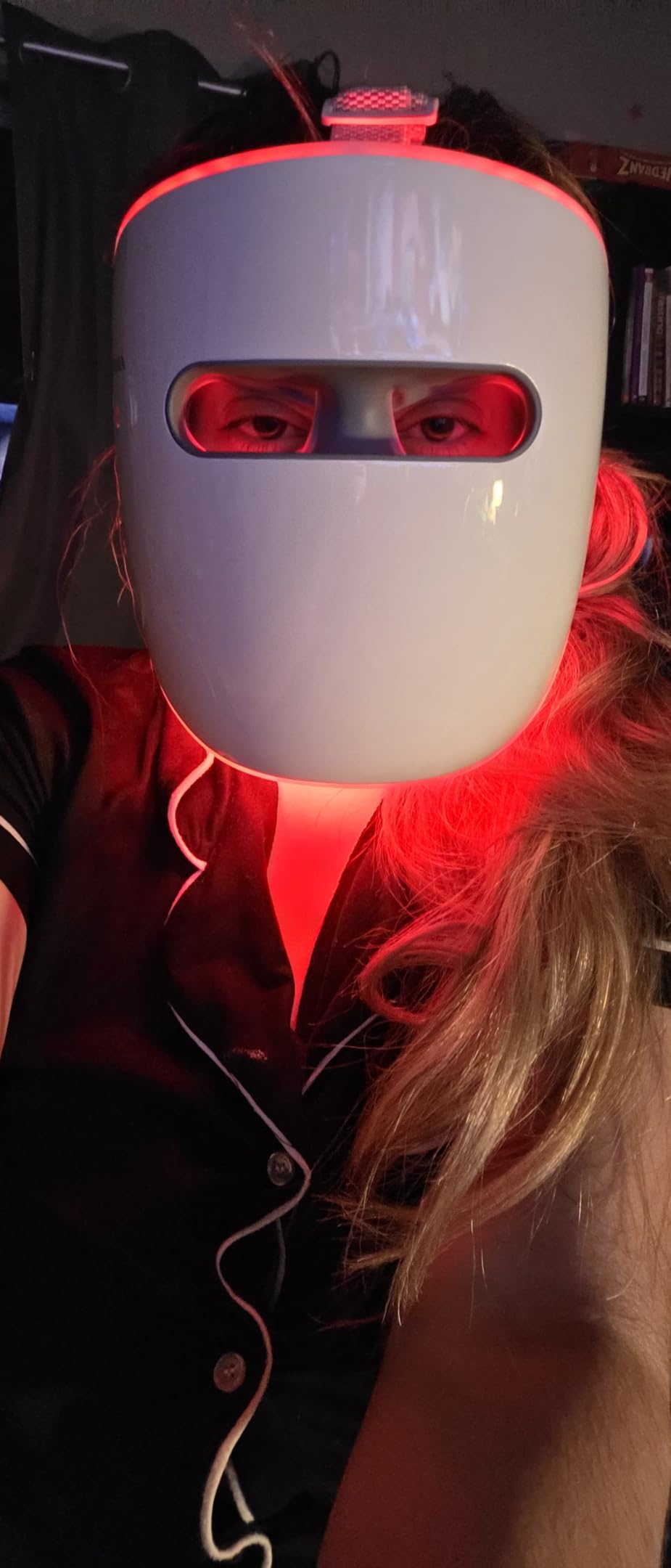
Where it is genuinely careful is accuracy. The listing claims ±5nm wavelength tolerance and more than 98% light purity, which is the kind of detail that lets you match your skin to a target wavelength instead of guessing. 240 imported lamp beads drive 30 mW/cm², roughly half the peak output of the INIA.
FSA and HSA eligibility is unusual at this specification level and can offset part of the outlay if your plan covers it. Owners who have used it for a year or more rate the build quality and customer service highly, and the adjustable chin pad plus patented silicone eye holder are repeatedly mentioned as reasons sessions stay comfortable.
Whether eight colours help with acne
For acne specifically, blue and red are the two that matter, and this mask covers both. The other six colours give you options for redness, tone, and general skin work, which is a fair return if you plan to keep the device long after the breakouts calm down. Precision is the real differentiator here, not the colour count.
Where it falls short
At 2.95 pounds this is the heaviest device in the roundup, and forehead pressure is a recurring note. The 30 mW/cm² output means shorter sessions than the high-output rivals, and at this tier of spend the weight is harder to justify when a lighter mask lists more LEDs.
7. gelpal 7-Color LED Mask Review – Best Travel LED Face Mask for Acne
gelpal 7-1 Colors Red Light Therapy For Face,LED Facial Skin Care Mask,Red Light Mask for Face, LED Facial Mask Light,Salon or Home,White.
90 LED beads
Seven colours plus white
Cordless, 15-minute sessions
1.01 pounds
Pros
- Seven colours plus white
- 90 LED beads covering 60-plus facial zones
- Cordless with roughly two weeks of battery per charge
- Lightest comfortable shell at 1.01 pounds
Cons
- Only 90 beads well below the rest of the field
- No published wavelength or irradiance figures
- Some owners still unsure after a month
The gelpal exists for a different job: proving whether LED therapy suits your skin before you commit real money. At a little over a pound and cordless, it is the one we would put in a bag for a long trip or hand to someone who finds masks overbearing.
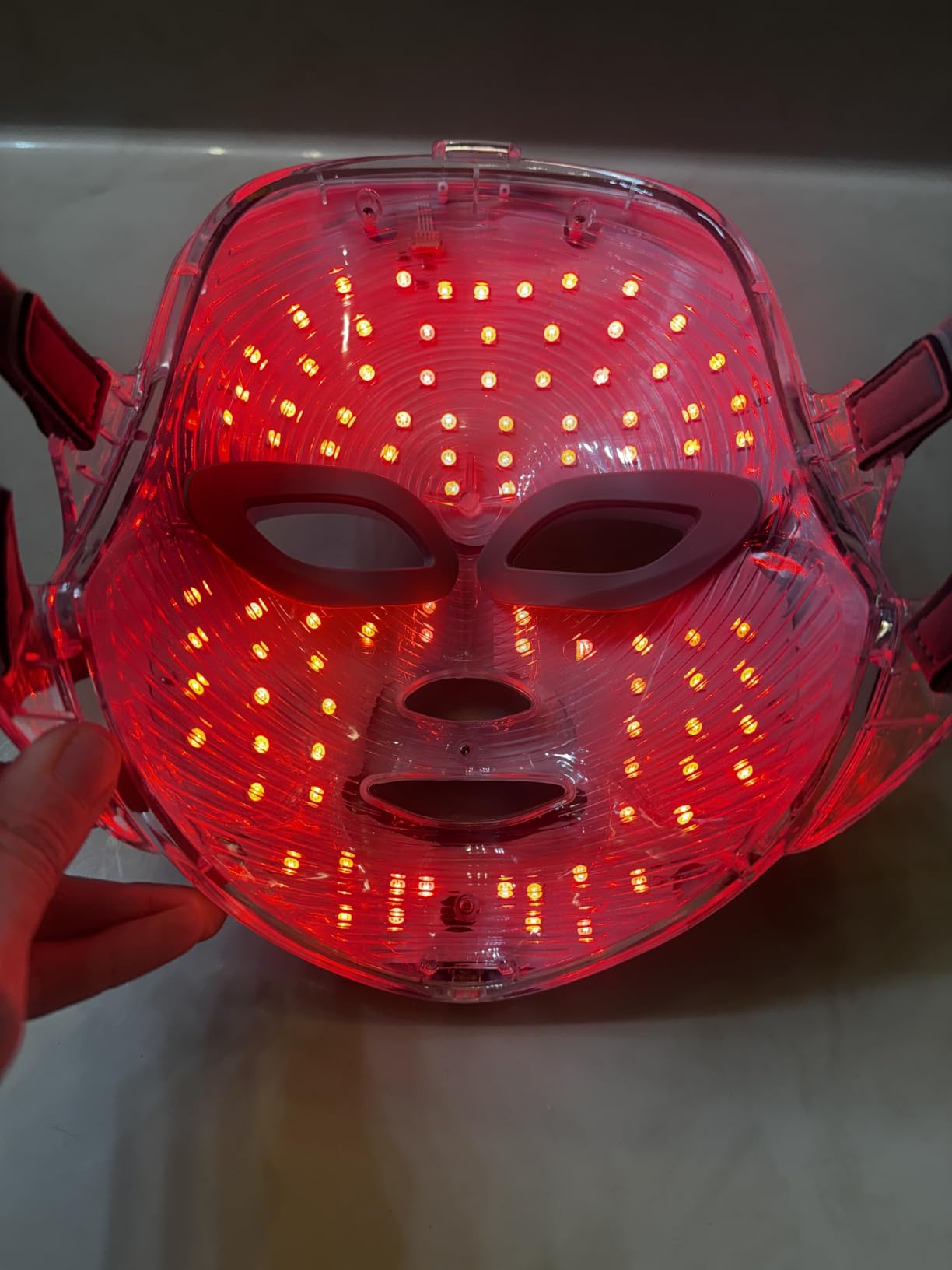
Seven colours plus white run through 90 LED beads, aimed at 60-plus facial zones on fixed 15-minute sessions. Battery life is the standout claim, with a full charge said to cover 14 sessions, which is about three weeks of reasonable use. The listing makes no mention of specific wavelengths or irradiance.
That omission is the point to weigh. A mask that never states its wavelength cannot be matched to a therapeutic target, so you are trusting the colour of the glow rather than a measured dose. Owners like the comfort and the price; a fair number are still waiting for visible change after a month or more.
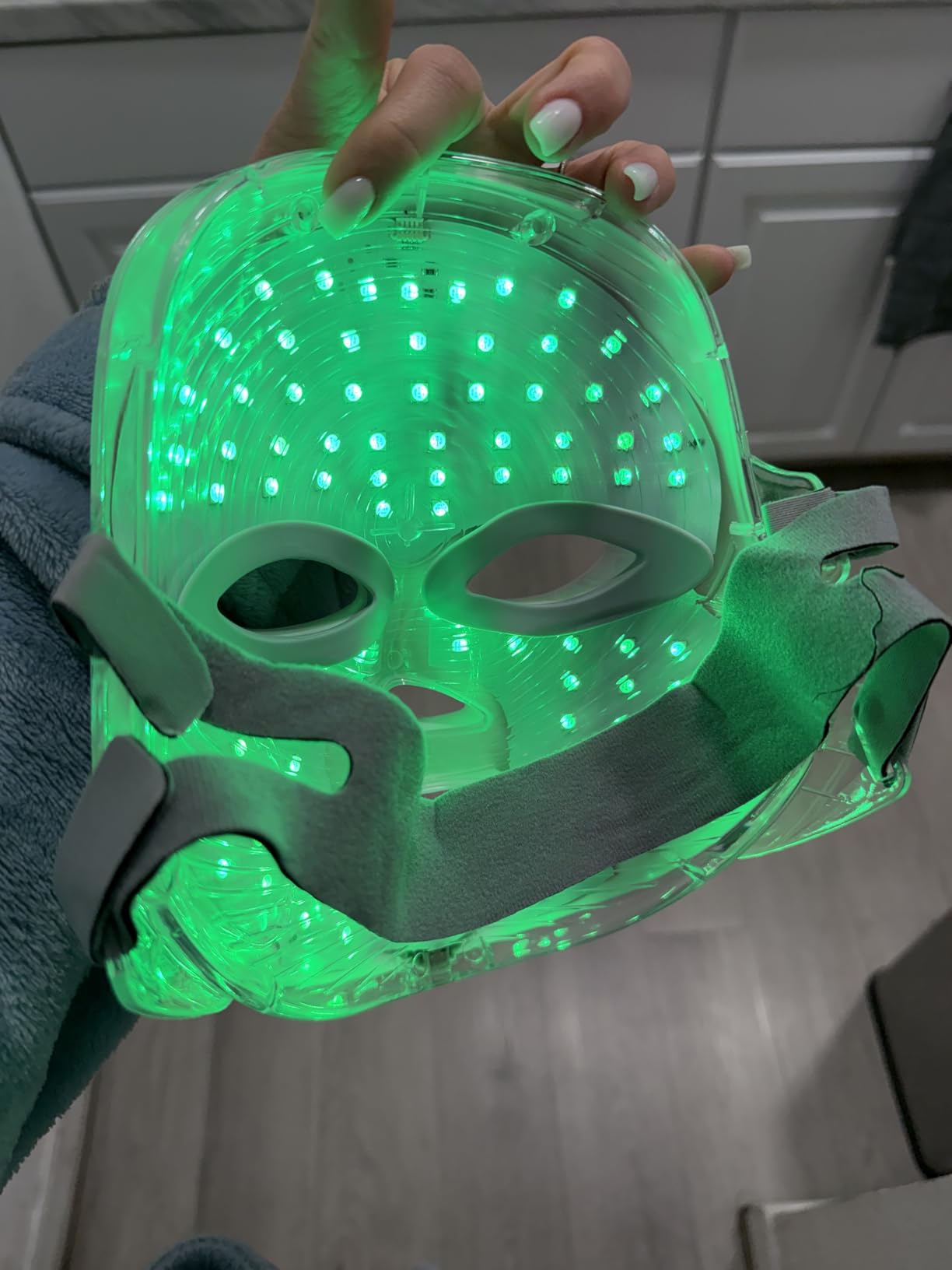
Good for a trial, weak for a treatment plan
Think of this as a two-week shakedown rather than a six-week protocol. If your skin shows no dryness or irritation and you enjoy wearing it, you have learned your tolerance for the format. If you want the bacteria question answered properly, you need a mask with a published 415nm band.
Where it falls short
Ninety beads is a fraction of what the leaders use, and the absence of any irradiance figure means the dose is unknown. Build quality also reads as basic next to the medical-grade silicone on the FDA-cleared options. Fine as a starter, weak as a primary treatment.
8. Nanoleaf FDA-Cleared LED Face Mask Review – Best Lightweight LED Face Mask for Acne
Nanoleaf FDA-Cleared LED Light Therapy Face Mask with 7 Treatment Modes
432 high-intensity LEDs
Seven treatment modes
Medical-grade silicone
FDA-cleared, 12.84 ounces
Pros
- FDA-cleared device from an established lighting brand
- Lightest shell in the roundup at 12.84 ounces
- Medical-grade ultra-flexible silicone
- Built-in battery with no app and no outlet
- Free strap extender for wider fits
Cons
- Seven modes with no near-infrared band listed
- Brand quotes 8-10 weeks for full results
- Newer to skincare than dedicated light brands
The Nanoleaf is the one nobody expects. It comes from a smart-lighting company rather than a skincare brand, and it is the lightest mask here at 12.84 ounces, which changes how a session feels after the first few minutes.
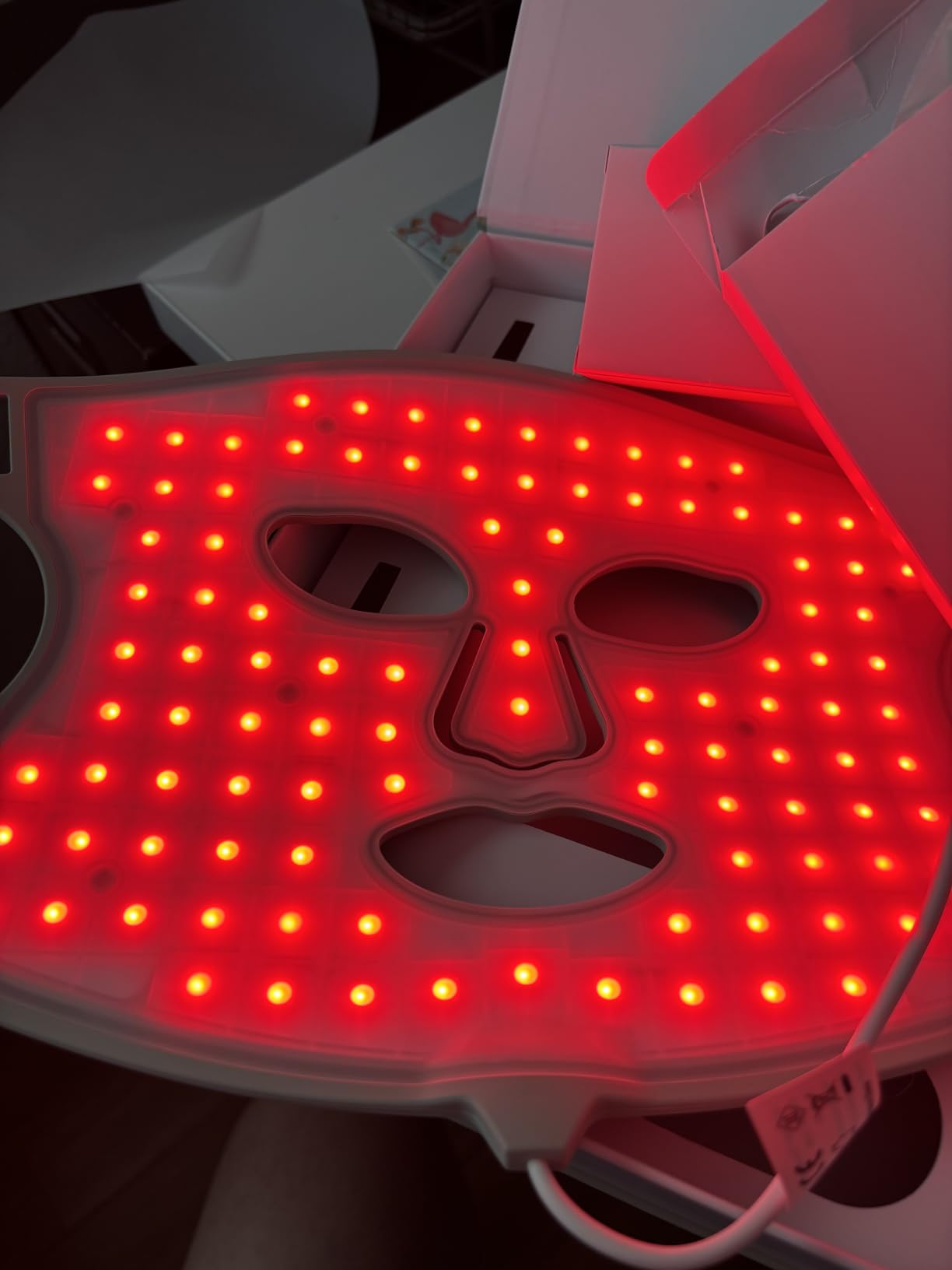
It is listed as FDA-cleared, runs 432 high-intensity LEDs across seven treatment modes aimed at fine lines, wrinkles, and uneven tone, and uses medical-grade ultra-flexible silicone. The battery is built in with an attached controller, so there is no app and no wall outlet involved at all.
The suggested protocol is 5 to 10 minutes, three to five times per week, with noticeable change from roughly two to six weeks and fuller results at 8 to 10 weeks. A free strap extender is available on request, which solves the fit problem for wider heads. Owners like the material and the simplicity, and some question whether the specification justifies the outlay against dedicated skincare brands.
Why weight changes adherence
Every heavy mask in this roundup draws the same comment after ten minutes: pressure at the forehead and a warm shell. At under a pound, this is the mask most likely to end up in a consistent routine, and consistency is what decides whether photobiomodulation does anything for you.
Where it falls short
The mode list does not name a near-infrared band, so this is a red-and-blue device for acne plus general tone work rather than a deep-repair tool. The brand also expects eight to ten weeks for the full effect, which is a longer runway than most listings claim. Seven modes is fewer than the eight-colour rivals offer.
9. GANOEL 7-Color Cordless Mask Review – Best Entry-Level LED Face Mask for Acne
Red Light Therapy for Face, 7 Color LED Face Mask, Cordless Rechargeable
7 LED colours
Cordless rechargeable
10-15 minute sessions
Adjustable straps
Pros
- Entry-level way to test LED therapy
- 50-minute charge gives up to 90 minutes of use
- Adjustable straps for a range of face shapes
- Light at 1.01 pounds
- Touch-button control
Cons
- ABS plastic shell rather than silicone
- No wavelength or irradiance published
- Fewer and weaker LEDs than medical-grade masks
The GANOEL is the cheapest way into the category and works as a stopgap rather than a solution. It launched in late 2025, so the review history is short, which is worth factoring into any decision made on early buyer feedback.
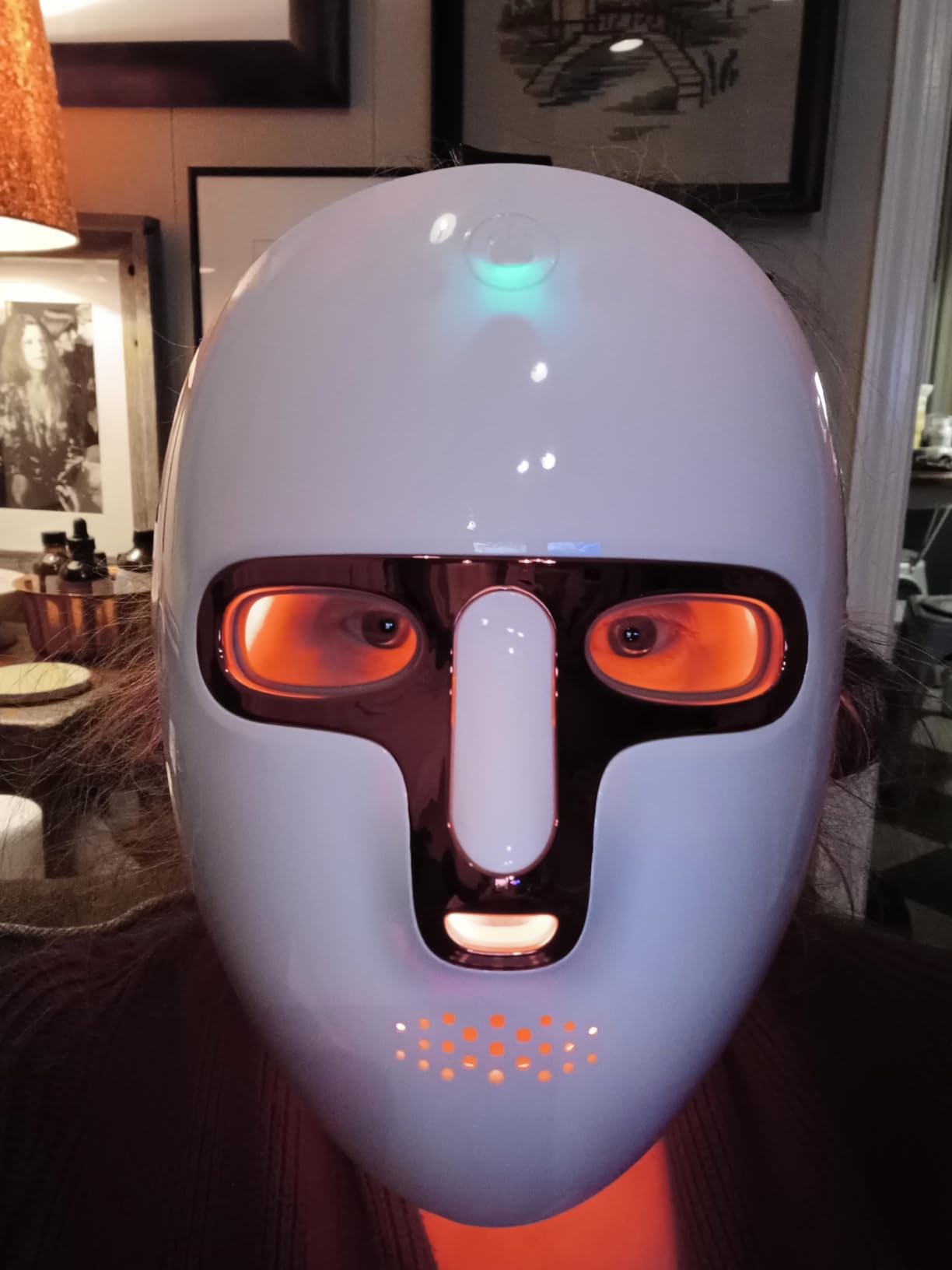
Seven colours run through an ABS shell with adjustable straps, sessions last 10 to 15 minutes, and the rechargeable cordless design claims a 50-minute fast charge for up to 90 minutes of continuous use. Control is a single touch button. No wavelengths or power figures are published.
Owners generally accept that the build reflects the price and see it as a sensible first purchase or a gift. People who expected a study-backed result after a few weeks were disappointed, which is the standard trap with cheap light devices that reviewers keep calling out.
What you learn from a cheap trial
Three things. Whether your skin reacts to light at all, whether you tolerate a mask shape on your face, and whether you will actually put it on four times a week. Those answers are worth having before you spend on a device with published irradiance, and this one answers them at the lowest commitment.
Where it falls short
Plastic rather than silicone means more sweating and less comfort over a long session, and the LED count and power are both well below the medical-grade options. With no wavelength specification, you cannot confirm it is emitting therapeutic blue rather than decorative blue. Do not expect acne results from it.
10. Kelyoo Red and Blue Mask Review – Best HSA-Eligible LED Face Mask for Acne
HSA FSA Red Light Therapy for Face Mask – LED Face Mask Light Therapy with Red Blue LED and Infrared Light, Anti-Aging, Blemish Repair Treatment
119 LED bulbs
Red, blue and combined modes
Wireless Type-C charging
FSA HSA eligible
Pros
- FSA and HSA eligible
- Dedicated blue mode for active breakouts
- Combined red and blue in one session
- Wireless Type-C charging
- Four light modes from 119 bulbs
Cons
- Strap durability is a common complaint
- Eye socket pressure on some face shapes
- 119 bulbs is far below the leaders
The Kelyoo is the budget pick for anyone who can claim it through a flexible spending or health account. Eligibility aside, it does the one thing a low-cost acne mask should do: give you a dedicated blue mode and a combined red-plus-blue mode without an app.
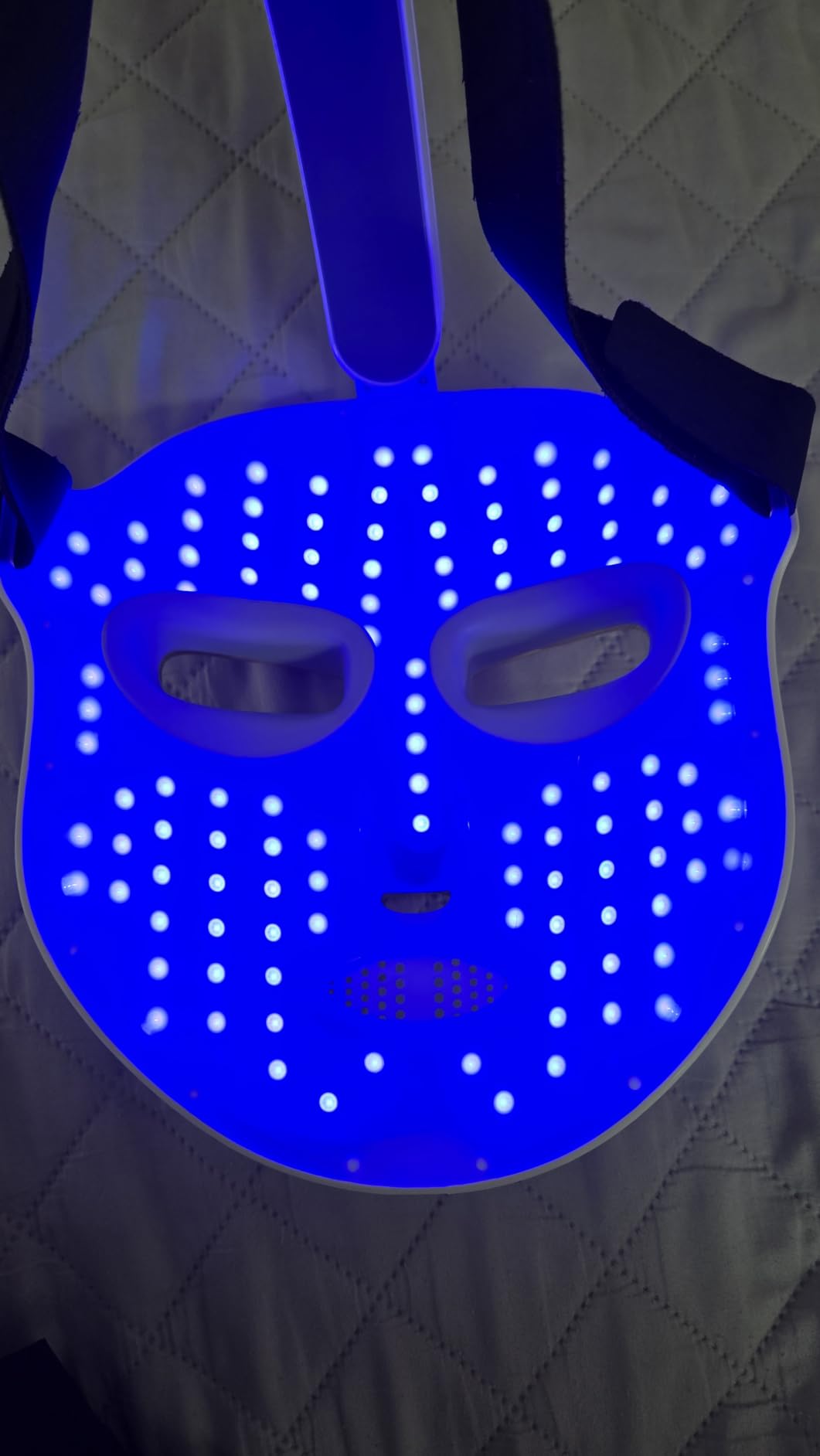
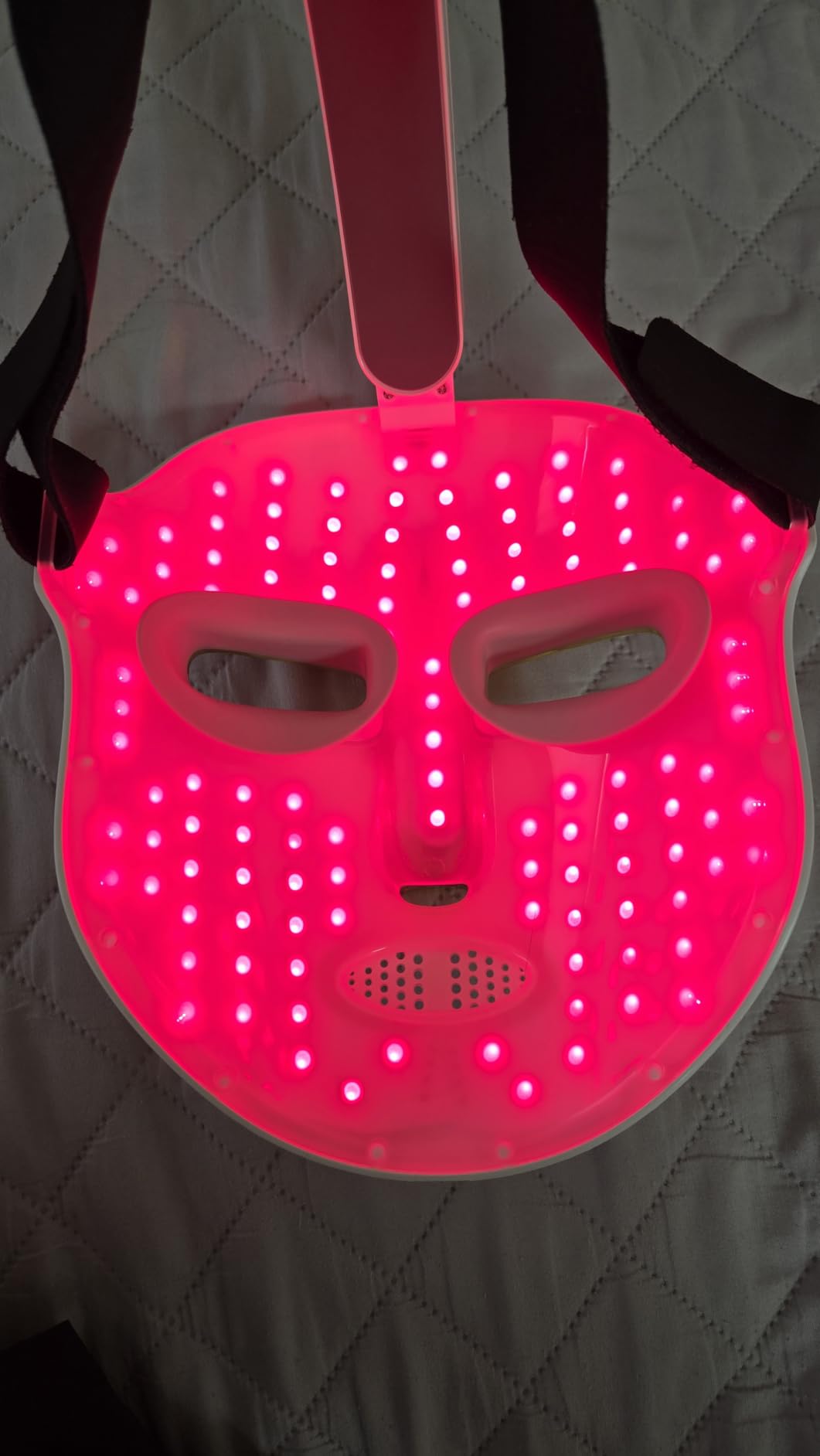
119 bulbs run across four modes, with red for anti-aging, blue for breakouts, and a combined setting for both at once. Power is wireless over Type-C, control is a touch button with a long press for on and off, and the straps adjust with Velcro. The rating sits lowest in this group, and owners with a good fit report positive results on skin.
Fit is the dividing line. Owners report eye socket pressure and difficulty adjusting the straps for different head sizes, and strap breakage after first use is the most common durability complaint. Treat it as a three-month device rather than a long-term investment.
When FSA or HSA eligibility changes the maths
If your plan reimburses it, the effective cost drops below the budget masks above and the decision becomes about warranty length, which is not specified here. That makes it a reasonable option for a first device and a poor one for someone who will keep using it for a year. Check the strap and fit before committing.
Where it falls short
One hundred and nineteen bulbs will not compete with the 432-LED and 680-bead masks on dose, and the spec sheet lists no wavelengths or irradiance to compensate. The Velcro straps are the weak link, and eye socket pressure limits long sessions for some face shapes.
What LED Masks Cannot Fix, Including Acne Scarring
The most honest answer to the scarring question is that no LED face mask meaningfully treats existing acne scars. LED therapy reduces the bacteria driving new lesions and calms inflammation on active spots. It does not remodel dermal collagen that has already been lost, so atrophic scars, ice-pick scars, and rolling scars need a different tool.
For scarring, the realistic options are a dermatologist-led plan that may include microneedling, fractional resurfacing, or subcision, or a retinoid routine used consistently over months. Where LED genuinely helps is prevention, by reducing the number and severity of future breakouts that would otherwise become new scars.
The same honesty applies to blackheads and congestion. Comedones are a keratin and sebum problem inside the pore, not a bacterial one, and no colour of light clears them. Salicylic acid, retinoids, and extraction do that job.
Post-inflammatory hyperpigmentation is a partial yes. Red light can fade red marks over weeks, and it pairs well with topical ingredients that address the pigment itself. Deep cystic acne is a straight no for home devices; those lesions sit too far below the surface and need medical treatment.
How to Choose an LED Face Mask for Acne
Check the wavelength before anything else. For active breakouts you want blue listed at 405 to 420nm, and if you also care about post-breakout marks you want red at 630 to 660nm. A brand that will not publish its wavelengths is telling you it has not measured them, and forum buyers treat that as a reason to pass. Asking the same questions of a mask that you would ask of a grow light, where the same jargon of wavelength, spectrum, and power density applies, is a good calibration: our LED grow light guide covers how manufacturers dress up unverified specs.
Second, look for irradiance in milliwatts per square centimetre. Above 30 mW/cm² is a reasonable working figure, and the leaders here reach 75 to 105. A mask with a high LED count but no output figure tells you nothing about the dose reaching your skin.
Third, decide between a mask, a panel, and a handheld wand. A mask covers the whole face hands-free and is the best choice for someone who can sit still for ten minutes. A panel treats faster and covers more, but it stays bolted to a wall. A handheld wand is the cheapest and most precise for a few stubborn spots, at the cost of a much longer treatment time. If you want the same technical vocabulary for another category, our guide to LED grow lights for indoor plants covers the same trade-offs between fixture size and coverage.
Fourth, settle the power question. Corded masks never run down mid-session and reviewers often prefer the steady output, while wireless masks let you multitask and are the reason many people keep a consistent schedule. Check the claimed minutes per charge and compare that against the session time you need. Long 30-minute sessions on a 2000mAh pack are where battery complaints come from.
Fifth, expect a budget ceiling. At the cheapest tier you are usually buying an unspecified light with a decorative colour count and a plastic shell, which is fine for a trial and thin on results. The useful middle band gives you a published wavelength and a measured output.
Safety: Skin Type, Medication, and Eye Exposure
Light therapy is safe for most people, but three groups need care. If you are on a photosensitising medication such as isotretinoin or certain tetracycline antibiotics, discuss light therapy with your prescriber first. Fitzpatrick V to VI skin tones carry a higher risk of post-inflammatory hyperpigmentation from light exposure, so a professional opinion is worth having. And if you are pregnant or breastfeeding, ask your clinician before starting.
For eye safety, prefer masks with a hover design or integrated eye protection, and keep your eyes closed during sessions as a precaution. The Aphrona, iRestore, and HIME SAMA all address this differently, from a hovering strap to a patented silicone holder.
How to Use an LED Face Mask for Acne
Start with clean, dry skin. Cleanse, pat dry, and do not apply creams or serums before the session, because occlusive products block the light before it reaches the follicles. This is the single most common mistake people make.
Use the mask for the stated time, typically 10 to 15 minutes, three to five times a week. Blue for active breakouts, red for marks and inflammation, and combined if the mask supports it. Overuse is real: skin can feel red, tight, or dry after too many sessions in a short window.
Then moisturise, and clean the mask. Wipe the panel after every use, because oil and bacteria collect on the surface and a dirty mask is an acne device working against you. The same basic checklist applies to any LED setup, and it is why we reviewed aquarium LED kits on maintenance rather than brightness alone.
Set expectations on a timeline. Most owner reports describe gradual change around four to six weeks, with fuller results at eight to twelve. Nothing changes overnight, and anyone promising otherwise is selling rather than reporting.
Frequently Asked Questions
Are LED light masks good for acne?
For mild-to-moderate inflammatory acne, yes. Blue light at roughly 415nm is absorbed by porphyrins in Cutibacterium acnes and triggers a chemical reaction that kills the bacteria without drying the skin surface. Red light at 630 to 660nm calms inflammation and fades post-breakout marks. Results are gradual, typically noticeable at four to six weeks.
Which LED light works best for acne?
Blue light in the 405 to 420nm range works best for active breakouts, because that band is strongly absorbed by porphyrins in C. acnes. Red light at 630 to 660nm is the better choice for inflammation and post-breakout red marks. A mask with both wavelengths handles new breakouts and fading marks in the same routine.
Which color LED mask is most effective for treating acne?
Blue is the acne colour, since it targets the bacteria that cause breakouts. Red is the repair colour, reducing the inflammation and marks a pimple leaves behind. For most acne-prone skin a combined red and blue session is the most useful, because the two problems arrive at different times. Green and amber appear in multi-colour masks but play supporting roles.
What is the best LED mask for acne scarring?
None of them, honestly. LED masks reduce new breakouts and calm inflammation, which helps prevent future scarring, but they do not remodel collagen that has already been lost. Atrophic, ice-pick, and rolling scars need dermatological options such as microneedling, fractional resurfacing, or subcision, ideally alongside a retinoid routine.
How long does it take for a LED face mask to work on acne?
Most owner reports point to four to six weeks of consistent use for a visible change, with fuller results at eight to twelve weeks. Use the mask three to five times a week at 10 to 15 minutes per session. Weeks one and two are usually uneventful, and any promise of overnight results is a red flag rather than a feature.
What are the downsides of blue light therapy?
Results are gradual, so the biggest downside is giving up too early. Some people notice temporary redness, tightness, or dryness after sessions, especially when overusing the mask. Devices that publish no wavelength or irradiance figure may deliver a dose too low to matter, and cheap masks frequently disappoint for that reason.
Final Verdict on the Best LED Face Masks for Acne
After weighing all ten, the NEWKEY 4D takes our final verdict as the best LED face mask for acne: 450 chips, a published output figure, a 10-minute timer that keeps sessions realistic, and the deepest owner history in the group. The Aphrona is the smarter buy if you want a true 415nm band and FDA clearance on the spec sheet, and the INTEO is the one to choose if wireless wear and neck coverage matter more than a bacteria-specific wavelength.
Whatever you pick, check the wavelength and irradiance before you check anything else, and give any device six consistent weeks before you judge it. The button on each review above shows the current listing details.