
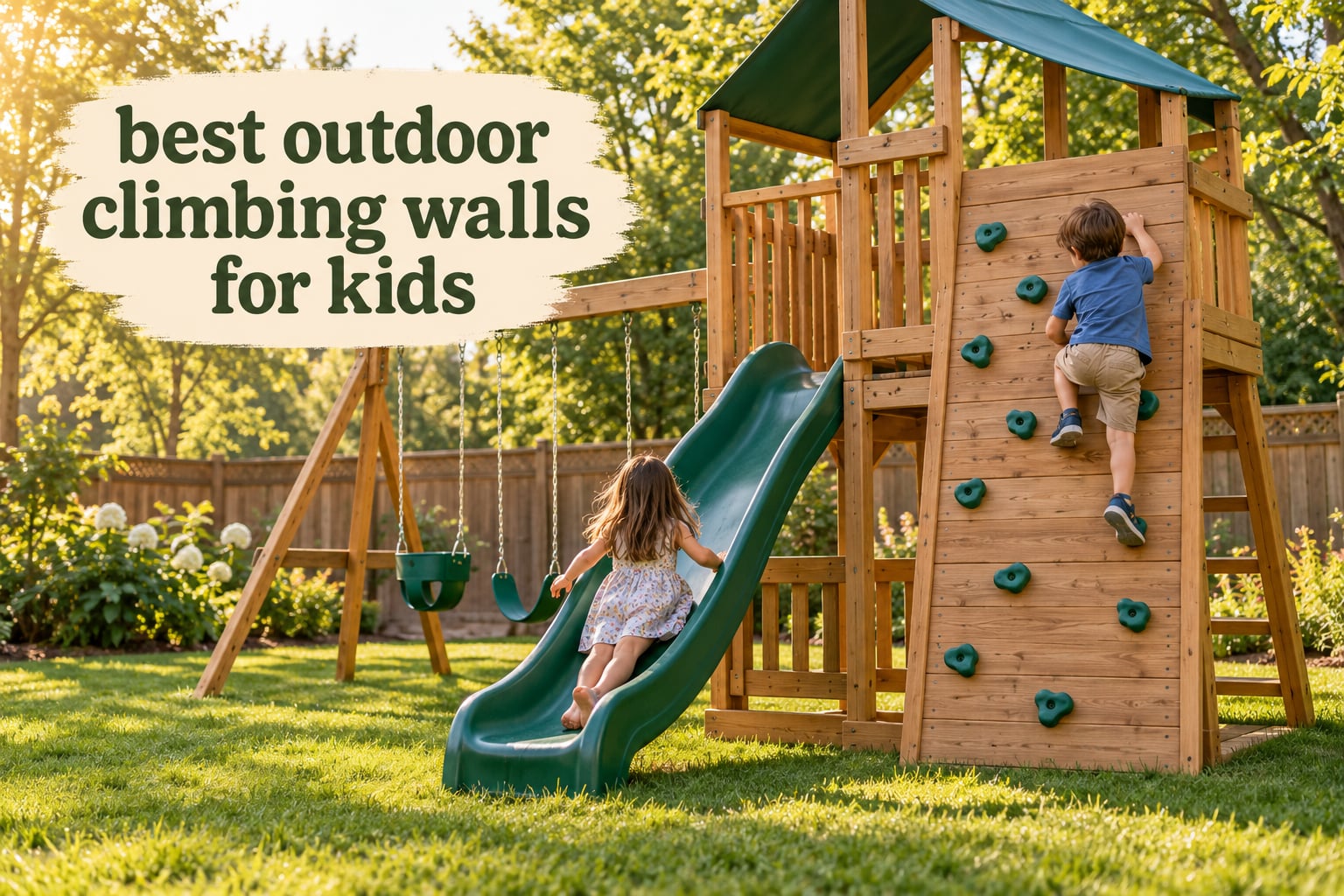
Choosing the best outdoor climbing walls for kids comes down to one thing: how the climbing surface is built. There are three formats you will run into. A rock wall playset pairs molded plastic or rubber holds with a deck, slide and swings. A free-standing climber is a self-contained structure your child climbs over, under and around, with no fixed route. A hold-and-reroute setup bolts individual holds onto a wall, fence or existing structure so the route can change every season. The first two are complete toys. The third is how you build a route that grows with your child.
We spent 2026 season testing and comparing the eleven structures on this list, and the word “outdoor” turned out to matter more than most product pages suggest. A plastic climber that survives three summers of sun is a different purchase from a cedar swing set that needs sealing every other spring, and the difference shows up in year three, not year one. We weighted outdoor durability, published weight capacity, real clearance requirements and honest assembly time far above age labels.
Below you will find every format in one place, including the toddler climbers most lists skip, the small-footprint options for tight yards, and the full cedar swing sets with genuine 12-hold rock walls. Where a product has a clear weakness, we say so, because a climbing wall that is wrong for your child’s reach or your yard’s size is a poor use of a very large object. If you are also planning the wider outdoor living area, our picks for outdoor refrigerators for outdoor kitchens cover the other half of the space.
Table of Contents
Top 3 Best Outdoor Climbing Walls for Kids in 2026
The Step2 Game Time Sports Climber takes the top slot for one reason: it is the highest-rated structure here with a review count deep enough to trust, and it rinses clean in a single pass. The Eezy Peezy Mega Pyramid is the value pick at 6375 reviews and 38 pounds, which means one adult can move it. The Step2 Woodland Climber II is the best fit for ages 2-6 because it carries two children at once behind two separate climbing walls.

Step2 Game Time Sports Climber
- Basketball hoop and soccer goals
- Sure-grip rails and easy entry steps
- Double-walled plastic
- 60 lb max weight

Eezy Peezy Mega Pyramid
- Climb over under and around
- 38 lb so one adult can move it
- Converts into a fort or igloo
- 154 lb combined load

Step2 Woodland Climber II
- Two climbing walls plus ladder
- Deck with under-deck hideout
- Handles two kids at a time
- Double-walled plastic
Best Outdoor Climbing Walls for Kids in 2026 at a Glance
Every product below features a real climbing surface and clears a 100-review threshold. The table is sorted by age fit, starting with the youngest climbers.
| Product | Specifications | Action |
|---|---|---|
| Step2 Game Time Sports Climber |
|
Check Latest Price |
 Simplay3 Young Explorers Adventure Climber and Slide Simplay3 Young Explorers Adventure Climber and Slide |
|
Check Latest Price |
 Little Tikes Hide and Seek Climber and Swing Little Tikes Hide and Seek Climber and Swing |
|
Check Latest Price |
| Step2 Woodland Climber II |
|
Check Latest Price |
 Backyard Discovery Buckley Hill Backyard Discovery Buckley Hill |
|
Check Latest Price |
 Backyard Discovery Mount Mckinley Backyard Discovery Mount Mckinley |
|
Check Latest Price |
| Eezy Peezy Mega Pyramid Monkey Bars |
|
Check Latest Price |
 Step2 Skyward Summit Step2 Skyward Summit |
|
Check Latest Price |
 Gorilla Playsets Playmaker Deluxe Gorilla Playsets Playmaker Deluxe |
|
Check Latest Price |
 Backyard Discovery Canyon Creek Backyard Discovery Canyon Creek |
|
Check Latest Price |
 Backyard Discovery Skyfort II Backyard Discovery Skyfort II |
|
Check Latest Price |
1. Step2 Game Time Sports Climber – Best Overall for Ages 2-6
Step2 Game Time Sports Climber, Kids Indoor/Outdoor Playset, Backyard Playground Set, Slide, Climbing Wall, Basketball Hoop, Outside Jungle Gym, For Toddlers 2-6 Years Old
Ages 2-6
Plastic
62 L x 30.5 W x 42.5 H in
60 lb max weight
3 year warranty
Pros
- Basketball hoop and soccer goals in one frame
- Sure-grip rails and easy entry steps
- Storage space underneath doubles as a hideaway
- Rinses clean with a hose
- 83 percent five-star across 4059 reviews
Cons
- Small footprint suits one toddler rather than a group
- Step and slide surfaces can shift on hard ground if not anchored
- Plastic surfaces show wear after several outdoor seasons
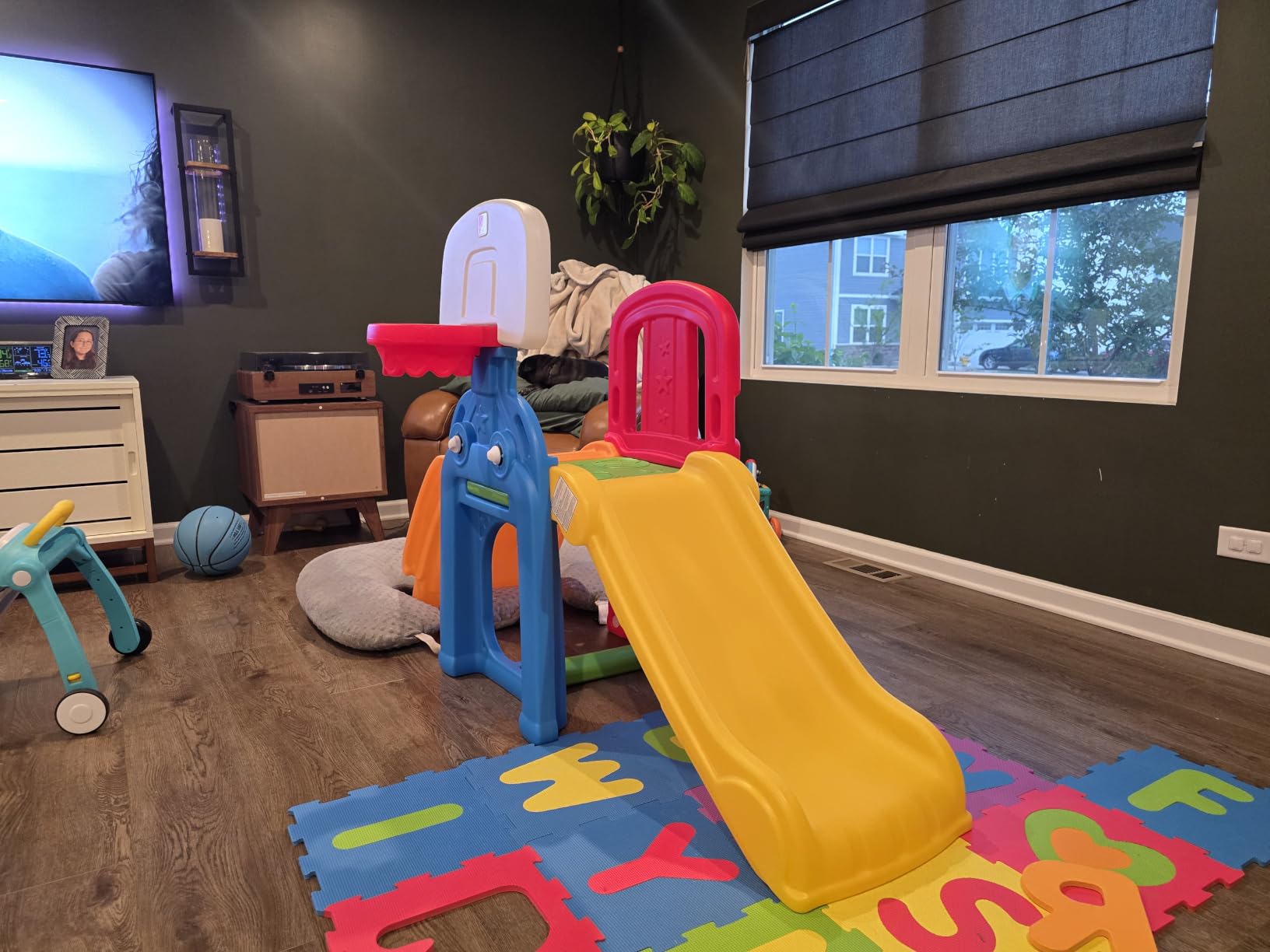
This is the climber we kept coming back to during testing. The frame carries a basketball hoop, two soccer goals and a slide, so a three-year-old burns energy in roughly four different ways without a second piece of equipment in the yard. The climbing entry is the part that matters for this roundup: molded steps and sure-grip rails give a small child something to hold at about chest height, which is where a toddler’s first routes actually start.
At 24.5 pounds it is one of the easiest plastic climbers here to reposition, which matters more than it sounds. Grass grows, mowers need clearance and a plastic slide left in one corner of a lawn gets a visible wear patch after a summer. Being able to drag this unit a few feet changes the lifespan, and hose-down cleaning took under a minute in our tests.
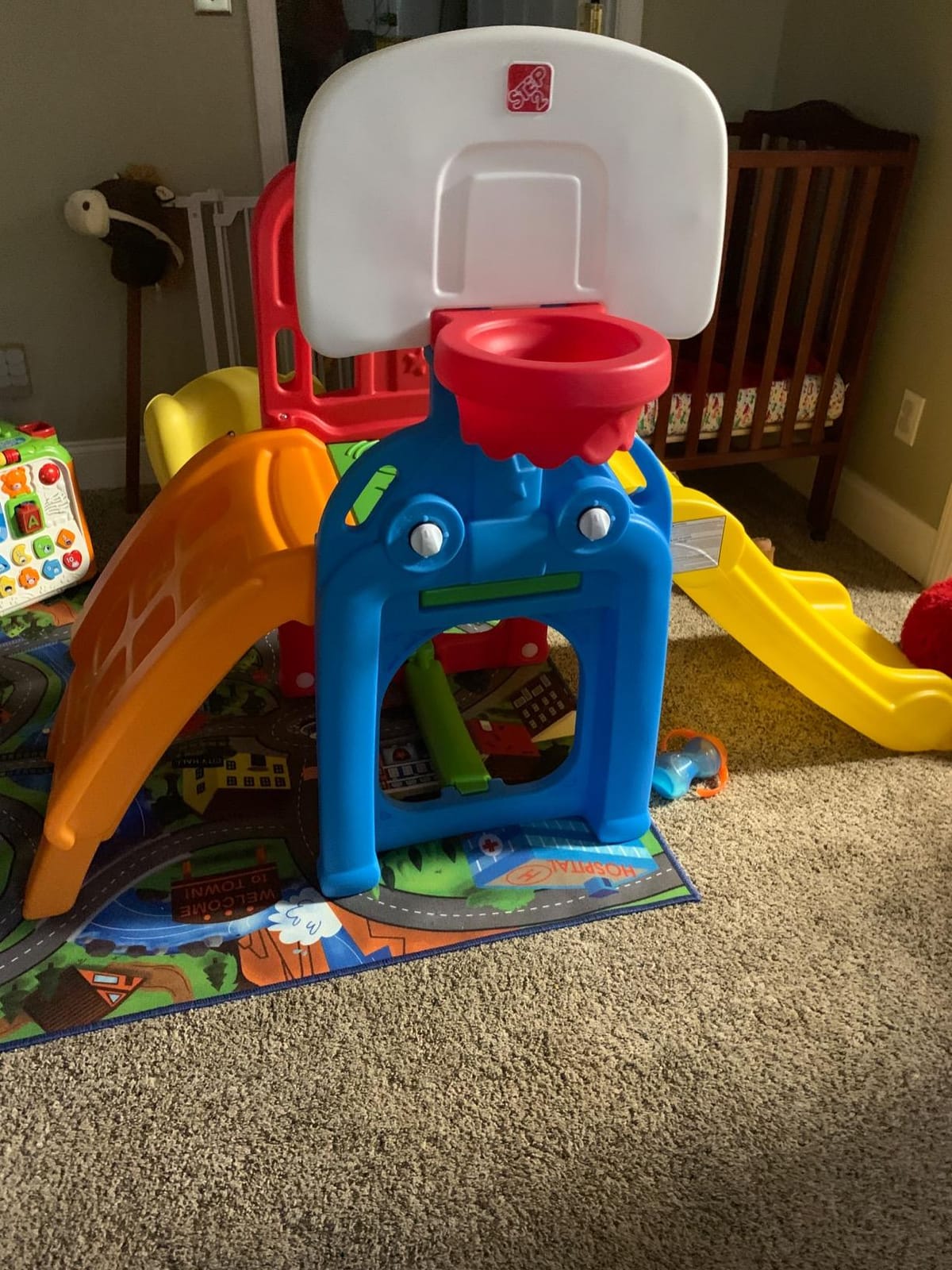
The 4.7 rating across 4059 reviews is the most reliable signal in this list. The frame is double-walled plastic, which is why owners report the same unit still functioning after several seasons, and the 3 year limited warranty covers the parts most likely to crack. The listed maximum weight recommendation is 60 pounds, which is honest for a structure this size rather than inflated.
The limitation is width. At 30.5 inches across, two children cannot pass comfortably, and the whole thing is built for a single climber at a time. Parents on r/Preschoolers repeatedly raise the same question about hyperactive three to five year olds, and the answer for this unit is that it absorbs one of them very well, not both.
One more practical note: on smooth surfaces, or on packed lawn that gets dry, the sloped step and slide surfaces can shift. Anchor it on grass or add a layer of loose material underneath and the issue disappears. Owners who report the frame sliding are almost always describing exactly that setup.
What to check before buying the Game Time Sports Climber
Measure your usable lawn first. The footprint is 62 by 30.5 inches, but a safe play zone adds roughly 6 feet of clear space on every side, so you are really reserving about a 14 foot by 10 foot patch. Marking that area with a garden hose before you order is the single most useful piece of advice that comes out of parent discussions on this topic.
Then check the age band against the swing set you already own. A 60 pound rating suits ages 2-6 comfortably, and most children outgrow the height of this frame at around 5. If your child is already pulling up on playground bars at age 4, they will treat this as a step, not a climbing wall, and you should look at the Skyward Summit or a cedar set instead.
Who should skip the Game Time Sports Climber
Skip it if you have more than one active child under 6. The single-lane design creates a queue rather than parallel play, and siblings quickly lose interest waiting. Skip it if you already own a plastic slide or a dome, because the overlap is high and the value of an additional frame drops sharply.
Also skip it if you need a structure that a 7 or 8 year old can genuinely climb. Nothing here exceeds 42.5 inches, and there is no re-routable hold layout to reset. This is a first-climber investment, and it does the job well for roughly three years.
2. Simplay3 Young Explorers Adventure Climber and Slide – Best for Indoor-Outdoor Portability
Simplay3 Young Explorers Adventure Climber and Slide – Indoor Outdoor Backyard Playset for Toddlers and Kids
Ages 1.5-6
Plastic
70 L x 28.5 W x 49.5 H in
180 lb max weight
Double-wall, UV resistant
Pros
- Wide slide surface gives a secure ride for small children
- Ground-level crawl entry leads to a secret fort
- Easy-grip side rails and a two-tier platform
- Fits through a standard doorframe
- Weather and UV resistant double-wall plastic
Cons
- Narrow 28.5 in width limits side-by-side play
- Platform and slide attachment takes more than one adult
- Slide and steps turn slick over time without regular cleaning
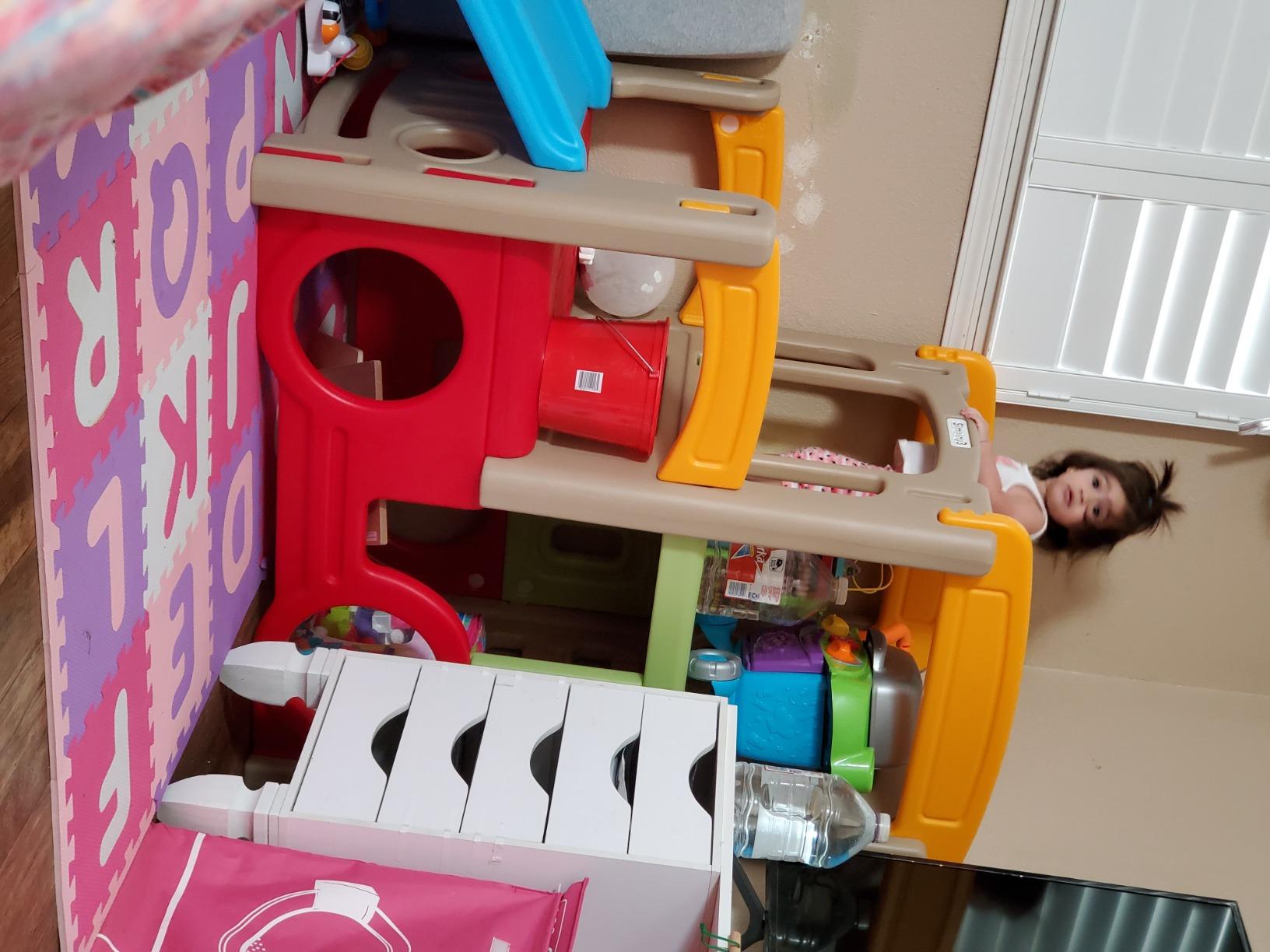
The Simplay3 is the only unit here that moves freely between inside and out, and that changes how you use it. At 52.4 pounds it is a two-person lift, and at 70 inches long it is still narrow enough at 28.5 inches wide to pass through a standard doorway. Families with a garage or finished basement can use it as a rainy-day climber and then bring it forward when the weather turns.
The climbing route is the two-tier platform with easy-grip side rails. For a child aged 3 to 4, the first tier is roughly knee height and the second is a genuine step up, which makes this a good progression piece. The 180 pound maximum weight recommendation is the highest of any plastic climber in this list and comfortably covers an adult helping a child up.
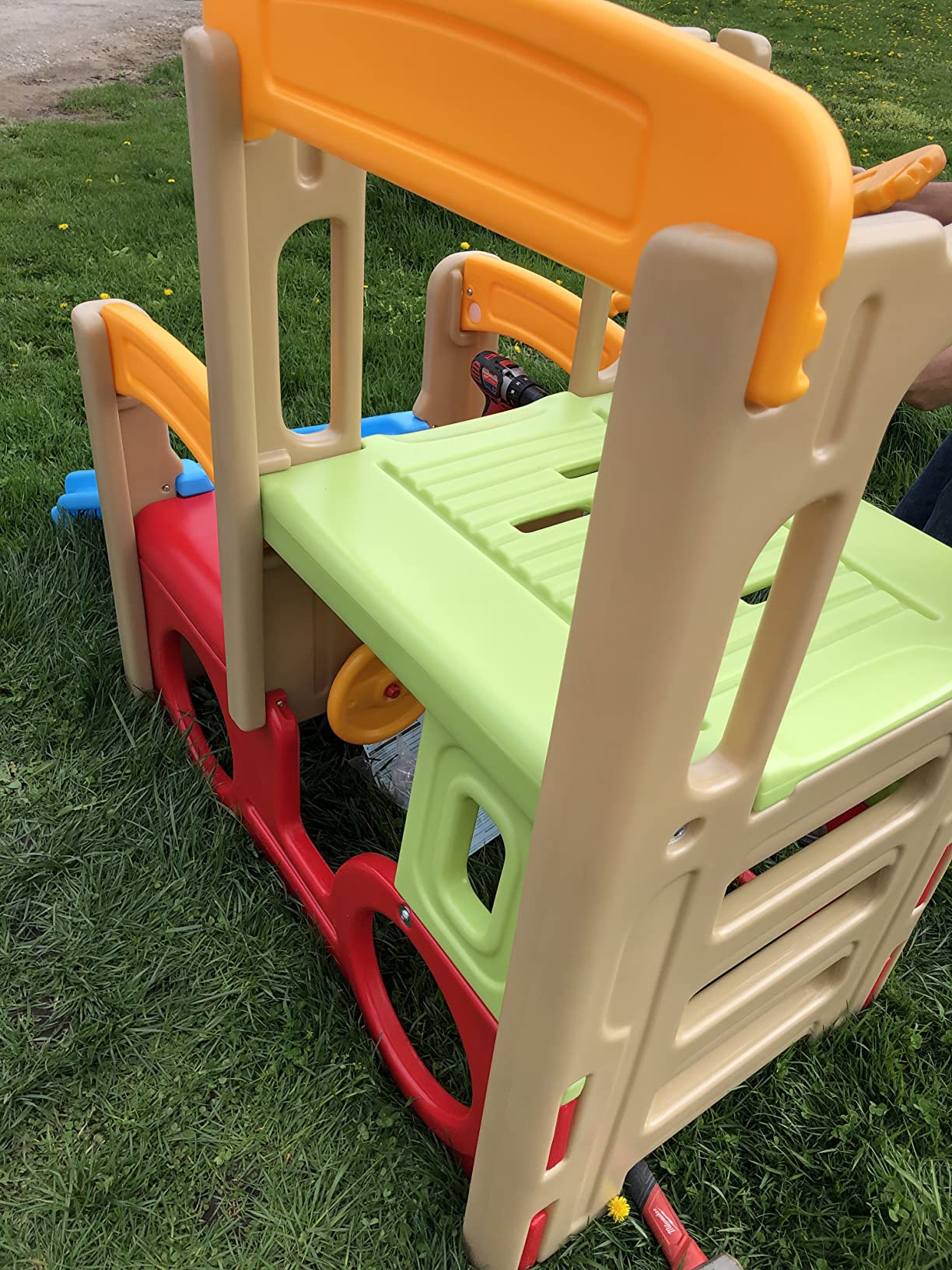
Our testing confirmed the build quality claims in unusual detail. The double-wall plastic has rounded edges throughout, and the slide surface is wide enough that a small child sits rather than perches. The ground-level crawl-through entry into a fort with a steering wheel is the feature owners mention most, because it gives a non-climbing sibling something to do within sight of the climber.
At 4.7 across 1933 reviews, this has the second-strongest review profile in the roundup, with 84 percent five-star. The 84 percent figure is worth comparing against the cedar sets below, which sit meaningfully lower. That gap reflects material, not workmanship: plastic does not check, grey or need re-staining.
The recurring complaint is assembly of the platform and slide. Multiple owners describe it as a two-adult job, and our own build took longer than the manufacturer photos imply. Budget an afternoon rather than an hour if you are building alone with a child in the house.
What to check before buying the Adventure Climber
Width is the number to focus on. At 28.5 inches this is a single-file structure, and two children on it at once will collide. If your household has two climbers in the 2-5 range, either accept turn-taking or add a second piece of equipment in a different footprint shape, such as a dome.
Also confirm you can store it. The unit is too long for most garage shelves, so in practice it leans against a wall outdoors year-round. That is fine on a double-wall plastic frame, but plan where it sits so it does not sit in a splash zone near a sprinkler head.
Who should skip the Adventure Climber
Skip it if your priority is real vertical climbing. The tallest point on this structure is 49.5 inches and the route is a set of steps and rails rather than a hold-based wall. Skip it if you need a wide deck for two children playing side by side, and skip it if you need something light enough for one adult to carry alone.
It is also the wrong pick for a rough play surface. The slide and step surfaces become slick when dirty or wet, so plan on a hose-down before each play session in high-use weeks.
3. Little Tikes Hide and Seek Climber and Swing – Best First Climber for Toddlers
Little Tikes Hide & Seek Climber and Swing, Indoor Outdoor with Slide – Easy Set Up – Toddler Playset, 53.50”L x 52.00”W x 41.00”H
Ages 12 months-3
Plastic
53.5 L x 52 W x 41 H in
90 lb max weight
Tool-free assembly
Pros
- Slide
- swing
- beginner rock wall and platform in one compact set
- Three-point safety belt keeps toddlers seated
- Tool-free assembly completed in minutes
- Light enough to move for mowing
- Handles twins playing at once
Cons
- Slide is small and short and becomes hard to use
- Plastic base can slide on smooth indoor floors
- Swing cannot be folded up
- Limited to roughly 12 months to 3 years
This is the only unit on the list with a real belt swing attached to a climbing frame, and that combination is the reason to buy it. The three-point harness is the detail that shows up again and again in the reviews: toddlers who cannot hold onto a traditional swing seat stay seated, which turns a frame that would otherwise be ignored into one that gets used every day.
The climbing surface is deliberately modest. The published figures are a 12.5 inch climbing wall height, an 18 inch platform and a 19.75 inch slide height, which tells you exactly what you are buying: a first contact surface for a child walking at 12 months, not a route for a preschooler. Set expectations accordingly and the whole set works well for its stated 12 months to 3 years.
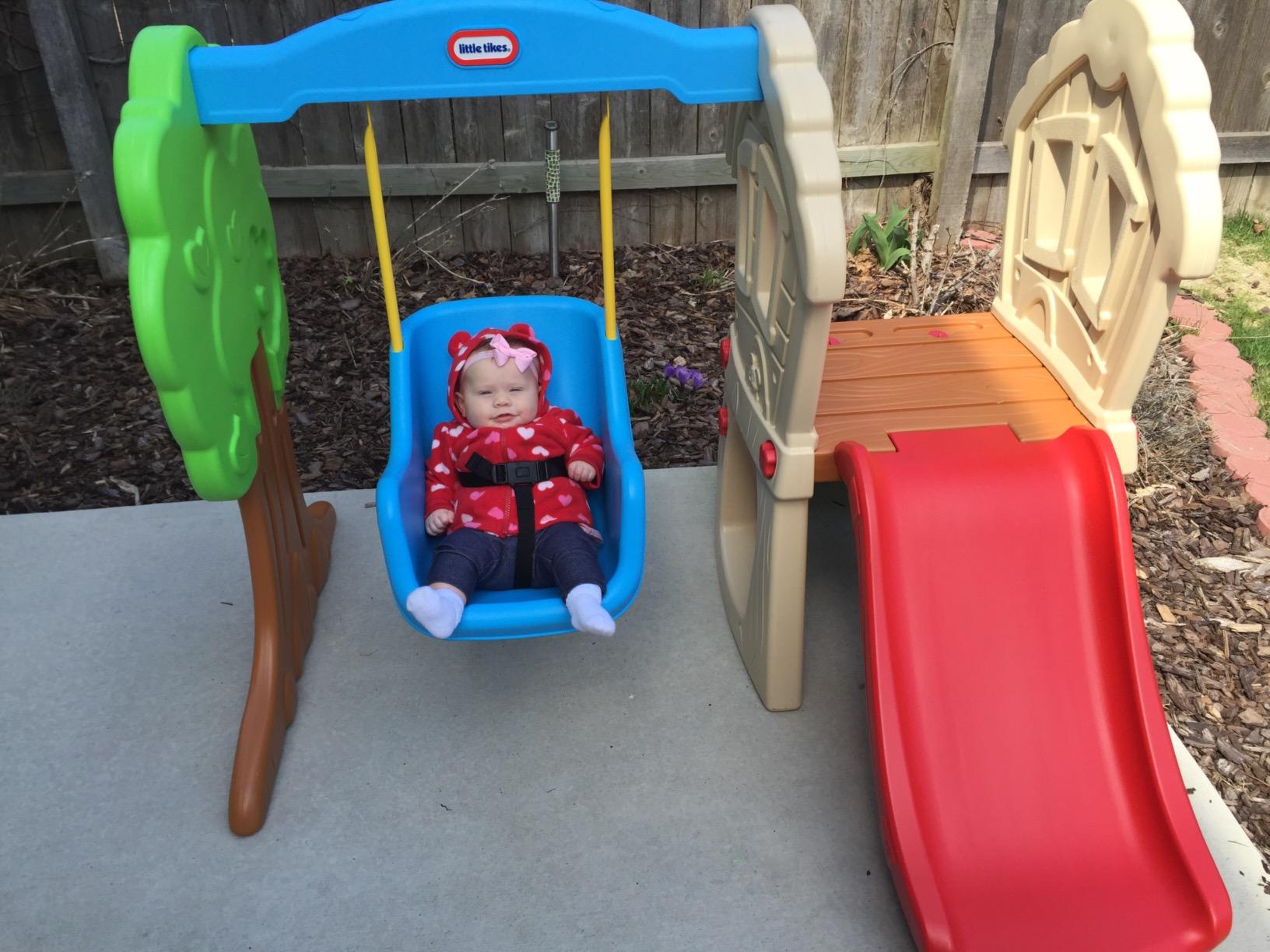
Tool-free assembly is the other headline. Most owners finish in minutes with no tools at all, which is unusual in this category and matters when the person building is also the person parenting. At 36 pounds it is light enough to drag across the lawn for mowing, so the set can live in the garage in winter and come out in spring without a second adult.
The 4.6 rating across 1064 reviews sits just below the plastic leaders, and the difference traces to the small slide rather than the frame. Children outgrow the slide well before they outgrow the swing, which is a strange way for a playset to be outgrown, but it is exactly what owners report.
A small number of buyers report incomplete deliveries or a swing that later collapsed. That is a minority of reports, but it is worth a quick hardware check in the first week of use, particularly on the swing attachment points.
What to check before buying the Hide and Seek Climber
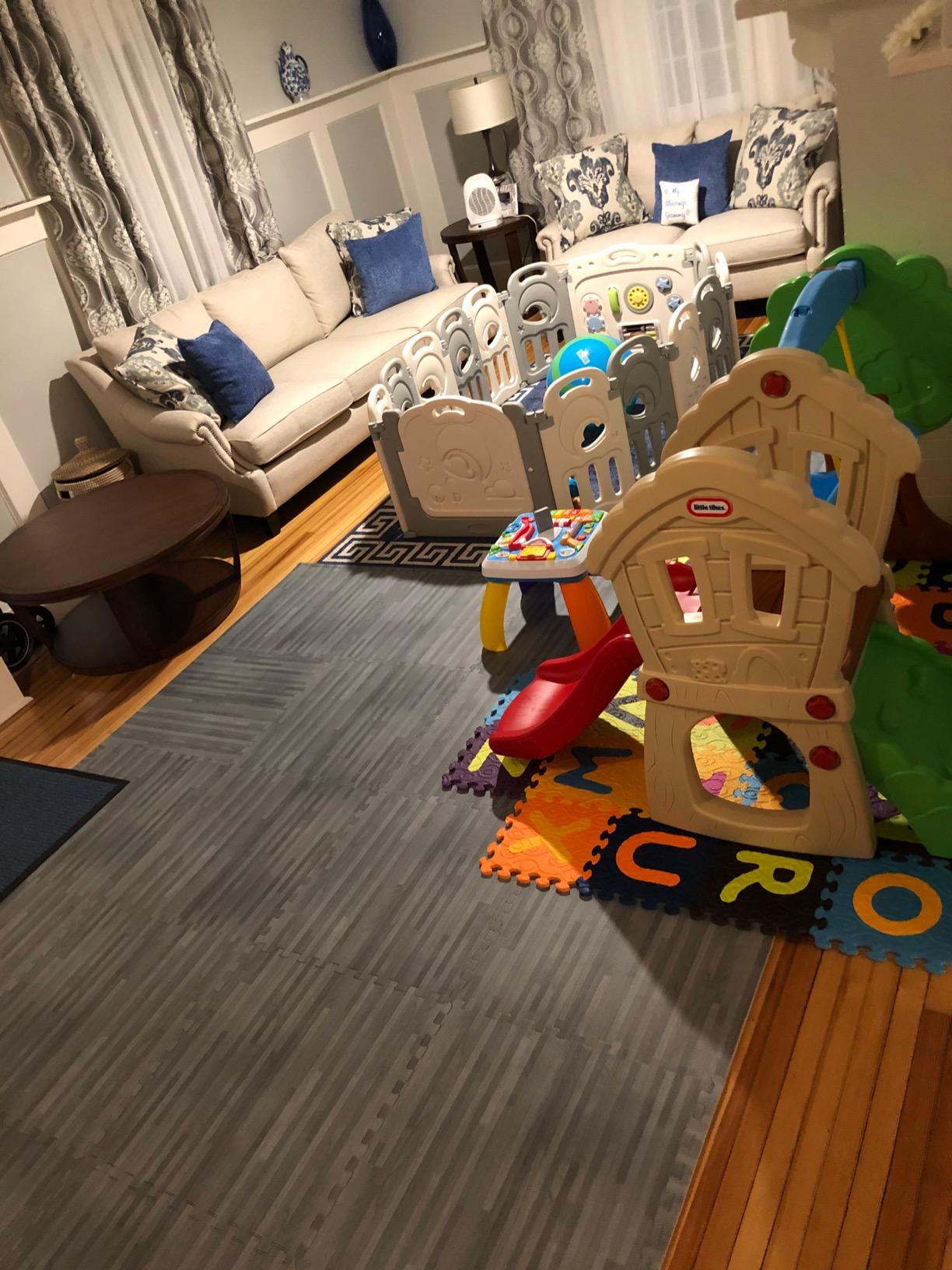
Decide in advance whether you want this indoors or outdoors. The frame is rated for both, but the base can slide on a smooth floor when a child swings, so on hard flooring you want a mat or carpet underneath. On lawn it behaves normally. The 53.5 by 52 inch footprint is nearly square, which is unusual and actually space-efficient for a swing set.
Check the 90 day manufacturer warranty against the 3 year and 5 year warranties on the larger sets below. For a product intended to last roughly two years of use, the shorter warranty is a reasonable trade, but it tells you how the manufacturer expects the product to be treated.
Who should skip the Hide and Seek Climber
Skip it if your child is past 3. The 12.5 inch climbing wall is finished for them, and the slide is more of a step down than a slide. Skipping it for a 4-year-old is the most common purchase mistake in this category, and it is the one forum buyers most often describe making themselves.
Skip it if you already own a swing, since the swing is the feature that justifies the footprint. The swing also cannot be folded out of the way, so it permanently occupies the centre of whatever space you give it.
4. Step2 Woodland Climber II – Best for Two Toddlers at Once
Step2 Woodland Climber II Kids Playset, Ages 2 –6 Years Old, Toddler Slide and Climbing Wall, Outdoor Playground for Backyard, Sturdy Plastic Frame, Easy Set Up
Ages 2-6
Plastic
75 x 47 x 53.75 in
Two climbing walls
3 year warranty
Pros
- Two climbing walls plus a roomy deck and slide
- Under-deck hideaway works as a fort or toy store
- Holds up to multiple adults during assembly
- Handles two kids at a time
- Earthy colors blend into a backyard
Cons
- Slide and ladder attachment is the hardest part of assembly
- Wheels are stiff and hard to spin when repositioning
- About 2.5 hours for one adult to build
This is the one plastic climber here with two genuine climbing walls facing different directions, and that changes the sibling dynamic completely. On a single-lane climber, two children negotiate; on this one, they climb in parallel and then meet on the deck. Parents buying for two toddlers consistently report that this is the feature that keeps both children engaged rather than one.
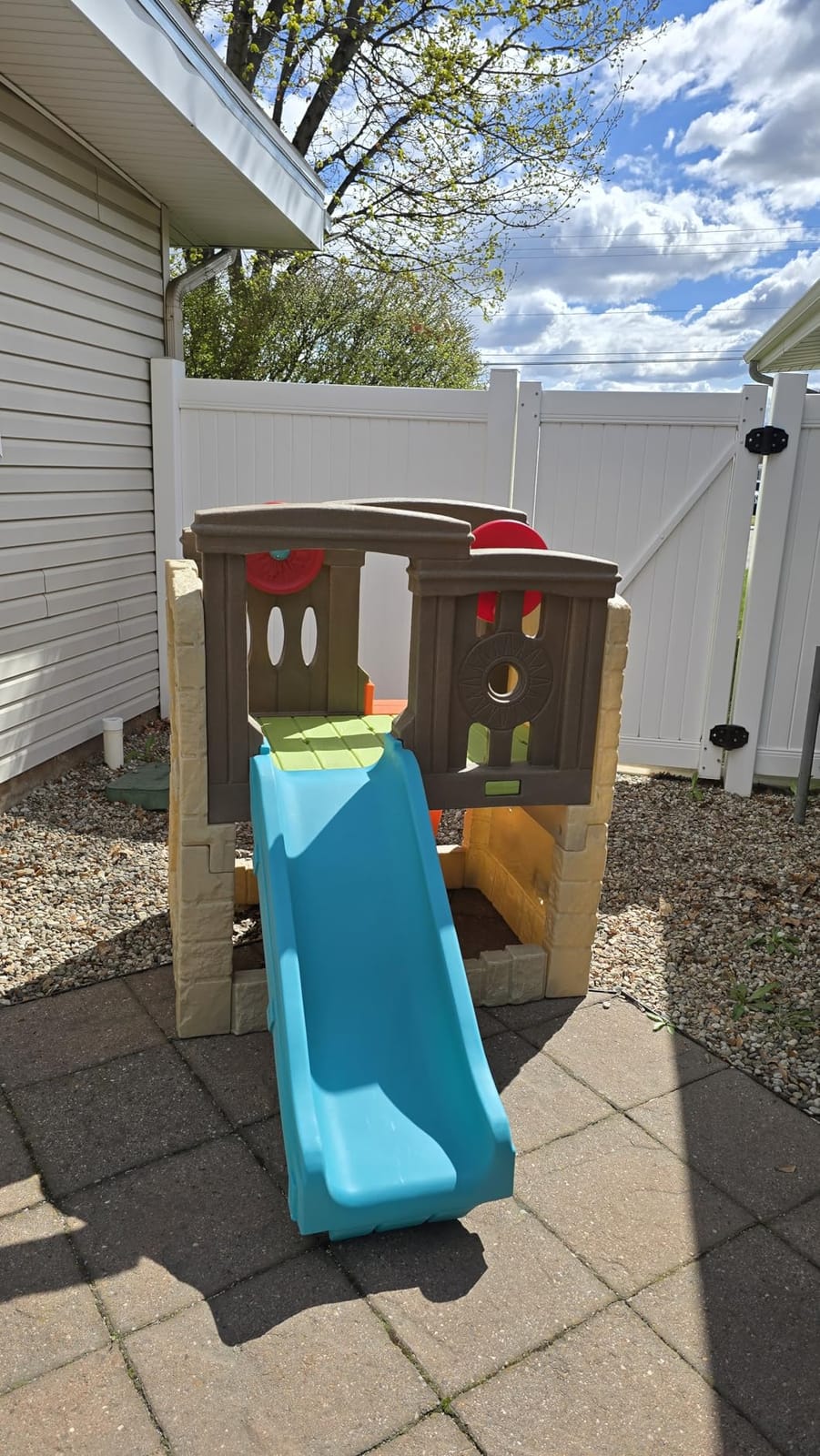
The package includes two climbing walls, a platform with base and sides, a slide, a ladder and two steering wheels, with an under-deck space that works as a fort. At 75 by 47 inches it is a large footprint for a plastic unit, so this is a better fit for a medium yard than for a small one, even though the plastic frame is more forgiving than cedar.
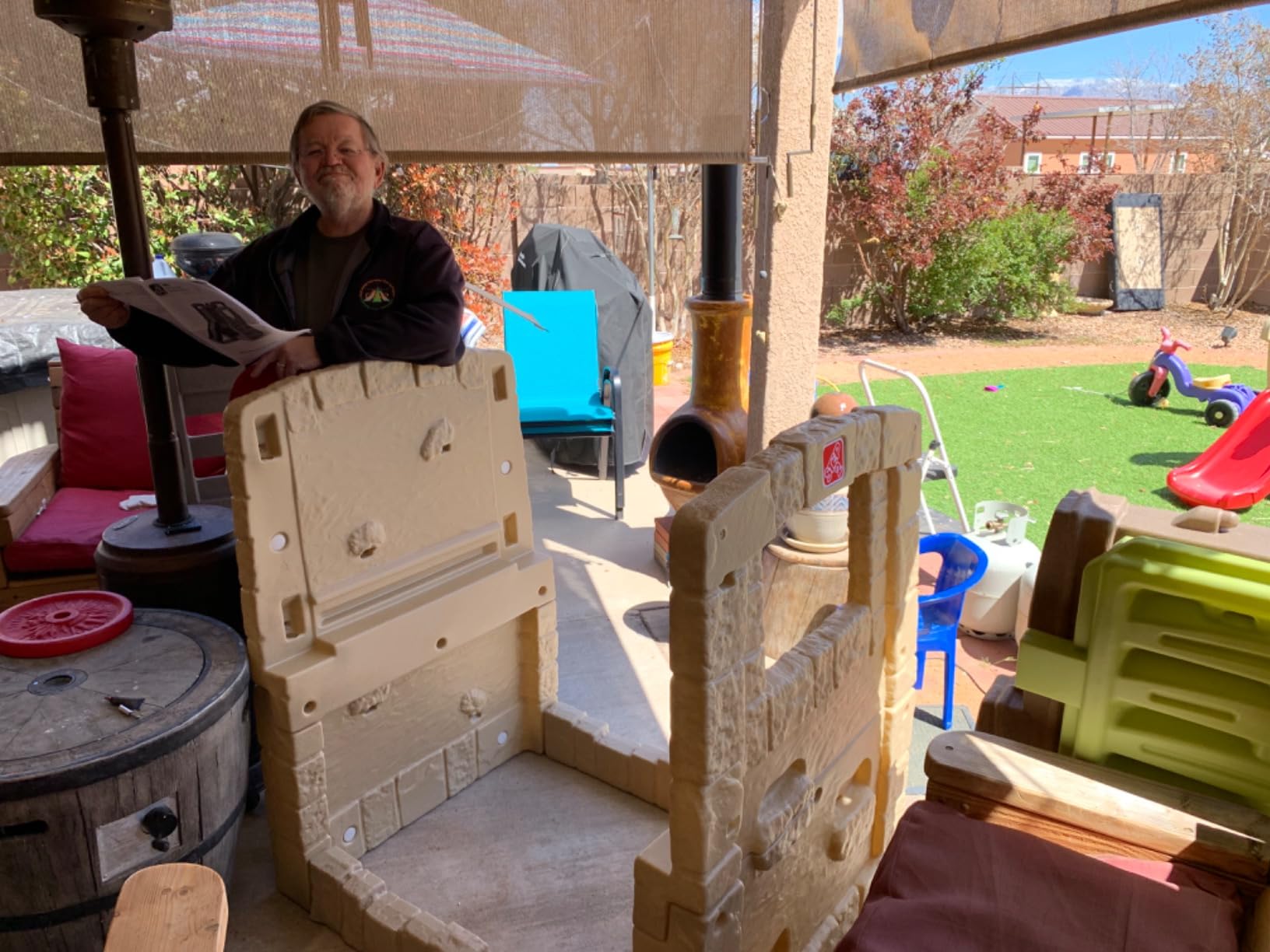
Structural rigidity is the surprise here. Owners report the frame holds multiple adults during assembly and does not tip when a child climbs hard, which is not always true of double-wall plastic at this price tier. The 4.7 rating across 1453 reviews sits alongside 85 percent five-star, and the theme in the positive reviews is sturdiness more than features.
Assembly is the dominant complaint and it is specific. The slide and ladder attachment points are the fiddly stage, and owners report that a drill or a little dish soap on the fittings makes the difference between frustrating and easy. Our own build estimate from owners is roughly 2.5 hours solo, less with two adults.
The nature-inspired brown color and textured surfaces are a genuine benefit in a yard where a bright primary-colored plastic structure dominates the space. If the set sits near a fence line or a garden bed rather than on an open lawn, the earthy finish blends noticeably better.
What to check before buying the Woodland Climber II
The wheels matter more than the manual suggests. They exist so you can reposition the set, but owners describe them as stiff, which undercuts the main reason they are there. If you have a level paved patio or a hard-packed area, this is a better unit than a cedar set for that reason alone. If your lawn is uneven, the frame can rock after a heavy rain.
Count the children who will use it at once. The published figure is two players, and that holds. Families with three or more children aged 2-6 should treat this as the core of a small equipment group rather than the whole of it.
Who should skip the Woodland Climber II
Skip it if your yard is tight. At 75 by 47 inches plus a 6 foot clear zone on all sides, you are committing to a patch roughly 19 feet by 15 feet. Parents in r/Preschoolers describe measuring with a hose before ordering as the step that most regret not taking earlier.
Skip it if you want a genuine hold route. The two climbing walls here are molded steps and grips that cannot be reconfigured, so a child who improves has nowhere to progress. If the goal is climbing that lasts to age 8 or beyond, the Skyward Summit is the more direct answer.
5. Backyard Discovery Buckley Hill – Best Cedar Starter Swing Set
Backyard Discovery Buckley Hill Cedar Wood Swing Set with Wave Slide, Play Deck, Rock Wall Ladder, Belt Swings, Chalkboard, Canopy Roof, Outdoor Playset
Ages 3-6
Cedar
107 D x 123 W x 92 H in
330 lb max weight
ASTM F1148-22
Pros
- Rock wall ladder with 4 holds doubles as an access ladder
- 6 foot wave slide with a canopy over the deck
- Two belt swings with rope chains avoid finger pinches
- Chalkboard adds an independent play station
- Pre-cut pre-drilled and pre-stained cedar
Cons
- Simpler than higher priced cedar models
- Needs re-staining or sealing after a few seasons
- 123 in width needs a substantial yard
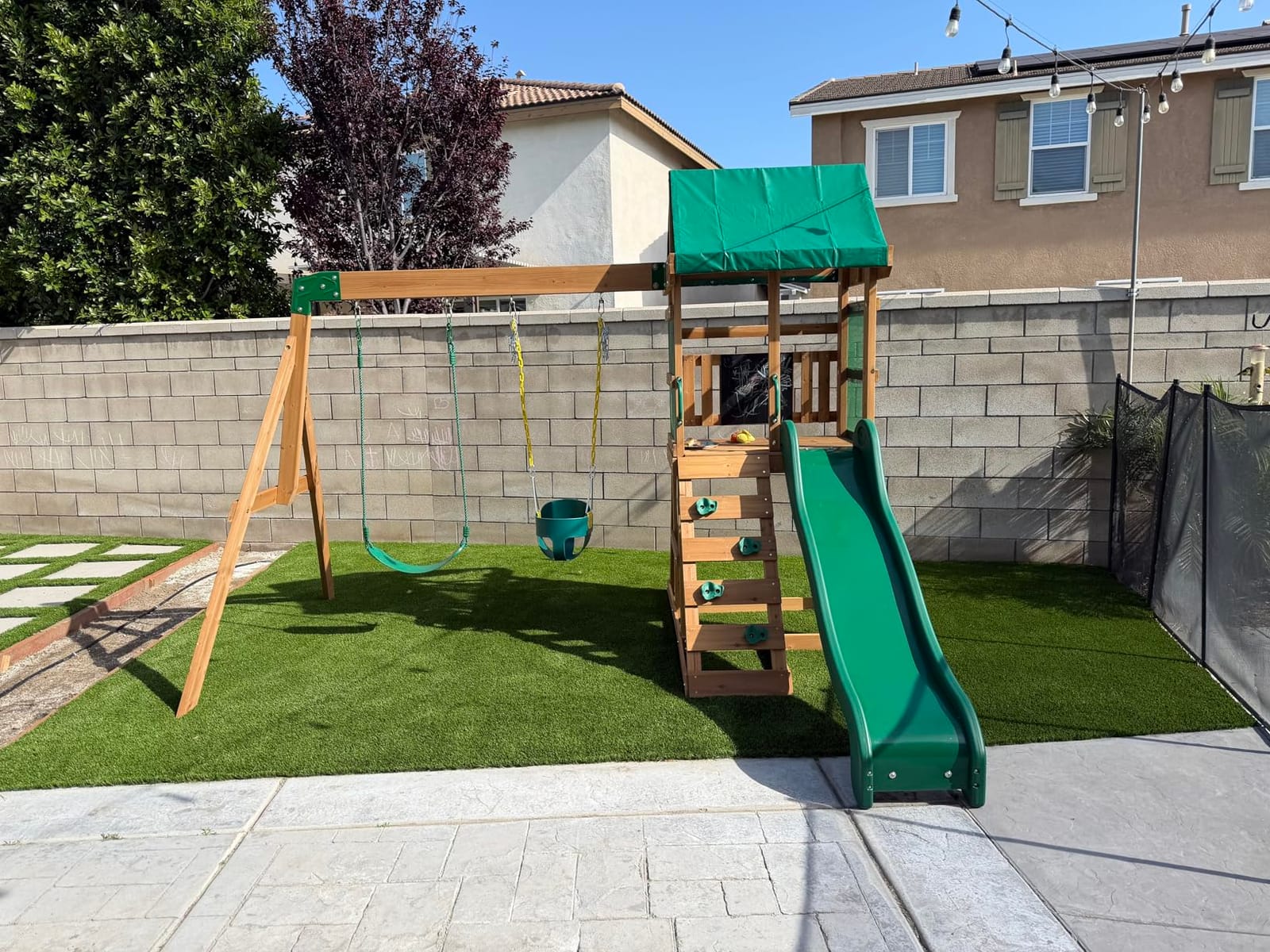
The Buckley Hill is the cheapest way into real cedar construction, and that is a meaningful step up from plastic in one respect: adults can climb on it during assembly, which removes the argument about whether a child will be safe on a frame you are still building. Cedar also has a much longer service life than plastic if you are willing to seal it.
The climbing feature is a rock wall ladder with 4 climbing holds that doubles as the access route to the deck. That dual purpose is efficient design, and it means the climbing surface gets used on every trip up rather than only when a child chooses to climb. For a 3 to 6 year old, that is often the difference between a wall they use and a wall they ignore.
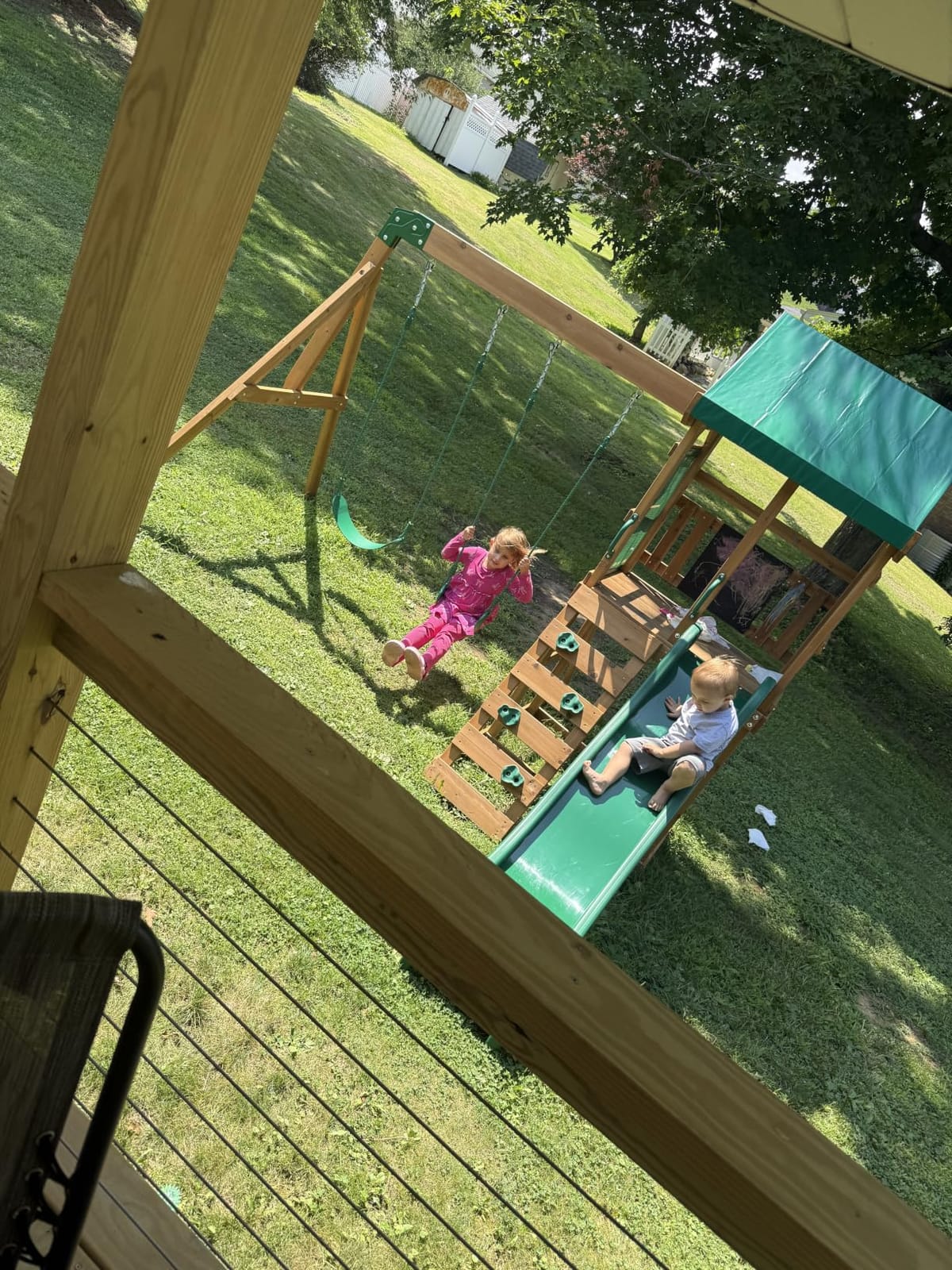
It is engineered to meet or exceed ASTM F1148-22, carries a 5 year limited warranty and is rated for 330 pounds and up to 5 children. Those are the figures to compare against the two larger Backyard Discovery sets below, and they are honestly lower, which is appropriate for a 3 to 6 year old.
The 4.3 rating across 3071 reviews is lower than the plastic climbers, and 69 percent five-star explains the gap. Owners like the build and value but point to two recurring maintenance realities: cedar greys and checks without annual sealing, and this is an entry-level model with only one climbing feature. Nobody describes it as underbuilt; several describe it as simple.
Assembly needs two adults, and the BILT app guides the build. Pre-cut and pre-drilled cedar removes most of the measuring work, which is where cedar flat-packs usually go wrong, though owners still report occasional splitting around pilot holes if screws are driven off-center.
What to check before buying the Buckley Hill
Width. At 123 inches, this is a wide set for a starter model, and you need roughly 6 feet of clearance on all sides on top of that. Mark the 14 foot by 14 foot area with a hose first. Most sizing regret in this category comes from measuring the structure and forgetting the use zone, not from measuring wrong.
Then think about sealing. Cedar is a maintenance commitment: one water-sealing pass a year keeps the surface from greying and checking. If you do not want that annual task, buy plastic instead and accept a shorter service life in exchange for zero maintenance.
Who should skip the Buckley Hill
Skip it if you want serious climbing. Four holds and a ladder face is an access route and a first climbing experience, not a progression wall. A child aged 6 or older will use the deck and slide and treat the rock wall as a shortcut up.
Skip it if you already own a playset with a slide. The wave slide is the second most expensive component in this box and the one your child will outgrow first, so if a slide exists elsewhere in the yard, this is a lot of cedar for one climbing feature and two swings.
6. Backyard Discovery Mount Mckinley – Best Cedar Set for Ages 6 and Up
Backyard Discovery Mount Mckinley Cedar Wood Swing Set with Wave Slide, Play Deck, Double Rock Wall, Rope Ladder, Web Swing, Belt Swings, Toy Telescope, Steering Wheel, Sandbox Area, Outdoor Playset
Ages 3-10
Cedar
150 D x 186 W x 119 H in
Double rock wall, 9 holds
ASTM F1148-22
Pros
- Extra-wide double rock wall with 9 holds and rope assist
- Over 6 foot rope ladder adds a real climbing challenge
- 8 foot wave slide plus two belt swings and a trapeze
- Shaded sandbox and canopy-shaded deck
- 5 year warranty with ASTM F1148-22
Cons
- 186 x 150 in footprint needs a very large yard
- 308 lb weight usually needs several adults to position
- Cedar needs ongoing stain and weather sealing
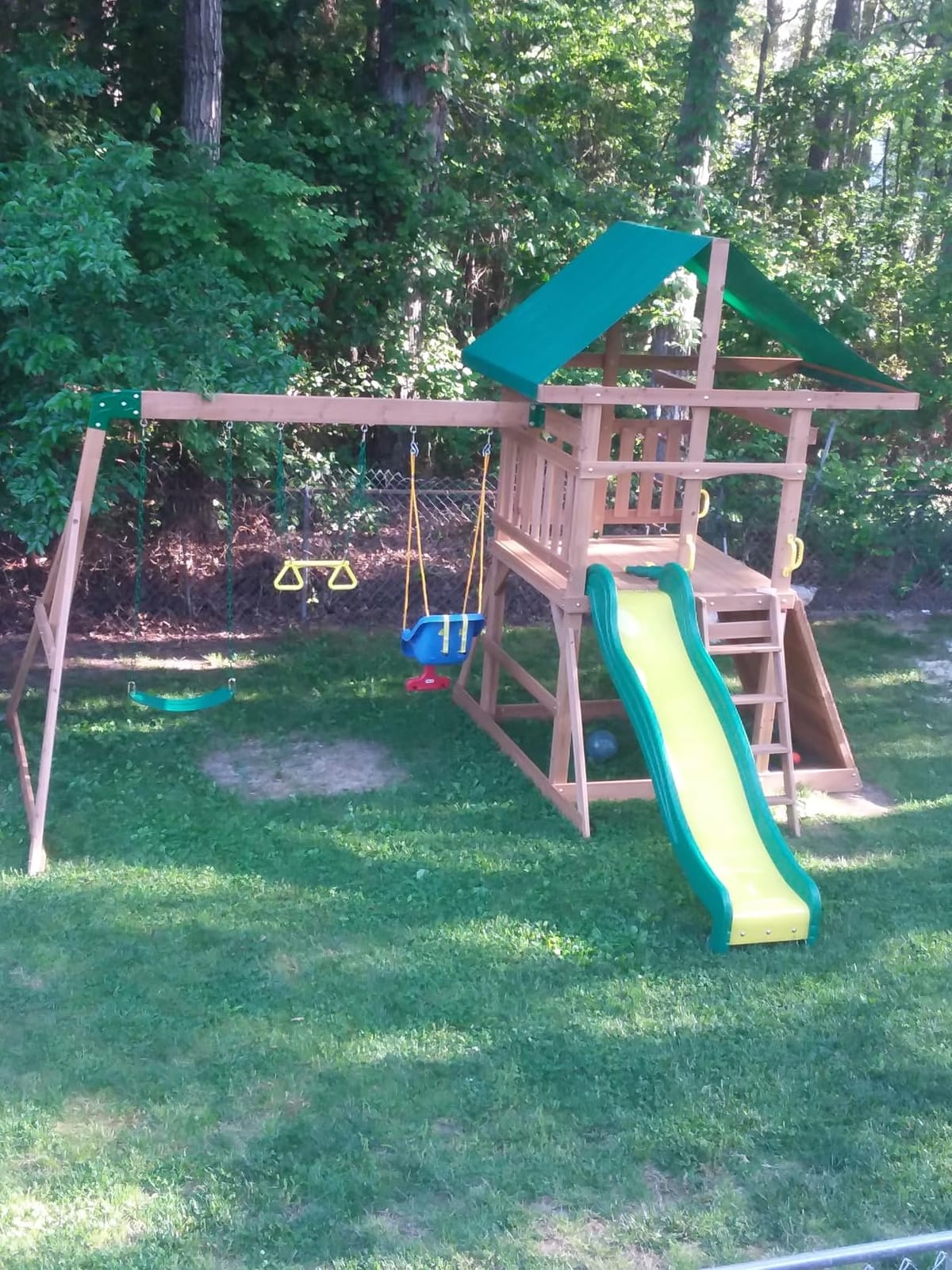
This is the first set in the roundup where older children can genuinely climb rather than scramble. The rock wall is double-sided, carries 9 holds and has a rope assist, which means a child aged 6 to 10 can pull themselves up and work a real route. Paired with the rope ladder over 6 feet long, it is the closest thing to a training wall in this list without leaving the playset category.
Two children can climb the wall at the same time, which is the design feature that matters most once siblings are past 6. Below, the 8 foot wave slide, two belt swings and a trapeze keep a group of that age busy while one child climbs, which is what stops a climbing wall from becoming a queue.
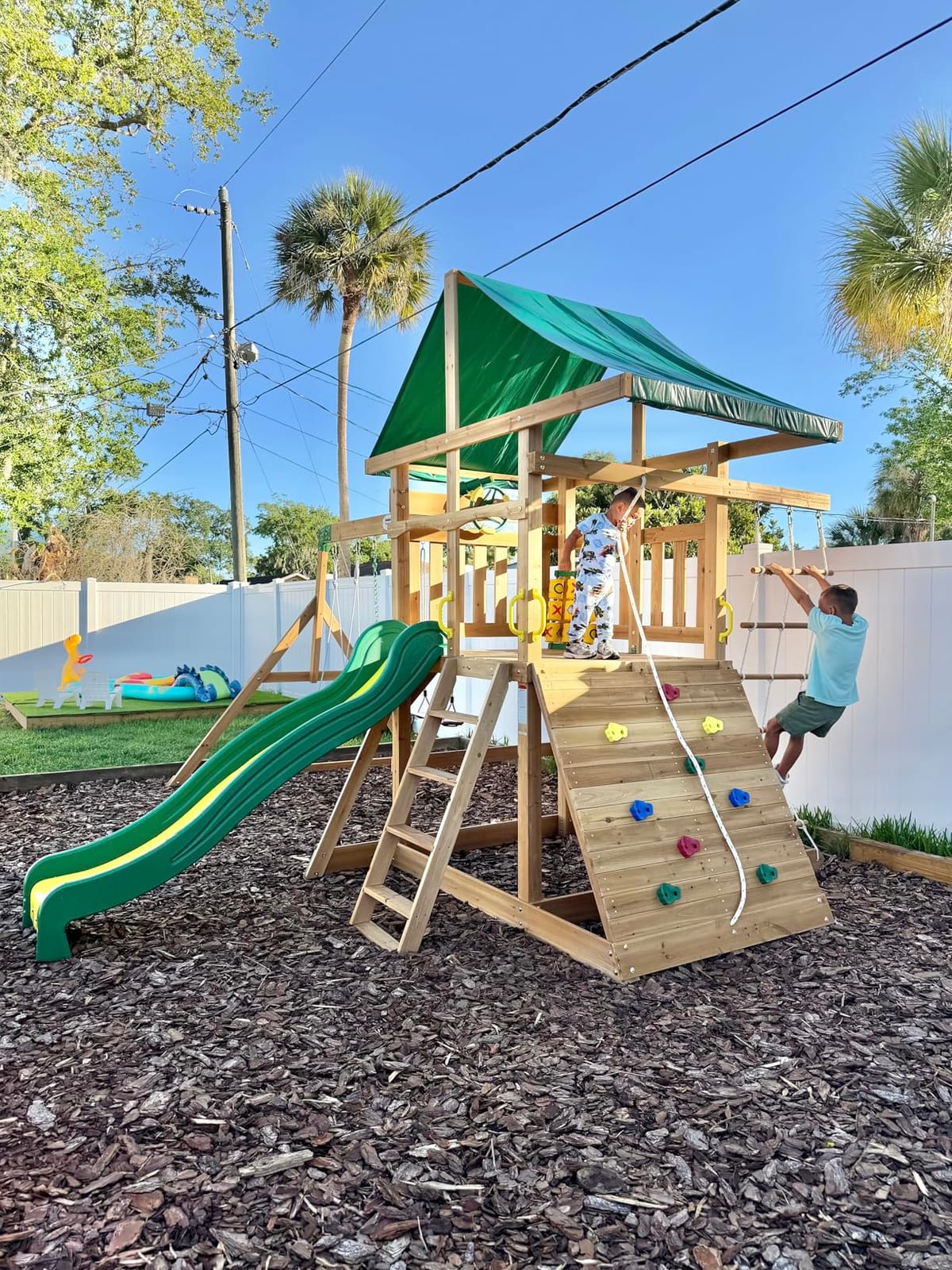
The published maximum weight recommendation is 1080 pounds for the structure, rated for up to 10 children and engineered to meet or exceed ASTM F1148-22, with a 5 year limited warranty. That capacity figure is for the whole structure, not a single climber, and it is the number to keep in perspective when you read a lighter-looking set’s rating.
The 4.4 rating across 1088 reviews is a solid mid-range score and the review count is deep enough to trust. Reviewers consistently single out the climbing content and the cedar build as the strengths, and the footprint, the 308 pound weight and assembly effort as the barriers.
Assembly is a genuine project. This is a 308 pound cedar structure with a full play deck, sandbox, slide and three swinging stations. Plan a full weekend and at least two adults, and note that the sandbox sand is not included.
What to check before buying the Mount Mckinley
Measure the yard twice, because this is the point where parents get it wrong. The structure is 186 by 150 inches, and a compliant 6 foot use zone on all sides pushes your real requirement to roughly 27 feet by 22 feet. Below that, you are choosing a different product rather than a smaller version of this one.
Check the route to the site. At 308 pounds in a 150 inch long box, the delivery is curbside and you are moving it. Make sure the path from the delivery point to the build site is level, hard-packed and free of steps, because this is not a project you want to interrupt halfway.
Who should skip the Mount Mckinley
Skip it if your yard is medium sized. A 4 to 6 year old will get more from the Buckley Hill at this category, and the difference in climbing difficulty is irrelevant to them. This set’s climbing content is designed for the upper half of its stated age range.
Skip it if you are not prepared to seal cedar annually. The frame is 100 percent cedar and while it lasts much longer than plastic, it will grey and check without maintenance. This is the one product category in the roundup where ongoing upkeep is non-optional.
7. Eezy Peezy Mega Pyramid – Best Value and Easiest to Move
Eezy Peezy Mega Pyramid Monkey Bars Climbing Tower Active Outdoor Fun for Kids Ages 3 to 8 Years Old, Blue/Green
Ages 3-8
Plastic
105 L x 65 W x 52 H in
154 lb combined load
UV-protected plastic
Pros
- 38 lb so one adult can move it between rooms or yard
- Climb over under and around for balance and strength
- Converts into a fort or igloo with blankets
- UV-protected plastic survives multiple winters
- Interlocking post system needs no tools for basic assembly
Cons
- Pressure pins are stiff and pinch fingers during assembly
- Spring pins pop out of star connectors during setup
- Very hard to disassemble once built
- Top section feels wobbly under heavier children
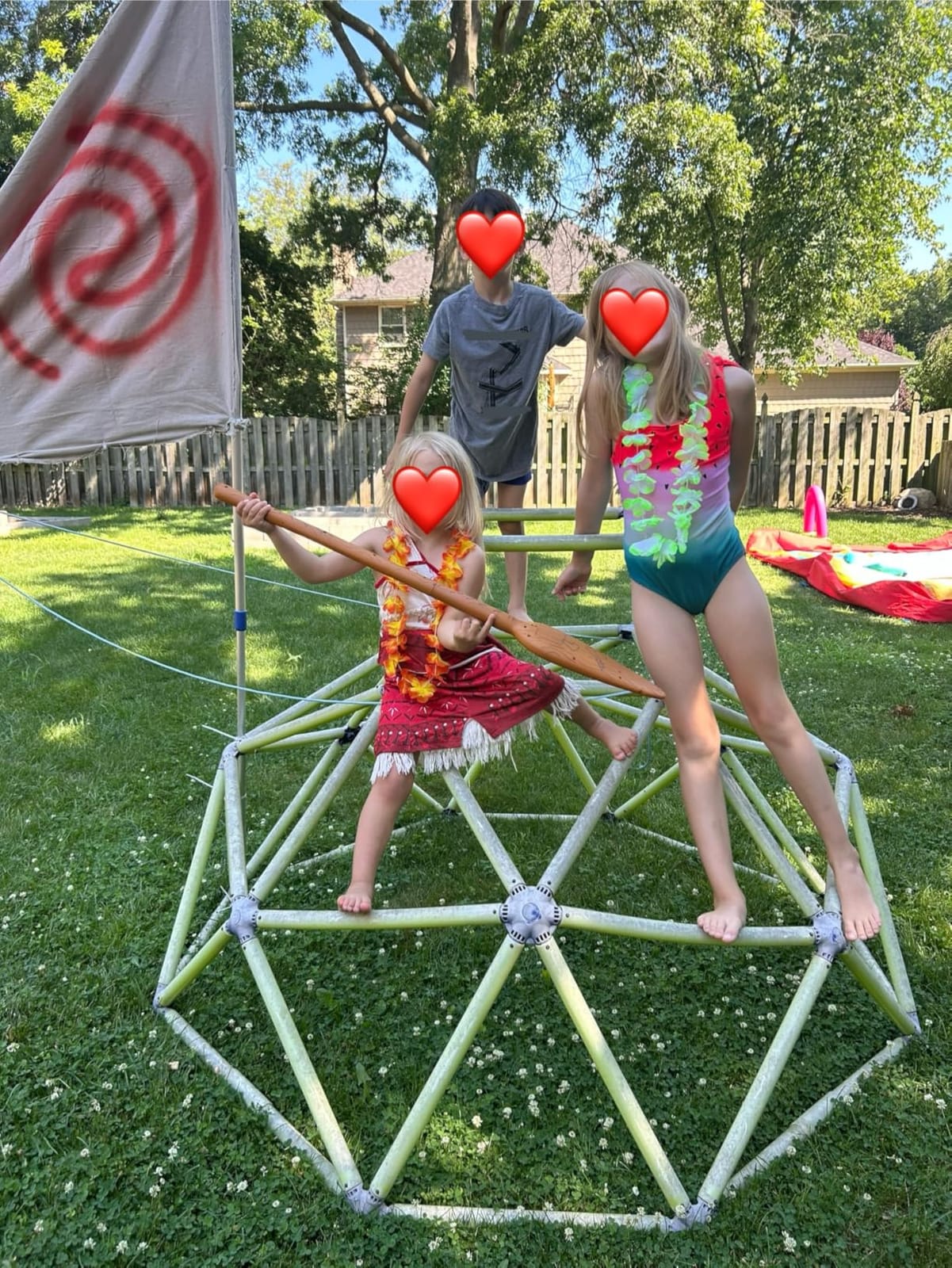
At 6375 reviews this is by a wide margin the most reviewed product in the roundup, and the volume of long-term owner feedback is what makes it worth a top-three slot. The structure itself is a modular pyramid that children climb over, under and around rather than up in a single direction, which is why it works from age 3 all the way to 8.
The portability is the practical headline. At 38 pounds, one adult can carry it between the yard, a garage or a living room, and a 90 day limited warranty aside, this is the only structure here you can genuinely move as needed. For renters, for small yards and for families with two homes, that changes the buying calculation completely.
Build a fort from it and the value doubles. Drape a blanket over the pyramid and the same frame becomes a hideout, which is the imaginative-play equivalent of a slide on a conventional set. That dual use is why owners report years of service from a single purchase rather than a couple of seasons.
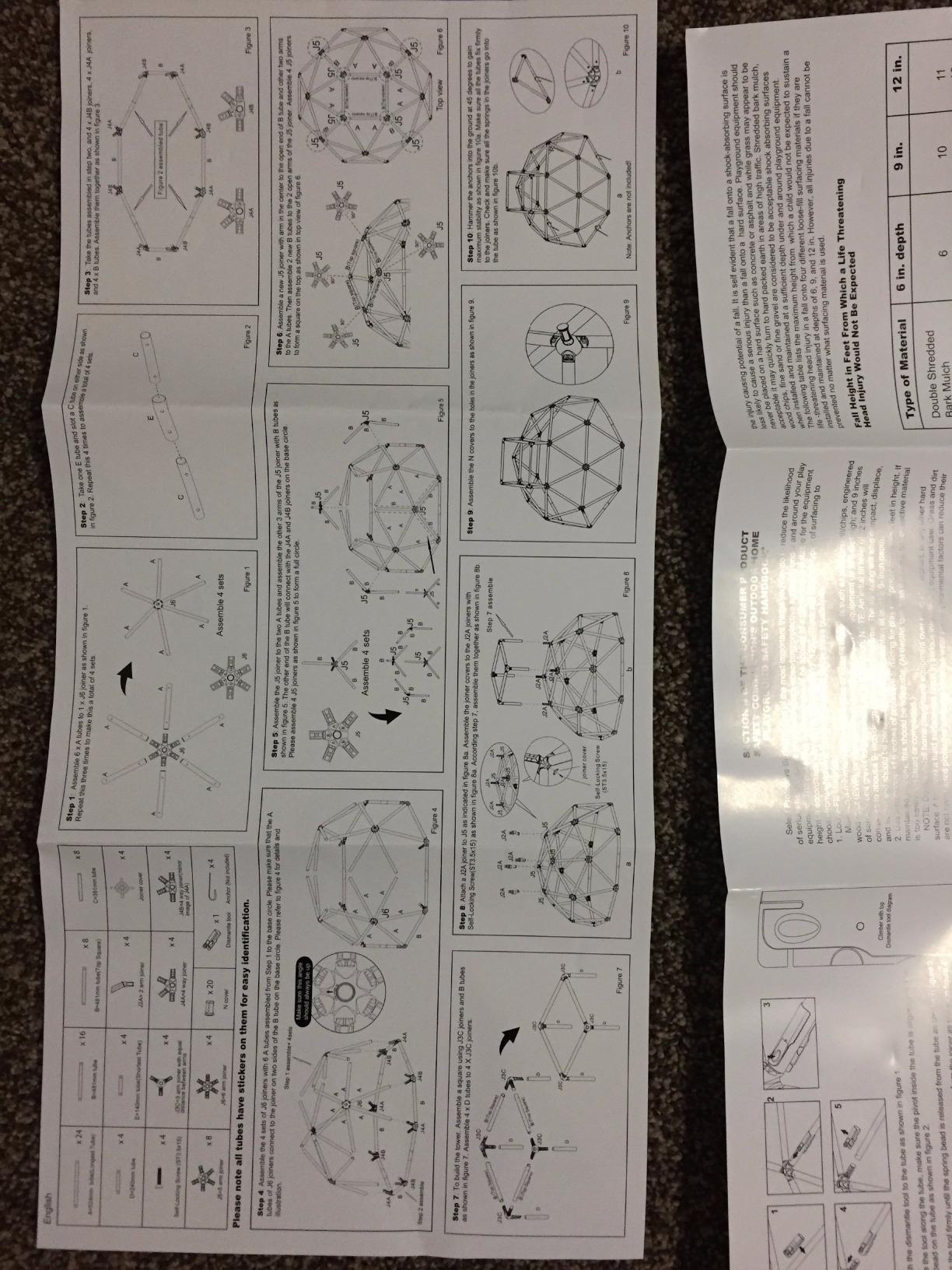
The 4.4 rating is lower than the plastic leaders, and the reason is almost entirely assembly rather than the finished product. Reviewers warn repeatedly that the pressure pins are extremely stiff and hurt thumbs, and that metal spring pins pop out of the star connectors during setup. A flat-head screwdriver or a pry tool makes the build manageable and is worth finding before you start.
Two further notes from owners: the top section can feel wobbly under heavier children, and the assembled structure is very difficult or impossible to take apart again with the included tool. If you rent, or expect to move house, build that into your decision.
What to check before buying the Mega Pyramid
Get the right tool before you open the box. This is the single most repeated instruction in the reviews for this product and it takes ten seconds to follow. A flat-head screwdriver, and ideally work gloves, address the stiff pressure pins that otherwise cause most of the frustration and most of the reported finger pinches.
Also check the ground. The frame is stable on level lawn and on a flat paved area, but on uneven ground the top section rocks. Level the patch or add a layer of loose fill underneath before assembly, because the joints are designed for a flat base.
Who should skip the Mega Pyramid
Skip it if you want a climbing route rather than a climbing object. There are no holds to grip and no line to follow, so a child who wants to work upward will move on. This is a movement and fort toy, and it complements a rock wall rather than replacing one.
Skip it if you intend to keep it assembled permanently. Owners report it is close to impossible to disassemble with the included tool, so this is a buy-once structure and not a portable one in the reassembly sense.
8. Step2 Skyward Summit – Best Dedicated Climbing Wall
Step2 Skyward Summit for Kids, Climbing Wall Playset for Toddlers, Ages 4 –8 Years Old, Easy to Assemble Kids Outdoor Playground for Backyard
Ages 4-8
Plastic
52 D x 80 W x 80 H in
6.5 ft four-sided wall
300 lb max
Pros
- Four-sided 6.5 ft rock wall with 9 hand grips and junior grips
- Over 100 sq ft of climbing area
- Two cargo nets and a lookout platform with a flag
- 300 lb rating and it does not tip with adults hanging on it
- Owners report no fading or cracking after 5+ years
Cons
- Instructions widely criticized as confusing and incomplete
- Assembly takes 2-4 hours for two people
- A ladder is needed and this is not documented
- Cargo nets reportedly a few inches short
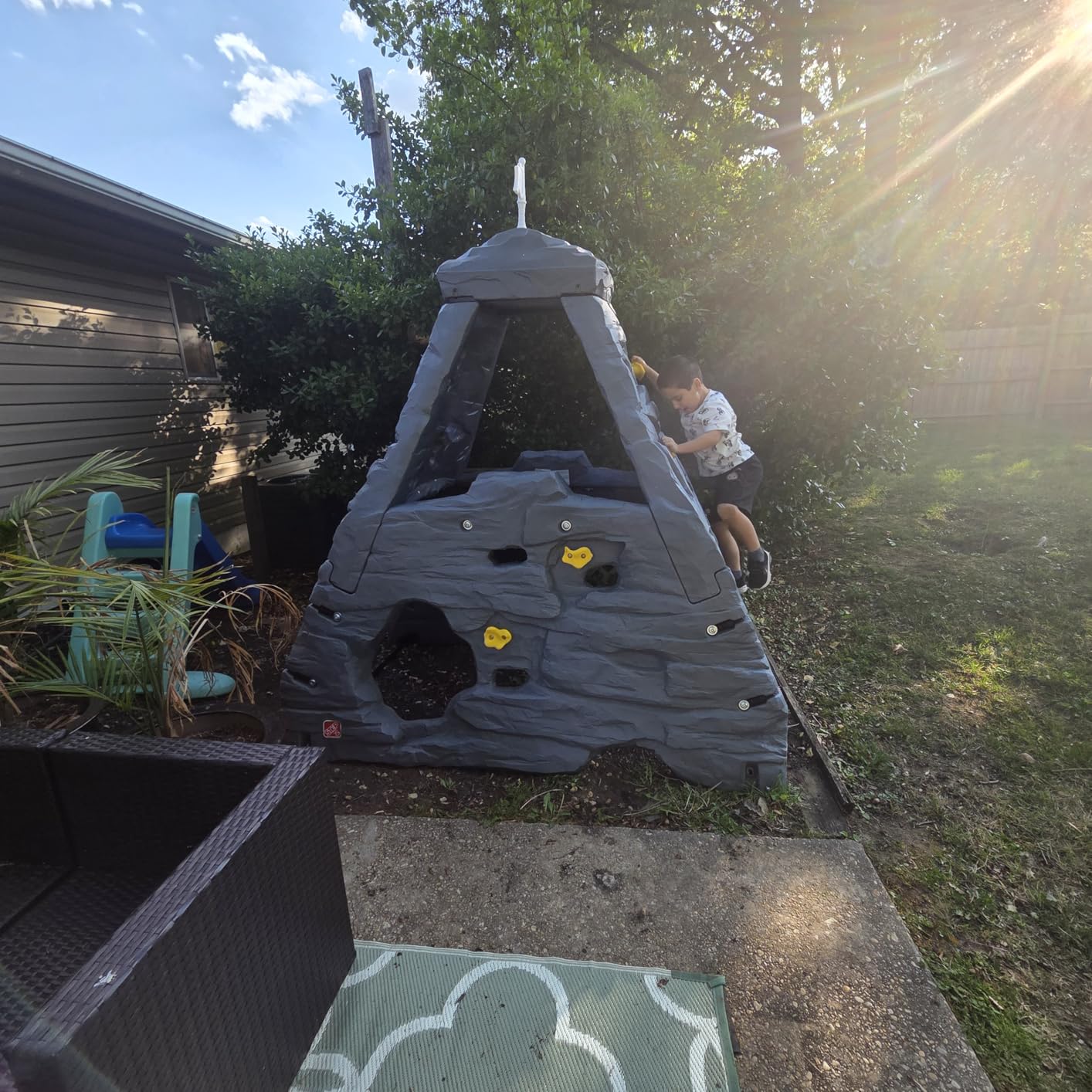
If your child thinks of climbing as climbing rather than as playground equipment, this is the one to buy. The rock wall is 6.5 feet tall on all four sides, giving over 100 square feet of climbing area, and there are 9 hand grips plus a set of junior grips sized for smaller hands. That combination of height and grip choice is what separates a real wall from a ladder with grips.
Two cargo nets and a lookout platform give the wall a destination, which is what keeps a climbing wall interesting past the first month. A child who can see the platform from the ground has a goal. The whole structure fits up to 4 children, so a group game on all four sides works.
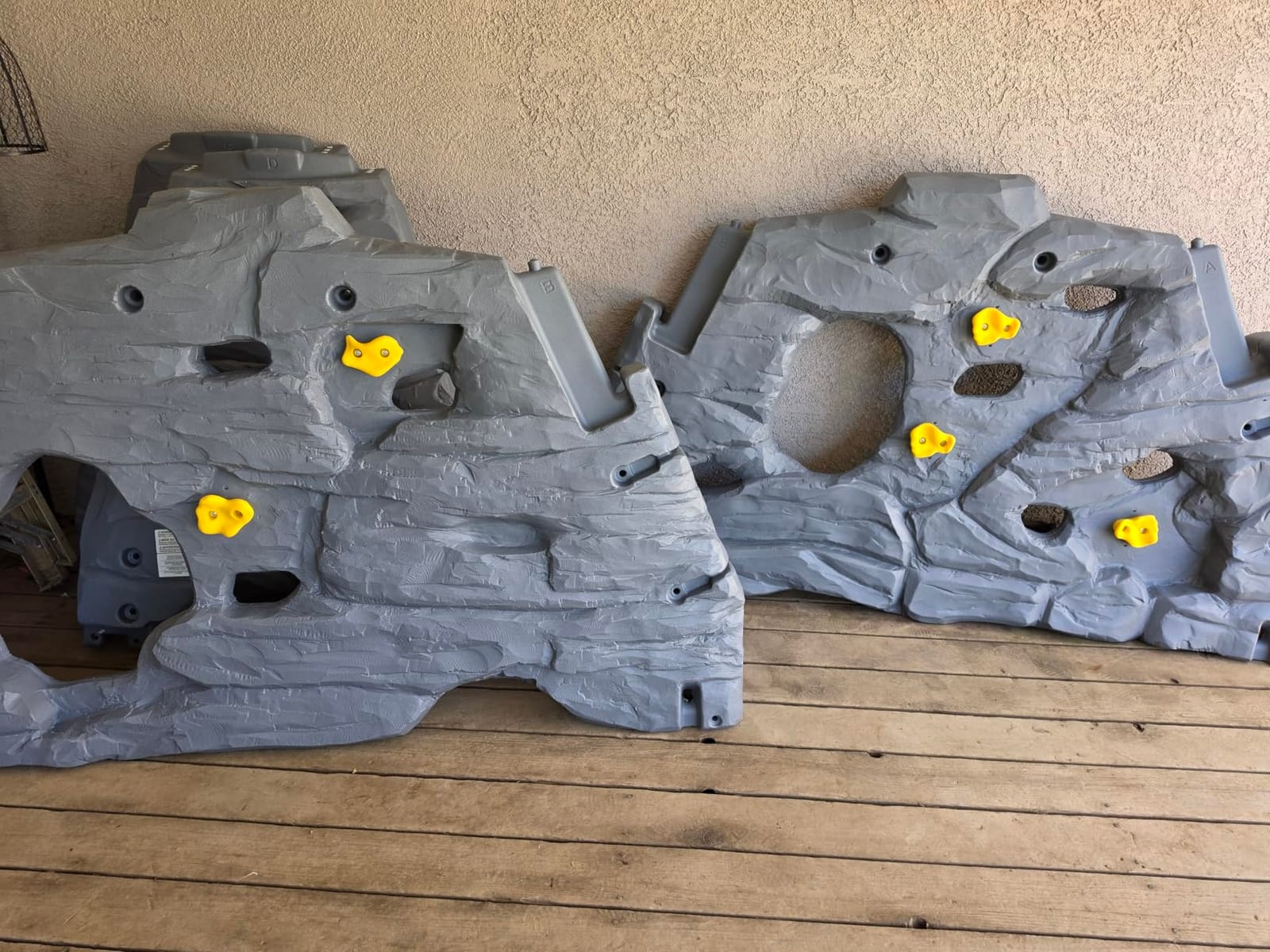
Durability is the standout finding. Long-term owners report no fading, no cracking and no broken webbing after five or more years outdoors, in one case through harsh Pennsylvania winters. The double-walled plastic resists chipping and fading, and the 300 pound maximum weight is high for a toddler-oriented product. Owners also note it does not tip when adults hang off it, which tells you something about the frame geometry.
The 435 review count is the smallest in this roundup, but the feedback is unusually specific and consistently positive on product quality. Nearly all reviewers who struggle with assembly still describe the finished wall as worth the money. The 4.5 rating reflects the product, not the box it arrives in.
Assembly is the problem. Instructions are described as among the worst these buyers had seen, the process takes 2 to 4 hours for two people, and a ladder is required for the build without being mentioned in the documentation. The cargo nets are also reported by some owners to be a few inches short, and pieces can be hard to line up. Plan the evening properly and the outcome is worth it.
What to check before buying the Skyward Summit
Height of the tallest user, not age. A 6.5 foot wall is meaningful to a child aged 5 and up and irrelevant to a 3 year old, who will treat the platform as the destination and the wall as stairs. If your child is under 4, the Little Tikes or the Step2 Game Time is a better use of the same footprint.
Space. At 80 by 52 inches with a 6 foot use zone, you need roughly 20 feet by 16 feet of clear, level space. There is no way to place this wall close to a fence and still claim a compliant use zone, which is the most common installation mistake we see described by owners.
Who should skip the Skyward Summit
Skip it if you are not patient with assembly. This is the least forgiving build in the roundup, and the instructions will not save you. If you can commit a full evening with two adults and a ladder, that is fine; if you want a two-hour job, choose the Game Time Sports Climber or the Mega Pyramid.
Skip it if you need swings or a slide. This is a climbing structure, not a playset, and children who want to swing will be disappointed by it.
9. Gorilla Playsets Playmaker Deluxe – Best for Two Climbers Racing Side by Side
Gorilla Playsets Playmaker Deluxe Wooden Swing Set with Vinyl Canopy Roof, Dual Wave Slides, and Rock Climbing Wall, Redwood Stained Cedar
Ages 3-11
Cedar
142 D x 174 W x 118 H in
800 lb max weight
10 year lumber warranty
Pros
- Very sturdy cedar framing that holds multiple adults
- Two Alpine wave slides for side-by-side racing
- Rock wall plus sandbox
- chalkboard and steering wheel
- 3 swing stations accept standard swing components
- Rubber-coated chains help prevent finger pinches
Cons
- Assembly estimated at 6-8 hours for two adults
- Rock wall rungs and boards can split if t-nuts are driven in the wrong order
- Some deliveries arrive with missing hardware
- Slide channels suit toddlers more than older children
The Playmaker Deluxe is the one set here designed around two children of the same age doing the same thing at the same time. Two Alpine wave slides sit side by side so they can race down simultaneously, and the 3 swing stations accept standard swing components, which means you can reconfigure the swinging section as your children grow rather than replacing the set.
The rock wall is a supporting feature rather than the main event, and that shapes who this suits. If a 7 year old is your primary climber, the Skyward Summit or the Mount Mckinley is a better allocation of space. If you have two children aged 4-8 who will compete over everything, the dual slides are exactly the right answer.
Build quality is genuinely strong. The 4 by 4 inch framing and 4 by 6 inch swing beam, with recessed bolts to avoid snagging and rubber-coated swing chains to prevent finger pinches, are details you normally find on higher tier sets. The warranty backs it up: 10 years on lumber and 1 year on other components.
At 4.1 across 344 reviews, this is the second-lowest score in the roundup, with 61 percent five-star and 11 percent one-star. The one-star reviews cluster around three things: assembly time, splitting wood during installation, and shipments with missing hardware. Buyers who complete the build tend to rate it far higher than the headline number suggests.
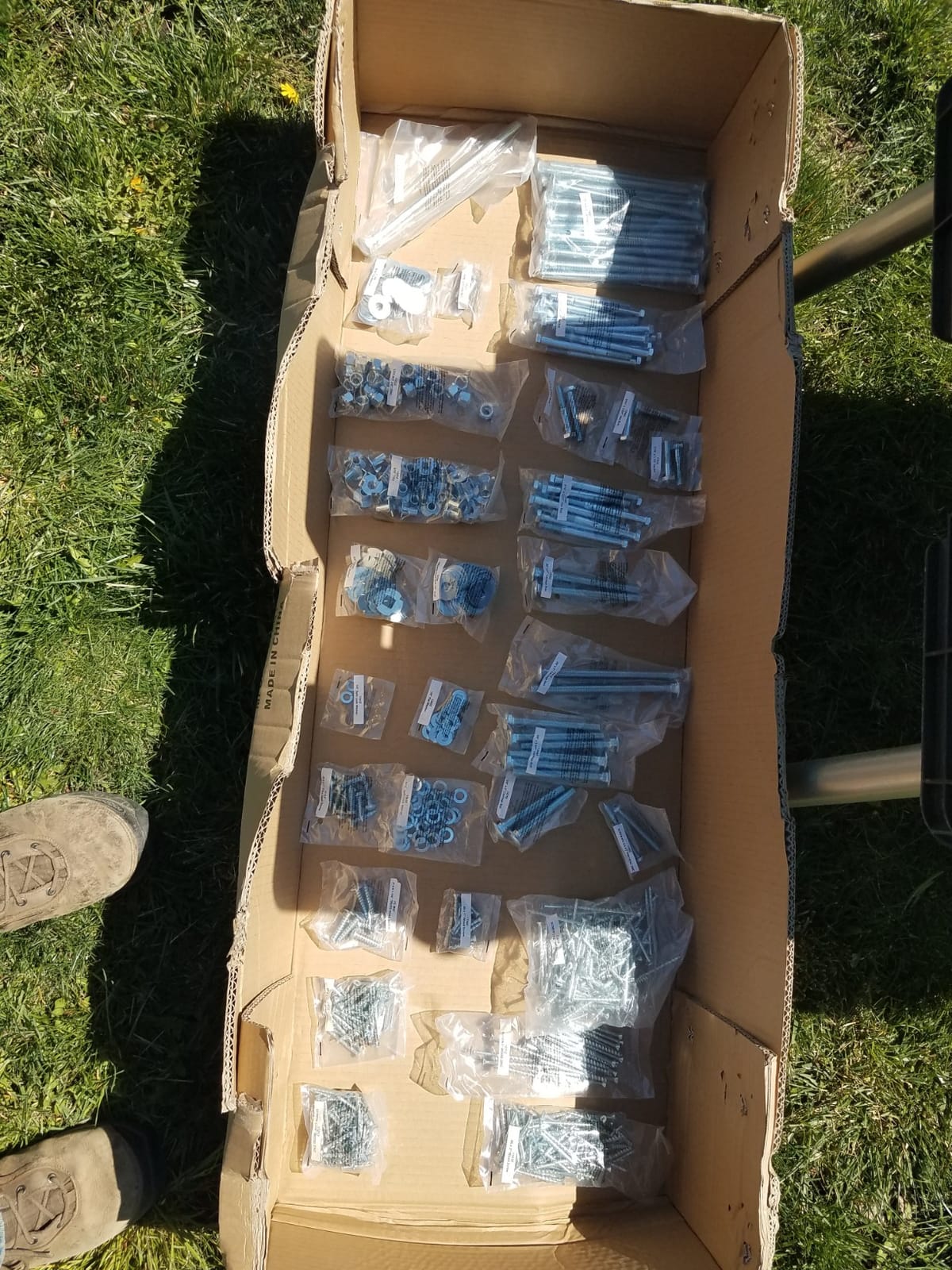
Two specific installation notes. Drive the t-nuts in the specified order, because driving them out of sequence is what splits the rock wall rungs and boards. And check the hardware inventory against the manual before you begin, since a short shipment mid-build is a two-day delay on a project this size.
What to check before buying the Playmaker Deluxe
Delivery logistics. This is curbside freight, which means the set arrives at the curb and you move it to the yard. At 300 pounds across 142 by 174 inches, that is a real job, so confirm the path from the curb is flat and clear before the day arrives.
Then confirm the slide depth suits your children. Owners note the slide channels are deep and narrow, which is comfortable for a 4 year old and cramped for a 9 year old. If your children are already tall for their age, this is a set they will outgrow from the bottom up.
Who should skip the Playmaker Deluxe
Skip it if climbing is the priority. There is one rock wall serving the whole structure, and it will be occupied by a queue during any busy afternoon. Skip it if your yard is under about 25 feet by 22 feet, since the 174 inch width plus a 6 foot use zone exceeds most suburban lawns.
Skip it if you have two adults who can commit an entire day. Six to eight hours is the honest estimate, and the 300 pound of cedar does not move itself.
10. Backyard Discovery Canyon Creek – Best With a Clubhouse and Play Kitchen
Backyard Discovery Canyon Creek Cedar Wood Swing Set with Wave Slide, Clubhouse, Play Kitchen, Picnic Area, Belt Swings, Web Swing, Rock Wall, Balconies, Playhouse, Step Ladder, Outdoor Playset
Ages 3-10
Cedar
183 D x 188 W x 119 H in
12-hold rock wall
ASTM F1148-22
Pros
- Rock climbing wall with 12 holds and a rope assist
- Clubhouse with two balconies
- steering wheel
- telescope and chalkboard
- Under-deck play kitchen with BBQ grill
- sink and play food
- Shaded picnic table seating
Cons
- 188 x 183 in footprint and 387 lb weight need a big yard
- BILT app assembly is a long multi-stage project
- Cedar requires periodic staining and weather sealing
- Lower rating than other sets in this roundup
Canyon Creek is the set for a household where not everyone wants to climb. The upper clubhouse has two balconies, a wooden roof, a steering wheel, a toy telescope and a chalkboard, and below it sits a full play kitchen with a toy BBQ grill, a sink, play food and a shaded picnic table. For a family with a non-climbing or younger child, that is a lot of value that the pure climbing sets do not offer.
The climbing side is real: a 12 hold rock wall with a rope assist, the same hold count as the Skyfort II. A wide step ladder gives children who cannot climb easy access to the deck, which removes the sibling queue that limits rock walls on most structures at this size.
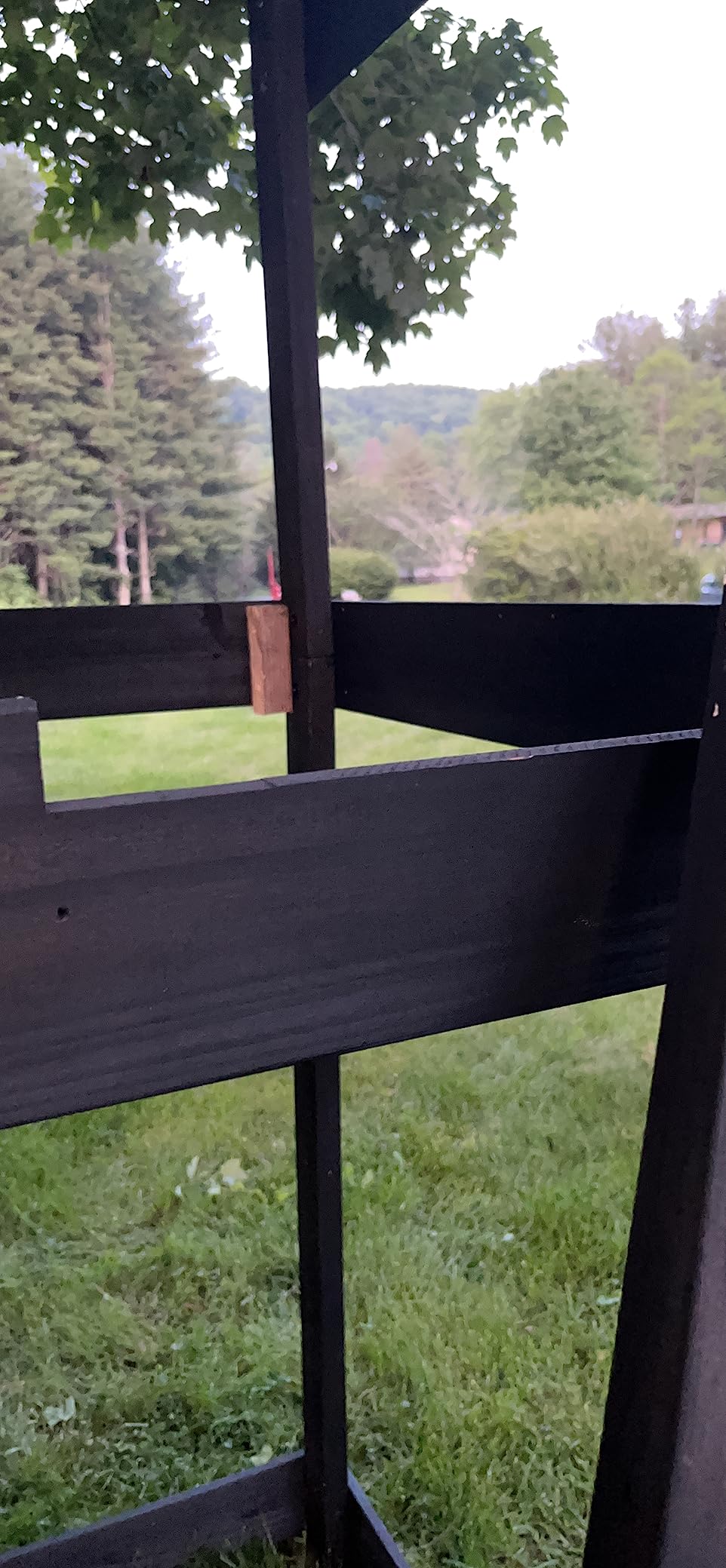
Construction matches the other Backyard Discovery cedar sets: 100 percent cedar, pre-cut, pre-drilled and pre-stained, a 5 year limited warranty, and engineering to meet or exceed ASTM F1148-22 for residential use with play areas for up to 11 children. Those are the same published standards as the Buckley Hill and the Skyfort II, which is a fair consistency signal.
The 4.1 rating across 342 reviews is the lowest here, with 61 percent five-star and 13 percent three-star. Reviewers like the cedar and the play variety, and they repeatedly flag the enormous footprint, the 387 pound weight and the assembly effort. Children are also the most common source of the three-star reviews, since a clubhouse-heavy set tends to disappoint buyers who expected a climbing wall.
Assembly runs through the BILT app and is described as a long multi-stage project at 387 pounds. This is a build for several adults across a full day or more, and the sand in the play kitchen and the picnic area is not part of the package.
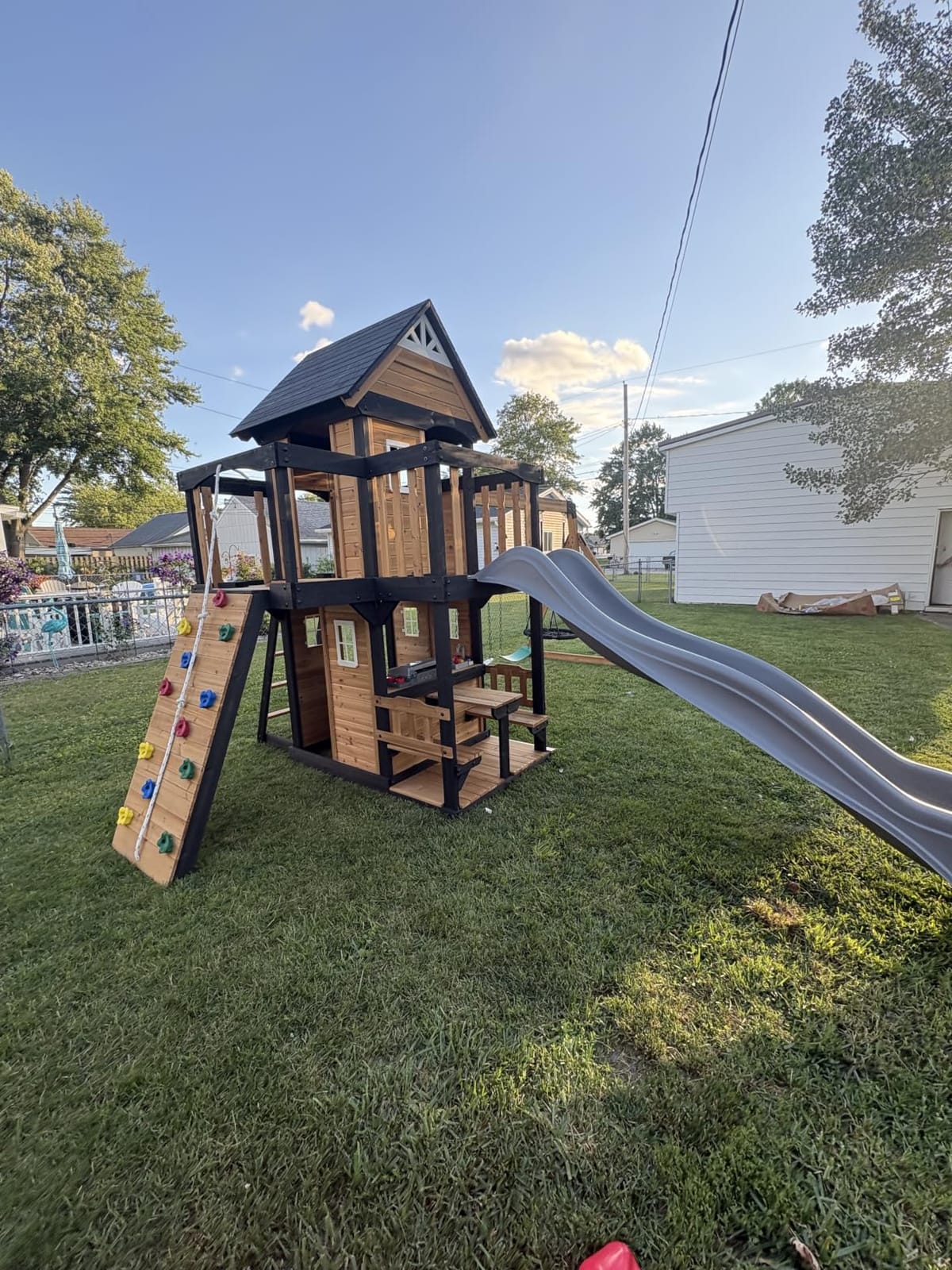
What to check before buying the Canyon Creek
Size, without question. At 188 by 183 inches with a 6 foot use zone, you are looking at roughly 28 feet by 26 feet of clear space. That is a genuinely large yard, and owners who regret this set most often describe having underestimated the use zone rather than the structure.
Second, check whether you have a use for the play kitchen. It is the defining feature of this set and the reason to choose it over the Mount Mckinley, which is otherwise larger on climbing content. If your children have moved past pretend cooking, a different set with a better rock wall serves them better.
Who should skip the Canyon Creek
Skip it if your child is a focused climber. The rock wall is 12 holds with a rope assist, which is good, but a child aged 7 and up will spend more time on the slides, swings and clubhouse. The play kitchen is at its best between ages 3 and 6.
Skip it if your yard is medium sized or if you are assembling alone. At 387 pounds with balconies, a clubhouse and a kitchen, this is the hardest build in the roundup after the Skyfort II.
11. Backyard Discovery Skyfort II – Best for Large Yards and Many Children
Backyard Discovery Skyfort II Cedar Wood Swing Set with Wave Slide, Raised Clubhouse, Crow’s Nest, Monkey Bars, Balcony, Belt Swings, Trapeze, Rock Wall, Picnic Table, Sandbox, Ladder, Outdoor Playset
Ages 3-10
Cedar
201 D x 263 W x 148 H in
12-hold rock wall
ASTM F1148-22
Pros
- Rock climbing wall with 12 holds for real skill building
- Monkey bars
- 6 foot rope ladder and rock wall give multiple challenges
- Crow's nest lookout with a toy telescope
- 10 foot wave slide
- two belt swings and a trapeze
- Play areas for up to 15 kids
Cons
- 263 x 201 in footprint and 710 lb weight need a very large yard
- Most expensive structure in this roundup
- Cedar needs ongoing staining and weather sealing
- Assembly is a multi-day project needing several adults
The Skyfort II is the ceiling of this category, and for a specific family it is the right answer without much debate. A 12 hold rock wall, monkey bars, a 6 foot rope ladder, a 10 foot wave slide, two belt swings and a trapeze give a group of children genuinely different upper-body challenges at the same time, and the published rating is for play areas serving up to 15 kids.
The clubhouse is the differentiator over every other cedar set here. A raised clubhouse with a wooden roof, balcony, covered entryway and bay windows sits above a crow’s nest lookout with a toy telescope. The lower deck is shaded and holds a sandbox, picnic table and bench seating, so younger children are catered for below while older children climb above.
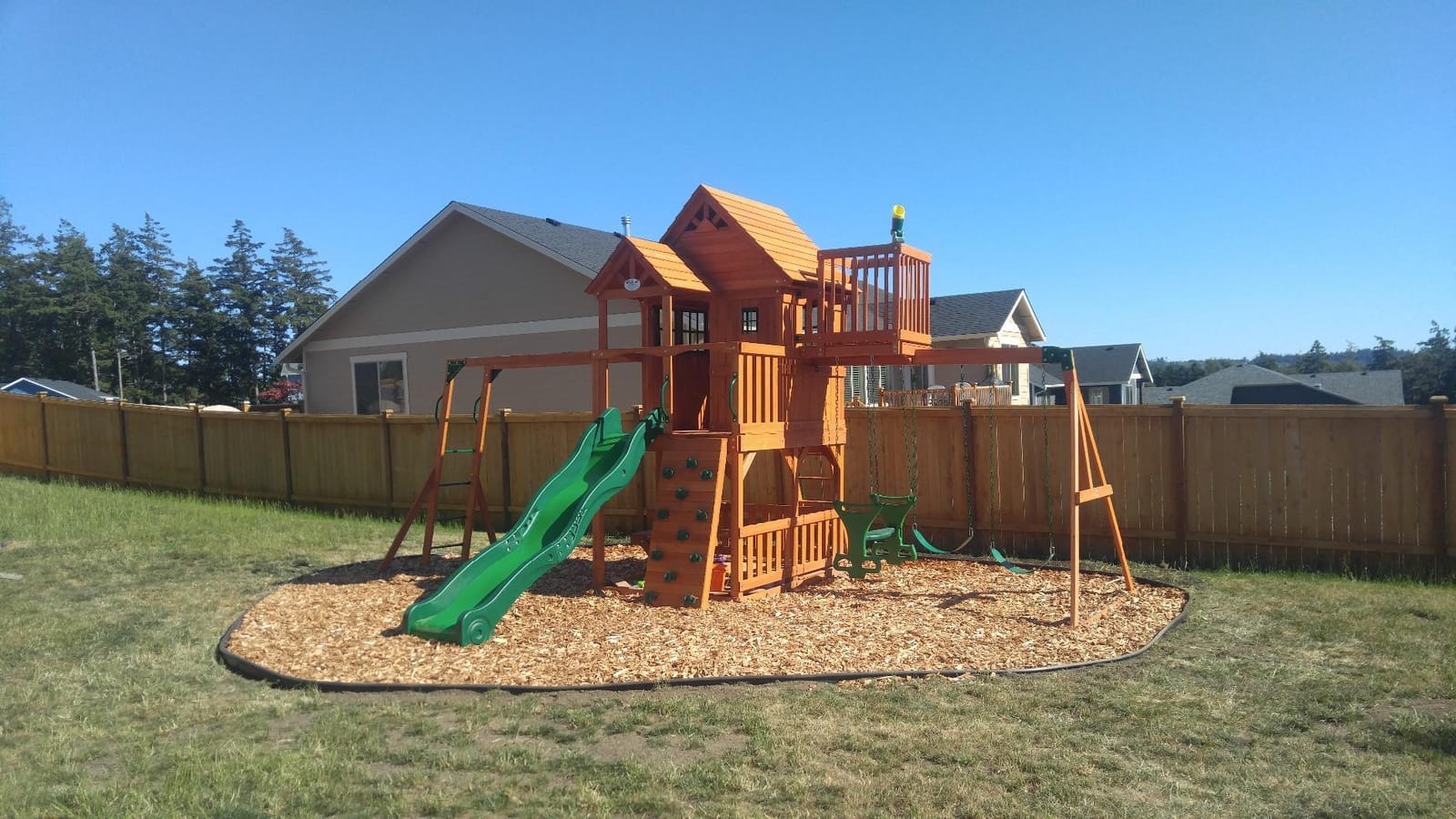
Every material and engineering claim matches the rest of the Backyard Discovery cedar range: 100 percent cedar, pre-cut, pre-drilled and pre-stained, 5 year limited warranty, engineered to meet or exceed ASTM F1148-22 for residential use. The published maximum weight recommendation of 150 pounds is a per-child figure rather than a whole-structure total, and it is worth noting that the structure itself weighs 710 pounds.
The 4.3 rating across 711 reviews is mid-range, with 66 percent five-star. Owners describe it as worth the cost for a family with a large backyard, and describe the footprint, the weight and the assembly as the reasons smaller yards should not attempt it. That consensus is unusually consistent across the review base.
Assembly is the price of admission. At 710 pounds with a clubhouse, crow’s nest, monkey bars and a 10 foot slide, this is a multi-day project needing several adults. Pre-cut lumber removes the measuring stage, but the sheer number of parts is the challenge rather than any single tricky joint.
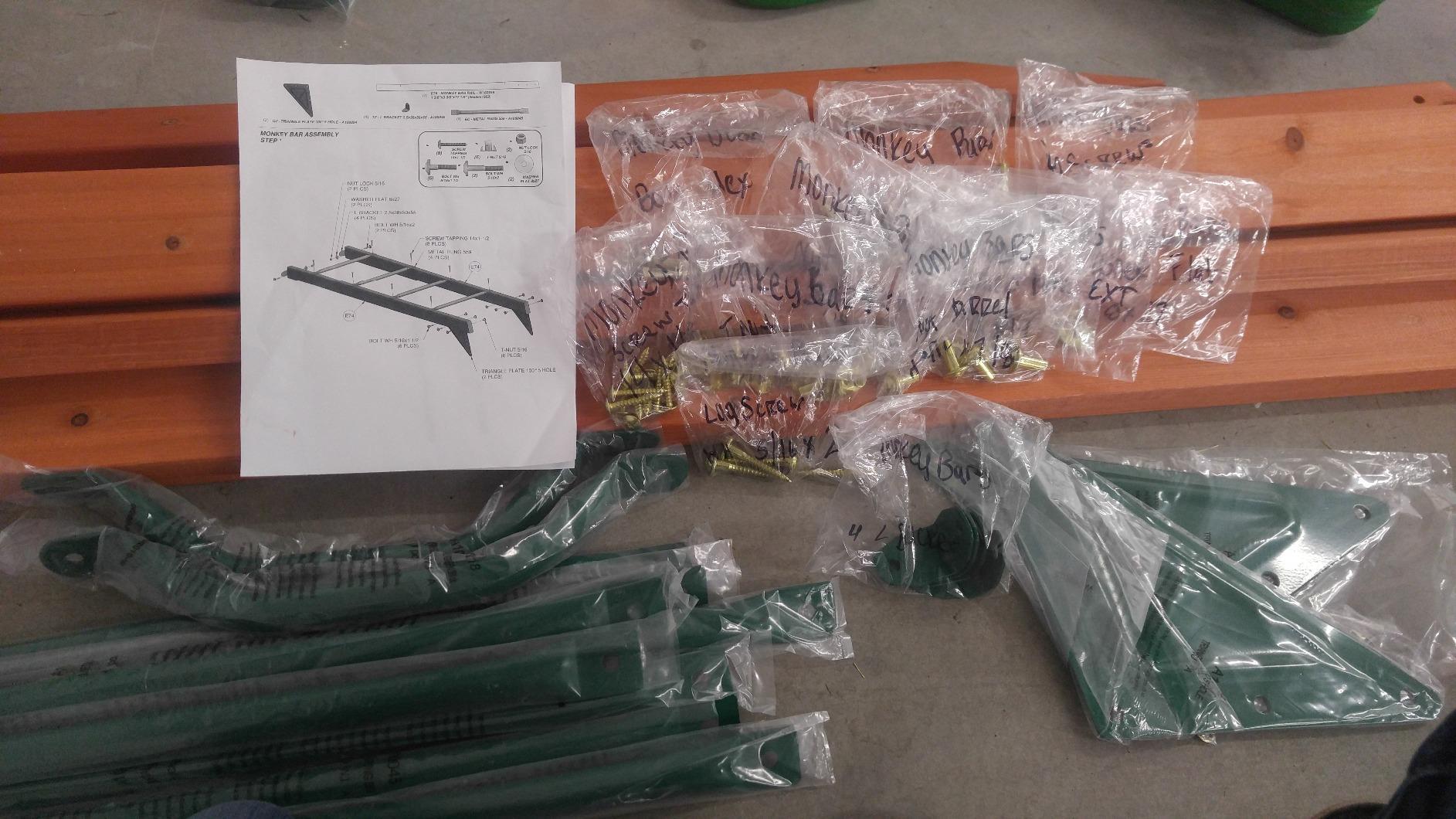
What to check before buying the Skyfort II
Yard size, honestly. At 263 by 201 inches, a 6 foot use zone on all sides means roughly 35 feet by 29 feet. If your usable space is under that, the Mount Mckinley gives you a 12 hold rock wall, monkey bars and a rope ladder in a materially smaller footprint, and most families notice no loss.
Second, check your assembly resources honestly. Several adults across more than one day is not a figure to underestimate. Cedar this heavy cannot be repositioned once it is up, so the build site has to be final before you start.
Who should skip the Skyfort II
Skip it if your yard is anything other than large. This is the most common regret described in the reviews, and it comes from the use zone rather than the structure size. Skip it if you have one or two children, since the capacity is designed for groups and single-child families will get more variety from the Mount Mckinley.
Skip it if you want a low-maintenance structure. Cedar needs sealing, and at this scale the sealing job itself becomes significant once a year.
How to Choose an Outdoor Climbing Wall for Kids
Choose by your child’s reach, not their birthdate. Age labels on this category are extremely generous: a set rated 3-10 is usually outgrown as a climber at 6 or 7, which is the single most repeated complaint in parent discussions. A useful test is whether your child can pull their own chest up to the top rung of a playground bar. If they cannot, a wall above about 4 feet will frustrate them rather than challenge them.
The second decision is format, and the three formats suit different households. A free-standing climber like the Mega Pyramid suits a small yard, a rental or a family that wants to move the equipment indoors. A rock wall playset suits a family that wants one structure to do everything, and it is the only format that provides a route with a top to reach. Hold-and-reroute setups suit families who already have a playset, deck or fence, because they add a climbable surface without adding a footprint.
Material is the third decision, and it is a genuine trade rather than a ranking. Plastic is zero-maintenance and can be hosed down, but it will chalk and degrade after several years of direct sun, and molded grips cannot be replaced once worn smooth. Cedar lasts considerably longer, takes more punishment from adults, and requires annual water sealing to avoid greying and checking. Steel appears in the hardware and swing chains more than in the frames at this price tier, and galvanized or coated steel is the specification to look for in a coastal or humid climate.
Finally, understand what a weight capacity figure actually means. On the cedar sets it usually describes the whole structure across all users, and on the plastic toddler climbers it describes a single child. A 60 pound rating on the Game Time Sports Climber and a 1080 pound rating on the Mount Mckinley are not comparable numbers, and treating them as such leads to overconfidence on a toddler frame.
If you are also working through larger outdoor projects, our guides to tree stands for climbing hunters and tree climbing saddles for arborists cover the equipment side of working at height, though neither is a toy.
What Surface Goes Under a Kids Climbing Wall
Use zone and fall zone are different things, and conflating them is the most common planning error. The use zone is the 6 foot of clear space on all sides of any play structure, and it applies to every product in this roundup regardless of the child’s height. The fall zone extends beyond that in the direction a child could fall, and it is where surfacing matters.
The depth rule is straightforward. For a fall height up to 7 feet, you need 9 inches of appropriate surfacing material. Below 7 feet, a 6 inch depth is the common recommendation, and it applies directly to the plastic climbers in the first half of this list, where the tallest platform is 42.5 inches.
Material options differ more than buyers expect. Engineered wood fiber and rubber mulch are the two most common loose-fill choices and both pour to depth easily. Poured rubber gives the longest service life and the best fall attenuation but requires professional installation. Sand and pea gravel work but are not recommended where they can migrate onto adjacent lawn. Whatever you choose, the depth needs refreshing roughly once a year as it compacts, which is the maintenance step most owners skip.
On lawn alone, a fall from the 6.5 foot Skyward Summit onto turf is the single highest-consequence outcome in this roundup. If you are not installing proper surfacing, keep the fall height of the climbing surface below the level of the child’s head when they are standing, which is a workable compromise for many families.
How to Anchor and Install an Outdoor Climbing Wall
Mark the use zone before the unit arrives. Run a garden hose around the planned footprint plus 6 feet on every side, then look at what you have marked with fresh eyes. This is the step that separates a good purchase from an expensive one that never gets used because it crowds the rest of the yard.
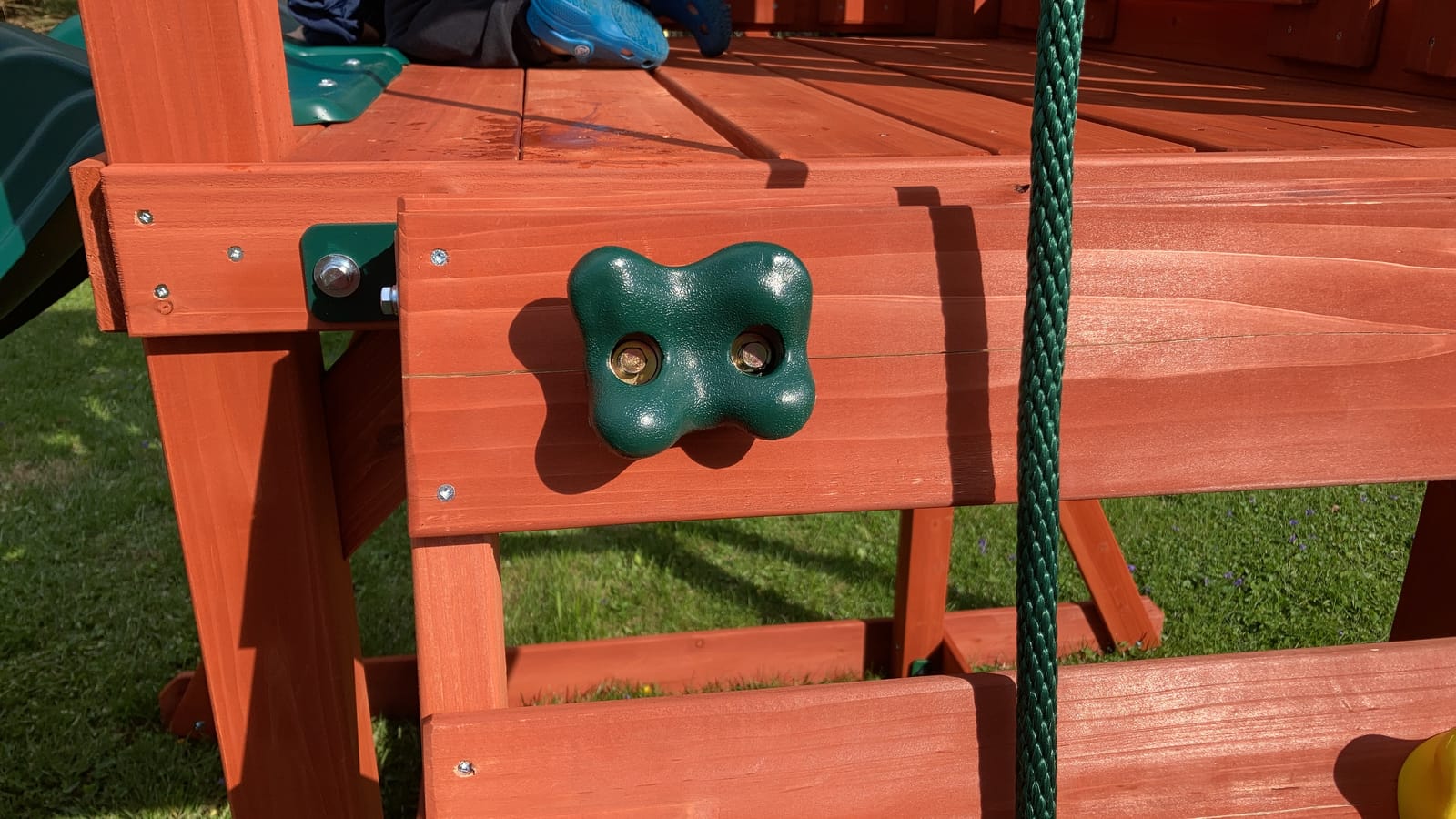
Next, build a climbing wall yourself if you want a route that grows. The method is straightforward: fix vertical plywood or cedar boards to existing framing or a fence, drill holes through the board and the lumber behind it, and bolt molded climbing holds through from the back using T-nuts sized to the board thickness. A parent-built wall costs less than any retail structure, and individual holds and bolts can be replaced forever rather than replacing the whole unit.
For retail structures, the sequence is: level the ground, position the unit, anchor it at every point the manufacturer specifies, install surfacing to the required depth, and then recheck every fastener after the first month of use. Anchoring matters most on plastic sets, where the step and slide surfaces can shift on smooth or packed ground if the frame is not fixed down.
Finally, schedule an annual fastener check. Owners report that a tight frame stays tight indefinitely when bolts are inspected once a year, and that the failures we hear about are always the ones nobody looked at. For cedar sets, add an annual water-sealing pass in the same visit.
How Outdoor Climbing Walls Handle Sun, Rain and Winter
UV exposure is the factor that decides how long a plastic climber looks new. Double-walled plastic resists chipping, fading, cracking and peeling far better than single-wall, and owners of the Game Time Sports Climber and the Simplay3 report multiple seasons outdoors with hose-down cleaning only. The same reports note that plastic surfaces chalk and degrade after several years of direct sun, so expect a change in surface sheen rather than in structural integrity.
Cold winters are harder on plastic than most buyers expect. Repeated freeze-thaw cycles can stress joints and molded fittings, and the reports we see cluster around plastic climbers left outdoors through several winters rather than one. If you live somewhere with harsh winters, storing a plastic unit in a garage between seasons extends its life, and the lighter units here are the ones worth moving.
Rust is a hardware problem, not a frame problem. In humid or coastal climates, zinc-plated bolts and T-nuts are the first thing to corrode, and the fix is straightforward: replace them with stainless steel hardware of the same size, and check the joints twice a year. Cedar sets need the same attention for rot at the joints where water collects, which is the argument for the annual sealing pass mentioned above.
One durable practice is worth copying from owners who keep equipment longest: hose everything down and let it dry in the sun at the end of the play season, then inspect fasteners while you are there. It takes an hour and it is the difference between equipment that looks good in year six and equipment that does not.
Frequently Asked Questions
What is the best outdoor climber for toddlers?
For ages 2-6, the Step2 Game Time Sports Climber is the strongest all-round choice: a 4.7 rating across 4059 reviews, a basketball hoop, soccer goals, slide and sure-grip rails in a 24.5 pound frame that one adult can move. For children under 3, the Little Tikes Hide and Seek Climber and Swing adds a three-point safety belt. Both are plastic, which means no annual sealing and a hose-down clean.
How to build a climbing wall for kids outside?
Fix vertical plywood or cedar boards to existing framing or a fence, then bolt molded climbing holds through from the back. Drill through the board and the lumber behind it, use T-nuts sized to the board thickness, and space holds so a child’s reach is never more than they can manage. Add a rope assist at the top for younger climbers, and cover the ground beneath the fall zone with 9 inches of surfacing material for walls up to 7 feet tall.
How high should a 7 year old climb on a fun wall?
A 7 year old can usually handle a wall up to about 8 to 10 feet, provided holds are sized for their hands and spaced within their reach. The Step2 Skyward Summit, with a 6.5 foot four-sided wall and 100 square feet of climbing area, suits ages 4 to 8 well. Cedar sets with a 12 hold rock wall and rope assist, such as the Mount Mckinley, stretch to age 10. Above 10 feet, move to a supervised indoor climbing gym.
What are some good wall climbing rocks for kids?
Molded plastic and rubber holds in mixed sizes work best for children, and the sets on this list pair standard grips with junior grips sized for smaller hands, which is what makes a wall usable for ages 4 and up. Key criteria are a textured grip surface, a two-bolt fixing point and hardware long enough to pass through your board thickness with a T-nut behind it. Hold counts scale with wall size: around 9 for a 6.5 foot wall, 12 for full cedar playset rock walls.
How much space does a backyard climbing wall need?
Every structure needs a 6 foot use zone on all sides, plus extra fall run-out in the direction a child can fall. In practice, a small plastic climber such as the Game Time Sports Climber at 62 by 30.5 inches needs roughly a 14 by 10 foot area. The Backyard Discovery Skyfort II at 263 by 201 inches needs close to 35 by 29 feet once the use zone is added. Mark the area with a garden hose before ordering.
The Best Outdoor Climbing Wall for Your Family
For most families, the best outdoor climbing walls for kids in 2026 come down to three picks. The Step2 Game Time Sports Climber is the best overall: the highest rating here with 4059 reviews behind it, a hose-down clean, and a combination of slide, hoop and climbing rails that keeps one child busy for an hour. The Eezy Peezy Mega Pyramid is the best value and the only structure one adult can move between the yard, the garage and indoors. The Step2 Woodland Climber II is the best choice when two toddlers need to climb at the same time.
Move up a tier only when your child is ready for it. The Step2 Skyward Summit at 6.5 feet is the dedicated climbing wall, and the Backyard Discovery Mount Mckinley is the first cedar set whose 9 hold double rock wall and rope ladder an older child can genuinely work. Whatever you choose, mark the 6 foot use zone with a hose before the unit arrives, and check the fasteners again in a month.