
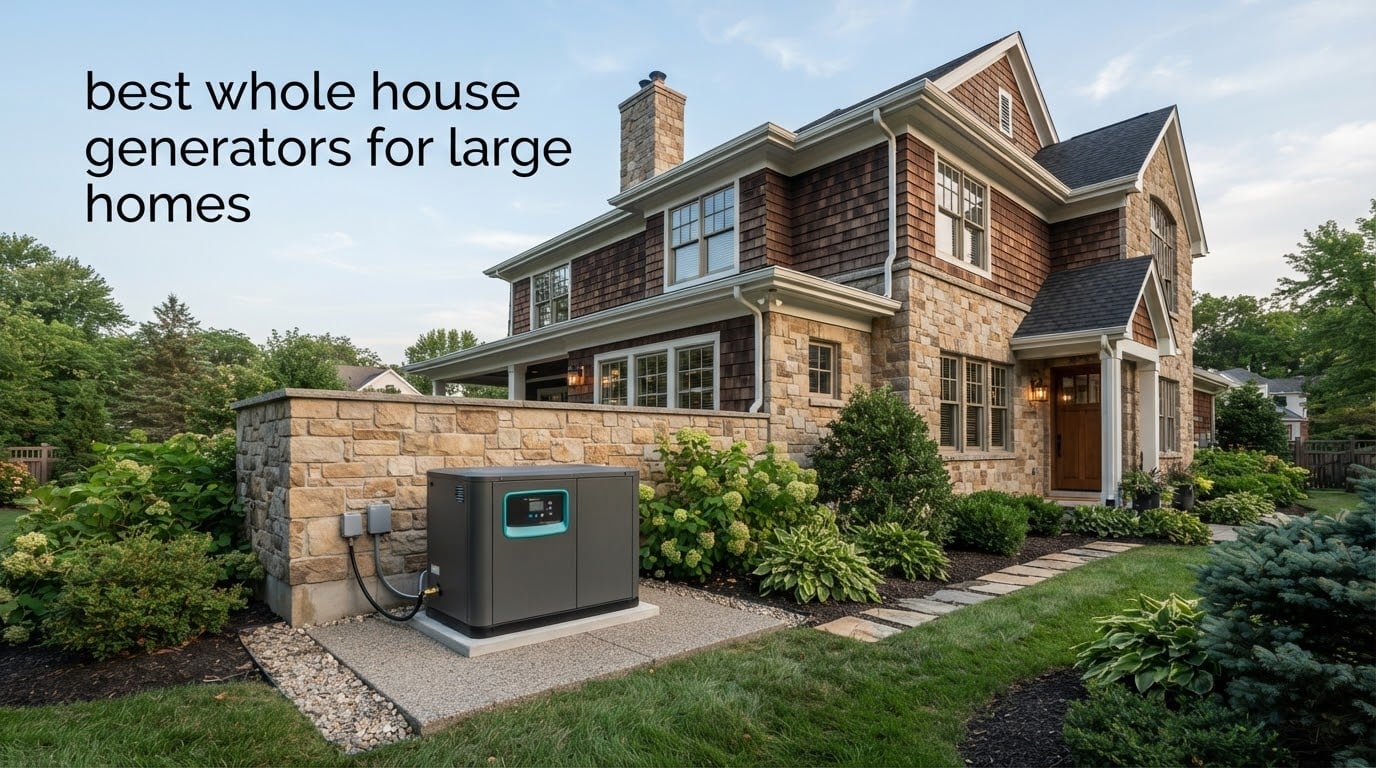
If your home runs past 3,500 square feet, the generator advice on most buying pages stops helping you. Those guides hand you a 22 or 24 kilowatt standby unit and call it whole-home coverage, which is fine for a 2,500 square-foot ranch with a single central air unit and nothing else exciting on the panel.
A large home is a different electrical animal. You are likely running two or three HVAC zones, a 4-ton or 5-ton compressor with a punishing locked-rotor start, two water heaters, a well pump, a sump pump, maybe an EV charger on a 60-amp circuit. Add an all-electric heat pump or resistance heat and your panel can pull 85 to 95 amps of continuous load on a 200A service, and you are into 400A service territory with two 200A main breakers.
That is the gap this roundup fills. We compared the best whole house generators for large homes currently on the market, from dual-fuel portables that can be carried to the crawlspace through a window to one permanently installed standby unit that is genuinely sized for a 4,000-plus square-foot house. Ten models, every one checked against its own specification sheet and owner feedback rather than against a marketing claim.
Nobody bench-tests a 518-pound standby generator, so this is not a lab report. It is a specification-driven comparison built the way we would build one for ourselves: match real capacity to a real load list, look hard at the transfer switch rating, and treat the local dealer network as part of the purchase.
While you are here, it is worth pairing this guide with our whole-house surge protector picks, since a large home is exactly where a single upstream event takes out several rooms of electronics at once.
Table of Contents
Top 3 Best Whole House Generators For Large Homes (October 2026)

DuroMax XP13000EH Dual Fuel
- 10500 running watts
- 13000 starting watts
- Gasoline and propane
- Transfer switch-ready 50A outlet
- Electric start with hour meter

Westinghouse WGen11500DFc
- 11500 running watts on gasoline
- 14500 peak watts
- THD under 3 percent
- 19 hour runtime
- Remote start with key FOB
Champion 16875W Tri Fuel
- 13500 running watts
- 16875 starting watts
- 739cc V-Twin engine
- 25 ft natural gas hose included
- 79 dBA at 23 feet
Best Whole House Generators for Large Homes at a Glance (October 2026)
| Product | Specifications | Action |
|---|---|---|
| DuroMax XP13000EH Dual Fuel Portable |
|
Check Latest Price |
 Generac Guardian 26kW Standby Generac Guardian 26kW Standby |
|
Check Latest Price |
 Kohler 20RESCL-200SELS Standby Kohler 20RESCL-200SELS Standby |
|
Check Latest Price |
 GENMAX GM15000ET Tri Fuel GENMAX GM15000ET Tri Fuel |
|
Check Latest Price |
 DuroStar DS13000MXT Tri Fuel DuroStar DS13000MXT Tri Fuel |
|
Check Latest Price |
| Champion 16875-Watt Tri Fuel |
|
Check Latest Price |
 DuroMax XP15000HXT Tri Fuel DuroMax XP15000HXT Tri Fuel |
|
Check Latest Price |
| Westinghouse WGen11500DFc |
|
Check Latest Price |
 Champion 15000-Watt Tri Fuel Champion 15000-Watt Tri Fuel |
|
Check Latest Price |
 WEN TF1300iX Tri Fuel Inverter WEN TF1300iX Tri Fuel Inverter |
|
Check Latest Price |
A word on what this grid does and does not tell you. Only one model in the set, the Generac Guardian 26kW, is a permanently installed standby unit. Everything else is a portable or semi-portable engine you own, fuel and maintain yourself, and wire to your panel through a transfer switch. That distinction matters more at 4,000 square feet than at 2,000, because the big loads you need to cover are exactly the ones you cannot drag out of a garage at 2am in a storm.
What Size Generator Do You Need to Run a Whole House?
For a large home, most buyers need somewhere between 14kW and 26kW, and the deciding variable is not square footage. It is whether your house has electric heat, more than one compressor, and a modern high-draw appliance list.
Here is the working breakdown we use, roughly in order of how the decision actually gets made:
Up to 2,500 sq ft, gas heat and appliances — a 10kW to 12kW air-cooled standby covers essentials. Outage-prone areas only.
2,500 to 3,500 sq ft, one HVAC zone — 14kW to 18kW. A 20kW air-cooled unit is the common ceiling here.
3,500 to 4,000 sq ft, two HVAC zones — 20kW to 22kW air-cooled, with a load-shedding transfer switch protecting the smaller unit.
4,000 sq ft, two zones plus well and sump pumps — a 26kW standby, or a tri-fuel portable with a soft-start compressor kit doing targeted duty.
5,000 sq ft, three zones or a 5-ton compressor — 26kW to 36kW, liquid-cooled, with a service-entrance rated switch.
6,000 sq ft and up, all-electric or with EV charging — 36kW to 48kW, often a commercial-frame unit or a single generator feeding two separate transfer switches.
Now the arithmetic, because almost nobody shows it. Take a 4,200 square-foot home, all-electric with gas cooking, two 4-ton air handlers, one 3-ton compressor, two 50-gallon water heaters, a well pump, a sump pump, a home office with a desktop and network gear, and a refrigerator and freezer.
Running loads: two 4-ton air handlers at roughly 1,200 watts each is 2,400W. The 3-ton compressor is about 2,200W running, and its locked-rotor start can pull six to eight times that for a couple of seconds. Water heaters contribute 3,800W each once both are hot. Pumps add 600W to 1,000W combined. The office and network gear sit near 800W. Refrigeration, lighting and small circuits add another 1,500W.
That is roughly 13,700W of steady running load before the compressor ever starts. Add the compressor surge, add 25 to 30 percent headroom for motor start and future additions, and you land in the 18kW to 22kW band at minimum. If you add an EV charger at 40 amps, resistance heat, or a second 5-ton compressor, you are at 26kW and climbing, and an air-cooled unit at that output stops being the sensible buy.
This is where soft-start compressor kits earn their cost. Owners on the r/generator forums repeatedly report fitting a soft starter to a 5-ton compressor and successfully running it off a much smaller generator, because the kit spreads the inrush over several seconds instead of slamming the engine with it. We have not measured that ourselves, but it is consistent enough across independent accounts to be worth asking your installer about before you step up a size.
The 4,000 square-foot tier in the list above is the one most published guides never reach. They stop at 22kW, hand a large homeowner a portable and call it coverage. If your load list comes out above 20kW, the configuration the arithmetic points at is the installed 26kW unit, not another portable.
If moisture control matters as much as power in your home, our whole-house dehumidifier guide for large homes covers the equipment that keeps humidity in check when the power does return.
1. DuroMax XP13000EH 13,000-Watt Dual Fuel – The Most Reviewed Portable in the Set
DuroMax XP13000EH 13,000-Watt Dual Fuel Portable Generator – Gas & Propane, Electric Start, Whole Home Backup Power, Transfer Switch Ready, RV & Emergency Ready
Running: 10500W
Start: 13000W
Gasoline or propane
50A transfer switch-ready
Pros
- 3991 owner reviews to draw on
- 10500 running watts handles two HVAC units
- Push-button electric start with recoil backup
- All-metal frame and power panel
- Switches fuel in seconds
Cons
- Louder than expected for the class
- Arrives with no engine oil
- Manual has the choke diagram reversed
- Some reports of excess oil consumption
The XP13000EH is the unit we keep coming back to, and the reason is simple: at nearly 4,000 owner reviews it carries by far the deepest body of real-world feedback in this category. When something breaks on a lesser-known engine, you find out from strangers. When something works, you find out from thousands of people at once.
In use, owners routinely report running two HVAC units, refrigerators, a freezer, microwaves and network gear through a 50-amp transfer switch without drama. The 500cc four-stroke engine, 100 percent copper windings and all-metal frame and power panel are a solid build for a machine that gets wheeled around a garage floor.
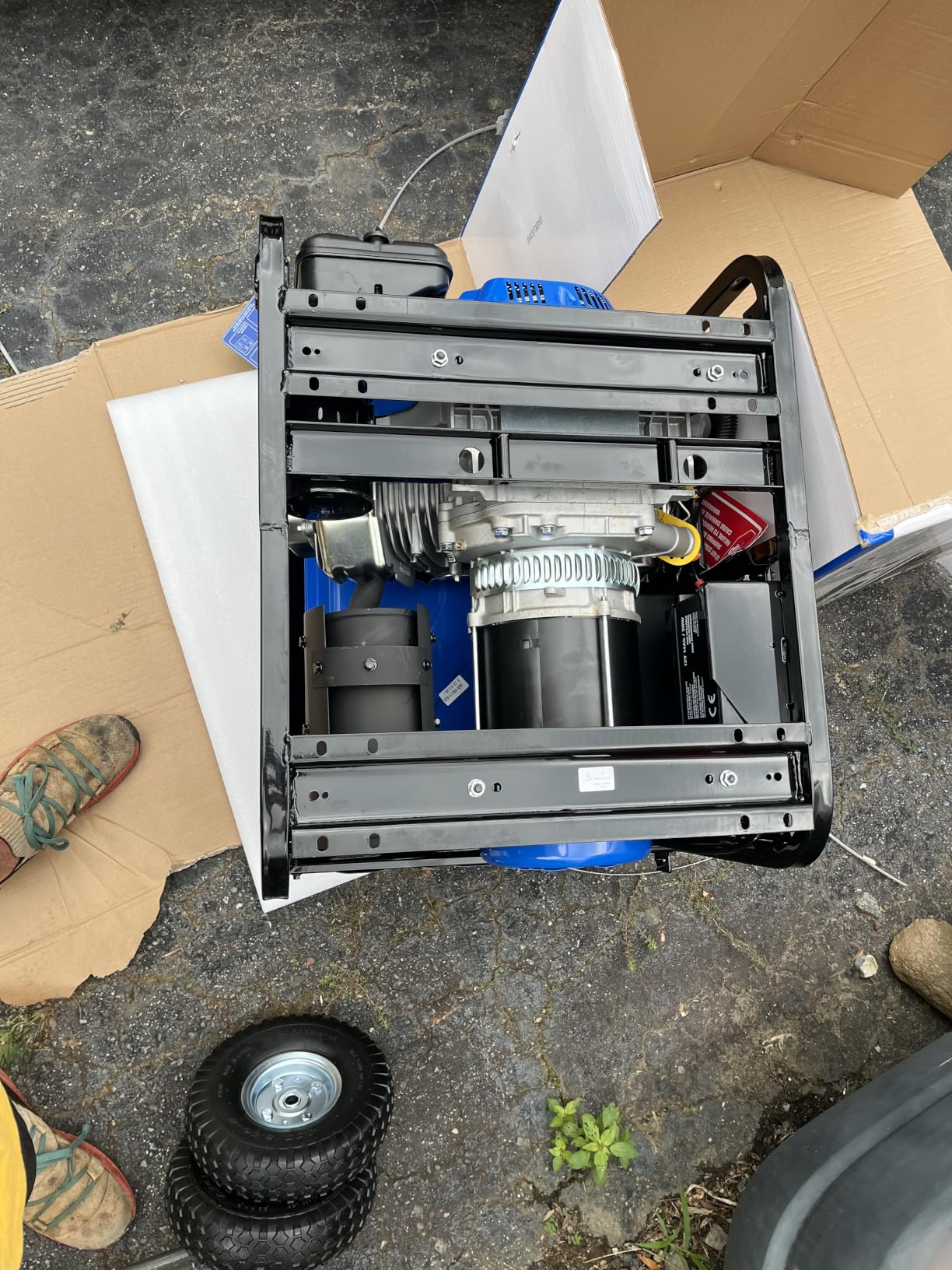
The honest caveat is that this is a portable, not a standby. You own the refuelling, you remember the fuel selector, and you do the weekly exercise yourself unless you pair it with an automatic start-stop accessory. Gasoline also goes stale, so the fuel rotation discipline falls on you.
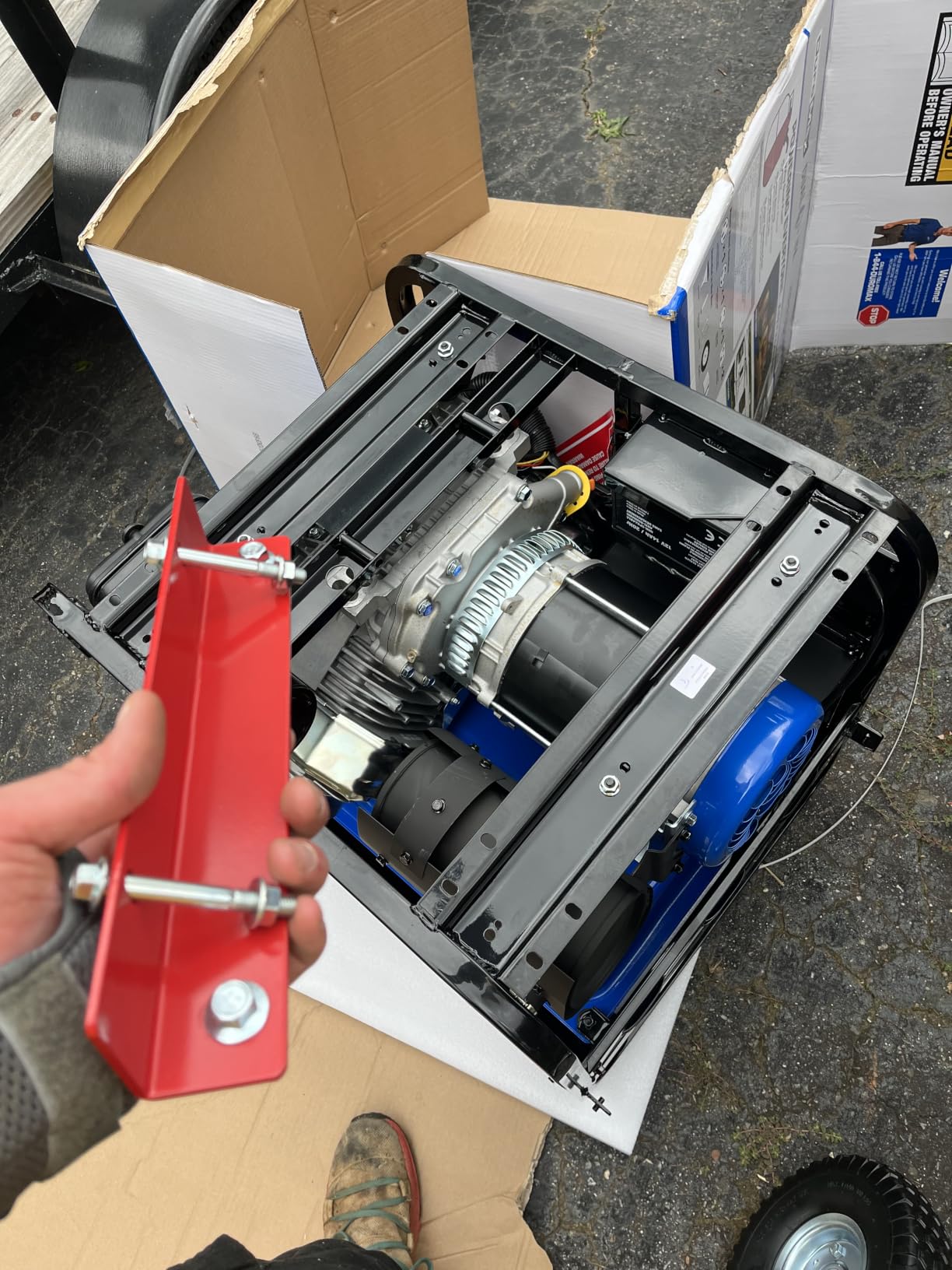
Two documentation irritants come up repeatedly and are worth knowing before day one. The unit arrives with no engine oil, and the manual’s choke diagram is printed reversed, so first-time owners following it literally can struggle to start the engine. Neither is a defect, but both cost an afternoon.
What it handles well on a large-home load?
At 10,500 running watts, this is not enough to carry a 4,000 square-foot all-electric home through a compressor start and a water heater bank at the same time. It is enough to carry the essentials: one compressor with a soft starter, one water heater, refrigeration, lighting and the office circuit.
The transfer switch-ready 50-amp outlet is the feature that separates it from a tailgate generator. Wire that outlet to a manual transfer switch and it becomes a legitimate partial-whole-home system for a fraction of an installed standby.
Where it falls short?
Total harmonic distortion runs higher than the premium brands, which is a consideration if you are running sensitive audio or networking equipment. Some owners also report elevated oil consumption or premature engine failure inside the warranty period, which is exactly the category of complaint that shows up more often in high-volume listings than low-volume ones.
Open-frame noise is the practical limit for some households. If a generator audible from the bedroom disqualifies a setup for you, look at an enclosed or inverter model instead.
2. Generac Guardian 26kW – The Only Permanently Installed Standby in This Group
Generac Guardian 26kW Home Generator, Transfer Switch & WiFi Monitoring
Running: 26000W
Natural gas or LP
200A ATS included
Under 5 percent THD
Pros
- Genuine 26kW whole-house capacity
- Under 5 percent harmonic distortion
- 200A aluminum-enclosed transfer switch included
- Wi-Fi Mobile Link monitoring
- Fully enclosed G-Force engine
Cons
- Professional installation required
- Service and reliability draw a real share of one-star reviews
- 518 pounds complicates placement
Everything else in this roundup is a machine you carry. This one is a machine that stays put, which is the entire point at this house size. A 26kW output with a bundled 200-amp transfer switch is the configuration that lets a large home run its compressors, water heaters and most lighting simultaneously without an installer having to hold their nose.
Power quality is the quiet strength. Generac’s True Power Technology is rated under 5 percent harmonic distortion, which is the number that matters when a home office, a home theatre and a networked thermostat all sit on the same bus.
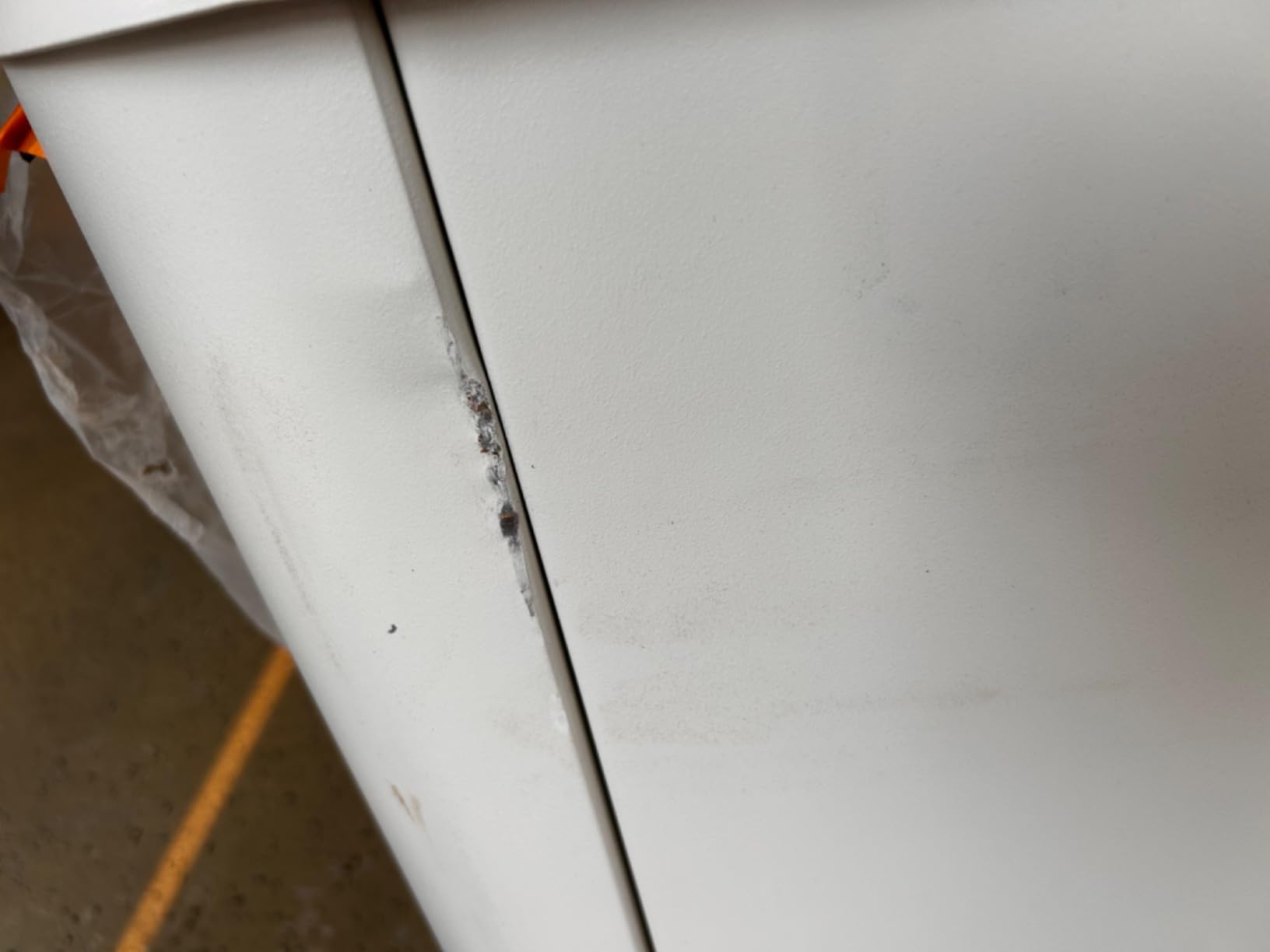
The generator runs on natural gas or liquid propane, so a piped-gas home never touches the fuel logistics that dominate portable ownership. The Mobile Link Wi-Fi module reports runtime and maintenance alerts to a phone, which removes the single most common failure mode in standby ownership: a unit that has not been exercised because nobody noticed it had a fault code.
At 518 pounds and 48.5 inches long, this is not a one-person job, and the placement conversation with your installer should start early because the pad, the setback and the fuel line all constrain where it can go.
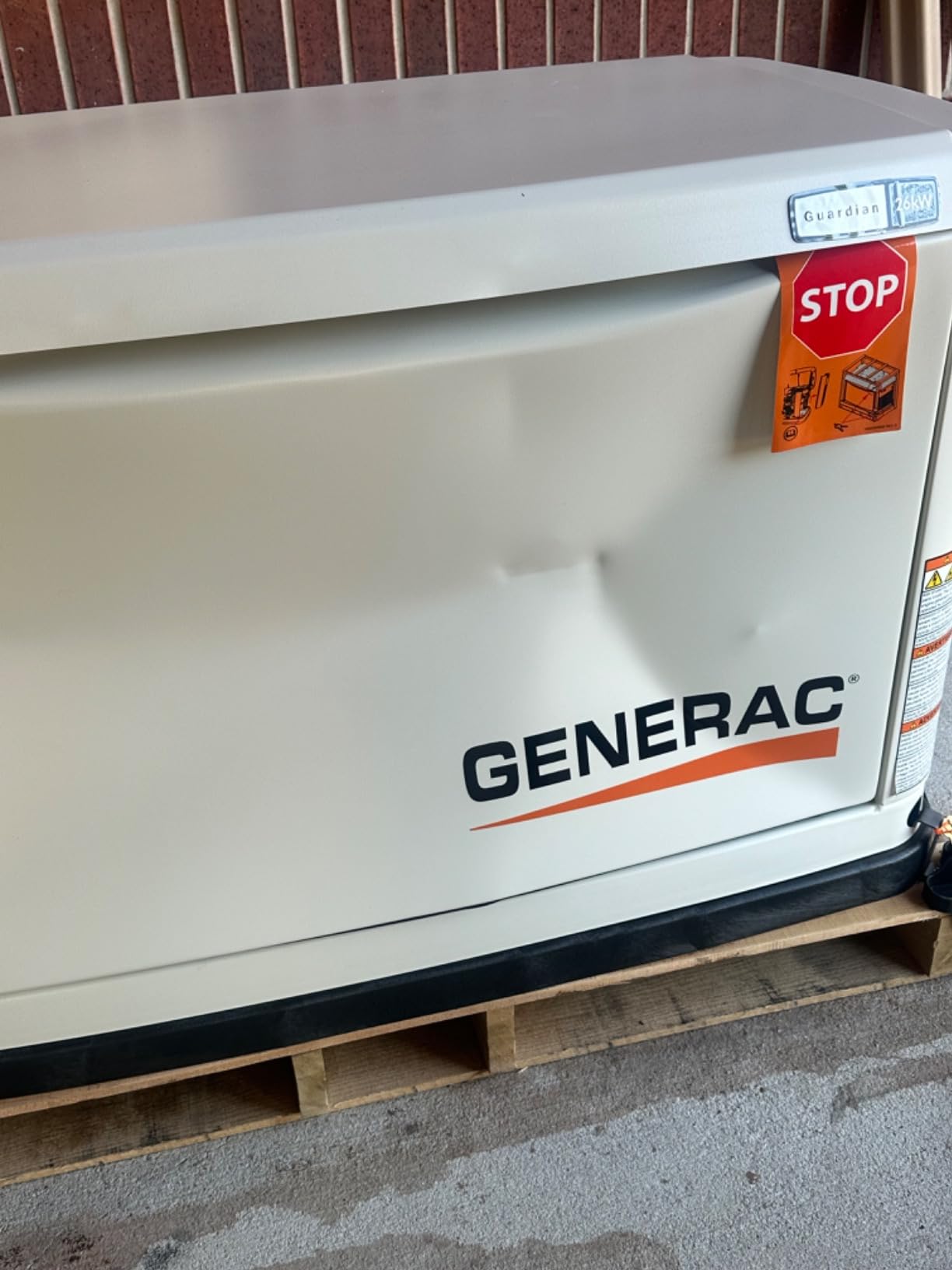
Why it earns a spot in a large-home roundup?
This is the capacity tier that most published sizing charts for this topic never reach. Published guides commonly stop at 24kW, then hand a 4,000 square-foot homeowner a portable and call it a day. If your load list comes out above 20kW, this is the configuration the arithmetic is pointing at.
The bundled 200-amp service-entrance transfer switch also shortens the install, and on a 400A service panel split across two 200A breakers you can run two of these instead of hunting for a 600A switch.
Where it falls short?
The review data on this specific listing is thin at 58 ratings, and roughly 13 percent of them are one-star with service and reliability doing most of the damage. Buyers in rural areas report the nearest qualified technician being a long drive away, and that is a structural problem with any brand, not a defect in this unit.
Professional installation is non-negotiable here, and it is the single largest cost line in any whole-home generator purchase. Budget for it as a certainty rather than an option.
3. Kohler 20RESCL-200SELS – Service Entrance Rated with Built-In Load Shedding
Kohler 20RESCL-200SELS 20, 000W Air-Cooled Standby Generator with 200 Amp Whole-House, Service Entrance Rated, Load Shedding Automatic Transfer Switch
20000 watts
200A service entrance ATS
Load shedding
Natural gas or propane
Pros
- Restores power in roughly 10 seconds
- Load shedding switch protects an undersized system
- Corrosion-proof enclosure for coastal sites
- Quiet operation with premium power quality
- 5-year and 2000-hour warranty
Cons
- Install and commissioning can approach the unit cost
- Controller tuning needs a technician or laptop
- Some engines idle rough out of the box
- Warranty clock can start at the factory date
Kohler’s 20kW sits right at the boundary between an air-cooled unit for a big house and a liquid-cooled unit for a very big one. The included transfer switch is the reason we put it in this roundup: it is service entrance rated, meaning it goes ahead of your main panel and can backfeed the whole house rather than a selected circuit or two.
Load shedding is the under-discussed feature here. The switch monitors the generator’s output and deliberately drops lower-priority circuits when the load climbs too high, which turns a too-small generator into a manageable system instead of one that shuts down mid-shower. Owners of the 22 and 24kW air-cooled models frequently need two or three add-on load-shed modules, so having it in the standard switch is genuinely useful.
The 100 percent corrosion-proof enclosure is not a marketing flourish. If your home is within a few miles of salt water, an enclosure that resists corrosion is the difference between a ten-year asset and a rust problem, and that is a real differentiator for coastal buyers.
Restoration of power in roughly 10 seconds is the number that matters for a home with medical equipment or a server closet, and it is a genuine differentiator against any portable system with a manual start sequence.
What it handles well in a large home?
Comfortably covers a 3,500 to 4,000 square-foot home with two HVAC zones, assuming gas appliances and no resistance heat. The load-shedding switch protects the appliance circuits first, which is the correct priority order when the compressor and the well pump both demand power.
If your panel is 200A, this is the right size. If your panel is 400A, you will want to talk to your electrician about two of these on separate switches or a step up to the liquid-cooled band.
Where it falls short?
Reports of rough idling or engine hunting out of the box are common enough that commissioning matters. Several buyers found they needed a technician to set the exercise interval and duration on the controller, which is another argument for buying from a dealer who will do the startup.
One detail worth checking before you buy: some owners report that self-registering the unit started the warranty clock from the factory date rather than the install date. Register through your dealer so the coverage window is unambiguous.
4. GENMAX GM15000ET – The Biggest Fuel Tank in the 11,000-Watt Class
GENMAX 15000W Tri-Fuel Portable Generator – 2025 Model with ATS, CO Sensor, Digital Display & 50A Output Perfect for Home Backup, Construction Sites & Emergency Power (GM15000ET)
Running: 11000W
Peak: 15000W
Tri fuel
10.56 gallon tank
Pros
- 11000 running and 15000 peak watts
- Tri-fuel on gasoline
- propane and natural gas
- One-button
- remote and recoil start
- Digital panel with load monitoring
- CO sensor with automatic shutdown
Cons
- One-star share is heavy for a 4.2 average
- Early reliability complaints more common than leaders
- CO cutoff can interrupt runs in enclosed spots
The GENMAX takes a different approach from the rest: rather than maximizing watts, it maximizes the number of ways you can start it and the amount of fuel it carries. One-button start, remote control and recoil start all in the box, and a 10.56 gallon tank, the largest in the 11,000-watt running class in this roundup.
The two-wire automatic start and stop cable is an unusual detail. It is designed for charging solar batteries and for installations where the generator needs to respond to a signal rather than a person, which makes it useful in a hunting cabin or a remote job site as well as at a house.
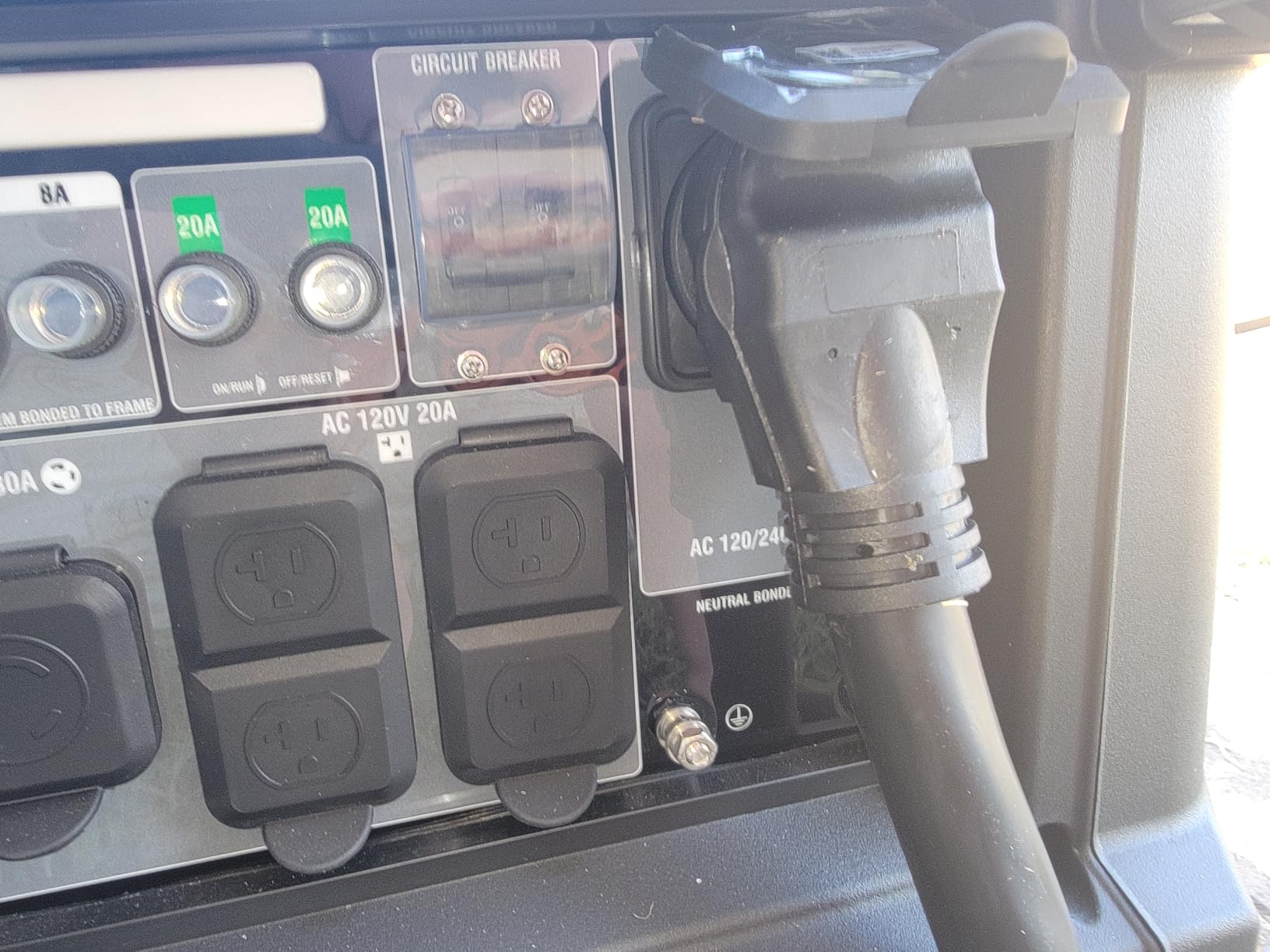
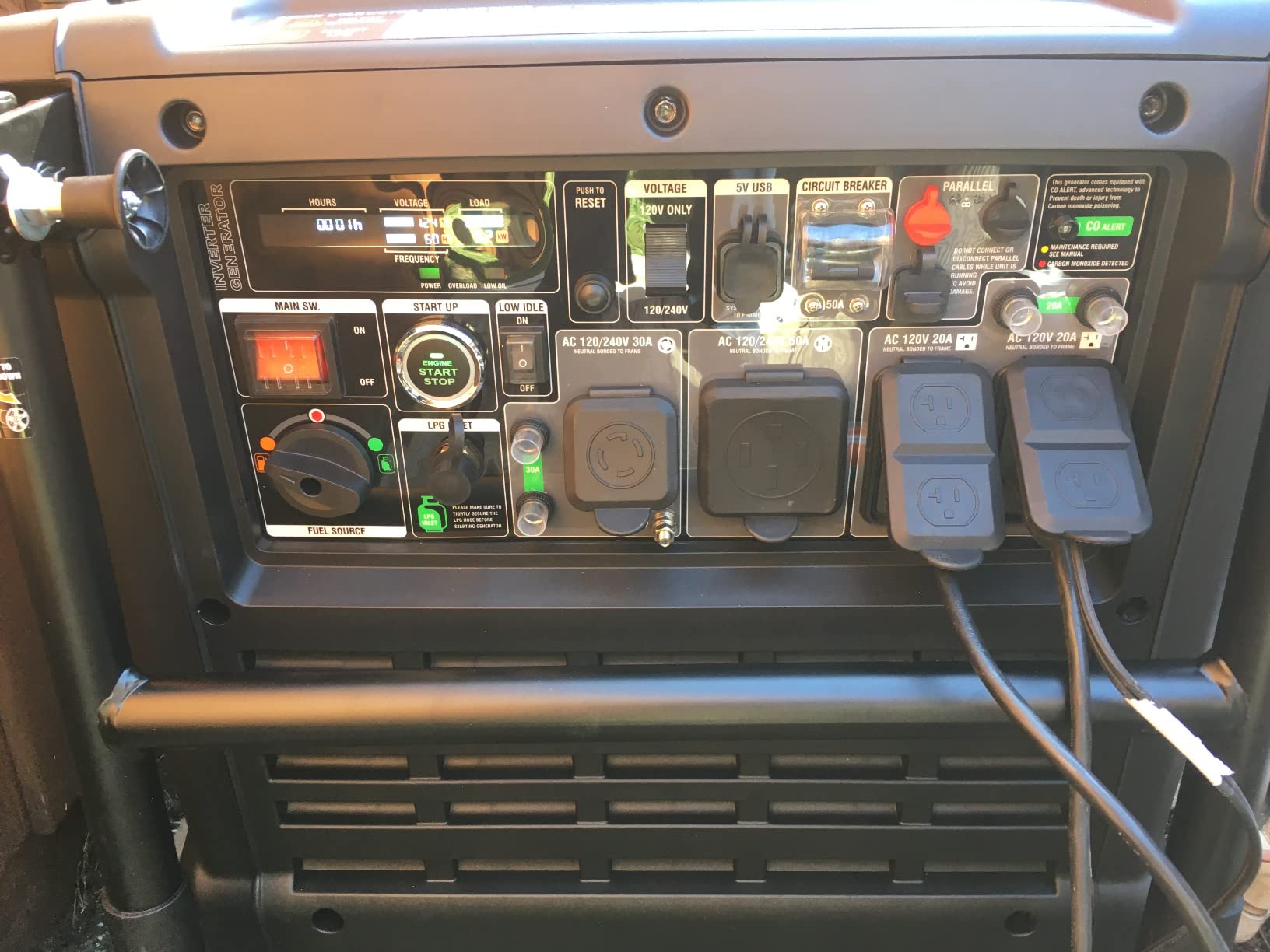
The digital control panel gives real-time operating data, a DC charging port and a flexible LED rope light that illuminates the panel for 30 seconds, which sounds trivial until you are refuelling at night in a storm.
Free lifetime technical support is included with the three-year warranty, and in a category where troubleshooting advice is often the difference between a working generator and a dead one, that has real value.
What it handles well in a large home?
At 11,000 running watts it covers a targeted load list: one compressor with a soft starter, one water heater, refrigeration, lighting and outlets. Tri-fuel flexibility means a fuel delivery problem during a storm does not end your power, which is the single most common fuel-related fear owners report.
The voltage transfer switch lets the unit deliver full 120V output and shift cleanly to 120/240V, so it can serve both your transfer switch and ordinary household loads.
Where it falls short?
The rating distribution is the concern here. Sixteen percent of reviews are one-star, which is heavier than the category leaders, and the reviews that sit in that bucket point at early durability problems rather than a specific fixable fault.
The CO detection cutoff is a genuine operational consideration. It is doing the right thing for safety, but it will stop a run if the unit is in a poorly ventilated position, and you need to plan the placement accordingly.
5. DuroStar DS13000MXT – The Most Direct Path to Natural Gas on a Portable Budget
DuroStar DS13000MXT 13,000-Watt 500cc Tri Fuel Portable Generator – Gas, Propane & Natural Gas, Remote Electric Start, Whole Home Power Backup, Transfer Switch Ready, RV & Emergency Ready
Running: 10500W
Peak: 13000W
Tri fuel
15 ft natural gas hose
Pros
- 13000 peak watts at the entry level of this group
- Tri-fuel including a 15 ft natural gas hose
- Remote electric start with recoil backup
- CO Alert automatic shutdown
- Transfer switch-ready 50 amp outlet
Cons
- Remote start range is limited for a wireless system
- First-run break-in and assembly checks needed
- Weight not published by the manufacturer
What separates the DuroStar from a pure tailgate generator is the 15-foot natural gas hose in the box. That single component is what turns a portable into something you can leave connected to a gas line, which removes fuel logistics and the stale gasoline problem in one move.
At 10,500 running watts and 13,000 peak, the power delivery is squarely in the essential-loads class. Owners report satisfaction concentrated on output and fuel flexibility rather than on refinement, which for a backup machine is an honest trade.
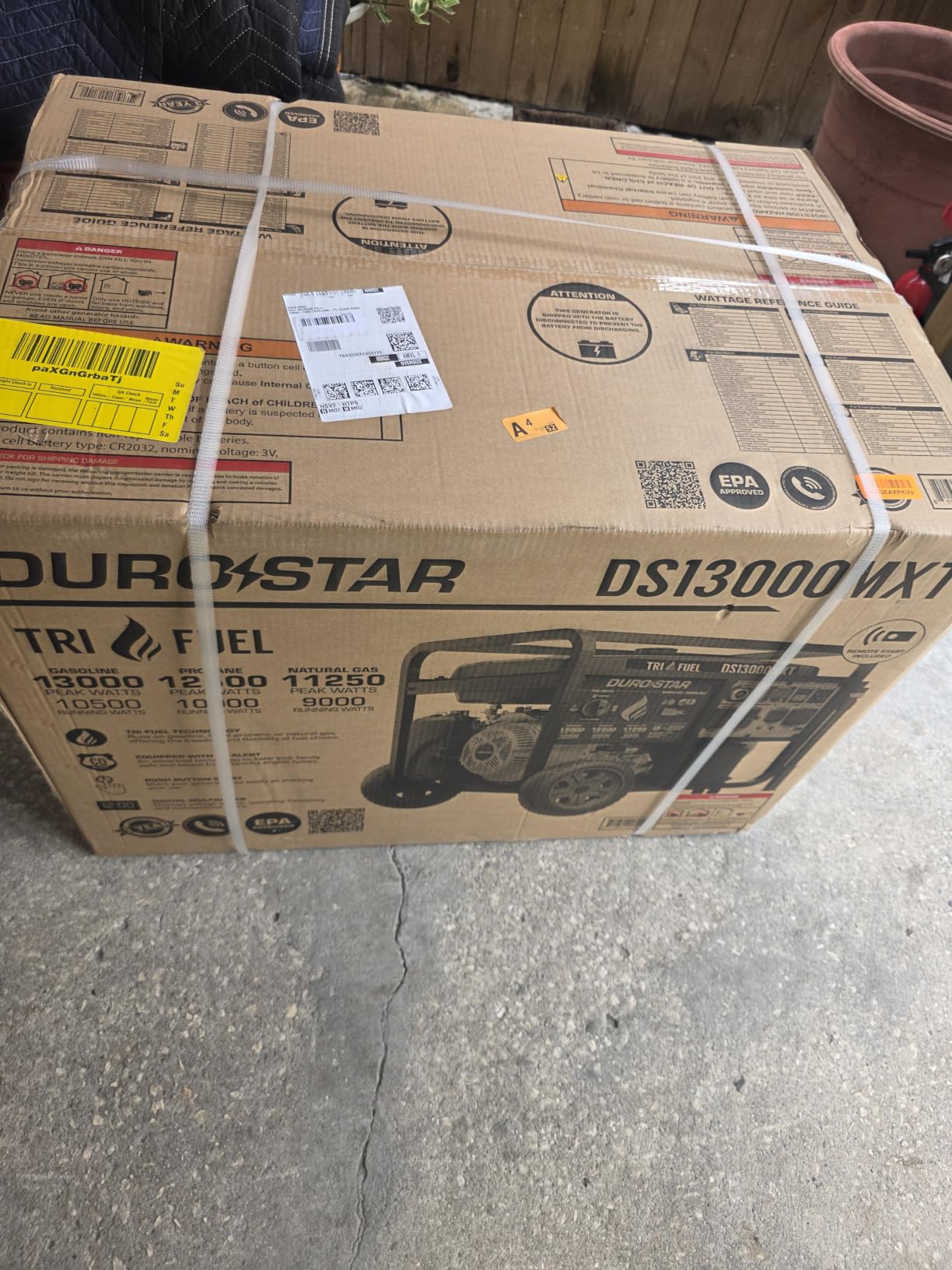
Remote electric start with a recoil backup means you can start it from inside the house if it is parked in a covered area with the exhaust pointed legally, and the front fuel selection knob makes the gasoline-to-propane-to-gas change obvious even for a first-time owner.
The 8.3 gallon tank runs up to 13 hours on gasoline, which is enough to carry a house through a typical overnight outage without a refuel trip.
What it handles well in a large home?
Best used as a targeted system: one compressor with a soft-start kit, a well pump, a sump pump, refrigeration and essential lighting. Paired with a manual transfer switch, it covers the circuits that actually matter when nobody wants to sit in the dark.
Because it runs on piped natural gas, its runtime is a function of the gas utility rather than a tank. That is a genuine advantage in an ice storm or a hurricane, when fuel delivery is at its least reliable.
Where it falls short?
The remote start is a wired key-fob style unit with a shorter effective range than a dedicated wireless start system, so plan where you park it accordingly. Weight is not published by the manufacturer, which makes planning your move path harder than it should be.
Owners also flag that the first run needs proper assembly checks and a break-in period before you put a real compressor load on it. That is normal engine practice, but follow it.
6. Champion 16,875-Watt Tri-Fuel – The Highest Starting Wattage Among the Portables
Champion 16,875-Watt Electric Start Tri Fuel Home Backup Portable Generator
Running: 13500W
Start: 16875W
739cc V-Twin
25 ft NG hose included
Pros
- Highest starting wattage in the roundup
- 739cc Milwaukee Series V-Twin engine
- Runs on natural gas
- propane or gasoline
- Intelligauge power meter
- CO Shield safety shutoff
- Three-year warranty with national service network
Cons
- 361 pounds makes it one of the heaviest
- 79 dBA is high for a residential neighborhood
- Some units arrive with loose panel hardware
This is the strongest portable in the group on paper and it is the one we would look at first if a large home had no room for a permanent installation. Thirteen and a half kilowatts of running power is a real step above the 10,500-watt cluster, and 16,875 starting watts gives a compressor room to come up to speed without bogging the engine.
The 739cc V-Twin engine is the physical reason for that headroom. A V-twin has more cylinders sharing the work, which typically means more torque, more even power delivery and better behavior under sustained load than a single-cylinder engine of the same size.

A 25-foot natural gas hose and a 6.6-foot propane hose are included, so connecting it to a permanent fuel source is a same-afternoon job rather than a parts hunt. Owners running this on natural gas through storm events report the fuel logistics disappearing entirely from their planning.
The Intelligauge power meter tracks voltage, frequency and runtime, which turns maintenance from a calendar guess into a number you can act on.
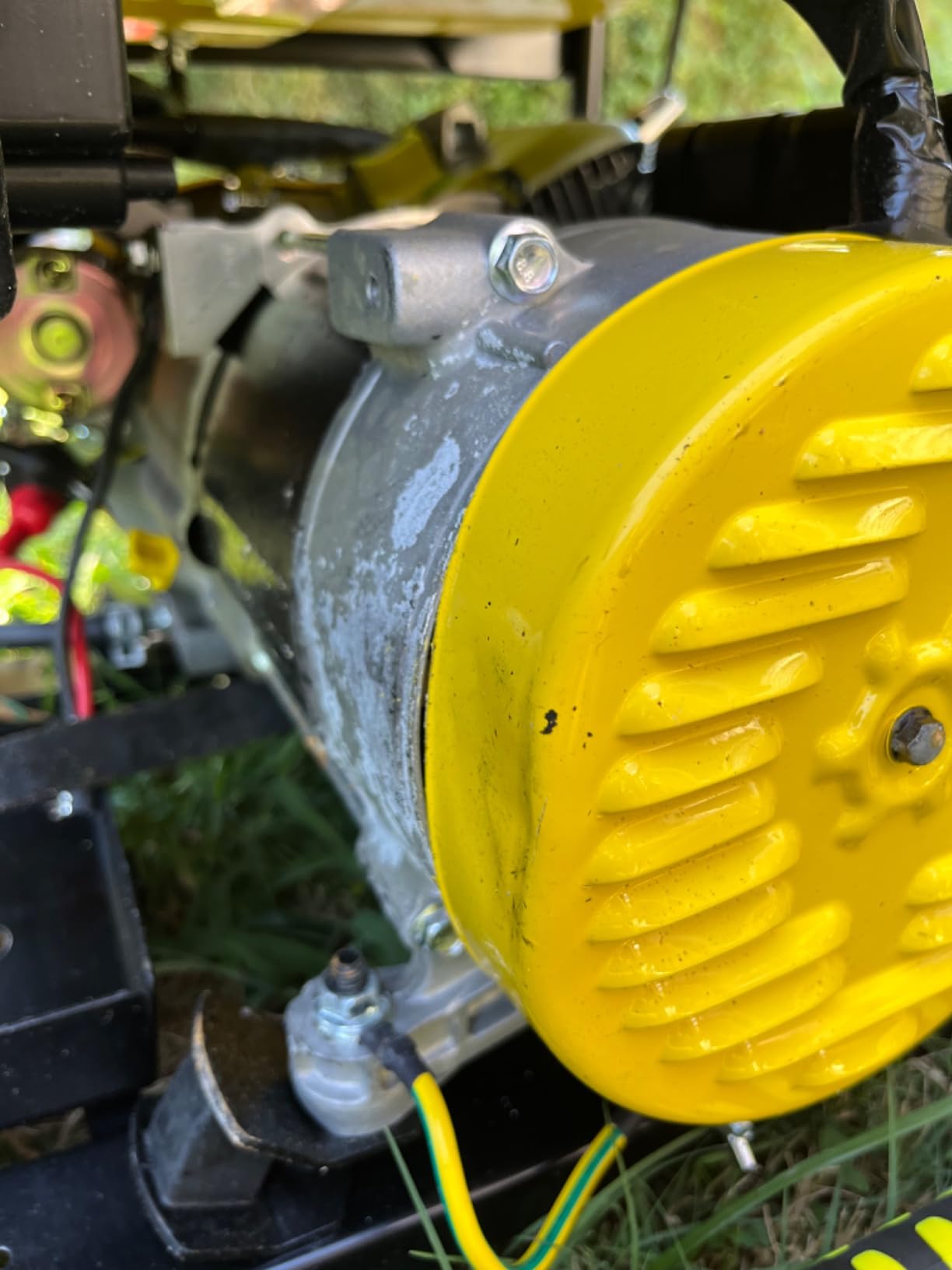
What it handles well in a large home?
At 13,500 running watts this reaches into the territory where you can carry two compressors or a compressor plus both water heaters, which is the minimum viable configuration for genuinely keeping a large home live rather than keeping it habitable.
The 11 gallon tank runs up to 8 hours on gasoline, and on natural gas or propane the runtime is set by your supply rather than the tank.
Where it falls short?
At 361 pounds and 33-plus inches on each dimension, this is not a unit you carry up basement stairs by yourself. The 79 dBA rating measured at 23 feet is high for residential use and is a legitimate concern in a neighborhood with an association.
Assembly quality control is the recurring complaint. Some owners report loose control panel fasteners or slightly bent frame tubing near the wheel bracing on arrival, which is worth inspecting thoroughly before you depend on it.
7. DuroMax XP15000HXT – The Longest Runtime in the Roundup at 17 Hours
DuroMax XP15000HXT 15,000 Watt Tri Fuel Portable Home Power Backup HXT Generator w/CO Alert
Running: 12000W
Peak: 15000W
17 hour runtime
670cc OHV engine
Pros
- 15000 peak and 12000 running watts
- 17 hour runtime on a 13.2 gallon tank
- 14 outlets including a 50A heavy duty
- LED display for gas
- load
- voltage and time
- CO Alert shutdown
- Five-year warranty
Cons
- Heaviest portable here at 362 pounds
- Only 58 ratings so long-term data is thin
- Specified 50 hertz frequency is unusual for US use
Runtime is the entire pitch here. Seventeen hours from a 13.2 gallon tank is the longest endurance figure quoted by any tri-fuel unit in this group, and for a multi-day outage in a rural area where refuelling is a logistics problem, that number is worth more than another kilowatt of capacity.
At 12,000 running watts from a 670cc OHV engine, the power class clears the essential-plus-some threshold. It is not a 26kW machine, but it is a meaningful step up from the 10,500-watt portables and it can carry a compressor and a water heater together without drama.
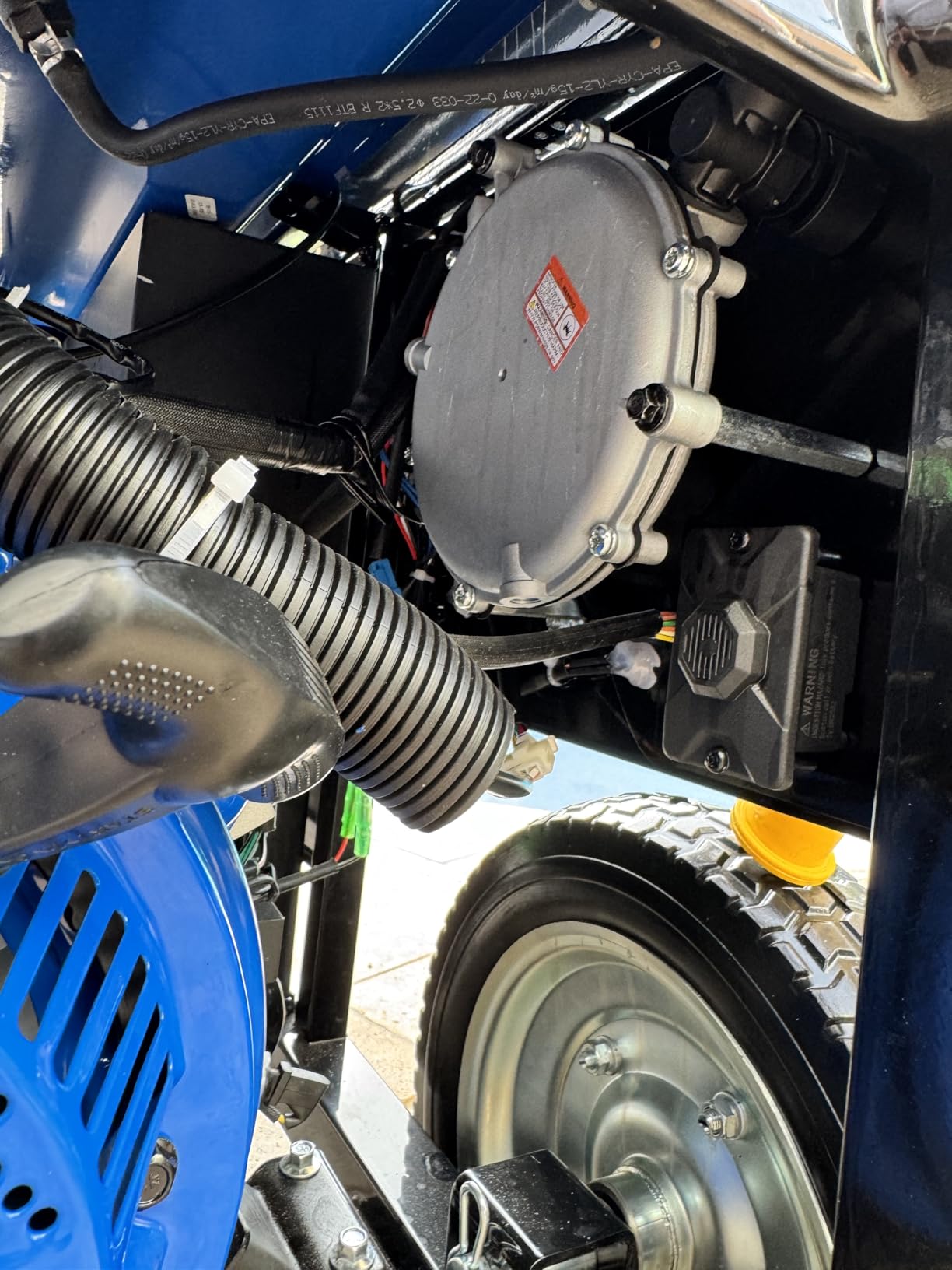
The outlet bank is unusually well specified for a portable: four 120V GFCI outlets, a 30A twist lock, a 120/240V 30A twist lock and a 120/240V 50A heavy duty output, across fourteen connections in total. That is a real transfer switch and a real job site panel in one box.
Push button and remote start with a quick fuel selection knob, plus an LED display showing fuel level, load, voltage, frequency and time, means an owner can answer almost any question about the machine from the panel alone.
What it handles well in a large home?
Seventeen hours covers an overnight and most of a following day without a fuel run, which for most households means the entire realistic duration of a grid interruption caused by a storm or an ice event.
The 50A heavy duty output makes it a credible match for a manual transfer switch, so a 4,000 square-foot home can run a defined set of circuits rather than a single extension cord.
Where it falls short?
At 362 pounds it is the heaviest portable here, and loading and unloading it in wet weather is a two-person job. The 50 hertz frequency specification is also unusual for US whole-home use, and it is worth confirming with a dealer how the unit behaves on a 60 hertz grid before you commit.
With only 58 ratings, the long-term durability record is not yet established. The five-year warranty is reassuring, but warranty length and proven lifespan are not the same thing.
8. Westinghouse WGen11500DFc – Under 3 Percent THD for Sensitive Electronics
Westinghouse 14500 Peak Watt Dual Fuel Home Backup Portable Generator, Remote Electric Start, Transfer Switch Ready, Gas and Propane Powered
Running: 11500W
Peak: 14500W
THD under 3 percent
Remote start key FOB
Pros
- Highest owner satisfaction in the roundup
- THD under 3 percent for sensitive electronics
- 19 hours on a 9.5 gallon tank with fuel gauge
- Remote electric start fires in seconds
- 550cc OHV with cast iron sleeve
- Easy hookup to an existing transfer switch
Cons
- Secondary fuel cutoff switch is easy to miss and poorly documented
- Remote control can ship attached to the pull cord
- Oil filter is closer to a cleanable metal screen
Total harmonic distortion under 3 percent is the number that earns this unit its place. Every other portable in this roundup sits somewhere above that, and Generac’s standby is quoted under 5 percent. If your large home has a home office with a desktop and network gear, a home theatre, or medical equipment on the same bus, clean sine-wave-adjacent output is not a luxury.
At 11,500 running watts on gasoline and 10,500 on propane, with 14,500 and 13,500 peak respectively, it delivers dual-fuel flexibility with a modest output penalty when you switch to propane. Nineteen hours of runtime on a 9.5 gallon tank is the longest quoted endurance in this roundup.
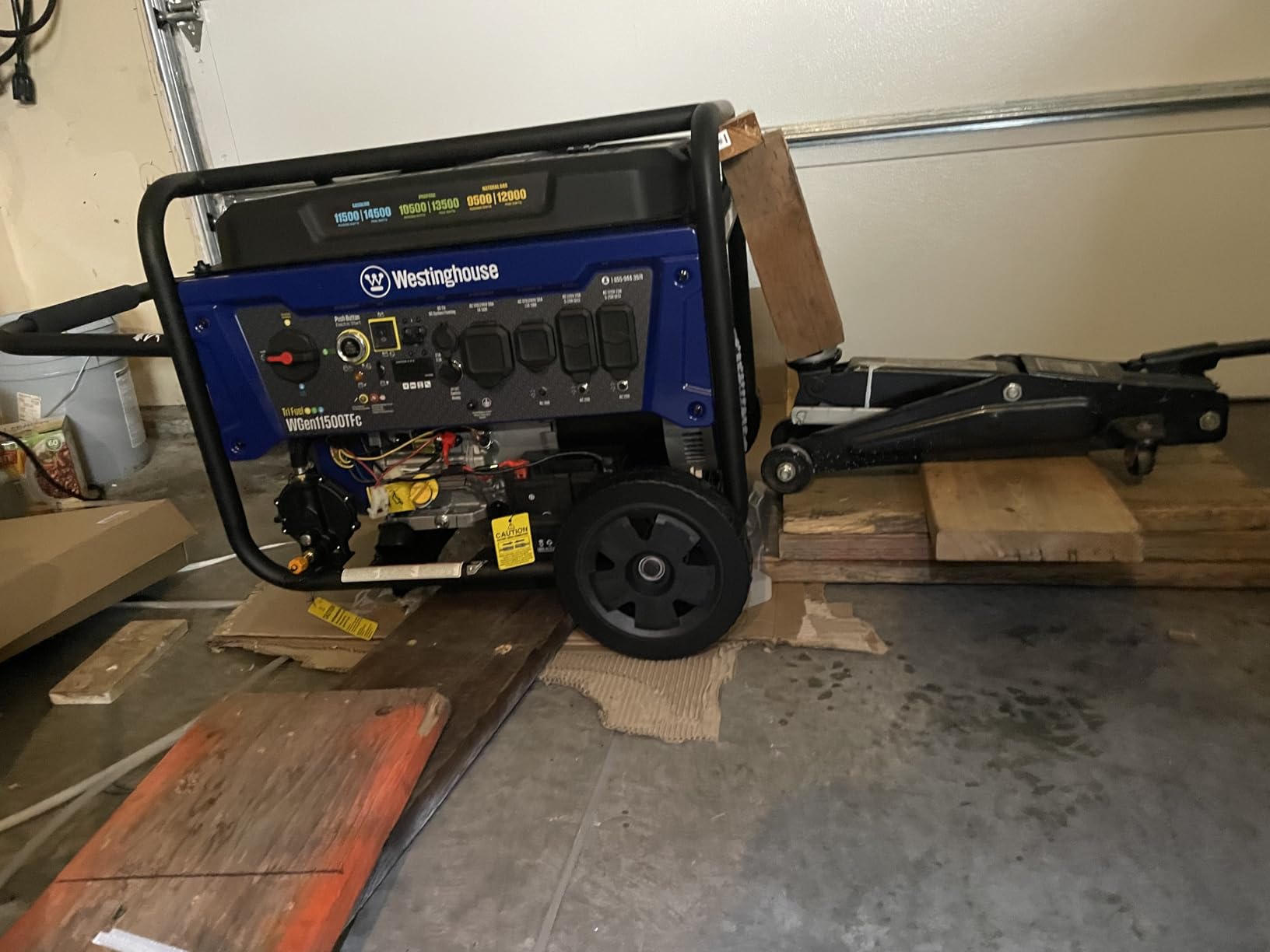
The 550cc four-stroke OHV engine has a cast iron cylinder sleeve, which is the single most durable thing you can find in a small engine. It resists the wear that eats a cast-aluminum sleeve over thousands of hours, and it is the reason many owners report these units still running after a decade.
Automatic voltage regulation, an hour meter, a fuel gauge, a CO sensor and overload protection cover the standard reliability checklist, and the key fob fires the electric start within seconds on either fuel.
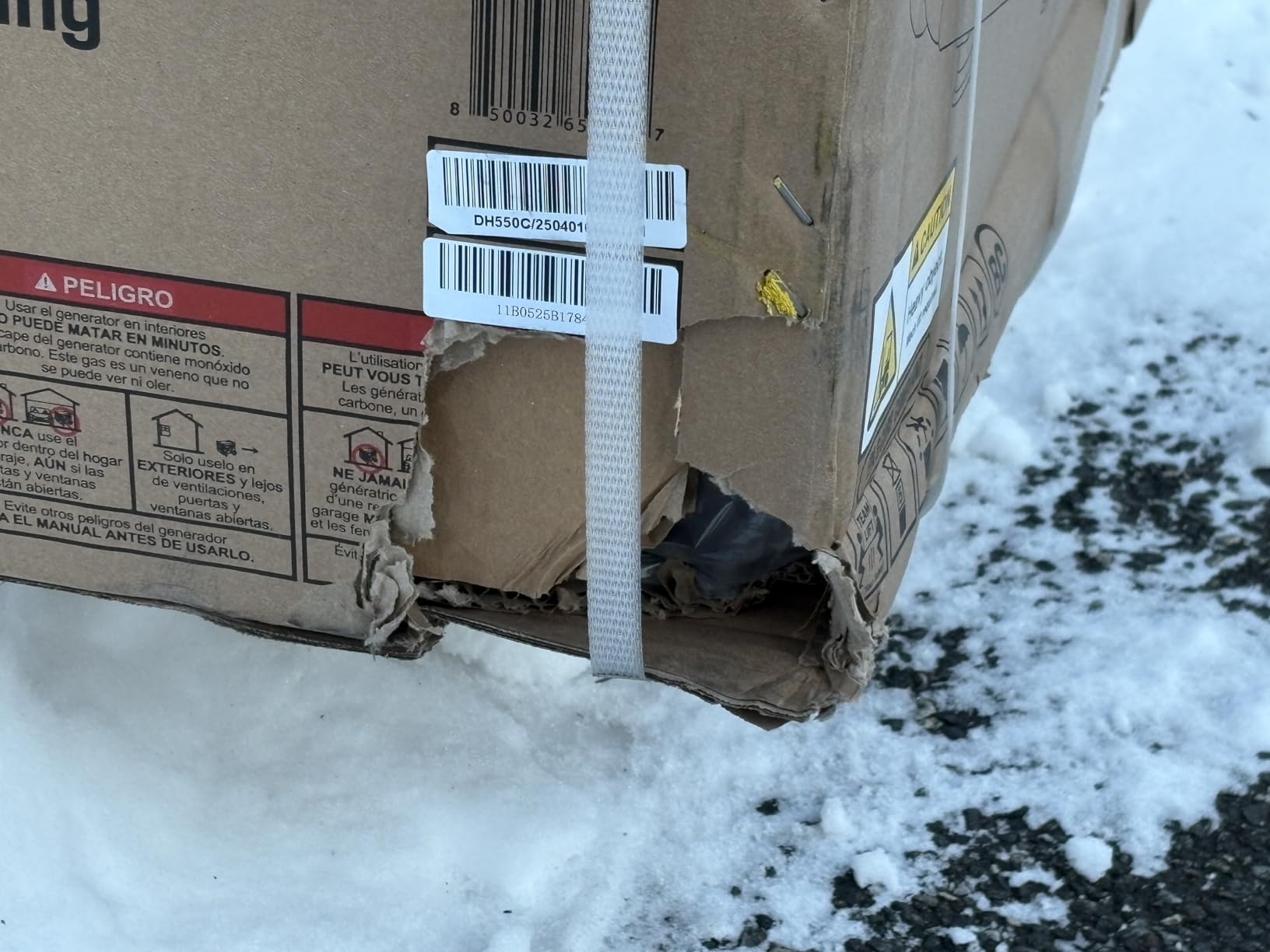
What it handles well in a large home?
Best deployed as an electronics-safe essential-loads system: refrigeration, network gear, office equipment, lighting, one water heater and a compressor fitted with a soft starter.
For a household that works from home and loses money every hour the connection is down, the difference between 3 percent and 8 percent harmonic distortion is a difference in how the equipment behaves when the power comes back on.
Where it falls short?
There is one documentation problem that catches a startling number of new owners. The secondary fuel cutoff switch is not mentioned in the quick-start guide and is not visible from above, so people who switch to propane and fail to find it end up pulling the starter cord repeatedly on a full tank.
The remote control also ships attached to the pull cord, so it can be separated from the machine without anyone noticing. The oil filter is closer to a cleanable metal screen than a true filter element, so oil change discipline matters more here than on a unit with a cartridge.
9. Champion 15,000-Watt Tri-Fuel – Built for Multi-Day Storm Running
Champion Power Equipment 15,000-Watt Electric Start Tri Fuel Home Backup Portable Generator with CO Shield
Running: 12000W
Start: 15000W
717cc V-Twin
78 dBA at 23 feet
Pros
- Carries an entire large home on natural gas
- Tri-fuel means a fuel shortage never ends your power
- 717cc V-Twin with battery electric start
- Up to 9 hours on an 11 gallon tank
- Champion replaced a shipping-damaged unit under warranty
Cons
- CO Shield cutoff can stop a run after 1.5 to 2 hours
- Second spark plug is hard to reach
- 331 pounds
- 78 dBA is high for residential use
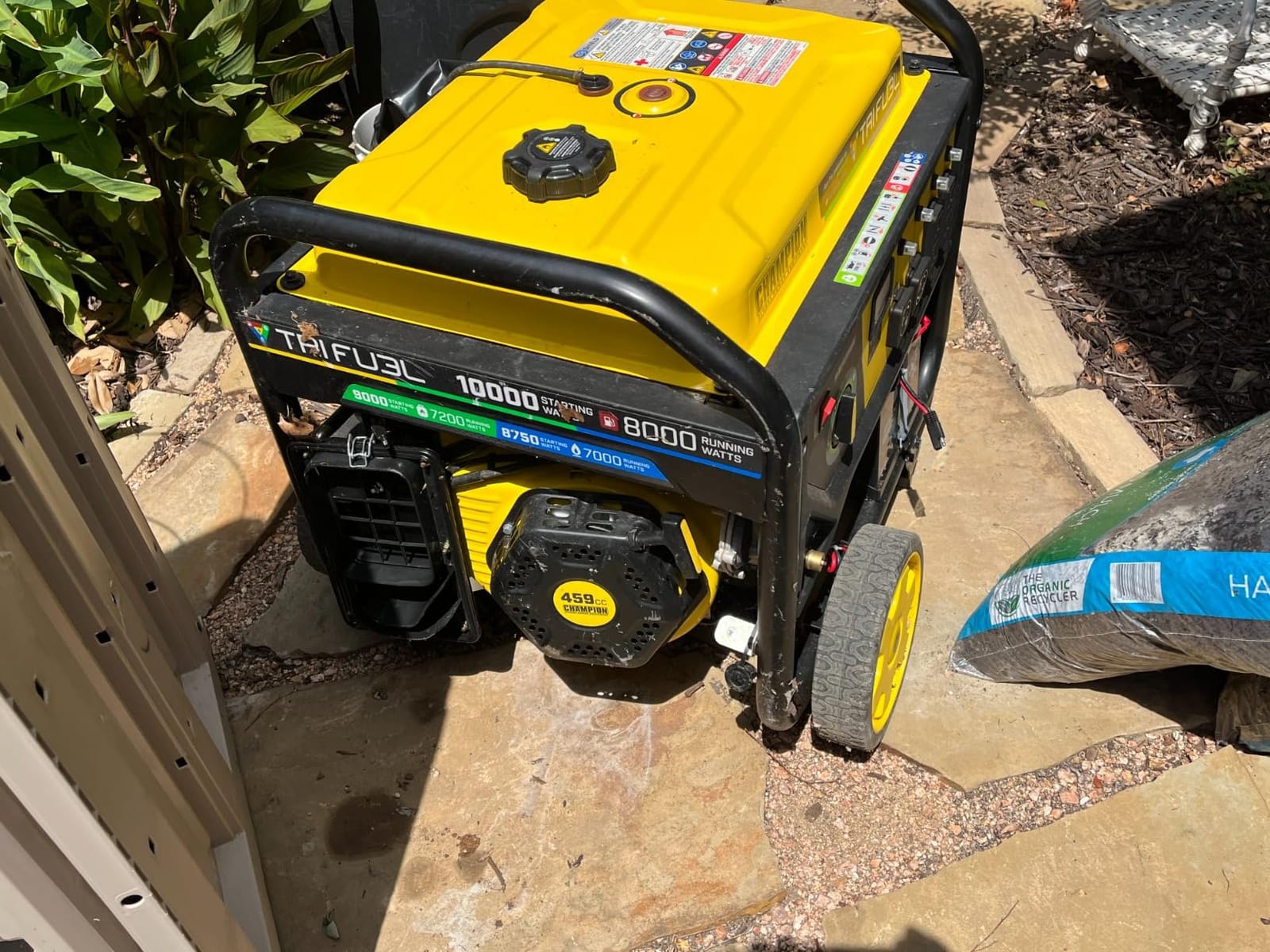
This Champion’s reviews include owners running it on piped natural gas for entire homes, HVAC compressors included, through multi-day hurricane outages. That is the use case it is built for, and the tri-fuel capability is the reason it keeps working when gasoline supply collapses and propane deliveries get scarce.
The 717cc V-Twin gives 12,000 running watts and 15,000 starting watts, with up to 9 hours of runtime on an 11 gallon gasoline tank. Champion’s warranty service has a track record of replacing shipping-damaged units outright, which matters when the unit arrives on a pallet and the unit is the only thing standing between your family and a dark house.
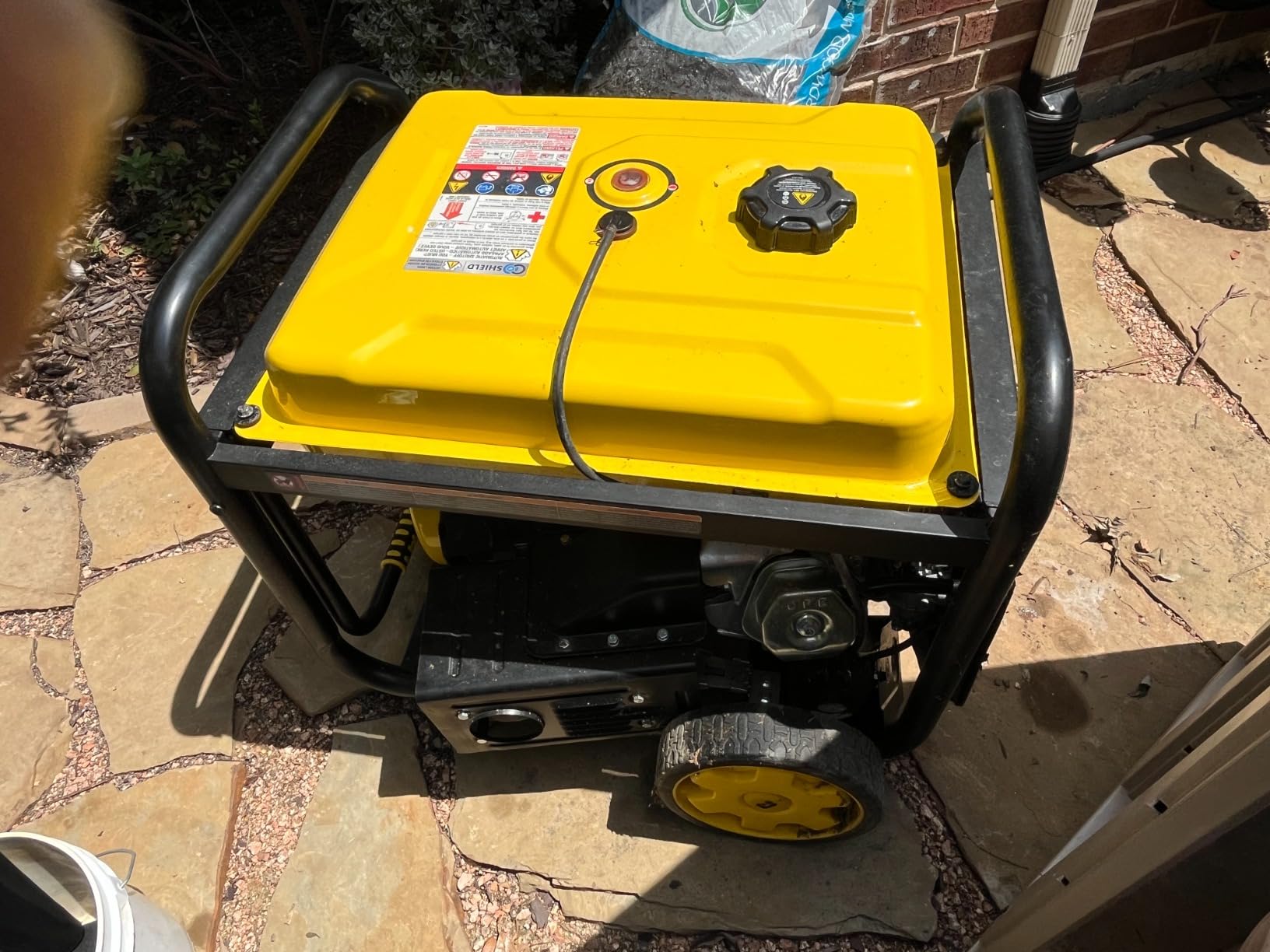
Owners running compressors with soft starters specifically report that this configuration carries the load, which matches the sizing math above. If you fit a soft starter to a 4-ton or 5-ton compressor, 12,000 running watts becomes a considerably more capable number than it sounds.
Intelligauge tracks voltage, hertz and runtime hours, and the CO Shield system shuts the engine down when it detects harmful fumes rather than letting the machine cook itself.
What it handles well in a large home?
A coastal home with multiple air handlers, a well pump and a sump pump can keep its essential systems running for days on a natural gas connection. Owners in hurricane territory consistently describe this as the configuration that works.
Where fuel supply is the risk rather than the power, tri-fuel is a genuine safety net: three fuel options mean the generator is never dead because one delivery channel closed.
Where it falls short?
The CO Shield sensor is described by owners as overly sensitive, shutting the unit down after roughly 1.5 to 2 hours even outdoors. That is a safety system doing its job with a tight threshold, but it will end a run you were counting on, so test it thoroughly in your actual placement before a storm.
The second spark plug is difficult to reach for maintenance, and the manual barely covers it. At 331 pounds and 78 dBA at 23 feet, this is also a heavy, loud machine to place next to a house.
10. WEN TF1300iX – The Only Inverter with an EV-Ready Outlet
WEN 13,000-Watt 120V/240V Tri-Fuel Inverter Generator with Quiet 550cc Engine, Electric Start, Wheel Kit, and CO Watchdog, Gas, Propane, and Natural Gas Powered (TF1300iX)
Running: 10500W on gas
Inverter architecture
14-50R EV outlet
CO Watchdog
Pros
- Bonded-neutral inverter output suits transfer switches
- One-button fuel switching across all three fuels
- Quiet 550cc four-stroke with electric start
- 7.1 gallon tank with up to 7.7 hours at half load
- 14-50R outlet supports Level 2 EV charging
Cons
- Running watts drop on propane and natural gas
- Only 22 ratings so long-term record is thin
- 14 percent one-star share in the ratings
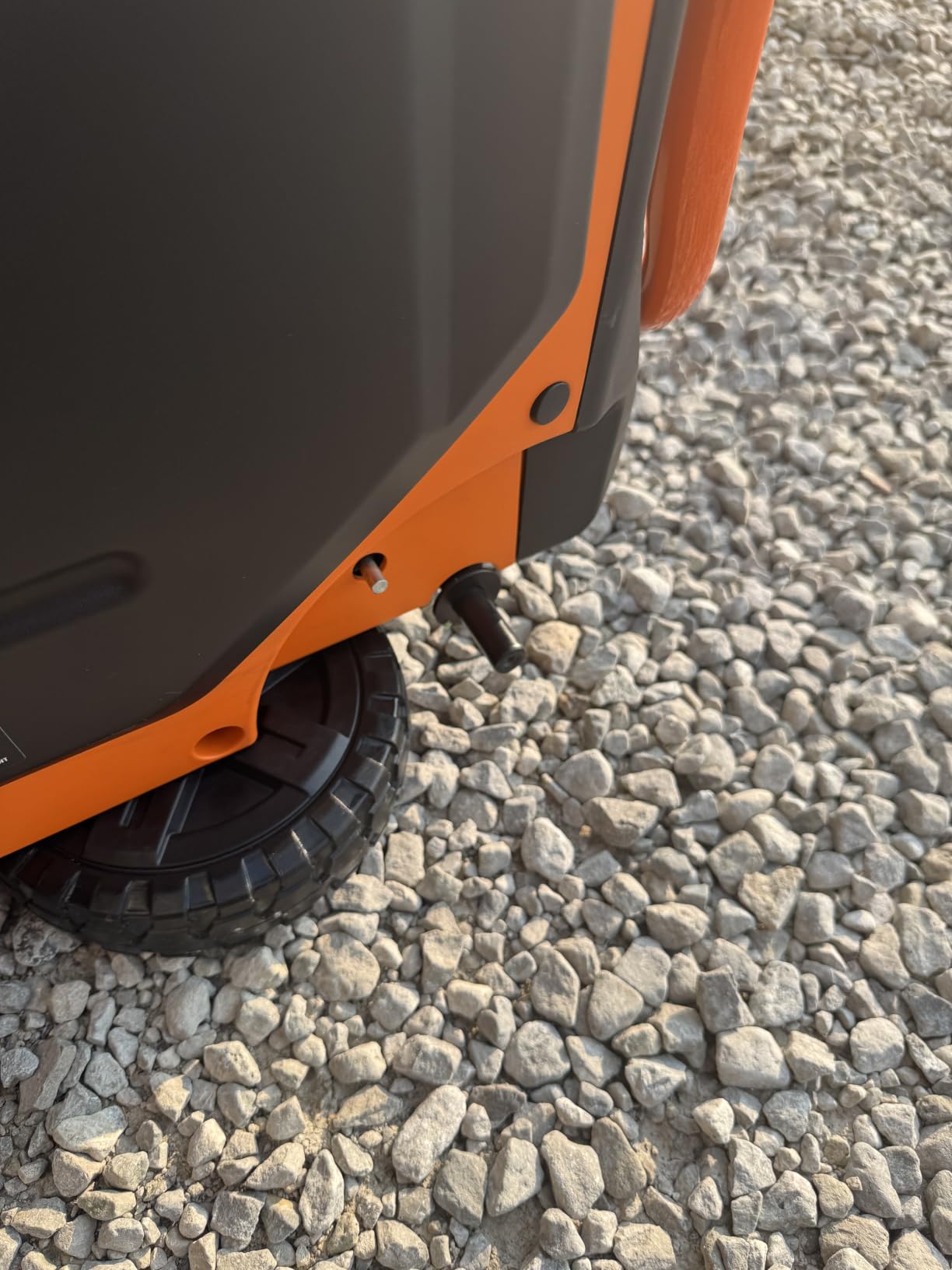
Every other portable in this roundup is a conventional open-frame engine. The WEN is an inverter, which means a different electrical architecture underneath, and that shows up in two ways that matter at this house size: a bonded-neutral 120V/240V output that pairs correctly with a transfer switch, and a much lower noise profile.
Output varies meaningfully by fuel. Gasoline gives 13,000 surge and 10,500 running watts. Propane drops to 11,250 surge and 9,000 running. Natural gas drops furthest, to 10,000 surge and 8,000 running watts. Plan your running-load target against the fuel you will actually use on piped gas, not against the headline number.
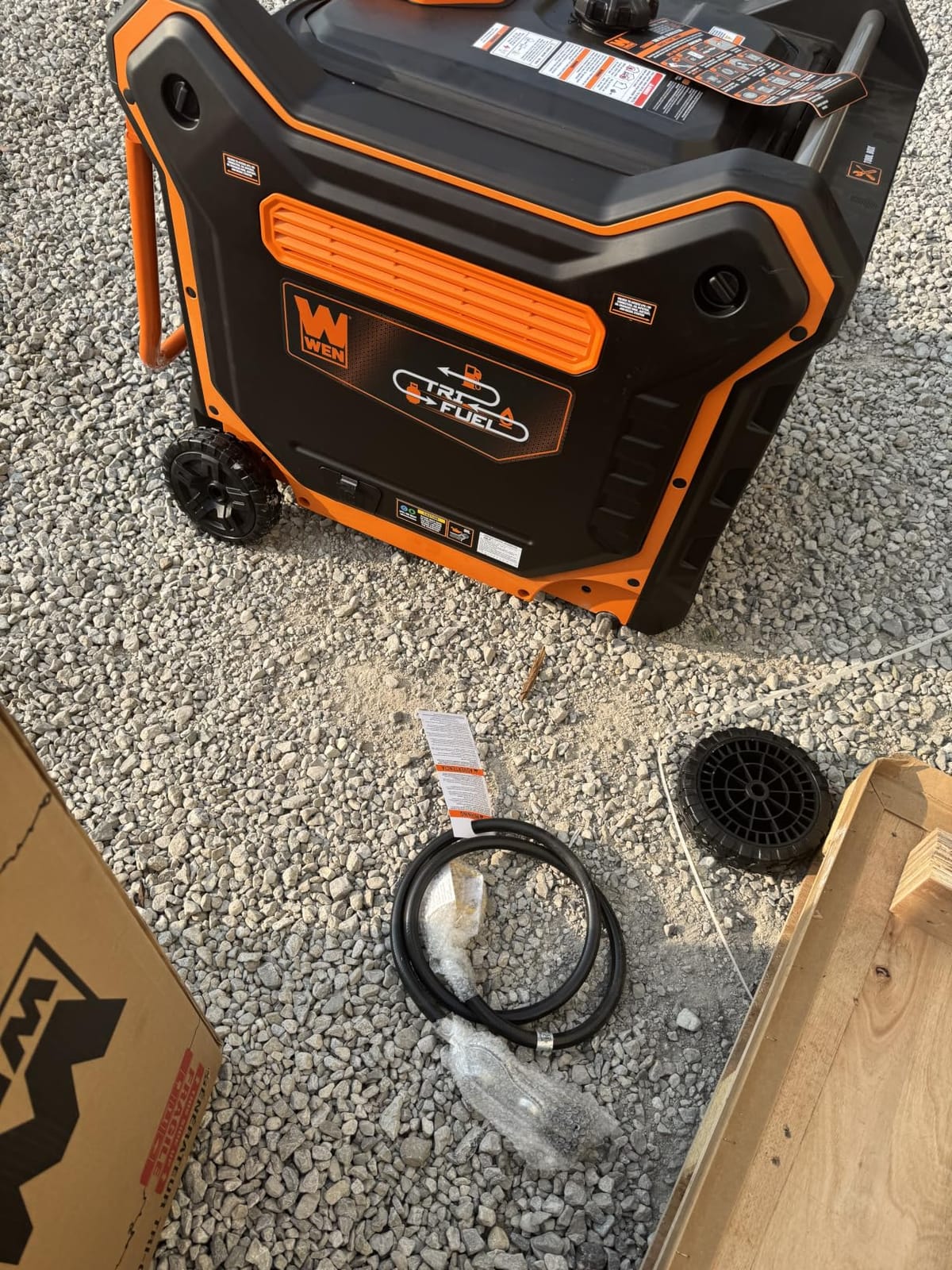
The 14-50R outlet is the item most large-home buyers in this decade care about. It is the standard connection for Level 2 EV charging, so this unit can feed a vehicle directly, which turns a generator from a backup appliance into a piece of infrastructure.
Eight outlets in total, including 120V duplex, 30A twist lock, 12V DC and USB, and a 7.1 gallon tank that delivers up to 7.7 hours at half load. The CO Watchdog sensor handles the safety shutdown.
What it handles well in a large home?
It is the right choice when noise is the binding constraint, which is common in neighborhoods with an association or where the generator has to sit close to a bedroom wall. The inverter architecture and quieter 550cc engine are the reason.
For a home with a 3,500 to 4,000 square-foot footprint on a 200A panel, a targeted essential-loads approach plus overnight EV charging is a sensible pairing, and the bonded-neutral output makes that wiring straightforward.
Where it falls short?
At 8,000 running watts on natural gas, this is the lowest sustained output in the roundup for piped-gas users. That is a real limitation if your emergency fuel plan is natural gas.
The rating base is the smallest here at 22 reviews, with a 14 percent one-star share. There is not enough data to establish a long-term reliability picture, so treat the warranty terms as the actual protection rather than assuming proven longevity.
Air-Cooled vs Liquid-Cooled Generators for Large Homes
Air-cooled engines are cheaper to buy and install. Liquid-cooled engines are quieter, run longer between services, and are the only practical option above roughly 25kW.
Here is the comparison that actually matters at 4,000 square feet and up:
Typical capacity — air-cooled tops out around 20kW to 22kW for this class; liquid-cooled covers 26kW to 48kW.
Noise — air-cooled is measurably louder at the same output because the cooling fan has to move more air.
Run time between services — liquid-cooled holds oil temperature more steadily, so service intervals stretch and summer performance holds up.
Suitability for hot climates — an air-cooled unit works hardest in exactly the conditions where a storm took your power out, which is a fair criticism.
Installation complexity — both need a pad, a transfer switch, a fuel line and a permit, but liquid-cooled units are heavier and the fuel plumbing is more demanding.
The practical rule we would give a friend: if your load calculation comes out above 20kW, stop shopping air-cooled. If it comes out at 20kW or below and your panel is 200A, an air-cooled standby with a load-shedding switch is a defensible and considerably less expensive choice.
Standby vs Large Portable vs Home Battery for Whole House Use
A standby generator starts itself, runs on a permanent fuel supply, and covers circuits you choose. A large portable is a machine you own, fuel and start yourself. A home battery gives you a seamless transition but a much smaller budget of energy.
Compare them on the dimensions that decide the purchase:
Automation — standby wins outright, restoring power in roughly 10 seconds with no human present.
Coverage — a 26kW standby can carry a whole large home; a 13,500-watt portable carries a defined circuit list.
Runtime — piped natural gas or a 500-gallon propane tank means days. A 20 lb propane cylinder on a portable means hours.
Noise — a portable near the house is the loudest thing on the property. A standby at a proper setback is largely inaudible.
Installation — a standby needs a pad, an automatic transfer switch, permits and licensed electrical work. A portable can be running this afternoon with a manual transfer switch.
Outage experience — for a large home, comfort, heat, water and a running sump pump across a multi-day event is a very different proposition from keeping a refrigerator cold.
A third path is emerging and forums increasingly recommend it: a smaller standby or inverter portable paired with a home battery. The battery covers the ten-second transition and the short loads, and the generator only starts when the battery drops low, which reduces fuel burn and noise dramatically. If your home is well-insulated and your outage exposure is short, that hybrid can carry you a long way for far less than a 26kW install.
What Drives the Installed Cost of a Large-Home Generator?
We are not going to put dollar figures on this page, because equipment pricing and labor rates move too quickly to be useful. What we can do is tell you the shape of the cost so you can compare quotes properly. Note that every price-driven guide is refreshed often, and the ranges move with each update, so treat any figure you see elsewhere as a snapshot rather than a quote.
On a turnkey liquid-cooled install, the equipment itself is usually the smallest share of the total. The larger shares, in rough order, are:
Electrical labor and the transfer switch — the switch alone is a meaningful equipment line, and the licensed electrician’s time is usually the biggest single line on the invoice.
Concrete pad — poured, reinforced, and engineered to carry the weight of the unit. Larger units need a deeper pad.
Fuel line — natural gas or propane piping from the supply to the unit, including permits for the gas line itself.
Permits and inspection — electrical permit, gas permit where applicable, and the final utility sign-off.
Site work — trenching, landscaping repair, and any distance between the unit and the panel.
Two levers genuinely reduce the total. Buying the unit independently rather than through the dealer’s turnkey package can save meaningfully, though you then own the commissioning. And a soft-start compressor kit can let you size down one power class, which is often a bigger saving than any equipment negotiation.
One number reframes the whole debate. The average US home sees only a few hours of outage per year, so if your exposure is a single ice storm every few years, a portable plus a manual transfer switch is the honest answer. If you are in a hurricane belt, a wildfire zone or a winter-storm corridor with medical equipment or a working-from-home requirement, the installed system earns its cost across a decade rather than across one event.
Propane Tank Sizing and Choosing a Fuel Type
Propane is the default for rural homes with no natural gas line, and the tank size conversation is where sizing mistakes get expensive. The arithmetic is simpler than most guides make it sound.
Rule of thumb for planning, not for sizing a tank: a large tri-fuel portable drawing a typical emergency load burns on the order of a gallon or two of propane per hour, and a 20 lb cylinder gives you roughly 7 hours on a mid-size portable. A 500-gallon tank at that burn rate is measured in days rather than hours, which is the only practical answer to a multi-day outage on a rural property.
On fuel choice generally:
Natural gas — infinite runtime as long as the line is intact, no storage to maintain, slightly less output than gasoline, and the line itself is a single point of failure.
Liquid propane — portable, no utility dependency, stable in storage, but dependent on delivery capacity during a storm, which is the anxiety owners report most.
Gasoline — the highest output of the three fuels on a portable, and the worst long-term storage story.
One practical note from owners: propane delivery is the thing that becomes impossible in exactly the week you most need it. If you go propane, size the tank for a genuinely extended outage rather than a weekend one.
Placement, Permits and How to Vet an Installer
Placement is not cosmetic. A standalone generator needs roughly 25 feet of clearance from doors, windows and vents, it must never operate inside a garage or an attached structure, and it needs carbon monoxide detectors rated to UL 2034 near sleeping areas.
Permits are required in nearly every jurisdiction. Electrical permits, gas permits where a fuel line is run, and a final utility inspection are normal parts of the process, and any installer who tells you permits are unnecessary is telling you something about the rest of the job.
Before you sign anything, ask these questions. They come directly from how buyers in the forums describe their good and bad experiences:
How many service calls does this dealer perform in my area, and who is my named technician?
What does the warranty cover, and does it cover parts, labor and travel, or parts only?
Does the warranty clock start at installation or at the factory date?
Who commissions the unit on startup, and is that included?
Do you run a load calculation on my actual panel, with my actual appliances, before quoting a size?
What is your availability during a declared emergency, and what is your typical response time?
The consensus answer from experienced owners is consistent: the best generator is the one for which you can find a qualified local technician who will also perform warranty repairs. A brand with no service network in your area is a liability, and a unit that is three hours away when a fuel valve fails is a 4,000-plus square-foot home running out of power in a storm.
One more piece of practical operating guidance that gets repeated constantly and appears on almost no buying guide: turn the generator-side breaker off before starting and stopping, and never bond neutral and ground at the generator. Those two habits prevent a meaningful share of the electrical complaints owners report.
Frequently Asked Questions
What size generator do I need to run a whole house?
For a large home, most buyers need 14kW to 26kW. Up to 2,500 sq ft on gas needs 10kW to 12kW; 2,500 to 3,500 sq ft needs 14kW to 18kW; 3,500 to 4,000 sq ft with two HVAC zones needs 20kW to 22kW; 4,000 sq ft with well and sump pumps needs a 26kW liquid-cooled standby; 5,000 sq ft and up needs 26kW to 48kW. Electric heat, EV charging and multiple compressors push the answer up, not square footage alone.
What is the difference between a standby generator and a large portable generator for whole house use?
A standby unit is permanently installed, starts itself when the automatic transfer switch detects an outage, and restores power in about 10 seconds, running on a piped natural gas line or a large propane tank. A large portable is a machine you own, fuel and start yourself, typically covering a defined circuit list through a manual transfer switch. Standby covers the whole home and runs for days; a portable covers essentials and runs for hours.
What is the most reliable home generator brand?
The most reliable generator is the one with a qualified dealer and technician within a reasonable drive of your home, and Kohler, Generac and Cummins all have the dealer networks to support that rule. Reliability in this category is set by installation quality, commissioning, fuel supply and annual service far more often than by engine design. Check whether labor, parts and travel are all covered before you choose a brand.
Are natural gas or propane generators better?
Natural gas gives effectively unlimited runtime with no storage to maintain, so it wins on anything urban or semi-rural with a gas line. Propane wins where there is no gas utility, because it removes the line as a single point of failure, but you must size the tank for a multi-day event because delivery is the weak point during storms. Gasoline gives the highest output on a portable and the worst long-term storage behavior.
How long will a whole house generator run on a full propane tank?
A mid-size tri-fuel portable running a typical emergency load burns roughly a gallon or two of propane per hour, so a 20 lb cylinder gives about 7 hours. A 500-gallon tank at that rate is measured in days rather than hours, which is why rural buyers should size the tank for an extended outage instead of a weekend one. A piped natural gas standby removes the tank question entirely.
What is the difference between air-cooled and liquid-cooled generators?
Air-cooled engines cost less to buy and install but top out around 20kW to 22kW for this class, run louder, and work hardest in exactly the hot conditions that cause outages. Liquid-cooled engines cover 26kW to 48kW, run quieter, hold oil temperature more steadily and stretch service intervals. If your load calculation comes out above 20kW, stop shopping air-cooled.
Our Verdict for Large Homes in 2026
If your load list comes out above 20kW, the Generac Guardian 26kW is the only genuinely whole-home option in this roundup, and it is the one we would install. Everything else here is a targeted system that covers a circuit list rather than a home, and at 4,000 square feet and up the difference between those two things is the difference between a warm house and a warm kitchen.
If the budget does not stretch to a permanent install, the DuroMax XP13000EH is our pick for the essential-loads path, with the largest body of independent owner feedback behind it, and the Westinghouse WGen11500DFc is the better answer when clean power for electronics is the priority. For raw starting headroom on natural gas, the Champion 16,875-watt unit is hard to argue with.
One last thing we would say to anyone shopping this category: measure your actual load first, buy from the dealer nearest your house, and add a soft-start kit to the compressor before you decide you need a bigger machine. Those three steps have saved buyers more money than any negotiation we have seen.
For the airflow side of keeping a large home comfortable through a hot outage, our whole-house fan guide for large homes covers what actually moves air when the HVAC is off.