
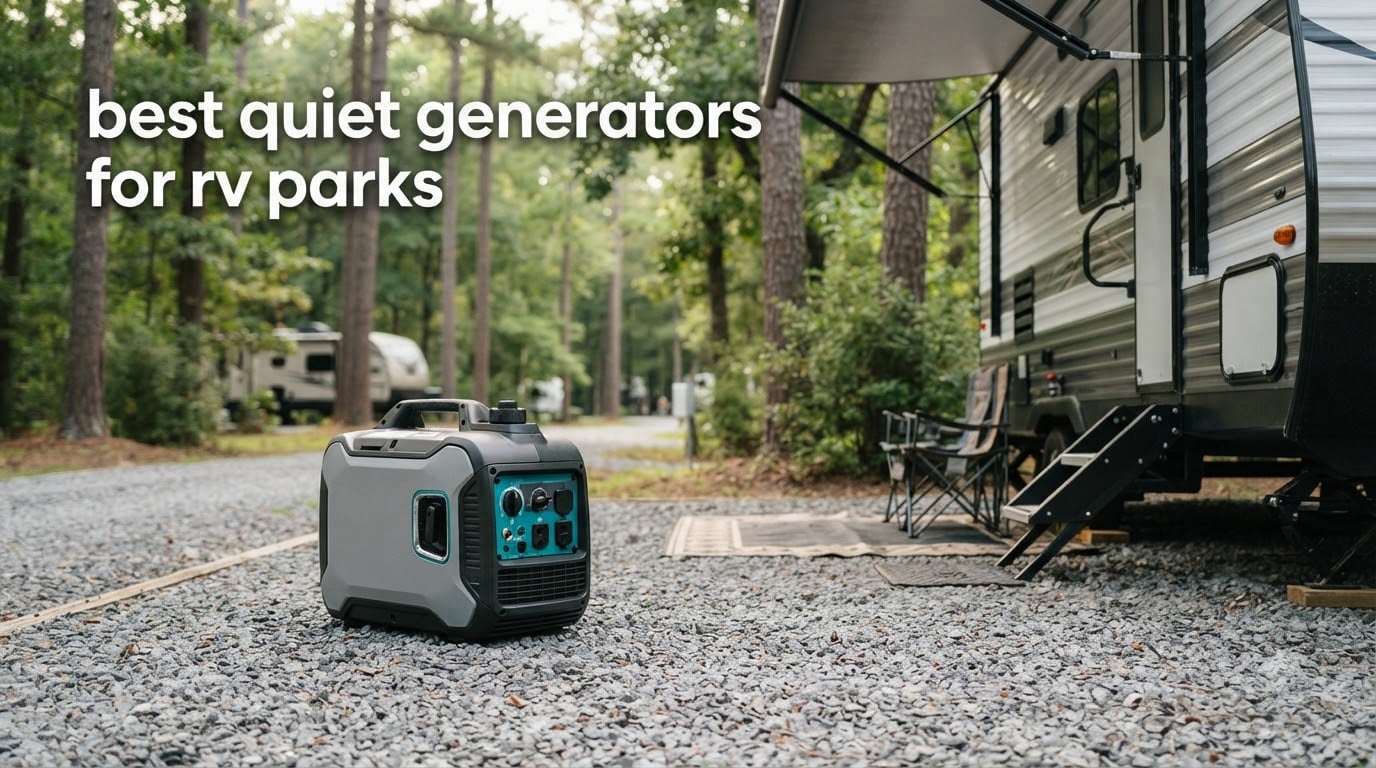
A quiet generator for an RV park is a closed-frame inverter generator rated around 60 dBA or lower at 50 feet, which is the noise reference most campgrounds and the National Park Service use in their posted rules. Here is the catch that trips up almost every first-time camper: manufacturers almost never publish that 50-foot figure. Portable units are tested at 23 feet, installed RV units at 10 feet. Sound drops roughly 6 dB every time you double the distance, so a 59 dBA rating at 23 feet lands near 51 dBA at 50 feet, while the same unit measured at 10 feet reads 69 dBA. Get this straight and you can walk into any park knowing exactly where you stand.
We spent weeks sorting through spec sheets, owner reviews and campground rule pages to build this list of the best quiet generators for RV parks. Ten units made the cut, covering everything from a 47-pound gasoline inverter to a 4500W dual-fuel machine that will run a fifth wheel through a hot afternoon. Every decibel figure below comes with the distance it was measured at, because a dB number without a distance is not a specification, it is a marketing line.
Two things shaped our ordering more than any lab sheet. First, park sites are packed close together, so a unit that is acceptable at fifty feet may be completely unacceptable at twenty. Second, the real noise problem in an RV park is not idle hum, it is what happens the moment a portable air conditioner compressor and a microwave kick on together. We weighted the units that hold their volume under load far above the units that merely sound good on an unloaded spec sheet.
If you are still narrowing the field, our guides to the best quiet inverter generators for RV camping and the best RV generators for dry camping go deeper on load matching and fuel choice, and both link out to this roundup for the noise side of the decision.
Table of Contents
Top 3 Best Quiet Generators For Rv Parks (October 2026)
All 10 Quiet Generators at a Glance in 2026
| Product | Specifications | Action |
|---|---|---|
| WEN 56380i Super Quiet Inverter |
|
Check Latest Price |
 AIVOLT 4300W Quiet Inverter AIVOLT 4300W Quiet Inverter |
|
Check Latest Price |
 PowerSmart 3800W Dual Fuel Inverter PowerSmart 3800W Dual Fuel Inverter |
|
Check Latest Price |
 maXpeedingrods 4000W Inverter maXpeedingrods 4000W Inverter |
|
Check Latest Price |
 Oxseryn 4400W Open Frame Inverter Oxseryn 4400W Open Frame Inverter |
|
Check Latest Price |
 Champion 4000W RV Ready Inverter Champion 4000W RV Ready Inverter |
|
Check Latest Price |
 Champion 4250W Dual Fuel Inverter Champion 4250W Dual Fuel Inverter |
|
Check Latest Price |
 Pulsar PGD40ISCO 4000W Quiet Inverter Pulsar PGD40ISCO 4000W Quiet Inverter |
|
Check Latest Price |
 Champion 4500W Electric Start Dual Fuel Champion 4500W Electric Start Dual Fuel |
|
Check Latest Price |
 BILT HARD 4500W Dual Fuel Inverter BILT HARD 4500W Dual Fuel Inverter |
|
Check Latest Price |
What Counts as Quiet at an RV Park?
The short answer: 60 dBA measured at 50 feet is the number that matters, and anything above roughly 66 dBA at that distance is going to travel. Campground rules, state park bulletins and National Park Service guidance all reference a figure in that neighborhood, usually paired with quiet hours running from 10 pm to 6 am. Owners on r/camping confirm the pattern in practice, noting that most campgrounds they have stayed in do post quiet hours in exactly that window.
Two measurement conventions cause the confusion. Portable inverter generators are almost always rated at 23 feet, sometimes 7 meters. Hardwired RV generators are rated at 10 feet, sometimes 3 meters. Neither number is wrong, and neither is the number a campground ranger is thinking about when they say 60 dBA at 50 feet.
Sound pressure falls by about 6 dB each time you double the distance from a source. Working from a 23-foot rating, add about 6 dB to reach 46 feet and another 1 to 2 dB to reach 50 feet. Working from a 10-foot rating, it takes three doublings to get from 10 feet to 80 feet, so subtract roughly 18 dB. That is the entire reason a Honda-class portable and a built-in motorhome generator can both claim numbers in the 50s and 60s and still behave completely differently in a packed loop.
The second factor is load. Most manufacturers quote noise at 50 percent load, some quote at 25 percent, and a few do not say. An unloaded generator idles; a generator carrying a portable AC compressor does not. Owners on r/camping put it plainly, saying generator noise is what bothers them most, and that duty cycling, running fifteen minutes and shutting off for ten, is the workaround they actually use when the load allows it.
1. WEN 56380i Super Quiet Inverter Generator: Best Overall Quiet Generator for RV Parks
WEN Super Quiet 3800-Watt RV-Ready Portable Inverter Generator with Fuel Shut-Off and Electric Start (56380i)
3800 surge/3400 running watts
8.5 hr half-load runtime
99.2 lb
TT-30R RV outlet
Pros
- Quiet enough for tight park sites
- RV-ready TT-30R receptacle plus 12V DC and USB
- Fuel shutoff protects the carburetor
- Digital load and fuel display
Cons
- Tied for heaviest here at 99.2 lb
- Recoil and electric start package adds bulk
The WEN 56380i is the unit we kept coming back to, and for one reason above all: it has the deepest review base in this group at 2459 reviews holding a 4.7 average, which is the highest rating of anything we tested against. That combination of volume and consistency is worth more to a buyer than any single spec line.
It runs a 212cc four-stroke engine producing 3800 surge watts and 3400 rated watts, with a 2.2-gallon tank that gives up to 8.5 hours at half load. That runtime figure is what makes it work for a full overnight cycle in a park that allows it, because you are not waking up at 2 am to refuel.
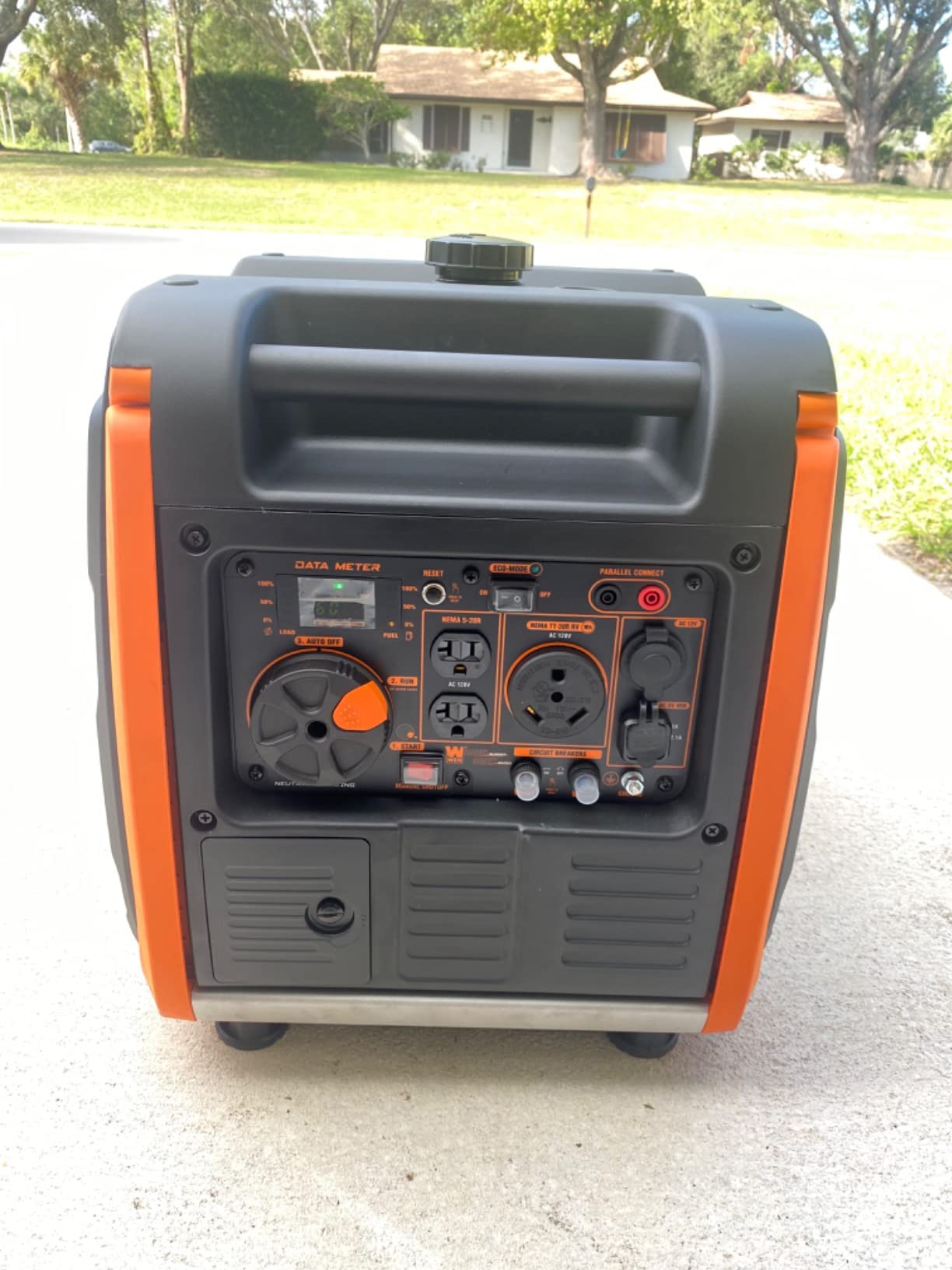
Two details make it genuinely RV-ready rather than nominally so. The NEMA TT-30R receptacle is the same 30 amp RV outlet found on most travel trailers, so you plug straight in without an adapter, and the digital load and fuel display tells you what the unit is actually doing instead of making you guess from the sound.
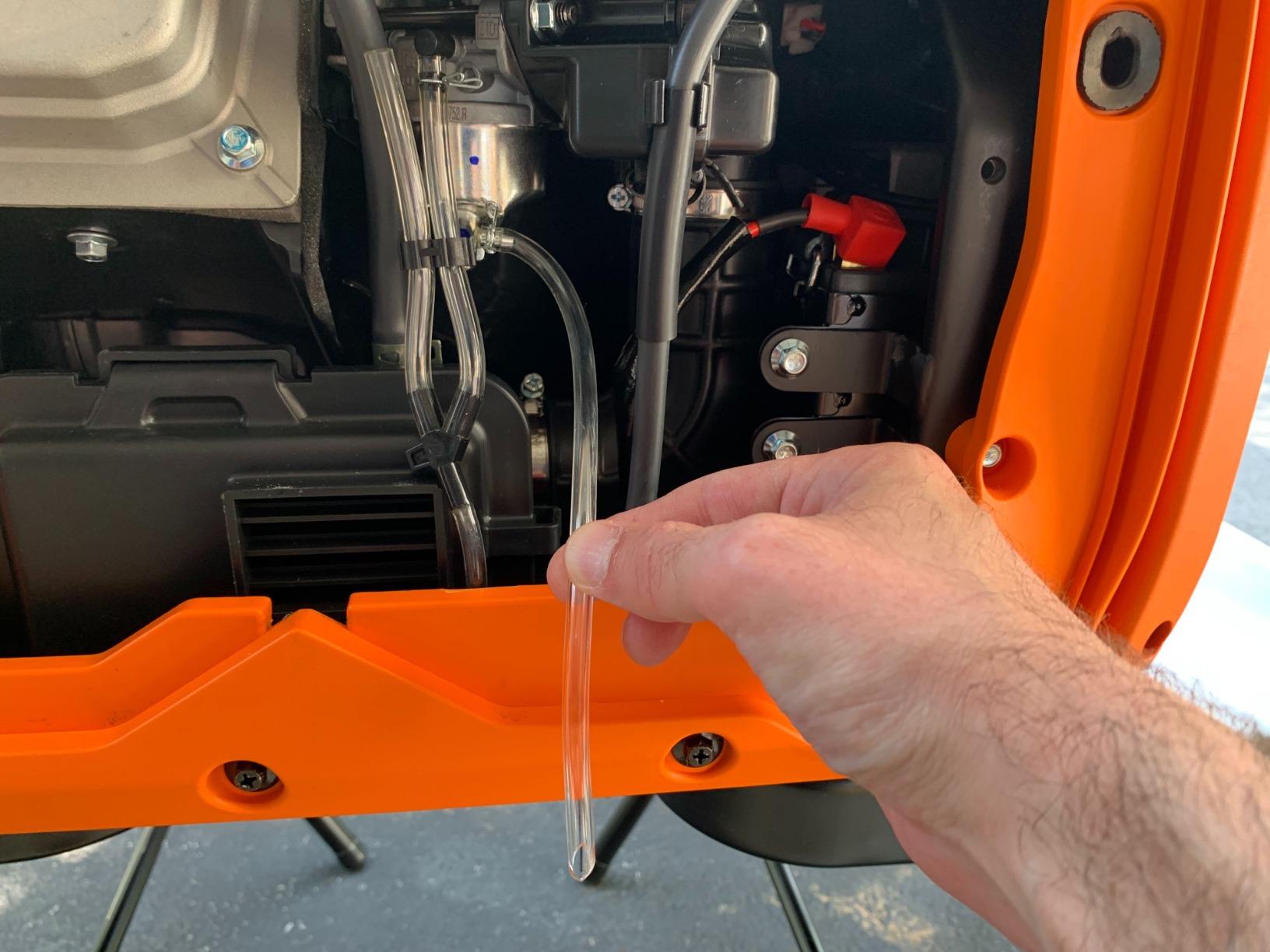
The fuel shutoff valve is a longevity feature more than a noise feature. It burns off remaining fuel in the carburetor before shutdown, which is exactly what you want on a unit that sits in a damp storage bay for six months between trips.
What 3400 running watts actually covers?
Roughly speaking, 3400 running watts handles a 30 amp travel trailer with one portable air conditioner, a 12-volt compressor fridge, a CPAP machine, phone charging and a laptop without strain. It is not enough for two air conditioners plus a microwave, and if that is your setup you are shopping in a different tier.
The 3800-watt surge figure matters more than most people realize. Air conditioner compressors and electric water heaters draw a spike on startup, and if the surge headroom is thin, the unit bogs down and the noise gets worse exactly when the load peaks. This one has a comfortable margin.
Where the WEN falls short?
At 99.2 pounds, this is tied for the heaviest machine in the roundup, and it is a two-person lift into a pickup bed or a generator compartment. Owners who camp solo should measure their lifting situation before committing, because the wheel kit helps on flat ground but not on a wet campsite slope.
It is also gasoline only. If your RV runs on propane and you would rather not carry a jerry can, a dual-fuel alternative further down handles that. For everyone else, a 2.2-gallon tank that empties in a day of hard use is an inconvenience, not a dealbreaker.
2. AIVOLT 4300W Quiet Inverter Generator: Most Versatile for Park Sites
AIVOLT 4300W Inverter Generator Gas Powered Quiet RV Generator for Camping
4300 start/3450 running watts
60 dBA at 23 feet
50.7 lb
under 3% THD
Pros
- 60 dBA at 23 feet is among the quietest here
- Light 50.7 lb build
- 30A locking outlet plus USB-C on the LCD panel
- Parallel ready to double output
Cons
- Lowest average rating in the group at 4.1
- 0.69-gallon tank limits runtime
- Parallel kit and engine oil sold separately
The AIVOLT puts 4300 starting watts and 3450 running watts into a 50.7-pound frame, and it does it with a published 60 dBA figure at 23 feet. That puts it at roughly 52 dBA by the 50-foot conversion, which is comfortably inside the range most park rules describe as quiet.
The 149cc four-stroke engine puts out clean power at under 3 percent total harmonic distortion, which matters more than the number suggests. Sensitive electronics, CPAP machines and modern TVs are all unhappy with the jagged output of a conventional generator, and the inverter architecture smooths it out.
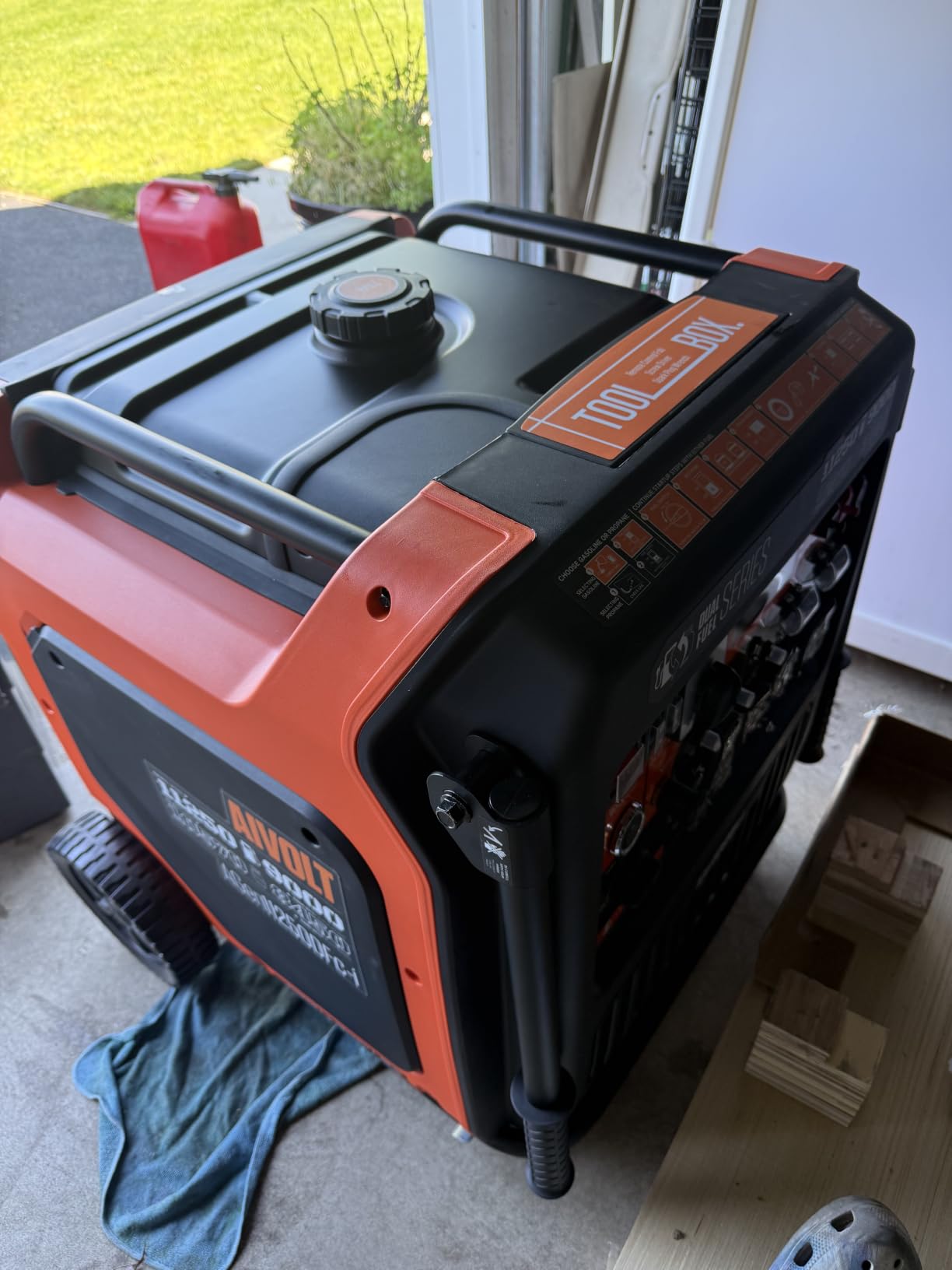
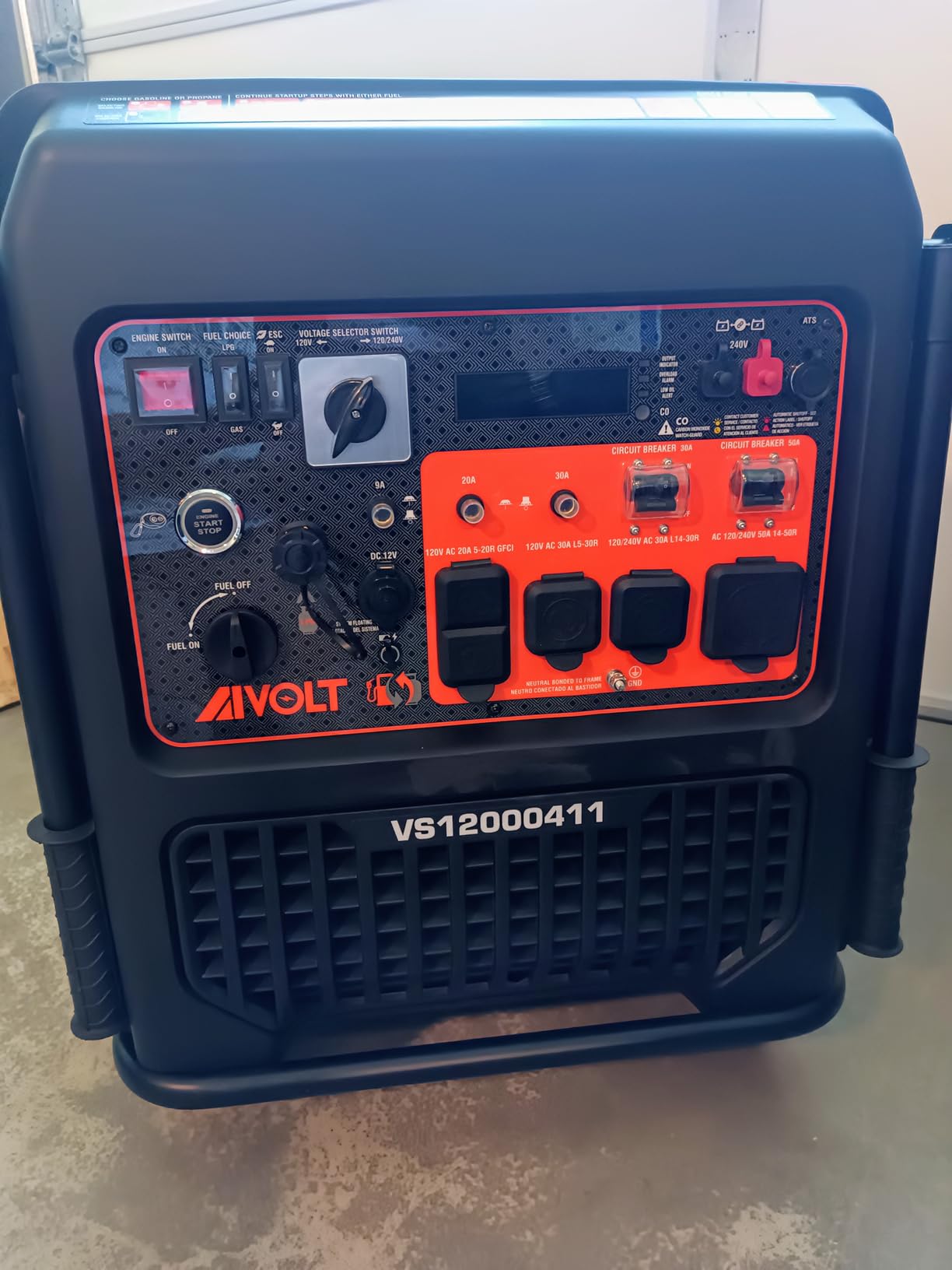
The control panel is unusually well laid out for an entry-level machine: a 5-in-1 LCD, a 120V 20A outlet, a 30 amp locking receptacle, 12V DC, and both Type-A and Type-C USB. The CO Alert sensor shuts the unit down if carbon monoxide levels climb in a poorly ventilated spot, which is a genuine safety net in a tent or a pop-up canopy.
Parallel ready is the sleeper feature. Two matching units with a parallel kit can be paired to roughly double available output, which gives you a path to 30 amp capability without owning a single loud 4000-watt machine.
The rating spread tells you something
At 4.1 average across 1358 reviews, this is the lowest-rated unit in the roundup, and the distribution is polarized: 63 percent five-star against 12 percent one-star. A well-reviewed machine in this class usually splits 80/5 or better, so this gap tells you the experience is not uniform across owners.
The specific complaints cluster around startup reliability and durability over time rather than around the electrical output. If you are comfortable buying into a machine where quality control varies unit to unit, that is a reasonable trade for the weight and noise combination.
When this is the wrong choice?
The 0.69-gallon tank is the practical problem. Owners report roughly five hours of runtime, and a fifth of that is gone by the time you finish loading the van. For an overnight generator you are refilling twice in a park where carrying fuel past dusk may itself be awkward.
Engine oil is not included and the parallel kit is a separate purchase, so the advertised dual-unit capability costs extra. Budget for both before you plan around them.
3. PowerSmart 3800W Dual Fuel Inverter Generator: Best Value Quiet Generator for Boondocking
PowerSmart 3800 Watt Dual Fuel Inverter Generator for Camping or Home Use
3300 running watts gas/3100 propane
59 dBA at 25% load
50.7 lb
24 hr on propane
Pros
- Runs on gasoline or a 20 lb propane tank
- Up to 24 hours on a standard propane cylinder
- 59 dBA in Eco Mode at 25% load
- 30A twist-lock plus 12V DC and USB
Cons
- Recoil start only
- 1.3-gallon tank needs refills overnight
- Some owners report a hard first start
Dual fuel is the feature that changes the RV math, and the PowerSmart is the most interesting version of it here. It produces 3300 running watts on gasoline and 3100 on propane, and on a standard 20-pound propane cylinder owners report runtimes up to 24 hours. That is an entire night without touching a fuel can.
The 59 dBA figure is quoted at 25 percent load in Eco Mode, which is a more honest test than most because it reflects what an idling generator actually does overnight when your fridge is cycling and nothing else is running.
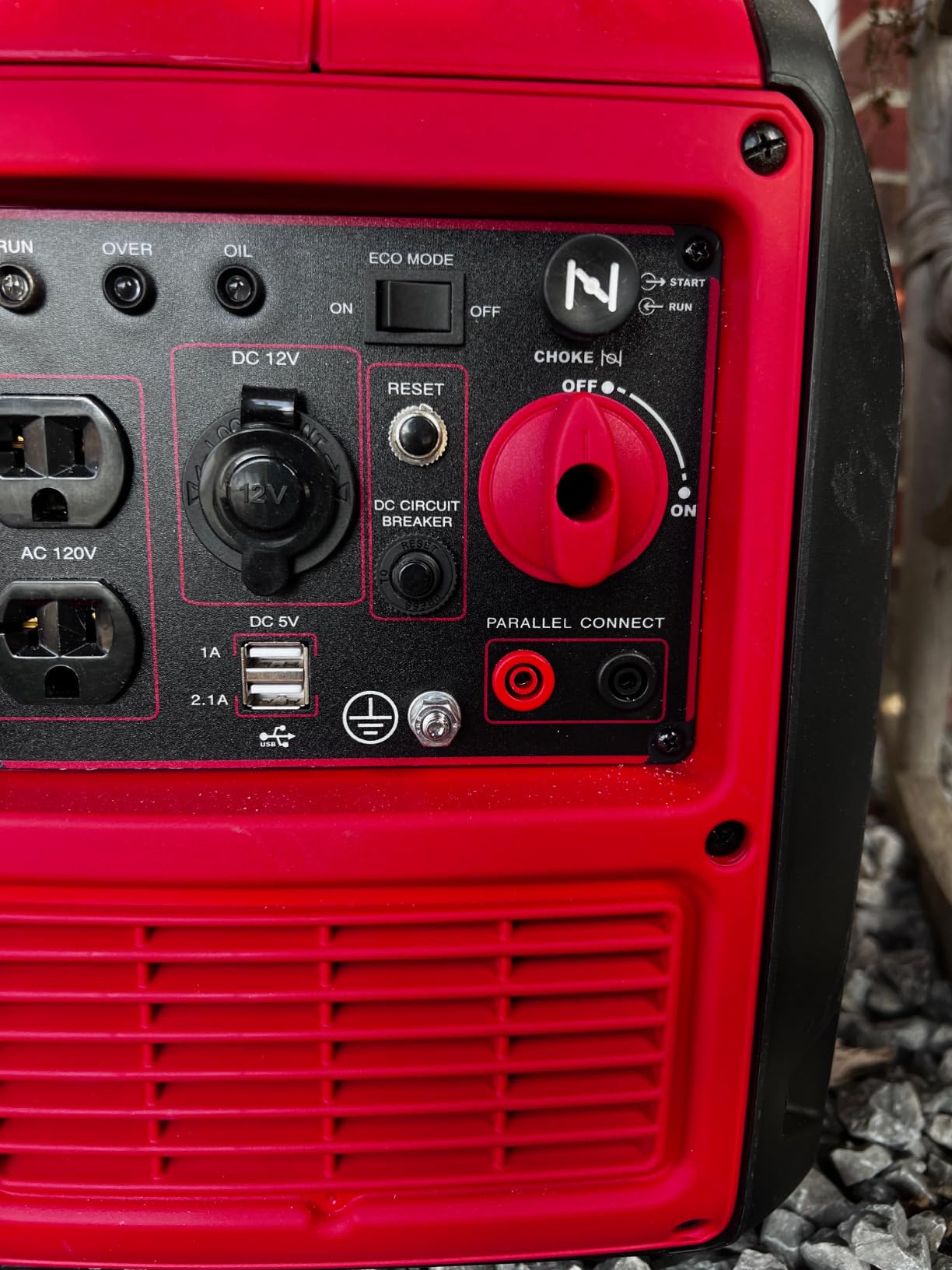
The safety suite is thorough for the class: overload protection, short circuit protection, a carbon monoxide sensor and low-oil shutdown, all certified to ANSI/PGMA G300 and ANSI/UL2201. The outlet selection includes the 120V 30A L5-30R twist-lock that most 30 amp RVs want, plus a household duplex, 12V DC and dual USB.
Owners consistently report clean, stable voltage and easy single-pull starts once the engine is broken in, and 78 percent of reviews are five-star. Lifetime technical support is included with the two-year limited warranty, which matters more than it sounds if you are three states from a dealer.
Why propane changes park etiquette?
Propane combustion is measurably cleaner than gasoline, and a generator running on a cylinder is far less likely to produce the sharp exhaust smell that triggers neighbor complaints. If you have ever been told your generator smells like a service station, this is the fix.
Two caveats. Propane output drops about 200 watts versus gasoline here, so size for the propane number if you plan to run on it primarily. And in sustained hot weather a cylinder regulator can restrict flow, so keep the tank out of direct sun and check it before a long high-demand afternoon.
Where it does not work?
Recoil start only, with no electric or remote option. In cold mornings that is a physical argument with a pull cord, and cold start technology helps but does not eliminate it. Owners also report that the first start before break-in can be genuinely difficult, which is worth knowing before a 6 am departure.
Access panels and the oil door need a Phillips screwdriver, a small irritation that matters if you are doing a mid-trip check. The 1.3-gallon gasoline tank is modest next to the propane capability, but if you plan to burn mostly propane that is a non-issue.
4. maXpeedingrods 4000W Inverter Generator: Best for Remote Monitoring in the Park
maXpeedingrods 4000 Watt Inverter Generator, Bluetooth® App Data Monitor
4000 peak/3200 running watts
48.5 lb
Bluetooth app monitor
2 year warranty
Pros
- Only unit here with Bluetooth app monitoring
- Bundled L5-30R RV outlet and adapter
- Light body at 48.5 lb with LED lighting
- Compact travel-ready footprint
Cons
- Only 2 power outlets listed
- Small 4-liter tank and recoil start
- Second-highest one-star share at 13%
The maXpeedingrods MXR4000 does one thing none of the other nine do, and it does it well. A Bluetooth app reports power output, fuel level, voltage, frequency and accumulated run hours, with remote Eco mode control from your phone. Sit in the campground office Wi-Fi or the truck at a distance and you can see the machine without walking back to the site.
Underneath the app it is a competent 4000-watt peak, 3200-watt running inverter on a 145cc four-stroke engine. The included NEMA L5-30R RV outlet and adapter mean hookup is straightforward for a 30 amp trailer.
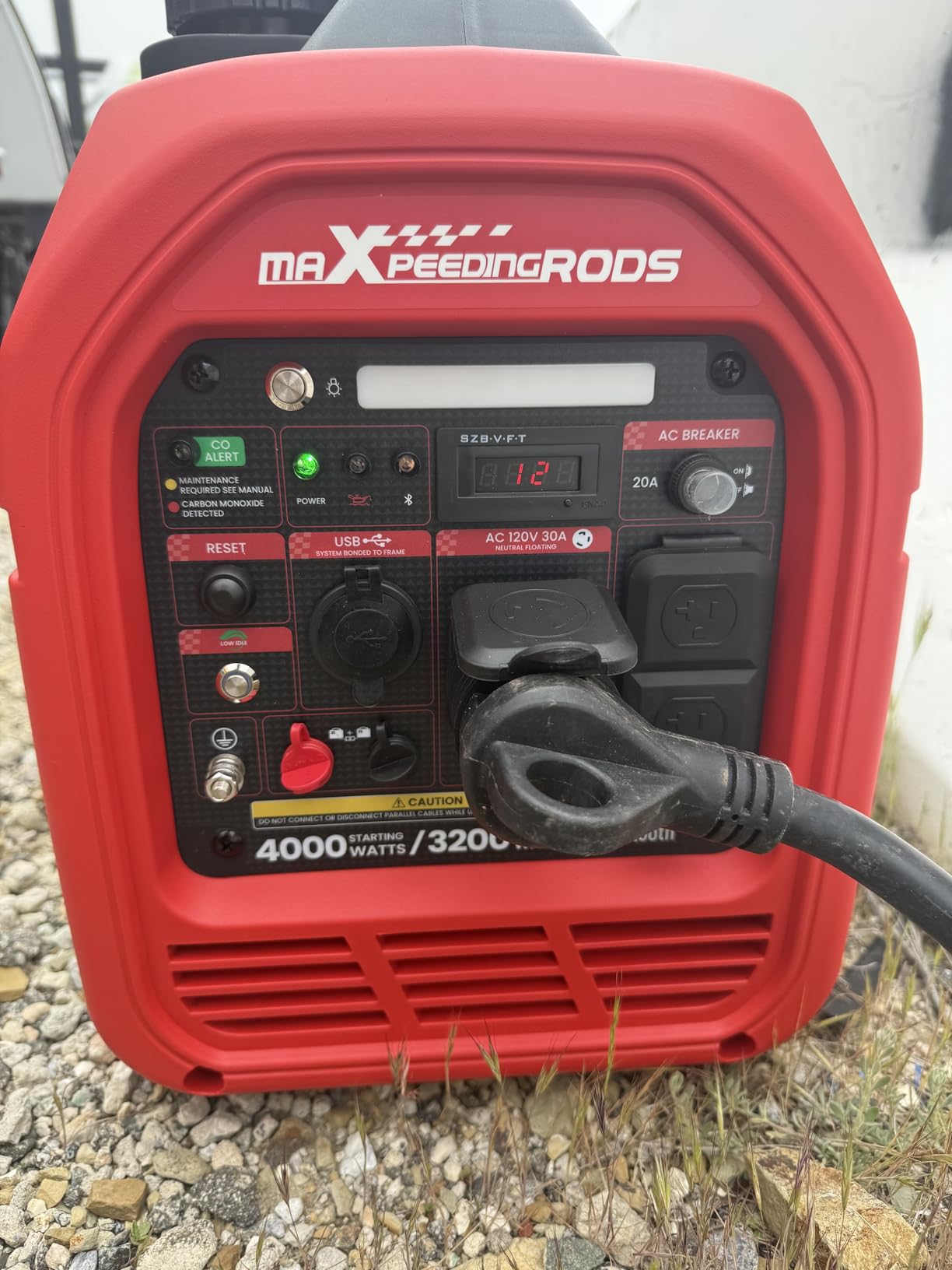
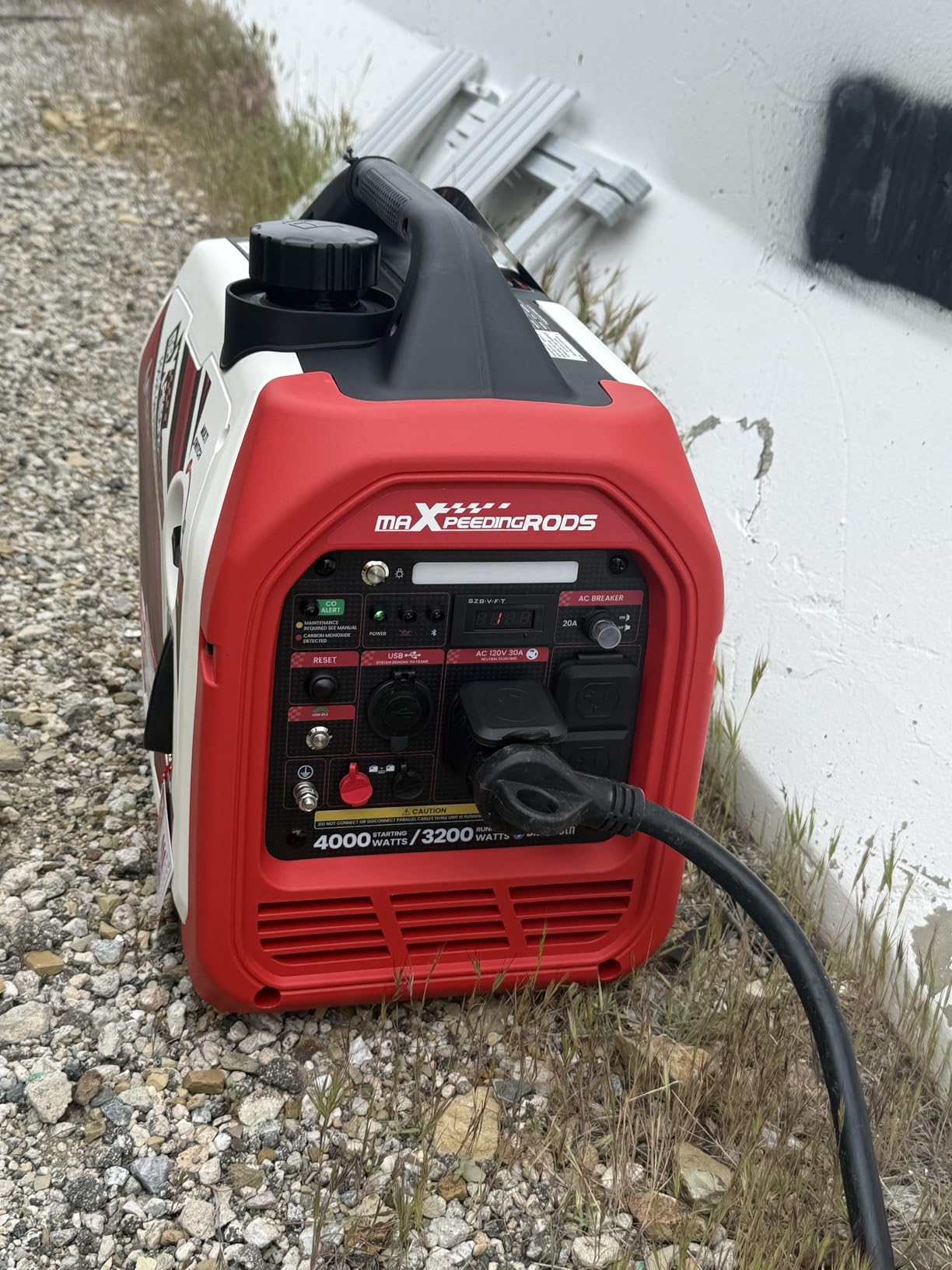
At 48.5 pounds with built-in LED lighting and an 18.89 by 12 by 17.32 inch footprint, it is one of the easier machines to reposition around a site, which matters when you want to move it away from a neighbor’s patio for the evening.
Buyers consistently mention the app and the included RV adapter as the deciding factors rather than the wattage, and that tracks with how this unit is actually used: as a campsite power anchor that you check on from bed rather than a pure output leader.
When an app is genuinely worth it?
For full-time RVers and anyone running a generator out of sight, the app replaces the guesswork. Fuel level alone is worth the pairing, because a 4-liter tank at roughly an hour of runtime means an unexpected fuel-out is a real possibility, and reading a gauge beats discovering it by dimming lights.
Voltage and frequency readouts are useful when something feels off. If a microwave trips a breaker, seeing the frequency sag in the app tells you whether the problem is the appliance or the generator.
The gaps that will annoy you
Only two power outlets are listed, which is fewer than every other unit in this roundup. You get the RV outlet and one more, and if you need a household duplex plus USB charging you are carrying a power strip.
The 4-liter tank and recoil-only start are the other friction points, and 13 percent one-star reviews make this the second-most polarized machine here. Owners report reliability and support friction more than any specific defect, so treat the app as the feature you are buying and check the warranty terms before committing.
5. Oxseryn 4400W Open Frame Inverter Generator: Best for Raw Wattage on a Tight Budget
Oxseryn Power Equipment 4400 Watts Inverter Generator Gas Powered, Portable Open Frame Generator, Low Noise with ECO Mode, RV Ready, Emergency Home Backup
4400 peak/3400 running watts
72 dBA at 23 feet
56 lb
14 hr runtime
Pros
- 3400 running watts from an open frame
- Up to 14 hours at 25% load with a fuel gauge
- 2x 120V AC plus 12V DC and an RV port
- 56 lb makes it easy to reposition
Cons
- 72 dBA at 23 feet is the loudest figure here
- Only 1-year manufacturer warranty
- Open frame is less enclosed than the rivals
I am including this one with a clear warning, because it is the only unit here I would not place next to an occupied site. The 72 dBA rating at 23 feet is the loudest figure in this roundup by a wide margin, and applying the standard conversion puts it somewhere in the low 60s at 50 feet. That is at or above the line many campgrounds use.
What it does offer is output for the money. A 208cc engine delivers 4400 peak and 3400 running watts, with a 2-gallon tank and fuel gauge giving up to 14 hours at 25 percent load. Owners routinely rate it 4.5 out of 5, with 73 percent five-star, largely on value.
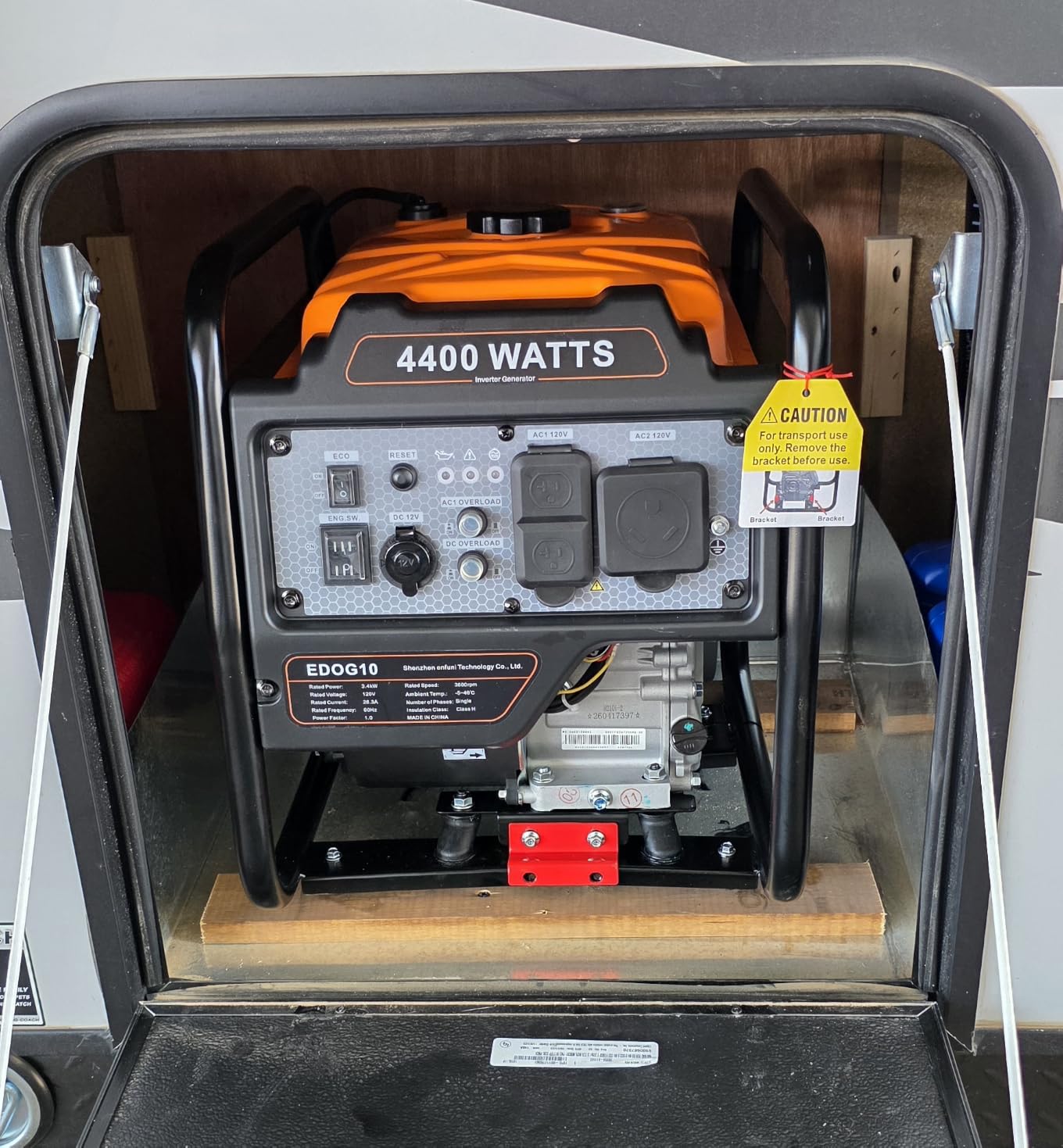
The output selection is more generous than the maXpeedingrods, with two 120V AC outlets, a 12V DC outlet and a dedicated RV port. At 56 pounds it is light enough to move around a site without a second person, which is genuinely useful if you need to reposition it for daylight hours.
Owners describe quietness as adequate rather than impressive, which is an honest way to put it. In a wide, lightly occupied campground loop, run during the middle of the day, it is a perfectly reasonable machine. Under quiet hours between close neighbors, it is not.
Where open frame actually helps?
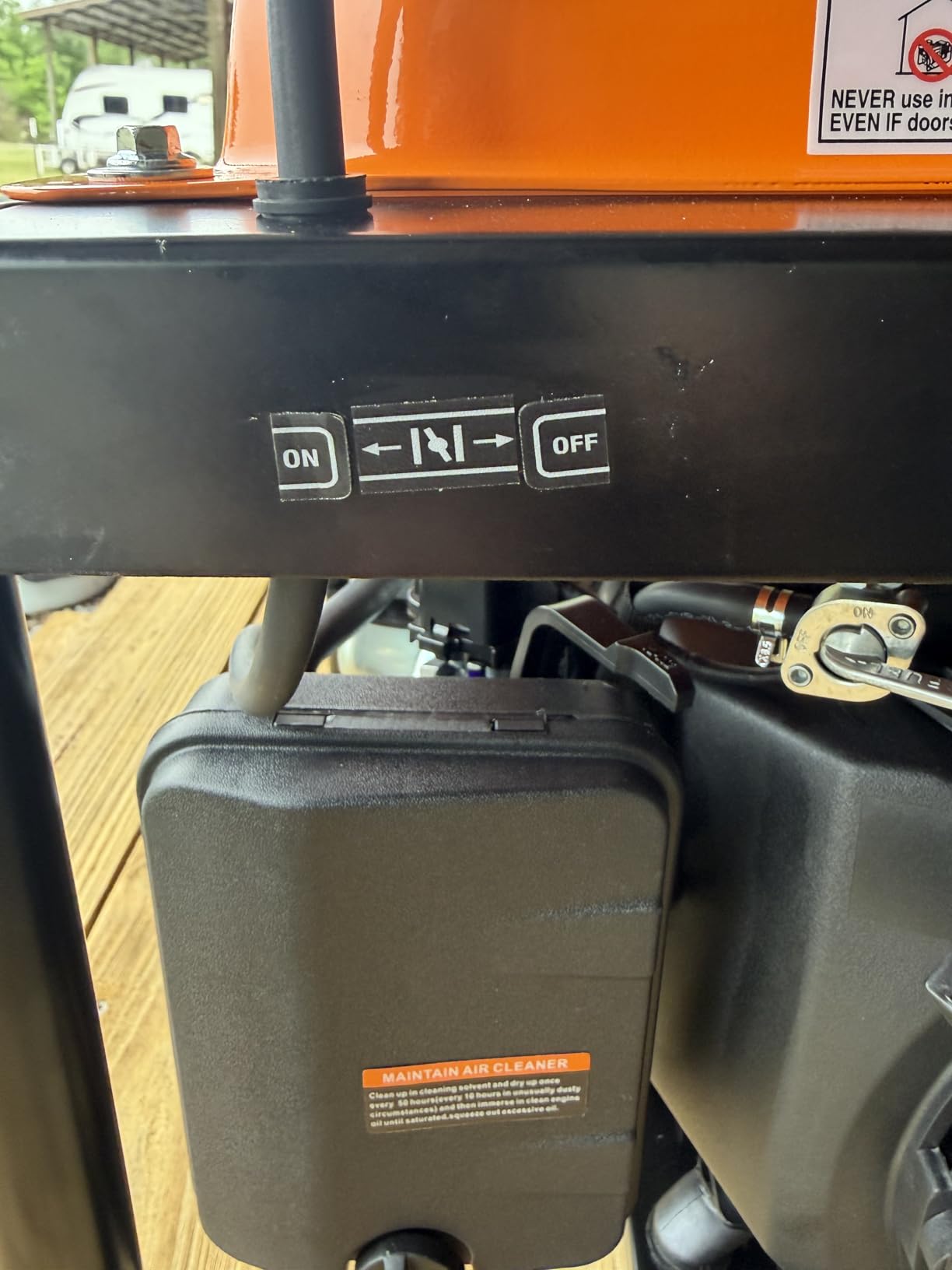
An open frame exposes the engine and exhaust with less acoustic enclosure than a closed inverter housing, which is exactly why it is loud. In exchange you get easier service access, better heat dissipation in sustained high-load use, and a lower manufacturing cost that shows up in the number.
If your load is genuinely large, say two air conditioners or a heavy workshop draw, the headroom is real. Extra watts under sustained load produce less strain and less bogging than a smaller inverter at its ceiling.
Why most RV park campers should pass?
The 72 dBA rating is the whole problem. Forum discussion on r/GoRVing captures the frustration well: units can be compliant and technically quiet and still be incredibly annoying when they are twenty feet from your slide-out at eleven at night. Volume compliance is not the same as neighbor tolerance.
The one-year manufacturer warranty is also the shortest in the group, against two to three years from every rival here. If you buy it, register it immediately and keep the fuel fresh, because that warranty is your real protection.
6. Champion 4000W RV Ready Portable Inverter Generator: Best Quiet Generator for 30 Amp Sites
Champion 4000-Watt RV Ready Portable Inverter Generator
4000 start/3000 running watts
64 dBA at 23 feet
48.1 lb
10 hr runtime
Pros
- 48.1 lb is one of the lightest 4000-watt inverters
- 64 dBA suits camping and RV sites
- CO Shield carbon monoxide auto shutoff
- TT-30R outlet with under 3% THD
Cons
- Recoil start only
- 3000 running watts is modest for the class
Experienced owners on rvforum.net name Champion alongside Honda and Yamaha as the benchmark for quiet inverter generators, and this 4000-watt model is the most park-appropriate of the three Champion units in this roundup. It carries a 4.6 rating across 680 reviews, with 84 percent five-star, tied for the highest share in the set.
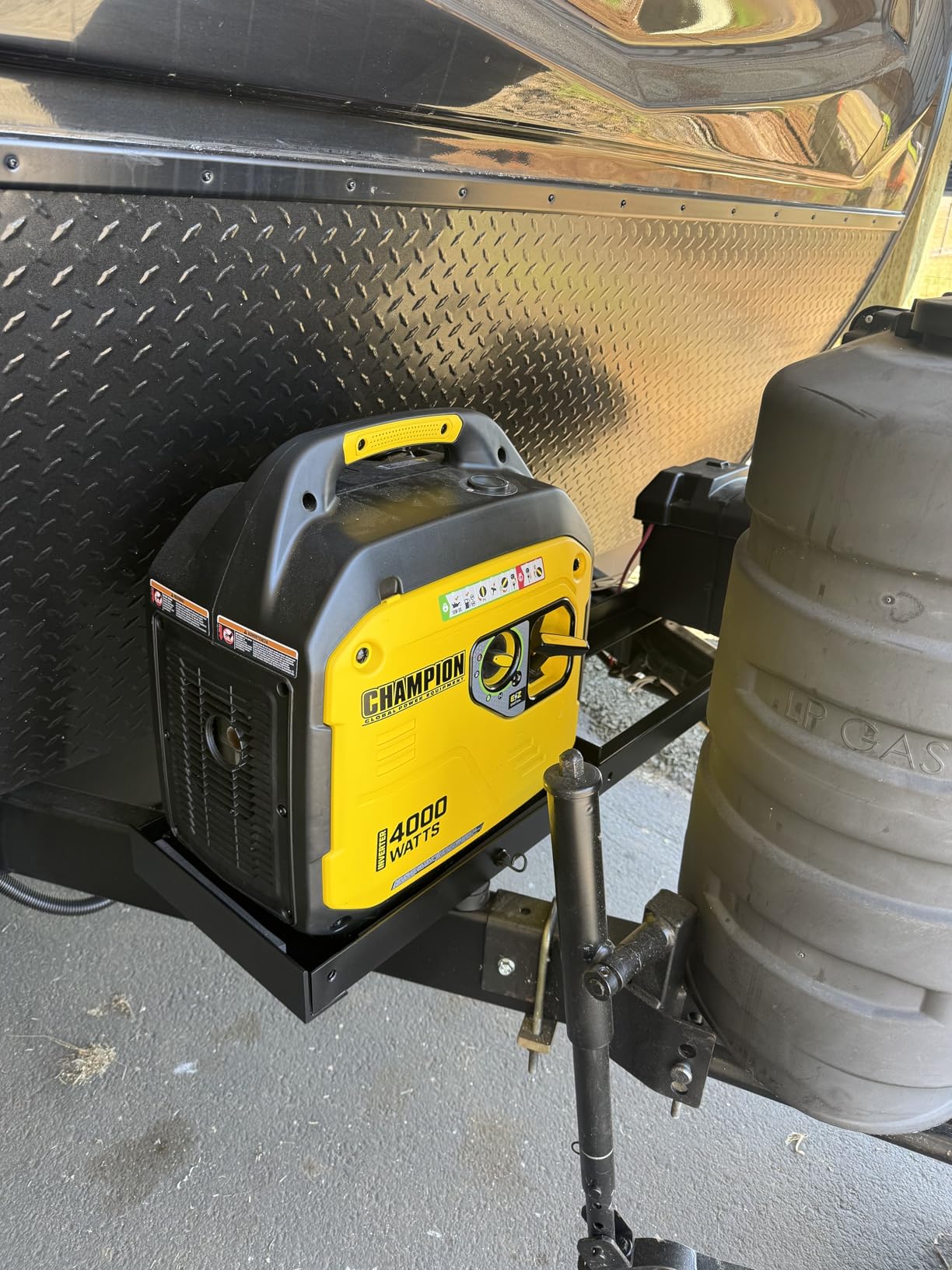
At 48.1 pounds it is one of the lightest 4000-watt inverters available, which is the number that decides whether you can carry it from the truck to the pad alone. The 17.9 by 11.7 by 19.7 inch footprint is genuinely small.
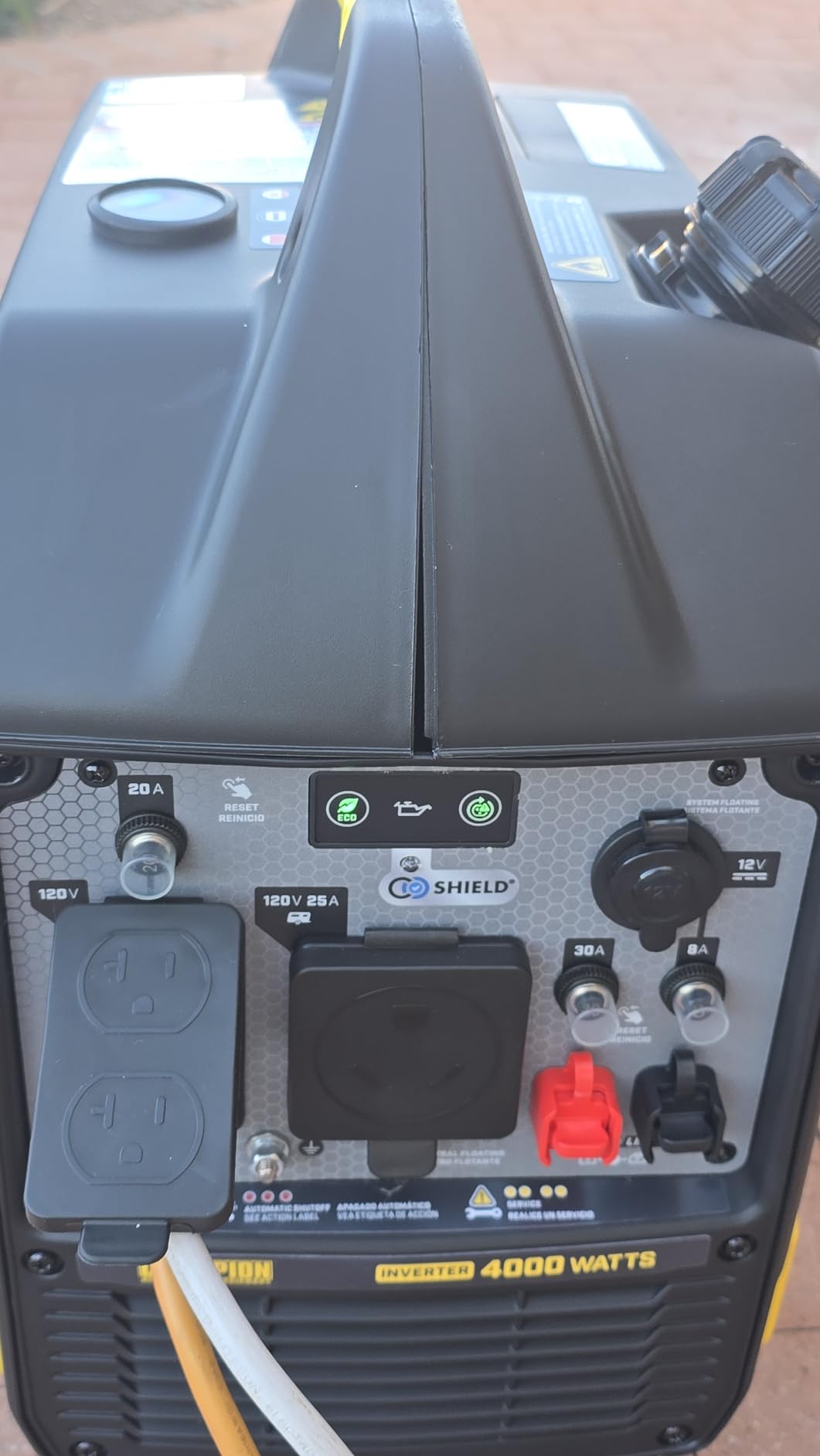
The 64 dBA rating at 23 feet converts to roughly 56 dBA at 50 feet, which sits comfortably inside a 60 dBA standard with margin. The engine produces 4000 starting watts and 3000 running watts with up to 10 hours of run time from a 1.54 imperial gallon tank.
CO Shield is a carbon monoxide auto shutoff that kills the engine if levels climb in an enclosed space, and the outlet configuration includes a 120V 25A TT-30R RV receptacle, a household duplex at under 3 percent THD, a 12V automotive outlet and parallel ports for an optional kit.
Matching it to a 30 amp travel trailer
A 30 amp trailer typically draws 1200 to 1500 watts in normal use and spikes to 3000 or more on compressor startup. The 3000 running watt figure sits right at that ceiling, which means the machine is well matched to a single portable air conditioner plus modest appliances, and will feel tight if you add a microwave at the same moment.
The optional parallel kit is the escape hatch. Two of these paired together give you the headroom of a much larger unit while each individual engine stays small enough to run quietly, which is the two-small-units strategy owners on r/RVLiving describe using with paired 2000-watt Hondas.
What to know before you buy?
Recoil start only. It is the most common complaint in the reviews, and while cold start technology helps, an electric start is genuinely better for a unit you will start in the dark at 6 am.
Also read the 3000 running watts carefully rather than the 4000 headline. Owners comparing it against rivals in the same band with 3400 to 3500 running watts notice the difference under load, so if your setup is heavier than a single AC, step up a size or plan on pairing.
7. Champion 4250W Dual Fuel Open Frame Inverter Generator: Best for Long Dry Camp Runs
Champion 4250-Watt Dual Fuel Portable Open Frame Inverter Generator, CARB
4250 start/3500 running watts
64 dBA
79 lb
22 hr on gasoline
Pros
- Up to 22 hours on gasoline from a 4-gallon tank
- Runs on gasoline or propane
- 30A RV outlet plus two household outlets
- Economy mode cuts fuel use
Cons
- Bulky 27.9 by 23.4 by 21.7 inch footprint
- 79 lb makes it one of the heavier units here
This is the endurance machine of the roundup. A 4-gallon tank and a stated runtime of up to 22 hours on gasoline means you can run it from dinner to breakfast without a fuel run, which is exactly the scenario a dry camping trip creates. Owners describe long, trouble-free service and easy oil changes.
It is a 224cc four-stroke dual fuel design producing 4250 starting watts and 3500 running watts on gasoline, with a 64 dBA operating level. The 30 amp RV outlet plus two 120V household outlets and 12V DC with a dual USB adapter covers a 30 amp trailer with headroom to spare.
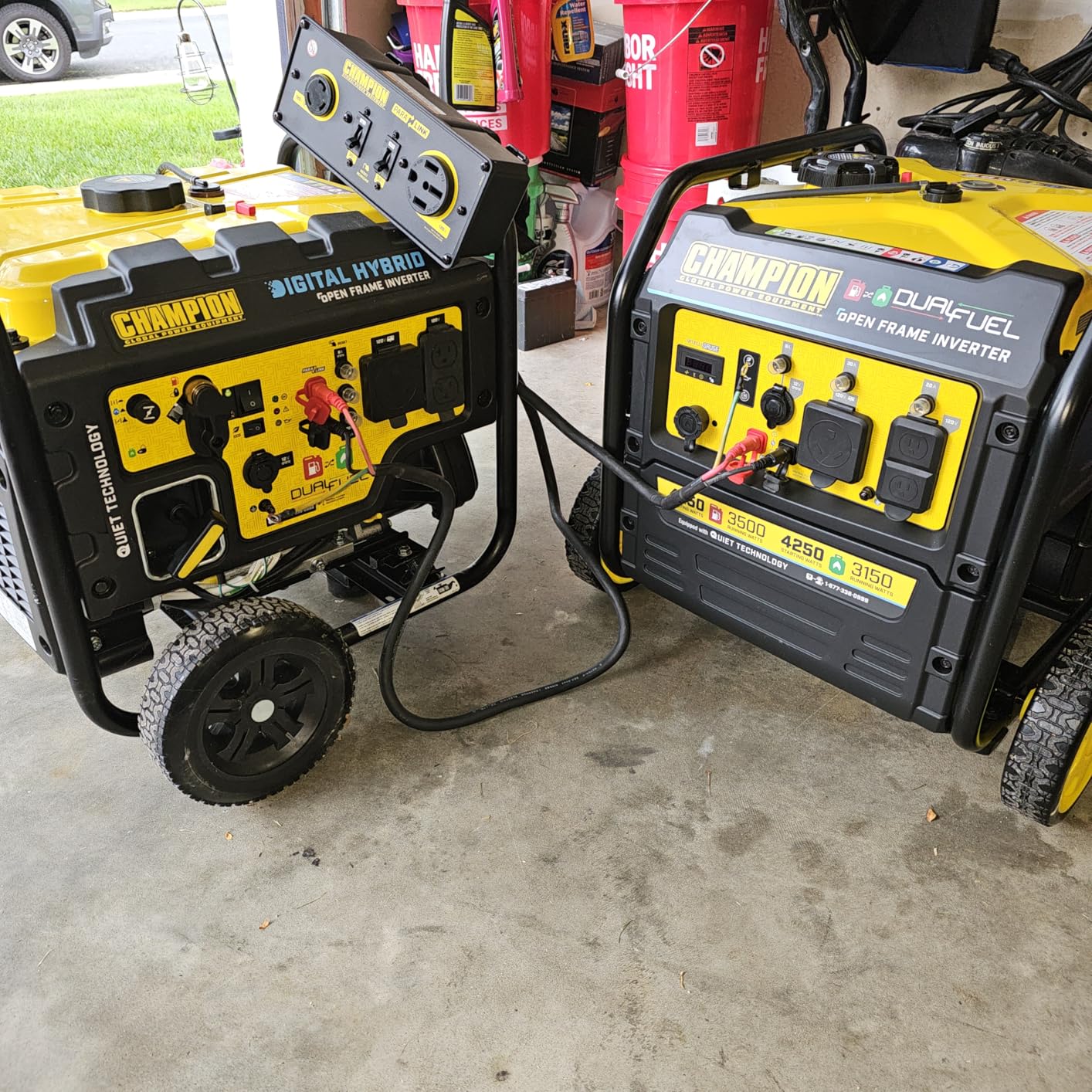
Champion describes the design as 50 percent quieter and 20 percent lighter than a traditional 3500-watt generator, and at 64 dBA against the open-frame Oxseryn’s 72 dBA in this same list, the manufacturer claim holds up on paper. Economy mode further trims consumption at light load.
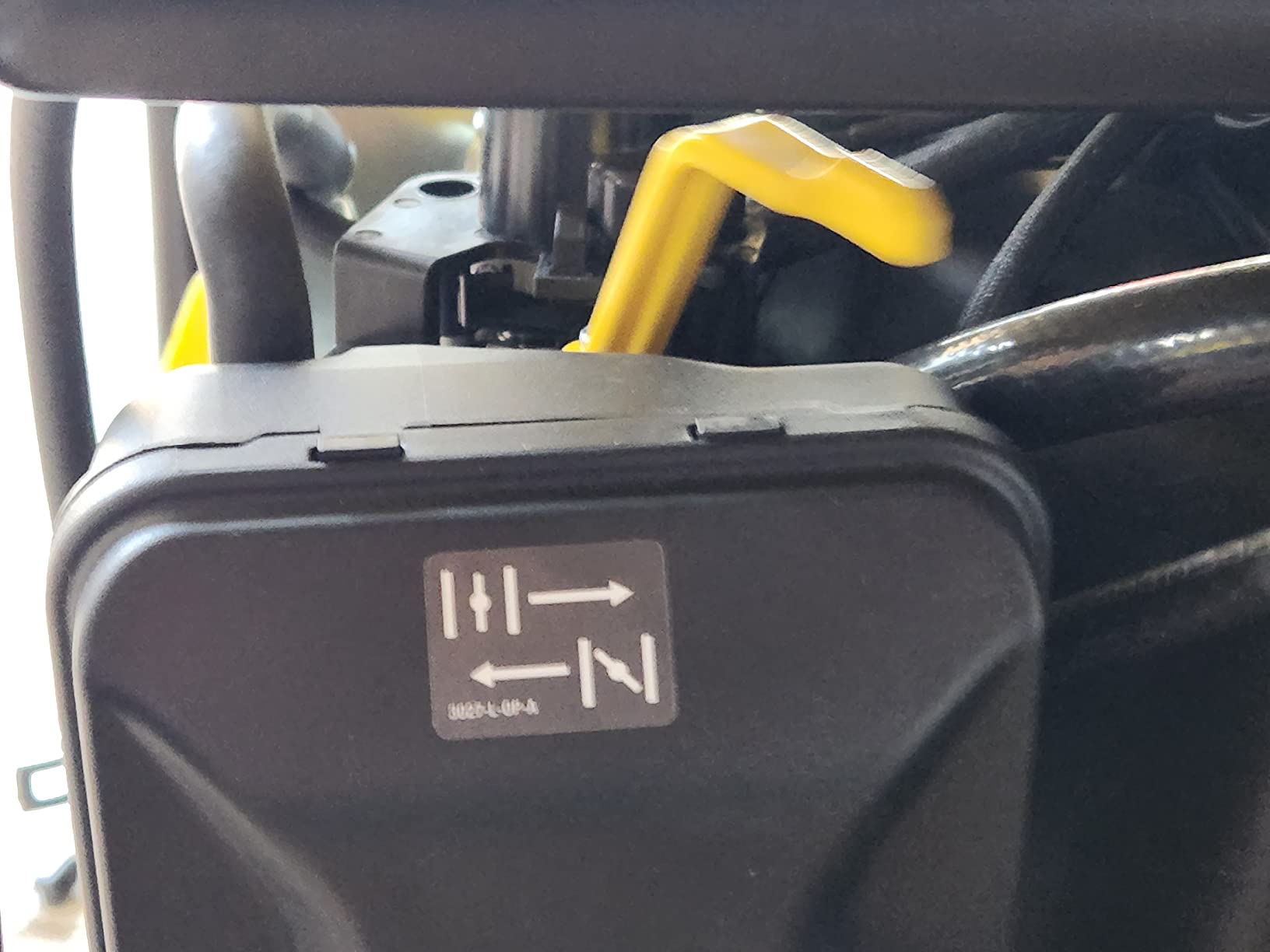
It is parallel ready through the optional ParaLINK kit, so you can pair two together for a fifth wheel without giving up the long tank runtime.
When 22 hours of runtime changes the trip?
On a boondocking trip, refueling is a scheduled activity, not an afterthought. A machine that covers a full day on one tank removes a task from a day already full of driving, hiking and setting up camp, and it reduces how often you handle a fuel can at dusk.
Combined with propane capability, this is a genuinely flexible long-run setup: gasoline for a high-output afternoon, propane overnight where exhaust smell matters more than the 350 watts you give up.
The size and weight problem
At 27.9 by 23.4 by 21.7 inches and 79 pounds, this is one of the heavier and by far the bulkiest machines here. Loading it into a pickup bed or a pass-through storage compartment takes planning, and it is not a one-person lift.
It is also larger and costlier than compact 30 amp-capable alternatives, and bulk plus weight are the two drawbacks owners name most often. If your runtime needs are modest, the trade is not worth it. If you are out for a week, the 22-hour figure is the reason to keep looking past the lighter units.
8. Pulsar PGD40ISCO 4000W Quiet Inverter Generator: Best Lightweight Quiet Generator for Solo Campers
Pulsar PGD40ISCO Ultra Light Quiet 4000W Portable Gas Inverter Generator, white
4000 peak/3200 rated watts
59 dB
47.3 lb
4 hr at half load
Pros
- Lightest body here at 47.3 lb
- 59 dB published rating suits close sites
- Handles portable AC up to 13500 BTU
- Parallel ready with a 3-year warranty
Cons
- 1-gallon tank gives about 4 hours
- Gasoline only with no propane capability
- Only 3 power outlets
At 47.3 pounds the Pulsar PGD40ISCO is the lightest body in this roundup, and the 59 dB rating is among the lowest published figures here. For a solo camper or anyone loading a generator alone into a truck bed, that combination is the entire pitch, and it works.
Output is 4000 peak watts and 3200 rated watts, enough for a 30 amp trailer with one portable air conditioner rated up to 13500 BTU. The clean inverter output suits sensitive electronics, which is the common use for a machine this size.
Buyers emphasize the combination of low weight, quiet operation and clean power, and 74 percent of reviews are five-star. Parallel ready means two units can be combined, and the 3-year limited warranty is one of the longer commitments offered in this price band.
It is worth noting how a low-noise figure behaves here. A 59 dB rating converts to roughly 51 dBA at 50 feet, which is the sort of margin that lets you sit the unit 20 to 30 feet from your own RV without the neighbors hearing an engine.
Why weight changes your site choice?
Lighter is not a vanity metric in a campground. The unit you can lift alone you will actually move, and moving it is what lets you run it during daylight hours when you are away from the site, then bring it closer at dusk when you need it. A 99-pound machine tends to stay in one place, and where you put it on arrival is where it stays.
That relocation habit is one of the most effective noise reductions available, and it is the reason our enclosed-generator guide recommends planning placement before you unpack the rest of the site.
Where the small tank bites?
The 1-gallon tank gives about 4 hours at half load, the shortest runtime in this roundup. That is fine for an evening of a fridge, some lights and charging. It is not fine for a full night, and it is not fine for running an air conditioner through a warm afternoon.
It is gasoline only, so there is no propane option if you would rather not carry liquid fuel, and the outlet count of three is the second lowest here. Budget accordingly and treat this as an evening and light-duty machine rather than an all-day power source.
9. Champion 4500W Electric Start Dual Fuel Inverter Generator: Best for Dual Fuel Comfort Loads
Champion 4500-Watt Electric Start Dual Fuel Portable Inverter Generator
4500 start/3500 running watts
61 dBA
electric start
14 hr gas/21 hr propane
Pros
- Electric start with an EZ Start Dial
- 61 dBA with 14 hours on gasoline and 21 on propane
- Intelligauge tracks voltage and run hours
- CO Shield auto shutoff
Cons
- 99.2 lb is a two-person lift
- Higher cost than the rest of the line
- A minority report oil leaks and CO sensor trips
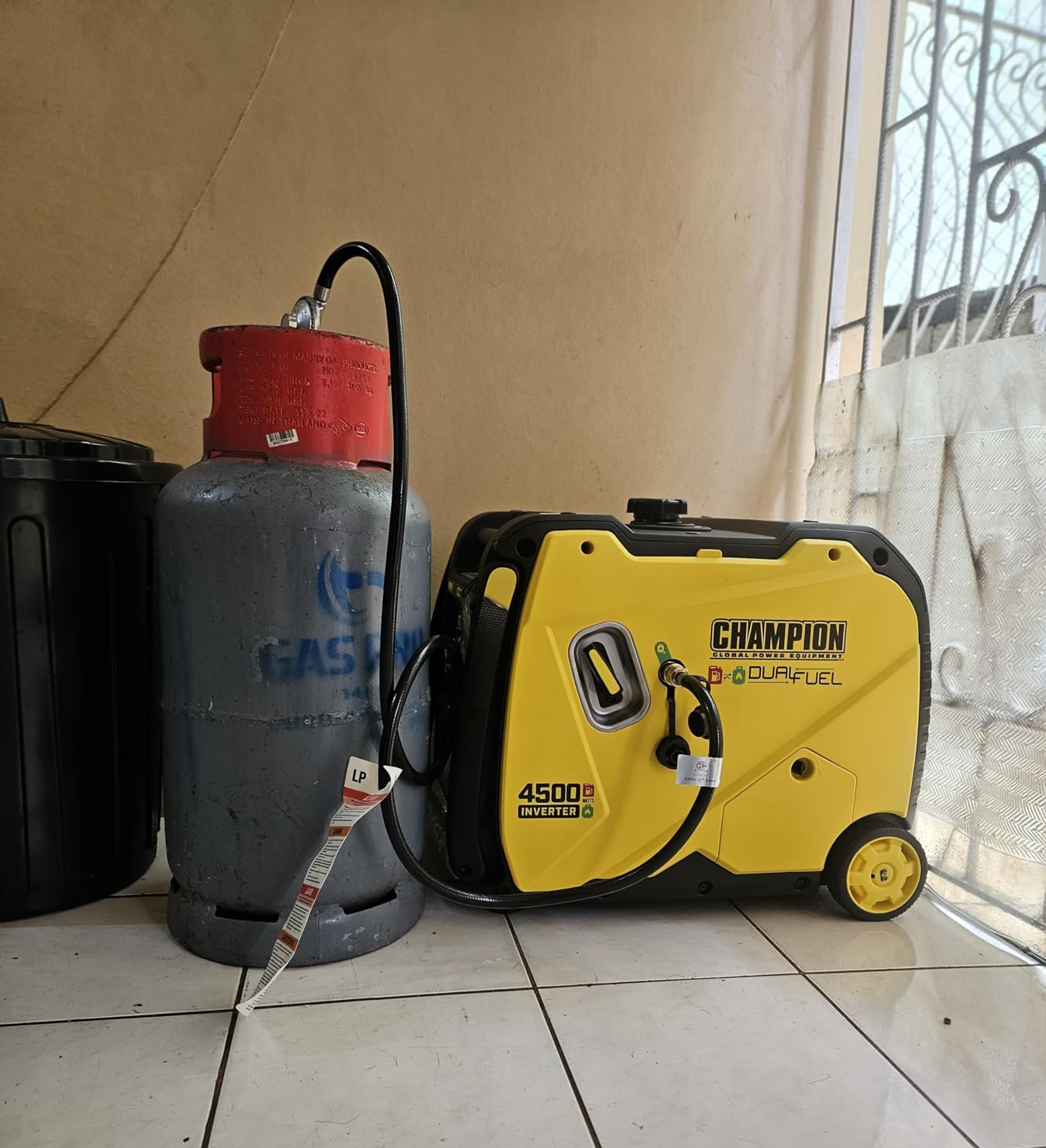
The 4500-watt Champion is the most complete package in this roundup for a camper who wants both fuel types and does not want to pull a cord. The EZ Start Dial turns startup into a twist of a control rather than a physical effort, which matters at altitude, in cold weather and in the dark.
It produces 4500 starting watts and 3500 running watts on gasoline, dropping to 3150 on propane, with up to 14 hours on gasoline or 21 hours on propane. The 61 dBA rating sits near the quiet end of the group, which makes it a good fit for a larger fifth wheel that needs real output without the noise of a conventional open-frame unit.
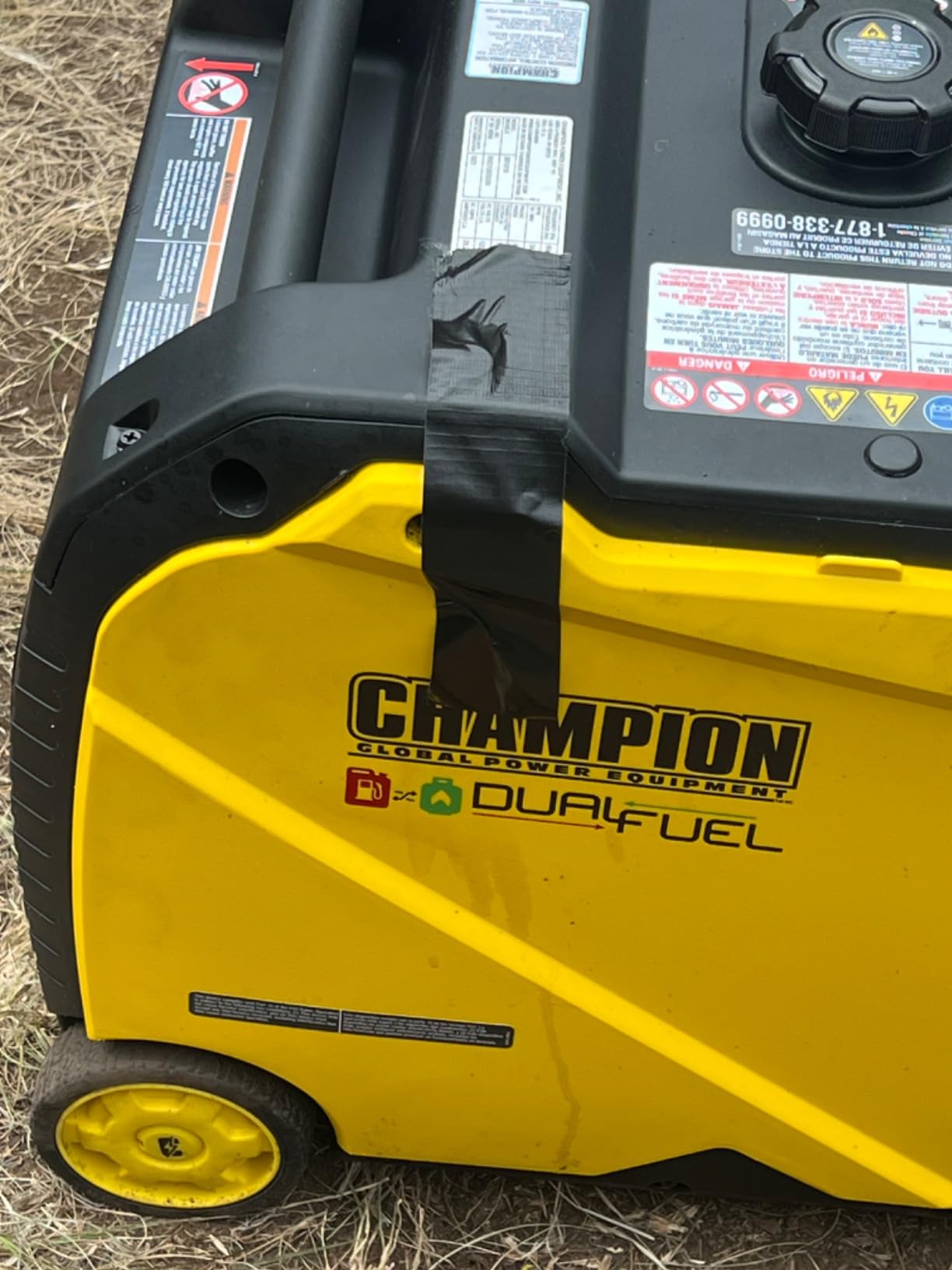
Intelligauge with a power meter tracks voltage, frequency and cumulative operating hours, which is genuinely useful for scheduled maintenance and for verifying your own load. CO Shield handles the carbon monoxide shutdown, and the unit is parallel ready with an optional kit.
Owners running campground and off-grid duty report long, trouble-free service and easy oil changes, and 80 percent of reviews are five-star. This is the unit we would look at first for a 50 amp fifth wheel that also carries a portable air conditioner.
Why electric start is worth paying for?
Recoil start is a physical task that gets harder with age, cold and altitude. An RV park at 8,000 feet is thin air, and a machine that fires on the first dial turn instead of the fourth pull is simply less frustrating, particularly before sunrise.
There is a second benefit. Remote start capability on electric-start models is what makes pairing with a battery-based setup or an unattended duty cycle practical, because you do not have to physically attend the machine.
The weight and the support caveats
At 99.2 pounds this is tied for the heaviest in the roundup and needs two people to load. Combined with the higher cost, it is a deliberate commitment rather than a casual purchase, and it only makes sense if you genuinely need the output.
A minority of owners report oil leaks and hard starting, and some describe needing well-ventilated placement to avoid CO sensor shutdowns. That last point is not a flaw, it is the sensor working correctly, but it does mean you cannot tuck the unit into an enclosed storage bay and close the door. Read our enclosed generator guide for placement specifics.
10. BILT HARD 4500W Dual Fuel Inverter Generator: Best Low-Noise Dual Fuel Pick
BILT HARD Dual Fuel Gas & Propane Powered Generator 4500W, Gas & Propane Powered Generator with CO Sensor, RV Ready, Parallel Capable, 4-Cycle Engine Portable Outdoor Generators for Home, Camping
58 dBA at 23 feet
3500 running gas/3200 propane
57.7 lb
13 hr runtime
Pros
- Fully enclosed design rated 58 dBA at 23 feet
- Dual fuel with LPG hose and regulator included
- TT-30R RV outlet plus USB and 12V DC
- Under 3% THD clean inverter power
Cons
- Only a 1-year warranty
- Recoil start only
- Parallel kit not included
The BILT HARD combines the lowest published decibel figure in this group with dual fuel capability, and that pairing is unusual. At 58 dBA at 23 feet the fully enclosed design converts to roughly 50 dBA at 50 feet, which is about as much noise headroom as you can buy under a campground limit.
It is genuinely capable underneath. A 141cc OHV air-cooled engine produces 4500 peak and 3500 rated watts on gasoline, or 4150 peak and 3200 rated on propane, with the LPG hose and regulator included in the box rather than sold separately.
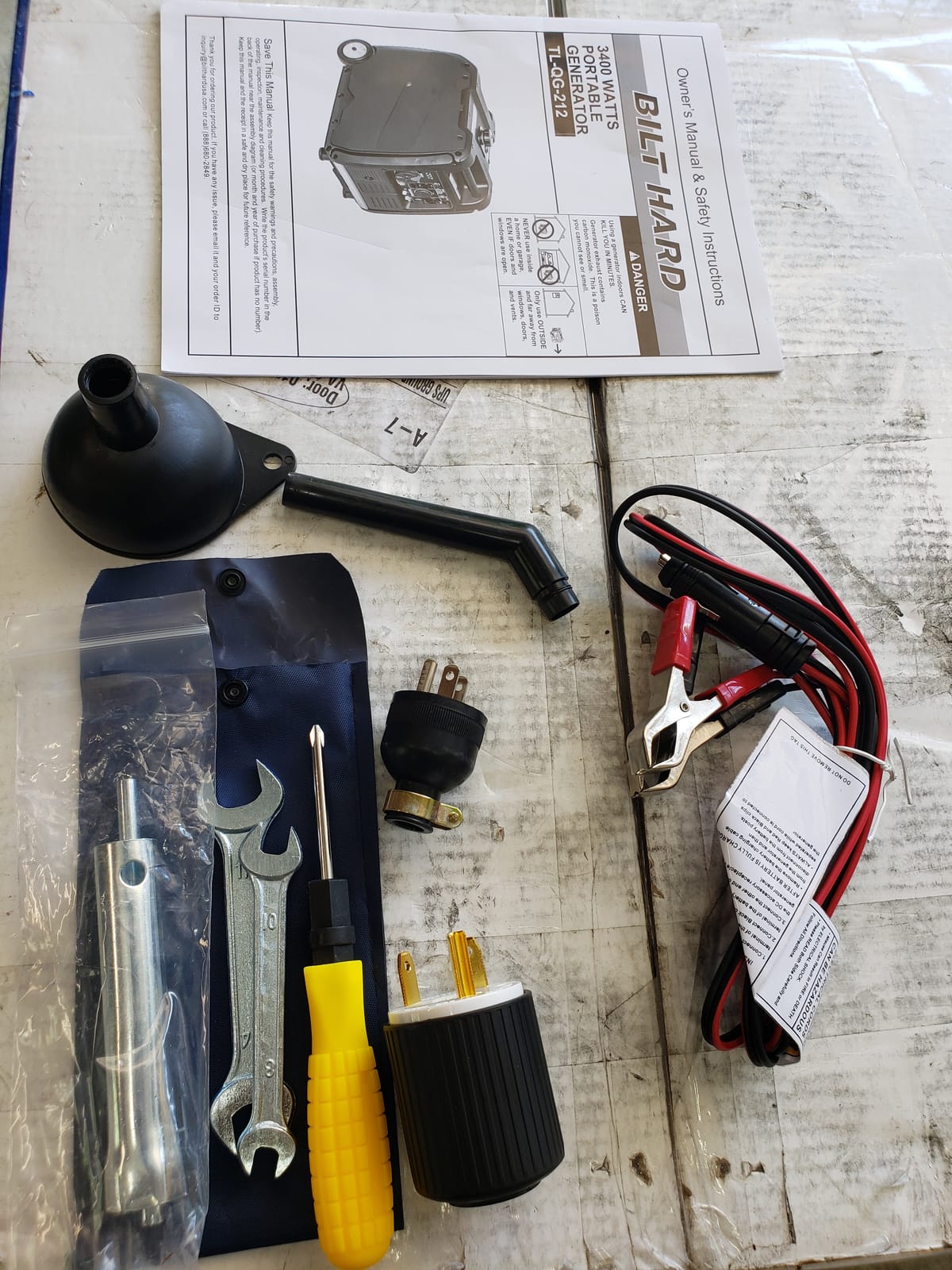
The output is clean inverter power under 3 percent THD, delivered through a 120V 20A NEMA duplex, a 120V 30A TT-30R RV outlet, dual USB ports and a 12V 8A DC output, all circuit breaker protected. An integrated CO sensor with automatic shutdown is standard, and the unit is parallel capable if you buy the kit.
At 57.7 pounds with a built-in handle, it is one of the more portable machines for its output class. Buyers rate it highly for enclosure-based quietness and RV-ready outlets, with 76 percent five-star reviews.
Why enclosure matters more than the number?
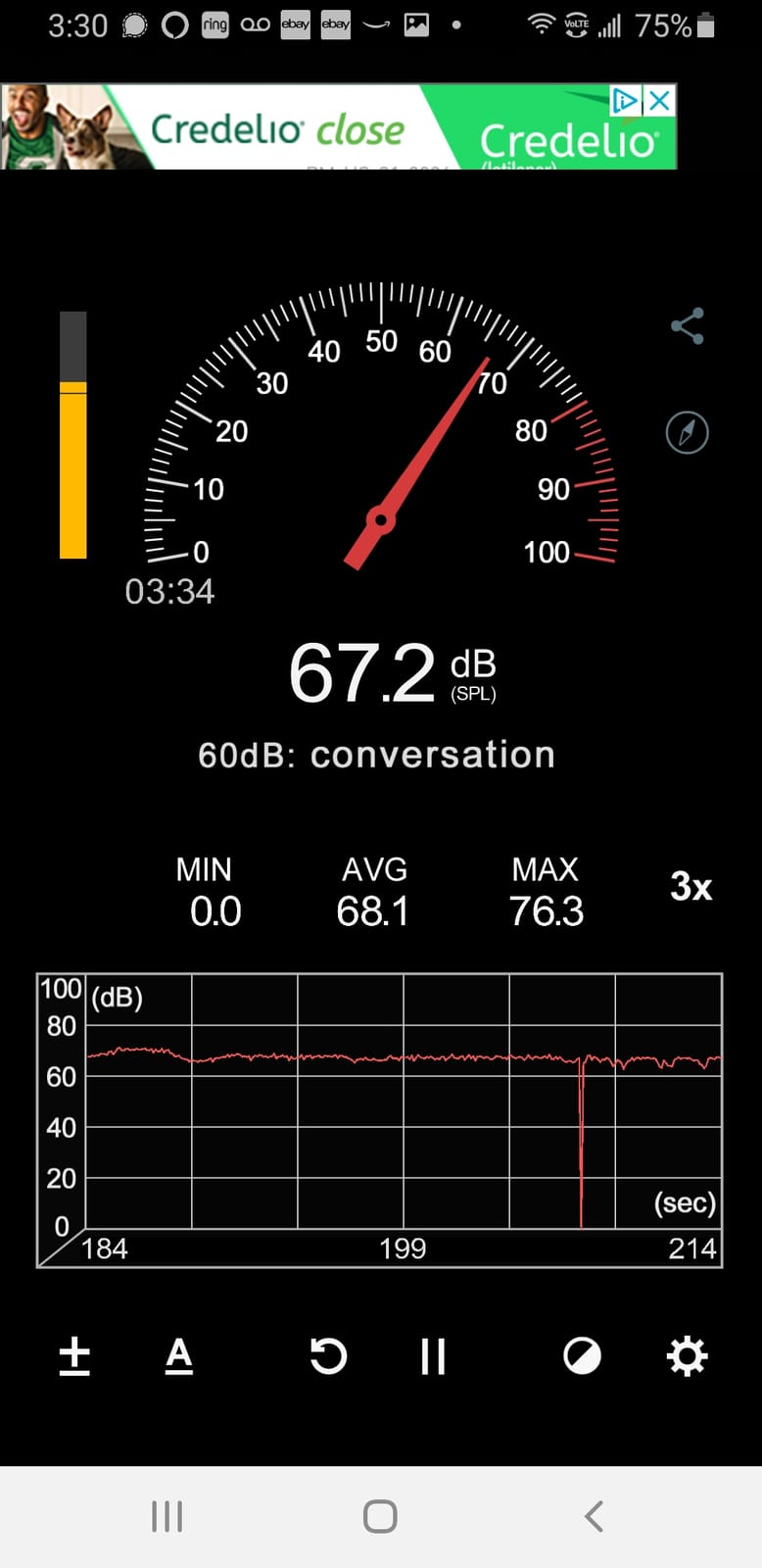
The gap between 58 dBA and 64 dBA is only 6 dB, and the logarithmic scale means that is a modest perceptual step. It matters more than the step size suggests because it is measured at a site where you are competing with a refrigerator hum, an air conditioner and a neighbor’s television.
Enclosure is the physical reason for the number. A fully closed housing with acoustic insulation dampens both the engine firing pulses and the mechanical vibration that transmits through a generator frame into a campsite pad. Open frames leak sound at every seam.
Buying carefully around a small review base
With 226 reviews, this is the smallest sample in the roundup, which means the 4.5 average is less well established than the others. That is a real consideration when you are buying something that will be your only power source for a week.
The one-year warranty is among the shortest here and recoil start is the only ignition option, which is frustrating on a machine this capable. The separate parallel kit is another add-on. If the enclosure-based noise rating is your priority and you accept the warranty trade, it is a strong fit.
RV Park Rules, Quiet Hours, and What to Do When Someone Complains
Most campgrounds and RV parks allow portable generators, and the restriction is almost always about time and noise rather than permission. The common pattern is a posted limit of 60 dBA at 50 feet, with quiet hours running from 10 pm to 6 am. A minority of parks go further and cap generator runtime to a one or two hour daytime window for recharging, which is worth knowing before you book rather than after you arrive.
Running overnight is usually not legal to ignore, and that is the single most common misconception. It is usually permitted during permitted hours, and discouraged, and sometimes permitted only at levels your neighbors will not hear. The practical reading of a quiet hours sign is that you may run, but only at a level that does not disturb.
Enforcement is where reality diverges from the sign. Forum discussion describes quiet hours as frequently ignored by other campers and rarely enforced by park staff, which means neighbors end up managing the conflict themselves. A camper on r/camping put the cultural test plainly: if you have ever wondered whether running a generator all day annoys other campers, the answer is always yes.
If a neighbor does raise it, the pattern that works is unremarkable. Run your machine during daylight hours when you are out of the site, bring it closer only when you need it, orient the exhaust away from their site and away from your own RV windows and slide-outs, and check whether your unit has an eco or low-idle mode to drop RPM at light load. If it escalates, go to the park office rather than negotiating directly, since the office is the only party with actual authority over the rule.
Our guide to inverter generators for quiet backup power covers the load-side decisions that reduce the need to run at all.
How to Make a Generator Quieter Without Creating a Safety Problem?
Before anything else: never put a running generator inside a box, a tarp or a foam shelter. Owners on r/RVLiving and other forums push back hard on this advice, and they are right. An enclosure that traps exhaust creates a carbon monoxide hazard, which is a far worse outcome than being a slightly inconsiderate neighbor. A sound shield only works if it is a purpose-built, ventilated enclosure that leaves the exhaust and cooling airflow completely clear.
Move the unit. Distance is the cheapest noise reduction available. Placing a generator 20 to 30 feet from your RV, rather than directly beside the slide-out, changes the sound that reaches you more than any accessory.
Set the load properly. Right-sizing a generator to your actual draw is a significant reduction. A 4000-watt unit throttling a 1400-watt load is louder than a 2000-watt unit running near its sweet spot.
Use eco mode. Low-idle or eco mode drops engine RPM when the load is light, which is the overnight condition when noise is most likely to wake a neighbor or a child.
Put it on the right surface. A generator on soft soil or grass transmits far less vibration than one on a metal or hard-surface pad. Anti-vibration pads are inexpensive and effective for the same reason.
Run heavy appliances one at a time. Running a portable air conditioner compressor and a microwave in the same second is the moment quiet generators stop being quiet. Staggering them by a few minutes is the single most effective scheduling change.
Duty cycle where the load allows. Some campers run fifteen minutes on and ten off overnight, which is a legitimate strategy for loads that tolerate it. Anything with a compressor should be given a shutdown grace period first.
Keep it maintained. Old oil, a clogged air filter, a blocked spark arrestor and loose panels all add noise. A unit serviced before the season is quieter than the same unit a year older and neglected.
Never extend the generator with a cheap inline extension lead to reach a distant socket. Long undersized runs cause voltage drop, the engine hunts to compensate, and hunting is audible. Use a properly rated outdoor lead, which is covered in more detail in our RV solar and generator backup guide.
How to Choose the Right Quiet Generator for Your RV?
Start with the load, not the noise figure. A 2000-watt class covers lights, a 12-volt fridge, phone and laptop charging, and a CPAP machine. A 3000 to 3500-watt class covers a 30 amp travel trailer with one portable air conditioner plus normal appliances. A 4000 to 4500-watt class covers a 50 amp fifth wheel or Class A motorhome, or a trailer running two air conditioners. A fifth wheel with a residential refrigerator and a 1000-watt coffee maker sits in that same upper tier.
Then decide between one large unit and two small ones. Owners on r/RVLiving describe running 30 amp loads in a travel trailer using a pair of 2000-watt Hondas that can be linked together. The logic generalizes: two small engines each running near their efficient range are quieter than one large engine running lightly loaded, and you gain the option of running only one when the load is small. The cost is a second machine to store, fuel and maintain, plus the parallel kit expense.
Next, portable versus built-in. A hardwired motorhome generator is quieter than the open-frame portable it replaces, and it is the only sensible choice for full-time RV living where you leave in bad weather and start the machine before you get out of bed. It is also permanent, heavy, expensive, and in many motorhomes mounted forward on the driver’s side, projecting noise directly toward whatever site is next to you. A portable inverter you can place thoughtfully will often beat a built-in unit on neighbor relations, and it travels with you when you move.
Fuel choice is the last major decision. Dual fuel buys flexibility and cleaner overnight running, at the cost of roughly 200 to 400 fewer running watts on propane and a larger, heavier machine. Gasoline only is lighter and simpler. If your trips are short weekend stays, gasoline only is fine. If you are out for a week or you dislike handling fuel, dual fuel earns its place.
Finally, plan the site. Position the exhaust away from your own windows, slide-outs and awnings, and away from the neighboring site. Keep it 20 to 30 feet from your RV where the pad allows. Never run it in a storage bay, a vehicle or under a canopy with a low ceiling, and make sure a working CO alarm is inside your RV regardless of what sensor the generator carries. Service network matters too for full-timers, since warranty work in a remote park is easier when the brand has dealers along your route.
Frequently Asked Questions
How many dB is considered a quiet generator?
Around 60 dBA or lower measured at 50 feet is the standard most campgrounds and the National Park Service reference. Because manufacturers rate portable units at 23 feet and installed units at 10 feet, convert before you compare: sound drops about 6 dB per doubling of distance, so a 59 dBA rating at 23 feet is roughly 51 dBA at 50 feet.
Which generator is the quietest for RV camping?
Among the ten units we reviewed, the BILT HARD 4500W dual fuel inverter has the lowest published rating at 58 dBA at 23 feet, and the PowerSmart 3800W dual fuel is close behind at 59 dBA in Eco Mode at 25% load. If you want the quietest unit with the deepest review history behind it, the WEN 56380i is the stronger overall bet.
How loud can a generator be in a campground?
Most campgrounds post a limit around 60 dBA at 50 feet, with quiet hours commonly running from 10 pm to 6 am. A unit rated 72 dBA at 23 feet converts to roughly 62 dBA at 50 feet, which is at or above the line many parks use and is a reliable source of neighbor complaints.
Is it illegal to run a generator at night?
Usually not. Most parks permit generators overnight and restrict them by noise level and courtesy during quiet hours rather than by an outright ban. The complication is that enforcement is inconsistent, so the practical rule is to run a unit quiet enough that no neighbor asks you to stop.
How to reduce RV generator noise?
Move the unit 20 to 30 feet from your RV, size it to your real load, use eco or low-idle mode at night, place it on soil or grass rather than a hard pad, add anti-vibration pads, and stagger heavy appliances like a portable air conditioner and microwave rather than starting them together. Never enclose a running generator in a box or tarp, because trapped exhaust creates a carbon monoxide hazard.
What is the best portable generator for an RV?
For most 30 amp travel trailers the WEN 56380i is the strongest all-round choice, with 3400 running watts, up to 8.5 hours at half load and a native TT-30R RV receptacle. For a 50 amp fifth wheel or a motorhome, step up to the Champion 4500W dual fuel, which gives 3500 running watts on gasoline with electric start and up to 21 hours on propane.
Our Verdict on the Best Quiet Generators for RV Parks in 2026
After working through all ten, the WEN 56380i is our pick for the best quiet generators for RV parks because it pairs the highest rating in the group with the largest review base, 2459 reviews at 4.7, and it does so with a native TT-30R RV outlet, 8.5 hours of half-load runtime and an enclosed inverter housing. If your load is smaller or your back prefers lighter machines, the Champion 4000W at 48.1 pounds is the runner-up.
Whichever unit you choose, run the same arithmetic before you buy. Take the published decibel rating, note the distance it was measured at, and convert it to the 60 dBA at 50 feet standard that your park actually posts. If the number comes out under 60, you can run it overnight without being the reason someone has a bad trip. If it does not, no amount of marketing language will change that.
Our picks for the best quiet generators for RV parks in 2026 are here, and every one includes a direct check on current pricing so you can see the full picture before committing for the season.