
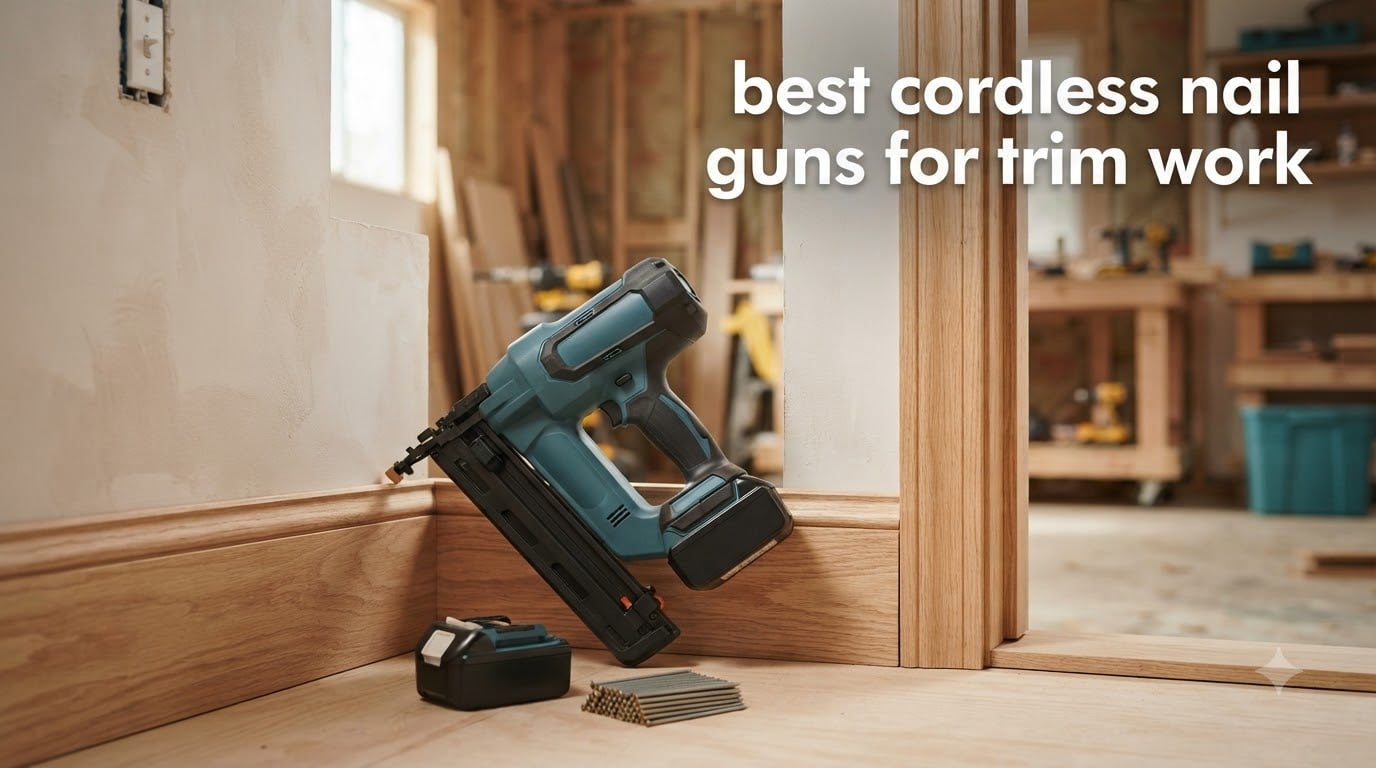
A cordless nail gun for trim work is a battery-powered nailer that drives thin 15, 16, or 18 gauge nails and brads into baseboard, door casing, crown molding and other interior trim without a compressor, a hose or a gas cartridge. If you are shopping for one, a 16-gauge angled finish nailer is the most versatile single tool, and an 18-gauge brad nailer is the lighter option for lighter trim.
That is the short answer. The longer answer is that the best cordless nail guns for trim work are not separated by speed or power nearly as much as they are separated by nail gauge, magazine geometry, and which battery platform you already own. Every one of the eight nailers below drives nails deep enough to hold baseboard to a stud in hardwood trim, so the deciding factor is really the ecosystem you are already married to.
We spent time with eight of the strongest cordless nailers on the market, compared the published specifications, and read through thousands of owner reviews to separate the tool-free feature lists from the real-world results. Before we get into the picks, if you are still cutting your trim on the saw side, our guide to the best miter saws for trim carpentry covers the crosscuts and cope joints that every nailer in this list has to hold together.
Table of Contents
Top 3 Cordless Nail Guns For Trim Work (October 2026)

DEWALT DCN680B 18 GA Brad Nailer
- Brushless motor
- Micro nose for line of sight
- Tool-free depth and jam release
- Selectable sequential or contact trigger

DEWALT DCN660B 16 GA Finish Nailer
- 16 gauge angled magazine
- Inline magazine for tight spaces
- Brushless motor
- Works with all 20V MAX batteries

Metabo HPT NT1850DG Brad Nailer
- 5.5 pound body
- 700 nails per charge
- Battery and charger included
- Tool-less depth of drive
All 8 Cordless Nail Guns Compared Side by Side in 2026
| Product | Specifications | Action |
|---|---|---|
| DEWALT DCN680B 18 GA Brad Nailer |
|
Check Latest Price |
| DEWALT DCN660B 16 GA Angled Finish Nailer |
|
Check Latest Price |
| Metabo HPT NT1850DG 18 GA Brad Nailer |
|
Check Latest Price |
 Milwaukee M18 Fuel 2746-20 18 GA Brad Nailer Milwaukee M18 Fuel 2746-20 18 GA Brad Nailer |
|
Check Latest Price |
 CRAFTSMAN V20 CMCN618B 18 GA Brad Nailer CRAFTSMAN V20 CMCN618B 18 GA Brad Nailer |
|
Check Latest Price |
 Ryobi ONE+ P321 18 GA AirStrike Brad Nailer Ryobi ONE+ P321 18 GA AirStrike Brad Nailer |
|
Check Latest Price |
 WORX WX842L 20V 18 GA Cordless Brad Nailer WORX WX842L 20V 18 GA Cordless Brad Nailer |
|
Check Latest Price |
 Ryobi ONE+ P326 18V 16 GA Finish Nailer Ryobi ONE+ P326 18V 16 GA Finish Nailer |
|
Check Latest Price |
1. DEWALT DCN680B 20V MAX XR 18 GA Brad Nailer – Best Overall for Trim
DEWALT DCN680B 20V MAX* XR® 18 GA Cordless Brad Nailer (Tool Only)
18 gauge brad nailer
6.2 lb tool weight
Brushless motor
20V MAX battery platform
Pros
- Brushless motor for runtime and durability
- Micro nose gives a clear line of sight
- Tool-free depth adjustment jam release and stall release
- Selectable sequential or contact actuation trigger
- Multi-functional LED light and tool diagnostics
Cons
- Tool only so a battery and charger are needed separately
- Heavier than the most compact 18 gauge nailers
- Magazine capacity and nail length range are not stated in the specifications
Best overall: the DCN680B is the pick we hand to someone who wants one nailer that handles most trim work and who already has DEWALT batteries in the truck. It carries a 4.8 star average across more than 3,700 reviews, which is the highest combined rating and review count of anything we tested for this roundup.
What separates it from the field is the micro nose. On trim carpentry, the thing that determines whether a job looks good is whether you can see the nail head as you approach a joint, and this nose gives you the sight line that most 18-gauge brad nailers take away from you.
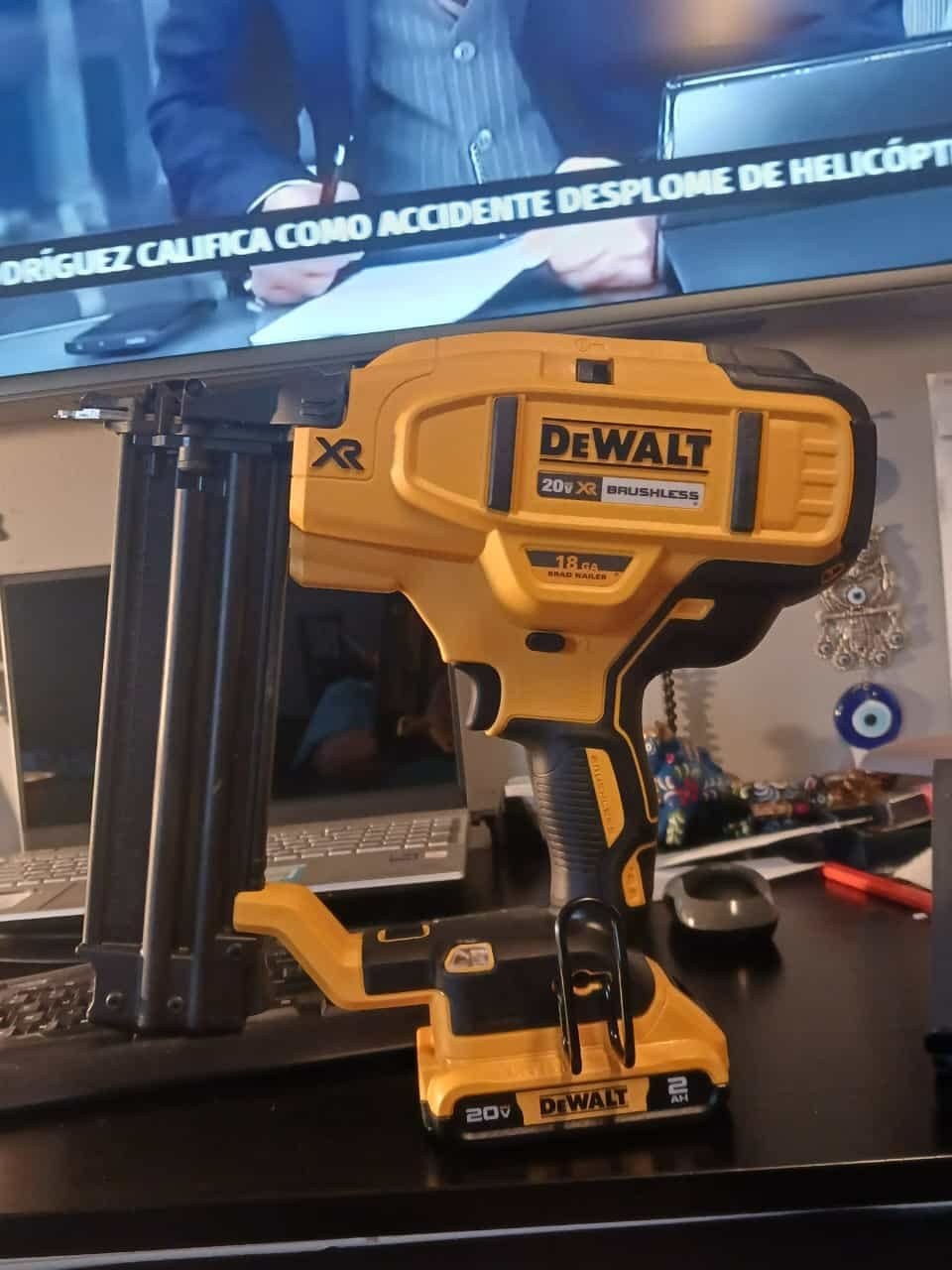
The tool-free feature set is unusually complete for this class. Depth adjustment, jam release, and the stall release lever that resets the driver blade are all tool-free, which matters when you are on a ladder and do not want to dig through a pouch for a hex key between boards.
Owners also rate the drive quality highly. At 88% five-star reviews, it is the most consistently praised nailer in our group, with the brushless motor, low-nail lockout, and adjustable belt hook all showing up repeatedly in the positives. The 6.2 pound tool weight is the trade-off; it is not the lightest nailer here, but for baseboard, door casing, and cabinet face frames the extra mass translates into a steadier hold on long fasteners.
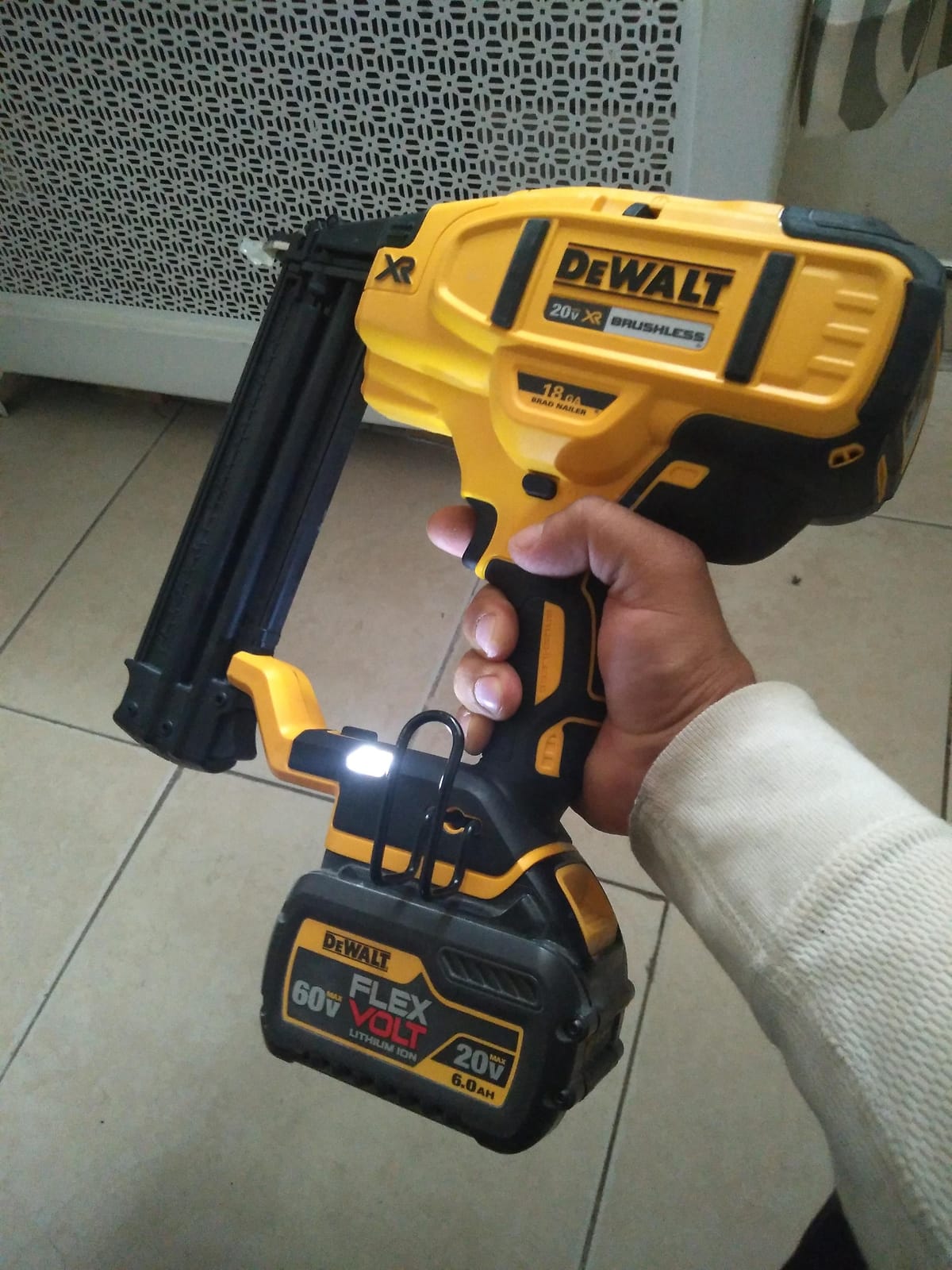
Who this nailer suits best?
This is the right tool for a homeowner redoing baseboard in two or three rooms, or a handyman running casing and cabinet trim jobs all week. The 18-gauge brad range handles trim from picture-frame weight up through 2 inch fasteners in softwood, and the no-mar behaviour of the nose keeps finished surfaces clean.
It is also the safest of the group to recommend broadly, because the selectable trigger lets you run sequential actuation on finish work where a bump fire would put an extra nail through an already-good joint.
Where it falls short?
It ships as a tool only, so a battery and charger have to be added to the cost of the purchase. If you have never owned a DEWALT tool, that is two extra purchases before the first nail goes in.
The nail length range and magazine capacity are not published in the specifications we pulled, so if you are planning long structural trim you should confirm the range before committing. At 6.2 pounds it is also one of the heavier options here, which is worth factoring in for full days of overhead crown work.
2. DEWALT DCN660B 20V MAX 16 GA Angled Finish Nailer – Best for Heavier Trim
DEWALT 20V MAX* Finish Nailer, Angled, 16GA, Tool Only (DCN660B)
16 gauge angled finish nailer
Inline magazine for tight access
Brushless motor
All 20V MAX batteries
Pros
- 16 gauge angled format suits trim molding and baseboard
- Inline magazine works in tight spaces and multiple orientations
- Bushless motor for runtime and durability
- Tool-free depth jam and stall release
- Selectable sequential or contact trigger
Cons
- Tool only so a battery and charger are needed separately
- One-star reviews sit at 5 percent the highest share among the DEWALT models here
- Magazine capacity and nail length range are not stated in the specifications
Best for heavy trim: if your project list includes 5/4 inch casing, thick baseboard, or anything that has to hold in hardwood, the DCN660B is the nailer to buy. Sixteen gauge is a heavier shank than an 18-gauge brad, and the angled magazine geometry gets the nose into corners that a straight magazine physically cannot reach.
Long-time finish carpenters on the forums we read reach for the same conclusion. Their advice is consistent: a 16-gauge angled nailer is the most versatile single trim nailer you can own, and you add a 15-gauge only when the trim gets heavy enough to justify a second tool.
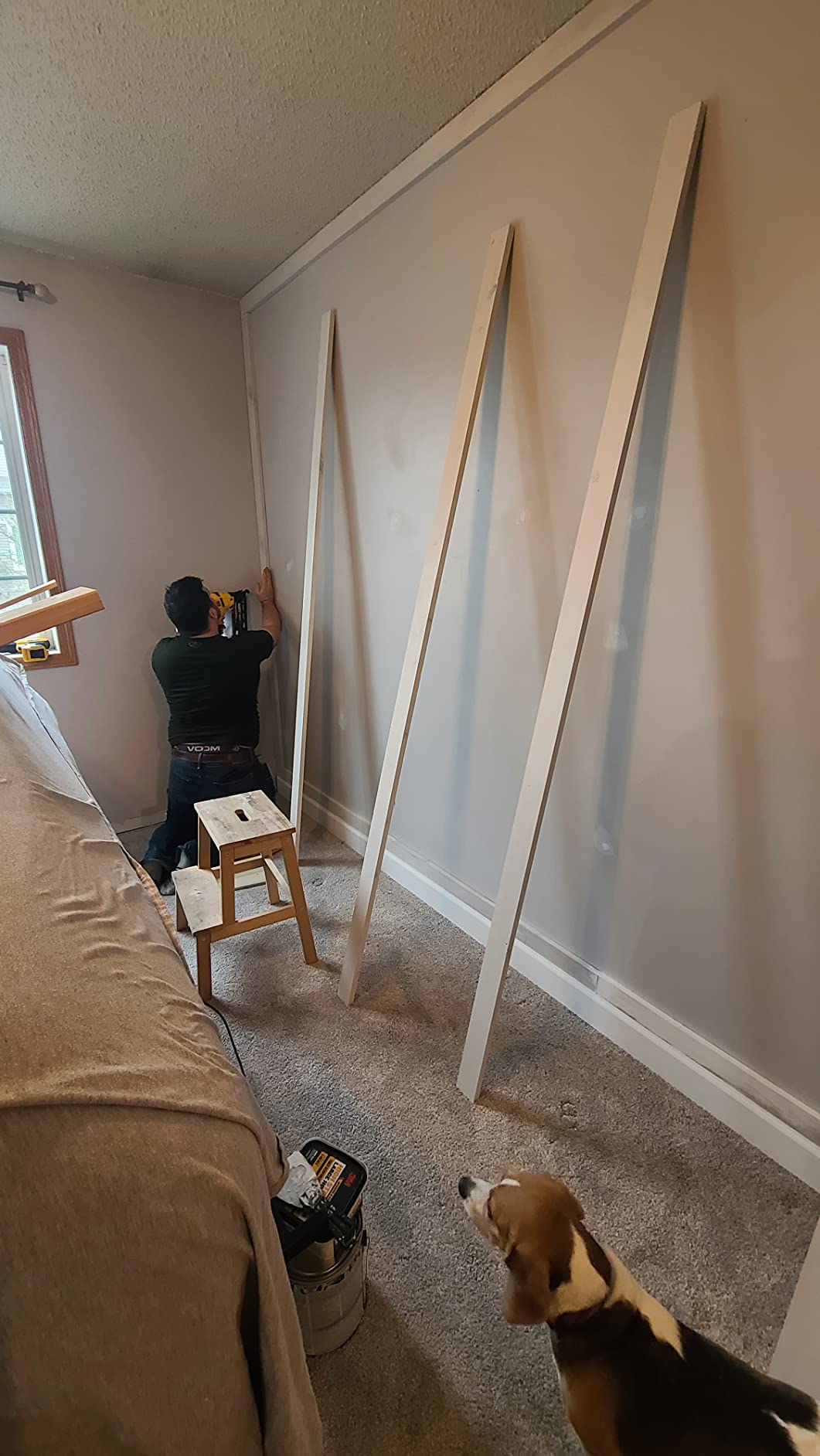
Technically it is the more complete tool of the two DEWALT nailers in this roundup. Alongside the brushless motor and full tool-free adjustment suite, it has an inline magazine that works in multiple orientations, which is the difference between finishing a door casing return and repositioning the whole tool twice per corner.
The rating profile is worth a note. It holds a 4.6 star average from 1,912 reviews with 84% five-star ratings, and the 5% one-star share is the largest among the DEWALT models here. Most of that critical mass is fulfilment and access related rather than drive performance, but it is a fair signal that this is not the flawless pick of the group.
What it handles that an 18 gauge cannot?
Sixteen gauge nails have a meaningfully thicker shank, so they resist pull-out in dense hardwood trim where an 18-gauge brad would creep. If you are nailing into oak, maple, or a prefinished door casing where a slightly proud hole is unacceptable, the extra shank buys you holding power and a cleaner set.
It also takes longer nails comfortably. Baseboard over a concrete or masonry-adjacent wall, thicker hardwood casing, and exterior trim applications are all within reach of a 16-gauge finish nailer in a way that 18-gauge brads are not.
What to watch for?
It is a bare tool, so the DEWALT battery and charger are on you. If you already run DEWALT 20V MAX tools, that is a non-issue; if you do not, it is the main reason people choose the lighter brad nailers in this list instead.
Because the shank is heavier, it is also the wrong tool for thin or delicate trim. Driving 16 gauge into lattice, slim colonial casing, or a 1/4 inch backerboard profile is how you split the molding.
3. Metabo HPT NT1850DG 18 GA Cordless Brad Nailer – Best Value Complete Kit
Metabo HPT Brad Nailer, 18 Gauge Cordless, 18V Kit, NT1850DG
18 gauge cordless brad nailer
5.5 lb tool weight
700 nails per charge
Battery and charger included
Pros
- Only 5.5 pounds lighter than every model here with a published weight
- Battery charger no-mar nose caps hook and safety glasses included
- 700 nails per charge on the included 2.0Ah battery
- Low center of gravity aids control in tight spaces
- No ramp-up time between nails
Cons
- The 18V Metabo HPT platform has a smaller installed base than Ryobi ONE+ or DEWALT 20V MAX
- Included 2.0Ah battery is smaller than the 4.0Ah packs some users prefer for long runs
Best value: the NT1850DG is the only nailer in this roundup that arrives with a battery, a charger, no-mar nose caps, a hook, and safety glasses in the box. For anyone starting from zero, that complete package is worth more than a spec-sheet advantage, and it is why the 2.0Ah included pack matters less than it looks.
At 5.5 pounds, this is the lightest nailer here with a published tool weight, and the low center of gravity is a deliberate design choice rather than an accident. On crown molding work that keeps your arms up, moving mass out of the nose and down into the body is the difference between finishing a room and taking a break halfway through.
The drive system is a mechanical spring mechanism that powers nails up to 2 inches, with no ramp-up time between shots. The trade-off against a brushless motor is raw speed, but for trim carpentry the immediate response is often the more useful trait, because you are placing one nail at a time against a scribe line rather than firing a pattern into sheathing.
Owners put it at 4.7 stars from 930 reviews with 86% five-star ratings, and the recurring praise is the combination of the light body and the completeness of the package. A 4.7 rating on a 930-review base is a solid signal, and the tool-free depth of drive plus the LED work light cover the two things trim carpenters complain about most on first use.
Why the light weight matters for trim?
Trim work is overhead, awkward, and repetitive. A 5.5 pound tool with a low center of gravity is easier to control at the top of a ladder than a 7 pound tool with the mass concentrated in the nose, and that control shows up in nail placement rather than in how tired your arms feel at the end of the day.
It is also the kit that makes the most sense for a first-time buyer. You are not working out how many batteries you need or whether the charger is included, you are handed a battery and a charger and a set of no-mar caps and you can start on a wall the same afternoon.
Where the platform works against you?
The 18V Metabo HPT platform has a smaller installed base than the Ryobi 18V ONE+ or DEWALT 20V MAX ecosystems, so the second battery and the future nailer may be harder to find than they would be on a bigger platform. That matters a great deal if you expect to grow into this system.
The included 2.0Ah battery is rated at 700 nails per charge, which covers a lot of trim, but on a whole-house package you will want a higher-capacity pack before you start rather than mid-job.
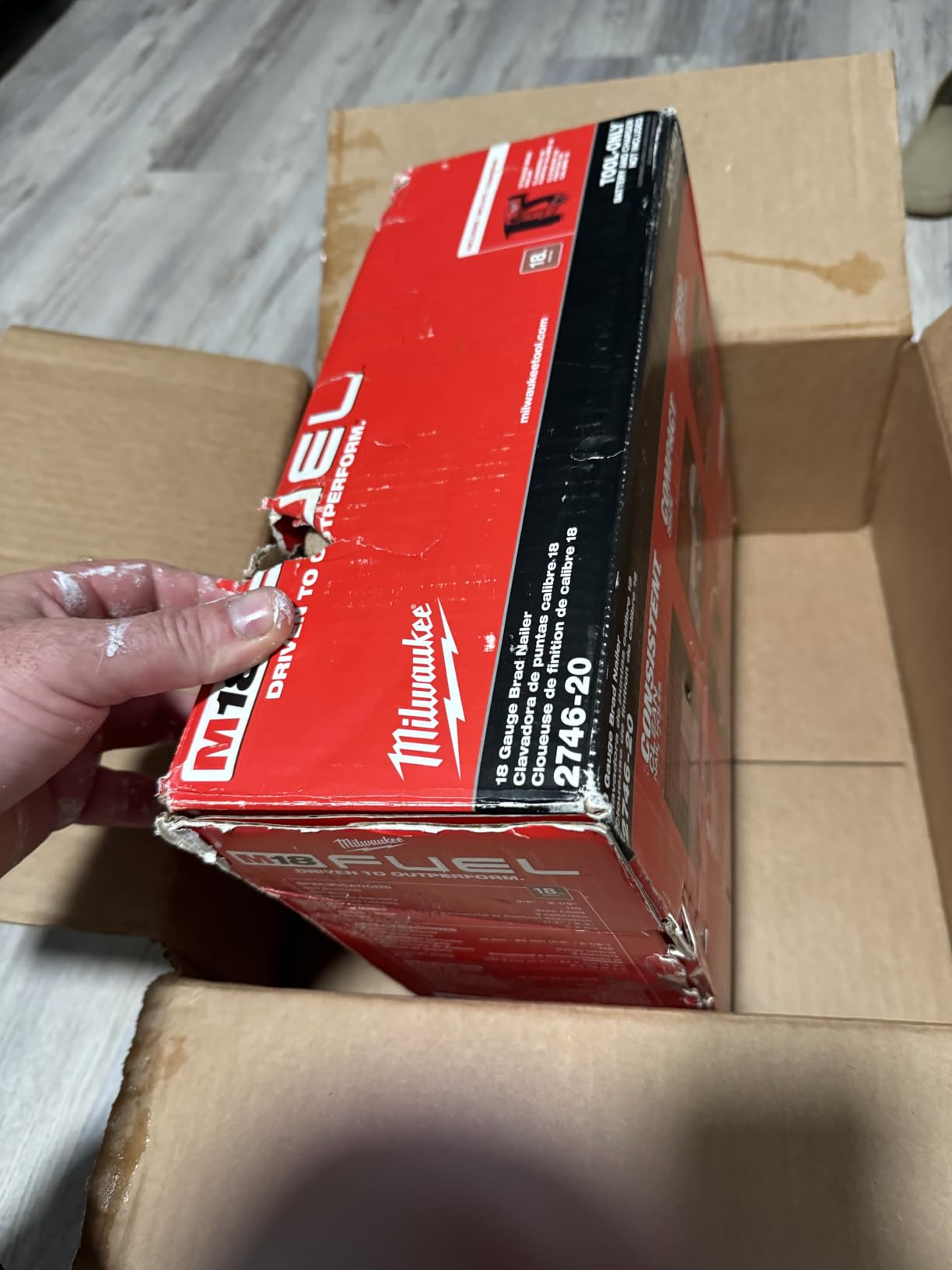
4. Milwaukee M18 Fuel 2746-20 18 GA Brad Nailer – Best for M18 Owners
Milwaukee Electric – M18 Fuel 18 Gauge Brad Nailer
18 gauge brad nailer
6.5 lb tool weight
Nitrogen air spring drive
M18 REDLITHIUM batteries
Pros
- Nitrogen air spring mechanism sets nails consistently with clean nail holes
- POWERSTATE brushless motor with REDLINK PLUS intelligence
- Zero ramp-up time keeps the firing rate up
- Tool-free drive depth adjustment
- Sequential and contact actuation modes
Cons
- Tool only so an M18 battery and charger are needed separately
- Body is larger than some owners expected
- One-star reviews sit at 6 percent
Best for M18 owners: if Milwaukee is already your ecosystem, this is the brad nailer that slots into the rest of the bag without a single new battery. The M18 Fuel platform is the deepest in the category, and the 18-gauge brad nailer is the piece most trim carpenters add first.
The nitrogen air spring mechanism is the technical headline. Instead of a spinning flywheel, a nitrogen-charged spring pushes the driver, which is why owners report zero ramp-up time and a fire rate that several of them describe as faster than the other brands they compared it against.
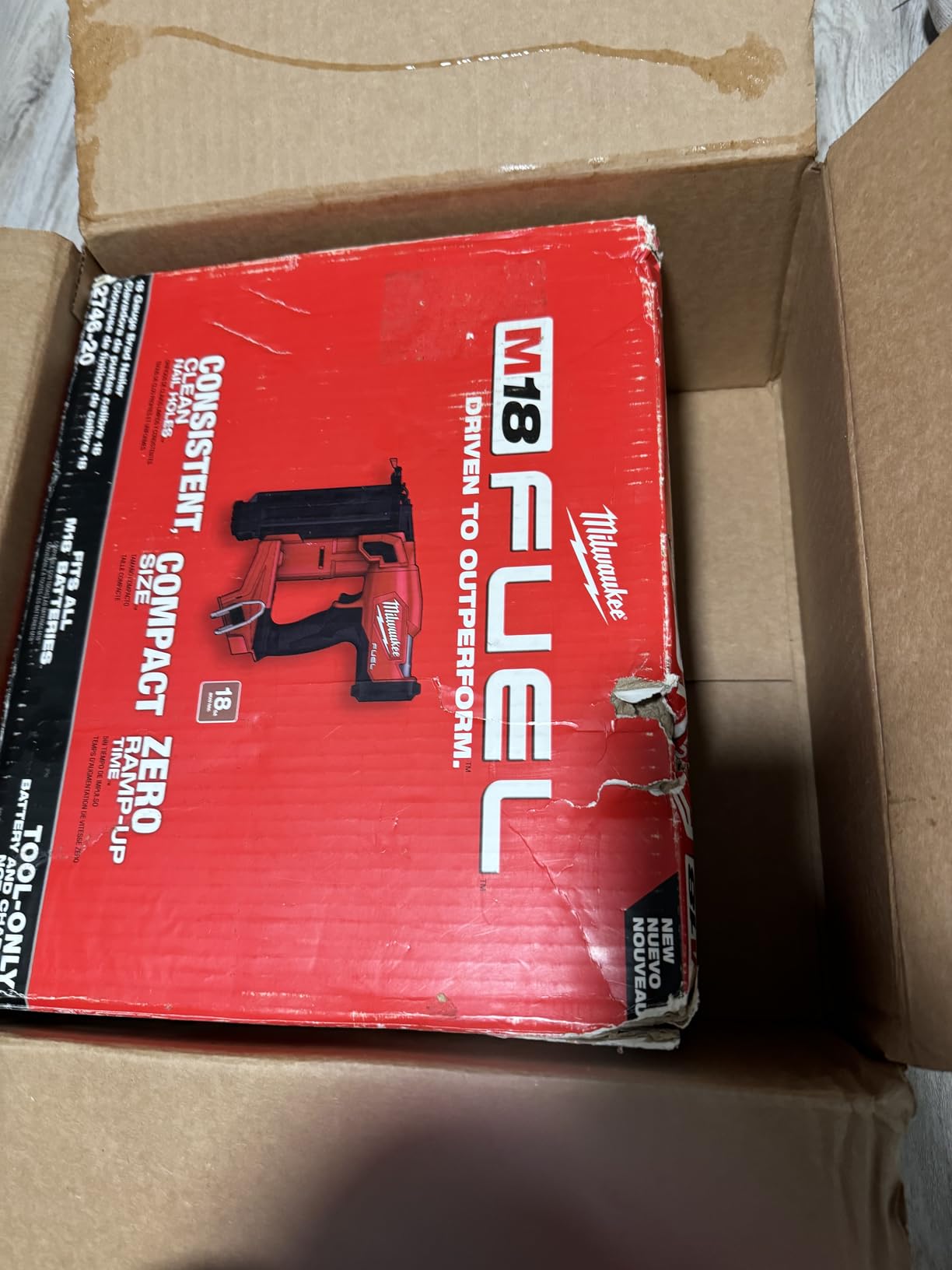
The drive quality story is consistent in the reviews. Owners repeatedly describe flawless driving with no misfires or misfeeds and clean, consistently set nails, and multiple professional carpenters cite this specific tool as their compressor replacement for trim work. At 85% five-star ratings from 811 reviews, that reliability claim is well supported.
Depth adjustment is tool-free and both sequential and contact actuation modes are available, so you can dial the safety behaviour to the job. The 6.5 pound tool weight is on the heavier side, which is the recurring ergonomic complaint alongside the body size.
Why the M18 ecosystem usually wins?
Battery cost is the whole argument. If you already own M18 REDLITHIUM packs and a charger, this tool costs you a bare nailer and nothing else, and every future tool on the platform reuses the same batteries. That is the single most repeated buying decision across the trim forums we read, and it usually beats a slightly better tool on a rival platform.
It also means the second battery problem never arrives. When a full-day crown job needs a pack swap, you already have the packs, and you already have the charger in the truck.
What to know before you buy?
It is a bare tool, so the M18 battery and charger are a separate purchase unless you already own them. The 6% one-star share is tied for the highest negative rating share in this group, though much of that critical mass concerns delivery problems rather than the tool itself.
Several owners also find the body larger than they expected, and one asked for a more compact version. If you work in tight closets or tight corners, check the physical size against your other 18-gauge options first.
5. CRAFTSMAN V20 CMCN618B 18 GA Cordless Brad Nailer – Best for V20 Owners
CRAFTSMAN V20 Brad Nailer, 18GA, Cordless, Bare Tool Only (CMCN618B)
18 gauge cordless brad nailer
Up to 420 nails per charge
Tool-free jam and stall settings
Works with V20 batteries
Pros
- Strong value with consistent firing and no jams reported by owners
- Tool-free jam and stall settings plus quick depth adjustment
- Well balanced lightweight body that works well overhead
- No-mar tip protects finished trim
- Uses existing CRAFTSMAN V20 batteries
Cons
- Battery charger and nails all sold separately
- Some owners report it feels heavier and more plastic bodied than expected
- A full battery is needed to reliably drive the longest 2 inch brads
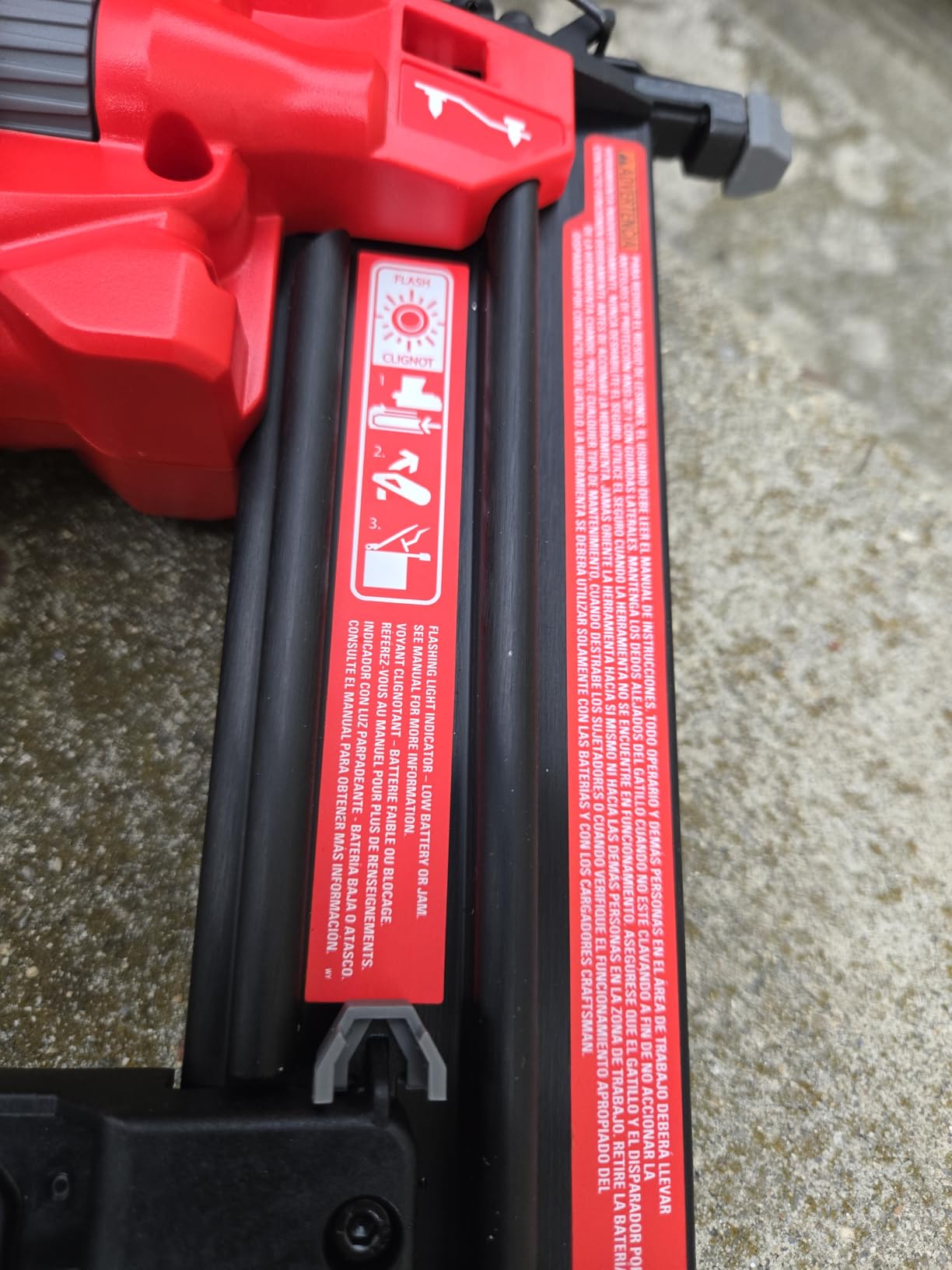
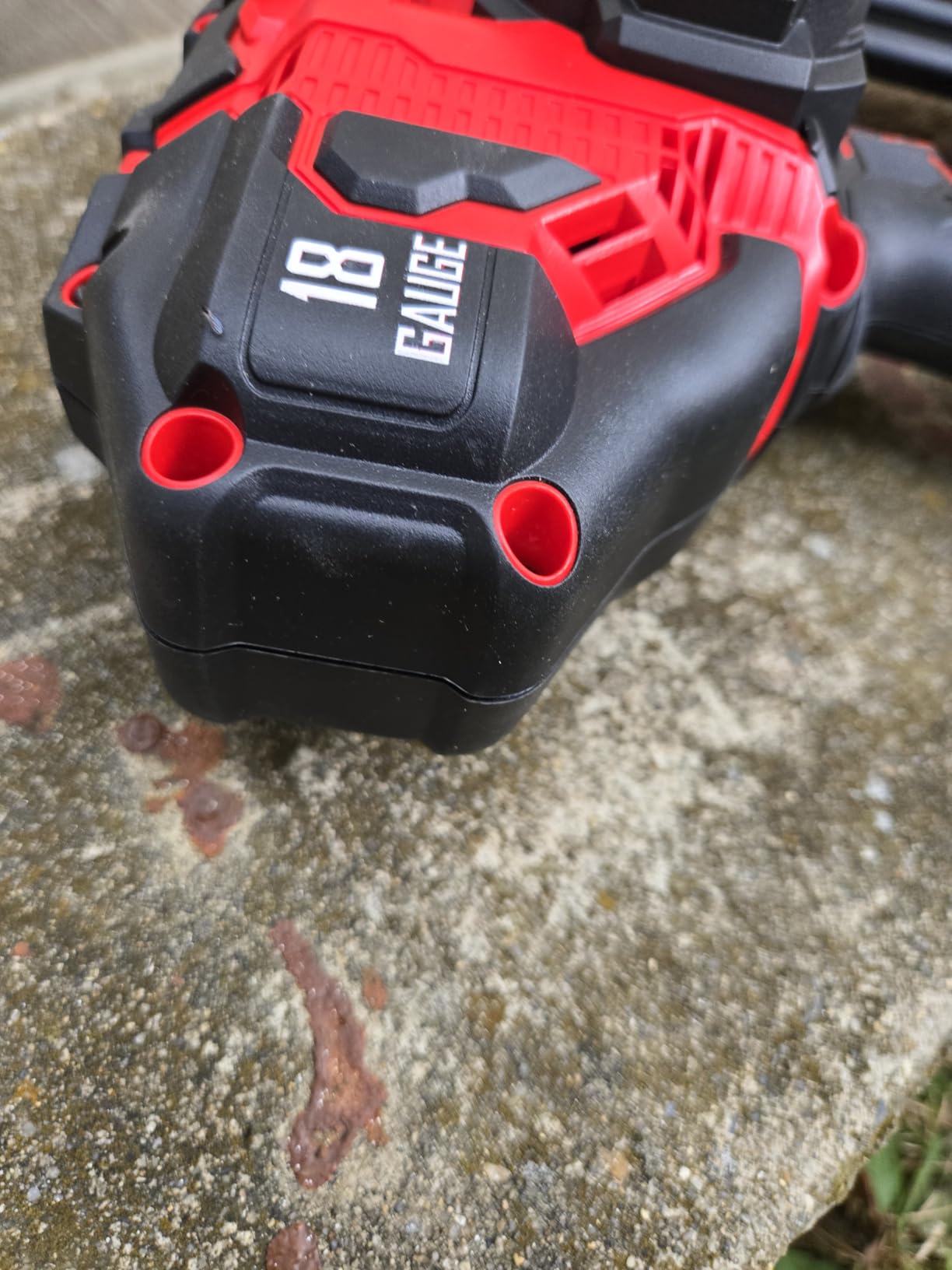
Best for V20 owners: the CMCN618B is the value pick for anyone already invested in the CRAFTSMAN V20 platform. It drives up to 420 nails per charge, accepts the same batteries as the rest of the V20 range, and carries a no-mar tip that matters more than it sounds when you are nailing into primed or finished trim.
The design notes read like someone thought about trim specifically. The listed benefits call out optimal balance with a center of gravity positioned for comfort during use, a lightweight body, and a belt hook for access, which are exactly the three things that matter when you are working overhead rather than driving nails into framing.
At 4.6 stars from 890 reviews it sits mid-pack, but the 81% five-star share is the lowest in our group and the 11% four-star share is the highest, and the reviews explain the gap neatly: people like the value and the balance, and they accept that it trades some speed and heft for it. Existing V20 battery owners rate it especially highly for exactly that reason.
Tool-free jam and stall settings mean the two most common first-day problems, a stuck nail and a stalled driver, are both handled without tools. That is a bigger deal in practice than it is in a spec sheet.
Where the V20 platform fits?
If the V20 ecosystem is already in your garage, the maths is simple: this tool reuses batteries you own, and there is no reason to start a second platform for a nailer. It covers the 18-gauge trim range that handles baseboard, casing, cabinet face frames, and general molding work.
It is a sensible second nailer too. A lot of trim carpenters keep one 18-gauge brad gun for the bulk of the work and a 16-gauge angled finish nailer for the heavy joints, and this slots into the first half of that pair.
Where it is not the answer?
Battery, charger, and nails are all sold separately, so a first-time buyer is adding three line items to get running. If you have no V20 packs at all, that changes the comparison entirely and the Metabo HPT kit becomes the more complete starting point.
On full-time daily duty the recoil is slower than a pneumatic brad gun, and one owner notes the longest 2 inch brads need a full battery to drive reliably. For weekend and light commercial work that is not a problem; for eight hours a day of production trim, it is.
6. Ryobi ONE+ P321 18 GA AirStrike Brad Nailer – Best Budget Pick for ONE+ Owners
Ryobi 18V ONE+ 18-Gauge Cordless Airstrike Brad Nailer (Tool Only) P321
18 gauge brad nailer
6 lb tool weight
AirStrike cordless drive
18V ONE+ platform
Pros
- Lowest cost tool in this roundup and strong value for occasional use
- Easy to load and accepts multiple nail sizes
- Textured grip resists slipping during long sessions
- Shares batteries with the widely owned 18V ONE+ platform
- One owner finished an afternoon of trim on a single 4.0Ah pack
Cons
- Driver can freeze mid-shot until the contact follower tab is lubricated with one report of total failure
- Trigger must be held until the nail is fully driven
- One-star reviews sit at 8 percent the highest share in this group
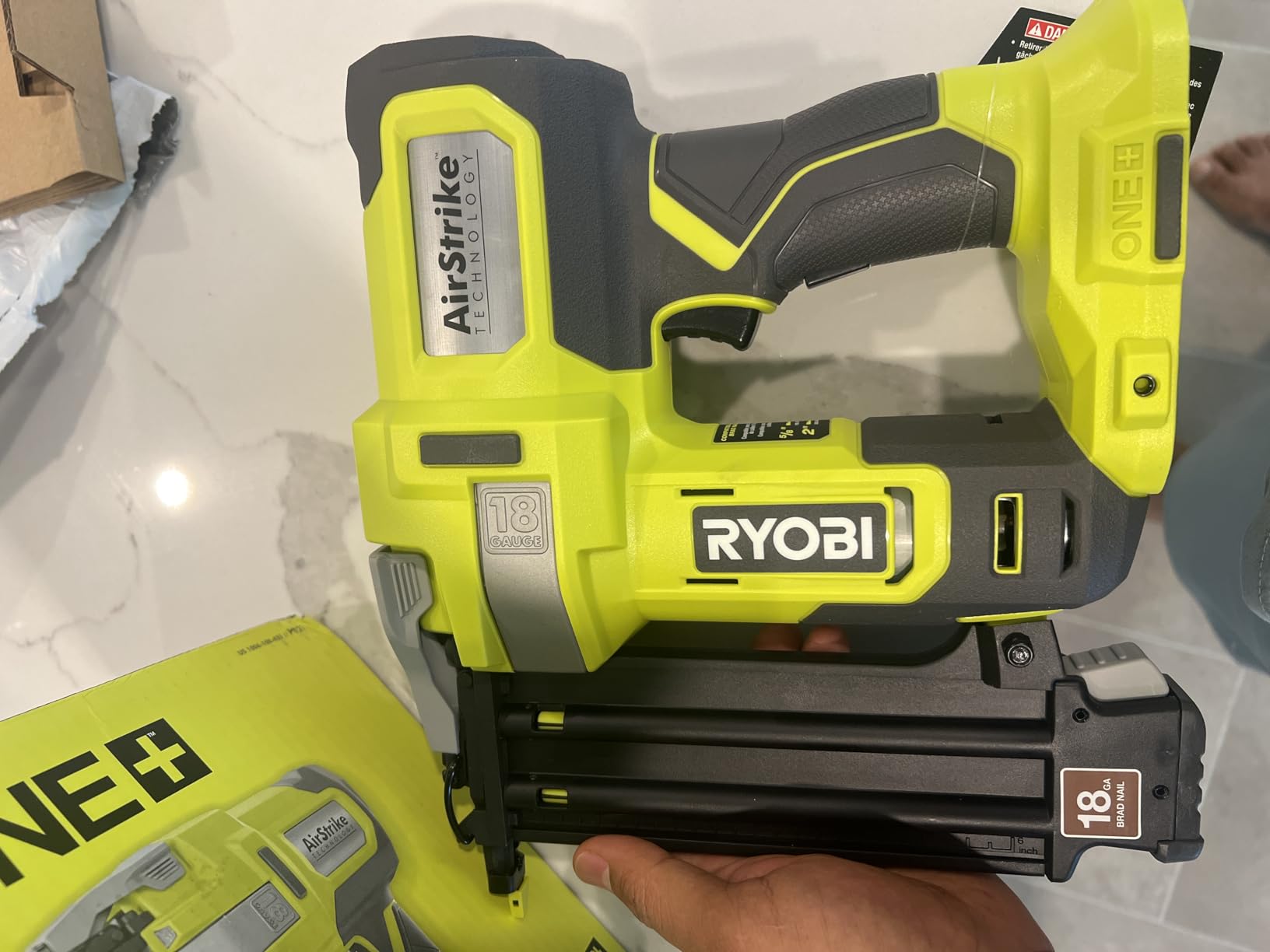
Budget pick: the P321 is the cheapest way to get into cordless brad nailing, and for anyone already running Ryobi 18V ONE+ batteries it is close to free at the point of purchase. The ONE+ platform is one of the most widely owned cordless ecosystems in the country, which means the packs, the charger, and the replacement nailer all exist when you need them.
The AirStrike design eliminates the compressor, hose, and gas cartridge entirely, and the tool-free depth adjustment plus textured grip are the two details owners mention most. One owner reported finishing an afternoon of trim work on a single 4.0Ah pack, which is the runtime profile you want for a Saturday.
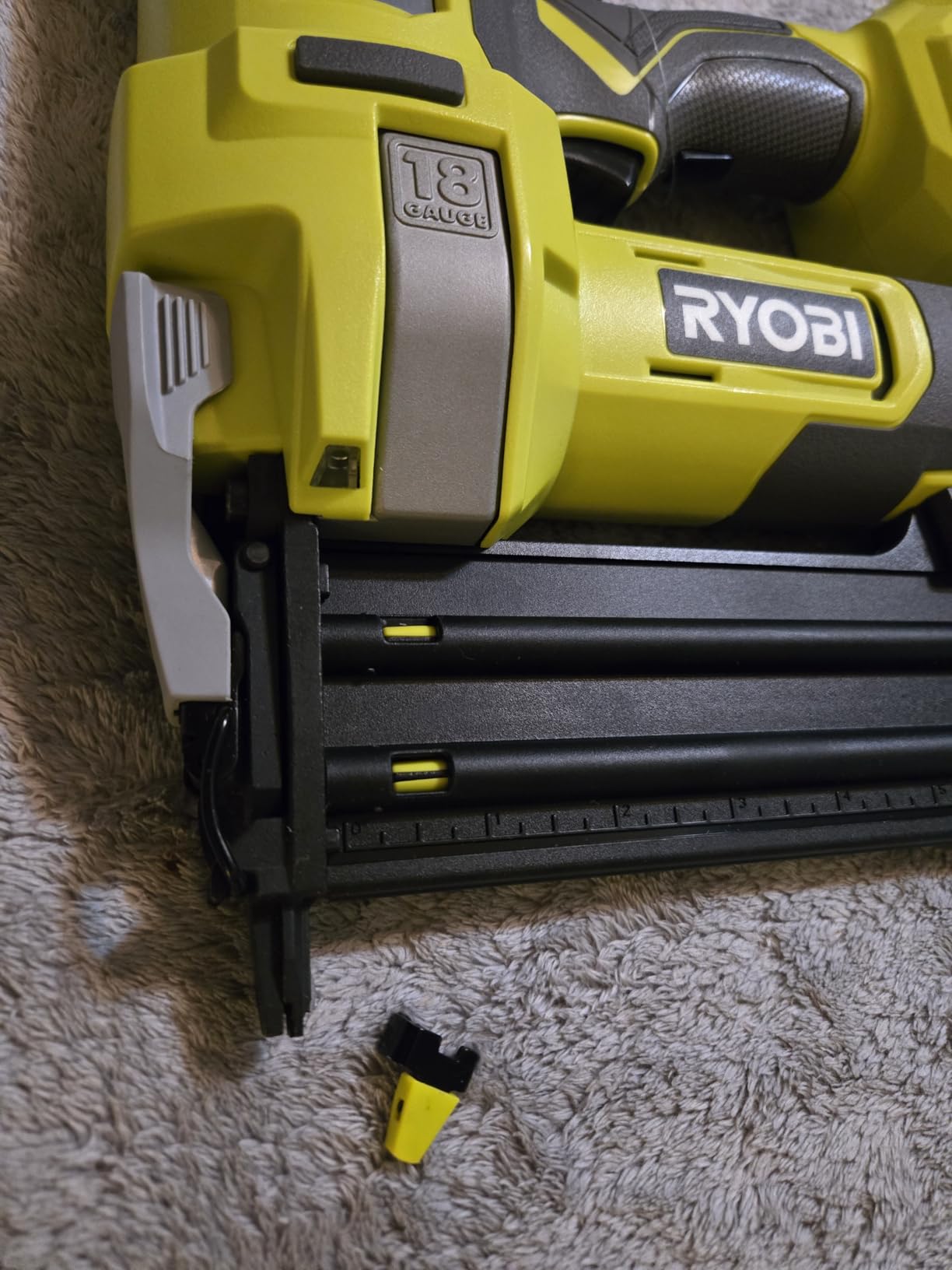
Now the honest part. At 4.4 stars from 838 reviews, this is the second lowest average in the group, and there is one specific recurring complaint that shows up in multiple reviews: the driver can freeze mid-shot until the contact follower tab is lubricated. One owner resolved it with WD-40 and 3-in-1 oil, which tells you both how real the issue is and how simple the fix is.
The related behaviour is that the trigger has to be held until the nail is fully driven or the tool can stop. That is a technique adjustment, not a defect, but on a rush job it is a distraction.
Who gets the most out of it?
A weekend DIYer replacing baseboard in a couple of rooms, or a handyman who nails trim occasionally rather than daily. For that duty cycle the tool is well matched: it loads easily, takes multiple nail sizes, and the grip stays put in a long session.
It is also the pick if you are outfitting a second property or a rental turnover crew where the tool will sit between long stretches of use. The lubrication habit is easy to keep up when you only reach for the gun once a month.
Where it falls short?
The 8% one-star share is the highest in this group, and the driver-freezing pattern is the main reliability caveat, alongside one report of total failure after roughly half a magazine despite oiling, a new battery, and support. If you are a full-time trim carpenter running this tool eight hours a day, buy a second nailer.
At 6 pounds it is not the lightest option, and users note arm fatigue on long sessions. For ladder and overhead work, the lighter Metabo HPT body is the more comfortable choice.
7. WORX WX842L 20V 18 GA Cordless Brad Nailer – Best for Fast Firing Rate
WORX Cordless Brad Nailer, 20V 18GA Nail Gun, WX842L
18 gauge brad nailer
80 nails per minute
7.06 lb tool weight
Power Share battery platform
Pros
- Drives brad nails up to 2 inches into hardwood
- 80 nails per minute is a fast stated firing rate
- Power Share battery works across 140 plus compatible products
- Tool-free jam release clears stuck nails quickly
- Anti-ejection design reduces flying nails when opening the magazine
Cons
- Heaviest nailer in this roundup at 7.06 pounds
- Power Share has a smaller installed base than ONE+ or 20V MAX
- Battery and charger inclusion varies by listing variant
Best for speed: the WX842L fires up to 80 nails per minute and uses NailForce Air Impact Technology to secure brad nails up to 2 inches into hardwood. That stated drive power is what makes it a credible option for panel molding, window trim, and small baseboard runs rather than decorative work only.
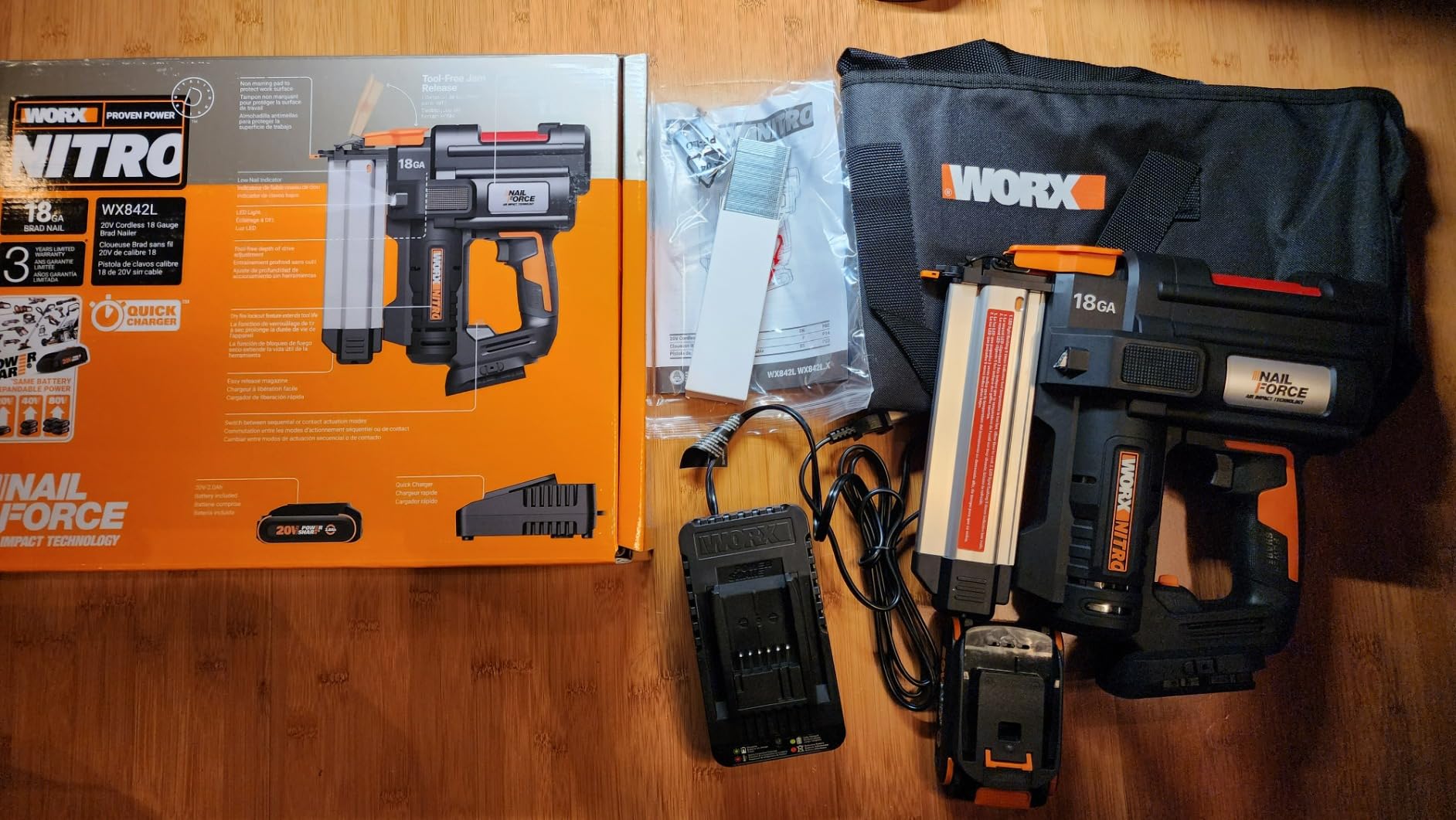
The 80 nails per minute figure is the fastest stated rate among the nailers here, and combined with the tool-free jam release it is why reviewers respond to this tool on pace. The battery is included in this configuration, and it is the same pack that runs more than 140 other Power Share tools.
Safety gets real attention in the design. The anti-ejection system is built to keep nails from flying when you open the magazine or clear a jam, which is one of the few places any nailer in this roundup addresses the most common cause of nail gun injury as a design feature rather than a warning label.
At 4.5 stars from 733 reviews with 78% five-star ratings, the reviews line up with the spec sheet: people like the drive power, the pace, and the jam release, and the near-universal reservation is the 7.06 pound weight on long or overhead sessions.
When the firing rate actually matters?
Firing rate is not a vanity spec. It matters when you are blind nailing a run of baseboard and your trigger finger starts anticipating each shot, when you are nailing shim and trim to a long return, or when you are working in a room where a compressor would be too loud at the wrong hour.
For those jobs, an 80 nails per minute brad nailer meaningfully shortens the afternoon, and it does so with no hose to trip over and no neighbour conversation to have afterwards.
What to weigh up first?
At 7.06 pounds it is the heaviest nailer we reviewed, and reviewers say so in almost every case. If your trim work is mostly overhead, the weight is going to catch up with you well before the battery does.
The Power Share platform also has a smaller installed base than the Ryobi ONE+ or DEWALT 20V MAX ecosystems, so check what else you would run on it before committing. Battery and charger inclusion varies by listing variant, so confirm what is in the box before you plan around it.
8. Ryobi ONE+ P326 18V 16 GA AirStrike Finish Nailer – Best Entry Point to 16 Gauge
RYOBI ONE+ 18V 16-Gauge Cordless AirStrike Finish Nailer (Tool Only), P326, Green
18V 16 gauge finish nailer
7.3 lb tool weight
78 percent smaller nose
On-board air pump drive
Pros
- 16 gauge nailer punches through solid hickory and works on hardwood tongue-and-grove
- On-board air pump is quieter than flywheel designs and needs no gas cartridges
- 78 percent smaller nose gives tight spot access
- Adjustment dial regulates drive speed for different materials
- Shares batteries with existing Ryobi ONE+ tools
Cons
- Lowest average rating in this roundup at 4.2 stars with a 12 percent one-star share
- Reported to drive nails too deep and to refuse to run at the lowest depth setting
- Heaviest and bulkiest body here at 7.3 pounds
Best entry to 16 gauge: the P326 is the cheapest route into a genuine 16-gauge finish nailer, which is the format most experienced finish carpenters name when asked for one versatile trim nailer. If you already own Ryobi ONE+ packs, it runs on the batteries you have.
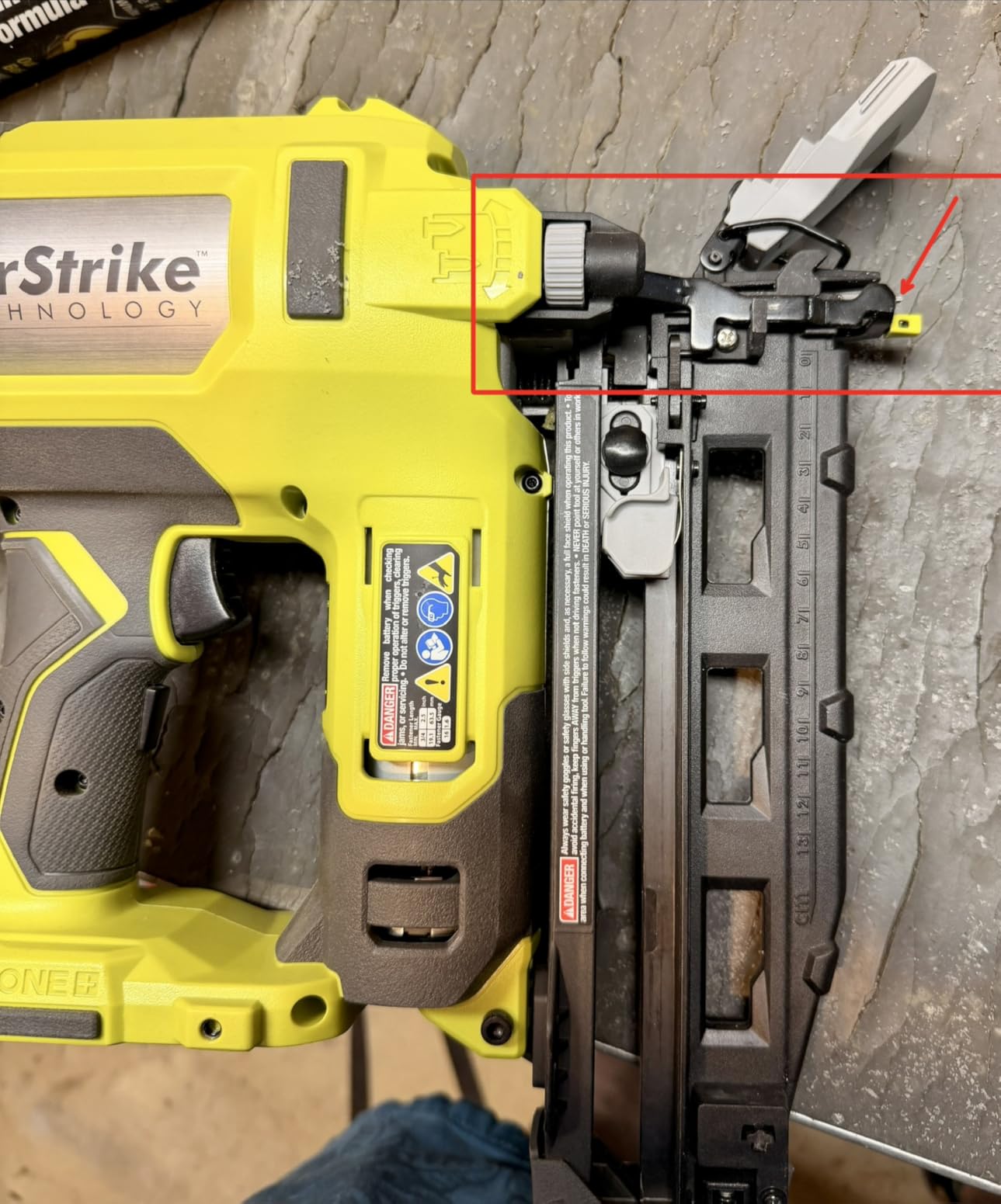
The on-board air pump design is the interesting engineering choice. Instead of a flywheel or a gas cylinder, it uses a small pump to pressurise each shot, and owners report it as quieter than the flywheel competitors. The 78% smaller nose compared with the earlier P325 is a real gain for tight spot access, and one owner used it to hang a teak tongue-and-grove ceiling by blind nailing.
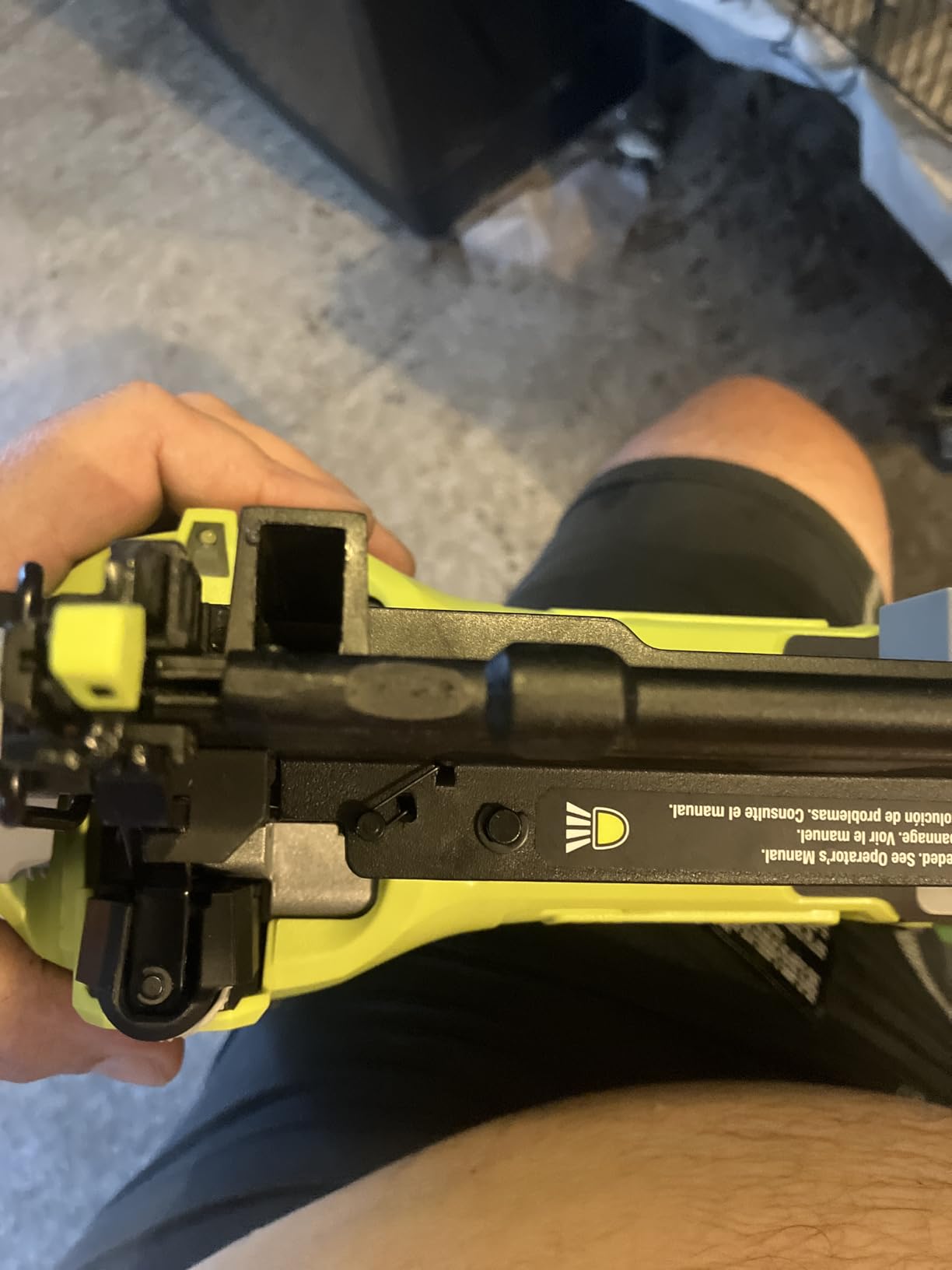
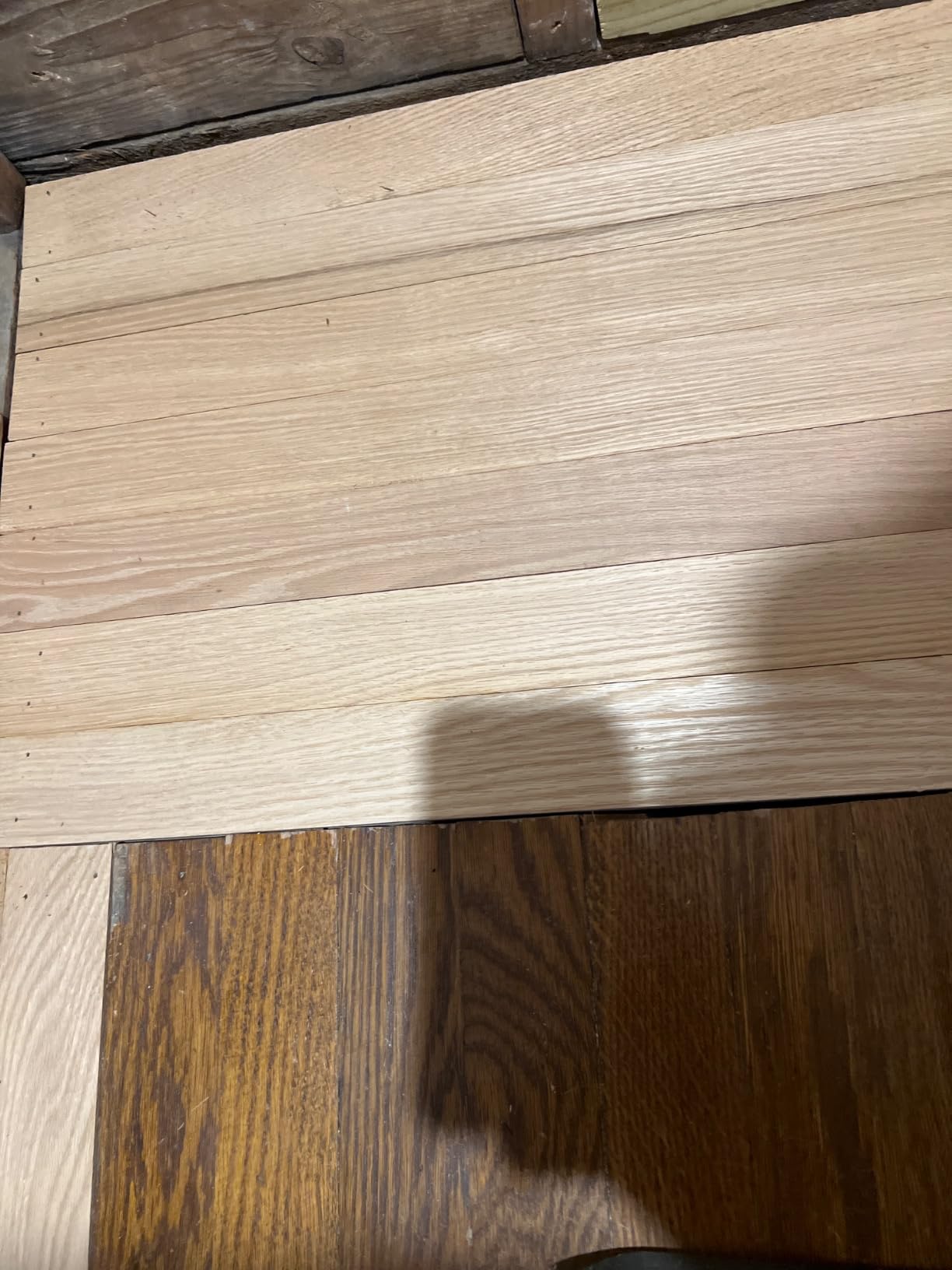
Now the reasons it sits last. At 4.2 stars from 189 reviews it has both the lowest rating and the smallest review base in this roundup, and the 12% one-star share is the highest. The specific complaints are depth control: owners report it driving nails too deep and refusing to operate at the lowest depth setting, plus one report of a sticking striking pin with a low success rate that ended in a warranty claim.
At 7.3 pounds it is also the heaviest and bulkiest body here, and owners describe it as heavy for overhead work. Magazine loading is not immediately intuitive for some users, which is a frustrating first impression on a tool you will load fifty times a day.
Why 16 gauge is still the right format?
The reason to own a 16-gauge finish nailer is holding power in heavier trim. A thicker shank resists pull-out in dense hardwood where an 18-gauge brad would creep, and it is the format that handles 5/4 inch casing, thick baseboard, and prefinished door casing without a proud nail hole.
The 78% smaller nose on this model means it can still get into tight spots that would defeat a bulkier 16-gauge tool, which is what makes it a genuine option for interior trim rather than just straight-run applications.
What to watch out for?
Depth control is the thing to test first. The adjustment dial lets you regulate drive speed for different materials, but if the tool will not run at its lowest setting, you have no headroom for delicate trim and no way to back off a blowout in primed MDF.
Its 4.2 rating and 12% one-star share, on only 189 reviews, mean the sample is thin. Buy it for the ONE+ platform and the format, and check the return terms before you commit to it as your only finish nailer.
How to Choose a Cordless Nail Gun for Trim Work in 2026?
Which nail gauge should you buy?
Choose 18 gauge for most interior trim, 16 gauge when the trim is thick or hardwood, and 15 gauge for the heaviest casing and exterior work. An 18-gauge brad nailer is lighter, faster, and leaves smaller holes, which is why it is the right default for baseboard, cabinet face frames, and door casing on a normal house.
Sixteen gauge is the most versatile single format for a finish carpenter because the thicker shank holds in hardwood and takes longer nails. Fifteen gauge is the heavy-duty tier for 5/4 inch casing, exterior trim, and cedar, where holding power matters more than the hole you are left to fill.
One warning from the forums worth repeating: the reason nailers blow through primed MDF baseboard is almost never the nailer, it is depth setting. Set on softwood test scrap first.
Match the nailer to the batteries you already own
This is the decision that saves the most money and it is the one people get wrong most often. Buying a better tool on a platform you do not own means buying a battery and a charger as well, and that added cost erases whatever advantage the tool had.
M18 REDLITHIUM: Milwaukee M18 Fuel 2746-20
20V MAX: DEWALT DCN680B or DCN660B
Ryobi 18V ONE+: P321 for brads or P326 for 16 gauge finish nails
CRAFTSMAN V20: CMCN618B
WORX Power Share: WX842L
Starting from nothing: the Metabo HPT NT1850DG kit, which includes a battery and charger
Only two of the eight nailers here come with a battery in the box. Everyone else is a bare tool, and that is the most common surprise new buyers hit at the checkout.
Angled or straight magazine for inside corners
An angled magazine holds the strip at roughly 20 degrees to the nail axis, which lets the nose slip into inside corners and cope joints where a straight magazine physically cannot get a nose in. If your trim list includes door casing returns, inside corners, or any scribe-to-fit joint, angled geometry is worth more than any other single feature on this list.
Straight magazines sit flatter, hold more nails in some configurations, and are easier to load. They are a reasonable choice when you are working on long straight runs of baseboard and nothing else.
Technique still matters more than geometry in a lot of cases. Finish carpenters on the forums are firm that inside corners on baseboard, shoe molding, chair rail, and crown should be coped rather than mitered, because coping removes the need to set and putty nails at the joint at all. Our miter saw guide for trim carpentry covers making those cuts cleanly.
What is a realistic number of nails per charge?
Only two of these nailers publish a figure. The Metabo HPT NT1850DG is rated at up to 700 nails per charge on its included 2.0Ah pack, and the CRAFTSMAN CMCN618B is rated at up to 420 nails per charge. Both are low, because 18-gauge brads are short, and both scale with the capacity of the pack you fit.
For planning, a room of baseboard in a normal house consumes on the order of 80 to 150 nails once you count the studs, the returns, and the closets. That means most single rooms are covered by a charge on any of these tools, and a whole-house trim package is a two-battery job for one person.
How to set the depth of drive on the first afternoon?
Spend the first ten minutes on a scrap offcut of the same species, not on the wall. Drive a nail, saw it off, and look at the shank: a proper countersink leaves the nail head sitting proud enough to grab with a second reference, and flush enough that filler covers it.
On primed MDF, back the depth off one setting from where you were on pine. MDF has no grain structure to give, so the driver keeps going until the fastener meets air, and the blowout hole you get is the fastest way to redo a room.
Keep a can of oil and a clean rag in the truck. Several owners of the Ryobi P321 found that lubricating the contact follower tab resolved a freezing driver, and the same habit keeps the driver blade on every other tool here running at full speed.
Safety habits that prevent nail gun injuries
Use sequential actuation, not contact actuation, on finish work. Contact mode fires a nail the moment the safety contact is pressed, and if the tool bumps the wall while you are reaching for a molding, you put a second nail through a joint you already nailed correctly.
Never look at the back of the nail when checking a jam. Turn the tool away from your body and open the magazine with the nose pointed at the floor. The WORX WX842L in this list has an anti-ejection design for exactly this reason, but the habit matters on every tool.
Wear eye protection, and if you are on a ladder all day, a good pair of work boots is as important as the nailer. You can see our steel toe work boot picks if you are shopping that part of the kit.
Frequently Asked Questions
What type of nail gun is best for installing trim?
A 16-gauge angled finish nailer is the most versatile single tool for trim, and an 18-gauge brad nailer is the right default for most interior work like baseboard and door casing. Angled magazines reach inside corners and cope joints that a straight magazine cannot. Add a 15-gauge nailer only when the trim is heavy casing or exterior work.
Should I use a 16 or 18 gauge nailer for baseboards?
Use 18 gauge for most baseboard. It is lighter, fires faster, and leaves a smaller hole that is easier to fill. Move up to 16 gauge when the baseboard is thick, the wall is hardwood, or you want longer nails for extra holding power. Avoid either gauge when driving into thin or delicate trim profiles.
What kind of nail gun do I need to install baseboards?
For interior baseboard, an 18-gauge brad nailer is enough. For thick, tall, or hardwood baseboard, use a 16-gauge angled finish nailer. Door casing, crown molding, and cabinet face frames are also finish nailer work. Whichever you pick, match it to the battery platform you already own before you compare features.
What are some good cordless nail guns for baseboards?
The DEWALT DCN680B is our overall pick with a 4.8 rating across more than 3700 reviews. The Metabo HPT NT1850DG is the best value because the kit includes a battery and charger and the body weighs 5.5 pounds. The DEWALT DCN660B is the choice for thick or hardwood baseboard because it drives 16 gauge nails.
What is the best nail gun for baseboards and trim?
For most people, the DEWALT DCN680B 18-gauge brad nailer is the best cordless nail gun for trim work because it combines the highest rating with the most owner feedback and a micro nose for clear sight lines. If your trim is heavy casing or hardwood, step up to the 16-gauge DEWALT DCN660B instead.
What is the best cordless nailer for trim?
The best cordless nailer for trim is usually the one that runs on the batteries you already own. Among the tools available, the DEWALT DCN680B rates highest overall, the Metabo HPT NT1850DG is the most complete kit, and the Milwaukee M18 Fuel 2746-20 is the pick if Milwaukee is your ecosystem. Ecosystem match usually beats a marginally better tool.
Conclusion: The Best Cordless Nail Guns for Trim Work in 2026
The DEWALT DCN680B is the winner of this roundup. It holds the highest rating and by far the largest review base in the group, its micro nose solves the sight line problem that slows trim carpentry down on every other tool here, and its full tool-free adjustment suite removes the two most common first-day frustrations.
Pick it if you already run DEWALT 20V MAX batteries or you are starting fresh and want the safest general-purpose choice. Pick the DEWALT DCN660B instead if your trim is thick casing, hardwood baseboard, or anything that needs the holding power of a 16-gauge shank.
Pick the Metabo HPT NT1850DG if you want the lightest body here and a package that includes a battery, charger, and no-mar caps on day one. Pick the Milwaukee M18 Fuel 2746-20 if M18 is already your ecosystem, and the CRAFTSMAN V20 CMCN618B if V20 is.
The Ryobi ONE+ P321 is the budget call for occasional weekend trim work, and the WORX WX842L is the one to buy if your fire rate matters more than your arms do at the end of the day. Whichever you land on, stay inside your existing battery platform unless there is a genuine reason not to, and pair it with a good miter saw for the cuts. We update this guide every year as new models land.