
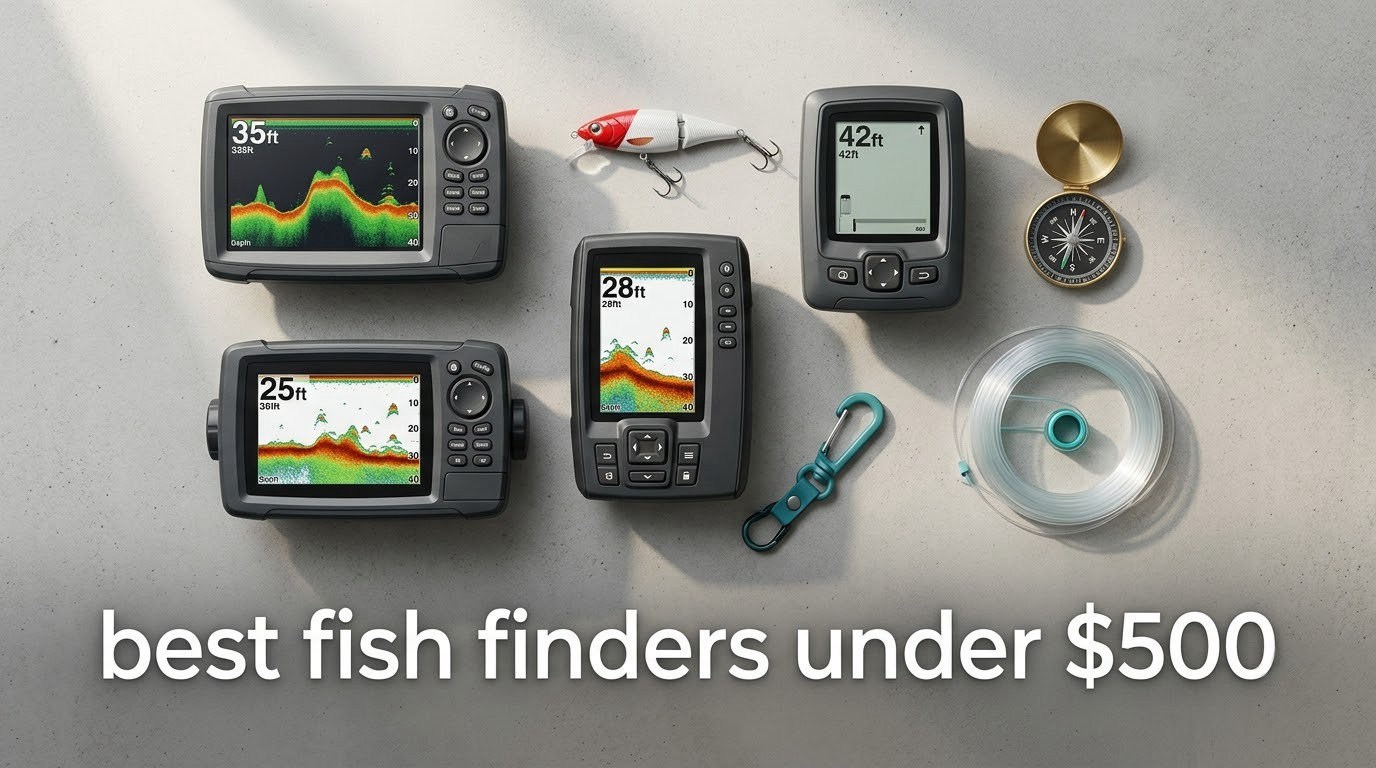
The best fish finder under 500 for most anglers is the Garmin STRIKER Vivid 4cv. It bundles a GT20 transducer that covers both CHIRP traditional sonar and CHIRP ClearVu scanning, adds color palettes that separate fish from structure, and includes Quickdraw Contours mapping, which is the combination rivals at this price point usually split in two.
That matters because the SERP for this query is full of advice from the last hardware generation. The HOOK2 4X, the PIRANHAMAX 4 DI and the ECHOMAP 740s are all superseded now, and a 2026 roundup that still leans on them is describing boats you cannot buy. Every unit below is current generation, and every rating and review count comes from verified buyer feedback rather than a spec sheet.
We compared twelve fish finders for this guide, reading owner reviews on display readability, install pain, transducer quality and how each one holds up in a kayak, a jon boat and on the ice. A fish finder, also called a sonar depth sounder, sends a sound pulse from a hull-mounted transducer and draws the returns on screen as arches, lines and bottom contour. Everything in this list sits under the 500 dollar mark without a hidden transducer charge. If you run an operation rather than a single boat, our guides to fish farming filtration systems, aquaculture aerators and fish grading equipment cover the tank side of things.
Table of Contents
Top 3 Best Fish Finders Under $500 (October 2026)

Garmin STRIKER Vivid 4cv
- CHIRP traditional plus ClearVu sonar
- Color Vivid sonar palettes
- Quickdraw Contours built in

Garmin STRIKER 4
- Sunlight readable 3.5 inch display
- CHIRP sonar
- Transducer and mounts included

The 12 Best Fish Finders Under 500 at a Glance
| Product | Specifications | Action |
|---|---|---|
| Garmin STRIKER Vivid 4cv |
|
Check Latest Price |
| Garmin STRIKER 4 |
|
Check Latest Price |
| Humminbird HELIX 5 DI G3 |
|
Check Latest Price |
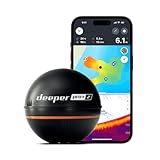 Deeper PRO+ 2 Sonar Deeper PRO+ 2 Sonar |
|
Check Latest Price |
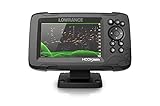 Lowrance HOOK Reveal 5 SplitShot Lowrance HOOK Reveal 5 SplitShot |
|
Check Latest Price |
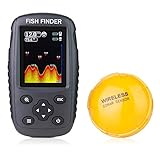 Venterior Wireless Portable Venterior Wireless Portable |
|
Check Latest Price |
 LUCKY Wireless and Wired Portable LUCKY Wireless and Wired Portable |
|
Check Latest Price |
 Garmin STRIKER Plus 4 Garmin STRIKER Plus 4 |
|
Check Latest Price |
 Humminbird PiranhaMAX 4 Humminbird PiranhaMAX 4 |
|
Check Latest Price |
 Deeper START Deeper START |
|
Check Latest Price |
 LUCKY 1108 Handheld LUCKY 1108 Handheld |
|
Check Latest Price |
 ReelSonar iBobber ReelSonar iBobber |
|
Check Latest Price |
1. Garmin STRIKER Vivid 4cv – Best Overall Under 500
Garmin Striker Vivid 4cv Fishfinder with Transducer – 4-inch LCD Display – Easy-to-Use Scanning Sonar – Color Palettes, 11.2 Ounces (010-02550-00)
4 inch color LCD
Vivid sonar color palettes
CHIRP plus ClearVu from GT20
Quickdraw Contours
Pros
- Highest average rating in this roundup
- Color palettes separate fish from structure
- GT20 transducer covers CHIRP traditional and ClearVu
- Quickdraw Contours mapping at this tier
- Two-year limited warranty
Cons
- 4 inch screen is the smallest Garmin here
- No side imaging
- Transducer still needs mounting
The STRIKER Vivid 4cv is the unit we kept coming back to while working through this list. It holds a 4.7 average across more than 1800 ratings, the strongest score in the group, and the reason is that the transducer in the box does double duty. The GT20 sends CHIRP traditional sonar for crisp arches and CHIRP ClearVu for a near-photographic look at what sits below the boat.
The Vivid color palettes are the part owners mention most. Instead of one flat sonar view, you get selectable color schemes that make weed, rock and fish read differently, which speeds up the learning curve for anyone new to reading arches.
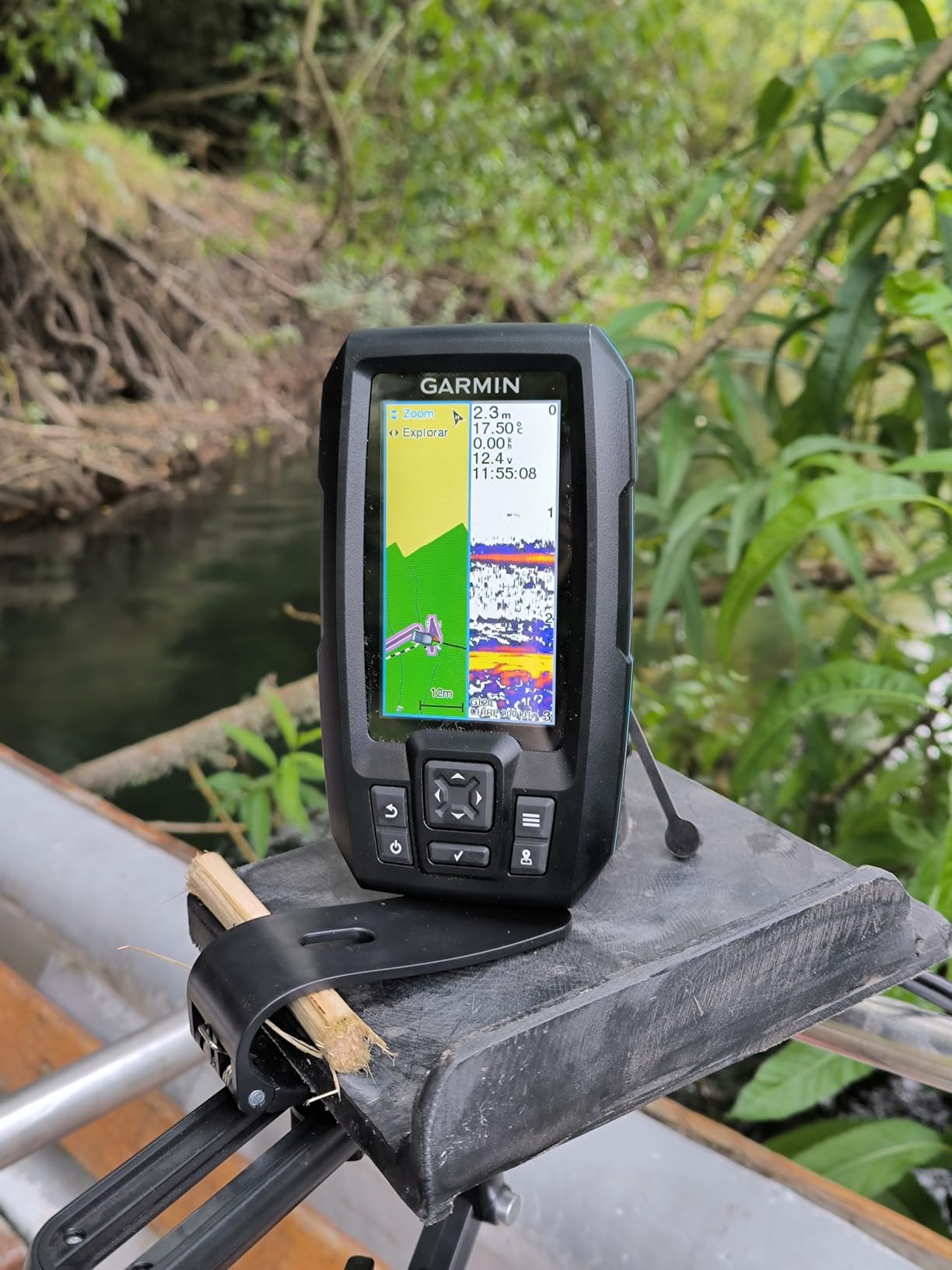
Quickdraw Contours is the quiet overperformer. It records depth as you cruise and turns it into custom one-foot contour lines automatically, so you can save the layout of a lake you have never fished. Buyers consistently flag that having this feature below 500 dollars, and inside a four-inch housing, is unusual.
GPS handles waypoints, routes and boat speed, and the tilt and swivel bailmount bracket in the box lets you angle the screen for glare. The unit weighs 11.2 ounces and draws from a 12 volt system, so power is a non-issue on a full day of fishing, and the two-year limited warranty is the longest in this roundup.
For 2026 buyers this is still the safest single recommendation in the roundup. Nothing else at this price gives you color imaging, CHIRP and automatic mapping in one box with a two-year warranty behind it.
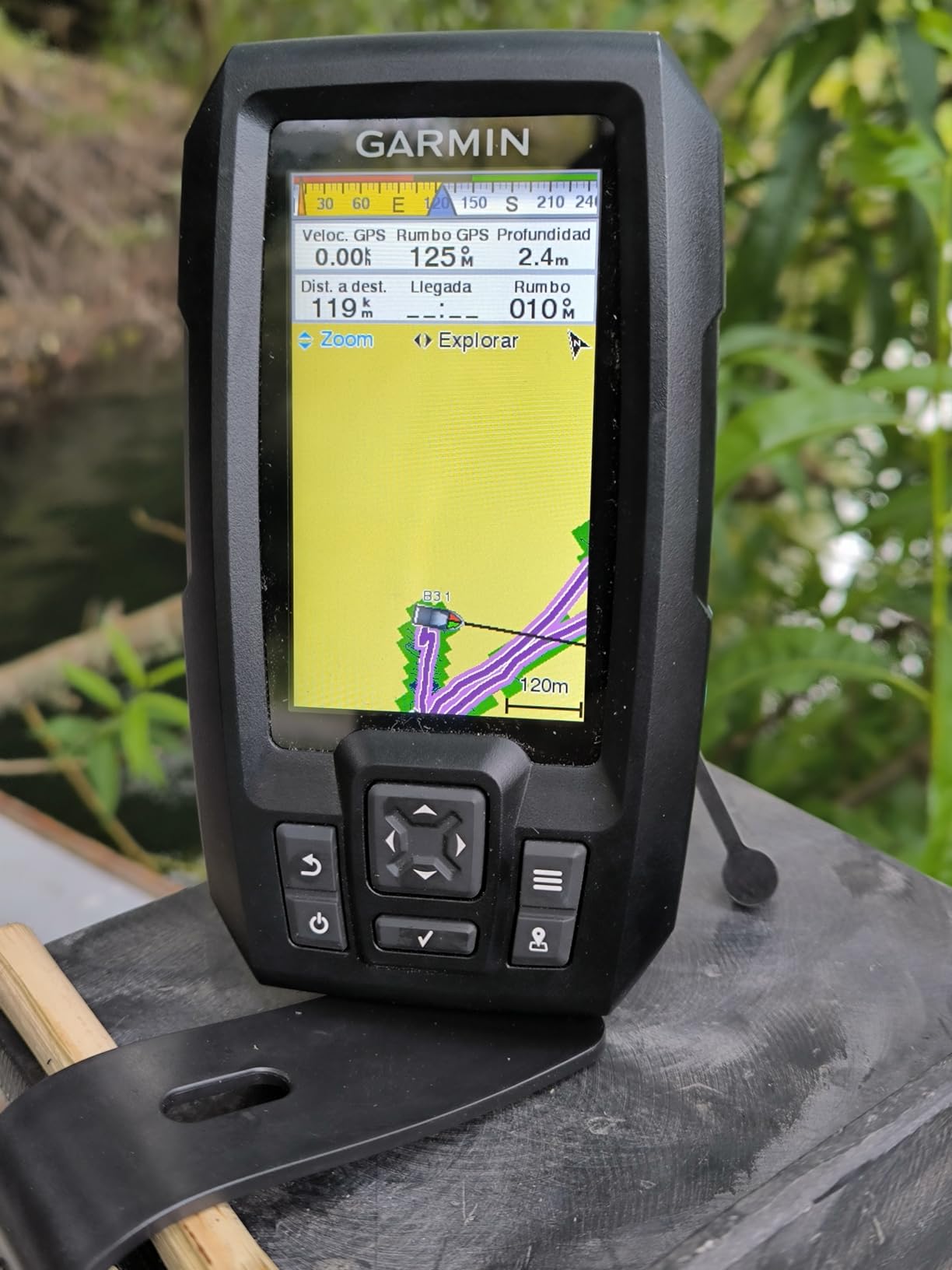
What you gain and lose against the bigger Garmin screens?
You gain imaging and mapping that the plain STRIKER 4 and STRIKER Plus 4 skip, and you keep a small footprint that mounts cleanly on a trolling motor. What you give up is screen real estate. At four inches, split-screen sonar and a chart side by side get cramped, and anglers who wear glasses say the text is small.
Who should skip it?
Skip this one if you fish deep reservoirs where target separation matters more than color coding, or if you plan to grow into side imaging later. A side-scan unit is a better long-term platform, and it is not something you can add to a four-inch Garmin head unit.
2. Garmin STRIKER 4 – Best for Kayaks and Small Boats
Garmin 010-01550-00 Striker 4 with Transducer, 3.5″ GPS Fishfinder with Chirp
3.5 inch sunlight readable LCD
CHIRP traditional sonar
Waypoint map with GPS
1600 ft freshwater depth
Pros
- Transducer
- transom and trolling motor mounts included
- Readable in full sun
- Simplest interface in the roundup
- 0.23 amp draw at 12 volt
- Over 9300 ratings on record
Cons
- Waypoint map only
- no charting
- Thin power leads in the box
- Signal can drop at speed
With more than 9300 ratings averaging 4.6, the STRIKER 4 is the most proven fish finder in this roundup by a wide margin. It is the first one we recommend to someone fishing from a kayak, and the reason is physical: at 3.5 inches and 8 ounces it barely registers on a deck, and the included bracket mounts to a trolling motor without drilling the hull.
It also pulls very little power, drawing 0.23 amp at 12 volt, so a small deep-cycle battery carries it through a full day. The keyed interface has dedicated buttons with no touchscreen to jab at with cold hands, and owners consistently say the screen stays readable in direct sun with sunglasses on.
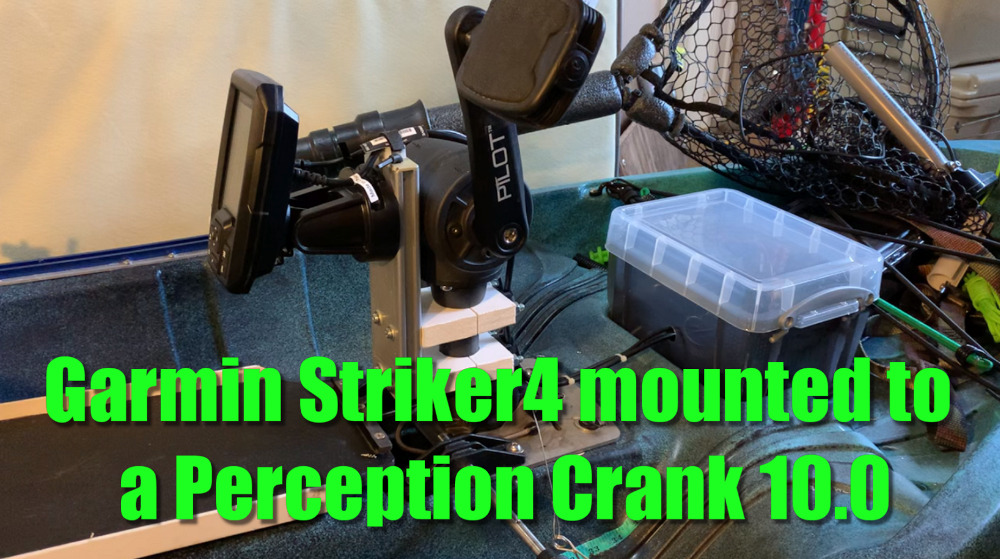
CHIRP sonar gives it crisper fish arches and better target separation than the older fixed-frequency units, and the ClearVu scanning mode adds a look at structure beside the boat. Rated depth reaches 1600 feet in freshwater and 750 feet in saltwater, which is more than most anglers on a small craft will ever need.
The waypoint map lets you mark a brush pile, stump or productive dock and come back to it. The built-in flasher is the sleeper feature for winter: it turns the same head unit into an ice sonar without another purchase.
What you give up is charting. There is no map engine beyond your own waypoint grid, so if you want to see a creek channel you have to find it yourself. Some owners also report the signal thinning above idle speed, and the supplied power leads are thin wire that needs securing properly.
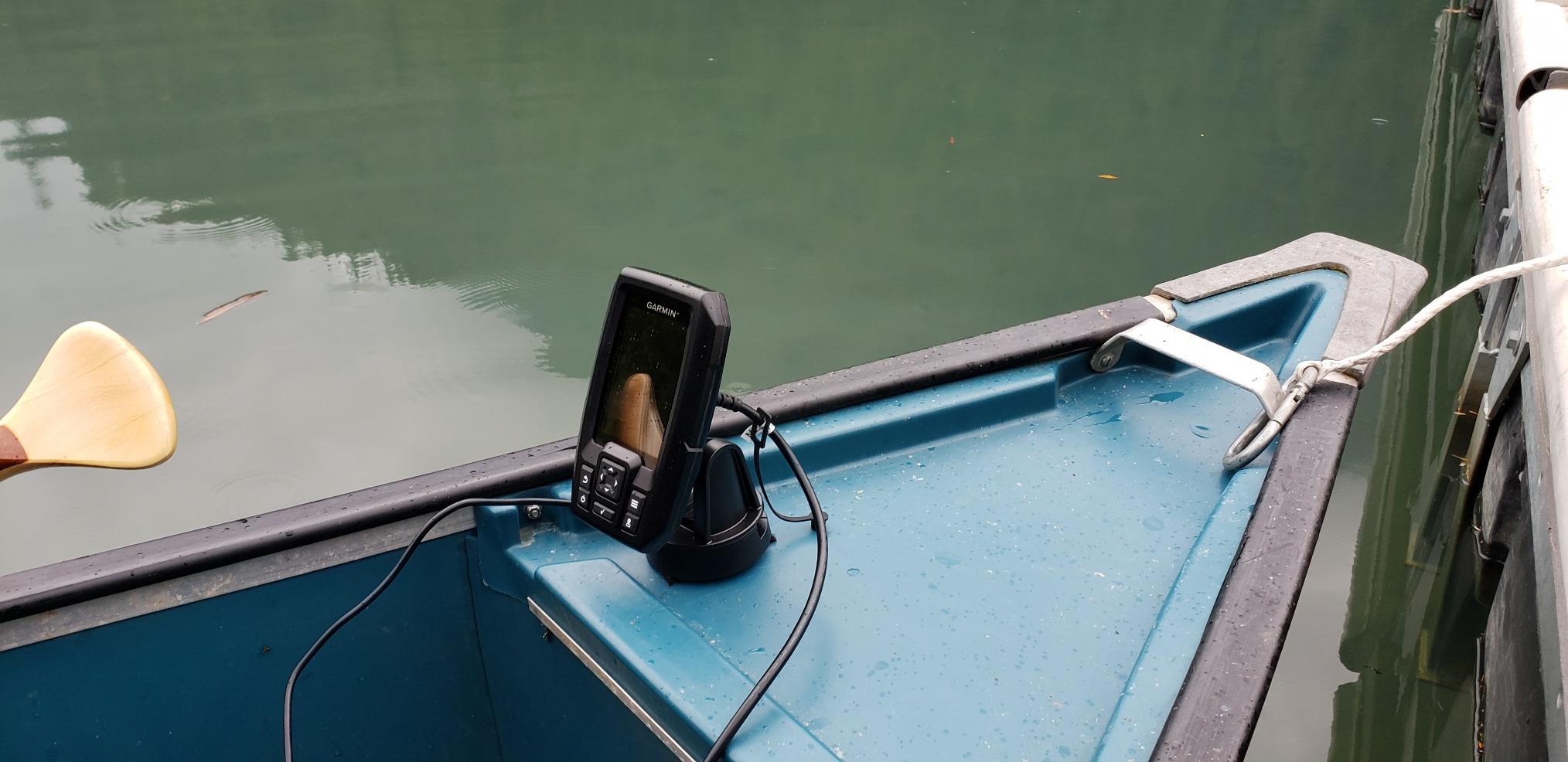
Mounting and power realities for a kayak
The transom and trolling motor mounts in the box cover most kayak rigs, and the tilt and swivel bracket lets you reposition the screen as you shift position. Budget for a small battery pack and a proper fuse, because neither the leads nor the documentation walk you through a clean install. If you want a wired unit that will never need a phone, this is it.
Where it falls short?
This is not the unit for someone who wants to see structure in real time while trolling deep water, or for anyone who plans to keep the same head unit for a decade and add mapping later. Both of those needs point to a larger Garmin or a Lowrance instead.
3. Humminbird HELIX 5 CHIRP DI G3 – Best for Down Imaging
Humminbird Helix 5 G3 GPS Fish Finder with Transducer, Dual Spectrum Chirp Sonar & Down Imaging
5 inch color TFT
CHIRP Down Imaging
Dual Spectrum wide and narrow
Humminbird Basemap
Pros
- Only down imaging view in this roundup
- Dual Spectrum wide and narrow modes
- Basemap covers 10000 plus lakes
- AutoChart Live with 8 hours recording
- Color TFT readable in bright sun
Cons
- Down Imaging setup has a learning curve
- Fuse and fuse holder not included
- Gimbal bracket is awkward to mount
The HELIX 5 CHIRP DI G3 is the one unit here that shows you a genuine picture of what is directly below the boat. CHIRP Down Imaging filters visual noise out of the beam, so you see weed edges, rock shelves and fish shape rather than a smear of returns, and owners say the five-inch color TFT stays readable in bright sun and low light alike.
Humminbird Dual Spectrum sonar adds a second trick most budget units lack. Wide Mode maximizes coverage while Narrow Mode tightens the cone for detail, and the low-Q transducer delivers precise two-dimensional target separation when you are trying to pick a walleye off a ledge.
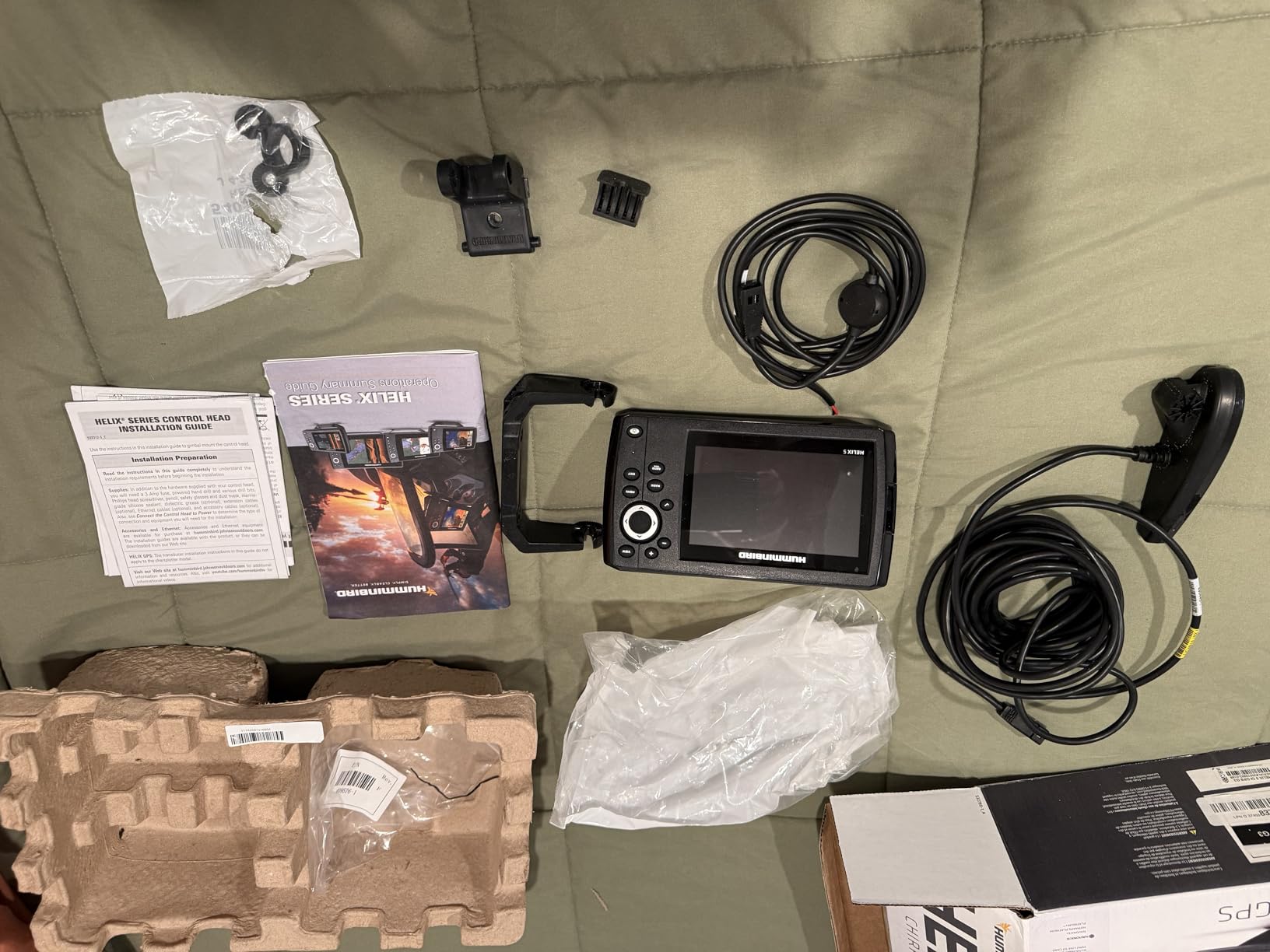
The mapping is the other reason to look here. A Humminbird Basemap covering more than 10,000 lakes and the continental US coastline is loaded in the box, and AutoChart Live records up to eight hours of real-time contour data as you fish. It upgrades to LakeMaster, CoastMaster or Navionics cards if you want more.
Worth knowing before you buy: the included transducer cable is substantial, the gimbal bracket takes some getting used to, and the box does not include a three-amp fuse or fuse holder. Several buyers also hit a learning curve setting up Down Imaging, so read the sensitivity settings before the first trip.
There is one report of a unit that would not power up after installation. At a 4.5 average across 338 ratings the sample is thinner than the Garmins here, which is a reason to buy from a seller with straightforward returns.
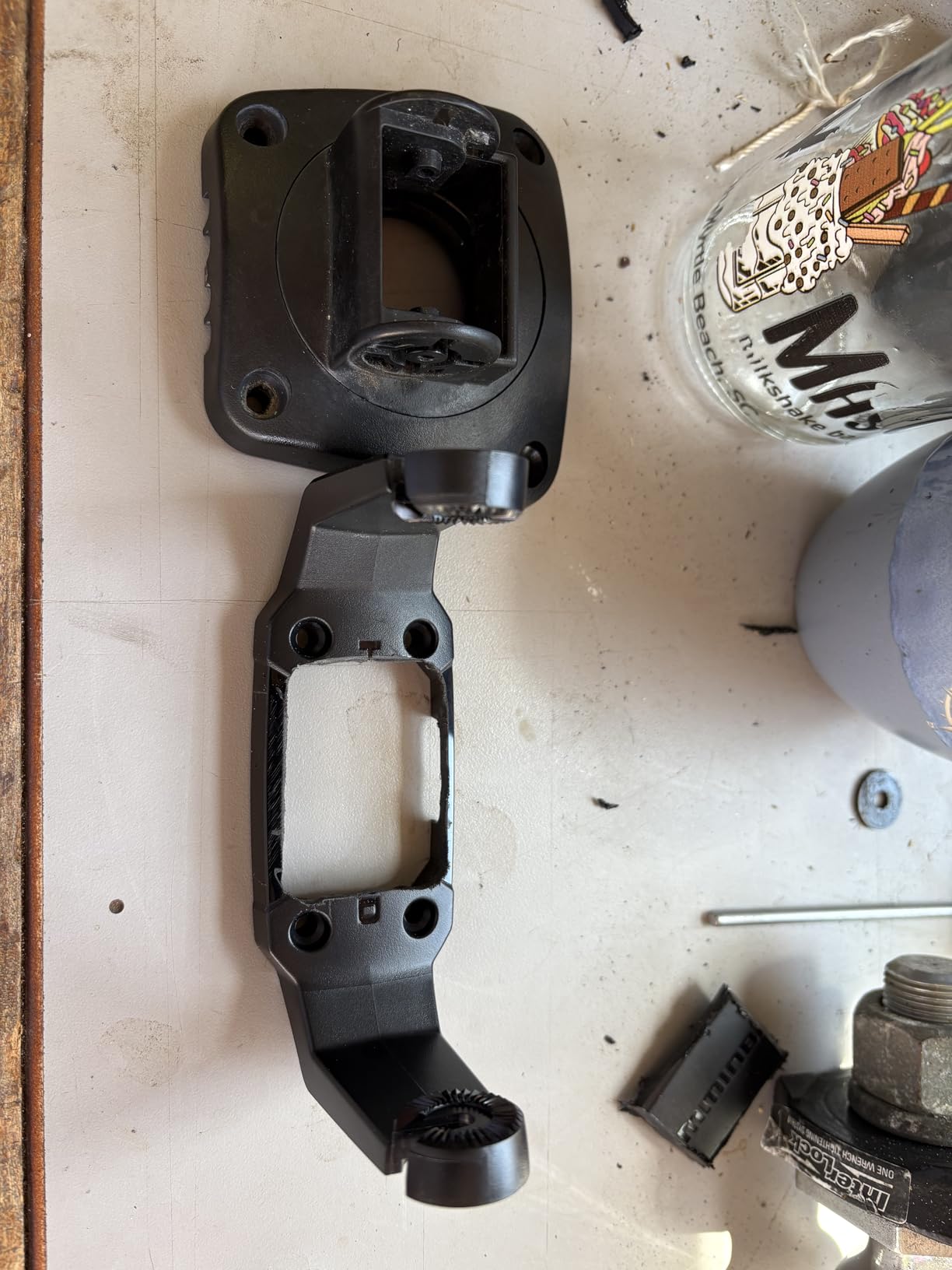
Down imaging versus side imaging at this budget
Down imaging answers what is under the boat right now, which makes it the right tool for finding a ledge, a weed edge or a shell bed and fishing it immediately. Side imaging answers what is off to the left and right, which is what you want when you are trolling a channel and cannot afford to stop. At this price, the HELIX 5 gives you the first one well and not the second one at all.
Who this suits and who it does not?
It suits the freshwater angler fishing a known reservoir who already knows roughly where the structure sits. It does not suit a complete beginner who will spend the whole first season in menus, and it does not suit an angler who wants a chartplotter with a full mapping ecosystem rather than a basemap.
4. Deeper PRO+ 2 Sonar – Best for Shore and Dock Fishing
Deeper PRO+ 2 Sonar Fish Finder – Portable Fish Finder and Depth Finder For Kayaks, Boats and Ice Fishing with GPS Enabled | Castable Deeper Fish Finder with FREE User Friendly App
Castable sonar to 100 meters
0.4 inch target separation
Built-in GPS bathymetric maps
Own Wi-Fi network
Pros
- 0.4 inch target separation on narrow beam
- Built-in GPS records bathymetric maps
- 330 ft accuracy
- Generates its own Wi-Fi
- Weighs 3.2 ounces
Cons
- All data lives in a phone app
- Phone battery sets your session length
- 2.4 inch screen in the box
The Deeper PRO+ 2 is the strongest portable unit in this roundup, and the reason is target separation. On the narrow beam it resolves returns down to 0.4 inch, fine enough to track a small lure or a vertical jigged minnow, and it stays accurate out to 330 feet.
The upgrade over earlier Deeper models is the built-in GPS. Cast the pod from a dock, a bank or a kayak and it records bathymetric maps you can save and return to, which means a productive drop-off gets logged with coordinates instead of living in your memory.
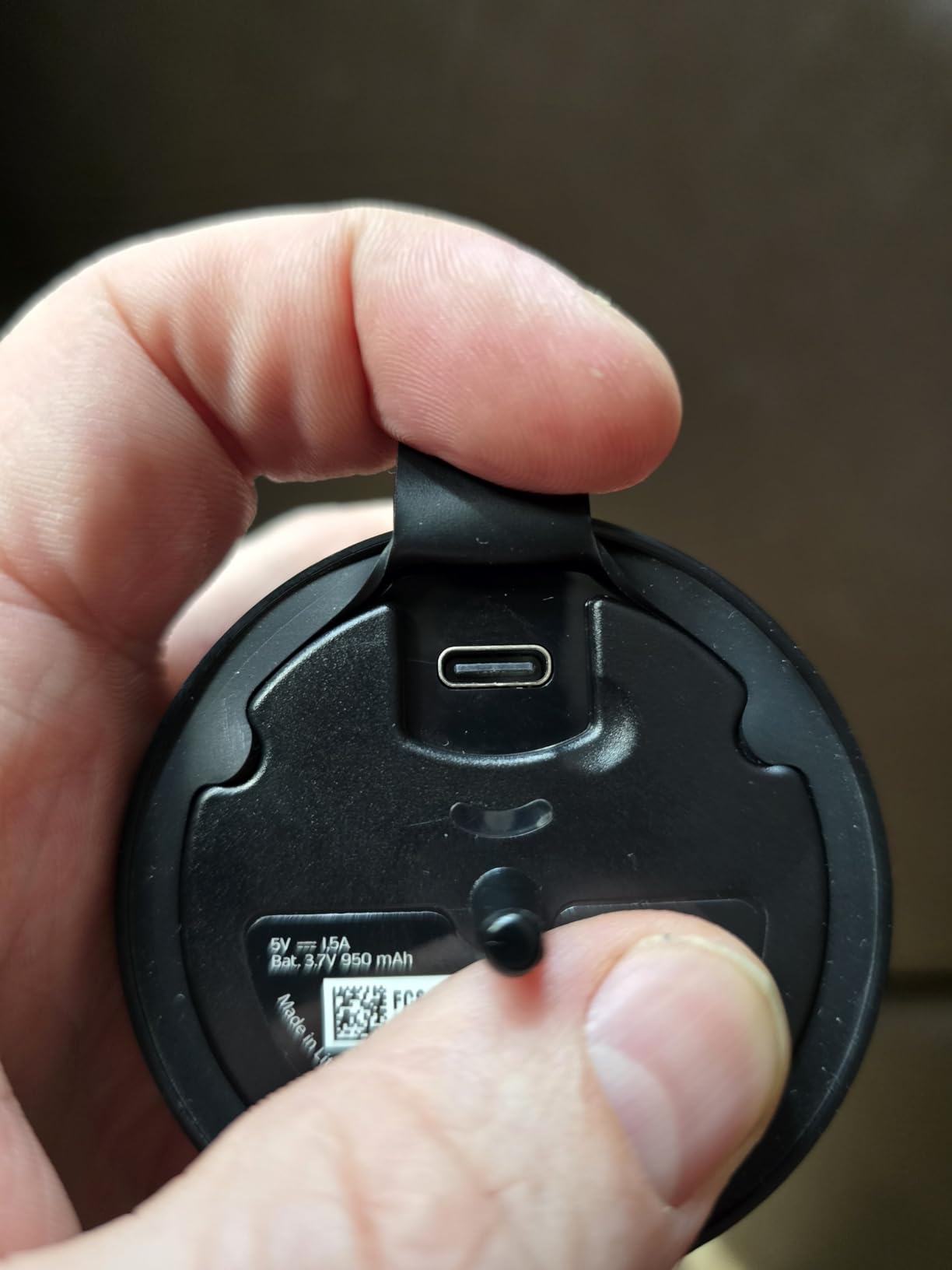
It also creates its own Wi-Fi network, so a full afternoon of scanning does not eat your mobile data. Wide, mid and narrow beam options let you cover a flat in one pass or drill into a single spot, and the whole unit weighs 3.2 ounces and fits in a tackle box.
The trade is real and buyers say it plainly: every reading appears in the Fish Deeper app on your phone, so you fish looking at a screen rather than a waterproof unit clipped to your hull. Your session is capped by phone battery, and the bundled display is 2.4 inches.
Owners moving up from a suction-cup wired portable consistently report that the cordless format changes how they fish. It also works on ice, which makes it a legitimate two-season tool rather than a summer-only gadget.
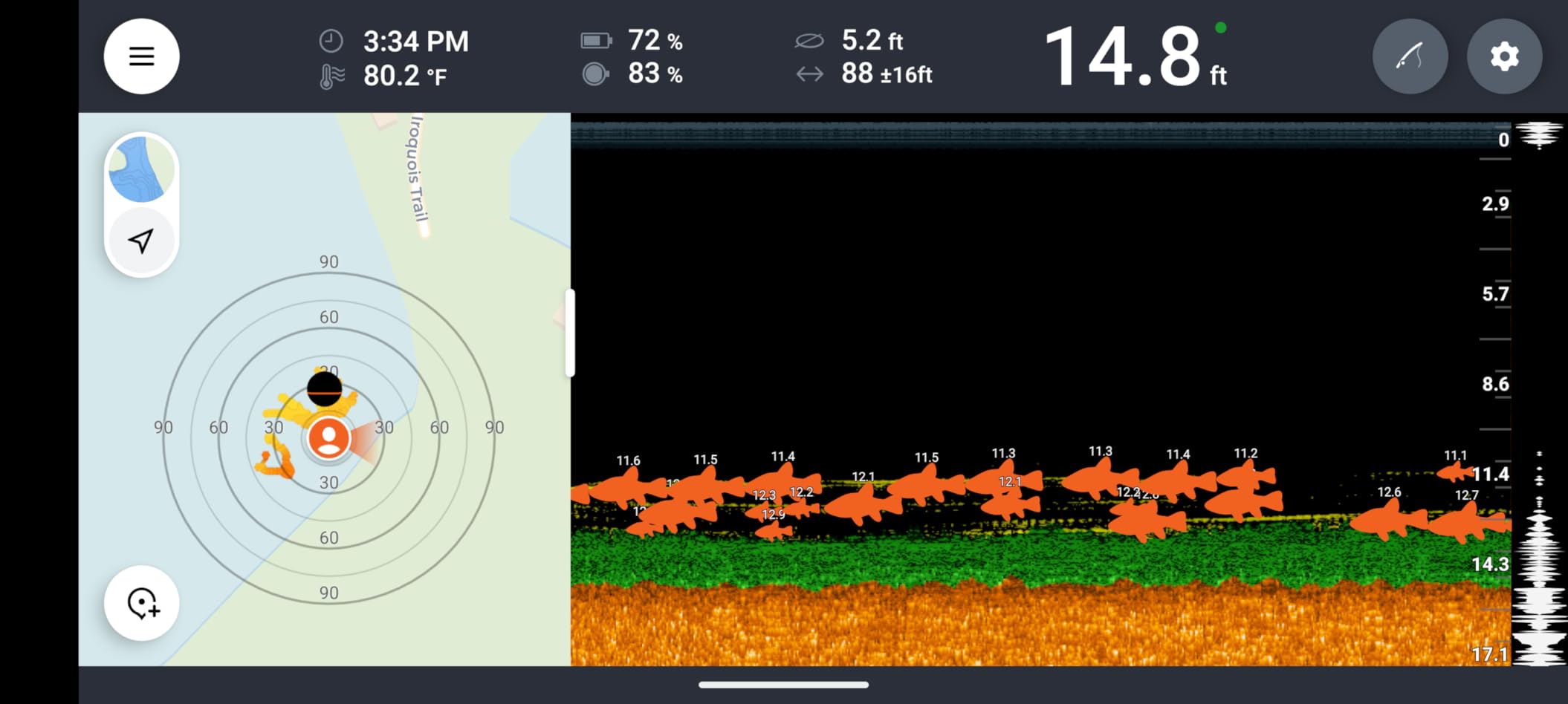
Bathymetric mapping from the bank is the real feature
Most castable sonar tells you how deep the water is right now. The PRO+ 2 also remembers it, so a productive bank or pier position can be saved as a map and reloaded later. If you fish the same stretch repeatedly, that is worth more than any extra inch of screen.
Where it is the wrong choice?
It is the wrong choice for trolling, since the sonar needs to sit still in the water, and for anyone who fishes in rain without a phone case. It is also the wrong choice for a saltwater angler who needs a permanently mounted head unit. For a family trip to a pond, nothing else here is as easy.
5. Lowrance HOOK Reveal 5 SplitShot – Best for Mapping
Lowrance HOOK Reveal 5 SplitShot – 5-inch Fish Finder with SplitShot Transducer, Preloaded C-MAP US Inland Mapping
5 inch SolarMAX display
SplitShot CHIRP plus DownScan
Genesis Live contours
Pros
- Preloaded high-detail inland lake maps
- Genesis Live builds custom contours
- SolarMAX screen visible in direct sun
- SplitShot combines wide CHIRP and DownScan
- Fuse and fuse holder ship in the box
Cons
- Configuration menu is complicated
- 13 percent of ratings are one-star
- Transducer cable routing is awkward
- 5 inch screen reads small to some
The HOOK Reveal 5 SplitShot is the mapping pick in this roundup, and it comes with high-detail charts of almost 4,000 US inland lakes already loaded. On a lake you have never seen, that means you can find a channel or a drop-off on the first trip rather than the third.
Genesis Live takes it further by building your own contours in real time as you move across the water. Combined with the SplitShot transducer, which pairs a wide-angle high CHIRP beam with DownScan structure imaging, this is a lot of capability in a five-inch housing.
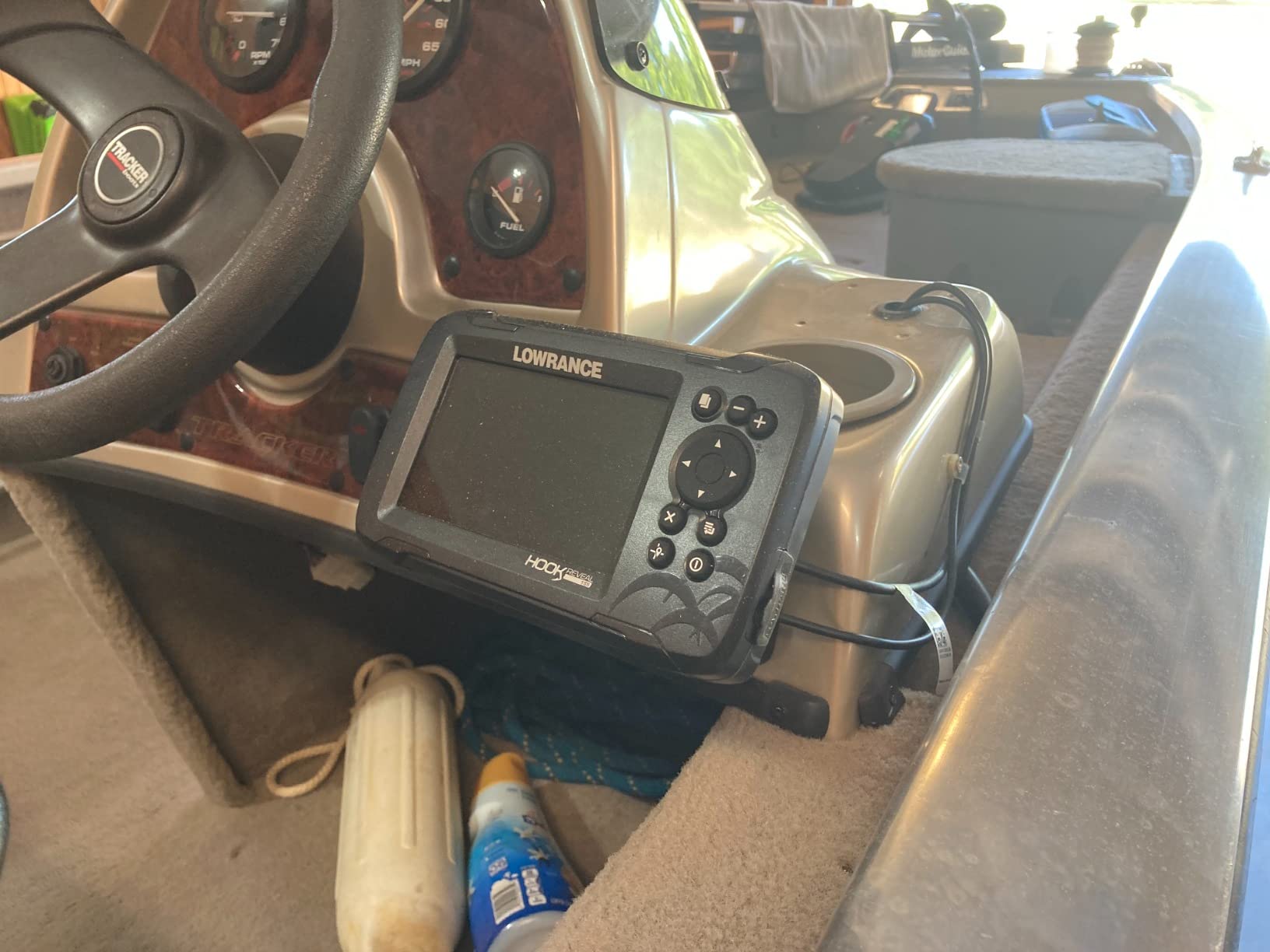
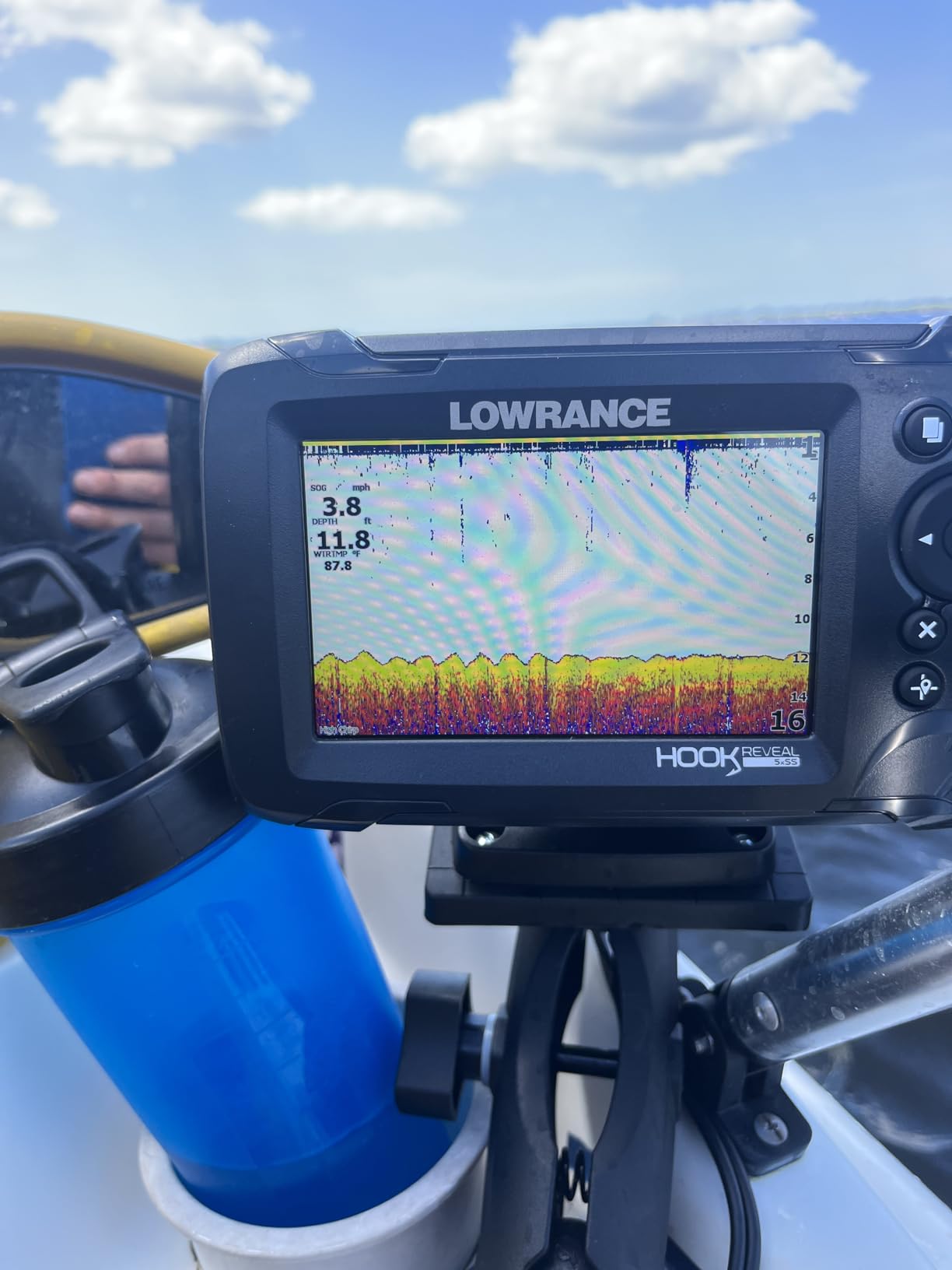
FishReveal processing combines CHIRP target separation with DownScan, and the autotuning sonar adjusts settings as conditions change, which saves you from menus on a cold morning. The SolarMAX display is genuinely daylight readable, and the box includes a fuse and fuse holder that several competitors leave out.
Buyers report it working straight out of the box after install, with maps loading without extra setup. The bottom-structure view adds context that helps you tell a ledge from a weed line.
Now the honest part. The 4.2 average across 424 ratings is dragged down by a cluster of one-star reviews, 13 percent of the total, covering units that failed after short use and a transducer that would not pair with the head unit. The configuration menu is also widely reported as complicated, and the transducer cable routing through a boat channel takes patience.
What preloaded maps are actually worth?
Charts of nearly 4,000 inland lakes are the single biggest reason to spend here rather than on a cheaper Garmin. If your water is on that list, you skip a season of learning the layout by trial and error. If your lake is not covered, the value drops sharply and a Quickdraw Contours unit becomes the smarter buy.
Who should look elsewhere?
Skip this unit if the highest one-star share in the roundup makes you uncomfortable, and consider it carefully if you fish saltwater where the inland map package helps you less. It is also a poor match for a first-time buyer who wants a simple menu, and the 5 inch screen is small for anglers who already struggle with close reading.
6. Venterior Wireless Portable – Best for Beginners
Venterior Portable Rechargeable Fish Finder Wireless Sonar Sensor Fishfinder Depth Locator with Fish Size, Temperature, Bottom Contour, Color Display
2.6 inch color TFT
Castable sensor with 262 ft range
Depth temperature fish size
2-year warranty
Pros
- Works immediately with no setup
- 262 ft sensor to unit range
- Reports fish size and bottom contour
- Selectable black or white background
- Two-year warranty
Cons
- Battery life drops in cold conditions
- 105 degree beam reads poorly over ice
- Receiver battery is short
- Fish size categories are subjective
The Venterior VT-FF005 is the easiest fish finder in this roundup to start with, and that is not a criticism. You tether the floating sensor to your line, cast it, and the handheld unit connects on contact with the water. There is no mounting, no wiring and no menu tree to learn before your first cast.
Once connected it reports water depth, temperature, fish depth, fish size and bottom contour on a 2.6 inch color TFT. The selectable black or white background is a small touch that matters, since white is far easier to read in direct sun and black is better after dark.
Range is the advantage over most castable units. The sensor holds a wireless link out to 262 feet, which comfortably covers a long cast, and the depth range spans 2.6 to 164 feet. Owners moving up from a wired suction-cup portable tend to be the happiest reviewers in the group.
Where it disappoints: the receiver battery is only good for a few hours of continuous use, cold weather drains it faster, and a 105 degree beam is too wide to read through an ice hole. Dragging it behind a moving boat also produces poor results, so it is a stationary tool.
Fish size is reported in small, medium and big categories rather than inches, so treat it as a hint, not a measurement. The two-year warranty is longer than most portables in this price range offer.
Why the wide beam matters more than the range?
A 105 degree cone covers a lot of water on a cast, which is why it is a good scout for finding a ledge from a bank or a dock. It is also why it struggles on ice, where you want a narrow beam pointed straight down. If ice fishing is your main use, choose a narrower-beam unit instead.
Who this suits?
It suits a beginner, a family trip, a renter with no boat, and anyone who fishes a pond from shore more than they fish open water. It does not suit an angler who owns a transom, because by the time you have a boat you can install something permanently wired and far more capable.
7. LUCKY Wireless and Wired Portable – Best Dual-Mode Portable
LUCKY Wireless Handheld Fish Finders Boat Wired Transducer Fishing Finder Sensor Sonar Waterproof Portable Depth Finders for Ice Fishing Sea Fishing Kayak
2.8 inch waterproof floating handheld
Wireless to 328 ft
Wired mode to 328 ft depth
Pros
- Only portable here that works wired or wireless
- Waterproof body that floats
- 328 ft depth in wired mode
- 125 kHz with 90 degree beam
- 10 plus hours in battery save mode
Cons
- Fish detection unreliable at max sensitivity
- Condensation can form inside the display
- Carrying case feels cheap
The LUCKY Y2020-CLA stands apart because it runs both ways. Cast the floating sonar ball and it works wirelessly out to 328 feet, or plug in the included 25 foot extension cable with the wired transducer and it reads to the same depth from a fixed position. No other portable in this roundup offers both.
The handheld body is waterproof and floats, with a glowing cap for night fishing and a 125 kHz beam at a 90 degree angle. USB charging gives five to six hours of use, or more than ten with battery save mode, which comfortably covers a day on a kayak.
Owners like that no separate battery bag is needed, and that depth readings and water temperature stay accurate well past 300 feet. The bundled kit is unusually complete: extension cable, wired transducer, anti-fish-bite float, charging cable and a case.
The honest weakness is fish detection. Several buyers say that at maximum sensitivity the unit misses fish and jigs that other gear marks clearly, so it is far better as a depth and temperature instrument than as a fish identifier. Condensation inside the display can form if you stow it wet, and the case is reported as cheap.
At a 4.2 average from 187 ratings, this is the smallest review sample in the roundup, so treat the strengths and weaknesses here as directional rather than settled.
When dual mode actually earns its keep?
Wireless is what you want for casting from a dock or a bank, where a cable in the water is a nuisance. Wired mode is what you want when you are anchored over a spot you found and want to hold it while you watch the screen. A single-mode portable only does the first job, and the fixed units on this list only do the second.
Who should pass?
Pass if your priority is finding fish rather than finding water, because detection reliability is the weak point here. Also pass if you plan to run it on the ice, where a 90 degree beam is wider than an ice hole and the readings suffer. A mounted unit serves a serious ice angler far better.
8. Garmin STRIKER Plus 4 – Best for Contour Mapping
Garmin 010-01870-00 Striker Plus 4 with Dual-Beam transducer
4.3 inch QSVGA display
Dual-beam CHIRP transducer
Quickdraw Contours
Built-in GPS
Pros
- Quickdraw contours across 2 million acres
- Dual-beam sonar with split-screen
- 200 W RMS transmit power
- Built-in GPS with routes and speed
- Transducer and multiple mounts in box
Cons
- QSVGA resolution less crisp than newer units
- No battery fittings included
- Maps cannot be transferred off the device
- Thin manual
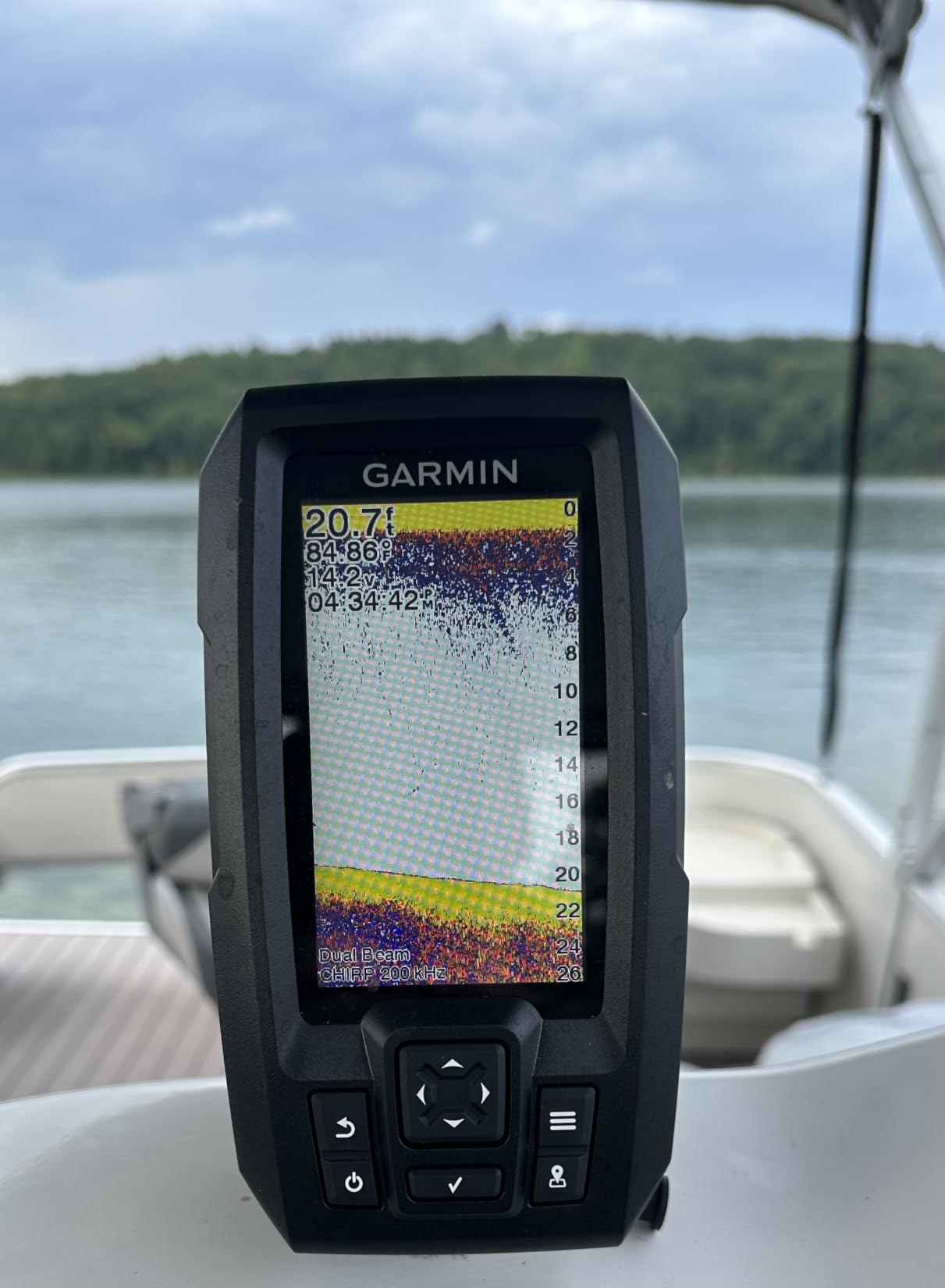
The STRIKER Plus 4 is the step up from the base STRIKER 4, and the two additions that matter are a larger 4.3 inch screen and Quickdraw Contours. The contour software covers up to two million acres, so you can record an entire region of lakes rather than a single water body.
The included dual-beam transducer with Garmin CHIRP traditional sonar gives you a wide and a narrow view at the same time, and the split-screen layout shows both. Transmit power is rated at 200 W RMS, which is real output rather than a marketing watt, and that is what keeps returns clean on deep water.
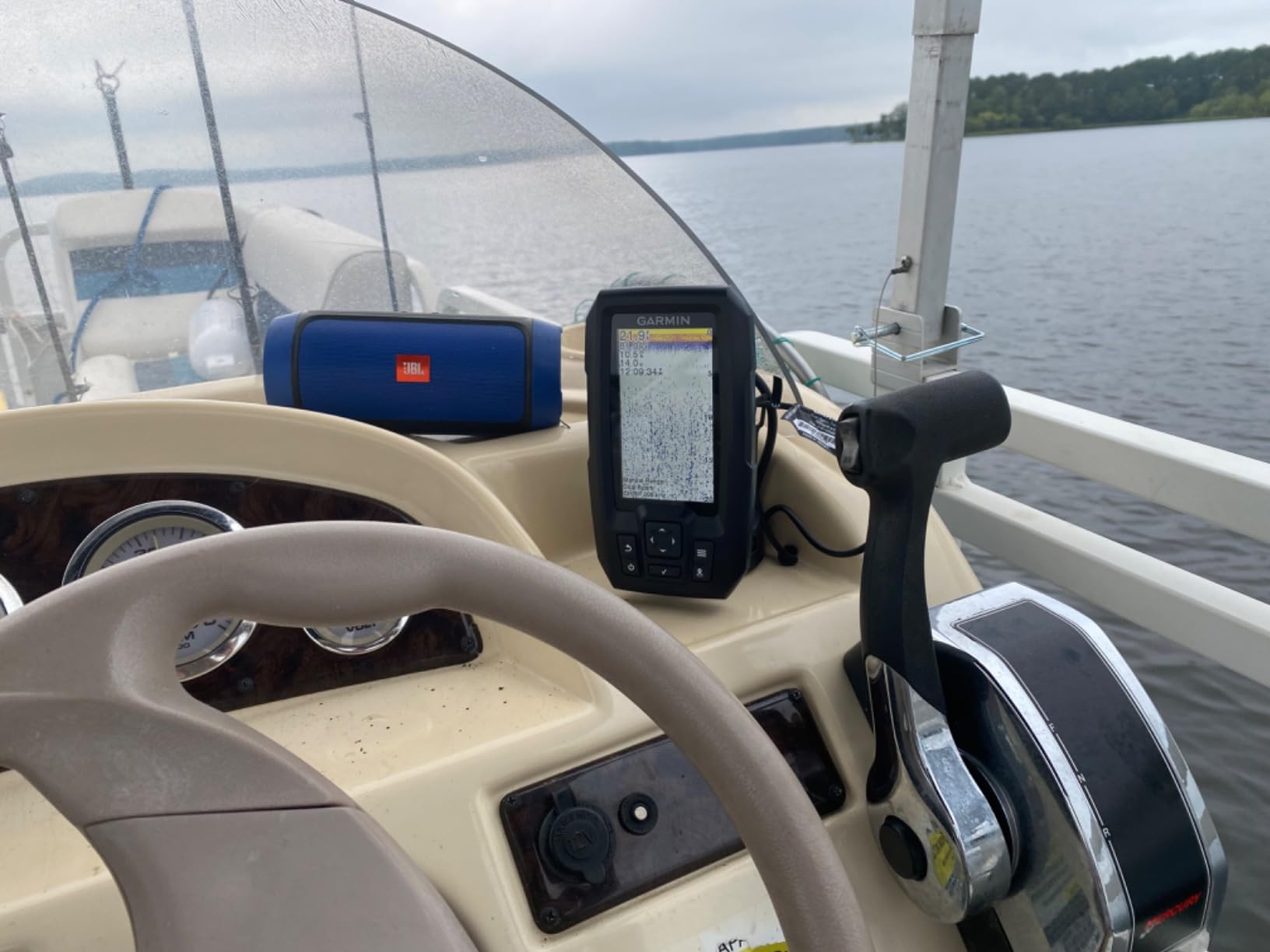
Owners rate it at 4.6 across more than 2400 ratings and repeatedly mention that it runs for days off a 7Ah sealed lead acid battery, which is the practical test for whether a portable setup is actually viable. The screen is bright and sharp in direct sun and readable on the ice.
The catch is resolution. The QSVGA panel is less crisp than newer Garmin screens, and several buyers notice it coming from a previous unit. The box does not include battery connection fittings, and Quickdraw maps built on this model cannot be uploaded or downloaded elsewhere.
Documentation is thin on setup, which is a recurring theme across this whole roundup rather than something unique to this model.
Quickdraw Contours versus preloaded charts
Quickdraw records the water you fish and builds contours from it. Preloaded charts give you water you have never seen. For a weekend angler who sticks to two or three lakes, recording your own is the better value and the reason this unit is worth the step up from the STRIKER 4. For someone who relocates constantly, a unit with inland charts already loaded serves them better.
Who should skip it?
Skip it if screen sharpness is a dealbreaker for you, since the QSVGA panel is the oldest in this list. Skip it if you want to move your maps between units, because the Quickdraw data stays on the device. And skip it if you plan to add side imaging later, because this head unit cannot take it.
9. Humminbird PiranhaMAX 4 – Best No-Frills Starter
Humminbird PiranhaMAX 4 Fish Finder with Transducer, Dual Beam Sonar
4.3 inch monochrome LCD
Dual Beam narrow and wide
600 ft maximum depth
Transducer included
Pros
- Transducer included in the box
- Dual beam trades detail for coverage
- 600 ft depth rating
- Adjustable tilt and swivel mount
- Established marine electronics brand
Cons
- Monochrome display with no color or charting
- No GPS or waypoint marking
- Heavier than comparable small units
The PiranhaMAX 4 does one job and does it without fuss. Dual Beam sonar gives you a narrow beam for detail and a wide beam for coverage, and switching between them is the entire control scheme. There is no menu to learn, which makes it a genuinely good first fish finder.
Depth rating is 600 feet, more than enough for inland lakes, and the tilt and swivel mount in the box lets you set the viewing angle quickly when the sun moves. The XNT 9 28 T transom-mount transducer is included, so there is no separate purchase to make before you can fish.
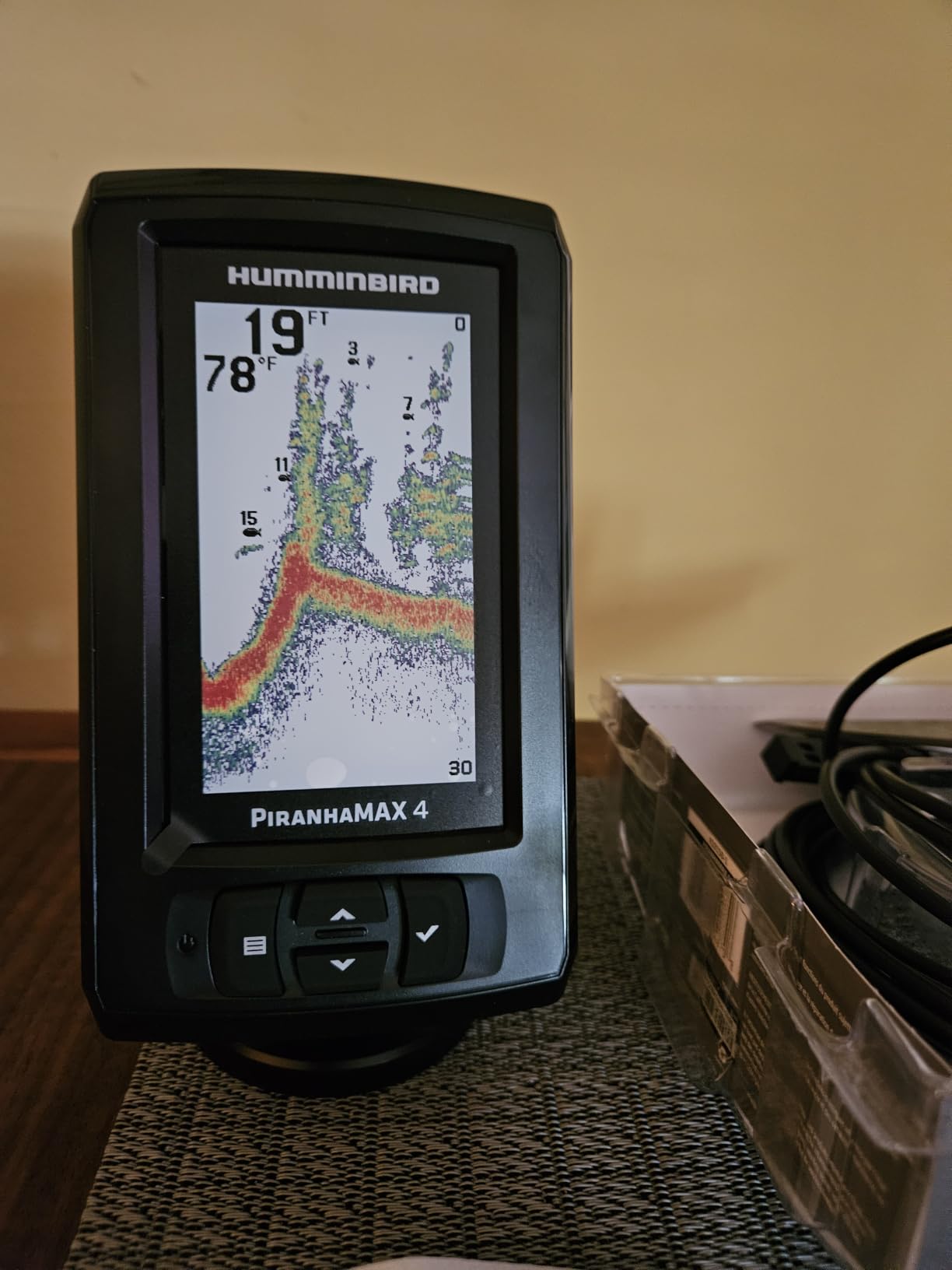
Buyers treat it as the no-alternatives option: an established marine brand, a one-year warranty, and a display that shows arches and bottom contour without asking you to configure anything. The 4.6 average across 1328 ratings reflects that simplicity being exactly what people wanted.
What you accept is a monochrome 4.3 inch screen with no color, no GPS and no waypoint marking. If you have never fished with sonar, that is a fine place to start. If you already know what you are looking for, you will outgrow it within a season.
The listed weight of 2 pounds is heavier than comparable small Garmin units, which is worth remembering for a small kayak where every ounce counts.
Is a basic unit still worth buying in 2026?
Yes, for a specific situation: a complete beginner, a short season on a pond, or a spare head unit to keep in the truck. A monochrome unit teaches you to read arches and bottom contour without letting you form habits around color palettes you may not need. The value is in the simplicity, not in the specification.
What it cannot do?
It cannot mark a waypoint, so you cannot find the spot you just found again, and it cannot record a route or build a map. It also cannot be upgraded with side or down imaging. Treat it as a complete answer for a specific job rather than a first step on a ladder.
10. Deeper START – Most Versatile
Deeper Start Fish Finder – Portable and Depth Finder for Recreational Fishing from Dock, Shore, Bank or Kayak | Castable Deeper Smart Sonar with Free User Friendly App
Castable and scans to 165 ft
40 degree sonar beam
Auto-saved scans with location
Pros
- No wires and no separate battery
- Creates its own Wi-Fi
- Auto-saves every scan with time and location
- Free app for iOS and Android
- About 6 hours per charge
Cons
- All data shown in the phone app
- Entry-level sonar resolution
- Casts and reads to 165 ft
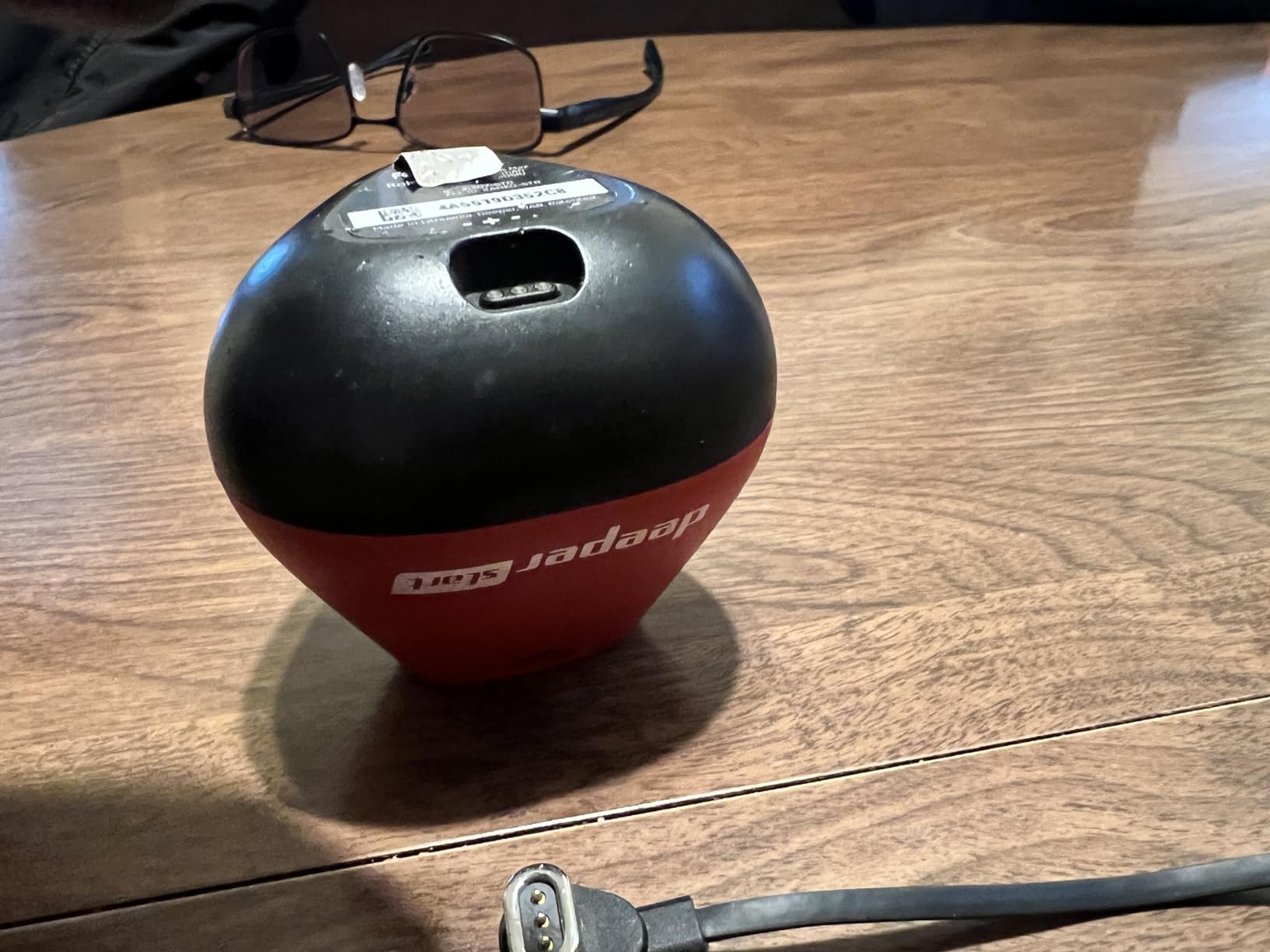
The Deeper START is the simplest thing here that still does something you cannot do by eye. Cast it up to 165 feet and it scans down to the same depth with a 40 degree beam, showing fish location, bottom contour and vegetation on your phone through the free Fish Deeper app.
It generates its own Wi-Fi network, so a full day of scanning costs you nothing in mobile data, and every scan is auto-saved with time and location. That history is quietly valuable: you can see whether the ledge you found last month was productive twice or once.

A full charge takes about 2.5 hours and gives roughly 6 hours of use, and a night fishing mode helps after dark. There is no external battery and no wiring, which is the whole appeal for someone fishing from a dock, a bank or a rented kayak.
At a 4.1 average across more than 3000 ratings the opinions split. Some owners say it does the job perfectly for family trips. Others find the readings basic, and the sonar resolution is clearly a step below the PRO+ 2. There is also no built-in GPS on this model, so the saved location depends on your phone.
Everything is displayed in the app, which means you fish while looking at a phone screen and your session is limited by its battery.
START versus PRO+ 2
The PRO+ 2 adds built-in GPS, finer 0.4 inch target separation on the narrow beam and greater range, and it is the better tool for an angler who fishes alone and wants to record structure. The START is the better tool for a group trip, a child learning to fish, or anyone who wants a depth reading without installing anything. Pick the START if the goal is simple, pick the PRO+ 2 if the goal is data.
Where it falls short?
It is not a trolling tool, not a boat-mounted tool, and not precise enough to separate two fish holding at the same depth. If you want to know how far below the surface a strike happened, the bigger Deeper is worth the step up.
11. LUCKY 1108 Handheld – Best for Kayak Hulls
LUCKY Kayak Portable Fish Depth Finder Water Handheld Fish Finder Sonar Castable Kayak Boat Fishfinder Transducer Fishing LCD Display FFC1108
2 inch backlit LCD
3 ft to 328 ft depth range
Weed sand and rock readout
Neck strap included
Pros
- Reads through a kayak hull
- Dependable depth readings for ledges
- Backlit for sun or darkness
- Five sensitivity levels for turbid water
- Fish and school alarm
Cons
- Does not show fish size
- Must be used from a boat or kayak
- Will not read through fiberglass
- Some power-on failures reported
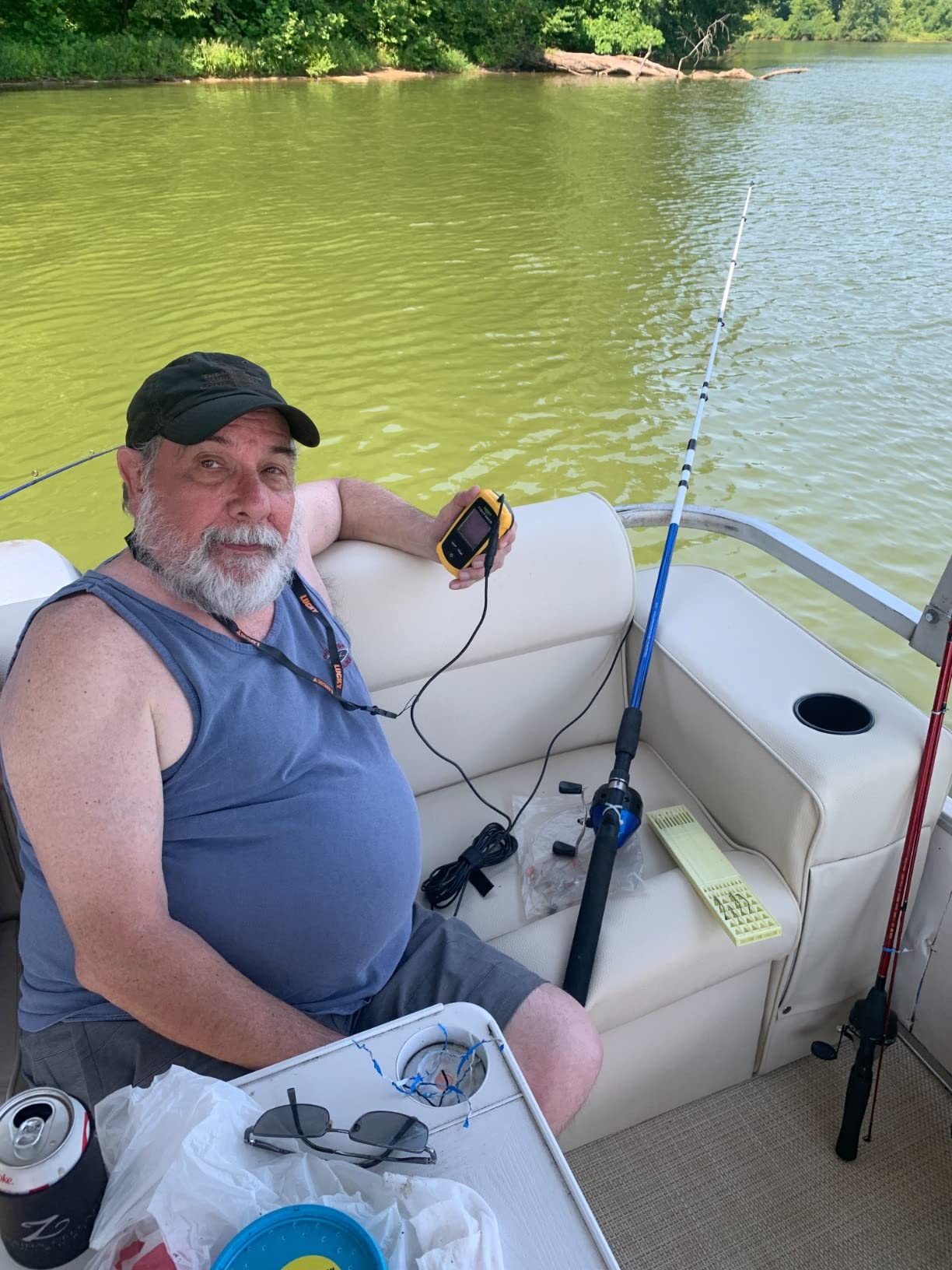
The LUCKY 1108 is a depth instrument rather than a fish identifier, and knowing that up front saves you disappointment. It reads depth from 3 feet to 328 feet with the transducer fully immersed, and multiple owners say the readings match an in-water transducer they already own.
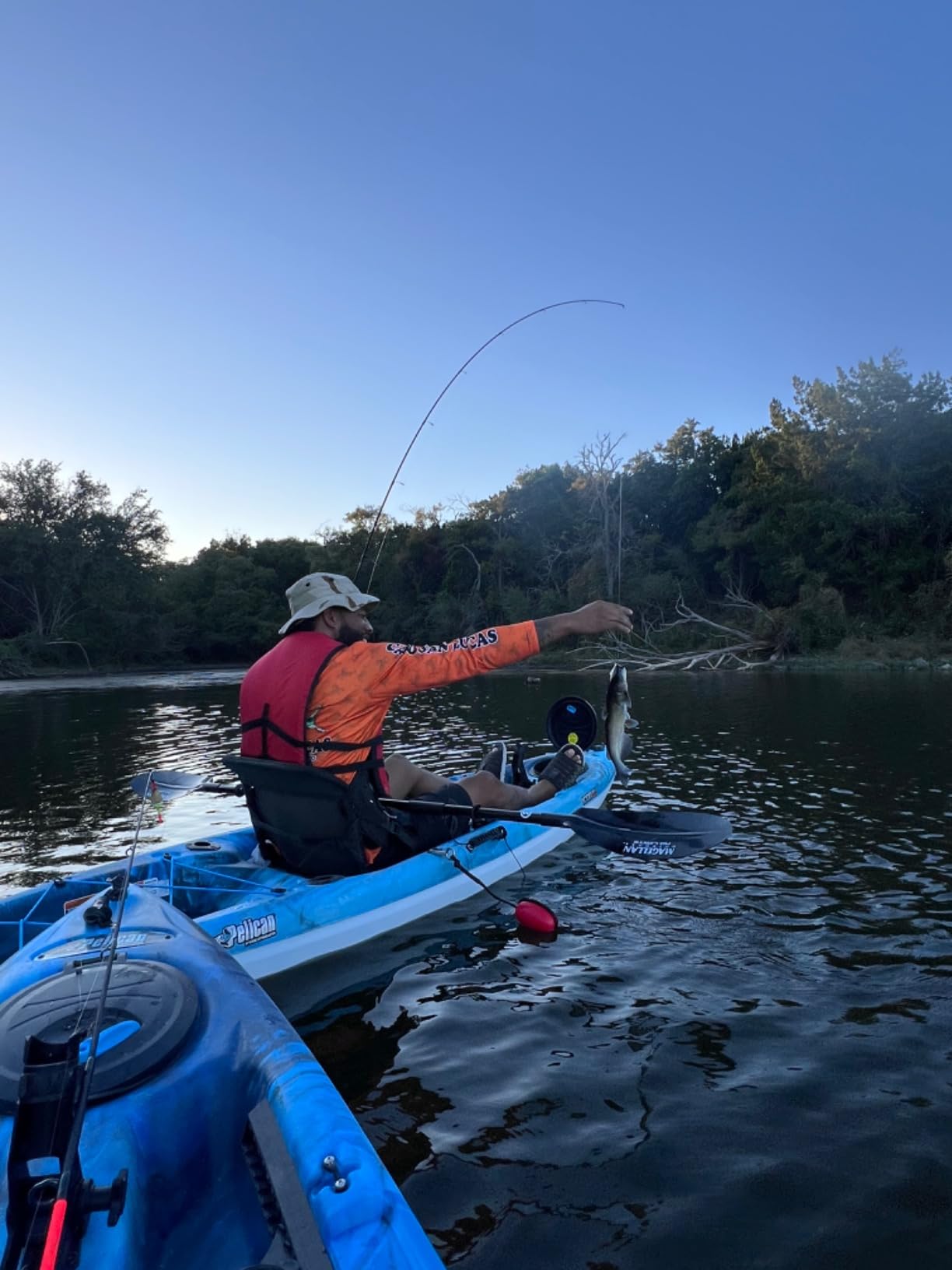
Its real strength is through a kayak hull. Multiple reviewers say it works through their polyethylene kayak, which is a cheap way to add depth awareness to a boat with no mounting point. The included neck strap leaves both hands free for paddling.
The display shows weed, sand and rock bottom composition, switches between feet and meters, and has a back light for either bright sun or darkness. Five levels of sensitivity let you clean up the picture in silty water, and a fish and school alarm gives an audible cue.
Battery life runs at least four to five hours on a fresh battery, longer in save mode. The 2 inch screen is small, but at this purpose-built feature set most owners do not treat that as a problem.
The limitations are clear from reviews. It cannot be used from shore, so it needs a boat of some kind, and it will not read through a fiberglass hull. A handful of owners also report a unit that would not power on after light use, which is the main reason the rating sits at 4.1 across 3284 ratings.
Depth reading versus fish finding
This unit finds ledges and drop-offs reliably, which is what you need when you are new to a lake and do not know where the structure is. It does not separate fish size and it does not show structure shape the way a CHIRP unit does, so treat every mark as a place to fish rather than a fish you have located. If the difference matters to you, the LUCKY is a false economy.
Who it works for?
It works for a kayak angler on a polyethylene hull who wants to stop fishing blind, and for anyone on a tight budget who wants to learn depth before investing in a mounted head unit. It does not work for shore fishing, for fiberglass boats, or for anyone who wants to mark spots and return to them, since it stores nothing.
12. ReelSonar iBobber – Best for Ice Fishing and Small Boats
Reelsonar Portable Fish Finder Accurate Fish Depth Finder with Depth Range of 135 feet 10+ Hours Battery Life with iOS & Android App Wireless
5 inch LCD
135 ft depth range
10+ hour rechargeable battery
Depth-tagged fish icons
Pros
- Pocketable and casts easily
- 9 to 10 hours of real battery life
- Free app with tutorials and watch support
- Fish icons color coded by size
- Works shore boat kayak and ice
Cons
- Bluetooth range only about 40 to 50 ft
- Frequent connection drops
- Poor readings in under 5 ft
- Unreliable when towed
The iBobber is the most polarising product in this roundup, and the 4.0 average across 6659 ratings is the lowest here. The owners who love it use it constantly for shore and small-boat fishing, and the ones who do not usually cite the same three problems.
On the positive side it fits in a pocket, turns itself on and off when it hits the water, and runs roughly nine to ten hours on a charge. The free app includes tutorials and a demo mode, supports smartwatches, and draws fish icons tagged with depth and color coded by size, plus a fish alarm for fish under docks and a strike alert when something bites.
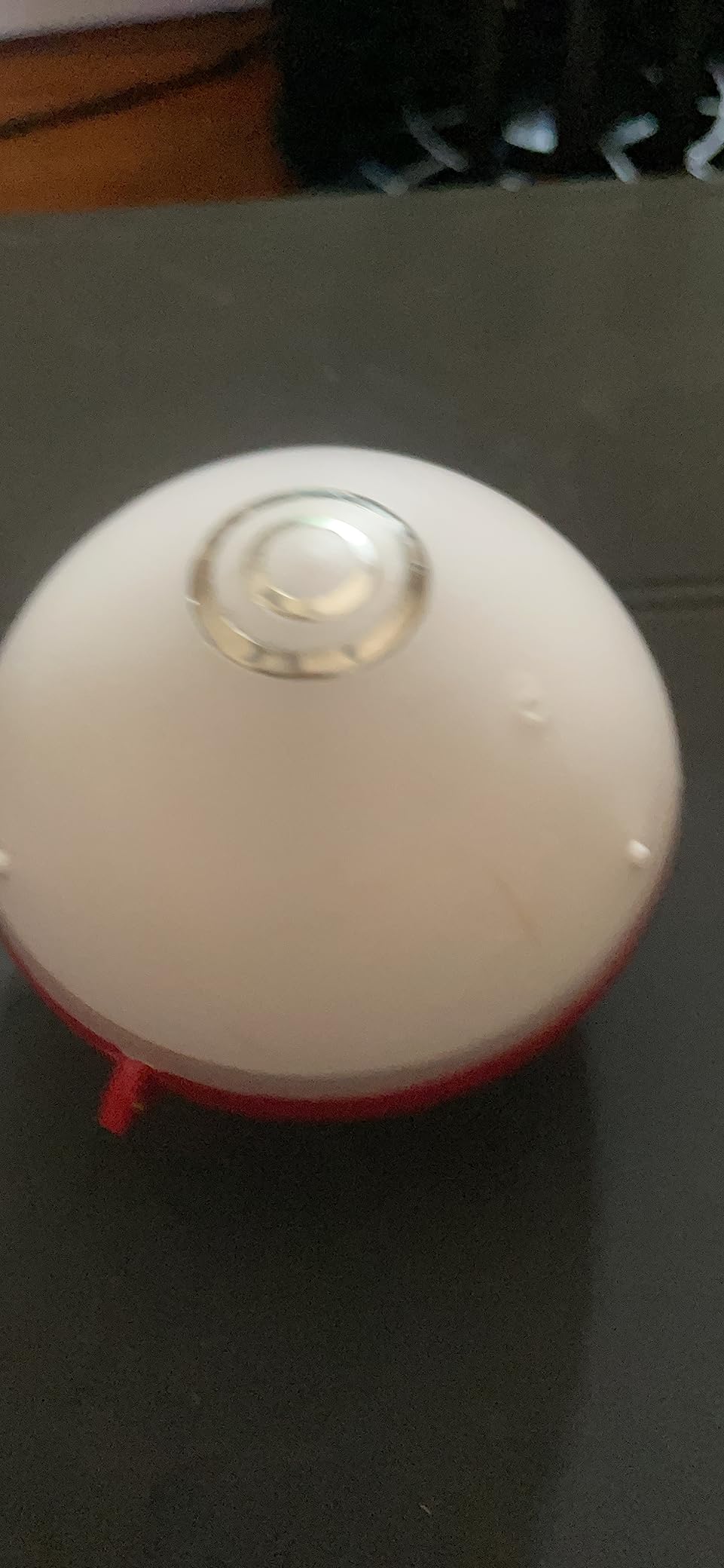
It works in freshwater or saltwater, from shore, from a boat or on ice, which makes it the most platform-flexible unit here. Owners also report repeat purchases, including a second unit bought years after the first.
The limitations are consistent enough to plan around. Bluetooth range is roughly 40 to 50 feet, so a long cast loses the connection. Owners report frequent disconnects, especially around aluminum boats. It needs at least 5 feet of water to read properly, and it is unreliable when towed behind a moving boat. Battery also drains quickly in fish alarm mode.
In short: a shore and ice tool with a fixed short range, not a boat electronics unit.
Why the review split is so wide?
This is a product where expectations decide the rating. Someone casting 20 feet from a dock into 8 feet of water gets a working fish finder with a day of battery. Someone casting 60 feet toward a channel edge loses the connection and concludes the product is broken. Both experiences are described in the reviews, which is why the distribution is so bimodal at 4.0.
Who should buy it and who should not?
Buy it if you fish ice, a small pond or a sheltered bay within 40 feet of where you sit. Skip it if you make long casts, fish from a metal boat, or want to troll behind a moving boat, because all three push past its limits. A wired transducer unit serves those anglers far better.
How to Choose a Fish Finder Under 500?
Most buyers at this budget are choosing between a permanently mounted head unit and a portable one, and the decision follows the boat rather than the spec sheet. The Garmin STRIKER 4 and the STRIKER Plus 4 cover the kayak, jon and pontoon case, while the Deeper and LUCKY portables cover shore, dock and ice. Decide that first and the rest of the list narrows fast.
Next, understand what CHIRP actually does. A traditional sonar unit sends one frequency at a time. CHIRP sweeps a band of frequencies simultaneously, which produces cleaner separation between two fish sitting close together. It is the single biggest technical jump you get at this price, and every recommendation in this roundup except the two lowest-cost handhelds has it.
Frequency is the depth trade-off. Low frequencies such as 50 or 83 kHz read deep and see far but blur two targets into one blob. High frequencies around 200 kHz give sharp detail in the first 60 feet and fall off quickly below that. Deep reservoirs and the Great Lakes reward a low-frequency transducer; ponds, lakes and shallower structure reward a high-frequency one.
Down imaging versus side imaging is the next question, and it is the one most first-time buyers get wrong. Down imaging, called DownScan, ClearVu or Down Imaging depending on the brand, shows a picture of what is directly beneath the boat and is the better tool for finding a ledge or a weed edge. Side imaging shows what is off to both sides and is the better tool for trolling a channel. At under 500 dollars you can usually have one, not both, which is why the HELIX 5 CHIRP DI earns the down imaging slot here.
LiveScope, Garmin’s version is called Panoptix LiveScope and Humminbird calls it ActiveTarget, is out of reach at this budget and no unit below adds it later. It is a real-time sonar view of individual fish passing, and it exists almost entirely above the 500 dollar line. Budget for the fact that moving to it means buying new head unit and transducer together.
Transducer bundling is where budget buyers get caught. Confirm the transducer is included before you buy, because a head unit sold without one is not usable. In this roundup the Garmin STRIKER 4, STRIKER Plus 4, STRIKER Vivid 4cv, the Humminbird HELIX 5 and PiranhaMAX 4, and the Lowrance HOOK Reveal 5 all ship with one. Also check what else is missing, since a fuse and fuse holder are absent from at least one box in this list.
GPS versus chartplotter is a smaller decision than it sounds. GPS gives you waypoints, routes and boat speed. A chartplotter adds maps and the engine to route over them. For most anglers under 500 dollars, GPS plus your own recorded contours covers the need.
Screen size versus resolution is the last screen question. Four to five inches is workable on a kayak and on the ice, and readability in sunlight matters more than pixel count for most people. Below five inches, split-screen layouts get cramped, so check that the unit can show what you need at once.
Finally, think about power. Fixed units draw from the boat battery and a portable pack is optional. Portable gear lives or dies by battery runtime, and cold weather shortens it. Check the water rating too: an IPX7 rating means immersion for up to 30 minutes, which covers spray, a dock and a rainstorm.
Garmin vs Lowrance vs Humminbird Under 500
Three of the recurring questions on this topic are brand comparisons, so here is the short version based on what the units above actually do. Garmin wins on interface simplicity and on mapping you build yourself, with Quickdraw Contours recording your own lake as you cruise. Its buttons are the least intimidating of the three, which matters if you are new to sonar.
Lowrance wins on preloaded detail. The HOOK Reveal 5 SplitShot carries high-detail charts of almost 4,000 US inland lakes and Genesis Live builds custom contours in real time, so the unit is useful the day it arrives. The trade is a more complicated configuration menu and the highest share of one-star reviews in this roundup.
Humminbird wins on image. The HELIX 5 CHIRP DI G3 is the only unit here with true down imaging, and Dual Spectrum sonar gives it a wide beam for coverage and a narrow beam for detail on the same pass. It also has the deepest preloaded basemap, covering more than 10,000 lakes plus the continental US coastline.
On connectivity, Lowrance and Humminbird lean on their phone apps more than Garmin does. On price at this tier, the three brands spread across the whole sub-500 range, with Garmin occupying both the cheapest mounted end and the feature-rich middle, and Lowrance and Humminbird sitting in the middle to upper part of it.
Frequently Asked Questions
What is the best fish finder under 500?
The Garmin STRIKER Vivid 4cv is the best fish finder under 500 for most anglers. Its bundled GT20 transducer covers both CHIRP traditional sonar and CHIRP ClearVu scanning, the Vivid color palettes separate fish from structure, and Quickdraw Contours mapping is included. It holds a 4.7 average across more than 1800 ratings with a two-year warranty.
What is the best fish finder on a budget?
On a tight budget the Garmin STRIKER 4 is the answer: more than 9300 ratings at a 4.6 average, a sunlight readable 3.5 inch screen, CHIRP sonar, GPS waypoint marking and a transducer with transom and trolling motor mounts in the box. For an even lower outlay the LUCKY 1108 reads depth through a kayak hull, though it will not show fish size.
Is Humminbird or Garmin better?
Humminbird produces the better image, since the HELIX 5 CHIRP DI G3 is the only unit under 500 dollars with true CHIRP Down Imaging and Dual Spectrum wide and narrow modes. Garmin produces the easier interface and better self-recorded mapping through Quickdraw Contours. Choose Humminbird to see structure, choose Garmin if you want to learn without fighting menus.
Is Lowrance or Humminbird better?
Lowrance is stronger on preloaded mapping, with the HOOK Reveal 5 SplitShot carrying high detail charts of almost 4000 US inland lakes plus Genesis Live custom contours. Humminbird is stronger on imaging and coverage, with down imaging and a basemap covering more than 10000 lakes and the continental US coastline. Lowrance suits unfamiliar water, Humminbird suits known water.
Is side scan or LiveScope better?
They solve different problems, and at under 500 dollars you can afford neither. Side scan shows structure to the left and right of the boat and is the right tool for trolling a channel. LiveScope, called Panoptix LiveScope on Garmin and ActiveTarget on Humminbird, shows individual fish passing in real time and exists almost entirely above this budget. Save for a later step up.
Our Top Pick for 2026
The Garmin STRIKER Vivid 4cv is the best fish finder under 500, because color Vivid sonar, CHIRP plus ClearVu from the included transducer and automatic contour mapping are the three features buyers most want, and it is the only unit on this list that delivers all three inside a four-inch housing with a two-year warranty. The Garmin STRIKER 4 takes the kayak and small-boat slot on volume of proof alone, and the Humminbird HELIX 5 CHIRP DI G3 takes the imaging slot as the only true down imaging view here.
Before you buy, check that a transducer is in the box and what the real out-the-door cost looks like, then match the unit to your hull rather than to the spec sheet. The right fish finder under 500 dollars is the one you will actually mount, power and use from the boat you own.
If you also handle fish after the catch, our guide to fish smokers for jerky and fish covers the other half of the trip.