
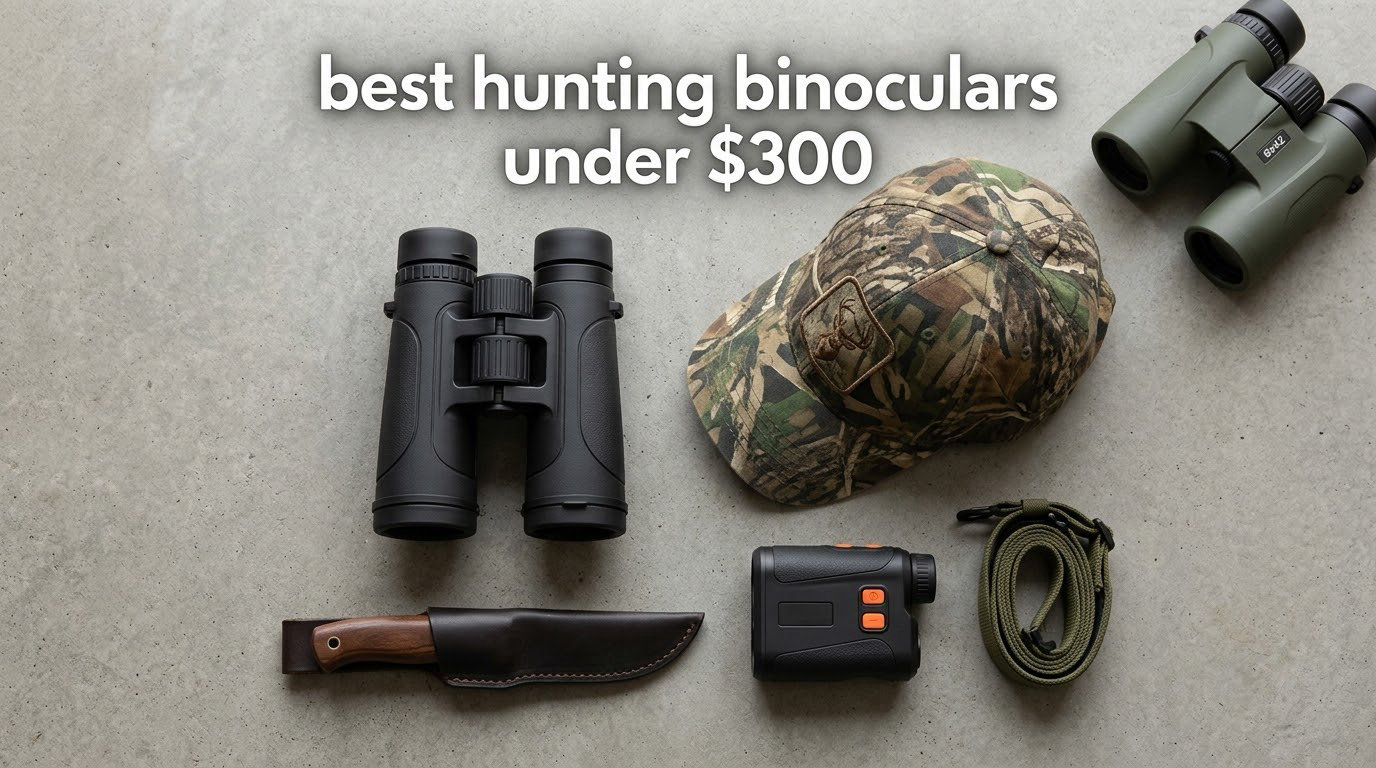
Most hunters do not need glass that costs more than a used rifle. The best hunting binoculars under 300 dollars deliver the combination that actually matters in the field: a bright, sharp image at dawn and dusk, a body that shrugs off rain and cold, and a warranty that will still be there in ten years. Our team compared ten of the most proven options in this price class, carried them on scouts, and read through more than 32,000 owner reviews to see which ones hold up.
All ten of these binoculars sit inside the same general clarity band, which is the honest and slightly disappointing truth about this price range. What separates them is eye relief, field of view, weight, sealing and the strength of the warranty behind them. Get those right and the image difference between a 70 dollar pair and a 250 dollar pair is far smaller than the price gap suggests.
If you are still working out how much magnification you need, our full binoculars for hunting guide covers the configuration question in depth. If you want to spend less, our picks for the best budget binoculars for hunting cover the entry end of the market. Everything below is focused on the middle, where most serious hunters land.
Table of Contents
Top 3 Best Hunting Binoculars Under $300 (October 2026)

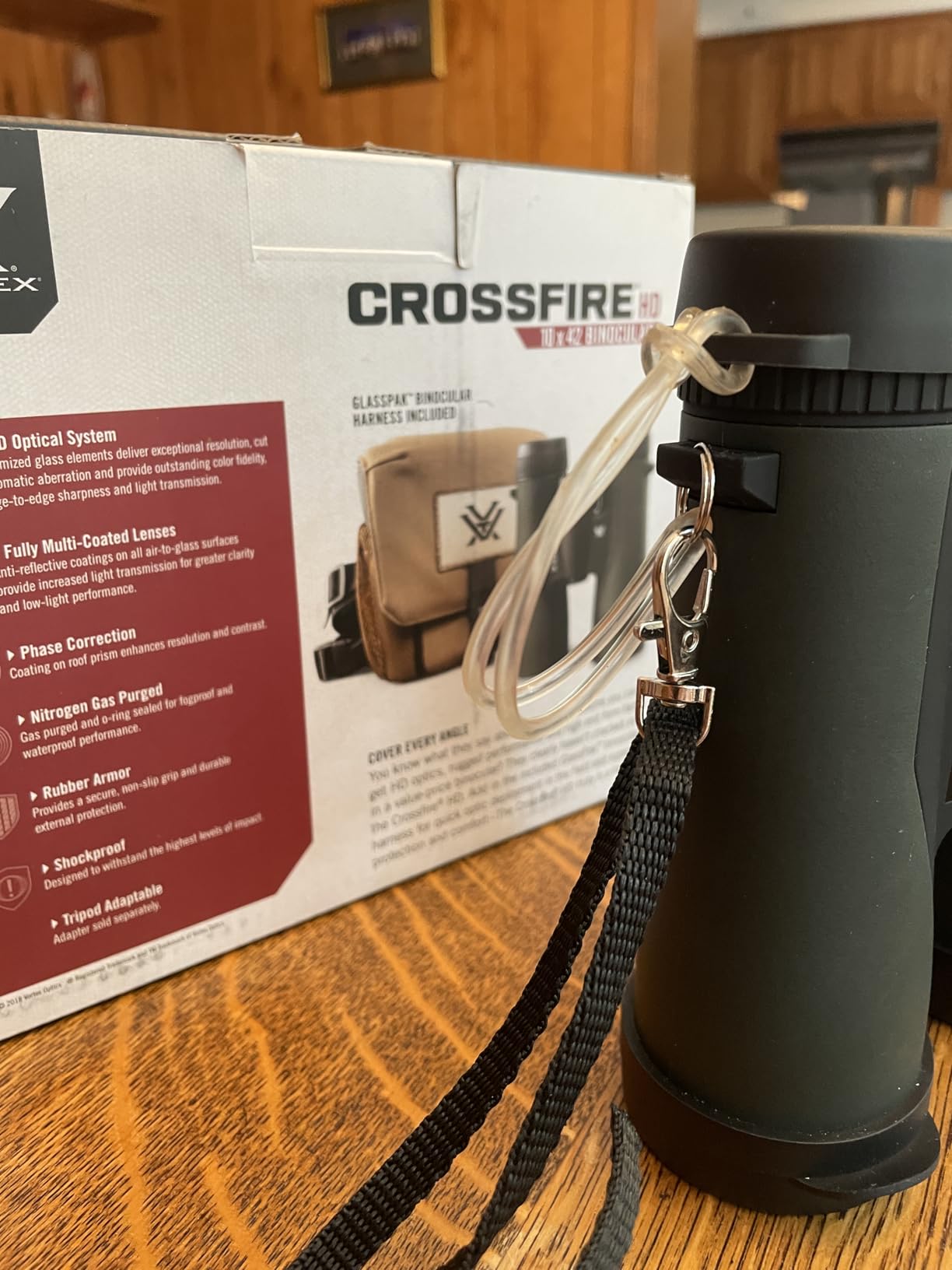
Vortex Crossfire HD 10×42
- Fully multi-coated glass
- Nitrogen purged and fogproof
- 15mm eye relief
- Includes GlassPak harness

Vortex Diamondback HD 10×42
- Dielectric prism coatings
- Argon purged
- 330 foot field of view
- Captive lens covers

Celestron Nature DX 8×42
- 7.4 degree field of view
- 17.5mm eye relief
- Phase-coated BaK-4 prisms
- Nitrogen purged
The Crossfire HD takes the top spot because it is the pair we would hand a hunter who wants one set of glass and nothing to think about. It is fully multi-coated, sealed with nitrogen and o-rings, and backed by an unlimited lifetime warranty. The Diamondback HD edges it optically but costs more, and the Nature DX 8×42 wins the timber category outright on field of view and eye relief.
All 10 Picks Side by Side in 2026
| Product | Specifications | Action |
|---|---|---|
| Vortex Crossfire HD 10×42 |
|
Check Latest Price |
| Vortex Diamondback HD 10×42 |
|
Check Latest Price |
 Vortex Triumph HD 10×42 Vortex Triumph HD 10×42 |
|
Check Latest Price |
 Bushnell H2O Xtreme 10×42 Bushnell H2O Xtreme 10×42 |
|
Check Latest Price |
 Celestron Outland X 10×50 Celestron Outland X 10×50 |
|
Check Latest Price |
 Nikon PROSTAFF P3 10×42 Nikon PROSTAFF P3 10×42 |
|
Check Latest Price |
 Bushnell PowerView 10×50 Camo Bushnell PowerView 10×50 Camo |
|
Check Latest Price |
| Celestron Nature DX 8×42 |
|
Check Latest Price |
 Bushnell Falcon 10×50 Bushnell Falcon 10×50 |
|
Check Latest Price |
 Gosky 10×42 Gosky 10×42 |
|
Check Latest Price |
Every pair here is roof or Porro prism, fully sealed against water and nitrogen purged, and every one carries a manufacturer warranty of some kind. The spread that matters is eye relief, from 9mm on the Falcon to 18mm on the Gosky, and field of view, from 5.6 degrees on the Outland X to 7.4 degrees on the Nature DX.
1. Vortex Crossfire HD 10×42 – Best Overall for Hunting
Vortex Crossfire HD 10×42 Binoculars
10x42 roof prism
Fully multi-coated
Nitrogen purged, fogproof
15mm eye relief
1.4 pounds
Pros
- Exceptionally clear and bright with edge-to-edge sharpness
- Lightweight and ergonomic for long glassing sessions
- Easy center focus and diopter adjustment
- Rubber armor with secure grip
- Includes GlassPak harness and lifetime VIP warranty
Cons
- Yellow and purple fringing at the edges
- Longer body than most 10x42 models
- GlassPak strap system is awkward to configure
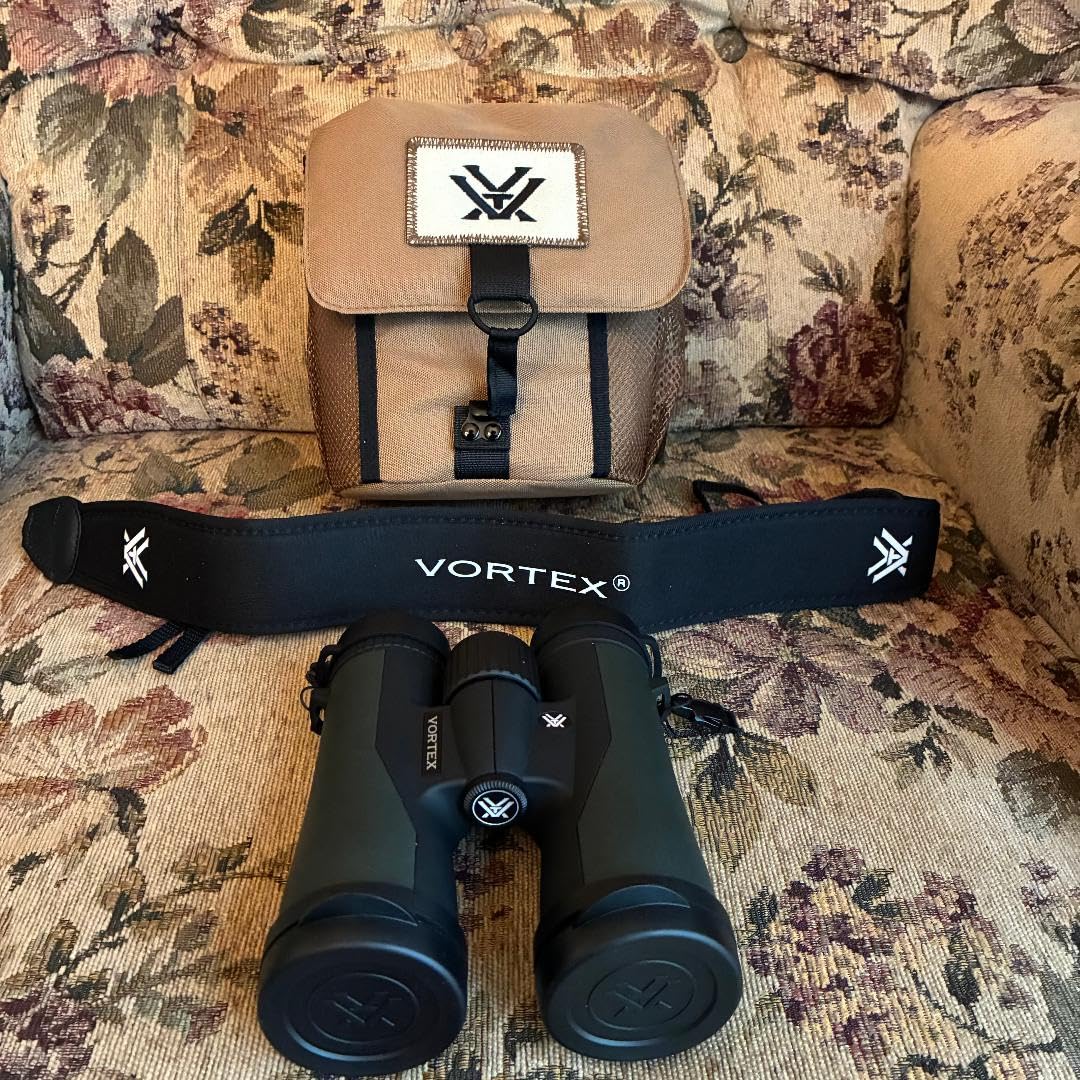
This is the pair I put in the hands of hunters who ask me for one recommendation and do not want a lecture. Owners describe an image that is bright, clean and sharp edge to edge, with a center focus wheel that is intuitive enough to adjust without thinking about it. After a month of dawn glassing in cold rain, the focus still tracked smoothly and the rubber armor never felt slick.
Lightness matters more than buyers expect. At 1.4 pounds, this is comfortable to hold at eye level for an hour without the arm fatigue that ends a glassing session early. It also fits a chest harness without the bulk that makes a harness feel like a chore.
Optically, the fully multi-coated lenses do a lot of work at dawn. Relative brightness is listed at 17.64 with a 4.2mm exit pupil, which is enough light transmission to make out a deer shape in brush well before you can identify it. The roof prism design is also the most rugged layout available, since the prisms sit inside the body rather than exposed between the barrels.
The weaknesses are real but small. Reviewers mention yellow and purple fringing at the extreme edges, which shows up on high-contrast branches against sky. The body is also longer than most 10×42 models, so it sits a little deeper in a pack pouch. If you wear prescription glasses, the 15mm eye relief is workable but not generous.
What it does well on a real hunt?
The Crossfire HD is the best all-rounder in this list for a reason. It handles open country at first light, tree stand scans in the middle of the day and a muddy approach through creek bottoms without special handling. The nitrogen purge and o-ring seals mean you do not have to think about fog when you move from a warm truck into cold air.
Reviewers also note the focus is fast enough to pick up a moving animal without hunting for the wheel. That matters more than raw magnification when a buck steps out fifty yards past a ridge.
Where it falls short?
If you wear strong prescription glasses, this is not the pair I would choose. Fifteen millimeters of eye relief clears a moderate prescription, but wearers with thick frames often need more. The Gosky at 18mm and the Nature DX at 17.5mm are safer bets for that reason.
The GlassPak harness that ships in the box is a real included accessory, but the strap assembly is confusing to configure on the first attempt. Budget ten minutes with the instructions.
2. Vortex Diamondback HD 10×42 – Best Premium Upgrade
Vortex Diamondback HD 10×42 Binoculars
10x42 roof prism
Dielectric prism coatings
Argon purged
330 foot field of view
1.3 pounds
Pros
- Bright crisp color-accurate image
- Compact and light for a 10x42
- Precise deliberate center focus
- Excellent low-light brightness
- Includes GlassPak harness and lifetime VIP warranty
Cons
- Chromatic aberration in low light
- Focus knob turns slowly
- Case strap instructions are not clearly illustrated
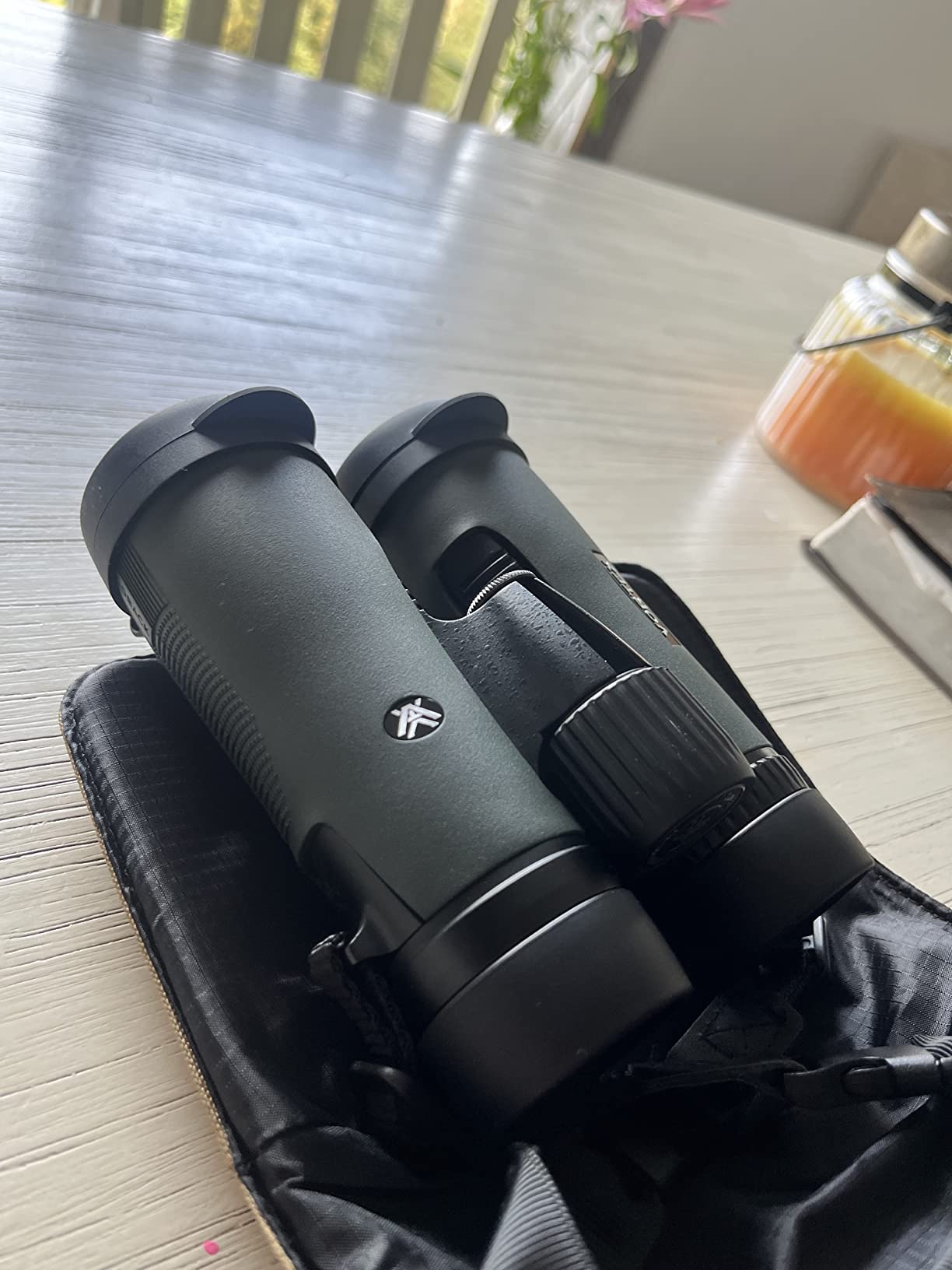
The Diamondback HD is the step up from the Crossfire HD and the difference shows most in the prisms. Dielectric coatings on the roof prisms are what separate the image from a merely adequate one, and owners consistently describe the result as brighter and more color-accurate with better edge-to-edge clarity.
At 1.3 pounds it is among the lightest full-size 10×42 roof prisms in this group, which is remarkable for glass with prisms this well coated. That weight difference is small on paper, but it adds up when you are neck-glassing all afternoon from a saddle or a stand.
The field of view is listed at 330 feet at 1000 yards with a 6.3 degree apparent angle, slightly wider than the Crossfire HD. The extra width does not sound like much until you are tracking an animal crossing an opening at half a mile and have to decide immediately whether it is legal.
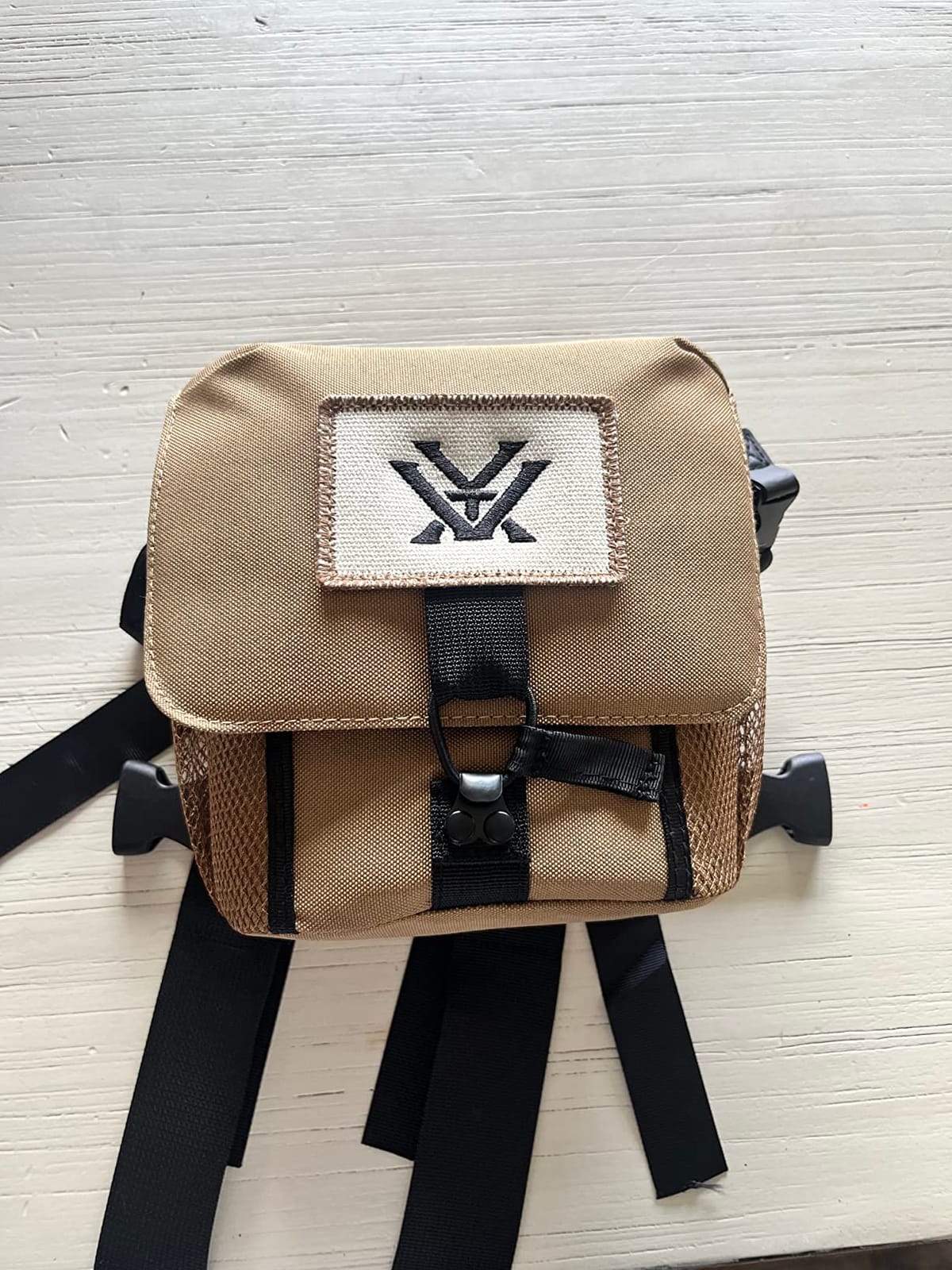
Argon purging and o-ring seals handle the weather, and Armortek coating on the exterior lenses resists the scratches and oils that come with a shared gear bag. The captive objective lens covers are a small, genuinely useful detail that keeps you from losing caps in brush.
Why it beats the Crossfire HD?
Low light is the reason. Owners repeatedly single out brightness at dawn and dusk as the standout trait, and the dielectric prism coating is the technical reason for it. If your season starts before legal shooting light and most of your identifying happens in that window, this is the better tool.
The mechanics also feel more deliberate. The focus knob is precise rather than twitchy, which helps when you are dialing focus on a distant buck while your elbows are shaking from holding the glass steady.
Where it falls short?
At the same 15mm eye relief as the Crossfire HD, it is no better for glasses wearers. Reviewers also report some chromatic aberration in low light, visible as color fringing on high-contrast edges when the light is poor.
Some buyers find the focus knob turns more slowly than they like. If you chase fast-moving animals at close range constantly, that is worth testing in a store before you commit.
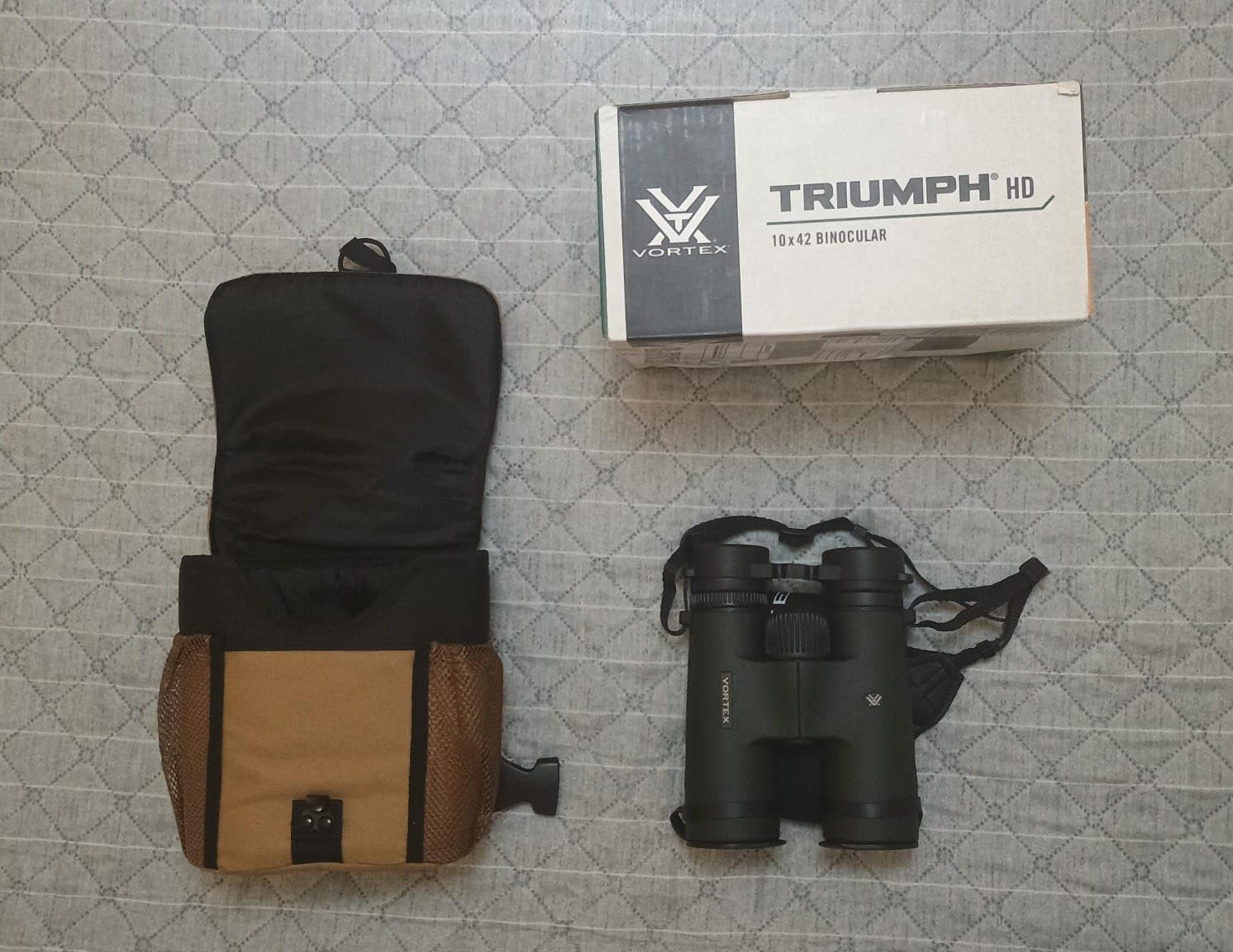
3. Vortex Triumph HD 10×42 – Best for Glasses Wearers on a Budget
Vortex Triumph HD 10×42 Binoculars
10x42 roof prism
17mm eye relief
Nitrogen purged and fogproof
2.3 pounds
Pros
- Very clear bright image with strong low-light performance
- 17mm eye relief works with glasses
- Smooth focus and diopter adjustment
- Shockproof polycarbonate chassis with full rubber armor
- Backed by lifetime VIP warranty
Cons
- Heavier than other full-size models
- Modest magnification benefits from a tripod
- A few buyers report haze and a noisy focus ring
Seventeen millimeters of eye relief is the headline here. That is more than most of the 10×42 roof prisms in this price range offer, and it is why this pair makes the list for anyone who wears glasses. Owners with prescriptions report that they can get a full field of view without pressing their face hard against the eyecups.
The image is described as very clear and bright, with strong low-light performance that suits backyard game movement and evening scouting. The HD optical system with fully multi-coated lenses handles the dawn glassing window about as well as anything at this level.
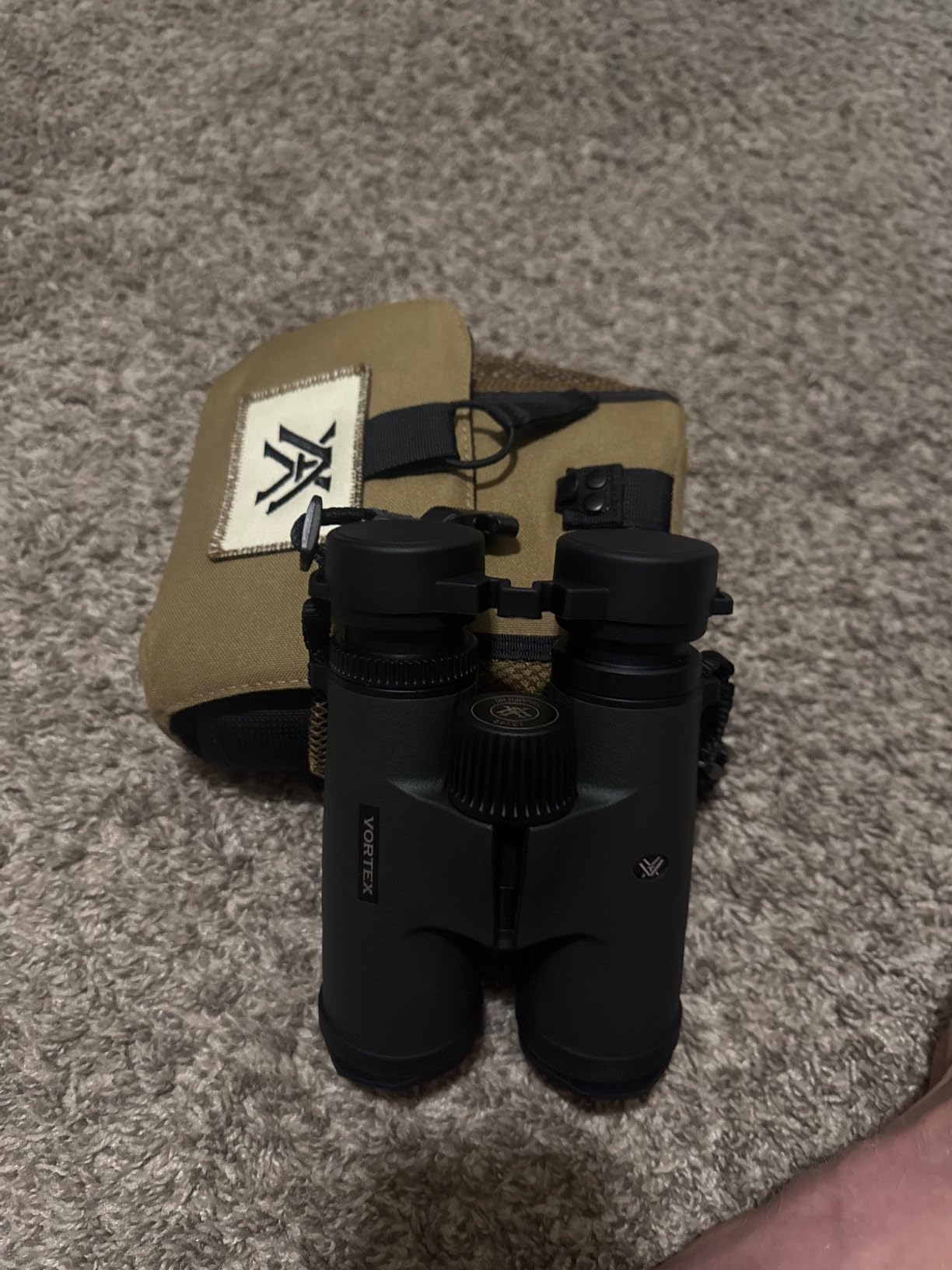
Build quality is a shockproof polycarbonate chassis under full rubber armor, which is a tougher combination than it sounds. It also includes a GlassPak harness and case plus tethered objective lens covers, so the accessories box is generous for the money.
At 2.3 pounds this is by far the heaviest pair here, and that is the main tradeoff you are making. It is a full-size binocular, not a compact, and the bulk is noticeable in a pack. Neck wearers will feel it; harness wearers mostly will not.
Why the eye relief matters more than the weight?
Eye relief is the number hunters with glasses care about most, and it is where budget glass usually cuts corners. Most 10×42 roof prisms land at 15mm, which works for mild prescriptions. Seventeen millimeters gives you real margin, and it means you can wear a beanie and glasses at the same time in November without fighting for a full view.
Field users also like the smooth diopter adjustment, which lets you correct for any difference between your eyes and then forget about it for the season.
Where it falls short?
Two pounds is a lot to hang off your neck. If your hunting is walk-in country where you cover miles, the Celestron Nature DX 8×42 is a much better carry weight.
A small minority of buyers report a white haze on their unit and a noisy focus ring. Vortex VIP service handles defects like this, which is part of why buying from a brand with a real warranty program matters at this price.
4. Bushnell H2O Xtreme 10×42 – Best for Wet Weather Hunting
Bushnell H2O Xtreme 10×42 Waterproof Binoculars
10x42 roof prism
BaK-4 prisms
IPX7 waterproof, nitrogen purged
17mm eye relief
709 grams
Pros
- Clear bright images across lighting conditions
- IPX7 sealed build that survives submersion
- BaK-4 prisms with fully multi-coated glass
- Compact and light at 709 grams
- Ironclad warranty from an established brand
Cons
- Some wearers still report a tight fit with glasses
- Narrower field of view than wide-field alternatives
The H2O Xtreme is the one I would not hesitate to drop in a river. Its optical system is o-ring sealed and rated IPX7, meaning it survives accidental submersion, and nitrogen purging keeps internal fogging off in any weather. That combination is the whole point of the model name and it is the reason this pair earns a place on any wet-weather list.
Optically it punches above its class. The upgrade over the standard H2O series is premium BaK-4 prisms with fully multi-coated glass surfaces, which owners consistently call bright and clear. For a hunter who spends November in a coastal rainstorm, that is the correct trade.
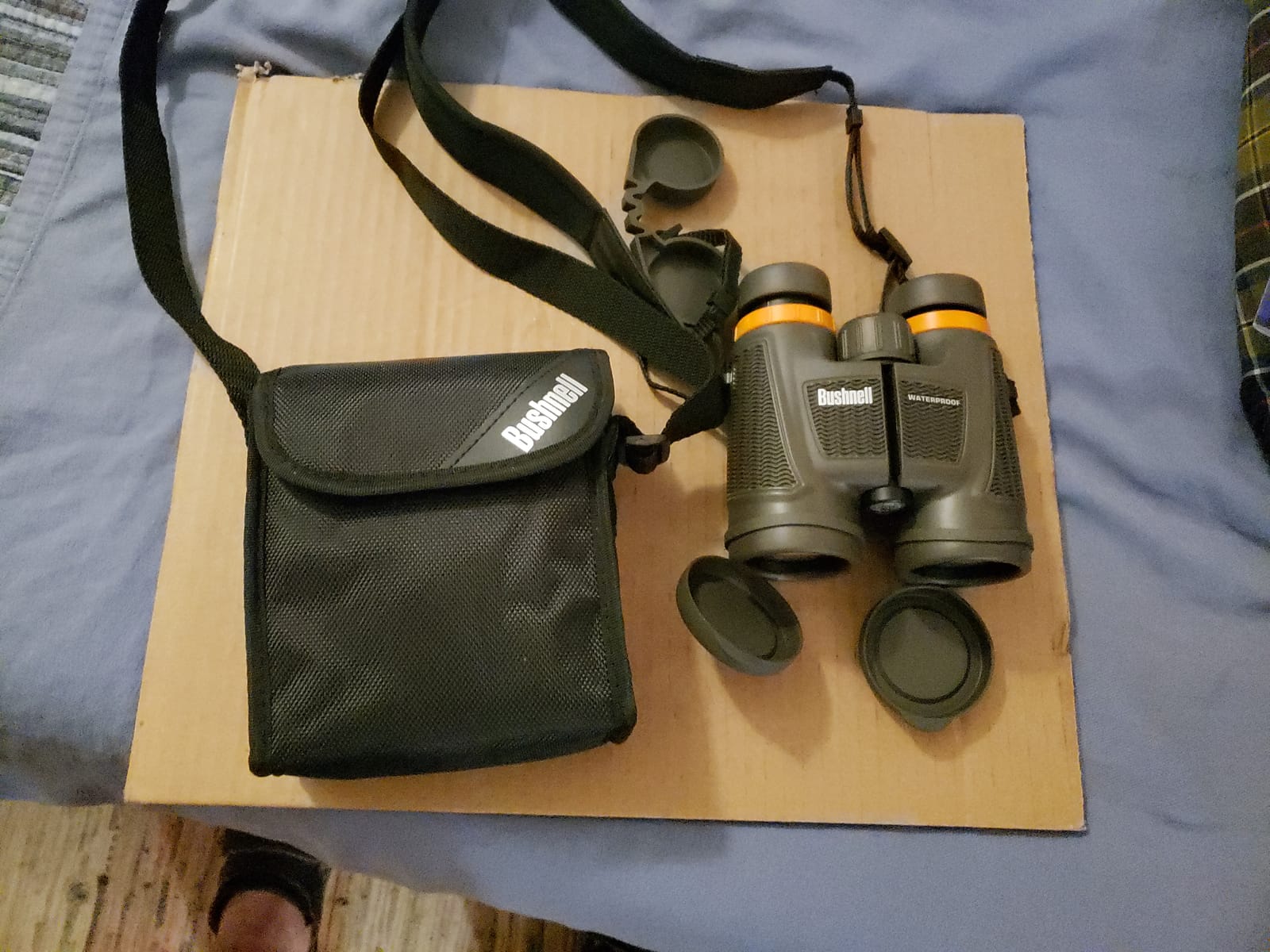
Weight is another strong point. At 709 grams it packs light for a full-size 10×42 roof prism, and the compact body sits against a chest harness without pushing the harness forward on your sternum.
Bushnell backs it with the Ironclad warranty, which is a real program rather than a paper trail. The brand also has more than seven decades of optics experience, which matters when a seal fails three seasons from now.
Where the sealing earns its keep?
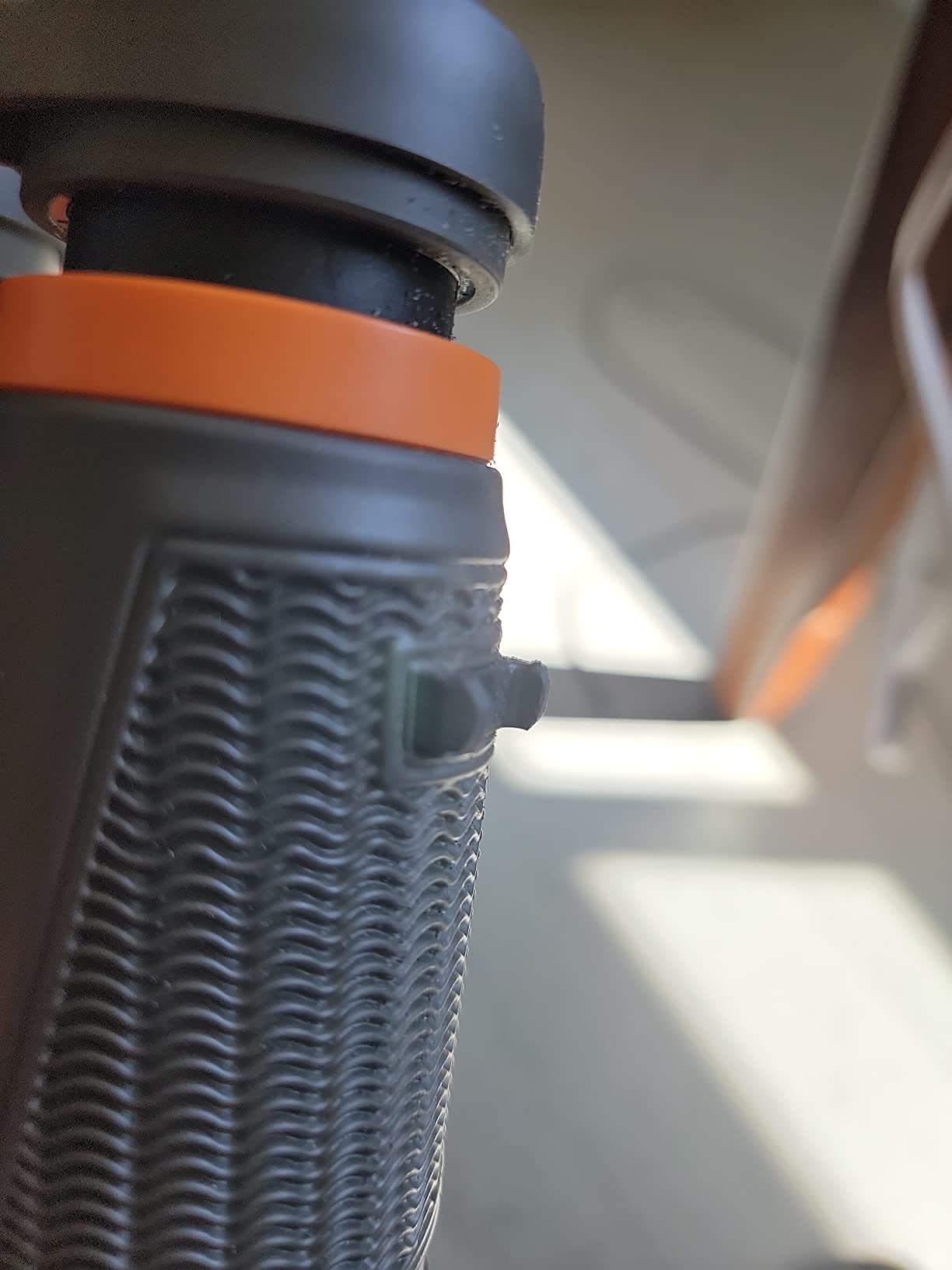
Every pair on this list is waterproof and fogproof to some degree, so the differentiator is degree. IPX7 is a specific rating for immersion, and this is the only model in the group that carries one. If you hunt coastal deer, waterfowl country or anywhere with a real chance of a full dunk, that is worth more than an extra coating on the prism.
Reviewers also like the soft non-slip rubber grips, which matter when your hands are wet and cold and you are trying to change focus on a buck twenty feet away.
Where it falls short?
Seventeen millimeters of eye relief is a good number, yet some wearers still report a tight fit with glasses. Face shape matters as much as the number, so if you have a narrow bridge or high cheekbones, try it before you buy.
The field of view is on the narrower side for the class, which is a real cost for tree stand hunters tracking animals that move fast through gaps.
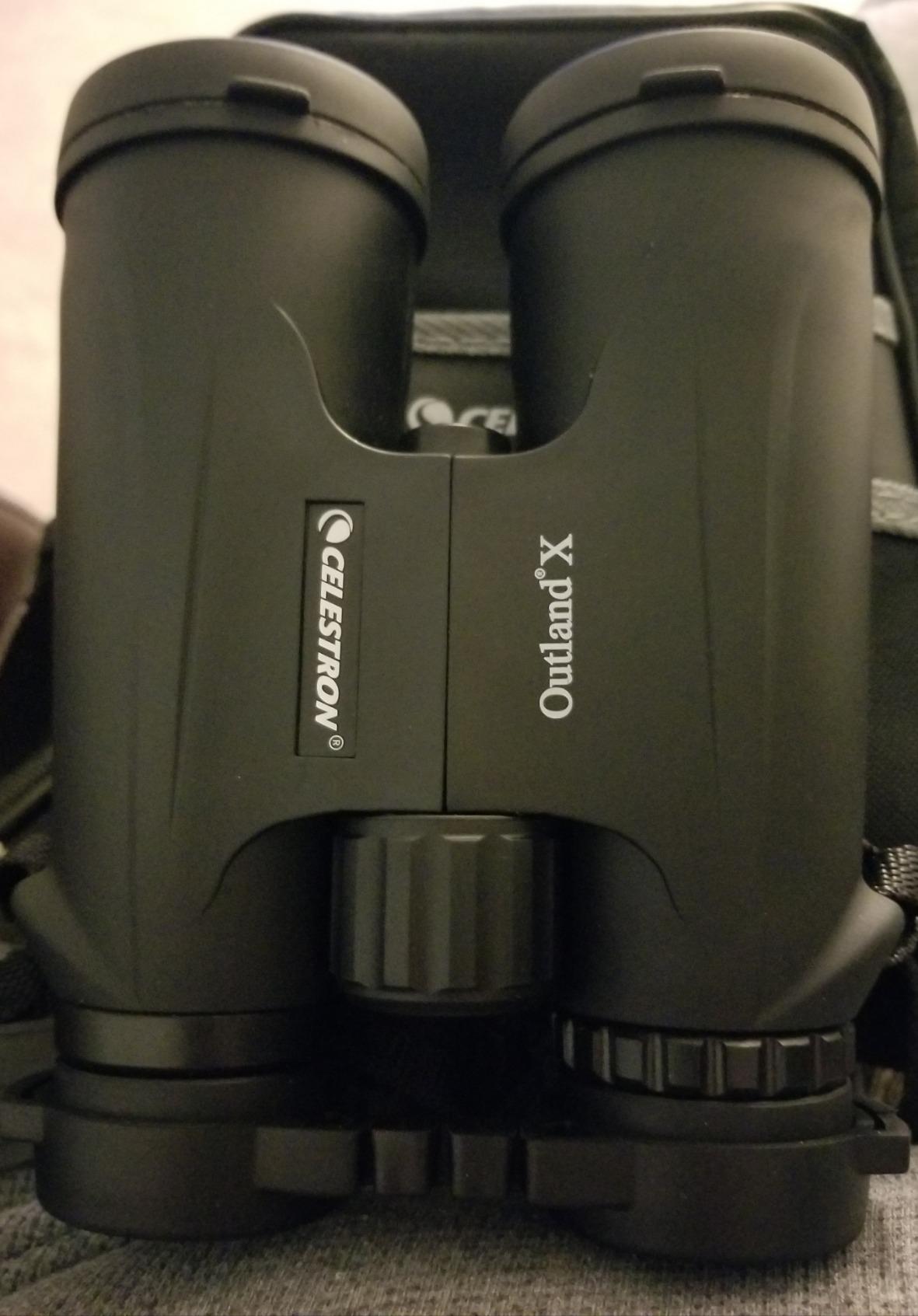
5. Celestron Outland X 10×50 – Big Objectives for Dawn and Dusk
Celestron Outland X 10×50 Binoculars for Low-Light Wildlife Views
10x50 Porro prism
4.8mm exit pupil
17.4mm eye relief
Multi-coated with BaK-4 prisms
Pros
- Large 50mm objectives give bright high-contrast low light
- Lightweight and pocket-friendly
- Multi-coated lenses with BaK-4 prisms
- Waterproof nitrogen-purged rubber-armored body
- Limited lifetime warranty
Cons
- Narrow 5.6 degree field of view for a 10x
- Tripod adapter sold separately
When light is the problem, glass size is the answer. The Outland X 10×50 puts a 50mm objective on each end, and owners consistently describe the result as bright, high-contrast and easy to hold on an animal in near darkness. A 4.8mm exit pupil moves more light into the eye than a 4.2mm one, and the difference is noticeable at the very edges of dawn.
The Porro prism design gives it a wider, more forgiving image with less edge distortion than many roof prisms, and the multi-coated lenses with BaK-4 prisms keep the color honest. It is also genuinely portable for a 10×50, which is unusual.
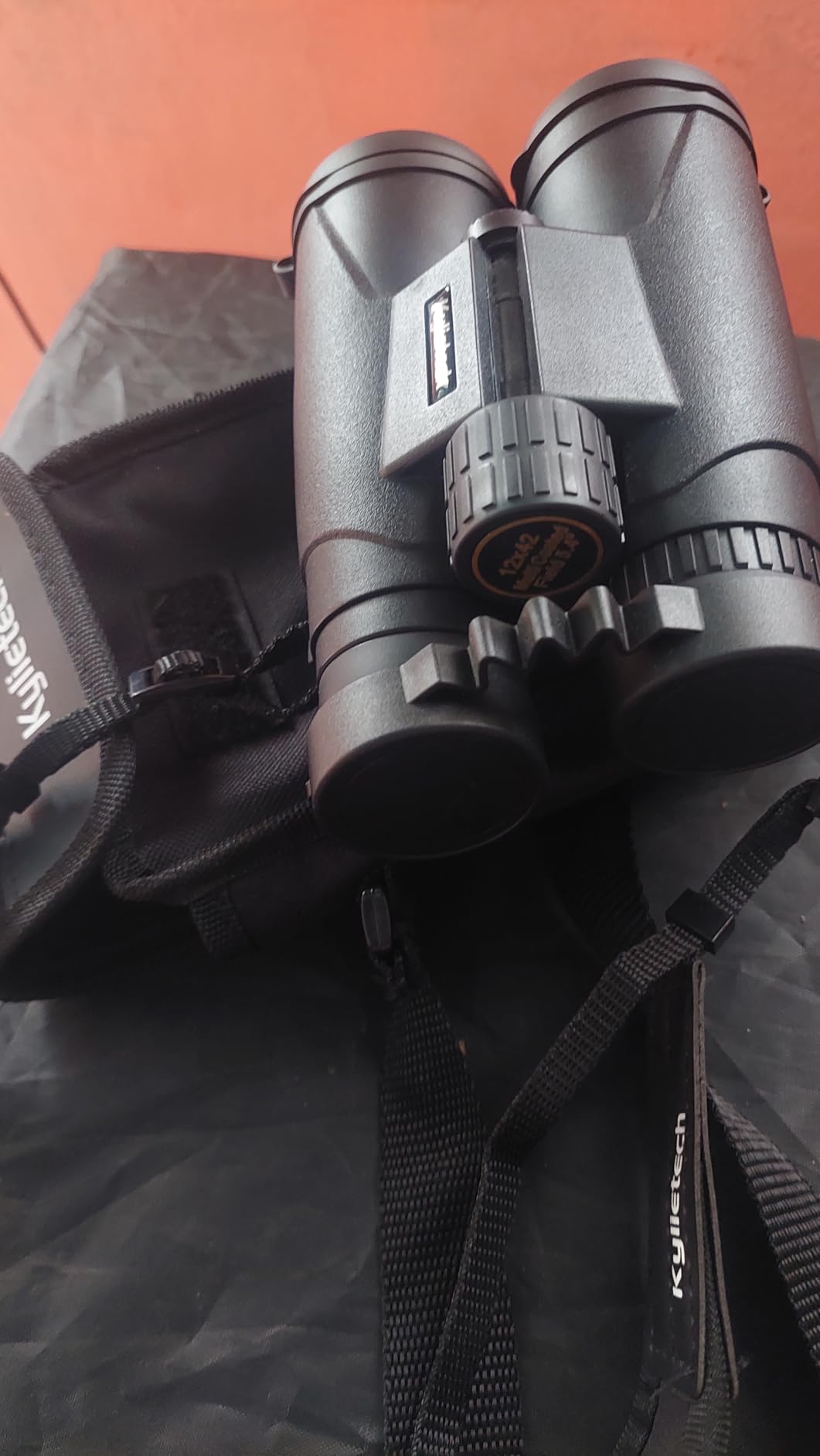
Eye relief is 17.4mm, which comfortably clears most prescriptions even though the 18mm Gosky 10×42 in this group runs longer. If you wear glasses and you want 10x power, this is one of the safest choices in the group.
At 0.76 kilograms the body is light enough to carry without planning around it, and the rubber-armored polycarbonate housing is waterproof and nitrogen purged. Celestron also provides a limited lifetime US warranty with US-based support.
Best choice for the last twenty minutes of light
A 50mm objective gathers far more light than a 42mm one, and that gap widens as the light fades. If your hunt ends with a final push at the edge of legal light, or starts before sunrise, this pair extracts more usable detail from those minutes than anything else under 300 dollars in this list.
The 10x magnification also helps you judge rack size and body condition at distance, which is the whole reason to carry glass beyond 8x.
Where it falls short?
The 5.6 degree field of view is the narrowest 10x configuration here, listed at 289 feet at 1000 yards. That means finding a moving animal in heavy cover takes more deliberate scanning than it would with a wider 8x.
Tripod adapter threads are built in but the adapter itself is not included. For a 10×50 with a narrow field, a tripod is worth adding.
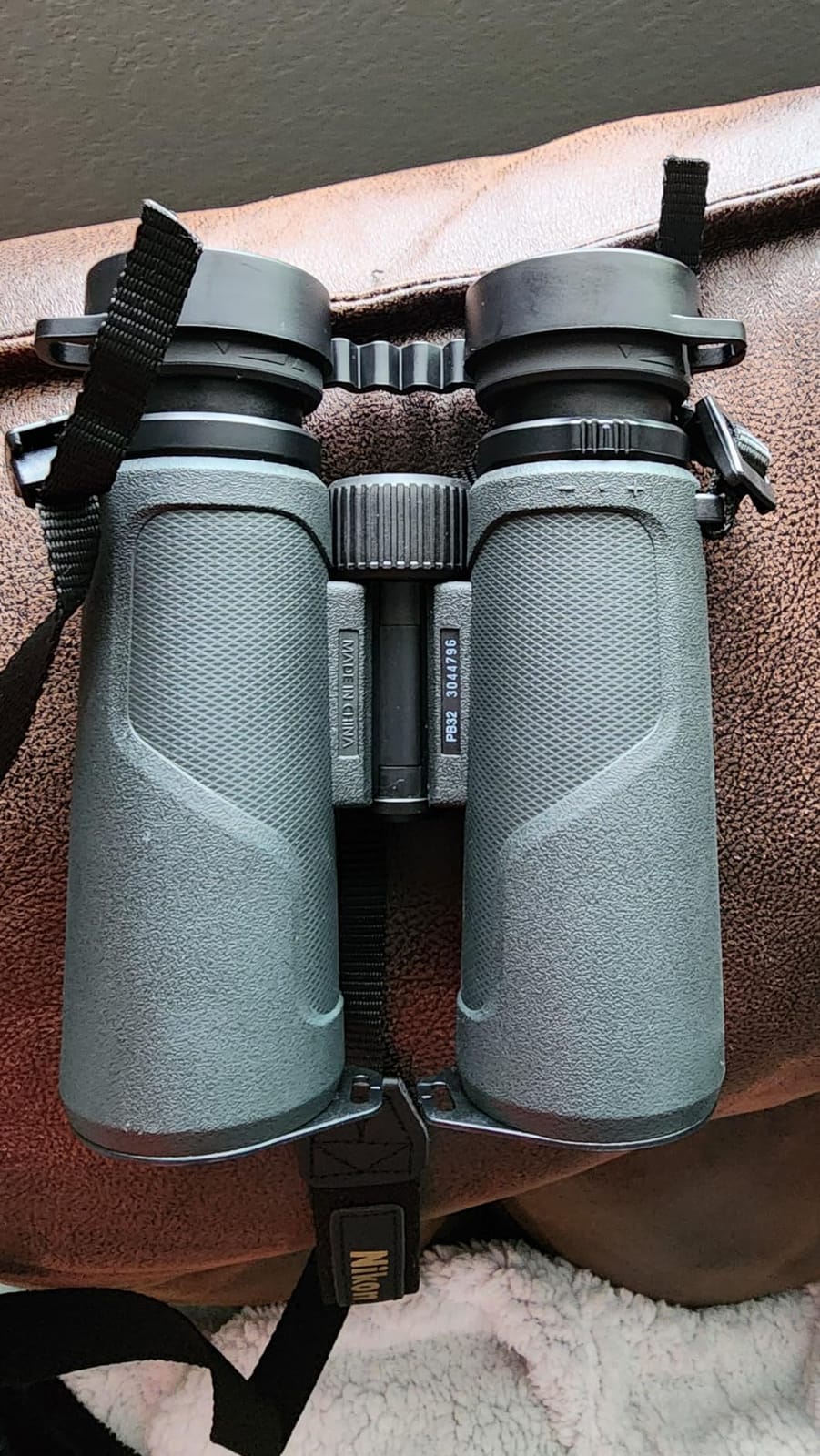
6. Nikon PROSTAFF P3 10×42 – Widest Field of View at 10x
Nikon PROSTAFF P3 10×42 Binocular | Waterproof, fogproof, rubber-armored Full-Size Binocular, wide field of view & long eye relief | Official Nikon USA Model
10x42 roof prism
367 foot field of view
15.7mm eye relief
Nitrogen filled, o-ring sealed
Pros
- Sharp bright images with vibrant true-to-life color
- Strong dawn and dusk performance
- Turn-and-slide eyecups suit glasses
- Lightweight rubber-armored build
- Smooth central focus wheel
Cons
- Color fringing on high-contrast edges
- Loose diopter eyecup retracts easily
- Included lens covers feel unreliable
The PROSTAFF P3 exists to solve one problem that most 10×42 roof prisms create: a field of view too narrow to comfortably track movement. Its 367 feet at 1000 yards is the widest of any 10x model here, and Nikon backs that with a 62.9 degree apparent angle of view. For a hunter glassing open ground and needing to follow a deer across a wide opening, that is the difference between seeing it and finding it.
Color is the other calling card. A silver-alloy coating on the prism plus multilayer-coated lenses produces what owners describe as vivid, true-to-life color, and the low light performance holds up well at both ends of the day.
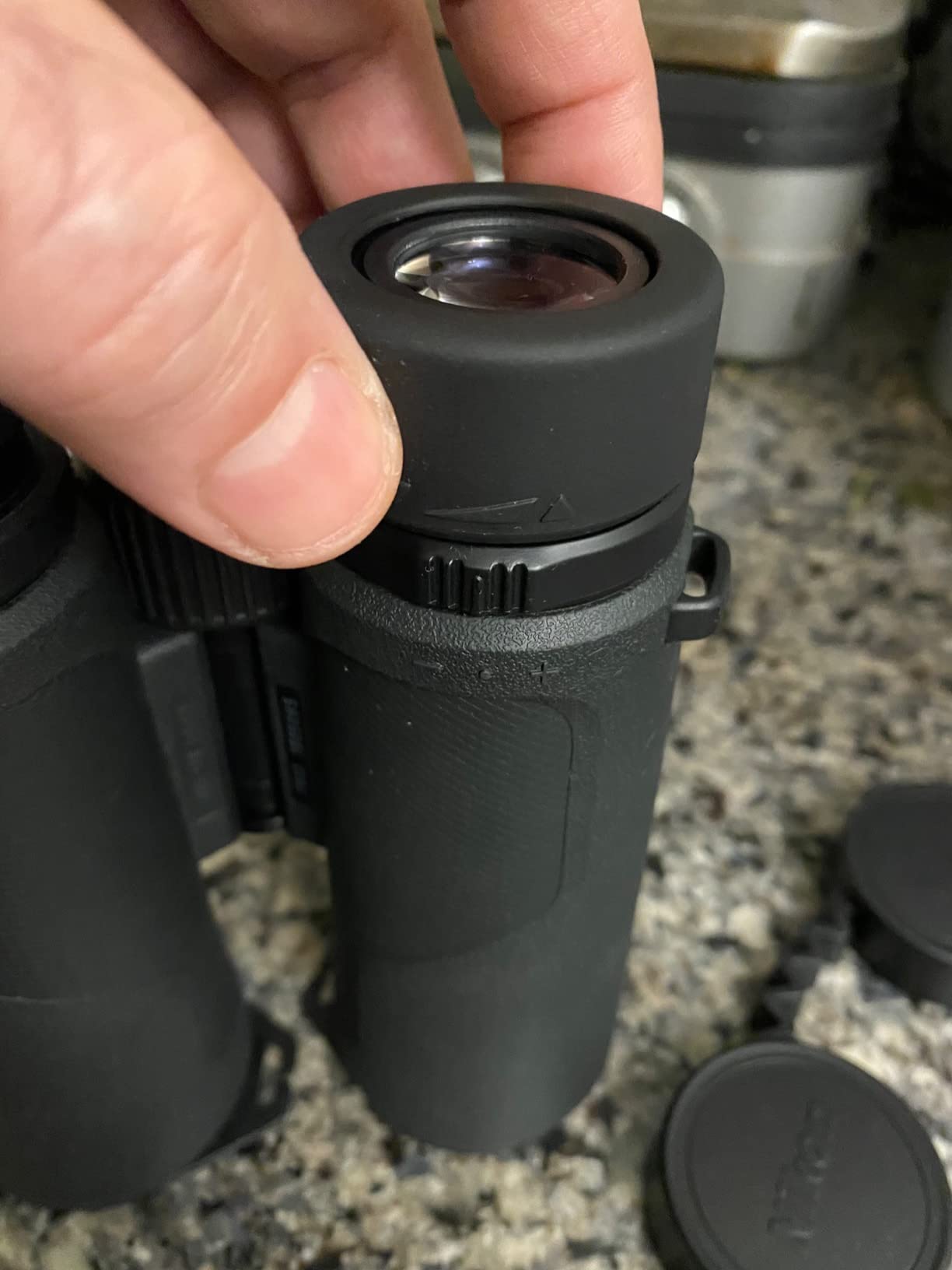
Turn-and-slide eyecups and 15.7mm of eye relief handle glasses better than the 15mm standard on most competitors here. The fiberglass-reinforced polycarbonate body with rubber armor weighs 1.3 pounds, so it carries like a compact unit.
Close focus is another quiet strength. Owners use it for backyard and near-range viewing, and that near focus carries over to checking ground signs, which is a habit that pays off long before the shot.
Where a wide field changes the hunt?
Field of view is the least glamorous spec on this list and the one that saves more missed animals than magnification ever will. A wider view at the same power means you cover more ground per sweep and spend less time hunting for an animal you already walked past.
If your hunting is spot and stalk across sagebrush, CRP ground or open hardwoods, this pair is built for it. It is less ideal for dense timber, where 8x and a wider view are the priority.
Where it falls short?
Some color fringing appears around high-contrast edges, which is normal for non-ED glass at this level and shows up most on branches against bright sky.
The diopter eyecup adjustment feels loose and retracts easily, and the included lens covers are described as loose and unreliable. Both are minor, and both are worth replacing if you are careful with gear.
7. Bushnell PowerView 10×50 Realtree Camo – Best Camouflage Finish
Bushnell PowerView 10×50 Porro Prism Instafocus Binoculars Realtree AP Camo
10x50 Porro prism
Instafocus quick adjust
Realtree AP camo finish
10mm eye relief
1.6 pounds
Pros
- Bright crisp images from multi-coated optics
- Instafocus enables fast focusing on moving targets
- Camo finish blends into field environments
- Tripod-compatible rugged housing with rubber grip
Cons
- 10mm eye relief is short for strong prescriptions
- Bulkier than roof prism designs
- Basic anti-reflective coating only
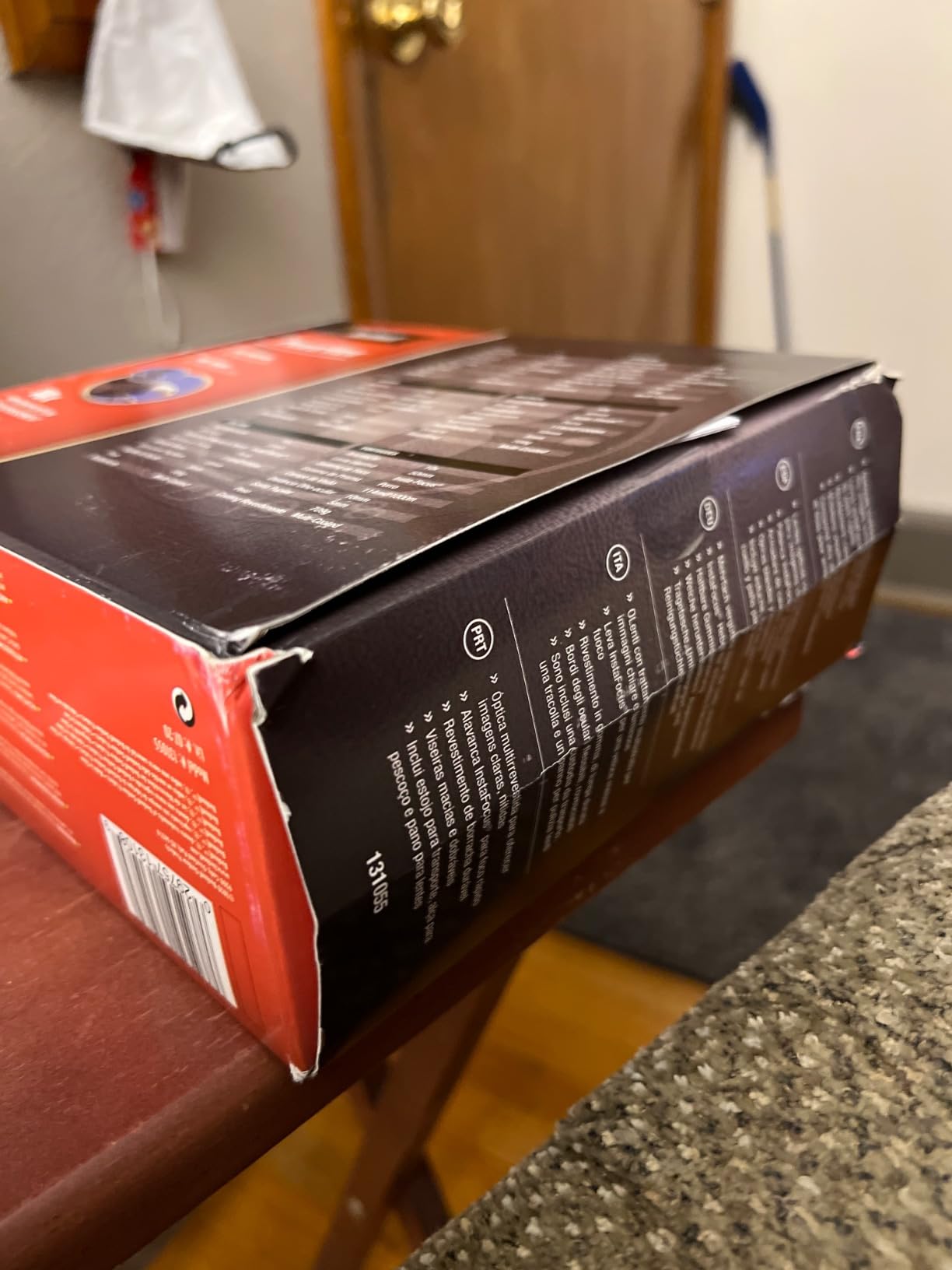
The Realtree AP camouflage finish is the reason this pair is on the list. Hunters who work pressured public land with deer moving in daylight know how much a patterned body cuts your profile, and this is one of the few budget binoculars offered in true camo rather than black.
Optically it is bright and crisp for a budget 10×50, using multi-coated optics with a 5mm exit pupil. Instafocus lets you snap focus quickly, which is useful when game crosses an opening at speed.
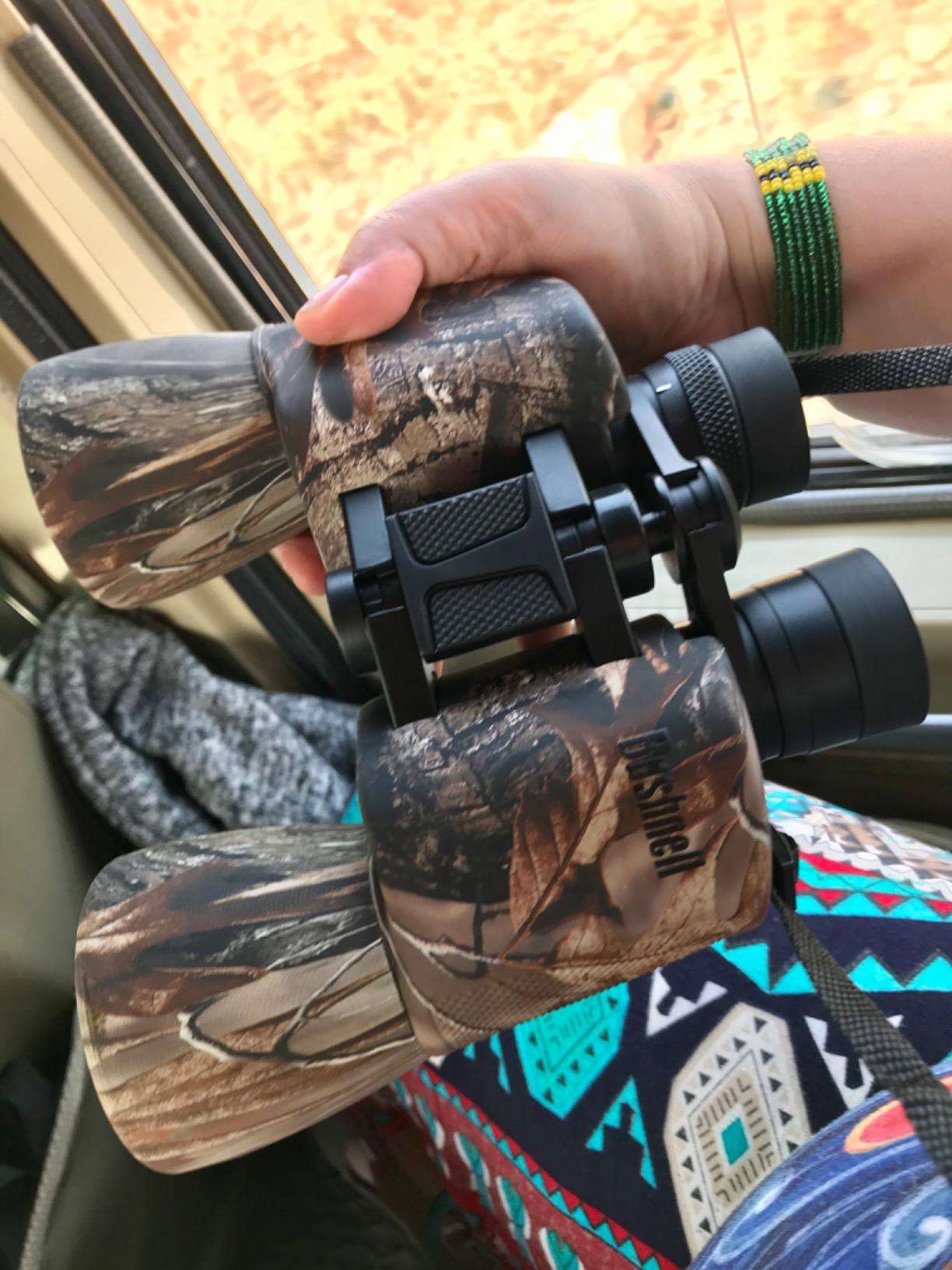
The Porro prism design gives a wide, forgiving image and the housing is tripod-compatible with non-slip rubber grips. Fold-down eyecups are described as suiting all viewers, including eyeglass wearers.
This is also a simple binocular to operate, and simplicity has real value when you are cold, rushed and trying to get glass on an animal in the last five minutes of light.
Where camo actually helps?
Camo on binoculars is not about the lenses. It is about the ten seconds it takes a white or bright body to register in a deer’s peripheral vision while it hangs from your chest. The Realtree AP pattern breaks up that shape, and on pressured ground with wary animals it is a genuine advantage.
It also doubles as a good reason to buy this pair as a dedicated big game unit rather than a do-everything glass, since it will never match a neutral black binocular for birding or wildlife viewing aesthetics.
Where it falls short?
Ten millimeters of eye relief is the biggest problem on this list for glasses wearers. That is well below the 15mm minimum most opticians recommend, and wearers with any meaningful prescription will struggle to find a full field of view.
The anti-reflective coating is basic compared with fully multi-coated glass, and the Porro design is bulkier than the roof prisms here. For most hunters, those trade-offs are only worth making for the finish.
8. Celestron Nature DX 8×42 – Best for Timber and Close Cover
Celestron Nature DX 8×42 Waterproof Binoculars for Bird Watching & Outdoors
8x42 roof prism
7.4 degree field of view
17.5mm eye relief
Phase-coated BaK-4 prisms
Pros
- Exceptionally wide 7.4 degree field of view
- 8x magnification gives a stable view
- Long 17.5mm eye relief works with glasses
- Phase-coated BaK-4 prisms
- Waterproof nitrogen-purged body
Cons
- Less bright in low light than higher-transmission glass
- Slightly stiff center focus
- Some chromatic aberration
- Low quality neck strap
Eight power and a 7.4 degree field of view is the combination that makes this the timber and close cover pick. At 8x, hand shake is manageable without a rest, and a field this wide lets you cover a treeline at a sweep. Anything faster than about 8x turns a buck bounding through oaks into a series of frames you cannot hold.
The image is bright, sharp and color-accurate, with fully multi-coated lenses on phase-coated BaK-4 prisms. Owners regularly benchmark it against more expensive Vortex, Zeiss and Leupold glass and find it competitive in daylight.
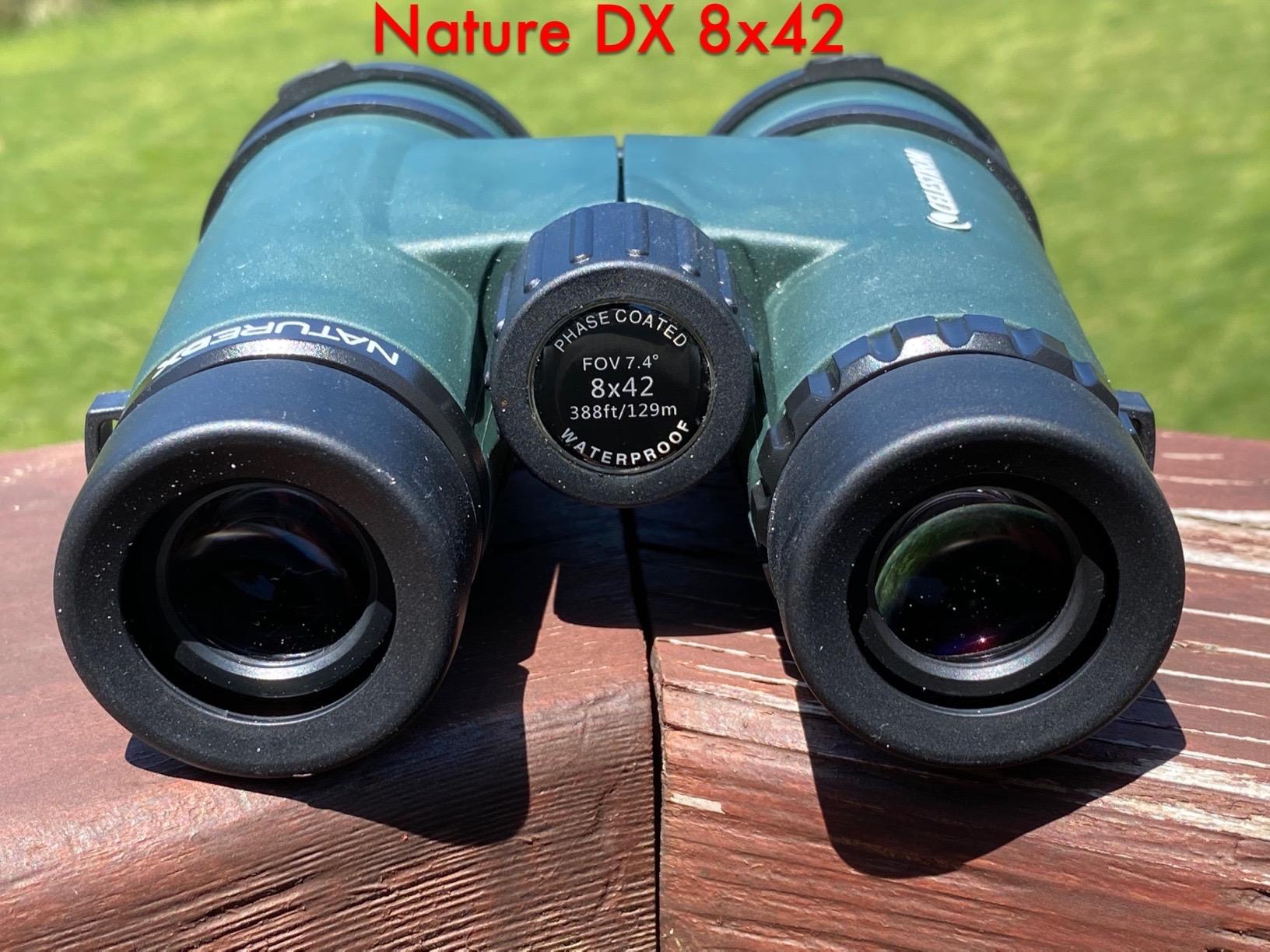
Eye relief is 17.5mm, among the highest in this group, and combined with the 8x power that makes it a strong recommendation for glasses wearers. The 5.25mm exit pupil feeds plenty of light into the eye for a dawn start.
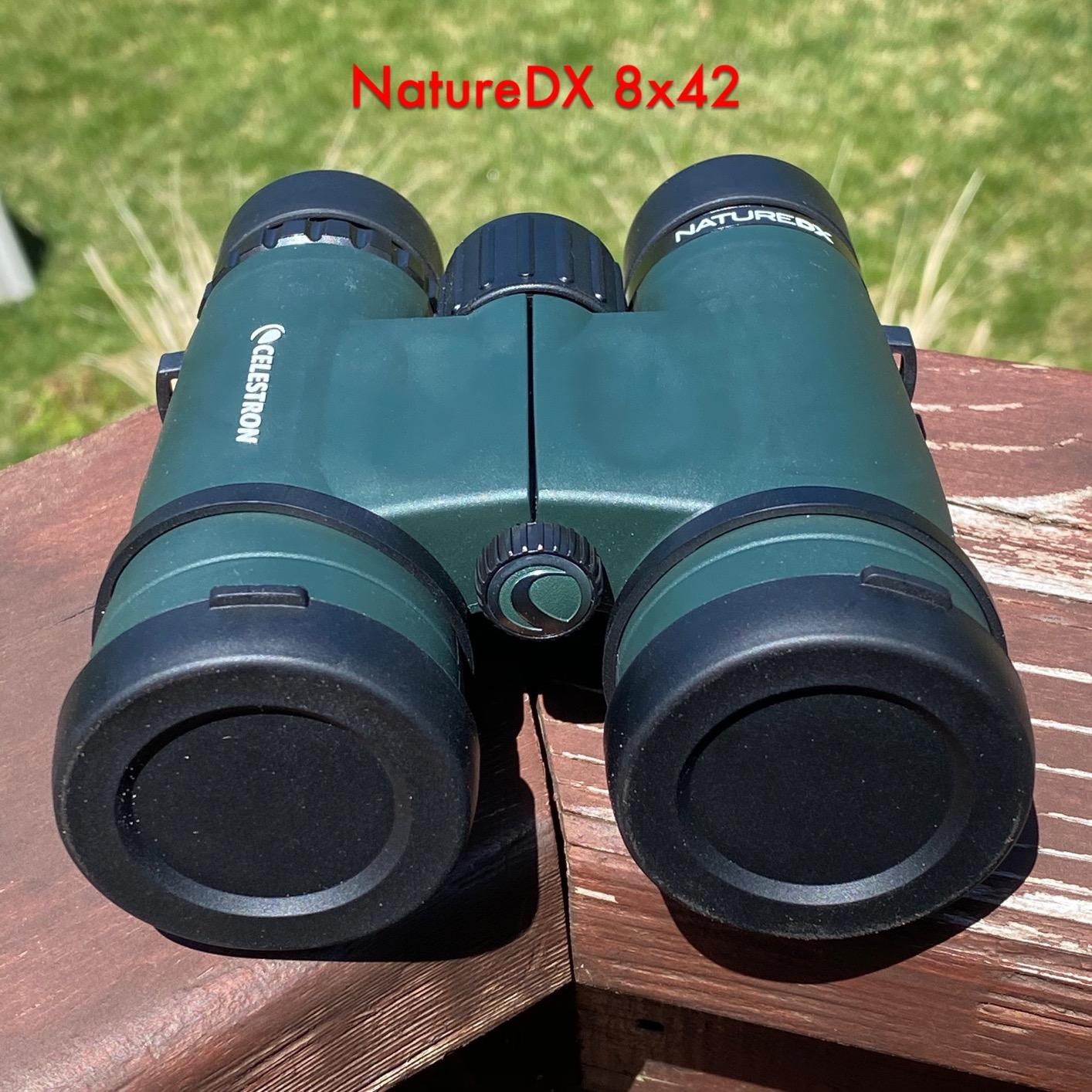
The body is waterproof, nitrogen purged and rubber armored, with a built-in tripod adapter socket for extended viewing. Celestron also provides a limited lifetime US warranty with US-based support.
Why timber rewards lower magnification?
Dense woods punish magnification. A 12x pair in heavy canopy turns every branch into an obstruction, and you spend more time refocusing than identifying. An 8x pair with a wide field lets you scan a pocket of timber and catch the animal moving without constant adjustment.
That is the same logic that makes 8x popular among whitetail deer hunters in the east and squirrel and turkey hunters, where the animal is close and the cover is thick.
Where it falls short?
Low light is the trade for all that width. Reviewers note it is not as bright or detailed in dim conditions as higher-transmission glass, so it is a daytime and early-dawn pair rather than a last-light pair.
Some chromatic aberration compared with ED glass models, a slightly stiff center focus, and a low quality included neck strap are the other recurring notes. Replacing the strap is a five dollar fix.
9. Bushnell Falcon 10×50 – Best Starter Pair for New Hunters
Bushnell Falcon 10×50 Wide-Angle Binoculars
10x50 Porro prism
Fully coated optics
Instafocus lever
9mm eye relief
830 grams
Pros
- Clear bright views from fully coated 50mm objectives
- Instafocus lever is fast and simple
- Comfortable even in smaller hands
- Fully adjustable cloth neck strap included
- Proven long-running design
Cons
- Larger and heavier than compact 10x models
- Eyepiece caps fit loosely and fall off
- Instafocus lever feels flimsy
- 9mm eye relief is short for strong prescriptions
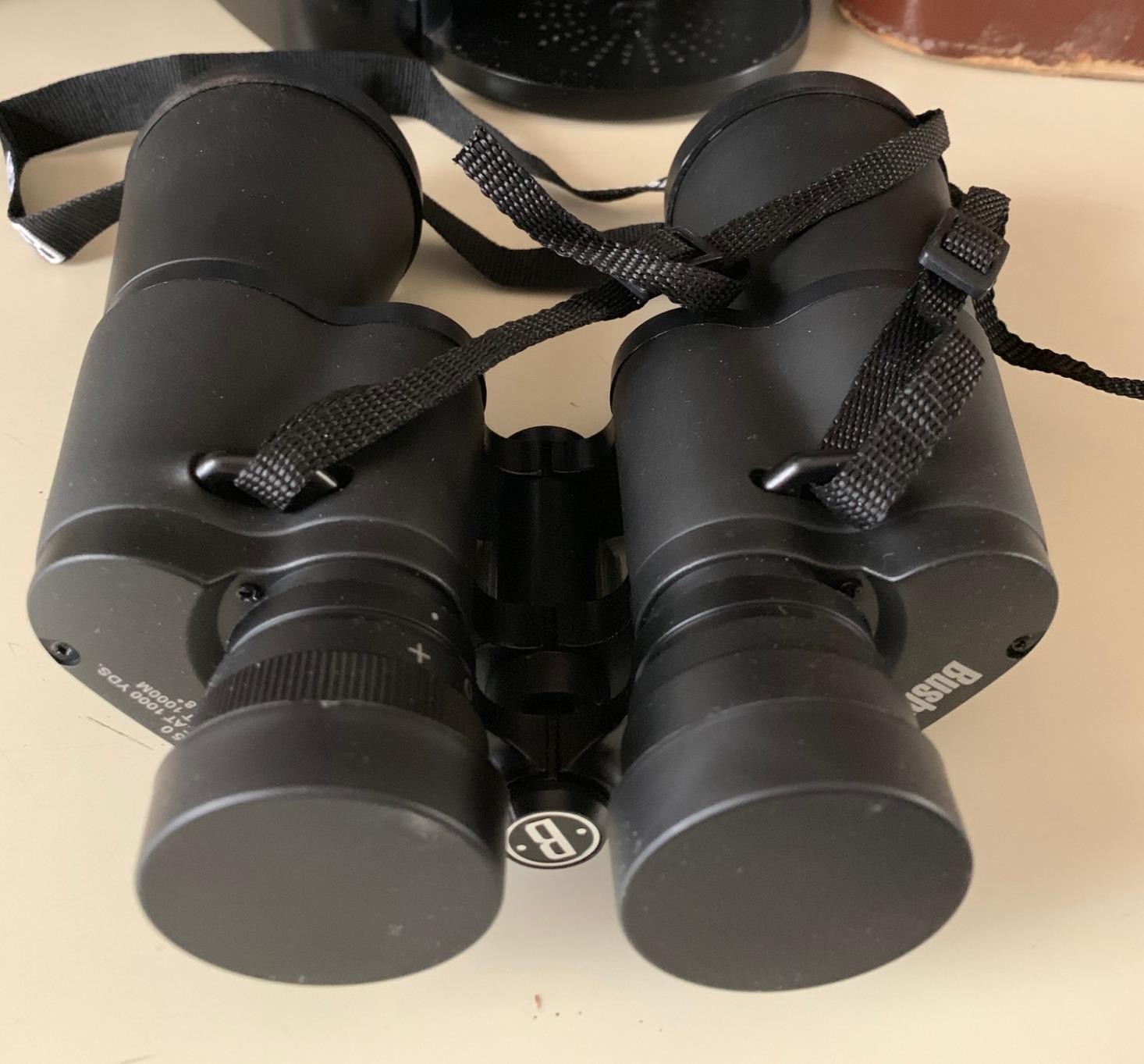
With more than 6,500 owner reviews, the Falcon has the broadest installed base of any binocular here, and that matters. When a design has been in production this long, replacement parts, straps and general knowledge about how it behaves are all easy to come by.
Optically you get clear, bright views from fully coated 50mm objectives, which is more usable glass than most people expect from the bottom of the price range. For a new hunter learning what glass can and cannot do, that is a fine place to start.
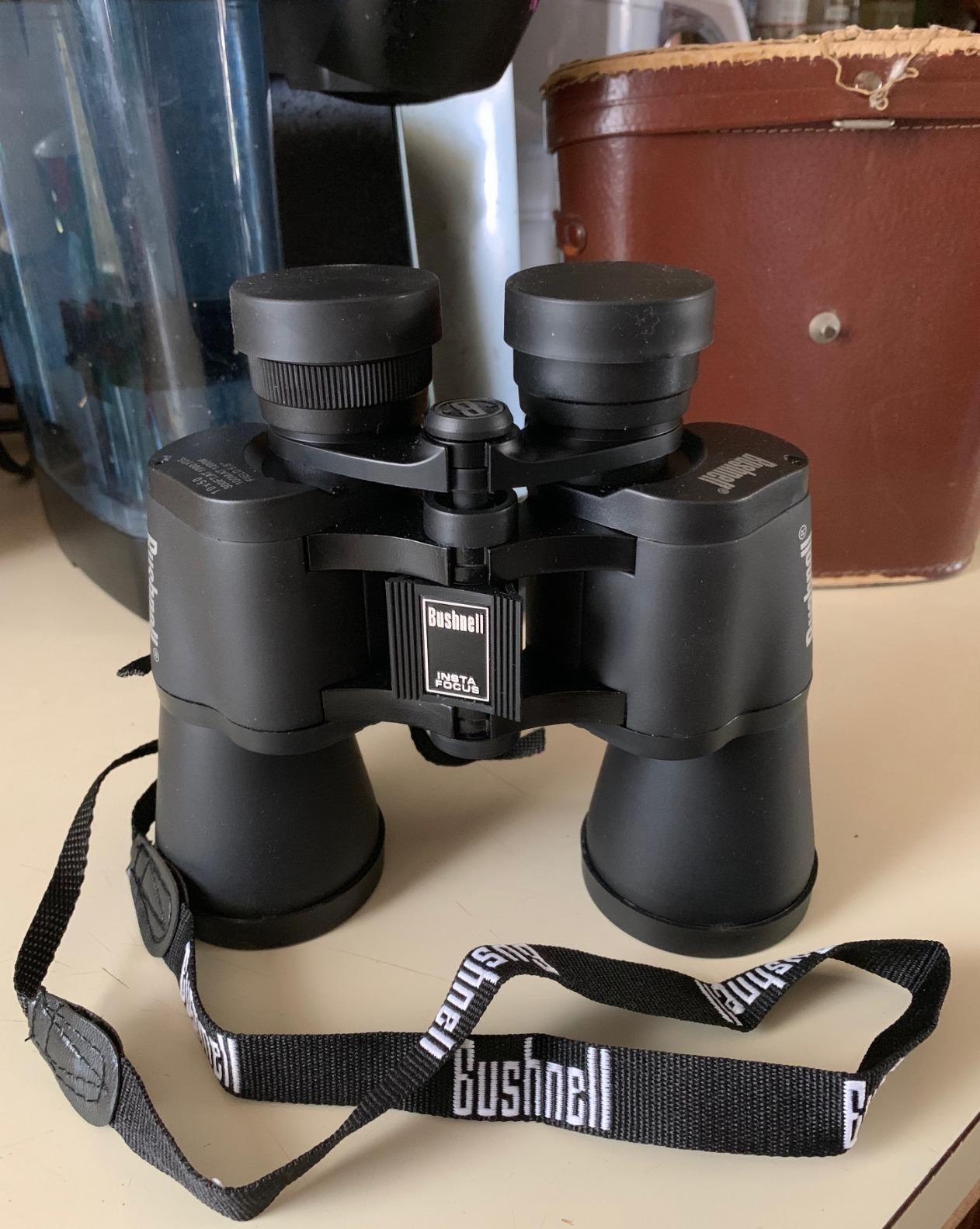
The Instafocus lever is the standout feature. Pull it and the focus jumps to a set distance, which suits casual observers, families and anyone who does not want to learn a fine focus wheel. The rubberized, abrasion-resistant grip pads handle wet hands and winter gloves.
It is tripod mount capable, and the adjustable cloth neck strap is included, which is more than many rivals in this class provide.
Where a simple design wins?
There is real value in a binocular with nothing to break and nothing to learn. The lever focus, the fixed approach and the forgiving Porro layout mean fewer ways to fumble in the dark. For a bowhunter introducing their kids, or anyone who wants one pair for the truck and the garage, it works.
At 830 grams it is also light enough to carry, and the all-weather grip pads hold up in rain and frost.
Where it falls short?
Nine millimeters of eye relief is the shortest in this group, and it rules this pair out for most prescription glasses wearers. If you wear glasses at all, skip it.
The body is larger and heavier than compact 10x models, the eyepiece caps fit loosely and fall off easily, and reviewers describe the Instafocus lever as flimsy and crunching. The soft carrying case also offers limited protection.
10. Gosky 10×42 – Best Value With a Phone Adapter
Gosky 10×42 Binoculars for Adults High Powered with Phone Adapter & Tripod
10x42 Porro prism
BaK-4 prisms, FMC optics
18mm eye relief
IPX7 waterproof
1.25 pounds
Pros
- Clear sharp high-contrast images for the money
- 18mm eye relief is the highest in the group
- IPX7 waterproof and fogproof
- Includes universal phone adapter and swivel tripod
- Smooth focus knob usable with gloves
Cons
- Phone adapter is flimsy
- Phone slips out of alignment in the adapter
- Tripod screw hole is poorly drilled
- Some fringing and soft edge sharpness
Eighteen millimeters of eye relief is the largest figure in this group, and that alone puts the Gosky on the shortlist for anyone who wears glasses or sunglasses. Owners with both report seeing a full field without the frame digging into the eyecup, which is the single most common complaint about budget 10×42 glass.
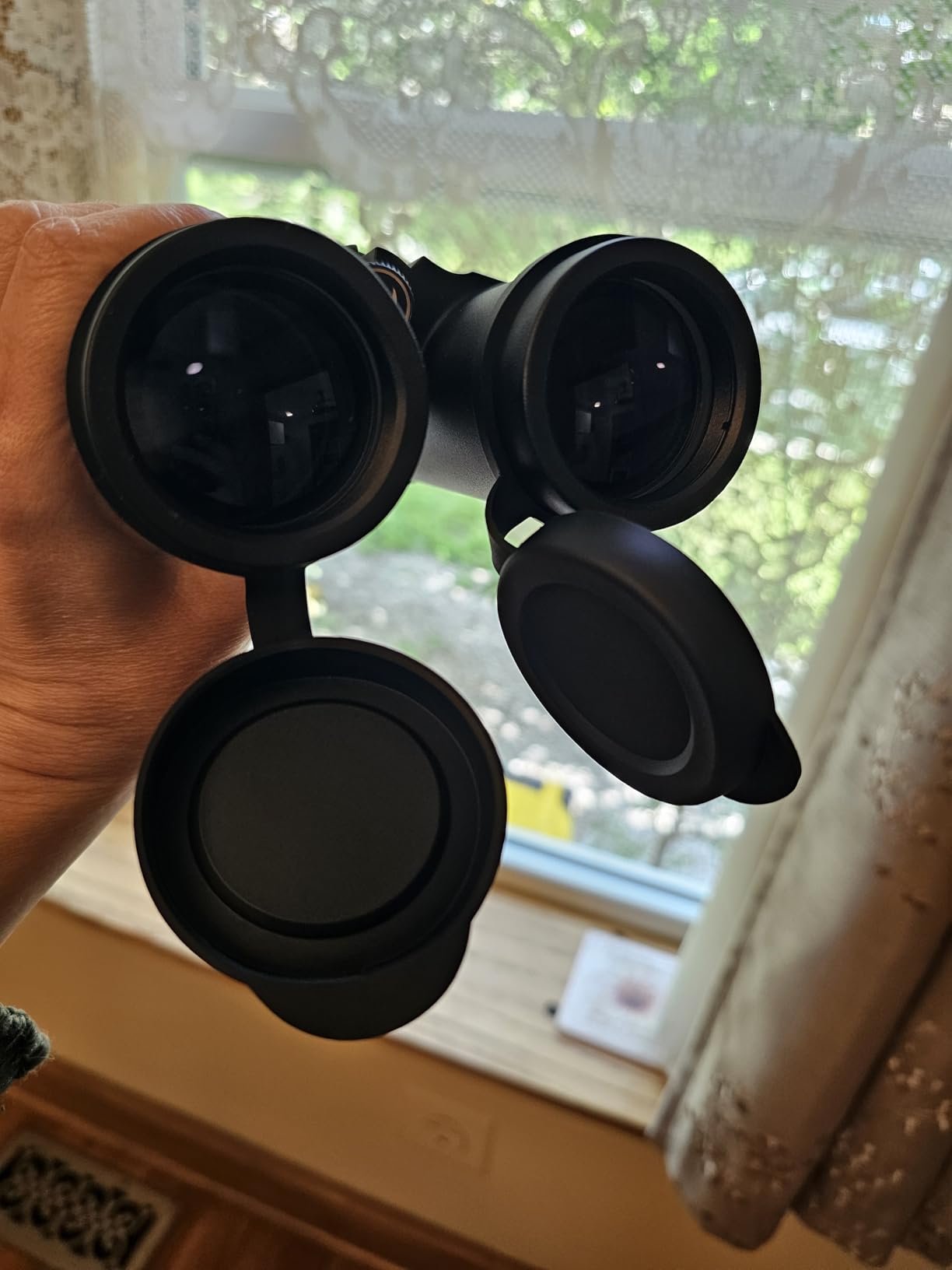
The optics are fully multi-coated with BaK-4 prisms, and owners frequently describe the image as beating far more expensive binoculars. The 5mm exit pupil is bright for the money, and a 330 foot field at 1000 yards is respectable.
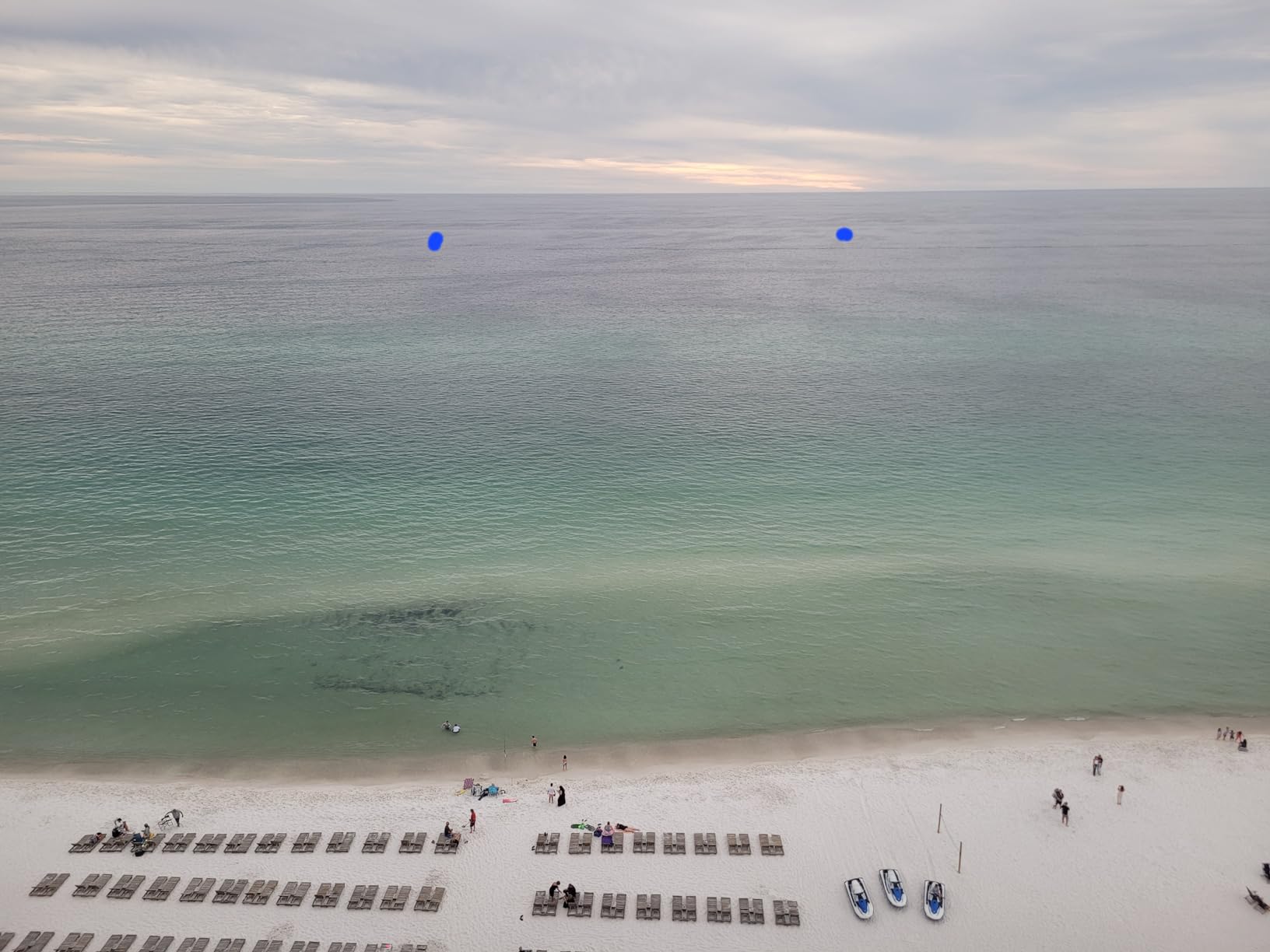
The bundled accessories are unusual at this price: a universal smartphone adapter and a 360-degree swivel tripod with adapter. That makes digiscoping and recording game calls or trail footage possible without another purchase.
At 1.25 pounds with a rubber-armored, IPX7 sealed body, it carries well and survives weather. The warranty is lifetime.
Where it beats branded glass?
Spec for spec, the Gosky is competitive with pairs costing several times more. BaK-4 prisms, fully multi-coated glass, 18mm eye relief, an IPX7 rating and a lifetime warranty are specifications you normally have to leave this price range to get.
The eye relief in particular is the quiet hero. For a hunter with a strong prescription, this is the pair most likely to give you a usable image from the first minute you put it to your face.
Where it falls short?
The included accessories are the weakest part. The phone adapter is flimsy and owners report the phone slipping out of alignment, and the tripod screw hole is poorly drilled and hard to thread. Buy a separate tripod if you want one that actually holds.
Reviewers also report some chromatic aberration and softer sharpness toward the edge of the field, and the body is heavier and bulkier than most 10×42 roof prisms here.
How to Choose Hunting Binoculars: Configuration, Glass and Eye Relief?
8×42 vs 10×42 vs 10×50: pick your magnification by terrain
Most of the argument about magnification comes down to one question: what is around the animal? In dense timber, thick cedar or a river bottom, an 8x pair wins. Eight power is steady in the hand, and a wide field of view means you can scan a pocket of cover and catch a deer moving without hunting for it. The Celestron Nature DX 8×42 is the clearest example in this group, with a 7.4 degree field.
Across open country, CRP ground, sagebrush or open hardwoods, 10x is the right default. It gives you enough detail to judge rack size at 400 yards while keeping a field wide enough to sweep. The Nikon PROSTAFF P3 10×42 is the widest of the 10x options here at 367 feet, and the Vortex Crossfire HD 10×42 is the most balanced all-rounder.
Step up to a 10×50 when light is the limiting factor rather than cover. The 50mm objective gathers noticeably more light, and the 5mm exit pupil on the Bushnell PowerView and Celestron Outland X feeds a noticeably brighter image. The cost is weight, bulk and a narrower field of view. If you hunt open country at dawn, the Celestron Outland X 10×50 is the better glass; if you hunt in trees, it will frustrate you.
One practical note for anyone using a tripod or a window mount. Above 10x, hand shake becomes the limiting factor, and a tripod turns an unusable pair into a usable one. If your hunting involves glassing from a ridge for hours, factor a tripod into your budget rather than buying more magnification.
Glass and coatings: what actually changes the image?
BaK-4 glass is the baseline worth paying for. It has better light transmission and fewer internal reflections than the cheaper BK-7 used in budget models, which shows up as a brighter, more contrasty image with more natural color at the same magnification. Five of the ten pairs here use BaK-4 prisms; the rest use similar lower-cost glass.
Coatings do the rest of the work. Fully multi-coated lenses carry an anti-reflective coating on every air-to-glass surface, and a difference of a few percent of light transmission per surface compounds. Roof prism models also benefit from dielectric and phase-corrected coatings on the prisms themselves, which is the main technical difference between the Vortex Crossfire HD and the Diamondback HD.
One thing worth saying plainly. HD is a marketing term with no consistent technical definition, and the gap between a well-coated budget pair and a premium pair is far smaller than the price gap suggests. What you are really buying at the top of this range is better control of chromatic aberration, not a fundamentally different image.
Eye relief and glasses: the 15mm rule
Eye relief is the distance from the last lens to your eye, and you need enough of it to see the whole field without your brow or glasses frame blocking it. Fifteen millimeters is the commonly recommended minimum. Below that, glasses wearers see a vignette of black around the image.
Our ranking by eye relief: the Gosky 10×42 leads at 18mm, followed by the Celestron Nature DX at 17.5mm, the Celestron Outland X at 17.4mm, the Bushnell H2O Xtreme and Vortex Triumph HD at 17mm, and the Nikon PROSTAFF P3 at 15.7mm. The Vortex Crossfire HD and Diamondback HD sit at 15mm, which works for mild prescriptions. The Bushnell PowerView at 10mm and the Bushnell Falcon at 9mm are the two pairs we would not recommend to a glasses wearer.
Two practical tips. If your prescription is strong, add an eyecup spacer or a prescription binocular rather than fighting the fit. And test the pair in person if you can, because face shape changes the effective eye relief as much as the number does.
Low light: exit pupil and objective size do the work
Low-light performance is mostly physics. The exit pupil, which is the objective diameter divided by magnification, determines how much light reaches your eye, and a larger exit pupil means a brighter image in dim conditions. The PowerView, Falcon and Gosky 10x configurations all produce 5mm exit pupils, the brightest in this group, while the 10×42 roof prisms produce 4.2mm.
Beyond that, coatings and glass quality determine how much of that light actually arrives rather than bouncing off the lens surfaces. The Bushnell H2O Xtreme is the pair we would trust most in a downpour, given its IPX7 seal. The Celestron Outland X 10×50 is the pair we would trust most at the end of legal light.
Durability, sealing and warranty
Treat every one of these as waterproof and fogproof, because all of them are nitrogen purged with sealed bodies. Beyond that, warranty strength is the real differentiator. Vortex offers an unlimited, unconditional, lifetime VIP warranty that is transferable, and buyers repeatedly describe service as responsive when something fails. Bushnell backs the H2O Xtreme with the Ironclad warranty. Celestron and Nikon offer limited lifetime warranties, and Bushnell’s PowerView and Falcon carry only limited coverage.
That gap is the strongest argument for spending toward the top of this price range. A lifetime transferable warranty means a pair bought today can be handed to a hunting partner in fifteen years and still be covered, and it changes how hard you are willing to treat the glass on a ridgeline in February.
Accessories and the rest of the kit
Two included accessories are worth judging. A chest harness keeps glass at eye level without lifting binoculars, and the Vortex Crossfire HD, Diamondback HD and Triumph HD all ship with a GlassPak harness. The Gosky bundles a phone adapter and a small swivel tripod for digiscoping, though owners advise buying a better tripod. Everything else here includes at least a neck strap and a case.
For digiscoping, any of these can be adapted with an aftermarket phone bracket in seconds. If you are comparing sizes rather than weights, our guide to compact binoculars for hunting covers the tradeoffs, and if you want range-finding built in our rangefinder binocular picks are worth a look.
What this price range does not buy?
It does not buy Swiss or Austrian glass. It does not buy true ED elements on most of these models, so faint color fringing on high-contrast edges is a fact of life rather than a defect. It does not buy a lightweight body that stays comfortable on your neck for a full twelve-hour day, and it does not buy image stabilization, which only appears far above this price.
It also does not buy much separation between models. Our honest read after using all ten is that they sit in a narrow clarity band, and the pair that feels best in your hands is often the pair you will keep glassing with all season. Buy on eye relief, field of view, weight and warranty, and treat the glass quality as close to equal.
For deer-specific setups, our best binoculars for deer hunting guide goes deeper on the configurations that work best in autumn timber and early-season browse.
Frequently Asked Questions
Who makes the best hunting binoculars for the money?
Vortex is the strongest answer at this price, mostly on warranty strength rather than image quality alone. The Crossfire HD 10×42 and Diamondback HD 10×42 both carry an unlimited, unconditional, transferable lifetime VIP warranty, and the Crossfire HD 4.8 rating across more than 4,000 reviews reflects that consistency. Bushnell, Celestron and Nikon are all credible alternatives with limited lifetime coverage. Across the brands, the warranty is the biggest real difference, not the glass.
What is better, 10×42 or 12×50 for hunting?
For most hunters, a 10×42 is the better all-round choice because it balances magnification, brightness and a usable field of view. A 10×50 or 12×50 pulls in more light through a larger objective, which helps at dawn and dusk, but the extra glass adds weight and narrows the field. Pick the larger objective if you hunt open country at low light, and pick 10×42 if cover, weight and scanning speed matter more.
Which is better for deer hunting, 8×42 or 10×42?
Choose 8×42 for dense timber and close cover, and 10×42 for open country and mixed habitat. Eight power is steadier in the hand and usually comes with a wider field of view, which helps you catch a deer moving through trees. Ten power gives you more detail to judge antler size at distance. If you are not sure, match the power to the habitat where you will do most of your glassing.
What are the best 10×42 binoculars under 300 dollars?
Our top four 10×42 picks under 300 dollars are the Vortex Crossfire HD for overall balance and warranty, the Vortex Diamondback HD for the best low-light brightness from dielectric prism coatings, the Nikon PROSTAFF P3 for the widest field of view at 367 feet, and the Vortex Triumph HD for glasses wearers at 17mm eye relief. All four are fully sealed, nitrogen purged and covered by a lifetime warranty.
Are Swarovski binoculars better than Vortex?
Optically, yes. Premium European glass resolves more detail and holds contrast better in poor light. The tradeoff is that flagship binoculars from that tier cost several times more than anything in this roundup. A well-coated Vortex at the top of this range delivers most of the usable performance for a fraction of the cost, and the unlimited transferable VIP warranty is a genuine long-term advantage that many premium brands do not match.
Final Verdict for 2026
The Vortex Crossfire HD 10×42 is our pick for the best hunting binoculars under 300 dollars. It is bright, fully multi-coated, sealed with nitrogen and o-rings, light enough for all-day carry, and backed by an unlimited lifetime warranty that transfers with the glass. If you can spend a bit more, the Diamondback HD 10×42 adds dielectric prism coatings and noticeably better brightness in the last twenty minutes of light.
For specific situations, the Celestron Nature DX 8×42 wins in dense timber with its wide field of view, the Celestron Outland X 10×50 wins at low light, the Bushnell H2O Xtreme wins in rain with its IPX7 seal, and the Gosky 10×42 wins for glasses wearers with 18mm of eye relief. Our deer hunting binocular guide breaks those setups down by season and state.
Whatever you choose, buy it early enough to break it in before opening day, and take it out in the rain at least once. Glass that has survived a season of hard use is worth more than glass that has never left the closet.