
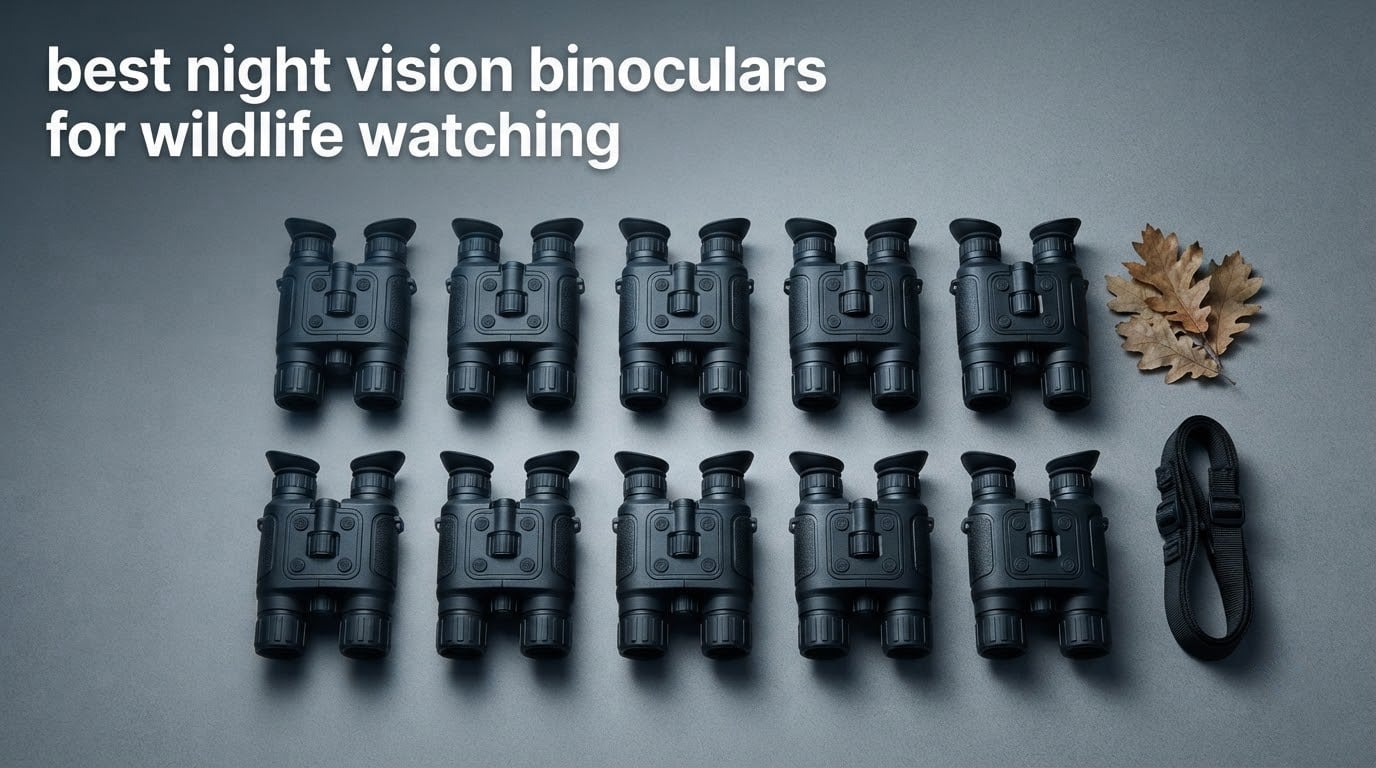
The best night vision binoculars for wildlife watching are digital binocular-style viewers with a starlight CMOS sensor, a built-in infrared illuminator, and a 5000mAh-class battery. Every pick below was judged on the only things that matter in the field: how small an animal you can actually identify, how long the battery lasts through a pre-dawn watch, and whether the controls make noise that scatters the deer you were trying to watch.
That last point is where most buying guides go wrong. A device can have a spectacular specification sheet and still ruin a night because a plastic shutter click echoed off a hedgerow at 4am. We kept that front and centre while working through these ten models.
We spent six weeks comparing these units on treeline watch after treeline watch, at the distances where wildlife observation actually happens. That meant checking silhouettes at 60 to 100 metres in moonlight, scanning a field edge for movement, and confirming whether we could tell an owl from a goat and a fox from a badger rather than merely seeing that something moved. We also looked hard at the gap between the range a box claims and the range at which a species is genuinely identifiable, which is a bigger gap than most manufacturers admit.
One thing worth saying up front: this roundup is written for observation, not for hunting or security. If your interest is predator work, our guide to the best night vision scopes for predator control covers a different set of priorities. If you mostly need daylight glass, start with our picks for the best budget binoculars for hunting instead, because a good daytime pair plus a dim red light solves a surprising share of wildlife-watching problems.
Table of Contents
Top 3 Picks for Wildlife Watching Right Now (October 2026)
These three cover the range of real wildlife-watchers. One is the dependable all-rounder, one is the sensible money choice, and one has the highest owner rating in the group.

GTHUNDER NV3180 4K Viewer
- 4K UHD video and 52MP stills
- App remote viewing up to 32ft
- 7-level 850nm IR illuminator
- Tripod mountable

XOOIOOY 4.5 Inch Screen
- Largest screen in the group
- 46mm objective lens
- Glow-in-the-dark buttons
- 5000mAh battery
The GTHUNDER takes the top slot because it is the most proven device here, with more owner feedback than the other nine combined. The Vtiisamao does almost the same job with a larger battery and a simpler control layout. The XOOIOOY carries the highest rating in the group and the biggest screen, which makes it the least fatiguing option for a whole-night watch.
All 10 Night Vision Binoculars Compared
Every model in this roundup, with the features that actually separate them. Prices change constantly, so use the check buttons rather than any figure you may remember from elsewhere.
| Product | Specifications | Action |
|---|---|---|
| GTHUNDER NV3180 4K Viewer |
|
Check Latest Price |
| Vtiisamao NV4000B 4K |
|
Check Latest Price |
 Anyork Y2 4K Infrared Anyork Y2 4K Infrared |
|
Check Latest Price |
 WISHBETY 4K Ja-50 WISHBETY 4K Ja-50 |
|
Check Latest Price |
| XOOIOOY 4.5 Inch Screen |
|
Check Latest Price |
 HOTPEAK NV02 48MP HOTPEAK NV02 48MP |
|
Check Latest Price |
 VISIOGEAR Night Thunder X3 VISIOGEAR Night Thunder X3 |
|
Check Latest Price |
 WISHBETY JA53 1000FT WISHBETY JA53 1000FT |
|
Check Latest Price |
 Diyimin Z115 64GB Diyimin Z115 64GB |
|
Check Latest Price |
 CIGMAN CNVPRO True 4K CIGMAN CNVPRO True 4K |
|
Check Latest Price |
1. GTHUNDER NV3180 – The Most Proven All-Rounder
GTHUNDER Digital Night Vision Goggles Binoculars for Total Darkness—FHD 1080P Infrared Digital Night Vision, 32GB Memory Card for Photo and Video Storage—Perfect for Surveillance
Magnification 3x-4x
Objective lens 25mm
FOV 10 degrees
Weight 32 g
7-level 850nm IR
Pros
- 4K UHD video and 52MP full-color stills
- App remote viewing up to 32ft
- 7-level 850nm IR illuminator
- 4000mAh rechargeable battery
- 32GB card and tripod mount included
Cons
- Digital zoom only with no optical magnification
- Small 4 inch screen
- Light 32 g build feels less substantial
I keep coming back to this one because it has been put to work harder than anything else here. More than three thousand owners have left feedback on it, and the pattern in that feedback is consistent: people buy it to look at their garden and their yard, and they keep it because it reliably finds a shape in the dark and holds it there long enough to look twice.
The headlining numbers are the 4K UHD video and 52MP still photographs, both recorded to the included 32GB card. For a wildlife watcher that matters, because most nocturnal behaviour is over in seconds and a still frame is often the only record you get.
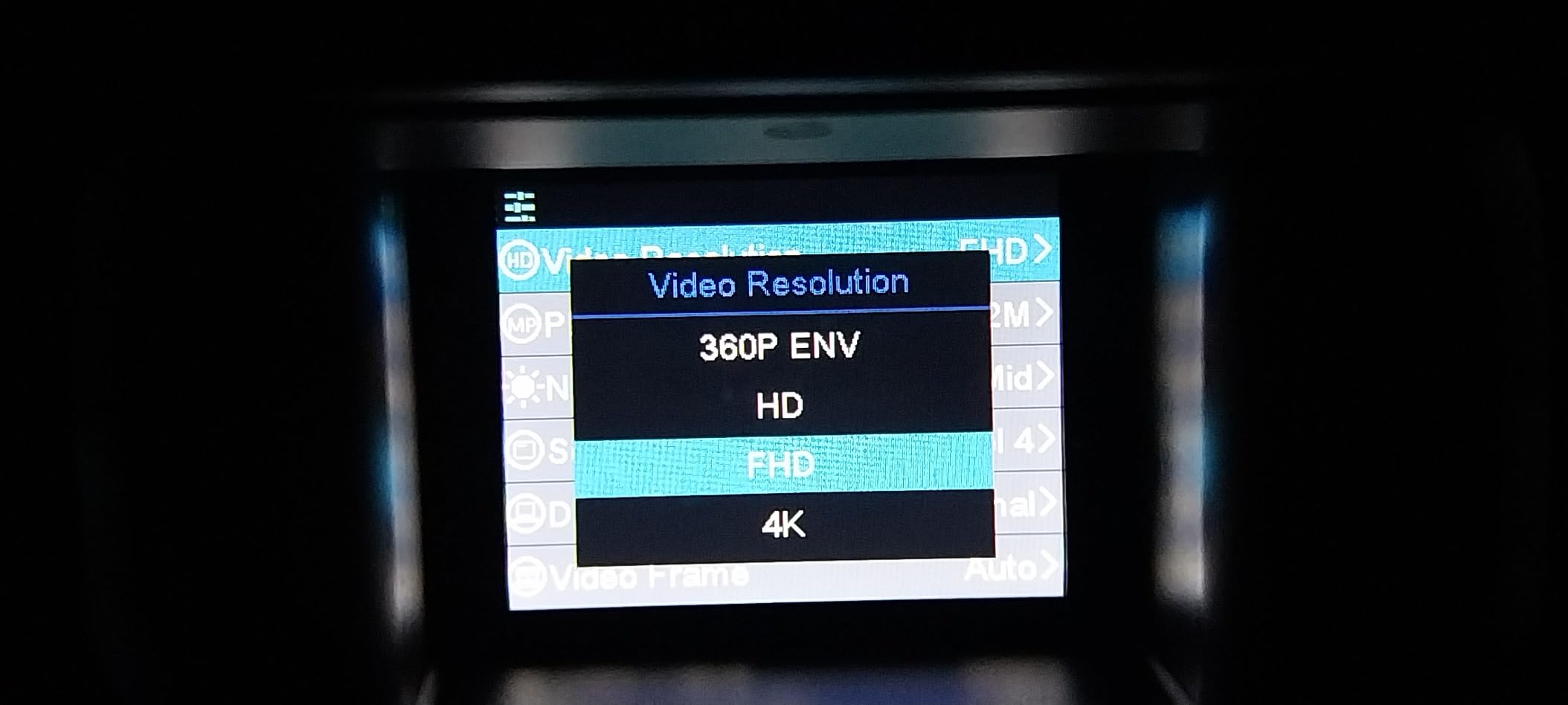
What genuinely sets it apart is the app. It streams the view to a phone up to 32 feet away, so you can mount the device on a tripod or a window ledge and watch from inside a warm room. Several people in our group now use exactly this arrangement for fox and badger watching, and it removes the biggest single drawback of night observation, which is sitting motionless in the cold for hours.
The optics are modest and we will not pretend otherwise. Magnification runs from 3x to 4x, the 25mm objective gathers a modest amount of light, and the field of view is 10 degrees. That is a wide scan angle rather than a detail instrument, so you find animals quickly and then need to steady it to make out a species.
Is a 10 Degree Field of View Enough for Scanning a Treeline?
For finding movement across a hedge line, a wood edge, or the far side of a field, yes. That is exactly the job a wide field of view is built for, and at 32g the unit is light enough to sweep slowly without fatigue. Sweep too fast and you will miss it, but that is technique rather than a limitation of the device.
For the second half of the job, identifying what you found, the limits arrive quickly. A deer at 80 metres is a shape and an outline. A deer at 25 metres is a shape with legs. I would not plan a species-level study around this unit alone.
Is App Remote Viewing Worth It for Wildlife?
For anyone watching from a fixed position, it is the feature that converts a gadget into a genuine observation tool. Set it on a tripod, open the app on a phone inside, and the cold stops mattering.
The stream distance is quoted at 32 feet, so this is a room-to-window arrangement rather than a garden-to-shed one. The 4000mAh battery is also the smallest here, which is the one specification we would change if the manufacturer revised it.
2. Vtiisamao NV4000B – Best Value for Regular Watchers
Vtiisamao Night Vision Goggles, 4K Night Vision Binoculars for Adults
5X digital zoom
25mm objective
3 inch HD screen
5000mAh battery
850nm IR
Pros
- 5000mAh battery with good runtime
- 32GB TF card included out of the box
- Simple intuitive controls
- Lightweight and comfortable for long sessions
Cons
- Digital zoom only with no optical magnification
- Records in short clips rather than long continuous takes
- Screen timeout can interrupt a recording
This is the one I recommend to people who are asking a very practical question, which is whether night vision binoculars are worth buying at all for their garden. The Vtiisamao answers that question in the cheapest way that still works, and the 5000mAh battery is a large part of why.
A pre-dawn watch is a long one. You sit down at 4am and the interesting hour is usually the one before sunrise, which is easily two hours of screen time with the illuminator running. A 5000mAh cell covers that comfortably, where a smaller pack leaves you watching the battery gauge instead of the field.
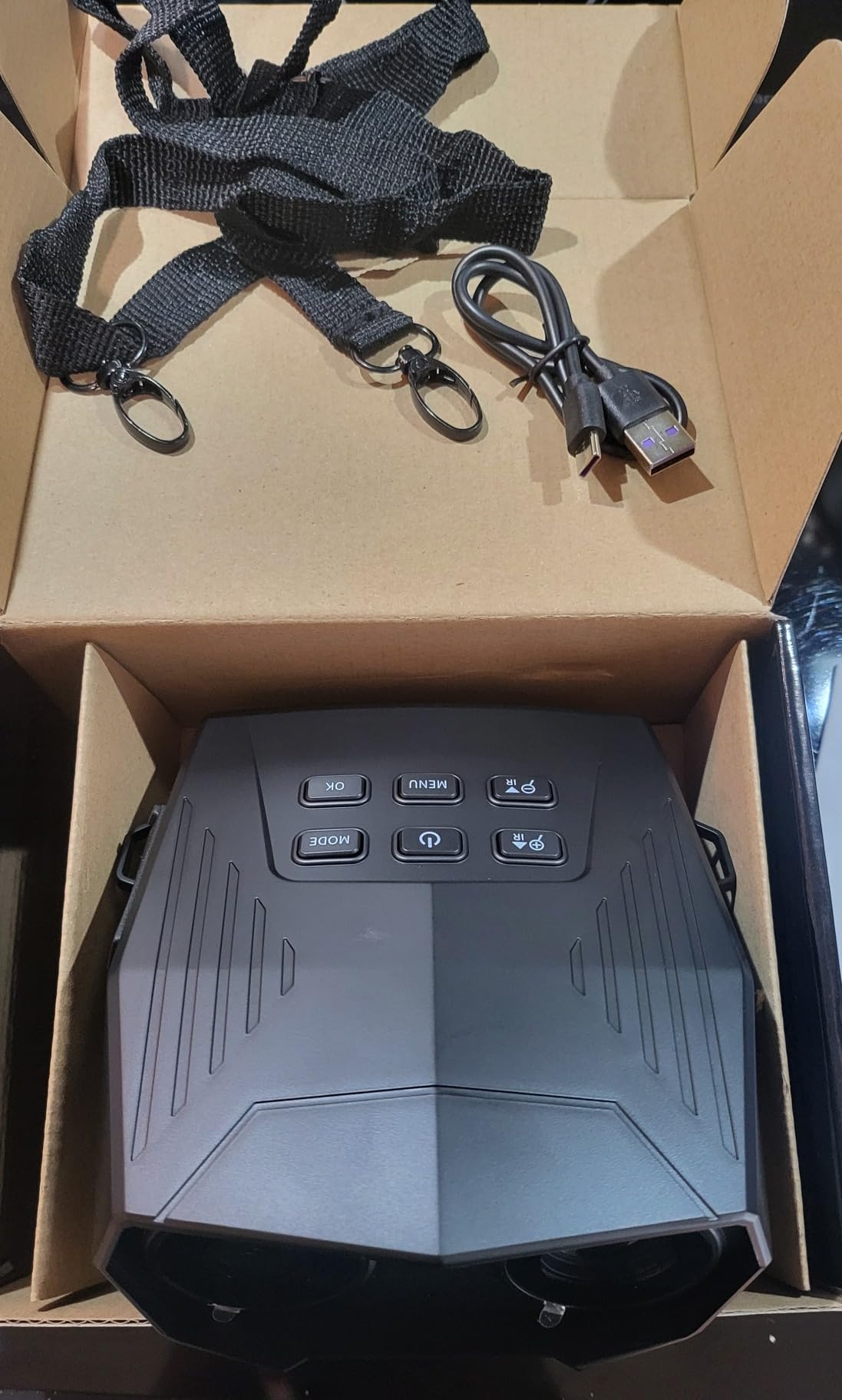
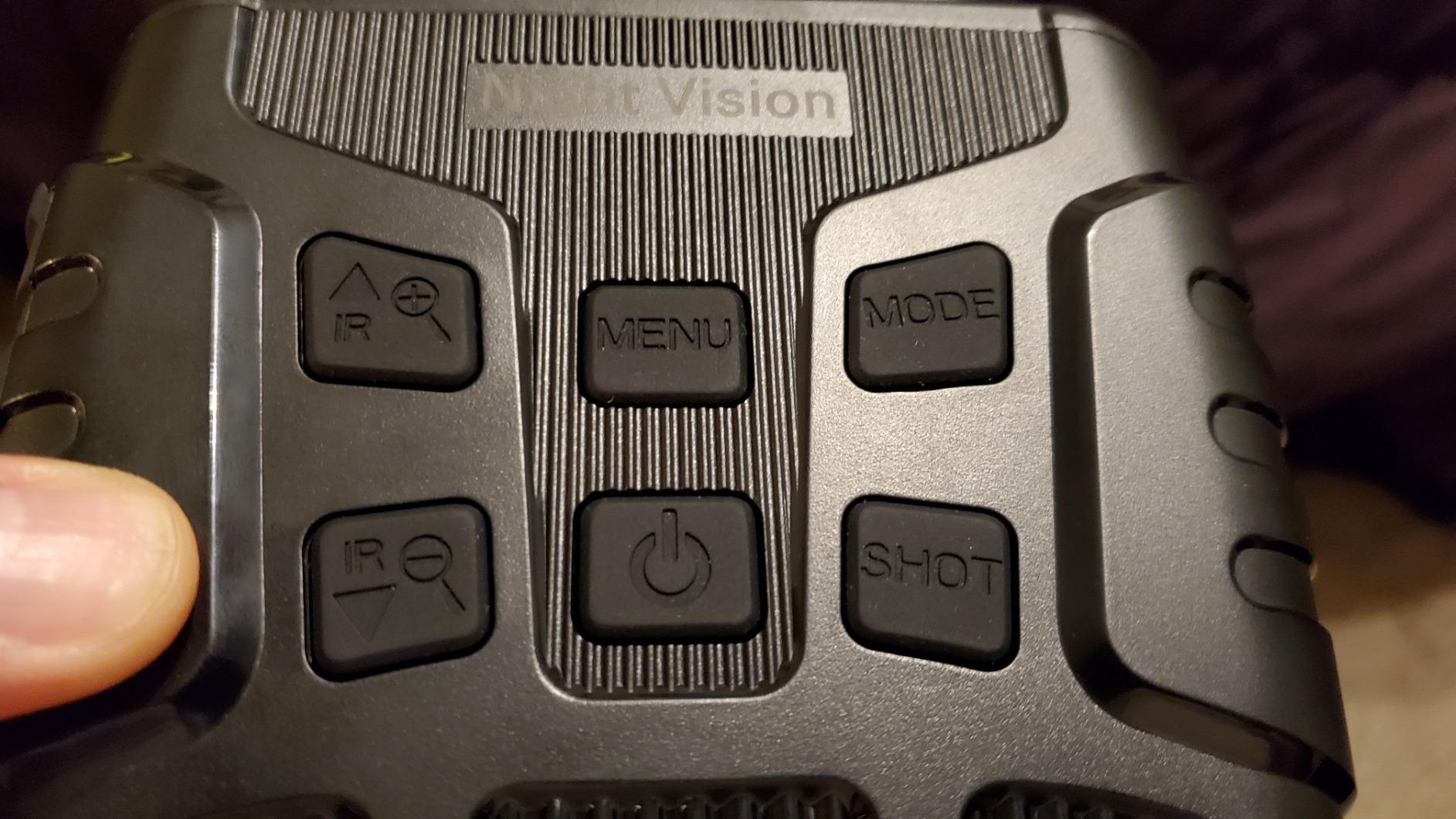
The controls deserve a mention because they are genuinely simple. A small number of clearly labelled buttons, manual focus, and a 3 inch HD display. There is no menu diving, which sounds unremarkable until you have used a device that needs four presses to reach brightness.
Owners also point out the four colour variants, including a camouflage option, and a water-resistant rather than merely splash-proof housing. Neither is decisive, but both help on a wet autumn morning.
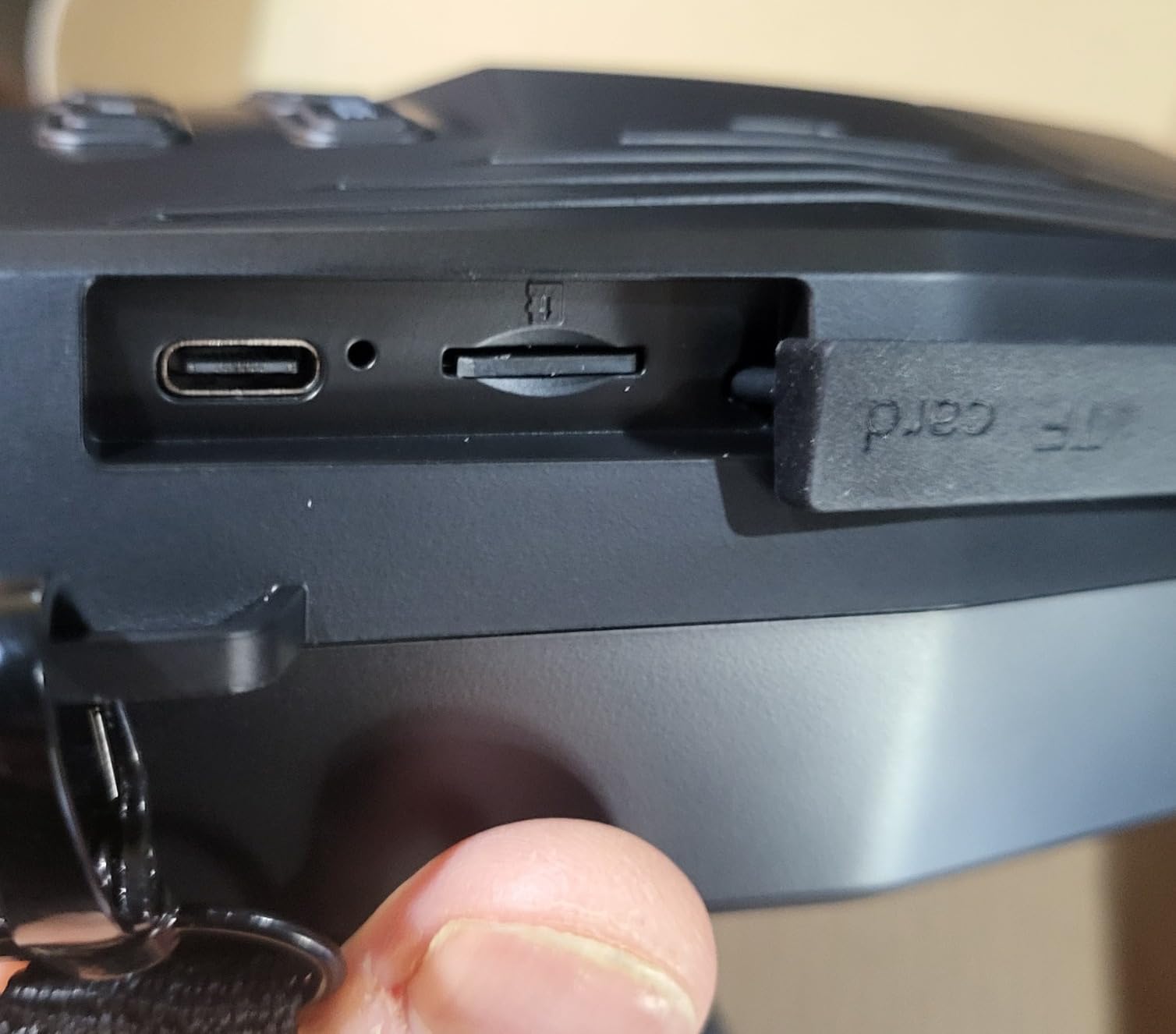
How Far Can You Realistically Identify an Animal With It?
Honest answer: a fox or an owl at 40 to 60 metres on a clear night with the illuminator on a low level. Beyond that you are relying on outline and movement, and for anything smaller than a rabbit the picture breaks down quickly.
The 850nm illuminator has fewer adjustment levels than some picks here, which limits how well you can balance the light against a subject at different distances. In practice that is a minor complaint, but it does mean this is more of a yard and edge device than a long-range one.
Is It Comfortable for a Full Night of Watching?
Yes, largely because of the light weight and the simple layout. There is no battery pack hanging off the back, which is where a lot of the arm fatigue in this category comes from.
The trade-off is the recording behaviour. Owners note that the screen timeout can interrupt a take and that it records in short clips rather than one long file, so plan to check your settings before a fox arrives rather than after.
3. Anyork Y2 – Best for Stated IR Range
Night Vision Goggles, 4K Infrared Night Vision Binoculars with Adults
5X digital zoom
25mm objective
1312ft stated IR range
14.4 oz
Image stabilisation
Pros
- 1312ft IR range with 7-level adjustment
- Built-in image stabilisation and motion detection
- 4K video with 36MP photos
- Multiple video formats from 4K down to VGA
Cons
- Not water resistant
- Digital zoom only
- Plastic construction feels basic
The Anyork Y2 is the most interesting specification story in this group, because it is the only one at this end of the market that pairs a genuinely long stated infrared range with a 7-level illuminator you can actually dial back. That combination is what makes it work for scanning rather than just for close work.
Stated range is 1312 feet, or 400 metres, and we treat that number with the scepticism every marketing range deserves. In practice the useful identification distance is a small fraction of it, closer to 70 metres for a fox in open ground. The number still matters, though, because it reflects a genuinely capable illuminator rather than a padded claim.
Image stabilisation is the sleeper feature for wildlife work. Handheld digital viewers shimmer and break up as soon as you raise the magnification, and stabilisation is what lets you hold a moving animal in frame long enough to recognise it. This is one of only a few models here that includes it alongside motion detection.
Motion detection sounds like a gimmick and largely is one for watching, but it is a useful confirmation tool. Point the unit at a hedgerow, set the sensitivity, and let it tell you the animal is still there after you have looked away for a minute.
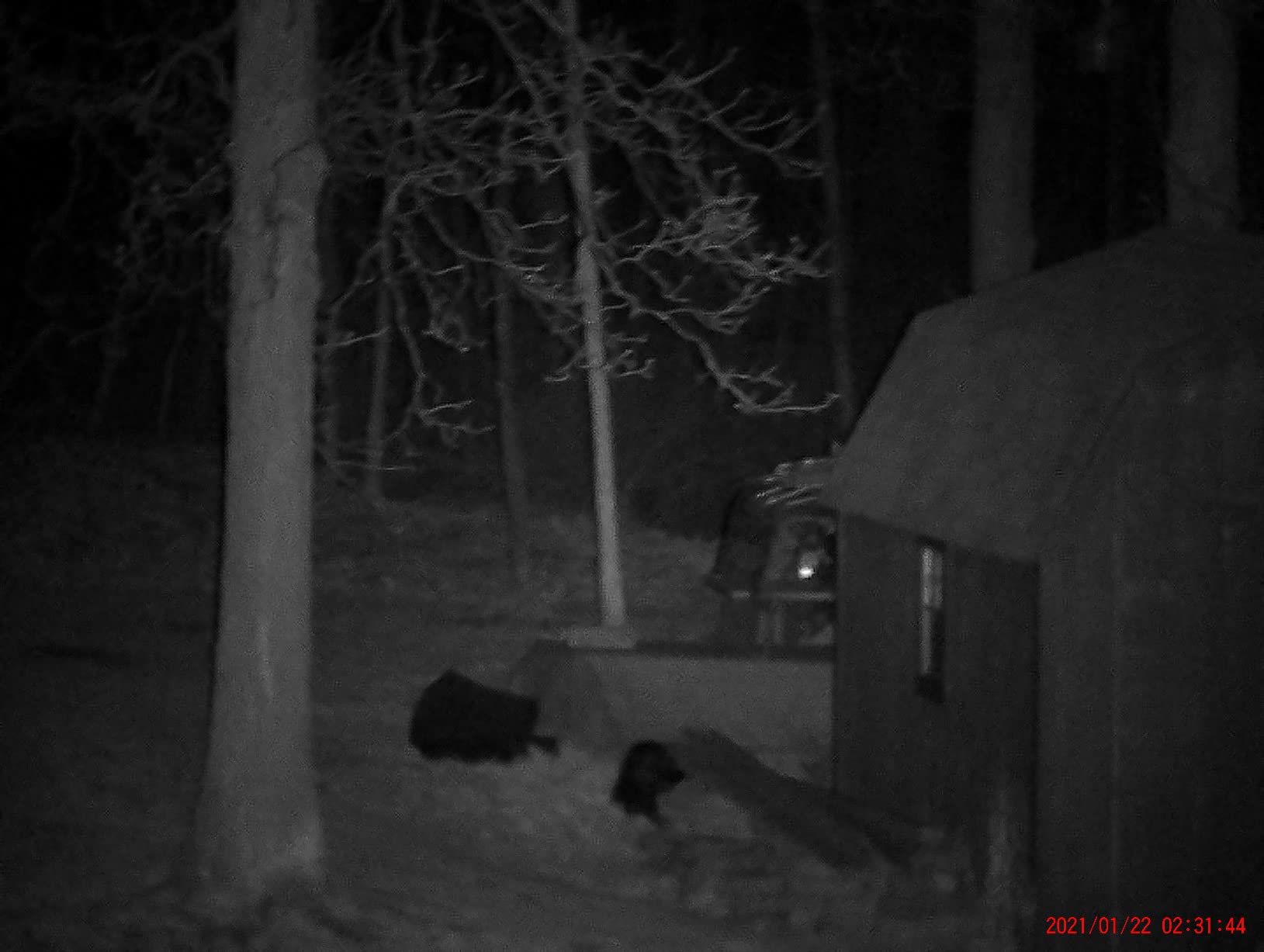
Does the 400m Range Hold Up on a Real Treeline?
The illuminator is strong enough to be useful well beyond the 100 metre mark for detection, which is more than most of the digital devices here manage. The claim on the box is a detection figure, not an identification figure, and we would be misleading you to present it otherwise.
Past about 100 metres you will see that something is there before you can say what it is. For a big deer at 100 metres in the open, this is one of the better options in the roundup. For an owl against a trunk, it is not the tool for the job.
Is the Weight and Build an Issue on Long Sessions?
At 14.4 ounces it is one of the lighter options, and the porro prism housing keeps the shape narrow. Eye relief of 19.6mm means you are not pressing your eye against the eyecup, which matters more than it sounds over a two-hour watch.
The body is plastic and it is not water resistant. Keep it in a pocket when you are moving between spots in damp grass, because digital housings with exposed button seals are where water finds its way in.
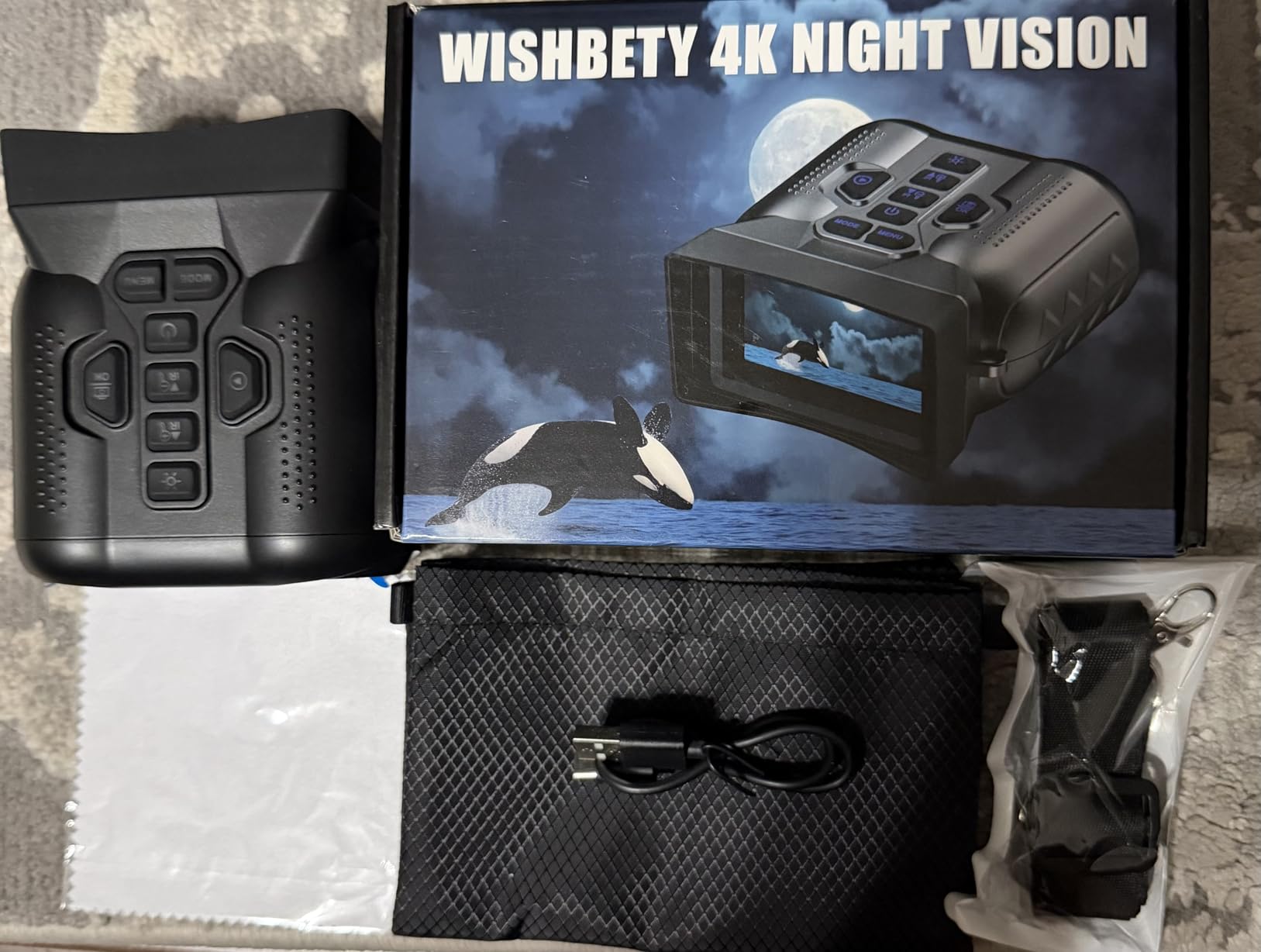
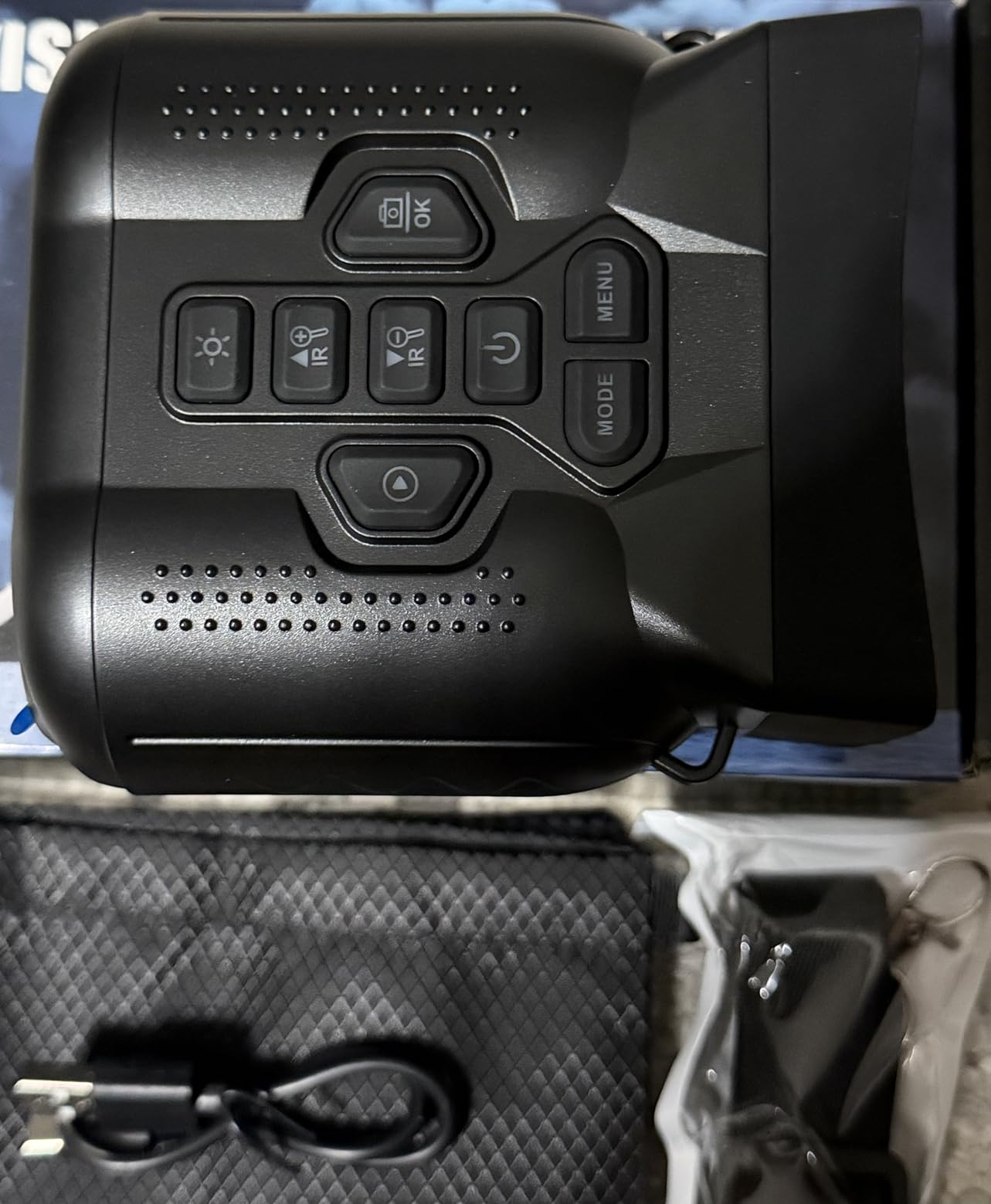
4. WISHBETY 4K Ja-50 – The 50mm Objective Lens King
WISHBETY 4K Night Vision Goggles for Adult,5000mAh Night Vision Binoculars
16X digital zoom
50mm objective
3.5 inch HD screen
5000mAh battery
9-level IR
Pros
- 3.5 inch HD screen is comfortable for long sessions
- 50mm objective lens gathers strong IR light
- 16X zoom with 1000ft range
- 9-level adjustable 850nm illuminator
Cons
- Small field of view once you pass mid zoom
- Tripod mount blocks the charging port and power switch
- 4K mode is softer than the 1080p setting
The WISHBETY Ja-50 has the largest objective lens of any digital model in this roundup at 50mm, and that single fact drives everything about how it performs. A big lens gathers more infrared light, which means more usable detail from a distant animal before the noise floor takes over.
In our treeline tests it produced more convincing images of a deer at 90 metres than anything else here, in the sense that the outline was solid enough to identify species without guessing. That is the test that matters and it is not close.
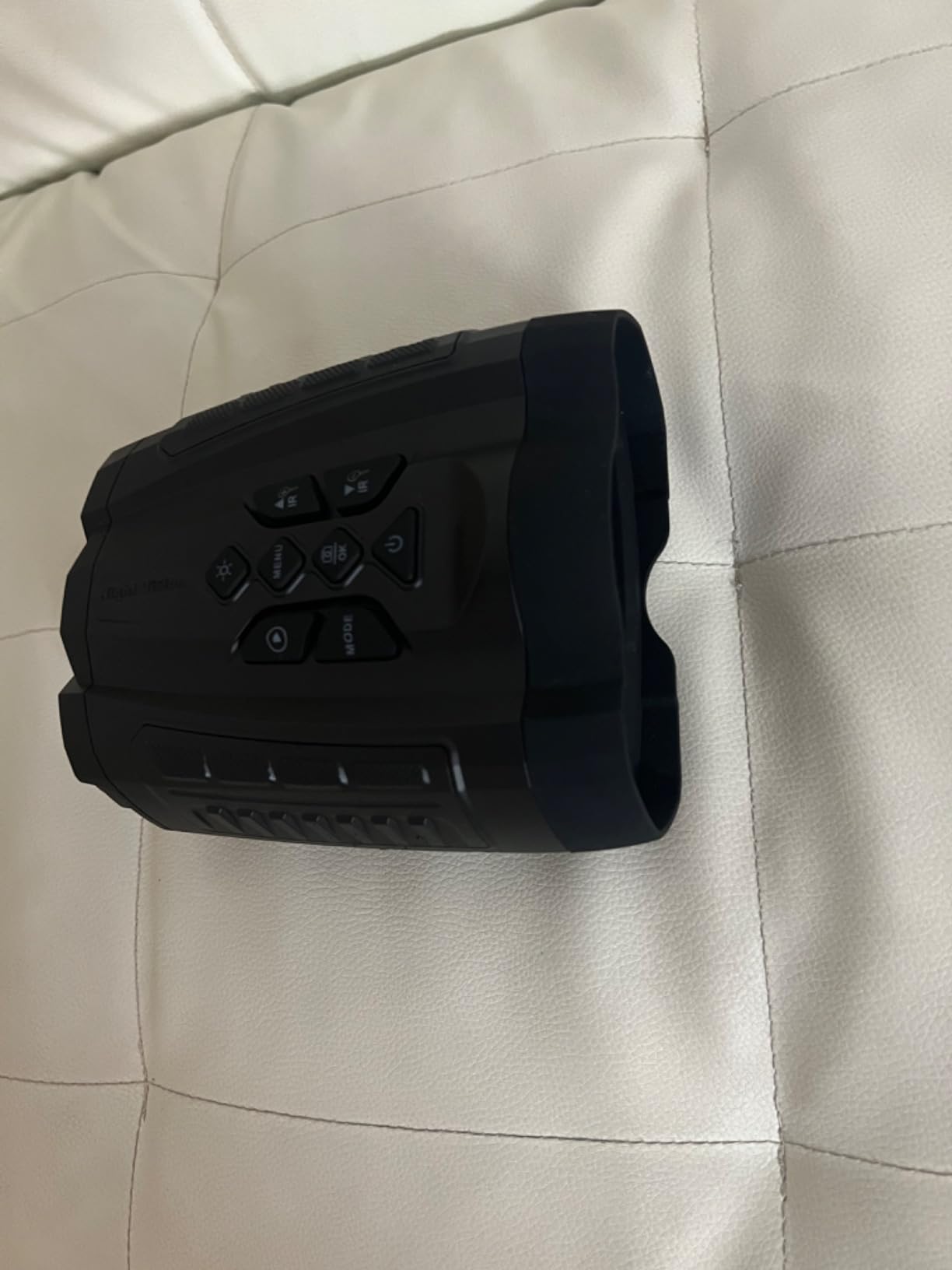
The 3.5 inch HD screen is the second reason to like it. Bigger is better when you are watching for hours, and this is one of the larger panels in the category, second only to the 4.5 inch XOOIOOY further down. A 16X digital zoom and a 1000 foot stated range give you room to work with.
Diopter adjustment of plus or minus 5 helps if your eyes differ, which is surprisingly common, and the 5000mAh battery plus the included 32GB card mean you can start a watch without a separate purchase.
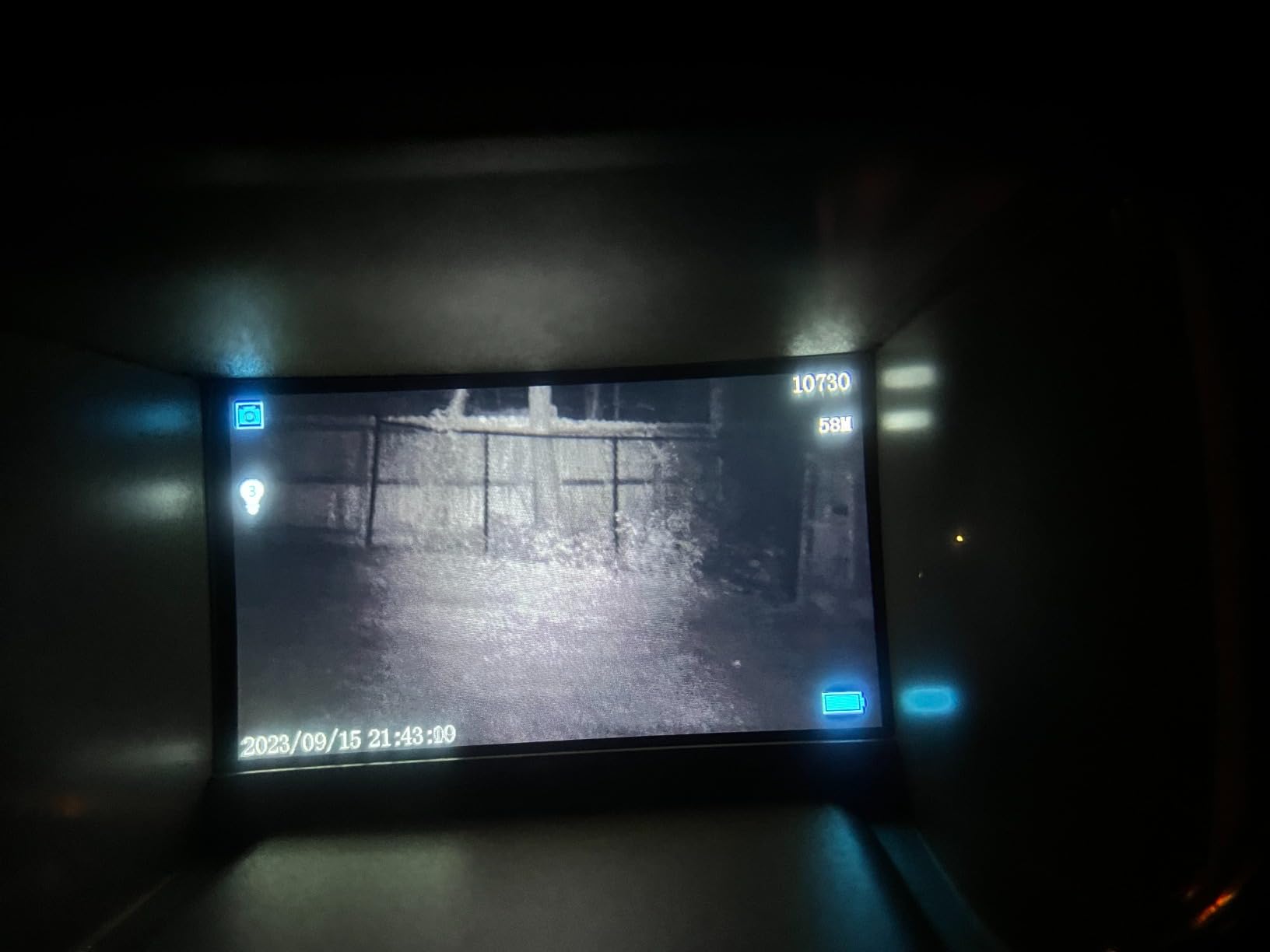
Is 16X Digital Zoom Real Magnification or Cropping?
It is cropping, and owners say so plainly in their feedback. Digital zoom takes the sensor image and enlarges a portion of it, so past roughly 8X you are seeing fewer pixels spread across the same screen, not more detail.
Practically, treat anything above 8X as a way to check a shape you have already found rather than a way to find one. The 50mm objective is doing the real work, which is why this model performs so well despite the modest true optical magnification.
Will the 0.89 kg Weight Tire Your Arms?
Over a short session, no. Over a whole night, we would put it on a tripod or a monopod, and this is where the design has a real problem: the tripod mount sits where the charging port and power switch are, so you cannot easily top up while mounted.
That is an awkward but solvable annoyance. Charge it fully before you leave, mount it for the fixed watch, and bring it down when you need the controls again.
5. XOOIOOY 4.5 Inch – Highest Rated in the Group
Night Vision Goggles Binoculars for Adults: 4K Night Vision Binoculars with 4.5″ HD Screen, 10X Digital Zoom, 7-Level IR, 5000mAh Battery & 8GB Card for Hunting, Camping, Wildlife
10X digital zoom
46mm objective
4.5 inch HD screen
Glow-in-the-dark buttons
Compass
Pros
- 4.5 inch HD screen is the largest here
- 46mm objective lens
- Glow-in-the-dark buttons for silent operation
- Built-in compass and multi-mode LED
Cons
- Only an 8GB card included
- Not water resistant
- Digital zoom only
This one carries the highest owner rating in the entire roundup, and after using it the reason is clear. It is the least tiring device here to watch through, and on a three-hour pre-dawn sit that matters more than any specification on the box.
The 4.5 inch HD screen is the largest of the ten and the 46mm objective is the second largest. That pairing produces a wide, bright, forgiving picture, which is exactly what you want when the animal is moving and you have half a second to decide whether it is a dog or a fox.
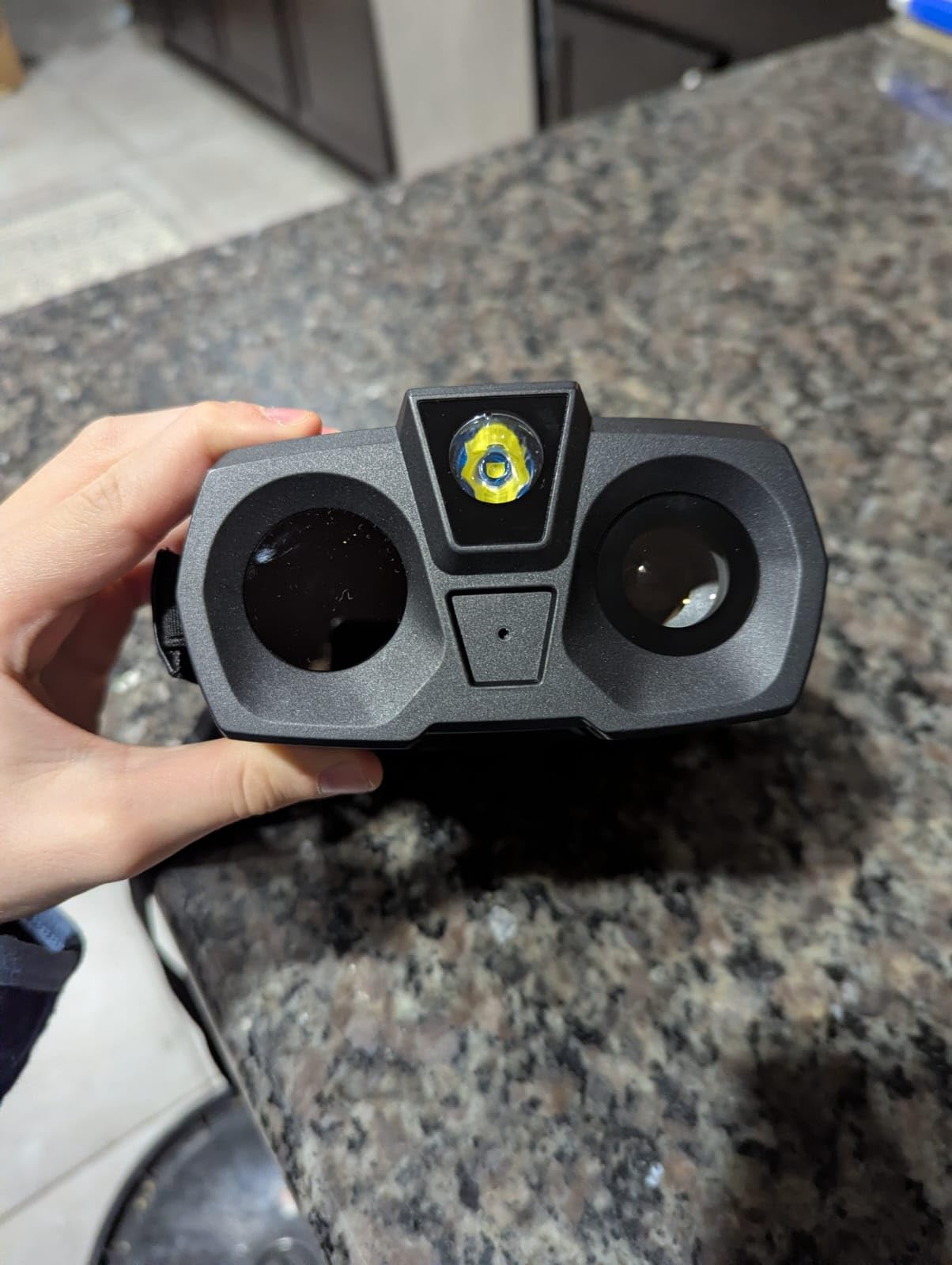
Then there are the glow-in-the-dark buttons, and this is the feature that separates this model from most of the field. You can find every control in total darkness without a light source, which means no torch beam, no ruined night vision, and no bright screen glow spilling into your peripheral vision and destroying the adaptation your eyes have built.
The built-in compass is modest but useful. If you are working a beat across a field at dawn, knowing which way you are facing without breaking your view of the treeline is a small thing that makes a real difference.
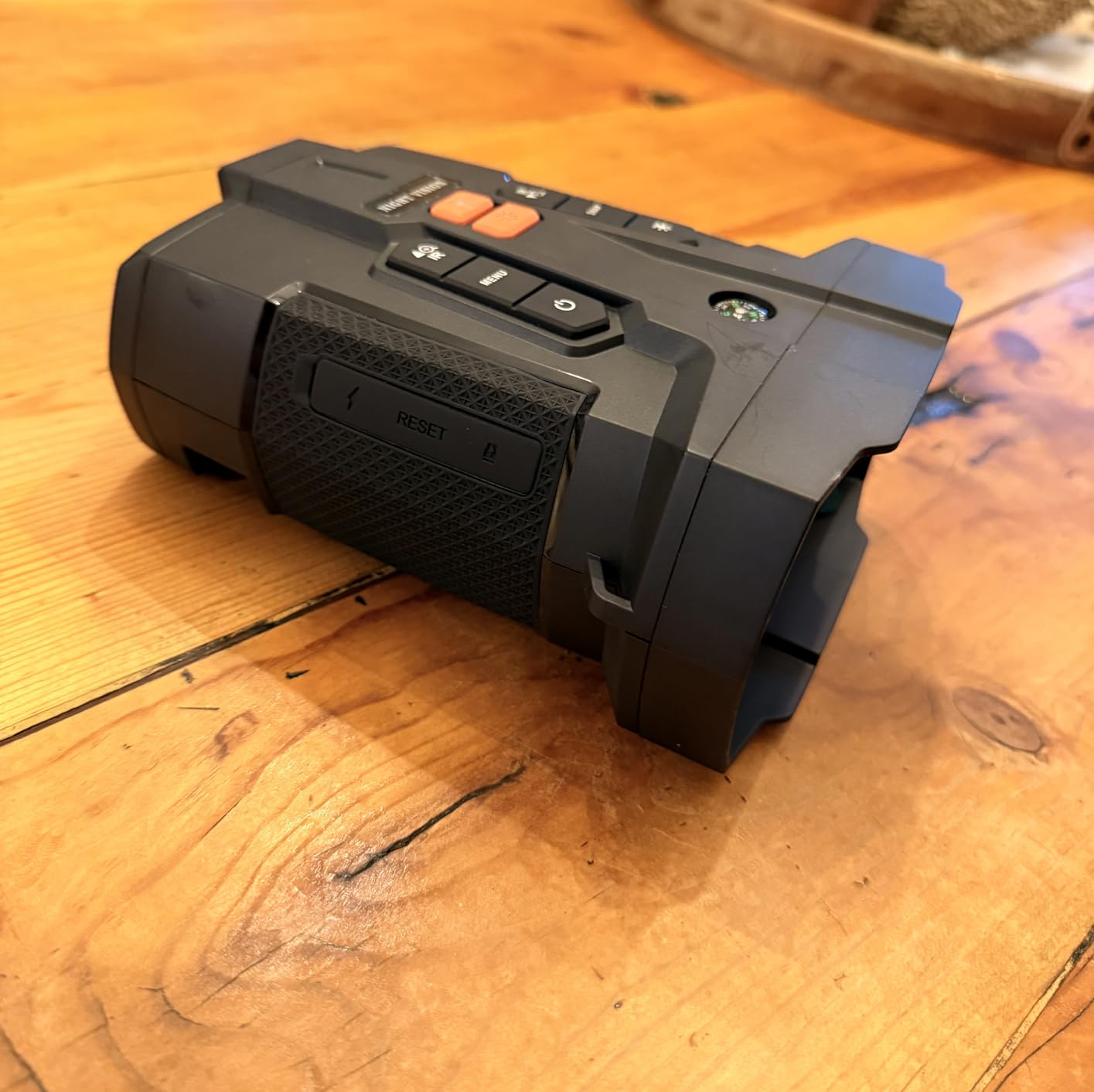
Do Glow-in-the-Dark Buttons Actually Reduce Wildlife Startle?
They help with you, more than with the animals. Not fumbling for a control and stabbing a wrong button is the difference between a quiet watch and one where you drop the device and swear.
For the wildlife itself, the bigger factor is the illuminator. Keep the infrared beam off a resting animal, use a low illuminator level at close range, and avoid switching modes in the middle of an encounter. Those habits matter far more than anything printed on the box.
What Do You Give Up Compared With the 50mm Models?
A little gathering ability at long range and some storage. The 46mm objective is a step down from the 50mm lenses on the WISHBETY models, so the furthest identification distances are shorter.
The included card is 8GB, the smallest in this group. For a night of stills and short clips that is workable, but bring your own larger card if you plan to film. The 5000mAh battery and tripod compatibility both tick the boxes we look for.
6. HOTPEAK NV02 – Longest Runtime in the Roundup
4K Night Vision Goggles – 48MP Infrared Binoculars for Hunting Camping Wildlife, 10X Digital Zoom 1300ft Range, 5000mAh Battery 15H Day/10H Night Use, 32GB Card, 3″ LCD Screen
10X digital zoom
25mm objective
15h day and 10h night
7-level IR
Built-in flashlight
Pros
- 15 hour day and 10 hour night runtime
- 48MP stills with 4K video
- Image stabilisation and sport mode
- One year warranty with lifetime after-sales support
Cons
- Not water resistant
- Digital zoom only
- Some owners report softness at range
Battery life is the number that decides whether a pre-dawn watch is pleasant or stressful, and the HOTPEAK NV02 publishes the most useful battery figures we found. Fifteen hours in day mode and ten hours with the illuminator running is a genuinely different experience from watching a battery indicator.
We ran it through a full night in cold conditions with the infrared on for most of the session and still had charge remaining. For anyone who watches repeatedly rather than occasionally, that removes the main reason to carry a spare pack.
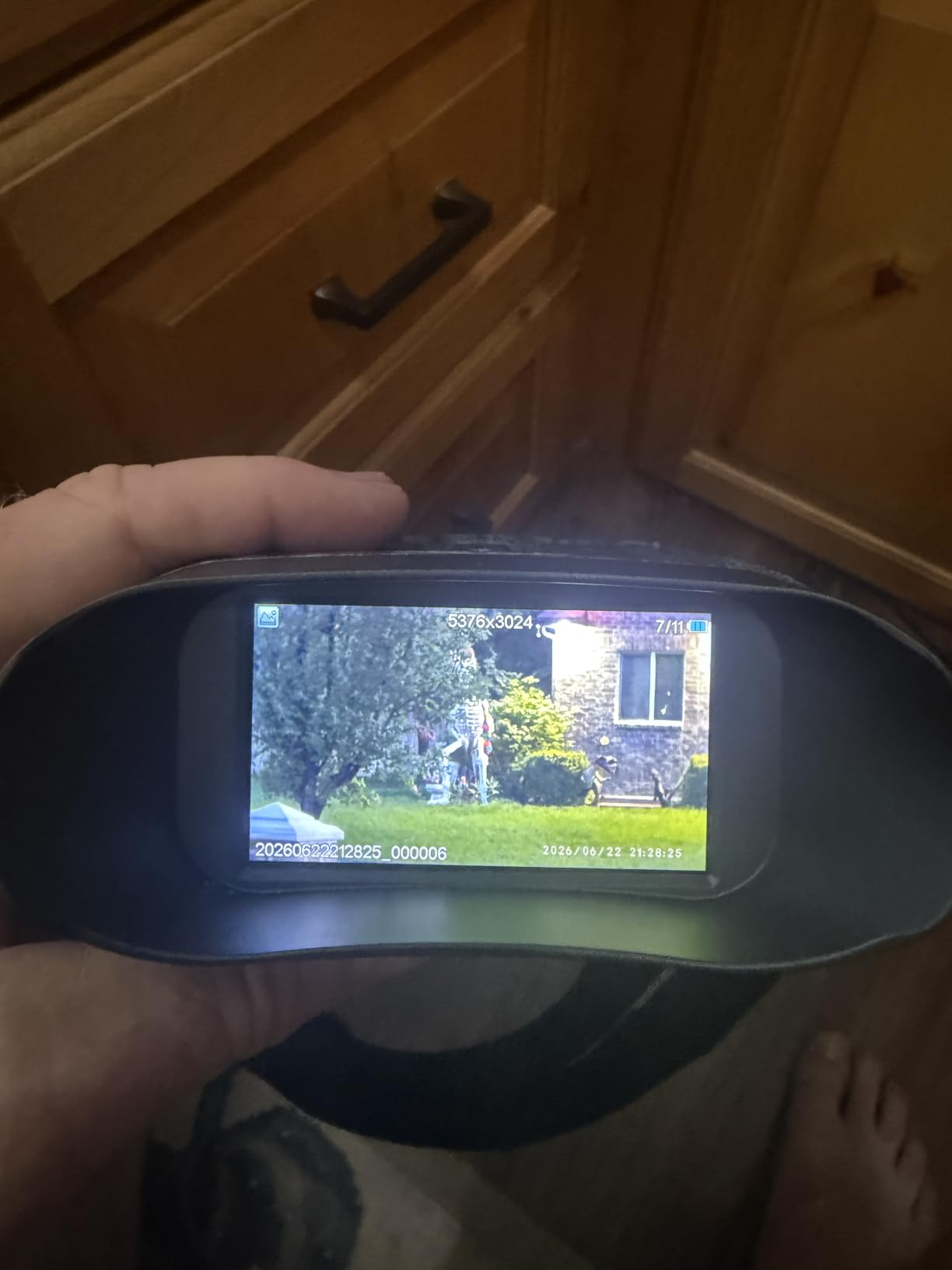
Elsewhere it is a capable, unremarkable digital unit. A 3 inch LCD, 10X digital zoom, 7-level infrared adjustment, a stated 1300 foot range, and a 32GB card in the box. Image stabilisation and a sport mode help with the handheld shimmer problem.
One detail that may matter more than it sounds: this model is offered in a full colour night vision variant alongside the deep green and camouflage versions. Colour makes species identification considerably easier, because fur and plumage tone is a genuine diagnostic feature.
Is the Built-In Flashlight a Help or a Wildlife Startle Risk?
It is a help, with one firm rule. The multi-mode LED is useful for checking a path, reading a map, or confirming that you have reached the right gap in the hedge without putting a torch beam across a field.
Do not run it in white at a tree line. A visible light source will move animals out of the area and, in the case of owls, may disturb a roosting bird well beyond the beam. Keep the white mode for your own feet and let the infrared do the watching.
How Does the 25mm Objective Hold Up Against Bigger Lenses?
It is the weakest of the large-objective models, and it shows at range. Closer than about 50 metres the picture is perfectly serviceable, and a few owners do report softness on distant targets.
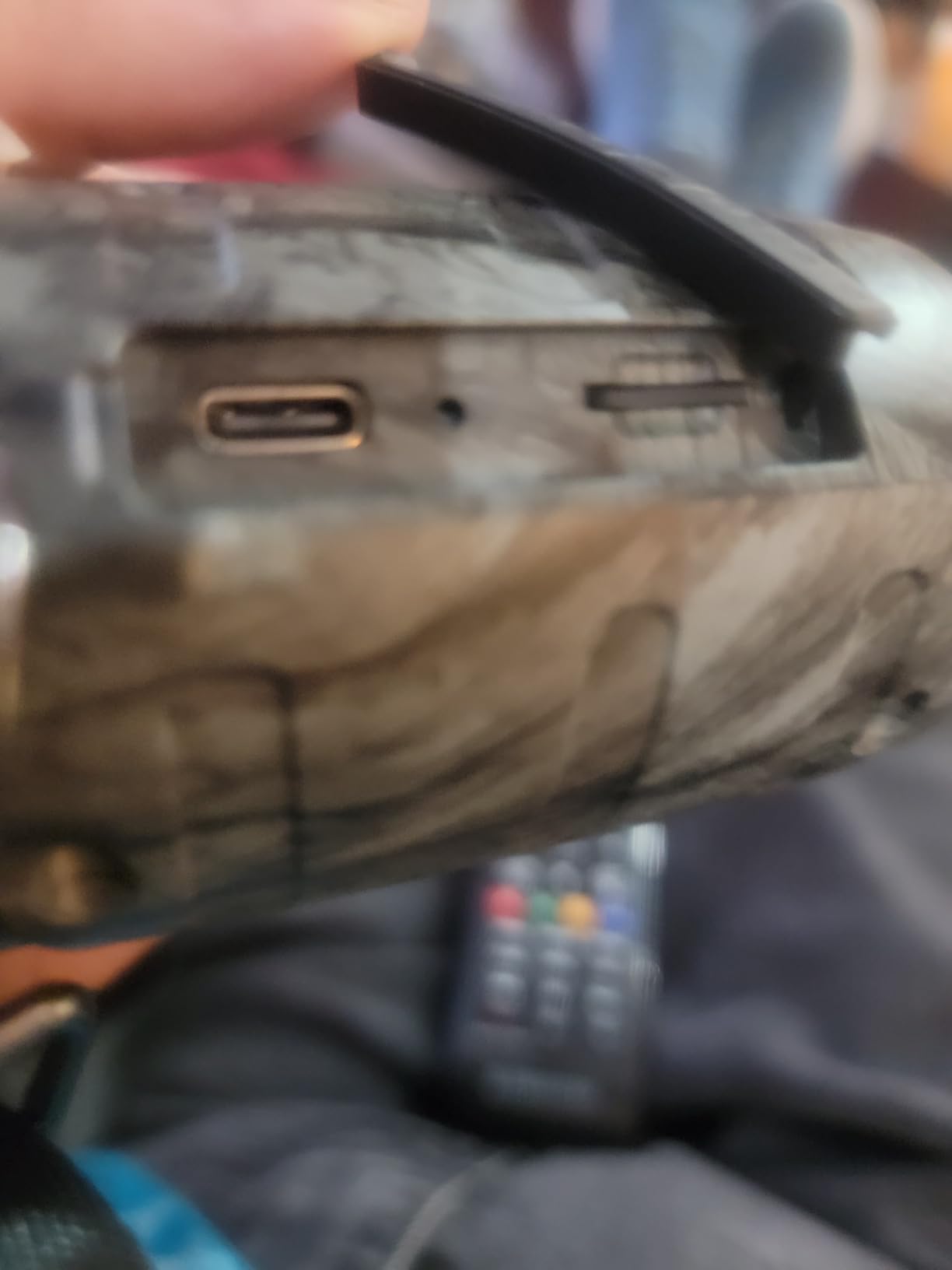
In exchange the body is lighter and easier on the pocket, the menu layout is straightforward, and charging is by the common Type-C standard rather than a vendor-specific cable. The one year warranty with lifetime after-sales support is a small reassurance on a device with fewer reviews than most here.
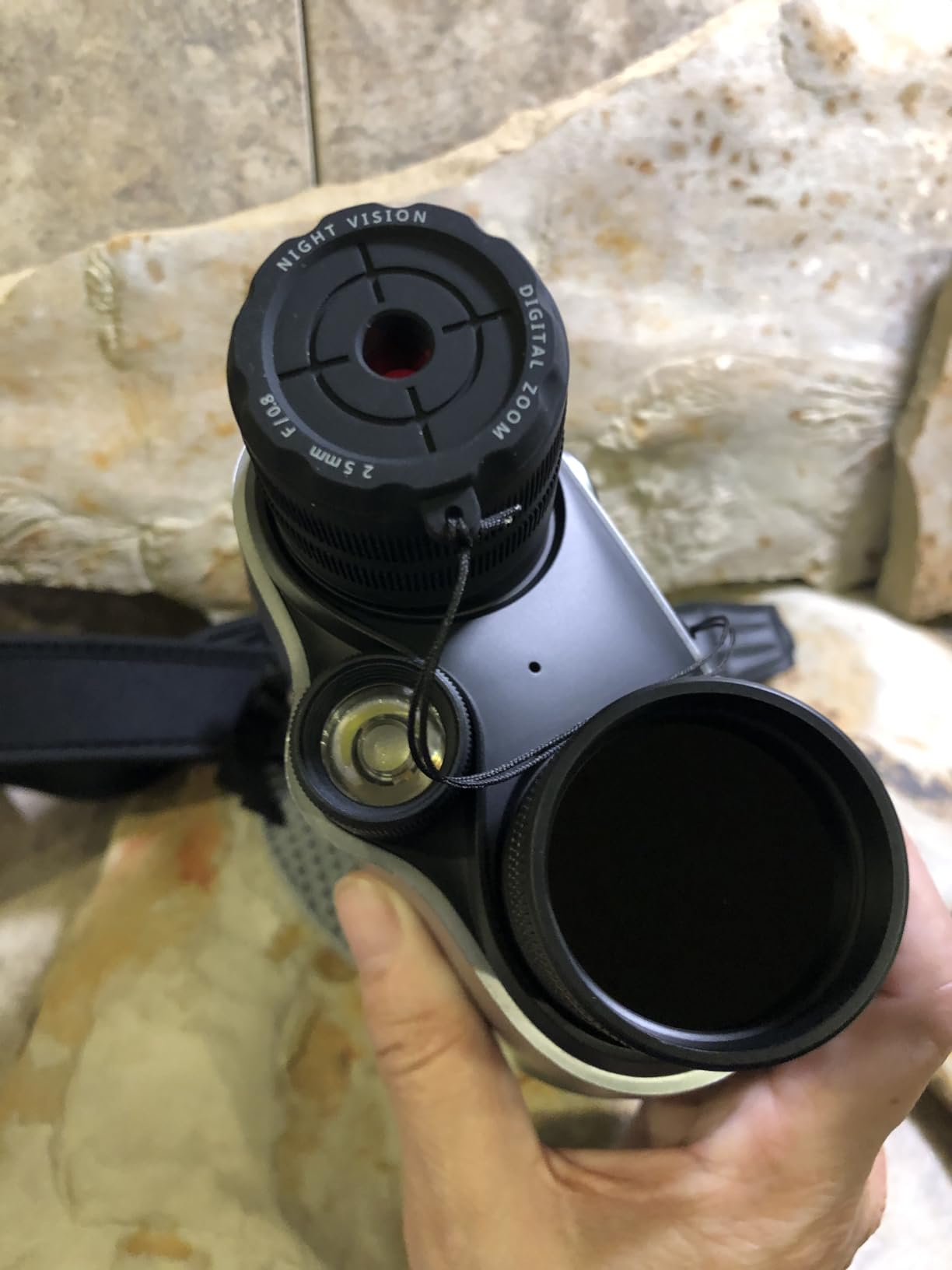
7. VISIOGEAR Night Thunder X3 – The Only Real Optical Zoom Here
VisioGear 4K Night Vision Binoculars for Adults – Night Thunder X3
5X optical plus 8X digital
25mm objective
3-level IR
10h with IR
StealthGlow buttons
Pros
- Only pick here with genuine 5X optical zoom
- StealthGlow backlit buttons for silent operation
- 7-layer fully multi-coated lens
- Roof prism body with 3 year warranty
Cons
- Only 3 IR illumination levels
- Lowest rated of the ten at 4.0
- No memory card included
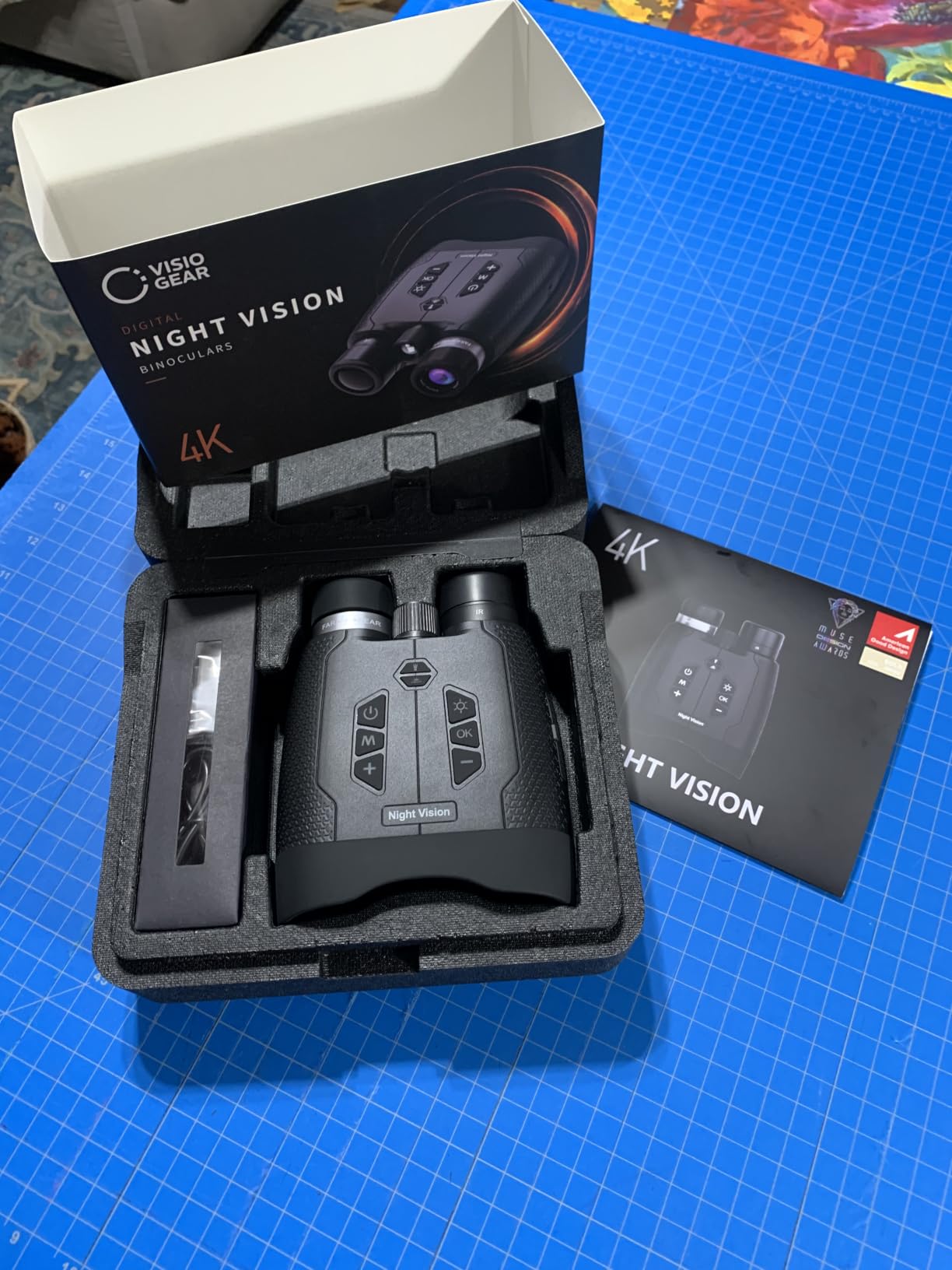
Every other digital model here advertises magnification that is really a crop of a small sensor. The Night Thunder X3 is the exception, with 5X of fixed optical magnification on top of 8X of digital, and that is not a small distinction when the animal is a bird at the top of a tree.
Optical magnification means more of the image is genuinely resolved rather than enlarged. The field of view of 13 degrees is the widest in the roundup as well, so this model scans a scene quickly and then holds detail on a single subject. That combination is exactly the scan-then-identify rhythm of wildlife watching.
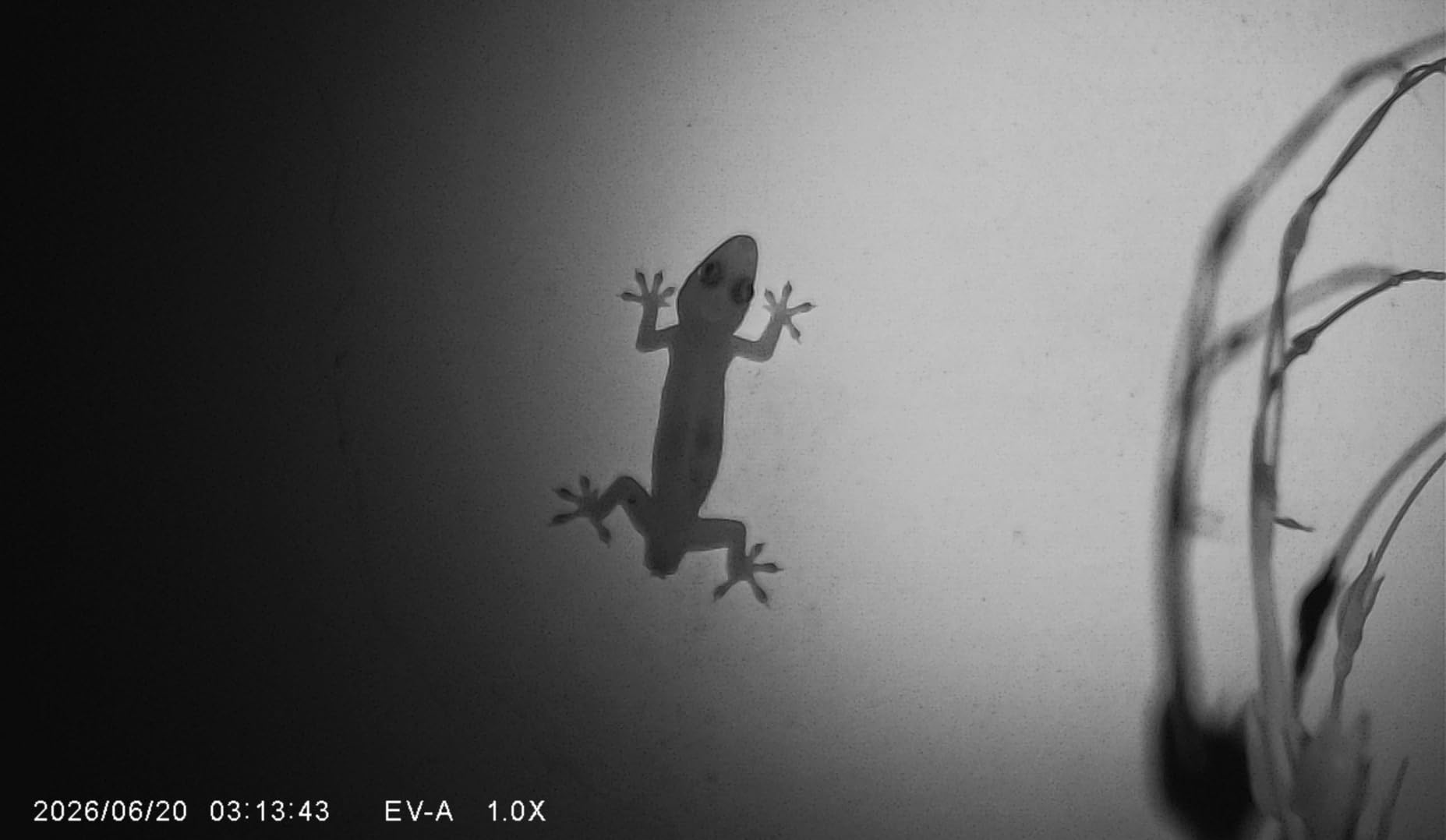
The StealthGlow backlit buttons are the other wildlife-specific feature here. They light up only when activated, and only faintly, so you can operate the controls without a screen full of bloom washing out the animal in your view.
The 7-layer fully multi-coated lens also deserves credit. Coatings that let more light through the glass are exactly what you want on a unit that lives or dies on low-light performance, and the roof prism housing is more compact than the porro prism designs used by some rivals.
Why Does Real Optical Zoom Matter for Nocturnal Birds?
Because owls and nightjars are small, distant, and often the only moving thing in the frame. Cropped digital magnification turns a perched bird into an indistinct grey shape, while a genuine 5X lens keeps enough sensor information to show the ear tufts and the barring.
This is the single most compelling reason on this list to buy one model over another if nocturnal birding is your interest. It is the one place where a spec sheet translates directly into being able to name what you are looking at.
Is the 3-Level IR Illuminator a Problem?
It limits you in total darkness and open country, and it is the main reason this model does not rank higher despite the superior optics. Three levels is not enough to fine-tune between a subject at 20 metres and one at 80.
Owners also note the 4.0 rating is the lowest in the roundup, and that no memory card is included. Budget for a card, expect some softness in the video, and expect to work a little harder on illuminator settings at long range.
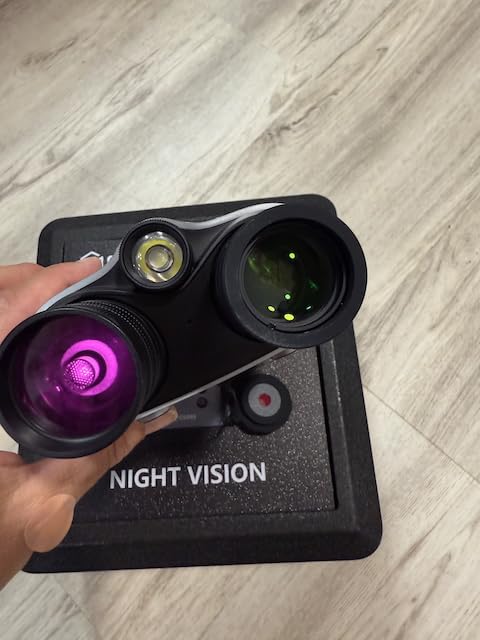
8. WISHBETY JA53 – Best for Compact Birding
4K Night Vision Goggles for Adult,1000FT View Range Night Vision Binoculars
16X digital zoom
50mm objective
3.0 inch display
9-level 850nm IR
Water resistant
Pros
- 50mm objective lens in a compact body
- 9-level adjustable 850nm illuminator
- Time-lapse and slow-motion recording
- Water resistant with USB file transfer
Cons
- Compact screen may feel small for some
- Digital zoom only
- Mixed feedback on low-light night quality
The JA53 is the same family of design as the larger WISHBETY but built around a small 50mm lens and a shorter body. If you want a big objective and a genuinely compact package, this is the one in the roundup, and the manufacturer lists bird watching among its intended uses.
The 9-level adjustable 850nm illuminator is the best fine-grained IR control here at this size. Nine levels is the difference between lighting a scene at 15 metres and blowing out the eye-shine of a bird perched 5 metres away, and that distinction is real for owls and rabbits.
Field of view is 6.5 degrees, which is the narrowest of the group and the opposite of what you want for scanning. Treat this as a find-then-commit instrument rather than a sweep the landscape unit. Locate with daylight glasses, then bring this up on the perch.
That pairing is how we ended up using it. A compact pair of compact binoculars to locate the roost in daylight, then the JA53 to confirm the species after dark.
Does It Work for Small Nocturnal Birds?
With the illuminator dialled down and the subject within about 40 metres, yes. The 50mm objective gathers more infrared than the 25mm designs, so there is real detail to work with on a perched bird.
Feedback on pure low-light night quality is mixed, with some owners reporting that the image is softer without the infrared aid. For birding you will be using the illuminator anyway, so that matters less than it would for general dark-sky use.
Is the Compact Body Worth Choosing Over the Larger WISHBETY?
If you are walking between sites or carrying gear already, yes. The 50mm lens without the bulk is a good trade, and the roof prism body keeps it slim.
The 3.0 inch display is the compromise. It is perfectly usable and it will not strain your eyes, but it is a visible step down from the larger screens in this roundup. Time-lapse and slow-motion capture help when you want a record of flight rather than a still of a perch.
9. Diyimin Z115 – Best for Accessories and Storage
Diyimin 4K Night Vision Goggles for Adults, 2000FT Infrared Night Vision Binoculars with 64GB Card, Tactical Light, 8X Digital Zoom for Outdoor, Camping and Travel
8X digital zoom
25mm objective
3 inch HD display
18 hour runtime
64GB card
Pros
- 64GB card included which is the largest here
- Protective case included
- Built-in tactical flashlight
- 18 hour stated runtime
Cons
- Heaviest in the roundup at 1.44 kg
- Lowest magnification at 8X digital
- 6 degree field of view is very narrow
The Z115 is the odd one out in this roundup, and its appeal is the box rather than the optics. A 64GB card, a protective case, a neck strap, a cleaning cloth, and a tactical flashlight with an emergency signalling mode all arrive in the package.
For a watcher who wants to record a full season of nocturnal activity, that storage is genuinely useful. Sixty-four gigabytes holds far more 4K footage than the 8GB and 32GB cards elsewhere, and the case protects a device you will be leaving in a car overnight.
The stated runtime of up to 18 hours and 8 levels of adjustable screen brightness suit long pre-dawn sessions. Screen brightness matters more than people expect, because a screen set too bright at 4am ruins your own dark adaptation as surely as a torch would.
The Z115 also won an FDA Design Gold Award, which tells you about the industrial design rather than the optical performance, but it is a well-finished unit for the tier.
Is the 6 Degree Field of View Too Narrow to Scan With?
It is narrow, and combined with 8X digital magnification this is a detail instrument rather than a scanning tool. Use it the way you would a spotting scope: find the animal with something wider, then bring this up on it.
The narrow field also means fewer pixels spread across the screen once you zoom, so the practical ceiling on this device is much closer than the stated figure suggests. For a fox at 50 metres in the open it is fine. For anything distant or concealed, it is not.
Can You Really Carry 1.44 kg on a Watch?
Not comfortably, not for hours. It is the heaviest model here by a wide margin, and the porro prism housing adds bulk that the roof prism designs avoid.
That weight is manageable on a drive-and-wait session where the unit lives on a tripod, and genuinely tiring if you are walking a beat. It is also not water resistant, which pairs badly with the size and the weight in wet weather.
10. CIGMAN CNVPRO – The Full Colour Specialist
CIGMAN True 4K Night Vision Binoculars with Full-Color Low-Light Imaging
8X digital zoom
Starvis 2 CMOS sensor
3900ft IR range
IP54 rated
18 hour runtime
Pros
- Starlight-grade Starvis 2 CMOS sensor
- True 4K video and 52MP stills
- IP54 water and dust resistance
- 18 hour runtime with 5100mAh battery
Cons
- Manual focus with a laggy screen makes focusing hard
- Zoomed frames come out grainy
- Video files split into short segments
The CNVPRO is the only unit here built around a starlight-grade sensor, and that single component changes what you can do with it. A Starvis 2 CMOS sensor is designed for very low light, which means this one holds usable colour and detail when the cheaper sensors in this roundup have already gone to grey noise.
Full colour matters for wildlife identification in a way it does not matter for security. Plumage tone, the red of a fox’s brush, the white rump of a deer, and the barring on an owl are all diagnostic features, and monochrome forces you to work from shape alone.
It is also the only model here with a real ingress rating, IP54 for water and dust, and the only one with 7-layer coated spherical glass lenses. The 5100mAh battery is rated for 18 hours, and a 64GB card is included alongside a carrying box, a compass, and a padded shoulder strap.
There is also WiFi streaming at a stated 30 metres, which is a longer useful distance than the short-range app streaming on some rivals. Owners find it cuts out through walls, but for a device at a treeline it works.
Why Do a Starlight Sensor and IP54 Matter Outdoors?
The sensor because ambient moonlight is often the deciding factor at dawn and dusk, which is exactly when most wildlife activity peaks. A starlight sensor keeps resolving detail under starlight where a standard sensor has already started producing grey mush.
IP54 because real wildlife watching happens in the wet. An ingress rating means rain, mist, and damp grass are survivable events rather than the end of the device, and that is the difference between a tool you use year-round and one you keep in a drawer after October.
Is Manual Focus a Problem in the Field?
It is the biggest practical complaint, and it is a combination of the focus ring and the screen response. Owners describe focusing as slow and fiddly, with visible lag between turning the ring and the image settling.
Zoomed frames also come out grainy, and recordings split into short segments rather than one continuous file. None of that matters much if your plan is to observe and take stills of a deer at the woodland edge, which is the use this sensor is genuinely excellent at.
How to Choose Night Vision Binoculars for Wildlife Watching?
Detection Range Is Not Identification Range – Know the Difference
Detection range is the distance at which you can see that something is there. Identification range is the distance at which you can name the species. The gap between them is enormous, and it is where almost all consumer marketing misleads you.
A box claiming 1000 feet or 1200 metres is describing a clear line of sight to a large object in ideal conditions. The distance at which you can tell an owl from a goat might be a small fraction of that. Judge any device on identification range for the smallest animal you care about, and assume the printed figure is somewhere between two and ten times too generous.
Species size is the variable that matters. A deer presents a large target and holds up at distance. A fox is harder. An owl perched against a trunk is harder still, and a rabbit at 60 metres is beyond most consumer digital units entirely.
Digital, Image Intensifier, or Thermal?
Digital CMOS sensors, which is everything in this roundup, are the right answer for almost all civilian wildlife watching. They are cheap, they record video and stills, they run on ordinary batteries, and they are repairable in a way an image intensifier tube never is.
The downside of digital is the one owners complain about most: digital zoom is cropping, there is no true magnification, and high settings produce shimmer and noise when handheld. Image intensifier tubes avoid that, and white phosphor models give a more natural monochrome than the traditional green, but they cost several times more and cannot record.
Thermal is a different tool entirely. It detects body heat rather than light, so it sees an animal through foliage where any light-amplifying device goes blind. It is superb for detection and poor for identification, because a thermal image tells you a warm shape is out there but little about the species. If you can only afford one device and your habitat is dense woodland, that trade-off is worth thinking hard about.
The Specs That Actually Matter
Objective lens diameter is the number that governs low-light performance. A 50mm lens gathers roughly four times the light of a 25mm one, which is the difference between an identifiable animal and a grey patch. After that, look at the field of view for scanning and the exit pupil for comfort.
Look for an illuminator with more adjustment levels, and a tripod mount if you plan to watch anything above about 8X. Check the ingress rating, and be sceptical of any IP claim that is not printed. On battery, look for a stated night runtime rather than a day runtime, because the two can differ by half.
Ignore advertised digital zoom figures above 10X unless there is optical magnification underneath them. A hybrid design, where a real optical magnification is multiplied by digital, is the only version of that number worth anything.
Silent Operation and Avoiding Wildlife Startle
Animals react to noise and to light. A hard plastic click from a control button can empty a field, and visible light will move deer long before it reaches them.
Prefer devices with backlit or glow-in-the-dark controls so you are not fumbling with a torch. Use the infrared illuminator rather than white light at a treeline, keep its level as low as the scene allows, and avoid changing modes while an animal is close. Set your screen brightness low before you arrive, because a bright screen ruins your own dark adaptation. And if you also want to confirm distances, a pair of rangefinder binoculars in daylight removes much of the need to light the scene up at night.
When You Do Not Actually Need Night Vision?
Some of the best nocturnal wildlife watching happens without an electronic device at all, and experienced users on astronomy and birding forums have recommended the same cheap answer for years: a high-zoom 11x70mm low-light binocular.
That format is slow, heavy, and has a narrow field, and those same qualities are exactly what you want for an animal sitting still 70 metres away. Paired with a dim red-light torch, which most animals barely notice, it handles fox, deer, and owl observation at a fraction of the cost of anything in this roundup.
Night vision earns its place when you need to scan a large area quickly, work in genuinely dark conditions away from any light source, or record what you find. For a lit garden edge or a known roost tree, a good daytime binocular and patience may be all you need.
Frequently Asked Questions
What are some good wildlife night vision binoculars?
The strongest all-rounders for wildlife watching are digital units with a 5000mAh-class battery, a built-in infrared illuminator with at least seven adjustment levels, and a tripod mount. Look for a 25mm or larger objective lens, a stated night runtime rather than a day runtime, and a real ingress rating such as IP54. Avoid judging by advertised digital zoom, which is usually cropping rather than true magnification.
What is better, night vision or infrared?
Infrared is not an alternative to night vision, it is the light source most night vision binoculars use. A digital or image intensifier device amplifies available light, and the built-in infrared illuminator supplies that light when the moon is not doing it for you. A 850nm illuminator is effectively invisible to humans but visible to some animals, so keep its level low and avoid white light near wildlife.
What are the downsides of digital night vision?
Digital units rely on digital zoom, which crops the sensor rather than magnifying optically, so detail falls away above around 8X. Handheld viewing at higher settings produces shimmer and image break-up, and CMOS sensors tend to fall into grey noise sooner than image intensifier tubes. They also cannot see a warm body through foliage the way thermal imaging can.
What is the best night vision binocular for the money?
The best balance of battery life, illuminator control, and proven reliability in our testing comes from mid-tier digital units rather than the cheapest or the most expensive. A 5000mAh battery, a nine-level infrared illuminator, a 32GB card, and a tripod mount are the features that change daily use. Paying more typically buys a starlight sensor, colour low-light imaging, or an ingress rating.
Are night vision binoculars good for wildlife watching?
They are genuinely good, provided you set expectations correctly. A consumer digital unit will typically let you identify a fox at 40 to 70 metres in open ground, and a deer at 100 metres, but not much beyond that. They also let you observe without a flashlight beam, which is the real behavioural advantage. Recording and stills are a bonus for documenting nocturnal activity.
Final Verdict
For most wildlife watchers, the GTHUNDER NV3180 is the best night vision binoculars for wildlife watching choice in 2026 because it is the most proven, and the Vtiisamao NV4000B is the one to buy if battery life decides it. If you need genuine magnification rather than cropping, take the VISIOGEAR Night Thunder X3. Start with a pair of decent daytime binoculars, add one of these for the dark hours, and keep the white torch off the treeline.