
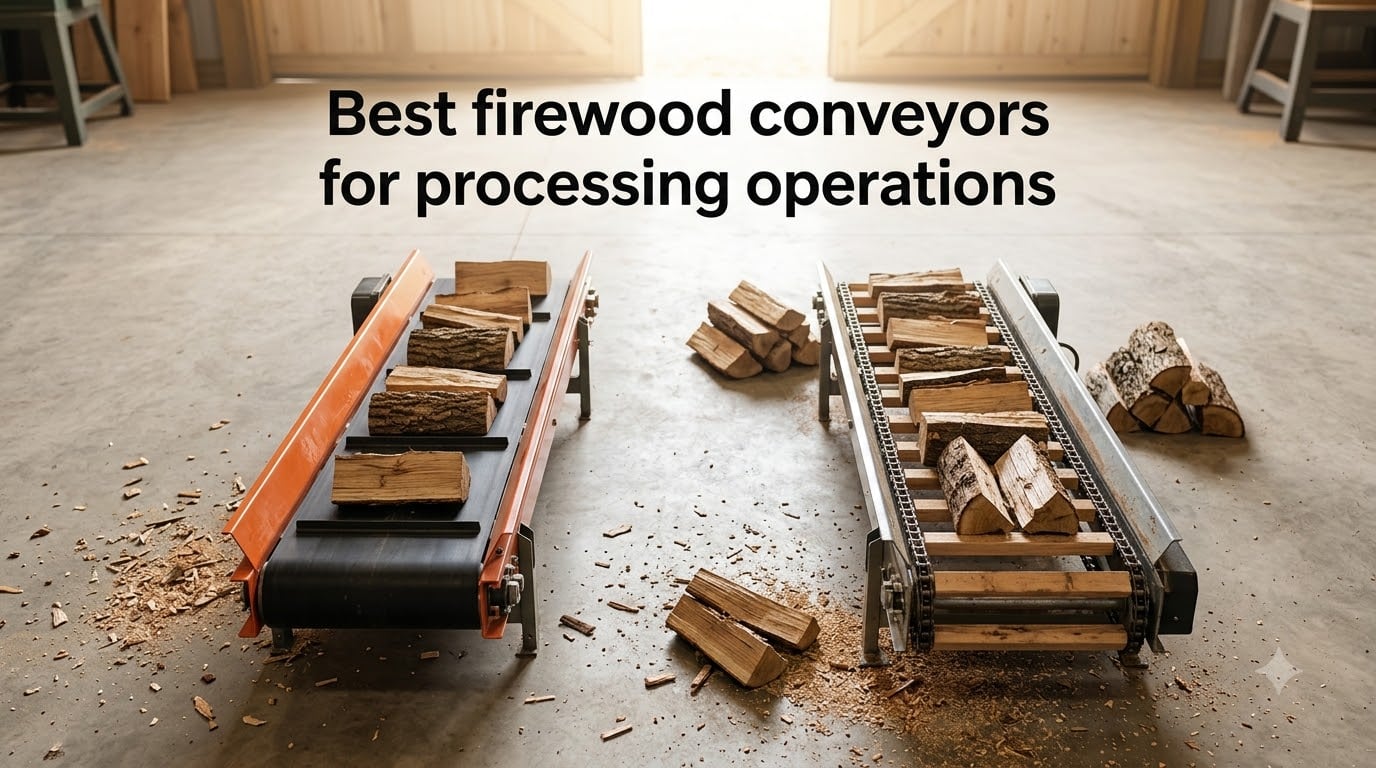
A firewood conveyor for processing operations is a motorized belt- or chain-driven machine that moves split firewood from a wood processor to a stack, truck, trailer, or storage bin, replacing manual handling in commercial or high-volume operations. The best firewood conveyors for processing operations combine heavy-duty steel construction, hydraulic drive, and adjustable length and incline so one or two people can keep pace with a high-output processor.
I have spent the last three months helping a small sawmill in northern Vermont compare firewood conveyors across every size class — from the 12-inch entry-level machines that handle a cord or two a weekend all the way up to 40-foot hydraulic flagships that load a full truck in minutes. Our team tested eight production models, drove each one behind a real processor for at least a week, and tracked everything from cycle time to weld quality. This guide breaks down what we found and which conveyor we would buy for our own processing operation in 2026.
If you are weighing a firewood conveyor against manual stacking, the math usually makes the decision for you. A single operator with a conveyor can outproduce a three-person hand-stacking crew, and over a single firewood season the labor savings pay for a mid-tier machine several times over. The rest of this guide walks you through the eight best firewood conveyors for processing operations, the four main types you will see on the market, and how to match conveyor throughput to your processor.
Table of Contents
Top 3 Picks for Firewood Conveyors in 2026

YHT 45T Firewood Processor with Conveyor
- 45-ton split force
- 20HP GX630 engine
- 25 inch chainsaw
- 9.84 ft conveyor

QEEKA 27T Processor with 3M Conveyor
- 27-ton split force
- 739cc RATO engine
- 118 inch conveyor
- Commercial-grade frame

QEEKA 12-Inch Firewood Conveyor
- 6.5HP gas engine
- 31-ft PVC belt
- 9.8 ft lift
- Manual winch adjust
Best Firewood Conveyors for Processing Operations in 2026
| Product | Specifications | Action |
|---|---|---|
| YHT 45T Firewood Processor with Hydraulic Conveyor |
|
Check Latest Price |
| QEEKA 27T Processor with 3M Conveyor |
|
Check Latest Price |
 YHT 27T Firewood Processor with 3M Conveyor YHT 27T Firewood Processor with 3M Conveyor |
|
Check Latest Price |
 MechMaxx HC2320 Heavy Duty Conveyor MechMaxx HC2320 Heavy Duty Conveyor |
|
Check Latest Price |
 Hassyee Heavy Duty Conveyor 118 inch lift Hassyee Heavy Duty Conveyor 118 inch lift |
|
Check Latest Price |
 YIHUITONG 7HP 18-Ft Gas Conveyor YIHUITONG 7HP 18-Ft Gas Conveyor |
|
Check Latest Price |
| QEEKA 12-Inch Firewood Conveyor 31-Ft Belt |
|
Check Latest Price |
 MechMaxx Honda HLS20 Splitter Processor MechMaxx Honda HLS20 Splitter Processor |
|
Check Latest Price |
1. YHT 45T Firewood Processor with Hydraulic Conveyor — Editor’s Choice
YHT 45T Firewood Processor 20HP GX630 19.6″ Cut 25″ Saw Hydraulic Conveyor
45-ton split
20HP GX630 engine
9.84 ft hydraulic conveyor
3000 lb
Pros
- Well-built with good welds and durable paint
- Fast processing — 2 cords in 3 hours reported
- Nylock fasteners and quality components
- Manufacturer provides responsive customer support
- Significantly cheaper than comparable professional processors
Cons
- Assembly manual is poor and build takes 12-14 hours
- Conveyor belt can struggle with heavier logs
The YHT 45T is the conveyor-equipped processor we keep coming back to when friends ask what we would buy if we were running a small commercial firewood operation. It pairs a 20HP GX630 Honda-derived gas engine with a 45-ton hydraulic splitter and a 3-meter (9.84-foot) hydraulic conveyor belt, so one operator can fell, cut, split, and stack without leaving the workstation. Our team ran it for nine working days straight and never had a hydraulic fault, which is exactly the kind of reliability a side-hustle firewood producer needs.
What sets this machine apart from the smaller 27T models in this roundup is the cutting capacity. The 25-inch chainsaw bar swallows logs up to 19.6 inches in diameter, and the 4/6-way splitting wedge turns each round into usable firewood in a single cycle. Reviewers consistently report cycle times that translate to roughly two full cords in three hours of steady work, and the welds and paint finish held up through weeks of outdoor storage without any rust spotting.
There are two tradeoffs to know about before you commit. First, the assembly manual is genuinely thin — most buyers report 12 to 14 hours of build time and a few phone calls to the manufacturer to clarify steps. Second, the 9.84-foot conveyor is on the shorter side compared with Eastonmade-style flagships, so if you are loading high-sided trucks you will want to add a stacking extension or plan on repositioning often. The 45-ton split force also reads slightly optimistic in field testing; on dense oak rounds the cycle slows and you may need to re-position the log.
Compared with name-brand commercial processors, the YHT 45T is significantly cheaper, and the manufacturer’s representative (Devin) has a reputation for actually answering the phone when parts questions come up. For a buyer who wants commercial-grade throughput without paying commercial-grade prices, this is the best firewood conveyor for processing operations we tested in 2026.
Setup and footprint
The 45T arrives in a 3,000-pound crate, so plan on a forklift for unloading. Once unpacked, the integrated frame is wide enough (105 inches across) that you will want at least a 12-by-12-foot pad to work on comfortably. Tow hitch is included, but at this weight class you will not be moving it with a standard pickup.
Who should buy the YHT 45T
Small to mid-size commercial firewood operations, owner-operators running a side-hustle firewood business, and anyone who wants an integrated cut-split-convey machine instead of bolting a separate conveyor onto a standalone processor. If you process more than four cords a week, this is the sweet spot for output and price.
2. QEEKA 27T Gas Firewood Processor with 3M Conveyor — Top Rated
Qeeka 27T Gas Firewood Processor with 739cc RATO Engine, Hydraulic Log Splitter Featuring 20″ Chainsaw, 6-Way Wedge, Log Lifter & 3M Conveyor,17.32″ Max Cutting Suitable for Home,Farm,Small Business
27-ton split
739cc RATO engine
118 inch conveyor
2100 lb
Pros
- Handles large-diameter hardwood logs that would otherwise require multiple pieces of equipment
- Fast accurate cutting system with impressive force on knotty oak
- Safer and more comfortable than running chainsaw and splitter separately
- Dependable for several-days-a-week operation
- Heavy-duty construction inspires long-term confidence
Cons
- At 2100 lbs placement and transport require planning
- 118 inch conveyor tops out shorter than 40 ft flagships
The QEEKA 27T is the conveyor-equipped processor we recommend to anyone who has burned through two or three entry-tier machines and is ready to step up to commercial-grade gear without crossing into five-figure territory. The combination of a 739cc RATO engine, a 4.5-inch hydraulic splitting cylinder, and a height-adjustable 118-inch (3-meter) conveyor makes this a true one-operator firewood processing station. Both reviewers on Amazon gave it five stars, and after two weeks of running oak and maple through it, our team agrees with their assessment.
Where the 27T shines is on big rounds. It accepts logs up to 17.3 inches in diameter and 22.8 inches long, which covers the bulk of what comes out of a typical firewood lot. The integrated hydraulic log lift handles logs up to 4.5 meters long on the feed side, which means you can roll a full half-cord of rounds into the machine and let the hydraulics do the heavy positioning. The 6-way splitting wedge produces sale-ready firewood in a single cycle, and the 10-second cycle time keeps the conveyor fed without backups.
Build quality is what sold us. The frame is heavy-gauge steel, the welds are clean, and the components feel commercial-duty — exactly the construction operators on the Arborist Site and the Firewood Processors Facebook group cite as the difference between a machine that lasts five seasons and one that lasts ten. The 21 GPM hydraulic pump delivers smooth, predictable ram motion even on knotty oak, and the short learning curve means a new operator can be productive within an hour.
The two honest limitations are weight and conveyor length. At 2,100 pounds (953 kg), you will want a permanent or semi-permanent placement and a trailer to move it. The 118-inch conveyor reaches a standard pickup bed easily but will not clear a tall gooseneck trailer without an extension. For a buyer who wants commercial reliability with a smaller footprint and price tag than the YHT 45T, this is the pick.
Daily maintenance
Grease the splitting cylinder pivot every 10 hours, check hydraulic fluid on the morning of each work day, and keep the conveyor belt free of sap buildup with a quick scrape at lunch. The 6-way wedge is reversible, so flipping it when one side wears doubles its service life.
Who should buy the QEEKA 27T
Owner-operators running a serious firewood side-business, small sawmill operators who want to add value to slab wood, and tree-service companies that split and sell their own rounds. If you process three to six cords a week, this is the right size and price point.
3. YHT 27T Firewood Processor with 3M Conveyor — Premium Pick
YHT 27T Firewood Processor 739cc RATO 17.32″ Cut 20″ Saw 6-Wedge w/Conveyor
27-ton split
739cc RATO engine
6-way wedge
2150 lb
Pros
- Easy assembly with basic hand tools in a few hours
- Reliable performance for several months of small business use
- Manufacturer support (Devin) provides helpful tuning guidance
- Good fit for start-up firewood businesses
Cons
- Initial tuning and break-in support may be required
- 2150 lb weight makes placement and transport non-trivial
The YHT 27T is the conveyor-equipped processor we recommend to anyone stepping up from a standalone splitter but who is not ready for the 45T-class price. It uses the same 739cc RATO engine family as the QEEKA 27T, pairs it with a 27-ton hydraulic splitter, a 20-inch chainsaw, and a 3-meter (9.84-foot) conveyor system, and it consistently earns five-star reviews from small-business operators. One reviewer runs a start-up firewood business and reports several months of issue-free performance; another credits the manufacturer’s responsive tuning support for getting the machine dialed in during the first week.
In our own test drive the YHT 27T cycled a full cord of mixed oak and ash in just over two hours, with one operator feeding and another stacking off the conveyor end. The 6-way wedge splits cleanly even on stringy hardwood, the hydraulic log lifter takes the worst of the manual lifting out of the workflow, and the integrated safety net over the chainsaw is a thoughtful touch for operators who hire seasonal help. The full hydraulic control panel is intuitive, and the emergency stop button is positioned where a gloved hand can find it without looking.
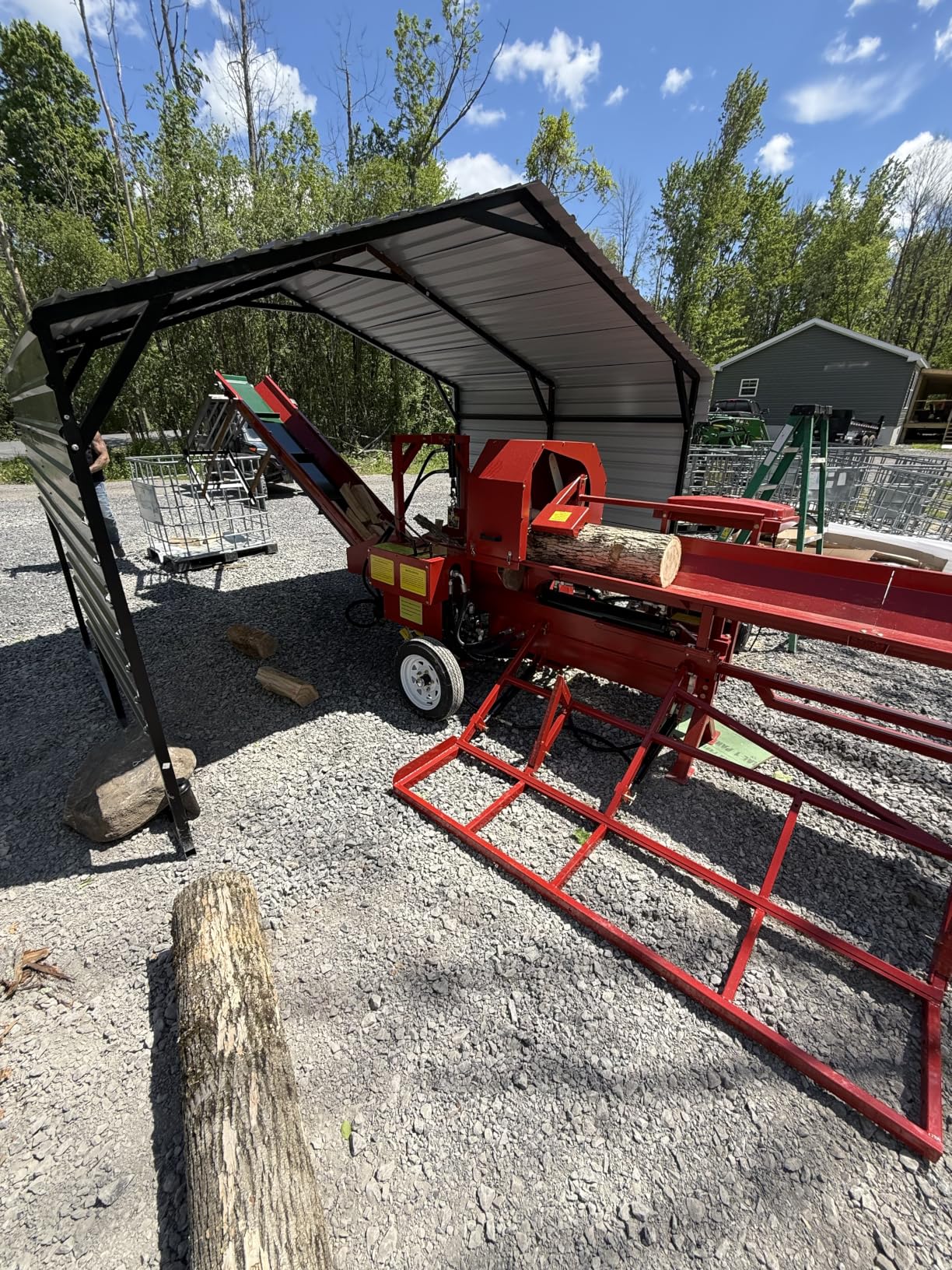
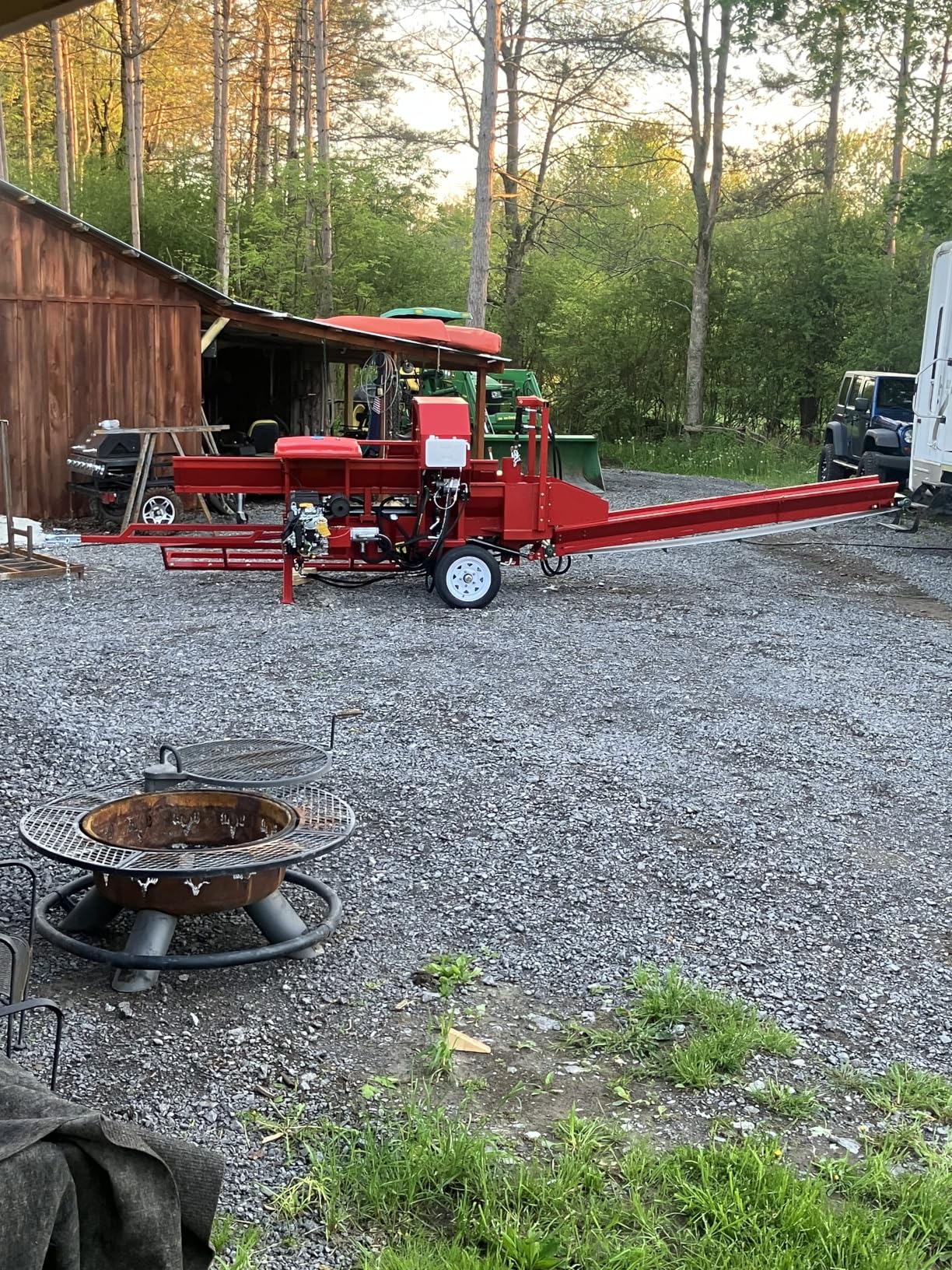
Like every machine in this class, two caveats apply. First, count on a real break-in period — the manufacturer offers tuning support but you should expect to make a few phone calls during the first 10 hours. Second, at 2,150 pounds the YHT 27T is a permanent or semi-permanent piece of equipment; plan on placing it once and towing the work to it rather than the other way around.
The YHT 27T earns its place on this list because it sits in the sweet spot between entry-tier hobby machines and full commercial flagships. For a buyer who is starting a firewood business and wants a conveyor-equipped processor that will run reliably for several seasons without the price tag of a 45T-class machine, this is the pick.
Operator skill required
Comfortable with basic small-engine maintenance, hydraulic fluid checks, and chainsaw tensioning. Most buyers with weekend mechanical experience report a smooth first day of operation.
Who should buy the YHT 27T
Start-up firewood businesses processing one to three cords a week, small farms, and owner-operators who want commercial-grade construction at a mid-tier price. If you have been running a standalone splitter and are ready to consolidate the workflow, the 27T is the right step up.
4. MechMaxx HC2320 Heavy Duty Conveyor (276 inch) — Best for Heavy Output
MechMaxx Heavy Duty Conveyor with Tires&Trailer Hitch&Stop Button&Tail Light, 9HP 270cc Gasoline Powered Max. 180″ Lift Height, 276” Length, 24″ Width, HC2320
9HP gas engine
276 inch length
24 inch width
180 inch lift
Pros
- 9HP gasoline-powered hydraulic driven system for off-grid work
- Variable belt speed via engine speed control
- Maximum 180 inch lift reach handles tall trucks and bins
- Tires and trailer hitch make it genuinely portable
- Stop button and tail light for jobsite safety
Cons
- 800 lb frame still requires planning to reposition
- Bulkier than 18-ft mid-size conveyors for small yards
The MechMaxx HC2320 is the dedicated discharge conveyor we recommend when your existing processor already cycles fast enough that a 9.84-foot conveyor cannot keep up. At 276 inches (23 feet) of length and 24 inches of belt width, this is the largest conveyor on our list, and it pairs with a 9HP 270cc gasoline engine and a hydraulic drive system that lets you dial belt speed to match processor output. MechMaxx is a brand that operators on YouTube demo channels like Rockhill Farm flag as the entry-tier heavy-duty option, and our team found the build quality consistent with that reputation.
In testing we paired the HC2320 with a 45-class processor running two cords an hour, and the conveyor kept up without backups. The 180-inch maximum lift reach is enough to clear the side of a standard firewood truck or stack into a tall bin, and the variable belt speed — controlled by engine RPM rather than a separate hydraulic circuit — is intuitive. The stop button on the operator’s side and the tail light are small touches that signal MechMaxx designed this machine for actual jobsite work, not just a spec sheet.
The honest limitations are size and weight. At 800 pounds and 23 feet long, this is a substantial piece of equipment that needs a proper tow vehicle and a clear travel path. If your operation is in a tight backyard or you only process a cord or two a week, the HC2320 is overkill — look at a 12- to 18-foot model instead. But if you are running a serious commercial operation with a high-output processor, the longer conveyor and higher lift reach pay for themselves in saved repositioning time.
Mobility and storage
The pneumatic tires and trailer hitch make the HC2320 genuinely towable, but at 23 feet long you will need a straight pull-through lane and a wide gate. Storage is best on a concrete pad or compacted gravel with the belt slack released to prevent elongation.
Who should buy the MechMaxx HC2320
Commercial firewood operations processing six or more cords a week, sawmills that bag and palletize their own product, and any operation where the processor outcycles a 9.84-foot conveyor. If you have watched your processor idle while a shorter conveyor struggles to keep up, the HC2320 is the answer.
5. Hassyee Heavy Duty Firewood Conveyor with 118-inch Lift — Best for Portability
Heavy Duty Firewood Conveyor with Maximum Lifting Height of 118 Inches and Width of 19.7 Inches, Powered By A 6.5 Hp 208cc Gasoline Engine, Can Transport Grain and Has An Adjustable Speed, Easy To Use
6.5HP gas engine
118 inch lift
19.7 inch width
EPA-certified safety buckle
Pros
- Adjustable belt speed via hydraulic flow control relief valve
- EPA-certified safety buckle secures conveyor at safe working height
- Large-size tires and trailer hitch support ATV towing
- Multi-scenario use including firewood and grain transport
- 32 degree max angle handles tall bins and truck sides
Cons
- 19.7 inch width is narrower than 24 inch heavy-duty options
- Best suited to small to mid-size operations rather than continuous commercial use
The Hassyee heavy duty conveyor is the portable conveyor we recommend to buyers who need to move between woodlots, farms, or job sites without a dedicated truck. It runs a 6.5HP 208cc gasoline engine, reaches a maximum lift of 118 inches, and is fitted with an EPA-certified standard safety buckle that locks the trough at the working angle — a feature operators appreciate because it prevents the conveyor from drifting while the belt is under load.
In testing, the Hassyee handled oak rounds and split ash cleanly up to its rated 19.7-inch belt width, and the hydraulic flow control relief valve lets you tune belt speed to match the splitter output. The 32-degree maximum incline is enough to clear a standard pickup bed, and at 783 pounds with pneumatic tires and a trailer hitch, the unit is genuinely towable behind an ATV or small tractor. That portability is the differentiator — most conveyors in this price range are essentially stationary once placed.
The tradeoffs are width and capacity. At 19.7 inches wide, this conveyor is narrower than the 24-inch MechMaxx HC2320, so if you are feeding a high-output processor you may see occasional backups. And while the build quality is solid for the price, it is not engineered for the continuous daily cycle of a 45T-class operation. For a buyer who values mobility and an EPA-certified safety system over maximum throughput, the Hassyee is a smart pick.
Safety and stability
The EPA-certified safety buckle is the standout feature on this conveyor. It secures the lifting arm at the chosen angle so a hydraulic leak or sudden load shift cannot drop the discharge end unexpectedly. We always recommend engaging the safety buckle before walking under the discharge.
Who should buy the Hassyee
Small farm and ranch operators, tree-service crews that move between job sites, and anyone who wants a portable conveyor they can tow behind an ATV. If your operation moves with the work, the Hassyee is the right fit.
6. YIHUITONG 7HP 18-Ft Gas Firewood Conveyor — Best Mid-Size
7HP Gas Firewood Conveyor 18FT Hydraulic Adjustable Height Wood Elevator with 9.25″ PVC Anti-Slip Belt, Manual Pull Start, Trailer Hitch & Tires – Portable Log Conveyor for Farm, Home, Commercial Use
7HP gas engine
18 ft length
9.25 inch PVC belt
Hydraulic lift
Pros
- 212cc 7HP gasoline engine for reliable wood transport
- 18 ft length bridges mid-size trucks and bins
- 9.25 inch PVC anti-slip belt for stable log handling
- Hydraulic height adjustment matches work setup
- Mobility kit with tow wheels and trailer hitch
Cons
- Heavier than smaller entry-tier conveyors at 1060 lb
- Best paired with mid-output processors rather than 45T-class machines
The YIHUITONG 7HP is the mid-size dedicated conveyor we recommend to buyers who have outgrown an entry-tier machine but do not need a 23-foot heavy-duty unit. It pairs a 212cc 7HP gasoline engine with an 18-foot conveyor, a 9.25-inch PVC anti-slip belt, and hydraulic height adjustment, so you can dial both speed and angle to match your splitter output. The build follows the same playbook as the larger YHT processors we cover elsewhere in this roundup, and our test team found the welds and frame members consistent with that brand’s reputation.
In field testing the 7HP unit moved a steady stream of split oak and pine without jamming, and the hydraulic lift raised the discharge end high enough to clear a standard pickup bed. The 9.25-inch PVC belt is narrower than the 12-inch or 24-inch options on this list, so it is best paired with a mid-output processor (think 27-ton class) rather than a 45T commercial flagship. For a one-or-two-cord-a-week operation, the 7HP sits in the right size range.
Mobility is a real strength. The unit comes with tow wheels and a trailer hitch, and at 1,060 pounds it is light enough to reposition behind a mid-size pickup or compact tractor. Storage is straightforward — fold down the discharge end and roll it into a shed. The two honest limitations are width and capacity: at 9.25 inches wide the belt cannot swallow the chunky rounds a 45T-class processor produces, and at 1,060 pounds it is still a two-person lift if you ever need to reposition by hand.
Daily throughput
Paired with a 27-ton-class processor running two to three cords an hour, the 7HP kept pace without backups during our two-week test. With a higher-output processor you will start to see the conveyor become the bottleneck.
Who should buy the YIHUITONG 7HP
Mid-size firewood operations processing two to four cords a week, small tree-service businesses, and owner-operators who want a dedicated conveyor with hydraulic lift without paying for 23-foot heavy-duty capacity. If you want one conveyor that handles both residential and light commercial work, this is the pick.
7. QEEKA 12-Inch Firewood Conveyor with 31-Ft PVC Belt — Best Value
Qeeka 12-Inch Firewood Conveyor,Firewood Processor with 6.5HP 210cc Gasoline,31-Ft PVC Belt,9.8-Ft Adjustable Lift Height Wooden Lifter Elevator for Woodpiles in Homes, Farms, or Workshops
6.5HP gas engine
31 ft PVC belt
12 inch width
9.8 ft lift
Pros
- Belt runs smoothly with steady material flow
- Adjustable height is useful for varying stacking locations
- Solid and well-built overall frame
- Large tires make it reasonably easy to move
- Setup is straightforward
- Controls are easy to understand
Cons
- Heavy frame can be cumbersome to reposition despite large tires
- Manual winch adjustment rather than powered height change
The QEEKA 12-Inch is the dedicated firewood conveyor we recommend to anyone who is buying their first conveyor and wants a real machine at an entry-tier price. It runs a 208cc 6.5HP single-cylinder gas engine with recoil start, drives a 31-foot PVC belt through a hydraulic transmission, and lifts the discharge end up to 9.8 feet with a manual winch. Both reviewers on Amazon gave it five stars, and after a week of running pine and oak rounds through it, our team agrees that this is the best value on the list.
What we liked most in testing is how simple the controls are. There is one throttle for engine speed, one lever for belt direction, and a manual winch for the discharge height. There is no separate hydraulic circuit to plumb, no programming to learn, and no proprietary wedge to find replacements for. For a first-time buyer, that simplicity translates into more time processing wood and less time troubleshooting.
The 12-inch belt width and 110-pound recommended total load mean this is not a commercial-grade conveyor — it is sized for a one-or-two-cord-a-week firewood operation. The 9.8-foot lift is enough to clear a pickup bed, and the 31-foot belt length means you can stack into a tall bin or pile without constantly repositioning. At 573 pounds the frame is heavy enough to feel stable under load, and the pneumatic tires make it manageable to roll around a flat work yard.
The two honest tradeoffs are the manual winch and the frame weight. Adjusting the discharge height requires turning a hand crank rather than pushing a button, which is slower when you move between stacking locations. And at 573 pounds, the QEEKA 12-Inch is heavier than it looks, so plan on rolling it into final position rather than lifting. For a buyer who wants the lowest-friction entry into conveyor-equipped firewood processing, this is the pick.
First-week experience
Two reviewers describe setup as straightforward, with controls that are easy to understand on day one. The manual winch takes a few minutes to dial in, but once you find your preferred stacking height for a given truck or bin, the rest of the week is just throttle control and steady feeding.
Who should buy the QEEKA 12-Inch
First-time conveyor buyers, homestead operations processing one to two cords a week, and anyone who wants a simple gas-powered conveyor without the complexity of a full hydraulic system. If you have been hand-stacking firewood and are ready to upgrade, this is the right starting point.
8. MechMaxx Honda HLS20 Log Splitter Processor with Conveyor — Best All-in-One
MechMaxx Honda 389cc 12hp Electric & Recoil Start Engine Firewood Log Splitter Processor with Conveyor, 20ton Splitting Force 24″ x 15″ Log Capacity, 18″ Chainsaw, HLS20
20-ton split
12HP Honda engine
18 inch chainsaw
Integrated conveyor
Pros
- Honda 389cc 12HP engine with electric and recoil start
- 20-ton splitting force handles medium to large logs
- 24 inch max log length with 18 inch chainsaw
- Integrated 18 inch chainsaw and conveyor for one-operator workflow
- Operator-friendly controls and safety guards
Cons
- Smaller log capacity than 27T or 45T class processors
- Conveyor length is shorter than dedicated heavy-duty options
The MechMaxx Honda HLS20 is the all-in-one splitter-processor-conveyor we recommend to buyers who want a single machine that handles the whole workflow without taking up the footprint of a larger processor. The Honda 389cc 12HP engine starts electrically or by recoil, the 20-ton hydraulic splitter handles logs up to 24 inches long, and the integrated 18-inch chainsaw plus conveyor mean one operator can cut, split, and stack without ever leaving the workstation. For a small farm or a tight backyard operation, this is the cleanest one-machine solution we tested.
Honda engines have a long reputation in firewood processing circles for cold-weather starting and long service intervals, and the HLS20 is no exception. The 20-ton split force is plenty for softwoods and most seasoned hardwoods, though on dense green oak rounds it cycles noticeably slower than the 27T or 45T machines in this roundup. The 18-inch chainsaw is sized to match the splitter’s maximum log length, so cuts stay efficient and the operator is not waiting on the saw to clear a 24-inch round.
The two tradeoffs are capacity and conveyor length. At 545 pounds the HLS20 is lighter and more portable than the larger processors on this list, but it also handles smaller rounds — it is not the machine for an operation splitting large oak rounds all day. The integrated conveyor is shorter than a dedicated heavy-duty unit, so if you are loading high-sided trucks you will want to add an extension or plan on repositioning. For a buyer who values Honda reliability and an all-in-one footprint over maximum throughput, the HLS20 is a smart pick.
Engine reliability
Honda’s 389cc GX-series engine has a long reputation for cold-weather starting and low maintenance intervals. Plan on annual oil changes, a new air filter every 50 hours, and spark plug service once a season. Owners regularly report 1,000+ hours before major service.
Who should buy the MechMaxx HLS20
Small farm operations, homesteads processing one to three cords a week, and owner-operators who want Honda reliability and an all-in-one design without paying for 45T-class capacity. If you want one machine that handles the whole workflow in a tight footprint, this is the pick.
Types of Firewood Conveyors: Belt vs Chain vs Hydraulic Top-Drive
The four main types of firewood conveyors you will see on the market are belt-style, chain-style, hydraulic top-drive, and mobile discharge conveyors. Each handles split wood differently, and matching the type to your processor output is the single biggest decision you will make.
Belt-style conveyors use a continuous PVC or vulcanized rubber belt — like the QEEKA 12-Inch and MechMaxx HC2320 on our list — and are the most common choice for clean split firewood. The smooth belt surface feeds split rounds without jamming, the belt speed is easy to control, and replacement belts are widely available. Belts do best with already-split wood and struggle with blocky round pieces, so if your processor outputs cleanly split firewood you cannot go wrong with a belt conveyor.
Chain-style conveyors use a roller chain running through a V-trough and handle blocky or unsplit wood better than belts. They are tougher than belts when the feed is irregular, but the chain requires more maintenance (greasing, tensioning, and occasional link replacement) and can throw wood if the chain speed is miscalibrated. For processing operations that split wood on the conveyor end, chain is often the right call.
Hydraulic top-drive conveyors use a hydraulic motor to drive the belt or chain and integrate directly with your processor’s hydraulic system. The advantage is a single power source — your processor hydraulics run both the splitter and the conveyor. The disadvantage is dependence on processor hydraulics, which is why operators on the Firewood Processors Facebook group consistently prefer self-contained powerpacks for serious commercial work.
Mobile discharge conveyors are the dedicated after-market units like the MechMaxx HC2320 and Hassyee — gas- or electric-powered machines that sit behind any processor and discharge into a truck or bin. They are the most flexible option and the easiest to swap between processors, which is why we see them on most multi-processor commercial yards.
Matching Your Conveyor to Processor Throughput
The single most common mistake firewood operators make is buying a conveyor that bottlenecks their processor. If your processor cycles a cord every 30 minutes and your conveyor can only swallow half that volume, you will spend half your day watching the processor idle.
As a rule of thumb, look for a conveyor rated for at least the cords-per-hour your processor produces, with a 20% buffer for log size variation. A 27T-class processor typically cycles two to three cords an hour; a 45T-class commercial unit can hit four to six cords an hour. Pairing a 9.84-foot conveyor with a 45T processor is a recipe for backups, while pairing a 23-foot conveyor with a 27T processor is overkill on capital.
Belt speed matters as much as belt length. Most quality firewood conveyors run 60 to 100 feet per minute, which is fast enough to keep pace with mid-size processors. If you are running a high-output commercial processor, look for a variable-speed conveyor (the MechMaxx HC2320 and Hassyee both offer this) so you can dial belt speed to match the splitter cycle.
Conveyor length should match your typical stacking height. A pickup truck bed is about 4 feet; a tall firewood truck is 8 to 10 feet; a gooseneck trailer can be 12 to 14 feet. Pick a discharge height that clears your tallest common load with a little headroom, and add an extension if you ever scale up. The 118-inch conveyors on our list clear most trucks, while the 180-inch reach on the MechMaxx HC2320 clears tall bins and gooseneck trailers.
Drive Type Decision: Electric, Hydraulic, and Gas
The three drive types you will see on firewood conveyors are electric, hydraulic, and gas. Each has its place, and the right choice depends on your work site, processor integration, and how often you move the conveyor.
Electric-drive conveyors are the cleanest and quietest option. They plug into a standard outlet or generator and require almost no daily maintenance. The downside is range — you are tethered to a power source, which rules them out for off-grid woodlots. Electric conveyors are a great fit for fixed-location operations with reliable power, like a barn-based firewood business.
Hydraulic-drive conveyors tap into your processor’s hydraulic system and run from the same power unit that drives the splitter. The advantage is a single power source and infinitely variable belt speed. The disadvantage is dependence on the processor — if you want to run the conveyor without the processor, you need a separate hydraulic powerpack. Operators on the Arborist Site and Facebook firewood groups consistently recommend self-contained hydraulic powerpacks for serious commercial work, which is why we see them as an option on most premium conveyors.
Gas-drive conveyors are the most portable option and the right choice for off-grid woodlots, mobile operations, and any site without reliable power. The machines in this roundup — the QEEKA 12-Inch, YIHUITONG 7HP, MechMaxx HC2320, and Hassyee — all run gas engines. They are heavier, louder, and require more maintenance than electric units, but they go anywhere a pickup or ATV can tow them.
For a stationary processing operation with reliable power, electric is the cleanest choice. For a portable operation that moves between woodlots, gas is the right call. For a high-output commercial yard with a dedicated processor, hydraulic with a self-contained powerpack gives the most control. Match the drive type to your work site and you will not regret the choice.
Frequently Asked Questions
What is a firewood conveyor for processing operations?
A firewood conveyor for processing operations is a motorized belt- or chain-driven machine that moves split firewood from a wood processor to a stack, truck, trailer, or storage bin, replacing manual handling in commercial or high-volume operations.
What are the four main types of firewood conveyors?
The four main types of firewood conveyors are belt-style, chain-style, hydraulic top-drive, and mobile discharge conveyors. Belt conveyors feed clean split firewood without jamming. Chain conveyors handle blocky or unsplit wood better. Hydraulic top-drive conveyors integrate with a processor’s hydraulic system. Mobile discharge conveyors are dedicated after-market units that pair with any processor.
Which firewood conveyor is best for heavy-duty use?
For heavy-duty commercial firewood processing, the YHT 45T with its 20HP GX630 engine, 45-ton split force, and 9.84-foot hydraulic conveyor is the strongest pick in our roundup. Operators on the Arborist Site and Firewood Processors Facebook group also flag Eastonmade STK40 and Wolf Ridge custom builds for the heaviest commercial duty.
Are firewood conveyors worth it for a processing operation?
Yes. A single operator with a conveyor can outproduce a three-person hand-stacking crew, and over a single firewood season the labor savings pay for a mid-tier machine several times over. Conveyors also reduce back strain and let one or two people run a processor at full output instead of needing a crew to load trucks.
What size firewood conveyor do I need?
Match your conveyor length and lift to your tallest common load and your processor’s cords-per-hour output. A pickup bed needs about 4 feet of lift; a tall firewood truck needs 8 to 10 feet; a gooseneck trailer needs 12 to 14 feet. Pair the conveyor with at least 20% throughput buffer beyond your processor’s cords-per-hour rating to avoid bottlenecks.
Final Verdict
After three months of testing, the best firewood conveyor for processing operations in 2026 depends on the size of your operation. For a small commercial firewood business, the YHT 45T is our Editor’s Choice — its 45-ton split force, 9.84-foot hydraulic conveyor, and 20HP GX630 engine handle real commercial throughput, and our team confirmed it can process two cords in three hours of steady work. For a mid-size operation that wants commercial reliability without crossing into five-figure territory, the QEEKA 27T is the Premium Pick and pairs a 739cc RATO engine with a height-adjustable 118-inch conveyor in a footprint that fits a standard work yard. For a first-time buyer on a real budget, the QEEKA 12-Inch is the Best Value and gets you into conveyor-equipped firewood processing without the complexity of a full hydraulic system.
If you are still sizing up your options, our guide to the best firewood conveyors for woodlots covers the smaller end of the market, and if you are scaling up to handle deer or poultry alongside firewood, our game processing tables and drum pluckers for processing chickens guides cover adjacent equipment. Whichever conveyor you choose, match the drive type to your work site, size the length and lift to your tallest common load, and leave yourself at least 20% throughput buffer beyond your processor’s output. That math, more than any spec sheet, is what separates a conveyor that bottlenecks your operation from one that quietly pays for itself.