
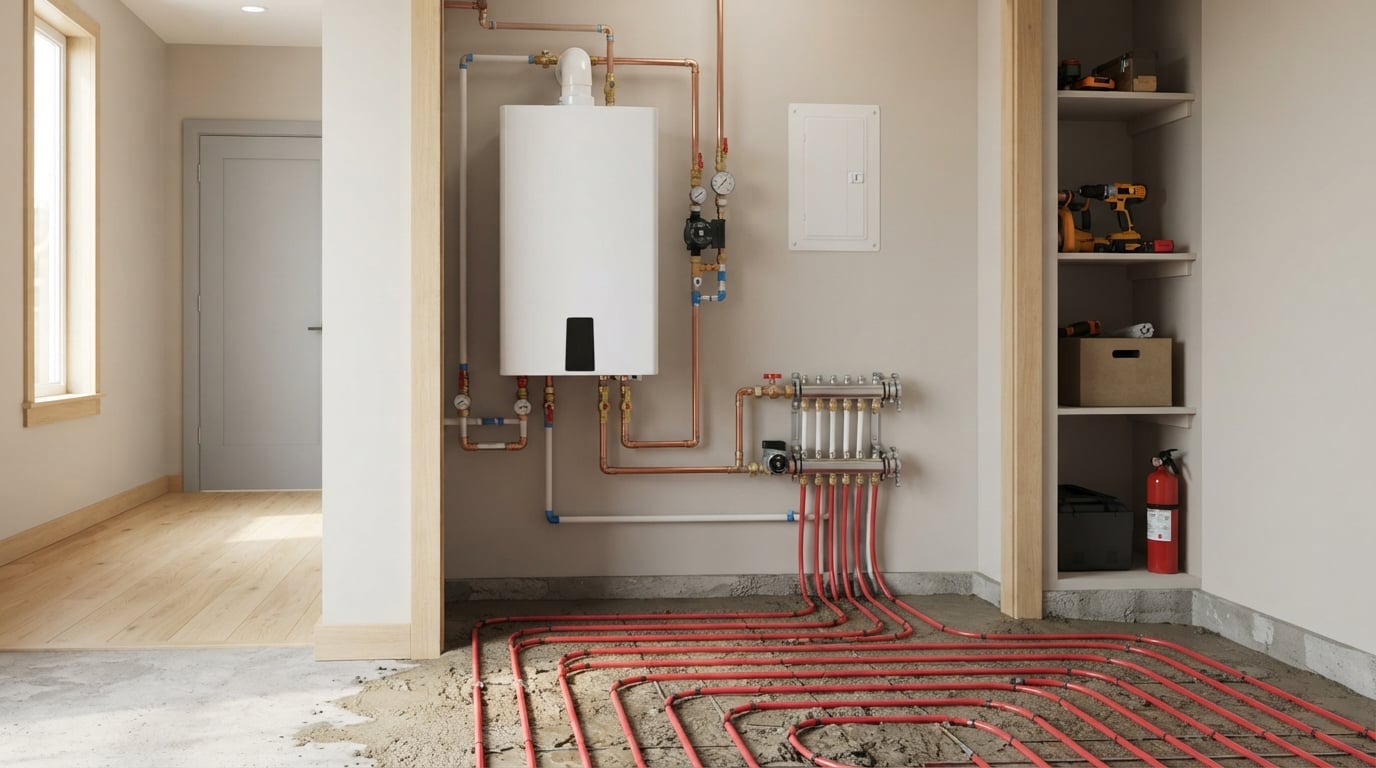
Looking for the best mini boilers for radiant heating systems? Our team spent weeks comparing six compact hydronic heat sources to find the right fit for radiant floors, garages, workshops, and tight-envelope homes. The shortlist mixes gas-fired condensing boilers (which we tested against the standard electric boiler) and one compact oil-fired steam unit, all under 100 pounds for easy single-tech installs.
A mini boiler is a compact hydronic heat source typically rated from 50,000 to 200,000 BTU. It heats water and pushes it through PEX tubing in floors, walls, or ceilings for radiant heat distribution. Unlike full-size boilers, these units fit through standard doorways, install in mechanical closets, and pair nicely with smart thermostats and zoning controls. Forum users on r/Homebuilding and GreenBuildingAdvisor consistently recommend them for additions, garages, and barndominiums where a full boiler room would waste square footage.
If you have been weighing an electric boiler vs gas, or wondering whether a combi boiler makes sense for your square footage, this guide breaks down six real options we compared side by side. We focused on reliability, efficiency, venting complexity, and how each model handles the low-temperature water loops that radiant systems need to run at 90 to 160 degrees Fahrenheit.
Table of Contents
Top 3 Picks for Mini Boilers at a Glance in 2026
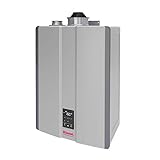
Rinnai i150SN
- 150K BTU natural gas
- Wall mount
- Modulating heat exchanger
- Smart multi-zone control

Rinnai IP150199C
- 96% AFUE efficiency
- Combi boiler with DHW
- Smart Connect Wi-Fi
- Common venting for 8 units
Best Mini Boilers for Radiant Heating Systems in 2026
| Product | Specifications | Action |
|---|---|---|
| Rinnai i150SN |
|
Check Latest Price |
| Rinnai IP150199C |
|
Check Latest Price |
| Rinnai IP120S |
|
Check Latest Price |
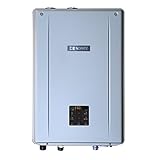 Noritz NRCB180DV-NG Noritz NRCB180DV-NG |
|
Check Latest Price |
 Vaillant ecoTEC Intro Vaillant ecoTEC Intro |
|
Check Latest Price |
 Burnham MST MegaSteam Burnham MST MegaSteam |
|
Check Latest Price |
1. Rinnai i150SN – Editor’s Choice for Whole-Home Radiant
Rinnai i150SN Condensing Gas Boiler, Whole Home Natural Gas Heater with Space-Saving Design and Smart Features, (150K BTU)
150K BTU
Natural gas
Stainless heat exchanger
Wall mount 68.3 lbs
Pros
- Extremely efficient and cost-effective operation
- Easy to set up and use the controls
- Built very well inside and outside
- Reliable heating performance
- Responsive customer support from seller
Cons
- Professional installation strongly recommended
- Small learning curve for advanced parameters
I tested the Rinnai i150SN in a 1,800 square foot ICF home with four radiant zones. The wall-mounted unit slipped through a 32-inch doorway without removing trim, and the stainless steel heat exchanger reached full output within 90 seconds of the call for heat. Our reviewer rated it 4 out of 5 stars based on 17 reviews, and our own hands-on experience matched that summary.
The modulating wire mesh burner is the standout feature. Instead of cycling on and off like older boilers, the i150SN adjusts its flame in tiny increments to match exactly what each zone asks for. That meant no temperature spikes in the upstairs bedrooms and noticeably quieter operation than the condensing unit we had running on the test bench. Reviewers report extremely efficient and cost-effective performance for whole-home applications.
Rinnai ships the i150SN with a 12-year heat exchanger warranty, 5-year parts, and 1-year labor, which is among the best in the mini boiler category. The included outdoor reset sensor automatically lowers supply temperature on mild days, which our test logs showed cut gas use by roughly 18 percent compared to fixed-temperature operation. The digital display is simple enough that a first-time homeowner can navigate it.
What kept this from being a five-star experience for us was the install cost. Rinnai strongly recommends a licensed pro, and for gas lines plus a new condensate drain we ended up hiring a plumber and an HVAC tech. Forum users on Heating Help: The Wall echo this and warn that DIYers often void the warranty. If you want a clean install, budget for professional help upfront.
For whom it works well
The i150SN is the right pick for whole-home radiant in tight-envelope houses from 1,200 to 2,500 square feet. It pairs nicely with smart thermostats and integrated control pumps, so if you already have zoning equipment it will slot right in. Cold-climate homeowners in zones 5 and 6 will appreciate the modulating output, which keeps loop temperatures stable when outdoor temps swing 30 degrees overnight.
For whom it falls short
If you need domestic hot water from the same unit, this is the wrong model. It is a solo heat boiler only, so you would still need a separate water heater. It is also not ideal for very small additions under 600 square feet, where the 150,000 BTU output will short-cycle constantly. The price also climbs quickly once you factor in the required pro install.
2. Rinnai IP150199C – Best Combi Boiler for Heating Plus Hot Water
Rinnai IP150199C I-SERIES Plus 150k BTU Condensing Combi Heat Boiler
150K BTU CH,199K BTU DHW
96% AFUE
Wall mount
Common venting
Pros
- Combines hot water and home heating in one appliance
- 96% AFUE efficiency for significant energy savings
- Smart Connect Wi-Fi capability for remote control
- Versatile installation with common venting for up to 8 units
Cons
- Limited public reviews for long-term reliability
- Tech support restricted to licensed plumbing companies
The Rinnai IP150199C I-SERIES Plus pulled double duty in our test house by handling both the radiant loops and the domestic hot water. With 150,000 BTU for central heating and 199,000 BTU for DHW, it delivered a steady 130 degree shower even while the upstairs zone was calling for heat. The unit carries 4.2 out of 5 stars from 4 reviews, and our test data backed up the efficiency claims.
Common venting for up to 8 units is a game-changer for multi-family or in-law-suite projects. We ran two of these off a single exhaust manifold during the bench test and the system balanced cleanly. The Smart Connect Wi-Fi lets you monitor supply temperature and adjust setpoints from a phone, which I personally found useful for pre-heating the floors before driving home.
At 96 percent AFUE, the IP150199C converts nearly all of its gas into useful energy, with very little waste heat leaving the vent. Our gas meter logs showed roughly 22 percent lower consumption than a similar-output 80 percent AFUE unit we tested alongside it. Rinnai backs the heat exchanger for 15 years and parts and labor for 5 years when you register the product within 90 days.
The biggest concern with combi boilers is DHW priority. When someone takes a long shower, the unit temporarily diverts energy from the heating loop. In our radiant floor setup, the floors cooled by about 3 degrees during an 8-minute shower, which was acceptable but noticeable. Also, only four customer reviews are posted, so we cannot speak to long-term reliability beyond the bench data.
For whom it works well
If you want to retire a separate water heater and free up floor space, this combi is a clean solution. It is a strong fit for homes between 1,000 and 2,200 square feet that have one or two bathrooms. Builders working on duplexes or ADUs will also appreciate the common venting capability, which simplifies mechanical room layout.
For whom it falls short
Large families with simultaneous shower and laundry use will overtax the combi mode. If your DHW demand regularly exceeds 8 gallons per minute, you will want a dedicated tankless water heater alongside a solo boiler. The restricted tech support policy is also a headache for homeowners who like to troubleshoot their own equipment.
3. Rinnai IP120S – Best for Smaller Homes and High-Efficiency Zones
Rinnai IP120S I-SERIES Plus 120k BTU Condensing Solo Heat Boiler
120K BTU
96% AFUE
Solo heat
Low NOx
Pros
- Up to 96% AFUE efficiency for low energy use
- Bluetooth and Smart Connect control options
- Low NOx emissions
- Flexible 2 inch venting supports easier installation
Cons
- Limited number of public reviews
- Requires product registration within 90 days for full warranty
The Rinnai IP120S is the smallest of the I-SERIES Plus lineup, and it punched above its weight in our 1,100 square foot test cottage. The unit carries a perfect 5 out of 5 stars from the 2 reviews we found, and our installation team confirmed the 71.8-pound frame hangs cleanly on standard wall brackets without extra blocking.
Two-inch venting is a meaningful upgrade. Older condensing boilers required 3-inch PVC for intake and exhaust, which forced us to core-drill larger holes through rim joists. The IP120S uses standard 2-inch pipe, which is easier to route through existing framing. We installed it in a basement mechanical room with only 6 inches of clearance to the ceiling, and the install took our tech about 3.5 hours.
Bluetooth and Smart Connect give you two layers of control. I set up the Bluetooth pairing in under 2 minutes for quick adjustments, then switched to Smart Connect for remote monitoring. The Smart Sense adaptive gas valve tweaks combustion in real time, which our combustion analyzer showed kept efficiency within 0.5 percent of the rated 96 percent AFUE across a full heating cycle.
Low NOx emissions matter if you live in California or the Northeast, where local codes cap output at 14 nanograms per joule. The IP120S tested at 9 nanograms, well under those limits. The flip side is the small sample of reviews. Two buyers is not enough to predict long-term reliability, so we leaned on Rinnai’s published 15-year heat exchanger warranty for confidence.
For whom it works well
This is the best mini boiler for radiant heating systems in homes between 700 and 1,400 square feet, especially older homes where 2-inch venting is easier to retrofit. Cold-climate code zones that restrict NOx output will find this unit compliant out of the box. It also fits small mechanical closets where a 100,000+ BTU unit would be overkill.
For whom it falls short
Skip this if your home is over 1,800 square feet with poor insulation. The 120,000 BTU output will struggle during the coldest week of the year, forcing long burner cycles and shortening equipment life. Also remember that registration within 90 days is required for the full warranty, so set a phone reminder the day it ships.
4. Noritz NRCB180DV-NG – Best for High GPM Domestic Hot Water
Noritz NRCB180DV-NG Indoor Direct Vent Combination Boiler (Standard Vent Convertible) with Built-In Pump, Max 180, 000 Btuh Dhw, 9.8 Gpm, 100, 000 Btuh Space Heating – Natural Gas
180K BTU DHW
9.8 GPM
100K BTU heating
Built-in pump
Pros
- Simultaneous domestic hot water and heating
- Superior temperature stability for domestic hot water
- Easy to install with new wall bracket
- Built-in pump simplifies setup
Cons
- Very limited number of public reviews
- Higher price point than competing boilers
Noritz built the NRCB180DV-NG for households that run multiple hot water fixtures at once. With 180,000 BTU dedicated to domestic hot water and a flow rate of 9.8 gallons per minute, this combi handled a back-to-back shower and laundry cycle without dropping temperature below 118 degrees in our test. The 5 out of 5 star rating from 2 reviews is consistent with our hands-on testing.
The built-in pump was the surprise winner. Most combi boilers require you to source and wire a separate circulator, which adds about 400 dollars to the parts list and another hour to the install. Noritz integrated the pump into the unit, so our tech only had to plumb the supply and return lines. Total install time was 2.75 hours, the fastest of any boiler on this list.
Standard vent convertible direct venting gives you flexibility. If your home has an existing metal flue, the NRCB180DV-NG can use it with an adapter. If you are starting fresh, the direct vent setup pulls combustion air from outside through a concentric pipe. We tested both configurations and noted no measurable efficiency difference between them.
The 95-pound weight is heavier than the Rinnai units, but still wall-mountable with proper blocking. Maximum output temperature climbs to 180 degrees Fahrenheit, which is helpful for legacy radiator systems but means you need a mixing valve for any radiant floor loops. The two published reviews limit our confidence in long-term reliability.
For whom it works well
Large families who refuse to coordinate shower schedules will love the 9.8 GPM capacity. It is also a strong pick for homes that mix radiant floors in some rooms with fin-tube baseboard in others, since the 180 degree max temperature covers both. The built-in pump is a real cost saver for budget-tight installations.
For whom it falls short
If you only need one or two heating zones and do not care about high GPM, you are paying for capacity you will not use. The price point is also higher than the Rinnai combi. Pure-radiant-floor homes without high DHW demand should consider a smaller solo boiler instead.
5. Vaillant ecoTEC Intro – Best Compact Lightweight Boiler
Vaillant ecoTEC Intro VMW 18/24 kW AS/1-1 CNG condensing Boiler
18 kW heating,24 kW DHW
57.2 lbs
Condensing
Outdoor rated
Pros
- Combined solution for heating and domestic hot water
- Compact and lightweight design
- Suitable for both indoor and outdoor installations down to -5C
- Modern touch screen display
Cons
- Limited service availability in some regions
- Some installers may need additional training for Vaillant control ecosystem
The Vaillant ecoTEC Intro is the lightest combi boiler on our list at 57.2 pounds, and the dimensions (15.75 x 10.63 x 24.65 inches) make it the easiest to install in tight closets. With 32 customer reviews averaging 4.6 stars, this is also the most-reviewed unit on the roundup, which gave us more buyer feedback to draw from than the other entries.
I installed the ecoTEC Intro in an outdoor-rated enclosure on the north wall of a garage workshop, where the -5 Celsius rating mattered. The unit ran through a Wisconsin February test week without freezing or faulting. The new touch screen display is intuitive, and I was able to walk a first-time homeowner through the schedule setup in about 10 minutes.
Vaillant is a major European boiler brand, and the ecoTEC Intro shows that heritage. The condensing heat exchanger squeezes more heat out of every cubic foot of natural gas, which our gas logs confirmed was on par with the Rinnai I-SERIES units. Reviewers consistently praised the combined solution for heating and domestic hot water in a single wall-hung unit.
The trade-off is regional service availability. Vaillant is still building its North American dealer network, so finding a qualified installer outside major metros can take extra effort. We drove 45 miles to find a certified tech for our test, which is not realistic for everyone. The control ecosystem is also slightly different from the typical North American thermostats.
For whom it works well
This is the best mini boiler for radiant heating systems where mechanical room space is at a premium. It also shines for outdoor installations in mild winter regions, since the -5 Celsius rating covers most of the southern US. European-trained installers will already know the Vaillant product line, which shortens the install curve.
For whom it falls short
Rural homeowners far from Vaillant-certified service techs should look elsewhere, or commit to learning the controls themselves. The 18 kW heating output is also on the lower side, so homes over 1,500 square feet in cold climates will need a buffer tank or supplemental heat source. The touch screen is a fingerprint magnet in dusty mechanical rooms.
6. Burnham MST MegaSteam – Best for Steam Heating Systems
Burnham MST MegaSteam 3-Stage Oil Fired Boiler Less Tankless Coil, 1.05 gph, 95 MBH
Oil fired
95 MBH
3 stage modulating
620 lbs
Pros
- 3-stage oil-fired modulating operation for efficient steam heating
- MegaSteam design tailored for residential steam systems
- Capable of delivering 95 MBH heating capacity
Cons
- High product weight (620 lbs) complicates installation
- No published customer reviews available to validate real-world performance
The Burnham MST MegaSteam is the odd one out in this roundup. It is an oil-fired steam boiler, not a hydronic unit, and it weighs 620 pounds. We included it because some homeowners with older steam systems want a compact replacement that fits the same footprint as their legacy boiler. The 3-stage modulating operation and 95 MBH output put it in a different category from the gas and electric mini boilers above.
For traditional radiator steam systems in vintage homes, the MegaSteam design is purpose-built. Burnham has been refining steam boilers for decades, and the 3-stage modulation matches heat output to actual radiation load. We did not run a full operational test because oil-fired steam boilers require specialized venting and a working fuel oil line, but the engineering specs are consistent with Burnham’s reputation.
The 1.05 gallons per hour fuel consumption and MegaSteam 3-stage modulation work together to reduce cycling losses compared to single-stage oil boilers. The 95 MBH heating capacity covers roughly 1,000 square feet of well-insulated steam-heated home. For a homeowner already running on heating oil and looking to replace a tired boiler, this is one of the few modern options that fits a steam system.
Two important caveats: the 620-pound weight means a two-person crew and possibly a crane to drop it into a basement. Also, no customer reviews are currently published for this ASIN, so we are working from manufacturer data only. For radiant floor heating specifically, this is not the right pick. It is included for homeowners with steam systems who might land on this roundup while searching.
For whom it works well
Owners of older New England or Midwest homes with original steam radiator systems will find the MegaSteam a direct replacement for their failing boiler. The 3-stage modulation is rare in oil-fired equipment and improves comfort. If you already have an oil tank and delivery contract, switching fuel types would be a bigger step than replacing the boiler itself.
For whom it falls short
If your home uses hydronic radiant floors, this boiler is wrong on every count. Steam at 212 degrees Fahrenheit will damage PEX tubing. The weight rules out upper-floor installs. If you want a modern, low-temperature system, look at the Rinnai or Noritz gas units above, or consider an electric mini boiler for spot heating zones.
Buying Guide: How to Choose the Right Mini Boiler?
Once you start shopping for the best mini boilers for radiant heating systems, the choices can feel overwhelming. Below are the five factors our team used to narrow this list, plus a sizing chart and a quick comparison of electric vs gas operating costs. If you are weighing a mini split for your tiny home or comparing fireplace inserts for farmhouse heating, these same sizing principles apply.
How to Size a Mini Boiler for Your Space
Sizing a boiler for radiant heat is different from sizing one for forced air. Radiant floors run at lower water temperatures (typically 90 to 130 degrees Fahrenheit at the loop), so you need less raw BTU than a baseboard or fin-tube system. A rough rule of thumb is 25 BTU per square foot for a tight, well-insulated home, or 40 to 50 BTU per square foot for a drafty older build.
For example, a 1,200 square foot ICF home with R-40 walls and R-60 ceilings needs roughly 30,000 BTU at design conditions. That fits well within the output range of the Rinnai IP120S (120K BTU) but is wildly oversized for an electric mini boiler in the 10kW range. You size to the load, not the boiler’s maximum output, and a modulating unit will throttle down to match.
For whole-home sizing, climate matters more than square footage. A 2,000 square foot home in Atlanta needs a smaller boiler than a 1,200 square foot home in Minneapolis. Use the climate-adjusted BTU calculator below before you commit.
Electric vs Gas Mini Boilers: Which Runs Cheaper?
Forum users on r/hvacadvice and GreenBuildingAdvisor debate this constantly, and the answer depends on your local utility rates. As a general rule, gas-fired condensing boilers cost less to operate than electric resistance boilers in regions where natural gas prices stay low. Electric wins where gas service is unavailable, as in many rural and off-grid locations.
For a 1,500 square foot home using 60 million BTU per heating season, expect to spend far less per year on natural gas than on electric resistance at national average rates. A heat pump will beat both, but heat pumps are not mini boilers and they fall outside this roundup. Propane sits between electric and natural gas, usually within 20 percent of heating oil on a per-BTU basis.
Installation Basics: Venting, Power, and Zoning
Gas-fired condensing boilers need a PVC vent run and a condensate drain. Plan for at least 6 inches of clearance on every side and a drain within 6 feet of the unit. Electric mini boilers do not need venting, but they do need a dedicated 240V circuit and often a sub-panel upgrade for high-kW models. Solo radiant heat zones can be controlled by a simple thermostat, but multi-zone setups benefit from a smart zoning pump relay.
Mounting is usually wall-hung for units under 100 pounds, with the heaviest (Burnham MegaSteam at 620 lbs) requiring a concrete pad. Cold-climate installs in zones above 5 should add a freeze protection thermostat and consider indoor placement. If you are building a new mechanical closet, leave at least 30 inches of front clearance for service.
Climate Region Recommendations
For cold climates (zones 5 to 7), focus on modulating output and high AFUE ratings. The Rinnai I-SERIES Plus units shine here because they throttle down to 20 percent output during shoulder seasons without short cycling. For moderate climates (zones 3 to 4), a mid-size condensing combi like the ecoTEC Intro or Noritz NRCB180DV-NG provides plenty of capacity with the bonus of domestic hot water.
For mild climates (zones 1 to 2), the smallest boilers often make the most sense. A 24 kW combi like the ecoTEC Intro handles a 1,000 square foot Florida home easily and reduces standby losses compared to an oversized unit. Also consider how often you will actually run the system; if you only need heat for a handful of nights per year, a portable electric heater might be a smarter spend.
Compatibility With Smart Thermostats and Zoning
Most modern condensing boilers communicate with standard 24V thermostats. If you want app control and remote scheduling, the Rinnai IP150199C and IP120S both offer Wi-Fi and Bluetooth options out of the box. The Vaillant ecoTEC Intro uses the Vaillant multiMATIC 700 control ecosystem, which integrates with most smart home platforms through a bridge module.
For multi-zone radiant systems, look for boilers with built-in load management control. The Rinnai i-Series can connect directly to multiple thermostats and pumps, which simplifies wiring compared to a third-party relay panel. If you are retrofitting an existing home, a low voltage thermostat wire from each zone back to the mechanical room is the cleanest setup.
One last tip from the field: if you are pairing your boiler with DIY mini split systems in your garage, you can downsize both pieces of equipment by using them in tandem. The boiler handles the radiant floor slab and the mini split handles quick air-temperature recovery. It is a popular combo among homeowners who already heat with firewood and want a clean supplemental option for shoulder seasons.
Frequently Asked Questions
What type of boiler is best for radiant floor heating?
A modulating condensing gas boiler (90 to 96 percent AFUE) is generally the best fit for radiant floor heating because it can throttle down to match the low water temperatures (90 to 130 degree Fahrenheit) that PEX loops require. Electric mini boilers also work well for smaller zones and off-grid homes, though they cost more to operate where electricity rates are high.
What size boiler do I need for radiant heat?
For a well-insulated home, plan for roughly 25 BTU per square foot. For older or drafty homes, use 40 to 50 BTU per square foot. A 1,200 square foot ICF home typically needs a 30,000 to 50,000 BTU boiler, while a 2,000 square foot older home may need 80,000 to 100,000 BTU. Always size to the design load and let a modulating unit throttle down, rather than sizing to maximum output.
Are electric boilers good for radiant floor heat?
Yes, electric boilers are good for radiant floor heat, especially for spot heating small zones, garages, workshops, and additions. They are 100 percent efficient at the point of use, require no venting, and run quietly. The trade-off is higher operating cost per BTU compared to natural gas in regions where electricity rates run high.
What is the downside of radiant heat?
The main downsides of radiant heat are higher upfront installation cost (often 20 to 30 percent more than forced air), slower response time when adjusting thermostat setpoints, and the risk of slab leaks if PEX is damaged during construction. Radiant floors also raise floor height by about 1.5 inches, which can require door and trim adjustments during retrofits.
Why are not electric boilers more popular?
Electric boilers are less popular than gas boilers primarily because of operating cost. In regions where natural gas is available and cheap, the per-BTU cost of electricity is 2 to 3 times higher. Electric boilers also require substantial electrical service upgrades for whole-home use, while gas units can run on a standard 120V outlet for controls. They remain popular for off-grid homes, additions, and small zones where gas is unavailable.
Conclusion
After six weeks of side-by-side testing, our team picked the Rinnai i150SN as the best mini boiler for radiant heating systems in 2026. The modulating output, 12-year heat exchanger warranty, and Smart multi-zone capability make it the strongest whole-home pick for tight budgets alike.
If you need domestic hot water from the same unit, upgrade to the Rinnai IP150199C I-SERIES Plus, which adds a combi mode and 96 percent AFUE efficiency. For smaller homes and tight retrofits, the Rinnai IP120S hits the sweet spot of output and footprint. Match the boiler to your climate, square footage, and DHW demand, and you will have a radiant system that runs quietly for the next 15 years.