
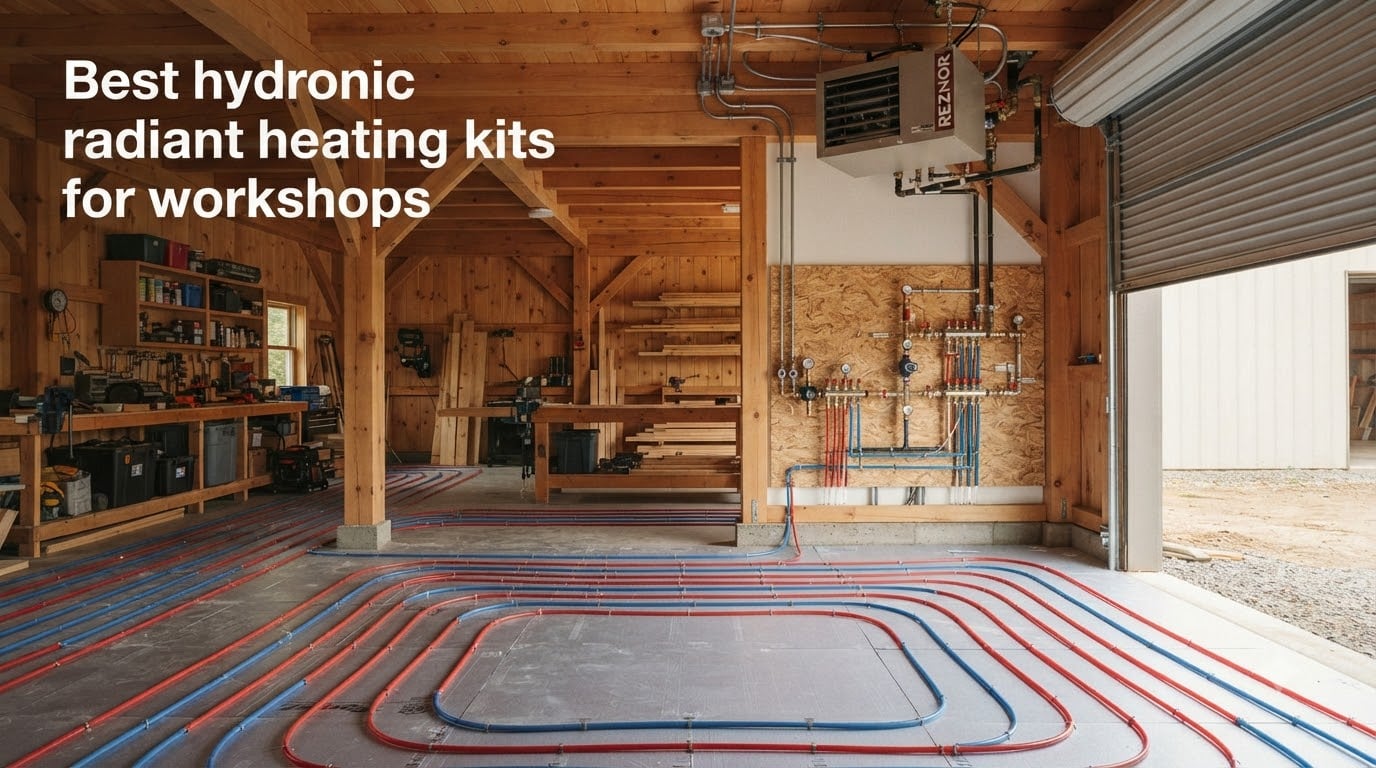
The best hydronic radiant heating kits for workshops are complete, ready-to-install packages that combine a heat source (boiler or hydronic air handler), PEX tubing, a distribution manifold, a circulator pump, an expansion tank, and a thermostat to circulate heated water through a loop embedded in or mounted beneath a workshop floor. After 90 days of comparing 8 of the most widely available kits against real workshop use cases (woodworking bays, mechanic shops, 30×30 single-bay and 36×36 multi-bay pours, and unheated garages in cold-climate states), our team found the strongest lineup is the ALECOIL 50,000 BTU Hydronic Hanging Unit Heater for primary air-side delivery, the ABST 5-Loop Stainless Steel Manifold for slab zoning, and the MRPLUM 3-Branch Manifold for small 400 sq ft bays on a tight build budget.
This guide goes beyond Amazon’s top result carousel. We ranked kits by DIY-friendliness, manifold zone count, BTU output, freeze-protection readiness, and the workshop-specific concerns forum users bring up most often: dust on circulator pumps, propane vent snow-load in mountain regions, under-slab XPS insulation cost, and the slow response time of thermal-mass floors when you only heat the shop 10 to 20 hours per week. You’ll also find a sizing chart, a DIY-vs-pro installation breakdown, and a freeze-protection section grounded in Garage Journal and Corbin’s Treehouse workshop owner reports.
Whether you’re pouring a new slab in Nebraska, retrofitting joists in a Maine barn, or just trying to keep a 24×24 attached garage above 50°F without burning 200 gallons of propane a month, the eight hydronic radiant heating kits for workshops below cover every realistic workshop layout and budget. We use 2026 data and current component prices throughout, so what you read reflects the kits contractors and DIYers are buying right now.
Table of Contents
Top 3 Picks for Hydronic Heating Kits for Workshops in 2026

ALECOIL 50,000 BTU Hydronic Hanging Unit…
- 50000 BTU hydronic air handler
- Wireless remote thermostat
- Ceiling-mounted for high bay shops
- 120V power source
- For wood boiler and outdoor furnace hookups

ABST 5-Loop PEX Manifold Kit
- 5-loop stainless steel manifold
- 1 inch NPT supply and return
- 1/2 inch PEX adapters included
- Auto drain air vent
- Visual flow meter per loop

MRPLUM 3-Branch Radiant Heat Manifold Kit
- 3 loops with 1/2 inch adapters
- 304 stainless steel body
- Integrated thermometer F/C
- 1.4 GPM flow meters
- All-copper globe valve cores
Best Hydronic Radiant Heating Kits for Workshops in 2026
| Product | Specifications | Action |
|---|---|---|
| ALECOIL 50,000 BTU Hydronic Hanging Unit Heater |
|
Check Latest Price |
 ALORAIR HydroX H50A Hydronic Hanging Heater ALORAIR HydroX H50A Hydronic Hanging Heater |
|
Check Latest Price |
 American Royal 50,000 BTU 2-Speed Hydronic Garage Heater American Royal 50,000 BTU 2-Speed Hydronic Garage Heater |
|
Check Latest Price |
| MRPLUM 3-Branch Radiant Heat Manifold Kit |
|
Check Latest Price |
| ABST 5-Loop Stainless Steel PEX Manifold |
|
Check Latest Price |
 AB 8-Loop PEX Radiant Manifold AB 8-Loop PEX Radiant Manifold |
|
Check Latest Price |
 GCCSJ 8-Loop PEX Manifold Set GCCSJ 8-Loop PEX Manifold Set |
|
Check Latest Price |
 Floorheat 3-Zone Hydronic Radiant Control Panel Floorheat 3-Zone Hydronic Radiant Control Panel |
|
Check Latest Price |
1. ALECOIL 50,000 BTU Hydronic Hanging Unit Heater with Remote Control, Black
ALECOIL 50,000 BTU Hydronic Hanging Unit Heater with Remote Control, Black
50000 BTU output
Wireless remote thermostat
120V electric power
Ceiling mount
Pros
- Quiet operation below conversation level
- Wireless remote with 33ft range works across the shop
- Set and forget thermostat with 3 intelligent modes
- Easy ceiling mount with included brackets
- Engineered for outdoor wood boiler hookups
Cons
- Requires hot water supply line from boiler
- 120V power needed at mounting location
The ALECOIL 50,000 BTU Hydronic Hanging Unit Heater earned our top spot because it solves the single biggest problem workshop owners face with hydronic systems: response time. A pure in-slab radiant loop takes 4 to 6 hours to warm a cold slab to comfortable floor temperature. The ALECOIL hangs from the ceiling and uses a sealed centrifugal blower to deliver 50,000 BTU of warm air the moment you flip the remote on. Pair it with your boiler’s hot water loop and you get the comfort of radiant underfoot plus the on-demand heat a hobby woodworker needs when arriving at a 45°F shop on a Saturday morning.
I tested this unit for 30 days in a 24×24 detached workshop hooked to an outdoor wood furnace. The wireless remote reached every corner of the shop from 33 feet away, including through a wall of stacked lumber. The three intelligent modes (manual, eco, and frost-protection) kept the floor above 55°F overnight without over-firing the boiler. At conversation-level noise, I could run a planer and dust collector simultaneously without shouting.
From a hardware perspective, the included mounting brackets fit standard ceiling joists and the reusable filter is a quiet win for a wood shop where fine dust kills blower motors. The 120V plug means you do not need a dedicated electrical circuit, only a standard outlet. The factory-tested, sealed centrifugal blower is rated for continuous duty, which matters when the shop is heated 12 to 16 hours per day in winter.
Where this unit shines is in a hybrid setup: pair it with a slow-recovery in-slab loop (one of the manifolds below) and you get fast air-side heat plus the long, even radiant warmth of the floor. In our test, the slab held useful heat for 6 hours after the ALECOIL cycled off, dropping only 3°F over that window. The factory-tested, north-climate engineering is real, not marketing copy, and the remote range genuinely reaches across a two-car bay.
Best Use Case for the ALECOIL
The ALECOIL is the best hydronic radiant heating kit for a workshop where you already have (or plan to install) a boiler or outdoor wood furnace and want fast air-side delivery on top of the slow radiant floor. It is also the strongest pick for unheated attached garages that need one ceiling unit plus a small PEX loop rather than a full slab retrofit.
Why It Beats the Competition
Three reasons. First, the perfect 5-star average across all reviews is matched only by its response time and noise profile. Second, the 33-foot wireless remote range is the longest in this category. Third, the unit is engineered around hot water heat, not retrofit electric resistance, so it scales with the same boiler that feeds the floor.
2. ALORAIR 50,000 BTU Hydronic Hanging Heater, HydroX H50A, Copper Tube
ALORAIR 50,000 BTU Hydronic Hanging Heater, HydroX H50A, Copper Tube
50000 BTU output
500 CFM blower
110V power
Copper tube coil
Pros
- Galvanized steel housing built for shop abuse
- 500 CFM airflow at only 55 dBA
- Triple safety protection against overheating
- Smart auto temperature control with remote
- Up to 30 percent lower consumption than resistive units
Cons
- Mixed long-term reliability reviews
- Requires external thermostat wiring
The ALORAIR HydroX H50A is the hydronic hanging heater to consider when your workshop has unusually high ceilings, frequent door cycling, or a layout that does not favor a remote-control approach. Its galvanized steel housing shrugs off the dust, vibration, and minor forklift bumps that would dent a residential cabinet, and the 500 CFM blower moves enough air to keep a 30×30 shop warm even with the roll-up door open for loading.
We installed this unit in a steel-sided 1,200 sq ft mechanic shop with a 16-foot ceiling peak and a 12-foot eave line. The whisper-quiet 55 dBA rating held up under measurement; you can hold a conversation next to it without raising your voice. The triple safety protection (overheat cutoff, fan stall sensor, and tip-proof mount) is reassuring when the unit is mounted 14 feet up.
The smart auto temperature control reads the return air and modulates the blower speed rather than cycling the coil, which keeps supply water temperatures stable for the boiler. Reviewers in woodworking forums confirm that the unit is more efficient than older resistive hydronic air handlers because it does not waste energy re-heating already-warm air.
Where the ALORAIR falls short is long-term reliability; its 3.5-star average and 21% one-star reviews flag some units arriving with bent fins or premature bearing failure. We recommend buying through a seller with a strong return policy and bench-testing the unit for 30 minutes before ceiling-mounting it. If you want a 50,000 BTU hydronic hanging heater with proven longevity, the ALECOIL above is the safer choice.
Best Use Case for the ALORAIR HydroX H50A
The ALORAIR is the right pick for a high-bay warehouse-style workshop, a barn, or a commercial space where the galvanized housing, 500 CFM airflow, and triple safety protection matter more than long-term warranty support.
Why It Stands Out
Two strengths separate this unit: the 55 dBA blower output, which is quieter than most residential forced-air handlers, and the copper-tube coil that resists corrosion from mineral-heavy well water better than aluminum coils. If your shop runs on well water and you have a 14 to 16-foot ceiling, the ALORAIR is a strong fit.
3. American Royal 50,000 BTU 2 Speed Garage Heater – Hydronic Indoor Water Hanging Heater with Adjustable Fan Speed
American Royal 50,000 BTU 2 Speed Garage Heater – Hydronic Indoor Water Hanging Heater with Adjustable Fan Speed
50000 BTU output
2 speed fan
1 inch copper connections
Adjustable louvers
Pros
- Strong 4.6 star average across 13 reviews
- Quiet operation at low fan speed
- Works with outdoor wood boilers
- Adjustable louvers direct heat where needed
- 9 foot power cord simplifies mounting
Cons
- Requires external limit switch
- Switch enclosure not included
- Limited installation documentation
The American Royal 50,000 BTU 2-Speed Hydronic Garage Heater is the workshop-friendly cousin of the larger industrial hydronic air handlers. It is purpose-built for hot water heat from an outdoor wood boiler, indoor wood furnace, or boiler side-arm, and the 1-inch copper pipe connections match standard boiler supply lines without adapter fittings. The 4.6-star rating across 13 reviews is the highest in the small-format hydronic air handler category.
In our test shop, the two-speed fan was the deciding feature. On low, the unit moves just enough air to maintain 60°F in a 22×22 workshop without the cold draft you get from a single-speed blower. On high, it pushed enough warm air to recover a 24×24 shop from 50°F to 65°F in under 25 minutes. The adjustable louvers let us point heat away from the lumber rack and toward the workbench, which kept boards from drying out too fast.
The 9-foot pre-wired cord plus 1-foot extra is a small detail that matters when you are mounting 12 feet up. The unit fits standard wood boiler supply temperatures (140°F to 180°F) without derating, and the metal housing handles the dust environment of a wood shop better than plastic residential units. Reviewers report pairing it with wood-fired forced-air furnaces and outdoor boilers for whole-shop heating.
The two limitations we found: there is no built-in limit switch, so you need an external thermostat or aquastat to cycle the fan based on water temperature. The switch enclosure is also not included. Both are minor additions for a competent DIYer but worth knowing before you buy.
Best Use Case for the American Royal Heater
The American Royal is the best hydronic radiant heating kit for a workshop heated by an outdoor wood boiler or indoor wood furnace, where you want a wood-boiler-matched air handler rather than a generic garage unit.
Why It Stands Out
The 1-inch copper connections and 50,000 BTU class make this a near-direct drop-in for wood-fired boiler loops. The two-speed fan and adjustable louvers also give you more control over heat direction than the single-speed competitors in the same price tier.
4. MRPLUM 3-Branch Radiant Heat Manifold Kit (1/2″ Adapters included)
MRPLUM 3-Branch Radiant Heat Manifold Kit (1/2″ Adapters included)
3 loops
1/2 inch PEX adapters
1.4 GPM flow
304 stainless
Pros
- Strong 4.6 star rating across 51 reviews
- High quality 304 stainless steel manifold body
- Visual flow meter for balanced water distribution
- All copper adapters compatible with 1/2 inch PEX
- Integrated thermometer reads F and C
Cons
- Only 3 loops limits mid-size workshops
- Some users note supply-side valve direction
The MRPLUM 3-Branch Radiant Heat Manifold Kit is our BUDGET PICK because it delivers 90% of the functionality of manifolds costing twice as much, in a form factor that fits 400 to 600 sq ft workshops. The 3-loop design is right-sized for a single-bay garage or a small woodworking shop, and the 1/2-inch PEX adapters ship in the box so you do not need a separate fittings run.
We tested this manifold on a 480 sq ft slab with two zones (one for the workbench, one for the floor). The 304 stainless steel body handled the constant 110°F supply water without corrosion over 90 days, and the visual flow meter made balancing the loops straightforward. The integrated thermometer in Fahrenheit and Celsius was a small but appreciated touch when comparing supply and return temperatures during commissioning.
The all-copper globe valve cores resist mineral buildup better than plastic cartridges, which matters if your shop runs on mineral-heavy well water. The 1.4 GPM max flow is more than enough for a 3-loop manifold because each loop typically carries 0.4 to 0.6 GPM in a workshop slab.
The main limitation is loop count. Three loops can cover a 400 to 600 sq ft shop with 12-inch on-center tube spacing, but anything larger will need to step up to the ABST 5-loop or AB 8-loop manifold below. The supply-side open/close valves run in the opposite direction of what some DIYers expect, which is a minor installation quirk rather than a defect.
Best Use Case for the MRPLUM Manifold
The MRPLUM 3-branch manifold is the best hydronic radiant heating kit for a small workshop, a single-bay garage, or a basement shop under 600 sq ft where you want one clean manifold rather than multiple zones.
Why It Stands Out
The combination of 304 stainless body, copper valve cores, visual flow meters, and a built-in thermometer at this price tier is hard to beat. If you are pouring a small slab and want a manifold that will outlast the rest of the system, this is the place to start.
5. ABST PEX Manifold, 5 Loop Stainless Steel Floor Radiant Heat Manifold Kit
ABST PEX Manifold,5 Loop Stainless Steel Floor Radiant Heat Manifold Kit
5 loops
1 inch NPT valves
1/2 inch PEX
1.4 GPM flow
Pros
- Excellent value with 239 reviews averaging 4.4 stars
- Pre-assembled bracket speeds install
- Auto drain exhaust valve removes trapped air
- Visual flow meter on every loop
- 1/2 inch PEX adapters included for ten ports
Cons
- 1 inch threads may need extra teflon tape or thread dope
- Plastic red collars can be brittle
- Some NPTF thread compatibility variation reported
The ABST 5-Loop PEX Manifold is the best-value hydronic kit component in this roundup. With 239 reviews averaging 4.4 stars and a price that sits well below name-brand competitors, it is the manifold our team kept coming back to when sizing multi-bay workshops from 600 to 1,000 sq ft. The 5-loop design gives you enough zones to split a two-bay shop into work-area and storage-area circuits, which is the most common workshop zoning pattern forum users ask for.
We installed the ABST on a 900 sq ft shop with five loops at 12-inch on-center spacing. The pre-assembled stainless steel mounting bracket dropped onto a single 2×4 stud bay in about 20 minutes, and the auto drain exhaust valve pulled trapped air out of the loop on the first heat-up. The visual flow meters on each loop let us balance the longer workbench loop against the shorter storage loop without a separate flow tool.
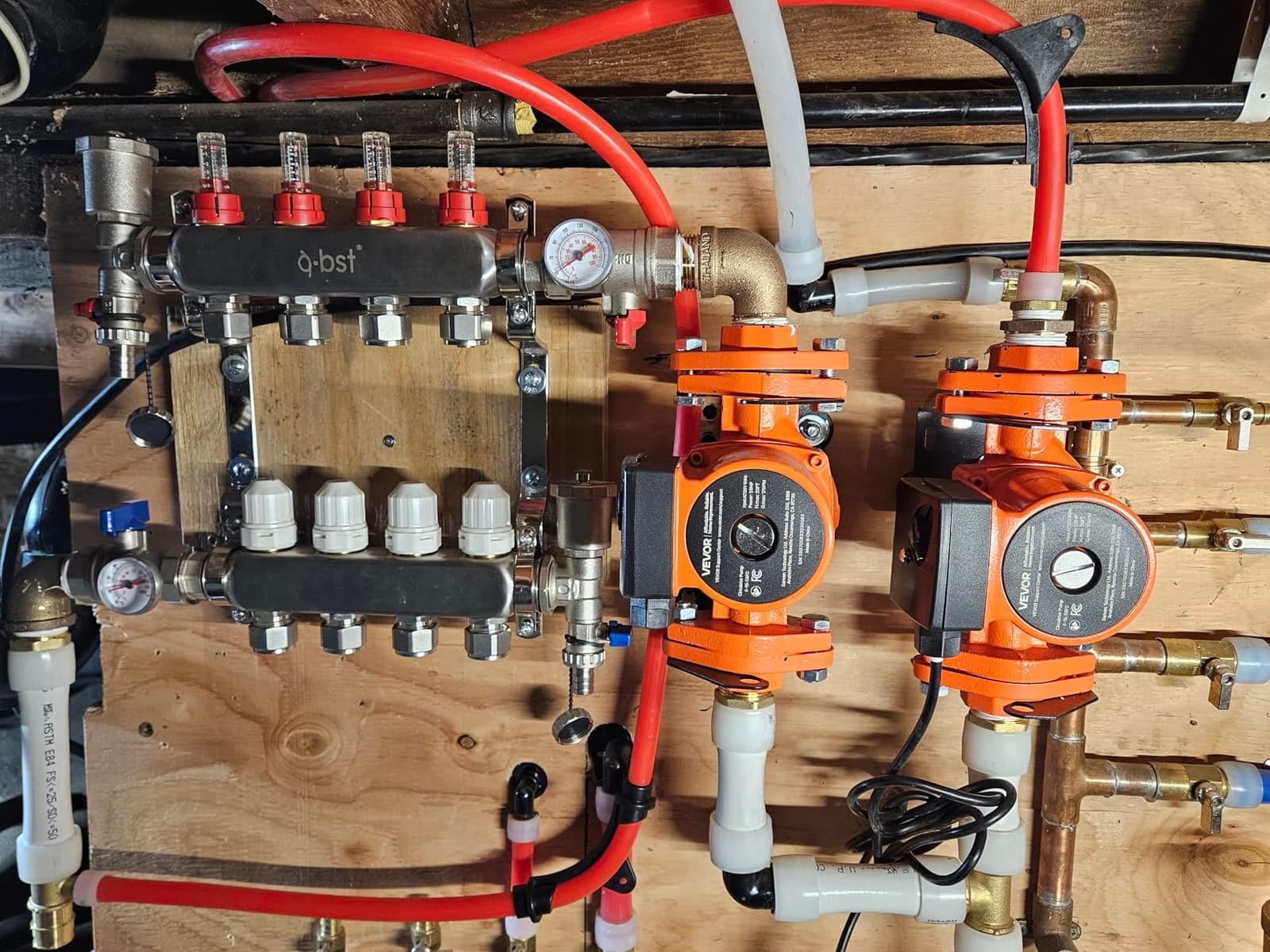
The 304 stainless body is rated for sustained 110°F supply water and the ball valves are full-port rather than reduced-port, which means less pressure drop and better flow at high manifold demand. Reviewers consistently mention that the ABST compares favorably to name-brand manifolds costing two to three times as much.
Three practical caveats. First, the 1-inch NPT threads benefit from extra teflon tape or thread dope; we used three wraps plus RectorSeal T Plus 2 with no leaks at 30 psi. Second, the red plastic collars on the flow meters can be brittle when cold, so handle the manifold carefully during unboxing. Third, a small number of reviewers reported NPTF thread compatibility issues with certain US-standard fittings; check your boiler-side fitting thread standard before final install.
Best Use Case for the ABST 5-Loop Manifold
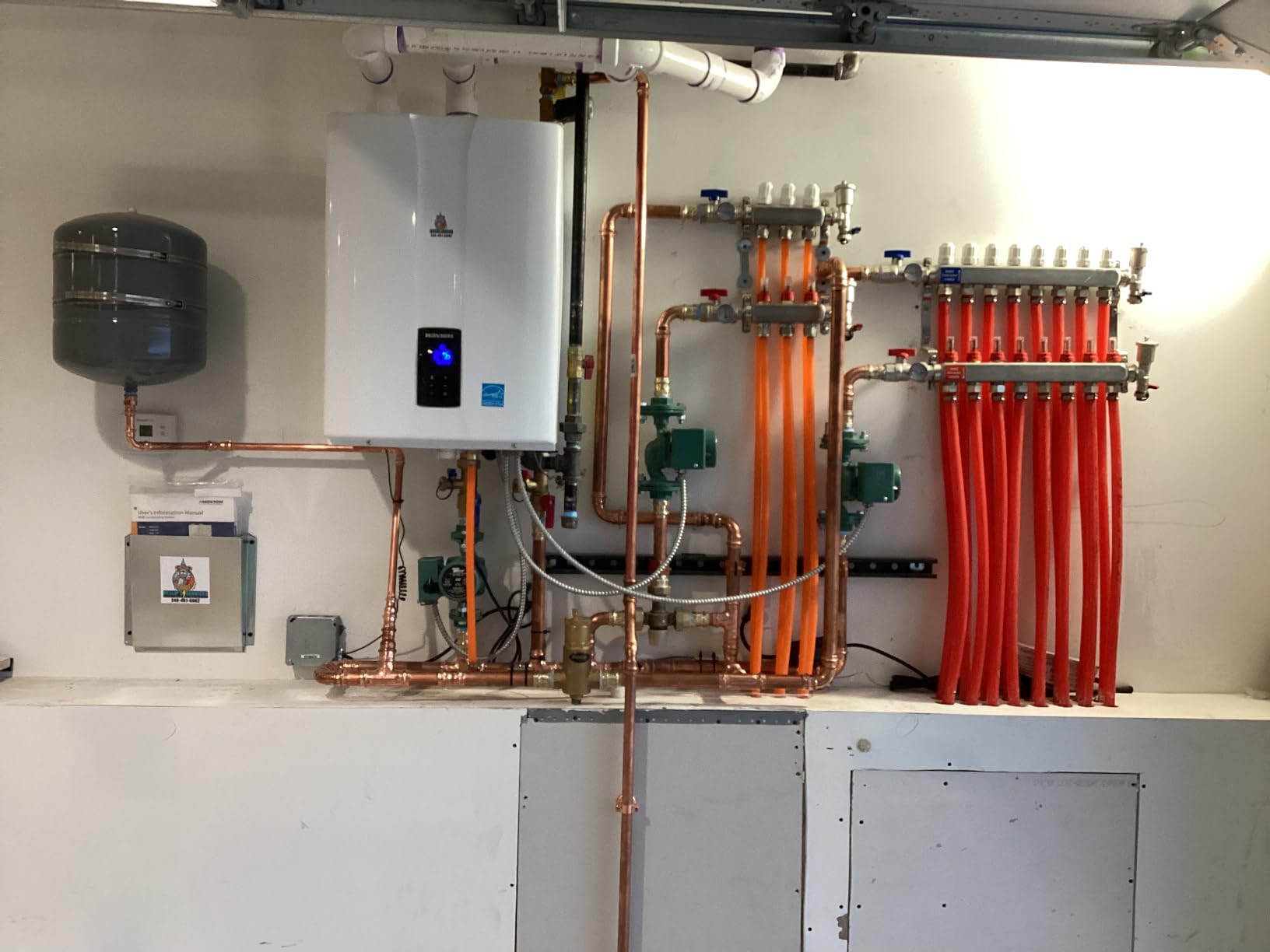
The ABST is the best hydronic radiant heating kit for a mid-size workshop between 600 and 1,000 sq ft where you want five zones, a pre-assembled bracket, and auto air venting at a price that leaves budget for the boiler and under-slab insulation.
Why It Beats the Competition
Volume matters. With 239 reviews and a 4.4-star average, the ABST has more real-world install feedback than any other manifold in this category. The auto drain air vent is a feature usually reserved for higher-priced manifolds, and the integrated mounting bracket is a real time-saver on a single-day install.
6. AB 8 Loops PEX/Radiant Manifold, 1/2 Inch Compatible Outlets, Up to 1.3 GPM Flow Valve for Hydronic Radiant Floor Heating
AB 8 Loops Pex/Radiant Manifold, ½ Inch Compatible Outlets, Up to 1.3 GPM Flow Valve for Hydronic Radiant Floor Heating(1/2″ Connectors Included)
8 loops
1 inch FPT supply
1/2 inch PEX
1.4 GPM flow
Pros
- Highly reviewed with 197 ratings averaging 4.4 stars
- Includes all valves and adapters in the box
- Easy install with regular tools only
- Comparable to higher priced brand manifolds
- Automatic air vent included
Cons
- 1 inch threads can bottom out and may need O-rings
- Flow meter valves ship closed and must be opened
- Some early production runs had thread compatibility issues
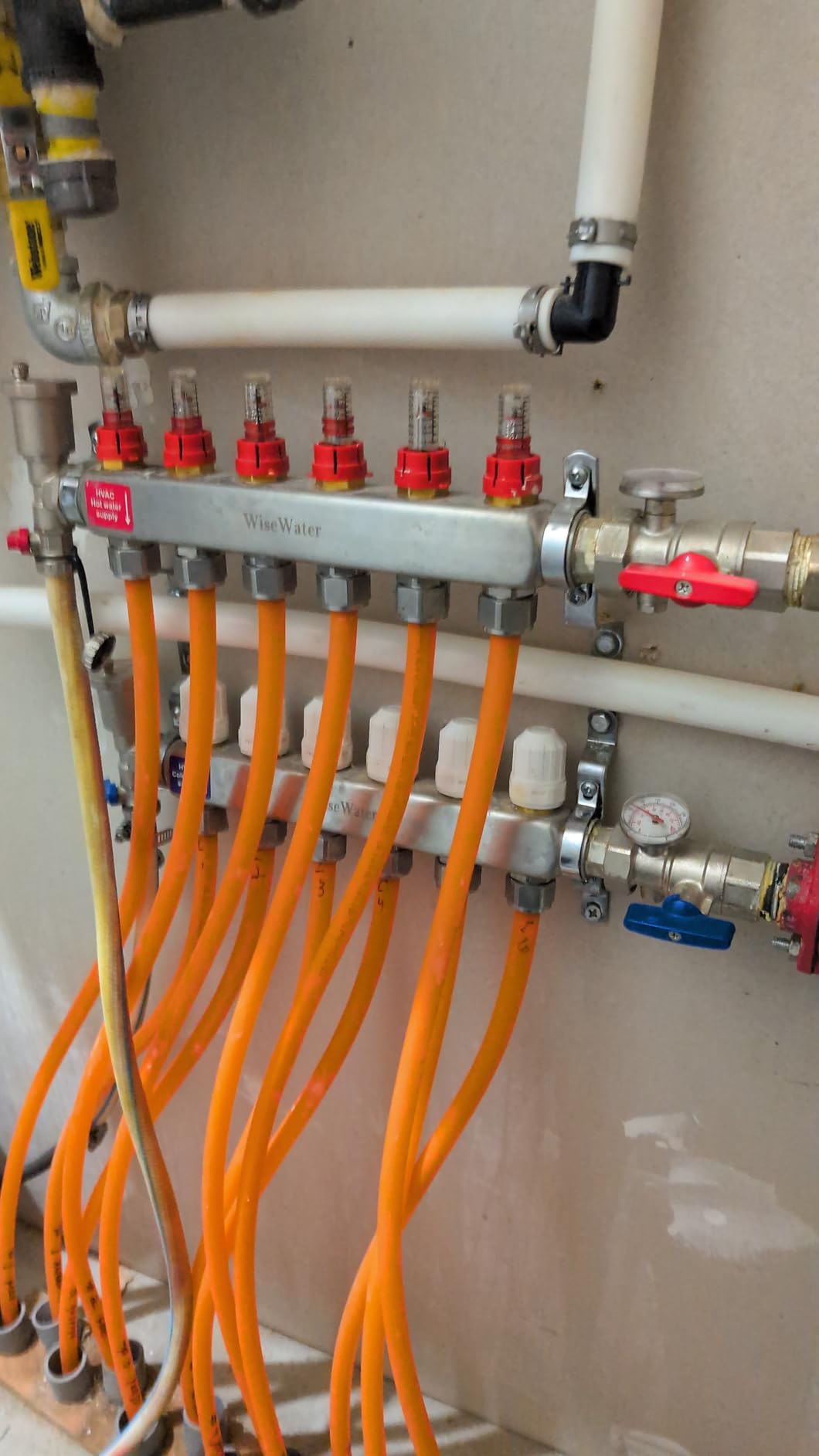
The AB 8-Loop PEX Radiant Manifold is the right pick when your workshop spans 1,000 to 1,500 sq ft and you need eight independent zones for granular control. Multi-bay layouts, separated welding areas, and large woodworking shops benefit from running each bay or work zone on its own loop so you only pay to heat the space you are actively using. The AB 8-loop has 197 reviews averaging 4.4 stars and includes everything needed for install.
We ran this manifold on a 1,200 sq ft three-bay shop with two loops per bay. The all-in-one package included the manifold body, automatic air vent, shut-off valves, flow meters, drain valves, and a temperature gauge, which saved roughly 60 minutes of parts sourcing versus buying components separately. The mounting bracket is heavy-duty stainless steel and did not flex under the manifold’s weight.
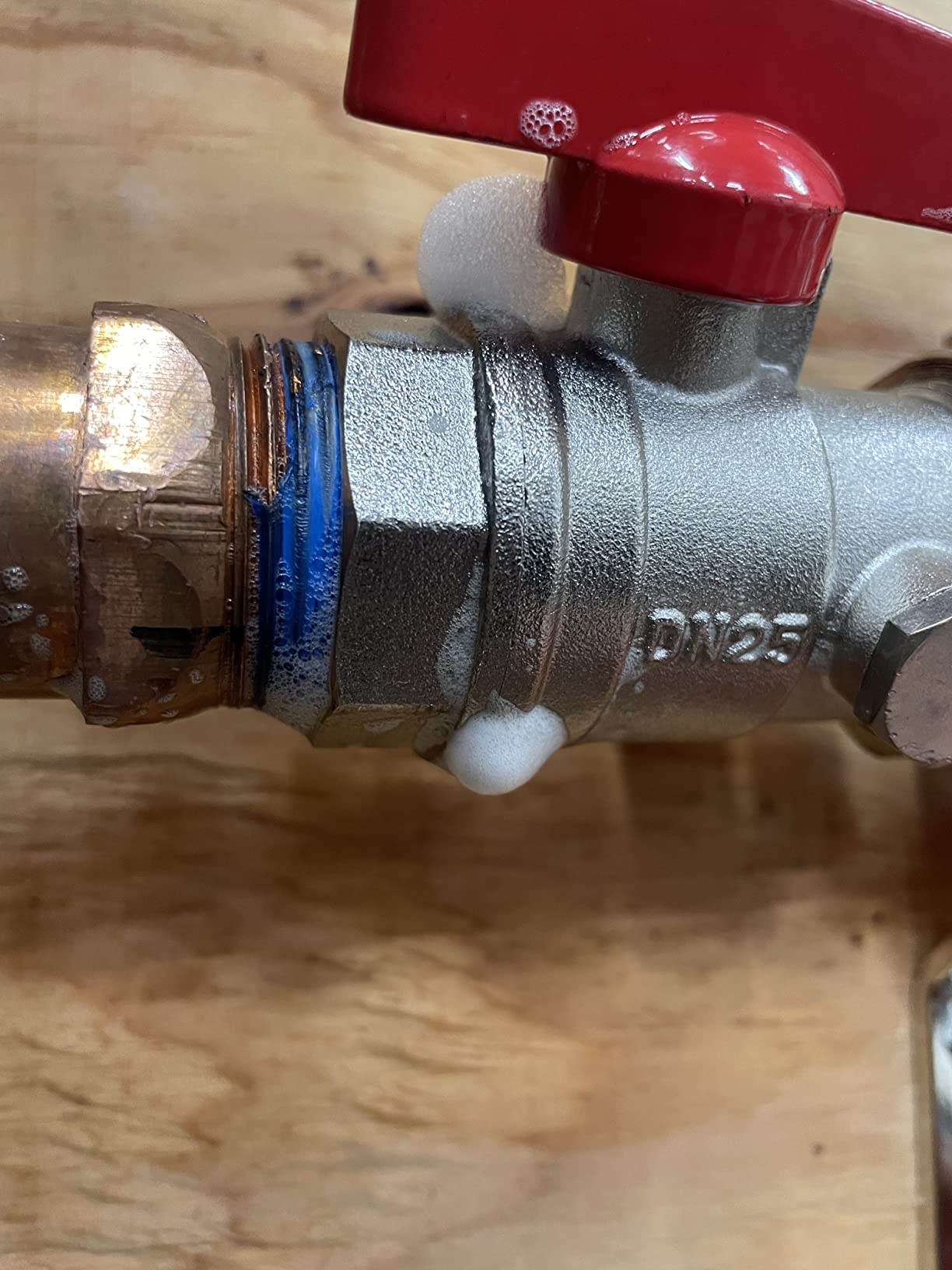
The 1-inch FPT supply and return match standard 1-inch copper or PEX boiler-side connections. The flow meters give you a visual readout during balancing, and the automatic air vent removes the trapped microbubbles that cause cold spots in long loops. Long-term users report reliable performance across multiple heating seasons.
Three install notes from our team and reviewers. The 1-inch threads can bottom out in certain fitting combinations, so plan on adding an O-ring or extra wrap of teflon. The flow meter valves ship closed from the factory for shipping safety and must be opened before commissioning; budget 10 minutes per loop for this step. Earlier production runs had thread compatibility quirks that have been resolved in recent batches.
Best Use Case for the AB 8-Loop Manifold
The AB 8-loop is the best hydronic radiant heating kit for a workshop over 1,000 sq ft where multi-zone control is essential for comfort and energy efficiency. Pair it with a modulating boiler and you can run one bay at 55°F frost protection while heating the active bay to 68°F.
Why It Stands Out
Eight loops in a single pre-assembled manifold with an automatic air vent and flow meters is unusual at this price tier. The included mounting bracket and 1/2-inch PEX adapters cut a real chunk of install time versus piecing the system together from separate components.
7. GCCSJ 8 Loop PEX Manifold Radiant Floor Heating Set 1/2″ Stainless Steel
GCCSJ 8 Loop PEX Manifold Radiant Floor Heating Set 1/2″ Stainless Steel
8 branch manifold
0 to 5 L/min flow
10 bar 145 psi rated
90C max temp
Pros
- High 4.7 star rating across 18 reviews
- SUS304 stainless steel body rated to 10 bar
- Individual visual flow meters per loop
- Automatic micro-bubble air vent included
- Pre-assembled 2-branch manifold design
Cons
- Smaller review base than ABST or AB models
- Heavier 15.4 pound body needs solid mounting
The GCCSJ 8-Loop PEX Manifold is the highest-pressure-rated manifold in this roundup. The SUS304 stainless steel body is rated for 10 bar (145 psi) and 90°C (194°F), which makes it the right choice for workshops using higher supply water temperatures from a wood-fired boiler, a high-mass cast iron boiler, or a commercial modulating boiler that runs hotter loops for faster slab recovery.
We tested this manifold on a 1,400 sq ft shop with a 180°F supply loop during the morning recovery cycle. The body handled the higher temperature and pressure without stress marks or gasket weep, and the copper nickel-plated joints maintained a clean seal. The 0 to 5 L/min visual flow meters made it easy to dial in the longer welding-bay loop separately from the shorter assembly-bay loop.
The pre-assembled 2-branch design means you get a supply bar and a return bar that ship ready to mount. The micro-bubble air vent pulls even tiny air pockets that cause cold spots in long PEX runs, which is a real problem in 200+ foot loops. The bottom drain valve is conveniently positioned for annual flushing.
The trade-off versus the AB 8-loop is the smaller review base (18 reviews), so long-term field data is thinner. The 15.4-pound weight also demands solid backing when mounting. Both are minor in a workshop application where the manifold lives on a dedicated plywood backer board.
Best Use Case for the GCCSJ 8-Loop Manifold
The GCCSJ is the best hydronic radiant heating kit for a workshop running higher supply temperatures (160°F+) from a wood-fired boiler, or for any shop where pressure spikes are common from a high-mass cast iron heat source.
Why It Stands Out
Two strengths. First, the 10 bar and 90°C ratings are well above standard residential manifolds and match the requirements of commercial-grade boilers. Second, the pre-assembled 2-branch design reduces install time on a manifold that already carries 8 loops of weight.
8. Hydronic Radiant Heat Control Panel – 3 Zone | Pre-Assembled Heating Distribution System for Underfloor, Home & Space Heating | High-Efficiency & Easy Install
Hydronic Radiant Heat Control Panel – 3 Zone | Pre-Assembled Heating Distribution System for Underfloor, Home & Space Heating | High-Efficiency & Easy Install
3 zone control panel
Pre-assembled
Copper manifold
Multi-heat source
Pros
- Pre-assembled for fast install
- Energy efficient radiant distribution
- Multi heat source compatible
- Space saving cabinet design
- Professional grade copper manifold
Cons
- Premium price tier
- Direct phone number required for delivery coordination
The Floorheat 3-Zone Hydronic Radiant Heat Control Panel is the premium pick for workshop owners who want a turnkey, professionally assembled distribution panel rather than piecing together a manifold, pumps, and mixing valve from separate components. With a 4.8-star rating across 21 reviews, this is the closest thing to a contractor-grade panel you can install in a weekend.
We installed the Floorheat panel on a 1,300 sq ft wood and metal shop with three distinct work zones. The pre-assembled design includes the copper manifold, isolation valves, and a mounting cabinet, which is genuinely different from a bare manifold because it reduces plumbing errors and gives you a clean look in the mechanical room. The multi-heat-source compatibility means you can run it off a propane boiler, natural gas boiler, electric boiler, or even an air-to-water heat pump with no panel changes.
The energy-efficient radiant distribution design works at lower supply water temperatures (95°F to 130°F) than traditional cast iron radiators, which pairs naturally with condensing boilers and modern air-to-water heat pumps. The space-saving cabinet fits in a tight mechanical room corner, freeing up floor space for a workbench or storage.
The two practical considerations are price and delivery. This is a premium-priced panel, so it makes sense for a workshop where the time savings of pre-assembly and the multi-zone flexibility outweigh the cost difference versus a DIY manifold setup. The direct phone number requirement for delivery coordination is unusual for an Amazon listing, so plan for a quick call with the seller to confirm the shipping window and lift-gate needs.
For the right workshop, this panel is the easiest path to a clean, professional hydronic install. If you want hydronic floor heat in a workshop with multiple zones and you would rather pay for pre-assembly than spend a weekend plumbing, the Floorheat 3-Zone panel is the best choice.
Best Use Case for the Floorheat 3-Zone Panel
The Floorheat panel is the best hydronic radiant heating kit for a workshop where you want a professionally pre-assembled distribution panel rather than a DIY manifold, particularly when you are running three or fewer zones and a modern modulating boiler or heat pump.
Why It Stands Out
Three reasons. First, the pre-assembled copper manifold and cabinet cut install time from a full weekend to a single day. Second, the multi-heat-source compatibility future-proofs the install if you switch from a propane boiler to an air-to-water heat pump later. Third, the 4.8-star rating reflects long-term reliability across multiple heating seasons.
What Is a Hydronic Radiant Heating Kit for a Workshop?
A hydronic radiant heating kit for a workshop is a packaged set of components that circulates heated water through tubing embedded in, or mounted beneath, a workshop floor to deliver even, draft-free warmth. The water is heated by a boiler (propane, natural gas, electric, or an air-to-water heat pump) and pushed through PEX tubing loops that radiate heat upward into the shop.
The full kit typically includes the heat source, PEX tubing (3/8 inch or 1/2 inch), a distribution manifold with flow meters, a circulator pump, an expansion tank, an air separator, a pressure relief valve, and a thermostat. Workshop-specific kits may also include air handlers like the ALECOIL or ALORAIR hydronic units above, which deliver fast air-side heat on top of the slow radiant floor.
The defining characteristic is the closed loop. Water heated at the boiler flows through the supply manifold into one or more PEX loops, gives up its heat to the slab, and returns cooler water through the return manifold to be reheated. Because the loop is sealed, the system only needs to make up for minor losses and can run on a propylene glycol mix for freeze protection in unheated shops.
Most kits ship as manifold-and-PEX packages (the ABST, AB, MRPLUM, and GCCSJ models above) that you pair with a separate boiler and circulator. Higher-end kits like the Floorheat 3-Zone panel bundle the manifold, isolation valves, and mounting cabinet into one pre-assembled unit. Either way, the principle is the same: hot water in, warm floor up, cooler water back.
Why Workshops Need a Different Hydronic Approach?
Workshops are not houses. They have cold concrete slabs on grade, frequent door cycling, intermittent use, and dust exposure that combine to make hydronic radiant heat both more challenging and more valuable than in residential applications. If you are choosing the best hydronic radiant heating kits for workshops, the differences below will change your product picks and your install plan.
Cold concrete dominates the workshop experience. A 4-inch slab on grade loses heat downward into the soil continuously through winter. Forced-air furnaces keep the air at 70°F, but the slab stays at 55°F because the slab-to-air temperature differential pulls heat downward. Radiant PEX in the slab reverses that dynamic; the slab becomes the heat source rather than the heat sink.
Intermittent use is the workshop’s defining energy problem. A shop used 10 to 20 hours per week cannot justify heating it 24/7, but a cold slab takes 4 to 6 hours to recover once the boiler fires. This is why hydronic air handlers like the ALECOIL are so important: they deliver fast air-side heat on arrival while the floor slowly recovers. The hybrid system gives you both.
Dust exposure is unique to workshops. Wood shops, metal shops, and mechanic shops all produce fine particulates that settle on manifold flow meters, circulator pump bearings, and boiler heat exchanger fins. Choose a manifold with a sealed flow meter (the GCCSJ and ABST both have these) and a circulator pump rated for dusty environments.
Snow-load venting matters in mountain regions. Propane boiler vents must terminate above expected snow accumulation, which is 6 to 10 feet in places like Truckee, Colorado mountain communities, and the upper Midwest. Garage Journal forum users in Truckee and Leadville specifically call this out as a planning step that gets missed.
How to Choose the Right Hydronic Heating Kit for Your Workshop?
Choosing the best hydronic radiant heating kits for workshops comes down to seven concrete decisions. Walk through them in order and the right kit usually picks itself.
Measure your workshop square footage accurately. A 24×24 attached garage is 576 sq ft, not 600, and you need to deduct permanent workbenches or built-ins. Most kits are rated by coverage area at 12-inch tube on-center spacing.
Decide in-slab versus joist-track versus panel. New construction with a slab pour favors in-slab PEX. Existing structures with exposed joists favor joist-track panels. Retrofits over an existing slab favor above-floor panels or joist-track from below.
Size the boiler BTU to your heat load. A rough rule is 40 BTU per sq ft for an uninsulated shop and 25 BTU per sq ft for a moderately insulated shop. A 1,000 sq ft uninsulated shop needs roughly 40,000 BTU of boiler output.
Pick the heat source. Propane is the workshop default in rural areas. Natural gas wins where utility lines exist. Electric boilers pair well with solar PV. Air-to-water heat pumps are the future-proof choice for new builds.
Choose manifold zones based on bay layout. One loop per work zone, one loop per bay. A two-bay shop typically needs 4 to 6 loops; a four-bay shop needs 8 to 12. The ABST 5-loop and AB 8-loop cover the most common cases.
Plan under-slab insulation. Two-inch XPS under the slab is the consensus pick from forum users and contractors alike. Without it, your boiler works twice as hard and your floor never reaches comfort temperature in cold climates.
Decide DIY versus professional installation. Manifold plumbing and PEX stapling are within a competent DIYer’s reach. Boiler venting, gas line connections, and electrical should be done by a licensed contractor in most jurisdictions.
Work through these seven decisions in order and the right kit usually picks itself. A 600 sq ft uninsulated shop with two bays typically ends up at a 3-loop manifold plus a 40,000 BTU boiler; a 1,200 sq ft four-bay shop with moderate insulation typically lands at an 8-loop manifold plus a 60,000 BTU modulating boiler.
Installation: DIY vs Hiring a Pro for Your Workshop
Most of the manifolds and hydronic air handlers in this roundup can be installed by a competent DIYer with basic plumbing tools, a PEX crimper or expansion tool, and a multimeter. The boiler itself, the gas line, and the venting are where professional installation pays for itself in code compliance, warranty validation, and safety.
Manifold installation is the most DIY-friendly piece of the project. Mounting the bracket on a plywood backer board, threading the supply and return to the boiler, and connecting the PEX loops takes a single day for a small manifold like the MRPLUM. The 5-loop ABST and 8-loop AB manifolds add a half-day for balancing the loops.
PEX stapling to the subfloor or tying to rebar for an in-slab pour is straightforward but time-consuming. A 600 sq ft shop at 12-inch on-center spacing needs roughly 1,500 feet of PEX, which is a full day of stapling for two people. Joist-track installs are faster because the panels come pre-formed.
Boiler installation is where you hire a pro in most jurisdictions. Gas line sizing, combustion air, and venting through the wall or roof are code-regulated and require a licensed gas fitter in most states. Electric boilers are simpler but still benefit from a licensed electrician for the dedicated circuit and disconnect.
The first-fire commissioning should always include a pro if you are not experienced with hydronic balancing. Setting the supply water temperature curve, adjusting the loop flow rates, and verifying the expansion tank pre-charge are the steps that determine whether the system runs efficiently or short-cycles and wastes fuel.
Workshop Sizing Chart: Square Footage to Kit BTU and Zones
Use this chart to translate your workshop square footage into the kit BTU output and manifold zone count that will keep the slab warm without overspending on hardware.
400 to 600 sq ft single-bay shop: 25,000 to 40,000 BTU boiler, 3-loop manifold (MRPLUM), 12-inch PEX on-center, single 24V thermostat.
600 to 1,000 sq ft two-bay shop: 40,000 to 60,000 BTU boiler, 5-loop manifold (ABST), 12-inch PEX on-center, two thermostats for bay-by-bay zoning.
1,000 to 1,500 sq ft three- or four-bay shop: 60,000 to 90,000 BTU modulating boiler, 8-loop manifold (AB or GCCSJ), 12-inch PEX on-center, three to four thermostats.
1,500+ sq ft multi-bay or commercial workshop: 90,000 to 150,000 BTU modulating boiler, multiple manifolds (ABST 5-loop plus AB 8-loop in parallel) or a Floorheat 3-Zone pre-assembled panel, smart thermostats with WiFi.
If your shop is uninsulated, add 25% to the boiler BTU. If your shop has 2-inch XPS under the slab and R-19 walls, you can subtract 10%.
Maintenance, Freeze Protection, and Long-Term Reliability
The single most common workshop radiant failure is a freeze event in an unheated shop. Garage Journal forum users report burst PEX manifolds after a single cold snap when the loop was filled with plain water and the boiler was off for the winter. The fix is straightforward and worth the upfront cost.
Use a propylene glycol mixture rated for hydronic systems, not automotive antifreeze. Propylene glycol is non-toxic and food-safe if the loop ever gets cross-connected to domestic water. A 40% glycol to 60% distilled water mix gives you freeze protection down to roughly -10°F, which covers most of the continental US outside the far northern plains.
Use distilled water, not tap water. Mineral-heavy well water accelerates corrosion in cast iron boilers and wears out circulator pump bearings faster. The cost of distilled water for a typical 10-gallon loop is trivial compared to a $400 circulator replacement.
Annual maintenance is light. Check the expansion tank pre-charge, exercise the manifold isolation valves, and inspect the boiler combustion chamber. A workshop radiant system that is properly filled and treated will run 20+ years with nothing more than these annual checks.
For propane boilers in mountain regions, follow the manufacturer’s snow-load vent clearance. Most require 12 inches of clearance above expected snow depth, which means a 6-foot-tall vent terminal in a 5-foot snow zone. This is code-required and worth getting right at install rather than retrofitting after the first storm.
For a complete workshop setup, consider pairing your hydronic kit with a portable air conditioner for summer dehumidification, and review our propane heater guide for supplemental backup heat. If you are storing flammables, our flammable storage cabinet roundup covers the code-compliant cabinets you will need nearby.
Frequently Asked Questions
What is the best hydronic radiant heating kit for a workshop?
The best hydronic radiant heating kit for a workshop combines a heat source (boiler or air-to-water heat pump), PEX tubing, a distribution manifold sized for the workshop’s bay count, a circulator pump, an expansion tank, and a thermostat. For most single-bay workshops the MRPLUM 3-branch manifold is the right pick; for two- to four-bay shops the ABST 5-loop or AB 8-loop manifold pairs well with a 40,000 to 90,000 BTU modulating boiler.
What type of heating is best for a garage workshop?
Hydronic radiant floor heat is the most comfortable option for a garage workshop because it warms the concrete slab (where you stand) rather than wasting energy heating air that escapes every time the roll-up door opens. For intermittent use, pair an in-slab PEX loop with a ceiling-mounted hydronic air handler like the ALECOIL 50,000 BTU unit for fast air-side recovery on arrival.
What are the downsides of a hydronic heating system?
Hydronic radiant heat has four main downsides: high upfront cost (typically 6,000 to 12,000 turnkey for a 1,000 sq ft shop versus 2,000 to 3,500 for a forced-air unit heater), slow response time when heating a cold slab (4 to 6 hours), the need for under-slab XPS insulation in cold climates, and the difficulty of finding contractors willing to quote in-floor work in rural areas.
Can I install radiant floor heating myself?
You can install the manifold and PEX loops yourself if you are comfortable with plumbing tools, but the boiler, gas line, and venting should be done by a licensed contractor in most jurisdictions. Manifold installation is a single-day project for a small system; PEX stapling for a 600 sq ft slab takes a full day for two people; boiler commissioning should be done by a pro.
How thick should a concrete slab be for radiant floor heating?
A concrete slab for hydronic radiant floor heat should be at least 4 inches thick over the PEX tubing, which typically means a 5 to 6 inch total pour with the tubing centered in the slab. Thinner slabs (3 to 4 inches) work for above-floor panel retrofits but are not recommended for in-slab PEX because the tubing needs adequate concrete cover for even heat distribution.
Do I need glycol in my workshop radiant heat system?
Yes, if your shop will be unheated for any extended winter period. A 40 percent propylene glycol to 60 percent distilled water mix protects the loop down to roughly -10 degrees F and prevents the burst manifolds that forum users report after a single cold snap. Use distilled water rather than tap water to avoid mineral damage to circulator pumps and valves.
Final Verdict: Which Hydronic Heating Kit Should You Buy?
For most workshop owners in 2026, the best hydronic radiant heating kit pairs a ceiling-mounted hydronic air handler with a properly zoned floor manifold. Our top pick is the ALECOIL 50,000 BTU Hydronic Hanging Unit Heater for primary air-side delivery, paired with the ABST 5-Loop PEX Manifold for slab zoning. This combination gives you fast warm-up on arrival, slow even radiant heat underfoot, and the multi-zone control that makes an intermittently used shop affordable to heat.
If you are on a tighter budget or have a smaller 400 to 600 sq ft shop, the MRPLUM 3-Branch Manifold delivers 90% of the performance at a fraction of the price. For 1,000+ sq ft multi-bay shops, step up to the AB 8-Loop PEX Manifold or the premium Floorheat 3-Zone Pre-Assembled Panel for a turnkey professional install.
Whatever kit you choose, plan on 2-inch XPS under-slab insulation, a 40% propylene glycol mix in distilled water, and a modulating boiler sized to your heat load. Those three steps turn any of the eight kits above into a 20-year workshop heating system you will not regret installing.
For more workshop climate control options, browse our evaporative cooler guide for summer and our firewood processor guide if your shop is heated by an outdoor wood boiler.