
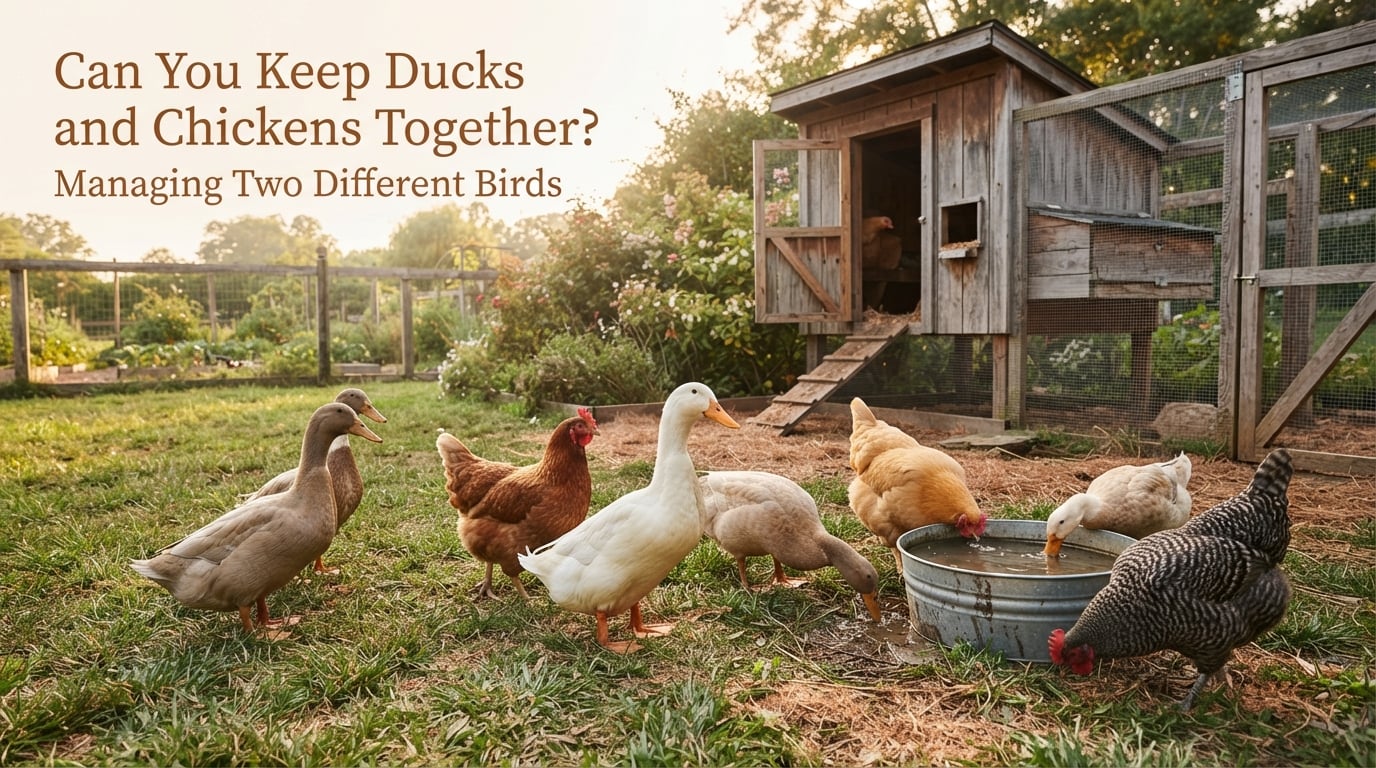
Yes, you can keep ducks and chickens together in the same backyard flock, and many poultry keepers do it successfully every single year. The two species have lived side by side on farms for centuries, and with the right setup, they can share a coop, a run, and even a foraging area without major problems.
That said, combining these birds is not as simple as tossing them into the same pen and walking away. Ducks and chickens have surprisingly different needs when it comes to water, feed, housing, and even sleeping habits. If you ignore those differences, you can end up with sick birds, a soggy coop, or worse, a serious injury from an aggressive drake.
I have managed a mixed flock of chickens and ducks for several seasons now, and I want to walk you through everything that actually matters. In this guide, you will learn where ducks and chickens get along naturally, where they clash, and how to set up your coop and run so both species stay healthy and happy. We will cover water management, the niacin feeding problem, housing differences, drake and rooster aggression, how to introduce new birds, and the common mistakes that catch first-time mixed flock keepers off guard.
Whether you already have a flock of chickens and are thinking about adding a few ducks, or you are starting fresh and want both from the beginning, this guide will help you understand how to keep ducks and chickens together the right way.
Table of Contents
Can You Keep Ducks and Chickens Together? The Short Answer
Yes, ducks and chickens can live together in a mixed flock, but they need careful management because their care requirements differ in four big areas: water, feed, housing, and behavior. You can keep them in the same coop, the same run, or the same foraging space as long as you plan for those differences ahead of time.
Most backyard keepers who succeed with a mixed flock do three things consistently. They provide separate water sources, they supplement duck feed with extra niacin, and they give ducks a floor-level sleeping area while chickens keep their roosting bars. Do those three things and you are already ahead of most beginners.
The problems usually start when keepers treat ducks like wet chickens. Ducks are waterfowl, not land birds, and their bodies behave differently in ways that matter. Once you understand those differences, keeping them together becomes much more manageable.
Key Differences Between Ducks and Chickens
Ducks and chickens might look like they belong in the same category, but their biology tells a different story. Here is where the two species differ most, and why those differences matter for a mixed flock setup.
Water Requirements
Water is the number one challenge when you keep ducks and chickens together, and it is the thing that trips up new keepers the fastest. Chickens are perfectly happy with a simple nipple waterer or a shallow dish. They drink, they walk away, and the area around the water stays relatively dry.
Ducks, on the other hand, need water for more than just drinking. They use it to clean their eyes, clear their nostrils, and most importantly, to waterproof their feathers through their preen gland. A duck that cannot dip its entire head underwater will struggle to maintain healthy plumage. This means ducks need a water source deep enough to submerge their heads, like a rubber tub, a kiddie pool, or a shallow pond.
The problem is that ducks are messy. They splash, they dabble, they mix food into the water, and they turn everything within a few feet into mud. Forum keepers consistently rank water management as their top headache with mixed flocks. The practical solution is to provide separate water sources. Give chickens a nipple waterer or a sealed fount inside the coop, and give ducks a deeper tub or pool outside or in a designated wet zone of the run.
Never use an open deep water container inside a shared coop at night. Chickens are poor swimmers and can drown in water that a duck would enjoy. This is a real risk that keeps experienced poultry keepers up at night, so plan your water placement carefully.
Feeding and the Niacin Problem
This is where things get technical, and it is one of the most important sections in this entire guide. Ducks need significantly more niacin, also called vitamin B3, than chickens do. A duckling raised on standard chick starter feed without enough niacin can develop serious leg and joint problems, including a condition called perosis, or slipped tendon, that can permanently cripple the bird.
Adult ducks need about twice the niacin that chickens require. If you feed a mixed flock nothing but standard layer feed, your ducks may develop niacin deficiency over time, showing symptoms like weak legs, reluctance to walk, and poor feather quality.
The good news is that the fix is simple and affordable. Many keepers feed a flock raiser or grower feed to the whole flock, then offer oyster shell separately so laying chickens can get the calcium they need without overloading the ducks. To boost niacin for ducks specifically, you can sprinkle brewer’s yeast on their feed, switch to a waterfowl-formulated feed, or add a niacin supplement to their water. A common ratio is about two to three tablespoons of brewer’s yeast per cup of feed for growing ducklings.
Another feeding difference worth knowing: ducks eat fast and can monopolize a feeder if you let them. Chickens are slower, more selective eaters. In a mixed flock, consider providing multiple feeding stations so the chickens are not crowded out at mealtime.
Housing: Roosting vs Floor Sleeping
Chickens and ducks sleep in completely different ways, and your coop design needs to account for both. Chickens have an instinct to roost off the ground on a bar or branch. They grip the roost with their feet and sleep upright, which keeps them safe from ground predators and makes their droppings easy to collect on a dropping board below.
Ducks do not roost. They sleep flat on the ground, usually in a corner or nestled into bedding. This is perfectly natural for them, and trying to force a duck onto a roost is both pointless and stressful for the bird.
In a mixed coop, this actually works out fine. The chickens take the roosting bars up high, and the ducks claim the floor. Just make sure the ducks have a dry, clean area to bed down that is away from directly beneath the roosts, where chicken droppings would fall on them overnight. A dropping board under the roosts solves this problem neatly.
Ducks also do not use nesting boxes the way chickens do. Chickens seek out a cozy, enclosed box to lay. Ducks will often just make a nest on the floor in a corner or in the bedding. You can keep nesting boxes for the chickens and let the ducks do their own thing on the ground.
Bedding and Moisture Management
If water is the number one challenge, moisture management is a close second, and it ties directly into bedding choices. Ducks splash water everywhere, and wet bedding in a chicken coop is a recipe for respiratory problems. Chickens have sensitive respiratory systems, and ammonia from wet, soiled bedding can cause real harm over time.
The best approach is to use a bedding material that handles moisture well. Hemp bedding, pine shavings, and straw all work, but the deep litter method is especially effective for mixed flocks. With deep litter, you add fresh bedding on top of soiled layers regularly, allowing the lower layers to compost in place. This absorbs moisture, controls odor, and even generates a small amount of warmth in winter.
Whatever bedding you choose, plan to refresh it more often than you would with a chicken-only flock. Ducks simply produce more liquid and mess. Ventilation in the coop is also critical. Good airflow removes moisture and ammonia without creating drafts, which keeps both species breathing easy.
Flock Dynamics and Behavior
Beyond the physical care differences, ducks and chickens interact with each other and with their own kind in ways that affect a mixed flock. Understanding their social behavior helps you avoid conflicts and spot problems early.
Chickens operate on a strict pecking order. Every bird knows its rank, and newcomers are challenged and put in their place, sometimes harshly. Ducks have their own social hierarchy, but it is generally looser and less aggressive than the chicken pecking order.
In practice, ducks and chickens mostly ignore each other once they are used to sharing space. They do not truly bond or become friends across species, but they also rarely fight without provocation. They forage in the same area, eat near each other, and coexist peacefully the vast majority of the time. Keepers on backyard poultry forums describe the relationship as polite coexistence rather than friendship.
Drake and Rooster Aggression
This is the most serious safety concern in a mixed flock, and every keeper needs to understand it before combining these birds. A drake, which is a male duck, has a mating behavior that is anatomically incompatible with chickens. Drakes are aggressive breeders, and if a drake attempts to mate with a chicken hen, he can cause severe internal injuries or even kill her. This is not a rare or exaggerated warning. It happens regularly, and forum keepers share serious, sometimes fatal outcomes.
The risk is highest during breeding season when drakes are most hormonally driven, and it is especially dangerous with larger duck breeds like Muscovies, which are known to be particularly persistent. If you keep a drake, you need either enough female ducks to keep him occupied, or a plan to separate him from the chickens during breeding season. A general guideline is at least three to four female ducks per drake to spread out his attention.
Roosters can also be aggressive, but their aggression toward ducks is usually less dangerous than a drake’s aggression toward chickens. A rooster may chase or peck at a duck, but the size and hardiness of most duck breeds means serious injury is less common. Still, monitor any male bird in a mixed flock closely during spring.
If you want the safest possible mixed flock, keep only females of both species. Hens and female ducks coexist with almost no friction, and you avoid the entire male aggression problem.
Keeping a Single Duck With Chickens
This is one of the most common questions from new keepers, and the answer is a firm no. Ducks are highly social flock birds, and a single duck will become stressed, lonely, and depressed without another duck for companionship. A chicken is not a substitute for duck company. They communicate differently, behave differently, and cannot meet a duck’s social needs.
If you want ducks, keep at least two, preferably three or more. A small group of ducks will be happier, healthier, and easier to manage alongside your chickens.
How to Introduce Ducks to an Existing Chicken Flock?
Adding ducks to a flock that already has established chickens requires patience and a gradual approach. If you just drop new ducks into the coop, the chickens will see them as intruders and the pecking order will be enforced aggressively. Here is a step-by-step method that works.
Start with a see-but-no-touch setup. Put the ducks in a separate enclosure within view of the chickens for at least a week. This lets both flocks get used to each other’s presence without any physical contact. A wire divider in the run works well for this.
After the initial observation period, allow supervised free-ranging time together. Let both species out into a large open area where they can interact but also escape from each other if needed. Watch for excessive aggression, but expect some chasing and pecking as the pecking order sorts itself out. This is normal and usually settles within a few days.
The best time to introduce ducks to chickens is when the ducks are close to the same size as the chickens. Adult ducks introduced to adult chickens usually work out fine. Ducklings should never be mixed with adult chickens unsupervised, because chickens will peck at small birds and can injure or kill them.
The easiest integration path of all is to raise ducklings and chicks together from the start. Birds that grow up together accept each other as part of the same flock and rarely have integration problems later. If you are starting fresh, consider getting both species as young birds and brooding them together.
Managing a Mixed Flock: Tips That Actually Work
Now that you understand the key differences and the introduction process, here are the practical management tips that separate a smooth mixed flock from a constant headache. These are the details that experienced keepers wish they had known from day one.
Space Requirements for a Mixed Flock
Mixed flocks need more space than a single-species flock because ducks are larger and messier than chickens. For coop space, plan on at least four square feet per chicken and six to eight square feet per duck inside the coop. For the run, aim for at least ten square feet per bird, and more is always better. Crowding leads to stress, feather picking, and disease, and ducks make crowding worse because of the mess they generate.
If you can give your mixed flock a large run or free-ranging access during the day, do it. Both species love to forage, and the extra space cuts down on behavioral problems dramatically. Ducks are enthusiastic foragers that will hunt for slugs, snails, and insects, which makes them excellent pest control for a backyard or small farm.
Raising Ducklings and Chicks Together in a Brooder
You can brood ducklings and chicks together, but you need to be aware of a few complications. Ducklings grow much faster than chicks, and within a couple of weeks they will be significantly larger. They are also far messier with water, which means the brooder will get wet fast. Wet bedding is dangerous for chicks, who are prone to chilling and coccidiosis in damp conditions.
To make a shared brooder work, use a waterer that minimizes splashing, like a nipple waterer or a fount with a narrow drinking lip. Change the bedding frequently, and consider giving ducklings their own water play sessions in a separate tub away from the chick area. Also remember that ducklings need that extra niacin from day one, so supplement their feed with brewer’s yeast even while sharing a brooder with chicks.
Winter Care Differences
Ducks are generally more cold-hardy than chickens, which surprises some keepers. Their dense, waterproof plumage and layer of fat insulate them well, and most duck breeds handle freezing temperatures without extra heat. Chickens, especially lighter breeds with large combs, are more vulnerable to frostbite on combs and wattles.
In a mixed winter flock, make sure the coop is dry and draft-free, with good ventilation. Do not use heat lamps, which are a fire hazard and can actually make birds less cold-hardy over time. Instead, focus on dry bedding and wind protection. Ducks will still want access to water in winter, which means you will be dealing with frozen water tubs. Use a heated dog bowl or change the water frequently to keep it liquid.
Snow is another consideration. Chickens often refuse to walk on snow and will stay inside the coop until it melts. Ducks, being waterfowl, are less bothered by wet and cold ground and may happily venture out. Make sure your run has a covered or sheltered area where the ground stays dry for the chickens’ sake.
Common Mistakes to Avoid
After reading forums and talking to keepers, a few mistakes come up again and again. Avoid these and your mixed flock experience will be far smoother.
Do not keep a drake with chicken hens without enough female ducks to distract him. This is the single most dangerous mistake in mixed flock keeping. Do not use open, deep water inside a shared coop. Chickens can and do drown. Do not feed ducks only chick starter without niacin supplementation, especially during their fast-growing phase. Do not skimp on space, because crowding plus duck mess equals disease and stress. And do not introduce adult ducks to adult chickens all at once. Use the gradual see-but-no-touch method and let them adjust.
One more mistake worth mentioning: assuming ducks and chickens will become friends. They will coexist, but they will not bond. If you are hoping for a heartwarming interspecies friendship, adjust your expectations. They are roommates, not best friends, and that is perfectly fine.
Frequently Asked Questions
What is the best breed of duck to keep with chickens?
Calm, medium-sized breeds like the Khaki Campbell, Buff Orpington, and Welsh Harlequin tend to do well in mixed flocks. Pekins are also popular and easygoing. Avoid Muscovy ducks if you have a drake, because they are larger and more persistent, which increases the risk to chicken hens during breeding season.
Do ducks need a pond if kept with chickens?
No, ducks do not need a full pond, but they do need water deep enough to subhead their entire head. A rubber tub, a large dog bowl, or a kiddie pool is sufficient. The water should be deep enough for them to clean their eyes and nostrils and to waterproof their feathers through their preen gland.
Is it okay to have one duck with chickens?
No, you should never keep a single duck. Ducks are highly social birds that need the company of other ducks to stay healthy and happy. A chicken cannot meet a duck’s social needs. Always keep at least two ducks, and preferably three or more.
Will ducks sleep in a coop with chickens?
Yes, ducks will sleep in the same coop as chickens, but they will not use the roosting bars. Ducks sleep flat on the ground in bedding or a corner. As long as they have a dry, clean floor area away from directly under the roosts, they will happily bed down in a shared coop overnight.
Can ducks and chickens eat the same feed?
They can eat the same base feed, like a flock raiser or grower formula, but ducks need extra niacin that standard chicken feed does not provide. Add brewer’s yeast to the ducks’ portion or use a waterfowl-specific feed. Offer oyster shell separately so laying hens get calcium without overdosing the ducks.
How do I keep the run dry with ducks?
Place the ducks’ water source in a designated wet zone, ideally outside or in a well-drained corner of the run. Use the deep litter method with absorbent bedding like hemp or pine shavings, and refresh it often. Good drainage, a covered area, and separating the water from the main run all help control the mud that ducks create.
Wrapping Up
You absolutely can keep ducks and chickens together, and thousands of backyard keepers do it successfully every year. The key is understanding that these are two different species with different needs, and designing your setup to serve both. Provide separate water sources, supplement duck feed with niacin, give ducks a dry floor to sleep on while chickens keep their roosts, and never keep a drake with chicken hens without enough female ducks to keep him busy.
If you are just starting out, consider raising ducklings and chicks together from the beginning for the smoothest integration. If you already have chickens, use the gradual introduction method and take your time. Once both flocks settle in, you will have a more diverse, entertaining, and productive backyard flock that brings something new to your daily routine.
Start with two or three ducks, set up your water and feed stations thoughtfully, and enjoy the experience. A well-managed mixed flock is one of the most rewarding setups in backyard poultry.