
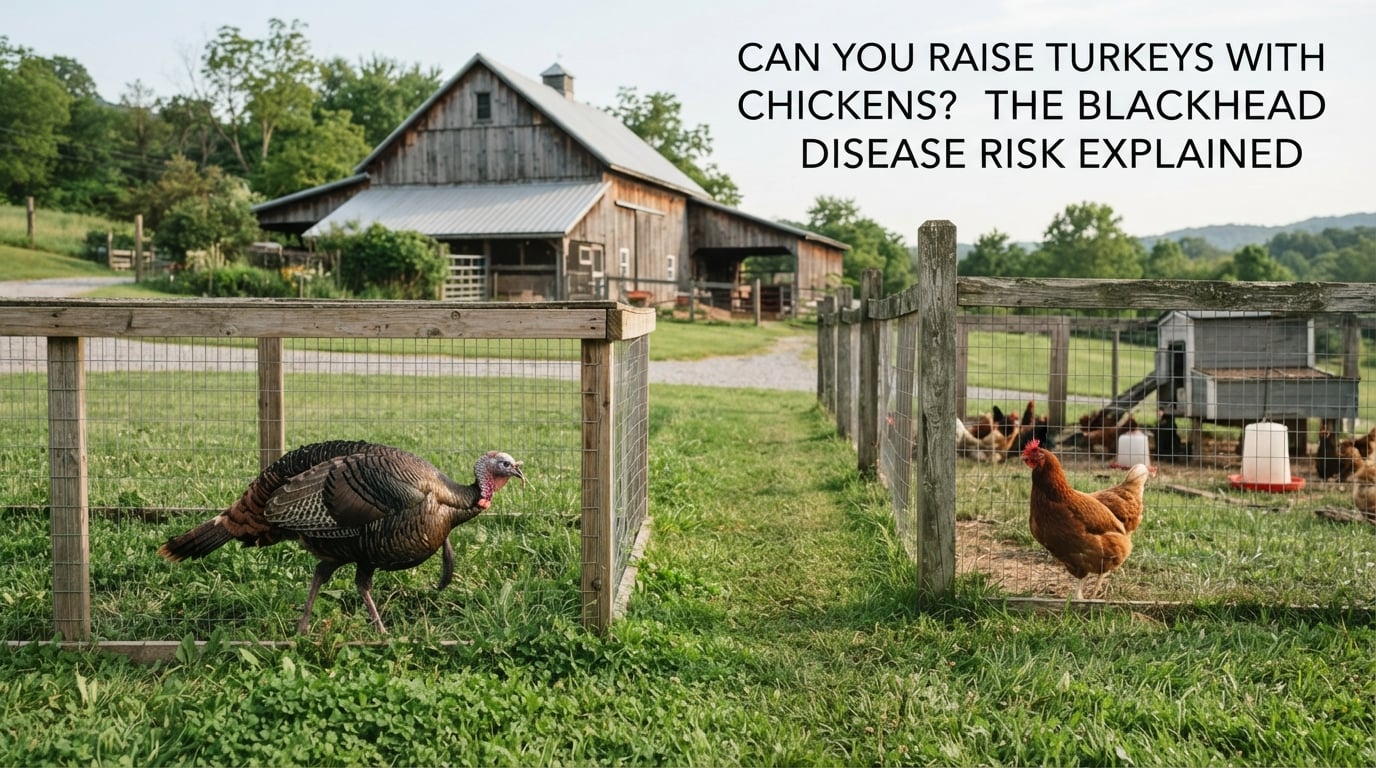
I learned the hard way that mixing turkeys and chickens is one of the riskiest decisions a new homesteader can make. After losing four of six turkey poults to a disease I had never even heard of, I went down a long rabbit hole reading university extension papers, vet journals, and homestead forums. The short answer is yes, you can raise turkeys with chickens, but only if you understand the blackhead disease risk and put real biosecurity in place first. If you skip the precautions, you are gambling with a 70-100% mortality rate in your turkey flock.
This guide explains what blackhead disease is, how it spreads, what symptoms to watch for, and the prevention steps our team uses after years of mixed-flock experience. You will also get a clear decision framework for what to do if you already keep chickens and turkeys together.
Table of Contents
Quick Answer: Should You Raise Turkeys With Chickens?
Most poultry experts say no, you should not raise turkeys with chickens, because chickens can carry the blackhead parasite without showing any symptoms while turkeys usually die from it. Chickens are silent carriers of Histomonas meleagridis, the protozoan that causes histomoniasis. Turkeys are extremely susceptible, with mortality rates between 70% and 100% in untreated flocks. If you must keep both species, separate housing, dedicated pasture, and a 3-year rotation cycle are non-negotiable.
Key facts at a glance:
Disease name: Blackhead (histomoniasis)
Causative agent: Histomonas meleagridis protozoan
Turkey mortality: 70-100% in unprotected flocks
Chicken role: Asymptomatic carrier
Main vectors: Cecal worms (Heterakis gallinarum) and earthworms
Pasture rest period needed: 3 years minimum
What Is Blackhead Disease (Histomoniasis)?
Blackhead disease is a parasitic infection caused by the protozoan Histomonas meleagridis, which destroys a turkey’s liver and ceca and kills most infected birds within weeks. The name is misleading, because the turkey’s head rarely turns dark. The classic darkened head only shows up in a small number of cases, and most birds die from liver failure before any color change appears.
The parasite lives inside the cecal worm Heterakis gallinarum, which is a common parasite of chickens. When a chicken sheds cecal worm eggs in its droppings, those eggs can survive in soil for years. Once an earthworm eats the eggs, the protozoan hatches and multiplies inside the worm. A turkey then becomes infected by eating the earthworm, by pecking at contaminated soil, or by ingesting feed or water laced with infected chicken droppings.
Once inside the turkey, the parasite burrows into the ceca, causes severe inflammation, and spreads to the liver. Birds can die in as little as 7-14 days after the first signs. Because the parasite has a long environmental reservoir, even a single brief exposure can doom an entire flock.
Why the name “blackhead” causes confusion
The cyanosis that gives the disease its name only shows up late in the infection, if at all. By the time a turkey’s head turns blue or dark, the bird is usually hours away from death. New keepers who wait for that visible symptom miss every opportunity to save their birds. Real-world losses almost always start with sudden death in otherwise healthy-looking poults.
Why Turkeys Are Highly Susceptible to Blackhead
Turkeys evolved with limited exposure to Histomonas meleagridis, so they have almost no natural immunity and die at far higher rates than chickens do. Chickens carry the parasite with little to no illness, while turkeys suffer severe liver and cecal damage that overwhelms them within days.
Young poults under 12 weeks of age are the most vulnerable. Heritage breeds like Bourbon Red, Narragansett, and Royal Palm tend to be slightly more resistant than broad-breasted commercial varieties, but no turkey breed is safe from blackhead. Even heritage flocks have been wiped out after a single season on contaminated pasture.
Older birds can survive an initial exposure and act as carriers, but they will likely die if re-infected or stressed. There is no vaccine and no approved treatment in most countries. The US pulled the last effective drug, dimetridazole, decades ago, and current options only treat symptoms, not the parasite itself.
How Blackhead Spreads From Chickens to Turkeys?
Blackhead spreads through cecal worm eggs, earthworms, and direct contact with chicken manure, which is why any shared space between the two species is a transmission route. Chickens shed Heterakis gallinarum eggs in their droppings, and those eggs can stay viable in soil for 3 years or longer. Earthworms pick up the eggs and pass the protozoan to any turkey that eats them.
Common transmission routes include:
Shared pasture or run space
Common feeders and waterers
Coop bedding contaminated with chicken droppings
Wild birds that visit both flocks
Shared equipment like rakes, scoops, and boots
Earthworms that migrate between chicken and turkey areas
The incubation period is short, usually 7-14 days from exposure to first symptoms. A turkey can pick up the parasite today and be dead by the end of next week. This rapid timeline is what makes the disease so devastating to first-time turkey keepers.
Symptoms of Blackhead Disease in Turkeys
The first symptoms of blackhead in turkeys are sulfur-yellow droppings, drooping wings, and sudden lethargy, followed by rapid weight loss and death within 1-3 weeks. Birds often appear depressed, stand with their eyes closed, and refuse feed. Droppings may be foamy, bright yellow, or runnier than normal because of cecal damage.
Other warning signs include:
Loss of appetite and weight loss
Huddled posture with ruffled feathers
Darkening of the head or face (late stage)
Sudden death in apparently healthy poults
Reduced water consumption
One of the worst parts of blackhead is that the disease can wipe out 80% or more of a young flock before the keeper realizes anything is wrong. If you see two or more of these signs in your turkeys, contact a poultry veterinarian or your state veterinarian’s office right away. A necropsy of a freshly dead bird is the fastest way to confirm the diagnosis.
How to Prevent Blackhead Disease in Mixed Flocks?
You can prevent blackhead disease by separating your turkey and chicken housing, rotating pastures on a 3-year cycle, and controlling cecal worms in any shared environment. There are seven steps our team recommends to anyone who insists on keeping both species.
Step 1: House turkeys in a separate coop at least 20-30 feet from any chicken housing. Airborne dust from chicken droppings can carry cecal worm eggs short distances, so distance matters.
Step 2: Use separate equipment for each flock. Color-coded buckets, rakes, and boots prevent accidental cross-contamination. I keep one red set for turkeys and one blue set for chickens.
Step 3: Rotate pastures on a minimum 3-year cycle. Because cecal worm eggs survive up to 3 years in soil, any ground chickens have used is unsafe for turkeys during that period. Move turkeys to fresh ground each season.
Step 4: Deworm your chickens regularly with a product approved for poultry. Lower cecal worm loads mean lower parasite pressure on your turkeys. Flubendazole and fenbendazole are common choices.
Step 5: Avoid feeding turkey poults medicated chick starter. Some coccidiostats like amprolium are tolerated, but others are toxic to poults. Use a turkey-specific starter or an unmedicated crumble instead.
Step 6: Provide clean, covered feed and water stations. Wild birds, rodents, and earthworms all love open feeders. Covered stations dramatically reduce exposure to contaminated soil and pests.
Step 7: Quarantine any new birds for 30 days before introducing them to your flock. New chickens or turkeys from unknown farms are one of the biggest sources of blackhead outbreaks.
What to Do If You Already Have a Mixed Flock
If you already raise turkeys with chickens, separate them as soon as possible and call your state veterinarian to ask about local blackhead prevalence. Many keepers run mixed flocks for years without incident, then lose an entire turkey flock in a single outbreak when conditions align. Acting early gives you the best chance to break the cycle.
A practical decision tree looks like this:
If your region has high blackhead prevalence: Separate immediately, even if it means rebuilding housing.
If your region has low prevalence: You can keep both species with strict separation, deworming, and pasture rotation.
If you have already lost birds: Submit a dead bird to your state vet lab for necropsy and adjust your plan based on results.
Do not rely on hatchery advice alone. Several homesteaders report that hatcheries have told them mixed flocks are fine, only to lose birds within months. Talk to a poultry vet or your state extension agent for region-specific guidance.
How Common Is Blackhead Disease in Your Region?
Blackhead disease is more common in warm, humid regions of the southern US, the Midwest, and areas with heavy chicken and turkey production. Cooler northern regions tend to see lower rates, but no area is truly safe. Your state veterinarian or poultry extension specialist can tell you how prevalent blackhead is in your specific county.
Regional factors that matter include soil type, earthworm density, climate, and proximity to commercial poultry operations. Sandy, well-drained soil supports more earthworms, which means more vectors. Wet, humid conditions favor parasite survival. If you live near commercial turkey farms, your exposure risk goes up because the parasite spreads through local wild bird populations too.
Frequently Asked Questions
Can turkeys survive blackhead disease?
Most turkeys do not survive blackhead disease. Mortality rates range from 70% to 100% in unprotected flocks, and there is no approved cure. A small number of adult birds may recover with aggressive supportive care, but young poults almost always die.
Can turkeys get diseases from chickens?
Yes, turkeys can catch several diseases from chickens, including blackhead (histomoniasis), Mycoplasma gallisepticum, and avian influenza. Blackhead is the biggest concern because chickens carry it without symptoms while turkeys die from it.
How do you keep turkeys from getting blackheads?
Separate turkey housing from chickens, rotate pastures on a 3-year cycle, deworm your chickens, use dedicated equipment, and quarantine new birds for 30 days. These steps break the parasite lifecycle and dramatically lower the risk.
How do you treat blackhead disease in turkeys?
There is no fully approved treatment for blackhead in turkeys in most countries, including the US. Some vets prescribe metronidazole or ronidazole off-label, but success rates are low and the disease often returns. Prevention is far more effective than treatment.
Can a turkey recover from blackhead disease?
A turkey can recover from mild blackhead infections with immediate supportive care, fluids, and vet-prescribed medication, but most cases are fatal. Survivors often carry the parasite and can spread it to other turkeys.
How common is blackhead disease in turkeys?
Blackhead is common wherever chickens and turkeys share pasture, especially in warm, humid regions. Outbreaks are less frequent in cool northern climates and on farms that practice strict separation and pasture rotation.
How do you protect turkeys from blackhead disease?
Protect turkeys by housing them apart from chickens, rotating pastures every 3 years, controlling cecal worms, using clean feed and water stations, and quarantining new birds. These biosecurity steps stop the parasite before it reaches your flock.
Final Thoughts on Raising Turkeys With Chickens
Can you raise turkeys with chickens? Yes, but only if you take blackhead disease seriously and run the two species on separate ground with strict biosecurity. The 70-100% mortality rate in turkeys is not a scare tactic; it is the documented outcome of unprotected mixed flocks across the US.
If you already keep both species, start with separation today and reach out to your state vet for regional guidance. If you are just planning your flock, give turkeys their own coop, their own pasture, and their own equipment from day one. Your turkeys will thank you, and you will avoid the heartbreak of watching an entire flock die within a single season.