
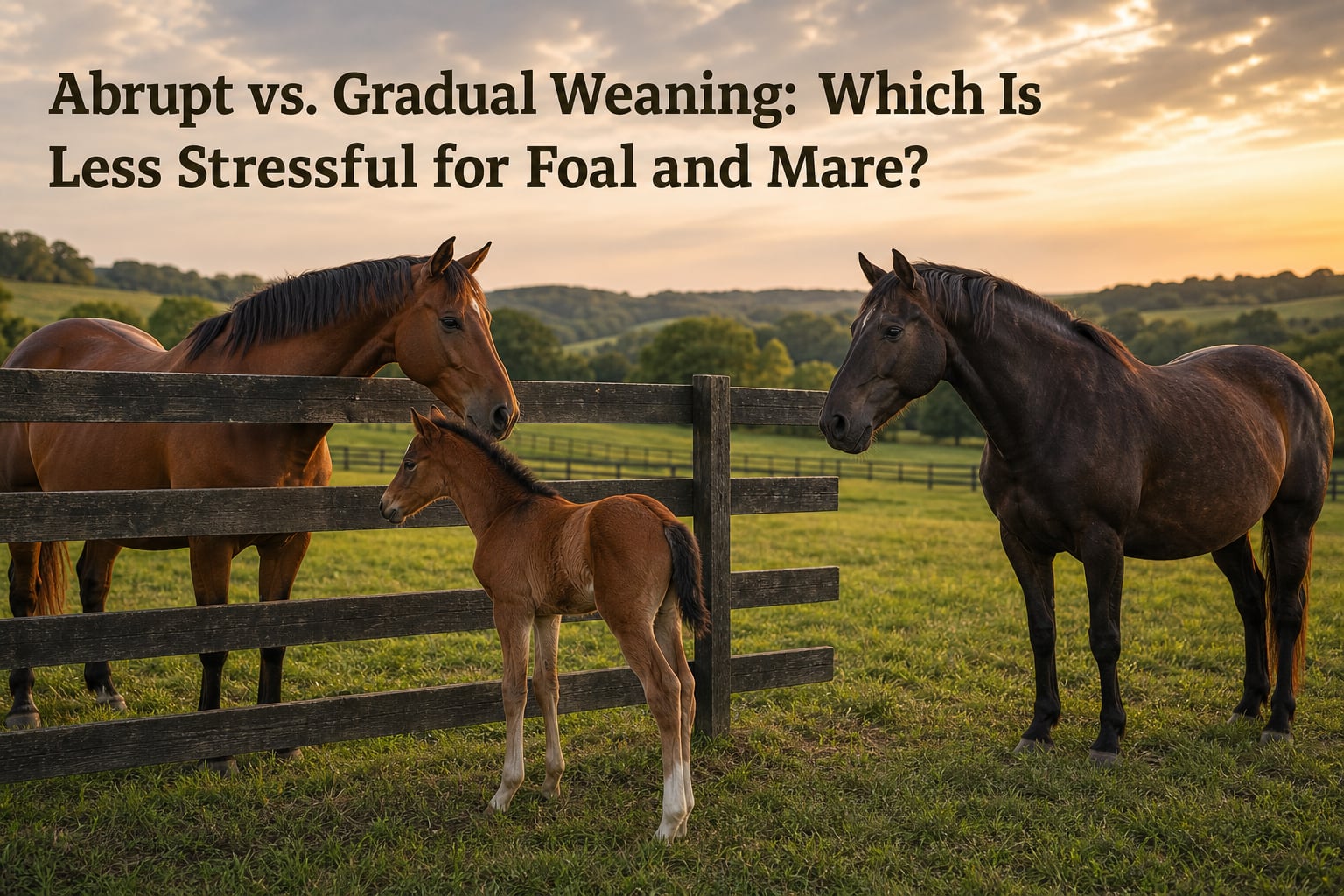
Choosing between abrupt vs gradual weaning for your foal and mare is one of the most important management decisions you’ll make as a horse breeder. Weaning is consistently ranked among the most stressful events in a horse’s life, and the method you pick shapes both short-term behavior and long-term emotional health.
I have walked both sides of this debate on my own farm. Some years we separated mares cold turkey because the setup demanded it. Other years we spent three weeks easing foals off with fence-line contact. Each approach taught me something about how mares and foals handle separation, and I want to share what research and field experience actually show.
The short answer: gradual weaning tends to produce lower cortisol spikes and fewer behavioral problems in foals, but abrupt weaning has practical advantages that work well under the right conditions. Let’s break down what each method looks like, when to use it, and how to reduce stress no matter which route you take.
Table of Contents
What Is Abrupt Weaning and How Does It Work?
Abrupt weaning means complete, immediate separation of the foal from the mare with no adjustment period. The mare and foal are separated in a single moment, often out of sight and out of earshot, and they do not reunite until the weaning process is considered complete.
This sounds harsh on paper, but there is a practical case for it. When done correctly, abrupt weaning can be easier on the mare because milk production drops faster once the foal is fully removed. Many experienced breeders also argue that foals handled this way tend to bond more quickly with their new social group because they have no choice but to seek comfort elsewhere.
The traditional abrupt method follows these steps:
- Choose a calm day when no other stressful events are happening on the farm.
- Move the mare to a paddock or stall far enough away that the foal cannot hear her calls.
- Place the foal in a safe, familiar paddock with at least one calm companion animal, such as an older gelding, a donkey, or a goat.
- Provide clean water, good quality forage, and a small amount of creep feed the foal has been eating.
- Monitor the foal closely for the first 72 hours, watching for signs of injury or excessive stress.
- Keep the mare on a reduced diet for several days to slow milk production.
Safety matters more here than with any other method. Fences must be solid, ideally wood or heavy-gauge wire, and the foal’s enclosure must be free of sharp corners or places where a panicked youngster could trap a leg.
What Is Gradual Weaning and How Does It Work?
Gradual weaning removes the mare and foal from full-time contact in small steps over days or weeks. The foal learns to spend time apart from its dam before full separation occurs, which research shows reduces stress markers during the transition.
The premise is simple. Horses are herd animals, and sudden isolation triggers panic. By stretching the separation over time, you give the foal’s stress hormones a chance to adjust instead of spiking all at once. Gradual weaning is sometimes called progressive or staged weaning for this reason.
Here is the standard gradual weaning process:
- Begin by separating the mare and foal for one to two hours per day, ideally with a safe fence between them so they can see and hear each other.
- Increase separation time gradually, working up to four hours, then six, then overnight separations by the second week.
- Use adjacent paddocks separated by a sturdy, non-climbable fence during the staged separation.
- Provide the foal with a calm companion animal during separations to reduce anxiety.
- Complete the final separation once the foal is eating solid feed confidently and drinking water independently.
- Continue monitoring for at least one week after the final separation.
The total gradual weaning process typically takes two to four weeks from start to finish. Some breeders extend it further, especially with first-time mares or foals that seem especially bonded.
When Should You Wean a Foal? Age and Readiness Signs
The most common weaning age falls between four and six months. Foals weaned earlier than four months often struggle with digestive and immune development, while foals left with the mare past six months can become heavily dependent and harder to separate.
I look for these readiness signs before weaning any foal:
- The foal is eating solid feed consistently and grazing well on pasture.
- The foal is drinking water independently without prompting.
- The foal spends significant time away from the mare on its own.
- The foal is healthy, with no signs of illness or parasite burden.
- The mare is in good condition and milk production is starting to slow naturally.
Many breeders also follow the 1-2-3 rule for mares. It means the foal should be one month past the mare’s last health check, the mare should be two months past her peak lactation, and the foal should be at least three months old before weaning starts. It is a useful memory aid even if you adjust the numbers for your situation.
Stress Comparison: Foal vs Mare in Each Method
This is where the research gets interesting, and where opinions diverge. Multiple studies have measured cortisol levels, heart rate, and behavioral changes in foals weaned both ways. The general finding is that gradual weaning produces a lower peak cortisol response and fewer long-term behavioral issues.
Kentucky Equine Research published a study showing that heart rates and blood cortisol levels were higher in abruptly weaned foals compared to those weaned gradually. The foals weaned gradually also returned to normal stress hormone levels faster. Similar research from equine behavior scientists confirmed that partial or staged separation is generally easier on the weanling than total and abrupt removal.
But there is a twist. Some horse managers report that abruptly weaned foals settle into a new routine faster once the initial shock passes. They argue the intense but short stress period is easier on the foal than the prolonged uncertainty of gradual separation.
From the mare’s perspective, abrupt weaning tends to be easier physically. Her udder stops producing milk faster once the foal is fully removed. Gradual weaning can leave some mares with prolonged engorgement, which raises the risk of mastitis if not managed carefully.
For the foal, the main stress signs to watch for include:
- Pacing or stall walking.
- Loud, repeated whinnying or calling.
- Loss of appetite.
- Cribbing or wood chewing.
- Restlessness and inability to settle.
- Diarrhea or signs of digestive upset.
- Self-harm, including kicking walls or biting at fencing.
Stereotypies like cribbing and stall walking are more common in abruptly weaned foals kept in isolated stalls, especially if no companion animal is provided.
Variations Worth Considering: Pasture, Barn, and Companion Weaning
You do not have to choose between strictly abrupt and strictly gradual. Several hybrid methods combine the advantages of both.
Group pasture weaning is a popular variation. Multiple foals are turned out together in a safe pasture, and the mares are removed one or two at a time over several days. The foals focus on their peers instead of searching for the mare, and the gradual removal of mares reduces the shock of any single separation.
Barn weaning involves stabling the foal in a safe stall with a companion animal next door. This method gives the foal a controlled environment but requires close monitoring because stalled foals can develop stress-related behaviors like weaving or kicking.
Fence-line weaning places the mare and foal in adjacent paddocks so they can see and touch noses but the foal cannot nurse. Many breeders consider this the gentlest option because the foal learns independence without losing the comfort of the mare’s presence.
Companion weaning uses a calm older horse, donkey, or goat as a babysitter. This works for both abrupt and gradual methods and is especially helpful when you only have one foal to wean.
For owners with a single foal and no nearby weaning-mates, companion weaning is often the most practical way to reduce isolation stress. A lonely foal without a companion is at the highest risk of severe separation anxiety regardless of method.
Practical Tips to Reduce Weaning Stress
Whichever method you choose, these strategies consistently lower stress for both mare and foal:
- Wean foals in familiar surroundings whenever possible. Moving the foal to a new location while weaning doubles the stress.
- Always provide a calm companion animal, even if it is a goat or a small donkey.
- Start creep feeding the foal at least four to six weeks before weaning so the digestive system is ready.
- Reduce the mare’s grain ration one week before weaning to slow milk production.
- Avoid stacking stressful events like vaccinations, farrier work, or travel in the same week as weaning.
- Keep a predictable feeding and handling routine for at least two weeks after separation.
- Watch the mare’s udder twice daily for the first week to catch signs of mastitis early.
- Allow at least one quiet week without training or sales activity after weaning.
On my own farm, the single biggest stress reducer has been the presence of a calm older gelding in the weaning paddock. Foals that have a steady adult to follow settle in half the time of those left alone.
Frequently Asked Questions
What is the easiest way to wean a foal?
The easiest method for most owners is fence-line gradual weaning. Place the mare and foal in adjacent paddocks separated by a safe fence for increasing periods over two to four weeks. This lets the foal adjust to independence without losing the comfort of the mare’s presence.
What happens if a foal is weaned too early?
Foals weaned before four months often struggle with digestive issues, weaker immune systems, and higher stress responses. Early-weaned foals are also more likely to develop stereotypies like cribbing or stall walking later in life.
How long do you separate a mare and foal for weaning?
In abrupt weaning, separation is permanent from day one. In gradual weaning, foals are separated for one to two hours at first, increasing to full separation over two to four weeks. After full separation, mares and foals should not be reunited to avoid restarting the bonding cycle.
Will a foal naturally wean?
Yes, in the wild foals gradually self-wean between nine and twelve months as the mare produces less milk and pushes the foal away. Domestic foals are usually weaned earlier for management reasons, but spontaneous natural weaning is possible if the mare and foal stay together without pressure.
Is abrupt or gradual weaning less stressful for foals?
Research consistently shows gradual weaning produces lower cortisol spikes, fewer behavioral problems, and faster recovery to baseline stress levels. Abrupt weaning can be done humanely with the right setup, but it carries higher short-term stress risk, especially for foals without companions.
What is the 1 2 3 rule for mares during weaning?
The 1-2-3 rule is a memory aid: the foal should be one month past the mare’s last health check, the mare should be two months past peak lactation, and the foal should be at least three months old before weaning begins. It helps breeders choose a low-risk weaning window.
Conclusion
Both abrupt and gradual weaning can work, but the evidence on abrupt vs gradual weaning foal mare stress points in a clear direction. Gradual weaning produces lower cortisol spikes, fewer behavioral issues, and a smoother emotional transition for most foals.
Abrupt weaning remains a valid option when managed well, especially with companion animals and a calm setup. The most important factors are not actually the method itself but the timing, the safety of the enclosure, the presence of a companion, and the consistency of care in the weeks that follow.
If you have the flexibility to choose, fence-line gradual weaning between four and six months of age, with a calm companion animal and a familiar environment, gives your foal the gentlest start to independent life.