
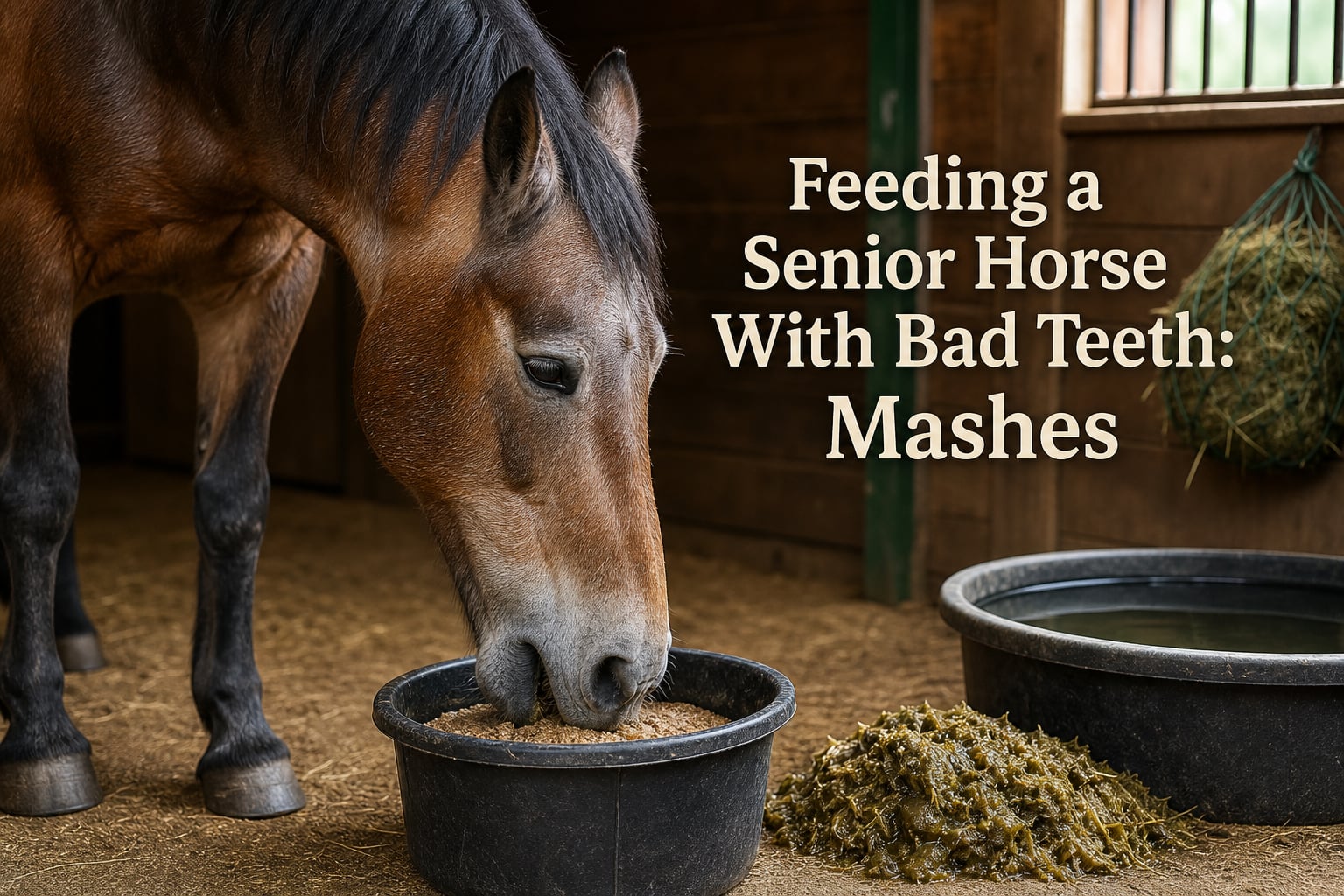
Feeding a Senior Horse With Bad Teeth: Mashes starts with one practical change: replace hard, dry mouthfuls with a fully softened feed that the horse can swallow and digest comfortably. A wet mash made according to the feed label can help a senior horse that struggles to chew long-stem hay, but it does not replace dental exams or a feeding plan from the veterinarian.
Older horses can remain bright, useful, and comfortable long after their chewing surfaces have worn down. The hard part for an owner is that a horse may still walk to the hay feeder eagerly while getting very little usable fiber from it.
This guide explains what quidding and weight loss can mean, how to prepare a mash safely, and how to choose among soaked hay cubes, hay pellets, chopped forage, sugar beet pulp, and complete feeds. It also covers the quiet management details owners repeatedly raise: choke worries, slow eating, and getting a frail horse time to finish a meal away from herd mates.
Table of Contents
Feeding a Senior Horse With Bad Teeth: Mashes Can Replace Hard-to-Chew Forage
A senior horse with poor teeth is commonly fed a wet mash built from a suitable complete feed or softened forage, plus any ration balancer or supplements prescribed for that horse. The aim is simple: provide fiber and nutrients in a texture that does not demand effective grinding from worn or missing teeth.
Start with a veterinarian and an equine dentist because dental pain, loose teeth, periodontal disease, and EOTRH need diagnosis rather than a feed-only fix. Then choose a feed the horse can manage, soak it exactly as its manufacturer directs, wait until the material is thoroughly soft, and offer manageable meals in a clean bucket.
- Soaked hay cubes are useful when the horse needs a forage replacement and can no longer process long hay well.
- Hay pellets can form a soft fiber base after full soaking.
- Sugar beet pulp can add fermentable fiber when the chosen product is prepared as directed.
- Complete feeds may supply a balanced meal in a mash-friendly form, subject to the label and the horse’s medical needs.
The mouth is the first stage of digestion. When mastication fails, forage reaches the hindgut in larger particles, which can reduce the horse’s ability to get value from fiber and may contribute to declining condition, dehydration, choke, or impaction colic risk.
Senior Horses Develop Dental Problems as Their Teeth Wear Down
Horses have hypsodont teeth, meaning teeth that erupt over much of life to replace surface worn away by grinding forage. That reserve is not endless, and an older horse can reach a point where the remaining tooth has little useful grinding surface.
Uneven wear can leave sharp points, hooks, gaps between teeth, or poor contact between the occlusal surfaces. Food packs into painful areas, a horse changes how it chews, and the reduced chewing may become a nutrition problem before anyone sees a dramatic dental change.
Hypsodont means a tooth type that continues to erupt as its working surface wears. Quidding means dropping partly chewed wads of hay or feed. Both terms matter because quidding is often an early at-home clue that chewing has become difficult.
Some seniors also develop EOTRH, short for equine odontoclastic tooth resorption and hypercementosis. This is a painful condition affecting teeth and surrounding structures, often involving the incisors; do not assume a horse that resists grazing, drops feed, or dislikes muzzle handling is merely being fussy.
It can be normal for older horses to lose teeth, but normal aging is not the same as harmless aging. A dental professional can tell whether a missing tooth, periodontal pocket, abnormal wear pattern, or painful condition is changing the feeding plan.
Dental Trouble Shows Up in the Feed Pan and Body Condition
Quidding is one of the clearest signs of dental trouble: look for damp wads of hay or feed near the manger, water trough, or stall. It is not proof of one specific disease, yet it is a sound reason to schedule an oral examination.
Other clues often appear as small changes rather than one crisis. A horse may eat more slowly than usual, tip its head while chewing, spill grain, select soft pieces from hay, leave coarse stems, have a foul mouth odor, or resist the bit.
- Loss of body condition despite an apparently normal appetite.
- Long fibers in manure, which can suggest inadequate chewing.
- Feed or water coming from the nostrils, coughing while eating, or a previous choke episode.
- Swelling along the jaw or face, nasal discharge, or reluctance to have the face touched.
- A horse that is pushed away from feed because it takes much longer to eat than its companions.
Track the horse rather than relying on the feel of one rib on one day. A weekly body-condition check, a weight tape used consistently, and photos from the same angle can show a downward trend while there is still time to adjust the plan with the care team.
Warning: Choke is an emergency concern, not a reason to force more water or feed by mouth. If a horse cannot swallow normally, coughs repeatedly, or has feed or fluid from the nostrils, remove access to feed and contact a veterinarian promptly.
A Safe Wet Mash Starts With the Feed Label and Full Softening
A safe wet mash is not simply dry feed with a splash of water. The correct water amount, water temperature, and soaking time depend on the particular hay cube, pellet, beet pulp, or complete feed, so the label and the veterinarian’s instructions come first.
Use this process for every new mash, especially when feeding a toothless horse or one with a history of choke. Make only the amount the horse will eat promptly, and change one part of the ration at a time when practical so changes in manure, appetite, or comfort are easier to spot.
- Step 1: Confirm the ration. Ask the veterinarian or qualified equine nutritionist how the forage replacement, complete feed, ration balancer, medications, and supplements fit together. A mash can be soft yet still be nutritionally incomplete if its components are guessed.
- Step 2: Read the exact preparation directions. Check whether the product requires soaking, how much water it calls for, and whether warm water is permitted. Never assume that one type of pellet or cube has the same preparation rule as another.
- Step 3: Add water before feeding. Put the measured dry feed in a clean tub, add the instructed amount of clean water, and stir so dry pockets do not hide at the bottom. The desired texture is consistently soft, not a bowl with a hard dry core.
- Step 4: Wait and check the texture. Search results for this topic commonly describe checking after about five minutes and stirring, but the feed label controls the actual soak time. Break apart any pieces with a clean scoop or gloved hand; if firm pieces remain, wait longer rather than serving them.
- Step 5: Cool and inspect. If warm water was used, let the mash reach a safe, comfortable temperature before it goes to the horse. Smell it, look for spoilage, and discard a batch that is sour, moldy, contaminated, or left sitting too long.
- Step 6: Feed under observation. Watch the first several meals of a new texture. A horse that bolts the mash, leaves it, coughs, or shows discomfort needs reassessment rather than a larger serving.
Clean buckets and utensils after each meal. Wet feed can spoil faster than dry feed, particularly in hot weather, and old mash residue is not a harmless extra flavoring.
Consistency helps more than clever recipes. A thin soup may be difficult for some horses to consume efficiently, while a dry or partly softened bowl can bring the chewing problem right back; use the finished texture specified for that feed and revise it only with professional advice.
Tip: Photograph a properly prepared batch and note the product, dry amount, water amount, soak time, and the horse’s response in a barn log. That record gives the veterinarian useful information if body condition or manure changes.
Soft Forage Alternatives Replace Long-Stem Hay When Needed
Soft forage alternatives give a horse with bad teeth a chance to keep receiving fiber when long hay is no longer chewable. The best choice depends on dental ability, current body condition, metabolic status, pasture access, medication, and what the horse will eat safely.
Soaked hay cubes provide a recognizable forage base
Soaked hay cubes can work well for a horse that needs an alternative forage source and will eat a fully softened mash. They must be soaked completely according to their directions; dry cubes are not an appropriate shortcut for a horse with compromised chewing.
Hay pellets make a soft fiber option after full soaking
Hay pellets can be easier to portion and can form a uniform mash when fully hydrated. They are still a feed change, so introduce them gradually and check that the total ration supplies the nutrients, calories, and forage replacement the individual horse requires.
Chopped forage works only when the horse can manage the particle length
Chopped hay may suit a horse with moderate dental limitations that can still chew short fibers. It is not automatically suitable for a horse with no functional grinding ability, which is why observing the horse eat and checking manure remain important.
Sugar beet pulp supplies fermentable fiber when prepared correctly
Sugar beet pulp is a common mash component because it contributes digestible fiber after appropriate preparation. It is not a complete feeding program by itself, and its fit in the ration should account for nonstructural carbohydrate concerns and any metabolic disease.
Complete feeds can simplify balanced mash meals
A senior complete feed may be designed to provide more than fiber, which can be helpful when hay intake has fallen. Read the feeding directions carefully and ask the veterinarian or nutritionist whether the horse also needs separate forage replacement, a ration balancer, or changes to mineral supplementation.
A practical way to choose is to start with the question, “Can this horse safely chew this exact texture?” Then ask whether that feed supplies the needed fiber, calories, protein, vitamins, and minerals without conflicting with the horse’s clinical needs.
- For a horse dropping hay: discuss soaked hay cubes or hay pellets as a forage alternative.
- For a horse needing a mash texture: discuss a properly soaked complete feed or a professionally balanced combination.
- For a horse with metabolic concerns: ask for an individual review of sugars, starch, and total ration rather than copying another horse’s recipe.
- For a horse with pain or sudden refusal to eat: seek veterinary and dental assessment before changing ingredients repeatedly.
Small Separate Meals Support Intake and Hydration
Small, observed meals can be easier for a dental-compromised senior than one large meal that it cannot finish. The exact schedule belongs to the individual horse, but the research for this topic points to wet mashes being fed several times daily in some cases, including four to six meals for horses that need that level of support.
Do not interpret that range as a universal prescription. Work out total daily intake first, then divide it into a schedule that the horse, caretaker, veterinarian, and barn routine can sustain without leaving wet feed standing.
Separate feeding is often as important as the recipe. Owners commonly report that old horses eat slowly and lose access to the bucket when fed with herd mates, so use a stall, a securely divided pen, or another supervised area where the horse can finish without pressure.
Fresh water must always be available. Wet feed adds water to the meal, but it does not replace drinking; watch trough access, keep water clean, and pay extra attention during hot weather, cold snaps, travel, illness, and any change in manure output.
Warning: Do not leave a prepared mash available for unrestricted grazing-style feeding unless the feeding professional specifically directs that method and the feed can be kept safe. A wet meal that sits can spoil, and a horse with dental trouble still needs its intake and swallowing observed.
Weight Gain Requires Calories, Fiber, and Clinical Oversight
Putting weight on an old horse with bad teeth means addressing the cause of low intake and then building calories safely around an adequate fiber base. More grain is not a dependable answer when the horse cannot chew well or when the diet lacks a balanced vitamin and mineral plan.
Ask the veterinarian to rule out pain, parasite burden, systemic illness, and malabsorption concerns while the dentist evaluates the mouth. A qualified equine nutritionist can calculate how a complete feed, soaked forage, and ration balancer should work together instead of asking a fragile horse to live on one ingredient.
Make transitions gradually and monitor appetite, manure, hydration, behavior, body condition, and weight-tape trend. A horse that becomes dull, develops diarrhea, refuses a new mash, or keeps losing condition needs a prompt call to the care team rather than another unplanned feed change.
Season changes matter because dental limitations do not pause when pasture quality, temperature, activity, or water intake shifts. Review the ration before winter, during heat, and whenever pasture access changes, then confirm the horse is actually consuming the amount planned.
The goal is not a dramatic number on a scale. It is a comfortable horse that can eat without pain, maintain appropriate condition for its age and workload, pass normal manure, and have a ration that remains workable for the people caring for it every day.
Frequently Asked Questions Give Straight Answers About Senior Horse Mashes
What to feed a senior horse with bad teeth?
Feed a senior horse with bad teeth a veterinarian-approved soft ration that may include fully soaked hay cubes or hay pellets, properly prepared sugar beet pulp, or a soakable complete feed. The correct choice depends on the horse’s dental exam, body condition, metabolic needs, and ability to swallow safely.
How do you fatten up an old horse with bad teeth?
Address dental pain and medical causes first, then use a gradual, professionally balanced plan that provides adequate soft fiber and calories. Track body condition and actual intake; adding more dry feed or grain is not a safe substitute for a ration the horse can chew and digest.
How late is too late to feed a horse?
There is no single clock time that is too late for every horse. A senior with dental issues may benefit from a schedule of smaller observed meals, but the total daily ration, food safety, turnout routine, and veterinary guidance matter more than a universal hour.
What should a 20 year old horse’s teeth look like?
A 20-year-old horse can have substantial wear, but only an equine dentist or veterinarian can judge whether the teeth, gums, bite surfaces, and roots are healthy for that individual. Quidding, weight loss, foul odor, and slow chewing warrant an exam regardless of age.
Is it normal for older horses to lose their teeth?
Older horses can lose teeth as their lifetime supply of erupting tooth is used and dental disease develops, but it should never be dismissed without an examination. Many horses can continue to do well when pain is treated and their forage is replaced with an appropriate soft mash program.
Feeding a Senior Horse With Bad Teeth: Mashes Work Best as One Part of Care
Feeding a Senior Horse With Bad Teeth: Mashes is about making each bite soft, balanced, and safe enough for the horse in front of you. Arrange a dental assessment, choose a fully softened forage or complete-feed approach with professional guidance, feed in a calm separate space, and keep close notes on condition, chewing, manure, and appetite.
A senior does not need to be left behind because it can no longer manage dry hay. With a thoughtful mash routine and timely clinical help, many older horses can keep eating comfortably and maintain a good quality of life.